When I mention vendanges to most people they think of grape picking and, maybe, putting the grapes into a tank (cuve). However, vendanges means much more than that and we are now entering stage two of the process.
Flower Power in cuve
Muscat in cuve
When the grapes have been picked and sorted they are stored in a cuve where the juice interacts with the skins extracting flavour, colour and also coming into contact with the yeasts which grow naturally on the skins. These yeasts then begin the process of fermentation which turns the sugars in the juice into an alcoholic wine. This mix of juice, skins, pips and flesh is known as must.
Checking progress
So, whilst picking continues at Mas Coutelou Jeff must already plan what is happening to those cuves of grapes which were picked a few days ago, You will remember from #1 that we picked Grenache and Syrah on days 1 and 2 and that they were in cuves 2A and 2B. They are picking up colour and the fermentation means that the sweet grape juice of last Wednesday is already very different. Still plenty of raspberry and red fruit flavours but the sugar levels have fallen and the liquid is now more austere, a little acidic and with a weight of alcohol. It has turned from child into young adult.
Today – Grenache and Syrah has matured
To ensure that the grape skins do not give unpleasant flavours, volatility etc., Jeff must ensure they do not dry out as they float on the juice, forming what is known as the cap (chapeau). Therefore, wine is pumped from the bottom of the cuve over the top of the chapeau to push it down a little and to moisten it. This is known as remontage.
Carole carries out a remontage
Alternatively, an instrument or hand can be used to push the chapeau down into the juice, a process called pigeage.
James performs a pigeage
When Jeff is satisfied that the juice is ready and has had optimal skin contact he will begin pressing the must to leave the final juice. We await the first press as yet but it will be in the next couple of days as the Grenache and Syrah are already showing their adolescence.
Meanwhile picking continues. Friday saw Sauvignon Blanc and Muscat À Petits Grains as the first white grapes of 2016 at the domaine. Monday saw the picking of the Merlot from Colombié which will, unusually, find its place in the Coutelou cuvées. I am no great fan of Merlot but the grapes were lovely and the juice tastes especially rich and full.
Today (Tuesday) was Flower Power day, sadly the snails won the battle this year. They ate so many of the buds in Spring that the vines struggled to produce much. The dryness merely confirmed Font D’Oulette would be low yielding in 2016. Around twenty cases is not much return for such a lovely parcel of vines. High quality grapes from the various cépages but very low quantity.
Flower Power
Flower Power
Clairette and Oeillade from Peilhan with some Grenache Gris and Muscat Noir was added to the mix. Also picked was the Cinsault from Rome which was in good condition with nice big berries. So my two favourite vineyards are already harvested.
James models the lovely Segrairals Syrah
Finally, some lovely Syrah from Segrairals was picked and there will be much more of this tomorrow. This Syrah is such good quality that Jeff is already excited about what he can do with it. Segrairals is the biggest vineyard of the domaine and is also serving up some of its best fruit.
Charles, Vincent and the new sorting table
A new sorting table was brought into play this week and it is certainly much more efficient than the previous method of sorting from the cases themselves. Triage of better quality but also much speedier too. The table is already paying for itself.
So, stage 1 (picking) is well under way, stage 2 (the must in cuve) is under way for some and stage 3 (pressing) will shortly begin. The jigsaw is already becoming more complicated for Jeff Coutelou.
Thursday, August 11th was the last day before Jeff shut up shop for a few days as he does every year to celebrate the Béziers Féria. A few days of rest and recuperation before the preparations really start for the vendanges. As he had received a number of requests for visits Jeff decided to group them all together and have a tour of the vines and tasting with lunch.
Visitors from Grenoble, Orléans and Nanterre assembled at the cave along with my friend and sommelier Sandra Martinez and we set off around some of the vineyards. Jeff explained his philosophy and vineyard work and it’s worth repeating a couple of points of note. I mentioned the problem of vers de la grappe a few weeks ago which Jeff treated with a spraying of clay to discourage the moth from laying its eggs. We found a bunch in La Garrigue which was affected and Jeff opened it up to reveal the cocoon of the larvae.
Vers de la grappe cocoon
He also explained how bats are the ideal solution and why he provides shelters, each bat would eat around 2,000 insects a day including the moths responsible for vers de la grappe.
Grenache
Castets
Clairette Musquée
We also looked around at the majority of vineyards and their dark green colour at a time when the vine is putting its resources into the grapes to get them to maturity, as that is how they reproduce. So, in a natural state the leaves start to look pale and tired as the vine is not channelling energy into the leaves. The dark green, attractive vines are so coloured because of the nitrogen feeds and, in some cases, irrigation.
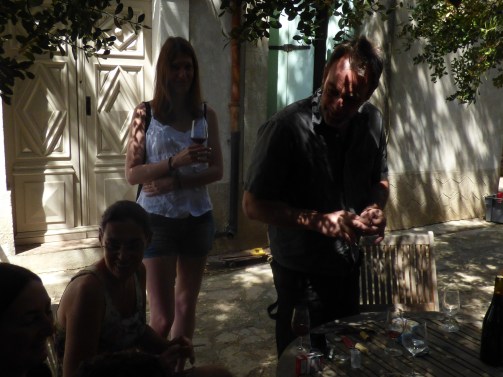
We returned to the domaine where we were joined by a group of wine professionals. In the garden we tasted a range of Mas Coutelou wines as well as some lovely salads and (for the carnivores) some charcuterie.
Jeff leads the tasting accompanied by his sister and niece
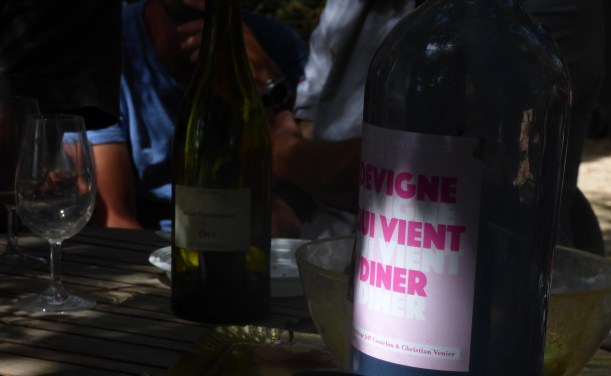
The list of wines shared, all from 2015 except the last, was: Bibonade (rosé and white), Peilhan Blanc, Maccabeu, OW1, 5SO Simple, Sauvé De La Citerne, On Peut Pas Vraiment Dire Que, Classe, La Buvette À Paulette, Flower Power, Flambadou, L’Oublié, Devigne Qui Vient Diner, 5J
I missed the Bibonades and Peilhan as I was getting the Maccabeu from tank. I had a bottle of Peilhan at home recently though and it was lovely, really strong evidence of the quality of 2015. All apples and pears and fresh acidity with a long finish. Even by Coutelou standards it is an exceptional wine.
Maccabeu
The Maccabeu is, if anything, even better. Cooked apple and cinnamon flavours, fresh acidity, almost smoky. There is so much going on here and, as the jug I collected the wine in was in front of me, I kept being drawn back to it through lunch. The wine changed and opened out with more fruit and spice. This will develop beautifully when it is bottled, a stunner, my new favourite.
OW1 is Jeff’s first skin contact wine. He was reluctant to join the trend and didn’t want an orange wine but this spent plenty of time on skins, I remember Cameron and I carrying out a manual pigeage. Now bottled the wine has texture and tannins from that skin contact but there is plenty of fruit and remains balanced and fresh. Very good.
Manual pigeage of OW1
5SO was on good form. The boisterous, chatty group became quiet for the first time, captured by its fruit profile and drinkability on a hot summer’s day, which essentially is what it was designed to do.
Citerne was one I didn’t have last week and it had been some time since I had tasted it. It showed well, the Mourvedre adding a real plummy depth. Another wine which will emerge in coming months, another to look forward to. OPPVDQ was on great form, another to quieten the crowd. It confirmed my opinion that this is a wine which will really benefit from some time in bottle, hang on to some if you have them. La Buvette À Paulette was last week’s big surprise and another bottle confirmed the pleasure, really showing its quality.
Flower Power not yet properly labelled. What a colour!
Flower Power took some time to come around but now that it has done so I can confirm that this will strengthen the reputation which it earned in its first vintage in 2014. The vineyard is still young and will continue to improve the wine it delivers, if the snails leave it alone. The ten grape varieties give a complex story of light and shade, red and dark fruits, floral and sappy.
Flambadou was once again a star, showing the lightness of touch in this Carignan. Jeff describes it as like a Pinot Noir. There is depth and character packed into quite a light structure. The vineyard has a light layer of limestone beneath the fine clay and it is this limestone which adds the complexity to the wine. A grand cru of Carignan.
L’Oublié and its story once again captured the imagination of everyone, its secondary flavours beguiling the tastebuds. Devigne Qui Vient Diner is the wine which Jeff made in partnership with Christian Venier from the Loire, Gamay added to some Languedoc grapes such as Cinsault. My, this has improved with a few months in bottle (magnum), really delivering a rounder more harmonious blend with zappy fruit and lovely sweet fruit.
Finally 5J the Grenache Gris from 2012 aged in barrel made to reflect a Spanish fino to accompany the best hams. Oxidised notes, barrique notes and a flash of clean fruit, quince and apple.
A great day, much longer than most were expecting but nobody showed any signs of fatigue or willingness to depart. Many joined us in the cave des soleras to taste some of the old wines there. And poignantly, some wine of Jean-Claude on what would have been his 80th birthday. His legacy will live on.
I enjoyed reading the Facebook post of one of the visitors Benoit who described Jeff as a magician and an artist. The day was a success.
Back in the Languedoc and, the first morning, I went over to see the vines. Jeff had sent me a message that they were in real stress because of the lack of rainfall. Ironically we had driven south through France under leaden skies and through fairly steady rain, until we reached the Languedoc where the skies turned blue and the temperatures rose. It has been very hot here throughout the three weeks I was away and, following a very dry autumn last year and not much rainfall in 2016, the vines are definitely in need of a good drink.
Stressed vines
Clear signs of drought
I have written many times this year about the vine stress due to very unusual seasons, the warm winter, cool spring. Sadly, summer has also added to their difficulties. Sure enough the vines look dry. The apex of the vine is often a good way to tell their health and they look tired and bare, almost burned.
Photographié de Rec D’Oulette
To safeguard the health of the young, newly planted or grafted vines Jeff and Julien were busy watering them in the Flower Power vineyard, Font D’Oulette. This is allowed as they are not grape producing this year. Straw was then placed around them to keep the moisture inside. Julien showed his dedication by doing more of this work at night time.
Even Icare was feeling the heat despite his haircut, he kept hold of the stick when it was thrown as if to say I’m not chasing after this anymore.
c/o agro.basf.fr
c/o gourgazaud.fr
Jeff also informed me of yet another problem, ver de la grappe. This is the larvae of a moth which feeds on the grape. I took a photo of an affected grape last year.
There are chemical treatments available to prevent and to treat the problem, no use to an organic producer of course and these chemicals are especially harmful, you can’t use the grapes until 21 days after spraying.
So, for Jeff the treatment involved spraying clay onto the vines to try to make the grape skins less attractive to the moth so it will lay the eggs elsewhere. This was only the second time in twenty years that he had sprayed against ver de la grappe. Also in the spray was fern and seaweed, the fern is a natural insecticide and the seaweed gives a health boost to the vine. However, having sprayed this morning (July 31st) Jeff was hoping that the much needed rain would hold off for a couple of days to allow the spray to work.
You can guess what happened next. A storm, heavy rain, much of the spray washed off the grapes. It is that sort of year, nothing seems to be going right. The rain which did fall was minimal and only undid the good work. The worst of all worlds. To spray or not to spray? To rain or not to rain? Caught between a rock and a hard place.
Colour and life remains
As I made my way around the vineyards there were plenty of good grapes to see, véraison (the changing colour of red grapes) has begun especially amongst the Syrah and Grenache of La Garrigue.
And I spent some time in Rome, a very parched looking vineyard but the ideal place to reflect upon its creator, Jean-Claude. There are some things to be thankful for even in this difficult year.
As work on the cellar ratchets up a notch in the next few weeks it was time to bottle the last of the 2015 wines which will be made for the moment.
The framework for the new mezzanine floor is in place and actually looks quite beautiful. It will be reinforced with concrete however, and the metal cross bars will disappear (which might stop us knocking our heads). Plumbing has also been tidied up and improved. Cuves will be placed below and on top of the structure. More work on stairs, flooring and around the cellar will happen soon. As I am heading back to the UK for a couple of weeks or so, it will be exciting to see the changes upon my return.
Peilhan June 30
The vines continue their growth in the sunshine and heat. Mildew problems are largely contained though some humidity leads to sporadic outbreaks (apologies for the pun). Sadly, there is a new threat of oïdium (powdery mildew) which likes that humidity and the warm days with cool nights we have been having. Powdery mildew shows as grey, white spots on the leaves and the grappe. Certain cépages are more vulnerable, including some of the traditional Languedoc varieties such as Carignan. The treatment is to spray sulphur powder and Jeff Coutelou made the first treatment this week in an effort to contain the problem, a job completed on Saturday morning. 2016 certainly has been a struggle.
Meanwhile 2015 wines such as Flower Power and L’Oublié went into bottle on Wednesday June 29th. You might recall that the L’Oublié assemblage was made a few weeks ago and after spending time in tank, marrying together, it is now in bottle. Both of these wines are extremely good, well worth waiting for when they are finally released which won’t be for a while.
Jeff, Renaud and Michel
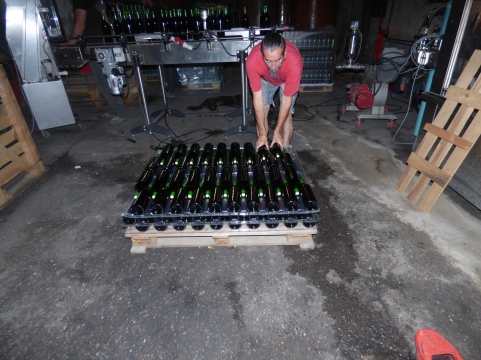
Jeff also put together a new cuvée exclusively for the French market, it will come in litre sized, Bordeaux style bottles as a «vin de table». An assemblage of various cépages it will be cheap, very drinkable and very desirable. The size of the bottles meant that they had to be filled by hand rather than the machine so Thursday was fully occupied with this cuvée. Jeff refers to it as a vin de gauche, after wine writer Vincent Pousson referred to Jeff as one of the last vignerons de gauche (left wing winemakers) because of his low prices making his wines accessible to all. It will be a wine to share and it will disappear down that litre bottle very quickly.
The new litre bottle of the vin de gauche
2015 seems increasingly like a golden year, its wines are certainly glittering. 2016, well despite all it has thrown at us, there is hope. Meanwhile the summer wine is bottled and the heat is getting to some of us, even after his haircut.
Saturday June 4th was supposed to be the Festival De Magie in Puimisson, a family magic show. Sadly it had to be postponed until September as, around 5.30pm, a huge thunderstorm broke over the area. Booming thunder and heavy rain were the main features as Puimisson and the wider region were treated to an alternative fireworks display to that scheduled in the Festival. Yet 2 hours later the skies were clear, the streets were dry again.
Flooded roads
Four of us though were treated to a magical evening. Jeff welcomed Cedric who runs the best website on French natural wines at vinsnaturels.fr (and I don’t say that because he chose one of my photographs on the opening page!) It gives great detail about vignerons, technical details about their wines and where they can be bought. His friend Ghislain was with him, another natural wine expert and promoter in the Grenoble area. Pat and I were invited along too and it was a real pleasure to meet up with them, they proved to be excellent company.
We were treated to 7 hours of tasting with Jeff in the cellars and at his home. And there was no question that Jeff is a true magician, conjuring up an amazing range of wines and of such a consistently high standard. I may be biased as he is my friend but the demand for his wines proves I am not alone in thinking so.
Error
This video doesn’t exist
We tasted all of the 2015 wines, those in bottle and already sold, those just bottled and those in tank and barrel. Whites, rosé, reds, sparkling and selection de grains nobles. Plus many wines from previous years in barrel and bottle. Before moving to the solera cave to taste, amongst others, the Grenaches wine I made. Hand on heart there was not one dud wine and there were many special wines.
Amongst white wines the Maccabeu and the macerated wine we bottled the previous day were showing well. So too the Bibonade sparkling wines, white and rosé. 5SO Simple was on form from the early wines alongside Vin Des Amis.
Of the next wave of wines, Classe was outstanding, Jeff thinks maybe the star of 2015. Tête À Claques was good, a blend of VdA and Syrah; Buvette À Paulette too, a blend of Mourvèdre and Cabernet Sauvignon. Flambadou will be excellent, it needs time but has all the ingredients to be especially good, just as it has been the last few years.
One wine which was noteworthy was Flower Power. This is the red produced from the complanted Font D’Oulette vineyard with its Aramon, Clairette Musquée, Cinsault, Oeillade and six other cépages. Its first vintage in 2014 won plaudits even from the conventional press. The 2015 I had tasted on Thursday and it was in a dumb moment, Jeff actually carried out a soutirage on Friday and by this Saturday evening it was singing. For me, this could be the star of 2015.
Flower Power’s complanted vineyard
Ghislain had brought some cheeses from Meilleur Ouvrier De France Bernard Ravaud. They were superb cheeses including a truffled comté which shall live long in the memory. Jeff opened one of the 2012 barrel aged 5J which I wrote about recently, and it is a great marriage with cheeses.
We moved to the solera cellar where we tasted some of the old Muscats and Grenaches. However, it was also good to taste my Grenaches wine from all three of its containers, the new 60l barrel, the old 30l barrel and the 27l glass bottle. As before the older barrel has a sweeter, fruitier profile whilst the new barrel gives a slightly leaner, more complex wine. The glass bottle is all sweet fruit and still fermenting! It was good to hear Cedric, Ghislain and Pat all give their approval.
My Grenaches from new barrel
The hours flew by, always the sign of a good night. Thirty wines or so, Jeff just keeps bringing them out from up his sleeve. Or have I just given away a magic secret?
On Wednesday June 8th more visitors to the cellar. Paco Mora of La Cave D’Ivry and a friend of his Charlotte, a caviste in Montpellier, visited. I have mentioned Paco before on here and I would love to visit his Cave. He takes time and trouble to visit the winemakers whose wines he stocks and to offer his support. He’s passionate about wine and good fun as well as having a keen social conscience. We shared wines, laughs and lunch and two more great wines.
La Vigne Haute 2010 was lovely, showing maturity, the Syrah fruit now brooding and dark with great length and depth. LVH has always been my favourite cuvée but even this had to bow down before Flambadou 2007. Pure Carignan, more leathery and plummy notes with a smooth as silk chocolate finish. If anyone tells you natural wines cannot age then I would ask you to quote this bottle as proof that not only can they age but they can become truly great! Spellbinding.
La Vigne Haute 2010
Flambadou 2007
And even time for a little levitation. Told you it was magic.
I mentioned recently that the cooler weather had delayed some of the growth in the vines and that flowering was late. Well, recent hotter weather has brought sudden change. Flowering happened around the turn of the month and was over very quickly, perhaps catching up lost time. In particular there was a heavy thunderstorm on Saturday June 4th which brought a torrent of rain. The water and the sunshine has really got the vines going. Tendrils reach for the skies and there is more bushiness to the vines.
The flowers gave way to the little hoods which cover the nascent grapes, capuchons. These quickly fall away too revealing the grapes for 2016. On some vines all of this is happening at the same time such as this Carignan (above) in Rec D’Oulette. The weather has also encouraged the growth of the grafted vines which we did back in March.
This brings work too. The palissage has to be lifted to support the vines, hard physical labour. And, sadly, the heat and rain bring problems of disease. Mildew has been around for a couple of weeks and I mentioned that Jeff was spraying in the very early hours and late at night last week. He worked until 1am Friday/Saturday and started again at 6am. Just as things seemed to be settling a big attack of mildew on the Grenache at Ste. Suzanne meant more treatment on Tuesday morning. This ‘curious’ year is proving to be hard work.
Jeff a Ste Suzanne (photo de La Garrigue)
Peilhan, feuilles pulverisées
Not all negatives though. The storm brought such a downfall that I was fearful for the flowering bunches. damage to them means no grapes. I happened to be in Puimisson during the storm (next article!) and the rain was lashing down, converting streets and roads to waterfalls and lakes. Yet as the rain eased I went to a couple of vineyards and the flowers were coping just fine. A trip round the vines on Monday morning revealed healthy growth and the soils had absorbed the rainfall.
Routes inondées
Grenache vines with flowers intact after the storm
This is not true of everyone. Much of the water on the roads was also full of clay from vineyards nearby, hence the yellowy brown colour. Vineyards which are treated with weedkillers, where the soils are ploughed deeply, even irrigated, were unable to cope so well with the heavy rain. Soils were carried away. Compare these photographs of Jeff’s vineyards with the parcel next door belonging to someone else. The difference is marked. Water can help or can damage.
Rec D’Oulette
Parcelle voisine
Rome
Parcelle voisine
Meanwhile back in the cellar there was more work to be done. Recent changes to the fabric of the cellar, especially the floor, have brought more efficient drains and a smoother surface, easier to clean. Further work will soon be done to the rest of the floor so the bottling of the next wave of wines had to be brought forward to allow the works to be done and dusted before vendanges.
Nouveau plancher en résine
Plancher plus vieux
The spring bottling of wines such as 5SO, PM Rosé, 7 Rue De La Pompe I described earlier. These are wines for early drinking, vins de plaisir. Now it was time for wines with a little more body. On Thursday June 2nd 10,000 bottles of Classe were made, and it is really something special in 2015. It took almost 12 hours and went very smoothly but believe me it is a hard day’s work. On Friday, Flambadou, made from the Carignan vines above, was bottled along with other smaller cuvées.
Vincent, Julien et Benoit
Julien prépare un magnum
Classe
Before anyone rushes in with orders Jeff will let these bottles rest for a few months to allow them to be at their peak when released, Flambadou probably in 2017 for example. There remains one or two cuvées still in tank which need a little more time, Flower Power being one.
So, most of the 2015 wine is now in bottle, the vines are revealing the grapes for 2016 and there are wines stored for 2017. Busy times at Mas Coutelou for everyone, well except one.
A detail from an illustration by Sir John Tenniel depicting Alice with the March Hare, Hatter and Dormouse at the Mad Tea Party. From Alice’s Adventures in Wonderland by Lewis Carroll.
It has been a most curious year and as it goes on it becomes curiouser and curiouser, just as Alice said. *
To quote another famous character, a certain Jeff Coutelou, during these last few months there was no proper autumn, no real winter, no true springtime. The last few months of 2015 and early 2016 were abnormally warm, not one single day of frost in Puimisson. Plant life started very early, there was blossom on trees in February, mimosa everywhere. People recorded their vines starting to ‘cry’ as the sap rose. And then, it all stopped. As March and April unfolded the weather was chilly with cold northerly winds. The plant life closed down its growth to a minimum. Budding (ébourgeonnage) was late even after the mild winter.
May is usually warm in the Languedoc and we have had some hot, sunny days but interspersed with cooler days and plenty with a lot of cloud cover. The vines pushed quickly some days, 25 – 30 cm the week before last and then… cooler weather slowed the growth again. Flowering (fleuraison) began last year around May 5th but this year Jeff and I spotted the first flowering on May 26th. Appropriately that was in the Flower Power vineyard, Font D’Oulette. Yet in the white grape vines, such as the Muscat in Peilhan, there is no flowering.
Premiere fleuraison 2016
It is likely that most of the vines will flower at the beginning of next week, most varieties at the same time which is, again, most unusual. Curiouser and curiouser. As the vendanges are calculated at 100 days after flowering, the likely date for harvest to get under way is now well into September, ie 10 – 14 days behind 2015. After a very precocious start to the year!
Carignan Noir, Rec D’Oulette
So why does this matter? Well, the vines have been unable to rest since last harvest. The lack of frost or cold weather in winter meant that the vines did not shut down fully. The sap has been on the move for months. Those early reports of vines crying in February, then delayed growth. Vines have sent out a lot of growth but the lack of sunshine has not produced much photosynthesis, the vines are often green in lower parts but lighter green higher up. The grafted vines in Font D’Oulette have been slow to send out growth, the sap flows and then cooler weather arrives.
Peilhan, note the lighter green near the tops
Humidity and grey clouds means a threat of mildew and some spots are evident on leaves in certain parcels. Jeff spent the night of May 20 spraying from 9pm to 1am, starting over again at 6am the next day. Why then? During the night and early morning the vines are more receptive to the influence of the spray as the pores are open in cooler temperatures. Not the usual spray of course. Mas Coutelou has been organic since 1987 and Jeff has gone much further. This spray was of nettles, horsetail, seaweed mixed with a tiny amount of sulphur and copper (allowed in organic farming). And also in that mix were essential oils of sweet orange and rosemary, pampered vines indeed. This prompt action has mastered the problem supported by timely sunshine and northerly winds.
Spots of mildew on the leaves and on the grappe
Whilst in Rome vineyard the other day we looked at the soils and Jeff pointed out the growth of good mushrooms and fungal life in there. The photos show this life, the white spots. Scientific research shows that it is through fungal life such as this that the vines communicate with each other and support each other. This has taken a lot of soil nurturing and management.
And to further demonstrate the health of the vineyards, remember the vandalism of the Carignan vineyard and the flowers that were planted there? Well they are growing back stronger than ever. Nature wins in the end. We can only choose to support it or fight it, but in the end nature will win.
Cinsault in Rome
At present despite this most curious of years the vines are in good health. The next three months will decide whether the grapes will be of good quality or not. Jeff reckons that the period from April 15 to July 15 the vigneron must be always present, always monitoring the vines to ensure that any problems can be sorted as soon as possible. That will make or break the vintage.
Flowers in the Coutelou vineyards
Meanwhile we have been treated to some beautiful flowers in the wild and around the vineyards. As well as birdsong in Rome vineyard. Nature at its best despite the curious year.
That is if the problems can be solved. Just this week Sancerre and Burgundy were hit by massive hail storms causing damage which means that the year is a write off in some vineyards. The third such storm this year in some of these areas. And on Saturday, May 28th Beaujolais was badly hit too. Again nature decides.
Hail damaged vines in Beaujolais (photo with permission from @duc_lionel)
A curious year, yes. But a disastrous one for some.
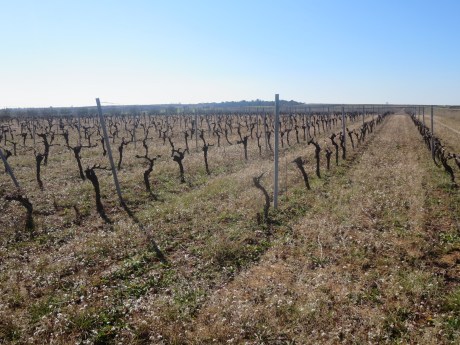
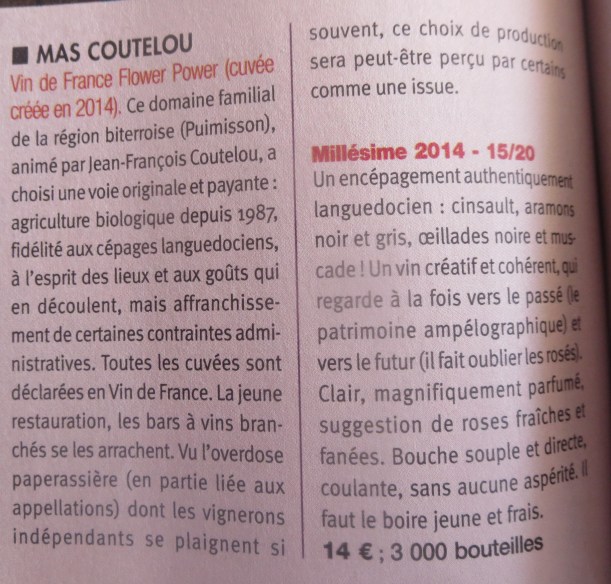
On March 17th we were in Font D’Oulette vineyard which, at just over 0,6 ha, is a small parcel replanted around 6 years ago with a variety of old Languedoc cépages such as Aramon Noir, Aramon Gris, Oeillade and the very rare Clairette Musquée. The grapes are picked together to make a single cuvée representing the parcel , Flower Power. This first appeared in 2014 and has made an impact already, selected by La Revue Du Vin De France as one of the Languedoc’s top 50 wines. As the vines age we can only anticipate eagerly what they will produce in future.
However, not all young vines thrive and some needed to be replaced. Two alternatives were in place this day as the rain fell steadily.
The second method was to graft onto the root stocks already in situ, something I had not seen before. The American root stock has to be used to protect against phylloxera which destroyed much of France’s vineyards in the 19th century. There are different methods of grafting such as ‘chip and bud’ but Jeff brought in a specialist, Tanguy, who uses a method known as ‘greffe en fente’.
The old vine is cut away to reveal the root stock. A very sharp knife, repeatedly sharpened through the day, cleans the surface and then inserts a cut through the wood revealing its core.
The cut is supported by tying string around it. The vine wood is also cut, as if sharpening it to make a thin wedge which is inserted into the cut root stock. The idea is to get the core of the two pieces as close as possible. This is then fastened tightly with the string. The graft is complete.
It looks simple but isn’t that the mark of a skilful worker, making something complicated look easy? Have a look at the video below to see the process in one go.
The vine is staked for support, always to the side which will help the vine against the prevailing north westerly winds. Jeff had brought some basalt soil from the Auvergne and this was then placed around the grafted vine poured into the body of a plastic bottle placed around the vine .
Basalt is one of the oldest forms of rock, roche mère (mother earth or bedrock) and is packed with nutrients. This will help the vine to grow well and by filling the bottle around the vine it is surrounded with top quality soil. Organic compost is added to the hole and then the earth is hoed back over it all, removing the bottle of course.
There is a risk. Up to 20% of vine grafts do not take in theory and with greffe en fente the whole vine would have to be grubbed up next year and replanted. Other methods can simply replace the graft. However, this method is the best for the vine itself and the most likely to take.
So what were the vines? Cinsault, Aramon Noir and Inconnue No.3. Inconnue means unknown, so why is it called this? The original vine was found in an old vineyard where it had never been catalogued. It was taken by the organic nursery where Jeff buys his vines and it was studied but was discovered to have never been indexed. it is unique, unknown, hence its name. One of its benefits is that it is resistant to oidium and it will also add diversity to this complanted vineyard with about 100 of the Inconnue No.3 vines being added. A hint of mystery to the blend.
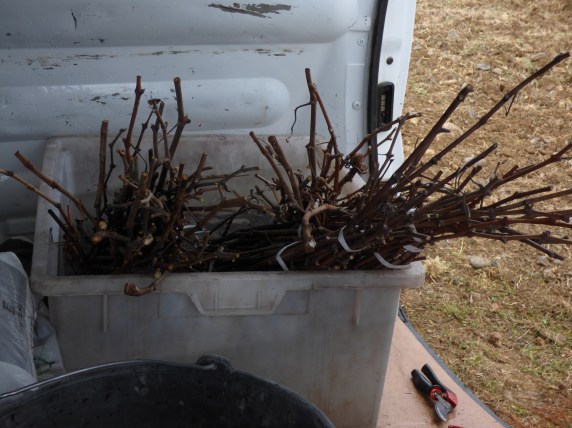
The vine canes, only about 7-8 cm will be used
A fascinating day despite the rain which soaked us all to the skin. It was hard graft but a rich, rewarding day celebrated at lunchtime with a magnum of… well it had to be Flower Power.
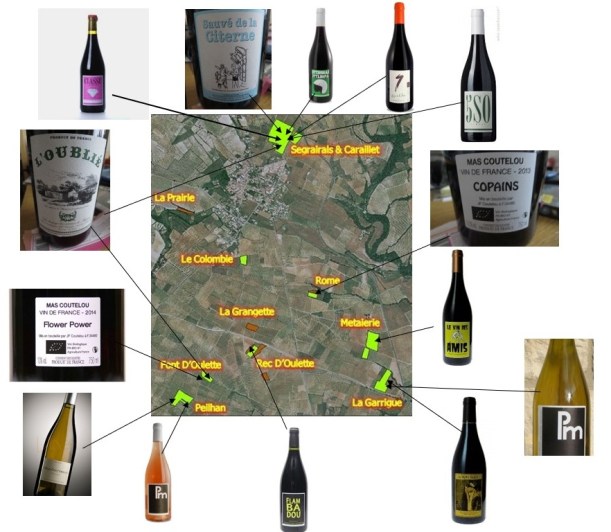
Jeff Coutelou produces a large range of different wines, or cuvées, every year. There are a number which are made every year, les incontournables. These are the biggest production wines, the breadwinners and, probably, his best known cuvées, Classe and Vin Des Amis. Depending upon the vintage Jeff will then decide what to do with the grapes he has left and which cuvées to produce. Some of these extra cuvées reappear regularly, others very occasionally and some will be new.
So, let’s start with the more celebrated wines.
Classe
A magnum of Classe
This is the wine which was described in The Guardian by wine writer David Williams like this in April 2015:
Mas Coutelou Classe, Languedoc 2013 For the natural wine-sceptic, it’s hard to think of a better place to start than the wines of Jeff Coutelou: full of vivid, finger-staining blackberry fruit, this carignan is explosively juicy and succulent: pure pleasure.
Usually a blend of 40% Grenache, 40% Syrah from Segrairals and Sainte Suzanne vineyards. In older years the remainder was Carignan, more recently Cinsault and a little Mourvèdre. Around 13,000 bottles of Classe are made with their distinctive pink labels showing a diamond. I always think of Classe as having a slightly darker fruit profile than Vin Des Amis whilst retaining its charm and drinkability.
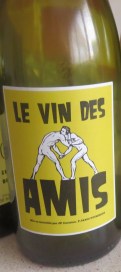
Le Vin Des Amis
The wine which was my first experience of Jeff’s wines and which blew away my preconceptions of good wine. It was the sheer vitality and energy of this Syrah and Grenache wine which impressed me. From the Metaierie or Sainte Suzanne vineyard it is made in similar quantity to Classe. The wine writer Jamie Goode described the 2012 as:
Rich, dense, vivid and pure. Quite backward with real grip under the vivid black fruits. Powerful and structure with amazing fruit quality, dominated by fresh blackberry and black cherries. 93/100
Whenever I share Vin Des Amis with people they always sing its praises and ask for it next time, it is well named. Another striking and unusual label gets it noticed but the fruity freshness are what makes people love it.
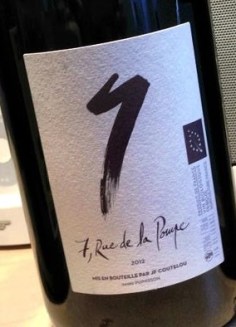
7, Rue De La Pompe
from wine anorak website
More Syrah from Segrairals with just a little Grenache from the same vineyard blended in. The different cuvées are based around different vinification methods as well as different parcels. The 2010 of Rue De La Pompe was a wine of the week for Jancis Robinson who also considered the 2012 as being like a northern Rhone wine with a bone dry profile. There are raspberry and pepper notes and the trademark freshness and vivacity.
Another large production in most years, around 10,000 bottles or so, it didn’t appear in 2014 because the Syrah was very low yielding that year and was used for the two big cuvées. The wine is called after Jeff’s address incidentally.
Sauvé De La Citerne
Citerne was another well known cuvée which did not appear in 2014. Largely Mourvèdre with some Grenache, again from Segrairals, this is wine which was originally made from grapes which Jeff didn’t use elsewhere, hence the name of the cuvée meaning saved from the tank. This was always one of my favourites with blackberry and blackcurrant flavours and an earthiness from the Mourvèdre. That cépage has done very well recently and was bottled as a single variety wine in 2014. Jeff has other plans for the Mourvèdre of 2015 with another cuvée planned mixed with Syrah and Cinsault, I have tasted it and it is lovely, very elegant and precise.
Sauvé De La Citerne will reappear with a 2015 however. It fits with the idea of making the cuvée from otherwise unused grapes that this year will see a blend of Grenache with a little Syrah. It will therefore be different but again my early tasting of it suggests a very attractive wine.
La Vigne Haute
This is probably my favourite cuvée of all and sadly it hasn’t appeared since 2013 and nor will it this year. Made purely from Syrah from the La Garrigue vineyard where the vines face northwards, this might explain the fresh acidity and vitality of La Vigne Haute. That acidity means that Vigne Haute ages extremely well and gains even more complexity. It is classic Syrah, red fruits and spice with great length and balance and beautiful aromas. It would be my desert island wine.
There was a pure Syrah in 2014 and another is planned for 2015 but under a different name, it is lovely but I do miss Vigne Haute, fortunately I have quite a few bottles tucked away until it reappears (please).
Jeff surveys the Vigne Haute vines
5SO Simple
5SO has quickly become established as a Coutelou favourite, around 7,000 bottles are made. Its name is a play on Cinsault and the wine is indeed pure Cinsault from the Segrairals vineyard. Designed as a light red, easy to drink it is delicious in summer slightly chilled and a great wine for drinking without food. Fresh cherry and raspberry flavours and a light structure make for a lovely wine.
Cinsault vine in Segrairals
Flambadou
Named after a barbecue tool Flambadou is pure Carignan from the vineyard Rec D’Oulette. It reappeared in 2013 and was also made in 2014 and 2015, made in smallish quantities as this is a small, low yielding vineyard. Jeff considered the 2013 as the star wine of that vintage and the 2014 is also amongst the best.
More full bodied than some of the other wines the Carignan brings dark fruit flavours and aromas. There is a brooding undertone of spice and plenty of red fruit freshness on the finish. Another wine which ages well. The vines are on an open parcel of ground so well exposed to the sun, the freshness a reflection of the healthy soils and skilled winemaking. Carignan is making a comeback in the Languedoc Roussillon and this is one of the best examples of why. Carignan enthusiast Michel Smith in his series on Carignan bottles praised Flambadou as follows, ” La bouteille a été vite vidée, ce qui est un bon signe”.
The Rec D’Oulette vineyard
Flower Power
from Roberson Wine website
cavepurjus.com
A relatively new addition to the Coutelou cannon. Flower Power is a true expression of terroir as this is a wine made from a variety of grapes from one parcel, Font D’Oulette (as the name suggests not far from where Flambadou originates). Jeff has begun to complant grape varieties more and more and to produce wine made from that mix of grapes. This is the first wine to show the results and it is a winner.
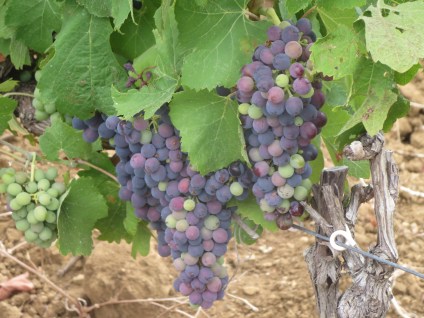
Aramon and Oeillade Noir are just some of the grapes in the mix of Flower Power. Aramon was once one of the most planted of all grapes in the Languedoc but went out of fashion as it was often overcropped and dilute. Now vignerons are realising that when it is grown with lower yields Aramon produces flavoursome wine. Oeillade is also interesting, a grape related to Cinsault, another old Languedoc variety which Jeff wants to bring back. Just to add some mystery there are some Clairette Musquée grapes in here, a white grape.
Font D’Oulette
Flower Power is lightly structured but packs a punch with flavours of black cherries and red fruits, and, appropriately, it is very aromatic, perhaps from the influence of the Clairette. As the vines age this will become more structured I would imagine but it is already a favourite.
In the last week La Revue Du Vin De France selected Flower Power as one of their top 50 Languedoc wines, an accolade from a source which does not usually favour natural wines.
L’Oublié
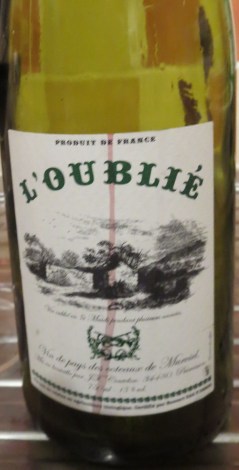
Now here is a fascinating wine. L’Oublié is a blend of cépages AND vintages. The wines are aged in old barrels, not the usual practice of the domaine. Carignan was the forerunner with some 2001 and then more Carignan 2007 and 2010 were added. Then Syrah joins the assemblage, grapes from 09, 10, 12 and 13. This blend forms L’Oublié, the forgotten one. I imagine this refers to the original 2001 Carignan barrel.
It has aromas of dark fruits and leathery, spicy notes too. It is dark flavoured too, blackberries, liquorice and even coffee are just some of the many complex flavours. It benefits from decanting to allow that complexity to resolve itself a little, and it will stay fresh for days after opening. There are not many wines like this around and I honestly don’t know why. It is unusual and one of my favourite wines because of its complexity, its balance of older and more youthful flavours. Terrific.
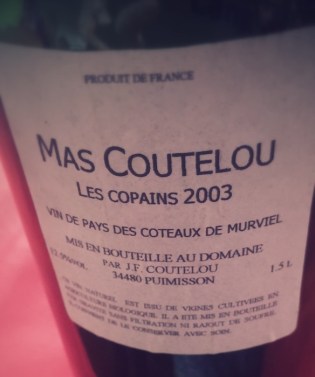
Les Copains
roumegaire.com
This was a wine which used to be a regular but disappeared after the 2003 vintage. It reappeared in 2013 and became my favourite wine (or have I already chosen another?!). Cinsault is the grape but it is a more complex wine than 5SO Simple, richer, darker and more structured. The grapes come from the beautiful Rome vineyard and are from 40 – 50 year old gobelet vines which bring low yielding fruit, rich and elegant. The wine is recognisably Cinsault with cherry notes but it has attractive depth and power, very long flavours of red fruit and peppery / spicy too. Sadly 2015 did not bring enough fruit to make Copains so enjoy what is available, it is worth ageing a couple of years but difficult to resist now.
Rome’s Cinsault vines
Other red cuvées are made for restaurants and and as one offs. A lovely pure Grenache was made in 2014 for example whilst Tete A Claques and Buvette A Paulette are others which appear from time to time.
It is fair to say that Mas Coutelou is best known for its red wines but there are some very good white wines too. They make up around 15% of the vineyards made up of a multitude of white grape varieties.
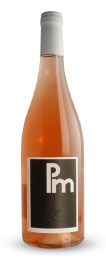
PM Blanc
vinogusto.com
The most regular of the white bottles though Jeff has started to experiment with various other blends and single variety wines. Most of the white grapes are grown in La Garrigue and Peilhan vineyards. PM usually contains Sauvignon Blanc from La Garrigue but assembled with other white grapes which are available such as Grenache Blanc, Macabeu, Muscat and Carignan Blanc. Dry, clean and full of flavour PM has texture and white fruits galore.
Single variety white wines in recent years have included, for example, Carignan Blanc from Peilhan. If Jeff feels that the grapes are of particularly high quality he will make a single variety wine. They always wear the mark of fresh acidity and the grape brings different fruit profiles, the Macabeu with aromatic yellow fruit for example. The Macabeu will appear from the 2015 vintage. I am a particular fan of Carignan Blanc and Jeff’s version was very clean, mineral and long lasting in flavour. This year he is combining it with Grenache Gris which did well in 2015 in Peilhan. Most of these white wines come in small quantities.
Roberson Wines
Muscat grapes grow in Peilhan and Rome and appear in some white blends as well as PM Rosé. The rosé is very aromatic and a dry wine, good with food and also on those hot, Languedoc summer days. It usually has juice from Syrah and Cinsault, pressed after a short time on skins.
Bibonade
Sparkling wines are also made at Mas Coutelou. Bibonade (think lemonade) has appeared in various forms, white and rosé and sometimes sweet! The dry version is fresh, clean and appley, a perfect quaffing wine and disappears very quickly after opening. There is usually Sauvignon Blanc, Muscat and some Grenache Blanc in there but again Jeff will play around with what he has available. This is my wife’s favourite wine!
Another sparkling wine which was popular in the 2013 vintage was Blanc Frisant. Macabeu and Grenache Gris grapes were bottled with a small quantity (8g) of sugar to encourage a second fermentation in the bottle. This produces a small quantity of CO2 bringing a light fizz when the bottle is opened. It was wonderfully refreshing with citrus and spice flavours. It is another example of Jeff’s inventiveness and experimental nature.
Carignan Blanc grapes in Peilhan
Sweet wines are made too, have a look at my article on the solera system.
So there we are, a huge array of different bottles, something for everyone. Fruit, freshness and drinkability are the hallmarks of Coutelou cuvées, they all contain those three qualities and many more. Jeff’s restless search for better wines means that the cuvées change every year (with two main exceptions). As he develops the cellar with more cuves available he will no doubt continue to produce new wines. As new plantations of grapes such as Riveyrenc, Terret, Morastel and Piquepoul Noir mature there will be even more variety. However, buy with confidence whatever is available is very good.
It’s been a few weeks since I updated about events at Mas Coutelou, partly due to Millésime Bio and, partly, because it’s a relatively quiet time. That is not to say nothing has been happening, far from it.
Maccabeu 2015
Flower Power 2015
Millésime Bio and Le Salon des Vins De Loire are two huge events in France attracting many thousands of trade visitors. As you have seen with Millésime Bio these salons also attract satellite events and Jeff takes part in those. Les Affranchis in Montpellier and La Dive Bouteille in Saumur last two days each and so adequate samples of the wines need to be prepared, transported and poured for guests to taste. Those events alone take about 7 days of the last month. I know from feedback from various people who sampled Mas Coutelou wines at both events that they enjoyed the wines which were samples from cuve (tank) of the 2015 cuvées such as Vin Des Amis, Classe, Syrah, PM Blanc and Flower Power. Hopefully the salons will spread the word about how good they are, the elegance and finesse of the vintage is obvious as you taste it.
Bottles of the 2015 wines made specially for the salons
Those visitors were also presented with Jeff’s annual Carte Des Voeux, his new year greetings card, together with his summary of the last year’s events, weather, vintage and cuvées. The Carte’s original is printed by hand and this year’s was especially complicated to print because of the different colours used. The message is worth the hard work.
For the last several weeks pruning (taille) has continued. Julien is leading the work this year and his back must be getting sore by now. It is hard work! The importance of good pruning should not be underestimated. It maintains the health of the vines, removing damaged or sick wood. It reduces the number of canes which will grow grapes so that the vine’s energy will produce quality rather than quantity, probably reducing potential yields by half. It also shapes the vine so that future work such as ploughing and harvesting will be more straightforward. I wrote about pruning last year describing the different methods.
I visited Julien in Peilhan vineyard on Monday, the same day as I saw a pruning machine at work in a nearby vineyard. It certainly does the job quickly and more cheaply but looking at the vines afterwards it was hard not to think that the machine did not reduce the number of canes to limit yields and, of course, cannot check the health of the vines. Julien and his fellow tailleurs are more costly but, to my mind, essential for good vineyard management and, ultimately, good wines.
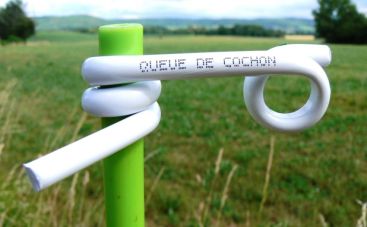
Michel was also in Peilhan, making sure that the pruned vines were tied to their trellis. If the vine is not straight he might stake itfor support and then tie the vine to the stake using a fastener called a ‘queue de cochon’ as it resembles a pig’s curly tail. This will help to avoid the vine being knocked during ploughing or other work.
Meanwhile, in the cellar it has been a hive of activity. One of the features of the cellar has been a large basket press which has been used by the Coutelou family for generations.
Sadly, it has been out of use for many years and became something of an obstacle as work was done, especially during the vendanges. Jeff reluctantly decided to remove it, I know this was a difficult choice for him. It proved to be a much more difficult task than anticipated as the press screw went deep into the ground and a massive hole still didn’t get to the bottom of it so, eventually, it was sawn through to enable the whole press to be moved.
photo from Jeff
photo from Jeff
The story does have a happy ending though as the press is on its way to Jeff’s friend Didier Barral where it will be put to good use. The result is certainly more space in the cellar, even if a part of the domaine’s history has disappeared.
Another big tank (cuve) has also been split into two. Jeff will be able to vinify smaller quantities of wine and have more choices about the most suitable cuve for grapes as they come in at harvest time.
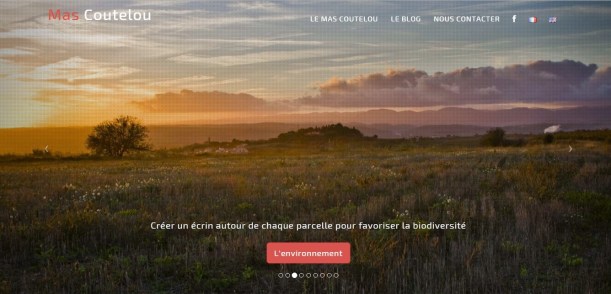
Finally, for those of you who want to find out more about Mas Coutelou a new website is available. I have included a link at the top of my page and invite you to have a look at the site.
Jeff wrote the text for it (I did the English translation) and it will inform you about the philosophy, methods and wines of the domaine. And it is those wines, the different cuvées, that I shall be writing about next time.
Pour les lecteurs français je m’excuse, j’ai des grandes difficultés de mettre à jour la page en français. J’ai demandé à WordPress pour résoudre le problème.







































 amarchinthevines