amarchinthevines

Learning about wine, vines and vignerons whilst living in the Languedoc


Leave a comment

It’s A Kind Of Magic

20160608_075213

En français

Saturday June 4th was supposed to be the Festival De Magie in Puimisson, a family magic show. Sadly it had to be postponed until September as, around 5.30pm, a huge thunderstorm broke over the area. Booming thunder and heavy rain were the main features as Puimisson and the wider region were treated to an alternative fireworks display to that scheduled in the Festival. Yet 2 hours later the skies were clear, the streets were dry again.

20160604_183831

Flooded roads

Four of us though were treated to a magical evening. Jeff welcomed Cedric who runs the best website on French natural wines at vinsnaturels.fr (and I don’t say that because he chose one of my photographs on the opening page!) It gives great detail about vignerons, technical details about their wines and where they can be bought. His friend Ghislain was with him, another natural wine expert and promoter in the Grenoble area. Pat and I were invited along too and it was a real pleasure to meet up with them, they proved to be excellent company.

20160604_190259

We were treated to 7 hours of tasting with Jeff in the cellars and at his home. And there was no question that Jeff is a true magician, conjuring up an amazing range of wines and of such a consistently high standard. I may be biased as he is my friend but the demand for his wines proves I am not alone in thinking so.

Error
This video doesn’t exist

We tasted all of the 2015 wines, those in bottle and already sold, those just bottled and those in tank and barrel. Whites, rosé, reds, sparkling and selection de grains nobles. Plus many wines from previous years in barrel and bottle. Before moving to the solera cave to taste, amongst others, the Grenaches wine I made. Hand on heart there was not one dud wine and there were many special wines.

20160604_222316

Amongst white wines the Maccabeu and the macerated wine we bottled the previous day were showing well. So too the Bibonade sparkling wines, white and rosé. 5SO Simple was on form from the early wines alongside Vin Des Amis.

Of the next wave of wines, Classe was outstanding, Jeff thinks maybe the star of 2015. Tête À Claques was good, a blend of VdA and Syrah; Buvette À Paulette too, a blend of Mourvèdre and Cabernet Sauvignon. Flambadou will be excellent, it needs time but has all the ingredients to be especially good, just as it has been the last few years.

One wine which was noteworthy was Flower Power. This is the red produced from the complanted Font D’Oulette vineyard with its Aramon, Clairette Musquée, Cinsault, Oeillade and six other cépages. Its first vintage in 2014 won plaudits even from the conventional press. The 2015 I had tasted on Thursday and it was in a dumb moment, Jeff actually carried out a soutirage on Friday and by this Saturday evening it was singing. For me, this could be the star of 2015.

P1010175

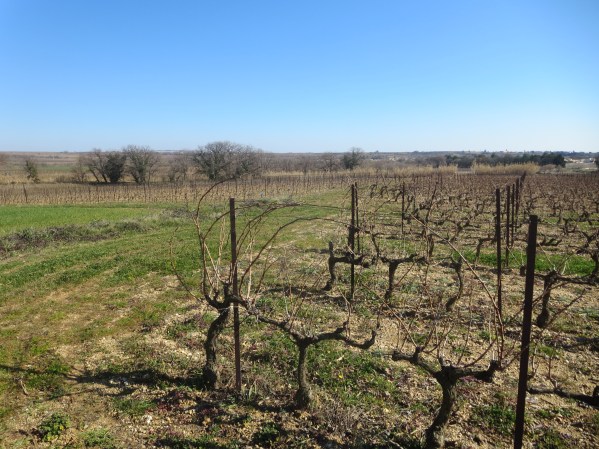
Flower Power’s complanted vineyard

Ghislain had brought some cheeses from Meilleur  Ouvrier De France Bernard Ravaud. They were superb cheeses including a truffled comté which shall live long in the memory. Jeff opened one of the 2012 barrel aged 5J which I wrote about recently, and it is a great marriage with cheeses.

We moved to the solera cellar where we tasted some of the old Muscats and Grenaches. However, it was also good to taste my Grenaches wine from all three of its containers, the new 60l barrel, the old 30l barrel and the 27l glass bottle. As before the older barrel has a sweeter, fruitier profile whilst the new barrel gives a slightly leaner, more complex wine. The glass bottle is all sweet fruit and still fermenting! It was good to hear Cedric, Ghislain and Pat all give their approval.

20160604_223304

My Grenaches from new barrel

The hours flew by, always the sign of a good night. Thirty wines or so, Jeff just keeps bringing them out from up his sleeve. Or have I just given away a magic secret?

On Wednesday June 8th more visitors to the cellar. Paco Mora of La Cave D’Ivry and a friend of his Charlotte, a caviste in Montpellier, visited. I have mentioned Paco before on here and I would love to visit his Cave. He takes time and trouble to visit the winemakers whose wines he stocks and to offer his support. He’s passionate about wine and good fun as well as having a keen social conscience. We shared wines, laughs and lunch and two more great wines.

La Vigne Haute 2010 was lovely, showing maturity, the Syrah fruit now brooding and dark with great length and depth. LVH has always been my favourite cuvée but even this had to bow down before Flambadou 2007. Pure Carignan, more leathery and plummy notes with a smooth as silk chocolate finish. If anyone tells you natural wines cannot age then I would ask you to quote this bottle as proof that not only can they age but they can become truly great! Spellbinding.

And even time for a little levitation. Told you it was magic.


P1010268


4 Comments

The story of a wine – we can’t really say

IMG_3752

En francais

On Peut Pas Vraiment Dire Que * is a new cuvée from Mas Coutelou in 2015. So how is a new cuvée born? This is its story.

Untitled

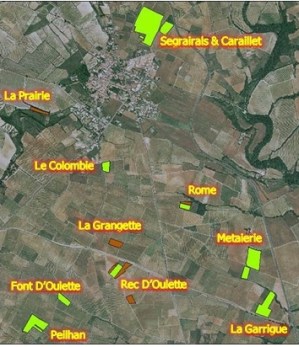
My favourite Jeff  wine over the years has been La Vigne Haute, a pure Syrah coming from the vineyard La Garrigue. This vineyard has a small ridge running west to east meaning that part of it faces north and part faces south. Jeff planted Grenache on the southward side as Grenache is a Mediterranean grape and likes the heat. On the north side is Syrah, a grape from the Rhone, which likes heat but not too much if it is to reveal its best.

La Vigne Haute is a wine of subtle Syrah. Perfumed with red fruits and tasting of silky smooth red and black fruits it carries elegance and restraint. However, in 2015 Jeff took the decision at the last minute not to make La Vigne Haute but rather to change the whole vinification of the grapes which were harvested. Here is the story in his own words, as told to Paco Mora a caviste in Ivry sur Seine. Jeff kindly gave me permission to reproduce it here.

“To thank you [for a generous comment on Facebook], I’d like to take a few minutes to tell you the story of “On Peut Pas Vraiment Dire Que.” A story which confirms that to make wine, we must first know, love and pamper both vineyards and grapes.

It comes from the parcel “La Garrigue”, my only parcel on villafranchien soil, which I planted:
 On the north side: Syrah (planted north / south) to be always caressed but never assaulted by the sun.
 On the south side: Grenache as it is not afraid of the heat.

IMG_0763

The buffer zones in Garrigue

This decision made me lose 10 vine stocks per row of vines (300 in total) to leave a buffer zone between the two varieties but it was a decision which seemed most suited to making the Syrah I dreamed of. It normally makes “La Vigne Haute” but also produced “PAF La Syrah” in 2012. This plot has a vein of water running underneath which the presence of horsetail fern confirms. This year, even during the heat wave, it never suffered and continued to push …. It was the most beautiful vineyard at harvest time.

The day of the harvest, we had planned to make Vigne Haute by implementing the classic method; destemmed grapes, putting it into tank, maceration of 2 to 3 weeks with little pumping, to encourage infusion and not to seek extraction.

The vineyard was beautiful, beautiful grapes, everyone at the winery was excited that this would be a great vintage. The first grapes arrived, and as son as I saw them, I thought I had to change everything … ..
The fact that they had not suffered from the July heat wave but instead had profited from it (because of the sun caressing that north facing slope, the heat effect lessened because of that vein of water). It had produced berries more swollen than usual … and I could really see that when they arrived in the cellar.

IMG_2359

After an hour, I said to myself “if you do as usual, you will not get to do what you want.” The fact that the liquid / solid ratio is different, if I had made a classic wine, I would have to extend the maceration time to extract enough material relative to the juice and in that case, there is also the risk of extracting good but also the less good.

So within 10 minutes I decided to change everything.

We continued by putting whole bunches into tank with the idea of making a short vinification. On that day, everyone was down in the mouth in the cellar because I had told them that there would be no Vigne Haute …. But I trusted my grapes and they told me that they would repay my faith in them .

We just left the grapes in vats for 7 days without any intervention and then pressed. So there was almost no exchange between the skins and juice in tank. The tannins and colour were extracted because of pressing the skins, which were ripe, and released them after their short stay in the vat.

In the end, it’s just the juice of the vine and the terroir that you have in the bottle ….
Nothing technical, just grapes that were cared for and nursed from their birth to their maturity ….”

So that is the story of On Peut Pas Vraiment Dire Que. I was one of those who was ‘down in the mouth’ on that day when Jeff changed everything. Yet it was, of course, the right thing to do. The wine is very like the Paf of 2012, fruity but with a lovely vein of soft tannin and bite running through it. It is elegant above all, a Syrah worthy of the great Rhone appelations but with Languedoc warmth and fruit.

And OPPVDQ is a tribute to the talent, intuition and knowledge of Jeff Coutelou. He knows his vines, his grapes and how to help them to express themselves to maximum advantage. I can’t really tell you how he does it… it’s natural.

A phrase which can be translated as ‘we can’t really say’.


2 Comments

Soutirage

P1000759

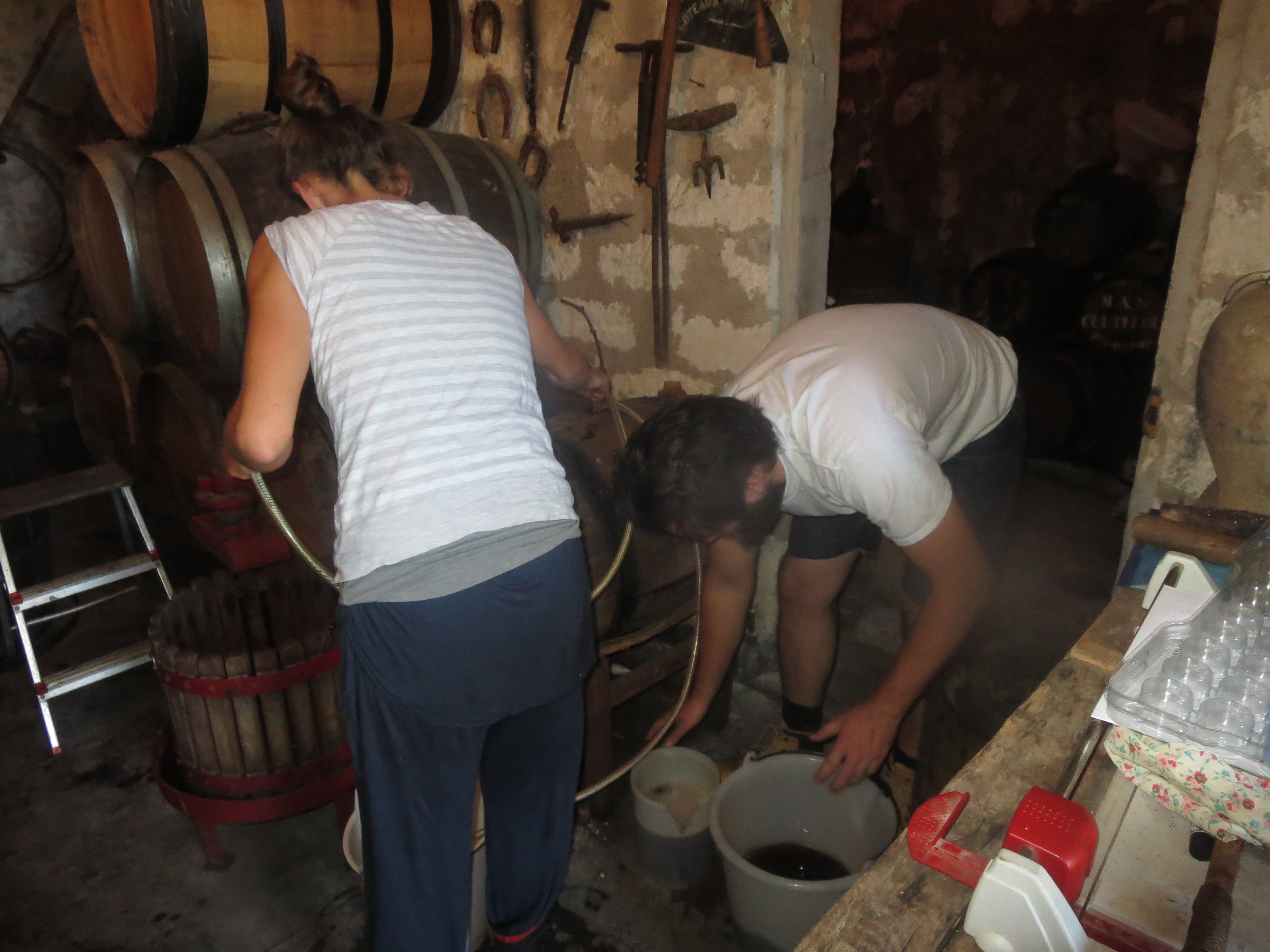
Soutirage is known as racking in English. After the wine has fermented the tank or barrel will contain the lees (dead yeast cells) and sediment. The yeast fermented the wine, lees have added flavour and some antibacterial properties but if left in contact with the wine they will start to add off flavours, cloud the wine and generally hinder the final wine. The process is carried out as gently as possible, using gravity rather than electrical pumps.

So on April 6th Jeff messaged me to say that the day had arrived to carry out soutirage of the wine I made for my 100th blog post and the vendanges tardives Grenache we picked on the last day of the vendanges.

We started with the Grenache. A tube was placed into the stainless steel tank, suction applied and the wine flowed gently into large 15l bottles. Jeff chose clear bottles so that he can watch the progress of the wines. They will be stored in his cellar in the dark so no problems from light damage. The Grenache still contained some residual sugar, was sweet, fresh and clean.

It was appropriate that we also racked the maceration white wine. Cameron had taken the lead on this wine and he was here after attending La Remise, the natural wine salon in Arles, I’ll be writing about soon. The wine was fresh, lots of fruit and also a light texture from the 4 month maceration. Very good.

And then the 3 Grenaches wine I took charge of. Most of this has been aged in barrels so the soutirage ended with them being emptied of their sediment.

There wasn’t that much sediment as the small vertical press I used controlled what entered the barrels, ie mainly juice. Naturally we had to top up those barrels after soutirage to replace the volume taken away. And now they continue their gentle ageing. I am very happy with the progress of the Grenaches, again more soon.

IMG_3882

P1000784

Traffic light wines

A fascinating day, another new process in winemaking for me to learn.


1 Comment

Little fish are sweet

En francais

How do you follow the Perfect Day? Apparently you just wait and, like the proverbial London bus, two come along together.

March 8th dawned chilly, just 2°C when I left Margon at 8am, bright and clear, a perfect day for the last Spring bottling. The biodynamic calendar was favourable too, last day of the descending moon and a flower day.

In fact we started with a morning of habillage (labelling and packaging). The start of a longer process of habillage to prepare wines to send to cavistes around the world, it’s time to earn some money! This morning palettes of ‘5SO Simple’ and ‘7, Rue De La Pompe’ were put together, a smooth enough process as Jeff, Michel, Vincent and I have all done this many times now (I’m getting to be an old hand!). One interesting feature is how different regions require different labels, customs stamps and even palettes, the USA different to Europe for example. So making sure you have the right matériel demands some time and attention.

So far, so good. The banter was enjoyable as ever, Icare provided some amusement when, hiding under the rollers, he gave himself a shock when a case of bottles passed over his head. The day improved with the arrival of Thomas, a sommelier who spent time with us at vendanges, excellent company.  However, the day then took an unexpected turn for the better with a phone call from Sylvain, one of Jeff’s myriad friends. He is a scientist, intellectual and fisherman and phoned to say he was on his way. With him was a cool-box full of sea urchins, sea bass and black mullet – all freshly caught.

So, just after noon, we repaired to 7, Rue De La Pompe, the house rather than the bottle. There Sylvain prepared a feast. The oursins, fresh with their delicate tongues of iodine, concentrated flavours of the ocean; a sea urchin butter spread on fresh bread; sashimi of bass and mullet; sea bass marinated in olive oil and Jeff’s white wine vinegar; sea bass chips (little fried nuggets of flesh and skin); chunks of bass and mullet fried lightly in a tempura beer batter; fish egg omelette; barbecued sea bass; black mullet grilled with broccoli, then coated in a Japanese sauce. Totally delicious, everything was a delight, every morsel.

The freshness of the fish and Sylvain’s imagination and skill provided us with a 3 hour banquet, conversation around the role of fish and wine in religions, lighter topics too. Sometimes I have to pinch myself.


And, of course, wines.

Snow Balls 14, that curious cuvée of Sauvignon Blanc, Grenache Gris, Muscat and others, it shouldn’t work but it always does – so fresh, clean, dry and fruity, a perfect match with the sashimi for example.

5SO Simple 15, ( the best 5SO ever?), perfumed cherry Cinsault, dangerously fruity and moreish but with a little more texture this year. A good match for the cooked fish with its cleansing acidity.

La Vigne Haute 2010. Oh my word. This is my favourite Coutelou cuvée and the 2010 is stunning. Pure, pure Syrah, bottled joy. Deep brambly red fruit scents, as you sniff the wine you are drawn in to the luscious aromas. Rich, smooth texture with the softest of tannins supporting it, cassis and red fruit flavours and soooo long with flavours of chocolate and coffee emerging. OK I’m sounding poncey but seriously, this is fantastic wine. It will improve for a few years yet and I have some in my ‘cellar’, happy man.

20160308_140901

2010 La Vigne Haute and its maker

An indulgence, the whole meal. The kind of life affirming meal which everyone should enjoy from time to time.

P1000360

And yet, back to bottling on this clear, fresh day. A special cuvee, one of the little cuvées. A barrel of Maccabeu and Grenache Gris from 2012 which will be named after the top Spanish ham, 5J. The aim was to produce a wine like a light Fino, slightly oxidised but concentrated and fresh to match those hams. The barrel was formerly used for making cognac (adding more flavour) and the wine succeeds in its ambition.

P1000371

Vincent, Sylvain (standing centre), Thomas (kneeling) and Jeff

It resembles a light fino, it is dry and the slight oxidation adds complexity but it is the clear fruit which lingers, lifted by that barrel influence. I was reminded of the Jura white wines I love, a Ganévat for example, but the fino / light amontillado sherry reference rings true. It is utterly delicious. A special cuvée demands a special bottle, so 50cl flute bottles were used with a glass stopper rather than a cork. Just a few hundred bottles of something very special.

5J maccabeu Grengris

The Maccabeu / Grenache Gris pressed in 2012 (photo by Jeff)

The barrel was then refilled with some of the top quality Maccabeu of 2015, ready for another delight in a few years. The treats continued though. Little fish are sweet. These were the words used by one of my heroes, WA (Arthur) Stephenson. He was a hugely successful horse racing trainer from my home area in County Durham and when his horse won the Cheltenham Gold Cup (jump racing’s top race) in 1987 he explained why he was at his local track instead of at the big meeting, “little fish are sweet”. As I had referenced Bowie last time I thought it was an apt and indulgent reference to the great man, who shared his time and thoughts generously whenever I spoke with him.


There was time to taste the Grenache wine which I made for my 100th blog post with the help of my friends. I intend to write a little more about this, suffice to say that the wine is developing very well in two different sized barrels and one super-sized glass bottle.

P1000381

Tasting the grenache

A tasting too of the 2015 Grenache Sélection De Grains Nobles, quietly maturing. Dark plummy colour, rich and round but it was black grapes that I could taste believe it or not with a sweet, raisin edge. A wine to wait for, and it will repay the patience I am sure.

SGN Grenache 15

SGN Grenache

Finally, a 40 year old Muscat. Figgy aromas, black olive and molasses. No sign at all of tiredness just intense, thick, sweet nectar yet still an acidity to keep it in balance. Liquid sunshine, a long past summer captured in a bottle, revived in the glass for us. A perfect end to (another) perfect day.

P1000391

40 year old Muscat (and bottle)


6 Comments

Living wine history

IMG_2170

Version française

As a History graduate and teacher I have always believed that to understand the present we must understand our history. Whether it be politics, culture, sport or, indeed, wine the route to the present gives us the fuller picture. In wine terms I relish the stories of the winemakers and how they came to their place in producing the wines we appreciate, that route often explains their philosophy and their hopes for the wines. I often hear from them, as in Clos Fantine or Domaine Montesquiou, how the family history and its relationship with the land influences how they nurture their soils, vines and wines.

Naturally, spending so much time at Mas Coutelou I have come to appreciate the story of the domaine and its roots and traditions through to its present. Nowhere is that history more alive than in one of its most unusual features, the solera system.

IMG_2173

I was talking to Rosemary George at the Mas Gabriel 10th anniversary dinner and I told her how a blog post she wrote first led me to Jeff’s door and, consequently, changed my story and journey to the Languedoc. Rosemary’s greatest memory of Mas Coutelou she said was of the solera system. It is certainly virtually unique in the region. After my initial tour of the vineyards and tasting with Jeff I was amazed by the discovery of a solera. Clearly it left an impact upon Rosemary too.

So, what is it? What is its own history?

IMG_2171

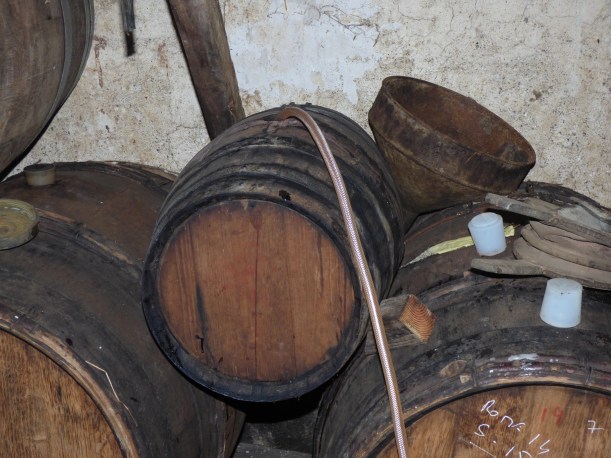
Soleras are usually associated with sherry. The word means ‘on the ground’ in Spanish. Barrels are filled with wine and the oldest wine is used to fill bottles though some of the wine is left. It is refilled from the next oldest barrel and that in turn by the third oldest. As each is only partly emptied the barrel’s contents become a mix of vintages. Traditionally, the oldest barrel is in on the ground and filled from above, hence the name solera. That ground barrel in Mas Coutelou’s solera is over 200 years old! The barrels also lose some of their contents through evaporation. The larger barrels (around 225 litres) lose around 6% of their wine per year, smaller barrels can lose up to 15%! Hence the need to replenish the barrels for natural reasons not just because they have been emptied.

IMG_2588

Michel removing must from muscat ready for the solera

The Coutelou system was started by Jeff’s great grandfather and has become a family tradition. Muscat and Grenache grapes are used to feed the solera each year. They can follow a route of being used for sweet or dry wines, they might be blended together or kept separately. Altogether there are 16 possible paths for the wines to take and Jeff must choose the most appropriate one based on his tasting experience.

The wines vary from the very dry to the very sweet and luscious. Some of the old Grenaches can be very like old amontillado sherries, lightly structured but packing power with long nutty, prune and raisin flavours which linger and fill your mouth. Others, especially the sweeter Muscats, are caramel, toffee and raisin in aroma and flavour and the wine clings to the glass with its viscosity. They are an utter delight and a special treat to savour slowly. Going from barrel to barrel in the two rooms where they lie there is an enormous range of wines, somehow Jeff keeps a record of them all in his head. As you taste them you are enjoying the results of decades of grapes from the lovingly tended vineyards, the work of generations of the family. This is tasting history.

IMG_2178     IMG_2177

IMG_2176

I love these wines, their complexity, aromas and flavours are captivating, making you smile, savour, sniff, speculate and sigh with pleasure. It is impossible to taste and to drink them without reflecting on the story of the wine and the people who made them. A sense of the past reinforced by the surroundings. The solera cellar contains all sorts of artefacts, equipment used in the vines and the cellars over the years as you can see above. It is a museum to great wines and to great people representing the history of the village and region too. The wines are that history in the glass, rich and rewarding.


4 Comments

Vendanges Diaries – #9 Dream

IMG_2773

Our last picking of 2015, Rome vineyard, October 9th; Michel, Cameron and Jeff

Version française

The very last week of vendanges, definitely.

Lots of work continued in the cellar during the week, pigeage and remontage as described in the previous post, and more wines which are now completing fermentation and being put into tanks to mature or to allow malolactic fermentation if it hasn’t already happened. This fermentation produces softer lactic acid which will make the wine taste more supple and fruity. The cellar is now much quieter and there is a sense of job done.

IMG_2720

                              Pigeage

IMG_2732

                      Carignan in tank

IMG_2734

Cameron cleaning tanks, cleanliness remains the priority

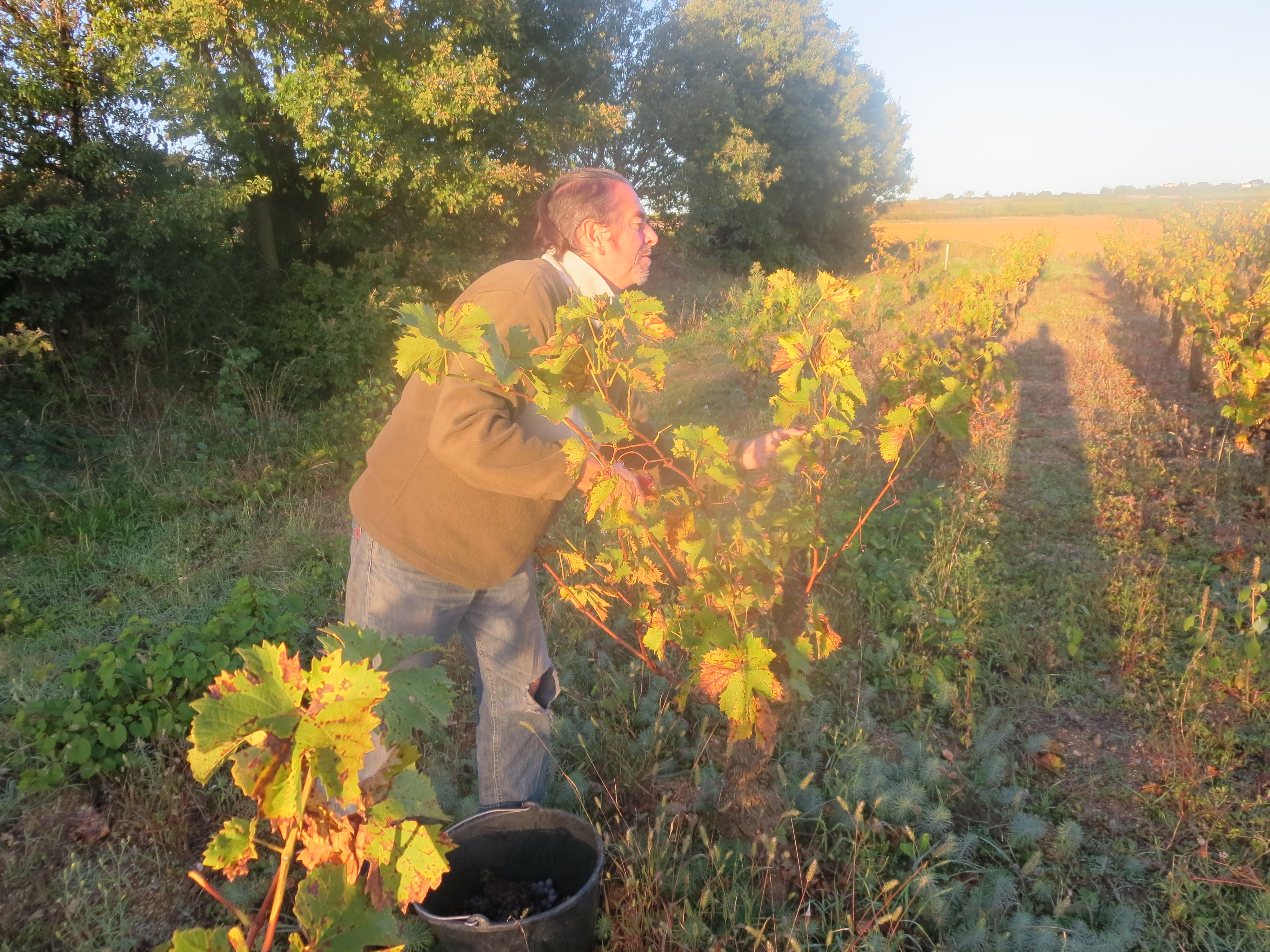
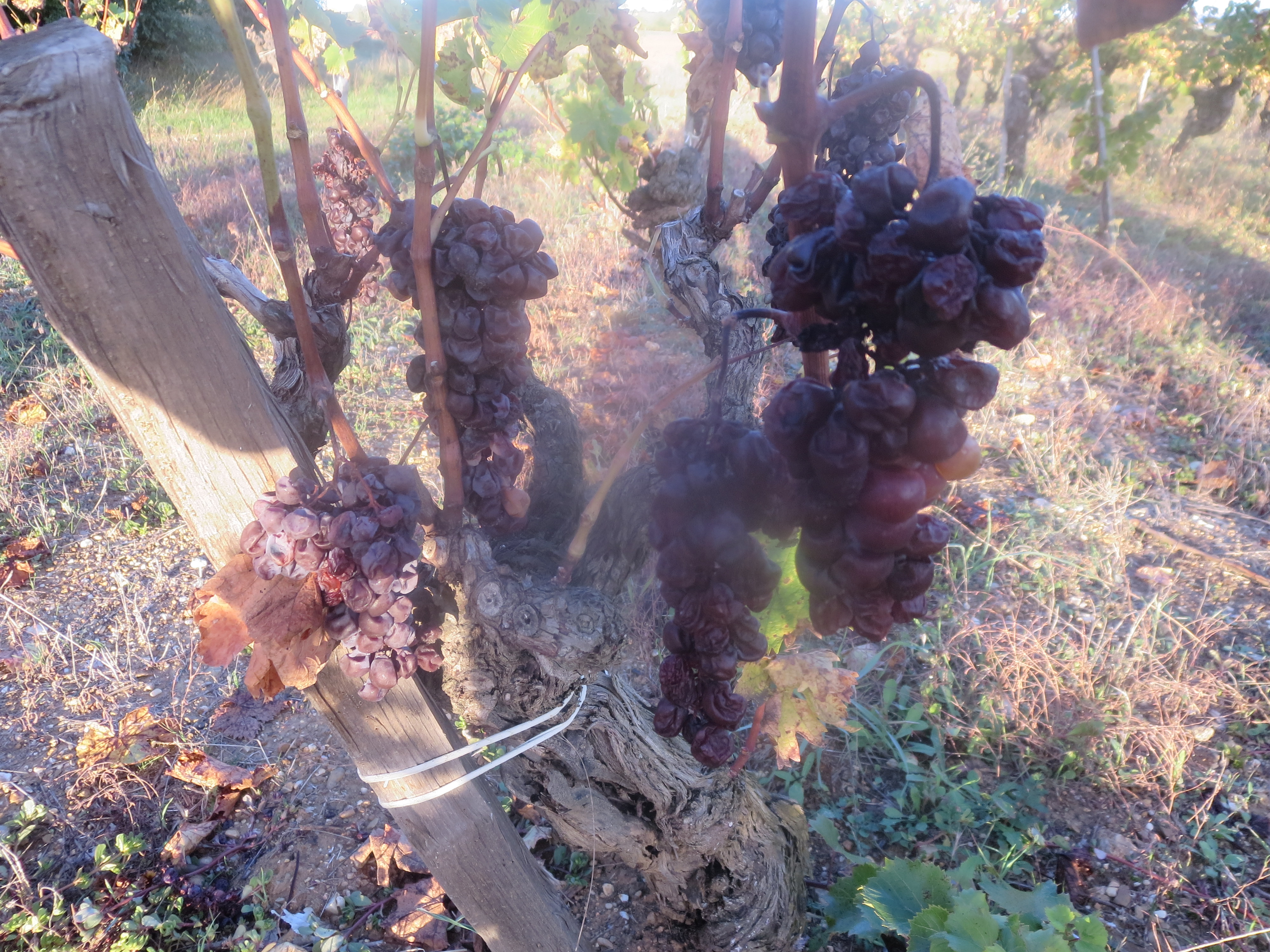
However, the final wine remained as grapes in the vineyards. Muscat grapes in Rome vineyard and Grenache in Sainte Suzanne have concentrated their sugars, developed a little noble rot even. So, on Friday October 9th Jeff, Michel, Cameron and myself ventured out to pick the Muscat and some of the Grenache. (The remaining Grenache was picked by the experienced Moroccan team on Saturday morning.) A beautiful autumnal morning cast shafts of sparkling sunlight on to the myriad colours of the leaves. It was incredibly peaceful and dreamlike.

IMG_2776

IMG_2777


IMG_2784

The Muscat was dried out in the main, the berries now like raisins with a lot of sweetness but not too much juice. The Grenache would give more juice to produce around 4.5hl of sweet wine in the end, which Jeff was happy with.

IMG_2780

IMG_2778


IMG_2781

                     My first bucket of Muscat

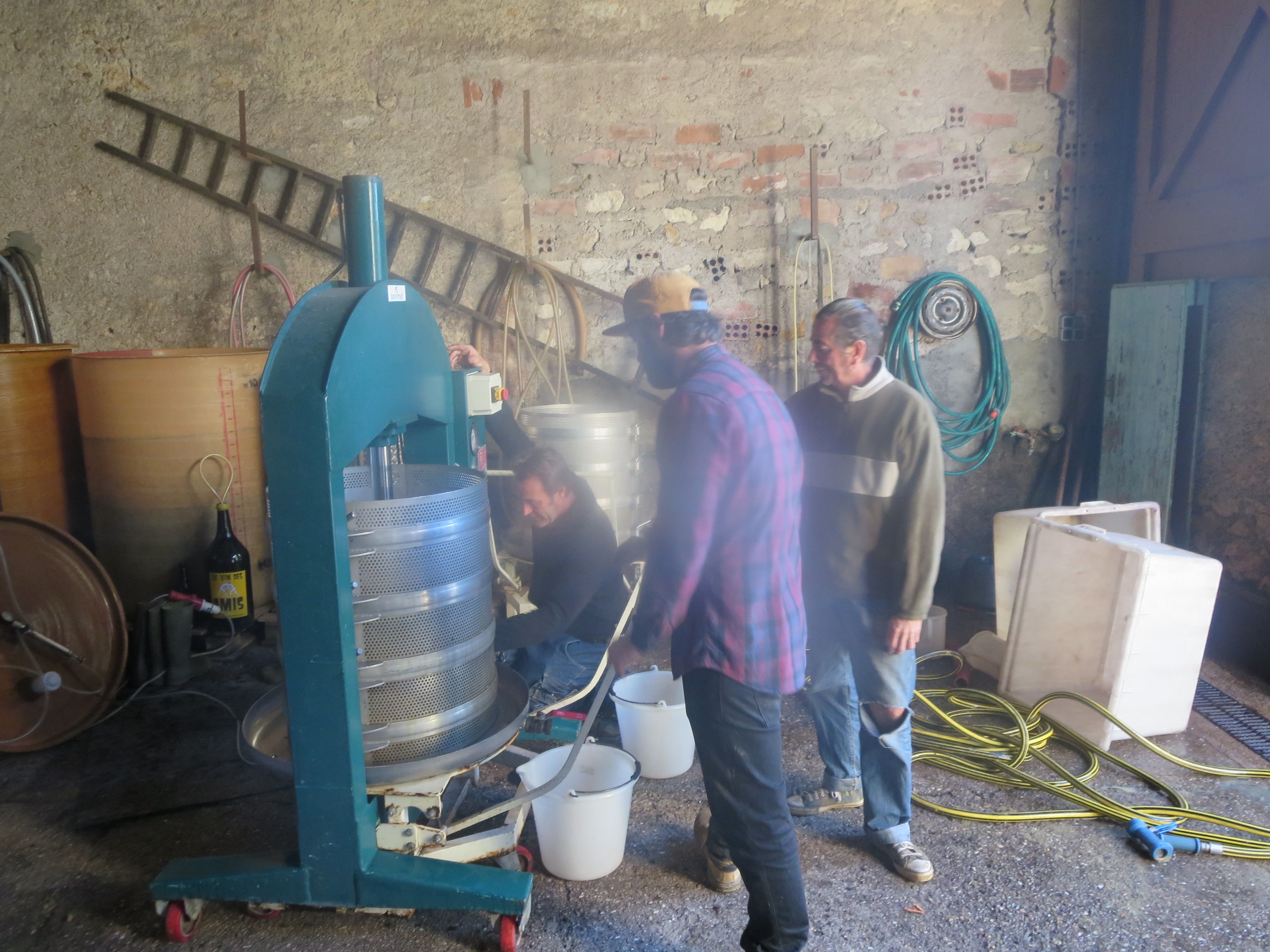
In the press the Muscat and Grenache were added one on top of the other in successive layers to give more complexity and allow the Grenache to fill out the Muscat. The juice was slow in emerging but eventually arrived in a lovely, light red colour with strong aromas of sweet raspberries.

IMG_2790

IMG_2793

The following day, Saturday 10th, the Grenache arrived and the last cagette of 2015 grapes entered the press.

IMG_2787

                   Grenache in Saint Suzanne

IMG_2799

  The last cagette of 2015 grapes goes into the press

IMG_2796

IMG_2801

     Pressing the button for the last time this year

It was a moment to breathe a sigh of relief, to feel a sense of pride in what has been achieved in the last 2 months and, a hint of sadness as the bonds of a team, which worked so hard and so well together, are gently loosened.

The relief also showed in recent days by getting together with other vignerons. An evening in Roquebrun at the excellent Cave St. Martin and then on Thursday a visit to Domaine Vassal, a conservatory of vines, with a who’s who of natural producers in the area. I shall write more about Vassal in a future post.

IMG_2714

Vignerons including Julien Peyras, Alain Castex, Axel Prufer, Yannick Pelletier, Jean Marie Rimbert, Carole Andrieu celebrate with Raymond Le Coq (red shirt) at his Cave St Martin

IMG_2767

l-r Rémy Poujol, Jeff, Yannick Pelletier, Julien Peyras, Joe Jefferies, Bernard Bellahsen (Fontedicto), Olivier Andrieu (Clos Fantine)

Then, on Sunday, team Coutelou gathered at Le Terminus in Cruzy, one of the best restaurants in the Languedoc. Jeff kindly paid for our celebration lunch together, the food and wine were excellent (including Clos Fantine and Julien Peyras wines) and the company could not be better. Cameron will be heading back to London this week though hopefully returning soon. So, it was an occasion to say ‘au revoir’ too.
Terminus

    l-r me, Cameron, Michel, Jeff – team Coutelou

IMG_2813

Jeff wondering how Cameron got a bigger glass! (It’s actually a decanter)

And to show that we really are moving into the next stage after vendanges Monday October 12th saw the first bottling of 2015 wines. Bibonade rosé is a sparkling, sweetish wine with 20 grams of residual sugar to produce 4 bars of pressure and, consequently, the sparkle. Jeff stopped the fermentation on Sunday and bottling under capsule took place this morning.

IMG_2820

IMG_2826

           Bibonade rosé, bottled and stored

So 2015 vendanges is done, 2015 wines are on the way. Job very well done. It has been a joyful experience for me to take a full part, thanks to Jeff, Michel, Cameron, Carole and everyone else who has been part of the team. A dream come true.
IMG_2617


13 Comments

Vendanges Diaries #8 – Vendanges to vinification

IMG_2698

Version française

Now that (nearly) all the grapes are picked the vendanges enter a new chapter. The grapes, bunches and juices are all in tanks in various forms and in various tanks or cuves. Some wines were pressed immediately, e.g. most whites, and the rosé after just a few hours on their skins to extract the rosé colour. These wines now sit in their cuve and are fermenting gently, changing from grape juice to wine. The sugars are changing to alcohol and, naturally, the result tastes different. One of the most interesting things about the last fortnight has been to monitor the change in flavours from pure sweetness of fruit to a cleaner, drier, infant wine.

IMG_2633

 Some baby wines

The decisions which face vignerons such as Jeff now are about what to make of the wines. The reds could be made for aging with lots of tannins and colour extracted from the chapeau de marc, (the cap of grape skins, pips and, possibly, stalks) which is still in tank with the juice (also called the moût). Alternatively they might want a fruitier, more immediate wine and so the juice will be separated earlier from the marc.

Processes such as pigeage and remontage, which I have mentioned before, help to extract colour, tannin and flavour from the skins. The marc contains chemical compounds such as anthocyanins which are what gives red wine its colour. To keep all of the juice in contact with the marc these processes can be used.

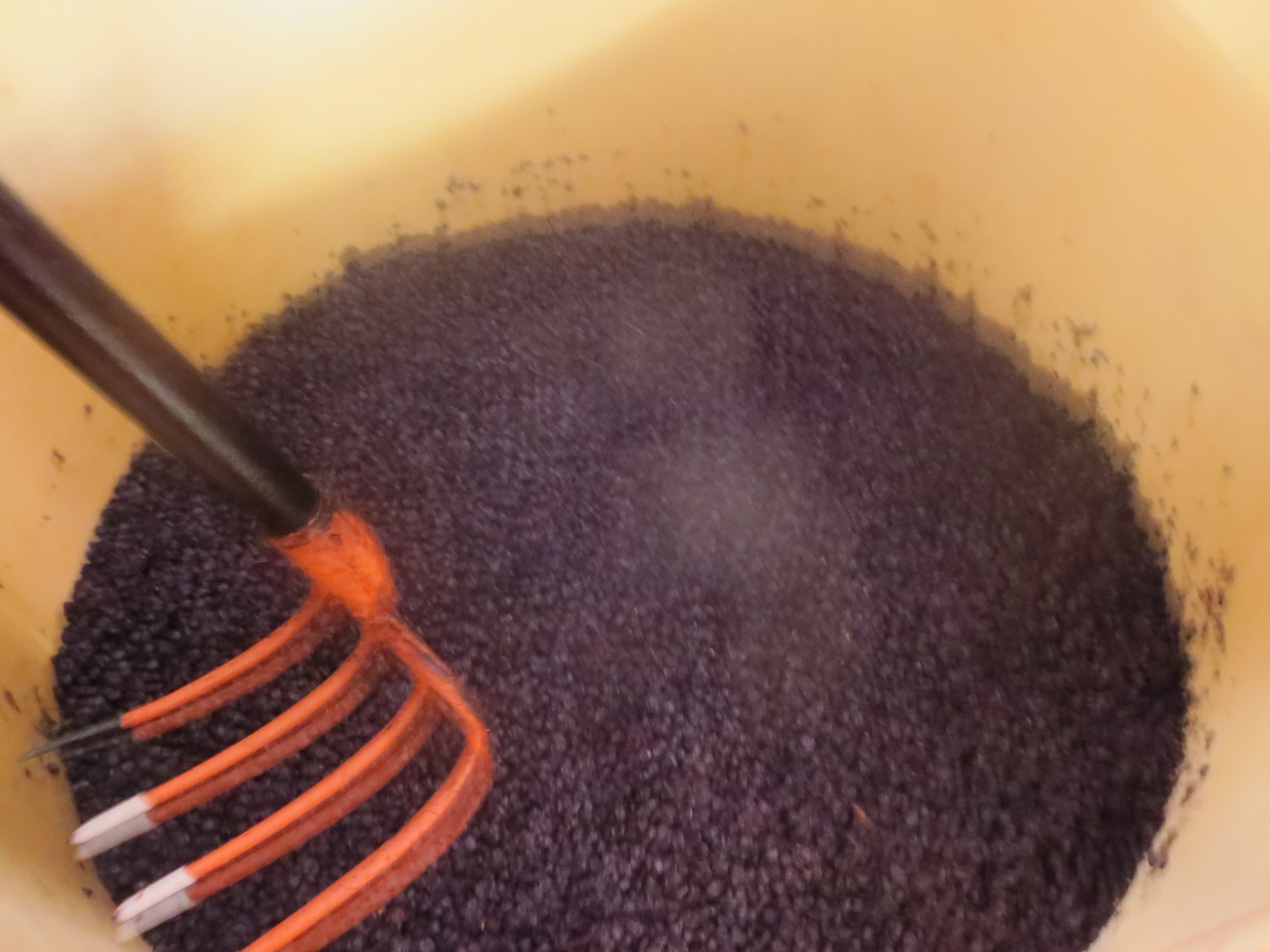
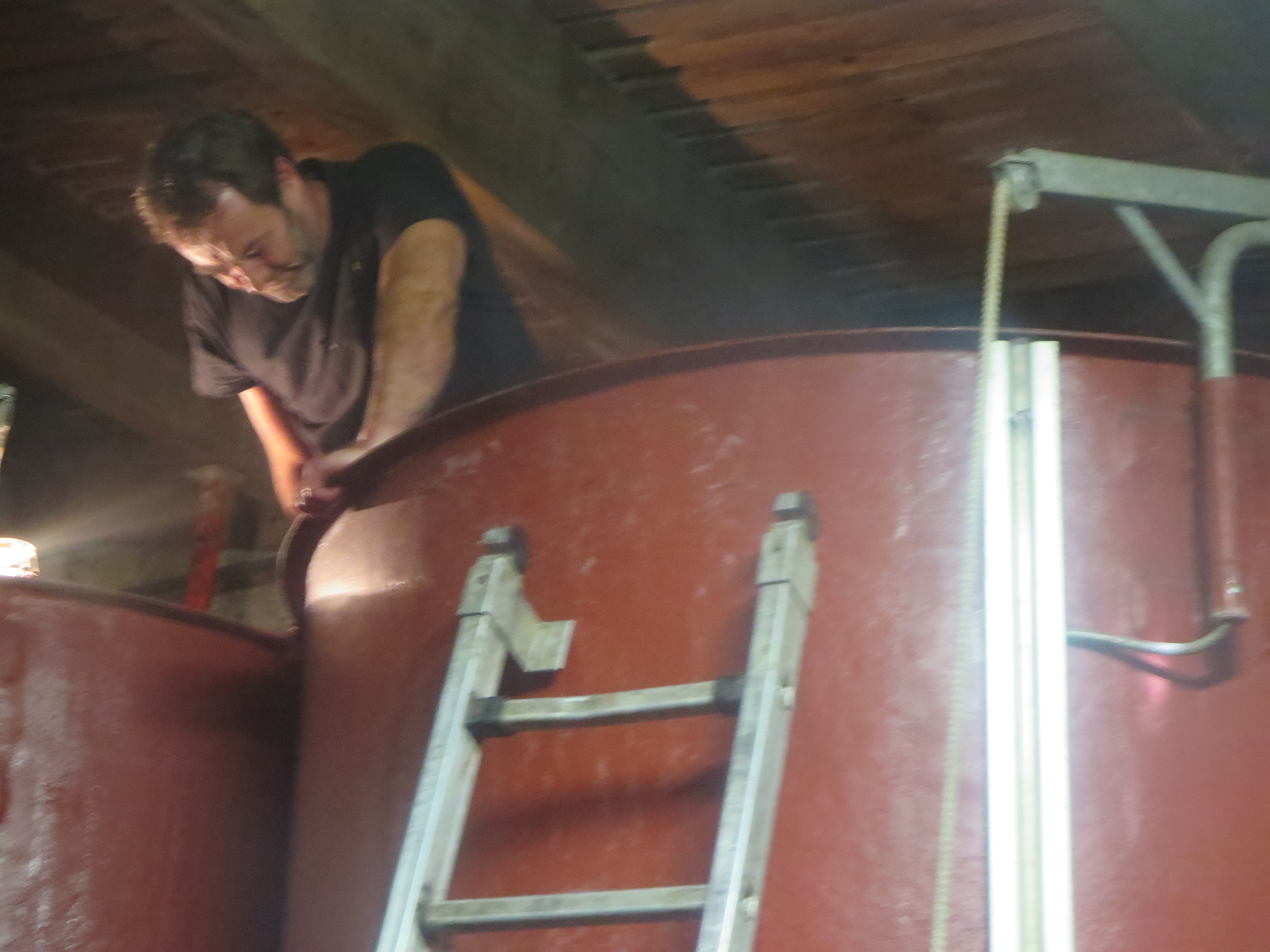
Pigeage is where someone pushes the chapeau down, breaking it up into the juice by using tools such as a fork or even by using your feet. This can be dangerous, if you fall in there is a real risk of death due to the carbon dioxide being given off by fermentation. The chapeau does become incredibly tough and hard so it takes a real effort to carry out pigeage. I speak from experience.

IMG_2579

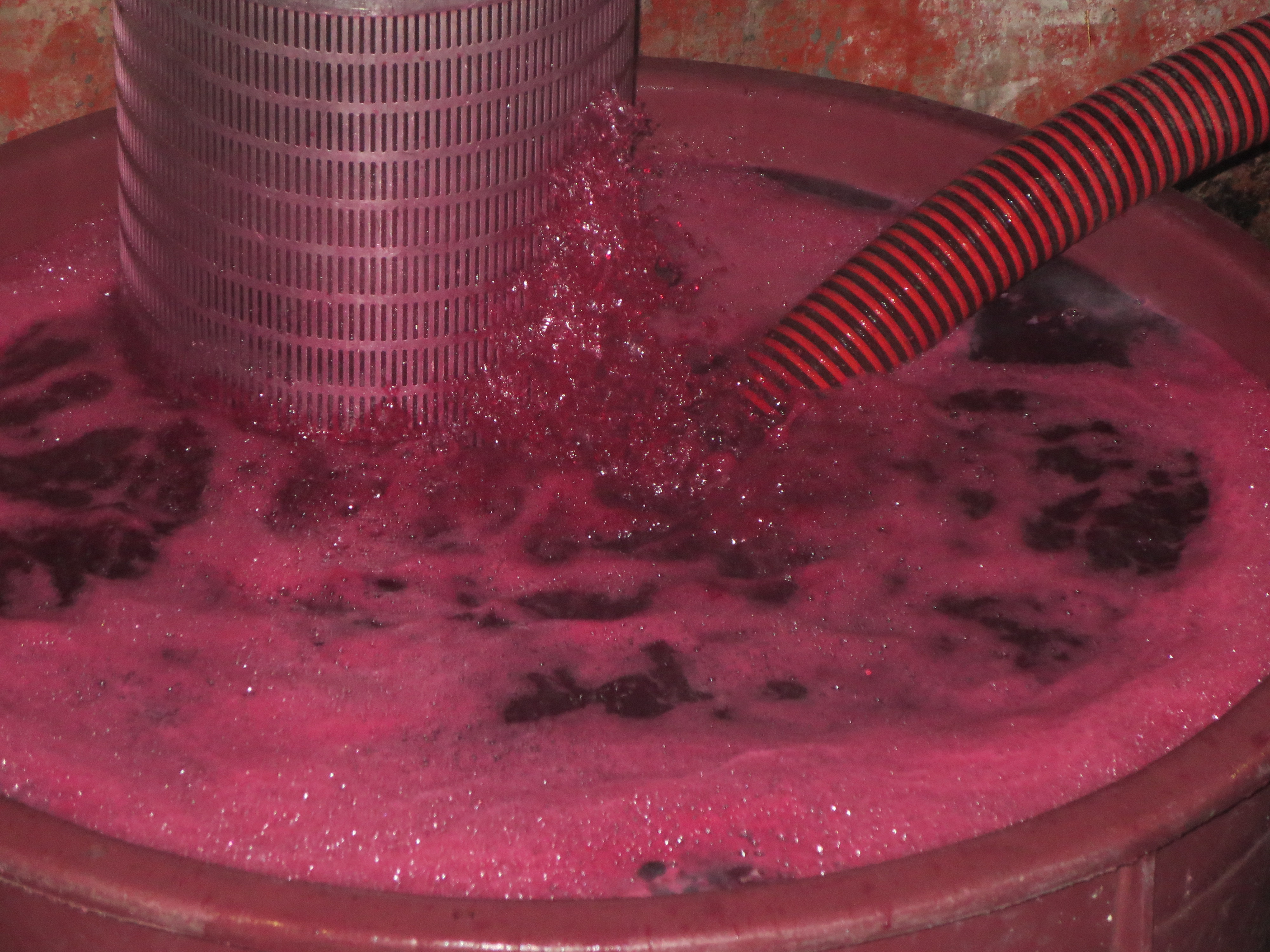
Remontage is the process of pumping the juice from the bottom of the cuve up and over the top of the chapeau, soaking it and allowing interaction between the chapeau and moût. Both processes also stop the chapeau from drying out on the top of the tank.

Je fais un remontage de Flower Power

       Me, doing a  remontage of Flower Power

However, if you carry out these processes too often and too long you can end up with harder, more astringent wine. A decision has to be made about the style of wine you want. There is a third option, délestage, where the juice (moût) is pumped into a separate cuve and the chapeau settles in the original cuve. Its own weight causes some crushing and so when the moût is pumped back into the tank a couple of hours later it comes into contact with the pips etc from this crushing, having added extra weight to the chapeau when first pumped back into the cuve. This process can produce a lighter, fruitier wine with a little more body. Jeff has used this for just one tank of Syrah, he thinks it can be harsher on the grapes. Pigeage and remontage are the more usual methods at Mas Coutelou.

So, over the last week Jeff, Cameron and Michel have been very busy doing all of this work as Jeff decides which methods best suit the grapes which were harvested. The best fruit will stand more work but even that will suffer if overworked. As someone who wants the grapes to reveal their health and terroir Jeff would choose to do only what is necessary.

IMG_2648

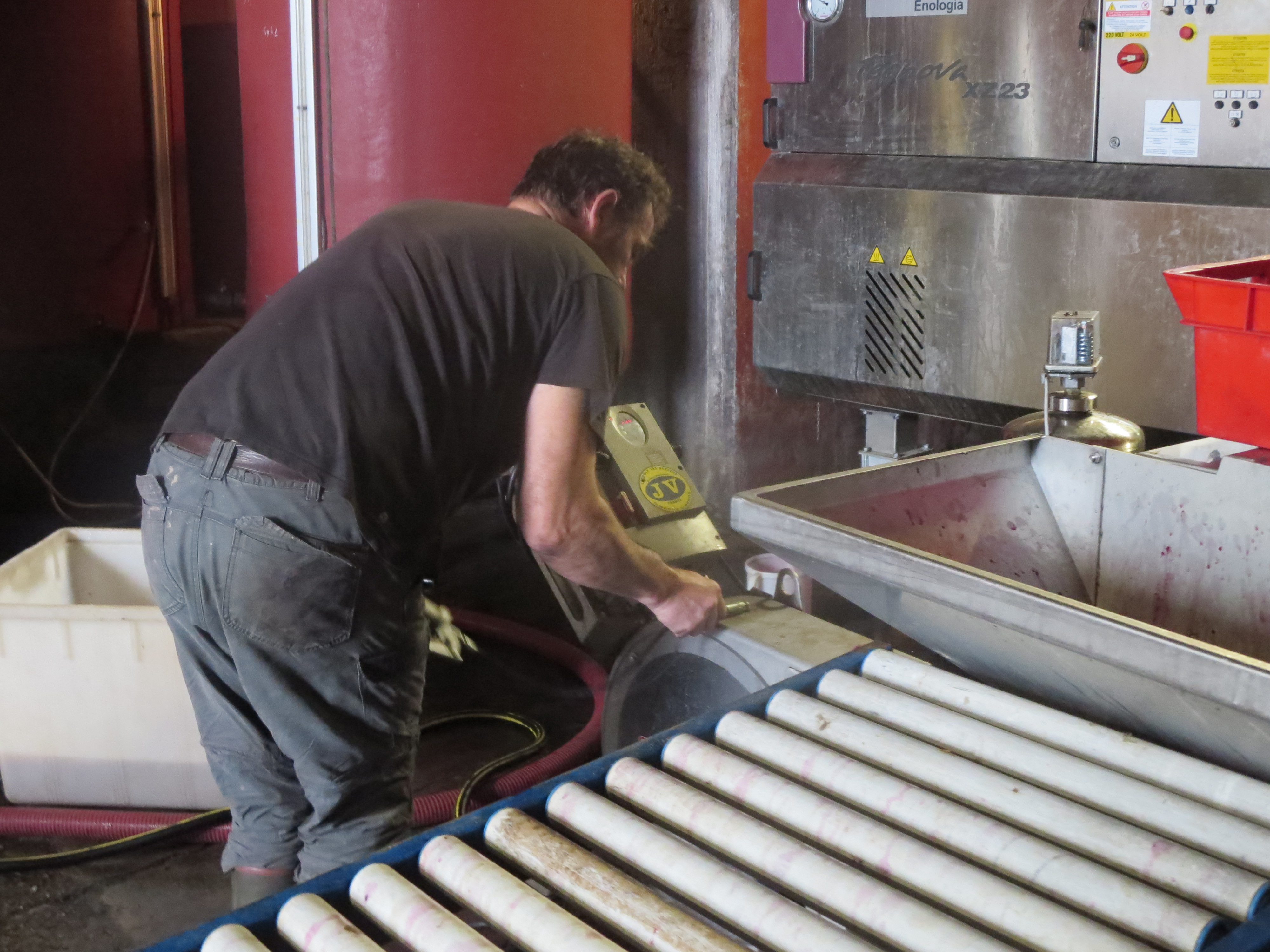
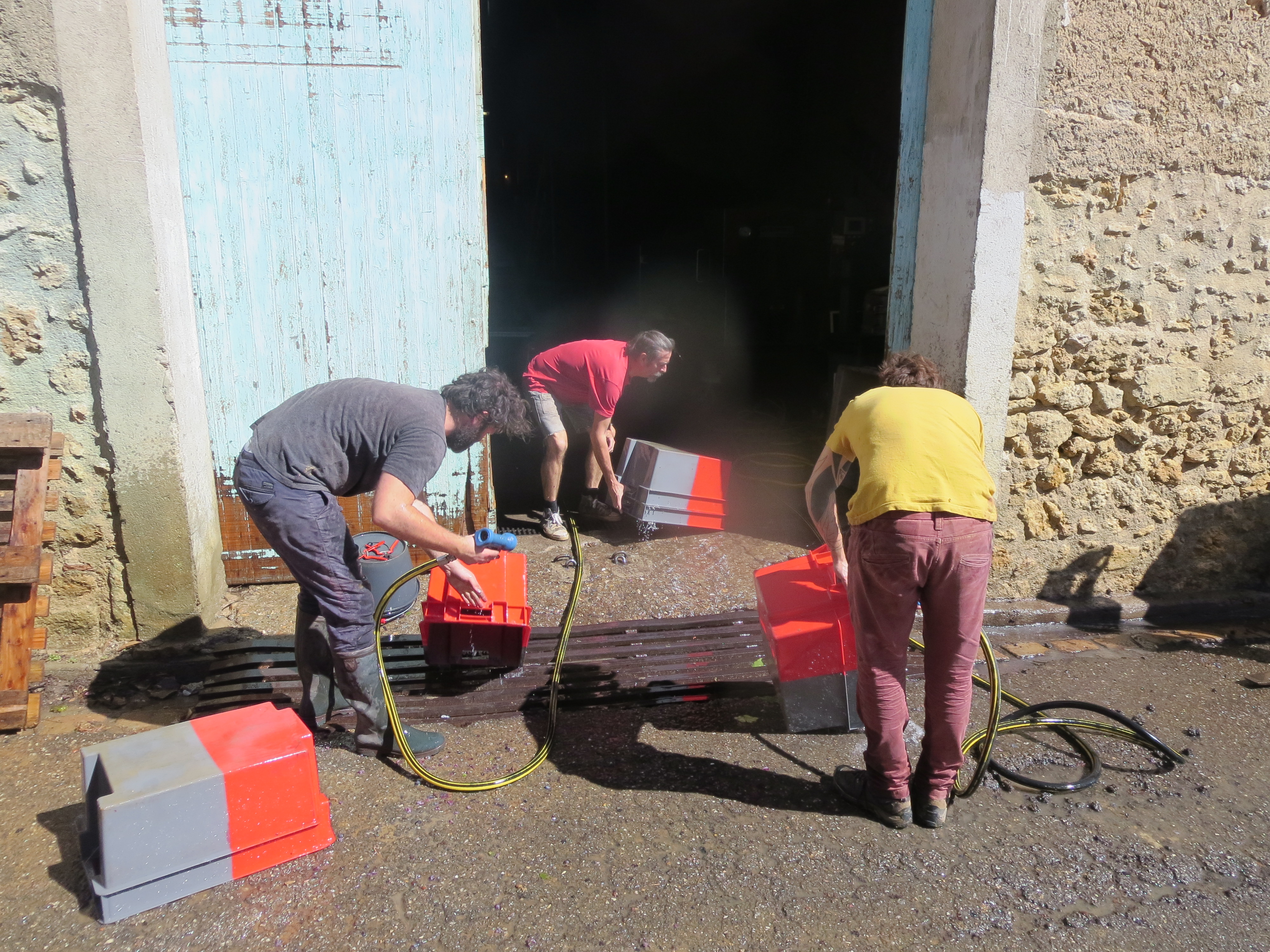
So, on Friday October 2nd the Grenache from Sainte Suzanne which were put into cuve as whole bunches (carbonic maceration) were pumped out and then pressed, a long day of hard work. Pumping juice, lifting out the marc by fork and shovel, pressing the marc, sending the juice to a new tank. This was one day of many, the same processes repeated many times and between each one … lots and lots of cleaning, to reduce any risk of contamination and spoilage.

IMG_2650

IMG_2652

IMG_2626

IMG_2654

IMG_2635

IMG_2627

IMG_2700

The Mas Coutelou name continues to expand globally, visitors to the cellar on Friday came from Sweden and Canada. There have been others in recent weeks from the UK, Australia and other regions of France. Selling the wine which is being made is another aspect of the whole process.

Other work last week included sorting the solera cellar on Wednesday October 1st. Wines were moved and blended, barrels were emptied and filled – more complexity for Jeff to get his around. A vineyard visit also unveiled a few rows of Grenache in Saint Suzanne which had not been picked. The grapes are starting to shrivel and concentrate their juices, possibly to be blended with the Muscat of Rome vineyard which are now well on the way to being dried out.

IMG_2691

IMG_2672

These grapes now taste like raisins, sweet but with not much juice so the Grenache would give volume. Rain which fell on Saturday, 3rd might change this plan, we shall see.

Two updates.

The Grenaches of my 100th blog post are progressing well. The barrels were racked to take the wine off the lees and leave a clearer wine. The smaller barrel was more cloudy than the big barrel, possibly due to it being pressed earlier but everything is going well and they now continue their slow fermentation. The 27l bottle stands in the main cellar and the fermentation is still bubbling through the equipment given to me by my friend Barry when I left the UK.

IMG_2646

IMG_2492

I tasted the wines today (Monday 5th). The bigger barrel produced a fruitier light red wine with the sugars still obvious. The smaller barrel was a little darker, with more texture and drier. Fascinating to see them adopt different personalities at such a youthful stage.

The team from London Cru tweeted to say that the Cabernet Sauvignon which they took back to London is really starting to show well as you may see from this photograph of remontage.

cabernet

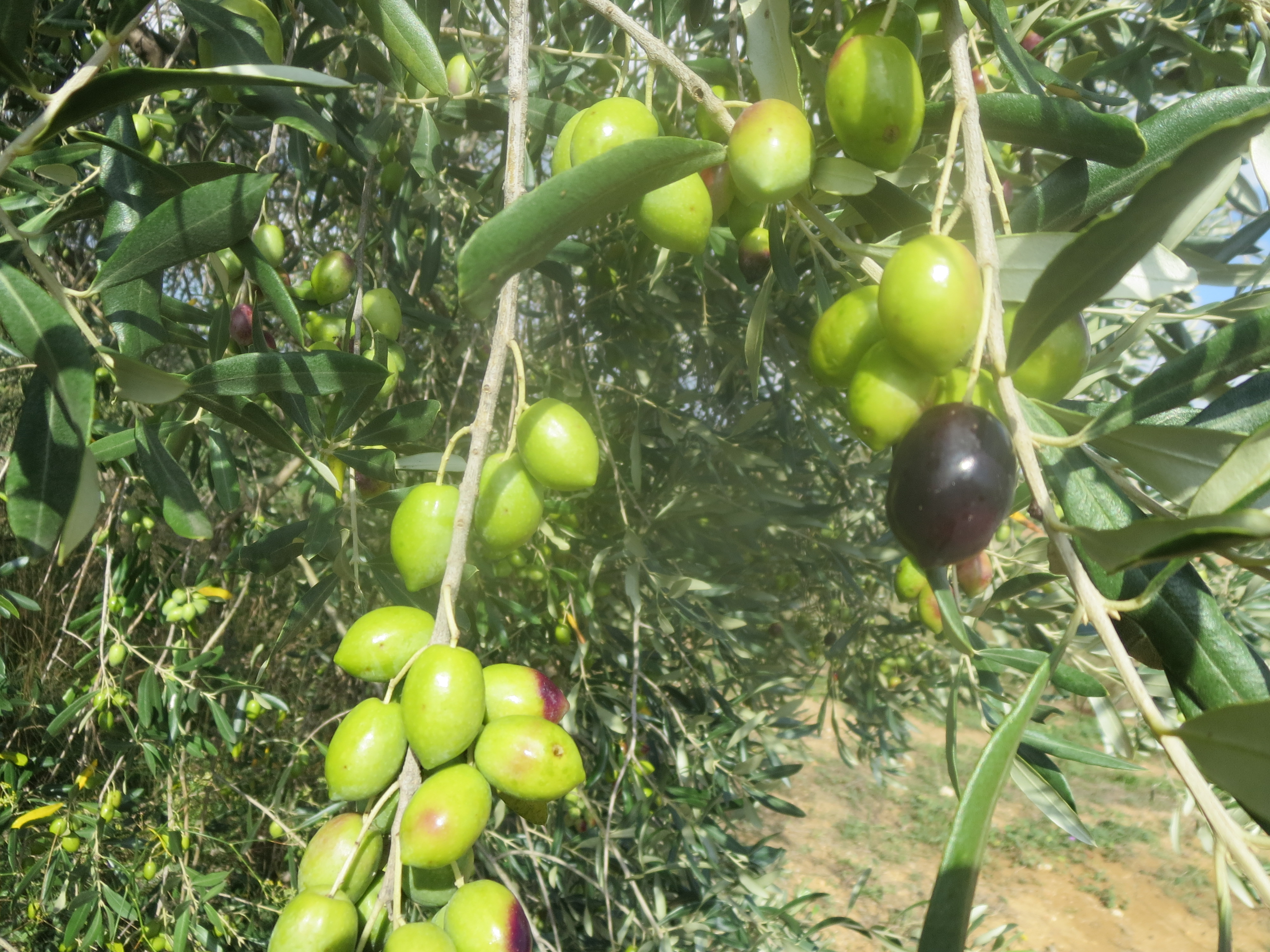
Meanwhile back in Puimisson autumn is really starting to show in the colours of the vines, they are stunning at present. The partridge family were waiting for me as I visited Rome on Friday, hopefully they will survive the hunting season which is getting under way in France. The olives are also ripening in some of the groves, these were in Sainte Suzanne on Friday. Unfortunately the olive flies which damaged so much of the harvest across southern France last year have been causing damage again in other groves.

IMG_2683

IMG_2685

IMG_2669

IMG_2665

IMG_2664

And one hungry member of the team can be relied upon to brighten up any day.

Error
This video doesn’t exist


2 Comments

Vendanges Diaries #6 – Mystery, Mourvedre and Flambadou

Mourvedre 17th

Version française

The storms which brought so much rain to Puimisson and the Languedoc on Saturday meant that there would be no picking on Monday or Tuesday the 14th and 15th.

IMG_2457

             Preparations for cellar work

Instead Jeff, Michel and Cameron were hard at work in the cellar for the two days. There is lots to do there so it was an opportunity to get everything on track. Lots of remontage, sous tirage etc. On Monday the 14th the Syrah which was to be made with carbonic maceration was pressed after its few days in tank with the fermentation inside the skins.

IMG_2476

                     The Syrah being pressed

The video shows Michel in the cuve moving the grapes to the front where Jeff forks them into the pump. You will see the grapes moving through the pipe into the press.


By Wednesday 16th the weather had turned much clearer and good winds meant that the grapes and soil were beginning to dry out nicely and so picking recommenced. The centre of attention was Rec D’Oulette known locally as Chemin De Pailhès and the Carignan grapes which grow there. These are the grapes which make the excellent cuvée «Flambadou», perhaps the outstanding wine of 2013 (and Jeff tells me of 2014 too). The bunches which arrived were excellent in quality, so fingers crossed for another great wine.

IMG_2511

                         Picking the Carignan

Carignan

                                    Carignan

IMG_2506

                         The Carignan in tank

IMG_2508

          Analysing the Carignan

Meanwhile cellar work continued as Cameron carried out more remontages and analyses. Today one of the wines to be moved was the Merlot which was bright, fresh and colourful.

Merlot being moved

                         Délestage of Merlot

As each wine is moved around the cellar, for example to take it off its skins, each cuve has to be cleaned thoroughly and then it will be filled with another set of grapes or fermenting wine. There is a seemingly never ending merry-go-round of wines and quite how Jeff keeps track of them all remains a mystery to me. Each move has to be planned to ensure that cuves are available, cleaned and big enough.

IMG_2521

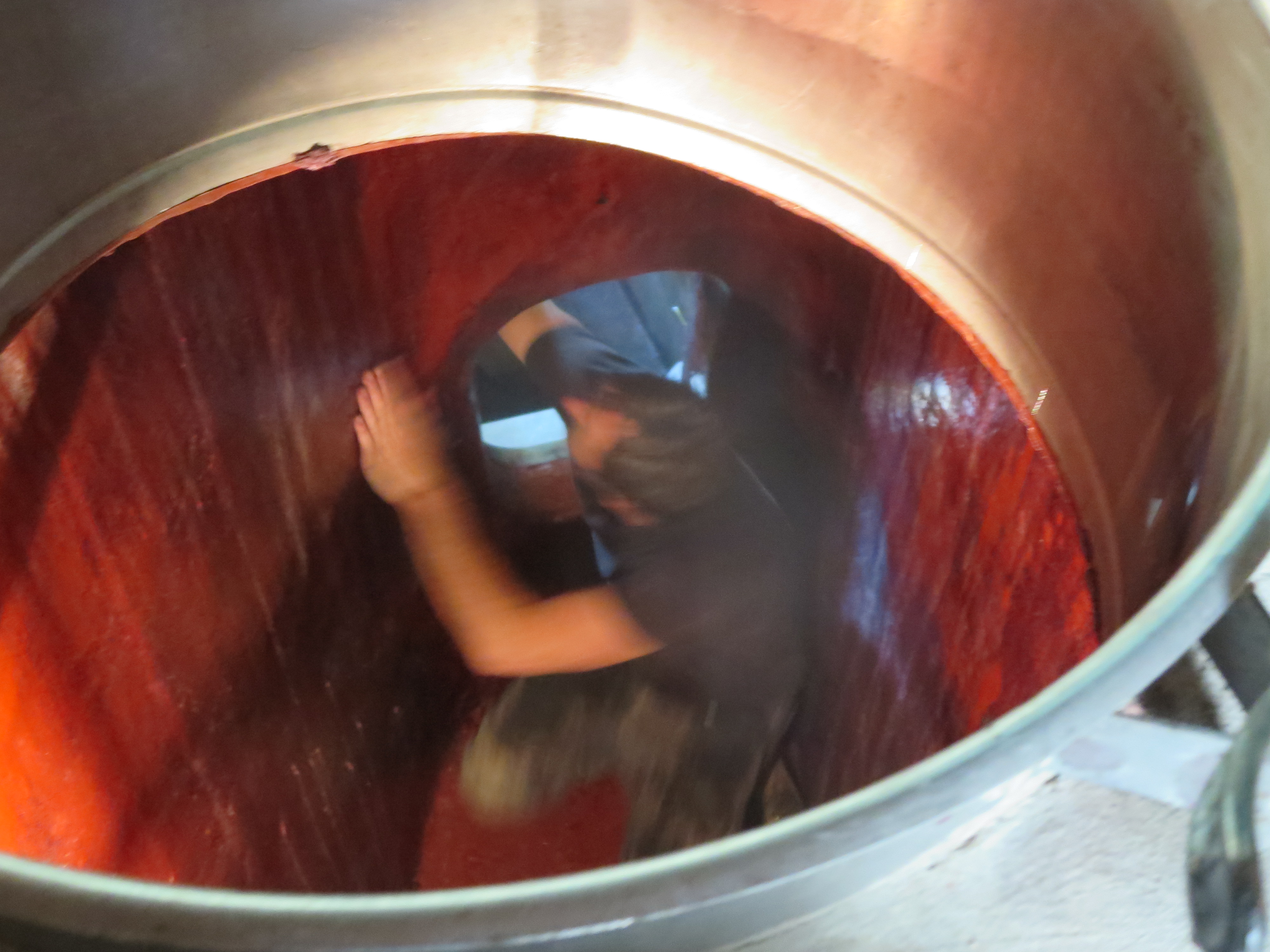
                 Cleaning from the inside

As a former teacher it reminds me of planning a timetable fitting in students, teachers and classrooms into the correct combination. Add in working as a mechanic to keep all the machines ticking over and the work of a vigneron becomes more complex, the job description is long.

IMG_2489

              Maintenance of the égrappoir

Thursday 17th brought Grenache from Sainte Suzanne (Metaierie), again carbonic maceration was to be used so back to the top of the cement tanks. Thomas was back and he, Cameron and I shared duties up there filling the tank.

IMG_2517

IMG_2526

        l-r Cameron, Michel and Thomas

Then cleaning of the cagettes ready for the next new cépage. Following the Carignan of Wednesday it was time to harvest the Mourvèdre from Segrairals. One of my favourite grapes, somewhat fickle in character but when grown by good producers it adds a complexity and depth with a hint of dark mystery. The bunches which arrived were certainly amongst the best of the whole harvest at Mas Coutelou.

Mourvedre 17th

                            Magnificent Mourvedre


They were clean, big bunches, the grapes with thick skins and smelling already of spice and blackcurrants. Some of the bunches were very heavy and it wouldn’t take many to produce a bottle of wine, on average you need about 1.25kg of grapes to make the 75cl of a normal wine bottle. Sorting was quick and easy, the pickers had done a good job and the fruit was in such good condition. I look forward eagerly to finding out what Jeff has in mind for these grapes, when I have asked he simply smiles mysteriously, something is afoot!

IMG_2532

Friday 18th brought the rest of the Mourvèdre still in tip top condition. When the pickers reached some of the lower parts of that parcel the quality did begin to dip a little so these bunches were taken away to be used separately, possibly for a rosé wine. I say possibly because final plans are a long way from being ready. Other jobs included pressing the Cinsault grapes which will make a rosé (definitely!!) and more remontages and analyses.

IMG_2533

                           Remontage

We were joined today by Charles, a young Frenchman who works in a restaurant in Berlin, and whose mother was a former colleague of Jeff when he was a teacher in Paris. Coincidentally his boss in Berlin was a student of Jeff! Charles added a real sense of fun and worked hard.

IMG_2537

                     Charles fills the press

By Saturday I was ready for a rest and so the 19th was the work of the Jeff, Michel and Cameron as they processed the last red grapes from Peilhan. Some of these will be used for blending but amongst them was the famous Castets. This you might remember is a cépage produced by only two winemakers in France, Chateau Simone in Palette and Mas Coutelou. The first harvest was in 2014 and we had watched eagerly its development. In fact we have been drinking some during harvest lunches and it is very promising, brooding with deep, dark fruit flavours and a freshness to lift it. Only 3hl was produced again this year, the same as last year.

Castets

                 Castets in tank

On Sunday 20th Jeff carried out a débourbage of the Cinsault rosé which was pressed on Friday. Débourbage means taking out the pips and skins etc to leave the juice on its own. The harvest is starting to slow down a little though much work remains to be done in the cellar. Jeff and the ‘Coutelou Gang’ will have certainly benefited from a little siesta in Sunday.

IMG_2500

Icare licking his lips at the great wine being made (maybe)


Leave a comment

Vendanges Diaries #5 (September 9 – 13)

IMG_2375

Version française

Wednesday September 9th saw further full on action. The early morning saw the only machine harvesting of Mas Coutelou grapes. This took place in La Colombié the parcel of Merlot vines. These are grapes that don’t especially interest Jeff in terms of making a domaine bottled cuvée but the quality of the fruit is good and they are used to make restaurant house wines and bag in box wines.

Merlot after picking

                        The Merlot vines after picking

After that attention turned to La Garrigue, the conical landscaped vineyard to the south of Puimisson. Much of the Syrah had already been picked the previous day and the remaining bunches were harvested. These were to be used for carbonic maceration again and so it was back to the top of the main cement tanks to work, not the easiest place.

IMG_2359

Thomas working with Cameron sorting Syrah

Tuesday had seen the arrival of two new faces to support the team as I described in Vendanges Diaries 4. Thomas was working with Cameron in sorting the Syrah whilst Karim assisted Michel in ferrying the cagettes to and fro. The team usually rotates these jobs so that people get the opportunity to try all aspects of vendanges as well as the chance to stretch your back and legs!

IMG_2383

        Karim and Michel seem happy

Then it was time to bring in the Grenache of La Garrigue. Grenache is a cépage of Spanish origins and loves the heat so it is planted on this parcel on a slope to the south to maximise the sunshine exposure. The result here was some beautiful bunches of very healthy fruit, easy to sort and giving aromas of spice and dark fruits even before it turns into wine.

IMG_2379

       Gorgeous Grenache in La Garrigue

IMG_2382

          Grenache grapes in the sunshine

Cellar work continued with Cameron carrying out analyses of the fermenting wines. It is worth noting that the natural yeasts of the grapes have been very quick to start fermentation in tank. After a couple of hours of crouching over the tanks in the morning I was happy to be stood at the égrappoir and then to help Cameron with remontages.

IMG_2390

         Cameron tying himself in knots

IMG_2389

  Me doing a remontage of Flower Power

IMG_2362

Cameron and I doing a manual pigeage of the macerating white cuvée

And of course….

IMG_2392

Thursday 11th September continued the harvesting of the Garrigue Grenache and then Cinsault from the opposite end of the village, to the north. More good quality fruit and more hard work from the whole team.

IMG_2396

       More gorgeous Grenache

The pressure was on however, the weather forecast was unkind with the promise of storms possibly on Friday, definitely by Saturday. Therefore the more grapes that could be harvested before the rain the better. It was full speed ahead though no let up in terms of sorting the grapes and ensuring the quality of the future wines. We were assisted by the arrival of Céline and Delphine the nurses from Bordeaux who I mentioned in ‘Centiment de Grenaches’.

IMG_2384

                        Cinsault being pressed

IMG_2394

           Must after pressing

There was a famous advert in the UK for tinned fish by a company called John West which said, “It’s the fish John West reject that makes John West the best”. Well that works for Mas Coutelou too. The Moroccan pickers by now were much more attuned to the strict quality demands of Jeff and were sorting the fruit, leaving any substandard grapes on the ground. Then the sorting in the cellar to check anything which did manage to get through that first tri. It’s the grapes Jeff Coutelou rejects that make Mas Coutelou the best.

IMG_2376

                            Rejected Grenache

Friday September 11th was the day of Centiment de Grenaches, the special cuvée Jeff suggested I make to celebrate the 100th blog post. Meanwhile more Grenache was being brought in for the regular cuvées, work continued apace as the clouds started to gather as predicted.

The night of Friday into Saturday brought 45mm of rain (almost 2 inches) as storms rumbled around the Languedoc. Amazingly some areas had next to nothing, Cabrières for example, whilst rain caused floods and the subsidence of the motorway a few kilometres away near Lodève. The 45mm at Puimisson meant 93mm in total since the start of the vendanges. That makes things more difficult of course as water covered grapes can’t be harvested for quality wines (though I noticed some harvesting in some other vineyards!). The ground is also muddy so picking becomes difficult and the biggest issue is the risk of disease and rot.

Work was therefore centred in the cellar with more remontages and analysis. The wines are now settling and need to be moved to take the juice off the skins and pips, to be pressed if made by carbonic maceration, to let them settle. Therefore the 12th and 13th were hard work as usual for Jeff, Cameron and Michel. Though you will see that it is Icare who is driving the team onwards.

IMG_2391


2 Comments

Vendanges Diaries (4) – Sept 6th to 8th

Carignan Blanc

                                        Carignan Blanc

Version française

This was the busiest week of the vendanges and required long hours of picking, sorting, pressing, remontage as well as lots and lots of carrying, lifting and often in confined spaces. In short it was hard work.

Why so busy? Well, Syrah which was the first of the red wine grapes to ripen makes up around a third of all the vines at Mas Coutelou and Grenache, the next to ripen, is also the next main cépage with up to 12% of the harvest. Together this meant that around half the 2015 harvest would be picked this week. Add in other smaller picking and the parcel of Merlot and this was definitely the crunch time.

Sunday September 6th was a day of rest for most but Cameron and Jeff were in the cellar working as usual, carrying out checks and analyses and remontages as necessary.

Monday 7th was a long day at work. It was around 8.45pm before we stopped. Syrah in Segrairals makes up around 2ha in total, though as with all land there are some prime areas whilst other vines, around the edges and in a few hollows where water gathers, are not of the same quality. In a typical year these would go towards cuvées such as Classe and 7, Rue De La Pompe but, as ever, plans are fluid.

Car Blanc grapes

              Superb bunch of Carignan Blanc

In addition a parcel of Carignan Blanc was harvested from Peilhan vineyard. There were some wonderful grapes and they were given special treatment, carefully sorted and then pressed using the small hydraulic press. The juice ran very clear and green and then gradually took on a slightly brown colour as it developed light oxidation. This is actually good as it helps to protect the juice later in its life and prevents damaging oxidation. Moreover, the effects of the oxidation from the pressing are removed through fermentation. Around 600l were produced in total, around 750 bottles worth. This makes a very good wine, something I was to be reminded of on Tuesday night, as we shall see.

IMG_2347

This was a long day but much good work had been done.

Tuesday 8th brought more Syrah to the cellar, this time from La Garrigue. These are the vines I have described before which face north on a slight slope to preserve the freshness and fruit flavours, good quality grapes which are often used for my favourite cuvée, La Vigne Haute, so I was even more keen to help to sort carefully and there were some lovely bunches of healthy fruit. Here’s hoping for a good vintage of LVH, as ever Jeff will make the call.

IMG_2337

Cameron unloading some Grenache Gris

Yet again another smaller harvest was done, again from Peilhan, this time with Grenache Gris. The lovely pink, grey berries are flexible in their use and might produce, white or rosé wines or be added to red wine as you will remember from my special cuvée post.

IMG_2343

            Grenache Gris after being pressed

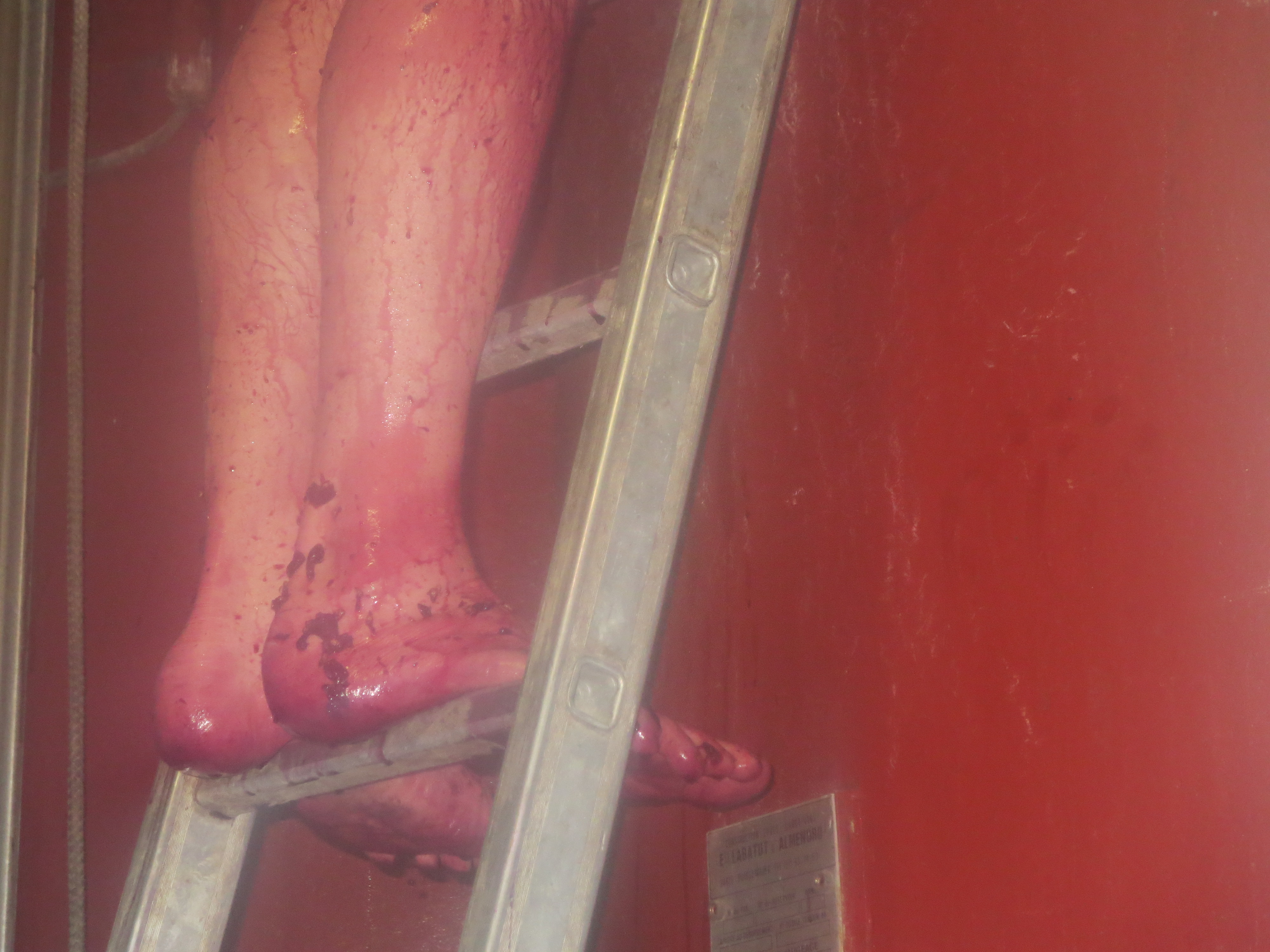
Meanwhile lots of analysis of the wines in tank and work to ensure that they are in good health. This even involved Jeff removing his trousers and jumping into the Flower Power tank to do some pigeage! Modesty means that I shall not share these photographs!

IMG_2355

Cameron getting a sample for analysis

IMG_2348

IMG_2354

The after effects

And of course there was plenty of this… (I couldn’t resist adding the tune)

Error
This video doesn’t exist

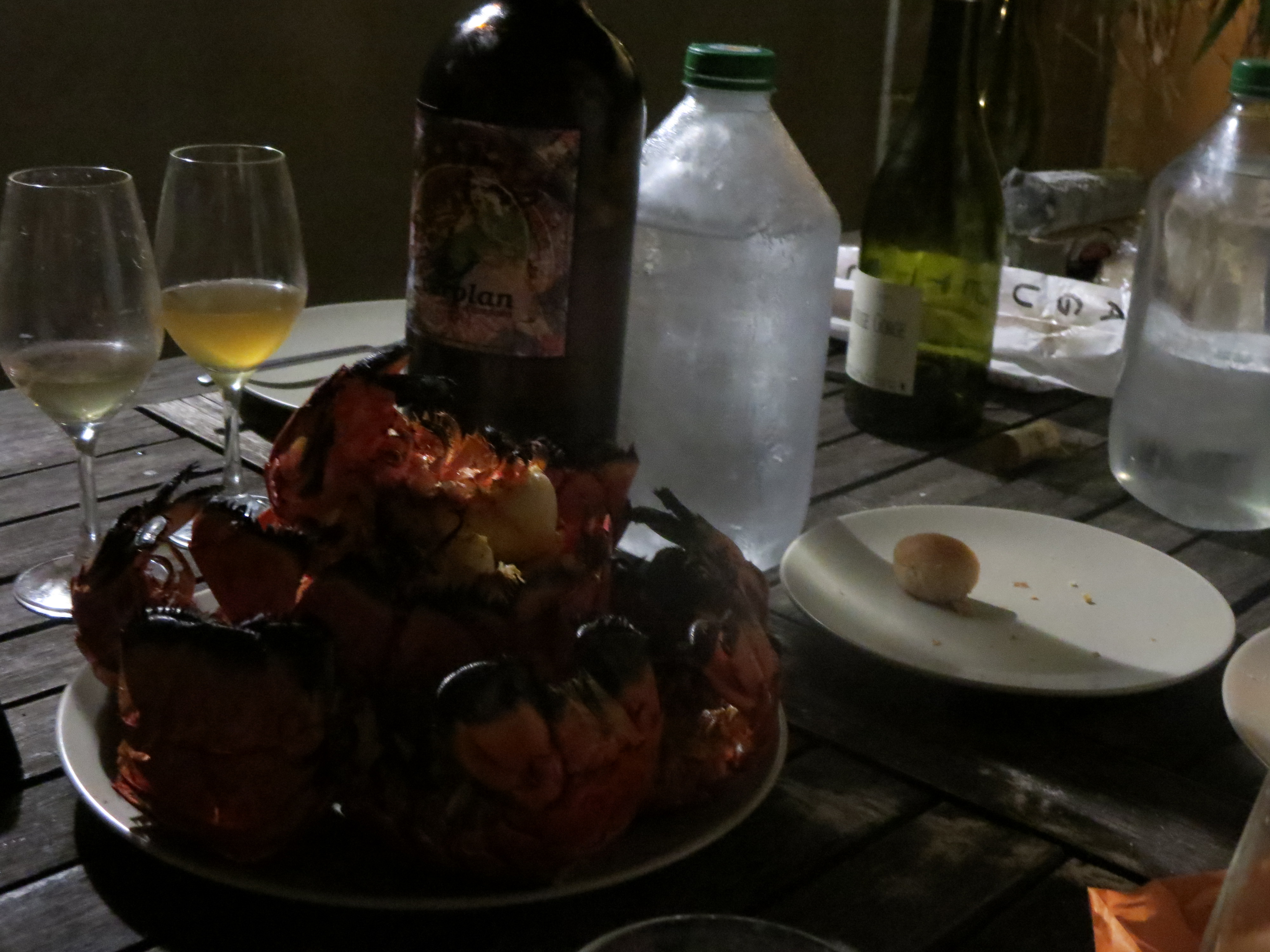
A bonus was to come though. We had been joined by two new additions to the team. Thomas is from Toulouse originally but has been working as a sommelier in the Languedoc and spent most of the week with us and will return next week. Karim is a fishmonger from Tours with an extensive knowledge of natural wines. He spent the week in Puimisson and brought a lovely surprise in the form of lobsters and scallops which made a wonderful dinner on Tuesday as Karim is also an excellent cook. We shared a magnum of Casa Pardet Chardonnay to accompany the shellfish as well as two Carignan Blancs, one from Mas Coutelou and the other from Jeff’s friend Cyril Fahl of Domaine Rouge Gorge in Roussillon. It was a special and hugely enjoyable meal, thanks to Karim and Jeff for the food and wine.

IMG_2367