amarchinthevines

Learning about wine, vines and vignerons whilst living in the Languedoc


6 Comments

Young, gifted and natural

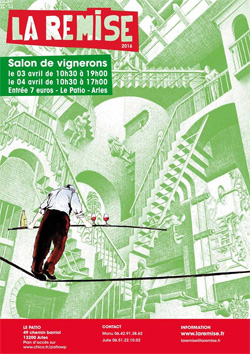
In March and April I was able to visit a number of wine tastings with the emphasis on natural wines, in Bédarieux, Arles and London. The latter, Real Wine Fair, I wrote about recently and also featured organic and biodynamic wines. One of the features of all three events, upon reflection, was the rise of a number of talented younger vignerons. Now, that should be no surprise, there have always been a number of young vignerons attached to the natural wine scene. Indeed there is a youthful core to the crowds who attend though, again noticeable, the age profile of attendees this year seemed to me to be much higher.

The buzz around natural wines has certainly created interest in the whole world of wine and been an entry point to many younger people who like the ideas and principles of many vignerons who seek to make wine with as little intervention as possible in the vineyard and cellar. It has struck a chord with many. As natural wines have become more widespread, vignerons more experienced in making wines without a safety net then their appeal has broadened. Many wine enthusiasts were put off by the (in my view false) reputation that natural wines were often faulty and wrong. I do believe that winemaking has improved and that consumers have more confidence in the wines, hence the arrival of a broader cross section of clients. As an older wine enthusiast myself I welcome the fact that I am, usually, not the oldest person in the room.


In the three salons there were many familiar faces, vignerons whose wines I have tasted, drunk and bought many times. Others whose wines are not for me. I shall return to these people in the next article. Many moons ago I likened the natural wine movement to punk rock in that it was creating an alternative scene and would introduce change on the whole industry. Just as punk was followed by a new wave of music, artists such as Joy Division, Talking Heads, Blondie and Elvis Costello who were influenced by punk but channelled its energy in a different way, I believe that there is a new wave of younger winemakers in the natural movement who are building on the work of the pioneers, the punk winemakers. Some for better, some for worse.

Here are some of those winemakers from the salons whom I would heartily recommend as vignerons to follow, whose wines I would gladly drink.
IMG_3790

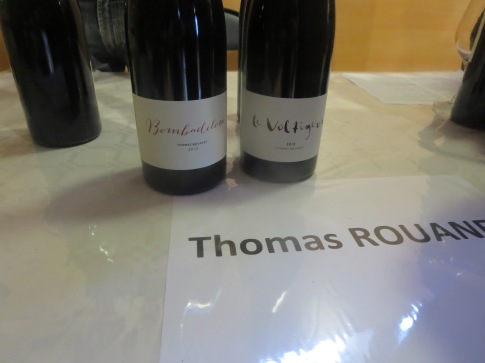
Thomas Rouanet from the St Chinian area I met at Bédarieux and enjoyed his wines especially the pure Carignan of ‘Le Voltigeur’ 14 with lovely fruit and freshness. I look forward to trying more from him.

Bastien Baillet has a 2ha domaine called La Bancale in the Fenouillèdes area of Roussillon. I gather he has been working with Jean Louis Tribouley, a very good producer himself of course. I very much enjoyed his ‘En Carême’ a Carignan based wine with plenty of red fruits and a nice balanced finish.
IMG_3827

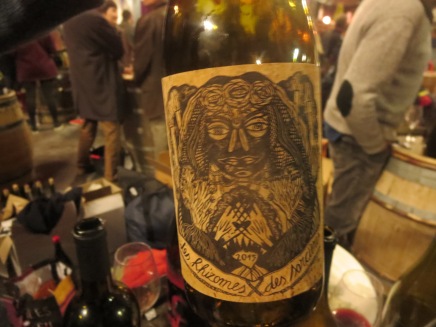
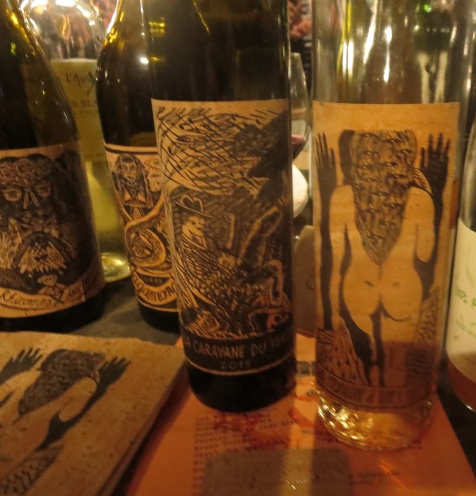
La Cave Des Nomades is also in Roussillon but this time in one of my favourite French towns, Banyuls sur Mer. Run by a young Portuguese and Polish couple their wines were without any question one of the big hits of La Remise. I tasted them on the Sunday and by the evening word was out just how good they were. On Monday I saw a number of prominent cavistes at the stand. With only 3ha their wines will run out quickly I am sure. José and Paulina’s domaine is part of the excellent 9 Caves project in Banyuls. A lovely range including an excellent vin doux naturel, my favourites were a very deep, balanced and fresh Grenache Noir 15 and a beautiful Grenache Gris 15 called ‘Les Rhizomes des Sorcières’, real depth of fruit with a delicious, clean finish. Fascinating labels too, one of my favourite range of wines this year.
IMG_3828

John Almansa runs Zou Mai in the Gard. He has worked with the excellent Philippe Pibarot and so, like Bastien Baillet above, he has learned about winemaking from a good teacher. Surely this must be a huge help. His first wine is a Cinsault and it was a very drinkable, fruity wine with a clean finish.
IMG_3845

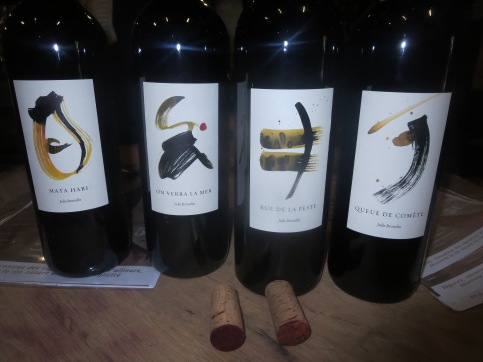
Julie Brosselin used to work with another domaine in Montpeyroux but has now struck out on her own. A number of people told me to go taste her wines, including excellent judges such as sommelier Sandra Martinez, and I am glad that they did so. Her white wine ‘Mata Hari’ was good and also the unusual combination of Cinsault and Mourvèdre in ‘Queue de Comète, full of juicy fruit. As a new domaine these were both 2015s and will improve still further.

Thierry Alexandre has been working with Les Miquettes in the Ardèche and has now produced wines of his own from just 1ha of vines. His Pet Sec (Marsanne/Roussanne) 15 was one of the best PetNats on offer at La Remise, fresh pears, clean and round. He showed the 14 and 15 St Joseph and they were both good, the 14 more rounded of course but both with good fruit and a round but clear finish, classic Syrah.

Most links I can find to Samuel Boulay say he is a Loire producer but the address given at La Remise was for Ardèche. A good Viognier/Marsanne was deliciously fresh and a Grenache / Merlot blend was very good, lots of round fruits and a fresh aftertaste.

Most of these winemakers were in a group of young producers invited by La Remise, an idea which I find encouraging and supportive. More salons should follow. From last year’s group a number returned as part of the main salon in 2016.
IMG_3821

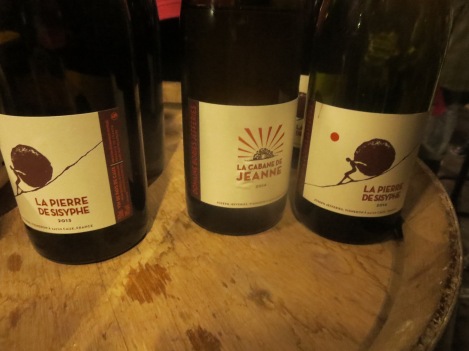
Firstly, Christelle Duffours of Mas Troqué, whose wines from Aspiran in the Languedoc are really starting to express themselves very well, improving all the time. Equally so Joe Jefferies of Bories Jefferies in Caux whose wines sell out quickly. I know Joe and so declare a partisanship, but I can honestly say that his white Pierre De Sisyphe (mostly Terret) is one of the best natural white wines I know. The reds are very good too.

One other domaine from that group in 2015 was L’Ostal from near Cahors. I wrote about them then and again after Labande De Latour in November. It was great to hear from Louis and Charlotte Pérot that they are doing well and that a 3* Michelin restaurant has taken their wine. I am not surprised. They are extremely talented winemakers as well as lovely people. Their wines are very drinkable, even young, and yet retain the spine of Malbec and Cahors which is traditionally a tough wine. Wines such as ‘Anselme’ and ‘Zamble’ are of high quality but there is always a refreshing lick of acidity which makes them so good to drink.

On my return from Arles I was talking to Jeff Coutelou about the wines I had tasted and he told me that he was very impressed by L’Ostal and that it is rare to find such talented winemakers as Louis and Charlotte. That was good to hear, as it meant I wasn’t mistaken in my praise for them but in particular it was good for the Pérots.

These are all skilled winemakers, I would happily drink their wines anytime. I do hope that I don’t patronise them by calling them young winemakers as though that makes them lesser producers. With more experience they will surely be looking to improve their wines still further and in their hands the future of natural wine looks healthy and successful.


Leave a comment

A la cave

En français

P1000984

I even set my mother and sister to work picking off snails last week

Snails and vandals aside there have been plenty of positives at Mas Coutelou in recent weeks, not least in the cellar. The beams in the photograph below have been strengthened with iron as some of the wood beams were no longer in contact with the wall!

P1000095

Before the changes


We saw recently the removal of the large, old press which used to dominate the top end of the cellar next to the cement tanks. Jeff has also removed a huge fibre glass tank which took up a lot of space. 145 hectolitres in size, it was now redundant as Jeff prefers to use smaller tanks for fermentation and maturation. Incidentally 145hl is almost 20,000 bottles of wine!

The photograph shows the number of doors in the cement tanks which have been divided to allow smaller amounts of wine. These two empty spaces now leave much more room in the cellar for all the machinery needed, during the vendanges for example. Jeff told me that the cellar had taken shape in 1956 so these are the first major changes in 60 years.


The floor has also been renovated with drains updated too. The surface you see in the photos from last week will be covered with resin, more practical in a wine cellar.

One of the more popular cuvées has also been the focus of work. Bibonade is a sparkling wine, white and rosé. This PetNat style is very refreshing but requires work just as any sparkling wine.

P1000923

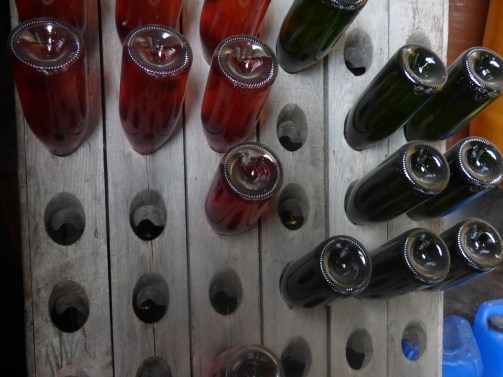
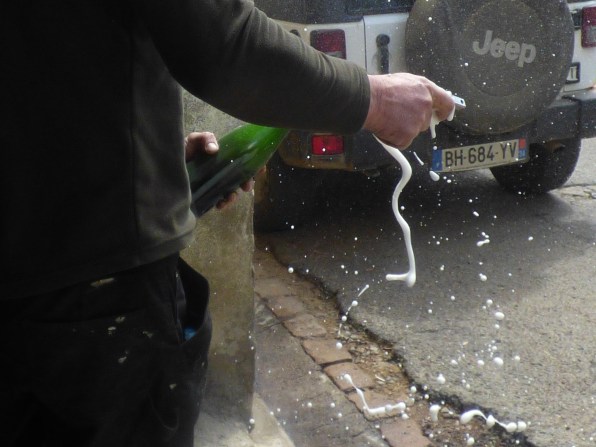
The fermentation in the bottle creates some residue which needs to be removed. The residue can be seen in the neck of the bottle as they are placed in these wooden frames known as pupitres (desks). Once the lees have gathered next to the capsule the bottle is opened so that they explode out with the force of the carbon dioxide made from fermentation. The bottle is then topped up and resealed.

Definitely a cuvée to enjoy, my wife’s favourite Coutelou wine for example.

P1000925


6 Comments

The Real World

RWF

Whilst making a brief return to the UK I noticed that The Real Wine Fair was taking place in London, a showcase for organic, biodynamic and natural producers. Thus, I endured a 5.30am start to the day to travel down to London, returning home at 11pm – but it was worth the long day. Above all it was an opportunity to taste outside of my usual wine list of France, wines were on show from all around the world. My plan, therefore, was to taste from these other places to give myself a better context and understanding of wines.

I liked the set up where producers were set out across the rooms by country and region. It allowed easy movement and planning, the catalogue was well set out and there were good food stalls available too from the likes of Ottolenghi and Galvin. The seminars were another good feature, I’d have loved to hear Alice Feiring or Jamie Goode on the Sunday but it was a real pleasure to listen to Wink Lorch speaking on the Jura.

IMG_3949

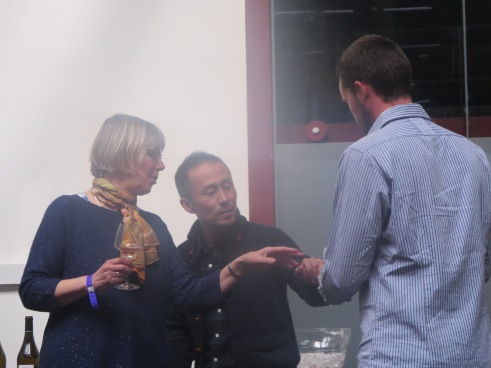
Wink Lorch with Kenjiro Kagami and Julien Maréchal

So these were the wines I enjoyed the most, as ever it was impossible to get round all of the producers I would have liked to visit.

France

Mouthes Le Bihan, Cotes de Duras Les Apprentis 2010 Merlot 60% with Cab Franc, Malbec and Cab Sauv – rich cassis nose and blackberry fruit. Nice whites especially 100% Semillon Pérette et les Noisetiers 14

Roc Des Anges, Maury Blanc Terres de Fagayra 14 (GrGris/GrBl/Macc) dense fresh, a lovely style of vin doux naturel – I liked this white version a lot

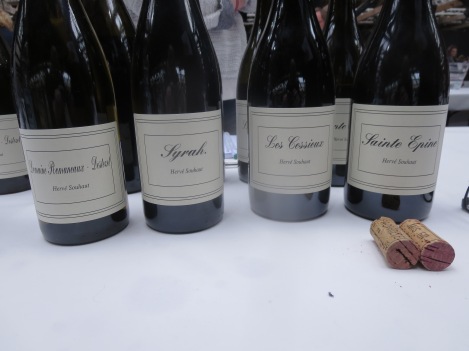
Domaine Romaneaux-Destezet (Hervé Souhaut), whole range good especially the 2014 VdP Ardèche wines Roussanne/Viognier and Syrah and the 2 2014 St Josephs, Cessieux and Saint-Epine with great depth yet balanced and fresh

IMG_3915

Foillard, Morgon Classique and Cote De Py both 14s both classic Beaujolais, the latter very concentrated

Lapierre, Raisins Gaulois, VdF 2015 – lovely fruit, simple style but extraordinary freshness and flavour from this top Beaujolais domaine

De Moor, Chablis Vendangeur Masqué 14, lovely zesty but round finish with long, dry finish

Derain, St Aubin Blanc ‘En Vesvau’ 14, concentrated, fresh, long and round

Buisson, St Romain Blanc especially the 13 (no so2) and the Meursault ‘Marguerite’ 14 with lovely aromas and fruit and good use of oak

Domaine de la Borde, Arbois. 2014 Chardonnay ‘Caillot’ lovely, 14 Savagnin lively, zesty but yellow fruit and balance, 15 Ploussard Les Charmines looked to be older but very good soft red fruits

Domaine Des Miroirs (Kagami), Chardonnay Sonorité du Vent 13 – terrific, textured, light golden colour with fresh nutty white fruits

Alexandre Bain – all wines especially ‘Pierre Precieuse’ with 30% botrytised fruit yet still dry with roundness and length

IMG_3923

Italy

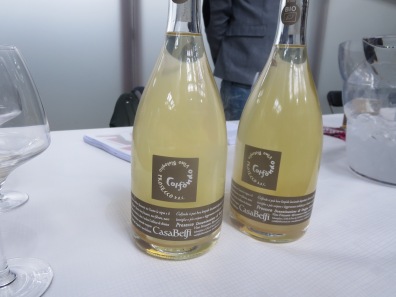
Proseccos from Casa Coste Plane di Loris Follador and Casa Belfi especially latter

IMG_3893

Princic, older wines, they do need time eg 11 Vino Bianco Trebez (PinotGrigio/Chard/SauvBl) 8 days on skins showed long, stone fruit flavours

IMG_3894

Vodopivec, 12 Carso Vitovska Anfore with textured pure fruit, 12 Vitovska Solo MM12 over 6 months skins, 2.5 years in foudre – orange colour lovely minerality, almost liquorice

La Stoppa, Reds best, eg Trebbilo Rosso 14 with fresh cherry acidity and best of all the intense red fruits, long maceration and years in foudre of the 07 Macchiona (possibly my favourite wine of the day)

COS, 14 Rami Bianco zesty and golden, 14 Cerasuolo deep, dark red fruits with lovely acid and best of all 14 Nero di Lupo, darker still, raspberry and cherry

Occhipinti, favourite of the Italian producers; SP 68 Rosso 2015, bright vibrant fruit and colour, tremendous Frappato 14 rounder than COS with red fruits, almost menthol freshness, lovely

Spain

Forja del Salnes, Rias Baxas – brilliant wines from old vines Albarino, 13 Leirana Finca Genoveva great concentration and depth (100 year old vines) yet still zesty, 2011 Golliardo A Telleira (60 year old vines at highe altitude) concentration, rich flavours but still clean. Red 13 Bastion de la Luna Tinto (Caino, Espadeiro and Loureiro grapes) – pure red fruits.

Celler Batlliu de Sort, Costers del Segre – reds a bit woody but lovely 13 Biu Riesling pure slatey Riesling, almost piercing citrus freshness

Germany

Thörle, excellent range, the dry Rieslings were all good especially Saulheimer Kalkstein 14 and impressive Schlossberg 14 (slate dry mineral). The Kabinett Riesling 15 was gorgeous, green apple with 56g of residual sugar. Spätburgunders too especially Kalkstein 14 and the single parcels 13 Probstey and 13 Holle with good concentration and depth.

IMG_3892


Austria

I said hello to Messrs. Tscheppe and Muster but did not taste due to time pressures as I had tasted their wines in Montpellier at Les Affranchis. They remain top of the class for me.

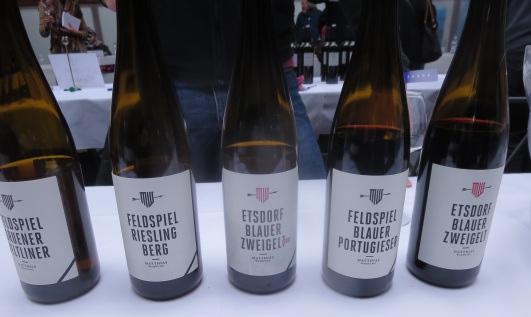
Warnung, 2013 Skin Contact Grüner Veltliner and 13 Riesling Berg especially the latter with spicy freshness. Nice Portuguieser Feldspiel 13 with round fruit and 13 Etsdorf Blauer Zweigelt, a rosé wine with citrus freshness and white fruit flavours.

IMG_3911


Schnabel, Morillon 14, a golden Chardonnay, mineral / texture and long nutty flavours, good Pinot Noir Hochegg 14 classic Pinot Noir

Georgia

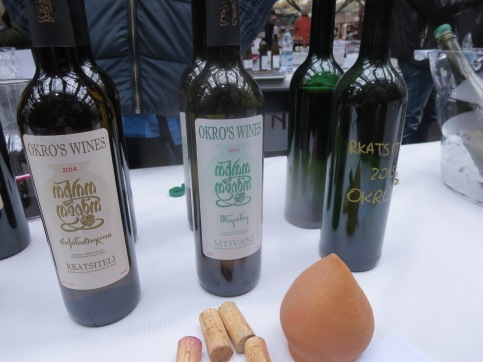
Okro’s Wines, Rkatsiteli 14 more rounded than some of the other whites, tighter, Rkatsiteli Pet Nat 15 also very good appley fruit

IMG_3900

Bitarishvili, 14 Iago with skin contact was actually fruitier than the non contact version, a little reduced but nice

Mandidli, 2015 Mandili Mtsvane grape, fruitier and rounder than other examples of this grape elsewhere, fruity, balanced

Revasashvili, 15 Chinuri clear pear / apple fresh and textured.

South Africa

Testalonga, lovely range. El Bandito skin contact 15, lovely Chenin Blanc, apple fruit and clean. Sweet Cheeks 15, Muscat d’Alexandrie skin contact, dry, fruity clean (impressive for a grape which can become very blousy). Dark Side Syrah 15, spicy, coloured. El Bandito, Mangaliza apple and pear with lovely balance.  Keep On Punching 15 Baby Bandito, Chenin, stainless steel dry, fresh clean apples. Baby Bandito Follow Your Dream (Carignan) 15, fresh, spicy light. Very keen on these wines from Craig Hawkins, a good man to talk with too.

Australia

Patrick Sullivan, Haggis 15, assemblage of leftover wines but really good fruit

USA

La Garagista, Vermont – Unusual varieties due to climate. Harlots and Ruffians 14 – Frontenac Gris 5 weeks contact but nice and fresh. Frontenac Noir (related to Aramon) in Loups Garoux 14 lovely aromas but a bit foxy and wild.

Kelley Fox, Oregon – Momtazi Pinot Noir 13 with concentration, depth and flavour. Maresh Pinot Noir 13, lighter colour but more fruit and elegance

Clos Saron, California Sierra Mountains– Carte Blanche 14 (Albarino) green, zesty fruity. Blue Cheer 14 nice blend with Cinsault lifting the Carignan to a lighter feel, spicy. Heart Of Stone Syrah 09, truffley, good deep and balanced. Stone Soup Syrah 12, fresh, tannic but good fruit

IMG_3927

Ambyth, California Paso Robles – nice whites especially Grenache Blanc 13 but best was Venustas 11, (Tempranillo/Sangiovese) lovely balance of fruit and spice, complex and long

Overall impressions. Well it was good to see how the world of wine is being influenced by organic, biodynamic and natural ideas. Whatever your thoughts about these influences they are making winemakers think about the way they produce wines. Interesting to see how producers as far afield as Oregon and Georgia, South Africa and Wales have embraced similar ideas and thinking, encouraged by events such as this no doubt.

There were some negatives for me. Skin contact is fine and clearly very fashionable for white wines. However, there were a lot of clumsy wines made in this style with overlong maceration or over extraction. They ended up tasting harsh and lacked fruit or freshness.I know some people like that, but not for me. Other producers did long maceration but kept fruit, freshness and balance. Maybe it is a learning process but I had really heard enough about skin contact wines by the end of the day. There were also some reductive wines, others with brett and mousiness. However, these were few in number in a Fair where I tasted over 300 wines.

There were many interesting wines, there were many very pleasing wines, and some excellent wines. I particularly loved the ranges from Occhipinti, Testalonga, Thörle, Clos Saron, Alexandre Bain and Romaneaux-Destezet. My top half dozen wines were:

  • La Stoppa, Macchiona 2007
  • Forja del Salnes, 2013 Leirana Finca Genoveva
  • Thörle, 2013 Schlossberg Riesling
  • Romaneaux – Destezet, 2014 St. Joseph Cessieux
  • Clos Saron, 2009 Heart Of Stone Syrah
  • Testalonga, 2015 Baby Bandito Follow Your Dream

IMG_3960


4 Comments

The story of a wine – we can’t really say

IMG_3752

En francais

On Peut Pas Vraiment Dire Que * is a new cuvée from Mas Coutelou in 2015. So how is a new cuvée born? This is its story.

Untitled

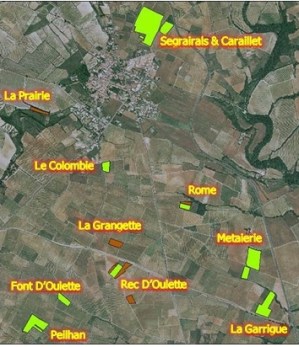
My favourite Jeff  wine over the years has been La Vigne Haute, a pure Syrah coming from the vineyard La Garrigue. This vineyard has a small ridge running west to east meaning that part of it faces north and part faces south. Jeff planted Grenache on the southward side as Grenache is a Mediterranean grape and likes the heat. On the north side is Syrah, a grape from the Rhone, which likes heat but not too much if it is to reveal its best.

La Vigne Haute is a wine of subtle Syrah. Perfumed with red fruits and tasting of silky smooth red and black fruits it carries elegance and restraint. However, in 2015 Jeff took the decision at the last minute not to make La Vigne Haute but rather to change the whole vinification of the grapes which were harvested. Here is the story in his own words, as told to Paco Mora a caviste in Ivry sur Seine. Jeff kindly gave me permission to reproduce it here.

“To thank you [for a generous comment on Facebook], I’d like to take a few minutes to tell you the story of “On Peut Pas Vraiment Dire Que.” A story which confirms that to make wine, we must first know, love and pamper both vineyards and grapes.

It comes from the parcel “La Garrigue”, my only parcel on villafranchien soil, which I planted:
 On the north side: Syrah (planted north / south) to be always caressed but never assaulted by the sun.
 On the south side: Grenache as it is not afraid of the heat.

IMG_0763

The buffer zones in Garrigue

This decision made me lose 10 vine stocks per row of vines (300 in total) to leave a buffer zone between the two varieties but it was a decision which seemed most suited to making the Syrah I dreamed of. It normally makes “La Vigne Haute” but also produced “PAF La Syrah” in 2012. This plot has a vein of water running underneath which the presence of horsetail fern confirms. This year, even during the heat wave, it never suffered and continued to push …. It was the most beautiful vineyard at harvest time.

The day of the harvest, we had planned to make Vigne Haute by implementing the classic method; destemmed grapes, putting it into tank, maceration of 2 to 3 weeks with little pumping, to encourage infusion and not to seek extraction.

The vineyard was beautiful, beautiful grapes, everyone at the winery was excited that this would be a great vintage. The first grapes arrived, and as son as I saw them, I thought I had to change everything … ..
The fact that they had not suffered from the July heat wave but instead had profited from it (because of the sun caressing that north facing slope, the heat effect lessened because of that vein of water). It had produced berries more swollen than usual … and I could really see that when they arrived in the cellar.

IMG_2359

After an hour, I said to myself “if you do as usual, you will not get to do what you want.” The fact that the liquid / solid ratio is different, if I had made a classic wine, I would have to extend the maceration time to extract enough material relative to the juice and in that case, there is also the risk of extracting good but also the less good.

So within 10 minutes I decided to change everything.

We continued by putting whole bunches into tank with the idea of making a short vinification. On that day, everyone was down in the mouth in the cellar because I had told them that there would be no Vigne Haute …. But I trusted my grapes and they told me that they would repay my faith in them .

We just left the grapes in vats for 7 days without any intervention and then pressed. So there was almost no exchange between the skins and juice in tank. The tannins and colour were extracted because of pressing the skins, which were ripe, and released them after their short stay in the vat.

In the end, it’s just the juice of the vine and the terroir that you have in the bottle ….
Nothing technical, just grapes that were cared for and nursed from their birth to their maturity ….”

So that is the story of On Peut Pas Vraiment Dire Que. I was one of those who was ‘down in the mouth’ on that day when Jeff changed everything. Yet it was, of course, the right thing to do. The wine is very like the Paf of 2012, fruity but with a lovely vein of soft tannin and bite running through it. It is elegant above all, a Syrah worthy of the great Rhone appelations but with Languedoc warmth and fruit.

And OPPVDQ is a tribute to the talent, intuition and knowledge of Jeff Coutelou. He knows his vines, his grapes and how to help them to express themselves to maximum advantage. I can’t really tell you how he does it… it’s natural.

A phrase which can be translated as ‘we can’t really say’.


4 Comments

Update on my Grenaches wine

In September I published my 100th blog post. To celebrate Jeff gave me permission to make a special cuvée. My wife Pat, friends Martin, May, Céline and Delphine helped me to pick Grenache grapes from my favourite vineyard, Rome. An assemblage of Grenaches Noir, Gris and Blanc was made.

IMG_2400

Since that lovely day the wine has been gently maturing in a variety of containers. Some went into a 60l barrel, more into a 30l barrel and the rest went into a 27l glass bottle. We tasted the barrel wines in November as they were still fermenting and it was already clear that there were differences between them. Further tasting in February revealed the differences more clearly with surprising results.

I had expected that the newer oak barrel would have a more pronounced effect upon the wine than the older barrel. Take a look at the two glasses in the photo, clearly one of the wines is a darker colour than the other. So is the darker colour from the older or newer barrel? (Answer lower down the page).

P1000771

On April 7th we carried out a soutirage to remove the dead yeast cells and other material which had served its purpose in the fermentation process but might now hinder the wine. There was actually little of that material as the pressing I made in September was a small scale one using the vertical press, meaning that the wine which went into the containers was actually quite pure grape juice.

I expected the older barrel to produce the darker wine but it was actually the reverse. On reflection I should have realised. The older barrel is more seasoned and the staves of the barrel are more saturated from years of wine, creating an effective barrier to oxidation. The newer barrel certainly doesn’t leak (thankfully) but allows more oxygen into the wine, producing the darker colour.

As to flavour and aroma. Well both barrel wines are both very pleasing. The older barrel certainly had fresh raspberry aromas with other red fruits, also a sweet edge which carried into the taste. It still has residual sugar but there is lovely red fruit and great length. The newer barrel gave a rounder flavour, still some sugar but there was a hint of spice and darker fruits.

The glass bottle was actively fermenting when we opened it. Take a listen.

Naturally the wine contained a little gas when we tasted it, but had very fresh aromas and flavours of red fruit with the sugar obvious due to the fermentation.

Now they are back in their various containers, topped with a little surplus Muscat to fill them. They will continue to eat the sugar and to develop their flavours. As this is almost the 150th article I hope that it won’t be another 50 before I get to taste them again. Thanks again to Jeff for allowing me to make this wine and to learn about what influences a wine and its development.

P1000761


Leave a comment

Vineyard, vinification and VAT

There are three main aspects to the life of a winemaker and it’s time to bring you up to date with all three.

Vineyard work. 

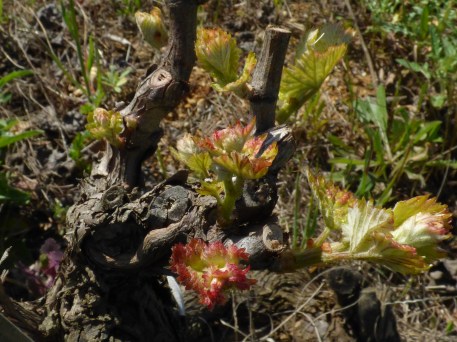
It is a lovely time of year to be in the vines as they start their growth for the year, buds of striking colour, first leaves and greenery. 

In Rome vineyard on April 10th there were butterflies, birdsong and bees, beautiful.

P1000840

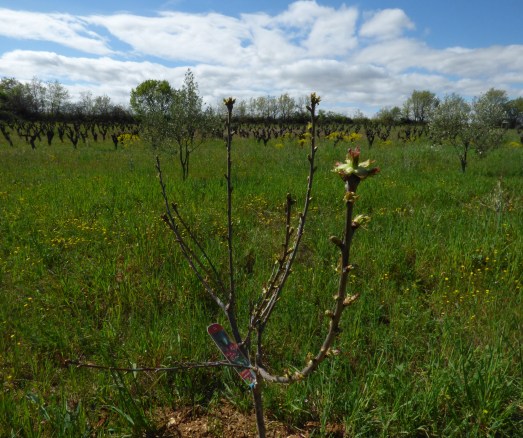
Rome through a new Coeur de Pigeon cherry tree

Taille is complete, ploughing completed (for the moment) and we have even had some rain at last which has encouraged the growth we see in the vines. However, it’s not all green for go. The buds are fragile and any more high winds could cause some damage to them leading to reduced yields in September. Moreover, Jeff pointed out another problem. Some of the buds are actually auxiliary buds (contre bourgeons) which would reduce yields further. The contre bourgeons generally don’t yield fruit and also take energy from the main buds so these don’t grow to full height.

labelled

The winter saw not one single day of frost in Puimisson, the vines were restless and unable to sleep in the face of cold weather. Therefore sap, which should be still, continued to flow and with mild temperatures in January and February the sap nudged the buds. However, a cooler spell at the end of February and March meant that the sap retreated a little and the buds were left stirred but not able to unveil themselves. As warmer weather returned the sap nudged auxiliary buds as the main buds had already seemingly started. In fact they may not now emerge at all and it is these auxiliary buds which will be left. Something to raise concern at a preliminary stage of the season. The vines generally are starting well but a few have this issue. More importantly the vines have had little rest, will they be able to offer their best in 2016?

 P1000829

Nonetheless it was good to see the newly planted vines in Font D’Oulette are already budding, a promising start.

P1000794

Vinification

The 2015 wines made for early drinking, e.g. Vin Des Amis, PM Rosé and Classe, have been bottled and dressed (habillage) with their labels. Other cuvées are still in tank resting after fermentation, maturing towards wines such as Flambadou. 

P1000759

Soutirage was carried out on some of these more complex wines as reported in the last article. Meanwhile Jeff continues to taste and to check their progress, to ensure the quality and health of the wines. 

Some wines from previous vintages have been bottled, for example the new barrel aged Maccabeu / Grenache Gris wine ‘5J’. New labels have been designed for these and they will eventually become rare treasures for followers of Mas Coutelou wines. One new wine is the Syrah ‘On Peut Pas Vraiment Dire Que’ and I will be narrating its story in a coming article, a story which reveals again the vinification skills of M. Coutelou.

VAT, sales

It is all  very well making good wines but, if you are to continue as a winemaker, you must be able to sell them. Jeff is in the position of being able to sell all of his wines and he could sell much more if he had it. That is the result of years of great wines which people want but also his ability to sell it. He has built loyal buyers around the world, often former students from his days as a teacher in Paris, for example his importers to Paris and New York, Fleur Godart and Camille Rivière. 

2016-04-04

However, Jeff still attends salons such as Les Affranchis in Montpellier, La Dive Bouteille in the Loire and, last week, La Remise in Arles (again more about La Remise soon). He was very happy with the salon and sold more wine, Vincent was regularly spotted carrying cases from the van to various cars!

Last Wednesday palettes of wine were sent to Paris and it was good to see Paco Mora, whose Cave d’Ivry is a loyal customer, publish some photos of their arrival. He looked happy and was very complimentary about Jeff’s skills and the new syrah.
So, there we are. It’s a busy life being a vigneron. Jeff has lots of paper work and admin to carry out this week as well as spending time in the vines. All with a bad back which he has nursed for several weeks. As you sip, or quaff, your Mas Coutelou wine (hopefully) spare a thought for the work which has gone into the wine in your glass.

P1000850

Paperwork? Count me out


2 Comments

Soutirage

P1000759

Soutirage is known as racking in English. After the wine has fermented the tank or barrel will contain the lees (dead yeast cells) and sediment. The yeast fermented the wine, lees have added flavour and some antibacterial properties but if left in contact with the wine they will start to add off flavours, cloud the wine and generally hinder the final wine. The process is carried out as gently as possible, using gravity rather than electrical pumps.

So on April 6th Jeff messaged me to say that the day had arrived to carry out soutirage of the wine I made for my 100th blog post and the vendanges tardives Grenache we picked on the last day of the vendanges.

We started with the Grenache. A tube was placed into the stainless steel tank, suction applied and the wine flowed gently into large 15l bottles. Jeff chose clear bottles so that he can watch the progress of the wines. They will be stored in his cellar in the dark so no problems from light damage. The Grenache still contained some residual sugar, was sweet, fresh and clean.

It was appropriate that we also racked the maceration white wine. Cameron had taken the lead on this wine and he was here after attending La Remise, the natural wine salon in Arles, I’ll be writing about soon. The wine was fresh, lots of fruit and also a light texture from the 4 month maceration. Very good.

And then the 3 Grenaches wine I took charge of. Most of this has been aged in barrels so the soutirage ended with them being emptied of their sediment.

There wasn’t that much sediment as the small vertical press I used controlled what entered the barrels, ie mainly juice. Naturally we had to top up those barrels after soutirage to replace the volume taken away. And now they continue their gentle ageing. I am very happy with the progress of the Grenaches, again more soon.

IMG_3882

P1000784

Traffic light wines

A fascinating day, another new process in winemaking for me to learn.


1 Comment

Little fish are sweet

En francais

How do you follow the Perfect Day? Apparently you just wait and, like the proverbial London bus, two come along together.

March 8th dawned chilly, just 2°C when I left Margon at 8am, bright and clear, a perfect day for the last Spring bottling. The biodynamic calendar was favourable too, last day of the descending moon and a flower day.

In fact we started with a morning of habillage (labelling and packaging). The start of a longer process of habillage to prepare wines to send to cavistes around the world, it’s time to earn some money! This morning palettes of ‘5SO Simple’ and ‘7, Rue De La Pompe’ were put together, a smooth enough process as Jeff, Michel, Vincent and I have all done this many times now (I’m getting to be an old hand!). One interesting feature is how different regions require different labels, customs stamps and even palettes, the USA different to Europe for example. So making sure you have the right matériel demands some time and attention.

So far, so good. The banter was enjoyable as ever, Icare provided some amusement when, hiding under the rollers, he gave himself a shock when a case of bottles passed over his head. The day improved with the arrival of Thomas, a sommelier who spent time with us at vendanges, excellent company.  However, the day then took an unexpected turn for the better with a phone call from Sylvain, one of Jeff’s myriad friends. He is a scientist, intellectual and fisherman and phoned to say he was on his way. With him was a cool-box full of sea urchins, sea bass and black mullet – all freshly caught.

So, just after noon, we repaired to 7, Rue De La Pompe, the house rather than the bottle. There Sylvain prepared a feast. The oursins, fresh with their delicate tongues of iodine, concentrated flavours of the ocean; a sea urchin butter spread on fresh bread; sashimi of bass and mullet; sea bass marinated in olive oil and Jeff’s white wine vinegar; sea bass chips (little fried nuggets of flesh and skin); chunks of bass and mullet fried lightly in a tempura beer batter; fish egg omelette; barbecued sea bass; black mullet grilled with broccoli, then coated in a Japanese sauce. Totally delicious, everything was a delight, every morsel.

The freshness of the fish and Sylvain’s imagination and skill provided us with a 3 hour banquet, conversation around the role of fish and wine in religions, lighter topics too. Sometimes I have to pinch myself.


And, of course, wines.

Snow Balls 14, that curious cuvée of Sauvignon Blanc, Grenache Gris, Muscat and others, it shouldn’t work but it always does – so fresh, clean, dry and fruity, a perfect match with the sashimi for example.

5SO Simple 15, ( the best 5SO ever?), perfumed cherry Cinsault, dangerously fruity and moreish but with a little more texture this year. A good match for the cooked fish with its cleansing acidity.

La Vigne Haute 2010. Oh my word. This is my favourite Coutelou cuvée and the 2010 is stunning. Pure, pure Syrah, bottled joy. Deep brambly red fruit scents, as you sniff the wine you are drawn in to the luscious aromas. Rich, smooth texture with the softest of tannins supporting it, cassis and red fruit flavours and soooo long with flavours of chocolate and coffee emerging. OK I’m sounding poncey but seriously, this is fantastic wine. It will improve for a few years yet and I have some in my ‘cellar’, happy man.

20160308_140901

2010 La Vigne Haute and its maker

An indulgence, the whole meal. The kind of life affirming meal which everyone should enjoy from time to time.

P1000360

And yet, back to bottling on this clear, fresh day. A special cuvee, one of the little cuvées. A barrel of Maccabeu and Grenache Gris from 2012 which will be named after the top Spanish ham, 5J. The aim was to produce a wine like a light Fino, slightly oxidised but concentrated and fresh to match those hams. The barrel was formerly used for making cognac (adding more flavour) and the wine succeeds in its ambition.

P1000371

Vincent, Sylvain (standing centre), Thomas (kneeling) and Jeff

It resembles a light fino, it is dry and the slight oxidation adds complexity but it is the clear fruit which lingers, lifted by that barrel influence. I was reminded of the Jura white wines I love, a Ganévat for example, but the fino / light amontillado sherry reference rings true. It is utterly delicious. A special cuvée demands a special bottle, so 50cl flute bottles were used with a glass stopper rather than a cork. Just a few hundred bottles of something very special.

5J maccabeu Grengris

The Maccabeu / Grenache Gris pressed in 2012 (photo by Jeff)

The barrel was then refilled with some of the top quality Maccabeu of 2015, ready for another delight in a few years. The treats continued though. Little fish are sweet. These were the words used by one of my heroes, WA (Arthur) Stephenson. He was a hugely successful horse racing trainer from my home area in County Durham and when his horse won the Cheltenham Gold Cup (jump racing’s top race) in 1987 he explained why he was at his local track instead of at the big meeting, “little fish are sweet”. As I had referenced Bowie last time I thought it was an apt and indulgent reference to the great man, who shared his time and thoughts generously whenever I spoke with him.


There was time to taste the Grenache wine which I made for my 100th blog post with the help of my friends. I intend to write a little more about this, suffice to say that the wine is developing very well in two different sized barrels and one super-sized glass bottle.

P1000381

Tasting the grenache

A tasting too of the 2015 Grenache Sélection De Grains Nobles, quietly maturing. Dark plummy colour, rich and round but it was black grapes that I could taste believe it or not with a sweet, raisin edge. A wine to wait for, and it will repay the patience I am sure.

SGN Grenache 15

SGN Grenache

Finally, a 40 year old Muscat. Figgy aromas, black olive and molasses. No sign at all of tiredness just intense, thick, sweet nectar yet still an acidity to keep it in balance. Liquid sunshine, a long past summer captured in a bottle, revived in the glass for us. A perfect end to (another) perfect day.

P1000391

40 year old Muscat (and bottle)


3 Comments

Perfect Day

En francais

Any excuse to include some Bowie who is producer and piano player on the song which is also one of Jeff’s favourites.

P1000319

Michel on top form

March 3rd was the last full day of the Spring bottling period and it was pretty much a perfect day in Jeff’s own words. The day was clear with high(ish) air pressure which is better for bottling and in the biodynamic calendar it was a fruit day with a descending moon, perfect too.

P1000277

Checking the weather

The only snag was the late arrival of the magnum bottles despite being ordered some time ago. So, things started over an hour late, bottling magnums and jereboams of Vin Des Amis and a new Syrah cuvée.

I had always assumed that a magnum being simply 150cl as opposed to the single bottle 75cl would be cheaper to produce, a bulk saving. However, the bottles are naturally more expensive, being produced in smaller quantities and they are filled by a slower machine rather than the usual bottling line. This takes more manpower too. So a magnum and other large formats do cost more, jereboams also need a larger cork. I like these large bottles, not just because there is more wine (good for groups of friends) but also the wine ages more slowly.

We had a relaxed lunch in the cellar, cheese, canned fish and charcuterie, the latter for Jeff, Michel and Julien. Naturally a few bottles were opened for quality control!

In the afternoon it was back to the main bottling line, helped by Catherine, for the Syrah cuvée and the new white wine from Peilhan vineyard, made from Carignan Blanc and Grenache Gris. The Syrah is lovely, I remember during the vendanges that the tank caused some of us some concern but Jeff always believed in it and …. he was right. Lovely dark fruits, fresh, mineral and long – almost as good as La Vigne Haute which is praise indeed.

The Blanc was, perhaps, even better for me, bright apple and pear flavours, very mineral, clean and pure. I do believe 2015 will produce some great reds from Mas Coutelou but that the white wines, often in the shadow, will emerge to take their place as stars in their own right. Jeff is confident that the Maccabeu is even better, there’s a long maceration blanc too. I have tasted them both and they are lovely wines in the making.

We didn’t finish until after 8pm, it was a long day but we had great fun, lots of laughs, great teamwork as well as the hard work. The bottling has been a success, the 2015s are proving to be even better than we thought – a perfect day.

Then just as I thought days could hardly get much better, along came Tuesday, March 8th. But you’ll have to wait for that report in a couple of days.


4 Comments

Vinisud – the Languedoc

vinisud2016

And so, to the Languedoc and I visited a number of domaines, some I knew already some were names I wanted to follow up. I am glad to report that the region more than held its own against the others represented. The Languedoc, and Roussillon, are sources of great wines.

Chateau Maris is in the Minervois area, I enjoyed their wines at Millésime Bio last year and was pleased to taste the new vintages. Some were brut de cuve (straight from the tank so immature) and still a little young for me to really appreciate but there were some good bottles especially Las Combes 2014, 100% Grenache with ripe, round fruit balanced with soft tannins. Lovely now, better in a couple of years.

IMG_3609

Domaine Gros-Tollot produce Minervois wines as well as other wines which are made outside the appellation rules. I confess to some bias against the domaine at first, two top Burgundy producers with a side project in the Languedoc? Surely this can’t be honest Languedoc wines. I was proved completely wrong. The wines are excellent, soft fruits with structure and complexity behind them, often from an outstanding use of oak which really does melt into the wine, adding to its aromas and flavours. I liked all the wines such as 2014 La 50/50, Fontanilles 14, and Combettes 14 which is produced from Marselan grapes, very much a Languedoc wine. Best of the bunch for me was La Ciaude 14 made from one vineyard of Syrah, Carignan and a little Grenache.

IMG_3636

Mas Gabriel is a firm favourite of mine, almost a  neighbour in the village of Caux. We enjoyed a chat with Deborah Core as well as tasting the new vintages of some of my favourite Languedoc wines such as the Carignan Blanc Clos Des Papillons. Special mention though for Les Fleurs Sauvages 2015, the rosé is medium coloured, clear though delicate red fruits and scents of those wild flowers. Very clean and dry it is a top quality rosé, which deservedly sells out very quickly.

Le Conte Des Floris comes next, also based in Caux, though the new cellar is in Pézenas. I love the wines of this domaine, I can’t remember a dull one. Driving forces behind the Wine Mosaic project Daniel and Catherine Conte Des Floris make a great Carignan Blanc Lune Blanche, the 13 was excellent. I really liked Carbonifère 12 and Homo Habilis 12 but my favourite was the Carignan Noir wine Basaltique 2014. Classic Carignan red fruits with an earthy, dark side adding complexity and, undoubtedly, longevity. Amazingly long, very fresh, full of flavour – one of my favourite wines of the whole event. This is one of the very best Languedoc domaines.

IMG_3611

Alain Chabanon is a renowned Languedoc producer, I am told he takes no prisoners but it was his wife who presented the wines. I have tasted them before, eg at last year’s Montpeyroux Portes Ouvertes, but they were on better form here. Campredon 14 and Saut De Côté 12 were both very good but my star was Les Boissières 2012. A classic Languedoc blend of Grenache/ Syrah/ Mourvèdre there was a depth of red fruits on the nose and in the mouth with complexity from 24 months of maturing before bottling. I preferred these three wines with classic Languedoc cépages to the more famous Merlot based wines which he makes. Incidentally his website is terrific with a short video of him presenting each of the cuvées and good technical detail.

Domaine De La Marfée is another which I would consider to be one of the very best Languedoc producers, and another I know thanks to Leon. I highlighted every single one of the wines in my notebook, from the lovely Blanc 13 to the most structured of their wines Champs Murmures 12. Complex, full, fruity, Della Francesca 12 and Les Vignes Qu’On Abat 12 were equally good but I actually chose the simplest of their red wines as my star on this occasion. Les Gamines 2013 is Mourvèdre/ Syrah and a little Grenache with a lighter structure than the other reds but no less complexity and fruit. I liked it so much that when we went out to eat at Trinque Fougasse in Montpellier that night I chose this wine to accompany the excellent food. Rare to find a whole range which is outstanding but Domaine De La Marfée achieves it.

IMG_3647

Domaine Canet Valette is yet another Languedoc star name, this time from the St. Chinian area. The reds are the stand out wines, Marc Valette described Antonyme as a vin de soif, his beaujolais, and it is a good everyday wine. I have often bought bottles of Une Et Mille Nuits in the past and the 2013  has delicious soft red fruits. The most famous name here though is Maghani and with reason. Marc served three vintages, 08, 10 and 14 and though the older vintages showed just how well it ages it was the Maghani 14 which I liked most. Concentrated and tannic still (this was a bottle made just for the event) there is an enormous depth of red fruits and real power, yet beautifully balanced.

IMG_3624

With Marc Valette

Mas Des Capitelles is a Faugères producer whose Carignan, Loris, was a wine which I really liked at a Millésime Bio offline where tasting reds was difficult. I wondered how in better conditions their wines would hold up and I am delighted to say they were even better. Catiède is classic Faugères from a vineyard under biodynamic conversion, 13 and 14 were good. The Vieilles Vignes 13 and 14 were even better, nice gentle use of oak to add complexity and extra depth from the greater use of Mourvèdre. Loris was good again, a new favourite of mine. Then we came to a series of three wines which the Laugé family make only in special years when they have an exceptional crop of one grape. Collection no. 1 2007 was made from Mourvèdre (with a small amount of Carignan and Syrah), and was chosen by the magazine Terre De Vins as one of their top 12 Languedoc wines. And for once I agree with a magazine! Complexity in a bottle, still fresh and youthful after all these years, great wine in short. Collection No. 2 is from 2011 and this time it was the Syrah which was exceptional and so dominates this wine. And no spitting this wine, I drank my glass. The Syrah leaps from the glass with its dark and red fruit aromas, the flavours match up and are deep and long. Great Syrah, great Faugères. I was also treated to a sample of the Collection No. 3 which will again be Mourvèdre led and it didn’t disappoint. Hard to choose just one wine but Collection No. 2  and that memorable Syrah just edges it for me.

Faugères is, in my opinion, the Languedoc’s star region and I enjoyed meeting up with other favourite producers in their area of Vinisud (incidentally it was very useful to have the producers from one region all in on area). My friend and top class producer Brigitte Chevalier of Domaine De Cébène was there; Jérôme Py of Causse Noire whose wines are getting better and better including a lovely Mathias 2011; and Jérôme Rateau of Haut Lignières as well as his eponymous range including an excellent Sur Le Fil 14 which is not yet bottled.

Finally it was a pleasant surprise to run into one stand just as I was preparing to leave Vinisud. Les Beaux Nezs Rouges was a group of natural wine producers sharing the stand. Amongst them were three very good producers from Aspiran, David Caer (Clos Mathélisse), Grégory White and Régis Pichon (Domaine Ribiera). I like the wines of all three and it was good to finish the salon on a high with a just a hint of the new style of winemaking. (More on David Caer on my wine of the week page.)

IMG_3721

Régis and Grégory beneath their red nose images

A very enjoyable salon, lots of good wines and a range of food stalls, wine accessories and various wine related activities. This is a salon for the trade and lots of business was being done all around. At the heart though is the wine and, happily, it remained the star of the show.

Part 1 of my Vinisud experience is here.