amarchinthevines

Learning about wine, vines and vignerons whilst living in the Languedoc


3 Comments

Visitors – Vendanges 17

P1020936

An unusual few days to report upon. Let’s start with some bad news. Twice in the last week people have dumped their rubbish in Jeff’s vineyards. As these were at opposite ends of the village it must be assumed that there are two selfish, anti-social idiots who would prefer to spoil the local environment than drive to the local tip (déchetterie).

Another unwelcome arrival was Hurricane Irma in the Caribbean. Jeff’s sister Catherine and her husband live on Guadeloupe so we were all concerned for their welfare. Happily she reported that the worst of the storm missed the island. Others may not have been so lucky of course.


For me there was one more unwelcome visitor. As I entered the cellar on Tuesday morning I mentioned the smell of Carbon Dioxide in the air. This had built up from fermenting grapes and with the cellar being less busy than usual the CO2 had built up. As Tuesday was hot the cellar doors stayed shut as much as possible and with remontages and open vats the CO2 was strong. Alas it seems I am particularly sensitive to it and it made me breathless and nauseous. I can understand better how some people have serious accidents with gas build up when they are working at open cuves. Maybe it’s because I’m getting old but the others were unaffected, and I’m the non – smoker! Happily, I have soon recovered.

Yet another visitor arrived in the form of the inspector who controls organic certification for Ecocert. I wrote about her annual visit in 2014, this was a spot check during vendanges to ensure that everything is done following organic principles. Reassuring for those of us who want to know that Bio wines are truly organic. Obviously, there was no concern as Mas Coutelou goes well beyond the standards required.

Animal visitors too. Buried in a case of Grenache from Sainte Suzanne was this 6cm caterpillar, quite a size. And, amongst the Carignan vines today was this dragonfly who was there with others and many butterflies. Which makes the actions of the fly tippers even more senseless.

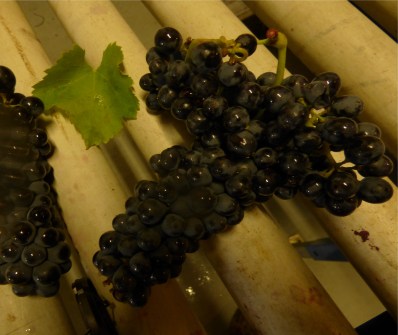
And so to grapes. More cépages to keep me happy. Piquepoul Gris and Terret Blanc along with Maccabeu picked from Peilhan on Tuesday morning will form a new white wine. The pink tint of the Piquepoul Gris will not colour the wine as it was pressed directly to remove the juice from the skins.

The aforementioned Grenache was supplemented with more Grenache on Wednesday this time from La Garrigue. So good was this harvest that Jeff is considering making a special cuvée with it. Together with the excellent Syrah from the vineyard La Garrigue has certainly performed well this year. Cinsault from Segrairals followed on.

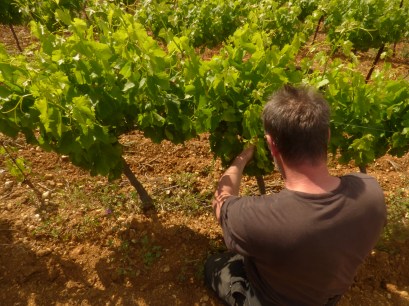
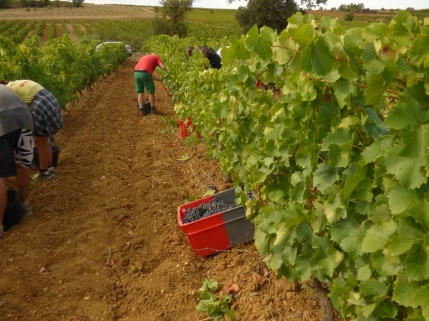
With smaller yields and dry weather the picking has been quick this year, efficient too with an excellent team working well. You will see in the photo below how they work in pairs across a vine to ensure that all the fruit is picked, hopefully avoiding each others’ fingers.
P1020930

So, what remains? Well probably five days of vendanges with Cabernet, Mourvèdre and Carignan still to come, the latter of course being the headline act in recent years. There are also a few rows of vines in Peilhan, eg the reds such as Oeillade and Castets and more Muscat too. All is set fair for a good finish.


4 Comments

Routine and variety – Vendanges 17

Ambroise, Selene and Vincent in the Syrah

A week into picking and the team is in a routine, working smoothly to steadily bring in the grapes. The quality remains high but there can now be no doubt that the ongoing dry spell has taken its toll. Quantities are down by up to 50%, bottles of the 2017 Mas Coutelou wines will be more difficult to seek out I’m afraid and, inevitably, more expensive.

P1020870

Flower Power

Thursday saw the Flower Power vineyard picked (Rec D’Oulette to give it the proper name) and just 7 cases of grapes were returned from the 0,4ha of vines. They are young still and will have found it hard to cope with the arid conditions.

Julien and Max in Rome

Rome, too, was picked and I went along as this is my favourite vineyard. Cinsault, Muscat and all three types of Grenache were harvested. From Peilhan came Grenache Gris and a few rows of the Maccabeu which will go into the PM rosé wine.

Muscat, Grenache Blanc and Cinsault (left from Rome), Grenache Gris and Maccabeu from Peilhan on the right

By now we are into the second stage of the vendanges. The grapes picked previously have been sitting on skins for varying lengths of time to extract colour and flavour but they will be separated when Jeff decides that further contact will not enhance the wine further. The juice is pumped to a new tank leaving the skins and pips behind to be used as marc for distilling.


This process of remontage is carried out increasingly as more tanks fill up. Tracking which wines are where is a skill in itself, each time the wine will be tasted and sent for analysis to ensure that acidity, sugars, potential alcohol are all correct and no nasty surprises await.

Jeff took me round a few of the vineyards to check on their progress for picking. We started with the Carignan, then on to the Mourvèdre and Cinsault of Segrairals. In all cases the pips and stalks showed us that more time was needed, they are still a little too green. Tasting the grapes showed plenty of sweet fruit but that greenness would not be good in the finished wine.

Cinsault after pressing

Cinsault after pressing, like modern art


Friday was based in the biggest parcel, Segrairals. Cinsault grapes first, to be pressed immediately so that a light pink juice emerges ready to be blended with the other rosé grapes. This happened on Saturday so that all the rosé grapes will ferment together to blend fully. Jeff explained to me that Cinsault is harder to press than most, the large berries contain a lot of pulp which breaks down less easily.

Syrah Segr

Syrah, Segrairals


Afterwards the remaining Syrah was tackled, again I went along to help with a bit of picking as well as doing the sorting with Jeff back in the cellar. The tri was not too difficult as good, firm bunches of healthy grapes came in case after case. Never mind the width feel the quality seems to be the motto, for Jeff’s sake greater quantity would be welcome.

More remontage, more testing in the cellar. It was good to see the white wines in good condition with fermentation already lively; bready, yeasty smells began to fill the cellar. More Syrah would be picked on Saturday morning but, readers, I admit that I took a break. The hard work, rich variety of grapes and early mornings meant that this time AMarch was not in the vines.

20170901_135759


3 Comments

I can’t really say how good – Vendanges 17


Syrah Garr

I don’t intend to record thoughts on every single day of the vendanges but there are some days which deserve a special mention. Yesterday, August 30th, was one of those days. And the reason was simply the quality of the grapes. These are my fourth vendanges and I do not recall such a consistently high standard of fruit coming from one parcel from the first case to the last.

parcel map cropped

The grapes were Syrah and they came from La Garrigue vineyard. La Garrigue is interesting because it has a ridge running through the middle, west to east. The slope facing south is planted with Grenache as it is a cépage which loves the sun and heat. The slope facing north is planted with Syrah, which certainly likes sun and heat, for example in the Rhone Valley, but not so much as Grenache.

The Syrah of La Garrigue produces, in very good years, my favourite wine of all from Jeff Coutelou (and therefore, in effect, my favourite wine). That wine is La Vigne Haute which combines the warmth and fruit of the Languedoc with the serious, mineral complexity of the Rhone. Sadly there has been no Vigne Haute produced since 2013 as Jeff has felt that the quality was not quite high enough for such a cuvée. In the excellent vintage of 2015 the decision was marginal and instead he produced the excellent On Peut Pas Vraiment Dire Que, which you can read about here.

Perhaps its my bad influence since the 2014 vendanges but La Vigne Haute eludes me. This year when I took the photos of the Syrah in La Garrigue (above), Jeff was concerned that the very dry months of summer had spoiled the Syrah but recent humid days had allowed the vines to recover and put their energy into the grapes.Well, I really have my fingers crossed for 2017. The grapes came in firm bunches, healthy to the core. Classic Syrah bunches too, almost T shaped.

The cases smelled of spice and fruit, other than snails with good taste there was little to sort. The juice gave aromas of passion fruit – not something I would ever have imagined possible but tropical fruits for sure. Flavours of raspberry, wild strawberry with a lovely vivacity. This was exceptional. Now, a lot can happen in the next few days, weeks and months. Jeff will simply allow the juice to express itself and not intervene, Coutelou wines are what nature makes with a simple guiding hand.

P1020837

Making sure the workers look after these great grapes

There are many more days of the vendanges to come, and there are some exciting grapes on the vines still. However, these grapes motivated me to write, to cross my fingers and trust in nature and Jeff to, maybe, finally deliver my favourite wine. Whatever, it will be worth buying and drinking, I can hardly wait.


4 Comments

Into the red – Vendanges 17

After the white grapes picked last week it was time to tackle the red, which form the main part (just under 90%) of Mas Coutelou’s production.

Monday was hot, very hot – Jeff’s car measured 42°C at one point in the vineyard of Le Colombié where we were picking Merlot grapes. This small (0.5 ha) parcel was planted with Merlot back in 1999 and, though not Jeff’s favourite cépage, the grapes provide a useful backup and the vines are in particularly good health. I spent a couple of hours picking and the heat made it very hard work, believe me. The quality was very good though the grapes lacked juice due to the lack of any rain in two months. Jeff said that they provided around 50% of last year’s juice which in turn was 20% below average.

Back in the cellar after lunch I sorted the remaining Merlot and some Syrah from Segrairals, the biggest of the Coutelou vineyards with 4ha under vine. These were juicier and were added to the Merlot in tank in order to bolster the quantity. The alcohol level was good at around 14% for both.

Today, Tuesday, it was off to Sainte Suzanne where Jeff thinks some of the best grapes of the year are to be found. The vineyard is planted with Syrah and Grenache and these are usually the grapes which make up Le Vin Des Amis, one of the more famous wines of the domaine. Jeff was proved correct, not that I would have doubted him of course! The bunches which came in were full, firm and in excellent condition. There was hardly any sorting to do other than removing leaves and snails. This will certainly make good wine. By the end of the day a few rows of Grenache from the parcel were added to the mix.

The grapes were all put into tank in whole bunches, grappes entières, rather than being separated from the stalks as the bunches were so healthy Jeff wanted to let them express themselves. In tank the grapes will begin to ferment within their skins under the weight and heat, though some will ferment as they burst. It was good to see Jeff happy with the results of the day’s harvest, long may it continue.

In the photos above Vincent is preparing the cuve for the whole bunches which will enter through the trapdoor at the top. In the second he adds CO2 to the tank which is part of the carbonic maceration process to help the berries ferment inside their skin.


2 Comments

Stress and grapes – Vendanges 17

Day two and the weather remained overcast and humid, there were even a few drops of rain. Rain which has been sorely missed in the last two months, there has been no real rain since June 26th, almost two months now. Some vines have found that stressful and virtually shut down therefore not ripening the grapes as well as they ought to do. Others, with underground water supply more available, are more vigorous and channeling their energy into the grapes. Judging what to harvest and when, is therefore even more difficult and stressful for Jeff.

The picking today began in Peilhan where the Muscat À Petits Grains was golden, starting to raisin in places. The berries are a little smaller than usual, another sign of the lack of recent rain. Nonetheless they were sweet, ripe and ready, measuring 15° of potential alcohol. In the press the lack of juice means that even a decent amount of grapes will produce only one barrique this year.

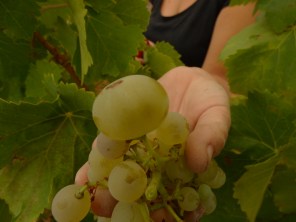
Then on to Clairette Musquée, a couple of rows in Peilhan, next to the red grape vines. This cépage is so rare that an ampelography expert recently failed to identify it on a visit. Into the mix was added Grenache Blanc from La Garrigue, which has fared better than some in that vineyard with the drought. Indeed one berry seemed to have thrived as you can see in the following photo.

GrBl huge

Whilst Roxane, Max and myself picked the Grenache the others moved into the newer plantation of Peilhan and picked Riveyrenc Noir, Riveyrenc Gris, Piquepoul Gris and Morastel. This really was a day for ampelography fans like myself. All of these grapes with the Clairette will help to make the rosé for 2017 and the first glass, hot from the press, tasted very good indeed over lunch.

Friday lunch was leisurely, we were joined by the excellent Paco Mora of La Cave D’Ivry, and some good bottles opened including a fabulous Sauvignon Blanc 002 from Jeff, 15 years old and still in great shape. Julien opened his new cuvée (one of only 50 bottles) from Faugères (Grenache Blanc and Roussanne) which was very good too. Monday will see the start of more full on days, bigger quantities, more work and faster lunches – so allow us this convivial interlude. Meanwhile, Icare continued in his inimitable style.


Leave a comment

And they’re off – Vendanges 17


No more racing metaphors I promise but today, Thursday August 24th, the Mas Coutelou 2017 harvest began. Just a gentle canter rather than a full gallop start to events with several rows of Sauvignon Blanc and Muscat vines picked. They will be vinified separately, the Sauvignon went into the large press immediately, the Muscat is lying on skins for a few hours. Julien made the first cut just after 7.30 this morning (photos above).

There was a good team of helpers available coming from Italy, Spain, France and, of course, the UK. Carole was back too which always brightens the day. The day was rather overcast and humid, which made the back breaking job of picking all the more tiring but we pressed on until the vines were finished at around 1pm, so five and a half hours of work.

P1020754

My own first bucket with leaf to identify the Sauvignon Blanc

In the cellar Jeff was anxious about how ripe the grapes were in La Garrigue so was a little relieved when the first readings came in around the 14° potential alcohol mark. There was a generous aroma of green apples coming from the press which augurs well. The Muscat was certainly riper, the grapes full of that hallmark Muscatty taste – they are the wine grapes which taste of grapes!

Caisses unloaded, grapes put into the press and the first juice flows

So, a good start, the team found its rhythm, gelled through conversation and over lunch and we attack the Muscat of Peilhan tomorrow. The bit is between the teeth, the finishing line is still far in the distance but on we go.

And for fans of Icare! Well, he’s still firmly in charge.

P1020764


2 Comments

Under starter’s orders

P1020465

Le patron earlier tending his vines

Version francaise

Other than wine my main interest is horse racing and I couldn’t help feeling a similarity as I toured the vineyards at Mas Coutelou this morning. The trainer has prepared his charges to the best of his ability throughout the year, faced up to problems of weather and disease, been up all night tending them and must now carefully select when they are at their peak for the big challenge ahead. Meanwhile his assistants and stable hands gather together, friends old and new to lend a hand to the master and to learn from him.

Old Cinsault vines of Rome

OK, maybe I am getting carried away. However, there is a feeling on the eve of my 4th vendanges of excitement that the race is on to bring in the best possible harvest from the grapes. Through winter, spring and early summer all went well, the rain came, the sun shone, the vines grew well. Latterly there have been setbacks it must be said. There has been next to no rain since June and the ground is once more parched. Some of the vines are stressed and their sap has lowered. This means that instead of concentrating energy into the grapes and ripening them fully the vines are protecting themselves. That is a real shame as everything was set for a top class vintage, now we have to wait and see what the next few weeks bring along. Rain is currently absent from the weather forecast, let’s hope that the meteorologists are mistaken.

Flower Power and ‘friends’

That said as I toured the vines I was impressed by the quality of the grapes. Yes the vines look tired, they should at this time of year as they ought to be giving everything to the fruit rather than the plant.

The grapes though look healthy, big bunches in the Carignan vineyard (above) for example though there is still some greenness in the juice and the pips. The Muscat is yellow, orange and flecked with gold and tastes very characteristic with its floral, sweet notes. They will be harvested on Friday, the Carignan in weeks to come.

Ones to follow? Well, in Peilhan the Castets looked lovely and tasted even better. Flower Power has so much more fruit this year though the snails are still present. The Grenache of La Garrigue, Syrah of Sainte Suzanne and the splendid old Cinsault vines of Rome would be my tips for future winners. There will be others which will surprise and delight, and hopefully few will prove lame and disappointing. (That racing metaphor just won’t go away!)


Meanwhile back at the cellar; cleaning, checking the equipment (the large press being serviced above) and even bottling the skin contact Carignan Blanc which James took charge of last year.

P1020743

James served his time here in Puimisson, learned and has just completed his first vendanges with his own wines in the Adelaide hills in Australia. Vincent’s vines in the Béarn are easing towards maturity, Julien has his vines here in the Languedoc. The team are back in Puimisson though, together with Michel and myself. And joining us this year is Ambroise from the Loire, come to learn too (in the photo with Vincent).

And even Jeff will be learning as two new arrivals from Spain will mean a new form of vinification this year. They will take their place alongside the (much) smaller amphora dating back to Julius Caesar which was donated to Jeff during the winter.

So we are under starter’s orders, Jeff will press the button on Thursday morning and we’ll be off. Let’s hope for a classic year.


8 Comments

Orange Is Not The Only Wine

20170624_200433

Orange wine (this was over extracted and medicinal)

Version francaise

Orange wine is very, very fashionable. Often associated with the natural wine movement that is not strictly true as many conventional winemakers are experimenting with orange wines too. Perhaps the fact that they have both emerged into the spotlight in recent years has brought the two such an association. I must say I like the idea but I have not always been convinced by the wines themselves, so here are some recent experiences.

First of all we should clarify what orange wine means. They are made from white wine grapes which are left on the skins for an extended period in order to extract more flavour. This long maceration also adds tannin and colour to the wine just as happens with red grapes when making red wine. The length of time for skin contact and the type of grapes will add more or less colour, flavour and texture to the wine.

This was how wines were made many years ago, the current trend is a revival of ancient practices. Some countries such as Georgia have always made wines like this. I have had the opportunity to taste such wines from all over the world including Georgia. Mostly I find them pleasing the mind and appreciating the technique rather than pleasing my palate. Academic rather than pleasurable. Often they lack charm, taste very dry and with no fruit, perhaps the result of overlong maceration.

However I have recently tasted some very attractive orange wines. Les Choix 2014 came from Turner Pageot in Gabian, a very well judged wine as there was still plenty of apricot fruit as well as being dry and textured, made from Marsanne grapes. Very good. Ora(n)ge Sur Les Canilles 2016 is made by Domaine Ribiera in Aspiran. Régis and Christine Pichon make this delicious wine from Clairette and Terret grapes, again they have extracted good texture and dry flavours as well as white fruit flavours. Both wines have the slightest note of Fino sherry which really appealed to me.

At Mas Coutelou in 2015 and 2016 Jeff used white grapes such as Muscat Petits Grains to make orange wines, usually supervised by our two Australian assistants Cameron in 2015 and James in 2016. The result in 2015 went to make OW1, a blend of eight grape varieties macerated for a couple of weeks. It is a bright colour, has good texture and plenty of fruit along with a herbal note. The following year James made the Muscat based wine and this is a real success, the muscat notes are there but restrained to give white fruit flavours which linger with good spicy notes and a dry finish.

Orange, skin contact, long maceration. Whatever name you give this style these are wines requiring judgement and skill from the winemaker. I encourage you to try them but select ones from winemakers you trust.

For more information from someone who knows orange wines much beter than me I would recommend this website from Simon J Woolf.


6 Comments

On Vintage and Video

Back in the UK and its grey climate after the blue skies of the Languedoc, the need for some colour was apparent. Other than friends and family it was a vintage and some videos which helped me to find some.

20170730_102023

The vintage was 2009. I first opened a bottle of one of my favourite wines the Cuvade Préciouse from Domaine Montesquiou, a dry Jurancon. This would be just about my house white wine, I love its dry, zesty flavours with just the faintest hint of sweetness on the finish. I often drink my bottles fairly quickly as it is so attractive but I tucked a few away and found this 2009 lurking on my wine racks. Lesson learned, I need to age more of these bottles. The years had added a directness, softened the zestiness a little and with the slight oak notes this was very much a Burgundy like wine. Just lovely.

I then opened a 2009 Motus from Domaine Treloar. 96% Mourvèdre (with a touch of Grenache) this was smooth as silk, tannins melted into a cocktail of red fruit flavours with great length and complexity. A wine truly at its peak and delicious. A prime example of the quality of the vintage in the Languedoc Roussillon region and of how good Mourvèdre can  be.

Intrigued by the success of those two bottles I then opened (all on different nights I should say) a Rhone 2009. It was Jeff who encouraged me to visit Domaine Du Cayron in Gigondas a few years ago. Run by the Faraud sisters their wines are made from the same grape varieties as the Languedoc and it is interesting to compare the regions. Very peppery, liquorice notes and dark red fruits this softened through the evening and still has the ability to age further. Classic Rhone, a lovely wine.

2009 was a good vintage and the benefits of maturing wine were clear with these bottles. A coincidence of two bottles became a mini examination of a vintage and it passed with flying colours.

bonum vinum

The other thing which brightened the days was the blog post of Jacques Bonum Vinum after a visit to Mas Coutelou, in particular the accompanying interviews. Well worth listening to, (it will stretch your French it must be said), it captures the passion and spirit of sharing which typifies Jeff. A very good piece of work, highly recommended.


4 Comments

Attention: Vin De Chantier

invite2

In 1957 Eugène Mas moved the family winery  into 6, Rue de l’Estacarède, Puimisson and made his first wines there having constructed the cement cuves the year before. It was much easier for wagins to collect the wines fromt here than from Rue De la Pompe where the wines were made before. In 1987 Jean Claude Coutelou converted the whole domaine to organic production, one of the first in the country. In 2017 Jeff Coutelou completed the renovation of those cellars and decided it was time to celebrate his family and their wonderful wines.

invite1

The cellars and garden were decorated, the wine flowed, music played. Friends and family gathered together to honour the history of the domaine and its future. Old vintages, jereboams and magnums matched the excellent food.

It was a great night, a celebration of all that is good in the world of wine – friends and family enjoying themselves around good bottles. ‘Grapes, work and love’ is one of Jeff’s sayings and Saturday night showed how many people love the work and care which Jeff gives to his grapes, and love Jeff himself. This was a celebration of the past but the wines and the work in the cellar show that there is a sparkling future ahead for Mas Coutelou.

P1020693

Midnight fireworks