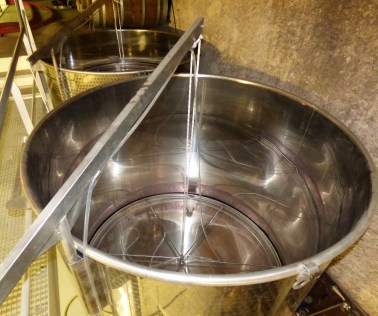
Cuves containing new wine including, potentially, La Vigne Haute. Note how the near one is far from full, this is 2018!
A hectic and busy week, including 12 hour days. The picking team had reduced in number therefore Jeff Coutelou had to make the time work to best advantage. Grenache Gris was amongst grapes picked on Monday to head towards rosé and other cuvées. The main focus though was the Carignan of Flambadou, the flagship of the domaine for the last few years. It may well be joined in cuve by the small, juicy berries of that rare Cépage, Castets.
Cabernet Sauvignon followed on Tuesday and Wednesday with more Syrah and Cinsault from different parts of the vineyards. Mourvèdre was the last big block of vines to be tackled and took a very full day on Thursday to pick. This parcel in Segrairals has varied topography, the lower parts become a little damp and are more prone to rot. It is important for Michel to convey not just the grapes but also the location of the grapes picked so that triage is made more efficient.
Top left – Carignan, top right – Castets, below Grenache Gris
By now Jeff was concerned that some of the vines were becoming so stressed by all the issues this year, mildew above all, that they were struggling to ripen the grapes. In order to ensure the health of the vines for next year it was no longer worth pushing them that little bit further so that next year would be compromised. Vines are fragile, living things which need to be looked after, Jeff nurtures them carefully.
Whilst picking was in full swing and cases were stacked up for sorting there was plenty of activity in the cellar. Wines in cuve or tank need treating carefully too, ensuring the juice ferments into wine with nothing added to it requires the vigneron makes good decisions about, for example, levels of acidity and alcohol, exposure to air and skins. I shall be coming back to this in the next post in a couple of days time.
And, after all that work, it is all too tiring for some of us!
Some serious hard work. A lot of grapes came through the cellars in these two days and we worked longer hours than usual. I can almost hear regular readers thinking, “Hang on, you said there were fewer grapes this year!” That is, sadly, still the case. Whereas in previous years all the grapes that came through in similar quantities might have been from one or two parcels this time it was grapes from several different parcels. All the grapes from those parcels. What might have taken three or four days was done in two.
White grapes from Peilhan, Cinsault from Segrairals came in thick and fast on Friday. Cinsault is a generous grape with big, floppy leaves and big, juicy grapes to match. Problematically the size of those grapes means that bunches can grow to quite a size but with large gaps between the round berries. Into those gaps rot, leaves, insects and moths find their way. Therefore it needs careful sorting, the rolling sorting table was needed. Amongst the usual leaves, grass, snails, earwigs and spiders I spotted an unwelcome visitor.
Lobesia botrana or European grape moth (ver de la grappe in French) lays its eggs inside bunches of grapes and the cocoon resembles cotton wool. They emerge as worms which eat into the grapes for nourishment, leaving a trail of juice which can attract rot. The moth’s main predators are birds and bats which is why Jeff Coutelou and others try to attract these species into their vineyards. As you can see I found one worm clinging to its Cinsault grape. I need to add this is rare, you will not be drinking worm juice in your wine!
So keen to bring home the Syrah and part of the van!
Saturday and more parcels. My favourite wine of Jeff’s is La Vigne Haute, the pure Syrah from La Garrigue vineyard with its north facing vines with some villefranchien soils. Jeff only makes this when the grapes are very good, seven times in the last seventeen years, this decade there are only three. I love LVH and always hoped to help to make it and last year was the first time, having tasted it in bottle (not yet released) I can promise that the wait was worth it. Surprisingly, despite the problems of 2018, the Syrah from this vineyard is in very good shape and might just make it as La Vigne Haute. A lot less sorting, healthy bunches, fingers crossed for the first star wine of this troublesome vintage.
Syrah from La Garrigue
The afternoon brought in the Grenache from La Garrigue. Sadly, this is not of the same quality as Grenache was most susceptible to and damaged by the mildew epidemic. The juice will receive a short maceration before being separated from its skins and then used for a project as yet undecided. There were some lovely bunches harvested, you can only think of what might have been. That the Grenache and Syrah from this vineyard was picked in one day tells its own story.
Lovely bunch of Grenache which Julien and Élise help to sort
Meanwhile soutirages, débourbages and pressings all take place, the cellar is a hive of activity. And of course there is the endless cleaning of everything. Analyses of the wines so far are positive and the juices taste very good, I particularly liked the Flower Power / Rome assemblage.
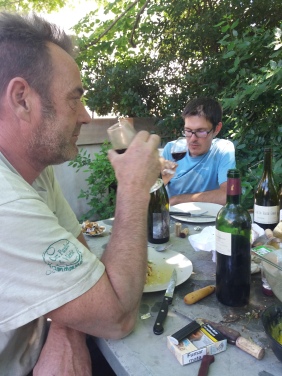
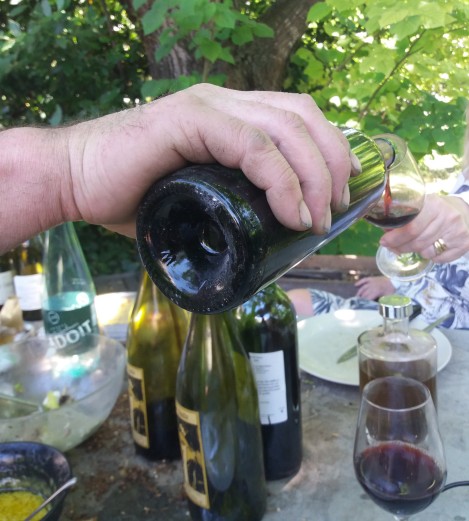
As I said long hours, hard work, aching back, stained hands and dirty fingernails. In between there were the usual laughs and camaraderie, bottles shared at lunchtime and after work. Despite everything the year has thrown at the Languedoc and Coutelou we know that there will be some good wines.
My fifth vendanges with Jeff Coutelou, time has flown and instead of a complete ignoramus helping where I can without getting in the way I now understand the different jobs and skills needed and can tackle most, if not all. This year’s reduced harvest (possibly up to 50% less than average) means we need a reduced team and so I hope I can put those years of experience to use to support Jeff along with Michel, Julien, Nathan and the team of pickers.
This year has been difficult due to the weather as I have tried to explain on here before. The long period of rain during the Spring meant that mildew hit hard across the region. Some friends have lost all their grapes, others significant amounts. Those in organic and biodynamic farming have been hit hardest as synthetic anti-mildew treatments proved more effective than organic ones. A couple of bursts of hail during thunderstorms triggered by the heatwave of July/August also damaged vines and bunches of grapes. One of the effects of both these problems is damage to the foliage, making it more difficult for the vine to have photosynthesis to produce energy to ripen the grapes easily.
Top left – mildew dried bunch on the left, top right – hail damage to grapes and leaves underneath
All of this meant that unlike other regions of France the vendanges began later than usual, the first picking was August 29th a full two weeks after 2015 for example. We began with white grapes, Sauvignon Blanc, Carignan Blanc and Muscat from La Garrigue vineyard. I did a little picking and then moved to the cellar for sorting.
The pickers in action, my bucket and case, back to the cellar and first analysis
With the problems of 2018 sorting might have been very difficult but actually not so much so far. The ripened grapes are healthy, the dry heat of summer means there is no evidence of rot. Instead we are looking for grapes dried by mildew, many bunches have clusters of them, they can be easily separated from the healthy grapes. Another issue is the number of unformed grapes, like little hard, green peas amongst the bunches. This is due a problem called millerandage, where the flower was unable to set the fruit, a product of the rainy, cold Spring and early mildew.
Cinsault with millerandage left side
The first red grapes soon followed, the Grenache from Sainte Suzanne, often the backbone of Le Vin Des Amis. This was the parcel hardest hit by mildew and the quantities are heartbreakingly reduced. Nonetheless there was enough to take picking on the afternoon of Wednesday and the Thursday morning. The sorted grapes were passed through the new destemmer (mercifully quieter than the previous one) and then sent for a short, cold maceration.
In the video Michel is putting the chapeau into the tank to cover the grapes. Dry CO2 has been added to make the grapes cold so that they do not get too hot and ferment too wildly. The juice was run off the skins on Saturday morning. Jeff has a number of options for using this juice, which was never going to be serious enough for using in a classic red wine.
We restart picking on Tuesday, September 4th. There are lots of healthy parcels ahead and things will perk up. This initial burst was a useful warm up, mechanical problems with the press and pump are now sorted and we head towards the main event. Wish us well.
There are plenty of healthy, juicy grapes to look forward to like this Carignan for Flambadou
And one member of the team just loves this time of year, with lots of attention.
You may recall that for French bureaucratic reasons the Coutelou domaine name had to change this year. Mas Coutelou was a combination of the surnames of Jeff’s parents, Mas being his mother’s family name. However, Mas also means a homestead or farm and only wines under Appellation or IGP labels are allowed to have that name. So, family name or not, Jeff’s Vin De France wines, Mas Coutelou for many years, had to have new branding.
Since he was already planning to release new products such as a fine (eau de vie), a kina (like a vermouth) and other spirits Jeff chose ‘Vins et Spiritueux Coutelou’. I have tried the Kina and like it, even though it’s not really my thing. Made from wine and organic herbs from the vineyards it is a very enjoyable aperitif.
It seems that renewal is the signature of the year. There has been much updating of the cellar in recent times; roof, insulation, a form of air conditioning, division of cuves to make it possible to vinify smaller parcels and quantities, resin flooring, better drainage, amphorae, temperature controlled stainless steel tanks. A new management space means that it is easier to see at a glance what is where and adds a tidiness to what was a more chaotic central space of the cellar.
Upstairs the new office space has been fitted out beautifully. Jeff commissioned a couple of local carpenters to make furniture. Using old barrels and a foudre of more than 130 years old they made a cupboard, with themed shelves and a stunning chair for the desk. They are real works of art, true craftsmanship. A table from the Coutelou family home has been skilfully renewed to add a feature to the space.
The empty parcel next to Ste Suzanne
And, in the vineyards more renewal. The small parcel at Sainte Suzanne which has been fallow for many years was supposed to be planted last year, in 2017. A very wet spell then and another this Spring has meant that those plans had to be shelved as the parcel was too wet. However, the vines were already ordered so Jeff has planted them in Segrairals where he had grubbed up some Cabernet Sauvignon. Instead of that extraneous variety Jeff has planted Aramon Noir and Aramon Gris (Aramon being the original grape in the parcel next to Ste Suzanne), Terret, Clairette Blanche, Clairette Rose, Picardan, Olivette, Servan (related to Syrah) and Grand Noir De La Calmette. I must admit to never having heard of some of these. Time to consult my copy of Galet’s wonderful Encycolpedia of Grapes. The Coutelou vineyards are fast becoming a treasure store of rare grapes, there are now several dozen varieties planted.
The very hot and dry month combined with the widespread mildew outbreak have meant that Jeff has spent many hours tending this new plantation, spraying and watering to help the new plants to survive. Happily, all is well.
2018 will always be remembered by Languedoc vignerons as a year of headaches and heartaches, months spent on tractors fighting disease, easy to become disheartened. The Coutelou renewals help to remind us that such problems are temporary.
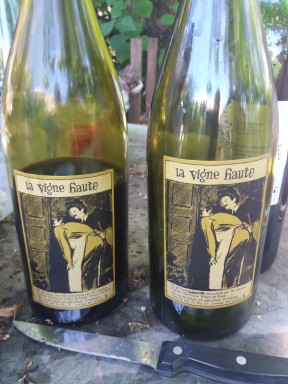
The last article described the ongoing problems in the Languedoc with mildew spoiling vines and grapes. Last Saturday Jeff invited me over to try and beat the blues a little. Steve from Besançon was staying with Jeff for a week to learn a bit more about being a vigneron. They had opened a bottle of La Vigne Haute 2013 on the previous evening and Jeff invited me over to try the last glass from the bottle.
When I arrived on the Saturday morning Jeff was spraying the Flower Power vineyard, Font D’Oulette. When he had finished we returned to his house and I had the remaining 2013, delicious it was too, still youthful but starting to add tertiary notes to the fruit. Jeff decided to open the 2010 to show how age helps La Vigne Haute to reveal its quality and depth; fruit, spice and leathery complexity. A bottle demonstrating perfectly why La Vigne Haute is my favourite wine of all. However, that was not the end. From his personal cellar emerged a 2001 LVH with no label. Still vibrant with fruit singing and yet more complexity of spice, classic black pepper notes. Simply excellent.
So, was that the end? Not at all. More Syrah from older vintages, 1998, 1997 and 1993. Each was still alive with black fruit and those spicy notes. The 91 was Jeff’s first solo bottling, a real privilege to taste it. He had added, all those years ago, a total of 5mg of SO2, pretty much absorbed now, and would certainly qualify as natural wine from a time when it was virtually unknown. A treasure trove of history as well as further proof of how well these wines do mature, there were no off notes at all. Indeed, they were delicious.
A 1999 Cabernet Sauvignon showed the quality of that grape from the region and how well it aged. There were still currant flavours, violets and more spice. A fresh acidity cleansed the palate. I hadn’t known what to expect, I was bowled over.
Legendary Roberta
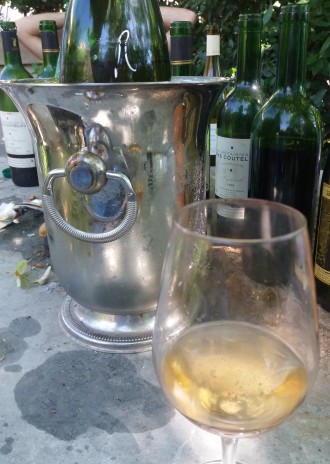
And to finish the 5 hour lunch a bottle of Roberta, the 2003 white wine made from all three Grenache grapes, one of Jeff’s first no added sulphite wines, aged in a special barrel which gives the wine its name. It is a treat I have tasted on a handful of special occasions, its nutty, round fruit was a perfect ending to a special day. Whatever 2018 brings this was a reminder of the special Coutelou wines.
After eight months away from Puimisson and the Coutelou vines it was definitely a case of being very happy to return. As I stood in Rome vineyard there was the chorus of birdsong, hum of insects, flash of colour from butterflies and flowers. A resounding reminder of why this is one of my favourite places on Earth, capable of making me joyful just by being there.
Rome
In Font D’Oulette (Flower Power), the vines are maturing well, many now sturdy and thriving in their gobelet freedom. The change from when we grafted some of them just two years ago is dramatic, perhaps more to me as I haven’t seen them since last October.
Grafted vine 2016, same vine now
In Peilhan and Rec D’Oulette (Flambadou’s Carignan) the roses were still just in bloom at the end of the rows but starting to wilt under the hot sun.
Carignan left and top right, Peilhan bottom right
And there lies the rub. The hot sun has really only been out in the region for the last week, it has been a catastrophic Spring. Rain has fallen dramatically, almost three times the usual level from March onwards after a wetter winter than usual. The annual rainfall average has been surpassed just halfway through the year. Moreover the rain was not in sudden bursts but steady, regular, in most afternoons. Vineyards all over the region are sodden, tractors and machines unable to fight their way through the mud making vineyard work difficult if not impossible. Even after a week of sun if I press down onto the soil I can feel the dampness on the topsoil.
Mix damp and warmth around plants and there is a sadly inevitable result, mildew.
Look again at the photo of Peilhan, zoom in on the wines at the bottom,
there are the tell tale brown spots.
This downy mildew lives as spores in the soil and the rain splashes them up onto the vines. Jeff had warned me of the damage which I described from afar in my last post. Seeing the tell tale signs of brown spots on the upper leaves on such a scale across vineyards all over the Languedoc is another matter though. All those vines touched will yield nothing (though some will still put them into production, so be confident of your producer). I have heard that some producers have effectively lost most of their vines for this year and similar stories from right across the region. Grenache seems particularly susceptible to mildew and it has been devastated at Jeff’s, the Maccabeu too.
Meanwhile Jeff has been struggling against nature, not a normal situation. He has sprayed all kinds of organic products from seaweed, nettles, essential oils such as orange and lavender, horsetail, clay. He has used the two natural elements permitted under organic rules, copper and sulphur. Jeff is particularly reluctant to use copper but such is the battle this year that it was necessary. Unfortunately like Sisyphus the task is uphill. He sprays, it rains and the effects of the spray are greatly lessened by washing it off the vines, so he has to start again. At least this week that is no longer the case and Jeff has been working all hours to save what he can, to roll that rock uphill once more. He is discouraged, even heartbroken to see the state of some of the vines he tends and cares for so much.
Dare I mention that now is the time when oidium, powdery mildew makes itself known? Please, not this year.
So, production will be down enormously this year, we hold out best hope for Syrah, Mourvèdre, Carignan Noir. Lower production means lower income too, so expect price rises and please do not complain as now you are aware of the reasons.
So happy returns? Well on a personal level yes. To see my great friend again, to have Icare waiting to be tickled, to see the good side of nature. But. This is not a happy time for vignerons across this region and it hurts to see my friends knocked about like this. Let us hope for northerly, drying winds, sunshine and no more disease so that something can be rescued this year, for Sisyphus to reach his summit.
It really is Flower Power now. Jeff sowed wildflowers and plants to help the soils of that vineyard retain moisture, ironic given the Spring.
It was always going to be the trip of a lifetime but, my word, it lived up to that billing. There are so many positives to Australia and New Zealand. I couldn’t help thinking that these young nations are energetic, vibrant and forward thinking in comparison to so much of Europe. Links with Pacific and Asian countries are to the fore and that will be their future though they retain a tremendous affection for their European links. The many people who were more than keen to talk with us were rightly proud of their countries, eager to find out about our trip and delighted to hear our enthusiasm. Positivity abounds.
The people themselves were such a highlight, as I have said before, they are helpful, polite and know how to enjoy themselves. The climate is obviously helpful in encouraging outdoor lifestyles, admittedly we were very lucky with the weather on our trip.
The wildlife was a constant joy, seeing kangaroos, koalas and kiwis in real life was just marvellous. Birds, fish and shark were stunning. Please look after them.
Above all though it was the joy of their natural landscapes which will live longest in the memory. These are jaw droppingly beautiful countries with such variety from coastlines, mountains, equatorial forest to the wonders of the Barrier Reef. Add on man made wonders such as Sydney Harbour’s Bridge and Opera House, I find myself smiling just thinking about them all.
Regarding wine. To be honest overall I was a trifle disappointed with so many wines and wine lists. The safe, conventional and commercial are everywhere. Perfectly drinkable wines but lacking excitement. However, dig a little and quality emerges. From Kalleske in the Barossa to Hans Herzog in Marlborough and Domaine Road in Otago I found conventional wines that were very good to drink. The highlights though were from the emergence of a natural wine scene in both countries. Kindeli, Cambridge Road and The Hermitage Ram in New Zealand were certainly highlights. Shobbrook, Sullivan, Tausend are names to look up in Australia.
In a way though I was spoiled early on. The Adelaide Hills was the source of so many of my favourite wines of the trip. There is a lively community of producers, supporting each other, who are making exciting, vibrant clean wines. Gentle Folk, Jauma, Manon, Basket Range, The Other Right are just some of the names to seek out. Add to that list the excellent bottles of my friend James Madden of Little Things wines. I am biased but his wines were amongst the best I tasted during this trip. The brilliant Chardonnay, refreshing PetNat, complex Field Blend were all in my top wines.
Australia and New Zealand have young winemakers looking to break with traditional methods. Behind the wave of producers in Europe perhaps but starting to create an impression and proving to my mind that there will be some wonderful wines to savour in coming years. It is no coincidence that most of these producers have worked in Europe, for example James at Jeff Coutelou’s. They will use that learning, adapt it to their local conditions to make their interpretation of Australian and New Zealand wines. I buy into their vision wholeheartedly.
Thanks to everyone we met for making the trip so special. Above all thanks to James, Sam, Flo and Pat for sharing their home with us and being so generous. And to Howard, a great chef, host and friend.
If I stick to wine this will be a short post. Through a mixture of bad planning and the need to do holiday activities which are not wine related there were no wine trips on North Island. The wines of Martinborough and Hawke’s Bay (with or without its apostrophe) were not untasted of course but we headed from Wellington to Rotorua and then the north coast missing out those two venerable wine regions. Another time maybe?
As I said I have tasted wines from both areas whilst here.
From Hawke’s Bay:
Craggy Range Sauvignon Blanc and Chardonnay which were both good, plenty of classic aromas and flavours with more concentration than most
Church Road Pinot Gris, pleasant though not world beating
Pask Syrah and Declaration Syrah both of which had good fruit and full flavours, the latter being more concentrated. A sign of how the area of Gimblett Gravels does add more depth
Te Mata Syrah was ok, typical of the grape though lacking the style and finesse of its elder brother Bullnose. Te Mata Coleraine was the first wine from New Zealand which convinced me that great wines could be made here when I tasted it a good 20 years ago.
The wine which stood out for me though, and I had 2015 and 2011 versions, was Stonecroft‘s Serine Syrah. This was my favourite red of the North Island by far and yet it is far from the most expensive. Good red fruits, complexity from some oak age and very persistent combined to make this a very good glassful and good value. Apparently it comes from the oldest Syrah vines in NZ and was once thought to be from Serine, a Syrah clone though this is not the case. Gimblett Gravels again and the 2011 had plenty of life even though this is not intended as a wine to age too long. I would like to find more of their wines.
From Martinborough
Schubert Syrah and Sauvignon Blanc which were fine, good examples of each
Palliser Riesling which was nice and tangy, good and dry
Escarpment Pinot Noir had good fruit and less sign of age than many other examples I have had in NZ
Parliament, the Beehive
However, North Island has been about the magnificent natural scenery and landscapes as well as the most friendly and attractive capital city in Wellington. The harbour, botanical gardens, cable car, Mt. Victoria and its views all make Wellington a perfect city to visit, its range of architecture and friendly greetings all add to its charm. Add in a magnificent national museum Te Papa with free entry including the outstanding Gallipoli exhibition, one of the best I have ever seen.
From there to the volcanic region of Rotorua, also showing many Maori villages and culture. Geysers, mud pools, hot water springs, steaming hillsides all have a mystery which captures the imagination and awes me.
The north coast of the Coromandel, Bay of Plenty and Bay of Islands are all superb, I have never seen a beach so enticing and beautiful as Cooks Beach whilst small towns and villages such as Whitianga as well as Russell (NZ’s first capital city) and Paihia on the Bay of Islands show colonial style architecture as well as charm, as long as the cruise ships have not landed! There were even some vineyards to look at too.
Finally I must mention Cult Wines in Wellington. I finally found some natural wines and this little shop has a good selection from New Zealand, Australia and Europe. We had a very good, juicy PetNat from Black Estate (Waipara) called Netherwood and a round no SO2 Pinot Noir from Escarpment (see above). It is interesting to see more domaines experimenting with making natural wines. These two were certainly successes. NZ’s fledgling natural wineries such as Hermit Ram and Cambridge Road were represented but travelling isn’t wine buying friendly.
Kindeli Otono, Escarpment Noir, Kindeli Verano
I did buy two wines from Kindeli which is the work of Alex Craighead. He has his own vineyards and sources more grapes, all from Nelson. Verano was a delicious, juicy, fresh field blend of Sauvignon Blanc, Pinot Gris, Gewürztraminer, Riesling, Chardonnay, Pinot Noir and Syrah. A deep rosé in colour it was very good. Otono is a blend of Gewurztraminer and Riesling, it is distinctly natural in style but the Gewurz violets come through and there’s a nice saline, dry lick to the finish.
I would love to have visited Hawke’s Bay but if you get the chance then New Zealand, both islands, are must visits. Wherever we have been has been spectacular in its own way.
The most famous wine region of New Zealand, Marlborough, is found in the north East corner of South Island. No less than 77% of the country’s wine originates from Marlborough, around the towns of Blenheim and Renwick in particular. Factor in the fact that 85% of Marlborough’s grapes are Sauvignon Blanc and we begin to see the importance of this variety to the reputation of wines from the region and, indeed, the rest of the country.
Certainly, the region is very different to Nelson, the focus of my last blog. There the vineyards are part of a much bigger agricultural scene, fruit orchards, hops, cattle and sheep mix with vineyards in the Nelson area to create a true pastoral landscape, e.g. in the Moutere Valley.
Journeying into Marlborough across the hills from Nelson the vines do not appear until shortly before reaching Renwick. But then vines stand, row after row, mile after mile. Wineries which put the country on the world wine scene stand side by side, Wither Hills with its many vineyards, Hunter’s, Villa Maria are all producers which played a major role in my personal learning about wine and, especially, wines from New Zealand.
The winery which first drew attention to and recognition of the potential of Marlborough Sauvignon Blanc was Cloudy Bay. Named after the beautiful bay to the East of the vineyards. This winery now produces a number of different wines but it was the Sauvignon which really made its name and established New Zealand as a quality producer. Cloudy Bay Sauvignon Blanc is also the long time favourite of my wife so a visit was obligatory.
Cloudy Bay itself
A very professional tasting room and comfortable garden allowed us to taste the celebrated Sauvignon 2017 which was classic Cloudy Bay but also the oaked version Te Koko 2014 which wears its wood ageing well. In addition we were able to taste a rare old version of the Sauvignon, from 2005. There was still plenty of acidity, the wine had become a little flabbier but had a dry finish. Not many bottles of 12 year old Cloudy Bay still exist I’d imagine, it was interesting to see that they do age quite well though I would drink any bottles younger. Pelorus NV sparkling wine and the Pelorus vintage 2010 (only available at the cellar) were both pleasant enough, the latter definitely had more weight and flavour. Chardonnay 15 was wild fermented in barrel (82% of it at least) and the oak was subtly done, a good example of the grape.
Herbicides and machine harvesting but a lovely setting
On to reds and the Pinot Noir 15 was very good, one of the best Pinots of the trip so far, fresh, fruity, juicy with good length. The Pinot Noir 2010 had already gone the way of so many older NZ Pinots, all forest floor and mushroom. It obviously appeals to Kiwis but not to this Rosbif. Neither did the Central Otago sourced Pinot Te Wahi 15, there was some rose scented fruit but this was very oaky and tannic, again not my style. There was also a very good Late Harvest Riesling, good Riesling notes, acidity balancing the sweetness.
Interestingly, Cloudy Bay has made the decision to reduce the varieties it uses. Riesling and Pinot Gris are out, they will concentrate on Sauvignon Blanc, Chardonnay and Pinot Noir alone. Cloudy Bay owns 50% of the vineyards it uses to make its wines and works with growers for the other 50%. This is common in the region, growers provide the grapes, the winery gives instructions on how they want the vines to be tended.
There are wineries which grow all their own grapes and I visited two, both organic producers. I had tasted Fromm wines before, notably a very nice Sauvignon Blanc La Strada 2016. On this visit we mainly concentrated on reds. Pinot Noir La Strada 16 was a little unforgiving to my taste, not much fruit showing. For once the older wine was more to my taste, the La Strada 10 being more open and balanced, red fruits and just a little earthiness. On to two single vineyard Pinot Noirs. Churton 16, more weight and concentration than the entry level, still very young and tight. Quarters 16 was different, more spicy and fruity, grown on more clay soils than the Churton. On to Syrah and I liked the La Strada 16 with its peppery, spicy notes and more friendly flavours. The Fromm Syrah 16 was more concentrated with rich pepper notes, quite tannic still, I am sure this will be very good. I must add that Syrah has been my favourite grape amongst red wines in New Zealand.
Fromm vines
Two white wines to finish, the highlight of the tasting for me was the Riesling Spätlese 17, well named being very much in the style of a Mosel spätlese, lovely apple fruit with zingy acidity and a lick of sweetness too. Finally, a Late Harvest Gewurztraminer 15 had classic aromas of the grape, spicy and floral but the wine had very fresh acidity cutting through the sweetness. Apparently this variety suffered in 2018 but I liked this wine, very well made.
My favourite visit of the day though was undoubtedly to Hans Herzog. The domaine is next to the Wairau river on one vineyard which the Herzogs have planted with lots of different grape varieties. They have planned this carefully so that sunnier aspects get grapes such as Montepulciano and Tempranillo whilst cooler areas are planted with white grapes and Pinot Noir. The plan makes for fascinating reading.
This is a biodynamic domaine and only a small amount of SO2 is added at bottling, these would qualify as natural wines for many people though I was surprised that harvesting is mostly by machine. There is a beautiful restaurant in the gardens next to the vines, with a splendid trellis supporting lots of different grape varieties and notes to explain each one. A treat for those, like me, who love to study ampelography. The food was very good too.
The Herzogs are Swiss and Hans comes from a family of winemakers of long standing. It was a young Swiss woman, Petra, who gave us a very generous tasting. Wild Gewurztraminer 2017 is named after its open fermentation and longer period on skins. It had vibrant aromas in the glass, spicy and dry flavours, a real treat and a sign of good things to come. Pinot Gris 16, 5 days on skins, was apple and pear notes, lovely and fresh.
Very ripe Roussanne grapes
The Sauvignon Blanc 15 was made on lees which are stirred and there was a yeasty aroma to the wine which was very dry and quite textural, one of those rare wines which actually tasted of …. grapes. Very good. A sparkling rosé wine to follow, Cuvée Therese made from Chardonnay and Pinot Noir with red fruit notes and a dry finish. Finally Gruner Veltliner 14, yellow in colour, pear and quince aromas and lovely texture and clean finish, lovely.
On to the reds. Pinot Noir 2011 was macerated 18 days on skins, aged for two years in bottle. My favourite Pinot Noir of New Zealand so far, fresh, vibrant spicy red fruit with a balancing acidity and complexity and gentle tannins. This is how Pinot Noir should be in my opinion. Tempranillo 14 was a lovely surprise. This is not a grape I usually like that much but this example was just lovely. The light red fruity notes of a young Rioja but without any oaky notes even though it was aged in barrels for 22 months. Energetic, lively, smashable. Spirit of Marlborough 09 is a Bordeaux style wine made from Merlot and Cabernet Sauvignon, aged 26 months in barrel and then more years in bottle. Again this would not be my favourite style of wine but somehow this works. Finally, and definitely worth waiting for, was the Nebbiolo 2013. Petra told us that this was the wine which is opened as a treat at the end of harvest, only one barrel was made. It is a stunning wine, easily my favourite in this New Zealand trip. Aromas of rose and fresh tropical fruits (yes in a red wine) and then, amazingly, hints of peach and apricot as well as red fruits. Light in the mouth yet with concentrated, long flavours. I loved this wine and was very impressed by the range, there is a real energy and vivacity in them. So different to a lot of the more commercial wines produced in the area and, hopefully, a sign that quality will win through.
1200 miles (1900km) in a week amongst some of the most beautiful scenery. Yes, a long way and with winding roads not a quick route but, my oh my, it was good.
We criss-crossed from Queenstown via Franz Josef to Christchurch, Hanmer Springs and then Nelson on the north coast of South Island. The Franz Josef and Fox glaciers were one of the main attractions and we did see them but we had the only day of heavy rain in a month and so could not get to them. Nonetheless the journey, through mountain ranges, rainforest and limestone valleys was spectacular.
Christchurch is a city recovering from earthquakes in 2010 and 2011 which caused 185 deaths and much damage. CCTV footage in the Quake City exhibition showed just how frightening things were. The Cathedral was the most prominent building to be damaged and it still stands looking forlorn, work will start in the next few months to take it down and then rebuild. Meanwhile an amazing ‘cardboard’ Cathedral is serving parishioners made from shipping containers, large cardboard rolls and plastic sheeting.
Hanmer Springs was a very relaxing spa village in the hills to the NW of Christchurch, we passed through part of the Waipara Valley wine region to get there. And, so, on to Nelson. A compact city with a central area containing restaurants and bars etc, I can recommend Urban for its modern, sharing tapas style but most of all The Cod & Lobster with an excellent value fish and seafood sharing plate.
Pinot Noir grapes still on vine
Nelson is a wine region but wine is not the only focus. This is a region of rich agriculture, fruit in particular, sheep and cattle too. Interestingly it is home to a rich tradition of growing hops for brewing beer and they have an excellent worldwide reputation. Wine is a relative newcomer to this farming and growing history but is making an impact already.
I have bought cases of Neudorfwine in the UK and have always rated them highly. It was therefore, a good opportunity to visit the winery in the hills to the West of Nelson. We tasted a few of the wines, it was very busy being Easter Saturday and their restaurant was doing a roaring trade in the sunshine. I must blame Jeff Coutelou for changing my taste in wines. I found the wines very precise and well made but I wasn’t excited by them even the Rieslings which I have always particularly enjoyed. The older Moutere Pinot Noir 2010 was richer and more fruity than many of the Otago Pinots of the last week. These are good wines, undoubtedly, probably not my personal style these days.
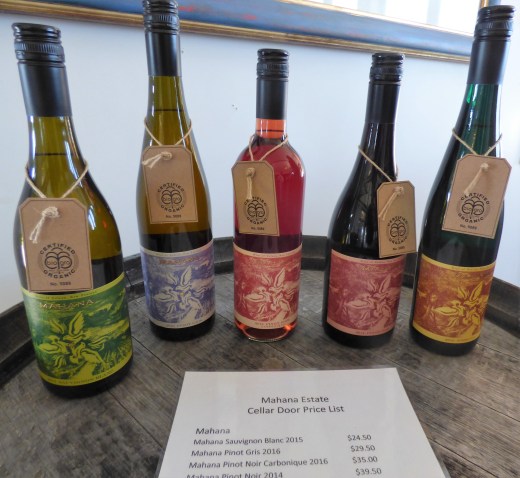
I also went to visit an organic producer, Mahana Estate, also in the Moutere hills. We tasted a good range of white and red wines as well as a Clairet style light red. The wines are unfined and unfiltered, made using biodynamic methods and only lightly sulphured at bottling. The wines had a freshness and energy which I have found lacking in many NZ wines. The estate is experimenting with techniques such as open fermentation to produce wines such as the ‘Feral’ white. The wines are made in a modern winery, complete with grassed roof and using gravity fed cuves. We ate a delicious lunch in the restaurant looking over the hills and the vines covered, as ever, by nets.
I tasted other Nelson organic wines from producers such as Greenhough and Richmond Plains which were quite pleasing but Mahana certainly hit the right notes more than the others, to my palate. Time to move on again, to the largest of New Zealand’s wine regions, Marlborough.


















 amarchinthevines