Any excuse to include some Bowie who is producer and piano player on the song which is also one of Jeff’s favourites.
Michel on top form
March 3rd was the last full day of the Spring bottling period and it was pretty much a perfect day in Jeff’s own words. The day was clear with high(ish) air pressure which is better for bottling and in the biodynamic calendar it was a fruit day with a descending moon, perfect too.
Checking the weather
The only snag was the late arrival of the magnum bottles despite being ordered some time ago. So, things started over an hour late, bottling magnums and jereboams of Vin Des Amis and a new Syrah cuvée.
Magnums
I had always assumed that a magnum being simply 150cl as opposed to the single bottle 75cl would be cheaper to produce, a bulk saving. However, the bottles are naturally more expensive, being produced in smaller quantities and they are filled by a slower machine rather than the usual bottling line. This takes more manpower too. So a magnum and other large formats do cost more, jereboams also need a larger cork. I like these large bottles, not just because there is more wine (good for groups of friends) but also the wine ages more slowly.
Jereboam corks
In place
Carton of jereboams
We had a relaxed lunch in the cellar, cheese, canned fish and charcuterie, the latter for Jeff, Michel and Julien. Naturally a few bottles were opened for quality control!
In the afternoon it was back to the main bottling line, helped by Catherine, for the Syrah cuvée and the new white wine from Peilhan vineyard, made from Carignan Blanc and Grenache Gris. The Syrah is lovely, I remember during the vendanges that the tank caused some of us some concern but Jeff always believed in it and …. he was right. Lovely dark fruits, fresh, mineral and long – almost as good as La Vigne Haute which is praise indeed.
Michel
Julien
The Blanc was, perhaps, even better for me, bright apple and pear flavours, very mineral, clean and pure. I do believe 2015 will produce some great reds from Mas Coutelou but that the white wines, often in the shadow, will emerge to take their place as stars in their own right. Jeff is confident that the Maccabeu is even better, there’s a long maceration blanc too. I have tasted them both and they are lovely wines in the making.
We didn’t finish until after 8pm, it was a long day but we had great fun, lots of laughs, great teamwork as well as the hard work. The bottling has been a success, the 2015s are proving to be even better than we thought – a perfect day.
Hand corking the jereboams
Lots of cleaning as always
How much is left Michel?
Then just as I thought days could hardly get much better, along came Tuesday, March 8th. But you’ll have to wait for that report in a couple of days.
There will be one more vendanges diary entry as the parcel of Muscat awaits, ready to make some sweet, delicious wine. However, after a month of work, the grapes are nearly all gone. Their juice lies quietly fermenting or sulkily just waiting in the tanks. So what have I learned from this month of effort? Well, reflecting on it I remembered last year’s vendanges and a video. Both are linked below. The title I used then seems, a year later, the right one so no apologies for using it again, though in French this time.
Now That’s What I Call Grapes 2015
The main feature has been the grapes themselves. It was not the easiest year for growing in terms of weather. Strong winds at flowering damaged some vines, a real heatwave for a month in June/July with months of dry weather too, then rain just as harvest began. There have been moments of doubt, it has been a slippery road as this Pézenas road sign suggests.
The berries were small and perhaps lacking in some acidity as harvest approached and then the rains threatened rot and damage. At times the tri had to be severe both in the vineyard and in the cellar. And yet. I remember beautiful bunches of Syrah, of Cinsault (almost 1kg in weight some of them), Cabernet Sauvignon and Muscat. In particular I remember some champion Carignan and magnificent Mourvèdre. Much needs to be done with vinification but, happily, the wines they produced are already showing the same quality, promising some great 2015s.
Syrah
Even when the juice was in the cuves it misbehaved at times, like naughty students in a classroom. There were moments when volatile acidity threatened and then when acidity was low. Through it all Jeff kept his head. And I recall his words at the time, “Il faut avoir la confiance en les raisins” / “You have to trust in your grapes”. No clever tricks, no resorting to sulphur dioxide to act as a safety net – just have faith that the work that has been done in the vineyard over the last years and recent months will bring healthy grapes which will make healthy wine. The pruning (taille), ploughing (labour), careful spraying at 3 in the morning – all of this effort leads to the grapes being able to produce high quality wines. Like a winner of the Tour De France you don’t just turn up on the day, it takes months of planning, training and hard work, so too the vigneron who produces top quality wine. And that faith has been rewarded, any problems have sorted themselves out, with a guiding hand from time to time.
Taille (February)
Labour (March)
Filled cuves containing the 2015 wines (September)
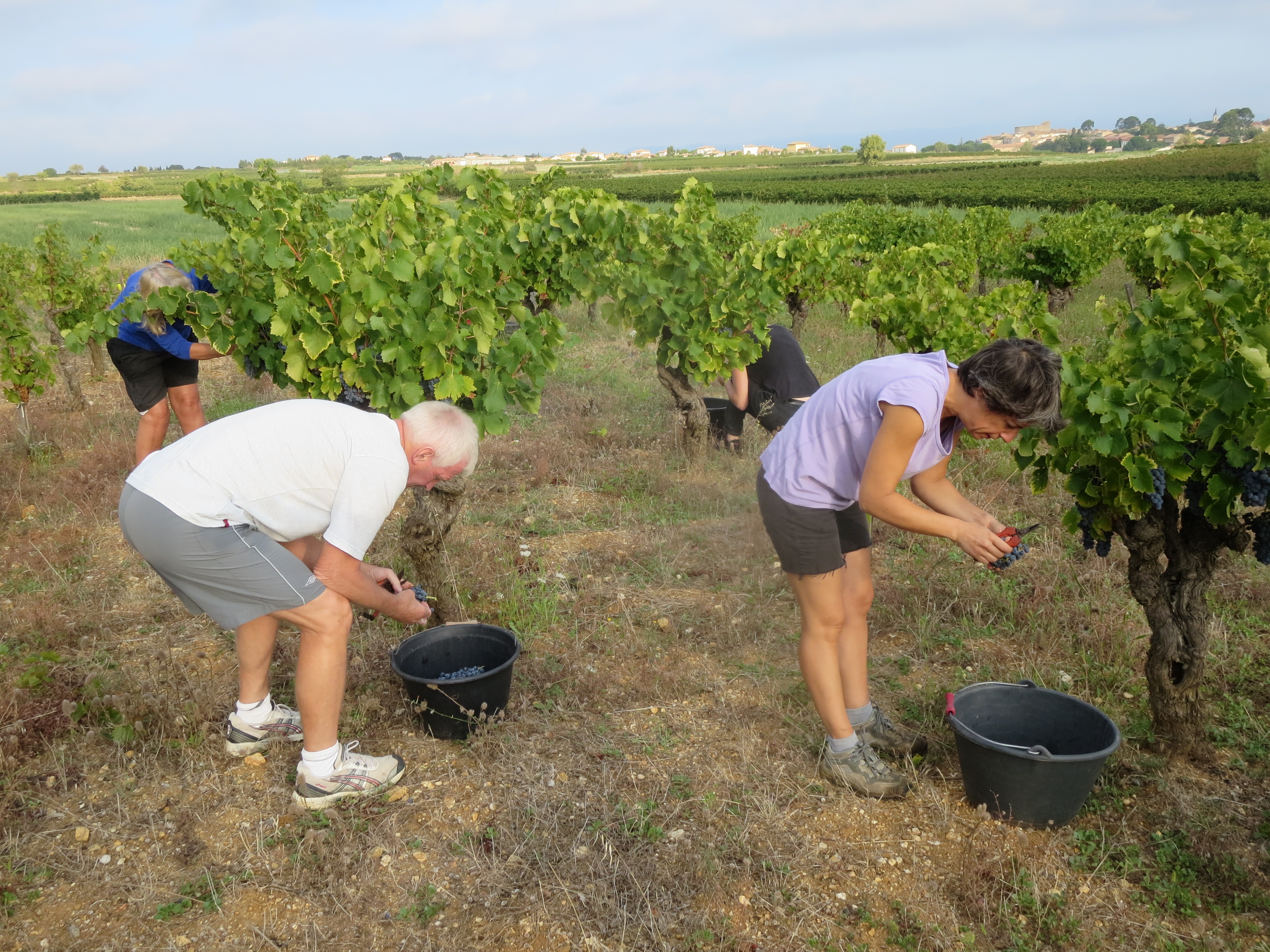
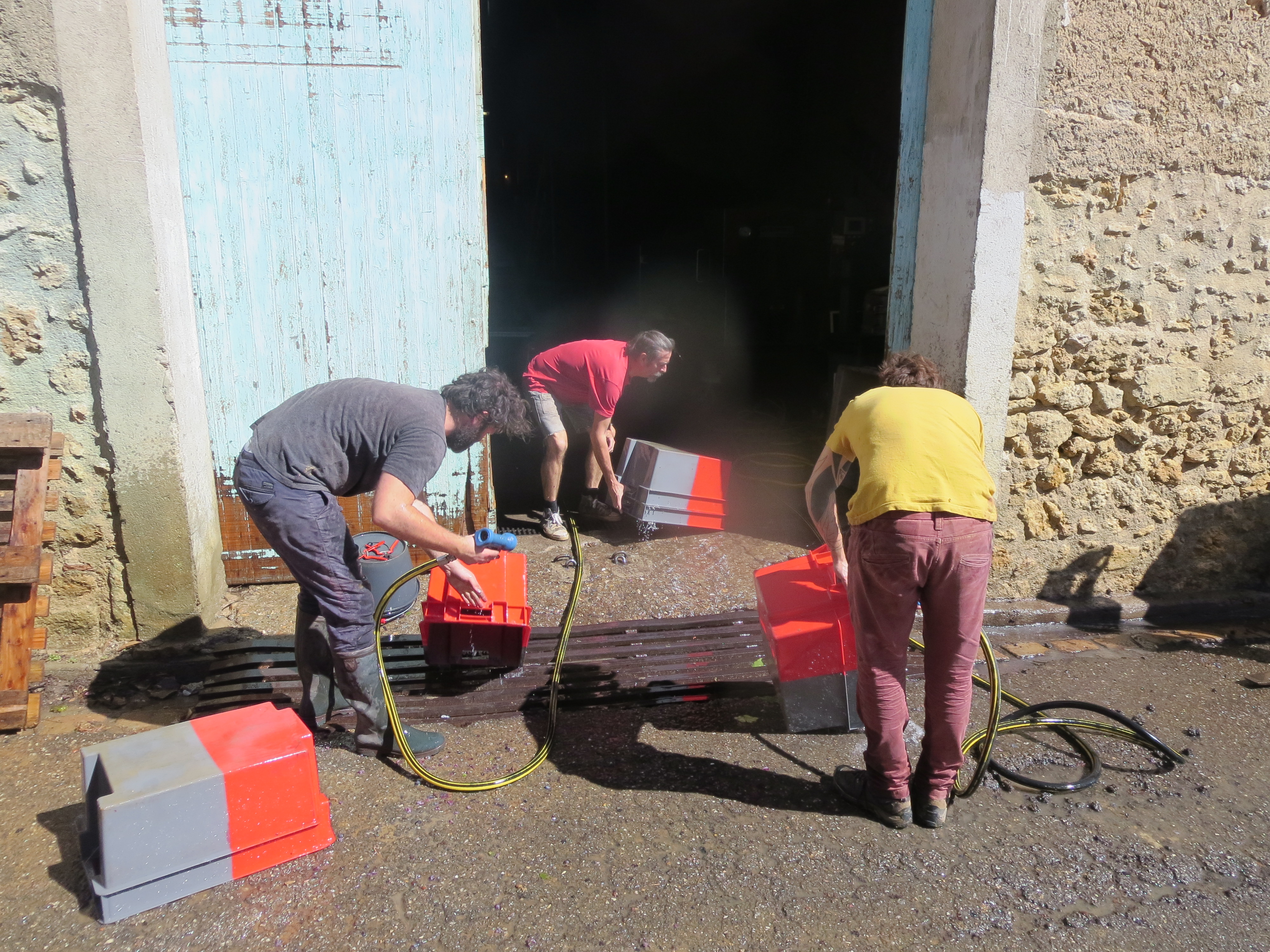
That means hard work and this is the second lesson I have learned. The vendanges are hard work. There is a glamour to them. As an enthusiastic wine amateur I often used to think how nice it must be to take part in the harvest. Sunshine, grapes, drinking wine – idyllic. The reality is all of those things but it is not all idyllic; it is back breaking, physically gruelling, hard work. Picking means bending over vines, insect bites, whilst trying to not cut your fingers instead of the grapes. In the cellar, long hours of standing to sort grapes, lifting and carrying heavy cases and twisting around with them, sometimes in confined spaces. The heat above a tank is tiring and sweaty. The drenching as you clean everything again and again. And I worked less than most. Add in all those hours of vineyard work, the background work in sorting the equipment, labour, paperwork and then the pressure of making the right decisions – you have to love this job to make a success of it.
Bent backs (Martin and Céline)
Standing for long hours while sorting (Karim and Cameron)
Twisting to lift a cagette (Michel)
Confined space, hot, back breaking – Thomas, Cameron
Soaked, Cameron, Michel and Thomas cleaning
And love is the third and final part of my lesson. The love which Jeff has for his vines and his commitment to making them the best they can be in order to produce the wines which people around the world will love. It is no coincidence that during the harvest we welcomed many friends who arrived to spend a few days with us, to play their part in the vendanges. They do so because they love the wines and they are friends of Jeff. He makes his wines to share, the best wines are those which you share with other people. Le Vin des Amis! Copains! the names of the cuvées tell a story.
Remember the story of the Chaud Doudou from last harvest? Well, I have been lucky to share the experience of the vendanges with a fantastic group of people over the last month. The camaraderie and friendship are part of the process of making the wine. And that spirit vanquishes any aches and pains.
My boots join the team (a proud moment)
Happy times
So, grapes, work and love. And if you don’t believe me, have a look at the video on this link to the excellent #QCQBM website. It is in French but the message is clear. Grapes. work and love.
The storms which brought so much rain to Puimisson and the Languedoc on Saturday meant that there would be no picking on Monday or Tuesday the 14th and 15th.
Preparations for cellar work
Instead Jeff, Michel and Cameron were hard at work in the cellar for the two days. There is lots to do there so it was an opportunity to get everything on track. Lots of remontage, sous tirage etc. On Monday the 14th the Syrah which was to be made with carbonic maceration was pressed after its few days in tank with the fermentation inside the skins.
The Syrah being pressed
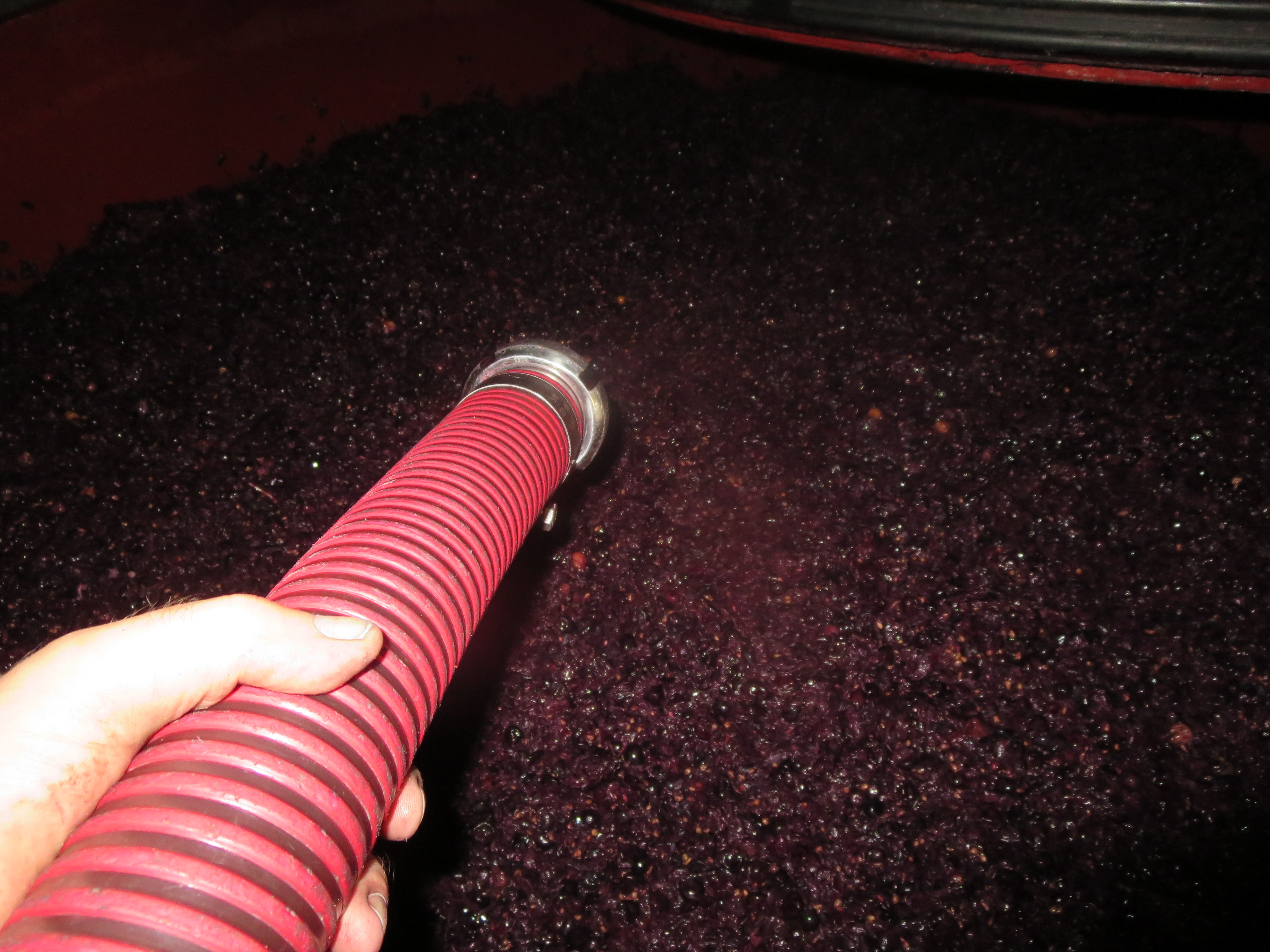
The video shows Michel in the cuve moving the grapes to the front where Jeff forks them into the pump. You will see the grapes moving through the pipe into the press.
By Wednesday 16th the weather had turned much clearer and good winds meant that the grapes and soil were beginning to dry out nicely and so picking recommenced. The centre of attention was Rec D’Oulette known locally as Chemin De Pailhès and the Carignan grapes which grow there. These are the grapes which make the excellent cuvée «Flambadou», perhaps the outstanding wine of 2013 (and Jeff tells me of 2014 too). The bunches which arrived were excellent in quality, so fingers crossed for another great wine.
Picking the Carignan
Carignan
The Carignan in tank
Analysing the Carignan
Meanwhile cellar work continued as Cameron carried out more remontages and analyses. Today one of the wines to be moved was the Merlot which was bright, fresh and colourful.
Délestage of Merlot
As each wine is moved around the cellar, for example to take it off its skins, each cuve has to be cleaned thoroughly and then it will be filled with another set of grapes or fermenting wine. There is a seemingly never ending merry-go-round of wines and quite how Jeff keeps track of them all remains a mystery to me. Each move has to be planned to ensure that cuves are available, cleaned and big enough.
Cleaning from the inside
As a former teacher it reminds me of planning a timetable fitting in students, teachers and classrooms into the correct combination. Add in working as a mechanic to keep all the machines ticking over and the work of a vigneron becomes more complex, the job description is long.
Maintenance of the égrappoir
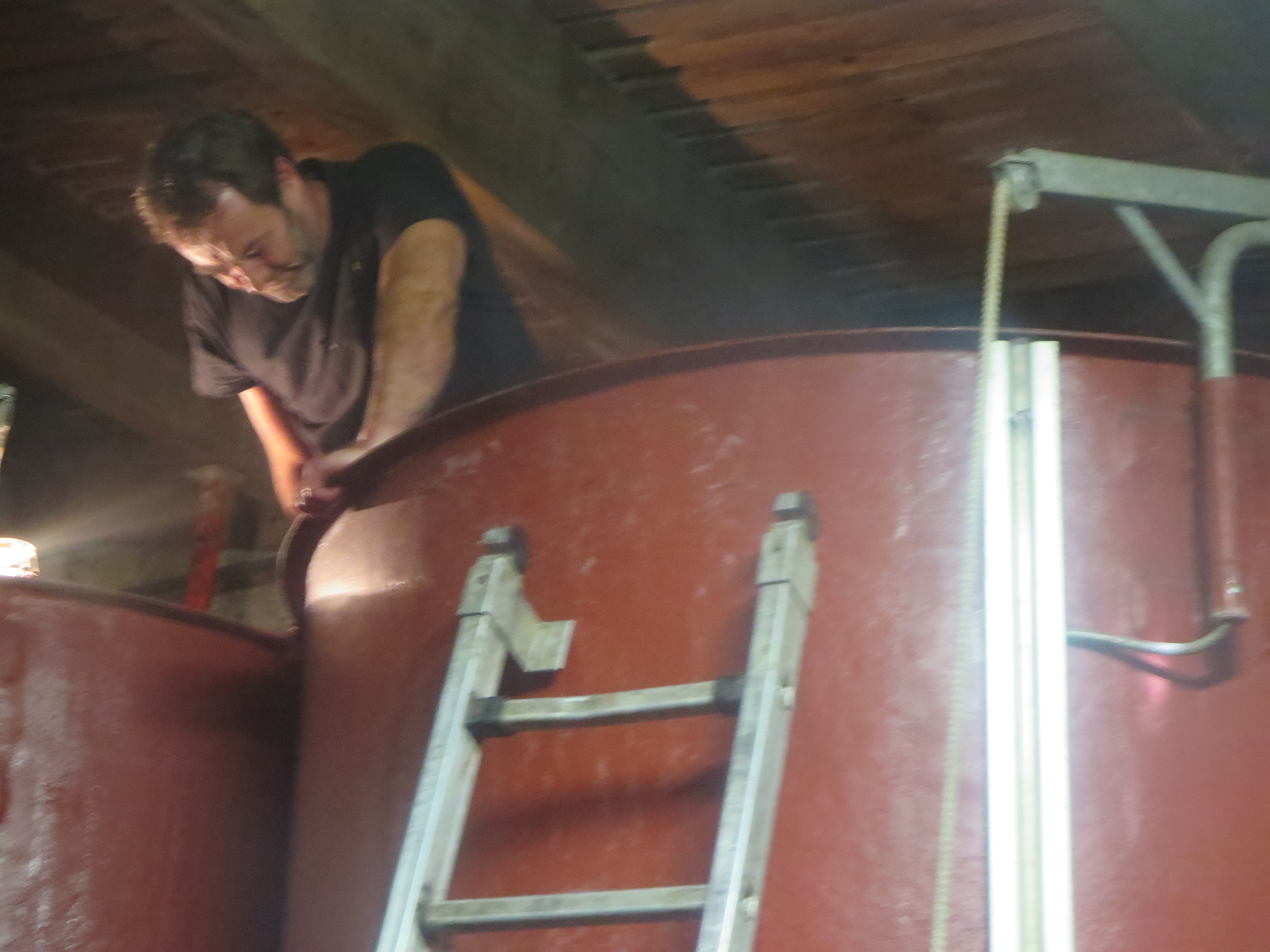
Thursday 17thbrought Grenache from Sainte Suzanne (Metaierie), again carbonic maceration was to be used so back to the top of the cement tanks. Thomas was back and he, Cameron and I shared duties up there filling the tank.
l-r Cameron, Michel and Thomas
Then cleaning of the cagettes ready for the next new cépage. Following the Carignan of Wednesday it was time to harvest the Mourvèdre from Segrairals. One of my favourite grapes, somewhat fickle in character but when grown by good producers it adds a complexity and depth with a hint of dark mystery. The bunches which arrived were certainly amongst the best of the whole harvest at Mas Coutelou.
Magnificent Mourvedre
They were clean, big bunches, the grapes with thick skins and smelling already of spice and blackcurrants. Some of the bunches were very heavy and it wouldn’t take many to produce a bottle of wine, on average you need about 1.25kg of grapes to make the 75cl of a normal wine bottle. Sorting was quick and easy, the pickers had done a good job and the fruit was in such good condition. I look forward eagerly to finding out what Jeff has in mind for these grapes, when I have asked he simply smiles mysteriously, something is afoot!
Friday 18th brought the rest of the Mourvèdre still in tip top condition. When the pickers reached some of the lower parts of that parcel the quality did begin to dip a little so these bunches were taken away to be used separately, possibly for a rosé wine. I say possibly because final plans are a long way from being ready. Other jobs included pressing the Cinsault grapes which will make a rosé (definitely!!) and more remontages and analyses.
Remontage
We were joined today by Charles, a young Frenchman who works in a restaurant in Berlin, and whose mother was a former colleague of Jeff when he was a teacher in Paris. Coincidentally his boss in Berlin was a student of Jeff! Charles added a real sense of fun and worked hard.
Charles fills the press
By Saturday I was ready for a rest and so the 19th was the work of the Jeff, Michel and Cameron as they processed the last red grapes from Peilhan. Some of these will be used for blending but amongst them was the famous Castets. This you might remember is a cépage produced by only two winemakers in France, Chateau Simone in Palette and Mas Coutelou. The first harvest was in 2014 and we had watched eagerly its development. In fact we have been drinking some during harvest lunches and it is very promising, brooding with deep, dark fruit flavours and a freshness to lift it. Only 3hl was produced again this year, the same as last year.
Castets in tank
On Sunday 20th Jeff carried out a débourbage of the Cinsault rosé which was pressed on Friday. Débourbage means taking out the pips and skins etc to leave the juice on its own. The harvest is starting to slow down a little though much work remains to be done in the cellar. Jeff and the ‘Coutelou Gang’ will have certainly benefited from a little siesta in Sunday.
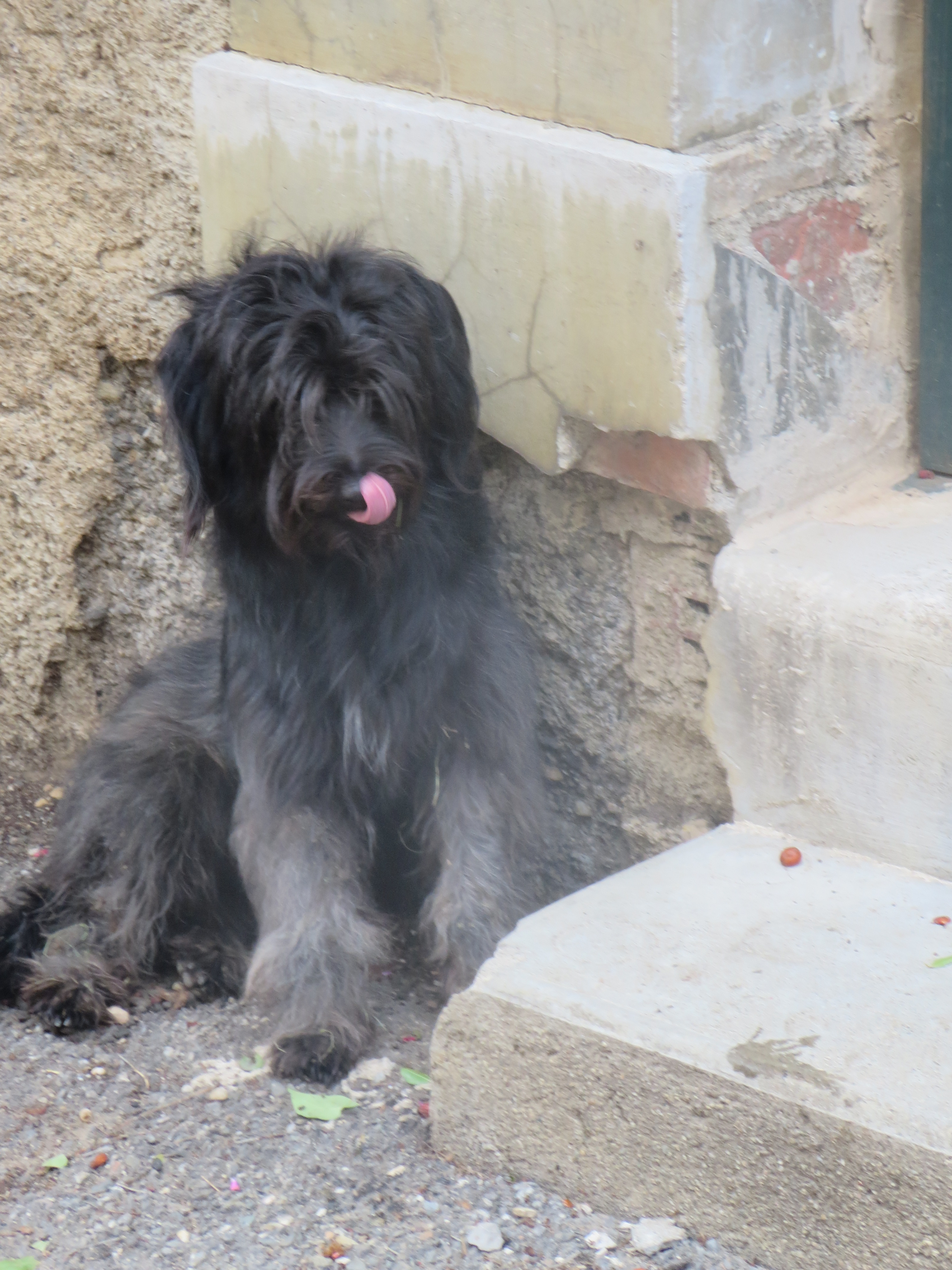
Icare licking his lips at the great wine being made (maybe)
Wednesday September 9th saw further full on action. The early morning saw the only machine harvesting of Mas Coutelou grapes. This took place in La Colombié the parcel of Merlot vines. These are grapes that don’t especially interest Jeff in terms of making a domaine bottled cuvée but the quality of the fruit is good and they are used to make restaurant house wines and bag in box wines.
The Merlot vines after picking
After that attention turned to La Garrigue, the conical landscaped vineyard to the south of Puimisson. Much of the Syrah had already been picked the previous day and the remaining bunches were harvested. These were to be used for carbonic maceration again and so it was back to the top of the main cement tanks to work, not the easiest place.
Thomas working with Cameron sorting Syrah
Tuesday had seen the arrival of two new faces to support the team as I described in Vendanges Diaries 4. Thomas was working with Cameron in sorting the Syrah whilst Karim assisted Michel in ferrying the cagettes to and fro. The team usually rotates these jobs so that people get the opportunity to try all aspects of vendanges as well as the chance to stretch your back and legs!
Karim and Michel seem happy
Then it was time to bring in the Grenache of La Garrigue. Grenache is a cépage of Spanish origins and loves the heat so it is planted on this parcel on a slope to the south to maximise the sunshine exposure. The result here was some beautiful bunches of very healthy fruit, easy to sort and giving aromas of spice and dark fruits even before it turns into wine.
Gorgeous Grenache in La Garrigue
Grenache grapes in the sunshine
Cellar work continued with Cameron carrying out analyses of the fermenting wines. It is worth noting that the natural yeasts of the grapes have been very quick to start fermentation in tank. After a couple of hours of crouching over the tanks in the morning I was happy to be stood at the égrappoir and then to help Cameron with remontages.
Cameron tying himself in knots
Me doing a remontage of Flower Power
Cameron and I doing a manual pigeage of the macerating white cuvée
And of course….
Thursday 11th September continued the harvesting of the Garrigue Grenache and then Cinsault from the opposite end of the village, to the north. More good quality fruit and more hard work from the whole team.
More gorgeous Grenache
The pressure was on however, the weather forecast was unkind with the promise of storms possibly on Friday, definitely by Saturday. Therefore the more grapes that could be harvested before the rain the better. It was full speed ahead though no let up in terms of sorting the grapes and ensuring the quality of the future wines. We were assisted by the arrival of Céline and Delphine the nurses from Bordeaux who I mentioned in ‘Centiment de Grenaches’.
Cinsault being pressed
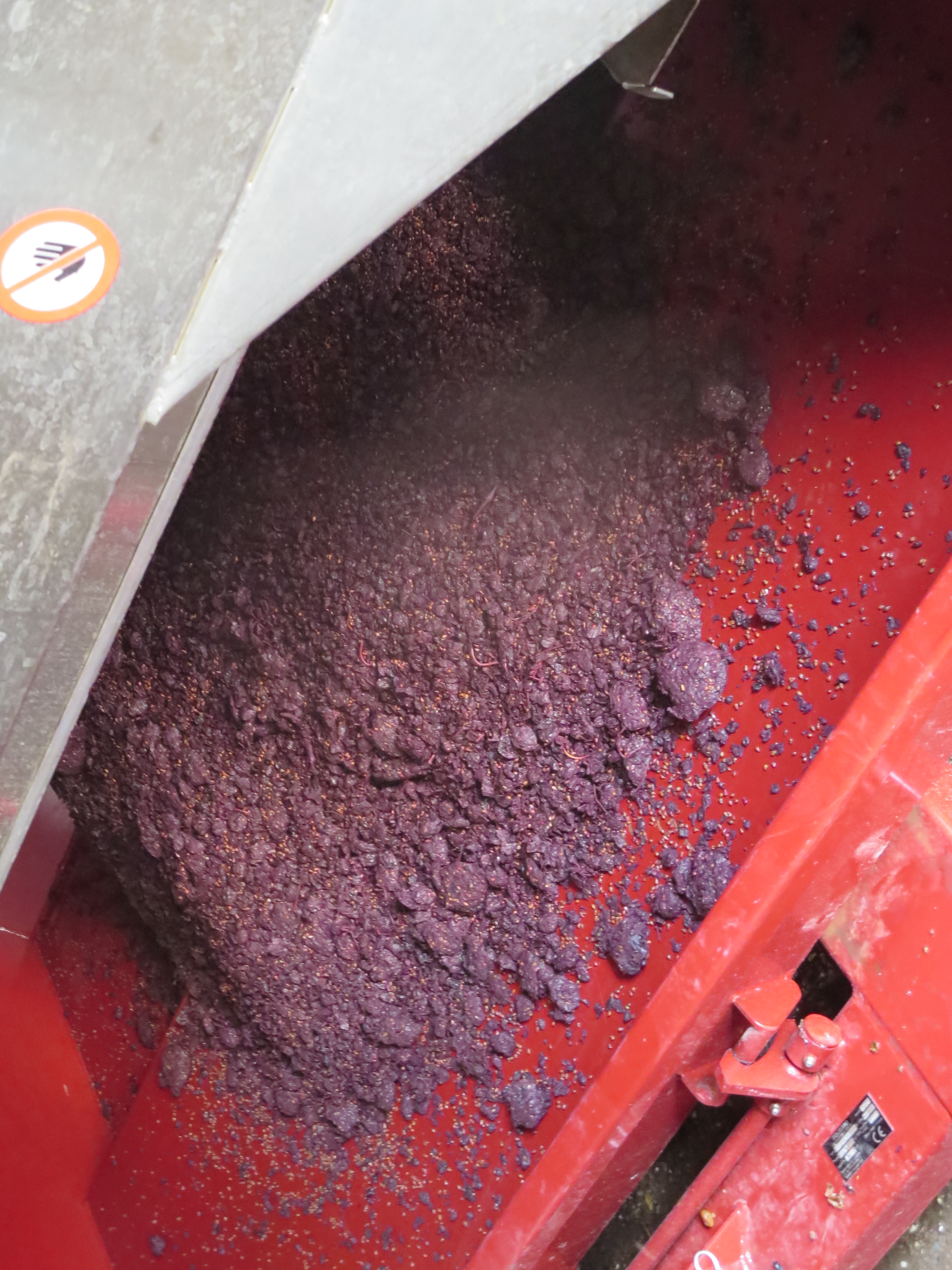
Must after pressing
There was a famous advert in the UK for tinned fish by a company called John West which said, “It’s the fish John West reject that makes John West the best”. Well that works for Mas Coutelou too. The Moroccan pickers by now were much more attuned to the strict quality demands of Jeff and were sorting the fruit, leaving any substandard grapes on the ground. Then the sorting in the cellar to check anything which did manage to get through that first tri. It’s the grapes Jeff Coutelou rejects that make Mas Coutelou the best.
Rejected Grenache
Friday September 11thwas the day of Centiment de Grenaches, the special cuvée Jeff suggested I make to celebrate the 100th blog post. Meanwhile more Grenache was being brought in for the regular cuvées, work continued apace as the clouds started to gather as predicted.
The night of Friday into Saturday brought 45mm of rain (almost 2 inches) as storms rumbled around the Languedoc. Amazingly some areas had next to nothing, Cabrières for example, whilst rain caused floods and the subsidence of the motorway a few kilometres away near Lodève. The 45mm at Puimisson meant 93mm in total since the start of the vendanges. That makes things more difficult of course as water covered grapes can’t be harvested for quality wines (though I noticed some harvesting in some other vineyards!). The ground is also muddy so picking becomes difficult and the biggest issue is the risk of disease and rot.
Work was therefore centred in the cellar with more remontages and analysis. The wines are now settling and need to be moved to take the juice off the skins and pips, to be pressed if made by carbonic maceration, to let them settle. Therefore the 12th and 13th were hard work as usual for Jeff, Cameron and Michel. Though you will see that it is Icare who is driving the team onwards.
This was the busiest week of the vendanges and required long hours of picking, sorting, pressing, remontage as well as lots and lots of carrying, lifting and often in confined spaces. In short it was hard work.
Why so busy? Well, Syrah which was the first of the red wine grapes to ripen makes up around a third of all the vines at Mas Coutelou and Grenache, the next to ripen, is also the next main cépage with up to 12% of the harvest. Together this meant that around half the 2015 harvest would be picked this week. Add in other smaller picking and the parcel of Merlot and this was definitely the crunch time.
Sunday September 6th was a day of rest for most but Cameron and Jeff were in the cellar working as usual, carrying out checks and analyses and remontages as necessary.
Monday 7th was a long day at work. It was around 8.45pm before we stopped. Syrah in Segrairals makes up around 2ha in total, though as with all land there are some prime areas whilst other vines, around the edges and in a few hollows where water gathers, are not of the same quality. In a typical year these would go towards cuvées such as Classe and 7, Rue De La Pompe but, as ever, plans are fluid.
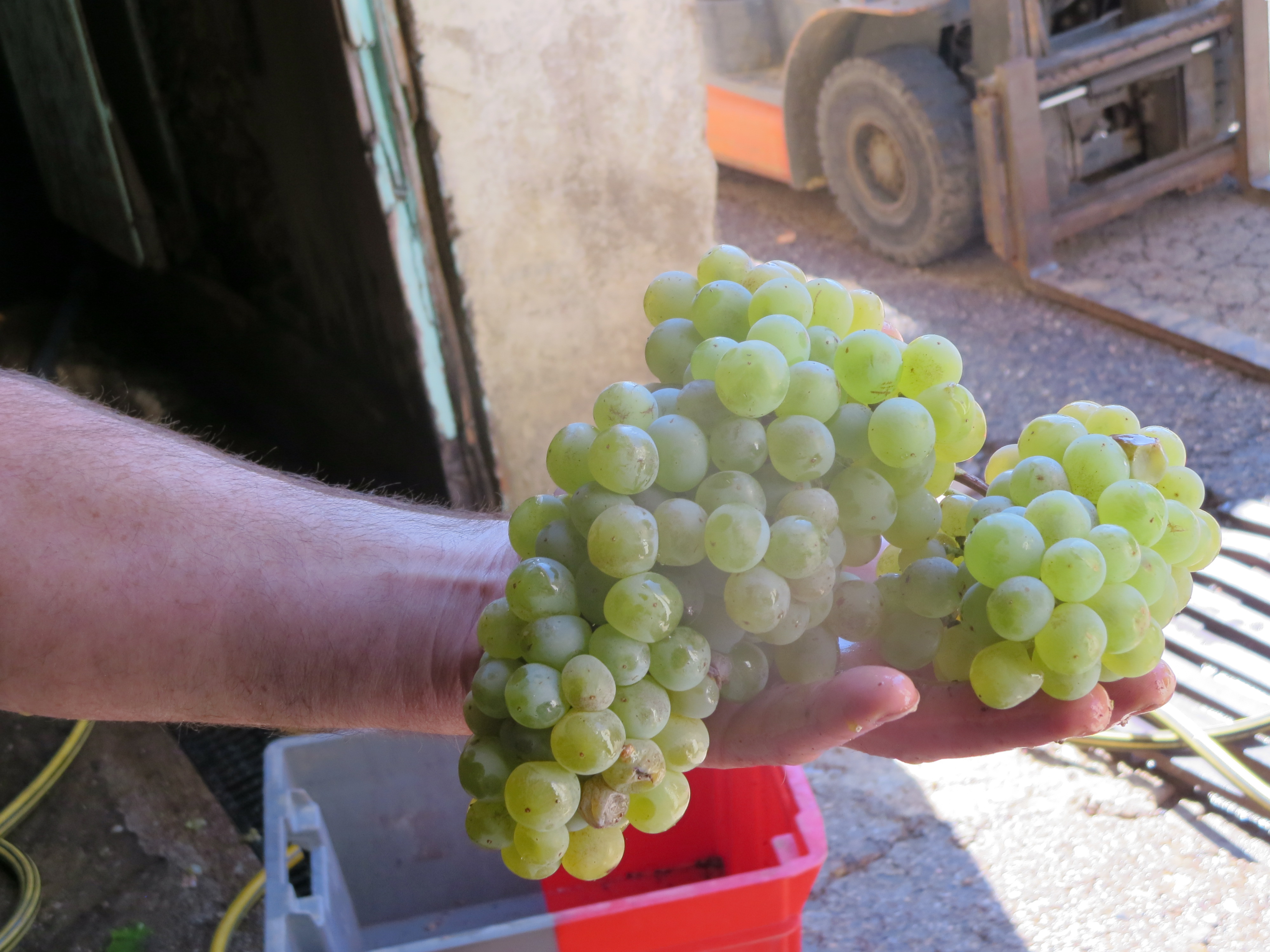
Superb bunch of Carignan Blanc
In addition a parcel of Carignan Blanc was harvested from Peilhan vineyard. There were some wonderful grapes and they were given special treatment, carefully sorted and then pressed using the small hydraulic press. The juice ran very clear and green and then gradually took on a slightly brown colour as it developed light oxidation. This is actually good as it helps to protect the juice later in its life and prevents damaging oxidation. Moreover, the effects of the oxidation from the pressing are removed through fermentation. Around 600l were produced in total, around 750 bottles worth. This makes a very good wine, something I was to be reminded of on Tuesday night, as we shall see.
This was a long day but much good work had been done.
Tuesday 8th brought more Syrah to the cellar, this time from La Garrigue. These are the vines I have described before which face north on a slight slope to preserve the freshness and fruit flavours, good quality grapes which are often used for my favourite cuvée, La Vigne Haute, so I was even more keen to help to sort carefully and there were some lovely bunches of healthy fruit. Here’s hoping for a good vintage of LVH, as ever Jeff will make the call.
Cameron unloading some Grenache Gris
Yet again another smaller harvest was done, again from Peilhan, this time with Grenache Gris. The lovely pink, grey berries are flexible in their use and might produce, white or rosé wines or be added to red wine as you will remember from my special cuvée post.
Grenache Gris after being pressed
Meanwhile lots of analysis of the wines in tank and work to ensure that they are in good health. This even involved Jeff removing his trousers and jumping into the Flower Power tank to do some pigeage! Modesty means that I shall not share these photographs!
Cameron getting a sample for analysis
The after effects
And of course there was plenty of this… (I couldn’t resist adding the tune)
Error
This video doesn’t exist
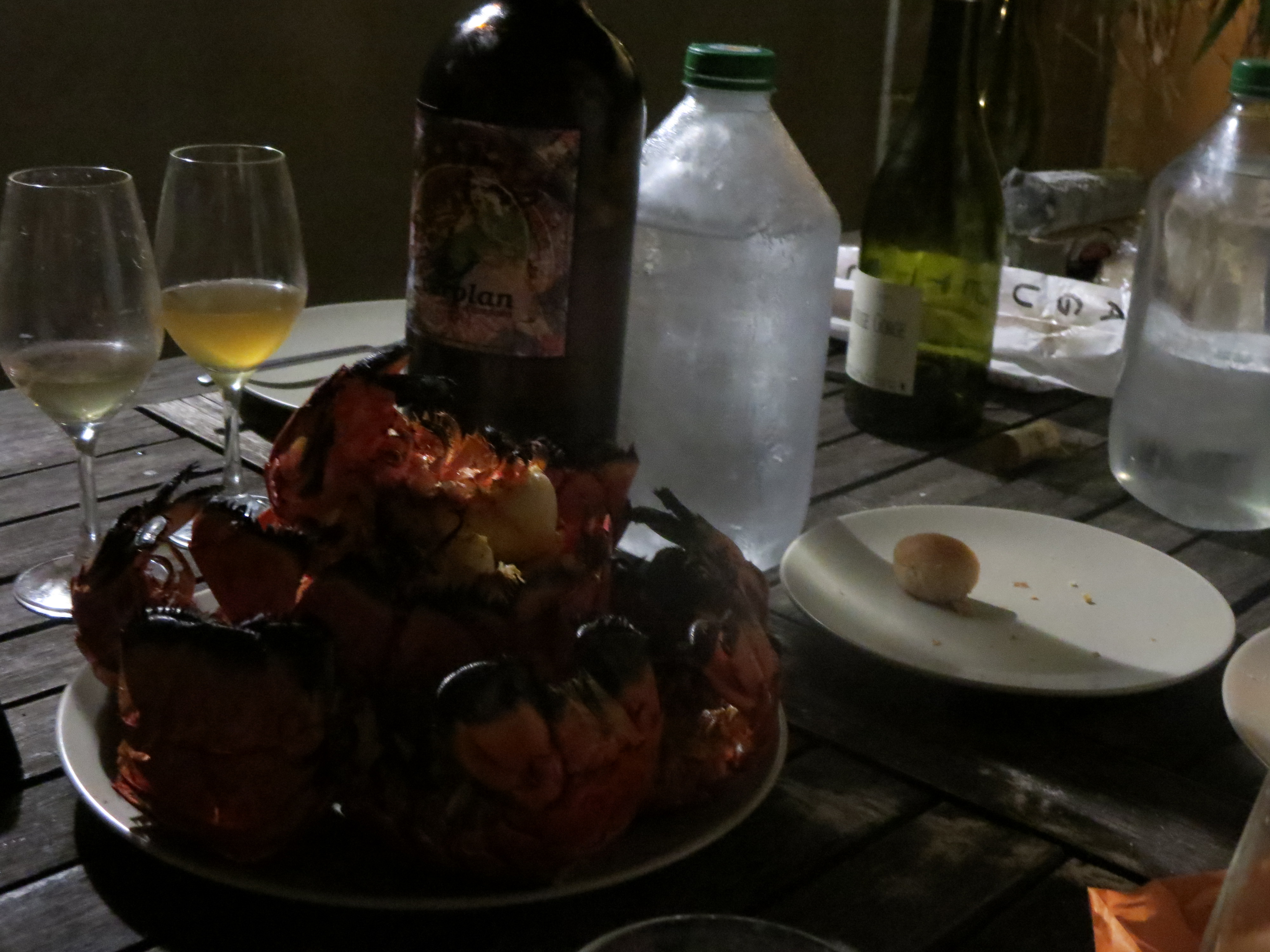
A bonus was to come though. We had been joined by two new additions to the team. Thomas is from Toulouse originally but has been working as a sommelier in the Languedoc and spent most of the week with us and will return next week. Karim is a fishmonger from Tours with an extensive knowledge of natural wines. He spent the week in Puimisson and brought a lovely surprise in the form of lobsters and scallops which made a wonderful dinner on Tuesday as Karim is also an excellent cook. We shared a magnum of Casa Pardet Chardonnay to accompany the shellfish as well as two Carignan Blancs, one from Mas Coutelou and the other from Jeff’s friend Cyril Fahl of Domaine Rouge Gorge in Roussillon. It was a special and hugely enjoyable meal, thanks to Karim and Jeff for the food and wine.
The harvest (vendange) began on Friday August 21st with a small parcel of Muscat grapes as described here. The next few days saw further preparations for the main harvest, for example clearing space in the barrels of the solera system for this year’s grapes. I shall write more about the solera later in the year.
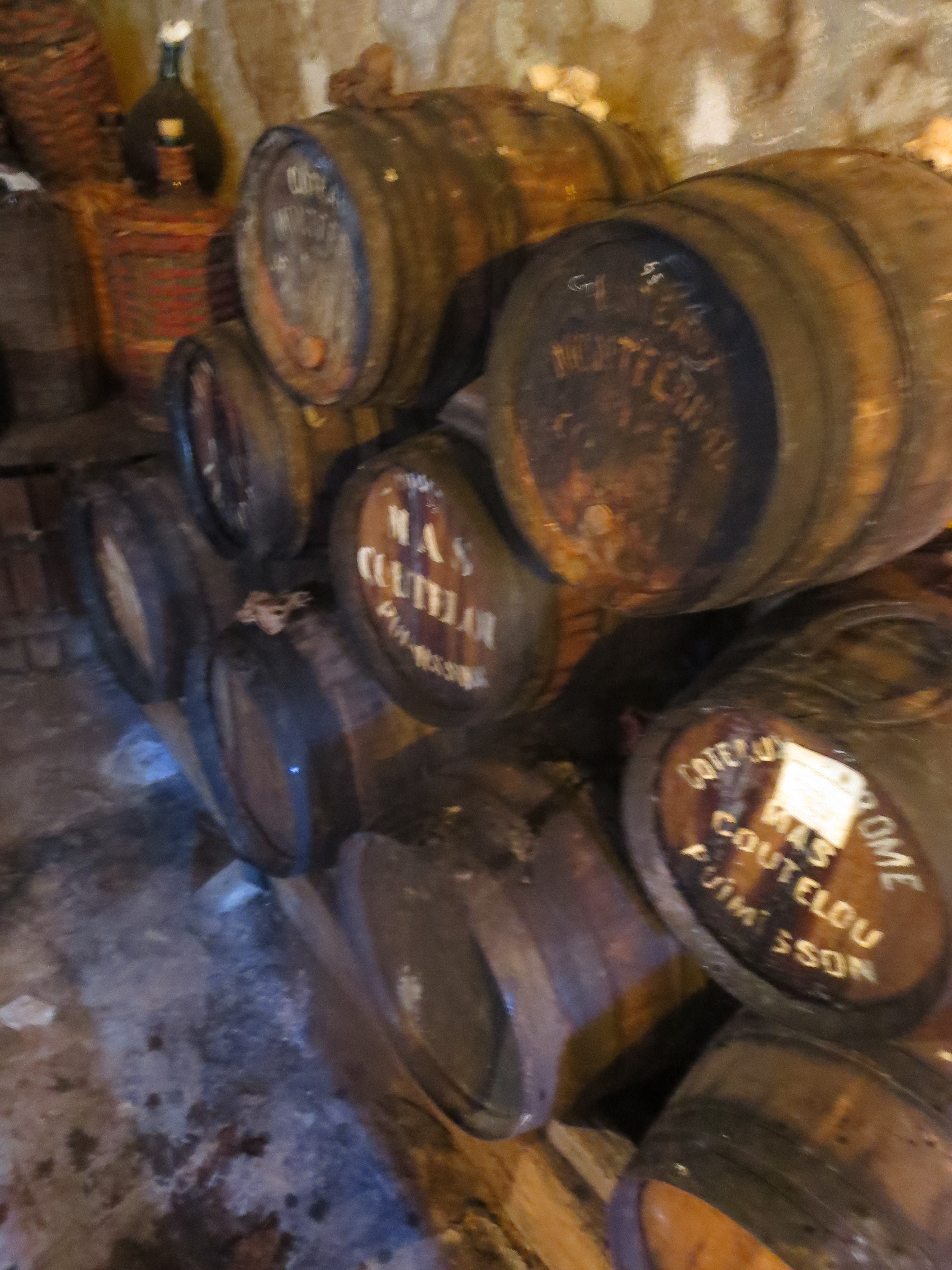
Solera system
So, it was Thursday 27th which was the start of the real vendanges with parcels of white and Syrah grapes collected from La Garrigue. This day was described here.
Friday 28th saw more Syrah being harvested, this time the Syrah of Metaierie usually referred to as Sainte Suzanne by Jeff. This is the vineyard of Vin Des Amis though options are always open. The pickers, led by Carole and Julien, worked through a cloudy morning to collect some high quality bunches.
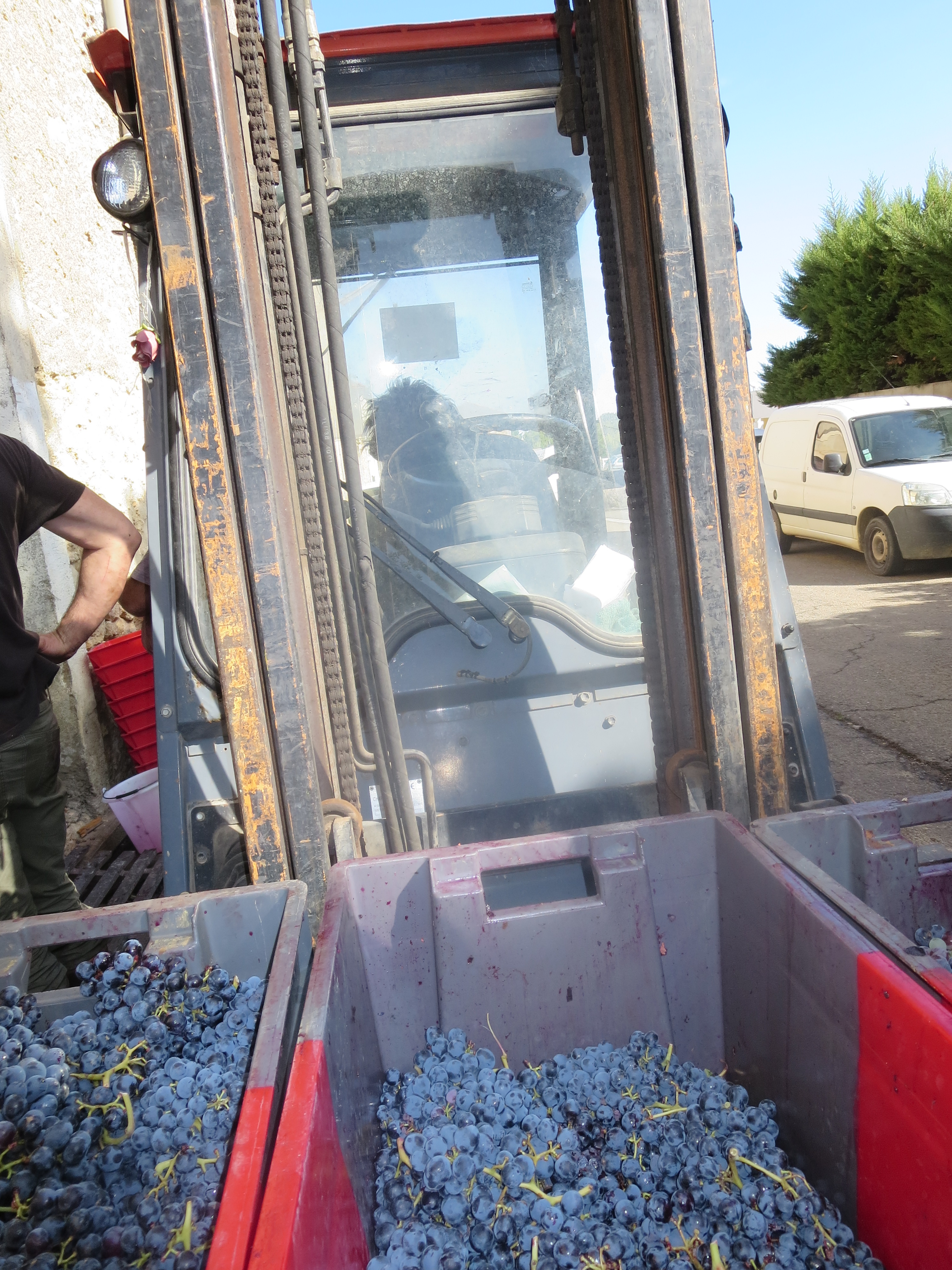
Michel transported the cagettes back to the cellar as quickly as possible. The cagettes are about two thirds filled so as not to overload the grapes in there which might damage them.
No, these cagettes are not full!
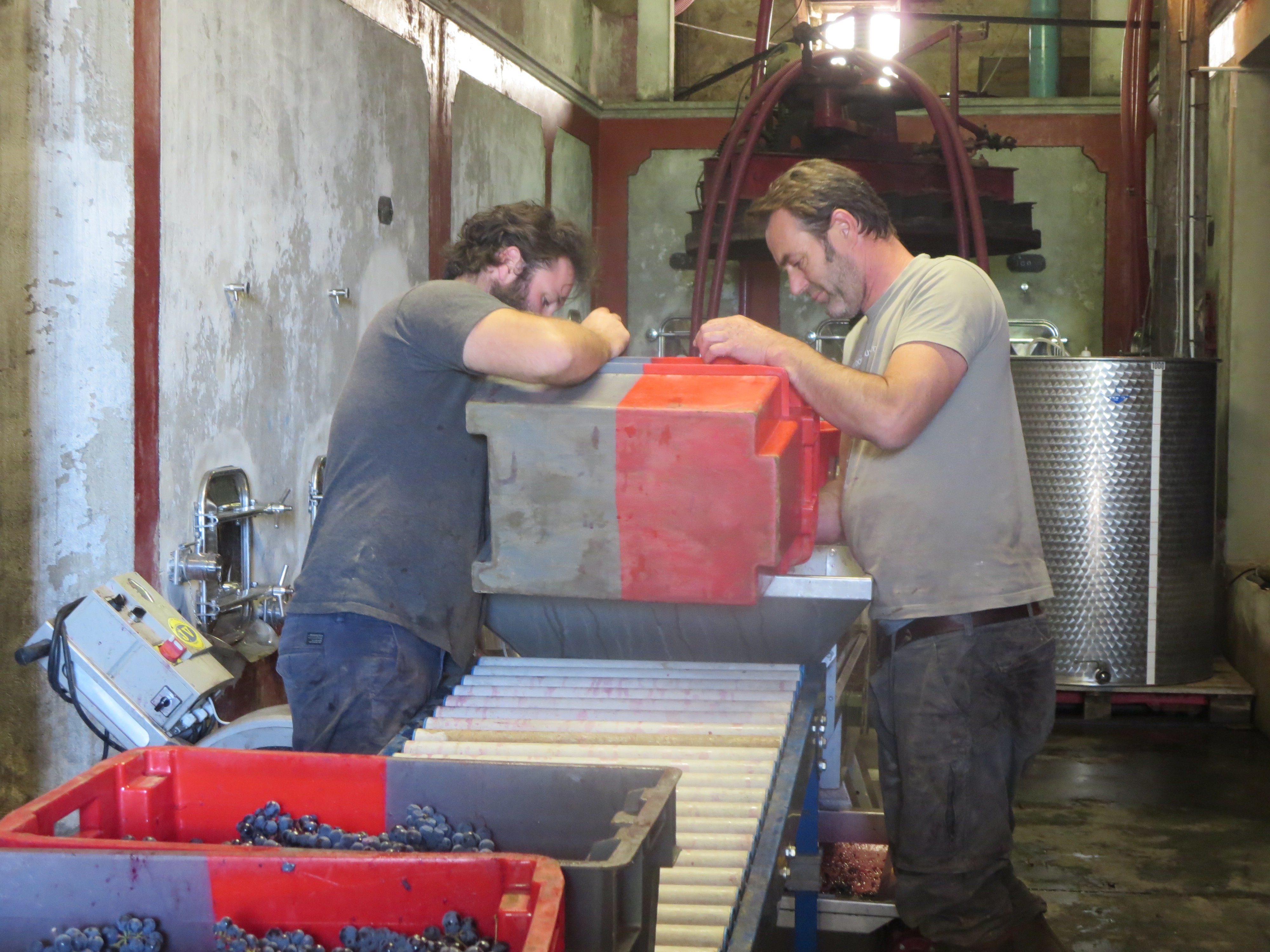
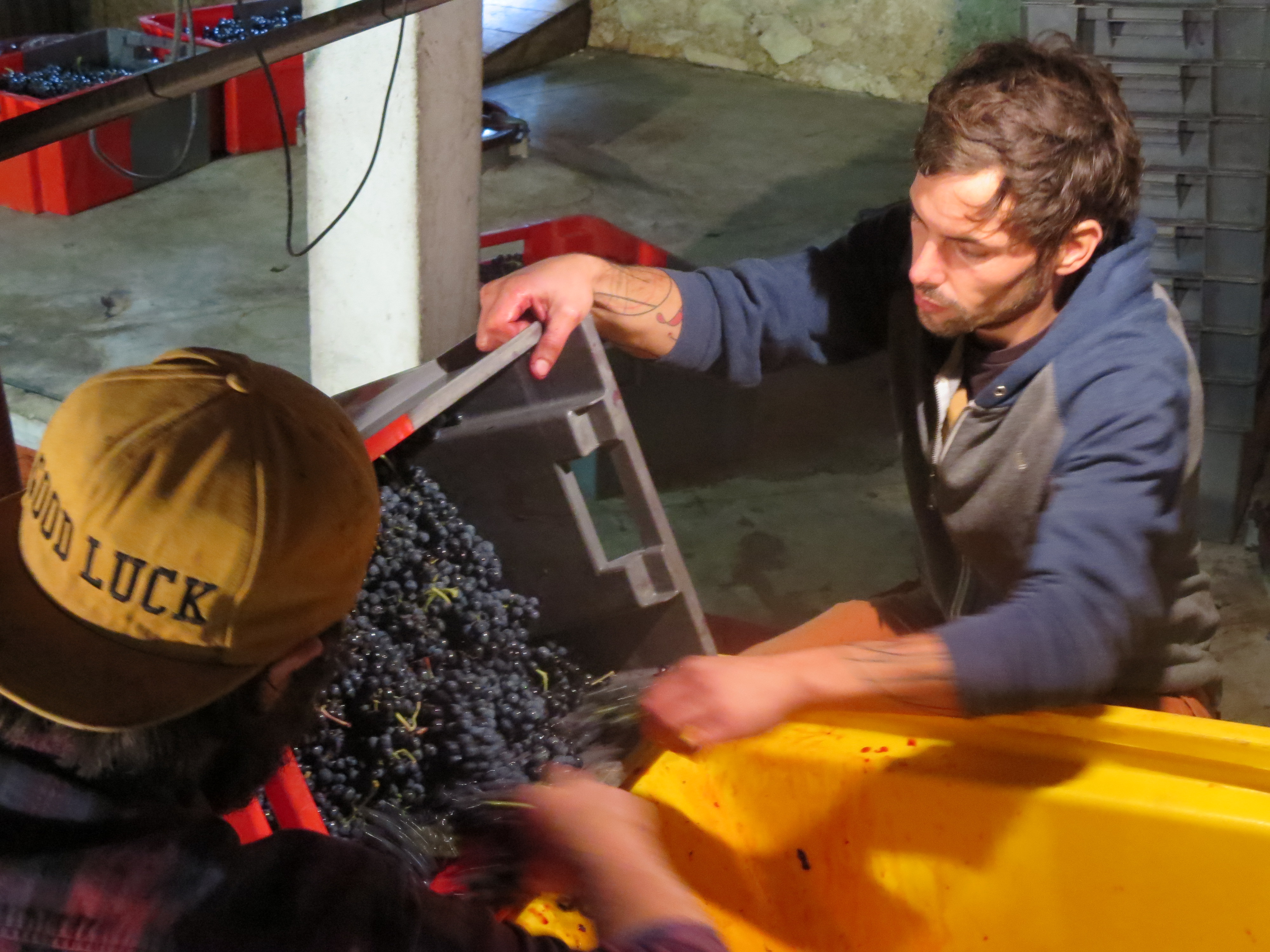
Upon arrival at the cave the cagettes are quickly taken for triage, sorting through the grapes to select only the best quality. Foreign objects such as snails and spiders are removed as are unripe grapes, any damaged or rotten grapes. It is important that only the best goes into the wines to keep them fresh and at the high quality we expect from Mas Coutelou. Two people sift through the cagette, removing any inferior grapes for further sorting by a third person. Jeff, Cameron and I took these roles on Friday. It is hard work, on your feet all day and lifting, carrying and sorting requires physical effort and also full concentration. There is, happily, also time to chat and laugh.
Cameron is from Melbourne, Australia and has been living and working in London as a sommelier for four years. He decided to learn more about the winemaking process and to “get his hands dirty”. He is already proving his worth and is a great addition to the team.
Meanwhile, the grapes which had gone to vat (cuve) have to be taken care of. Fermentation has started and the wine is already producing material which needs to be removed to keep the wines clean. They are, therefore, pumped out of their original cuve into another to allow the waste to be cleaned away and the fresh, juice ready to settle for its longer journey of fermentation.
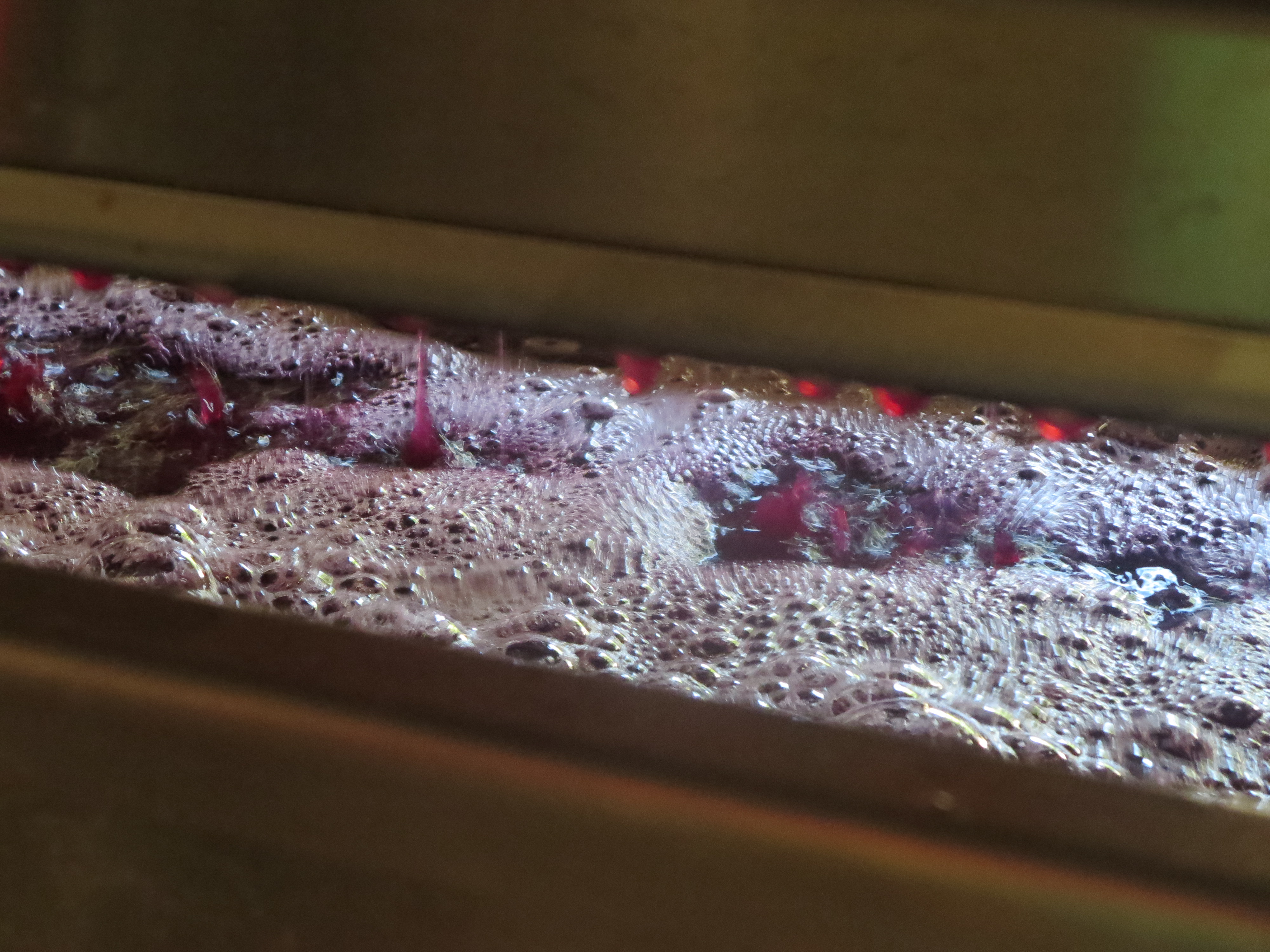
Fermentation beginning in the Sauvignon Blanc grapes collected yesterday (Thursday)
And at the end of the day the cleaning work is intense. Everything is cleaned throughout the day but at its end another full clean takes place. This removes the risk of contamination from dirt or damaged fruit which would ruin the wine. It is laborious but necessary.
Julien cleaning the cagettes
Ready for tomorrow
The égrappoir (destemmer) ready for tomorrow too
What else needs cleaning? Proof that I did work!
Analysis of the Syrah showed that the alcohol level was around 12.7% with medium levels of acidity. Later picking would have added more sugar and more potential alcohol but would have lowered levels of acidity. The skins are essential to the quality of the wine as they contain the colour, tannin and much of the flavour of the wine. These were in excellent condition according to the analysis, good news.
Jeff’s own calculations from cellar tests. Samples go to the oenologue for full analysis
Classic shape for a bunch of Syrah grapes
There have already been some concerns expressed by winemakers and analysts that the heat of 2015 might affect the quality of wines around France especially regarding acidity. The decision to harvest the Syrah was therefore the right one, fresh, cleansing acidity is a hallmark of Jeff’s wines. Many winemakers have been waiting to start harvest as, on August 30th, the moon is at a perigee, the time when it is closest to Earth in its orbit. As it begins to wane and move away from Earth many winemakers will start their harvest. Jeff has chosen to put the quality of the grapes first rather than principles about biodynamics.
Moon over Margon at its perigee on August 30th
Saturday 29th was a work day for the cellar and the pickers and saw the harvesting of Cinsault grapes from my favourite vineyard, Rome. The grapes were big and juicy though some were uneven and needed more careful sorting. Clearly these were precious grapes as Icare was guarding and watching over them assiduously. The harvest was not as big as many years and so the pickers moved onto Sainte Suzanne again for more Syrah grapes whilst yesterday’s grapes have begun to ferment already.
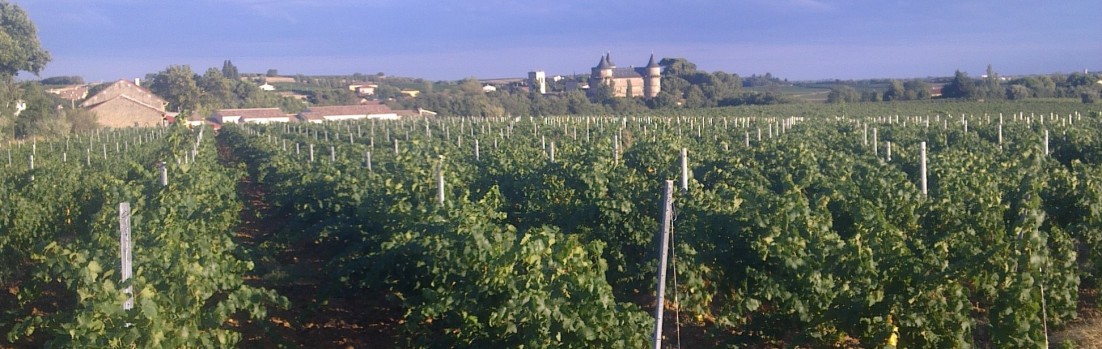
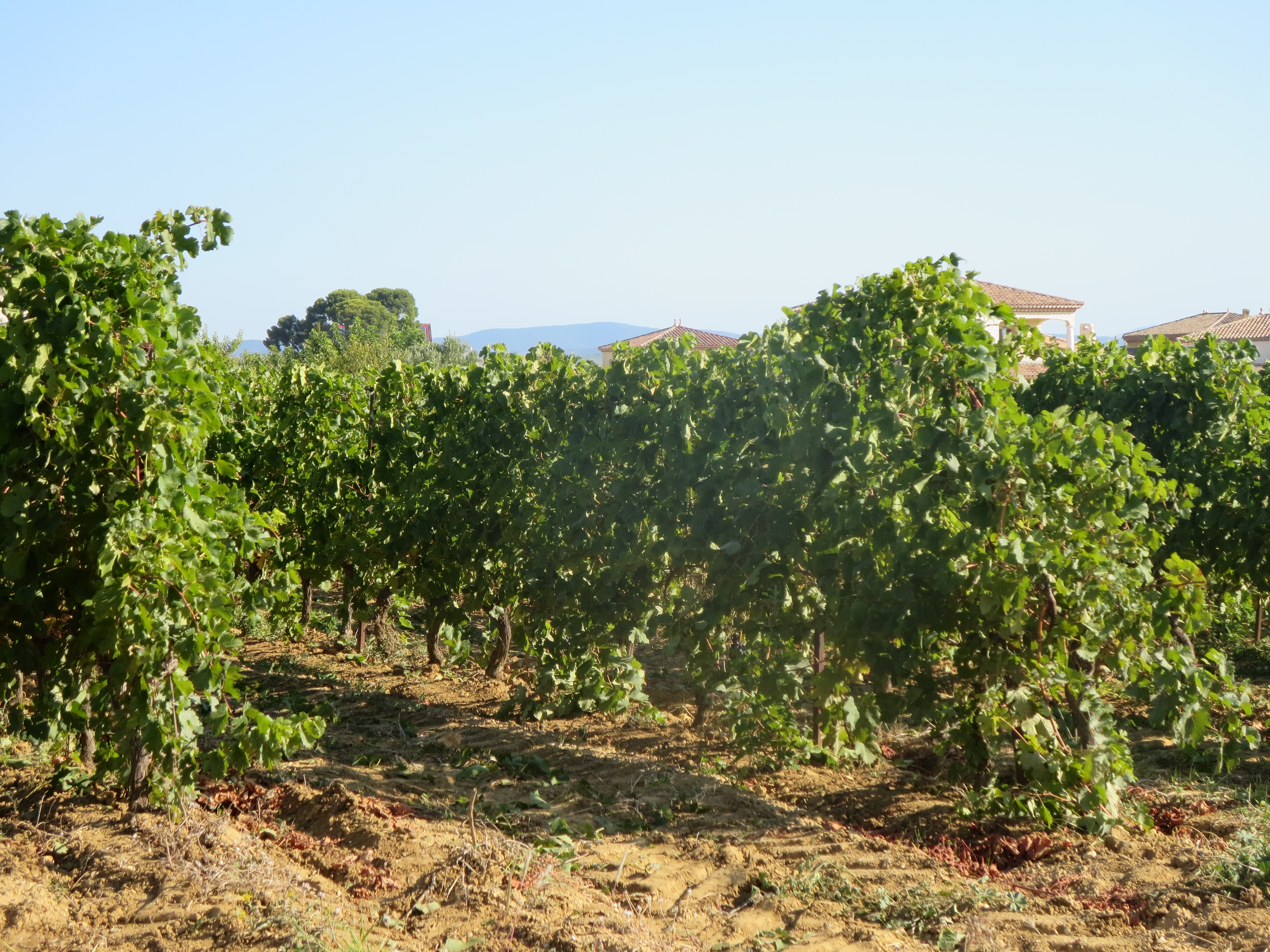
When you live in the Languedoc you are surrounded by vines. They are everywhere and form the world’s biggest vineyard area, producing one third of all France’s wine. Vines stretch over hill and valley, coastline and plains. As you walk around it is easy to think of vines as all being the same, part of one big plantation, but when we have received visitors and we go on walks through the vineyards they often ask me what sort of vine we are passing. Cue guesswork on my part unless I am in the vineyards of Mas Coutelou. To remedy this ignorance and to meet the brief at the top of this blog that I should be “learning about wine, vines and vignerons” I set myself the challenge of being able to identify the main types of vine in the region.
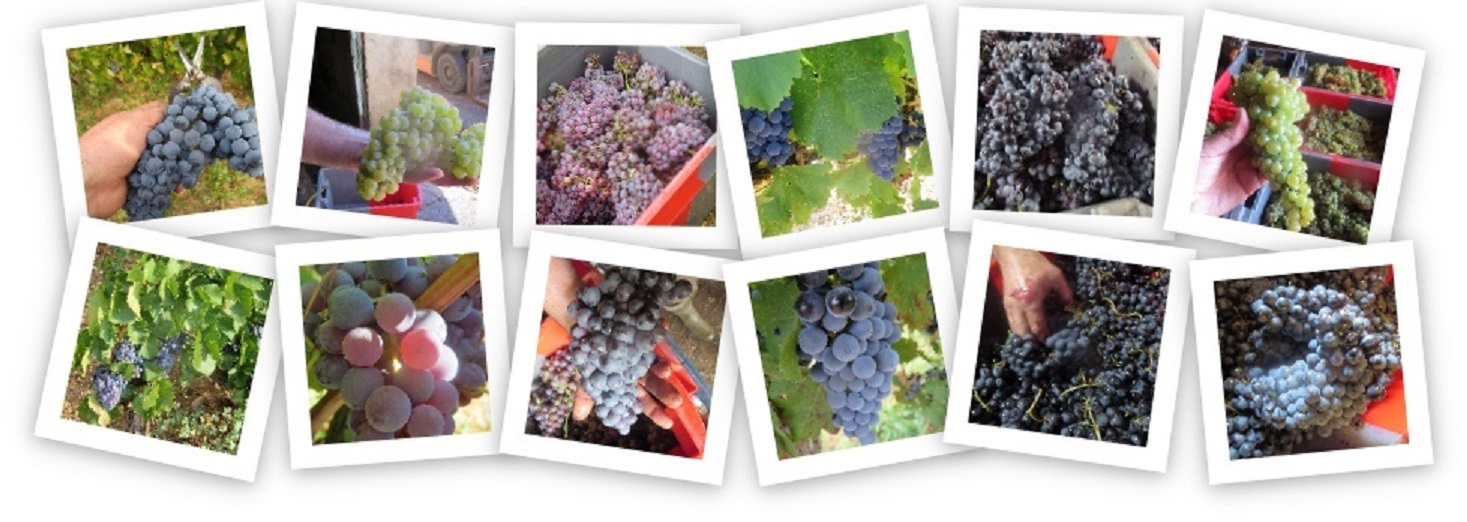
Ampelography is the study of identifying and classifying grapevines. There are many learned books on the subject, some running to hundreds of pages. However, I wanted a simple guide, to learn the basic varieties before expanding to others. I took some photographs in the parcels of vines of Mas Coutelou and using the internet and Jeff himself I hope I have put together a simple reference piece. As we enter harvest it has proved useful to me so that I know what I am picking or sorting. Hopefully it will be useful to you too, whether you visit vineyards or just take an interest in wine and vines.
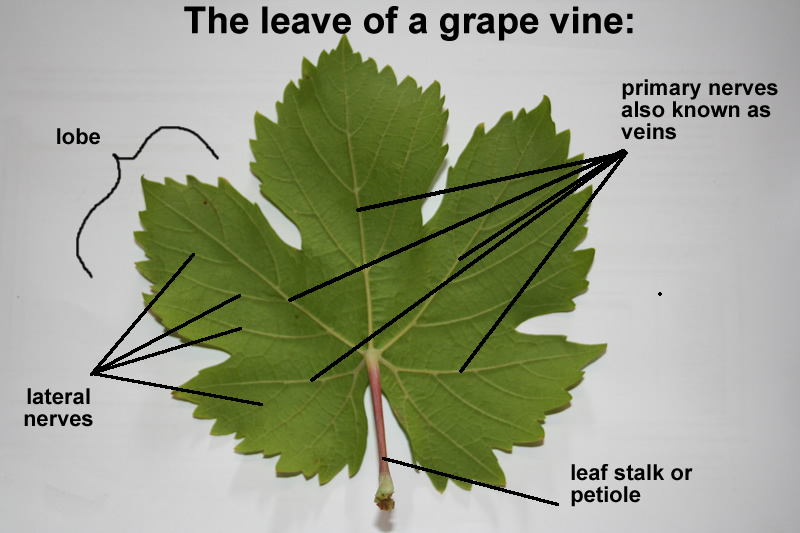
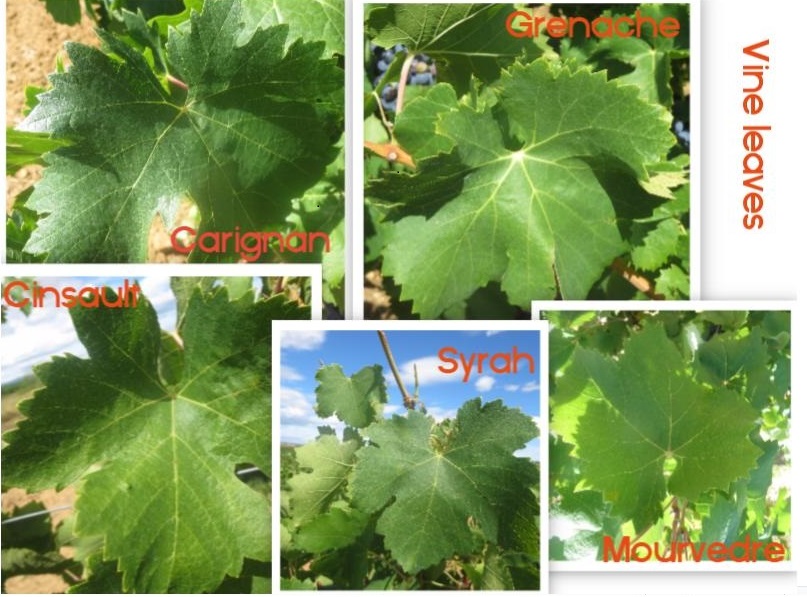
Experts use features such as the shape of the grape bunches, size and colour of the grapes. However, for me the most obvious way of distinguishing between vines are the shape of the leaves.
The colour of leaves varies but so too the number of lobes (from just one to seven), the colour of the veins and the shape of the sinus around the stalk (pétiole). The sinus is the gap between the lobes. So here is my simple guide to identifying some Languedoc vines. I have started in this post with the five main red wine varieties.
Red wine vines
Syrah
Syrah in Segrairals vineyard
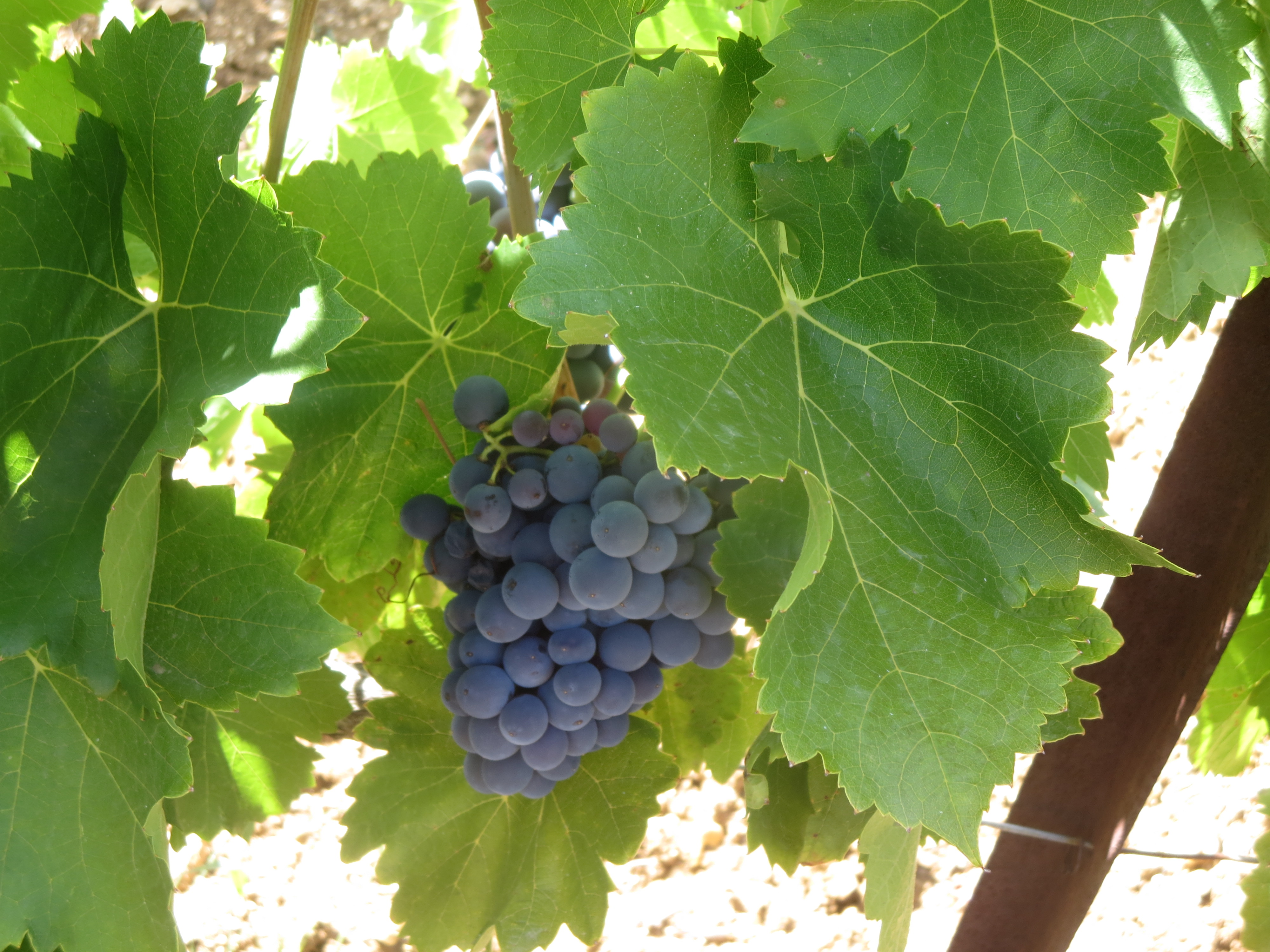
Syrah is one of the great varieties of the Languedoc. Famous for its wines in the Rhone Valley and around the world (Shiraz in Australia) Syrah produces great wines here too. The leaves are quite a light green in colour with 5 lobes which are well separated out including a big sinus (V shaped) around the stalk (pétiole). The veins are quite light and stand out. The leaf edge has small, gentle teeth shapes. The grapes tend to be oblong shaped and fairly small in size. Syrah is one of the earlier red varieties to ripen.
Recommended wines:
Mas Coutelou – La Vigne Haute
Others – Sylvain Bock, Raffut; Plan De L’Homme, Alpha; Haute Lignières, Sur Le Fil; Terre Inconnue, Sylvie
Syrah grapes
Grenache
Grenache in La Garrigue
A variety which loves the heat, very much a Spanish and Mediterranean grape. Grenache leaves have a more round appearance than Syrah with big, wide lobes which are not so separated as the Syrah giving the impression of a big, whole leaf. There is a wide sinus around the stalk. The leaf edges have saw teeth which are quite marked. Light veins and round, medium sized grapes. Grenache is a late ripening variety. Often used to blend it is not often used for single variety wines.
Mas Coutelou – Grenache, Mise De Printemps
Others – Engelvin, Même-Si and Vieux Ronsard; Treloar, One Block Grenache;
Grenache grapes
Mourvèdre
Mourvedre in Segrairals
Mourvèdre is a late ripening and, sometimes, a difficult grape to ripen. The lobes are broad and form three rather than five as you can see in the photo on the right of the page above. There is a little green colouring in the veins and the sinus around the stalk is a lyre shape. The teeth around the edge are distinct and quite big all around. The grapes come in biggish bunches though the grapes are medium in size.
Mas Coutelou – Sauvé De La Citerne
Others – Clos Fantine, Cuvée Courtiol; La Liquière, Tucade; Treloar, Motus
Mourvedre grapes
Carignan
Carignan in Rec D’Oulette
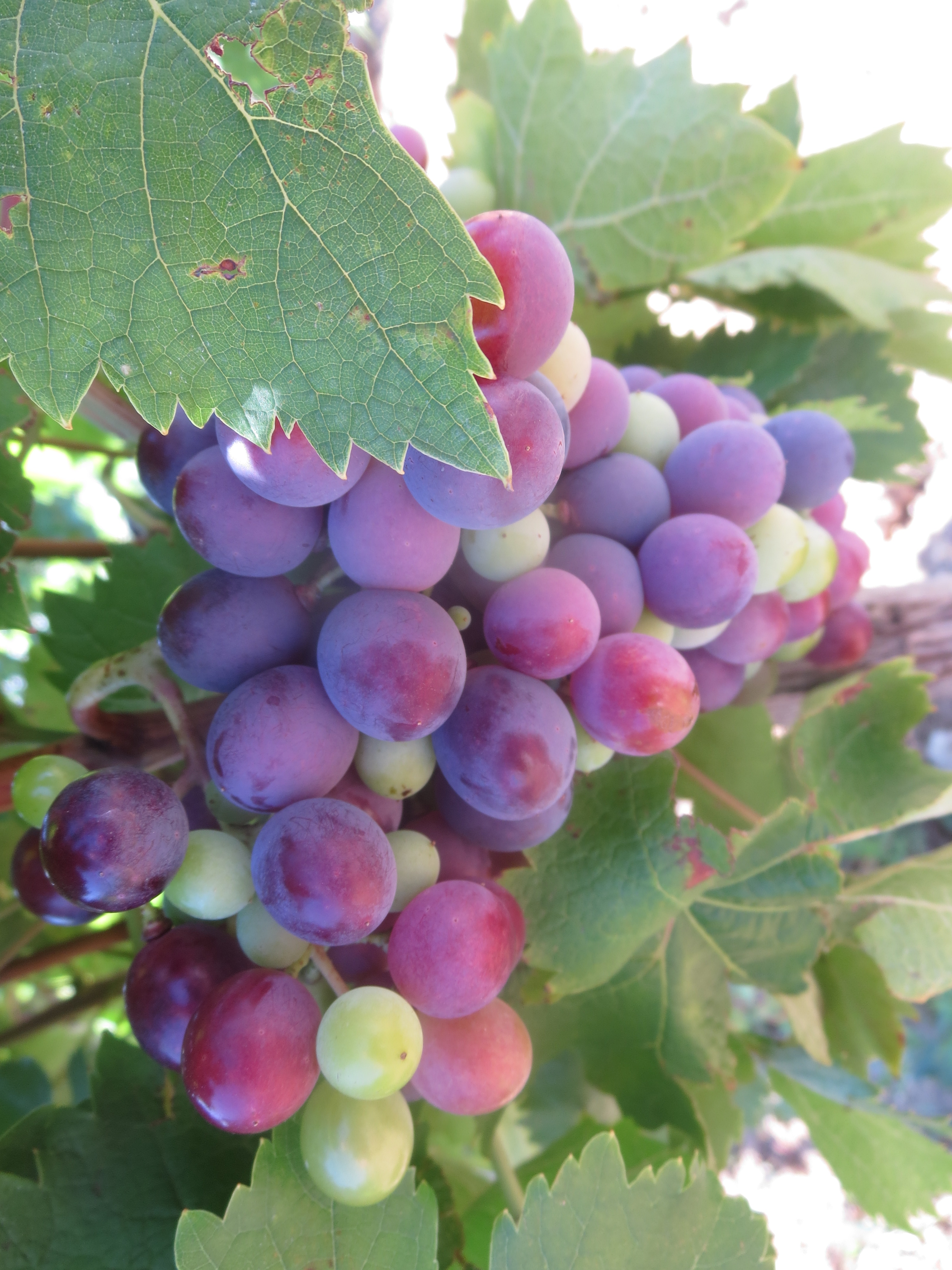
Carignan has big leaves which are quite hairy underneath and have a more dimply appearance than most in the upper surface. Five lobes usually though in the photo above the lower lobes are small with big upper lobes and a distinct top lobe. The teeth are tapered and distinct. The veins are hardly coloured. This is a late ripening variety and you can see the grapes below which are still turning black, even though this was taken at the same time as the other photos. The grapes and clusters are medium to large in size.
Carignan grapes
Mas Coutelou – Flambadou
Others – Mas Des Capitelles, Loris; Coume Mayou, La Loute Mas Gabriel, Trois Terrasses Deux Ânes – L’Enclos
Cinsault
Cinsault in Segrairals
I like to think of Cinsault leaves as being very like the grape’s flavours, open, friendly and welcoming. These are big widely spaced lobes and a deep, open sinus around the stalk. The veins are light and clear and the teeth are big, almost rounded which cover all the leaf edge. Often used in rosé wines Cinsault is starting to be used to make some great red wines in the region.
All photos taken on August 2nd unless otherwise stated
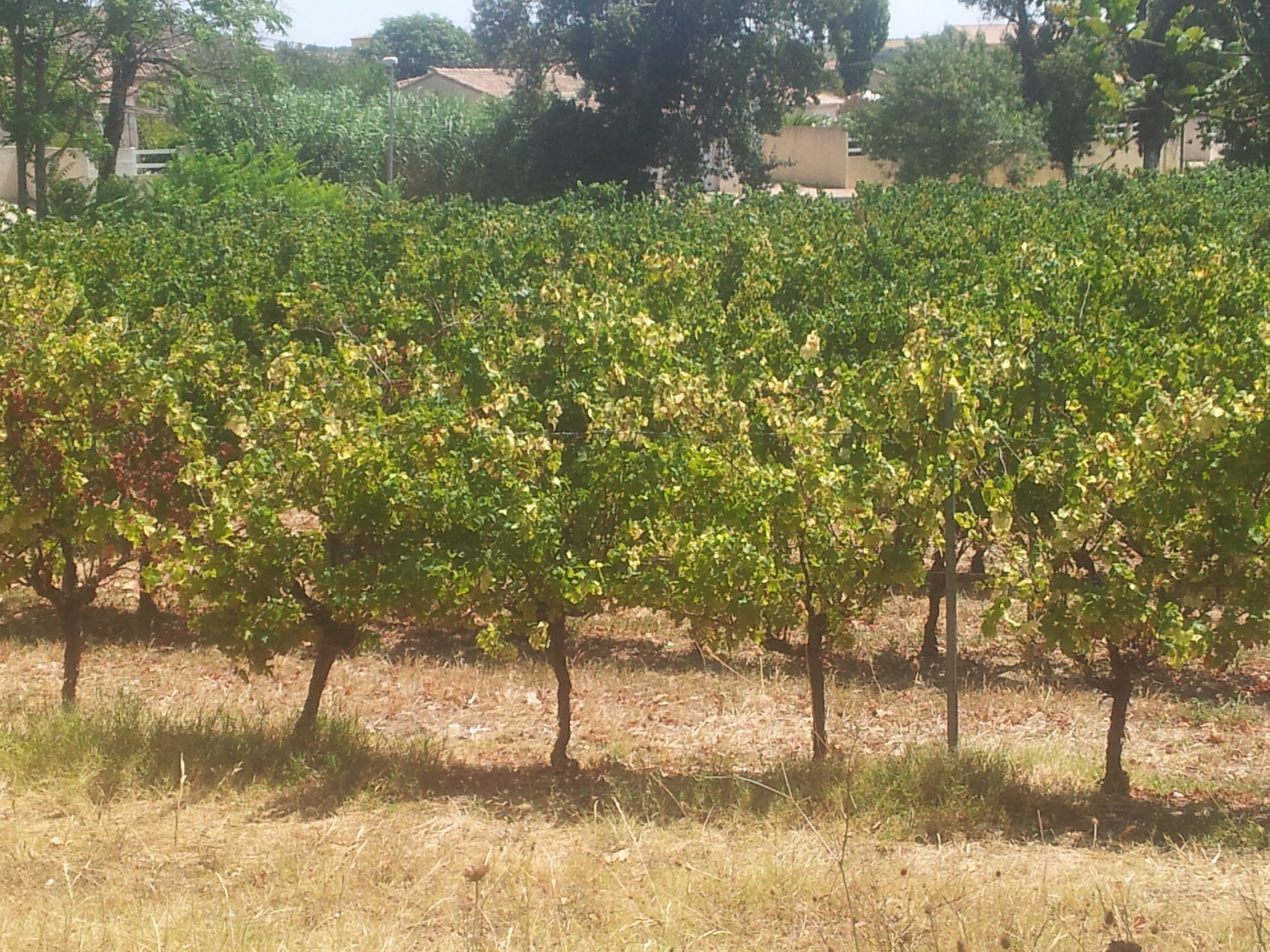
It was June 12th when rain last fell on Margon and the vines in the region, although generally doing well, were starting to show signs of fatigue and heat stress; leaves curled in upon themselves, some yellowing, a slight shrivelling.
Vines near Pézenas showing some stress
Vines in Margon which were not pruned in spring and are really suffe
A few drops fell on July 25th but the skies had been very dark and had promised much more, it was almost cruel to have that rain, a tease of what might have been. However, July 31st brought around 10mm to Puimisson. A decent rainfall, enough to give the vines a drink and to stop the drying out process. Not enough of course after weeks of lack of moisture and some more rain in the next few weeks would be very much welcome to swell the grapes and the harvest. The vines are now pouring their energy into their fruit rather than their vegetation, but they need the nutrients to do so.
So, how had the vines responded to the rain which fell? Well a tour on Sunday (August 2nd) showed the vineyards of Mas Coutelou to be in rude health, a decent harvest is now predicted though that extra rain would be most welcome.
Segrairals in full bloom, healthy, happy vines
Segrairals, biggest of the vineyards, showed some healthy Cinsault, Syrah and Grenache with no signs of stress or disease. As the home of Classe, 7,Rue De La Pompe and 5SO this is especially welcome, as they are some of the big sellers.
Cinsault in Segrairals
To Rome, my favourite vineyard. The gobelets were looking well, plenty of grapes both the white varieties and the Cinsault. There was a little mildew around the entrance but minimal, no cause for concern. Could there be a cuvée of Copains in 2015? Jeff tells me that no decisions are made as yet, caution prevails and he will wait to see what the harvest gives him before he makes final choices about how to use the grapes and the wines which result.
Rome’s centurion vines in good health
Muscat Noir grapes, a tiny bit of mildew top left
Sainte Suzanne (Metaierie) suffered from coulure in May with the strong winds blowing off some of the flowers on the vines, which will reduce yields a bit. However, the grapes there are growing well, what might have been a problem looks now a much brighter picture, good news for fans of Vin Des Amis.
Peilhan, just a little more tired and suffering
The only vineyard parcel which has shown stress is Peilhan, There was a lot of regrafting and replanting in the spring and the dryness has caused problems for these new vines. There was also oidium in this parcel, the only vineyard to be attacked by this powdery mildew. Yet amongst those problems there are plenty of healthy grapes, some careful picking and sorting will be needed but it will produce good wine.
The famous Castets grapes of Peilhan
La Garrigue was blooming, the white varieties such as the Muscats are swollen and changing hue to lovely golden shades.
Muscat a Petits Grains in La Garrigue
The Syrah is well advanced, a dark purple colour across virtually the whole bunches, the pips though betray a little immaturity as they taste and look green and sappy. A little more time and patience will pay dividends. As the world’s biggest fan of La Vigne Haute, I have my fingers crossed.
Syrah in La Garrigue, ripening beautifully in the shade of the vine
The Grenache in La Garrigue, despite facing south, is a little more delayed in colour but getting there and very healthy.
Grenache in La Garrigue
In fact despite risks of disease earlier in the year (see here) Jeff has been able to use minimal treatments in 2015. Oidium and mildew (powdery and downy mildew) can be controlled by copper sulphate, sometimes called the Bordeaux mix when added to slaked lime. This is a bluish colour when sprayed by conventional and organic vignerons and is often seen on the leaves of vines. Vignerons might also use chemical fungicides if they are not organic producers.
Neighbouring vineyard which was given herbicide shortly after harvest last year and whose new vines have been treated regularly
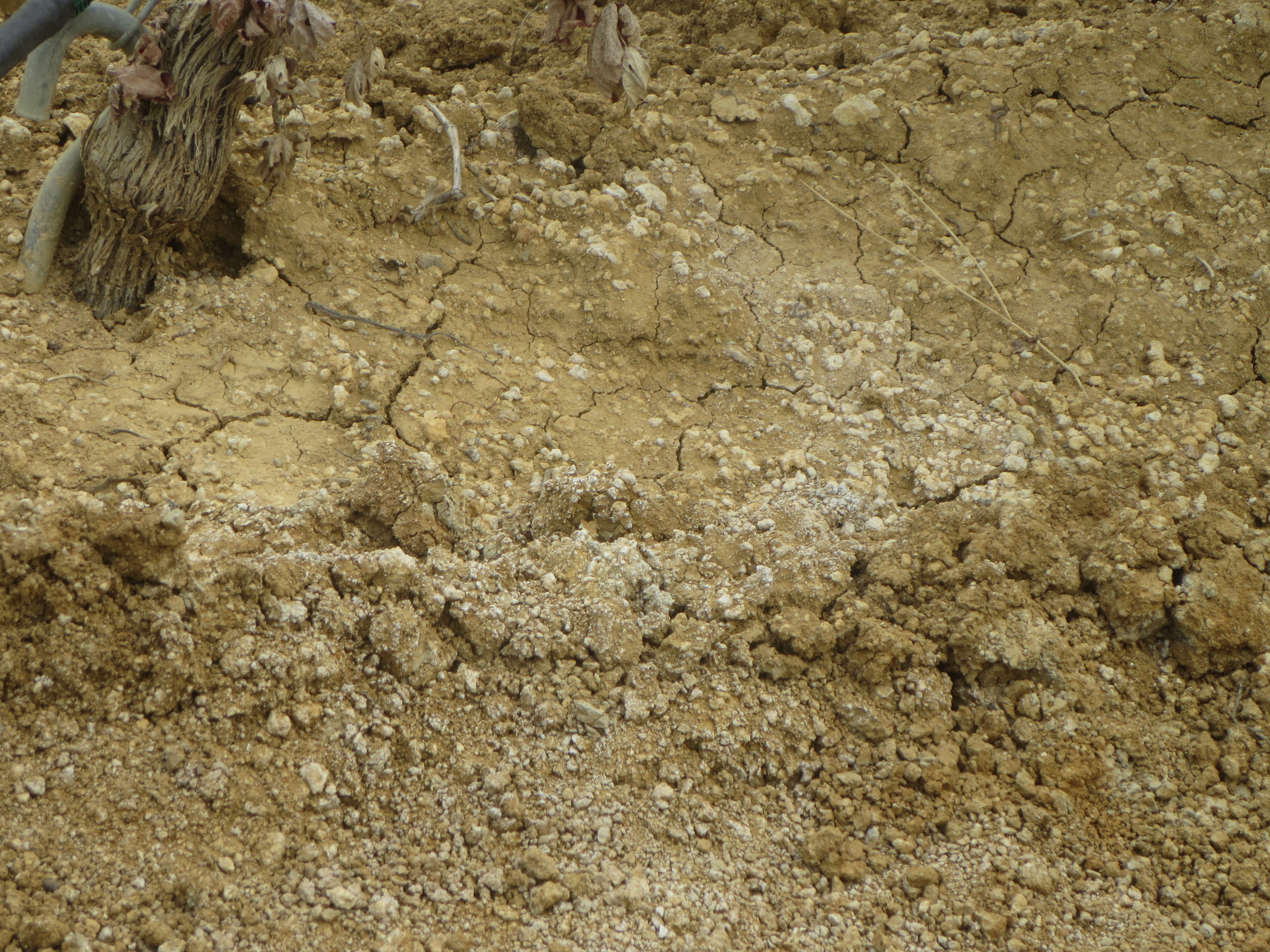
Some neighbours have also irrigated their vines and one alarming consequence is the changing of the soil and its pH as the calcium carbonate in the water shows through, you can see it in the white parts of the soil in this photo taken on July 22nd.
The irrigation is also causing the vines to grow quickly and tall with thin trunks as seen below. It should be acknowledged that there are many conventional producers who take great pride in the health of their soils and vines and would be horrified by some practices described here.
As a proud holder of Ecocert organic status and as a natural wine maker Jeff must use natural products only. Tisanes of plants which fight mildew such as horse tail, fern and nettles can be sprayed and this is the basis of many biodynamic treatments. However, the two main weapons in the armoury of organic producers are copper and sulphate, both natural products.
Copper is used against mildew, but is harmful to the soils and kills life in them if used in significant quantities. Organic producers are limited to 30kg per hectare over a 5 year period, allowing more to be used in years with more downy mildew for example but only if less is used in the other years. In fact Jeff has used just 200g per hectare in 2015 and this after years of well below average use, his use of copper is on a major downward trend. He is reluctant and very careful in using copper as he is aware of its danger to the soils, yet mildew has not been a major threat this year.
Oidium seen in May
Similarly Jeff has used sulphur in soluble form at doses much lower than the permitted level, three treatments over the course of the growing season. In addition one dose of sulphur powder was sprayed when the risk of oidium was high (May) and a second spraying for Peilhan only as it is the vineyard which was attacked by oidium. In contrast to neighbouring vignerons who have sprayed every 10 days including after the bunches closed up (so more than a dozen treatments) this really is minimal intervention.
So July’s parting gift of 10mm of rain was welcome, August might like to follow by offering some rain soon. Too near the harvest is bad as it would dilute the juice rather than help the grapes to reach a good size. Things look promising, let us hope that nature completes its bounty. There is an old saying that June makes the wine and August makes the must, ie the character of the wine with its colour, yeast and flavour. With 3 weeks or so until picking begins it is an exciting, and nervous, time, waiting to see what that character will be.
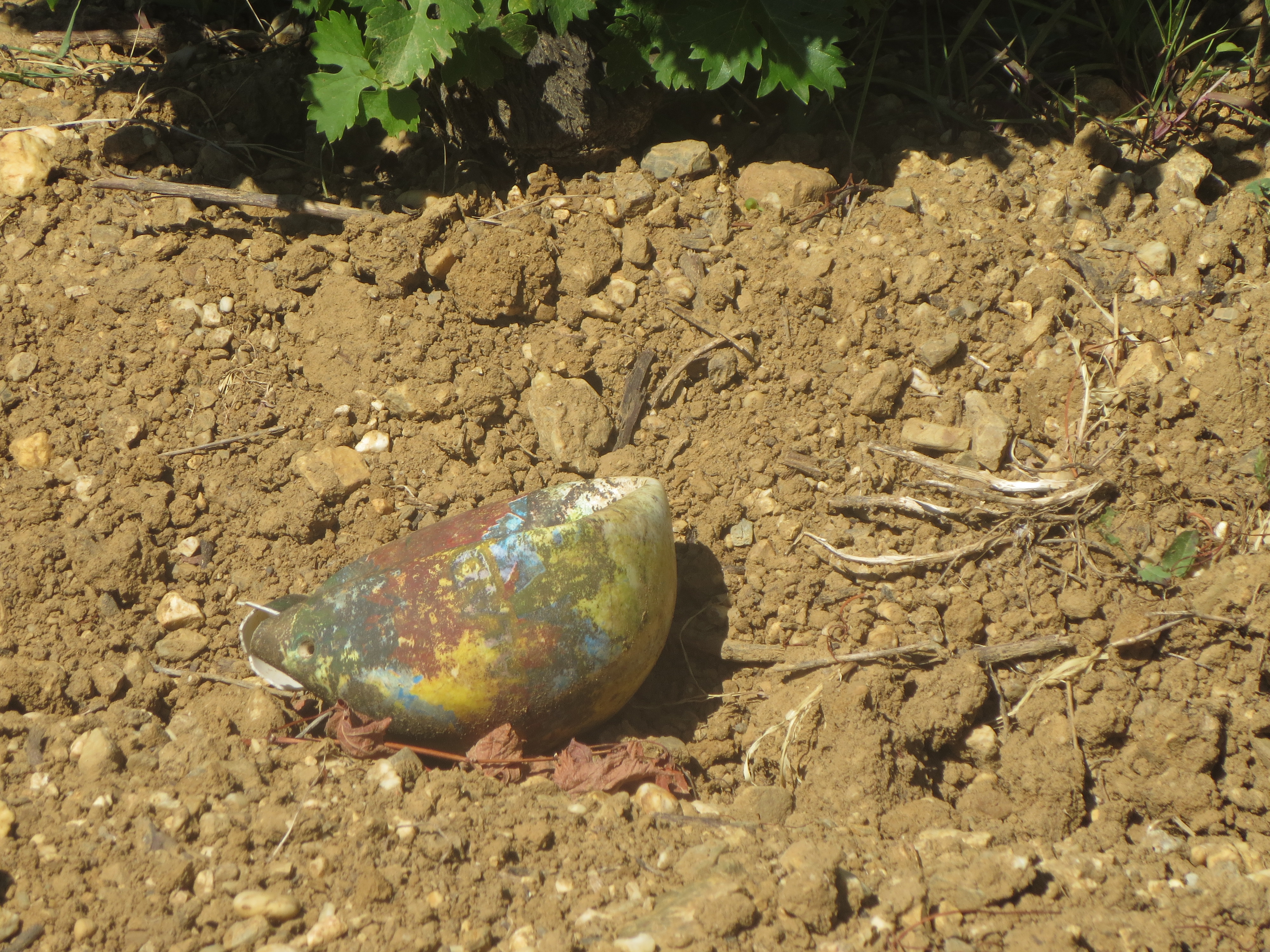
No Icare this time but look what we found amongst the vines, he’s been here!
NB there are lots of reports about recent wine tastings here.
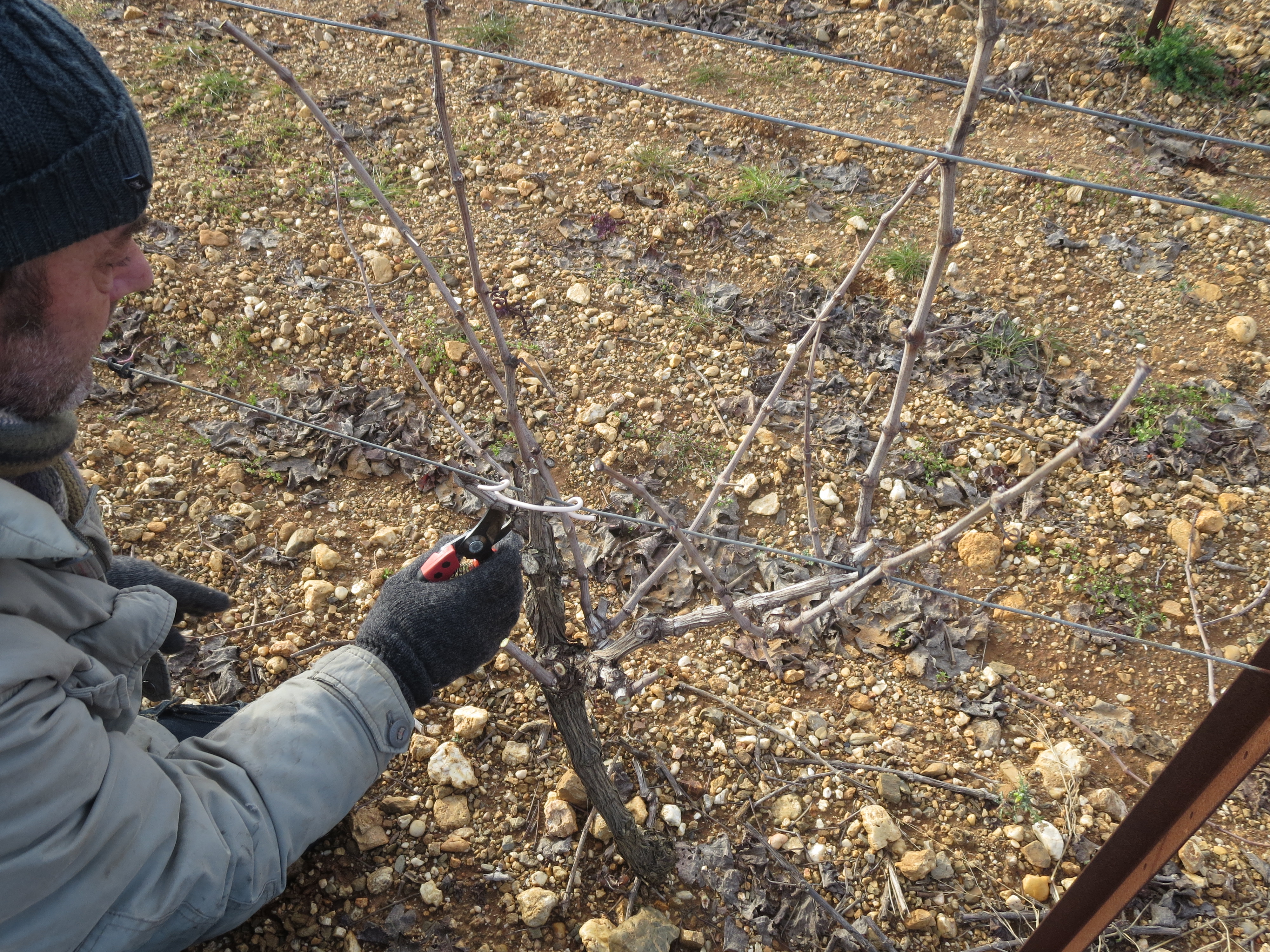
It was the 30th January and having promised to write about vineyard work in each month of the year, I felt that a deadline was looming! After tasting wines in Montpellier for a few days it was definitely time to get back to the vineyard the key component of those wines. Jeff took me to the vineyard called La Garrigue which is to the south east of Puimisson, home of Mas Coutelou. It is one of around a dozen parcels of land which Jeff owns, though some are home to olive and fig trees as well as hedgerows and other methods of reintroducing biodiversity into a district which has become one large vineyard. I shall be writing soon about the various parcels and Jeff’s work to safeguard and boost the local environment and biodiversity.
La Garrigue is rather like a small pyramid in form with a peak in the middle and vines around the sides.
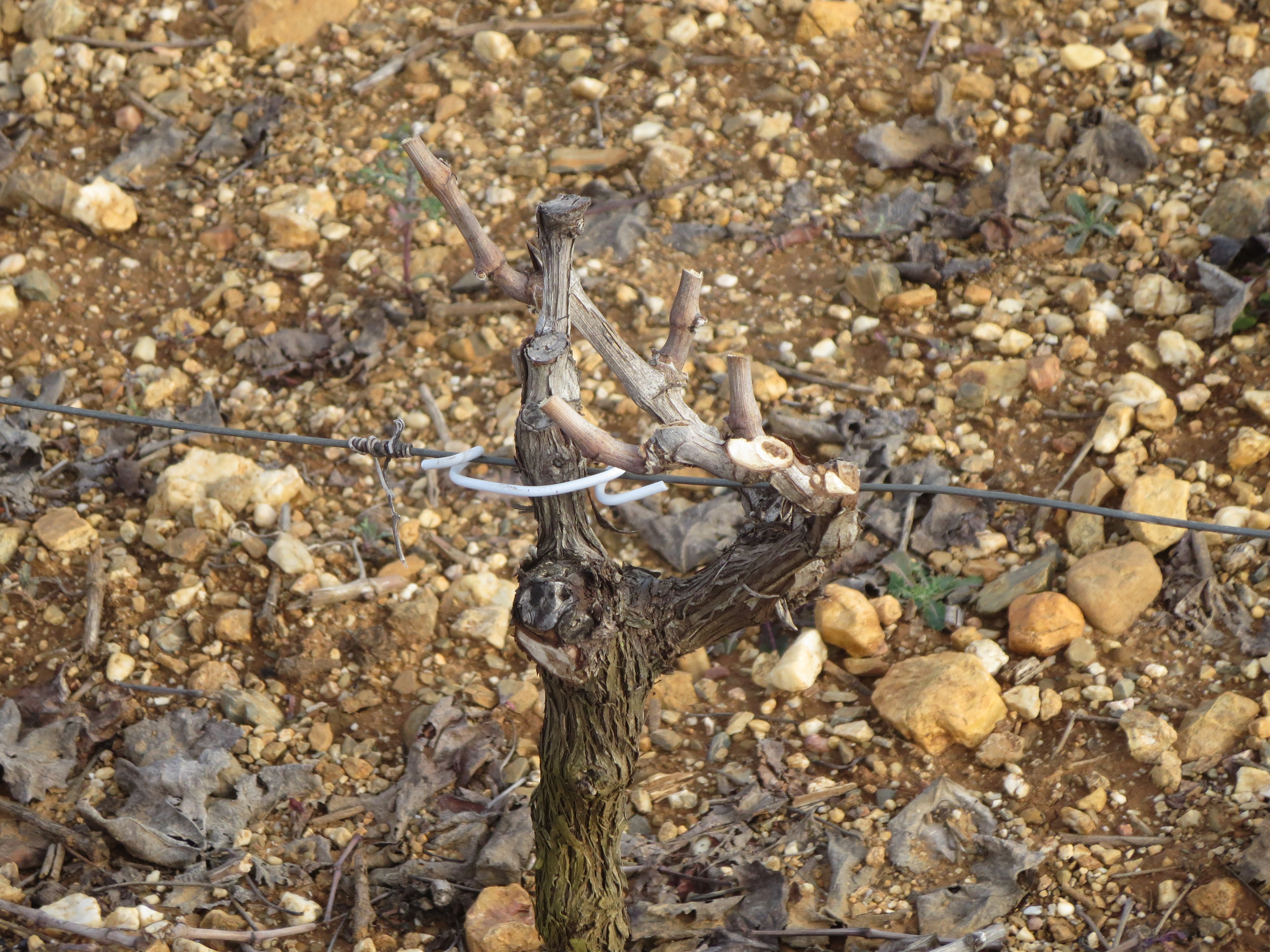
Facing north is a parcel of Syrah planted in 2006, so the vines are still young. They face north so that the freshness and spiciness of the grape variety are preserved rather than being overcooked. They are also planted in rows facing north to south so that the wind blows down the rows, helping to prevent disease and to dry the grapes after rain. Carole was busy pruning this area and the preferred method is the gobelet style. This is the traditional and most natural way of growing vines in the Languedoc and Jeff has preferred to use this method for his vines for a number of years and so these Syrah vines are grown using gobelet.
Syrah vine pruned in the gobelet style
However, as you will see in the video, Carole studies each vine carefully and if she feels it would benefit from a different style she will prune in the more suitable way. This may be because the vine canes are growing too vigorously between the rows of vines and need shaping along the rows. As these are young vines they are being supported by wire trellising. In this case a cordon de royat system might be used.
Syrah vine pruned in cordon rather than the gobelet style which most of the Syrah vines are. It was felt its needs suited cordon better
Facing south is a parcel of Grenache vines. This is a variety which welcomes heat and is grown through Spain and around the Mediterranean. It adds spice and complexity to wines and, facing south, the sunshine brings out these characteristics. In this parcel cordon de royat is used as the pruning method. This was the system used when the Grenache vines were planted back in 2000 and so they continue to be grown in that style as it is not advisable or even possible to change them to gobelet now. The Grenache is usually used in the popular cuvee Classe.
Grenache vines,cordon pruning
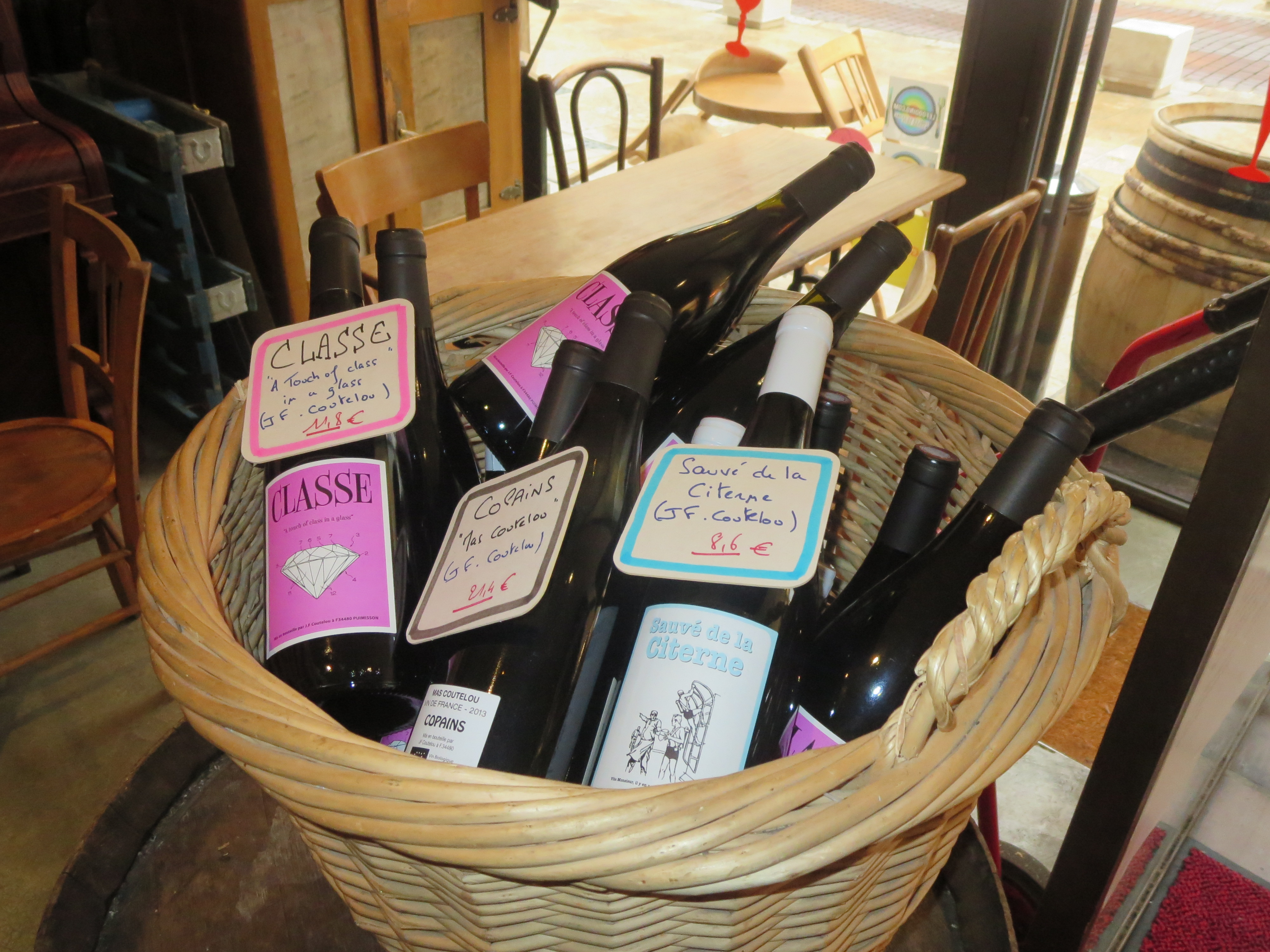
A magnum of Classe
To the easterly side of La Garrigue is a block of Sauvignon Blanc. This is not a variety often grown in the Languedoc as it gives green, fresh almost acidic notes in its wines and the region is often too hot for it to show those qualities. Facing east, however, means that the sun hits the grapes in the morning so does not overheat or over ripen them, preserving the freshness of the fruit. In this parcel guyot is the preferred system of pruning. This system allows more air to circulate around the grapes and as the white grapes are more fragile guyot training helps to protect their health. The white grapes are usually used in the white blend, PM.
Sauvignon Blanc vines pruned in guyot style up the wire trellising
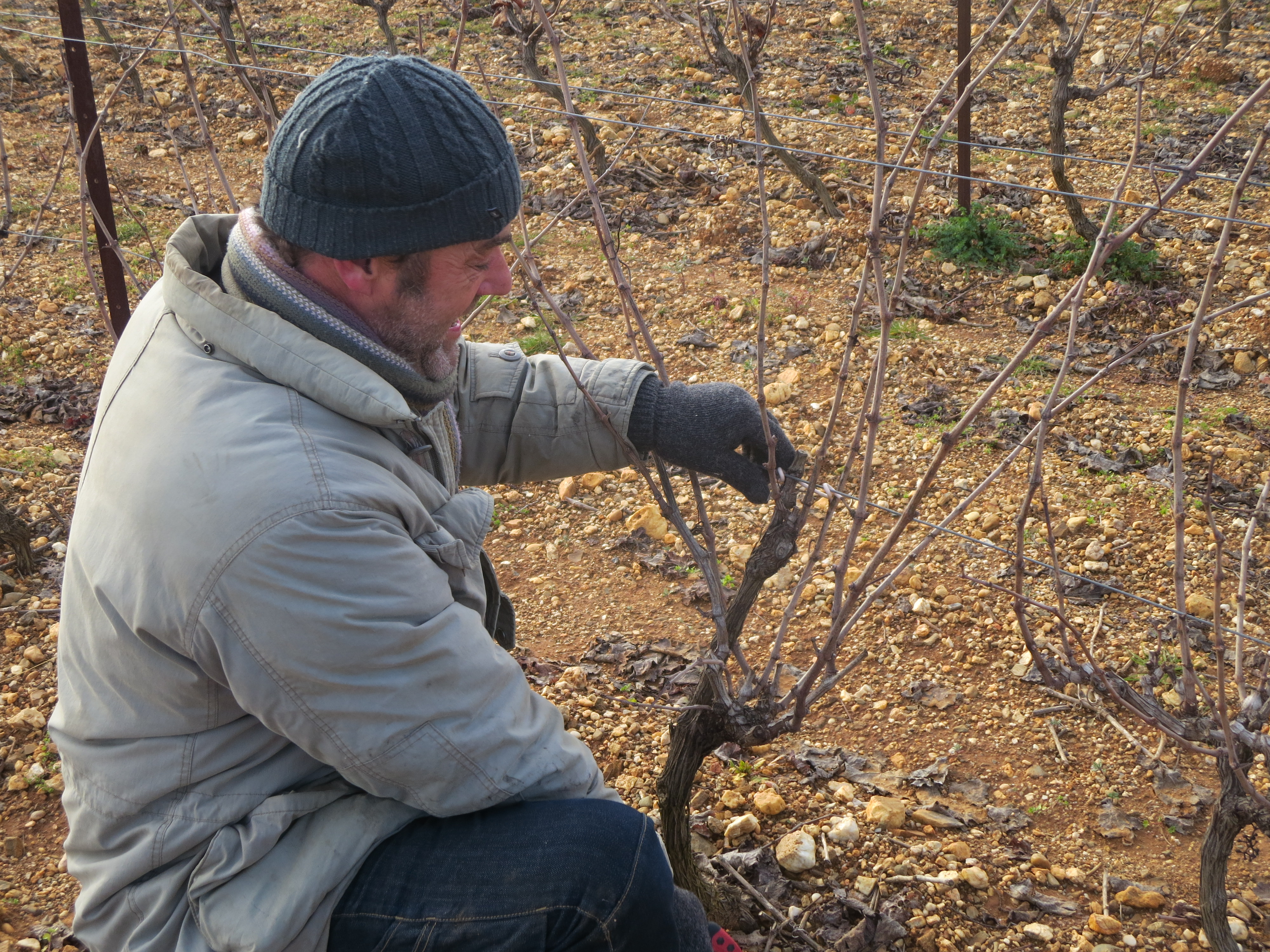
What struck me most, other than a bitingly cold, northerly wind, was how carefully Carole and Jeff study each vine to ensure that it is given a pruning which suits its needs. Direction, quality of the wood, crowding are all considered before they decide what to cut and at what length the remaining cane should be left. Some canes were cut very short, others had 8 to 10 eyes which will produce bunches of grapes. It depended upon the capability of the vine to bear such fruit. It is this care and attention which characterises the work of the skilled artisanal vineyard worker and winemaker.
Jeff studying a Syrah vine
First cuts
Getting to the heart of the vine
The finished vine
I would compare this with a machine I watched around Margon which cut the vines to the same shape and size regardless of their health and
needs. The cutting was fast and much easier work but the pruning was brutal and imprecise with no regard for the individual vines. For vignerons producing cheap, bulk wines I can understand their actions.However, it confirmed in my mind that artisanal vignerons are the ones producing the wines I want to drink
Machine pruning vines, the yellow arm contains the blades
Pruning is not glamorous. But is a vital part of the winemaking year, preparing the vines for when they reawaken in spring and enabling them to produce the right quantity of healthy grapes which in turn will produce great wine.
Simon Bertschinger explaining his wines and sharing his passion for them
It’s always good to discover new wine domaines in the area and Mas Sibert was recommended to me by Dominic George at Le Wine Shop in Pézenas, well worth a visit in itself incidentally.
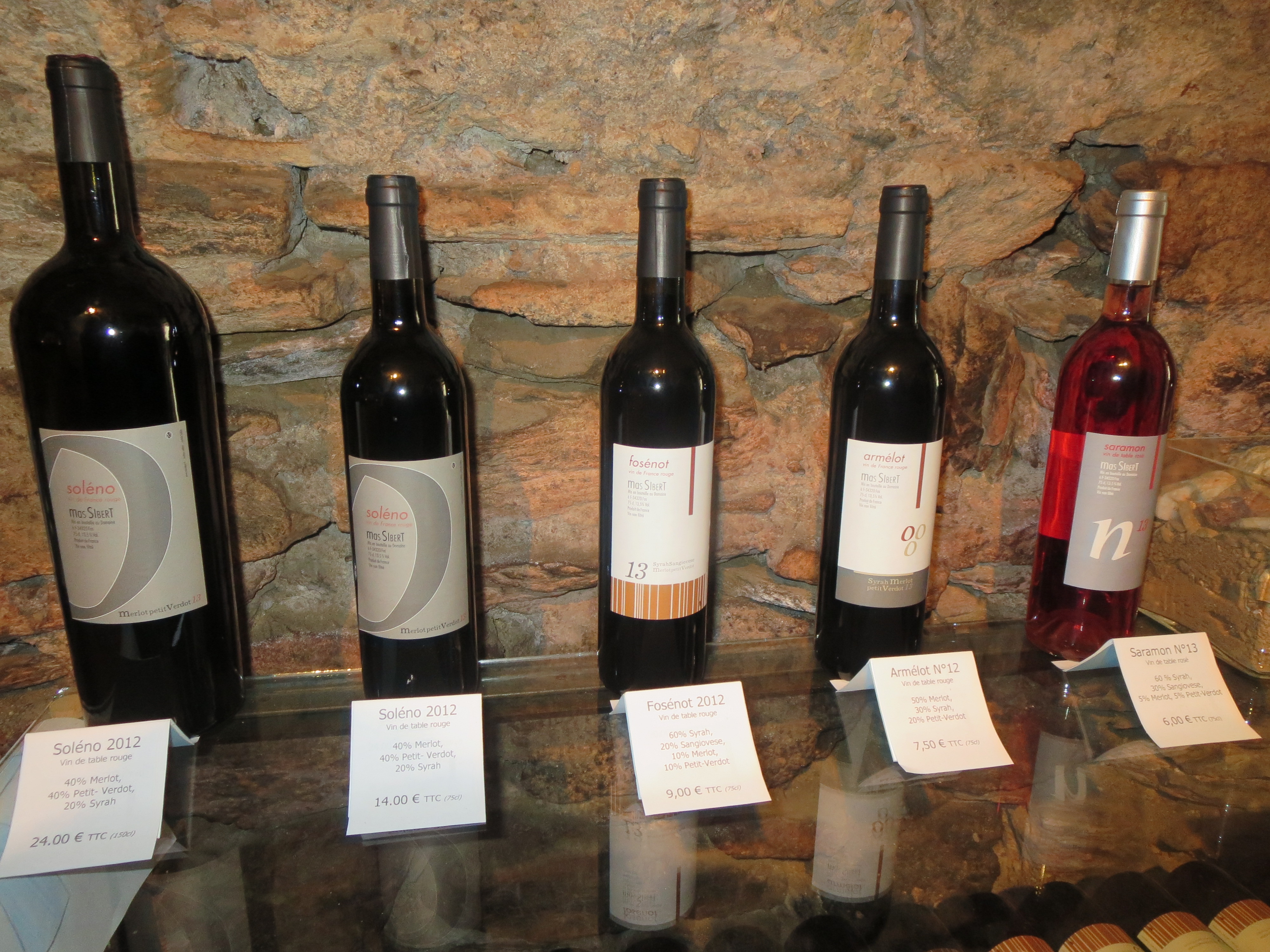
Mas Sibert is in Fos, a 3 ha domaine run by Simon Bertschinger and Sara Frémine. They produce natural wines (with tiny amounts of SO2 added before bottling) with clear freshness, terroir and complexity. They are clean, well made and use unusual grapes for the region such as Merlot, Petit Verdot and Sangiovese, hence they are bottled as Vin De France.
The wines, the rosé is already sold out
They also have a bread oven and in summer they make bread and pizzas on Sundays, something I shall definitely be looking to profit from. A domaine to follow as Simon’s work in the vineyards will continue to enrich the wines. He is looking to plant new white grapes (from older cépages) and they will take time to come on stream but I look forward to trying them. Simon used the word ‘passion’ many times in describing his work and wines and it shows in the glass. He is also realistic, has not tried to overmake the wines but lets the terroir and it’s grapes speak for themselves. He has built the cave so that gravity helps the movement of the wine during production rather than pumping.
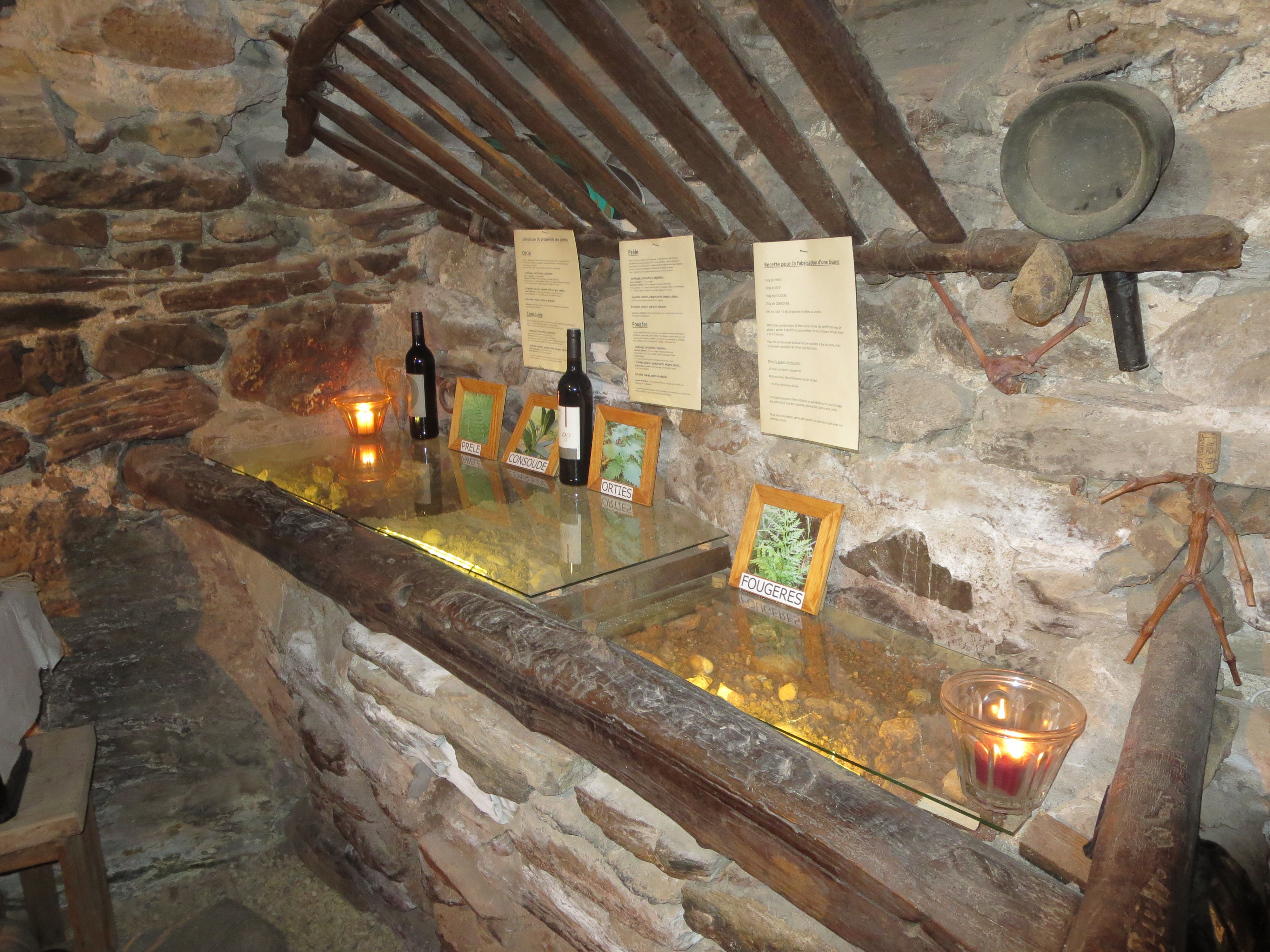
A very interesting display in the cave showing the soils and natural treatments using plant teas eg nettles, horse tail and ferns
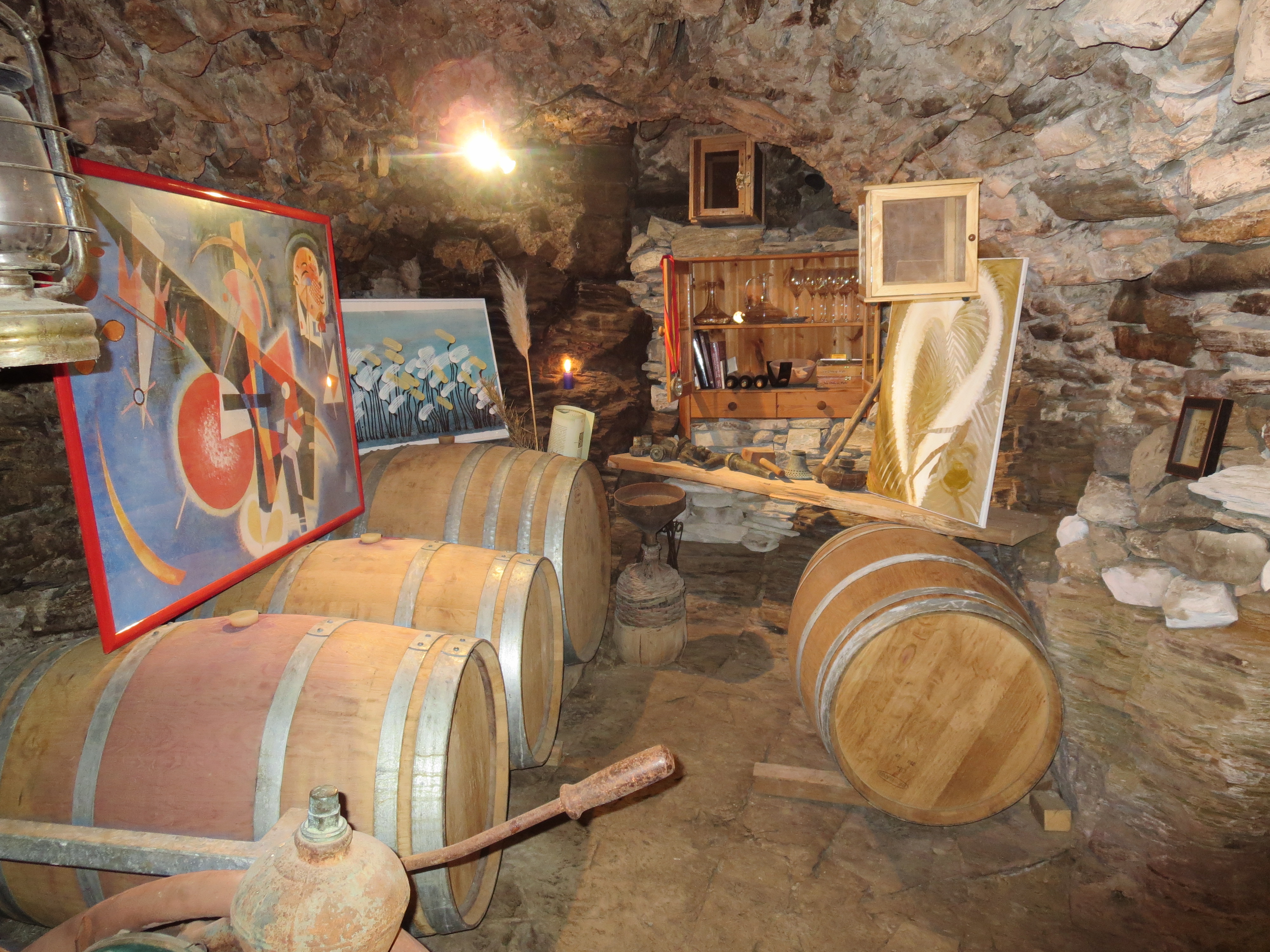
The barrels used for Soléno have been used for 4 or 5 wines before so are used for a little oxidation and complexity rather than oak flavours
I tasted 3 reds:
Armélot 2013 Merlot, Syrah, Petit Verdot – Clean, fresh, rich and smooth but the Syrah adds nice spicy notes.
Fosénot 2013 Syrah, Sangiovese, Merlot, Petit Verdot – The Syrah shines with clear fruit but it is the Sangiovese which adds the interesting acidity and fresh cherry flavours. Very good, my personal favourite.
Soléno 2013 Merlot, Petit Verdot, Syrah. More Petit Verdot here than Armélot, the Bordeaux varieties get some oak ageing in old barrels for complexity. It had a light colour and structure but carries a real weight. Good and will develop with time.
Did I like them? Well I bought some so yes I did!
It actually snowed in Fos, hence the coat. I enjoyed talking with Simon as well as tasting his wines



















































 amarchinthevines