amarchinthevines

Learning about wine, vines and vignerons whilst living in the Languedoc


Leave a comment

Vendanges 2016 #2 – adolescence

En français

When I mention vendanges to most people they think of grape picking and, maybe, putting the grapes into a tank (cuve). However, vendanges means much more than that and we are now entering stage two of the process.

When the grapes have been picked and sorted they are stored in a cuve where the juice interacts with the skins extracting flavour, colour and also coming into contact with the yeasts which grow naturally on the skins. These yeasts then begin the process of fermentation which turns the sugars in the juice into an alcoholic wine. This mix of juice, skins, pips and flesh is known as must.

p1010698

Checking progress

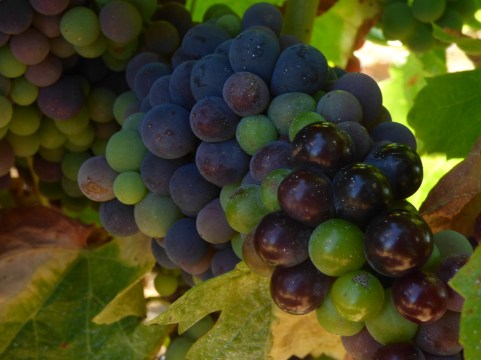
So, whilst picking continues at Mas Coutelou Jeff must already plan what is happening to those cuves of grapes which were picked a few days ago, You will remember from #1 that we picked Grenache and Syrah on days 1 and 2 and that they were in cuves 2A and 2B. They are picking up colour and the fermentation means that the sweet grape juice of last Wednesday is already very different. Still plenty of raspberry and red fruit flavours but the sugar levels have fallen and the liquid is now more austere, a little acidic and with a weight of alcohol. It has turned from child into young adult.

p1010697

Today – Grenache and Syrah has matured

To ensure that the grape skins do not give unpleasant flavours, volatility etc., Jeff must ensure they do not dry out as they float on the juice, forming what is known as the cap (chapeau). Therefore, wine is pumped from the bottom of the cuve over the top of the chapeau to push it down a little and to moisten it. This is known as remontage.
p1010696

Carole carries out a remontage

Alternatively, an instrument or hand can be used to push the chapeau down into the juice, a process called pigeage.

p1010670

James performs a pigeage

When Jeff is satisfied that the juice is ready and has had optimal skin contact he will begin pressing the must to leave the final juice. We await the first press as yet but it will be in the next couple of days as the Grenache and Syrah are already showing their adolescence.

Meanwhile picking continues. Friday saw Sauvignon Blanc and Muscat À Petits Grains as the first white grapes of 2016 at the domaine. Monday saw the picking of the Merlot from Colombié which will, unusually, find its place in the Coutelou cuvées. I am no great fan of Merlot but the grapes were lovely and the juice tastes especially rich and full.

Today (Tuesday) was Flower Power day, sadly the snails won the battle this year. They ate so many of the buds in Spring that the vines struggled to produce much. The dryness merely confirmed Font D’Oulette would be low yielding in 2016. Around twenty cases is not much return for such a lovely parcel of vines. High quality grapes from the various cépages but very low quantity.

Clairette and Oeillade from Peilhan with some Grenache Gris and Muscat Noir was added to the mix. Also picked was the Cinsault from Rome which was in good condition with nice big berries. So my two favourite vineyards are already harvested.

p1010694

James models the lovely Segrairals Syrah

Finally, some lovely Syrah from Segrairals was picked and there will be much more of this tomorrow. This Syrah is such good quality that Jeff is already excited about what he can do with it. Segrairals is the biggest vineyard of the domaine and is also serving up some of its best fruit.
p1010688

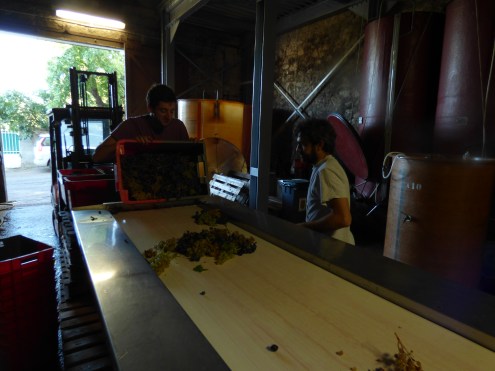
Charles, Vincent and the new sorting table

A new sorting table was brought into play this week and it is certainly much more efficient than the previous method of sorting from the cases themselves. Triage of better quality but also much speedier too. The table is already paying for itself.

So, stage 1 (picking) is well under way, stage 2 (the must in cuve) is under way for some and stage 3 (pressing) will shortly begin. The jigsaw is already becoming more complicated for Jeff Coutelou.
p1010667

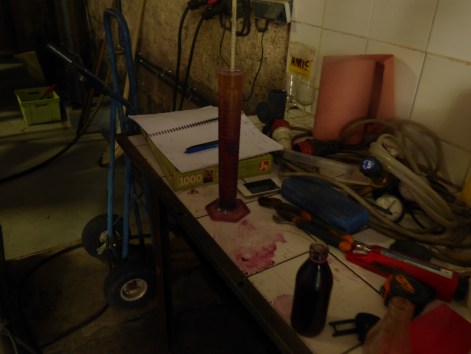
There really is a puzzle under there


2 Comments

Full steam ahead

En français

There was something of the nautical in these two photographs hence the title.

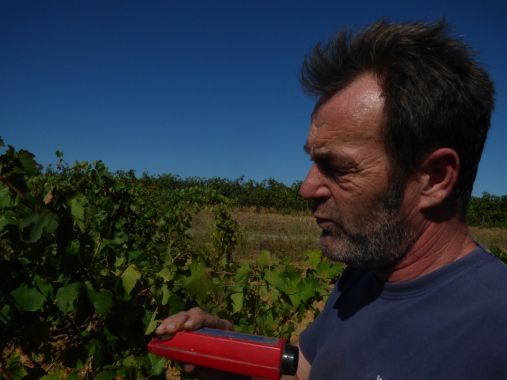
The preparations for the vendanges are in full swing, the hail has speeded up the start date as damaged grapes, especially, the Grenache in Sainte Suzanne, need to be picked earlier than foreseen. A tour of the vineyards on Wednesday morning with Jeff was an opportunity for him to taste the grapes and use the refractometer to measure the sugar and potential alcohol in them.

P1010534

Picking will require even more care than usual in some parcels as the bunches will need to be checked thoroughly for any damage due to mildew, hail, vers de la grappe or any other issue. Many grapes will be left on the ground. The rest will be sorted back in the cave and Jeff has invested in a new sorting table to ensure scrutiny can be absolute. No chances will be taken as always, only healthy fruit will go into the wine. That is the how natural wines have to be, made from the healthiest fruit as nothing will be added to it to disguise faults, unripe grapes or unhealthy grapes.

P1010510

Karcher washer has been well used

In similar vein everything has been cleaned down, washing equipment is a time consuming but vital part of ensuring healthy grapes. Harmful bacteria are the enemy, with no SO2 antiseptics we have to make sure that everything is spotless.

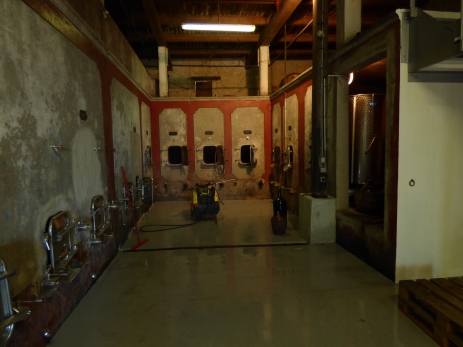
And there have been plenty of other changes in the cellar to ensure that the winemaking will be top quality. Out has gone the old press and some big tanks (cuves) as I have mentioned before. In has arrived new stainless steel cuves, temperature controlled. There is more room, a new resin covered floor to make cleaning easier.

Steel gantries have been erected to make it easier to access the cuves from above. This will make it easier for any whole bunch winemaking as the grapes can be put in tank much more simply and with more checks on quality. It will also be easier to carry out pigeage (punching the grape skins, pips etc down into the juice) and remontage (where the juice is pumped over the top of the cap of grape skins etc). A new staircase to the gantry makes life a lot easier and safer too.

Some of the big cement cuves have been divided to enable Jeff to make smaller quantity wines which will offer more options at the time of assemblage.


So, Monday. We are ready. The grapes will be ready. Let the vendanges begin.


3 Comments

Top ten tasting (Mas Coutelou)

20160802_224144

En français

Friends Ceredig and Lesley were staying with us in Margon and our neighbours Martin and May had relatives and guests staying too so I thought it was a good time to organise a Mas Coutelou tasting.

P1010461

Carignan during the tour with Cora and Brian

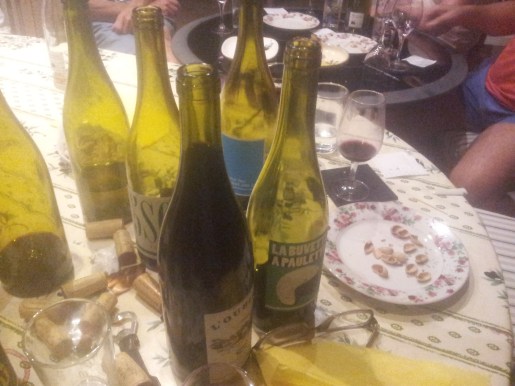
Brian and Cora had shown an interest in the vines and we had made a tour of the vineyards and cellar on Tuesday 2nd. Jeff kindly invited us to take a few bottles from the cave and I made up a series of ten bottles. They were served in the following order, nine from 2015, one from 2014 to show vintage difference:

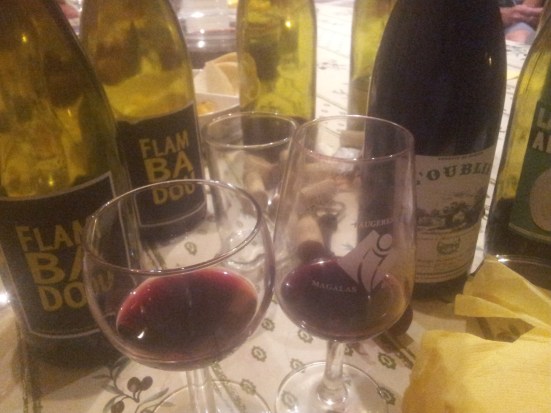
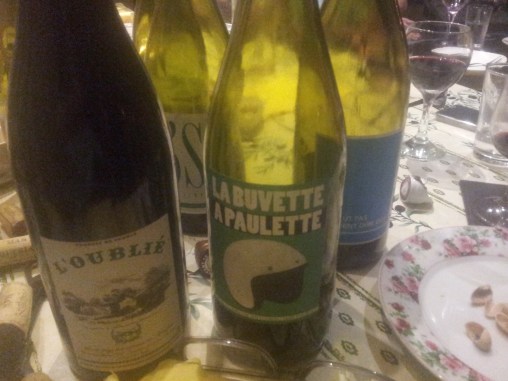
2015: Carignan Blanc / Grenache Gris; PM Rosé; 5SO Simple; Buvette A Paulette; On Peut Pas Vraiment Dire Que; Le Vin Des Amis; Classe; Flambadou; Flambadou 2014; L’Oublié.

Martin initiated a scoring system and at the end of the evening the results showed some agreement about the top wines but some differences too. Wine is personal and that is one reason why I am becoming more sceptical about scores generally. However, this was in fun and here were the results of the Anglo-Irish jury.

20160802_224348

At number 10, the Carignan Blanc / Grenache Gris. My fault this, I had a bottle from the first six off the bottling line and it contained a little water so came across dilute. However, there were some lovely apple and pear characteristics and it was a hit with one guest who doesn’t usually like white wines. I know from other bottles that this is a lovely wine which wasn’t done justice on the night.

8=  PM Rosé An interesting result, perhaps showing that rosé finds it hard to be taken seriously (or just that people loved the reds). PM is so much more aromatic and punchy than most rosés that perhaps it confounded expectations. For me it is a cracking wine, with real character and heft as well as being bone dry and perfect on a summer’s evening.

8= 5SO Simple Another surprise for me as 5SO is really hitting its stride. I served it slightly chilled and everyone liked it though some found it too light for a red. I love the cherry bright fruits and clean finish, it is a great alternative to summer rosés.

7 On Peut Pas Vraiment Dire Que Liked by all, loved by some, a little austere for a couple of people. My opinion is changing on this wine. I thought it was a light Syrah which was for short term drinking but the last couple of bottles seem to suggest it is entering a phase of taking on weight and a serious side. Certainly I shall be keeping the rest of my bottles for a few years to see how it develops, I think it will become something special. It may not be La Vigne Haute but it is a serious Syrah of real quality.

6 Flambadou 15 Well liked though suffered by comparison with the 2014 which was more developed. There is an elegance to this, perhaps the best cuvée from Mas Coutelou in the last several vintages. Jeff likens it to Pinot Noir at time, there is a limestone layer beneath the fine clay soils of the vineyard and this seems to add the lightness and elegance. Red fruit aromas and flavours with a streak of tannins. This is very youthful and will develop with time, complexity is already there. A great wine from a great vintage.

20160802_224209

5 La Buvette À Paulette Round, blackcurranty, juicy, very enjoyable. This was popular because of its sheer drinkability though some found it a little green. No doubt the Cabernet Sauvignon will develop further but this was on song already. It won’t be released until January 2017 and it is definitely one to wait for, a cuvée I hadn’t realised could be so good.

4 Flambadou 14 The extra year added more roundness to the wine making it more enjoyable in the short term. The extra complexity appealed to many of us as well as the red fruits. It is lovely though I do think the 15 will become better, being such a good vintage.

20160802_224144

3 L’Oublié Another recently bottled wine which we assembled a few weeks ago. The aromas were immediately a sign of complexity, hints of tobacco, coffee, dark fruits, there are notes from the barrel and you can tell there is some older wine in here but there is also a freshness from the 2013 Cinsault. The story of the wine and its assemblage I wrote about recently and the air of mystery about L’Oublié added to its appeal at the tasting.

2 Classe No label on as this was another bottle recently put together and has not yet been prepared for sale. As soon as it was opened the exuberant fruits, blackcurrant and raspberry, almost leaped from the glass. There is a depth, richness and a darker profile in there too, this is one of the very best cuvées of Classe. Not hard to see why it appealed so strongly on the night with everybody.20160802_224234

1 Le Vin Des Amis Ever popular, ever first choice. When I serve Coutelou wines to friends it is almost always Vin Des Amis which is the most appreciated. The open, fruity nature makes it immediate and the complexity gives it a sense of being special. Which, of course, it is. It really was on good form here and a clear winner on the night.

A great evening. Lovely people around a series of great bottles, how could it not be? And wow those wines are great, hopefully more people converted to natural wines and to Jeff’s in particular.

A word to for the 2015 vintage. I am, of course biased as this was my first full vintage, but it is proving to be top class, everything is drinking well and the bottles still to come will highlight its class still further.

20160802_231710

In  order of preference from right to left

For what it’s worth my own order read:

  1. L’Oublié
  2. Classe
  3. Flambadou 15
  4. La Buvette A Paulette
  5. Flambadou 14
  6. On Peut Pas Vraiment Dire Que
  7. PM Rosé
  8. Le Vin Des Amis
  9. 5So Simple
  10. Carignan Blanc / Grenache Gris


Leave a comment

Natural terroir

P1010223

En français

The choice of my recent wine of the week, Olivier Leflaive’s Burgundy Oncle Vincent 2012, made me think about how wines change. When I used to regularly visit Leflaive and Burgundy in the 1990s the style of wine was very oak influenced, a response to the New World oaked wines and to the influence of Parker / Rolland in Bordeaux. The wines smelled of vanilla and tasted of wood. Subtlety was often lost, especially on the lower ranked wines. Happily those days are in the past (though I still come across some very heavily oaked wines even in the Languedoc) and this bottle was zesty and fresh with a little oak adding creaminess.

onc-1

Similarly if I choose to drink a Riesling from Alsace I can find two wines from grapes grown side by side in the same vineyard which will taste very different. One producer might prefer a lean, dry style of wine whilst his/her neighbour makes wine in a rounder style with more residual sugar. The same can be said of wines from any region of course. So where does that leave the notion of terroir?

Terroir is that elusive term which describes soil, micro-climate, slope etc. Effectively it means the location, the ‘in situ’ of the wine. However, some will also add the influence of the local culture upon the winemaking in the concept of terroir, Alsace with its traditional residual sweetness for example. However, different winemakers choose different methods and styles according to not just local tradition but outside influences, wines tasted, travels etc.

yellow tail

Amongst those influences has been the growth of the natural wine movement. I have read and heard numerous accounts by natural winemakers of how they came to choose this philosophy for their métier. Most include their discovery of a natural wine which made them tear up the rulebook and decide that this was the style of wine which they wanted to make because of their freshness, drinkability and flavours. A typical account can be found here.

Yet those who still find fault with natural wines are wont to declare that natural wines mask the flavour of grape and place because they often taste of natural wine and nothing else. Take this remark by Rosemary George*, English wine journalist and Languedoc resident, “if there is one thing that I reproach natural wines, it is that they all, irrespective of provenance, have a tendency to a similarity of style.  The best have that delicious mouth-watering freshness, but that somehow seems to mask their origins.”

geology

You will not be surprised to read that I disagree. I do accept that some, less well made natural wines do have aromas and flavours which resemble each other regardless of origin. However, I think in the vast majority of cases that natural winemaking has progressed and reflect their terroir and grape(s) much better than most conventional wines. How can it be otherwise? If a winemaker adds enzymes, artificial yeasts and SO2 how can than not be adding an extraneous element to the flavour of the wine which is nothing to do with the place? If you add oak chips or staves does that make the wine more Burgundy, Bordeaux or Barossa? Or does it simple meet the established concept of what a wine from those areas ought to taste like?

Winemakers will often aim for a flavour, they want their wine to be the same year after year. That is how the big companies retail Yellow Tail, Blossom Hill etc, the customer expects a certain flavour if wine and that is what they will be given. Like Coca Cola. This does not reflect terroir or vintage at all and, to be fair, the big companies would not claim otherwise. However, I do get the impression that many smaller winemakers follow a similar recipe.

A recent visit to a wine fair in Vouvray was a very disheartening experience. I tasted wine after wine which lacked character but did taste very much like the next sec or demi-sec from the next producer. The conformity was alarming. There was a Vouvray style common to most producers but it was bland and dull. There were one or two exceptions where a winemaker had taken deliberate steps to change their winemaking and vineyards, D’Orfeuilles for example.

P1010117

Healthy wines come from healthy soils including microbial life as here at Mas Coutelou’s Rome vineyard

So give me a wine of character. Give me a wine with nothing added where the vineyards’ health is reflected in the grape juice which makes the wine. Give me that grape juice with nothing extraneous added,  natural yeasts for example. Let that wine be carefully nurtured and not messed around with, no added flavourings. If it is aged in barrel then I would expect it to reflect that influence but not be dominated by it. I want to drink wines which reflect the vitality of healthy grapes in healthy vineyards. The wines will alter from year to year because nature alters from year to year. That is terroir and why natural wine reflects terroir in as pure a state as possible.

*(To be fair to Rosemary she does like some natural wines and it was her writing that first introduced me to Jeff Coutelou so I have much to thank her for.)


1 Comment

Last of the summer wine


Flower Power

Flower Power 2015

En français

As work on the cellar ratchets up a notch in the next few weeks it was time to bottle the last of the 2015 wines which will be made for the moment.

The framework for the new mezzanine floor is in place and actually looks quite beautiful. It will be reinforced with concrete however, and the metal cross bars will disappear (which might stop us knocking our heads). Plumbing has also been tidied up and improved. Cuves will be placed below and on top of the structure. More work on stairs, flooring and around the cellar will happen soon. As I am heading back to the UK for a couple of weeks or so, it will be exciting to see the changes upon my return.

P1010407

Peilhan June 30

The vines continue their growth in the sunshine and heat. Mildew problems are largely contained though some humidity leads to sporadic outbreaks (apologies for the pun). Sadly, there is a new threat of oïdium (powdery mildew) which likes that humidity and the warm days with cool nights we have been having. Powdery mildew shows as grey, white spots on the leaves and the grappe. Certain cépages are more vulnerable, including some of the traditional Languedoc varieties such as Carignan. The treatment is to spray sulphur powder and Jeff Coutelou made the first treatment this week in an effort to contain the problem, a job completed on Saturday morning. 2016 certainly has been a struggle.

P1010422

Meanwhile 2015 wines such as Flower Power and L’Oublié went into bottle on Wednesday June 29th. You might recall that the L’Oublié assemblage was made a few weeks ago and after spending time in tank, marrying together, it is now in bottle. Both of these wines are extremely good, well worth waiting for when they are finally released which won’t be for a while.

Jeff also put together a new cuvée exclusively for the French market, it will come in litre sized, Bordeaux style bottles as a «vin de table». An assemblage of various cépages it will be cheap, very drinkable and very desirable. The size of the bottles meant that they had to be filled by hand rather than the machine so Thursday was fully occupied with this cuvée. Jeff refers to it as a vin de gauche, after wine writer Vincent Pousson referred to Jeff as one of the last vignerons de gauche (left wing winemakers) because of his low prices making his wines accessible to all. It will be a wine to share and it will disappear down that litre bottle very quickly.

vin de table 2

The new litre bottle of the vin de gauche

2015 seems increasingly like a golden year, its wines are certainly glittering. 2016, well despite all it has thrown at us, there is hope. Meanwhile the summer wine is bottled and the heat is getting to some of us, even after his haircut.


4 Comments

The Forgotten art of assemblage


IMG_0022

One of the more interesting wines at Mas Coutelou is L’Oublié. It is also one of my favourite wines. On Thursday, June 9th Jeff called in his oenologue, Thierry Toulouse, to help to decide on the blending (assemblage) of the new version of L’Oublié.

P1010228

So what is L’Oublié? It is a blend of grapes just like the vast majority of Languedoc wines and, indeed, Mas Coutelou wines. However, it is also a blend of wines from different years. For example the Carignan is a blend of wine from 2001, 2007 and 2010 which has been stored and aged in a barrel called a demi muid. Add in a similar blend of Grenache and Syrah from different years and then other wines to add even more complexity and depth. The name means ‘the forgotten one’ referring to the original barrel of wine which had been, well, forgotten.

P1010234

This is how I described L’Oublié in my article about the Coutelou cuvées:

“It has aromas of dark fruits and leathery, spicy notes too. It is dark flavoured too, blackberries, liquorice and even coffee are just some of the many complex flavours. It benefits from decanting to allow that complexity to resolve itself a little, and it will stay fresh for days after opening. There are not many wines like this around and I honestly don’t know why. It is unusual and one of my favourite wines because of its complexity, its balance of older and more youthful flavours. Terrific.”

It is the mix of darker flavours with the hallmark Coutelou freshness which really appeals to me about this wine. So, how is it made?

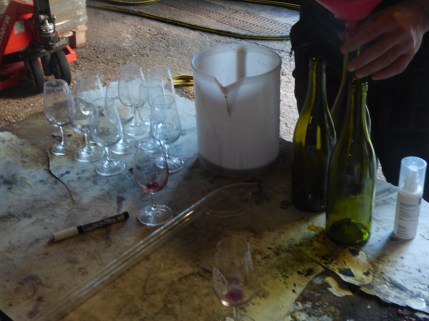
Jeff had taken samples from the demi muid barrels of old Carignan, Grenache and Syrah and also samples of other wines which he had, for example Copains 2013. This is a pure Cinsault, from Rome vineyard, released in 2014 but Jeff had aged some of it in barrel too. Younger wines were on the table too, available to be used. We tasted these separately first to get a feel of the flavours which would be in the mix. Frankly, the barrel aged Copains was so good I’d have made a wine just of that!

Using the base wines of the old blends the oenologue measured out the proportions based on the quantities of each wine available for the final cuvée.

The wine was left to mix for a few minutes and then we tasted. The first was very good but, perhaps, edging a little too much towards the dark side of flavours. So, some 2015 wine was added to freshen it up and … voilà. The characteristics of previous versions of L’Oublié but made with newer wines on top of the base wines.


The decision on the blend made, Jeff then set about blending the components together in tank where it will sit for a while to marry together. This will be bottled at a future date, yet to be determined as it depends upon when the wine is ready. It will tell Jeff the right moment. Yet another wine to look forward to.

P1010240

The secret code of L’Oublié

If you don’t want to take my word for how good L’Oublié is then here are other reviews and tasting notes:

http://www.lsfinewines.co.uk/acatalog/Mas_Coutelou.html

http://www.leblogdolif.com/archive/2011/12/05/grain-grain-le-petit-raisin-gnan-gnan.html


Leave a comment

It’s A Kind Of Magic

20160608_075213

En français

Saturday June 4th was supposed to be the Festival De Magie in Puimisson, a family magic show. Sadly it had to be postponed until September as, around 5.30pm, a huge thunderstorm broke over the area. Booming thunder and heavy rain were the main features as Puimisson and the wider region were treated to an alternative fireworks display to that scheduled in the Festival. Yet 2 hours later the skies were clear, the streets were dry again.

20160604_183831

Flooded roads

Four of us though were treated to a magical evening. Jeff welcomed Cedric who runs the best website on French natural wines at vinsnaturels.fr (and I don’t say that because he chose one of my photographs on the opening page!) It gives great detail about vignerons, technical details about their wines and where they can be bought. His friend Ghislain was with him, another natural wine expert and promoter in the Grenoble area. Pat and I were invited along too and it was a real pleasure to meet up with them, they proved to be excellent company.

20160604_190259

We were treated to 7 hours of tasting with Jeff in the cellars and at his home. And there was no question that Jeff is a true magician, conjuring up an amazing range of wines and of such a consistently high standard. I may be biased as he is my friend but the demand for his wines proves I am not alone in thinking so.

Error
This video doesn’t exist

We tasted all of the 2015 wines, those in bottle and already sold, those just bottled and those in tank and barrel. Whites, rosé, reds, sparkling and selection de grains nobles. Plus many wines from previous years in barrel and bottle. Before moving to the solera cave to taste, amongst others, the Grenaches wine I made. Hand on heart there was not one dud wine and there were many special wines.

20160604_222316

Amongst white wines the Maccabeu and the macerated wine we bottled the previous day were showing well. So too the Bibonade sparkling wines, white and rosé. 5SO Simple was on form from the early wines alongside Vin Des Amis.

Of the next wave of wines, Classe was outstanding, Jeff thinks maybe the star of 2015. Tête À Claques was good, a blend of VdA and Syrah; Buvette À Paulette too, a blend of Mourvèdre and Cabernet Sauvignon. Flambadou will be excellent, it needs time but has all the ingredients to be especially good, just as it has been the last few years.

One wine which was noteworthy was Flower Power. This is the red produced from the complanted Font D’Oulette vineyard with its Aramon, Clairette Musquée, Cinsault, Oeillade and six other cépages. Its first vintage in 2014 won plaudits even from the conventional press. The 2015 I had tasted on Thursday and it was in a dumb moment, Jeff actually carried out a soutirage on Friday and by this Saturday evening it was singing. For me, this could be the star of 2015.

P1010175

Flower Power’s complanted vineyard

Ghislain had brought some cheeses from Meilleur  Ouvrier De France Bernard Ravaud. They were superb cheeses including a truffled comté which shall live long in the memory. Jeff opened one of the 2012 barrel aged 5J which I wrote about recently, and it is a great marriage with cheeses.

We moved to the solera cellar where we tasted some of the old Muscats and Grenaches. However, it was also good to taste my Grenaches wine from all three of its containers, the new 60l barrel, the old 30l barrel and the 27l glass bottle. As before the older barrel has a sweeter, fruitier profile whilst the new barrel gives a slightly leaner, more complex wine. The glass bottle is all sweet fruit and still fermenting! It was good to hear Cedric, Ghislain and Pat all give their approval.

20160604_223304

My Grenaches from new barrel

The hours flew by, always the sign of a good night. Thirty wines or so, Jeff just keeps bringing them out from up his sleeve. Or have I just given away a magic secret?

On Wednesday June 8th more visitors to the cellar. Paco Mora of La Cave D’Ivry and a friend of his Charlotte, a caviste in Montpellier, visited. I have mentioned Paco before on here and I would love to visit his Cave. He takes time and trouble to visit the winemakers whose wines he stocks and to offer his support. He’s passionate about wine and good fun as well as having a keen social conscience. We shared wines, laughs and lunch and two more great wines.

La Vigne Haute 2010 was lovely, showing maturity, the Syrah fruit now brooding and dark with great length and depth. LVH has always been my favourite cuvée but even this had to bow down before Flambadou 2007. Pure Carignan, more leathery and plummy notes with a smooth as silk chocolate finish. If anyone tells you natural wines cannot age then I would ask you to quote this bottle as proof that not only can they age but they can become truly great! Spellbinding.

And even time for a little levitation. Told you it was magic.


P1010268


Leave a comment

Busy times

busy

En français

Busy times. In the vines and in the cellar.

I mentioned recently that the cooler weather had delayed some of the growth in the vines and that flowering was late. Well, recent hotter weather has brought sudden change. Flowering happened around the turn of the month and was over very quickly, perhaps catching up lost time. In particular there was a heavy thunderstorm on Saturday June 4th which brought a torrent of rain. The water and the sunshine has really got the vines going. Tendrils reach for the skies and there is more bushiness to the vines.

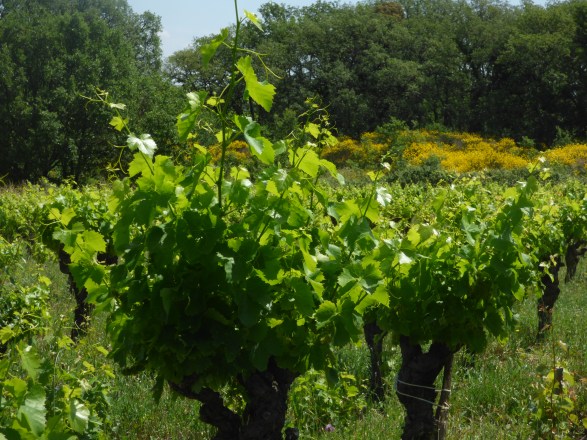
The flowers gave way to the little hoods which cover the nascent grapes, capuchons. These quickly fall away too revealing the grapes for 2016. On some vines all of this is happening at the same time such as this Carignan (above) in Rec D’Oulette. The weather has also encouraged the growth of the grafted vines which we did back in March.

This brings work too. The palissage has to be lifted to support the vines, hard physical labour. And, sadly, the heat and rain bring problems of disease. Mildew has been around for a couple of weeks and I mentioned that Jeff was spraying in the very early hours and late at night last week. He worked until 1am Friday/Saturday and started again at 6am. Just as things seemed to be settling a big attack of mildew on the Grenache at Ste. Suzanne meant more treatment on Tuesday morning. This ‘curious’ year is proving to be hard work.

Not all negatives though. The storm brought such a downfall that I was fearful for the flowering bunches. damage to them means no grapes. I happened to be in Puimisson during the storm (next article!) and the rain was lashing down, converting streets and roads to waterfalls and lakes. Yet as the rain eased I went to a couple of vineyards and the flowers were coping just fine. A trip round the vines on Monday morning revealed healthy growth and the soils had absorbed the rainfall.

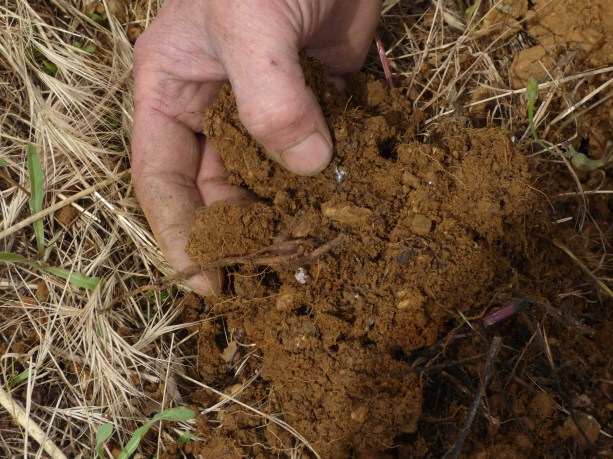
This is not true of everyone. Much of the water on the roads was also full of clay from vineyards nearby, hence the yellowy brown colour. Vineyards which are treated with weedkillers, where the soils are ploughed deeply, even irrigated, were unable to cope so well with the heavy rain. Soils were carried away. Compare these photographs of Jeff’s vineyards with the parcel next door belonging to someone else. The difference is marked. Water can help or can damage.

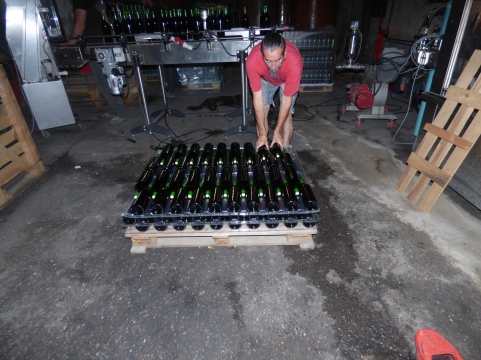
Meanwhile back in the cellar there was more work to be done. Recent changes to the fabric of the cellar, especially the floor, have brought more efficient drains and a smoother surface, easier to clean. Further work will soon be done to the rest of the floor so the bottling of the next wave of wines had to be brought forward to allow the works to be done and dusted before vendanges.

The spring bottling of wines such as 5SO, PM Rosé, 7 Rue De La Pompe I described earlier. These are wines for early drinking, vins de plaisir. Now it was time for wines with a little more body. On Thursday June 2nd 10,000 bottles of Classe were made, and it is really something special in 2015. It took almost 12 hours and went very smoothly but believe me it is a hard day’s work. On Friday, Flambadou, made from the Carignan vines above, was bottled along with other smaller cuvées.

Before anyone rushes in with orders Jeff will let these bottles rest for a few months to allow them to be at their peak when released, Flambadou probably in 2017 for example. There remains one or two cuvées still in tank which need a little more time, Flower Power being one.

So, most of the 2015  wine is now in bottle, the vines are revealing the grapes for 2016 and there are wines stored for 2017. Busy times at Mas Coutelou for everyone, well except one.


6 Comments

Get Back

the-beatles-get-back-session

En français

Whilst having a rather disappointing lunch in Marseillan the other day I ordered a 50cl of Faugères rosé from Sylva Plana and it was quite nice, pale pink, fresh with a little red fruit on the finish. I went to check the back label to see if my guess of Cinsault was correct and… nothing. There was no back label, nothing to inform me about the wine at all. I found this frustrating, Sylva Plana are normally very modern in their approach, have a good restaurant to promote their wines, they’re organic etc. However, they are far from alone. Lots of producers don’t add back labels.

I think this is a wasted opportunity. Most wine drinkers these days have some interest in the wine they are drinking and by supplying information the domaine (I speak generally now) is surely creating a connection to their customer which might be followed up with further sales.

20160430_104416

Jonathan and Rachel Hesford at Domaine Treloar provide information in French and English about the grapes in the wine, information about vines and vinification as well as advice on food pairing and when the wine will be at its best. This latter is followed up on their website where more detailed information is available on each wine. I think this is very good practice, the consumer can find out much more about the wine they drink if they choose.

The label from California producer Ridge on the left gives a lot of detail about vinification and what is actually in the wine. Rather surprised at the amount of added water I must say. Perhaps even more informative is this smart back label from Burgundy (right).

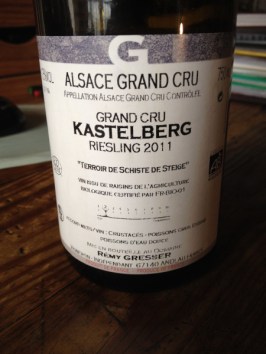
Even little things can help to explain the wine and advise the potential buyer about the wine in the bottle. Alsace wines are often criticised and misunderstood because they can range from dry to sweet from producer to producer even when the label says pretty much the same thing. I like the way this producer shows a scale to describe the level of dry – sweet.

img_7311

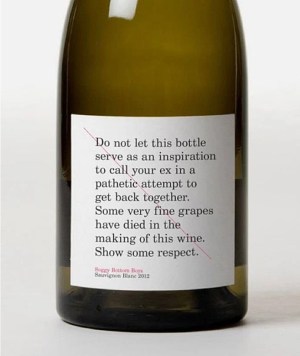
Some producers like to show a humorous side to their work and don’t take themselves too seriously. At least you get to know the grape variety at the bottom.

1459322682816-2060258914

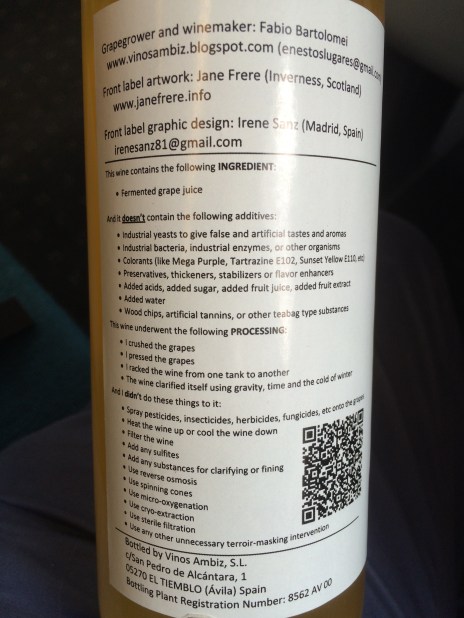
And finally, I do like this back label from a producer keen to emphasise their organic, even natural, credentials. Note also the QR code so that the buyer can link to the website to get more information. Extra points from me there.

image22

So, come on producers. Don’t leave us in the dark about your wines. We want to know about them, to find out the story which makes a wine special and more personal. At least give us the grape varieties.

Happily, for once I was right. The rosé was Cinsault dominated but please don’t leave us in the dark. And if you want something to really inspire you have a look at this, which is something I have already stared at for ages and makes me want to try the wine.

IMG_20160206_093142


Leave a comment

Real? RAW? Just very good


IMG_3808

At La Remise

In the last article I wrote about the young up and coming winemakers whose wines I enjoyed at Bédarieux, La Remise and The Real Wine Fair. Whilst this new wave are producing good things there are still many good tunes from the some of the ‘older’ fiddles. As ever there were many vignerons present who have been making natural wines for longer. Many of these began as winemakers on a family domaine and learned about winemaking in conventional form before deciding to go natural. Others have moved into the world of wine with the intention of making natural wine.

Natural wines developed a reputation for faults amongst traditional wine drinkers (especially some journalists). Some of these appraisals were genuine, others a matter of perception. There is no doubt that some wines are faulty, I have tasted them myself. Problems such as mousiness and brett are genuine faults. Other issues can be a matter of taste, eg skin contact.

In contrast, however, I visited a wine fair in Vouvray on Sunday May 15th. It was full of conventional producers, bar one converting to biodynamics. There were many dull wines, often with high sulphur. There were many faulty wines. So, j’accuse les vins conventionels.

Natural wines are, in fact, the way that wines were made for generations, over hundreds of years. The conventional wines of 2016 are the product of more recent methods, of modern science and technology. Going back to the traditional methods involves a leap of faith and requires very healthy grapes if you are to  abjure sulphur dioxide. As the natural wine movement has gained momentum in the last 20 years many of its producers have become more experienced in making wines without the safety net of modern science and technology. Standards are getting higher, the wines ever better. So, here are some that I enjoyed recently.

IMG_3795

With Fred Rivaton

At Bédarieux I was very happy to meet up again with Fred Rivaton from Latour De France (66) who makes many of my favourite wines. Blanc Du Bec and Gribouille, both 2014s, were delicious. In the last few weeks I have selected both as Wine Of The Week, and would do so most weeks when I was fortunate enough to open a bottle. One of the best.

Another of my WOTW selections was the Pinot Blanc 2010 of Gérard Schueller. He was present at Bédarieux too and his 2014 Pinot Blanc and Riesling were both excellent. Next time I visit Alsace he’ll be top of my list of domaines to visit. I bought both of those wines.

Philippe Valette‘s Macon wines were another source of quality, I especially liked his Chaintré 2012, a beautifully clear, zesty and round expression of Chardonnay. As a third generation winemaker, Valette is a fine example of my comments above.

Didier Barral (Domaine Leon Barral) is one of natural wine’s great stars. His wines at Bédarieux were proof of how justified his reputation is. They require time to be at their peak but are pleasurable, profound and priced accordingly but worth it. Barral is a model of biodiversity and philosophical winemaking, a must try. My favourites were the Blanc 14 made mostly from Terret with lovely melon, grapefruit flavours and great length, together with the Faugères 13 of stunning depth.

Nicolas Carmarans is living proof that talent and good winemaking can make very drinkable, quality wines in regions not usually associated with wine. He works in the Aveyron. There is a direct, mineral side to his wines married to fruit and length. Wines such as Selves 14 and Maximus 14 reflect local grape varieties such as Fer Servadou at their best.

IMG_3861

Clos Fantine is a domaine which features regularly in this blog and the 2015 wines which Corinne was showing at La Remise were the best of recent vintages in my opinion. La Lanterne Rouge and Faugères Tradition have pure fruit with structure, complexity and a beautiful expression of the schistous soils of the area.

Philppe Pibarot makes wines in the Gard. As well as encouraging his young assistant John Almansa, Philippe makes first rate wines. I loved both his white wines, Blanc and Clos Domitia 14 with Clairette, Roussanne and Piquepoul and the delicious red fruit freshness of Cante Renard 15 made from Cabernet Sauvignon with Languedoc varieties such as Carignan and Syrah mixed in.

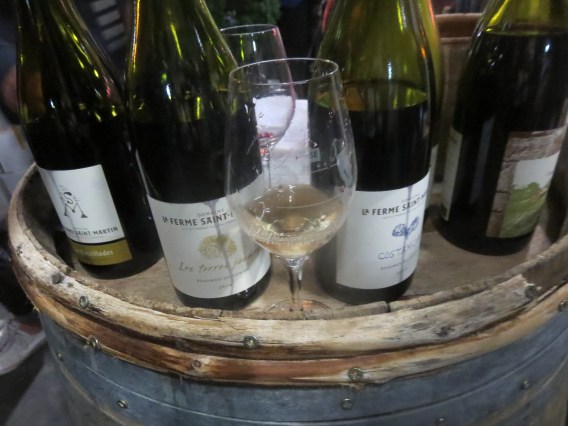
Guy and Thomas Jullien are still young but I have enjoyed their Ferme Saint Martin Rhone wines many times and met them in Arles and London. I especially enjoyed the Ventoux wine Estaillades 14 (Grenache and Counoise) with round, spicy flavours and the Beaumes De Venise Costancia 14 a 50/50 blend of Grenache and Syrah, more structured but balanced with lots of delicious fruit.

IMG_3811

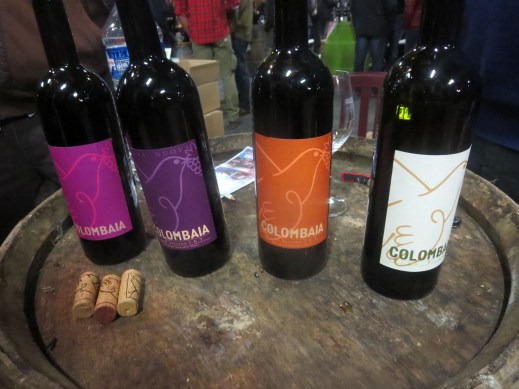
Italian producer Colombaia presented some lovely wines at La Remise, classic Tuscan wines with Sangiovese, Malvese and Colorino grapes. Lovely freshness and fruit were trademarks of the wines and I particularly appreciated their Rosso Toscano 12 from young vines.

IMG_3809

From Galicia in Spain I enjoyed the wines of La Perdida. Perfumed, spicy aromas in their wines, nicely balanced too – signs of good winemaking. The Godello 14 with 20 days maceration on skins was one of the best examples of longer skin contact white wines that I have tasted and the Garnacha (with 30% Mencia) was even better, full of deep spice and dark fruits and very aromatic.

IMG_3814

I could add other names like Yannick Pelletier, Julien Peyras and Alexandre Bain. Good producers all.

And, yes I am biased, there are the excellent wines of Jeff Coutelou. It is interesting to taste Mas Coutelou wines in the context of producers from around France and Europe. They more than hold their own, the 2015 freshness and restraint certainly lifting them to bear comparison with the best of the Rhone, Loire or anywhere.

IMG_3826

Jeff is a 5th generation producer, he learned winemaking skills from his family before branching out into ‘real wine’ production. He has a natural talent of course but he has learned from experience and his wines are improving in quality as a result of that talent and learning about his vines, his soils and his cellar work. And passing it on to the new wave of producers who come to spend time with him.

Terms such as ‘real’, ‘natural’, ‘living’ are often applied to these wines, but don’t get hung up about them. The cuvées and producers I have listed here are just very very good wines and winemakers.

IMG_3831