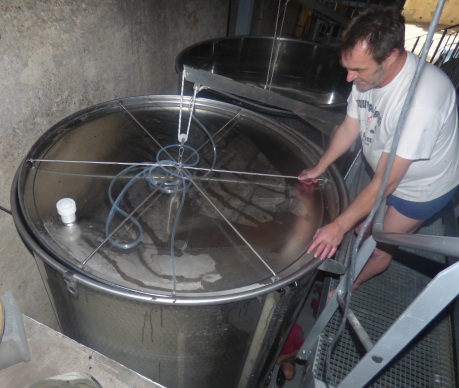
It’s a simple explanation honestly. The tank of Mourvèdre was ready for remontage. That is where juice from the bottom of the tank is pumped over the cap of grape skins, pips etc (the must) which rise during fermentation. That cap becomes hard and there is a risk of bacterial infection plus the whole idea of having the skins in there is to extract tannins, colour and flavour so it’s pointless having them separated from the juice.
A normal pigeage
You may recall that this was the tank where Jeff had to improvise last Monday when the érafloir broke down. Some of the bunches were destemmed, others went in whole bunch. There is therefore a higher than usual amount of solid material in the tank. This had formed a solid cap and Jeff needed it to be pushed back into the juice. A fork was used at first as is normal (the process called pigeage), but the crust was too firm. So, Jeff took off his boots and socks and climbed in.
This is dangerous for two reasons. He could fall through the cap and into the juice and, secondly, there is a lot of carbon dioxide coming from the fermentation which, as I found out, can make you ill. So hanging on to the sides and with myself and Matthieu ready to catch hold Jeff pushed down with his feet onto the cap.
He described the cap as cold but underneath the fermentation meant that the juice was hot. As Jeff pushed down the cap it was fascinating to see the gentle bubbling of the fermentation process, sadly it was too dark for the camera to pick up. As he pushed the cap down, Jeff needed to push lower so, off came the trousers. Moving around the tank the cap began to sink bit by bit.
Out he came and a normal remontage took place though in his briefs!
And the wine? Well it tastes very good, perhaps with more legs in the glass than usual.
Last Monday (September 11th) we were joined at Mas Coutelou by winemakers Charlotte and Louis Pérot and of their friends. You might recall that their Cahors domaine L’Ostal is one which has appeared on these pages before. I first met Louis in spring 2015 at La Remise in Arles where I was taken by his wines and was eager to spread the word of how good they were. Happily Jeff agreed with my judgement and a friendship grew between the winemakers.
Cabernet Sauvignon 2017
Sadly the spring of 2017 brought 3 nights of frost to the vines of L’Ostal damaging the young growth and buds, up to 80% of the vines were damaged meaning huge losses on the year. Jeff decided to help out and offered the Pérots the opportunity to come to Puimisson and take some Cabernet Sauvignon grapes to ensure they had more wine. I hasten to add that this was a gift, free of any charge, offered simply to help out a colleague and friend. I have heard of similar stories for other winemakers affected but it was humbling to see this fraternity in action for myself.
Heading home
Louis and Charlotte picked around 60 cases and drove them back to Puy L’Evêque where I am sure they will make another very good wine. We actually opened one of their magnums the following day at lunch, and very good it was too. If you thought Cahors wines are too difficult I urge you to try and find one from L’Ostal, it will change your mind.
In a year when Jeff himself will lose up to 40% of his average production he showed no hesitation in helping out someone who was in a worse situation than himself. A mark of the man.
In other words, the finish. Well, the finish of the picking. Tuesday September 12th was so much calmer than the previous day as the Cabernet Sauvignon from Segrairals arrived.
Thoughout the vendanges the grapes have been good, smaller than the norm because of the dryness, but in excellent health. The Cabernet was no exception. Sorting was all about snails and dry leaves rather than any problems with the grapes and the vat filled gradually, problem – free, as the day progressed. The stalks were brown showing the maturity of the bunches as the third érafloir of yesterday completed its job efficiently.
Myself and Jeremy
As we awaited the first cases Jeff and I went around some of the vats and took samples for analysis as well as tasting the wines. I wish that I could convey the bready aromas filling the cellar of the yeasts at work, they give such a sense of change, optimism, alchemy.
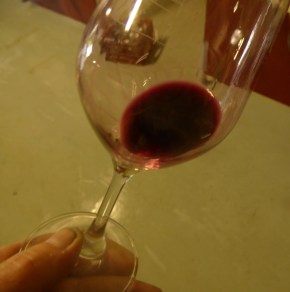
Amongst the wines we tasted were two from 2016, Syrah and Grenache, which have been sparked back into fermentation by the very presence of this year’s grapes in the cellar. The process is truly amazing. The glass in the photo below shows the top Syrah from La Garrigue harvested two weeks ago, which just may become La Vigne Haute. It is a stunner.
Quality across the board is undoubtedly high though Jeff is counting the cost of the quantity, his first estimates are that the overall yield will be around 39 hectolitres per hectare. Average years would give between 50 and 60 hl/ha.
Joining us on the day was a former student of Jeff and Vincent restaurateur Régis Lamazère and his wife and baby. Régis runs his autonymous restaurant in Berlin where Charles who was here for vendanges 2016 used to work.
After the grapes were in and the last cases sorted by Julien and Vincent it was time to start serious cleaning of all the equipment which will be put away for 2018. The picking may be over but the work never stops. A full programme of pressing, remontages etc is in place for the next week. Stay tuned.
“Quelle journée!” That was how Jeff messaged me on Monday evening. Safe to say things didn’t go exactly to plan, nor did Plan B work so it was Plan C in the end. What am I talking about? Let me explain a day which shows how impromptu thinking is important.
Mourvedre waiting to be picked
Plan A was straightforward and, maybe, things had gone too smoothly up till then. I wrote recently how the team was in the groove and the grapes were being harvested efficiently. Monday was the day for the Mourvèdre to be picked, a real star of the 2016 crop, hopes were high for a repeat.
Jeff surveys the Mourvèdre under a gorgeous sky
Everything began well. A silvery dawn revealed grapes in tip top condition though smaller yields in keeping with the vintage. The first cases arrived and I was sorting through them with Matthieu, a trainee sommelier on work placement. And then the destemmer (érafloir) suddenly stopped. On opening the main body Jeff found the fan belt off and one of the wheels sheered away. No easy fix.
These cases were sorted Plan A ; the offending mechanics
We had already destemmed 20 cases or so and the grapes were in stainless steel tank. With no érafloir, however, we could not destem. Jeff declared that we would have to move to whole bunches. We moved upstairs to the new mezzanine floor created in the cellar renovations of the last two years. Trapdoors in the floor are positioned above the tanks and big plastic chutes are connected so that the bunches can fall through into the tank. The cases are brought by Michel to the upper floor via the garden and then sorted just as carefully.
The tank was now filled with destemmed bunches and lots of juice but also whole bunches in amongst that. This was Plan B. A neighbour then offered the use of his destemmer which was brought down and put in place whilst Plan B was working. We started this and did a few cases of destemming again but it was a big machine, meant for huge quantities of grapes and was too powerful for the amount we were processing.
Jeremy and Matthieu sort whole bunches
Lunchtime. Reflection. Back to Plan B, whole bunches.
Meanwhile Jeff took the original destemmer to the repairers who declared it unrepairable! However, these were the same people who had renovated the cellar and they kindly offered Jeff the use of a third érafloir. Plan C. This proved just the job, even quieter and more efficient than the original. So, we have an interesting tank of Mourvèdre, a millefeuille of grapes, juice and stems. No doubt it will still produce very good wine as the grapes were healthy and of very good quality. However, it had been a day to try Jeff’s patience whilst other tanks also demanded his attention.
The third érafloir of the day ; Matthieu and Ambroise
He had also damaged one of the large tubes used for pumping the grapes and juice first thing, I think a black cat must have crossed his path on the walk to the cellar that morning! All’s well that ends well however, but it was certainly proof that you need to have contingencies and how experience can help a vigneron to overcome adversity.
There are numerous different tasks during the vendanges, I thought I’d expand on a few as I reflect on the last two days. Both Thursday and Friday began with lovely sunrises over the vines as we picked, almost worth the early start to the day.
Picking was done by the half dozen Moroccan workers who work non-stop and chatter away even faster. This year there was a more stable team working with Jeff, on previous vendanges there has been a core of people with lots of others coming to spend a couple of days and then moving on. Many of these did sterling work, such as Thomas and Charles, but with an unchanging team for three weeks progress has been smooth.
In the vineyard Julien and Vincent took charge along with Selene, Max, Roxane, Ambroise and Jeremy. Michel ferried the grapes to the cellar where Jeff controls the process of turning fruit into wine. The team (including myself) would also help out in the cellar as needed, Jeff aiming to give opportunities to learn about the winemaking process to everyone. Ever the teacher.
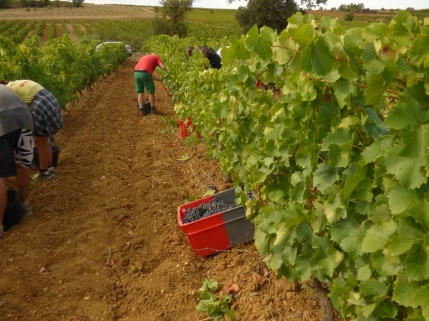
This photo shows Roxane, Selene and Max picking Carignan. Roxane is cutting the bunches whilst Selene and Max carefully sort through their bunches to remove anything untoward such as insects, leaves, rotten or dried berries. On the other side of the vines are other pickers to ensure everything is taken. The bunches go into buckets and when they are filled they are emptied into the cases stored under the vine.
Muscat D’Alexandrie
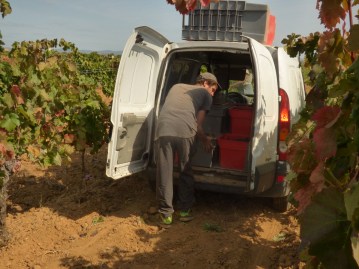
Michel arrives in the vineyard and drives between two rows to collect the cases, often supported by Julien. The grapes are returned to the cellar as quickly as speed limits allow, unloaded and subjected to further sorting.
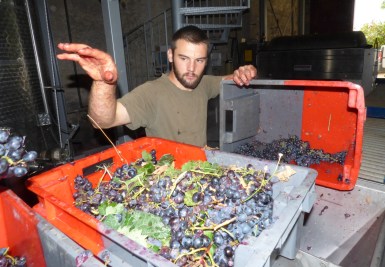
In the photo below Ambroise is checking for anything which escaped the pickers or fell into the cases whilst waiting to be collected. This year the grapes have been very healthy and so no need for the sorting table to be used. However, snails often sneak into the bunches and cases seeking some nourishment in the very dry weather.
The bunches are either pressed immediately, eg for white wine or sent to vat. In the latter case they will be destemmed first or sent as whole bunches depending on the style of wine Jeff decided will be most suited to the grapes. They will spend a day or two there before the process of debourbing or délestage. The juice has now been sitting on the skins, flesh and pips which form a cap on the top of the juice or sink to the bottom of the vat. Délestage involves removing the juice from this mass when it has absorbed as much colour, flavour, tannin as Jeff deems optimal. The juice heads to a new tank to recover. In the video below you will see that it passes through a machine which cools down the juice. Fermentation produces a lot of heat, too much can bring problems which would spoil the wine. That is the main reason why Jeff also invested in new temperature controlled stainless steel tanks this year, especially for white wines.
Error
This video doesn’t exist
The fermentation begins promptly, the healthy yeasts produced by the grapes themselves triggers the process of turning grape juice and its sugars into alcoholic wine. Odours of bread making and fresh fruits fill the cellar, hints of the pleasures of Mas Coutelou 2017 wines ahead.
Skins after pressing
Meanwhile, after pressing the grapes skins are recovered from the press itself and put into a large container. There they will ferment and produce the base for brandy and spirits, nothing is wasted.
Muscat D’Alexandrie
Carignan Blanc
Carignan
Cinsault
Castets
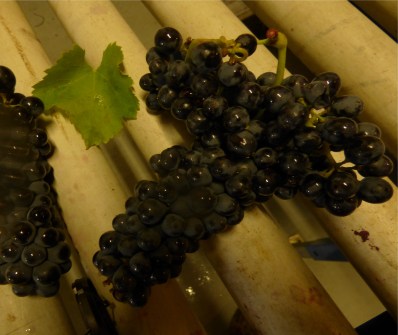
More interesting varieties were harvested these two days. Top left above is Muscat D’Alexandrie, large oval grapes tasting of pure grape juice. Carignan Blanc is one of my favourite white grapes from the region, it makes dry, complex wines. The middle row shows Carignan and Cinsault picked these days. Last but certainly not least, Castets is a rare red variety, less than 1 hectare in the world and much of that is in Peilhan. Sadly, it too has been hit by the dry summer, lovely quality but lacking in volume, a summary of this vintage.
And, after a hard day for some of us my T shirt shows the fruit of the day. Whilst Icare takes things at his own pace.
An unusual few days to report upon. Let’s start with some bad news. Twice in the last week people have dumped their rubbish in Jeff’s vineyards. As these were at opposite ends of the village it must be assumed that there are two selfish, anti-social idiots who would prefer to spoil the local environment than drive to the local tip (déchetterie).
Another unwelcome arrival was Hurricane Irma in the Caribbean. Jeff’s sister Catherine and her husband live on Guadeloupe so we were all concerned for their welfare. Happily she reported that the worst of the storm missed the island. Others may not have been so lucky of course.
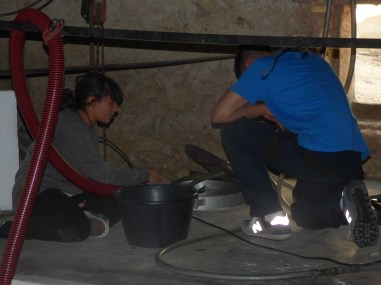
Jeremy cleaning the cuve from inside
Selene supervising a remontage
For me there was one more unwelcome visitor. As I entered the cellar on Tuesday morning I mentioned the smell of Carbon Dioxide in the air. This had built up from fermenting grapes and with the cellar being less busy than usual the CO2 had built up. As Tuesday was hot the cellar doors stayed shut as much as possible and with remontages and open vats the CO2 was strong. Alas it seems I am particularly sensitive to it and it made me breathless and nauseous. I can understand better how some people have serious accidents with gas build up when they are working at open cuves. Maybe it’s because I’m getting old but the others were unaffected, and I’m the non – smoker! Happily, I have soon recovered.
Yet another visitor arrived in the form of the inspector who controls organic certification for Ecocert. I wrote about her annual visit in 2014, this was a spot check during vendanges to ensure that everything is done following organic principles. Reassuring for those of us who want to know that Bio wines are truly organic. Obviously, there was no concern as Mas Coutelou goes well beyond the standards required.
Animal visitors too. Buried in a case of Grenache from Sainte Suzanne was this 6cm caterpillar, quite a size. And, amongst the Carignan vines today was this dragonfly who was there with others and many butterflies. Which makes the actions of the fly tippers even more senseless.
Terret Blanc, Piquepoul Gris
Maccabeu
And so to grapes. More cépages to keep me happy. Piquepoul Gris and Terret Blanc along with Maccabeu picked from Peilhan on Tuesday morning will form a new white wine. The pink tint of the Piquepoul Gris will not colour the wine as it was pressed directly to remove the juice from the skins.
Grenache, La Garrigue
The aforementioned Grenache was supplemented with more Grenache on Wednesday this time from La Garrigue. So good was this harvest that Jeff is considering making a special cuvée with it. Together with the excellent Syrah from the vineyard La Garrigue has certainly performed well this year. Cinsault from Segrairals followed on.
Vincent, Julien and Selene
Max and Roxane
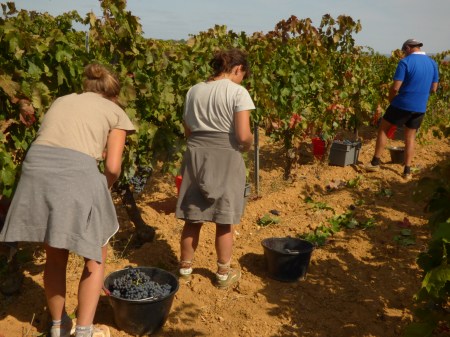
With smaller yields and dry weather the picking has been quick this year, efficient too with an excellent team working well. You will see in the photo below how they work in pairs across a vine to ensure that all the fruit is picked, hopefully avoiding each others’ fingers.
So, what remains? Well probably five days of vendanges with Cabernet, Mourvèdre and Carignan still to come, the latter of course being the headline act in recent years. There are also a few rows of vines in Peilhan, eg the reds such as Oeillade and Castets and more Muscat too. All is set fair for a good finish.
A week into picking and the team is in a routine, working smoothly to steadily bring in the grapes. The quality remains high but there can now be no doubt that the ongoing dry spell has taken its toll. Quantities are down by up to 50%, bottles of the 2017 Mas Coutelou wines will be more difficult to seek out I’m afraid and, inevitably, more expensive.
Flower Power
Thursday saw the Flower Power vineyard picked (Rec D’Oulette to give it the proper name) and just 7 cases of grapes were returned from the 0,4ha of vines. They are young still and will have found it hard to cope with the arid conditions.
Julien and Max in Rome
Rome, too, was picked and I went along as this is my favourite vineyard. Cinsault, Muscat and all three types of Grenache were harvested. From Peilhan came Grenache Gris and a few rows of the Maccabeu which will go into the PM rosé wine.
Muscat, Grenache Blanc and Cinsault (left from Rome), Grenache Gris and Maccabeu from Peilhan on the right
By now we are into the second stage of the vendanges. The grapes picked previously have been sitting on skins for varying lengths of time to extract colour and flavour but they will be separated when Jeff decides that further contact will not enhance the wine further. The juice is pumped to a new tank leaving the skins and pips behind to be used as marc for distilling.
Vincent preparing the day
Remontage about to happen
This process of remontage is carried out increasingly as more tanks fill up. Tracking which wines are where is a skill in itself, each time the wine will be tasted and sent for analysis to ensure that acidity, sugars, potential alcohol are all correct and no nasty surprises await.
Jeff took me round a few of the vineyards to check on their progress for picking. We started with the Carignan, then on to the Mourvèdre and Cinsault of Segrairals. In all cases the pips and stalks showed us that more time was needed, they are still a little too green. Tasting the grapes showed plenty of sweet fruit but that greenness would not be good in the finished wine.
Cinsault after pressing, like modern art
Friday was based in the biggest parcel, Segrairals. Cinsault grapes first, to be pressed immediately so that a light pink juice emerges ready to be blended with the other rosé grapes. This happened on Saturday so that all the rosé grapes will ferment together to blend fully. Jeff explained to me that Cinsault is harder to press than most, the large berries contain a lot of pulp which breaks down less easily.
Syrah, Segrairals
Afterwards the remaining Syrah was tackled, again I went along to help with a bit of picking as well as doing the sorting with Jeff back in the cellar. The tri was not too difficult as good, firm bunches of healthy grapes came in case after case. Never mind the width feel the quality seems to be the motto, for Jeff’s sake greater quantity would be welcome.
More remontage, more testing in the cellar. It was good to see the white wines in good condition with fermentation already lively; bready, yeasty smells began to fill the cellar. More Syrah would be picked on Saturday morning but, readers, I admit that I took a break. The hard work, rich variety of grapes and early mornings meant that this time AMarch was not in the vines.
I don’t intend to record thoughts on every single day of the vendanges but there are some days which deserve a special mention. Yesterday, August 30th, was one of those days. And the reason was simply the quality of the grapes. These are my fourth vendanges and I do not recall such a consistently high standard of fruit coming from one parcel from the first case to the last.
The grapes were Syrah and they came from La Garrigue vineyard. La Garrigue is interesting because it has a ridge running through the middle, west to east. The slope facing south is planted with Grenache as it is a cépage which loves the sun and heat. The slope facing north is planted with Syrah, which certainly likes sun and heat, for example in the Rhone Valley, but not so much as Grenache.
The Syrah of La Garrigue produces, in very good years, my favourite wine of all from Jeff Coutelou (and therefore, in effect, my favourite wine). That wine is La Vigne Haute which combines the warmth and fruit of the Languedoc with the serious, mineral complexity of the Rhone. Sadly there has been no Vigne Haute produced since 2013 as Jeff has felt that the quality was not quite high enough for such a cuvée. In the excellent vintage of 2015 the decision was marginal and instead he produced the excellent On Peut Pas Vraiment Dire Que, which you can read about here.
Perhaps its my bad influence since the 2014 vendanges but La Vigne Haute eludes me. This year when I took the photos of the Syrah in La Garrigue (above), Jeff was concerned that the very dry months of summer had spoiled the Syrah but recent humid days had allowed the vines to recover and put their energy into the grapes.Well, I really have my fingers crossed for 2017. The grapes came in firm bunches, healthy to the core. Classic Syrah bunches too, almost T shaped.
The cases smelled of spice and fruit, other than snails with good taste there was little to sort. The juice gave aromas of passion fruit – not something I would ever have imagined possible but tropical fruits for sure. Flavours of raspberry, wild strawberry with a lovely vivacity. This was exceptional. Now, a lot can happen in the next few days, weeks and months. Jeff will simply allow the juice to express itself and not intervene, Coutelou wines are what nature makes with a simple guiding hand.
Making sure the workers look after these great grapes
There are many more days of the vendanges to come, and there are some exciting grapes on the vines still. However, these grapes motivated me to write, to cross my fingers and trust in nature and Jeff to, maybe, finally deliver my favourite wine. Whatever, it will be worth buying and drinking, I can hardly wait.
After the white grapes picked last week it was time to tackle the red, which form the main part (just under 90%) of Mas Coutelou’s production.
Monday was hot, very hot – Jeff’s car measured 42°C at one point in the vineyard of Le Colombié where we were picking Merlot grapes. This small (0.5 ha) parcel was planted with Merlot back in 1999 and, though not Jeff’s favourite cépage, the grapes provide a useful backup and the vines are in particularly good health. I spent a couple of hours picking and the heat made it very hard work, believe me. The quality was very good though the grapes lacked juice due to the lack of any rain in two months. Jeff said that they provided around 50% of last year’s juice which in turn was 20% below average.
Back in the cellar after lunch I sorted the remaining Merlot and some Syrah from Segrairals, the biggest of the Coutelou vineyards with 4ha under vine. These were juicier and were added to the Merlot in tank in order to bolster the quantity. The alcohol level was good at around 14% for both.
Today, Tuesday, it was off to Sainte Suzanne where Jeff thinks some of the best grapes of the year are to be found. The vineyard is planted with Syrah and Grenache and these are usually the grapes which make up Le Vin Des Amis, one of the more famous wines of the domaine. Jeff was proved correct, not that I would have doubted him of course! The bunches which came in were full, firm and in excellent condition. There was hardly any sorting to do other than removing leaves and snails. This will certainly make good wine. By the end of the day a few rows of Grenache from the parcel were added to the mix.
Syrah – Ste Suzanne
Grenache Ste Suzanne with Max
Syrah – Segrairals
The grapes were all put into tank in whole bunches, grappes entières, rather than being separated from the stalks as the bunches were so healthy Jeff wanted to let them express themselves. In tank the grapes will begin to ferment within their skins under the weight and heat, though some will ferment as they burst. It was good to see Jeff happy with the results of the day’s harvest, long may it continue.
In the photos above Vincent is preparing the cuve for the whole bunches which will enter through the trapdoor at the top. In the second he adds CO2 to the tank which is part of the carbonic maceration process to help the berries ferment inside their skin.
Day two and the weather remained overcast and humid, there were even a few drops of rain. Rain which has been sorely missed in the last two months, there has been no real rain since June 26th, almost two months now. Some vines have found that stressful and virtually shut down therefore not ripening the grapes as well as they ought to do. Others, with underground water supply more available, are more vigorous and channeling their energy into the grapes. Judging what to harvest and when, is therefore even more difficult and stressful for Jeff.
The picking today began in Peilhan where the Muscat À Petits Grains was golden, starting to raisin in places. The berries are a little smaller than usual, another sign of the lack of recent rain. Nonetheless they were sweet, ripe and ready, measuring 15° of potential alcohol. In the press the lack of juice means that even a decent amount of grapes will produce only one barrique this year.
Grenache Blanc
Clairette Musquée
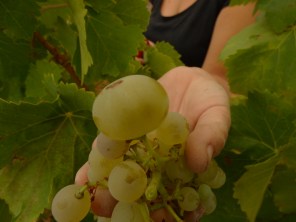
Then on to Clairette Musquée, a couple of rows in Peilhan, next to the red grape vines. This cépage is so rare that an ampelography expert recently failed to identify it on a visit. Into the mix was added Grenache Blanc from La Garrigue, which has fared better than some in that vineyard with the drought. Indeed one berry seemed to have thrived as you can see in the following photo.
Whilst Roxane, Max and myself picked the Grenache the others moved into the newer plantation of Peilhan and picked Riveyrenc Noir, Riveyrenc Gris, Piquepoul Gris and Morastel. This really was a day for ampelography fans like myself. All of these grapes with the Clairette will help to make the rosé for 2017 and the first glass, hot from the press, tasted very good indeed over lunch.
Morastel
Roxane with a huge bunch of Morastel
Friday lunch was leisurely, we were joined by the excellent Paco Mora of La Cave D’Ivry, and some good bottles opened including a fabulous Sauvignon Blanc 002 from Jeff, 15 years old and still in great shape. Julien opened his new cuvée (one of only 50 bottles) from Faugères (Grenache Blanc and Roussanne) which was very good too. Monday will see the start of more full on days, bigger quantities, more work and faster lunches – so allow us this convivial interlude. Meanwhile, Icare continued in his inimitable style.




















 amarchinthevines