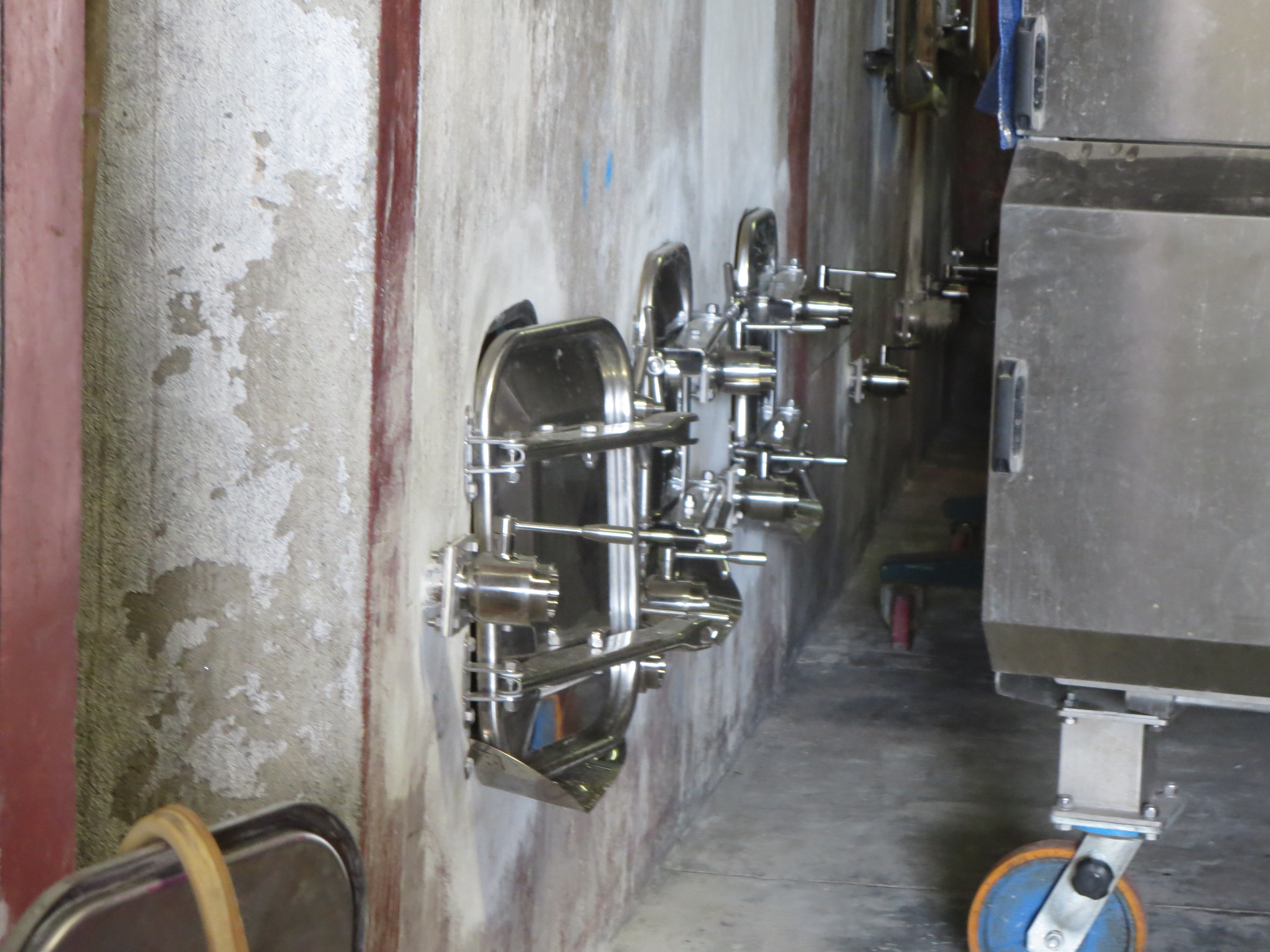
Well, cave painting is a slight exaggeration but there have been lots of changes in the main cave in recent weeks. The first took place a little while ago when one of the cement tanks, cuves, was divided into two. This will allow an additional wine to be made separately giving more flexibility to Jeff to decide what cuvées to make. As he has increased the number of parcels of different varieties, especially older cépages such as Aramon and Castets, then these have to be vinified with other grapes or separately. More cuves add more choice.
Before
After
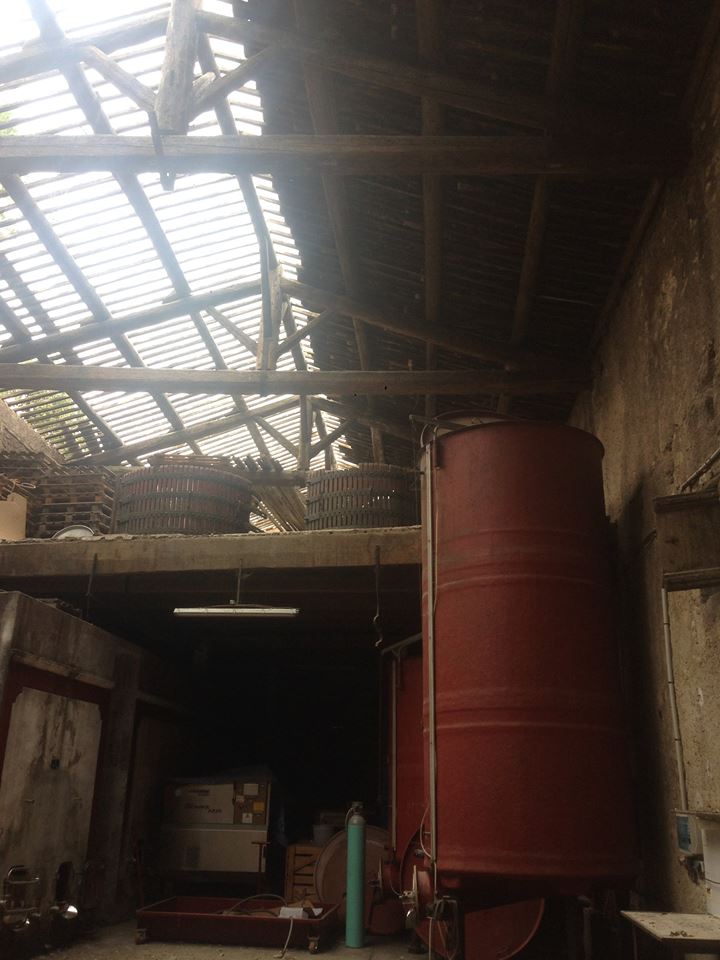
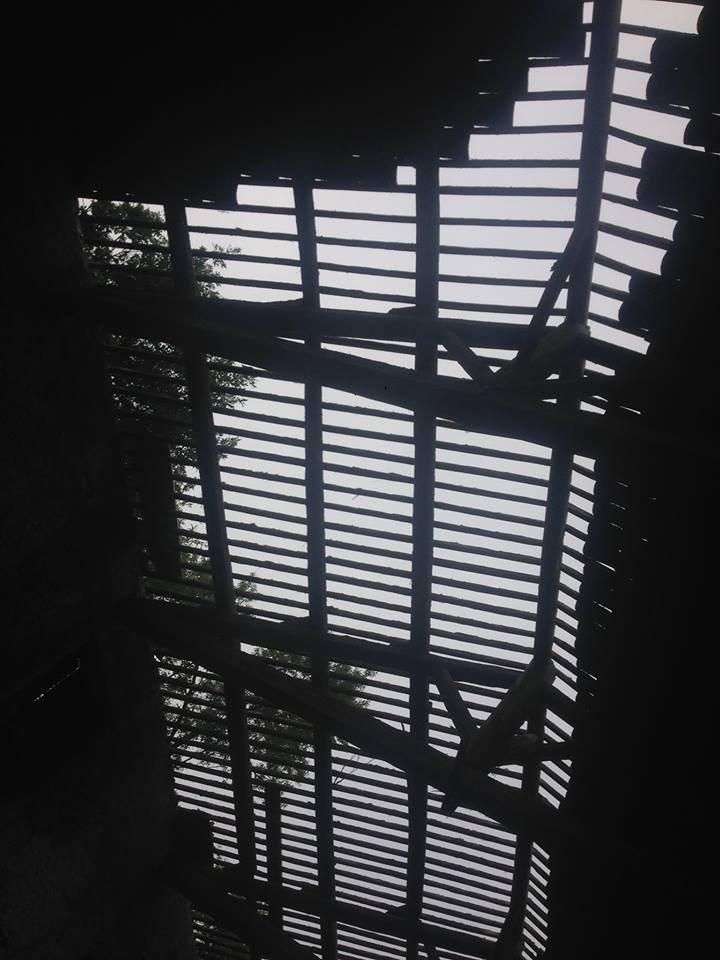
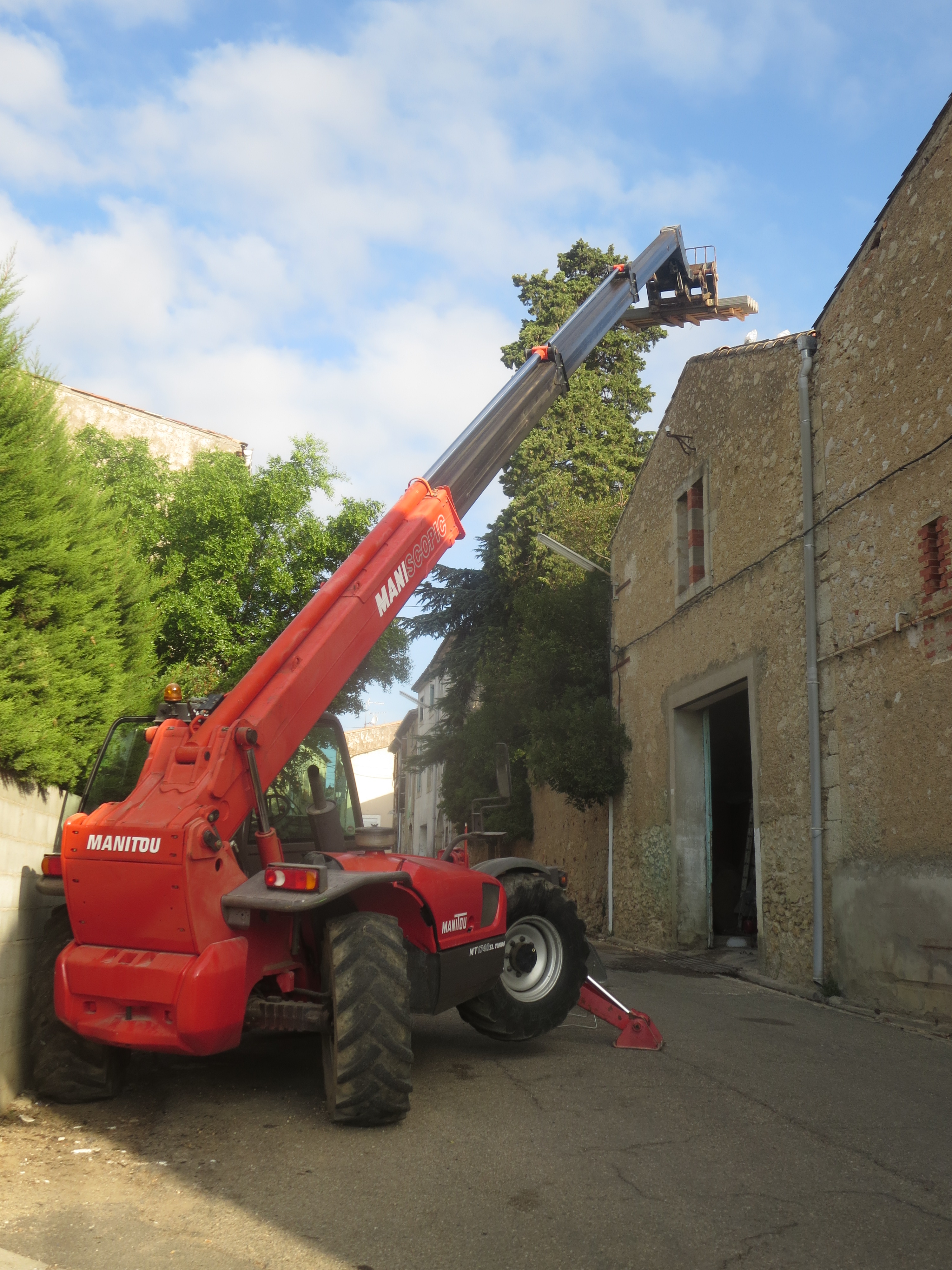
The main cellar is a marvelous place with its sheer size and history of winemaking. The roof has always been a joy to look at because of the magnificent timber work and vaulting. Sadly, after five generations of Coutelou vignerons, the roof had problems. The woodwork needed replacing in some areas and the tiles needed to be relaid or replaced. A large expense to take on board.
Holes and gaps in the damaged roof
Dismantling the roof. Photo by Jeff
Photo by Jeff
Almost closed up
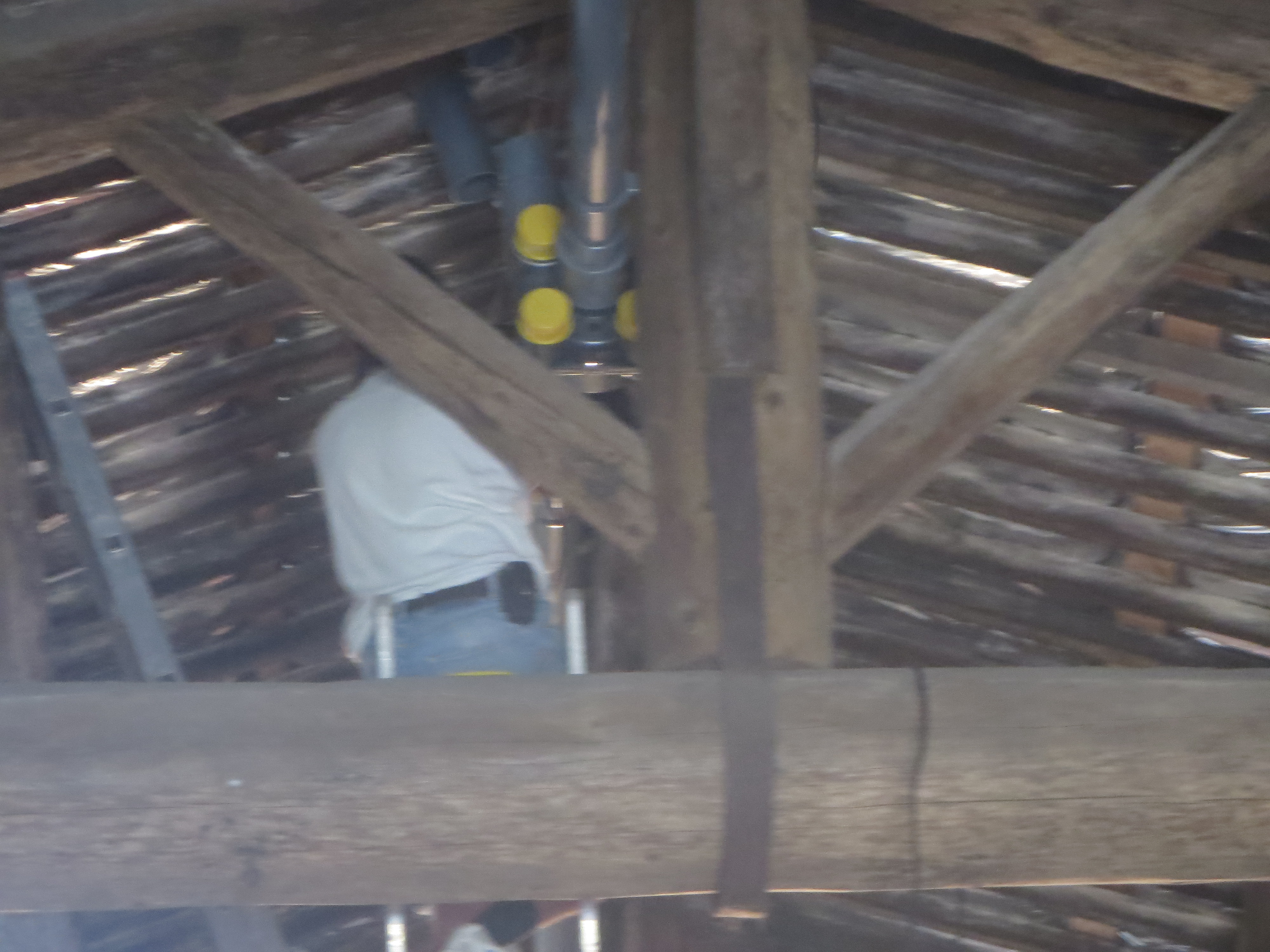
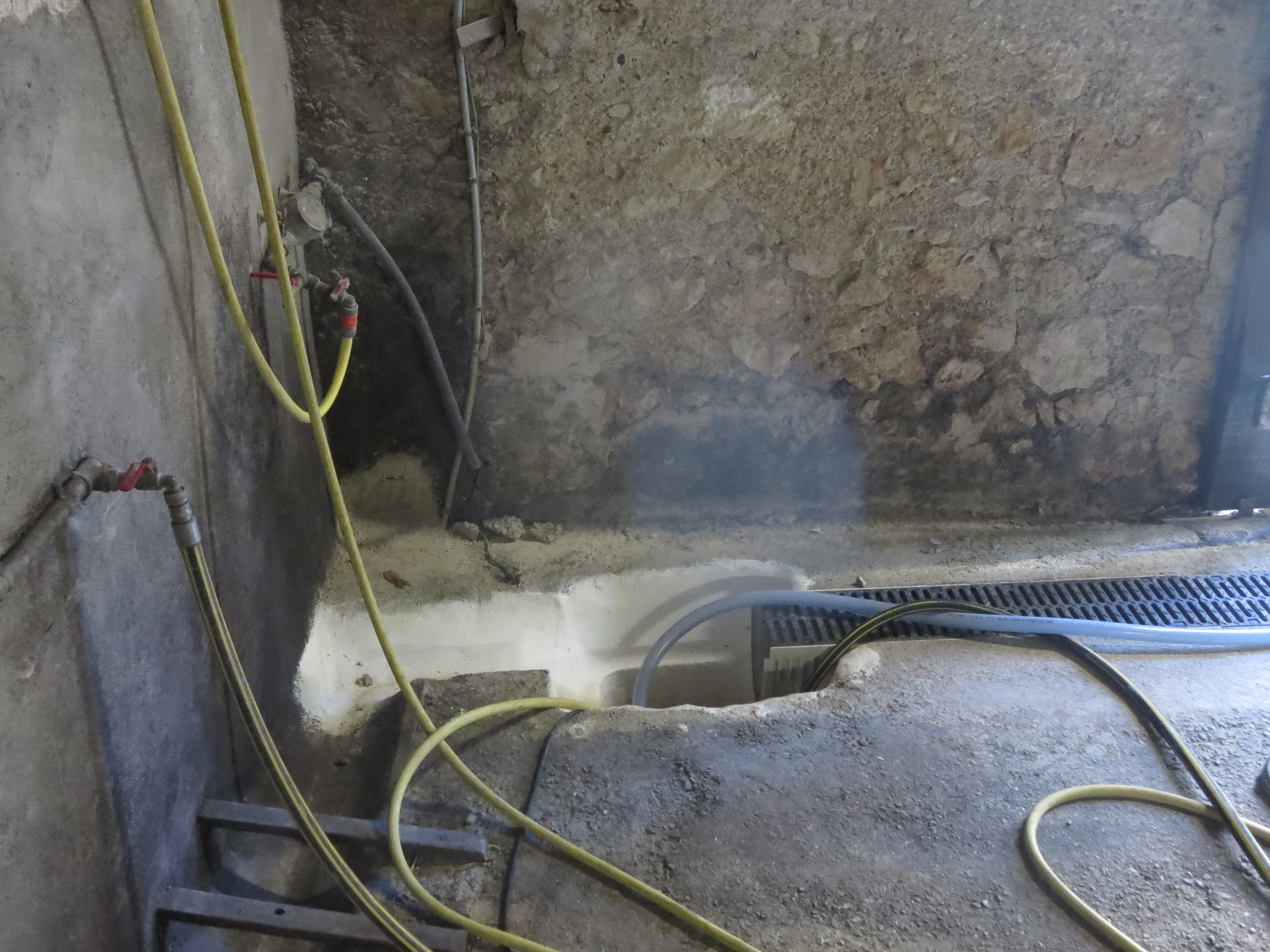
Whilst the work on the roof has been going on Jeff took the opportunity to improve other features, such as new electric points and drains but also new equipment to circulate the air better in the higher parts of the cellar where heat can gather.
New electrics and air control
New drains and pumps
All this means better control, better conditions for winemaking and, I am sure, even better wines. To pay for all the work! As we are now just a matter of days from vendange the cleaning up process has begun even as the work comes to an end. Everything must be clean and ready.
All photos taken on August 2nd unless otherwise stated
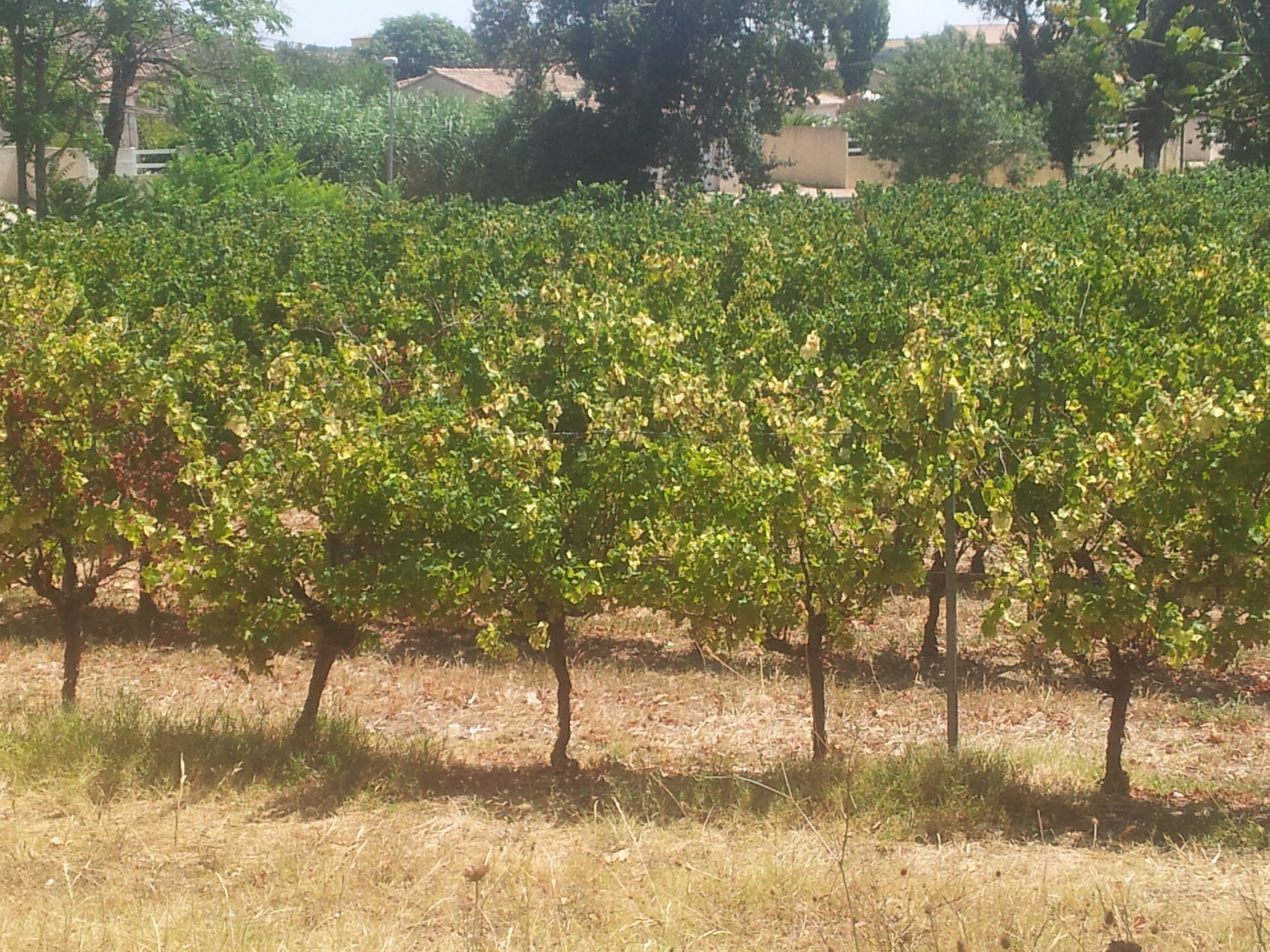
It was June 12th when rain last fell on Margon and the vines in the region, although generally doing well, were starting to show signs of fatigue and heat stress; leaves curled in upon themselves, some yellowing, a slight shrivelling.
Vines near Pézenas showing some stress
Vines in Margon which were not pruned in spring and are really suffe
A few drops fell on July 25th but the skies had been very dark and had promised much more, it was almost cruel to have that rain, a tease of what might have been. However, July 31st brought around 10mm to Puimisson. A decent rainfall, enough to give the vines a drink and to stop the drying out process. Not enough of course after weeks of lack of moisture and some more rain in the next few weeks would be very much welcome to swell the grapes and the harvest. The vines are now pouring their energy into their fruit rather than their vegetation, but they need the nutrients to do so.
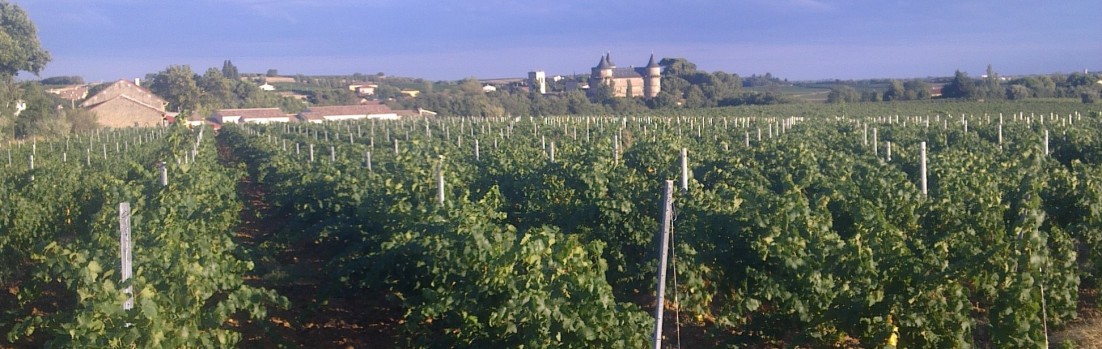
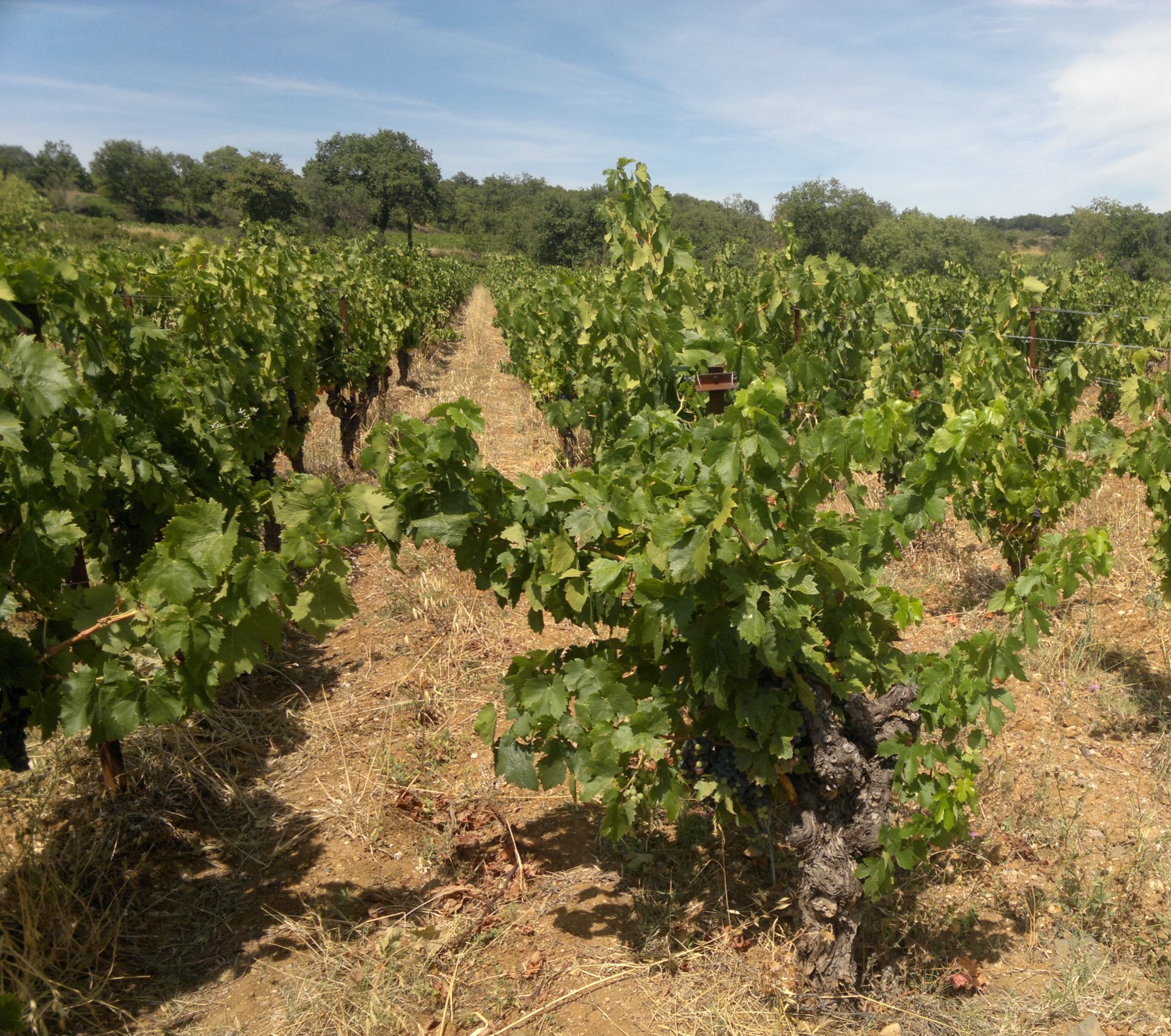
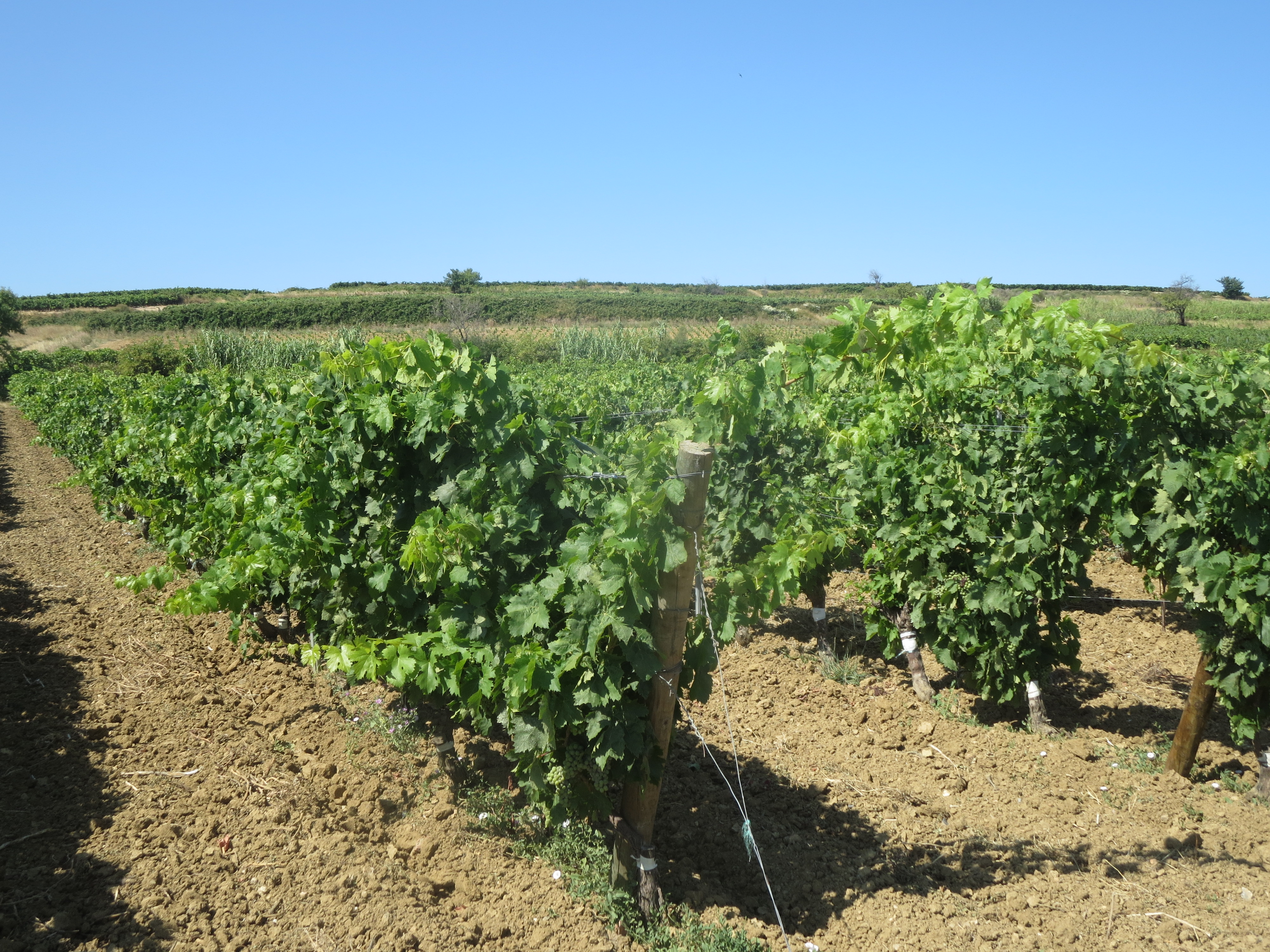
So, how had the vines responded to the rain which fell? Well a tour on Sunday (August 2nd) showed the vineyards of Mas Coutelou to be in rude health, a decent harvest is now predicted though that extra rain would be most welcome.
Segrairals in full bloom, healthy, happy vines
Segrairals, biggest of the vineyards, showed some healthy Cinsault, Syrah and Grenache with no signs of stress or disease. As the home of Classe, 7,Rue De La Pompe and 5SO this is especially welcome, as they are some of the big sellers.
Cinsault in Segrairals
To Rome, my favourite vineyard. The gobelets were looking well, plenty of grapes both the white varieties and the Cinsault. There was a little mildew around the entrance but minimal, no cause for concern. Could there be a cuvée of Copains in 2015? Jeff tells me that no decisions are made as yet, caution prevails and he will wait to see what the harvest gives him before he makes final choices about how to use the grapes and the wines which result.
Rome’s centurion vines in good health
Muscat Noir grapes, a tiny bit of mildew top left
Sainte Suzanne (Metaierie) suffered from coulure in May with the strong winds blowing off some of the flowers on the vines, which will reduce yields a bit. However, the grapes there are growing well, what might have been a problem looks now a much brighter picture, good news for fans of Vin Des Amis.
Peilhan, just a little more tired and suffering
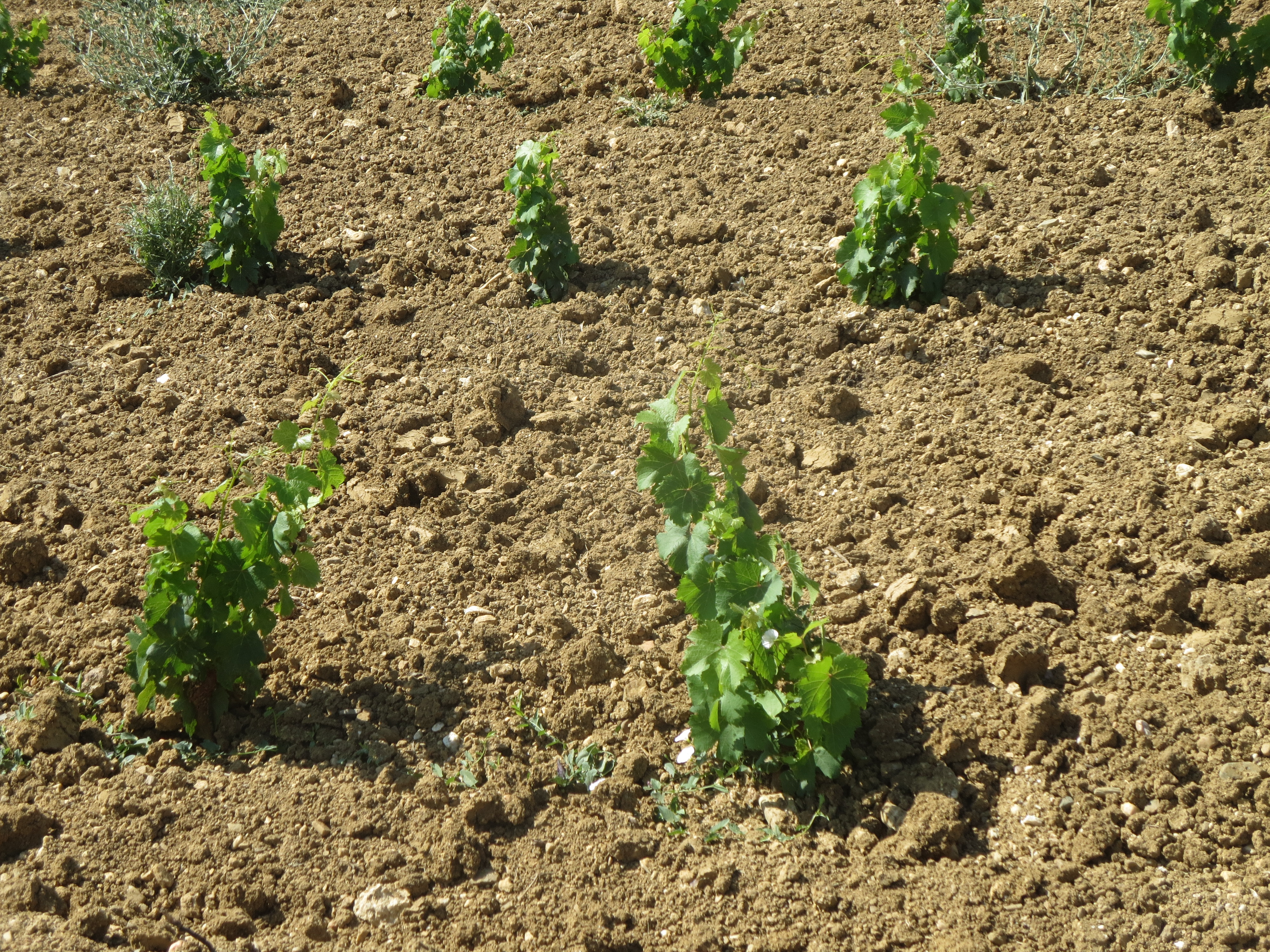
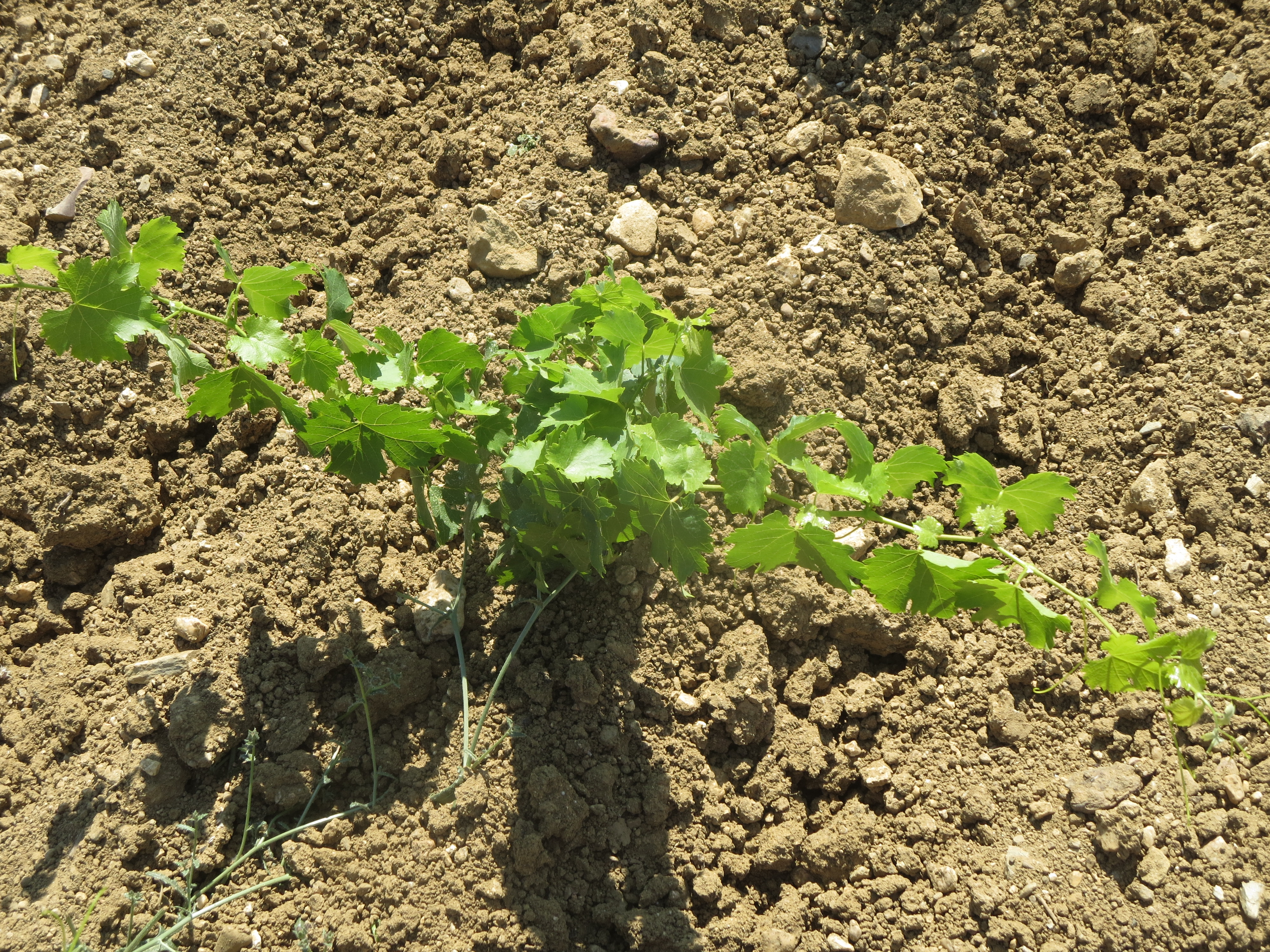
The only vineyard parcel which has shown stress is Peilhan, There was a lot of regrafting and replanting in the spring and the dryness has caused problems for these new vines. There was also oidium in this parcel, the only vineyard to be attacked by this powdery mildew. Yet amongst those problems there are plenty of healthy grapes, some careful picking and sorting will be needed but it will produce good wine.
The famous Castets grapes of Peilhan
La Garrigue was blooming, the white varieties such as the Muscats are swollen and changing hue to lovely golden shades.
Muscat a Petits Grains in La Garrigue
The Syrah is well advanced, a dark purple colour across virtually the whole bunches, the pips though betray a little immaturity as they taste and look green and sappy. A little more time and patience will pay dividends. As the world’s biggest fan of La Vigne Haute, I have my fingers crossed.
Syrah in La Garrigue, ripening beautifully in the shade of the vine
The Grenache in La Garrigue, despite facing south, is a little more delayed in colour but getting there and very healthy.
Grenache in La Garrigue
In fact despite risks of disease earlier in the year (see here) Jeff has been able to use minimal treatments in 2015. Oidium and mildew (powdery and downy mildew) can be controlled by copper sulphate, sometimes called the Bordeaux mix when added to slaked lime. This is a bluish colour when sprayed by conventional and organic vignerons and is often seen on the leaves of vines. Vignerons might also use chemical fungicides if they are not organic producers.
Neighbouring vineyard which was given herbicide shortly after harvest last year and whose new vines have been treated regularly
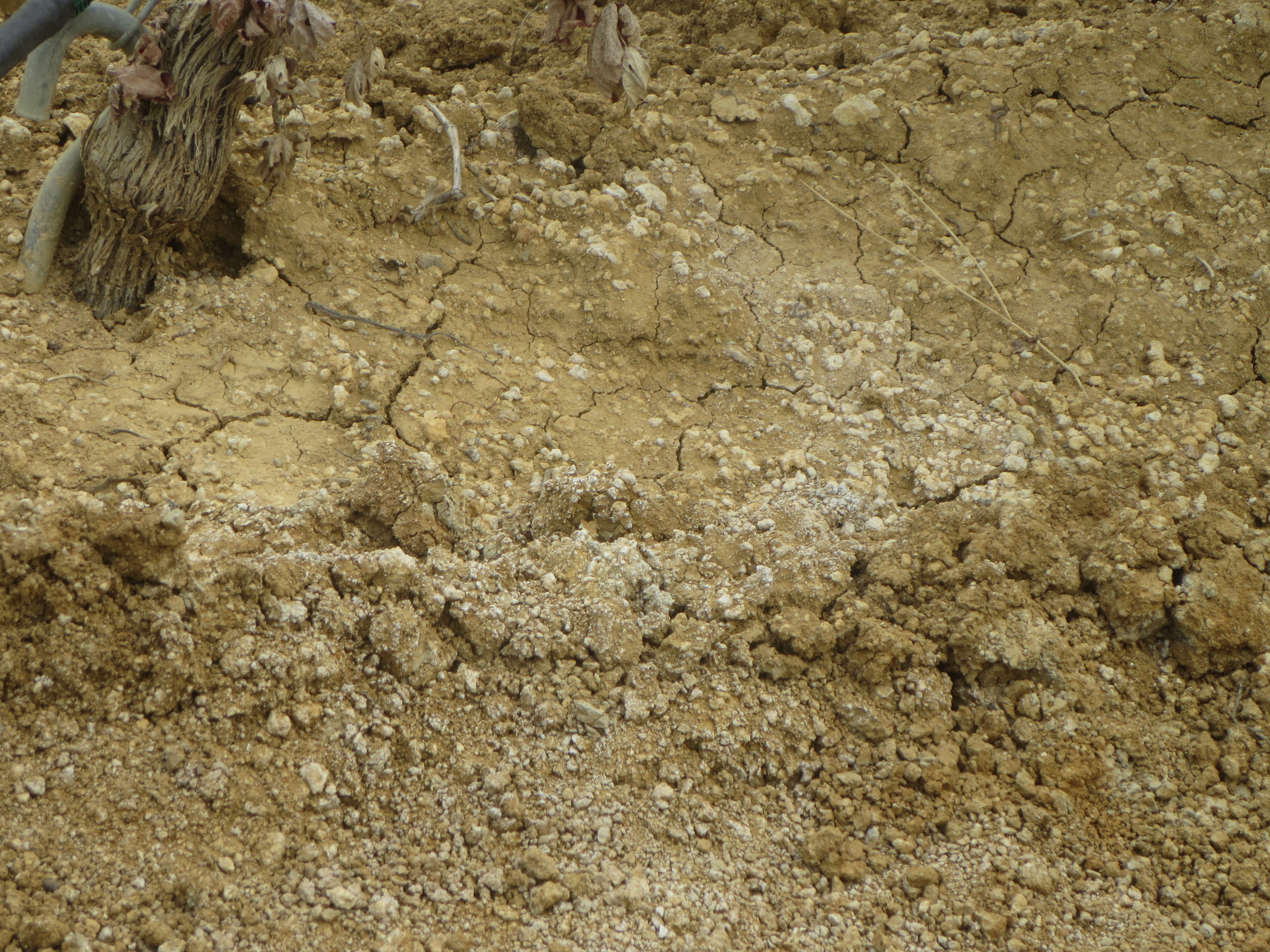
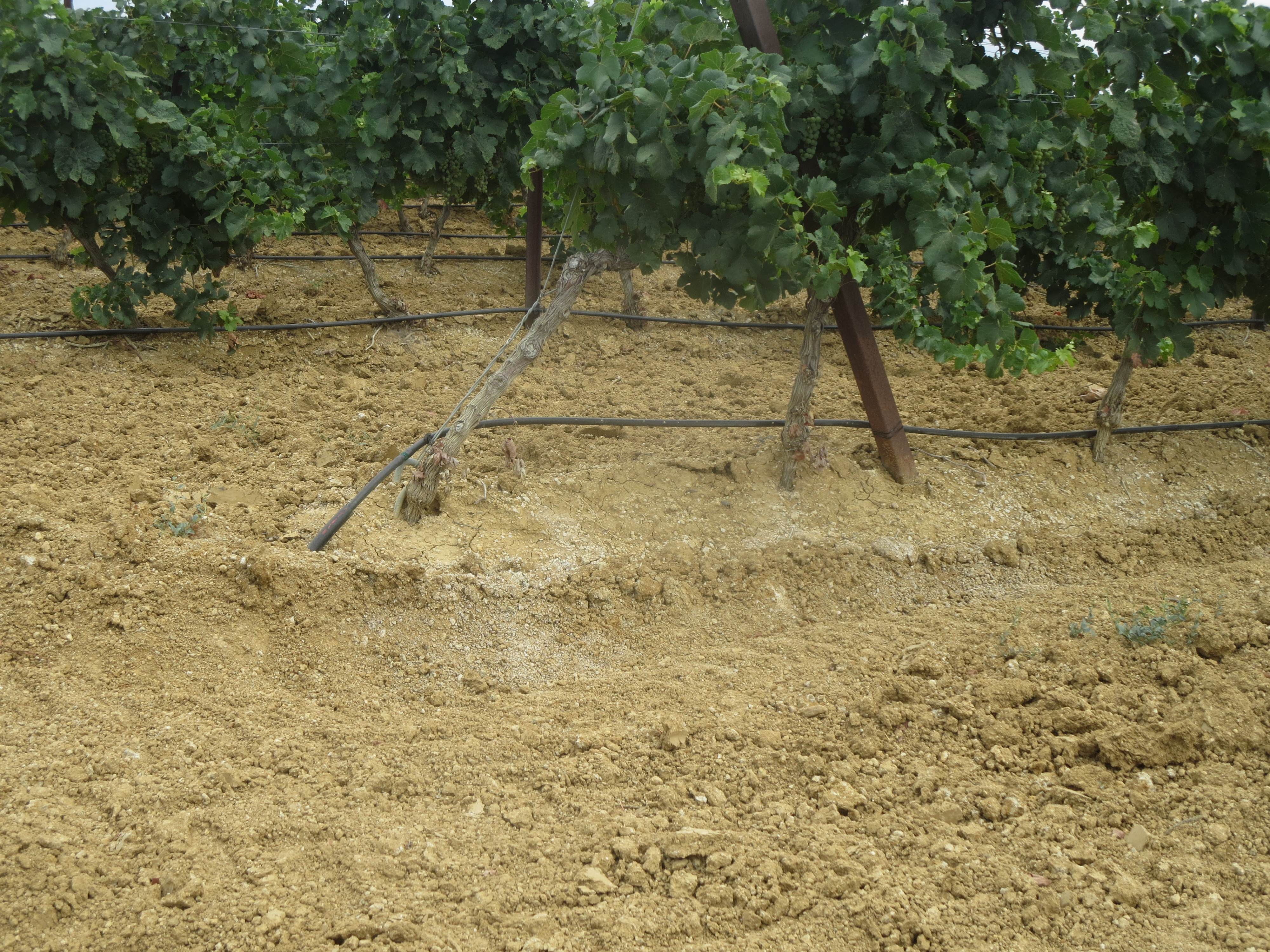
Some neighbours have also irrigated their vines and one alarming consequence is the changing of the soil and its pH as the calcium carbonate in the water shows through, you can see it in the white parts of the soil in this photo taken on July 22nd.
The irrigation is also causing the vines to grow quickly and tall with thin trunks as seen below. It should be acknowledged that there are many conventional producers who take great pride in the health of their soils and vines and would be horrified by some practices described here.
As a proud holder of Ecocert organic status and as a natural wine maker Jeff must use natural products only. Tisanes of plants which fight mildew such as horse tail, fern and nettles can be sprayed and this is the basis of many biodynamic treatments. However, the two main weapons in the armoury of organic producers are copper and sulphate, both natural products.
Copper is used against mildew, but is harmful to the soils and kills life in them if used in significant quantities. Organic producers are limited to 30kg per hectare over a 5 year period, allowing more to be used in years with more downy mildew for example but only if less is used in the other years. In fact Jeff has used just 200g per hectare in 2015 and this after years of well below average use, his use of copper is on a major downward trend. He is reluctant and very careful in using copper as he is aware of its danger to the soils, yet mildew has not been a major threat this year.
Oidium seen in May
Similarly Jeff has used sulphur in soluble form at doses much lower than the permitted level, three treatments over the course of the growing season. In addition one dose of sulphur powder was sprayed when the risk of oidium was high (May) and a second spraying for Peilhan only as it is the vineyard which was attacked by oidium. In contrast to neighbouring vignerons who have sprayed every 10 days including after the bunches closed up (so more than a dozen treatments) this really is minimal intervention.
So July’s parting gift of 10mm of rain was welcome, August might like to follow by offering some rain soon. Too near the harvest is bad as it would dilute the juice rather than help the grapes to reach a good size. Things look promising, let us hope that nature completes its bounty. There is an old saying that June makes the wine and August makes the must, ie the character of the wine with its colour, yeast and flavour. With 3 weeks or so until picking begins it is an exciting, and nervous, time, waiting to see what that character will be.
No Icare this time but look what we found amongst the vines, he’s been here!
NB there are lots of reports about recent wine tastings here.
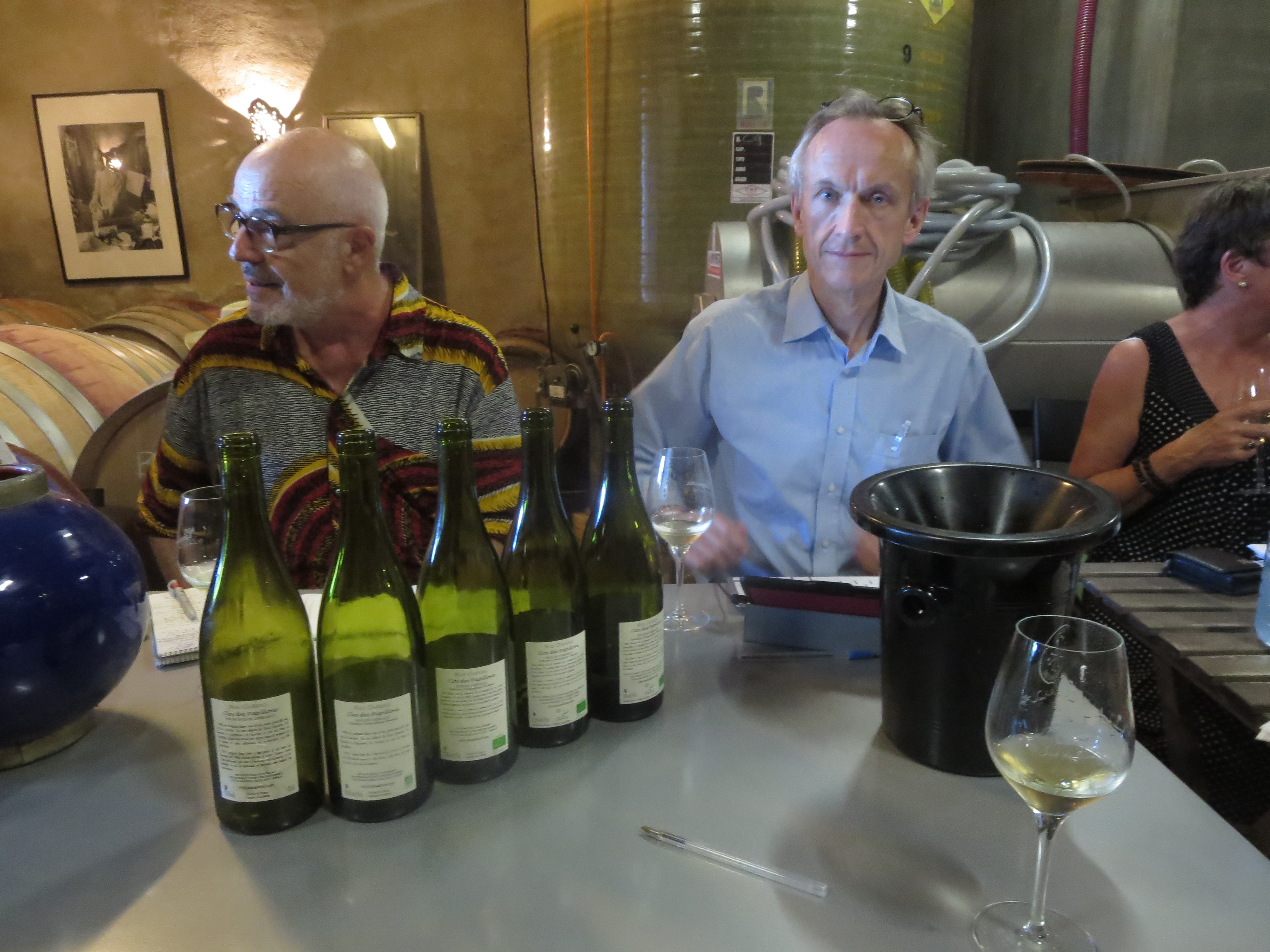
Deborah and Peter Core have been making wine in Caux (34) for 10 years, a cause for celebration. I was truly honoured to be invited to share their celebration evening with a vertical tasting of their Carignan led wines and a dinner held in their cave and garden. Present were luminaries such as Rosemary George, Michel Smith, Andrew Jefford, Catherine Roque of Domaine Clovallon, Gary Voss and Annette Atkins of Voss Estate in Martinborough, New Zealand along with Helen Deneuve who works for Coteaux Du Languedoc and other wine groups and is a good friend of Deborah’s, as well as Wendy Gedney, owner of Vins en Vacances, a wine tours company, Christopher Gallaway, wine expert and Bernard Degioanni, wine and food journalist, so it was a true privilege to be amongst their company.
l-r Christopher, Gary, Annette and Wendy
Michel, Andrew and Rosemary at work whilst Peter pours
l – r: Bernard (just), Peter, Catherine and Helen
Mas Gabriel has long been one of my top Languedoc wine domaines and I have purchasing from there over many vintages. I have huge respect for the Cores who gave up successful careers in London in law and finance to follow their dream of making wine. Having trained and studied in New Zealand and France, they decided on the Languedoc as the region which would offer them what they were seeking in making their wines. Land was bought around Caux and the work began. What courage to embark on such a venture and the going must have been immensely difficult at times in the ten years which have followed. Learning about your vineyards, making wine in different vintages, mastering the bureaucracy in a second language and, not least, finding markets. That they remain so passionate about their land and wines whilst being the most courteous and charming people is testament to two people of strength, determination and talent. Their wines are produced organically, indeed biodynamically, and are marked by freshness and fruit.
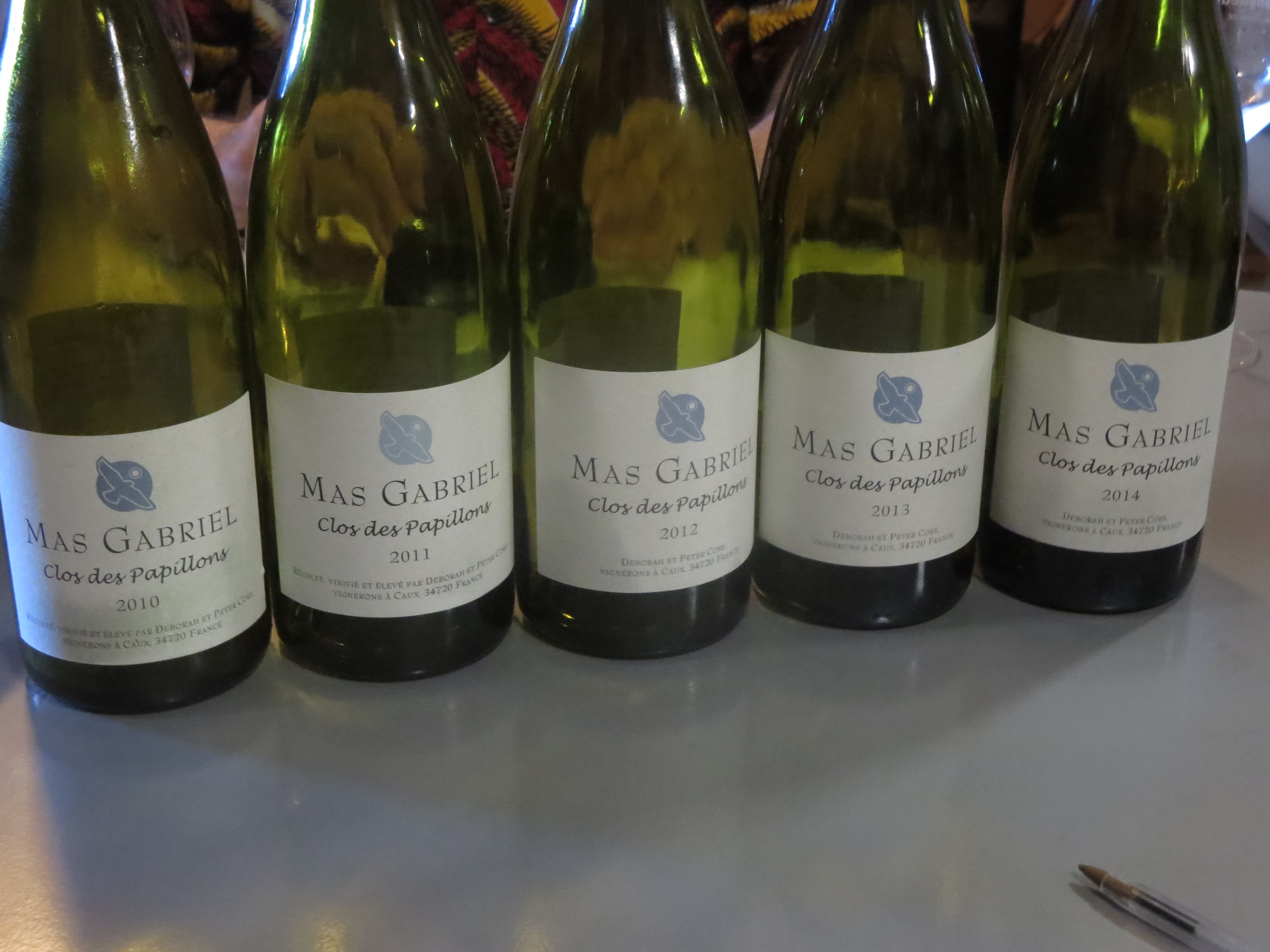
We gathered in the cave for the tasting and began with a flight of 5 vintages of Clos Des Papillons, the white wine of the domaine (though joined by a new white cuvée in 2014, Champ Des Bleuets). Papillons has long been one my favourite white wines of the region so this was a special treat for me.
Until 2014 the Carignan was given a small 5% addition of Viognier but in 2014 the Cores changed this to 15% Vermentino. Around a third of the Carignan Blanc is aged in acacia barrels to add a little complexity without oak flavours. There is no malolactic fermentation as they seek to reflect the freshness and natural acidity of Carignan Blanc. When the wine was first made yields were tiny at 12 hl/ha but much work and even more cow manure has helped to boost yields to 20-25 hl/ha. There are only around 0,4ha of the vines (more have been planted) and this is a variety with only about 40ha in the Languedoc so Mas Gabriel has around 1% of them all. Peter and Deborah actively sought out the parcel after tasting the Carignan Blanc of neighbour Conte De Floris, who does make excellent wines also. The parcel they found is made up of 40 year old vines in gobelet on a sandy, limestone soil.
So, the wines:
2014 – The first Clos Des Papillons with 15% Vermentino, which is grown in soil with galets, large round flat stones. The wine is very young still and a fresh, lively aroma is matched by a dry, very mineral initial taste. Fresh, fleshy fruits then fill the mouth to round out the dry core of the Carignan, like a peach with the fruit around the stony centre. The Vermentino certainly appears to provide that fruity roundness though the Carignan was slightly less acidic than usual in 2014 too. The wine comes together to form a lovely, refreshing, clean taste. It is very young, it will fill out further and I really like it.
2013 – A big rush of freshness leaps from the glass. Green and yet apricotty. It settles down quickly and lovely fruity, dry aromas emerge. The harvest was quite late in 2013, September 16th, so the nights were fresher as the grapes reached the optimum ripeness, and this is reflected in the fruit itself. Huge flavours of yellow and white fruits mixed with fresh acidity – always in balance, always with a delicious tension. Lovely, a very good wine.
2012 – Yellow, almost light golden in colour. I could detect a little more evidence of wood on the nose but nothing out of balance and it provided yet more complexity, there was no obvious taste of wood. The acidity appeared less obvious, though it was actually a lower pH than usual, the result of an extra year in bottle? Juicy, yellow fruits, with an edge of citrus and agrume. Stony, clean and delicious. I smiled in relief that I have resisted temptation and kept a bottle or two of this vintage, excellent.
2011 – Woh, what a nose, almost ‘Riesling’ in character with hints of kerosene. Happily, Wendy Gedney agreed with me, it’s not just me! Full flavours, lingering lime and lemon fruit flavours add that delicious freshness, definitely more so than 2012. Long, refreshing, balanced, poised! This was the earliest picked vintage (August 24th). It has years of life ahead if anyone still has a bottle (sadly, not me). I loved this.
2010 – Lively, this is certainly not on a downward slope, far from it. Still a yellow/green Starburst citrus edge. the highest acidity of any of the Carignan vintages yet the wine has rounded out a little. There is a saline, mineral edge in there too but then as you drink (and I did drink some!) an almost waxy, oily finish which helps to coat the mouth with the yellow and white fruit flavours. Lingering, clean and lovely.
Clos Des Papillons ages well, no question about it. The freshness and acidity surely help this and whilst difficult to resist drinking in a year or two I am now determined to hold back some bottles. Interestingly, Andrew Jefford was slightly less in agreement with most and would welcome some malolactic fermentation to round out the flavours more. For me, I love it as it is. To choose one vintage? I really like them all, there is nothing here to which I would not give at least 4/5 on my personal scale. 2011 perhaps but maybe 2013 just wins with the freshness, sorry Andrew.
In the Trois Terrasses vines with Peter in 2012
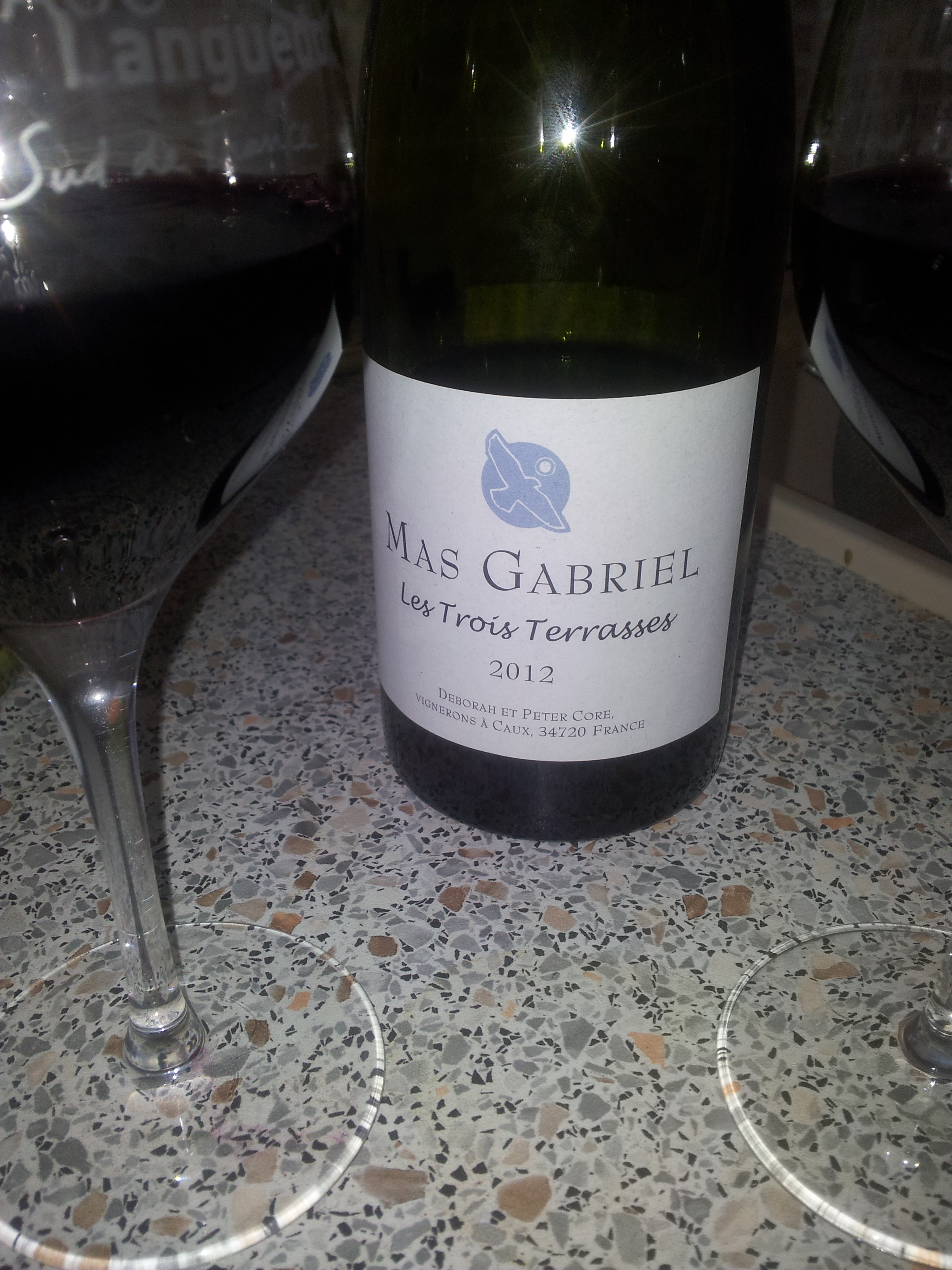
So to Trois Terrasses, the first of two red wines made at the domaine, the other being Clos Des Lièvres, a Syrah led wine which is bigger and more powerful, and also excellent I hasten to add (deserved Gold Medal winner at Millésime Bio this year). The first two vintages in 2008 and 2009 were 100% Carignan but in 2010 came a change with 20% Syrah and afterwards up to 30% of the wine is Syrah and Grenache. These are vinified separately in cuves, the Carignan cuve being cement the others fibreglass. Peter explained that yields of the Carignan were only 10 hl/ha at first but they have built this up, with more hard work and cow manure, to 25 to 30 hl/ha on average. This is reflected in gradually lowered alcohol levels in the Carignan with slightly higher acidity.
2013 – Slightly reductive at first but that blew away within a few seconds to leave a torrefacted nose with plummy, dark fruits which carried over into the flavours along with those coffee notes. There was an almost citrus freshness on the finish refreshing the palate. Spicy, peppery notes developed too and though this needs a little time yet, it is already good and will grow into something very good in a couple of years.
2012 – Rounder, darker, deeper. Complex nose of dark fruit with freshness evident even on the nose. Full in the mouth, rounding out with lots of fruit and minerality and always the trademark freshness which I love so much in Mas Gabriel wines. It is a characteristic which reminds me so much of biodynamic and organic wines, dare I say natural wines too! It certainly appeals to me.Still youthful, this is a wine which has been a big hit with friends and family when I have shared a bottle with them. Very good.
Here’s one I shared earlier
2011 – Rounder aromas, hints of cassis. Perfumed and fruity, very heady in a pleasing manner. It tastes round and full too, ripe plums and a raspberry fresh note. Liquorice with pepper sprinkling the range of flavours too. As the wine evolved in the glass there were even smoky notes emerging. Very complex, but all working well together, always lovely to drink and, yes, that fresh finish. Very good.
2010 – The year in which Syrah was first added to the Carignan. Fruit aromas spring out from the glass, cassis, blackberry and red fruits too, lively acidity. Ironically, given the blending, Carignan characters emerge, a slightly leathery, wild edge to add to the complexity. Plummy but not too fruity. No sign of being old, still very much a wine reaching its peak with a long time to enjoy it. Harmony despite all the complexity, balance and freshness, of course. Very good.
2009 – 100% Carignan. Almost restrained on the nose, the wine colour is garnet and fresh, no signs of starting to age. A wine reaching its prime but still plenty of life ahead. Pure, direct, lovely fruit with some dusty, round tannins. The acidity is still fresh but beautifully balanced with fruit profiles such as raspberry, cassis, blackberry, plums – round, ripe and delicious. Deep, complex, full. Superb. There was a noticeable lull in conversation as we tasted this wine, it stopped us in our tracks and we had to simply stop and admire, hallmark of very, very good wine.
2008 – The first ever Trois Terrasses, pure Carignan. I detected a little more alcohol on the nose but nothing off putting. Soft, easy to drink with black fruits and a little gaminess, tannins still present but soft and supportive to the wine. Very much alive and kicking, it will continue to grow. I liked it, a lot, though perhaps overshadowed by the previous glass of 2009.
My favourite, most peoples’ favourite, was the 2009. Joyful wine, the sort of glass which makes you realise why you find wine so fascinating and rewarding. Of the blends, I particularly like the 2010 and the 2012 but I am happy to have some bottles of all of them left.
At dinner in the garden with a refreshing breeze
An interesting discussion followed as we compared favourites. Andrew Jefford had chosen the 08 and 09 and suggested a return to pure Carignan. Much thought for Peter and Deborah but they must have been delighted at how well the wines all performed, worthy of anyone’s cellar, certainly in the top rank of the Languedoc. I was so pleased for them, they deserve every little bit of credit and praise. I gather the thought of a pure Carignan was already in their heads, maybe this evening will influence them.
And so to dinner, made by Deborah and her friend Helen Deneuve. They even provided me with a superb vegetarian main course which was one of the best I have eaten in a long time. To accompany dinner the Cores served their Carignan rosé, Fleurs Sauvages, so popular that it disappears very rapidly out of the cellar every year, and justifiably. Various bottles of Clos Des Papillons and Trois Terrasses also appeared on the table to be drunk not just tasted. A fitting end to a fantastic evening. The conversation flowed, Michel entertained us royally (am I allowed to use that adjective for a Frenchman?) and then provided a beautiful Banyuls Mas Blanc 2003 to accompany a delicious chocolate gâteau.
Deborah, Michel and a photo of Rosemary taking a photo
Thank you so much for the invitation Deborah and Peter, it was such a privilege to be present. There was talk of reassembling in another 5 years for ten vintages and that would be a dream. So raise your glass to Mas Gabriel, and make sure it is filled with one of their wines, you deserve nothing but the best, and so do they.
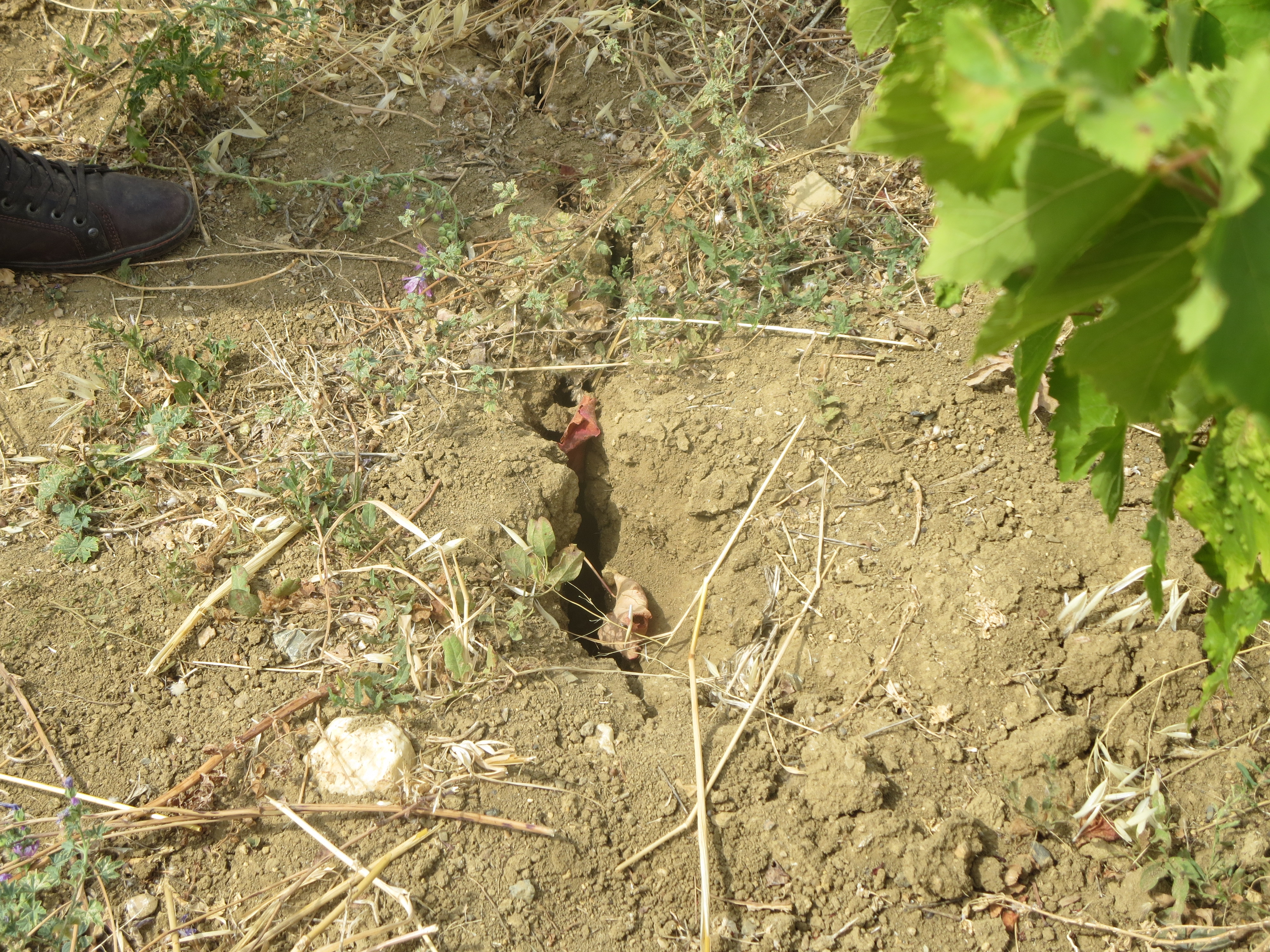
The weather in the Languedoc has been a talking point, apparently it is not just a topic for us British people. No rain since June 12th, very high temperatures, 39C one day last week. Fires in the garrigue, vineyards and even towns, including our neighbouring village of Roujan. The result of this has been fissures in the ground, e.g. the photograph below in one of Jeff’s vineyards.
This crack in the soil is over 30cm deep, a sign of the drought conditions
Some of the vignerons in the area have been irrigating their vines and a sign of this has been evident too. If you look at the photos below you will see white traces in the soil. This is calcium carbonate which is a product of the water imported to irrigate the vines. In other words the irrigation is changing the nature of the soil itself.
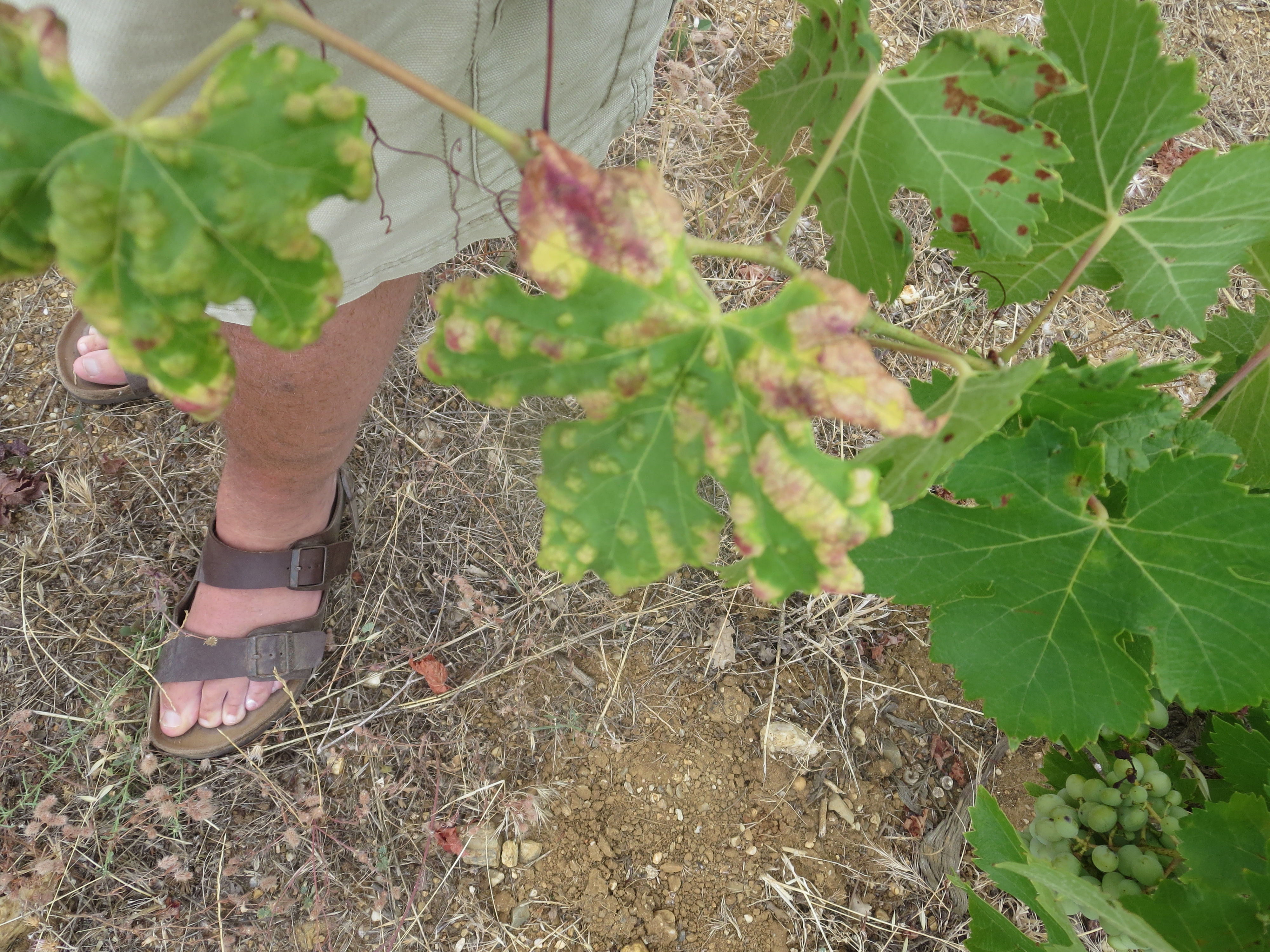
The vines themselves are remarkably resistant and strong even in the face of the lack of water. This summer is nothing unusual for the Languedoc but it builds on a fairly dry year in 2014 too. The leaves of the vines are curling in on themselves, a sign of some stress.
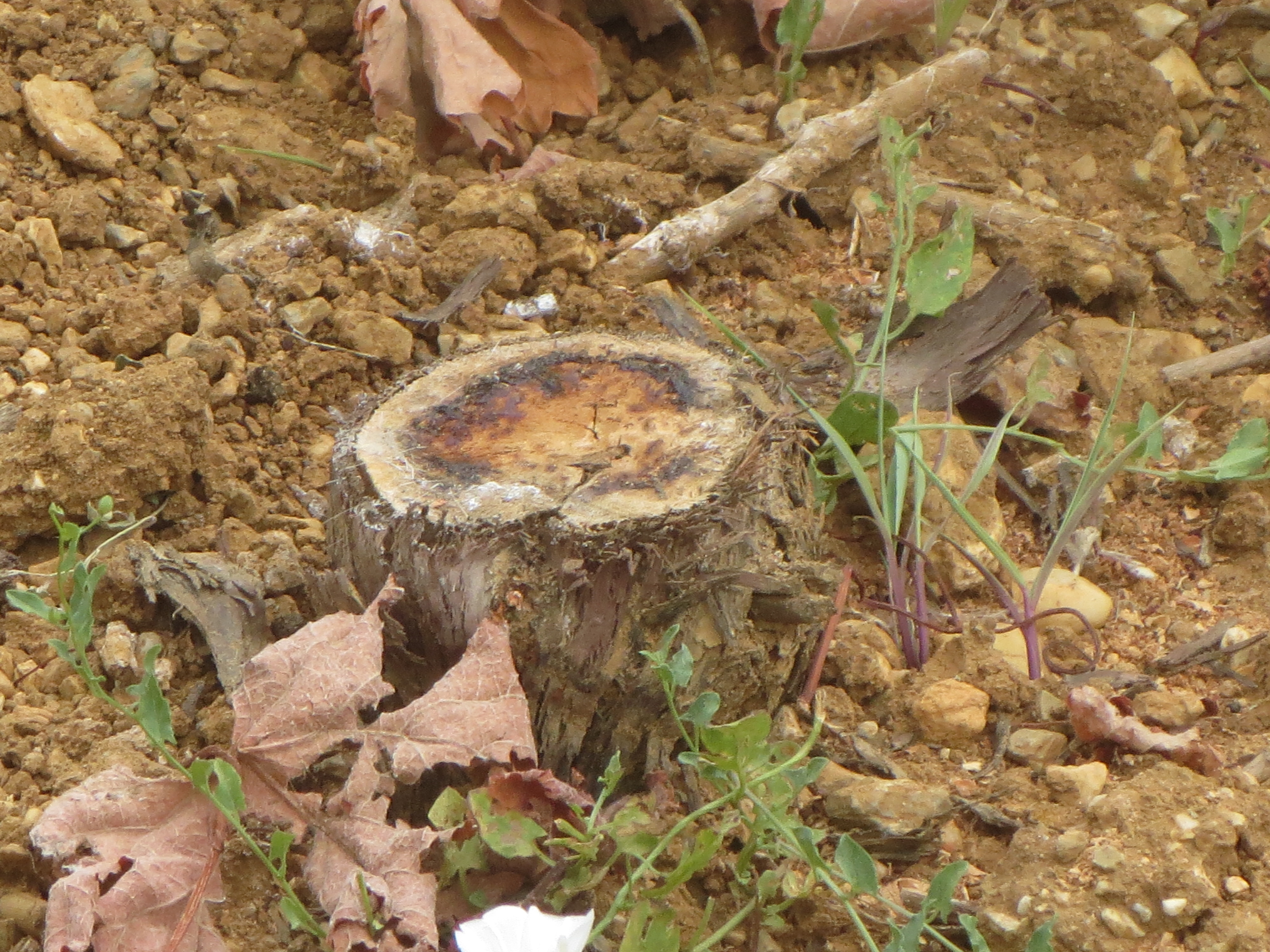
Other problems are showing too. Esca is a virulent wood disease which is a major threat to the vineyards of France, working like a cancer inside the wood. It suddenly emerges and affects the leaves and causes the grapes to shrivel and drop off.
Esca showing on vine leaves in the Languedoc, July 21st
Some have linked its spread with rainy springs and higher summer temperatures, such as 2015. There is no cure, it was formerly treated with arsenic but that has, understandably, been banned. It is thought that 10 – 20% of French vines may be infected by the fungus, they have to be replaced and, of course, they take time to grow and don’t produce the same quality as older vines would have produced.
Vine stock showing the signs of esca after being cut
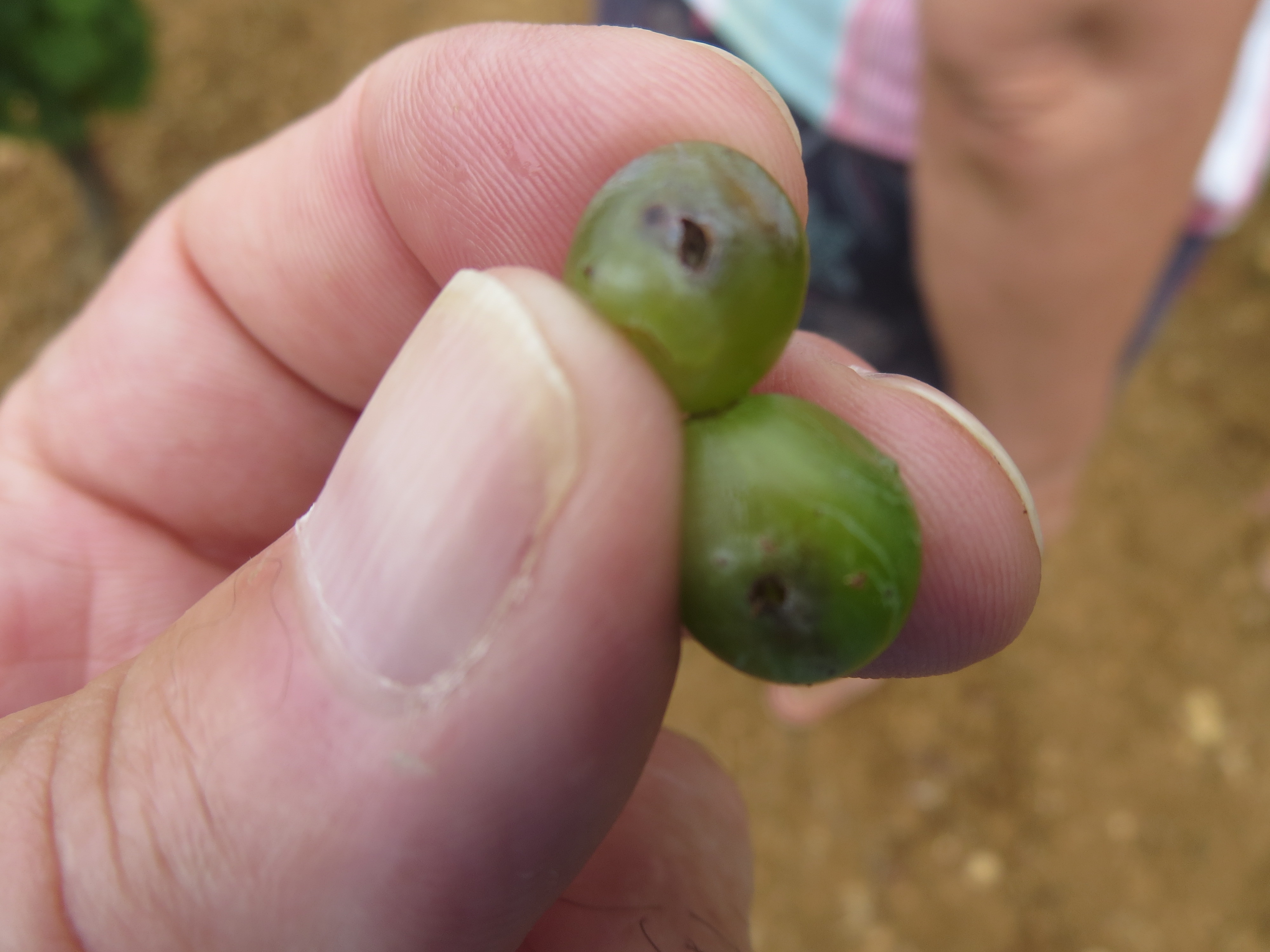
One perennial problem is vers de la grappe. These are the larvae of butterflies and they grow in coccoons amongst the grape bunches, leaving a white filament as proof of their residence. They pierce the skins of some grapes causing them to be ruined.
Characteristic puncture marks of vers de la grappe, July 21st
Careful pruning must follow.
July 21st
Bats and other predators eat these pests which is why Jeff, amongst others, encourages bats to live near his vines by putting up bat houses and encouraging the growth of plants, trees etc around and amongst their vineyards.
Bat house at Ste. Suzanne, (Metaierie)
The main concern is that the lack of water will reduce yields, rain would help to swell the grapes and produce more wine. Some rain was forecast on July 22nd but in Puimisson and many other areas, none arrived.
Not all bad news however. The vines are resistant and the careful management of soils, unlike the irrigated vines above, means that their roots go deep into the soil searching for water. Struggling vines produce the most interesting wines. Let us hope that this is the case in 2015.
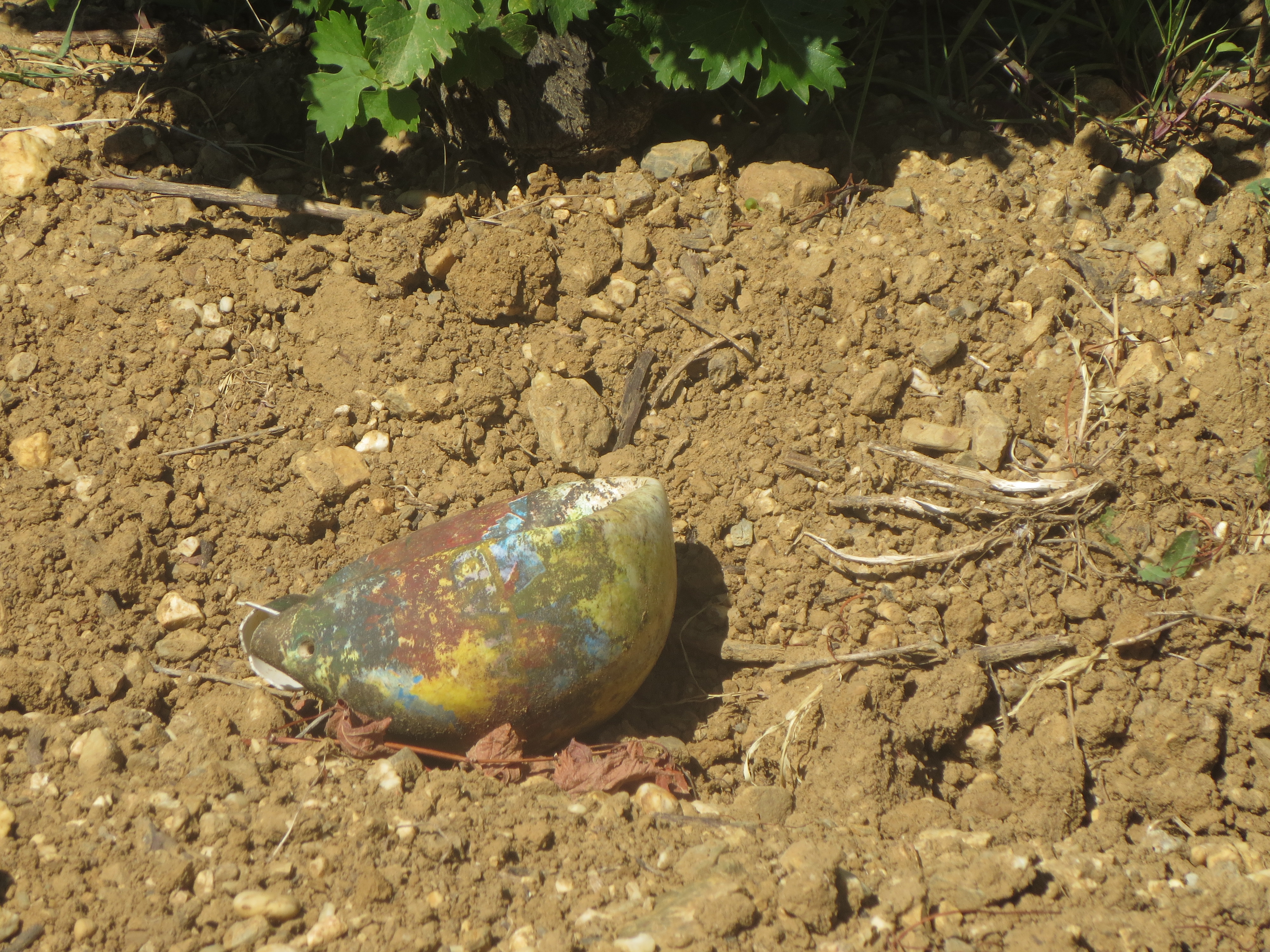
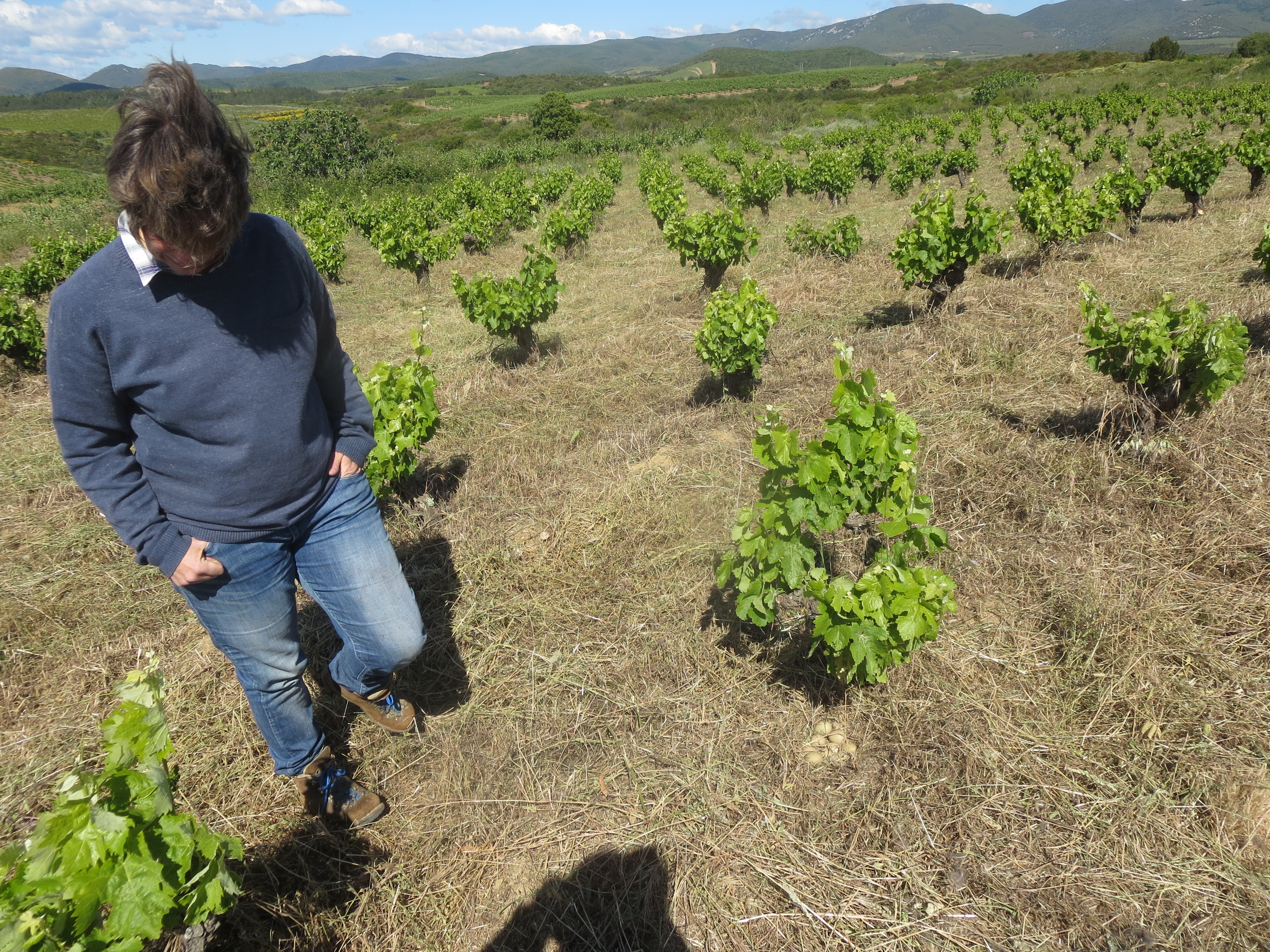
Diversity amongst the vines at Mas Coutelou continues, less than 10 metres from the fissure in the ground above were these partridge eggs which had hatched recently.
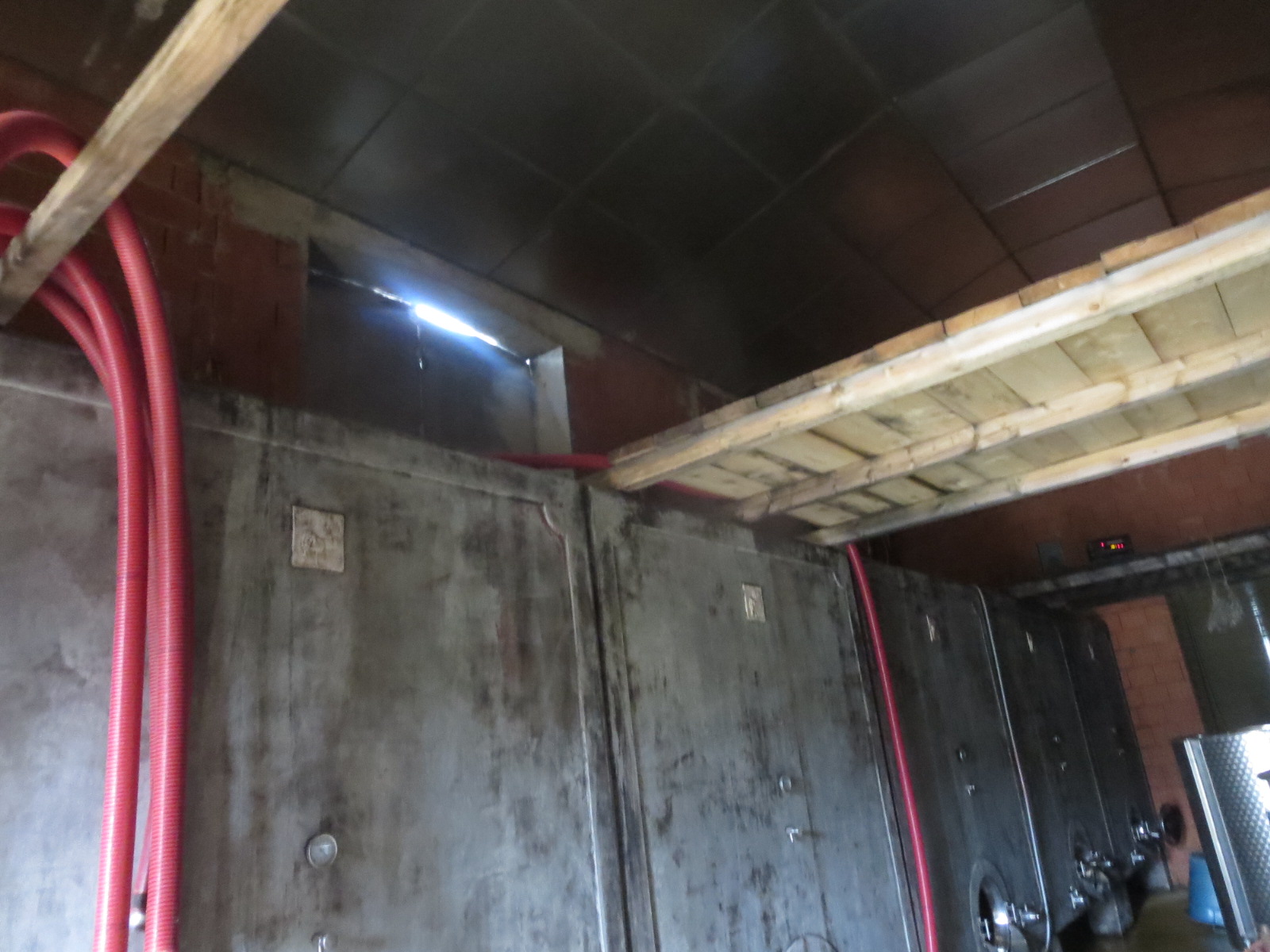
And in the cellars work has begun to replace the leaky roof, which is built on timbers hundreds of years in age. It is a beautiful roof and happily the timbers have been saved, most tiles will be recycled. I will write more about the changes in the cellar as preparations for the vendange begin.
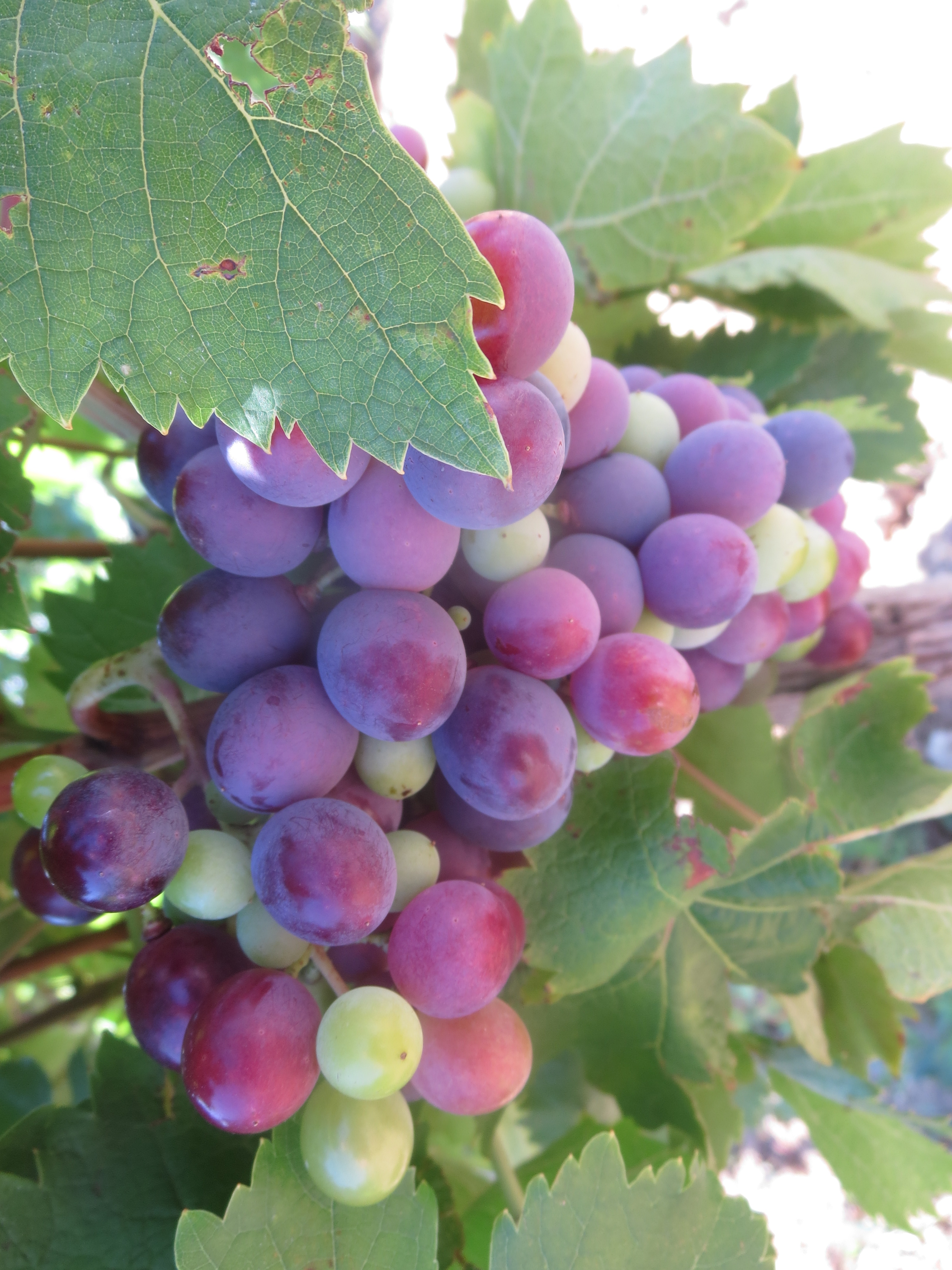
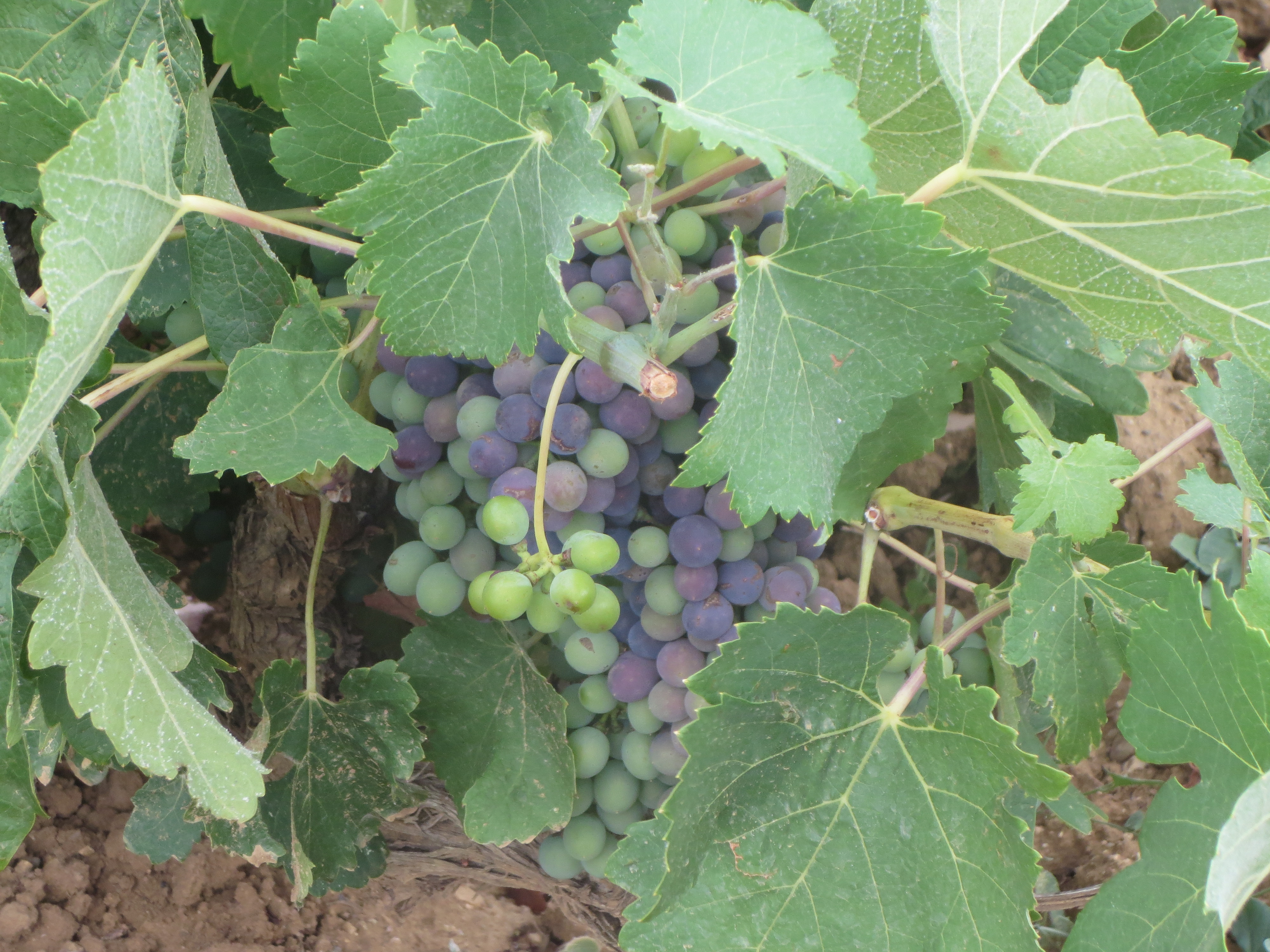
And finally véraison is in full swing. The change of colour of the red grapes is one of the key events in their development as they approach maturity. This marks the change in growth of the berries, they are now producing sugars within the grape rather than concentrating on simply growing and producing acidity. It is certainly one of the most noticeable and landmark changes in the grapes.
Note the curling leaves, the vines are feeling the lack of water.
Véraison and the increase in sugar levels also attracts more animals to eat them, birds, insects etc. Problems, problems everywhere. Who would be a vigneron?
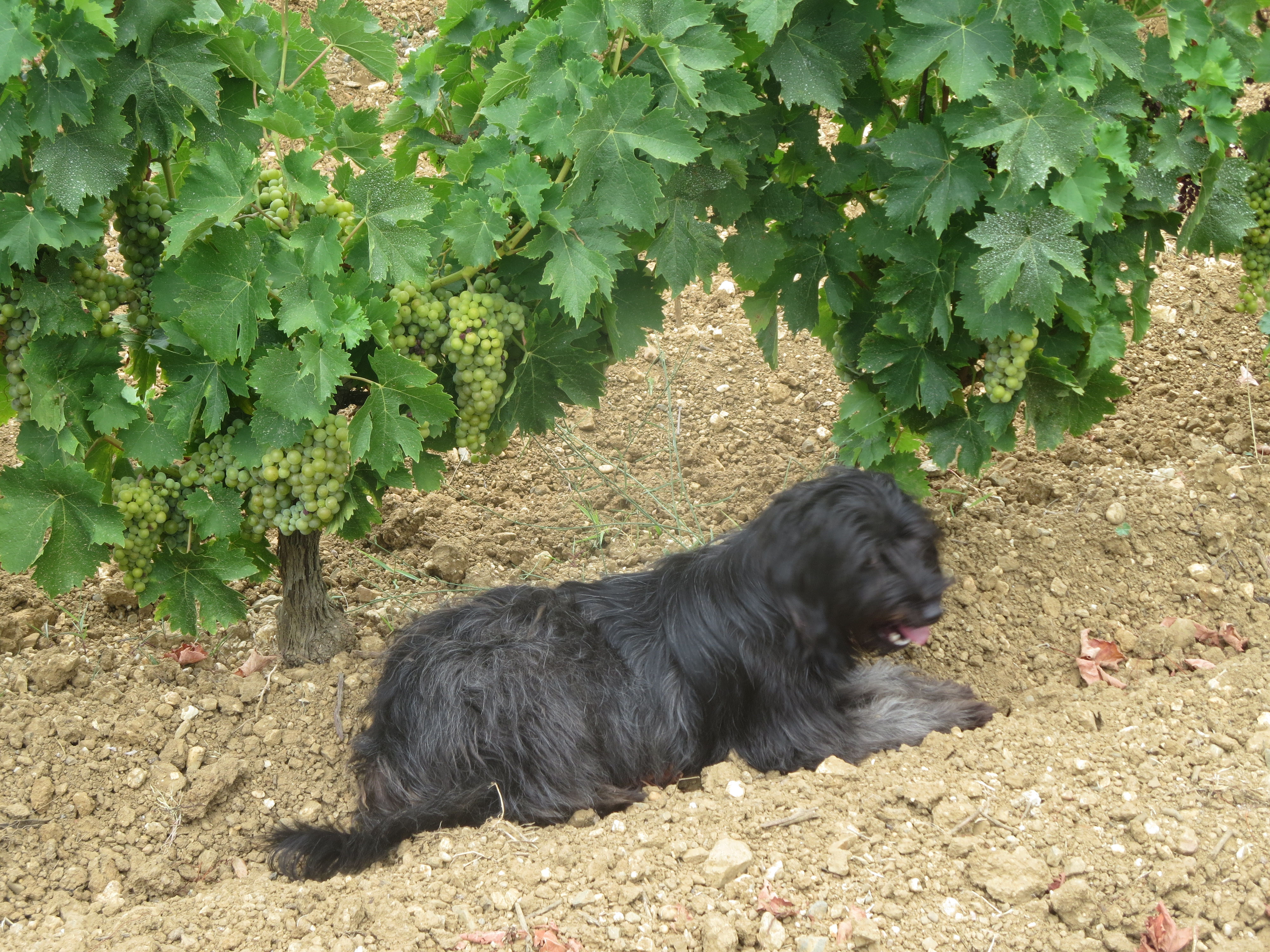
Two creatures love being in the vines for sure, me to watch their growth and, more importantly, Icare who loves to be in amongst the dirt and, in this heat, he loves the shade of the vines.
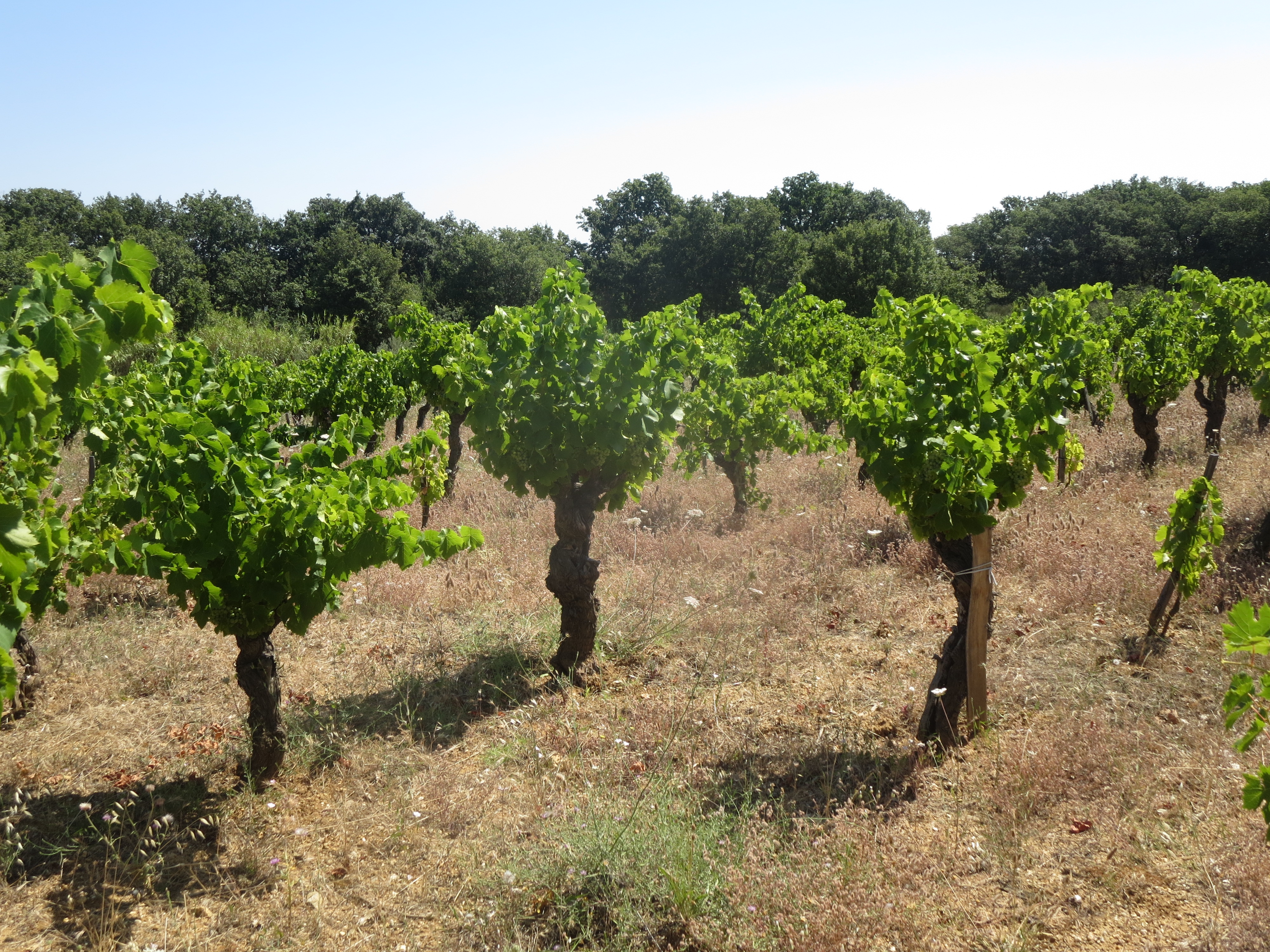
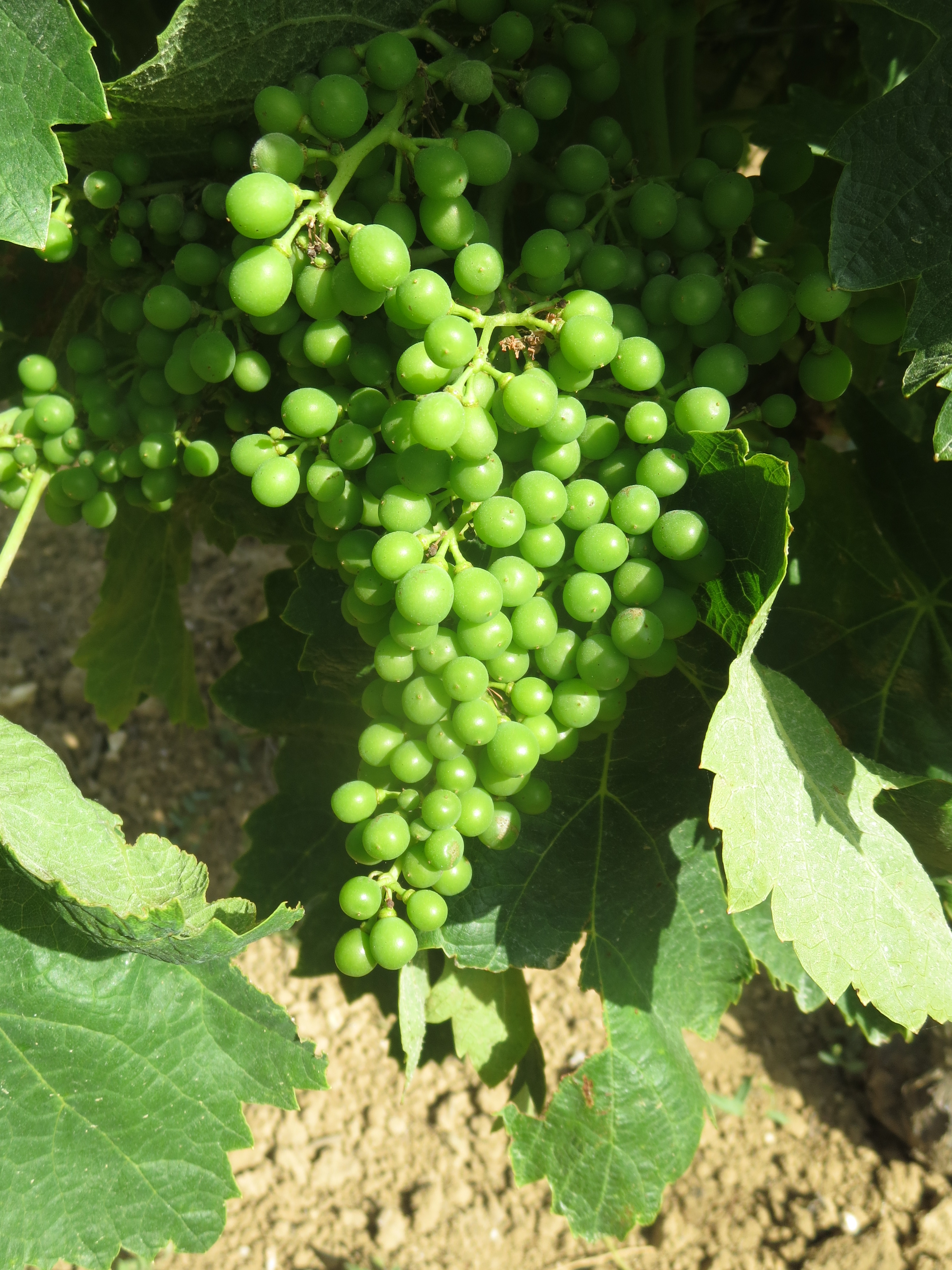
After 3 weeks in the UK I was keen to see how the vines had developed in the meantime. I was aware that there had been a real heatwave with temperatures in the high 30s every day (even the UK was hot for a few days!) but there was little sign of stress in the vines, they are green, voluminous and with some big bunches of grapes. Indeed the grapes are now at around 50% of their final volume and the bunches are closing up with the berries touching each other. Jeff’s latest estimate for the main harvest is that it will start around August 23rd, a fairly typical vintage in that respect.
Peilhan July 10th, ploughing evident
Vines are now taller than Pat
I did notice that Jeff had been busy with a further ploughing. This is partly the consequence of the dry weather. Weeds and other plants amongst the vines offer competition for resources such as water and when it is so dry as 2015 (following a generally dry 2014) the vines could have been stressed so ploughing was deemed wise.
Grapes developing nicely. Spots of sulphur on the leaves from spraying against oidium
There has also been some oïdium (powdery mildew) in the the last few weeks and, indeed, for much of this growing season. Therefore there had been some spraying of sulphur and the oïdium is under control.
Aoutement, the stems are lignifying
The main change in the vines was aoûtement. This is where the stems of the vines are starting to harden and turn to wood, lignification. The stems turn a reddish brown colour as can be seen in the photo below. The pips in the grapes are also now firm.
Vines can effectively feed and support between 100 and 200 grapes. They produce more in case of damage and therefore many vignerons will be in the vines carrying out a green harvest, éclaircissage, where they cut off leaves, stems and bunches so that the number of grapes is limited to help the vine to provide optimal development. Normally this would be done on the side of the vine which is least exposed to the sun as the foliage is needed on the more exposed side to protect the grapes from too much direct sun.
More signs of aoutement
Ironically this process has not been needed at Mas Coutelou so far because of the earlier damage of coulure. (see previous post here). This reduced the number of grapes which developed by around 20% in some vineyards, so green harvesting is not required. There will still be lower quantities of grapes harvested this year, coulure is bad news for the vintage supply and some cuvées will be missing.
The new vines at Peilhan were watered to help their growth
Overall, however, the vines are in good health and preparing for the final stages of their annual growth cycle. Rain would be very welcome, reducing the risk of stress and also helping the grapes to swell and to produce more. We didn’t even bring any back from the UK! Maybe the 14th July celebrations will bring some. If you listen to the video below you will hear that the cicadas in Rome vineyard are apparently already celebrating!
I was reflecting on two wine blogs which I read recently (Frankie Cook and David Crossley) Independently they were writing about how we got into wine and how, over the years, our tastes have changed.
Pat and myself with our tasting guide at Olivier Leflaive, Puligny Montrachet
I was brought up in a County Durham small town, Crook. My family were teetotal and brought me up as a Methodist. This meant that alcohol had virtually no impact upon my life for many years, the pub was not a part of lives other than the occasional meal whilst on holidays. Wine was an alien concept, something which posh people and foreigners drank. Even during my time at Liverpool University I drank some beer but never wine. That I should turn out to be horse racing fan with passion for wine may be seen as something of a reaction to that upbringing though it should be said that my childhood and youth were wonderful and I would not change anything about them.
So it was a school trip which ignited my interest in wine. As a teacher. I was asked to accompany a visit to the Rhine Valley in Germany in 1982. The hotel where we stayed was big and old fashioned, in the centre of Bacharach not far from Rüdesheim.
Bacharach am Rhein
The hotel owner was a very sociable and generous host and every evening he would offer us wine to accompany our meal and then he would teach us about the local wines and how they could vary in levels of dryness or sweetness and according to site and winemaker. (I hasten to record that two teachers would abstain to supervise the children). Well his teaching was a revelation! As far as I knew wine came in two types, red and white just as there were different flavours of soft drinks such as Cola, lemonade etc. Our host opened up a whole new world of how wines could vary so much even within the same place and vintage never mind from other regions. How I wish that I could remember the name of that German tutor, he set me on the road which leads to the Languedoc in 2015.
With Oz Clarke at a London tasting, his books taught me so much
From Germany to Australia. 1980s Britain saw a boom in wine interest in Britain, fuelled by television coverage, magazines and books. My chosen guides were Oz Clarke and Hugh Johnson, different in approach but knowledgeable and with a great ability to communicate their enthusiasm and to educate me with their words. At the same time the arrival of New World wines, especially from Australia, and Oz’s championing of those wines widened my tastes from German Riesling, though that remains my favourite white wine type it should be said. Huge stonking Shiraz, colourful Chardonnay and cassis-heavy Cabernet Sauvignons were the order of the day. Wyndhams Bin 222 and 444, Penfolds Bins 128 and 389, then cheap! Massive amounts of oak (often from wood chips added to the barrel) which today would make me shudder and wince.
Add in the Sauvignon Blancs which were starting to arrive from New Zealand, tropical fruits, cut grass and cat’s pee aromas. Cloudy Bay Sauvignon was the bottle to find, indeed it was rationed out. And trips to Oddbins, the most dynamic of wine retailers, who offered Penfolds Grange Hermitage for around £20 (now over £200), why didn’t I buy it all?
Iain and I using Oz Clarke and Hugh Johnson to help us navigate Beaune
From the Antipodes to France. By the mid 1980s I was a regular holidaymaker in France, profiting from school holidays in summer. The Loire was the first region visited and particularly tasting wines in Vouvray. Dry, appley Chenin Blanc wines which could magically also be sweet and luscious vins moelleux in the hands of winemakers such as Huët, Foreau and Fouquet.
A startlingly youthful me with my brother in law Iain in the Cave Madeleine, Vouvray.
My first wine fair was in the troglodyte Cave Madeleine on August 15th. I assumed you drank rather than spitting the wines and rolled happily down the street back to the accommodation. Then onto Burgundy, Alsace, Beaujolais, the Rhone Valley, Bordeaux and Jura. Some were more welcoming to wine drinkers than others. Great welcomes from people like Martin Schaetzel in Ammerschwihr who opened bottles generously. I met lovely people whose passion for their work and wines was freely shared with visitors. Louis Champagnon in Chénas was always a man who greeted you with a smile, food, a joke and great modesty.
With the great Louis Champagnon, Chénas
The Échezeaux producer who shared her Grand Crus, knowing that as a young teacher I couldn’t afford them (sadly I still couldn’t 25 years later!). Sadly, Bordeaux was different, most producers kept their doors firmly closed, though I still loved the wines. I tasted first growths such as Haut Brion at generous merchants such as Hungerford Wines. I bought en primeur in 1990 and struck lucky with a great vintage and wines from La Lagune and d’Angludet at just over £100 a case.
My experiences broadened, more tastings, more wines from around the world but especially France. As a teacher my budget was limited and I relied upon Oddbins, The Wine Society and supermarkets to find good wines. Plus I got bolder in knocking on doors, a remarkable visit to Didier Dagueneau and his wonderful Pouilly Fumés for example. In Germany trockenbeerenauslese wines were offered and I even learned to pronounce it.
A March in the vines of the Loire
A March in the vines of the Rhone
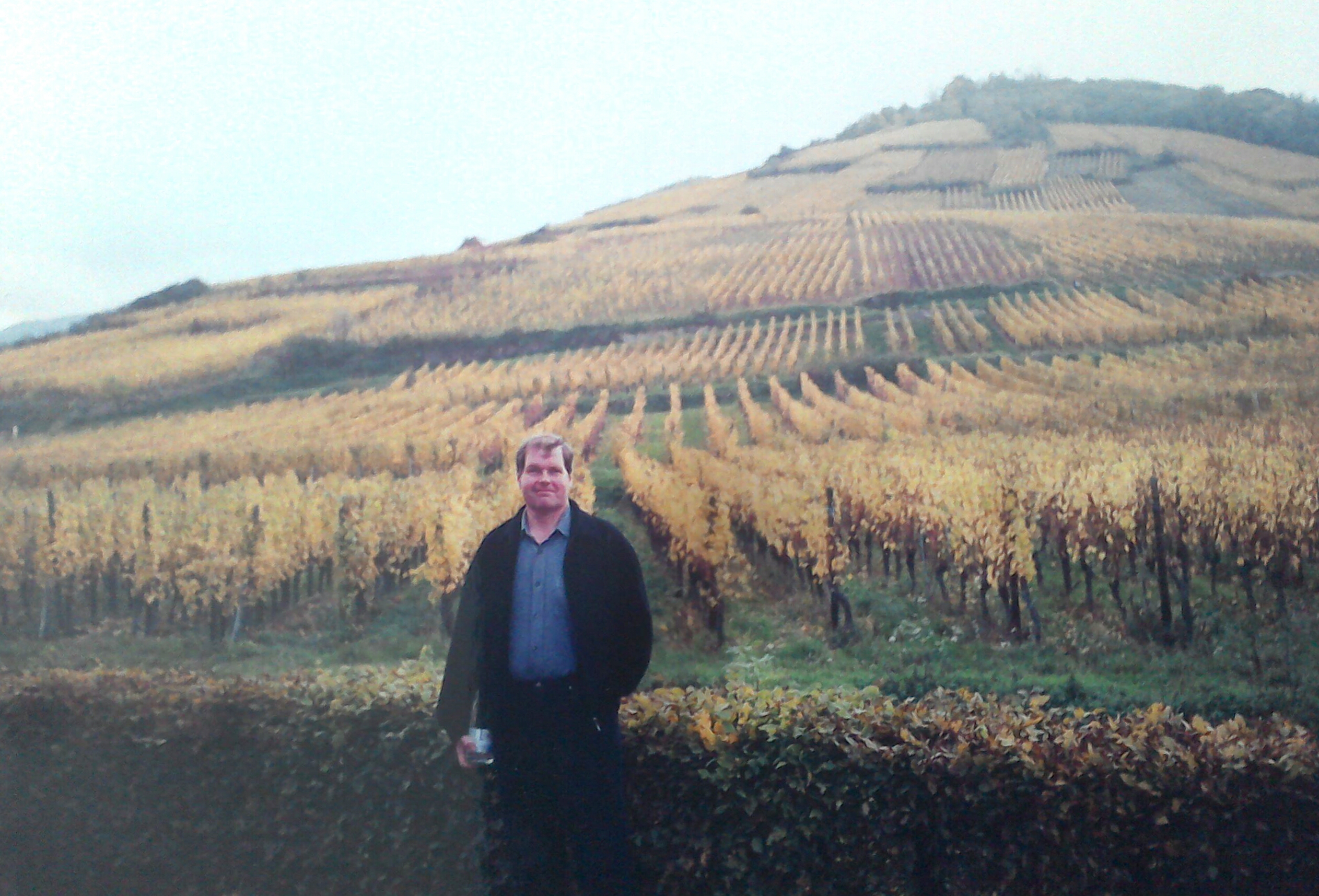
A March in the vines of Alsace, golden autumn 2001
Blind spots remained however, Italy and Spain in particular, much to my brother in laws’s disbelief. California too though a visit to the USA (South Dakota and Seattle) showed me that good wines were abundant there, and oh those ice wines in Canada! Lovely. A trip to Sicily also opened my eyes to the possibilities of Italian wines, the Frappato grape and Etna wines were revelations.
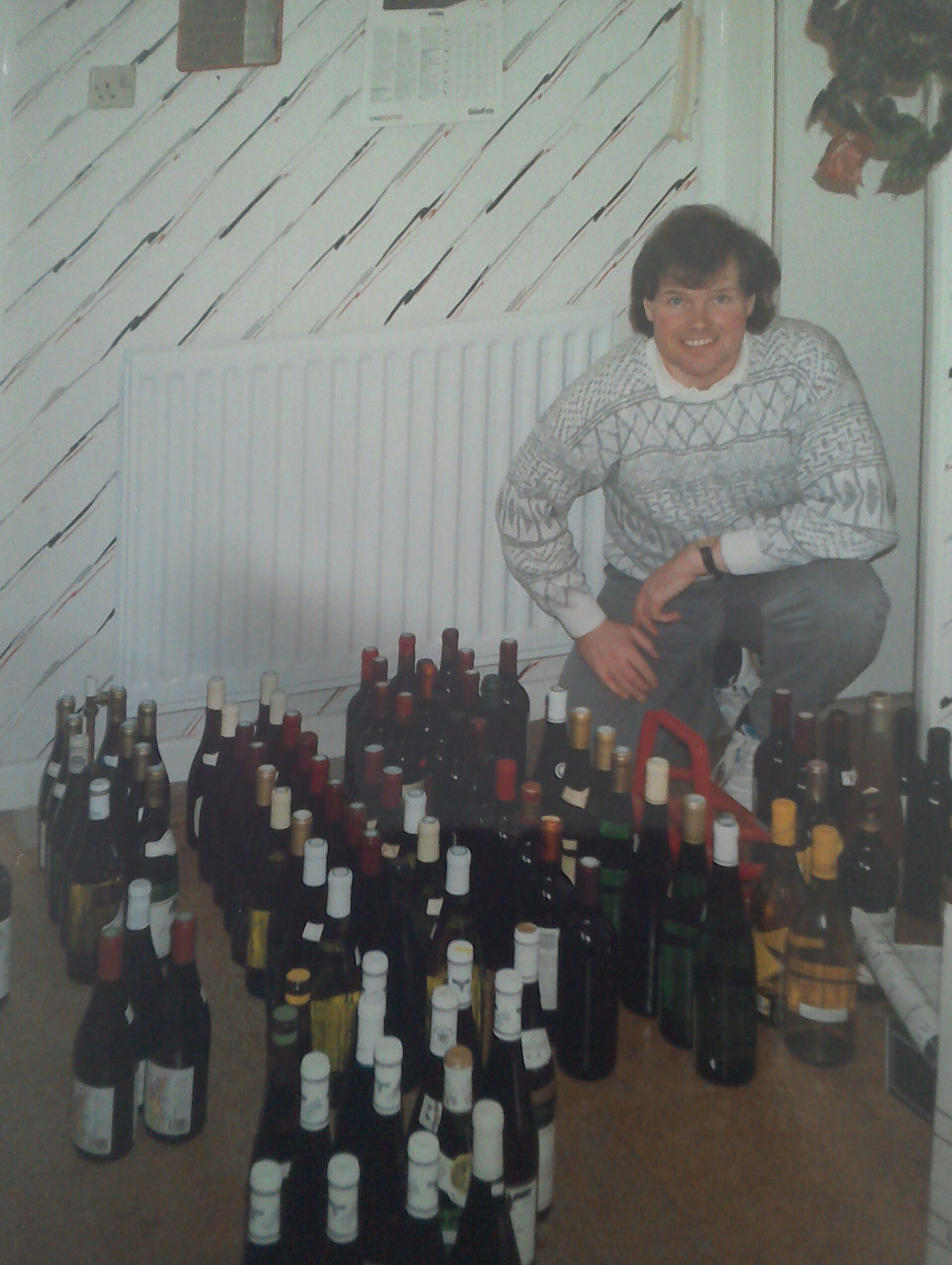
Well 30 years of wine drinking brought joys and disappointments, bargains and rip offs. Memorable bottles, glasses and also corked wines, a whole case of expensive Chablis was one painful low. A hundred bottles stored away has turned into five hundred. And then with age the question, when will I drink it? Why buy expensive en primeur which won’t be at its best until I’m too feeble to drink it or indeed incapable of drinking it.
Sorting and happy (and hair!)
Wine fair in Cahors
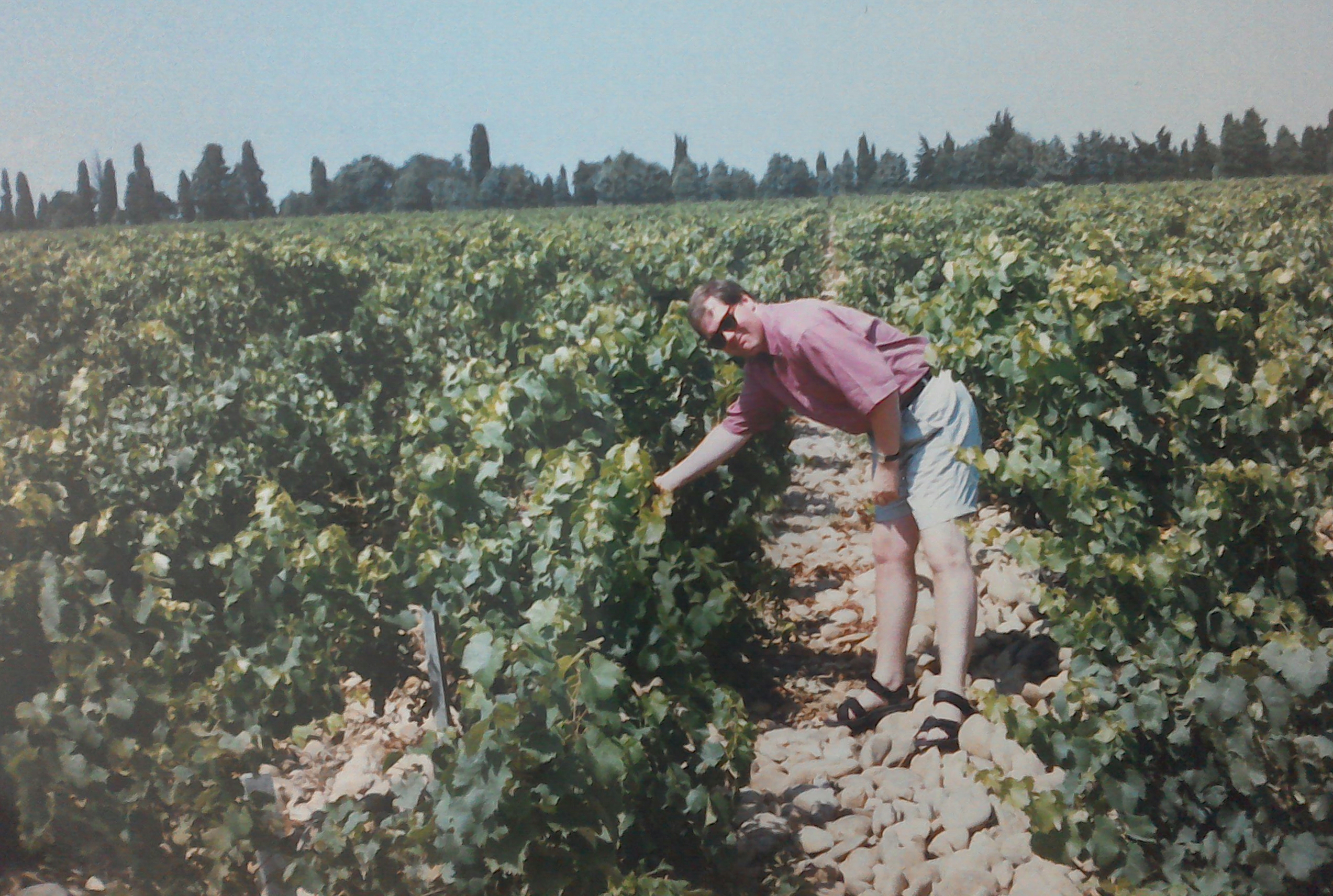
Tentative steps further south in France in the last decade. The Languedoc. Rosemary George was my guide through her book and blog to discovering the well priced and under rated wines of the region. Wines which offered pleasure but also, from many producers, complexity. A chance visit to Puimisson and Mas Coutelou as that was the domaine Rosemary wrote about when I was in the area. The expected half hour visit turned into three and a half hours. Even after visiting hundreds of vineyards and cellars I was flabbergasted. Vineyards without chemicals, wines without sulphur, a solera! In Puimisson?? All true. Above all a generous, passionate man and generous friend who happens to be a great winemaker. And a teacher about the vineyards and winemaking who encouraged my interest and deepens my understanding and who agreed to being the focus of a blog to keep me busy. Le Vin Des Amis indeed. Retirement, the chance to spend a year, indeed more, in this fabulous region. Learning, living.
Love of beauty is taste. The creation of beauty is art.
(Ralph Waldo Emerson)
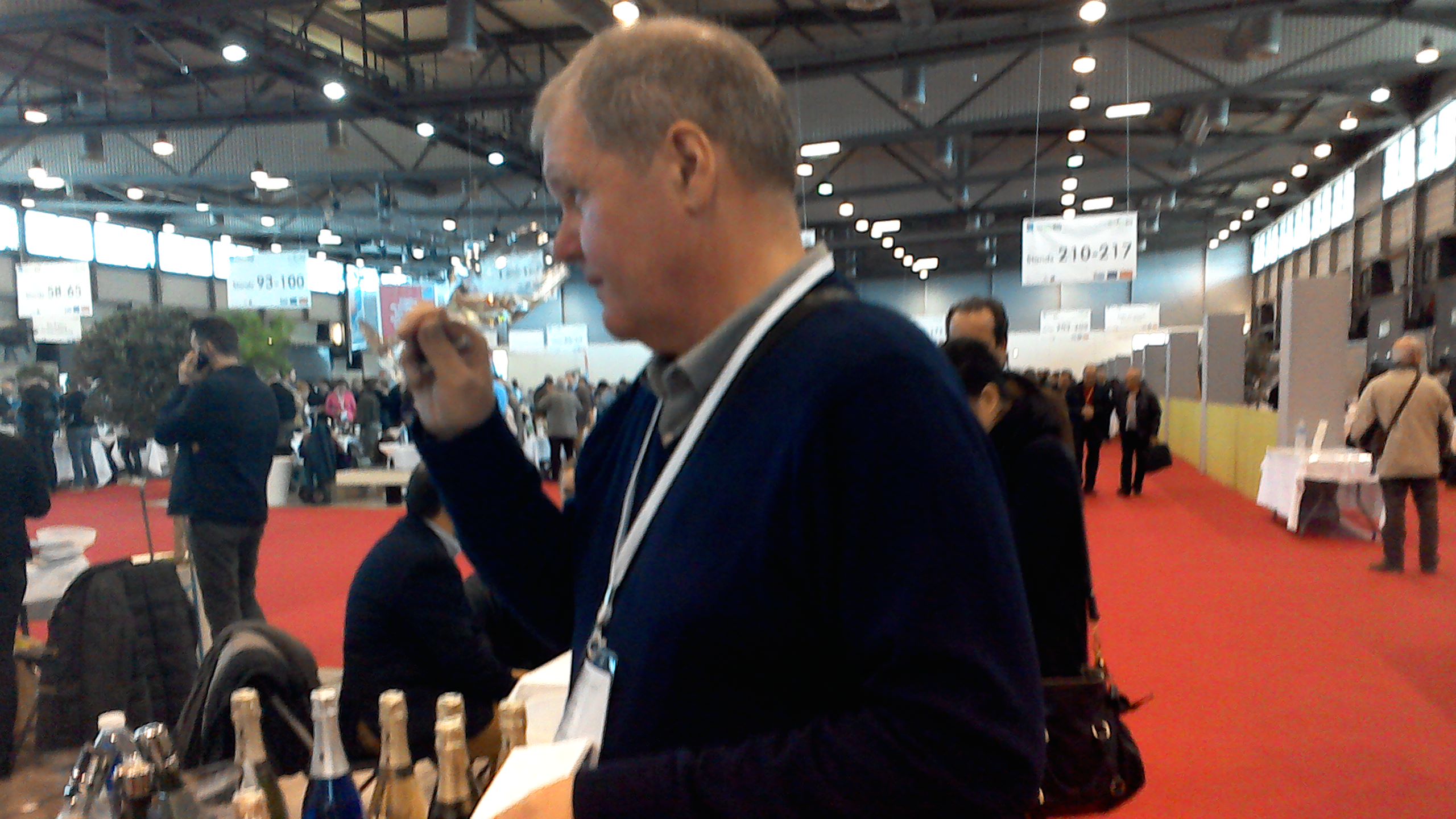
In recent months I have been honoured to be asked to take part in a number of wine tastings. Mostly these were regular tastings of wines where the producers present some of their cuvées and the tasters choose which stands to visit and to taste at. It is good to chat to the producer to try to get some idea of how they work and some background to the wines. Of course there are drawbacks, if you don’t like the wine then you have to choose how to respond. I have seen some people simply walk away without comment but personally I tend to be diplomatic and utter bland statements such as “Interesting”. Alternatively, I may ask questions to avoid making a comment before thanking the producer and moving on.
I am always wary of how much I have drunk at such events and I think it is important to remember that wine is an alcoholic drink with consequences. At a recent event in St Saturnin I tasted around 60 wines, spitting of course. This was a paid for tasting and as well as the glass the organisers provided a bag which included an alcotest, a breathalyser. I decided to try mine after the tasting and was surprised to see that it measured only around half the drink driving limit of 50mg per 100 millilitres. Not that I was driving back to Margon I hasten to add. Even spitting wine after tasting it absorbs alcohol into the body. I had expected it to produce a higher reading but was unprepared to drive with even that amount.
St Saturnin
At other events I have tasted many more wines, up to 450 in one day at Millésime Bio in January (where I used the tram to get back to the hotel). The question people ask is how can I taste the wines properly after even a quarter of that number? In years gone by I attended big tastings in London and Edinburgh for example and I remember palate fatigue setting in. I tried strategies such as whites first, then sparkling wines to refresh and finally reds but I often found that I quickly tired of the reds even after short breaks. These days I have become more used to larger tastings and my palate is more trained. I can’t argue that my tasting ability will be diminished but I do feel able to assess wines reasonably well for much longer than I used to do.
A different problem which does affect that ability is that of getting used to wine styles. Tasting a lot of Languedoc reds for example I do begin to expect certain flavours and styles and so look for them rather than treating each wine on its own merits. Indeed, if a different sort of wine is then presented, eg a dessert wine or a different grape variety, the change is often very welcome and so the risk is of giving it more credit than perhaps it deserves.
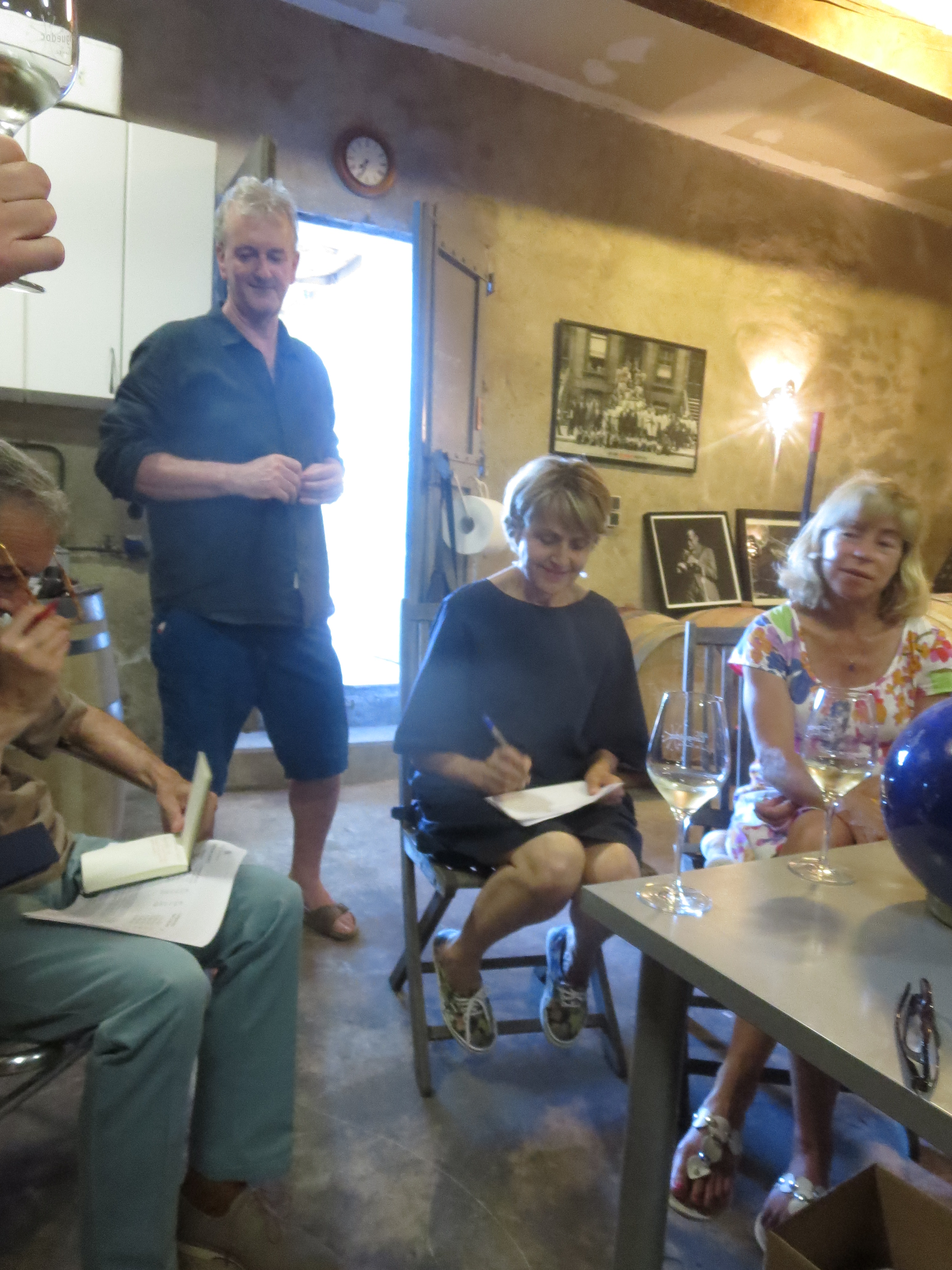
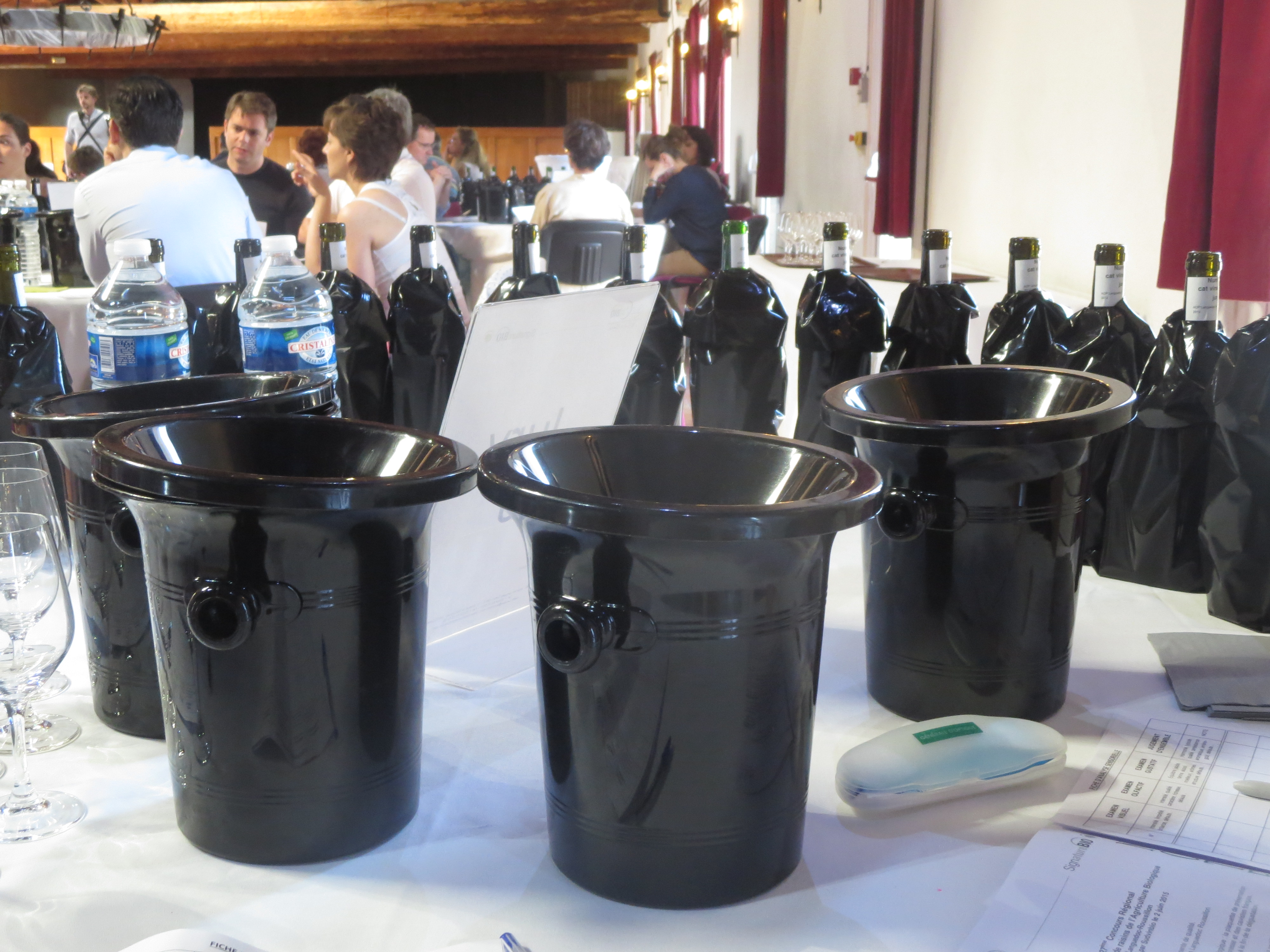
I was also asked to taste series of wines for Guide Hachette, an enjoyable experience and definitely an honour. These tastings are carried out blind, the wines wrapped in covers so that the tasters cannot see the name of the producer to avoid conflicted interest or bias. Divided into groups of four we then compared notes after writing copious notes on appearance, aromas and taste as well as thoughts on possible food matches, and an overall judgement and mark out of 5. Happily the tasters were usually fairly consistent in their assessment of the wines, the training and experience of the jurors came to the fore. I was relieved that my marks were in line too! Even then the fact that the vintage and grape variety was given, so some level of expectation and prejudgement is in evidence. Overall though I felt reasonably confident that the marking was fair.
Wines waiting to be judged at Sudvinbio
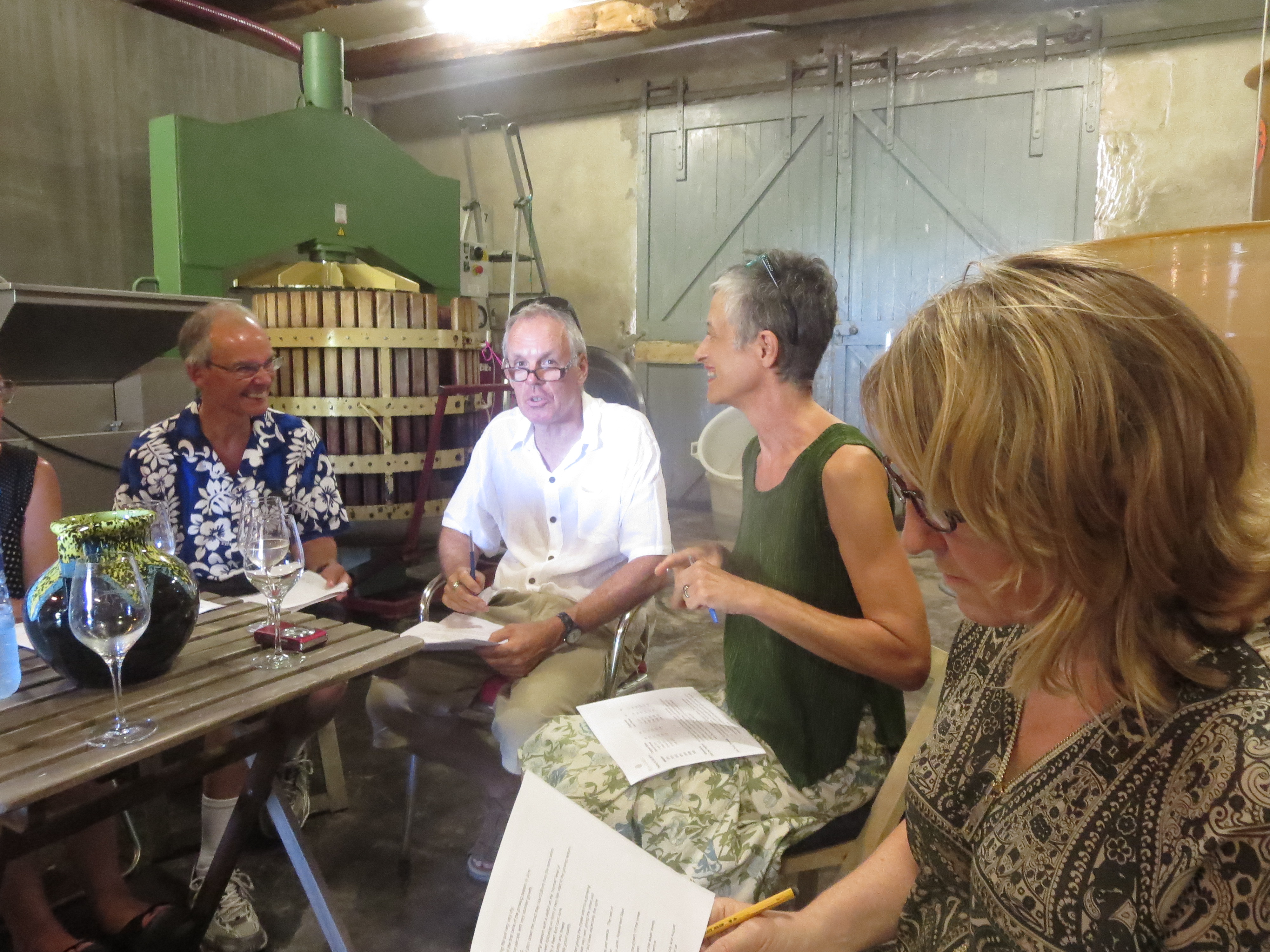
Then last month I was asked to judge at a competition for Sudvinbio, organic Languedoc wines. I was on a jury of older vintages of Languedoc red wines. Again the mix of vigneron, oenologue, journalist, sommelier and blogger (ie me) were fairly much in agreement. Three wines stood out and deserved some recognition. However, we had been asked to award 4 medals which I did find a little odd. How can you decide in advance how many medals should be awarded? In the end a 4th wine was given a medal, but this was much more disputed with some liking it, others (including me) not liking it. I remain unconvinced by competitions though it again gave me some confidence of my own tasting ability.
Judges at work
Tasting is a personal experience, what I like you may not and vice versa. Experience of tasting wine does help us to appreciate and, for want of a better word, judge wines. We do bring prejudices to tasting, for example I know that I find Merlot and, especially, Cabernet Franc difficult.
There are all kinds of psychological and physiological factors which affect our ability to taste, from temperature to mood to patterns of tastebuds. Jamie Goode’s book ‘Wine Science’ has a fascinating chapter on the psychology of tasting, highlighting the work of Read Montague in Texas for example in showing how our prejudices can affect our taste.
All I can do is build on my experience, try to be aware of my own prejudices and be honest about my assessments as snapshots of wines at a particular moment in time and to my taste. It is however, a most enjoyable databank of experience to compile. Thank you to all those who are helping me to do so. Meanwhile don’t forget to enjoy the art of the vigneron.
I have visited hundreds of vineyards over the years but very few have stirred the same excitement and admiration as those of Clos Fantine, run by the Andrieu family of Corine, Carole and Olivier. With a helping hand from their New York importer Camille Rivière, who also imports Mas Coutelou wines, Corine asked me to visit on May 21st and I returned on June 11th.
There are around 30ha of vines around their base in La Liquière high in the Faugères hills. The soil is schist, Corine told me of 3 types, grey, blue and pink. This slaty soil makes it difficult for vines to send their roots down into the bedrock as it ends to lie horizontally, so they must seek fissures and faults for their roots to penetrate as the topsoil is meagre. This undoubtedly adds to the qualities of freshness and energy which mark so many of the best Faugères wines and certainly those of Clos Fantine. Corine explained that they do not try to fight this natural acidity but rather they work with nature, a philosophy which is fundamental to every aspect of the domaine. Nature rules, the Andrieus guide it perhaps.
Schist soils
The three siblings took over the running of Clos Fantine from their father in 1997 and continued to work conventionally until 2000 when they began to use the natural yeasts of their terroir and then, in 2004, more confident of their vineyards and of themselves and of their ideas and beliefs, they stopped adding sulphites. This was no trendy whim on their part, they were certainly not riding a natural wine bandwagon. Corine is a qualified oenologue who reads widely around viticulture and agronomy. She used, and still uses, her scientific background to guide her winemaking as well as the philosophy about nature which she shares with her family. As she said to me, “You have 3 core tenets; the use of science, faith in what you are doing and the art in creating the wine.”
As we drove around the vineyards with their stunning setting there was a true feeling of well being. We met Olivier who was hard at work in one parcel strimming grass between the vines. The Andrieus do not plough the soil as they feel that this upsets the balance of it, and that the hot Languedoc sunshine and strong winds would dry the soil out too much if ploughed, leading to erosion of the already thin topsoils. Sunshine is not a problem in the region, water is and by not ploughing the family also help to preserve the water in the soil. Grass, flowers and other plants grow naturally and when the grass is fully grown and starts to seed they strim it to add organic matter to the soils and seed for the following year.
Olivier strimming the grass
The grass also provides shelter for insects and spiders which in turn will help the vines by attacking grape parasites such as ver de la grappe. These are real living vineyards, illustrated by the discovery of two separate partridge nests, both filled with eggs, at the base of vines in that one parcel.
Partridge eggs in their nest below one of the vines
Corine talked about how they see the land as between 3 stages, farm/grassland, garrigue and forest. They are seeking to keep their vines on the edge between the first two stages so that the vines are having to work a little to compete with flora and fauna without being overstressed. Meanwhile, Olivier also spoke about keeping good quality air around the vines, eg allowing the air to circulate freely around the vines to keep disease at bay and also about using the flowers and grass.
The fresh air of La Liquiere
Disease, of course, is an issue at the domaine despite their hard work to minimise it. This is true of all vineyards. Mildew had hit when I was there in May, nothing too serious but a reminder that nature can also be cruel. Natural treatments available to them include the use of sulphur and copper which had been used for the first time in a few years. However, the vines were not in any danger, the mildew had been contained.
Marcottage vine training, in fact this mother vine was attached to two offshoot vines
All the vines are gobelet, low to the ground. Corine described how they had recently bought a parcel of vines and their first action was to remove the palissage, the stakes and wires used to train the vines. The vines flopped and spread out as if relaxing, in Corine’s words, like a woman released from her corsets in Victorian times. Gobelet is the traditional method of growing vines in the Languedoc. The bushy vines have plenty of foliage to shelter the grapes from the sun but also have space to fan out allowing the air inside to stop humidity and defend against disease. The gobelets did give the impression of a vineyard which could have been from any period of the last few centuries, ageless.
Gobelet vines
Corine used the word ‘energy’ a lot whilst I was there. She was referring to the soils and the vineyards. The nurturing of the soil and the vines is about channelling the energy of nature into those vines and ultimately the grapes and the wines through their management of soil and air. However, energy also describes the work of Corine, Olivier and Carole. They are relentless in their quest to improve the vineyards and the wines.
Energy!
They read widely, for example Corine is an admirer of Jean Marie Pelt and his writings on plants and nature. She quotes science, history and nature readily and compares her wines to others in the region but also to wines and vineyard practices from the rest of France and internationally. Corine seeks to learn from these and we talked about viticulture in Australia and Chile, as there are little things done there which might help to improve wines, “we may never be perfect but we can try to be the best we can be.” This awareness of learning and the outside world is more widespread than it used to be in France but I have not come across that many vignerons who are so keen to learn from various sources.
Corine, happy in her vines
At the start of this blog article I mentioned how happy and at ease I felt in the vineyards of Clos Fantine. The location, its touch of wildness and naturetogether with the philosophy of the Andrieus all rubbed off on me too.
At that point a wagon arrived to collect some palletts of wine to take to Belgium. As the domaine is up a narrow road Corine was going to have to transport the wines using the forklift down to the wagon in the village. I was actually quite pleased as it gave me the opportunity to return a few weeks later to visit the cellars and to taste the wines.
As a storm broke over La Liquière on June 11th it was a dramatic backdrop in which to return. The cellar has been designed to allow the grapes to be moved by gravity rather than pumping after being harvested by hand and gathered in small cagettes. The cement vats we tasted from were full of single variety wines busy fermenting. Corine uses no pigeage or remontage in the vats, something which was new to me, and as the weather cools down in autumn and winter the cellar doors are opened to allow the temperatures to drop and halt the fermentations naturally. These resume in spring as temperatures rise again. The result is a gentle, long and cool maceration with as little intervention as possible.
Doors lead over the vats meaning the grapes can be moved by gravity
And the results… Well we tasted Carignan, Syrah, Grenache, Mourvèdre from the vats and each was clear, direct, mineral and oh so fresh with fruit singing out. They were also classic in their cépage typicity, it was relatively straightforward even for me to identify each one. They were excellent as was a Terret from a barrel which contained wines from a number of vintages, in other words in a solera type system. Complex, long, mineral and the slight oxidative notes were refreshing and interesting.
We then retired to the kitchen and tasted from bottle. The Terret, Valcabrières, was a delight. Great depth of flavour with zesty refreshment and white fruits such as notes of pear. Long in the mouth it was delicious. Recently bottled it was already very good but will improve as it settles in bottle. Lanterne Rouge is Aramon and Cinsault, very much Languedoc varieties and a wine I have described on here a few times as it is a favourite with lively fruit aromas and a deceptively light first taste which grows more complex in the mouth. The Clos Fantine Tradition is mainly Carignan and Grenache and has real depth of dark fruit flavours and great complexity and a refreshing, clean finish. It is classic Languedoc red wine but with added zest and liveliness. Finally Cuvée Courtiol is made from the best grapes of the millésime. Ripe, full and delicious with length and soft tannins that will marry into the wine with age. I really love these wines and when Corine said there was no obligation for me to buy any wines when I asked if I could, I hastened to reassure her that I felt no obligation, I wanted to buy some and will certainly want to do so again!
I learned so much in my time at Clos Fantine with the Andrieu family and I admire and respect their work, their philosophy, their passion for learning and nature and, of course, their wines. I implore you to seek out their wines and drink them.
Time to head back to the UK for 3 weeks or so. Time to reflect on all that has happened since the dark, cold days of January. It has been wonderful to witness changes in seasons from almond blossom to irises to poppies to full bloom of flowers, fruits and, of course, vines. From the pruned sticks of January to the lush, verdant vines of June. Changes everywhere.
Let’s start in my favourite vineyard, Rome with photos from various months showing the gobelet vines I call the centurions in deference to their stature and location.
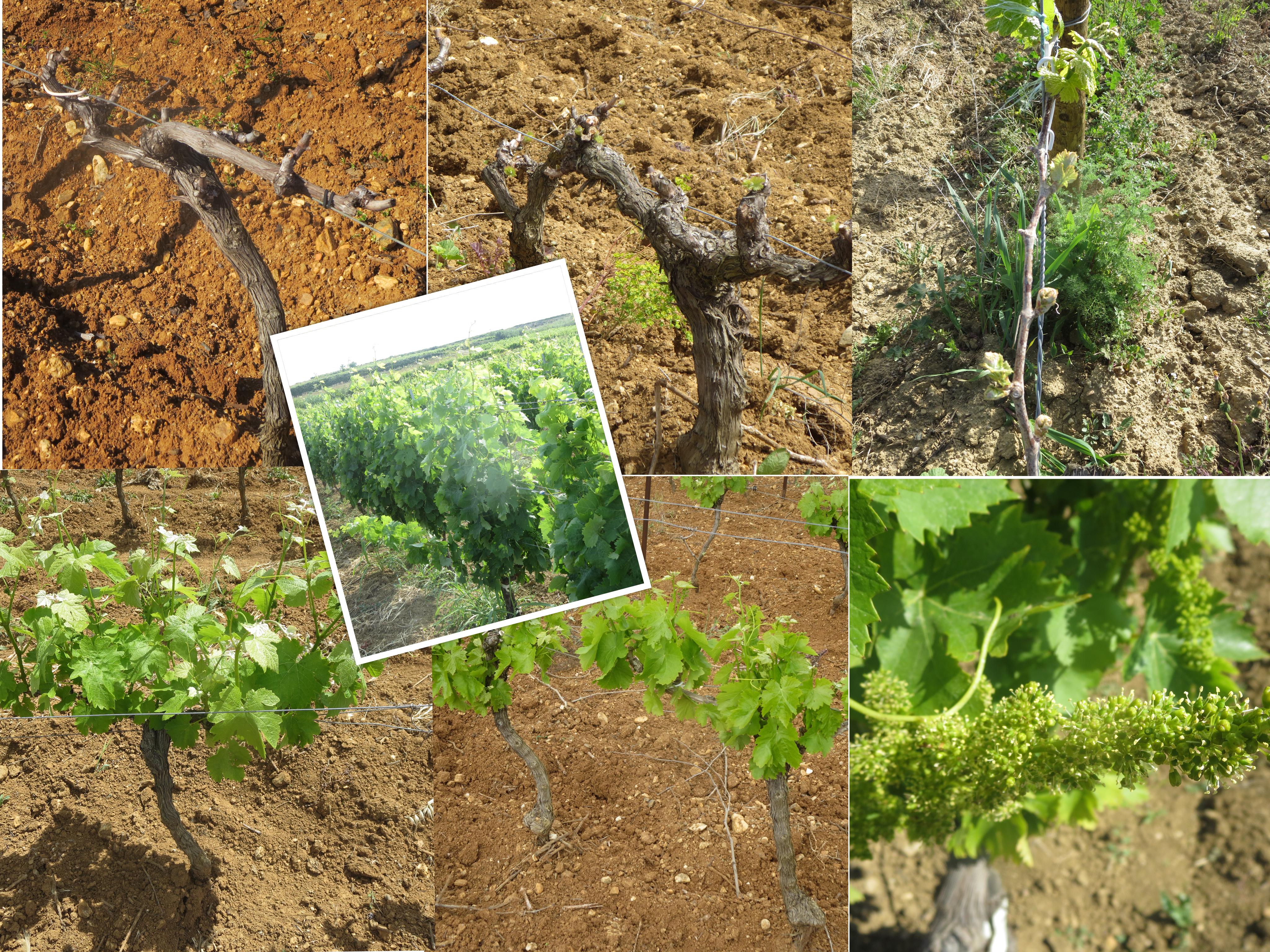
La Garrigue, a vineyard of Syrah and Grenache as well as white varieties is one I have watched closely as it was where I watched Carole and Jeff prune in January. Read this collage left to right on both rows before the full growth in the centre.
So what has changed in the grapes?
Top row
left – bourgeons / buds with their cottony covering and green specks of leaf
2nd from left – Etaillage and grappes / first leaves with the formation of future bunches
3rd from left – grappes / buds form in bunches
right – the bunches separate
Bottom row
right – fleuraison with capuchons / the flowering of the grapes with little brown hoods
middle – fleuraison complete flowering bunch
left – boutons / the grapes begin to form
The grapes are starting to form their seeds which will gradually harden (nouaison). When I return here in July the black grapes will start to change colour (véraison). Can’t wait to see it.
After weeks of sunny and hot weather storms have hit the region in the last few days. Monday (June 8th) saw the first and hail hit Faugères nearby damaging some vines at Domaine Sylva Plana for example. Hail is a nightmare for vignerons, it can strip the vines of leaves and budding grapes at this stage of the year. Today (June 12th) the storms are back with lots of heavy rain.
The water is welcome, the long weeks of sunshine and high winds have dried out the soils. Steady rain would be better but water will help the vines and reduce stress. However, if the rain turns to hail then disaster strikes.
The vines have had a hard time in the last year or so, a dry winter and spring in 2014 certainly reduced yields as the vines were stressed. The mildew and oidium which arrived in early May added to their problems. I also mentioned that coulure hit Mas Coutelou as the high winds damaged the delicate flowers. Sadly the problem is widespread across cépages and vineyards. Jeff estimates that it could reduce yields this year by up to 30% compared to an average year and that after reduced yields in 2014.
Healthy bunch developing
Coulure in Rome vineyard
And in Peilhan
Jeff already announced that certain cuvées would not appear from the 2014 harvest, it looks as if that will be repeated in 2015. Bad for those of us who love Coutelou wine but mostly for Jeff himself.
The storms and rains also bring humidity so mildiou will undoubtedly be a threat again. Treatments will be needed. Some vignerons in the area, and certainly in cooler regions, will be pruning and cutting back the lush growth of vines. This allows more air to circulate and therefore hopefully reduce the risk of mildiou. In the Languedoc, heat and sunshine is more common and the grapes will need protection from the direct sun so Jeff prefers not to cut back the main growth, the frequent winds will allow air to circulate naturally without it. However, some particularly vigorous branches will be cut.
Some vine branches might need to be removed
The other main vineyard task will be to remove the gourmands, the buds and branches which grow directly on the bottom part of the vine trunk. These simply use up the vines’ energy.
Gourmands (side branches) growing on the trunk of the vine
Finally the palissage wires need to be tightened as they have heavier vines to support. The vine branches can grow between 10cm and 15cm per day at present.
Meanwhile bottling, tidying, cleaning and alterations are happening in the cellars and wine salons/tastings have to be attended to sell the wines that remain (not so many this year). The vignerons must be as vigorous as their vines.
Let’s hope that the stormy weather passes without further damage and that nature helps the vines for the rest of this summer allowing them to produce as well as they can in 2015 and to recover and become stronger for 2016.