Saturday June 4th was supposed to be the Festival De Magie in Puimisson, a family magic show. Sadly it had to be postponed until September as, around 5.30pm, a huge thunderstorm broke over the area. Booming thunder and heavy rain were the main features as Puimisson and the wider region were treated to an alternative fireworks display to that scheduled in the Festival. Yet 2 hours later the skies were clear, the streets were dry again.
Flooded roads
Four of us though were treated to a magical evening. Jeff welcomed Cedric who runs the best website on French natural wines at vinsnaturels.fr (and I don’t say that because he chose one of my photographs on the opening page!) It gives great detail about vignerons, technical details about their wines and where they can be bought. His friend Ghislain was with him, another natural wine expert and promoter in the Grenoble area. Pat and I were invited along too and it was a real pleasure to meet up with them, they proved to be excellent company.
We were treated to 7 hours of tasting with Jeff in the cellars and at his home. And there was no question that Jeff is a true magician, conjuring up an amazing range of wines and of such a consistently high standard. I may be biased as he is my friend but the demand for his wines proves I am not alone in thinking so.
Error
This video doesn’t exist
We tasted all of the 2015 wines, those in bottle and already sold, those just bottled and those in tank and barrel. Whites, rosé, reds, sparkling and selection de grains nobles. Plus many wines from previous years in barrel and bottle. Before moving to the solera cave to taste, amongst others, the Grenaches wine I made. Hand on heart there was not one dud wine and there were many special wines.
Amongst white wines the Maccabeu and the macerated wine we bottled the previous day were showing well. So too the Bibonade sparkling wines, white and rosé. 5SO Simple was on form from the early wines alongside Vin Des Amis.
Of the next wave of wines, Classe was outstanding, Jeff thinks maybe the star of 2015. Tête À Claques was good, a blend of VdA and Syrah; Buvette À Paulette too, a blend of Mourvèdre and Cabernet Sauvignon. Flambadou will be excellent, it needs time but has all the ingredients to be especially good, just as it has been the last few years.
One wine which was noteworthy was Flower Power. This is the red produced from the complanted Font D’Oulette vineyard with its Aramon, Clairette Musquée, Cinsault, Oeillade and six other cépages. Its first vintage in 2014 won plaudits even from the conventional press. The 2015 I had tasted on Thursday and it was in a dumb moment, Jeff actually carried out a soutirage on Friday and by this Saturday evening it was singing. For me, this could be the star of 2015.
Flower Power’s complanted vineyard
Ghislain had brought some cheeses from Meilleur Ouvrier De France Bernard Ravaud. They were superb cheeses including a truffled comté which shall live long in the memory. Jeff opened one of the 2012 barrel aged 5J which I wrote about recently, and it is a great marriage with cheeses.
We moved to the solera cellar where we tasted some of the old Muscats and Grenaches. However, it was also good to taste my Grenaches wine from all three of its containers, the new 60l barrel, the old 30l barrel and the 27l glass bottle. As before the older barrel has a sweeter, fruitier profile whilst the new barrel gives a slightly leaner, more complex wine. The glass bottle is all sweet fruit and still fermenting! It was good to hear Cedric, Ghislain and Pat all give their approval.
My Grenaches from new barrel
The hours flew by, always the sign of a good night. Thirty wines or so, Jeff just keeps bringing them out from up his sleeve. Or have I just given away a magic secret?
On Wednesday June 8th more visitors to the cellar. Paco Mora of La Cave D’Ivry and a friend of his Charlotte, a caviste in Montpellier, visited. I have mentioned Paco before on here and I would love to visit his Cave. He takes time and trouble to visit the winemakers whose wines he stocks and to offer his support. He’s passionate about wine and good fun as well as having a keen social conscience. We shared wines, laughs and lunch and two more great wines.
La Vigne Haute 2010 was lovely, showing maturity, the Syrah fruit now brooding and dark with great length and depth. LVH has always been my favourite cuvée but even this had to bow down before Flambadou 2007. Pure Carignan, more leathery and plummy notes with a smooth as silk chocolate finish. If anyone tells you natural wines cannot age then I would ask you to quote this bottle as proof that not only can they age but they can become truly great! Spellbinding.
La Vigne Haute 2010
Flambadou 2007
And even time for a little levitation. Told you it was magic.
I mentioned recently that the cooler weather had delayed some of the growth in the vines and that flowering was late. Well, recent hotter weather has brought sudden change. Flowering happened around the turn of the month and was over very quickly, perhaps catching up lost time. In particular there was a heavy thunderstorm on Saturday June 4th which brought a torrent of rain. The water and the sunshine has really got the vines going. Tendrils reach for the skies and there is more bushiness to the vines.
The flowers gave way to the little hoods which cover the nascent grapes, capuchons. These quickly fall away too revealing the grapes for 2016. On some vines all of this is happening at the same time such as this Carignan (above) in Rec D’Oulette. The weather has also encouraged the growth of the grafted vines which we did back in March.
This brings work too. The palissage has to be lifted to support the vines, hard physical labour. And, sadly, the heat and rain bring problems of disease. Mildew has been around for a couple of weeks and I mentioned that Jeff was spraying in the very early hours and late at night last week. He worked until 1am Friday/Saturday and started again at 6am. Just as things seemed to be settling a big attack of mildew on the Grenache at Ste. Suzanne meant more treatment on Tuesday morning. This ‘curious’ year is proving to be hard work.
Jeff a Ste Suzanne (photo de La Garrigue)
Peilhan, feuilles pulverisées
Not all negatives though. The storm brought such a downfall that I was fearful for the flowering bunches. damage to them means no grapes. I happened to be in Puimisson during the storm (next article!) and the rain was lashing down, converting streets and roads to waterfalls and lakes. Yet as the rain eased I went to a couple of vineyards and the flowers were coping just fine. A trip round the vines on Monday morning revealed healthy growth and the soils had absorbed the rainfall.
Routes inondées
Grenache vines with flowers intact after the storm
This is not true of everyone. Much of the water on the roads was also full of clay from vineyards nearby, hence the yellowy brown colour. Vineyards which are treated with weedkillers, where the soils are ploughed deeply, even irrigated, were unable to cope so well with the heavy rain. Soils were carried away. Compare these photographs of Jeff’s vineyards with the parcel next door belonging to someone else. The difference is marked. Water can help or can damage.
Rec D’Oulette
Parcelle voisine
Rome
Parcelle voisine
Meanwhile back in the cellar there was more work to be done. Recent changes to the fabric of the cellar, especially the floor, have brought more efficient drains and a smoother surface, easier to clean. Further work will soon be done to the rest of the floor so the bottling of the next wave of wines had to be brought forward to allow the works to be done and dusted before vendanges.
Nouveau plancher en résine
Plancher plus vieux
The spring bottling of wines such as 5SO, PM Rosé, 7 Rue De La Pompe I described earlier. These are wines for early drinking, vins de plaisir. Now it was time for wines with a little more body. On Thursday June 2nd 10,000 bottles of Classe were made, and it is really something special in 2015. It took almost 12 hours and went very smoothly but believe me it is a hard day’s work. On Friday, Flambadou, made from the Carignan vines above, was bottled along with other smaller cuvées.
Vincent, Julien et Benoit
Julien prépare un magnum
Classe
Before anyone rushes in with orders Jeff will let these bottles rest for a few months to allow them to be at their peak when released, Flambadou probably in 2017 for example. There remains one or two cuvées still in tank which need a little more time, Flower Power being one.
So, most of the 2015 wine is now in bottle, the vines are revealing the grapes for 2016 and there are wines stored for 2017. Busy times at Mas Coutelou for everyone, well except one.
A detail from an illustration by Sir John Tenniel depicting Alice with the March Hare, Hatter and Dormouse at the Mad Tea Party. From Alice’s Adventures in Wonderland by Lewis Carroll.
It has been a most curious year and as it goes on it becomes curiouser and curiouser, just as Alice said. *
To quote another famous character, a certain Jeff Coutelou, during these last few months there was no proper autumn, no real winter, no true springtime. The last few months of 2015 and early 2016 were abnormally warm, not one single day of frost in Puimisson. Plant life started very early, there was blossom on trees in February, mimosa everywhere. People recorded their vines starting to ‘cry’ as the sap rose. And then, it all stopped. As March and April unfolded the weather was chilly with cold northerly winds. The plant life closed down its growth to a minimum. Budding (ébourgeonnage) was late even after the mild winter.
May is usually warm in the Languedoc and we have had some hot, sunny days but interspersed with cooler days and plenty with a lot of cloud cover. The vines pushed quickly some days, 25 – 30 cm the week before last and then… cooler weather slowed the growth again. Flowering (fleuraison) began last year around May 5th but this year Jeff and I spotted the first flowering on May 26th. Appropriately that was in the Flower Power vineyard, Font D’Oulette. Yet in the white grape vines, such as the Muscat in Peilhan, there is no flowering.
Premiere fleuraison 2016
It is likely that most of the vines will flower at the beginning of next week, most varieties at the same time which is, again, most unusual. Curiouser and curiouser. As the vendanges are calculated at 100 days after flowering, the likely date for harvest to get under way is now well into September, ie 10 – 14 days behind 2015. After a very precocious start to the year!
Carignan Noir, Rec D’Oulette
So why does this matter? Well, the vines have been unable to rest since last harvest. The lack of frost or cold weather in winter meant that the vines did not shut down fully. The sap has been on the move for months. Those early reports of vines crying in February, then delayed growth. Vines have sent out a lot of growth but the lack of sunshine has not produced much photosynthesis, the vines are often green in lower parts but lighter green higher up. The grafted vines in Font D’Oulette have been slow to send out growth, the sap flows and then cooler weather arrives.
Peilhan, note the lighter green near the tops
Humidity and grey clouds means a threat of mildew and some spots are evident on leaves in certain parcels. Jeff spent the night of May 20 spraying from 9pm to 1am, starting over again at 6am the next day. Why then? During the night and early morning the vines are more receptive to the influence of the spray as the pores are open in cooler temperatures. Not the usual spray of course. Mas Coutelou has been organic since 1987 and Jeff has gone much further. This spray was of nettles, horsetail, seaweed mixed with a tiny amount of sulphur and copper (allowed in organic farming). And also in that mix were essential oils of sweet orange and rosemary, pampered vines indeed. This prompt action has mastered the problem supported by timely sunshine and northerly winds.
Spots of mildew on the leaves and on the grappe
Whilst in Rome vineyard the other day we looked at the soils and Jeff pointed out the growth of good mushrooms and fungal life in there. The photos show this life, the white spots. Scientific research shows that it is through fungal life such as this that the vines communicate with each other and support each other. This has taken a lot of soil nurturing and management.
And to further demonstrate the health of the vineyards, remember the vandalism of the Carignan vineyard and the flowers that were planted there? Well they are growing back stronger than ever. Nature wins in the end. We can only choose to support it or fight it, but in the end nature will win.
Cinsault in Rome
At present despite this most curious of years the vines are in good health. The next three months will decide whether the grapes will be of good quality or not. Jeff reckons that the period from April 15 to July 15 the vigneron must be always present, always monitoring the vines to ensure that any problems can be sorted as soon as possible. That will make or break the vintage.
Flowers in the Coutelou vineyards
Meanwhile we have been treated to some beautiful flowers in the wild and around the vineyards. As well as birdsong in Rome vineyard. Nature at its best despite the curious year.
That is if the problems can be solved. Just this week Sancerre and Burgundy were hit by massive hail storms causing damage which means that the year is a write off in some vineyards. The third such storm this year in some of these areas. And on Saturday, May 28th Beaujolais was badly hit too. Again nature decides.
Hail damaged vines in Beaujolais (photo with permission from @duc_lionel)
A curious year, yes. But a disastrous one for some.
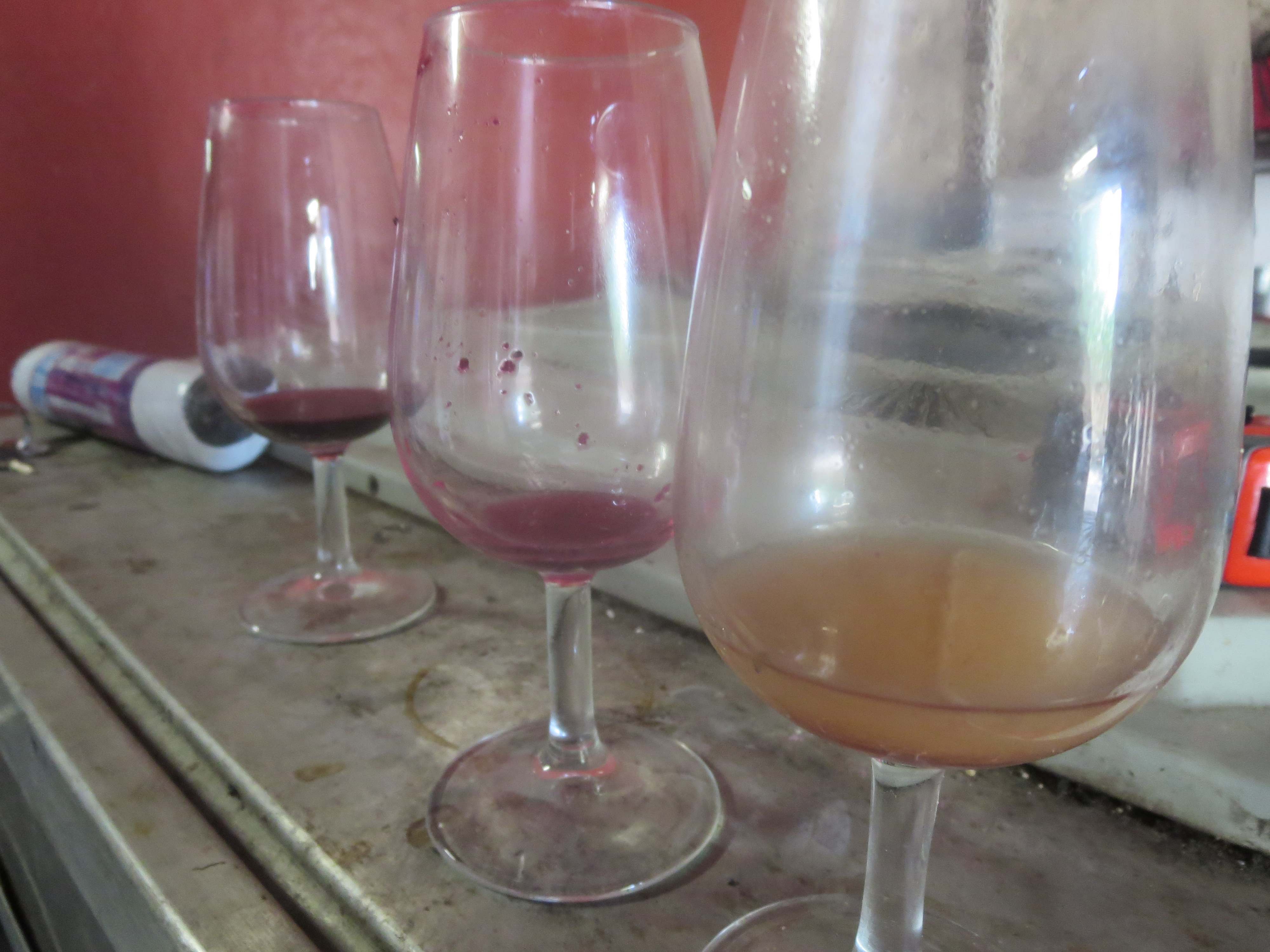
Now that (nearly) all the grapes are picked the vendanges enter a new chapter. The grapes, bunches and juices are all in tanks in various forms and in various tanks or cuves. Some wines were pressed immediately, e.g. most whites, and the rosé after just a few hours on their skins to extract the rosé colour. These wines now sit in their cuve and are fermenting gently, changing from grape juice to wine. The sugars are changing to alcohol and, naturally, the result tastes different. One of the most interesting things about the last fortnight has been to monitor the change in flavours from pure sweetness of fruit to a cleaner, drier, infant wine.
Some baby wines
The decisions which face vignerons such as Jeff now are about what to make of the wines. The reds could be made for aging with lots of tannins and colour extracted from the chapeau de marc, (the cap of grape skins, pips and, possibly, stalks) which is still in tank with the juice (also called the moût). Alternatively they might want a fruitier, more immediate wine and so the juice will be separated earlier from the marc.
Processes such as pigeage and remontage, which I have mentioned before, help to extract colour, tannin and flavour from the skins. The marc contains chemical compounds such as anthocyanins which are what gives red wine its colour. To keep all of the juice in contact with the marc these processes can be used.
Pigeage is where someone pushes the chapeau down, breaking it up into the juice by using tools such as a fork or even by using your feet. This can be dangerous, if you fall in there is a real risk of death due to the carbon dioxide being given off by fermentation. The chapeau does become incredibly tough and hard so it takes a real effort to carry out pigeage. I speak from experience.
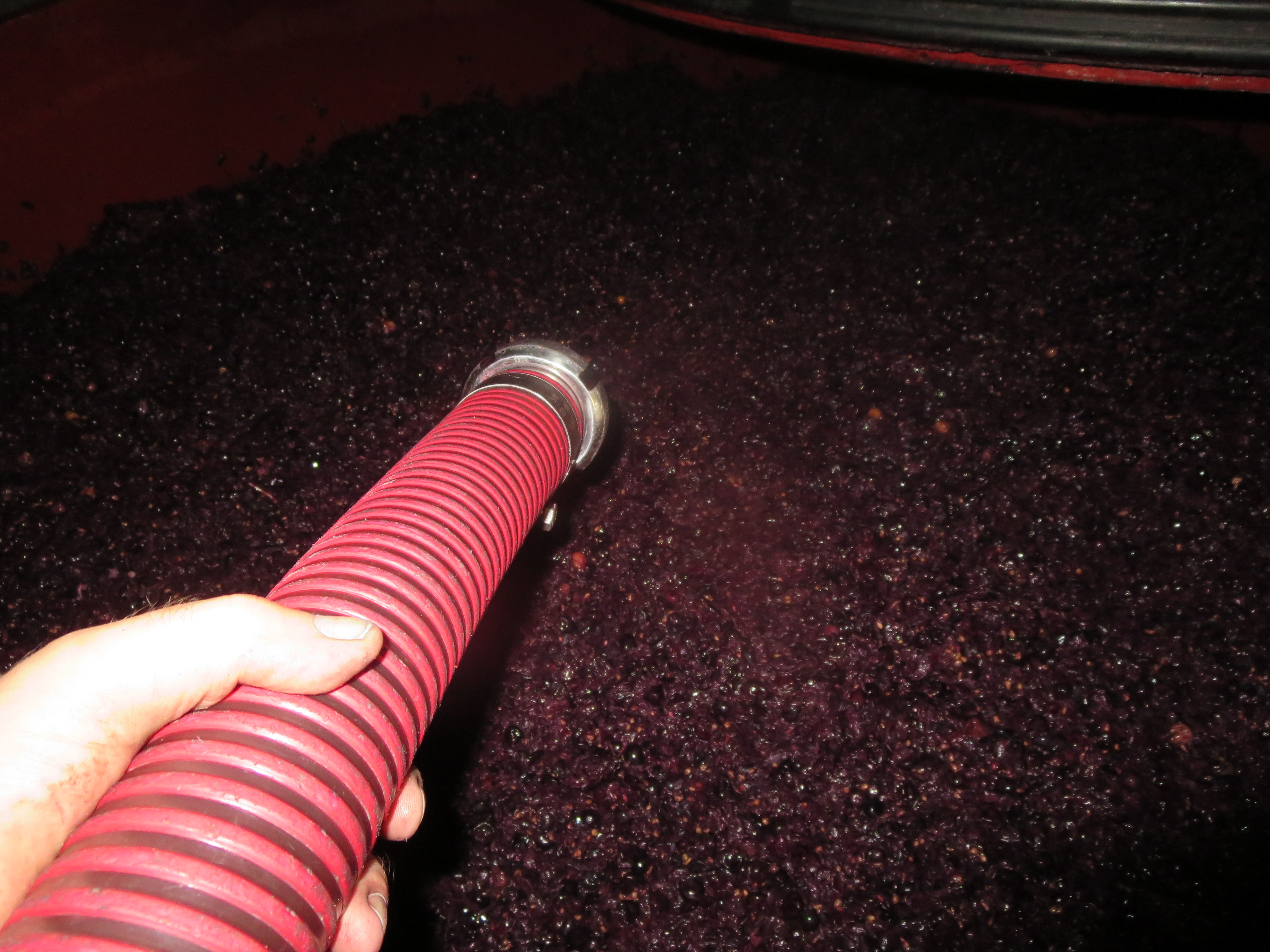
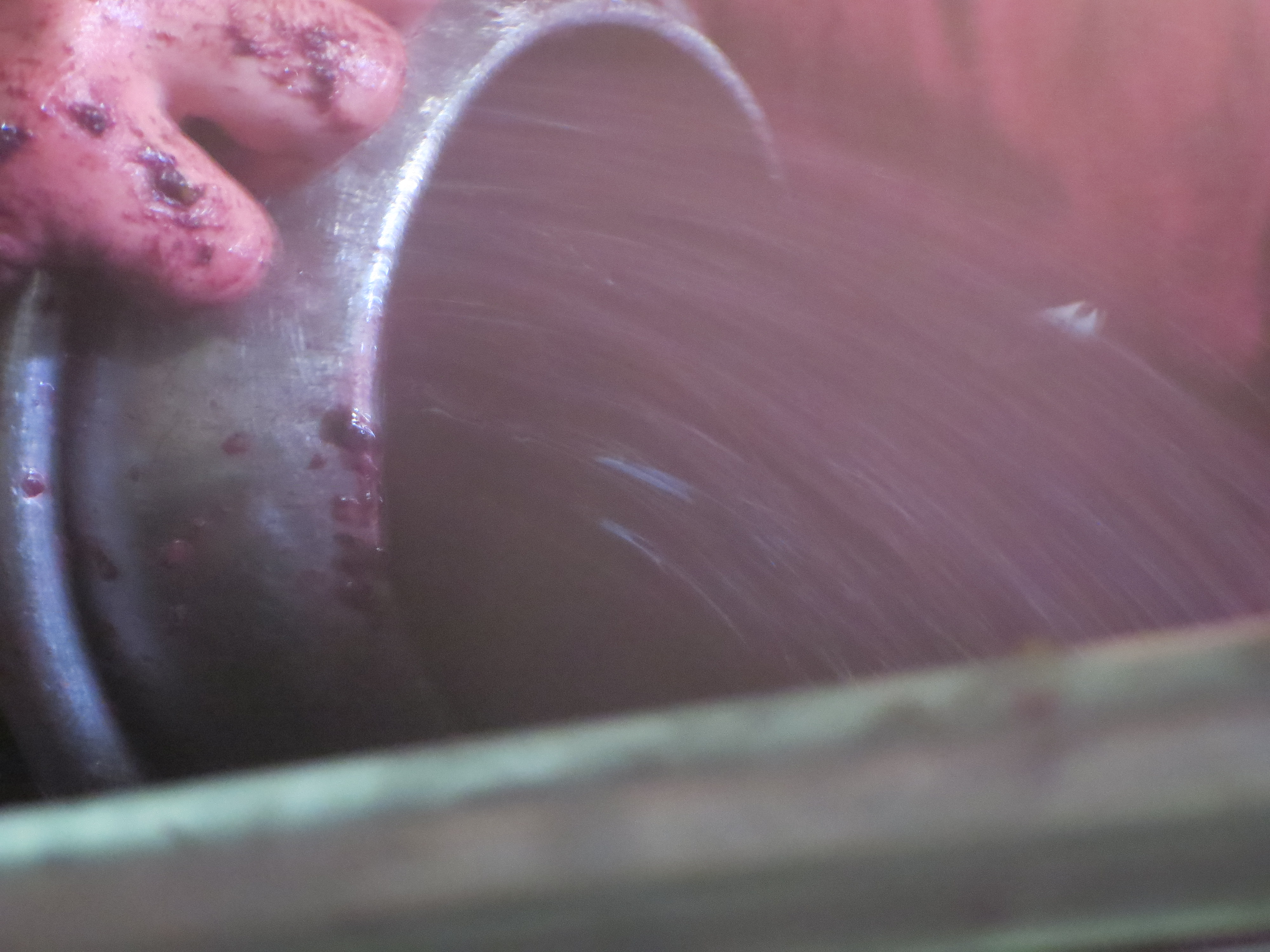
Remontage is the process of pumping the juice from the bottom of the cuve up and over the top of the chapeau, soaking it and allowing interaction between the chapeau and moût. Both processes also stop the chapeau from drying out on the top of the tank.
Me, doing a remontage of Flower Power
However, if you carry out these processes too often and too long you can end up with harder, more astringent wine. A decision has to be made about the style of wine you want. There is a third option, délestage, where the juice (moût) is pumped into a separate cuve and the chapeau settles in the original cuve. Its own weight causes some crushing and so when the moût is pumped back into the tank a couple of hours later it comes into contact with the pips etc from this crushing, having added extra weight to the chapeau when first pumped back into the cuve. This process can produce a lighter, fruitier wine with a little more body. Jeff has used this for just one tank of Syrah, he thinks it can be harsher on the grapes. Pigeage and remontage are the more usual methods at Mas Coutelou.
So, over the last week Jeff, Cameron and Michel have been very busy doing all of this work as Jeff decides which methods best suit the grapes which were harvested. The best fruit will stand more work but even that will suffer if overworked. As someone who wants the grapes to reveal their health and terroir Jeff would choose to do only what is necessary.
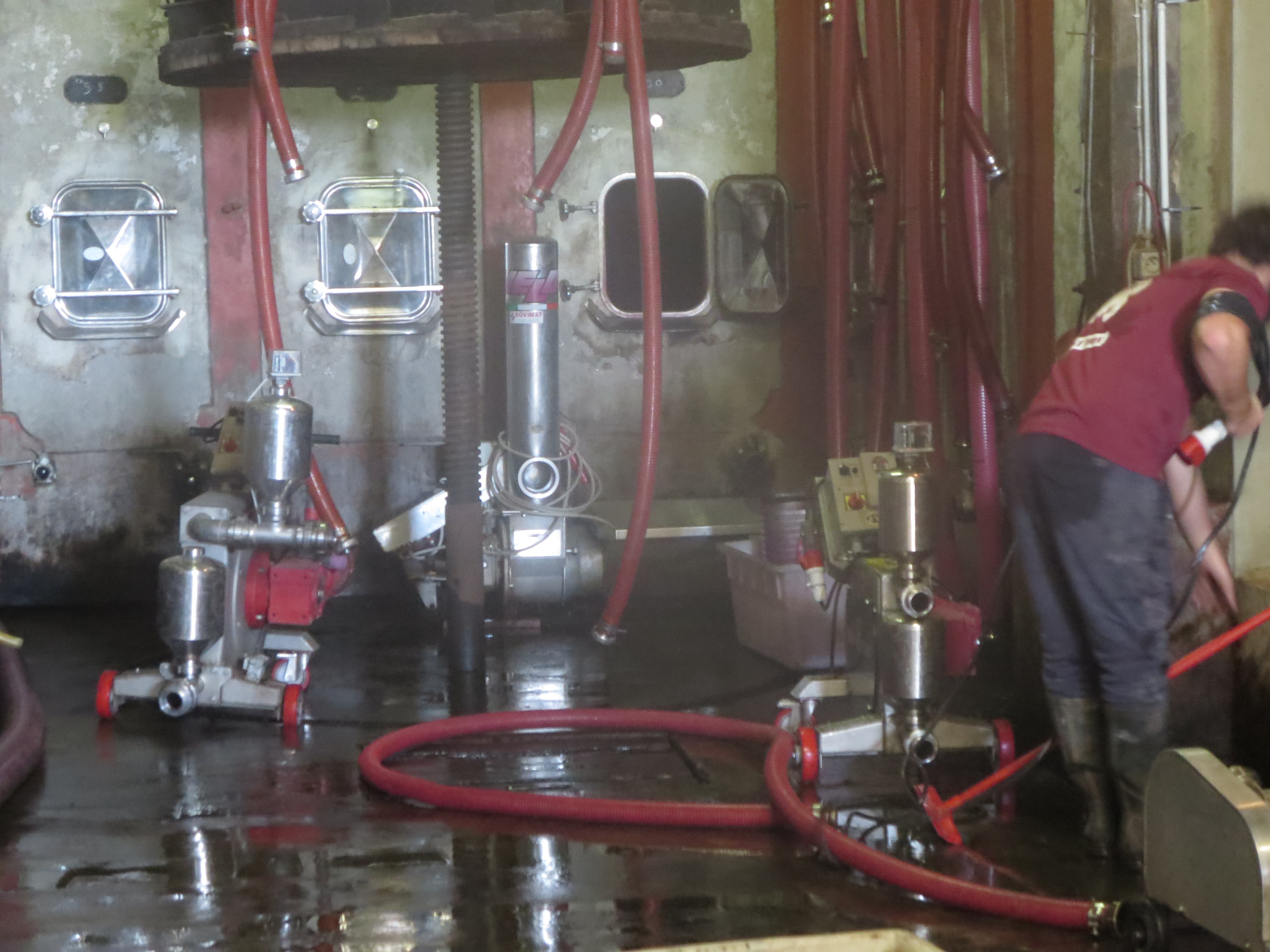
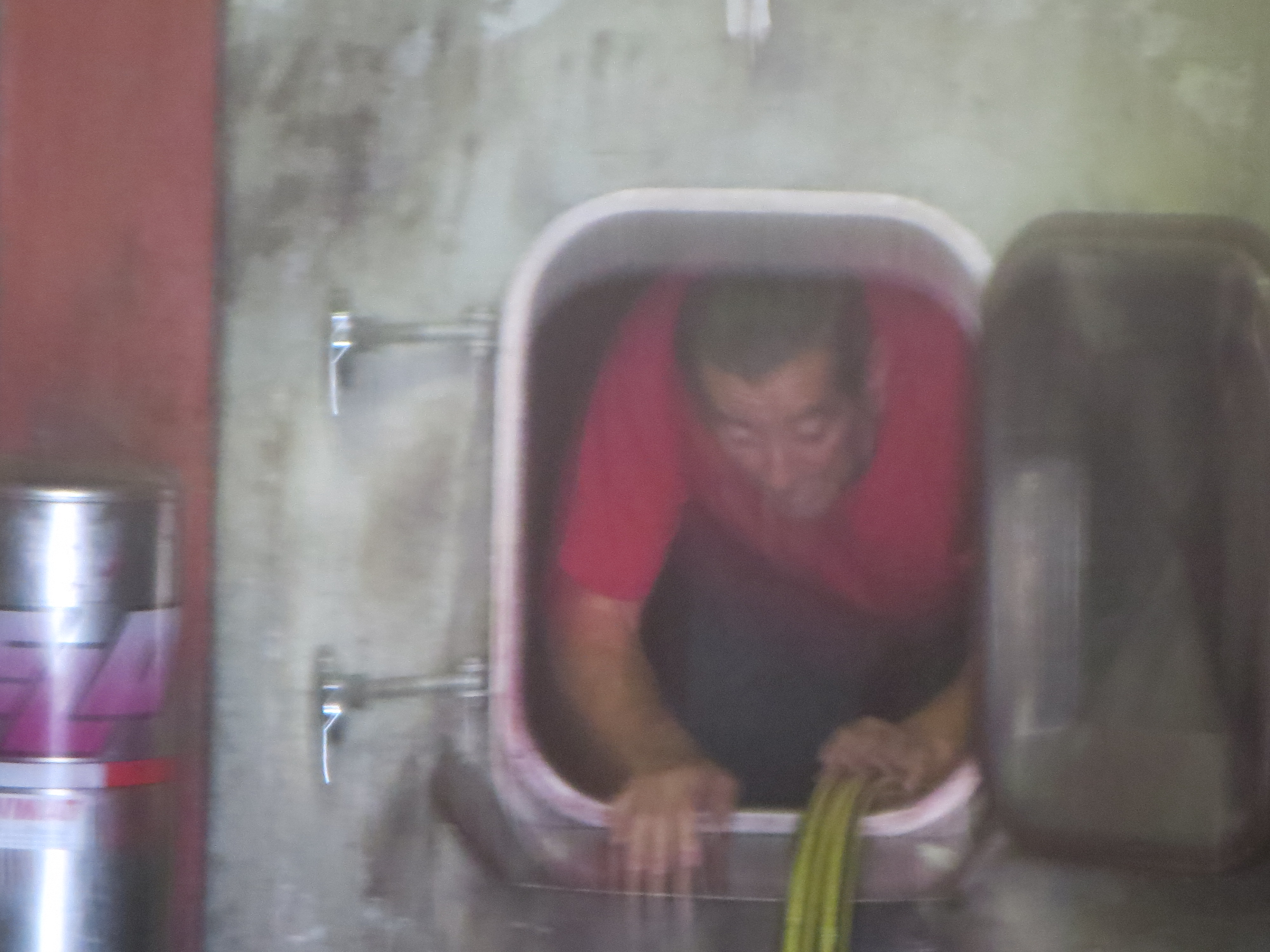
So, on Friday October 2nd the Grenache from Sainte Suzanne which were put into cuve as whole bunches (carbonic maceration) were pumped out and then pressed, a long day of hard work. Pumping juice, lifting out the marc by fork and shovel, pressing the marc, sending the juice to a new tank. This was one day of many, the same processes repeated many times and between each one … lots and lots of cleaning, to reduce any risk of contamination and spoilage.
The Mas Coutelou name continues to expand globally, visitors to the cellar on Friday came from Sweden and Canada. There have been others in recent weeks from the UK, Australia and other regions of France. Selling the wine which is being made is another aspect of the whole process.
Other work last week included sorting the solera cellar on Wednesday October 1st. Wines were moved and blended, barrels were emptied and filled – more complexity for Jeff to get his around. A vineyard visit also unveiled a few rows of Grenache in Saint Suzanne which had not been picked. The grapes are starting to shrivel and concentrate their juices, possibly to be blended with the Muscat of Rome vineyard which are now well on the way to being dried out.
These grapes now taste like raisins, sweet but with not much juice so the Grenache would give volume. Rain which fell on Saturday, 3rd might change this plan, we shall see.
Two updates.
The Grenaches of my 100th blog post are progressing well. The barrels were racked to take the wine off the lees and leave a clearer wine. The smaller barrel was more cloudy than the big barrel, possibly due to it being pressed earlier but everything is going well and they now continue their slow fermentation. The 27l bottle stands in the main cellar and the fermentation is still bubbling through the equipment given to me by my friend Barry when I left the UK.
I tasted the wines today (Monday 5th). The bigger barrel produced a fruitier light red wine with the sugars still obvious. The smaller barrel was a little darker, with more texture and drier. Fascinating to see them adopt different personalities at such a youthful stage.
The team from London Cru tweeted to say that the Cabernet Sauvignon which they took back to London is really starting to show well as you may see from this photograph of remontage.
Meanwhile back in Puimisson autumn is really starting to show in the colours of the vines, they are stunning at present. The partridge family were waiting for me as I visited Rome on Friday, hopefully they will survive the hunting season which is getting under way in France. The olives are also ripening in some of the groves, these were in Sainte Suzanne on Friday. Unfortunately the olive flies which damaged so much of the harvest across southern France last year have been causing damage again in other groves.
And one hungry member of the team can be relied upon to brighten up any day.
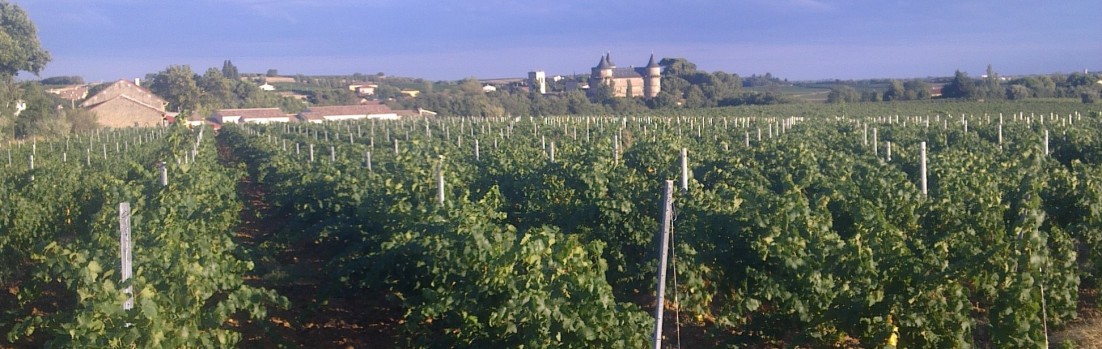
The traditional image of a vineyard is that of one big parcel of vines surrounding a chateau as in Bordeaux, with its smart house and cellar buildings for making and storing wine. However, that is not the reality for most vineyard owners. Jeff Coutelou has his home and his cellars in the centre of Puimisson in the Hérault, surrounded by a childrens’ nursery, houses and work buildings. The vineyard itself surrounds the village but comes in a number of small parcels rather than one big vineyard. Each brings its own characteristics in terms of soil, surroundings and exposure to the elements, ie its own terroir. The parcels have been accumulated over the years by Jeff’s grandfather, father and himself. In the satellite photograph below you will see the parcels and how they relate to the village. Vineyards are shown in green, olive groves in red.
(Photo taken from Rapport Biodiversité d’Exploitation Mas Coutelou produced by Agrifaune)
There are about 17.5 hectares (43 acres) of land though olive trees occupy about 2.5ha (6.7 acres) and well over 1 ha (3 acres) is fallow land or has other trees, hedges and plants. The soil is virtually all clay and limestone. As you may be able to see in the satellite photograph much of the land to the south of Puimisson is vineyard, to the point of monoculture. Jeff wants to use his land to produce biodiversity so olives, figs, roses and hedges help to create little oases of wildlife. More details are outlined at the end of this post.
Segrairals and Caraillet (6.8ha, 5.7 under vines)
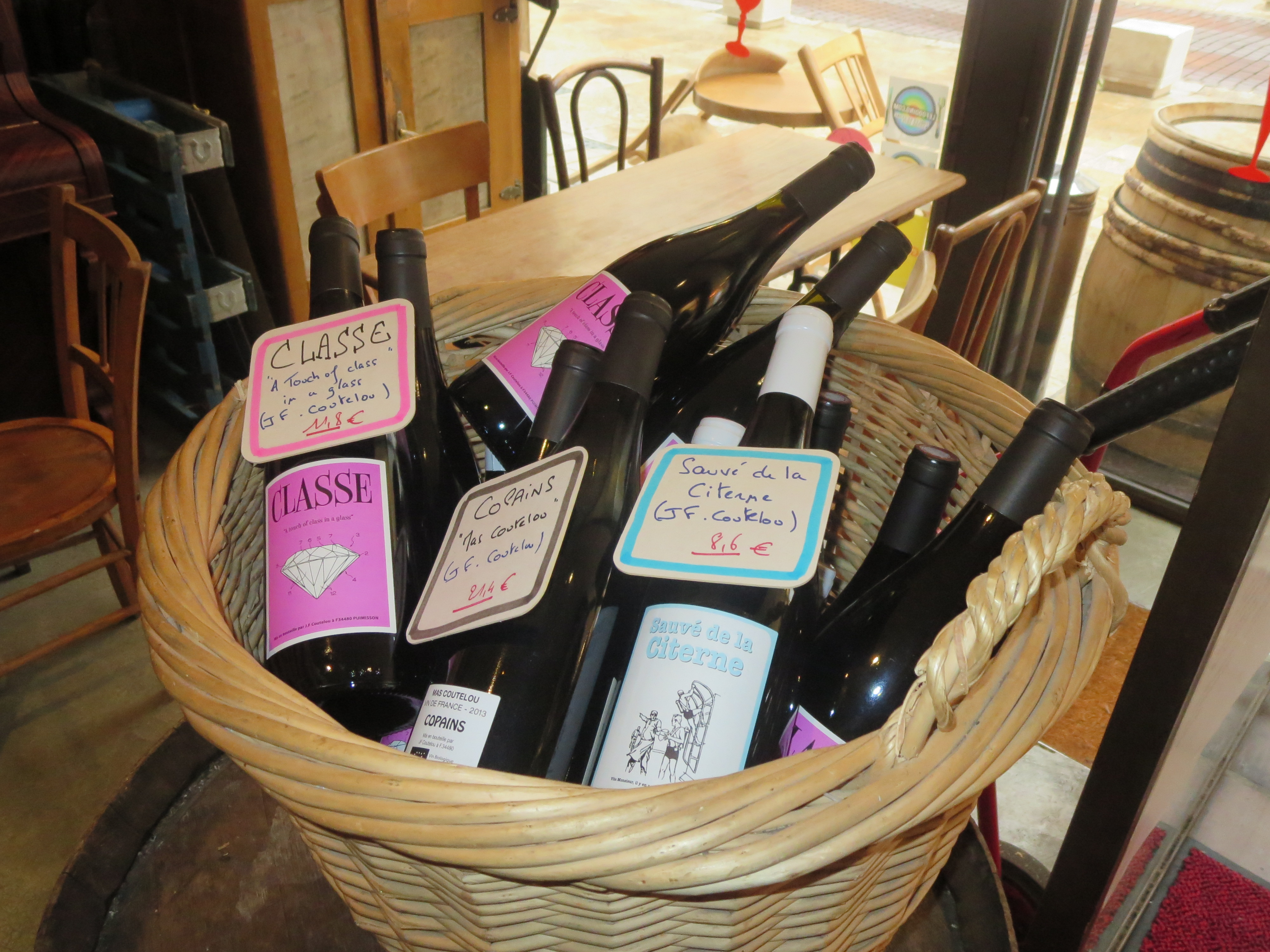
This is the biggest of the parcels and the only one situated to the north of the village and closest to it. Surrounded by the village and a couple of roads it is well protected by trees and hedges, including figs and olives. A variety of grapes are planted with the oldest being some Syrah planted in 1993, Cabernet Sauvignon planted 1998 and younger plantings of Mourvedre, Syrah and especially Cinsault. The Syrah goes into bottles such as Classe and 7, Rue De La Pompe. Mourvedre goes into Sauvé De La Citerne and the Cinsault into 5SO. The Cabernet grapes will be used for blending in various cuvées or sold to the UK to make the new London Cru Cabernet Sauvignon, a project run by Roberson in London.
Main body of Syrah and Cabernet grapes
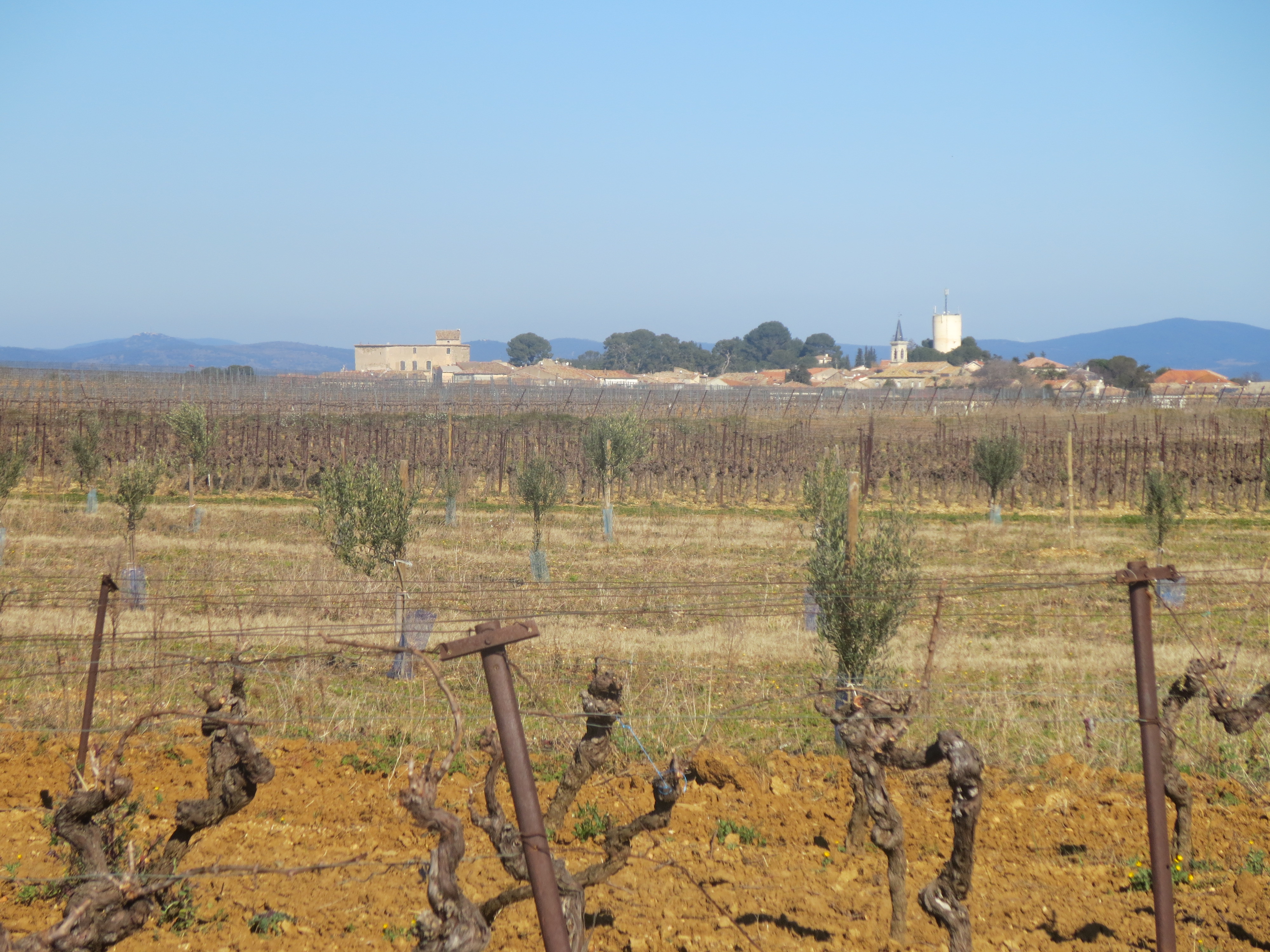
Planted olive trees in the foreground with some younger Cinsault and Syrah vines in the background
La Prairie (0.5ha)
To the west of Puimisson La Prairie is an olive grove in a very pleasant area with an official ecology walk going past it. No vineyard planted.
Mountains seen from La Prairie
Prairie olive plantation
Le Colombié (0.6ha)
Just at the southern tip of the village Le Colombié is planted entirely with Merlot vines. These will produce grapes used to blend for cuvées prepared for restaurants, bag in box etc. Merlot is not a typical Languedoc variety, these were planted in 1999.
Le Colombié – Merlot vines
Rome (0.7ha)
Possibly my personal favourite vineyard of them all. It is quite isolated even though there are other vineyards around. Isolated, because there is a wood which shelters it. The gobelet Cinsault vines date back to 1966 and 1975 and go into the Copains or,in some years, Vin Des Amis or Classe. These old vines are also surrounded with young olive trees and the parcel is an attractive and quiet haven. There is also a planting of some 20 different varieties of grapes including various types of Muscat which are used in a solera system. This was started many years ago by Jeff’s grandfather and ever since wines have been used to top up the old barrels to make Vieux Grenache and Vieux Muscat. Sensational wines. The added benefit is that because there are so many different types of vine they cross pollinate and this adds an extra layer of complexity to the Cinsault in the Rome vineyard.
All vines lead to Rome
Gobelet Cinsault vines, olive trees and the surrounding woods
Metaierie (2.3ha)
The parcel which was the basis of my post One Day Like This when we harvested the last grapes of 2014, some Grenache. There are a few older Merlot vines (to be replaced in 2015) but the parcel is mainly the home of Grenache and Syrah grapes which are used to make the ever popular Vin Des Amis.
Smaller Metaierie parcel
Main Metaierie vineyard, home of Vin Des Amis
La Garrigue (1.8ha)
Described in some detail in the post Working In The Vineyards (January). Made up of three sections: some younger Syrah facing north for freshness, a section of Grenache facing south, as it likes the heat and some 20 year old Sauvignon Blanc vines too. The Sauvignon is used to make the white blend PM or other white cuvées, the Syrah goes into my favourite La Vigne Haute and the Grenache is used to make Classe along with the Syrah from Segrairals.
Grenache
Sauvignon Blanc
La Grangette (0.5ha)
A parcel of half a hectare (just over an acre) surrounded by vines, Jeff decided that it is compromised in terms of quality grapes so he planted 112 olive trees in 2011 to provide contrast to the fairly barren land and vines surrounding Grangette.
Rec D’Oulette (1ha plus a smaller, separate parcel of 0.3ha)
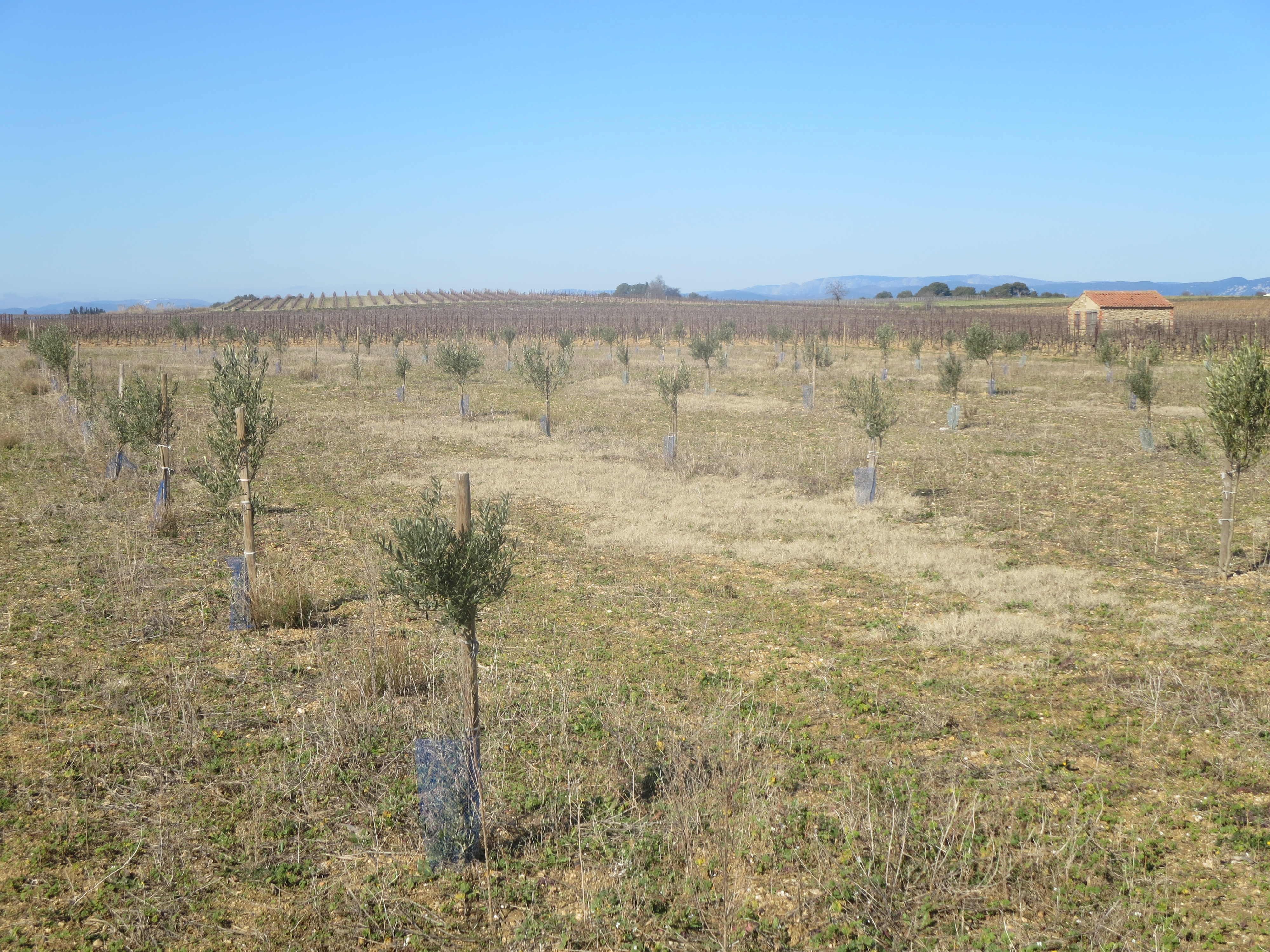
Actually made up of two parcels of land. This has seen a lot of work in recent years as Jeff has tried to diversify it. The central block is half a hectare of 30 year old Carignan, used in making Flambadou, a wine which is really improving and was one of the stars of 2013. Surrounding these vines Jeff has planted half a hectare of olive trees to keep them away from the chemicals of neighbouring vineyards. The second part of Rec resembles Grangette as an isolated small parcel and again Jeff has planted olive trees to diversify as it is too small and isolated in its organic nature for grapes.
Carignan vines for Flambadou
Font D’Oulette (0.65ha)
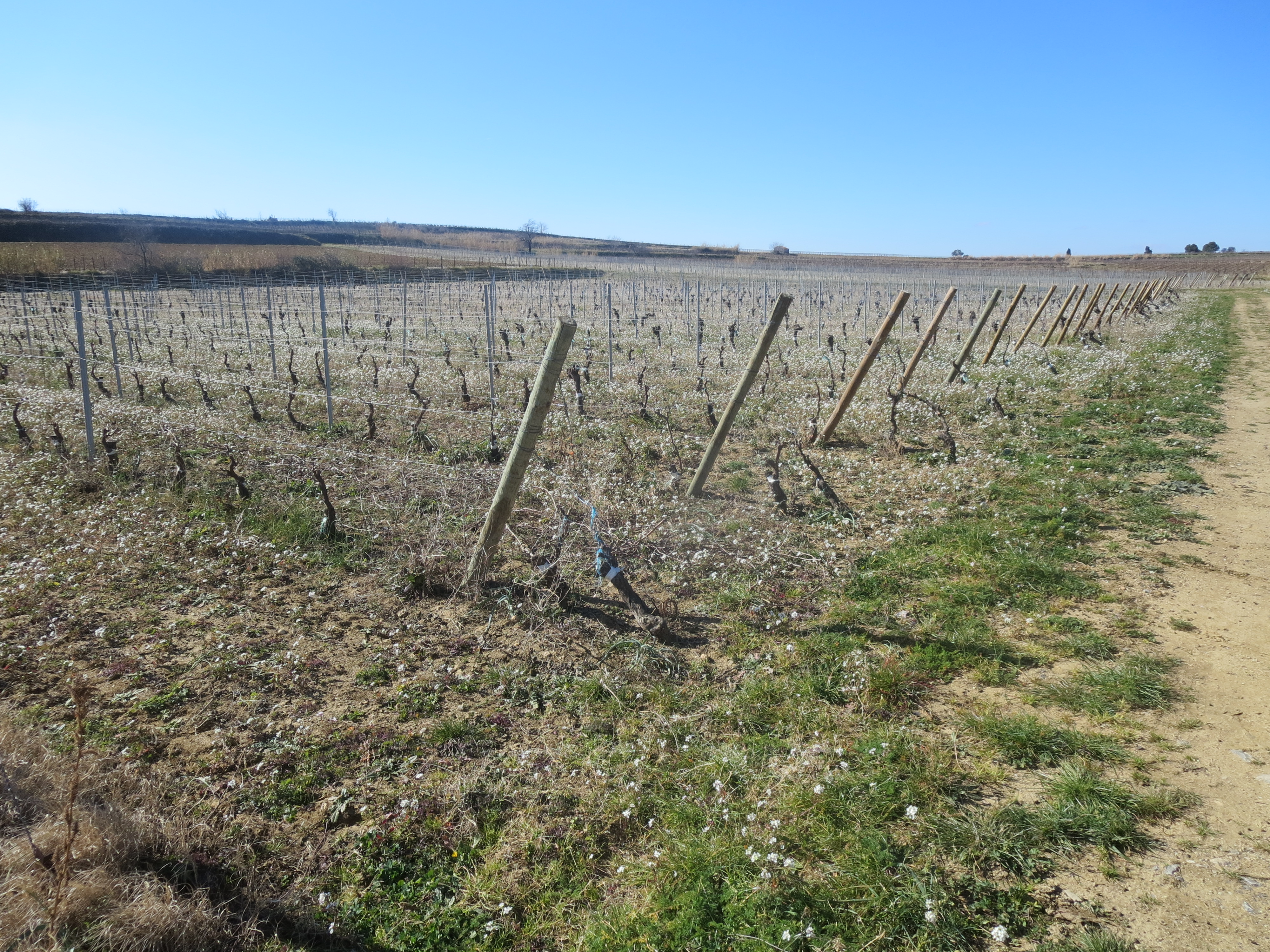
A parcel where Jeff has worked hard in recent years. More olive trees planted in 2011 as were those in the small section of Rec. In addition he has grafted an older variety Aramon into the vineyard covering over half a hectare. These grapes will be used to create new cuvées and the first blend of grapes produced in 2014 is highly promising tasted from tank.
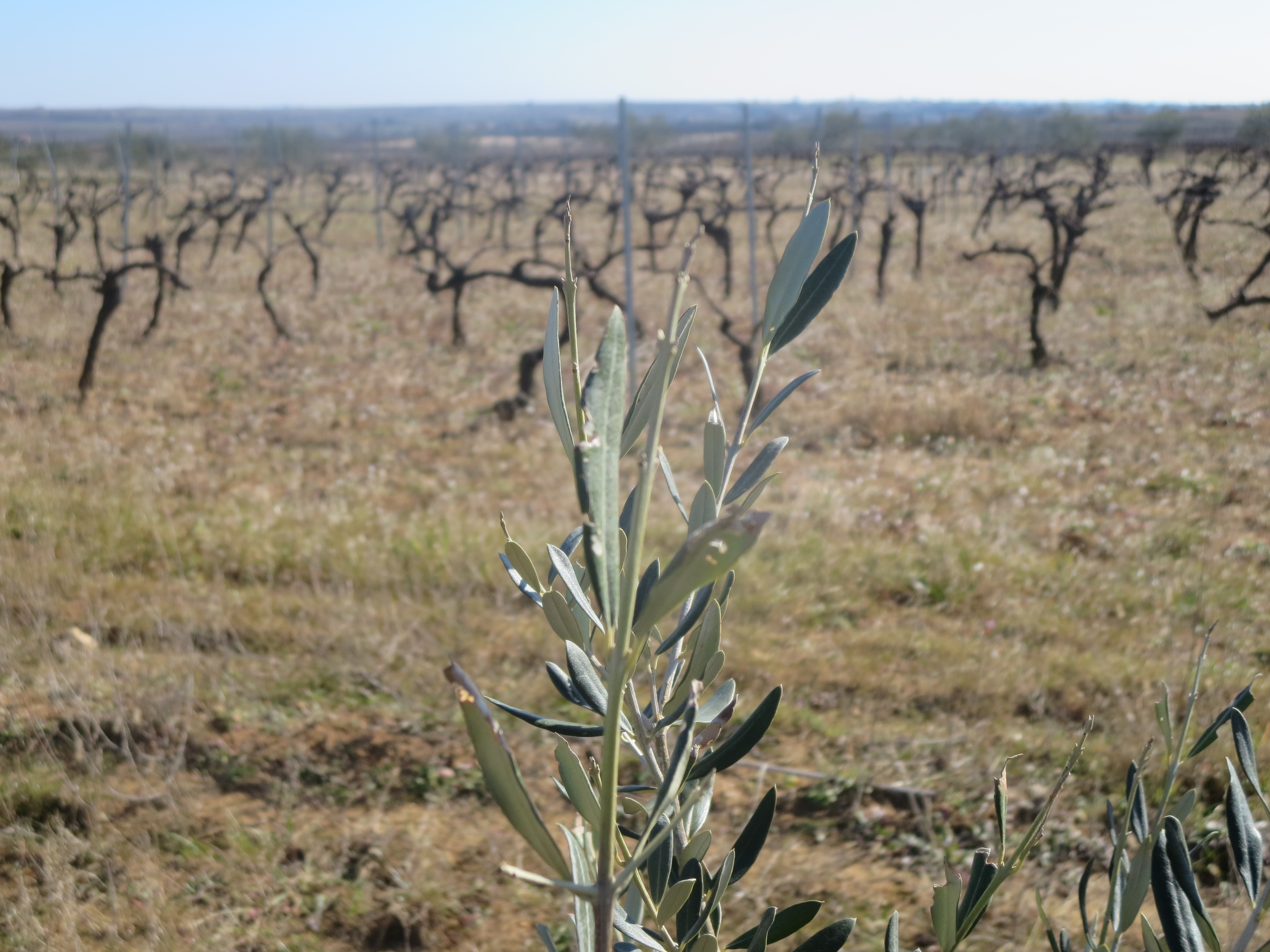
Olive trees to protect the new Aramon vines
Aramon vines
Les Roques (1ha, not on satellite photo)
One hectare of land to the south east of the village heading into Lieuran-les-Béziers, this was the vineyard I showed after the storms of November 28th 2014 when it was flooded. In fact the vines have been grubbed up and there is a programme in place to plant trees and to provide a barrier to the Libron river in case it should flood gain.
Les Roques shortly after the November storms
Peilhan (2.2ha)
An attractive vineyard nicely protected. About a hectare is planted with white grape varieties, including a section of Carignan Blanc which has been used to make a cuvée all on its own. Maccabeu, Grenache Gris and different types of Muscat make up the other white varieties and these are usually picked, assembled and vinified together as part of the PM white blend. This also the home of the Castets vines I have written about a lot, one of only two Castets vineyards in France. More Carignan vines are joined by another interesting grape variety, Clairette Musquée which was blended with the Aramon from Font D’Oulette last year. This is the vineyard where a recent plantation took place to bring back older varieties to the area. Terret Blanc, Riveyrenc Gris and Piquepoul Gris were planted along with Terret Noir, Morastel and Riveyrenc Noir. picked, assembled and vinified together as part of the PM white blend. This also the home of the Castets vines I have written about a lot, one of only two Castets vineyards in France. More Carignan vines are joined by another interesting grape variety, Clairette Musquée which was blended with the Aramon from Font D’Oulette last year. This is the vineyard where a recent plantation took place to bring back older varieties to the area. Terret Blanc, Riveyrenc Gris and Piquepoul Gris were planted along with Terret Noir, Morastel and Riveyrenc Noir.
Main parcel with white vines, Castets, Carignan and Clairette Musquée
Planting the new parcel of Peilhan
The domaine
Overall Syrah is the predominant grape variety making up around one third of production, although 2014 saw a big reduction in the harvest due to the dry spring and early summer. Red grapes dominate with well over 90% of production.
Jeff and his Castets
(L-R) Vin Des Amis, 7 Rue De La Pompe, Paf
Organic since 1987, no synthetic chemical products have been used on the soils for over 25 years now. No artificial yeasts are added in the winemaking process, the grapes produce healthy yeasts themselves to stimulate fermentation. Grapes also naturally produce tiny quantities of sulphites but Jeff has been experimenting with using no added sulphur since 2003 and has successfully completed the last three harvests without adding any sulphur to the wines. This dedication to producing wines which are as natural as possible, made with as little intervention as possible means that Jeff is restless in seeking to improve the quality of his soils and in protecting them from the non-organic practices of neighbouring vineyards. He has also brought in Agrifaune to put together a project to plant over I kilometre of hedges. These will help to prevent soil erosion, protect Coutelou vines from surrounding vineyards and also provide shelter to wildlife which in turn will help to protect the vines, for example by eating damaging insects. Trees such as oak, laurel and elder are being planted along with plants such as agrypis and wild rose. Around the vineyards wider borders of grasses and wild plants are being allowed to grow even if that means that vines have to be scrubbed up. Similarly ditches and fallow land will be used to encourage biodiversity. So in an area of monoculture these oases of biodiversity and wildlife will help to enrich nature, the vineyards and, ultimately, the wines.
In my last blog entry I wrote about the planting of a new vineyard with a range of old varieties of vine. The parcel of land is part of the Peilhan vineyard and sad to say it is under threat together with the vineyard (Rec D’Oulette) which provides the Carignan grapes for the Flambadou cuvée, one of the most highly rated bottles of Mas Coutelou.
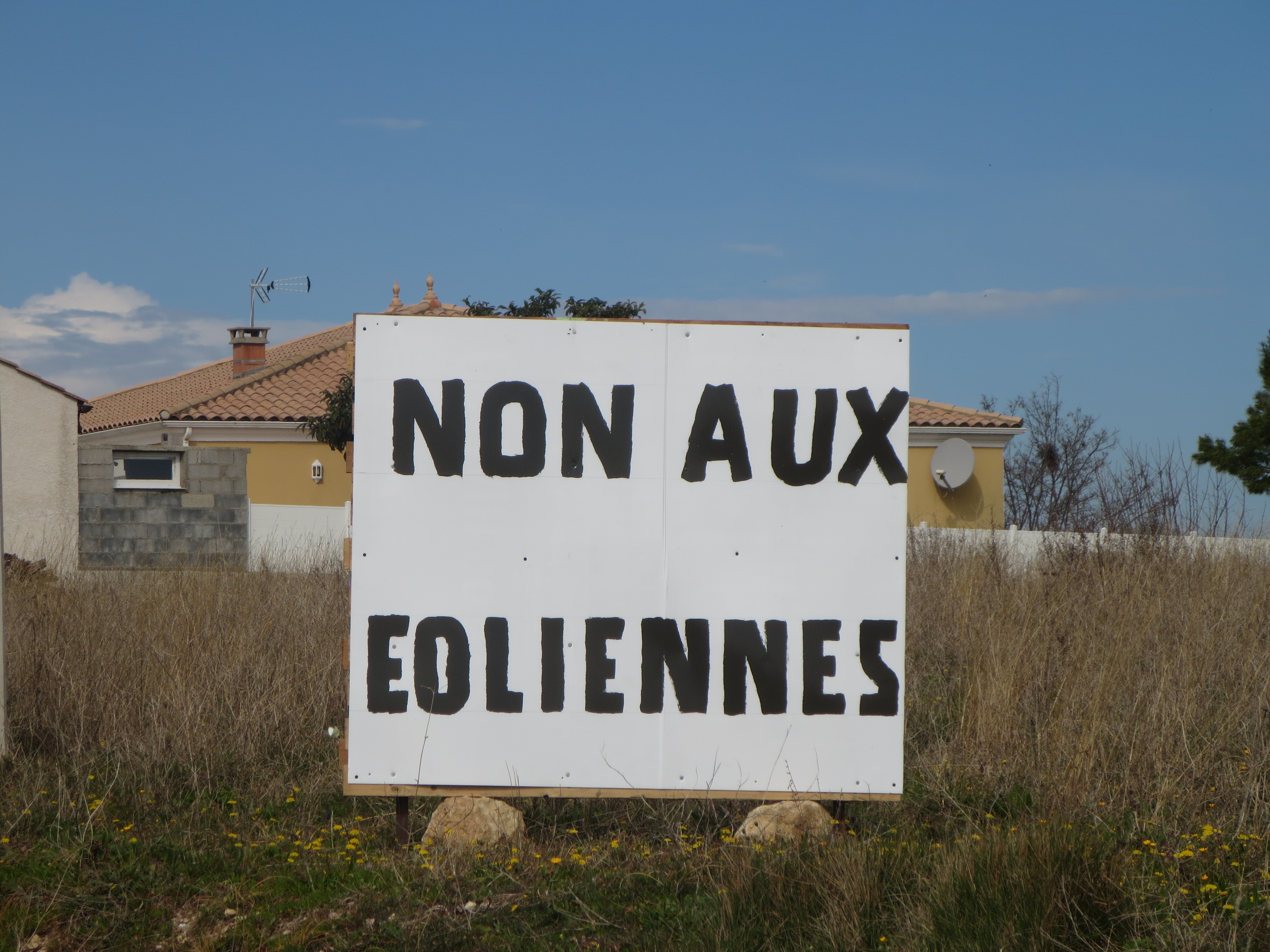
The threat comes from a plan by the company Quadran to plant 6 or 7 wind turbines on the plain behind the commune of Corneilhan. Ironically the village of Corneilhan will profit from the plan but is on the other side of a small hill from where the turbines will be situated, therefore the impact upon Corneilhan will be minimal unlike that upon neighbouring villages such as Pailhes and Puimisson whose residents will have to look at the turbines every day. Planning restrictions means that the turbines would have to be built on a stretch of land running across the area where Peilhan and RecD’Oulette are to be found.
Some neighbouring viticulteurs might be tempted to have a turbine on their land as they will receive a payment of 3000€ per megawatt per year created as compensation for not being able to produce wine from their vineyard. Jeff, and others, will not do so but the turbines will have a significant effect on the climate and terroir of his vineyards, if the project comes to fruition. Air turbulence, noise and the movement of the turbines will clearly alter growing conditions such as temperature and humidity but there are other consequences. Jeff has been working to provide biodiversity in the form of hedges, trees and plant life which shelter birds, bats and insects that provide a means of controlling vine pests such as ver de grappe and wasps. This helps to prevent the use of chemical pesticides and thus helps the environment. The presence of these ‘environmentally friendly’ turbines will undoubtedly upset the healthy ecosystem provided by these birds, bats and insects.
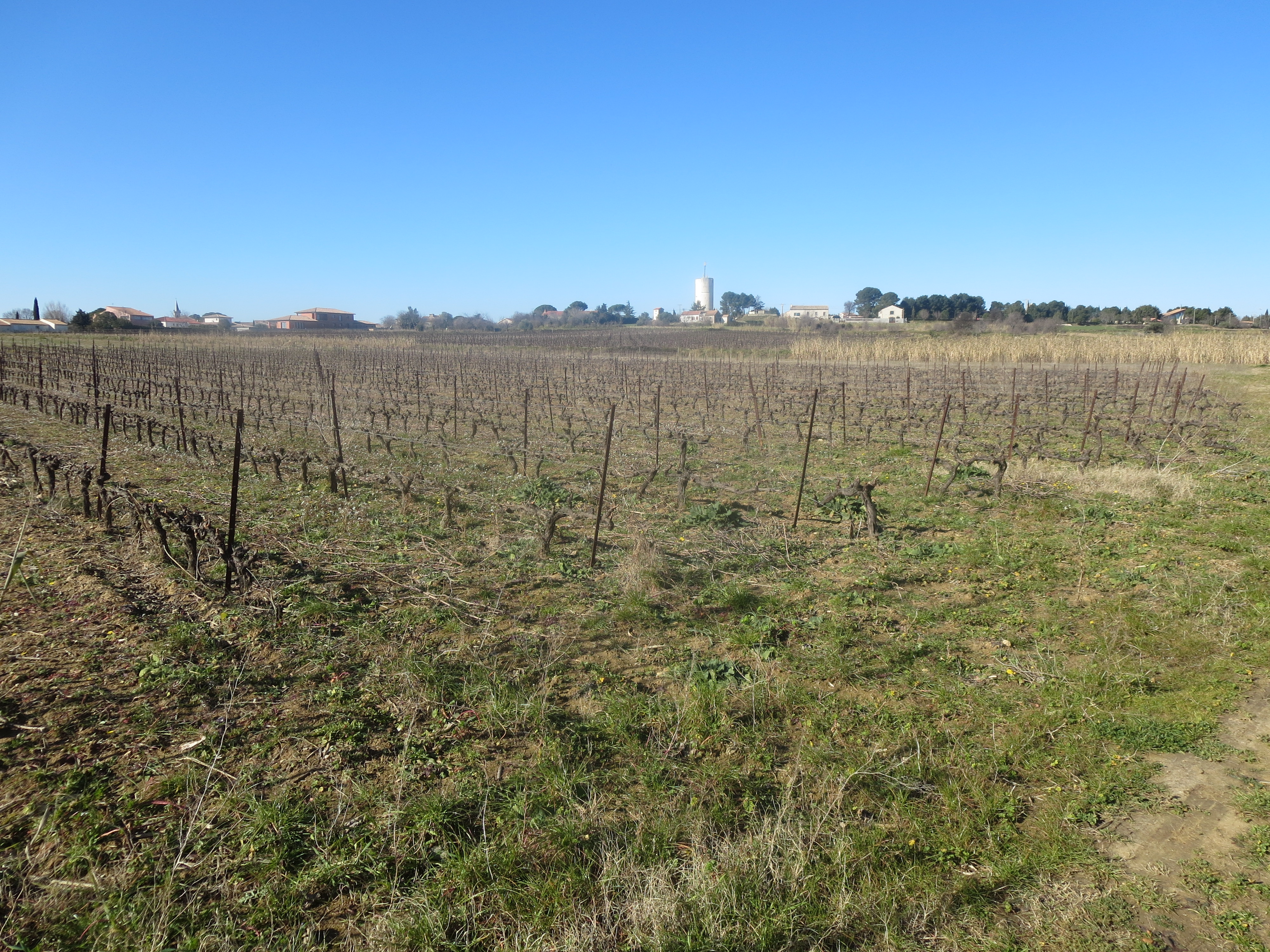
Puimisson from Peilhan, how much would wind turbines dominate this landscape!!
Trees and plants border the vineyard
Olive trees in Rec D’Oulette
However, Jeff’s main concern is simply for the visual and auditory impact upon the area as a whole rather than just his personal loss. The area will be completely changed by the project and it does seem strange that they would build wind farms on agriculturally useful land rather than unproductive land elsewhere. It is ironic that so called green energy threatens the local environment. Without mentioning the threat to tourism which is economically important in the area.
In any case the best renewable energy is the one you don’t consume!
To show support for the people of the area as well as the vineyards you can sign this epetition now. I shall, of course, update with further news.
It has been a stormy week in the Languedoc and the weather has certainly disrupted the plans of vignerons in the region. Tragically five people were killed in a flood in Lamalou Les Bains and that event puts winemaking into perspective. However, the fortunes of wine growers and makers have also been hit by such extreme weather. Driving past Pézenas up the A75 on Thursday swathes of vineyards were under water on the low lying plains. The humidity also means that where grapes are left to pick there is a real risk of disease and even rot. I was talking to the excellent winemaker Emmanuel Pageot this morning as we visited Gabian for the jour patrimoine and he was explaining how complicated such problems have made the harvest. I was invited to join Emmanuel for a tasting soon and I will definitely report here on his latest wines. They are amongst my favourite wines of the region but I shall try to be objective.
In Margon Wednesday saw thunder and lightning and sheets of rain non stop through the day. Yet, in Puimisson, where Jeff lives and has his vineyards there was only a small rainfall, a reflection of the dry year there which has caused the smaller harvest. Normally Jeff would harvest 200-250 hectolitres from his 4 hectares of Syrah grapes, this year that production is down to 145 hectolitres. This means less wine, of course, and also a lot more thinking on his feet as smaller quantities mean that he has to decide which of his wines he uses the grapes for. Therefore it seems unlikely that there will a cuvée of 7, Rue De la Pompe this year as the grapes are needed for other cuvées. The quality of grapes is high though, for example the Syrah which is going into the Paf cuvée is concentrated and finer, partly due to a miserly production of only 25 hl per hectare.
(l-r) Vin Des Amis, 7 Rue De La Pompe, Paf
Other grapes have been small in size and so because there is a lot of skin and pips compared to juice the wine needs to be blended with other fuller grapes. Jeff is also thinking of introducing new cuvées to use what he has. Cinsault, for example, has done well this year so offers new possibilities and there is also the possibility of producing a cuvée which Jeff’s father used to make. I will write more about that as the year develops and decisions are finalised.
As picking was on hold at some points due to the weather Tuesday lunch was more leisurely and Jeff had more time to relax and talk. He recounted a French fairy story The Chaud Doudou. Basically it is about sharing and how everyone feels better for having done so.
Jeff went on to share an Occitan proverb which translated means “What you give flourishes, what you keep to yourself perishes” and I think this sums up Jeff Coutelou’s wines, he shares his skills and his passion for the land and for nature. The title of this post are the words he uses to describe his winemaking philosophy; grapes, work and love. To produce such high quality wines he needs the best grapes, he works tirelessly and he instills endless love into the wines he produces. If you think that sounds far fetched then try some, he is telling the truth.






























 amarchinthevines