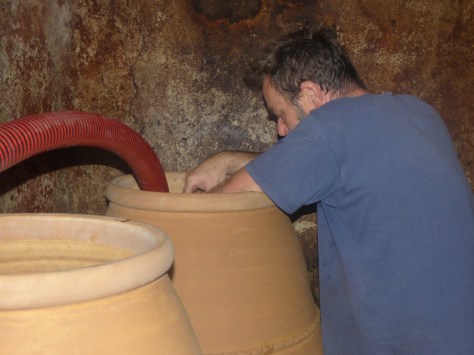
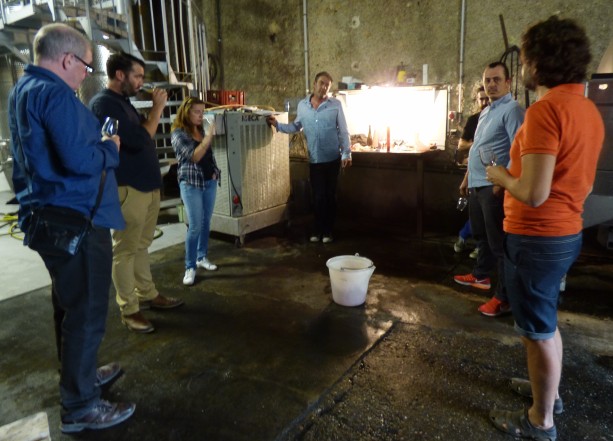
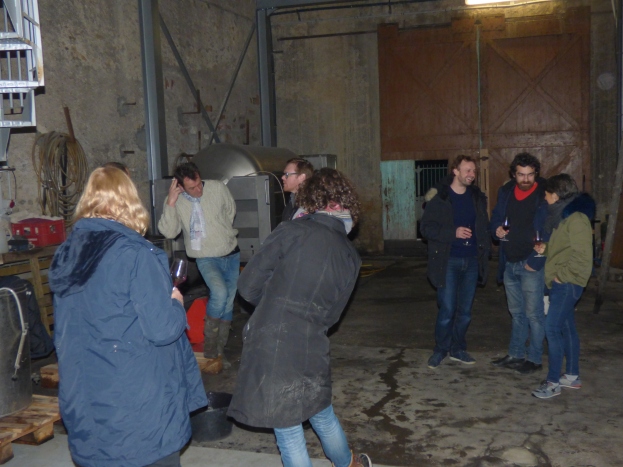
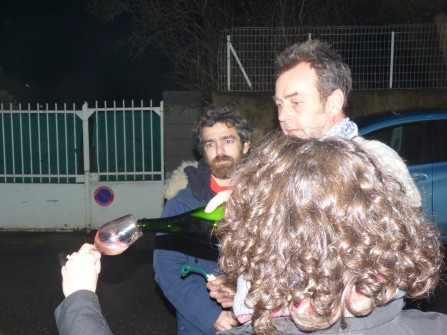
A morning in the cellars, a good chance to catch up with not just Jeff but Michel and Julien who I hadn’t seen since last October. The gathering was to do the assemblage of L’Oublié the cuvée made up not just of different grape varieties but different vintages of those grapes. Old Carignan and Grenache from ‘forgotten’ barrels includes years such as 2001, 2007 and 2010. Added to these are younger wines such as Syrah from 2014 and 2015, Copains 2013 and some 2017 Grenache amongst others. There is even some of the grapes often used to make La Vigne Haute, my favourite wine of all.
As always with work in the Coutelou cellar the priority is cleanliness, the safeguard which ensures that no added sulphites are added to the wines. Everything is cleaned thoroughly before use and after use, every time a piece of equipment is needed. It adds to the work load but it is vital for the wines to be pure.
The wines were then taken from the various barrels and tanks to one of the large fibre glass tanks to spend time blending and harmonising before it will be bottled at some point in the future. The resultant blend was excellent. I had coincidentally opened a bottle of the last blend of this cuvée just two days before and it was on fine form so this one has a lot to live up to. First impressions are that it will do just that, a new star is born!
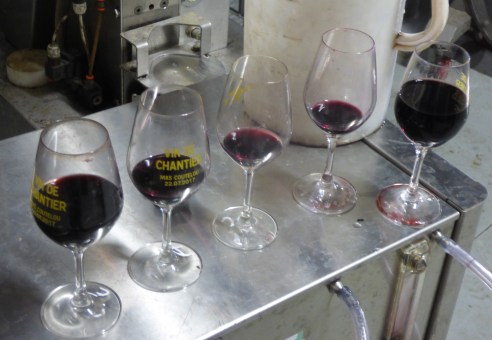
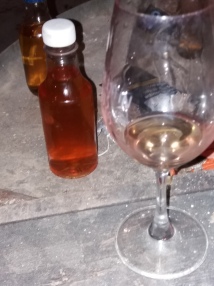
Component wines to make L’Oublié
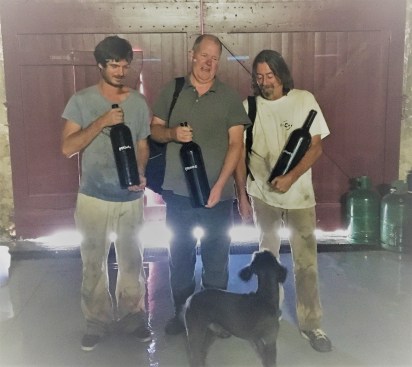
Then more moving around of different wines to free up some of the tanks which will be needed for the 2018 vintage. Checks were made on all the wines in the cellar including the new amphorae. This is the second wine to be matured in them, the first having been bottled already. I tasted some of that first amphora wine and it was very impressive, a real stand out. Jeff kindly gave the three of us a jereboam of that first wine and it will be a very special occasion when it is opened. Offers for an invitation are welcome!
After the final clean up and a couple more tastings the morning’s work was completed, yes work – honestly. The team was back together, the wines are together. All is well.
After eight months away from Puimisson and the Coutelou vines it was definitely a case of being very happy to return. As I stood in Rome vineyard there was the chorus of birdsong, hum of insects, flash of colour from butterflies and flowers. A resounding reminder of why this is one of my favourite places on Earth, capable of making me joyful just by being there.
Rome
In Font D’Oulette (Flower Power), the vines are maturing well, many now sturdy and thriving in their gobelet freedom. The change from when we grafted some of them just two years ago is dramatic, perhaps more to me as I haven’t seen them since last October.
Grafted vine 2016, same vine now
In Peilhan and Rec D’Oulette (Flambadou’s Carignan) the roses were still just in bloom at the end of the rows but starting to wilt under the hot sun.
Carignan left and top right, Peilhan bottom right
And there lies the rub. The hot sun has really only been out in the region for the last week, it has been a catastrophic Spring. Rain has fallen dramatically, almost three times the usual level from March onwards after a wetter winter than usual. The annual rainfall average has been surpassed just halfway through the year. Moreover the rain was not in sudden bursts but steady, regular, in most afternoons. Vineyards all over the region are sodden, tractors and machines unable to fight their way through the mud making vineyard work difficult if not impossible. Even after a week of sun if I press down onto the soil I can feel the dampness on the topsoil.
Mix damp and warmth around plants and there is a sadly inevitable result, mildew.
Look again at the photo of Peilhan, zoom in on the wines at the bottom,
there are the tell tale brown spots.
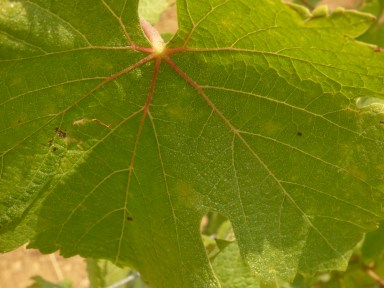
This downy mildew lives as spores in the soil and the rain splashes them up onto the vines. Jeff had warned me of the damage which I described from afar in my last post. Seeing the tell tale signs of brown spots on the upper leaves on such a scale across vineyards all over the Languedoc is another matter though. All those vines touched will yield nothing (though some will still put them into production, so be confident of your producer). I have heard that some producers have effectively lost most of their vines for this year and similar stories from right across the region. Grenache seems particularly susceptible to mildew and it has been devastated at Jeff’s, the Maccabeu too.
Meanwhile Jeff has been struggling against nature, not a normal situation. He has sprayed all kinds of organic products from seaweed, nettles, essential oils such as orange and lavender, horsetail, clay. He has used the two natural elements permitted under organic rules, copper and sulphur. Jeff is particularly reluctant to use copper but such is the battle this year that it was necessary. Unfortunately like Sisyphus the task is uphill. He sprays, it rains and the effects of the spray are greatly lessened by washing it off the vines, so he has to start again. At least this week that is no longer the case and Jeff has been working all hours to save what he can, to roll that rock uphill once more. He is discouraged, even heartbroken to see the state of some of the vines he tends and cares for so much.
Dare I mention that now is the time when oidium, powdery mildew makes itself known? Please, not this year.
So, production will be down enormously this year, we hold out best hope for Syrah, Mourvèdre, Carignan Noir. Lower production means lower income too, so expect price rises and please do not complain as now you are aware of the reasons.
So happy returns? Well on a personal level yes. To see my great friend again, to have Icare waiting to be tickled, to see the good side of nature. But. This is not a happy time for vignerons across this region and it hurts to see my friends knocked about like this. Let us hope for northerly, drying winds, sunshine and no more disease so that something can be rescued this year, for Sisyphus to reach his summit.
It really is Flower Power now. Jeff sowed wildflowers and plants to help the soils of that vineyard retain moisture, ironic given the Spring.
Last weekend I should have been in the Languedoc with Jeff and attending a wine tasting at Latour De France. Sadly, a 48 hour bug put a stop to that.
Instead I reflected on a tasting we did at Jeff’s on October 3rd of all the 2017 wines in cuve. Regular readers will recall that they vintage is of high quality but low quantity. Quantities will be in short supply of what will be seriously good wines. There was a tinge of sadness about that as we tasted through the range.
These were my notes on the evening.
Maccabeu / Grenache Gris – still some residual sugar. Fresh nose, Fruity, pears. Slight sweetness which will disappear. Clean and lovely.
Sauvignon Blanc – fresh apple, bright and zesty. A true Sauvignon character, refreshing.
Carignan Blanc – lovely, full, clean, direct – fresh and fruity. Very good.
Rosé – very pale, flowery aroma, fresh and clean, exactly what you’d want from a rosé.
Syrah (Ste Suzanne) – whole bunch, red fruit, round tannins, good finish, full, very good.
Cinsault – lovely, fresh and juicy red fruit, cherry, 13,5% but tastes lighter. Good.
Syrah (Segrairals) – amazing passion fruit nose which carries into taste. Fresh, citrus and lovely red fruit, a real star.
Syrah (La Garrigue) – La Vigne Haute (fingers crossed). Terrific, direct full tannnins, splendid fruit, full, long – stunner.
Flower Power – Maccabeu, Syrah (St Suz), Grenache (St Suz), Grenache Gris, Cinsault, Terret Noir and Flower Power – Despite the different assemblage this has the character of previous Flower Power – fruity, silky tannin and very appealing. Lovely.
Grenache – blend of Ste Suzanne / La Garrigue – 2015 St Suz provided 80hl, this year the 2 vineyards made 60hl. Lovely, fresh cherry flavours with a spicy finish.
Mourvėdre – crunchy, spicy good tannins and dark fruits. Very true to the grape. Good.
Carignan – top of the class. Lovely fresh red and black fruits, excellent balance of freshness and complexity. Star yet again.
Merlot – lovely fruit nose, fresh, touch of wildness which should settle. Nice.
Cabernet Sauvignon – still some sugar, plenty of fruit, easy to drink with classic blackcurrant notes.
We went on to drink a couple of the 2016 wines which were still in cuve, a very floral and spicy Syrah and an assemblage of Grenache, Syrah and Mourvèdre which had good fruits with a soft tannin finish.
Reflections on the evening? The quality of 2017 is clear it is up there with the 2015s, just such a shame that fewer people will get to drink them. The whites are very good but the reds shine especially the future La Vigne Haute and Flambadou. The wines had all fermented beautifully causing few worries. A vintage to cherish, can’t wait until it is in bottle.
The 18thC German physicist’s words struck home to me after visiting the vineyards for one last look around before I head back to the UK. They are a beautiful sight at this time of year, a rainbow of colours as I hope my photos will show. And all under a golden, morning sun, of which more later.
That the vineyards are so stunning at this time of year came as no surprise but they had one or two lessons to teach me, my fourth autumn here but still learning.
There is truth in Lichtenberg’s words. The vines are giving back to the earth some of what they took from it during the year, the leaves mulch into the soil, a repayment yet also an investment for next year. Together with the discarded bunches and berries left from vendanges, they will add life to the earth, indeed there were insects and butterflies, birds and worms aplenty. Healthy soils.
BUT. They are very, very dry. Cracks in the earth in October. Two mornings of light rain, otherwise next to nothing for four to five months. Parts of the Hérault are already being declared as an emergency situation because of the drought. The temperatures remain in the mid to high 20s, lovely for visitors but the local population and the earth need steady rain to arrive soon. The forecast shows no rain.
My other major lesson was the variation in varieties, not a tautology I promise.
Compare the two halves of Ste Suzanne taken from La Garrigue, to the left is the Syrah, to the right Grenache. In La Garrigue these two cépages show a difference, the Syrah losing its leaves, the Grenache still mainly green.
La Garrigue – Syrah left and Grenache right
Meanwhile the Carignan leaves turn a vivid red colour, much more so than any other variety.
And in my favourite vineyard, Rome. The birds are back in numbers after the summer. Birdsong rings around the bowl of the parcel, the fig tree has given its two crops and the olives are turning colour just like those in Font D’Oulette, the Flower Power vineyard.
One of the winemaking trends of recent years has been a return to the learning of our forefathers. The revival of old grape varieties, use of horses for ploughing, many of the practices of natural winemaking are references to the past. As a historian these practices are very welcome to me.
Another welcome revival has been the use of amphorae for fermenting or ageing wines. Of course this was the methodology of the Greeks and Romans thousands of years ago but they had all but disappeared in western Europe. Certainly the practice survived in the East, especially Georgia, partly due to the poverty of Soviet times. The fall of communism and this search for the past has brought about a revival of interest in the amphora.
The advantage is that clay is porous and allows an exchange of the wine with air/oxygen. This is why wooden barrels have been used but the advantage of amphorae is that they do not give the familiar taste of oak. Many producers who have used amphorae claim that they keep wines fresher than barrels.
Earlier this year I reported how Jeff had been given a present by a diving friend who discovered a Roman (time of Julius Caesar) amphora in the Mediterranean. I had hoped that it could be used for winemaking but it needs a lot of reconstruction as well as disinfection. However, it seemed to inspire Jeff who went to Spain in order to buy two 400l amphorae. On September 29th it was time to fill them.
They had been filled with water for several weeks to remove dust but also to moisten the clay so that it would not soak up the wine. A cuve of Carignan and the very rare Castets was the wine to enter the amphorae which are about 1m50 high. Filled almost to the brim each was sealed with a stainless steel chapeau bought for the job. And so we await the results, regular tasting will allow Jeff to decide how long the wine will be aged.
A new departure, a return to the ways of the ancients.
There are numerous different tasks during the vendanges, I thought I’d expand on a few as I reflect on the last two days. Both Thursday and Friday began with lovely sunrises over the vines as we picked, almost worth the early start to the day.
Picking was done by the half dozen Moroccan workers who work non-stop and chatter away even faster. This year there was a more stable team working with Jeff, on previous vendanges there has been a core of people with lots of others coming to spend a couple of days and then moving on. Many of these did sterling work, such as Thomas and Charles, but with an unchanging team for three weeks progress has been smooth.
In the vineyard Julien and Vincent took charge along with Selene, Max, Roxane, Ambroise and Jeremy. Michel ferried the grapes to the cellar where Jeff controls the process of turning fruit into wine. The team (including myself) would also help out in the cellar as needed, Jeff aiming to give opportunities to learn about the winemaking process to everyone. Ever the teacher.
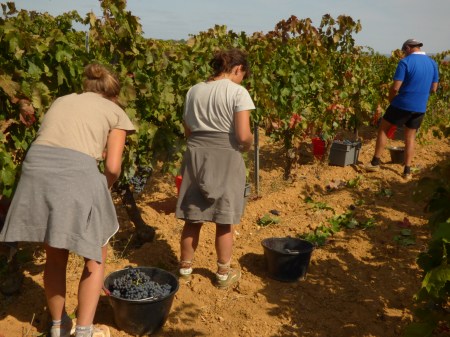
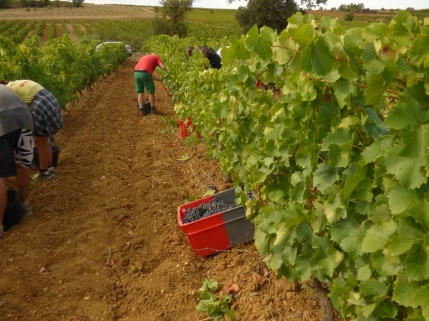
This photo shows Roxane, Selene and Max picking Carignan. Roxane is cutting the bunches whilst Selene and Max carefully sort through their bunches to remove anything untoward such as insects, leaves, rotten or dried berries. On the other side of the vines are other pickers to ensure everything is taken. The bunches go into buckets and when they are filled they are emptied into the cases stored under the vine.
Muscat D’Alexandrie
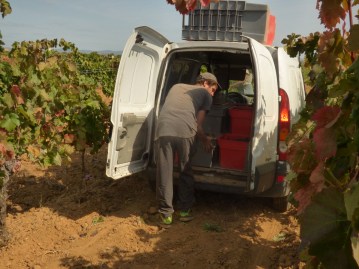
Michel arrives in the vineyard and drives between two rows to collect the cases, often supported by Julien. The grapes are returned to the cellar as quickly as speed limits allow, unloaded and subjected to further sorting.
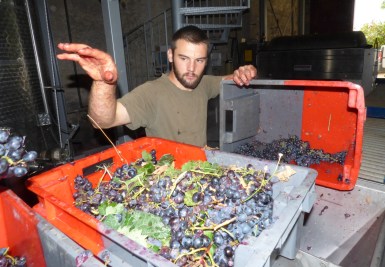
In the photo below Ambroise is checking for anything which escaped the pickers or fell into the cases whilst waiting to be collected. This year the grapes have been very healthy and so no need for the sorting table to be used. However, snails often sneak into the bunches and cases seeking some nourishment in the very dry weather.
The bunches are either pressed immediately, eg for white wine or sent to vat. In the latter case they will be destemmed first or sent as whole bunches depending on the style of wine Jeff decided will be most suited to the grapes. They will spend a day or two there before the process of debourbing or délestage. The juice has now been sitting on the skins, flesh and pips which form a cap on the top of the juice or sink to the bottom of the vat. Délestage involves removing the juice from this mass when it has absorbed as much colour, flavour, tannin as Jeff deems optimal. The juice heads to a new tank to recover. In the video below you will see that it passes through a machine which cools down the juice. Fermentation produces a lot of heat, too much can bring problems which would spoil the wine. That is the main reason why Jeff also invested in new temperature controlled stainless steel tanks this year, especially for white wines.
Error
This video doesn’t exist
The fermentation begins promptly, the healthy yeasts produced by the grapes themselves triggers the process of turning grape juice and its sugars into alcoholic wine. Odours of bread making and fresh fruits fill the cellar, hints of the pleasures of Mas Coutelou 2017 wines ahead.
Skins after pressing
Meanwhile, after pressing the grapes skins are recovered from the press itself and put into a large container. There they will ferment and produce the base for brandy and spirits, nothing is wasted.
Muscat D’Alexandrie
Carignan Blanc
Carignan
Cinsault
Castets
More interesting varieties were harvested these two days. Top left above is Muscat D’Alexandrie, large oval grapes tasting of pure grape juice. Carignan Blanc is one of my favourite white grapes from the region, it makes dry, complex wines. The middle row shows Carignan and Cinsault picked these days. Last but certainly not least, Castets is a rare red variety, less than 1 hectare in the world and much of that is in Peilhan. Sadly, it too has been hit by the dry summer, lovely quality but lacking in volume, a summary of this vintage.
And, after a hard day for some of us my T shirt shows the fruit of the day. Whilst Icare takes things at his own pace.
An unusual few days to report upon. Let’s start with some bad news. Twice in the last week people have dumped their rubbish in Jeff’s vineyards. As these were at opposite ends of the village it must be assumed that there are two selfish, anti-social idiots who would prefer to spoil the local environment than drive to the local tip (déchetterie).
Another unwelcome arrival was Hurricane Irma in the Caribbean. Jeff’s sister Catherine and her husband live on Guadeloupe so we were all concerned for their welfare. Happily she reported that the worst of the storm missed the island. Others may not have been so lucky of course.
Jeremy cleaning the cuve from inside
Selene supervising a remontage
For me there was one more unwelcome visitor. As I entered the cellar on Tuesday morning I mentioned the smell of Carbon Dioxide in the air. This had built up from fermenting grapes and with the cellar being less busy than usual the CO2 had built up. As Tuesday was hot the cellar doors stayed shut as much as possible and with remontages and open vats the CO2 was strong. Alas it seems I am particularly sensitive to it and it made me breathless and nauseous. I can understand better how some people have serious accidents with gas build up when they are working at open cuves. Maybe it’s because I’m getting old but the others were unaffected, and I’m the non – smoker! Happily, I have soon recovered.
Yet another visitor arrived in the form of the inspector who controls organic certification for Ecocert. I wrote about her annual visit in 2014, this was a spot check during vendanges to ensure that everything is done following organic principles. Reassuring for those of us who want to know that Bio wines are truly organic. Obviously, there was no concern as Mas Coutelou goes well beyond the standards required.
Animal visitors too. Buried in a case of Grenache from Sainte Suzanne was this 6cm caterpillar, quite a size. And, amongst the Carignan vines today was this dragonfly who was there with others and many butterflies. Which makes the actions of the fly tippers even more senseless.
Terret Blanc, Piquepoul Gris
Maccabeu
And so to grapes. More cépages to keep me happy. Piquepoul Gris and Terret Blanc along with Maccabeu picked from Peilhan on Tuesday morning will form a new white wine. The pink tint of the Piquepoul Gris will not colour the wine as it was pressed directly to remove the juice from the skins.
Grenache, La Garrigue
The aforementioned Grenache was supplemented with more Grenache on Wednesday this time from La Garrigue. So good was this harvest that Jeff is considering making a special cuvée with it. Together with the excellent Syrah from the vineyard La Garrigue has certainly performed well this year. Cinsault from Segrairals followed on.
Vincent, Julien and Selene
Max and Roxane
With smaller yields and dry weather the picking has been quick this year, efficient too with an excellent team working well. You will see in the photo below how they work in pairs across a vine to ensure that all the fruit is picked, hopefully avoiding each others’ fingers.
So, what remains? Well probably five days of vendanges with Cabernet, Mourvèdre and Carignan still to come, the latter of course being the headline act in recent years. There are also a few rows of vines in Peilhan, eg the reds such as Oeillade and Castets and more Muscat too. All is set fair for a good finish.
A week into picking and the team is in a routine, working smoothly to steadily bring in the grapes. The quality remains high but there can now be no doubt that the ongoing dry spell has taken its toll. Quantities are down by up to 50%, bottles of the 2017 Mas Coutelou wines will be more difficult to seek out I’m afraid and, inevitably, more expensive.
Flower Power
Thursday saw the Flower Power vineyard picked (Rec D’Oulette to give it the proper name) and just 7 cases of grapes were returned from the 0,4ha of vines. They are young still and will have found it hard to cope with the arid conditions.
Julien and Max in Rome
Rome, too, was picked and I went along as this is my favourite vineyard. Cinsault, Muscat and all three types of Grenache were harvested. From Peilhan came Grenache Gris and a few rows of the Maccabeu which will go into the PM rosé wine.
Muscat, Grenache Blanc and Cinsault (left from Rome), Grenache Gris and Maccabeu from Peilhan on the right
By now we are into the second stage of the vendanges. The grapes picked previously have been sitting on skins for varying lengths of time to extract colour and flavour but they will be separated when Jeff decides that further contact will not enhance the wine further. The juice is pumped to a new tank leaving the skins and pips behind to be used as marc for distilling.
Vincent preparing the day
Remontage about to happen
This process of remontage is carried out increasingly as more tanks fill up. Tracking which wines are where is a skill in itself, each time the wine will be tasted and sent for analysis to ensure that acidity, sugars, potential alcohol are all correct and no nasty surprises await.
Jeff took me round a few of the vineyards to check on their progress for picking. We started with the Carignan, then on to the Mourvèdre and Cinsault of Segrairals. In all cases the pips and stalks showed us that more time was needed, they are still a little too green. Tasting the grapes showed plenty of sweet fruit but that greenness would not be good in the finished wine.
Cinsault after pressing, like modern art
Friday was based in the biggest parcel, Segrairals. Cinsault grapes first, to be pressed immediately so that a light pink juice emerges ready to be blended with the other rosé grapes. This happened on Saturday so that all the rosé grapes will ferment together to blend fully. Jeff explained to me that Cinsault is harder to press than most, the large berries contain a lot of pulp which breaks down less easily.
Syrah, Segrairals
Afterwards the remaining Syrah was tackled, again I went along to help with a bit of picking as well as doing the sorting with Jeff back in the cellar. The tri was not too difficult as good, firm bunches of healthy grapes came in case after case. Never mind the width feel the quality seems to be the motto, for Jeff’s sake greater quantity would be welcome.
More remontage, more testing in the cellar. It was good to see the white wines in good condition with fermentation already lively; bready, yeasty smells began to fill the cellar. More Syrah would be picked on Saturday morning but, readers, I admit that I took a break. The hard work, rich variety of grapes and early mornings meant that this time AMarch was not in the vines.
After a month back in the UK due to bereavement I apologise for not posting for the last two weeks.
Ancient Cinsault in Rome
Grapes forming
It was good to return to the Languedoc even in the midst of a midsummer heatwave. After a day’s acclimatisation I was at Jeff’s on Thursday morning, good and early. Well I thought so though he and Julien had been at work in the vines from 6am! Michel and Vincent were busy labelling some bottles of 7, Rue De La Pompe.
Leon Stolarski and his wife Diane arrived to meet up with Jeff, I can reveal that Leon will be the importer of Mas Coutelou wines in the UK along with Noble Rot bar in London. I showed them the updated cellar and Jeff led us on a tasting through the 2016 wines, of which more next time.
Peilhan May
Peilhan June
Almost as much as the people I missed the vineyards. They offer such variety, calm and beauty. The one advantage of being away for a while is to see the change over a month. The sun has seen off the wildflowers, the greenery of the vines now contrasting sharply with the parched grass. The flowers on the vines have also long gone and the grapes are now well formed and starting to swell, the size of peas. There is no sign yet of the red grapes starting to change colour (véraison).
Grape flowers May
Grapes June
Flower Power May
Flower Power June
Carignan May
Carignan June
Rome May
Rome June
The vines look to be in very good health. The 700mm of rain through the winter, the spell of very cold weather too have helped them to rest and be strong, a vibrant green colour. The humidity of recent days brings the threat of mildew and oidium (downy and powdery mildew respectively) and Jeff has sprayed the vines with organic treatments to help them fight against the disease.
Mildew spots
The other main risk is from snails. In 2016 they ravaged Flower Power vineyard for example, reducing the harvest there to virtually nil. There is less evidence of them there this year but there are huge numbers in Peilhan and Segrairals. In the former they are covering the trees which Jeff planted around the vines a couple of years ago, feasting on the greenery amidst the parched vegetation.
Nevertheless so far so good, 2017 promises to be a good vintage.
It was a year of difficulties as I have reported on here many times. From a virtually arid winter and spring to a chilly early summer and then a very hot summer the vines had a struggle to cope with the bizarre climate. Add in a hail storm, snails eating away large numbers of grapes and mildew. No surprise then that the quantity of wine produced was much reduced, bottles will be much scarcer than previous years – so when you get the chance buy them. If quantity is down then what about quality?
I have had the good fortune to taste through the range of wines on two occasions. On September 27th the wines were in their infancy settling in tank, the team got together to gain first impressions. In late January and in February this year I tasted them again with a number of visitors. What I tasted was the wine from the different vineyards before it was then assembled into the various cuvées which Jeff will eventually put out. Therefore, my notes are about the ingredients rather than the finished dish.
Tasting January 28th
I decided to simply publish my notes as I wrote them on the two occasions – no editing, just my personal impression at the time. Already these wines had changed a great deal after 4-5 months and they will have changed again even before being assembled into Le Vin Des Amis etc. I have chosen only the main wines, there are several other cuves with other wines but these are the main wines of Mas Coutelou.
September 2016
January / February 17
Muscat Petits Grains – 2 weeks maceration, fairly neutral nose but fresh Muscatty flavour with tannins / texture. Orange flavour in there – G
Nose is Muscatty and orange blossom. No real grapey Muscat flavours but a dry wine, fresh, direct and clean. Little drying on finish but coming together well. – G
Carignan Blanc – little reduced on nose, nice fresh acidity and appley fruit. Still cloudy – G
This has improved, white flower aromas, fresh, white fruits, very long – VG
Maccabeu/Grenache Gris/ Muscat – Lovely pears and red apples. Fresh acidity, lovely. Full, nice texture – VG
Some residual sugar still but direct fresh fruit – pears and apples – G
Cinsault (Segrairals) – assembled with marc from Syrah. Nice fresh acidity – OK
Not tasted
5. Grenache Ste Suzanne – Little green, quite acid, some spicy after notes. A bit tart – OK
11.5%, light but fruity and grapey, lost its tartness, more round – QG
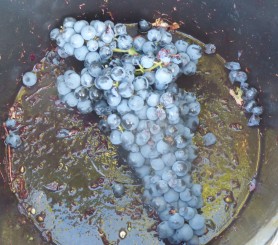
Grenache just picked
6. Syrah Ste Suzanne – Nice, perfumed, red fruits, good acidity and soft tannins – G
Very attractive red fruit nose, has some heft yet only 12%, rich and easy to drink – G
Syrah from Ste Suzanne
7. Flower Power (plus others) – Round red fruits, lively, red fruit flavours – QG
Syrah and Cinsault in there too, nose is lovely, really attractive with red fruits and floral. Nice round easy fruits – G
8. Syrah Segrairals – Still fermenting, quite a lot of residual sugar. Nice, fresh acidity, red fruits – G
Not tasted
9. Syrah La Garrigue – Slight acetate nose, Round dark fruits. Nice texture and mouth filling – G
Dark, ripe round fruits on nose and flavour, plummy, a little closed, good tannins – G
10. Grenache La Garrigue – Nice ripe cherry aromas, good acidity and texture. Ripe – G+
Very fresh and open, round ripe fruits. A little residual sugar still – G+
11. Mourvedre – Very attractive floral aromas, some sugar still, raspberry fruit – G
Improved a lot, a little reduced but liquorice flavours, dark and how it builds in the mouth, could be a surprise star – VG
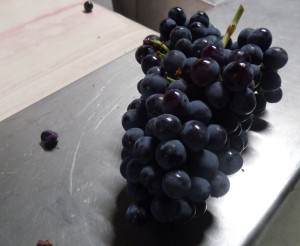
Mourvedre I picked
12. Carignan – lovely dark fruit, very fruity and fresh flavours. Very clean finish, almost slatey minerality – VG
Still working, a little spritz. Quite acidic as yet but there are dark ripe fruits and these are playing together on the palate, will develop well – G
Still fermenting
Overall, the general impression is of good quality with plenty of freshness and fruit to balance. Mourvedre could provide the star wine of the year which would be a surprise, though the Carignan will no doubt improve and be a star once again. The whites, in various styles, are again showing how good white wines can be in this region. After a very problematic year it is surprising that the wines emerged so well, testament to healthy vines and a skilled winemaker.





























 amarchinthevines