A sign of acceptance in the mainstream wine world? Decanter magazine held its first tasting of natural wines recently. Simon Woolf, Andrew Jefford and Sarah Jane Evans were charged with the tasting and I think that is a very fair minded trio of experienced tasters.
The first issue they faced was how to classify a selection of natural wines and Simon explained on his very good blog themorningclaret.com how they adopted the rules of RAW, the natural wine fairs organised by Isabelle Legeron. That means organic/biodynamic production (preferably certified), hand harvesting, no modern techniques such as reverse osmosis, no fining or filtration and no cultured yeasts. Of course the issue of sulphites was central to discussion, as it so often is, and RAW’s rules allow up to 70mg/l so this tasting allowed the same. When I attended and reported on RAW this spring I made it clear that I view this as too high but that was the rule laid down here.
122 wines were tasted mainly based on bottles provided by UK retailers. Interestingly, and inevitably, the three tasters produced very different results. Being a Decanter tasting they were required to give marks (which I increasingly dislike) but the comments and selections are well worth reading. The results and top ten wines for each of the tasters is available on Simon’s blog here along with a link for a pdf of the Decanter article. The full list of wines tasted is here.
I have obviously been drinking too much wine as I know the vast majority of these 122 bottles. Their top wine turned out to be La Stoppa’s Ageno 2011 and I have praised this domaine before as well as that wine, so no argument from me. My own views would differ from all three but that is the nature of tasting (and why marks make little sense to me). Kreydenweiss, COS, Occhipinti, Haywire, Meinklang, Muster, Sainte-Croix and Testalonga are all firm favourites of mine so, in fact, I would agree with many of the selections.
I highlight this event because I think it is a landmark in that a very conservative magazine (I didn’t renew my subscription many years ago because of its very traditional bias) has brought natural wine on board. I believe natural wine should be willing to accept constructive criticism from such fair minded critics and so this is an important step in the right direction.
Also worth noting is the sheer spread of producers from all corners of the globe, natural wine is not going away it is growing in popularity with consumers and producers. Note too that some big producers are making versions of natural wine, a trend mentioned on these pages before. Whilst I personally may not regard them too sympathetically at least it is a sign that the philosophy behind natural wine is winning support.
So, well done Decanter, and Simon Woolf in particular, for promoting this tasting.
Wonderful wines which definitely pass muster with me
Sad to report that frosts have continued to damage the vineyards of France (and elsewhere) since I first reported on them 10 days ago. Virtually every night in regions such as the Loire and Chablis vignerons have lit fires, used helicopters to circulate the air, sprayed the buds with water to keep them at 0º rather than the colder air temperatures. For all that, nature will prevail and damage to the vineyards has mounted with vignerons facing wipeout in some of their vineyards and heavy losses in others.
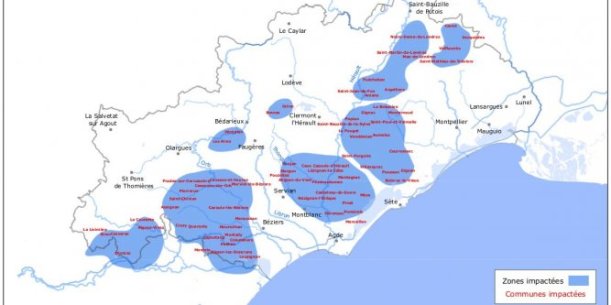
Sadly the Languedoc has not been immune. I have heard reports of damage in Aspiran, Caux and elsewhere including to friends’ vines. I can only sympathise as they face a significant loss of income and wine. It is suggested that the Hérault will lose 20% of its production this year. Midi Libre included this map showing the affected areas. Jeff has had a few vines touched but, happily, there are no real losses.
Areas such as Fronton and Gaillac in the South West, Bugey to the east of Burgundy and in the foothills of the Alps have seen even greater losses and these are regions where viticulteurs struggle to make a living in good years.
Bordeaux has been affected too in recent nights and whilst the big chateaux have been employing the helicopters and braziers smaller vignerons have had to cope as best they could. I was rather annoyed to see one very well known wine writer’s response to this news being to express concern about prices rather than the welfare of the vignerons.
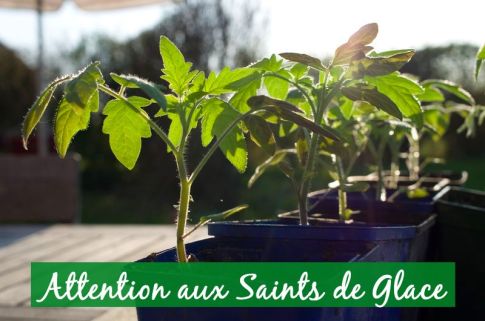
The early spring which promoted bud growth has made this cold spell especially damaging and disastrous. Spring frosts are not unusual, tradition dictates that they are a risk until the Saints De Glaces, this year from May 11 to 13. It was the warm weather of early April which made the vines vulnerable. Climate change? A precocious year? Whatever, the suffering is all too real.
We live in momentous times as elections are upon us. Promises have been made by all and sundry, new facts have been sent to astound us. So let me make it clear…
There is only one choice which makes sense, only one piece of campaigning which has kept its promise since the start of the year.
So, vote Coutelou, open that bottle and register your support for someone who always delivers on his promise. The last “vigneron de gauche*” who is always right!
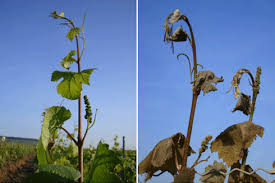
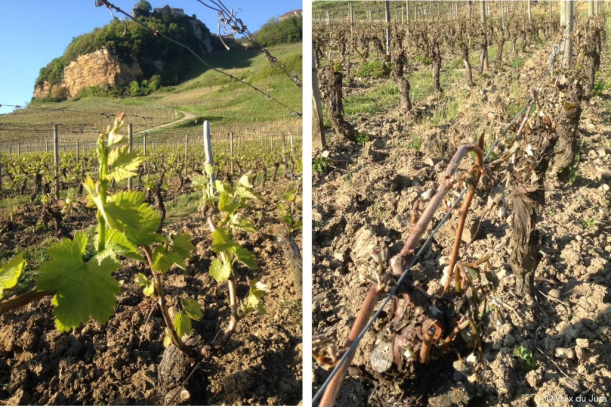
Sad to hear reports of widespread frost damage to vines all over France and Italy on Tuesday and Wednesday nights. Temperatures plummeted to -6ºC in Chablis and the Jura for example. And at a time when vines have begun to bud and the leaves unfurl. The result, of course, is damage to these buds which will not produce grapes this year. No grapes means no money for the winemaker. And in some regions this is two years on a row. I was in the Loire at this time last year and saw the damage it can do for myself, some vignerons losing whole vineyards.
Jura before and after the frost (Véroselles)
Two weapons have been deployed by some vignerons. Firstly, impressive photos from Burgundy and Chablis where, perhaps more wealthy, vignerons used fires amongst the vines to try to keep temperatures higher.
Burgundy (Ulysse Paris)
Chablis (Titouan Rimbault)
The other tactic, more counter intuitive, is too spray the vines with water so that the buds and leaves are immediately covered in ice and this protects them from further damage.
Chablis spraying (Ulysse Paris)
Chablis (Météo89)
Large scale producers such as Roederer in Champagne are reporting losses of 10-20% of their vines for the year. Some smaller scale winemakers will have lost proportionally much more. I can only sympathise. Let’s hope things turn better for them soon.
Addendum 3.15 pm
I have seen some photos of the Languedoc being hit too.
It appears that hail also struck some areas last night too. The frost risk will last until Saturday.
Two bottles of wine from Spain. Both enjoyable to drink without setting the world alight. So what makes them worth a blog post?
The answer lies in the empty bottles. The Albet i Noya was a typical bottle, nothing unusual. Until I opened the other, a wine recommended from Lidl’s Easter range. The bottle was so heavy, so unusually heavy, that I decided to weigh it. 747g was the result, compared to 427g for the other bottle which is about average for others I weighed. (This involved huge sacrifice in drinking wines, I do hope you appreciate that. As well as slightly obsessive behaviour!).
In other words, 2 bottles of the Albarino weigh roughly the same as 3 more regular bottles. In terms of shipping and the environment that must come at a cost. The more serious point I am making is that whilst we campaign for environmental awareness in terms of vineyard practice we should also be aware of the environmental cost of the finished product. In this case there was no good reason for a heavy bottle, it was not sparkling wine under pressure which would require thicker glass. No doubt thousands of these bottles were transported around, using up extra fuel and creating more emissions.
I liked the wine but I would not buy another bottle because I think I am paying for unnecessary packaging. Unnecessary damage too for my pocket and the earth. There is simply too much cost involved, time to take a stand.
It was a year of difficulties as I have reported on here many times. From a virtually arid winter and spring to a chilly early summer and then a very hot summer the vines had a struggle to cope with the bizarre climate. Add in a hail storm, snails eating away large numbers of grapes and mildew. No surprise then that the quantity of wine produced was much reduced, bottles will be much scarcer than previous years – so when you get the chance buy them. If quantity is down then what about quality?
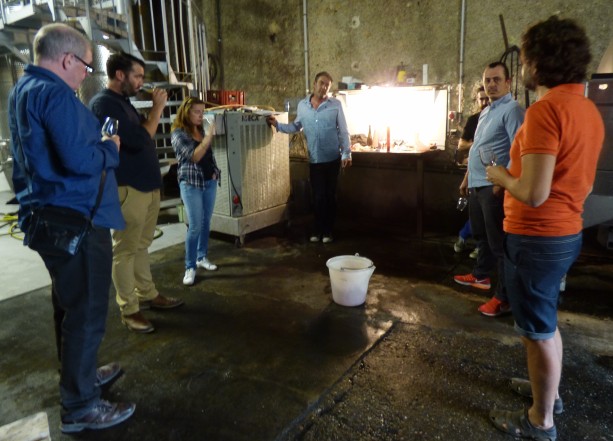
I have had the good fortune to taste through the range of wines on two occasions. On September 27th the wines were in their infancy settling in tank, the team got together to gain first impressions. In late January and in February this year I tasted them again with a number of visitors. What I tasted was the wine from the different vineyards before it was then assembled into the various cuvées which Jeff will eventually put out. Therefore, my notes are about the ingredients rather than the finished dish.
Tasting January 28th
I decided to simply publish my notes as I wrote them on the two occasions – no editing, just my personal impression at the time. Already these wines had changed a great deal after 4-5 months and they will have changed again even before being assembled into Le Vin Des Amis etc. I have chosen only the main wines, there are several other cuves with other wines but these are the main wines of Mas Coutelou.
September 2016
January / February 17
Muscat Petits Grains – 2 weeks maceration, fairly neutral nose but fresh Muscatty flavour with tannins / texture. Orange flavour in there – G
Nose is Muscatty and orange blossom. No real grapey Muscat flavours but a dry wine, fresh, direct and clean. Little drying on finish but coming together well. – G
Carignan Blanc – little reduced on nose, nice fresh acidity and appley fruit. Still cloudy – G
This has improved, white flower aromas, fresh, white fruits, very long – VG
Maccabeu/Grenache Gris/ Muscat – Lovely pears and red apples. Fresh acidity, lovely. Full, nice texture – VG
Some residual sugar still but direct fresh fruit – pears and apples – G
Cinsault (Segrairals) – assembled with marc from Syrah. Nice fresh acidity – OK
Not tasted
5. Grenache Ste Suzanne – Little green, quite acid, some spicy after notes. A bit tart – OK
11.5%, light but fruity and grapey, lost its tartness, more round – QG
Grenache just picked
6. Syrah Ste Suzanne – Nice, perfumed, red fruits, good acidity and soft tannins – G
Very attractive red fruit nose, has some heft yet only 12%, rich and easy to drink – G
Syrah from Ste Suzanne
7. Flower Power (plus others) – Round red fruits, lively, red fruit flavours – QG
Syrah and Cinsault in there too, nose is lovely, really attractive with red fruits and floral. Nice round easy fruits – G
8. Syrah Segrairals – Still fermenting, quite a lot of residual sugar. Nice, fresh acidity, red fruits – G
Not tasted
9. Syrah La Garrigue – Slight acetate nose, Round dark fruits. Nice texture and mouth filling – G
Dark, ripe round fruits on nose and flavour, plummy, a little closed, good tannins – G
10. Grenache La Garrigue – Nice ripe cherry aromas, good acidity and texture. Ripe – G+
Very fresh and open, round ripe fruits. A little residual sugar still – G+
11. Mourvedre – Very attractive floral aromas, some sugar still, raspberry fruit – G
Improved a lot, a little reduced but liquorice flavours, dark and how it builds in the mouth, could be a surprise star – VG
Mourvedre I picked
12. Carignan – lovely dark fruit, very fruity and fresh flavours. Very clean finish, almost slatey minerality – VG
Still working, a little spritz. Quite acidic as yet but there are dark ripe fruits and these are playing together on the palate, will develop well – G
Still fermenting
Overall, the general impression is of good quality with plenty of freshness and fruit to balance. Mourvedre could provide the star wine of the year which would be a surprise, though the Carignan will no doubt improve and be a star once again. The whites, in various styles, are again showing how good white wines can be in this region. After a very problematic year it is surprising that the wines emerged so well, testament to healthy vines and a skilled winemaker.
It’s a while since I wrote about the happenings at Mas Coutelou, so time for an update. I am thankful to Jeff, Vincent and Julien for keeping me up to date in my absence.
The first few months of 2017 have been damp in the Languedoc, a contrast to the arid 2016. The photos by Julien above show water standing a week after rain and his feet sinking into the soil as he pruned. Jeff had planned to plant a vineyard of different types of Aramon at Théresette next to La Garrigue which has lain fallow for the last few years. However, the soil remains very damp and planting has not been possible, unless things change quickly the project will be postponed until next year. For the same reason, the first ploughing would have begun by now in most years, but is on hold for drier conditions.
Pruning the last vines (photo and work by Julien)
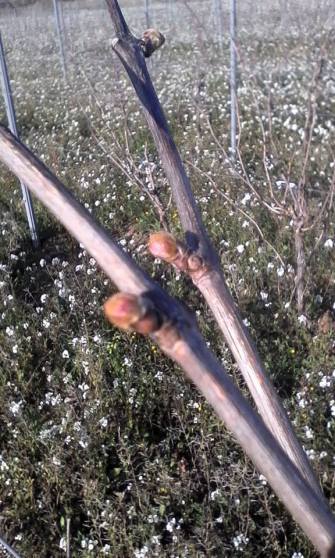
Julien completed pruning (taille) around March 10th. He photographed the first budding (débourrement) amongst precocious varieties such as the Muscat. However, Jeff told me this week that, generally, budding is later this year, the damper, cooler weather again responsible. That is not necessarily a bad thing. Remember that frost can cause great damage to vines, especially buds, and the Saints De Glace (date when traditionally frost risk is over) is May 11-13. I recall visiting the Loire last April and seeing frost damage, whole vineyards with no production for the year.
Julien photographed some early buds
The weather conditions are favourable for something, sadly not good news either. Snails, which ravaged large numbers of buds and leaves in Flower Power and Peilhan last year, have found the damp much to their advantage. They are a real pest, a flock of birds would be very welcome or we’ll see more scenes like these from 2016. Of course, one of the reasons why birds and hedgehogs are lacking is the use of pesticides by most vignerons in the region.
In the cellar the new office and tasting room is complete. Our friend Jill completed a montage of Mas Coutelou labels which we gave to Jeff as a gift. Hopefully that may decorate the walls of the new rooms.
The floor which was half covered in resin last year has been finished all over and another new inox (stainless steel) cuve has arrived. (photos by Vincent).
On March 22nd the assemblages of the 2016 wines took place. Or at least most of them. One or two cuves still have active fermentation with residual sugar remaining but otherwise the wines were ready and the conditions were favourable. I won’t reveal what cuvées are now blended, that is for Jeff to unveil. However, I can say that the reduced harvest of 2016 means fewer wines are available and fewer cuvées made. In the next article I shall be giving my thoughts on the 2016 wines from tastings in October and February.
Finally, there was an award for Jeff himself. On March 30th he was made an official ambassador for the Hérault by the Chamber of Commerce of the département. This was an honour for Jeff himself and the generations of the Mas and Coutelou families who made the domaine what it is. Founded in the 1870s at 7, Rue De La Pompe by Joseph Étienne Mas who planted vines and kept cows after he had fought in the Franco – Prussian War of 1870-1. Five generations later Jeff is an ambassador for Puimisson, vignerons and the Hérault and with his wines he is really spoiling us.
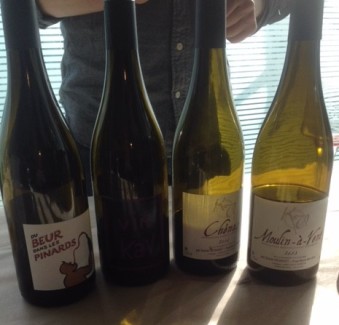
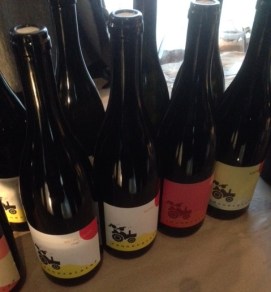
I had heard good reports about Karim Vionnet’s wines and I enjoyed the lighter non-oaked versions in particular. Du Beur Dans Les PInards 2015 had well balanced fruit and depth, very good Beaujolais. The light, straightforward Chiroubles ‘Vin De KaV’ 2015 would please anyone, though added sulfites seemed unnecessary.
The Roussillon is home to many excellent winemakers and I had seen some rave reviews about Riberach so it was good to taste their wines at last. Riberach is a collection of grower, winemakers and others with 20ha of vines certified by Ecocert. I liked the wines in general especially the white wines. Hypothèse Rouge 2011 had good fruit and mineral mouthfeel but top for me was the Hypothèse Blanc 2014. The red is based on Carignan Noir, the white on Carignan Gris – a Carignan whitewash for me.
The highlights of the Montpellier tastings in January included Chateau Meylet from St. Émilion and, perhaps, Bordeaux based wines are making a comeback in my affections as Chateau Massereau based in Barsac was a favourite here. Certainly the Sauternes wines were a real delight (La Pachère lighter than Cuvée M) but the reds were the core wines, I liked them all but especially the Cuvée Socrate 2009, picked early for freshness which shone in the glass. A word too for a really good Clairet 2015, weightier than a rosé with 48 hours of skin contact, fruity, light and delicious.
Another Austrian producer makes my list, it really is a source of some of the best wines at present. I presume Eduard Tscheppe is somehow related to the excellent Andreas whose wines I have praised so often on here. Together with his partner Stephanie they make very attractive and drinkable wines. So popular that they ran out of wine early on the Sunday so I made a bee line for them on Monday morning. The Theodora (weiss) 2015 was very mineral but plenty of fruit too, complex and good. my other favourite was Emmeram 2015 made from Gewurztraminer, not everybody’s favourite grape but this was long, fruity, exotic and just a touch of residual sugar to add a pleasurable finish.
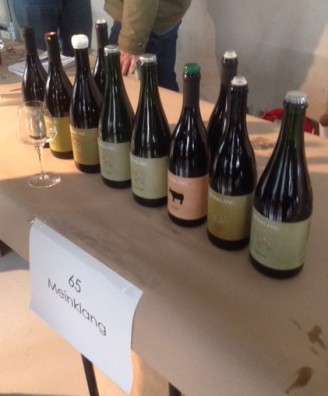
More from Austria and amongst the best of its producers, another to run out of wine early. Delicious Foam White 2015, a petnat with superb freshness and depth after 15 months on lees. Graupert Pinot Gris 2015 had chewy fruit (2 weeks on skins) and a lovely clean finish. The two Konkret wines (raised in concrete eggs) were particularly good, proof that ageing wines in this style does work well. The white had lovely peachy aromas and long fruit, the red was clear, direct and long. The Zweigelt 2015 was a highlight, beautiful precise fruit and a mineral, clean finish. I should also praise the delicious Foam Cider.
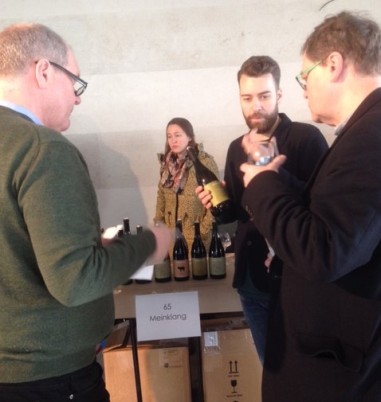
So much did I like the wines and cider from Meinklang that I immediately ordered some.
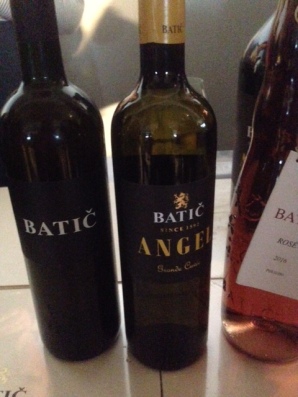
I tried wines from quite a few East European producers and was a bit disappointed by them. However, Batic, a Slovenian producer, was outstanding. A lovely 2016 Cabernet Sauvignon but the real star was Angel 2011 a blend of 7 varieties complanted in the vineyard, 31 days on skins and 4 years in barrel. How does that make such a light, fruity, pleasurable wine? I don’t know but it was a terrific wine.
Excellent Italian wine based on Sangiovese and Cabernet Sauvignon. Freshness was the hallmark of the wines. Particular favourites were Vigna Alla Sughera Rosso 2013, lovely sharp cherry flavours. The Vigna Al Mare 2013 had real Cabernet profiles of blackcurrant. Vino Rosso Base 2014 was a light blend of the 2 grapes and very drinkable.
Conclusions
A very good tasting offering the opportunity to taste wines from many countries. Natural wines are on the up, producers emerging not just in the traditional hotspots of France and Italy. One well-known wine writer recently suggested in a description of one wine that natural wine is a fashion. Apparently she is unaware that they have been made for almost 40 years, they are no fad. More producers, more customers, more restaurants – the demand for natural grows every month.
I remain unconvinced by amphorae, some producers are mastering the technique but there is a lot of clumsy, inexperienced use at present. Concrete eggs on the other hand do seem to be more sympathetic to the wine.
Most producers at RAW were certified organic or biodynamic. It is important that consumers should be confident that their wine is really natural. The wine described by the critic was made SO2 free but not organic, to my mind (and in RAW’s charter) that would not be a natural wine. I also did wonder why some producers continue to feel the need to add sulfites to the wine.
Natural wines are here to stay, they will hopefully become known as simply very good wines. The wines described in the last 3 articles should help to provide many examples of such very good wines. And that is without covering the wines of such illuminati as Cornelissen, Gravner and Texier.
And so to the wines at RAW which contain sulfites above 20mg/l, in other words sulfites added. Reading Alice Feiring’s book ‘Naked Wine’ she tells of how the founding father of natural wine Jules Chauvet used SO2 as do some of the movement’s well-known figures such as Foillard and Puzelat if they feel they need to do so in order to protect that particular wine. Natural wine is about more than just sulfites though its reputation seems to be bound with that additive. RAW’s own charter is worth reading on the subject.
I did enjoy many wines at RAW which are above my artificial 20mg/l mark. There are a dozen domaines worthy of mention so I shall be brief in describing them. Again I refer you to the RAW website for more information (via links) and also to David Crossley’s website for more detailed descriptions on some.
Confounding all my prejudices about big, sweet California wines this domaine’s hallmark was freshness and a light touch. Whether a peach aroma Sonoma Valley Chardonnay 2016 or a juicy, red fruit Redwood Valley Carignan 2015 and even a Cabernet Sauvignon 2015 Santa Cruz Mountains – all these wines delivered everything you’d want in flavour and drinkability together with some complexity. Together with The Scholium Project I am converted to West Coast wines.
And Canada too. This is an interesting project where as well as making their own wine new winemakers are helped to make theirs too. Read more at the link above. Their Haywire wines were very good, providing an interesting contrast for me. As stated before I am not the biggest fan of extended skin contact wines, but here was a Free Form Sauvignon Blanc 2015of 9 months maceration which was fruity as well as having texture, very good. I preferred it to a more traditionally made Pinot Gris. On the other hand the red skin contact was outshone by a beautifully fresh Water And Banks Pinot Noir 2015, classic grape character with red fruits and an earthy crunch. Lovely.
Jura wines are very on trend and with good reason, there are many excellent wines being produced there. I visited the region 20 years ago when Jura wines were hard to find because nobody was interested, now they are hard to find because they are in demand. I have had the good fortune to taste many excellent producers before including La Pinte, present at RAW. This domaine was new to me however, and another name to add to my list of must buys.
The Crémant Cuvée Adrian 2014 would certainly fit nicely into any occasion, refreshing tasty sparkling Chardonnay. The Chardonnay Sur Montboucon 2015 was even better with round , green and yellow fruits, great character. Perhaps my favourite wine was the Poulsard 2014, very light like a rosé in colour but packing dense rose and red fruit aromas and long red fruit flavours. One of my wines of the event. A word too for Vinum Paléas 2015, Éric’s straw wine with a slight honey note but dry and refreshing. Skilled winemaking.
I don’t recall drinking wines from Bugey before. I will again. Again wines marked by a freshness and pure fruit . A lovely, fresh Chardonnay les Côtes 2016– more direct and zesty than the Jura style but a good food wine. The Pinot Noir Tradition 2016 made another comparison with the Jura and again it was more direct, good red fruits, ripe and clean. My favourite was the Altesse De Montagnieu “en Chinvre” 2016which is quite a mouthful! Roussette is the grape and there was a grapefruit, citrus attack with a soft finish, really good.
It really is good to see a region fighting back led by a producer who lets nature speak.
I was delighted to bump into Mathieu Deiss again. I have met him at a couple of tastings before when he was showing the wines of the family domaine with his father at the helm. I love those wines and their philosophy of place rather than grape. He is a passionate young winemaker and I am happy, but not surprised, to say that his own wines are crackers too.
Singulier is a blend of various white grapes, mostly Riesling made by carbonic maceration. The 13 was nice but the 15 was even better, singing with zesty fruit and character with mo SO2 either. It was another skin contact wine which made sense adding that characteristic texture to the fruit. Vibration 2013 was a Riesling with quite the best aromas of any wine at the Fair. Classic Riesling, zesty and long fresh flavours which grew in the mouth. Pierres Sauvages 2013 is a blend of Pinots; Blanc, Gris and Noir but made as a white wine so no long skin contact with the Noir grapes. This filled the senses, it is still developing in bottle I would say, lovely.
To the Loire, that hotbed of natural wine and another new domaine to me based in Azay Le Rideau. I liked the reds but Loire reds are often a blindspot for me and it was the white wines which really stuck out, based on Chenin Blanc. The Azay Le Rideau ‘Les Chênes’ 2015 was a classic Loire white with zest and minerality, textured and fruity. I also liked the Blanc Chenin 2015 made in concrete eggs which seemed to have a richer depth. More young winemakers making an impact, the future looks good.
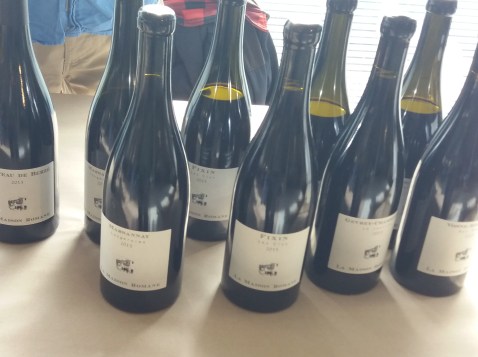
I have bought wines from this domaine in the past and was pleased to see them here at RAW. This is a classic Burgundy domaine and I love good Burgundy. No disappointments here, lovely Savigny and Pernand Vergelesses but there were two stand out wines. Corton Blanc 14 was a reminder of why Chardonnay in Burgundy can be just about perfect. The aromas and flavours seemed to have limitless depth, from apple and green fruits to rich, round hazelnuts. A stunner. And the Corton Bressandes Grand Cru 2014, just makes me smile thinking of it. Still a baby, but delivering forest aromas, dark red fruits, earthy notes – it’s one of those Pinot Noirs which just says this is as good as red wine gets. Tannins aplenty still but in a few years? I would love a supply of these to follow the wine’s progress. Top class biodynamic wine with producers cutting back on sulfites too. Love it.
Wines from classic old world regions and new world upcoming areas too. The world of wine is embracing natural wine.
As my last article said RAW promotes wine “in a natural state; not treated by manufacturing or other processes.” However, those vignerons who do work to make wine as naturally as possible might argue that wines with SO2 levels over 20mg/l are not truly what they would mean by natural. No doubt Isabelle Legeron would regard measures of one particular substance as not the whole issue about natural wine and she would be correct, especially regarding work in the vineyard. Nonetheless the RAW guide itself listed producers with no added sulphites, those with <35mg/l and the others. Some producers cross these boundaries making some wines with added SO2 especially at bottling whilst other bottles are sulphite free.
My favourite producers who mostly add no SO2 are described below, apologies to those I did not get to. I have included links to the excellent RAW website which has details of all the bottles. Have a look to at David Crossley’s articles, more detailed and descriptive than I can manage.
My favourite wines were those of The Scholium Project as I described last time, some of whose wines are sans sulfites. However, of those producers working wholly without sulphites, top of my list was the Aosta Valley producer Selve.
Since this domaine was taken over by the Nicco family in 1948 they have been making wine naturally, in the early days selling it to local people on tap! Three generations later the wines continue to be made with respect to the terroir and nature. The grape here is Nebbiolo, one I often find difficult to like but here it was stunning, such vibrant, pure wines with structure typical of the grape but also delicious round dark fruits.
The main bottling is Picotendro. The 2012 was deep and complex but very drinkable even now. However, Jean louis also produced a 2012 aged in chestnut wood rather than oak and that was on a higher plateau altogether. Four years in old wood had softened and rounded the wine and added a nutty complexity,. In special years the family produce a cuvée called Pantheon and I tasted the 2003. Certainly there were signs of its 14 years, a brown edge to the colour but the wine was youthful, in good form and full of life ahead. It was simply delicious, balanced and pleased palate and brain. This is the domaine who showed me that their analyses show virtually no sulfites in the wine, less than 2mg/l mostly.
I had planned to taste more Spanish wines at RAW and I must admit I failed to do so. Of the half dozen I did taste Uva De Vida stood out a mile. Based near Toldeo, Carmen López and Luis Ruiz manage their vineyards biodynamically (Demeter certified) and I love their quote from the RAW biography, “The earth does not belong to man, but man belongs to the earth”. That should be the philosophy of every winemaker, indeed everyone.
The wines are made with the Graciano grape. It was the Latitud 40 wines which impressed me so much. The 2012 Crianza had real energy and the 14 months in old oak added spice to a red fruit profile. The Castillacuvée was offered from 2014 and 2015. The 14 was bigger, spicier and had lots of power and depth but always balanced by fruit and life. I actually liked the 15 better, no oak and there was actually even more spice and complexity. Pure, well made wines.
Austrian wines have rapidly become amongst my favourites in the last 2-3 years, producers such as the Tscheppes, Preisinger, Meinklang and Pittnauer have really excited me. The same was true at RAW and this was a new domaine to me. Low intervention, including virtually no use of machine in the vineyard together with no added SO2 is not an easy choice for a young winemaker but Alexander and Maria succeed in producing lovely fresh wines, white and red.
There were numerous cuvées on offer and all were good. My white wine highlights included a skin contact wine which still had plenty of fruit and zest as well as complexity (Welschriesling Maischevergoren 2015), a fascinating, lively field blend of varieties Gemischter Satz Maischevergoren 2013 again made with skin contact and best of all a beautiful Weissburgunder Unfiltriert 2016, loads of grapefruit, melon and long flavours.
My favourite reds were both from the St. Laurent grape, the Unfiltriert 2015 had beautiful clarity and fruit whilst the vat sample 2016 was as good if not better. 2016 was a harsh year for winemakers in Austria with yields well down and this St Laurent is testament to Alexander’s skill. My liking for recent vintages suggests that the wines are improving as the domaine progresses.
Two sisters, Susanne and Stefanie, in the early years of their winemaking and already producing very good wines.My two favourite wines here were both called Waiting For Tom, in tribute to the two men with whom they learned about winemaking, Tom Lubbe and Tom Shobbrook. They clearly were good teachers and students. The rosé 2016 made from Zweigelt was one of the best rosés I have tasted, lovely aromas of fresh red fruits and citrus carried into the taste. Light, refreshing – a perfect rosé wine. The red 2016 combines Pinot Noir with Blaufrankisch and St. Laurent and has so much life, freshness and joy.
Champagnes formed many of the highlights of the January Montpellier tastings and again here at RAW. This domaine works organically (Ecocert) and uses horses to hoe the soils, no dosage, no added sulphites either. The Vibrato 2012 was lovely, slightly yeasty (which is how I like champagne). Refreshing, long flavours and bettered only by the 2013 where the fruit was even more prominent. I’d have these in my cellar every time.
I have sung the praises of this domaine a few tomes on this blog, Alexandre works biodynamically (Ecocert and Demeter) and adds nothing to the grape juice. His pure way of working has got him into trouble with authorities in the past even though these are the purest examples of Pouilly Fumé! All 3 cuvées on offer were excellent, my favourite the Pierre Précieuse 2015with its clean fruit and , yes, minerality. I do think he is a winemaker at the top level.
Oronce De Beler makes wines in Vosne-Romanée but is not a vigneron, he makes his wines from bought in grapes from organically grown sites. He works naturally with little or no SO2. Let’s face it when red Burgundy is made well there are not many better wines, hence the high prices these days. I liked all the wines here they showed good balance of fruit and complexity, promising long life in bottle as well as pleasure now. Favourites were the Fixin Les Clos 2015, tannins bolstering lovely fruit and a top class spicy Vosne-Romanée Aux Réas 2015of great depth, all spice, red fruits but plenty of ripe tannins too.
I admit to some partiality here as I know these wines well, they are amongst my favourite Faugères wines and, if you know this site you will know that Faugères is my favourite Languedoc region. Catherine Roque made wines at Clovallon (now run very well by her daughter) and acquired Mas D’Alezon in 1997. Demeter certified and working sans sulfites has added zest to the wines and the classic Faugères is lovely but the wine which wowed me here was a new one to me. Le Presbytère 2016 has Cinsault and Carignan but also Lledoner Pelut as the major part. I only know of a few domaines working with the grape and, if winemakers drink this bottle, they will be clamouring for the vines. Delicious, drinkable, clean red fruits but with a depth and coffee notes on the finish. One of the wines of the tasting.
I should mention Clot De L’Oum in the Roussillon and Domaine Rapatel in the Gard who also offered some lovely wines. Also special mention to Olivier Cohen whose excellent wines I described here from a previous tasting.





















 amarchinthevines