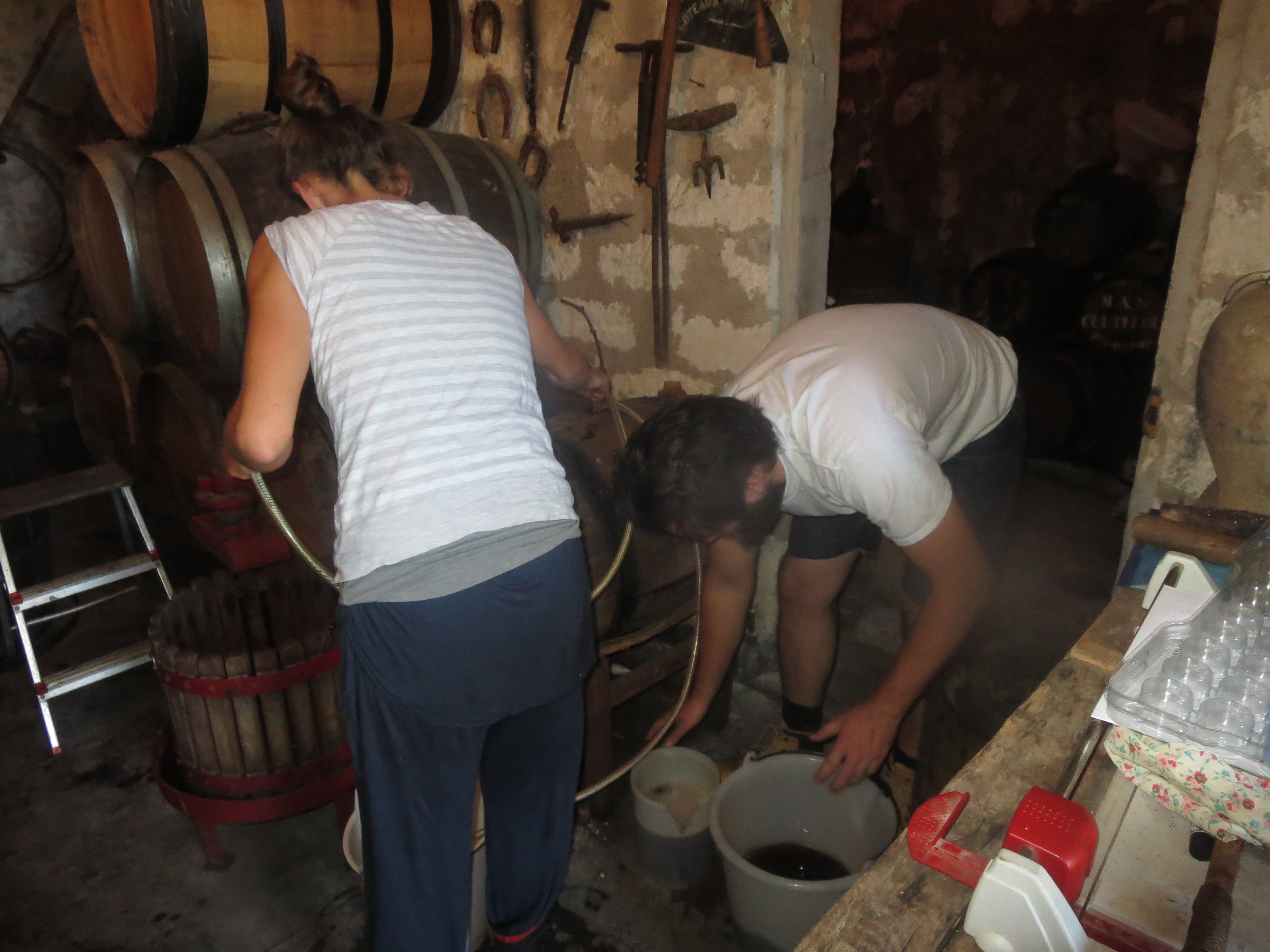
Soutirage is known as racking in English. After the wine has fermented the tank or barrel will contain the lees (dead yeast cells) and sediment. The yeast fermented the wine, lees have added flavour and some antibacterial properties but if left in contact with the wine they will start to add off flavours, cloud the wine and generally hinder the final wine. The process is carried out as gently as possible, using gravity rather than electrical pumps.
Vendanges
So on April 6th Jeff messaged me to say that the day had arrived to carry out soutirage of the wine I made for my 100th blog post and the vendanges tardives Grenache we picked on the last day of the vendanges.
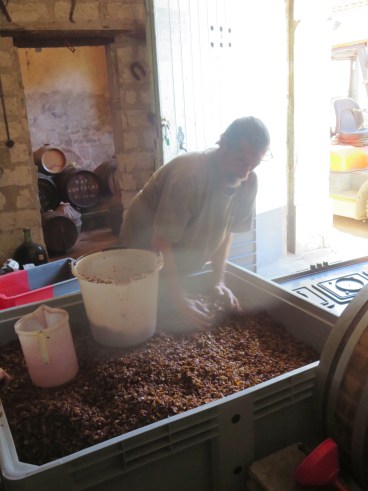
We started with the Grenache. A tube was placed into the stainless steel tank, suction applied and the wine flowed gently into large 15l bottles. Jeff chose clear bottles so that he can watch the progress of the wines. They will be stored in his cellar in the dark so no problems from light damage. The Grenache still contained some residual sugar, was sweet, fresh and clean.
Sediment au fond de la bonbonne
It was appropriate that we also racked the maceration white wine. Cameron had taken the lead on this wine and he was here after attending La Remise, the natural wine salon in Arles, I’ll be writing about soon. The wine was fresh, lots of fruit and also a light texture from the 4 month maceration. Very good.
And then the 3 Grenaches wine I took charge of. Most of this has been aged in barrels so the soutirage ended with them being emptied of their sediment.
There wasn’t that much sediment as the small vertical press I used controlled what entered the barrels, ie mainly juice. Naturally we had to top up those barrels after soutirage to replace the volume taken away. And now they continue their gentle ageing. I am very happy with the progress of the Grenaches, again more soon.
Traffic light wines
A fascinating day, another new process in winemaking for me to learn.
On March 17th we were in Font D’Oulette vineyard which, at just over 0,6 ha, is a small parcel replanted around 6 years ago with a variety of old Languedoc cépages such as Aramon Noir, Aramon Gris, Oeillade and the very rare Clairette Musquée. The grapes are picked together to make a single cuvée representing the parcel , Flower Power. This first appeared in 2014 and has made an impact already, selected by La Revue Du Vin De France as one of the Languedoc’s top 50 wines. As the vines age we can only anticipate eagerly what they will produce in future.
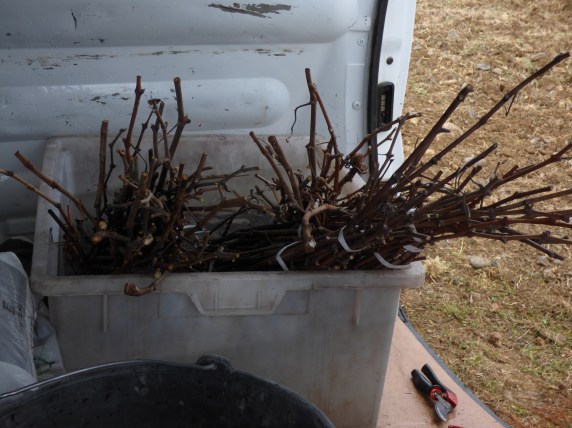
However, not all young vines thrive and some needed to be replaced. Two alternatives were in place this day as the rain fell steadily.
The second method was to graft onto the root stocks already in situ, something I had not seen before. The American root stock has to be used to protect against phylloxera which destroyed much of France’s vineyards in the 19th century. There are different methods of grafting such as ‘chip and bud’ but Jeff brought in a specialist, Tanguy, who uses a method known as ‘greffe en fente’.
The old vine is cut away to reveal the root stock. A very sharp knife, repeatedly sharpened through the day, cleans the surface and then inserts a cut through the wood revealing its core.
The cut is supported by tying string around it. The vine wood is also cut, as if sharpening it to make a thin wedge which is inserted into the cut root stock. The idea is to get the core of the two pieces as close as possible. This is then fastened tightly with the string. The graft is complete.
It looks simple but isn’t that the mark of a skilful worker, making something complicated look easy? Have a look at the video below to see the process in one go.
The vine is staked for support, always to the side which will help the vine against the prevailing north westerly winds. Jeff had brought some basalt soil from the Auvergne and this was then placed around the grafted vine poured into the body of a plastic bottle placed around the vine .
Basalt is one of the oldest forms of rock, roche mère (mother earth or bedrock) and is packed with nutrients. This will help the vine to grow well and by filling the bottle around the vine it is surrounded with top quality soil. Organic compost is added to the hole and then the earth is hoed back over it all, removing the bottle of course.
There is a risk. Up to 20% of vine grafts do not take in theory and with greffe en fente the whole vine would have to be grubbed up next year and replanted. Other methods can simply replace the graft. However, this method is the best for the vine itself and the most likely to take.
So what were the vines? Cinsault, Aramon Noir and Inconnue No.3. Inconnue means unknown, so why is it called this? The original vine was found in an old vineyard where it had never been catalogued. It was taken by the organic nursery where Jeff buys his vines and it was studied but was discovered to have never been indexed. it is unique, unknown, hence its name. One of its benefits is that it is resistant to oidium and it will also add diversity to this complanted vineyard with about 100 of the Inconnue No.3 vines being added. A hint of mystery to the blend.
The vine canes, only about 7-8 cm will be used
A fascinating day despite the rain which soaked us all to the skin. It was hard graft but a rich, rewarding day celebrated at lunchtime with a magnum of… well it had to be Flower Power.
How do you follow the Perfect Day? Apparently you just wait and, like the proverbial London bus, two come along together.
March 8th dawned chilly, just 2°C when I left Margon at 8am, bright and clear, a perfect day for the last Spring bottling. The biodynamic calendar was favourable too, last day of the descending moon and a flower day.
In fact we started with a morning of habillage (labelling and packaging). The start of a longer process of habillage to prepare wines to send to cavistes around the world, it’s time to earn some money! This morning palettes of ‘5SO Simple’ and ‘7, Rue De La Pompe’ were put together, a smooth enough process as Jeff, Michel, Vincent and I have all done this many times now (I’m getting to be an old hand!). One interesting feature is how different regions require different labels, customs stamps and even palettes, the USA different to Europe for example. So making sure you have the right matériel demands some time and attention.
So far, so good. The banter was enjoyable as ever, Icare provided some amusement when, hiding under the rollers, he gave himself a shock when a case of bottles passed over his head. The day improved with the arrival of Thomas, a sommelier who spent time with us at vendanges, excellent company. However, the day then took an unexpected turn for the better with a phone call from Sylvain, one of Jeff’s myriad friends. He is a scientist, intellectual and fisherman and phoned to say he was on his way. With him was a cool-box full of sea urchins, sea bass and black mullet – all freshly caught.
So, just after noon, we repaired to 7, Rue De La Pompe, the house rather than the bottle. There Sylvain prepared a feast. The oursins, fresh with their delicate tongues of iodine, concentrated flavours of the ocean; a sea urchin butter spread on fresh bread; sashimi of bass and mullet; sea bass marinated in olive oil and Jeff’s white wine vinegar; sea bass chips (little fried nuggets of flesh and skin); chunks of bass and mullet fried lightly in a tempura beer batter; fish egg omelette; barbecued sea bass; black mullet grilled with broccoli, then coated in a Japanese sauce. Totally delicious, everything was a delight, every morsel.
The freshness of the fish and Sylvain’s imagination and skill provided us with a 3 hour banquet, conversation around the role of fish and wine in religions, lighter topics too. Sometimes I have to pinch myself.
And, of course, wines.
Snow Balls 14, that curious cuvée of Sauvignon Blanc, Grenache Gris, Muscat and others, it shouldn’t work but it always does – so fresh, clean, dry and fruity, a perfect match with the sashimi for example.
5SO Simple 15, ( the best 5SO ever?), perfumed cherry Cinsault, dangerously fruity and moreish but with a little more texture this year. A good match for the cooked fish with its cleansing acidity.
La Vigne Haute 2010. Oh my word. This is my favourite Coutelou cuvée and the 2010 is stunning. Pure, pure Syrah, bottled joy. Deep brambly red fruit scents, as you sniff the wine you are drawn in to the luscious aromas. Rich, smooth texture with the softest of tannins supporting it, cassis and red fruit flavours and soooo long with flavours of chocolate and coffee emerging. OK I’m sounding poncey but seriously, this is fantastic wine. It will improve for a few years yet and I have some in my ‘cellar’, happy man.
2010 La Vigne Haute and its maker
An indulgence, the whole meal. The kind of life affirming meal which everyone should enjoy from time to time.
And yet, back to bottling on this clear, fresh day. A special cuvee, one of the little cuvées. A barrel of Maccabeu and Grenache Gris from 2012 which will be named after the top Spanish ham, 5J. The aim was to produce a wine like a light Fino, slightly oxidised but concentrated and fresh to match those hams. The barrel was formerly used for making cognac (adding more flavour) and the wine succeeds in its ambition.
Vincent, Sylvain (standing centre), Thomas (kneeling) and Jeff
It resembles a light fino, it is dry and the slight oxidation adds complexity but it is the clear fruit which lingers, lifted by that barrel influence. I was reminded of the Jura white wines I love, a Ganévat for example, but the fino / light amontillado sherry reference rings true. It is utterly delicious. A special cuvée demands a special bottle, so 50cl flute bottles were used with a glass stopper rather than a cork. Just a few hundred bottles of something very special.
The Maccabeu / Grenache Gris pressed in 2012 (photo by Jeff)
The barrel was then refilled with some of the top quality Maccabeu of 2015, ready for another delight in a few years. The treats continued though. Little fish are sweet. These were the words used by one of my heroes, WA (Arthur) Stephenson. He was a hugely successful horse racing trainer from my home area in County Durham and when his horse won the Cheltenham Gold Cup (jump racing’s top race) in 1987 he explained why he was at his local track instead of at the big meeting, “little fish are sweet”. As I had referenced Bowie last time I thought it was an apt and indulgent reference to the great man, who shared his time and thoughts generously whenever I spoke with him.
There was time to taste the Grenache wine which I made for my 100th blog post with the help of my friends. I intend to write a little more about this, suffice to say that the wine is developing very well in two different sized barrels and one super-sized glass bottle.
Tasting the grenache
A tasting too of the 2015 Grenache Sélection De Grains Nobles, quietly maturing. Dark plummy colour, rich and round but it was black grapes that I could taste believe it or not with a sweet, raisin edge. A wine to wait for, and it will repay the patience I am sure.
SGN Grenache
Finally, a 40 year old Muscat. Figgy aromas, black olive and molasses. No sign at all of tiredness just intense, thick, sweet nectar yet still an acidity to keep it in balance. Liquid sunshine, a long past summer captured in a bottle, revived in the glass for us. A perfect end to (another) perfect day.
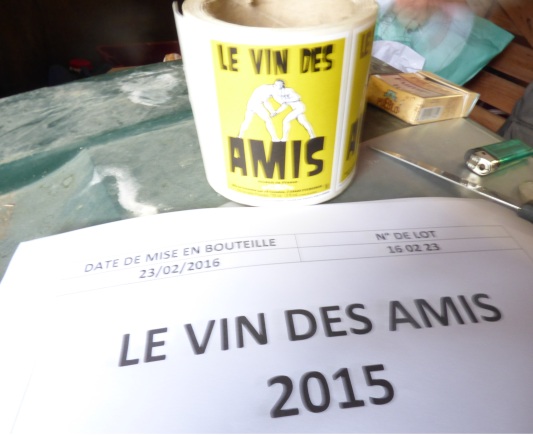
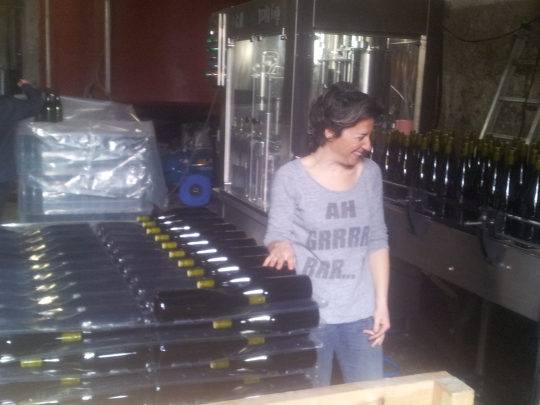
Yesterday (February 23rd) was the first big bottling day of Mas Coutelou 2015 wines. First in line was Vin Des Amis and 11,400 bottles were prepared. As Jeff put it, “Le vrai jour pour la belle cuvée”. (The bringing into the world of the beautiful wine). It proved to be the most aptly named of wines as Jeff welcomed friends from far and wide.
Vincent, a friend of many years who has featured before, was here from Paris. Another Paris based teacher, Sébastien, is spending a week in Puimisson in order to learn about being a vigneron (see his report on the domaine here). The most important visitor yesterday was Céline who was celebrating her birthday.
Birthday girl
Bordeaux based Céline has been a regular visitor to Puimisson for many years and helped me with picking grapes for my 100th blog wine last September. Her husband, restaurateur Brice, and friends Thibaut and Anne from Monein in the Béarn, were here to help her to celebrate and threw themselves into the bottling work with gusto. Michel, Julien and I were present too.
The bottling line was in operation from 7.30am to around 5.30pm. Cuve 7, which contains up to 100hl, was emptied and the bottles taken to be stored for a few months until they are ready to label and to market in springtime. With 10 of us available we were able to share the load and take the occasional break as Jeff provided food and wine to ease us through the day. The Vin Des Amis was opened of course and it is already a bright, clear, delicious vintage of this popular cuvée, fresh red fruits with a lingering spiciness. Another sign of how good the 2015 will be. Jeff also opened a 1997 Mas Coutelou, a wine from his first solo vintage which had a lovely earthy perfume combined with red fruits which carried into the taste. The age was showing, the flavours cut short a little but still very drinkable. We also tasted some of the white wines from tank, they are developing beautifully, an amazing Maccabeu in particular. Could this be the year white wines steal the show at Mas Coutelou?
I thought I was the star!
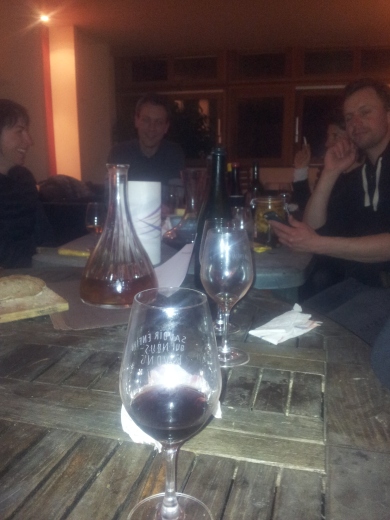
The theme of friendship continued as Pat and I were invited along to dinner at Jeff’s to celebrate Céline’s birthday. Brice prepared some delicious fish dishes; marinated mackerel, squid in garlic and parsley, fresh cockles in a seafood broth, monkfish with garlicky potato purée and delicious sauce. He is clearly a very talented chef as well as restaurateur, ably assisted by Thibaut who made some very tasty flour-free crêpes.
And then there were the wines. A veritable who’s who of natural wine’s top producers. Plageoles’ sparkling Mauzac was a good start with which to toast Céline. Her phone rang throughout the day, she clearly personifies vin des amis.
A delicious rosé from Clos Des Grillons in the Gard followed, full flavoured, very appetising. Much more fruity than many rosés, this originates in Tavel.
Perhaps my favourite wine was the Pinot Blanc 2010 of Gérard Schueller, very full, a honey edge but dry – not sure that I have ever tasted a Pinot Blanc of such quality. I must track down some other wines from the domaine.
Céline had brought along a 2012 Leon Barral Blanc, Terret Blanc and Gris with some Viognier and Roussanne. Textured, a golden colour but very fresh and a good match with the fish.
La Bégou 14 made by Maxime Magnon in the Corbières was lovely, fresh white peach flavoured and very round, Grenaches Gris and Blanc. I liked this wine a lot, more evidence of how good Grenache Gris can be.
JF Ganévat’s J’en veux encore is a light red wine from an amazing blend of umpteen local Jura grapes by a producer who makes up to 40 cuvées (he must have amazing powers of memory to keep on top of so many wines). I tasted some of the range earlier this year and must admit to preferring the white wines but this was nice, very drinkable red fruits and a good match with the monkfish in its seafood sauce.
Back to Barral for Jadis 2001. Shy at first but this opened up in carafe through the night. Plummy, spicy, very long and terrific Faugères, the Carignan shone through with roundness from the Grenache. I have not always ‘got’ Barral’s wines but this showed me that they need time and patience. Very good.
Sébastien brought along a biodynamic Sauternes from Rousset-Peyraguey, a 2000 yet youthful with lovely sweetness but also freshness.
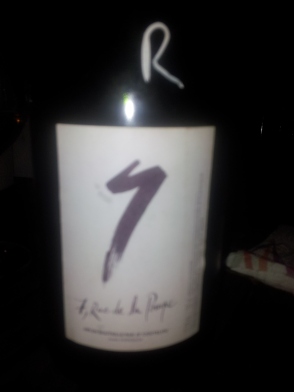
And then, just when you think you have got to grips with Jeff’s wines, there appeared two remarkable bottles. The first was Robert A, despite the label. This was Grenache Gris and Blanc from 2003, his first year of going sulphur free in the cellar. It passed through some interesting stages in its development and early bottles spat out their cork so it was put into sparkling wine bottles. It was amazing. Unbelievably fresh for a 12-13 year old white wine, white fruits with a tight edginess but clean and bright. It continued to develop in glass and in bottle through the evening, wine of the night.
R for Robert
Then came another new cuvée to me BL002, also from 2003. A Sauvignon Blanc but I’d never have identified it as such, with a sweetness (from the Muscat in the blend) and delicious freshness. Many around the table chose this as their preferred wine and it was another amazing wine. How does he do it? Vincent chose this because it reminded him of those early days of Jeff’s winemaking adventures and of their long friendship, a perfect fit for the theme of the day.
A birthday. A long day. A rewarding day. A memorable day. A day for friends, for vin des amis.
It’s been a few weeks since I updated about events at Mas Coutelou, partly due to Millésime Bio and, partly, because it’s a relatively quiet time. That is not to say nothing has been happening, far from it.
Maccabeu 2015
Flower Power 2015
Millésime Bio and Le Salon des Vins De Loire are two huge events in France attracting many thousands of trade visitors. As you have seen with Millésime Bio these salons also attract satellite events and Jeff takes part in those. Les Affranchis in Montpellier and La Dive Bouteille in Saumur last two days each and so adequate samples of the wines need to be prepared, transported and poured for guests to taste. Those events alone take about 7 days of the last month. I know from feedback from various people who sampled Mas Coutelou wines at both events that they enjoyed the wines which were samples from cuve (tank) of the 2015 cuvées such as Vin Des Amis, Classe, Syrah, PM Blanc and Flower Power. Hopefully the salons will spread the word about how good they are, the elegance and finesse of the vintage is obvious as you taste it.
Bottles of the 2015 wines made specially for the salons
Those visitors were also presented with Jeff’s annual Carte Des Voeux, his new year greetings card, together with his summary of the last year’s events, weather, vintage and cuvées. The Carte’s original is printed by hand and this year’s was especially complicated to print because of the different colours used. The message is worth the hard work.
For the last several weeks pruning (taille) has continued. Julien is leading the work this year and his back must be getting sore by now. It is hard work! The importance of good pruning should not be underestimated. It maintains the health of the vines, removing damaged or sick wood. It reduces the number of canes which will grow grapes so that the vine’s energy will produce quality rather than quantity, probably reducing potential yields by half. It also shapes the vine so that future work such as ploughing and harvesting will be more straightforward. I wrote about pruning last year describing the different methods.
I visited Julien in Peilhan vineyard on Monday, the same day as I saw a pruning machine at work in a nearby vineyard. It certainly does the job quickly and more cheaply but looking at the vines afterwards it was hard not to think that the machine did not reduce the number of canes to limit yields and, of course, cannot check the health of the vines. Julien and his fellow tailleurs are more costly but, to my mind, essential for good vineyard management and, ultimately, good wines.
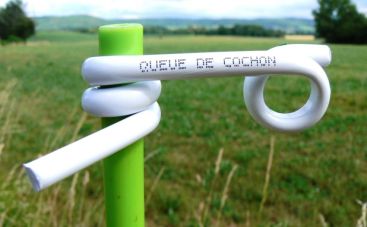
Michel was also in Peilhan, making sure that the pruned vines were tied to their trellis. If the vine is not straight he might stake itfor support and then tie the vine to the stake using a fastener called a ‘queue de cochon’ as it resembles a pig’s curly tail. This will help to avoid the vine being knocked during ploughing or other work.
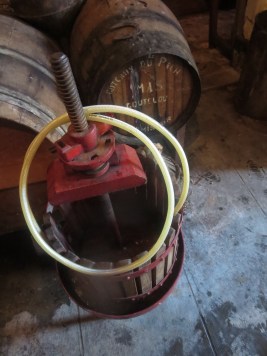
Meanwhile, in the cellar it has been a hive of activity. One of the features of the cellar has been a large basket press which has been used by the Coutelou family for generations.
Sadly, it has been out of use for many years and became something of an obstacle as work was done, especially during the vendanges. Jeff reluctantly decided to remove it, I know this was a difficult choice for him. It proved to be a much more difficult task than anticipated as the press screw went deep into the ground and a massive hole still didn’t get to the bottom of it so, eventually, it was sawn through to enable the whole press to be moved.
photo from Jeff
photo from Jeff
The story does have a happy ending though as the press is on its way to Jeff’s friend Didier Barral where it will be put to good use. The result is certainly more space in the cellar, even if a part of the domaine’s history has disappeared.
Another big tank (cuve) has also been split into two. Jeff will be able to vinify smaller quantities of wine and have more choices about the most suitable cuve for grapes as they come in at harvest time.
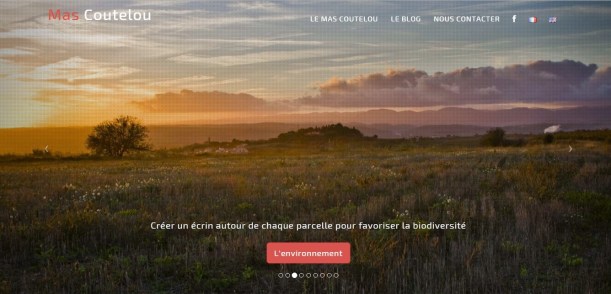
Finally, for those of you who want to find out more about Mas Coutelou a new website is available. I have included a link at the top of my page and invite you to have a look at the site.
Jeff wrote the text for it (I did the English translation) and it will inform you about the philosophy, methods and wines of the domaine. And it is those wines, the different cuvées, that I shall be writing about next time.
Pour les lecteurs français je m’excuse, j’ai des grandes difficultés de mettre à jour la page en français. J’ai demandé à WordPress pour résoudre le problème.
As a History graduate and teacher I have always believed that to understand the present we must understand our history. Whether it be politics, culture, sport or, indeed, wine the route to the present gives us the fuller picture. In wine terms I relish the stories of the winemakers and how they came to their place in producing the wines we appreciate, that route often explains their philosophy and their hopes for the wines. I often hear from them, as in Clos Fantine or Domaine Montesquiou, how the family history and its relationship with the land influences how they nurture their soils, vines and wines.
Naturally, spending so much time at Mas Coutelou I have come to appreciate the story of the domaine and its roots and traditions through to its present. Nowhere is that history more alive than in one of its most unusual features, the solera system.
I was talking to Rosemary George at the Mas Gabriel 10th anniversary dinner and I told her how a blog post she wrote first led me to Jeff’s door and, consequently, changed my story and journey to the Languedoc. Rosemary’s greatest memory of Mas Coutelou she said was of the solera system. It is certainly virtually unique in the region. After my initial tour of the vineyards and tasting with Jeff I was amazed by the discovery of a solera. Clearly it left an impact upon Rosemary too.
So, what is it? What is its own history?
Soleras are usually associated with sherry. The word means ‘on the ground’ in Spanish. Barrels are filled with wine and the oldest wine is used to fill bottles though some of the wine is left. It is refilled from the next oldest barrel and that in turn by the third oldest. As each is only partly emptied the barrel’s contents become a mix of vintages. Traditionally, the oldest barrel is in on the ground and filled from above, hence the name solera. That ground barrel in Mas Coutelou’s solera is over 200 years old! The barrels also lose some of their contents through evaporation. The larger barrels (around 225 litres) lose around 6% of their wine per year, smaller barrels can lose up to 15%! Hence the need to replenish the barrels for natural reasons not just because they have been emptied.
Michel removing must from muscat ready for the solera
The Coutelou system was started by Jeff’s great grandfather and has become a family tradition. Muscat and Grenache grapes are used to feed the solera each year. They can follow a route of being used for sweet or dry wines, they might be blended together or kept separately. Altogether there are 16 possible paths for the wines to take and Jeff must choose the most appropriate one based on his tasting experience.
The wines vary from the very dry to the very sweet and luscious. Some of the old Grenaches can be very like old amontillado sherries, lightly structured but packing power with long nutty, prune and raisin flavours which linger and fill your mouth. Others, especially the sweeter Muscats, are caramel, toffee and raisin in aroma and flavour and the wine clings to the glass with its viscosity. They are an utter delight and a special treat to savour slowly. Going from barrel to barrel in the two rooms where they lie there is an enormous range of wines, somehow Jeff keeps a record of them all in his head. As you taste them you are enjoying the results of decades of grapes from the lovingly tended vineyards, the work of generations of the family. This is tasting history.
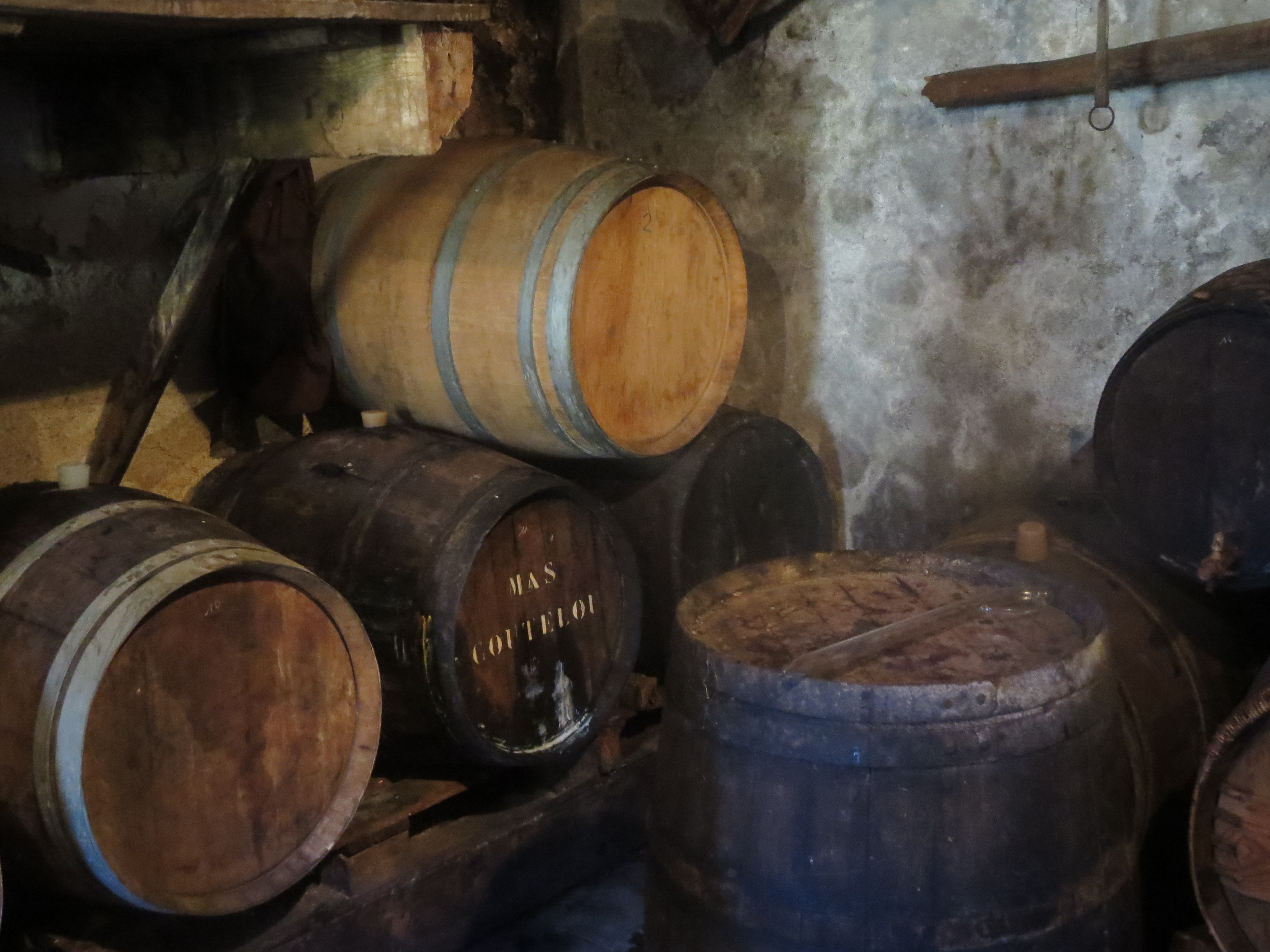
I love these wines, their complexity, aromas and flavours are captivating, making you smile, savour, sniff, speculate and sigh with pleasure. It is impossible to taste and to drink them without reflecting on the story of the wine and the people who made them. A sense of the past reinforced by the surroundings. The solera cellar contains all sorts of artefacts, equipment used in the vines and the cellars over the years as you can see above. It is a museum to great wines and to great people representing the history of the village and region too. The wines are that history in the glass, rich and rewarding.
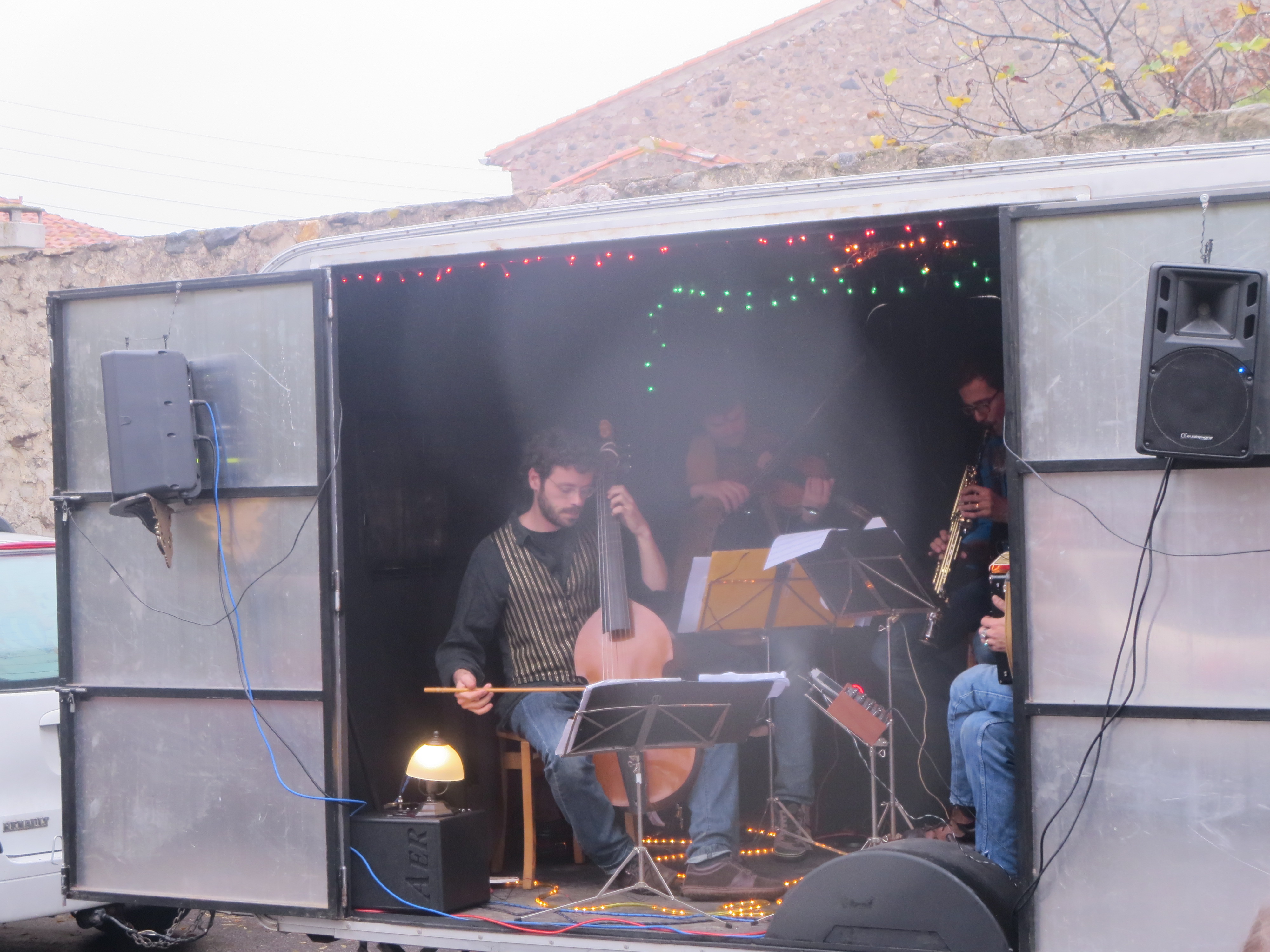
Latour not Le Tour. It is a village in the Pyrénées-Orientales with an unusual profile in terms of winemaking as nearly all the vignerons make natural wine. La Bande de Latour is their open day and it was such a fun event last year that we decided to return again, the date was in the diary for a long time.
Unbelievably the event took place on the only bad day’s weather in the last 3 weeks, low cloud, mist and dampness prevailed though the event was far from spoiled and more than compensated for the weather. The vignerons of Latour invite others from around the Languedoc Roussillon and further afield, but there is a common bond of natural wine. In recent weeks there has been much discussion in the world of wine about whether natural wines should be certificated and what direction the wines should take. I intend to address these issues in the next articles but it was a good opportunity to see what lessons could be learned at such a gathering of producers.
The first thing to say is that there were wines which did not appeal and which seemed a little lacking. I believe that natural wines are moving on and that with more experience of not using sulphites, for example, winemakers are learning how to tackle the process of making clean, fresh and healthy wines with a minimum of faults despite not having the safety net of additives, interventionist winemaking etc. However, there were some winemakers present who, in my view, are either new to the approach, haven’t learned or have not moved on. I won’t name names here but would share my thoughts if anyone wants to get in touch.
However, I felt that the majority of wines were of at least good quality, with fruit, freshness, balance and complexity – all that you would want from any wine but certainly the features which make natural wines appeal to me. There were wines which really were top class and I put my money where my mouth is by buying some.
Top of the podium was undoubtedly Cyril Fhal of Clos Rouge Gorge. His vineyards are high in the hills, gobelet and exposed to the elements. Cyril is a master of Carignan and his wines are relatively expensive though not by comparison with the likes of Burgundy or Bordeaux, and his wines do bear comparison with top class wines. The Carignan was very good indeed, long, fresh, deep and balanced. However, it was the Blanc, made from Maccabeu which really captured my imagination, one of the best wines I have tasted in 2015. It starts zesty and fresh and then the oak adds a little roundness, coating the mouth with spicy notes but always clean and refreshing. Beautiful wine, brilliant winemaking. I happily bought both wines.
Outstanding
Other top performers from the village included Domaines Rivaton, Mathouans and Trbouley.
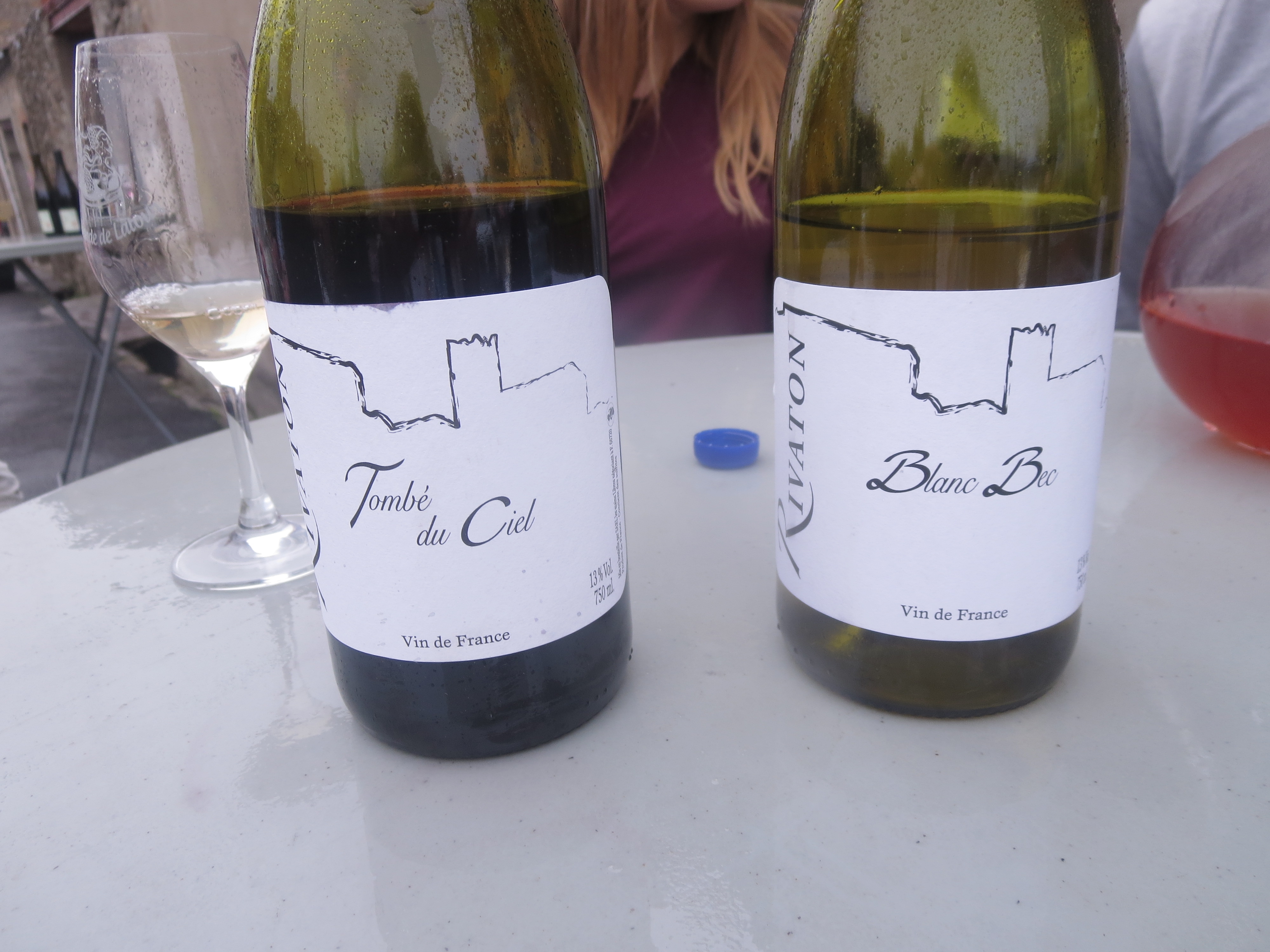
Frédéric Rivaton presented a very good white wine, Blanc Bec 2014 which was full flavoured, fresh and balanced the Carignan Blanc, Grenache Gris and Maccabeu beautifully. The rosé was mainly Grenache and the best of his wines today, lovely aromatics of red fruits matched by full, almost textured, flavours. Very good. I liked the red Gribouille too, showing a lot of depth and complexity. I liked Rivaton wines when I have tasted them before but they seemed to be much more complex and interesting today, more purchases.
I don’t remember tasting DomaineMathouans wines before, I certainly have no notes, and that is my loss. These wines were very well made with lots of fruit but also much more complexity behind the fruit. Light tasting but structured, easy to drink but with real depth and interest. The orange wine Mine De Rien 2014 made from Muscat Petits Grains had lovely muscat aromatics (plus a little reduction which disappeared in glass), but was dry, clean and not overly concentrated as some orange wines can be. Fresh and clean, very well made. Assureté is a blend of red grapes which are complanted in the vineyard and vinified together. Full, fruity and very good – my question is why on earth did I not buy some? My mistake. And again with Le Bon, Le Brut et Le Carignan which was aromatic, red fruits with deeper black fruits behinid, very complex but always fresh and balanced. Aline Hock is clearly a very talented winemaker, I intend to find out more about the domaine.
Renaud of Domaine Mathouans, a convincing advocate for the wines
Jean-Louis Tribouley‘s wines have always appealed to me. Today we only tasted the red wines, which was a shame as I love his Grenache Gris. They were all good wines, however, I have to single out Mani 2012 made from young vine Grenache, Syrah and Carignan which was sweet, ripe and very good. Another I wish I had bought.
My other favourite wines came from outside the area.
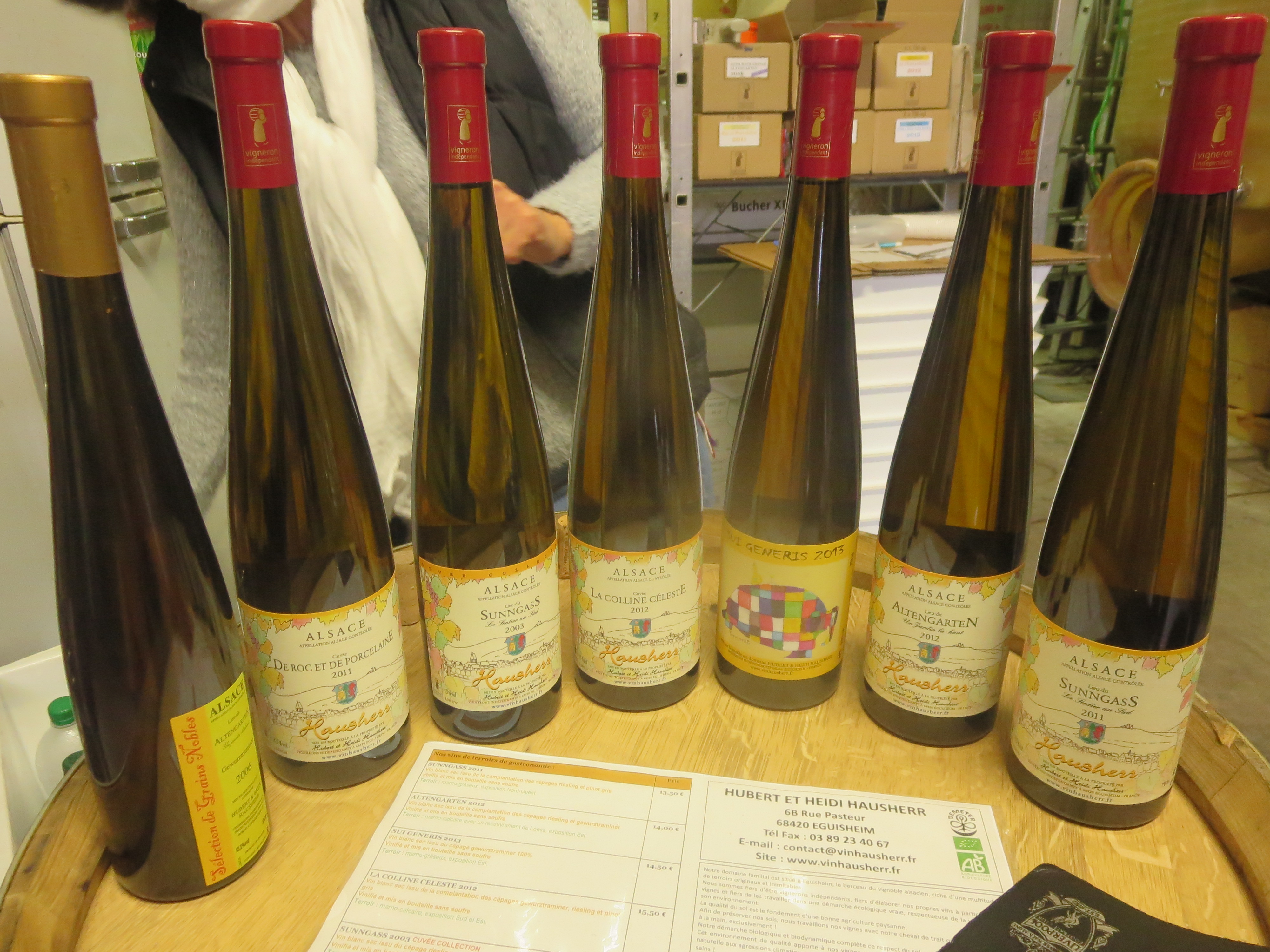
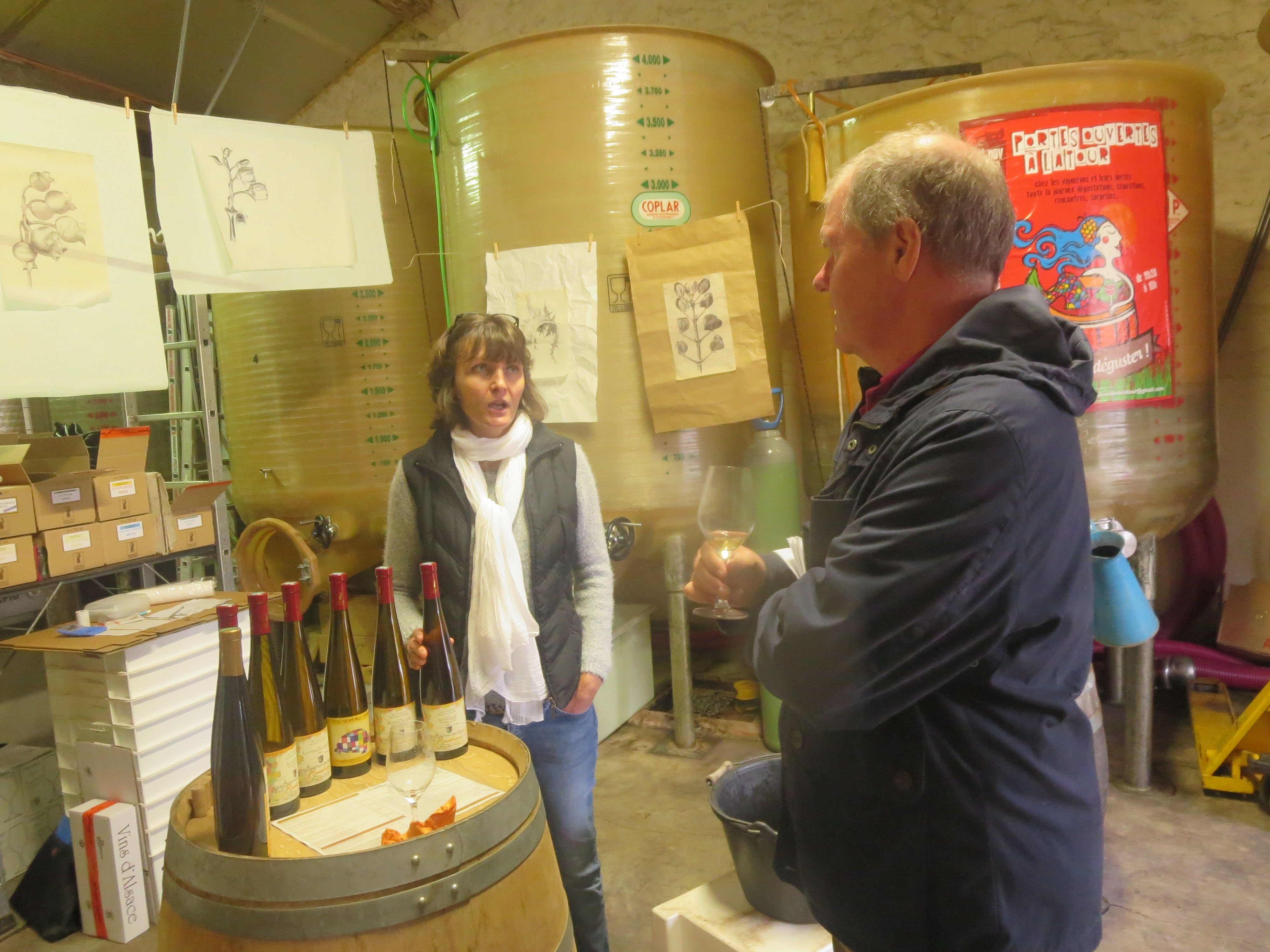
I was taken by the wines of Domaine Hausherr when I met them in Montpellier in January. Despite their long journey to Latour the wines were equally good today. Hausherr like to express their vineyards rather than single varieties as most Alsace producers do. Therefore, wines such as Altengarten are a blend, in this case Riesling and Gewurztraminer. They are wines with full, ripe aromatics hinting at sweetness but in fact they are very dry and expressive, really delicious. La Colline Celeste 2012 was my favourite of the dry wines and I also really liked Roc Et Porcelaine 2011 which was made from the same vineyard but with more residual sugar kept to add a touch of sweetness. Sungass 2003 was also very interesting, the hot summer of 12 years ago but the wine was fresh and dry, pure Riesling with petrolly notes.
Talking to Heidi Hausherr
L’Ostal is in Cahors, a small and youthful domaine run by Louis Pérot. The Malbec grape can be tough and often needs aging but Louis has made different styles of wine using, for example, carbonic maceration. There is still a classic Cahors, Plein Chant (2013 bigger than 2014) but I really enjoyed Anselme 2014 which was full, rich but velvety and very good. Similarly Le Tour (not Latour) was bigger than many of the wines but retained a freshness and fruit character. I was happy to buy both of these and enjoyed the other wines too. Particular thanks to Louis who replaced a bottle I broke on the way out, my fault and he didn’t need to, it was much appreciated.
I’d also like to add Axel Prufer of Temps Des Cerises to my recommendations. The Chardonnay Peur De Rouge 2013 was very good, this is a wine which is coming into its own and Axel confirmed it needs a year or two to do so. His red Fou du Roi 13 was also very good but the Chardonnay was a real treat.
So a great day, lots of music, choices of food (including vegetarian!) and a good atmosphere despite the gloomy weather. There were my favourite wines, there were others too from Domaine Sabbat and the very promising new domaine of La Bancale.
Enjoyed talking to Bastien Baillet of La Bancale, a domaine to watch
I do think natural wines are moving on and improving still further and La Bande de Latour provided me with plenty of evidence to support me. As I said I shall be coming back to the whole natural wine debate soon.
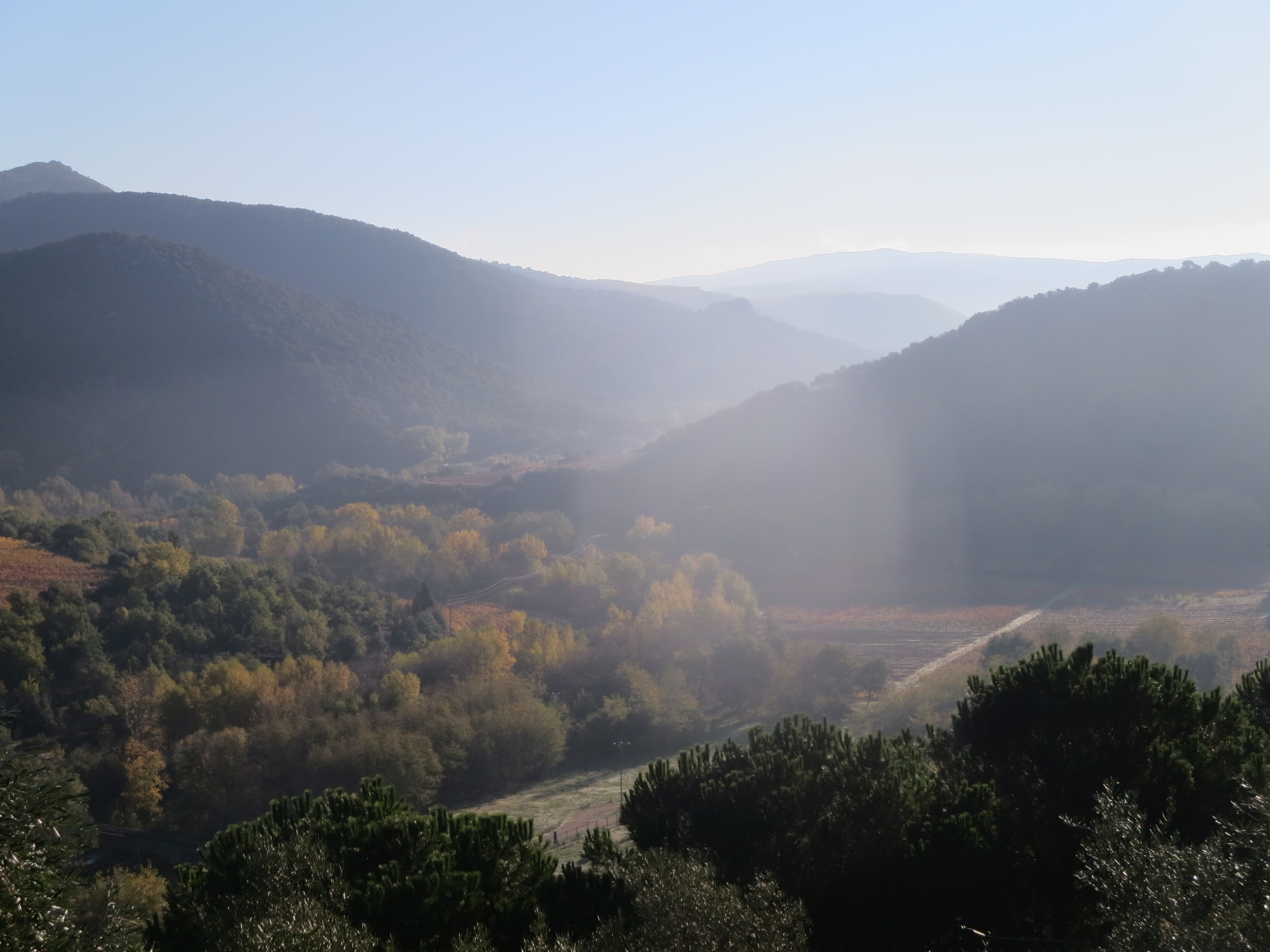
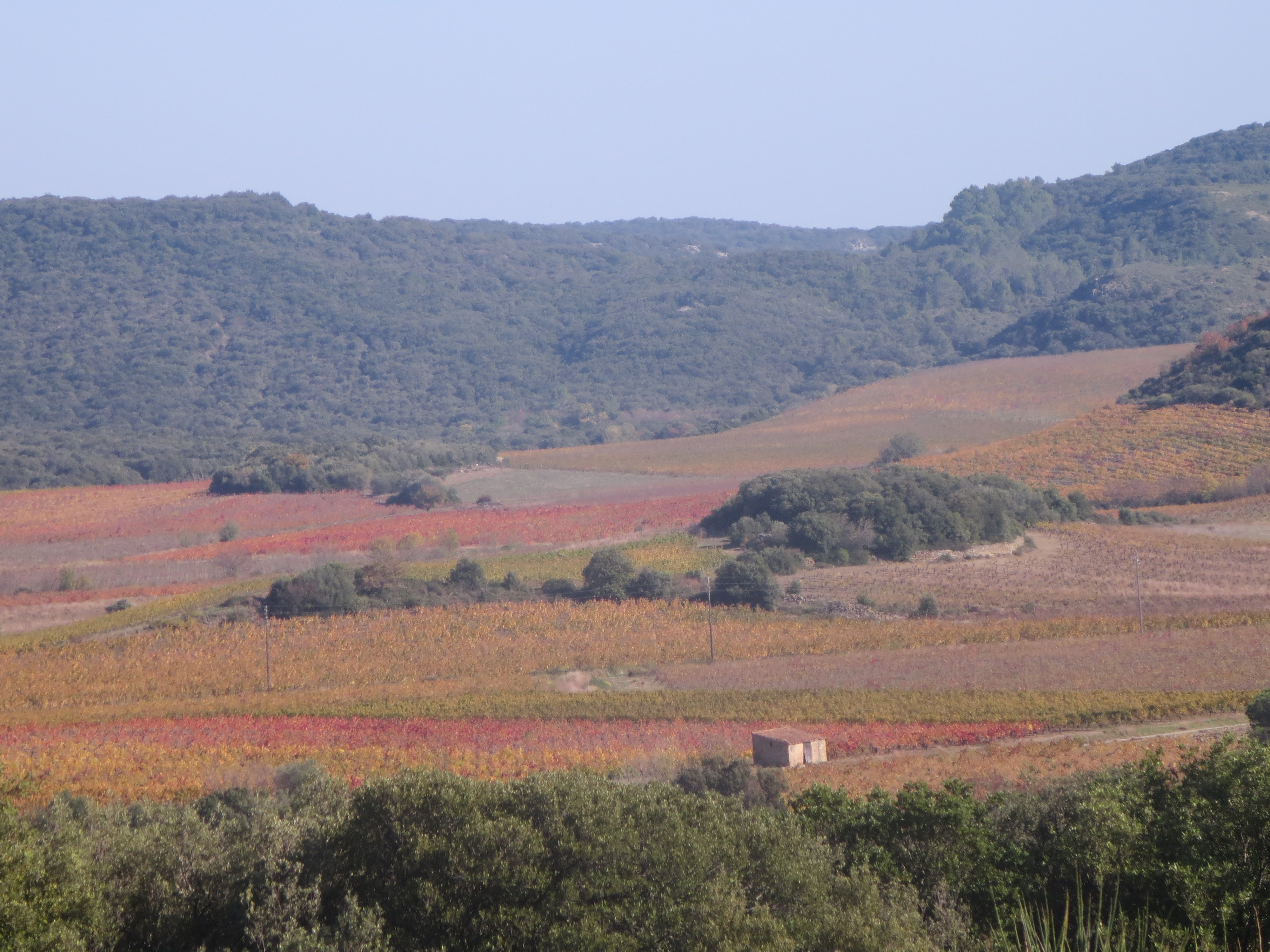
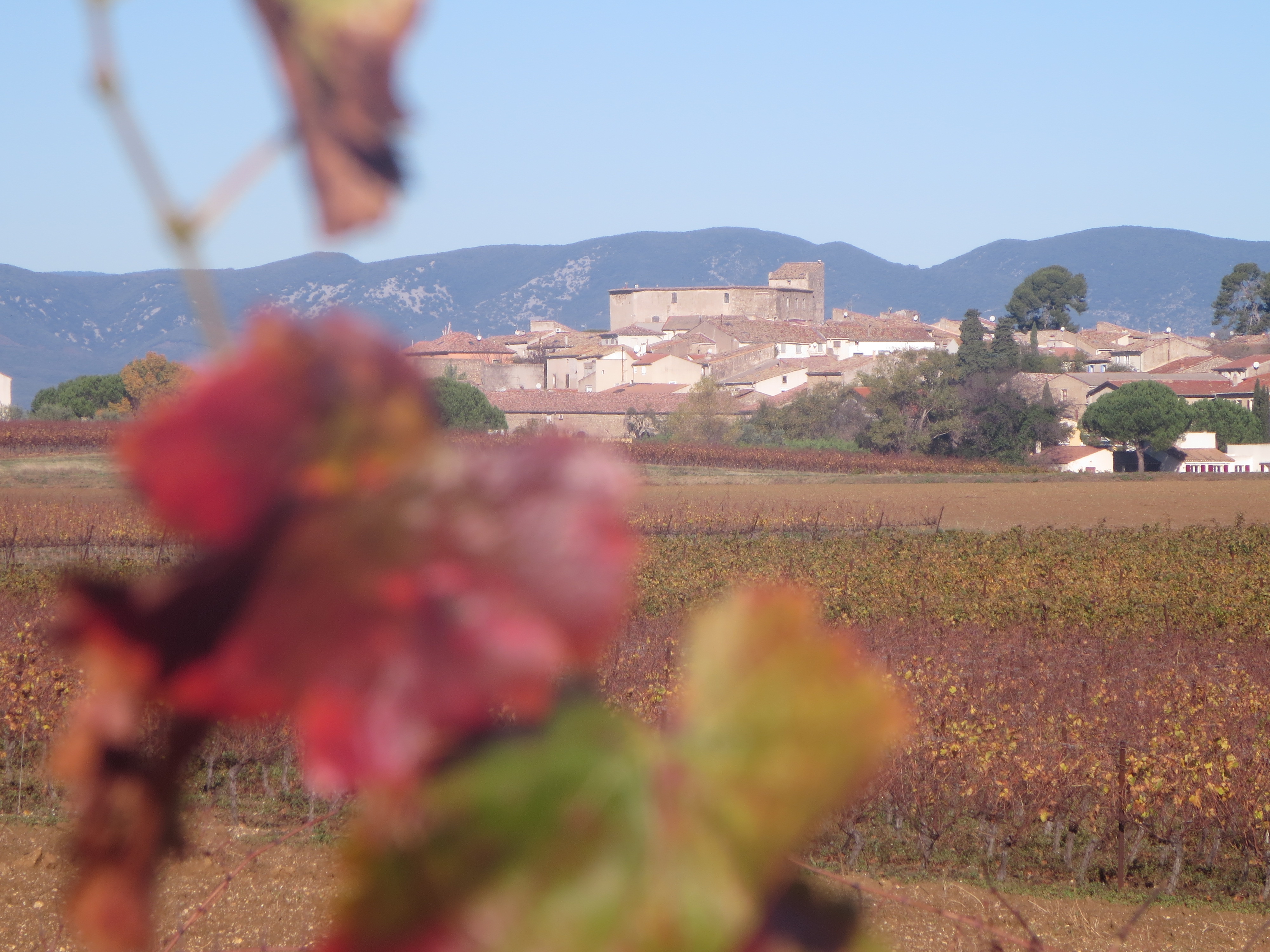
Autumn is often a melancholy time as the days shorten, temperatures drop and the first signs of winter approach. And yet 2015 in the Languedoc has seen a most untypical autumn. Last week the warmest November day ever was recorded and we have enjoyed blue skies, warm sunshine and hot afternoons, 26°C has been regularly seen on our garden thermometer. The resulting sunshine has produced the most breathtaking scenery, with colours across a wide spectrum of autumn. As I wrote on the Out And About page, every time you turn a corner there is another heart stopping view.
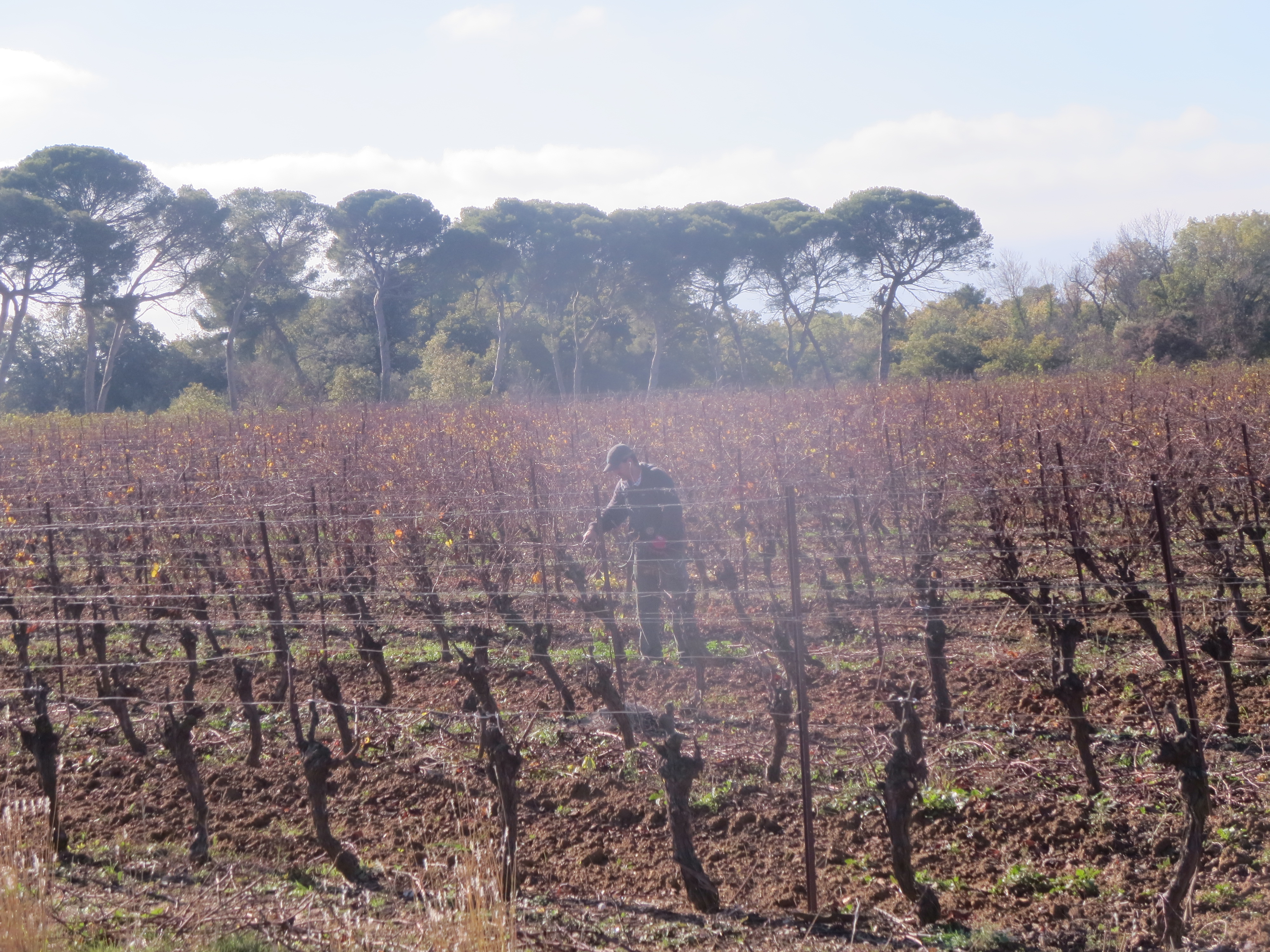
The vines are now closing down, preparing for winter. Their fruit has gone except for a few overlooked grapes which the birds, wasps and insects have been enjoying. Their leaves are shedding and the skeleton of the vine stands out again for the first time since early May, their form revealed, cordon or guyot for example.
First taille of autumn 2015, guyot vines
Indeed, some vignerons have actually started to prune again ready for 2016. I suspect they are working to a pre-prepared timetable as the vines have been slow to lose their leaves and still show some life. At Mas Coutelou the taille will not take place until next year and most top vignerons will leave it until then, just before the growing season. The extra wood helps to protect against frosts for example. Some vignerons are starting to cavailloner, in other words to move earth from between the rows of vines towards the plants themselves, the extra soils will again act as a blanket against the frosts.
Puimisson basks in autumn sunshine
Dew on some Grenache Blanc grapes left behind in Rome
Other jobs remain to be done. After the months of busy vineyard work and harvest it is a time for sending wine to be sold. Pallets have left Puimisson to cavistes and restaurants around the world. Last Friday, November 6th, they set off to Germany, Finland and various regions of France. More have already gone to New York, London, Melbourne amongst many cities.
The season of salons has started in earnest too. This weekend I was in the Roussillon for La Bande De Latour, highlighting many of the best natural wines of the Roussillon and elsewhere.
The following day I was in Autignac for a tasting of some of the best Faugères wines and also their fines or brandies. I shall post about these soon. I was talking to the excellent Hausherrs, vignerons who had driven to the Pyrenees from Alsace for La Bande, a long, long way. Hard work.
In the next few weeks Jeff will be starting to assemble the wines for the main cuvées of 2015, the likes of Classe and Vin Des Amis. Decisions to be made about what proportions of which cuves to blend for the wines. Sadly, I shall miss this process as we head back to the UK for a wedding. Into every life a little rain must fall.
It has been a beautiful autumn, the weather and the vendanges have made it a magical time. Thanks as ever to Jeff for allowing me to share the experiences and insights of the season.
Messrs Coutelou, Aubry, Poujol, Bellahsen and Prufer
On October 8th a group of vignerons paid a visit to Domaine Vassal in Marseillan Plage, I was happy to be invited to join them. The visit boosted my growing interest in ampelography as well as being great fun, of which more later.
Domaine Vassal was founded in 1949 and is the largest collection of resources about grapes and vines in the world. Its own roots (apologies for the pun) lie in a collection gathered in Montpellier University after the outbreak of phylloxera. This was the disease which almost wiped out the wine industry in France when it arrived in 1863. It is the work of an aphid which lives in the roots of vitis vinifera the original vines of France and Europe including the cépages with which we are familiar such as Chardonnay, Syrah and Cabernet). Sadly, this aphid arrived from the USA, via England (those Anglo-Saxons!), and ate its way through France’s vineyards. Montpellier started to conserve vitis vinifera and to study it and found the cause of phylloxera by doing so. It was also discovered that American rootstock was resistant to the aphid so, by grafting vitis vinifera onto American rootstock, vignerons could grow the traditional cépages rather than hybrid vines of lesser quality.
The other feature noticed about the aphid was that it could not live in sand and so the decision was taken to transfer the collection from Montpellier to Marseillan, Domaine Vassal’s grounds are sand. This means that the vines which are grown there can be grown directly from the sand, no grafting onto American rootstock is needed. Since 1949 some 14,000 species of vine have been collected together.
The sands of Vassal
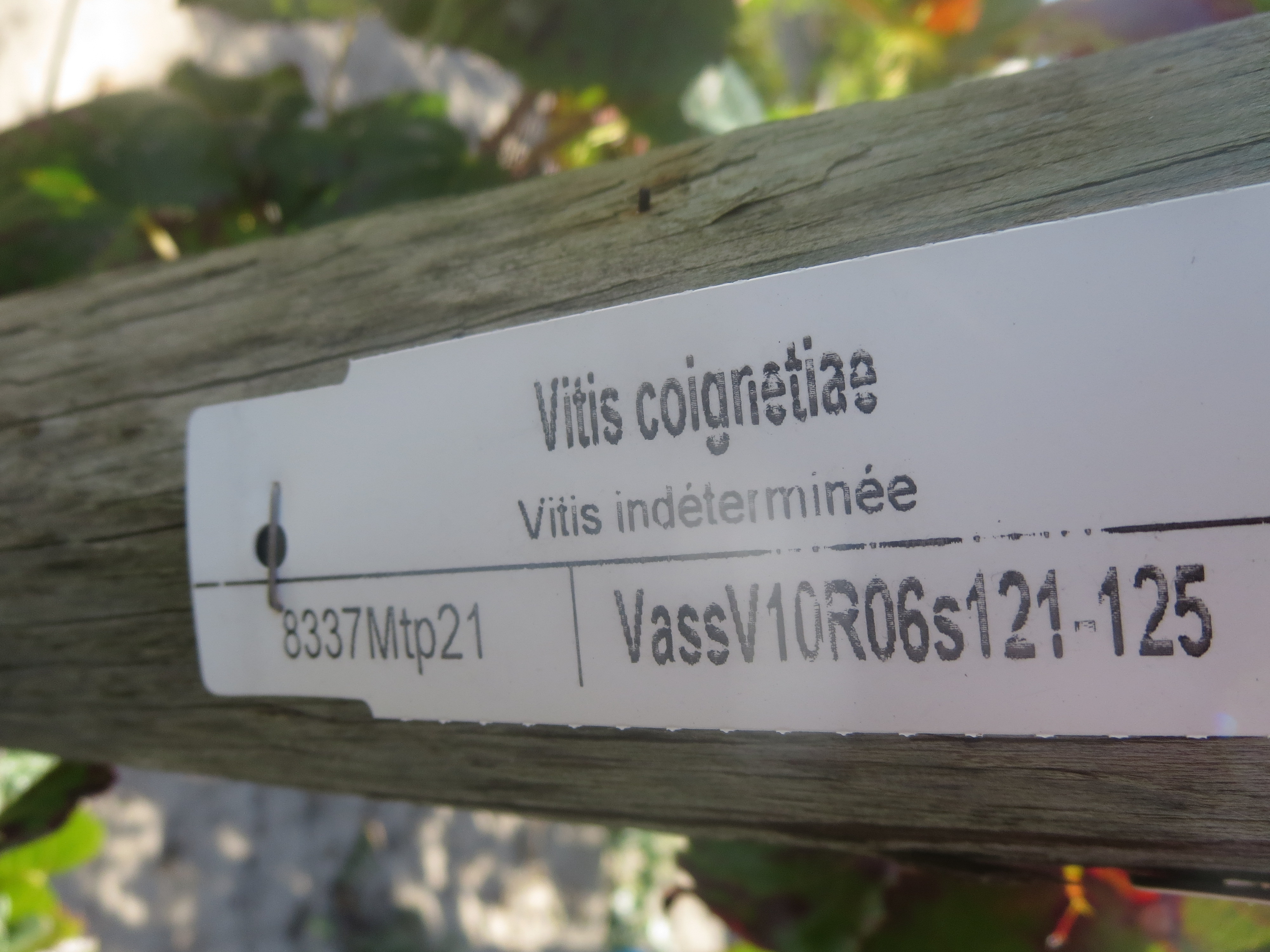
Genetics now means that they can be identified more accurately and 7,700 species remain, many of the species having been shown to be doubles. Cépages are frequently called by different names in different parts of France let alone different countries so it is easy to think of cépages as being different when in fact they are the same. (For example, Cinsault has over 40 different names around the world according to Pierre Galet’s authoritative Dictionnaire des Cépages.)
The aim of Vassal is to:
Acquire
Conserve
Classify
Valorise (ie develop and show the worth of the vines)
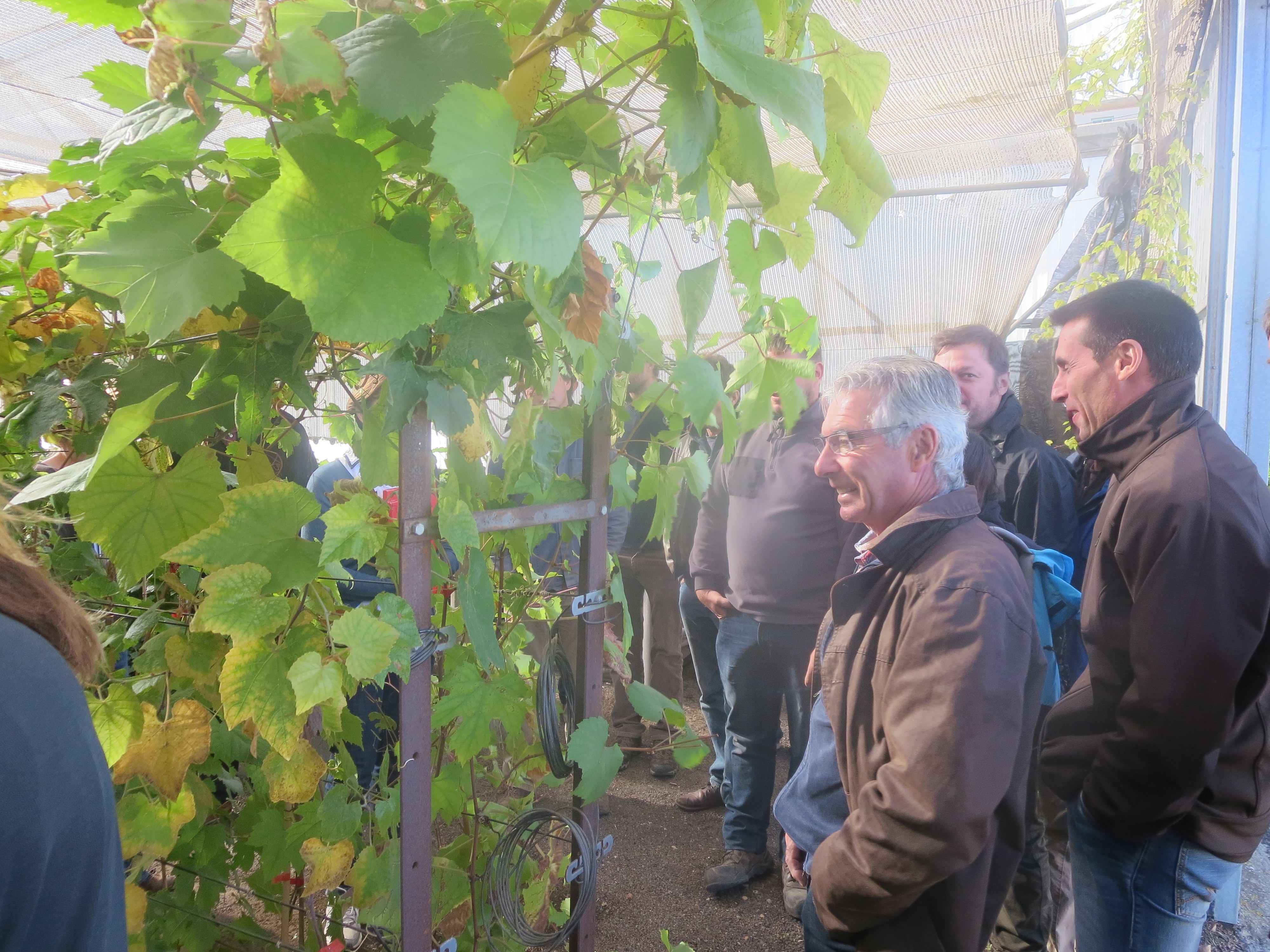
The Domaine receives donations of vines every year, five examples are required for each arrival. Last year there was a higher than average number of arrivals (up to 900 plants), indicating that new varieties are still waiting to be added to our knowledge. Researchers also go out to old vineyards to see if other vines can be found. These acquisitions are then planted. At first they may be placed in insect proof greenhouses to protect them and to be nursed.
The plants are then placed on one of the fifteen parcels of land at the Domaine which covers around 27 hectares. Most of these are vitis vinifera but there are also hybrids, wild vines and rootstocks.
Hybrid
The vines are studied carefully by genetics and by identification through the leaves, grapes and other features so that they can be classified as new or doubles of already recognised vines. Samples of all aspects are taken and preserved in files to make a unique collection which is being digitised. Further studies look to reveal how the cépage might be best grown, what yields it might offer, would they be commercial?
Hybrid vines with waxy leaves
With so many vines there are losses, but very few, and replacement plants are grown in the nurseries, almost 6,000 were planted last year. This is a vast undertaking and a hugely valuable resource. Vignerons are encouraged to visit and see whether they would like to trial some of the cépages in Vassal, trials which will run with a few plants and over 3 years.
Joe Jefferies takes an interest
Jeff Coutelou is keen to do just that and is looking at what cépages might mix well into the array of different vines which he already grows. Indeed, when talking with staff at Vassal, he discovered that he might have one or two cépages which are not in their collection! This could be mutually beneficial.
Remi Poujol and Francois Aubry amongst the vines
It was a fascinating place to visit and I applaud the work of Domaine Vassal. Unfortunately there is a cloud on the horizon, the collection is going to have to move. A site has been identified at Pech Rouge near Gruissan but every vine will need to be transferred and, as the new site will not be sandy, will also have to be grafted. This is a massive undertaking which will take a few years to accomplish and the staff are determined that no species will be lost. The professionalism and skill I see at Vassal will be tested, I am sure they will pass that test.
Messrs White, Poujol and Maurel
After the visit the vignerons decamped to the nearby beach, a fire was lit and a barbecue enjoyed. Accompanied, of course, by examples of many excellent wines appropriately from many cépages. There was no cloud on the horizon here. As well as Mas Coutelou there was Mas D’Agalis (Lionel Maurel), Fontedicto (Bernard Bellahsen), Julien Peyras, Grégory White, Yannick Pelletier, Fontude (Francois Aubry), Le Temps Des Cerises (Axel Prufer), Remi Poujol, Bories Jefferies (Joe Jefferies), Clos Fantine (Olivier Andrieu). In other words the great and the good of Languedoc natural winemakers. It is interesting to see that this group is to the fore in promoting and conserving old and rare cépages, a natural fit.
For a fuller account of Domaine Vassal’s work read this article by Ken Payton.
Soutirage? It’s where you take wine from one container and move it to another. Traditionally this was done from barrel to barrel by gravity but these days it applies to moving the wine by other methods too. Why? Well the wine has been fermenting on lees, the dead yeast cells and other parts of the grapes. The wine needs to be removed from these as they cause cloudiness and you don’t want to drink wine full of lees. The lees can also cause off flavours in the wine so once they have served their purpose in helping to ferment and flavour the wine in a positive way they need to be separated.
All pumps to the full
By moving the wine you also add oxygen to it and remove the risk of carbon dioxide building too much in the cuve which might cause issues such as reduction, a wine fault leading to odours of rotten eggs, rubber, struck matches or worse. That oxygen acts as a kind of inoculation too, a little bit helps to reduce the risk of wine oxidising later.
Julien checking the level of wine in the recipient cuve
Therefore, on Friday 30th October, Jeff decided to carry out soutirage. Also, as the weather has been very warm they will continue to ferment a little longer in their new home before the colder weather does arrive. This means that there will still be some CO2 in the wine. Too much is bad but a little is good and this is the core of winemaking – finding the balance between all these different pros and cons. CO2 in small quantities helps to stabilise a wine and makes not using SO2 easier (important at Mas Coutelou) and also adds a little freshness and sense of texture, possibly a sense of acidity too. Oxygen, carbon dioxide, lees – you want to get just the right amount but no more.
Cuve being emptied to another
What this did mean was more planning and more of the puzzles of what wine goes where. My last post showed how complex this is. And here we bring in the surchargé part of the title. Jeff has had a busy week with lots of paperwork, orders to sort, bottles to label, package and get ready for sending out to cavistes around the world. Add in administration work for customs, taxes and many other agencies. The side of being a winemaker that people don’t really see.
Same wine before (left) and after (right) soutirage, there was a noticeable difference in taste
I went to the vineyards on Thursday to take some photos of the beautiful colours in the vine leaves, unexpectedly I found Jeff in Peilhan digging out cannes de provence near a stream with a pick. He said this was his break from the paperwork, he needed some fresh air.
Looked like more hard work to me, and people ask me if I would not want to become a vigneron!
Please note that I have updated the Out And About and Tastings pages recently, click the links at the top of the page to see what’s been happening.




























 Top of the podium was undoubtedly Cyril Fhal of Clos Rouge Gorge. His vineyards are high in the hills, gobelet and exposed to the elements. Cyril is a master of Carignan and his wines are relatively expensive though not by comparison with the likes of Burgundy or Bordeaux, and his wines do bear comparison with top class wines. The Carignan was very good indeed, long, fresh, deep and balanced. However, it was the Blanc, made from Maccabeu which really captured my imagination, one of the best wines I have tasted in 2015. It starts zesty and fresh and then the oak adds a little roundness, coating the mouth with spicy notes but always clean and refreshing. Beautiful wine, brilliant winemaking. I happily bought both wines.












 amarchinthevines