After almost three months away it is good to be back in the Languedoc, and especially to be back in Puimisson, the home of Mas Coutelou. Jeff and Icare greeted us warmly and it didn’t take me long to get back into the vines.
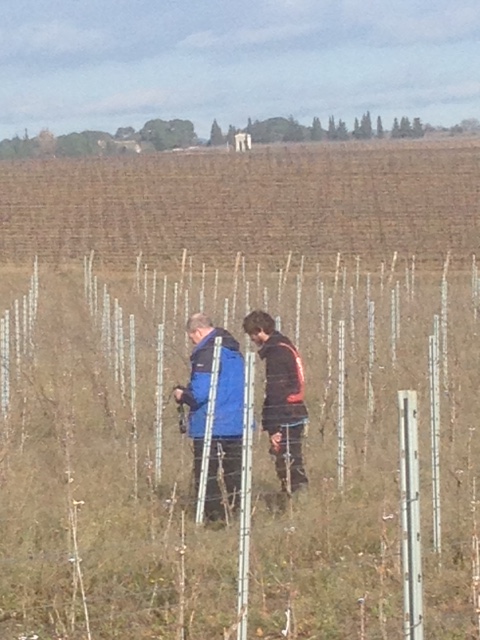
Carole and Julien were hard at work pruning in Rome vineyard, my favourite of all, I was happy to see them all. Fortunately, the day I was there (24th January) was a lovely, sunny afternoon and quite warm but recent weeks have seen freezing temperatures overnight and pruning on such mornings is brutal. However, it is vital work.
Dead vines removed, their place ready for new ones
The vine needs to be trained for the season to come, cutting away dead wood and restricting the growth of the vine so that it is does not overproduce which would reduce the quality of the wine. Pruning also offers the opportunity to check the health of each vine and to identify vines which need to be replaced.
The vine is studied, first cuts remove the growth of last year and then decisions made about which branches to remove and which to leave as spurs, which direction the growth will take and, also, about which spurs might be prepared for the following year too. All with freezing fingers and aching back.
Much work had already been done but much remains ahead. In the photos below the Grenache of Sainte Suzanne has been pruned but the Syrah remains to be done. Similarly, the reds of Peilhan are pruned but the white parcel remains to do.
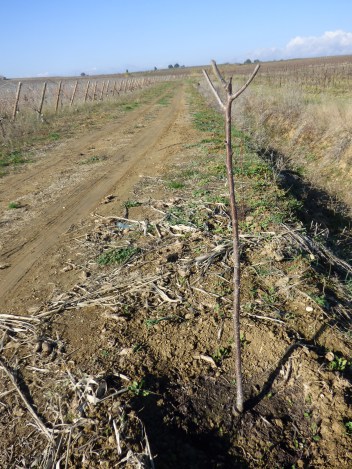
Work has also begun on preparing a parcel next to Sainte Suzanne which has remained fallow for a few years giving recovery to the soil. Known as Théresette this parcel will be planted with Aramon (Noir and Gris) which is what used to be planted in this parcel many years ago and which was well suited to the soil.
The ‘new ‘ parcel under preparation. La Garrigue in the background.
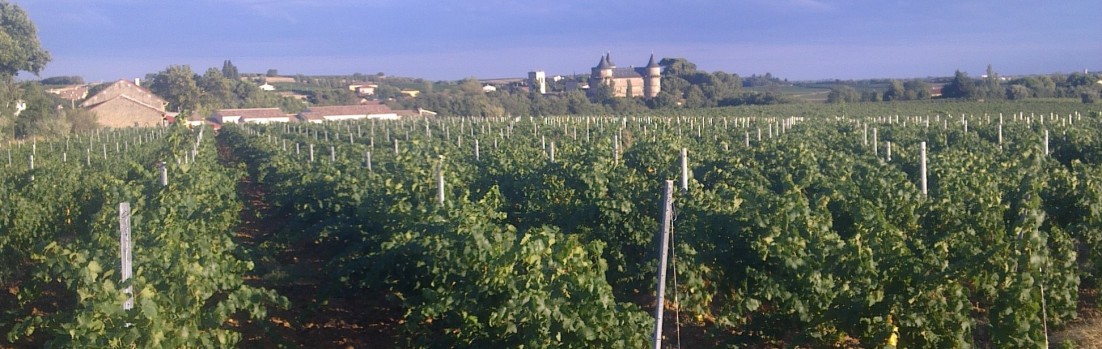
The winter also offers the chance to see the bare vineyards and their topography. When people talk about the value of a particular parcel or vineyard it is easy to overlook how even within a small area there are variations of slope and gradient which would alter drainage and exposition to the sun. Vines are all different even within a parcel and the pruning process treats each vine on its own merits to help it to produce the best fruit it can.
Syrah of La Garrigue
Flower Power
Peilhan
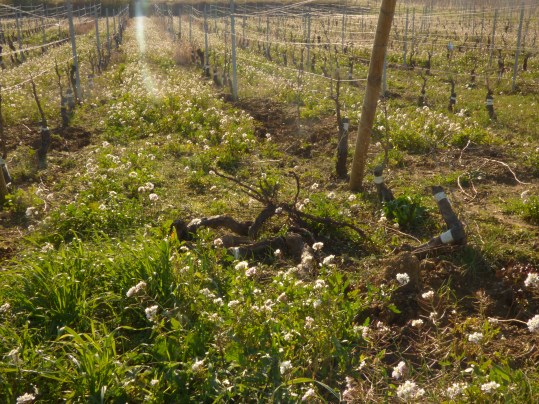
The vineyard soils are covered in white this January, not with snow, not here in the Languedoc at least. The white flowers of wild rocket form a spectacular blanket contrasting with the stark wood of the vines themselves. Even in winter there is something special and beautiful about being in this place, a march in the vines is so fulfilling.
“When all the parts of the puzzle start to look like they fit Then I must remember there’ll be days like this” (Van Morrison, Days Like This)
l-r, Morgane, Jeff, Julien, Thierry, Michel, me, James, Howard
As we approached the end of vendanges a number of the team were moving on. It was an inspired move to have a farewell day, picking, tasting and celebrating together, though we were already missing some like Charles, Carole and Maylis.
The morning dawned over Peilhan and the vineyard which we planted in March 2015. Rows of Terret Blanc and Noir, Riveyrenc Gris and Noir, Piquepoul Noir and Morastel produced grapes this year. They cannot be used in major cuvées sold to the public as they are too youthful. However, Jeff decided to pick them to make something for himself out of interest. So, on a bright, warm autumnal morning we gathered, picked, chatted and laughed.
Terret Blanc
Piquepoul Gris
Riveyrenc Gris
Piquepoul Noir
Morastel
Meagre Terret Noir
Interesting to see how some varieties produce more than others already, more precocious perhaps, the Terret Noir being especially shy. Altogether we picked around six cases only but there was a real mix of colour and some nice looking fruit which went into a small cuve in whole bunches.
Howard
James and Julien
Later that day we gathered again, this time in the main cellar along with Thierry Toulouse, Jeff’s oenologue. We tasted through the whole range of 2016 wines in cuve before heading to a local restaurant for a meal. The results of the tasting were fascinating. Clearly, they are in a stage of transition, fermentations still progressing. Nonetheless the wines were already showing their character. I won’t go into too much detail here, though I did take notes to help me record how the wines change in coming months.
Me, Thierry and Priscilla
Priscilla, Morgane, Jeff and Julien
l-r, Morgane, Jeff, Julien, Thierry, Michel, me, James, Howard
In summary though I was amazed. I have said many times on here how difficult this year has been. A very warm winter, drought, mildew, delayed summer being just some of the problems. Yet here we tasted some lovely fresh fruit, lively acidity and other promising signs. I would mention the Carignan Blanc, lovely Syrah and Grenache from La Garrigue, juicy Mourvèdre and in particular the wonderful Carignan Noir of Flambadou. All those puzzles which Jeff had to hold in his head about harvesting dates, moving wines, possible assemblages etc, well those puzzles were solved in the glass. I had expected some disappointments but somehow Jeff has conjured some potentially top quality wines.
2003 Roberta
At the end of the current wines Jeff also shared a 2003 bottle of white wine based on Grenache Blanc, Noir and Gris, called Roberta (it’s a long story!). This was one of three cuvées which were the first that Jeff made sans sulfites. Yet it was complex; fresh, fruity, nutty. A wine which made my heart sing, proof that SO2 is not required for ageing wines as we are often told. Perhaps in 13 years time we shall be tasting the 2016 wines and marveling at them too.
A fitting way to close the vendanges period, a team rightly proud of what it had achieved.
“When all the parts of the puzzle start to look like they fit
Then I must remember there’ll be days like this”
Thursday, August 11th was the last day before Jeff shut up shop for a few days as he does every year to celebrate the Béziers Féria. A few days of rest and recuperation before the preparations really start for the vendanges. As he had received a number of requests for visits Jeff decided to group them all together and have a tour of the vines and tasting with lunch.
Visitors from Grenoble, Orléans and Nanterre assembled at the cave along with my friend and sommelier Sandra Martinez and we set off around some of the vineyards. Jeff explained his philosophy and vineyard work and it’s worth repeating a couple of points of note. I mentioned the problem of vers de la grappe a few weeks ago which Jeff treated with a spraying of clay to discourage the moth from laying its eggs. We found a bunch in La Garrigue which was affected and Jeff opened it up to reveal the cocoon of the larvae.
Vers de la grappe cocoon
He also explained how bats are the ideal solution and why he provides shelters, each bat would eat around 2,000 insects a day including the moths responsible for vers de la grappe.
Grenache
Castets
Clairette Musquée
We also looked around at the majority of vineyards and their dark green colour at a time when the vine is putting its resources into the grapes to get them to maturity, as that is how they reproduce. So, in a natural state the leaves start to look pale and tired as the vine is not channelling energy into the leaves. The dark green, attractive vines are so coloured because of the nitrogen feeds and, in some cases, irrigation.
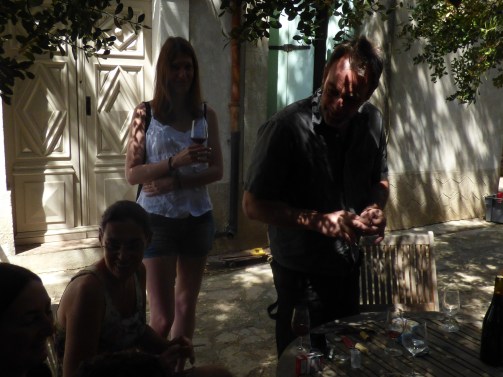
We returned to the domaine where we were joined by a group of wine professionals. In the garden we tasted a range of Mas Coutelou wines as well as some lovely salads and (for the carnivores) some charcuterie.
Jeff leads the tasting accompanied by his sister and niece
The list of wines shared, all from 2015 except the last, was: Bibonade (rosé and white), Peilhan Blanc, Maccabeu, OW1, 5SO Simple, Sauvé De La Citerne, On Peut Pas Vraiment Dire Que, Classe, La Buvette À Paulette, Flower Power, Flambadou, L’Oublié, Devigne Qui Vient Diner, 5J
I missed the Bibonades and Peilhan as I was getting the Maccabeu from tank. I had a bottle of Peilhan at home recently though and it was lovely, really strong evidence of the quality of 2015. All apples and pears and fresh acidity with a long finish. Even by Coutelou standards it is an exceptional wine.
Maccabeu
The Maccabeu is, if anything, even better. Cooked apple and cinnamon flavours, fresh acidity, almost smoky. There is so much going on here and, as the jug I collected the wine in was in front of me, I kept being drawn back to it through lunch. The wine changed and opened out with more fruit and spice. This will develop beautifully when it is bottled, a stunner, my new favourite.
OW1 is Jeff’s first skin contact wine. He was reluctant to join the trend and didn’t want an orange wine but this spent plenty of time on skins, I remember Cameron and I carrying out a manual pigeage. Now bottled the wine has texture and tannins from that skin contact but there is plenty of fruit and remains balanced and fresh. Very good.
Manual pigeage of OW1
5SO was on good form. The boisterous, chatty group became quiet for the first time, captured by its fruit profile and drinkability on a hot summer’s day, which essentially is what it was designed to do.
Citerne was one I didn’t have last week and it had been some time since I had tasted it. It showed well, the Mourvedre adding a real plummy depth. Another wine which will emerge in coming months, another to look forward to. OPPVDQ was on great form, another to quieten the crowd. It confirmed my opinion that this is a wine which will really benefit from some time in bottle, hang on to some if you have them. La Buvette À Paulette was last week’s big surprise and another bottle confirmed the pleasure, really showing its quality.
Flower Power not yet properly labelled. What a colour!
Flower Power took some time to come around but now that it has done so I can confirm that this will strengthen the reputation which it earned in its first vintage in 2014. The vineyard is still young and will continue to improve the wine it delivers, if the snails leave it alone. The ten grape varieties give a complex story of light and shade, red and dark fruits, floral and sappy.
Flambadou was once again a star, showing the lightness of touch in this Carignan. Jeff describes it as like a Pinot Noir. There is depth and character packed into quite a light structure. The vineyard has a light layer of limestone beneath the fine clay and it is this limestone which adds the complexity to the wine. A grand cru of Carignan.
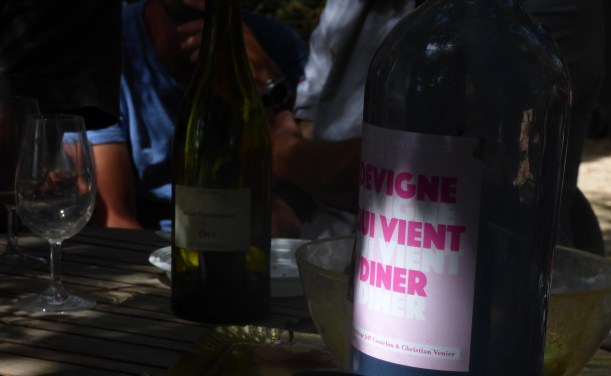
L’Oublié and its story once again captured the imagination of everyone, its secondary flavours beguiling the tastebuds. Devigne Qui Vient Diner is the wine which Jeff made in partnership with Christian Venier from the Loire, Gamay added to some Languedoc grapes such as Cinsault. My, this has improved with a few months in bottle (magnum), really delivering a rounder more harmonious blend with zappy fruit and lovely sweet fruit.
Finally 5J the Grenache Gris from 2012 aged in barrel made to reflect a Spanish fino to accompany the best hams. Oxidised notes, barrique notes and a flash of clean fruit, quince and apple.
A great day, much longer than most were expecting but nobody showed any signs of fatigue or willingness to depart. Many joined us in the cave des soleras to taste some of the old wines there. And poignantly, some wine of Jean-Claude on what would have been his 80th birthday. His legacy will live on.
I enjoyed reading the Facebook post of one of the visitors Benoit who described Jeff as a magician and an artist. The day was a success.
Any excuse to include some Bowie who is producer and piano player on the song which is also one of Jeff’s favourites.
Michel on top form
March 3rd was the last full day of the Spring bottling period and it was pretty much a perfect day in Jeff’s own words. The day was clear with high(ish) air pressure which is better for bottling and in the biodynamic calendar it was a fruit day with a descending moon, perfect too.
Checking the weather
The only snag was the late arrival of the magnum bottles despite being ordered some time ago. So, things started over an hour late, bottling magnums and jereboams of Vin Des Amis and a new Syrah cuvée.
Magnums
I had always assumed that a magnum being simply 150cl as opposed to the single bottle 75cl would be cheaper to produce, a bulk saving. However, the bottles are naturally more expensive, being produced in smaller quantities and they are filled by a slower machine rather than the usual bottling line. This takes more manpower too. So a magnum and other large formats do cost more, jereboams also need a larger cork. I like these large bottles, not just because there is more wine (good for groups of friends) but also the wine ages more slowly.
Jereboam corks
In place
Carton of jereboams
We had a relaxed lunch in the cellar, cheese, canned fish and charcuterie, the latter for Jeff, Michel and Julien. Naturally a few bottles were opened for quality control!
In the afternoon it was back to the main bottling line, helped by Catherine, for the Syrah cuvée and the new white wine from Peilhan vineyard, made from Carignan Blanc and Grenache Gris. The Syrah is lovely, I remember during the vendanges that the tank caused some of us some concern but Jeff always believed in it and …. he was right. Lovely dark fruits, fresh, mineral and long – almost as good as La Vigne Haute which is praise indeed.
Michel
Julien
The Blanc was, perhaps, even better for me, bright apple and pear flavours, very mineral, clean and pure. I do believe 2015 will produce some great reds from Mas Coutelou but that the white wines, often in the shadow, will emerge to take their place as stars in their own right. Jeff is confident that the Maccabeu is even better, there’s a long maceration blanc too. I have tasted them both and they are lovely wines in the making.
We didn’t finish until after 8pm, it was a long day but we had great fun, lots of laughs, great teamwork as well as the hard work. The bottling has been a success, the 2015s are proving to be even better than we thought – a perfect day.
Hand corking the jereboams
Lots of cleaning as always
How much is left Michel?
Then just as I thought days could hardly get much better, along came Tuesday, March 8th. But you’ll have to wait for that report in a couple of days.
It’s been a few weeks since I updated about events at Mas Coutelou, partly due to Millésime Bio and, partly, because it’s a relatively quiet time. That is not to say nothing has been happening, far from it.
Maccabeu 2015
Flower Power 2015
Millésime Bio and Le Salon des Vins De Loire are two huge events in France attracting many thousands of trade visitors. As you have seen with Millésime Bio these salons also attract satellite events and Jeff takes part in those. Les Affranchis in Montpellier and La Dive Bouteille in Saumur last two days each and so adequate samples of the wines need to be prepared, transported and poured for guests to taste. Those events alone take about 7 days of the last month. I know from feedback from various people who sampled Mas Coutelou wines at both events that they enjoyed the wines which were samples from cuve (tank) of the 2015 cuvées such as Vin Des Amis, Classe, Syrah, PM Blanc and Flower Power. Hopefully the salons will spread the word about how good they are, the elegance and finesse of the vintage is obvious as you taste it.
Bottles of the 2015 wines made specially for the salons
Those visitors were also presented with Jeff’s annual Carte Des Voeux, his new year greetings card, together with his summary of the last year’s events, weather, vintage and cuvées. The Carte’s original is printed by hand and this year’s was especially complicated to print because of the different colours used. The message is worth the hard work.
For the last several weeks pruning (taille) has continued. Julien is leading the work this year and his back must be getting sore by now. It is hard work! The importance of good pruning should not be underestimated. It maintains the health of the vines, removing damaged or sick wood. It reduces the number of canes which will grow grapes so that the vine’s energy will produce quality rather than quantity, probably reducing potential yields by half. It also shapes the vine so that future work such as ploughing and harvesting will be more straightforward. I wrote about pruning last year describing the different methods.
I visited Julien in Peilhan vineyard on Monday, the same day as I saw a pruning machine at work in a nearby vineyard. It certainly does the job quickly and more cheaply but looking at the vines afterwards it was hard not to think that the machine did not reduce the number of canes to limit yields and, of course, cannot check the health of the vines. Julien and his fellow tailleurs are more costly but, to my mind, essential for good vineyard management and, ultimately, good wines.
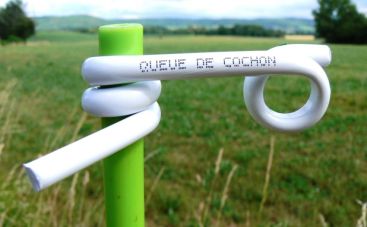
Michel was also in Peilhan, making sure that the pruned vines were tied to their trellis. If the vine is not straight he might stake itfor support and then tie the vine to the stake using a fastener called a ‘queue de cochon’ as it resembles a pig’s curly tail. This will help to avoid the vine being knocked during ploughing or other work.
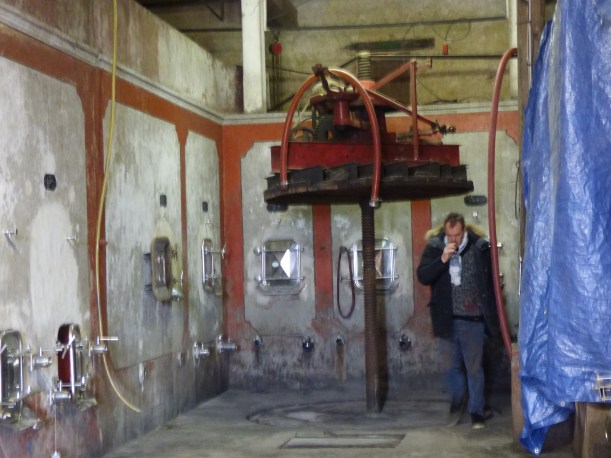
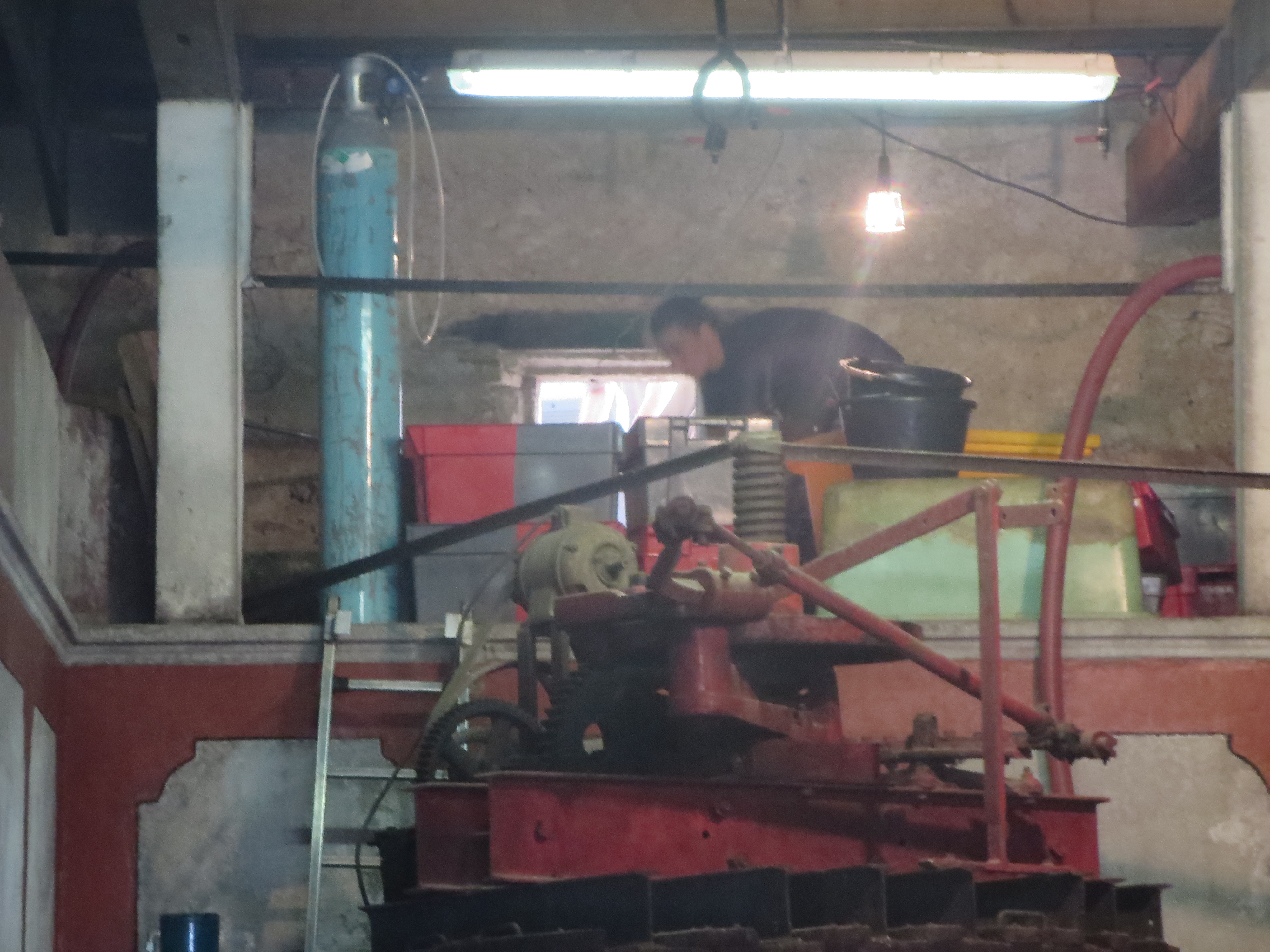
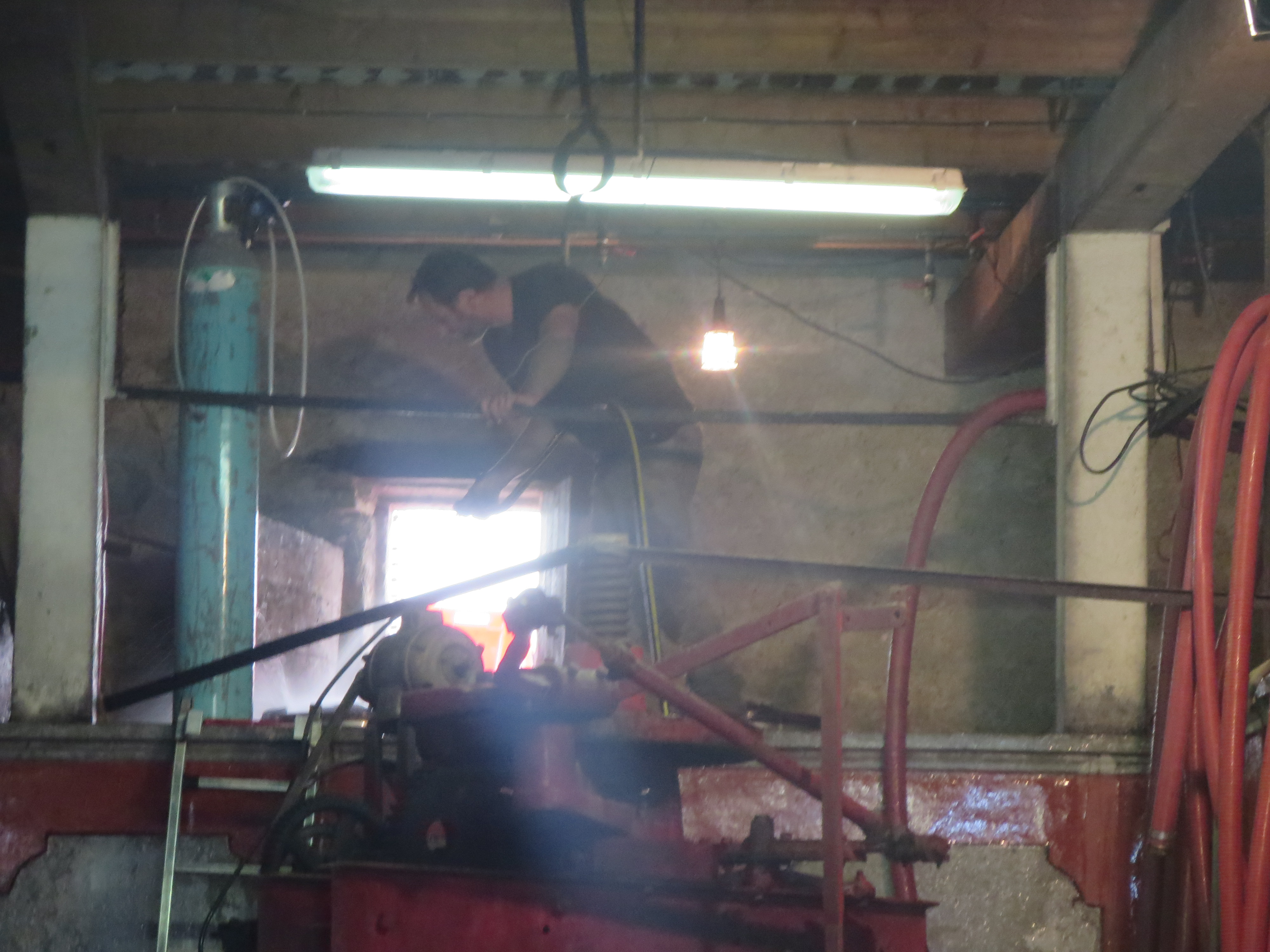
Meanwhile, in the cellar it has been a hive of activity. One of the features of the cellar has been a large basket press which has been used by the Coutelou family for generations.
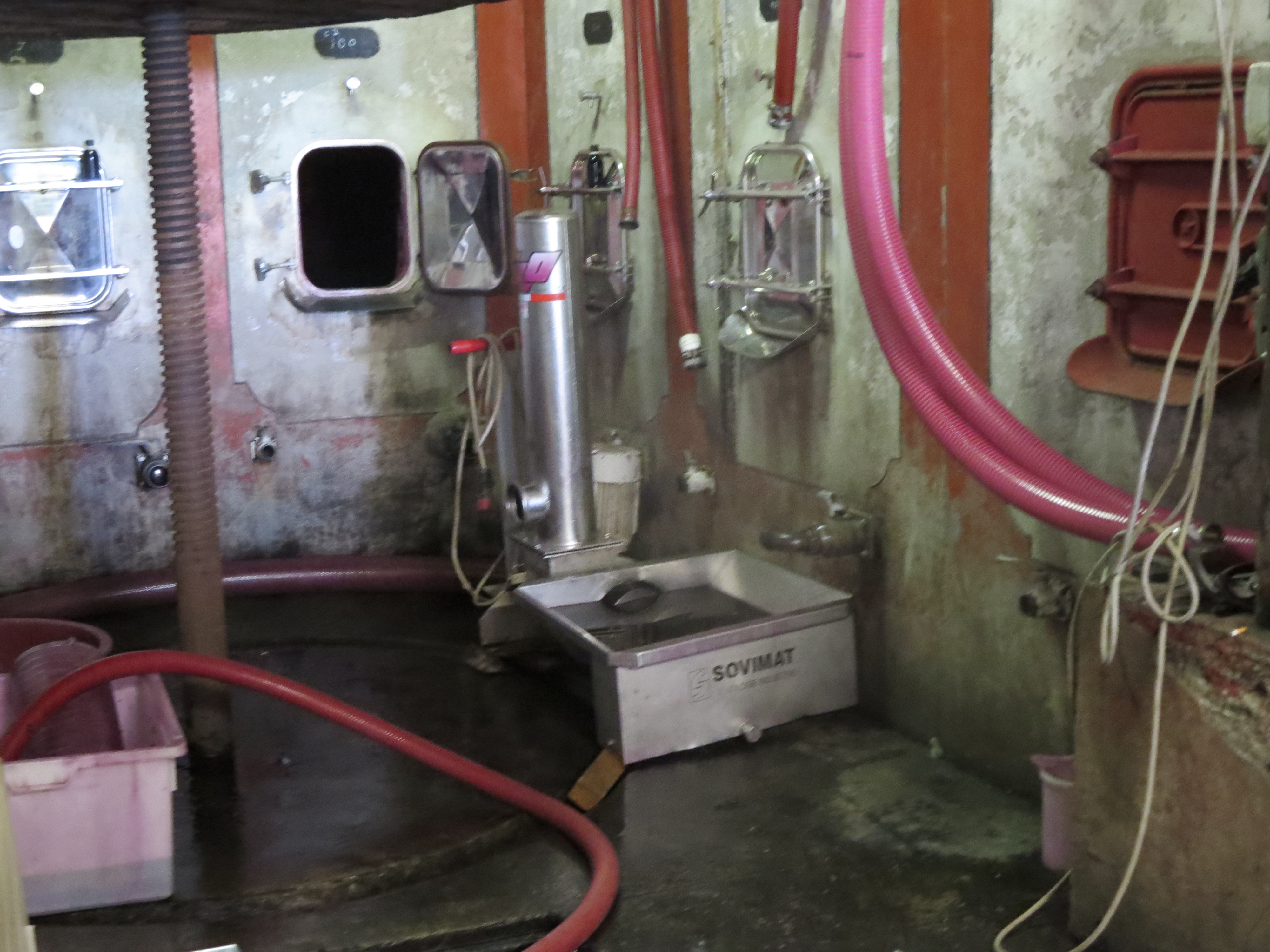
Sadly, it has been out of use for many years and became something of an obstacle as work was done, especially during the vendanges. Jeff reluctantly decided to remove it, I know this was a difficult choice for him. It proved to be a much more difficult task than anticipated as the press screw went deep into the ground and a massive hole still didn’t get to the bottom of it so, eventually, it was sawn through to enable the whole press to be moved.
photo from Jeff
photo from Jeff
The story does have a happy ending though as the press is on its way to Jeff’s friend Didier Barral where it will be put to good use. The result is certainly more space in the cellar, even if a part of the domaine’s history has disappeared.
Another big tank (cuve) has also been split into two. Jeff will be able to vinify smaller quantities of wine and have more choices about the most suitable cuve for grapes as they come in at harvest time.
Finally, for those of you who want to find out more about Mas Coutelou a new website is available. I have included a link at the top of my page and invite you to have a look at the site.
Jeff wrote the text for it (I did the English translation) and it will inform you about the philosophy, methods and wines of the domaine. And it is those wines, the different cuvées, that I shall be writing about next time.
Pour les lecteurs français je m’excuse, j’ai des grandes difficultés de mettre à jour la page en français. J’ai demandé à WordPress pour résoudre le problème.
First visit of 2016 to Mas Coutelou this morning. We tasted the 2015 wines, now mostly assembled, and whilst I am sworn to secrecy about what they will be I can confirm that the cuvées are looking excellent. There is a real elegance and refinement to them already, Jeff has compared them to Rhone and Loire wines rather than the typical, fuller Languedoc wines. They are still in their infancy of course, tasted from tank, and in midwinter they are still coming around. However, the structure, aromas and flavours are in place for wines of real quality.
The weather was much discussed as the temperatures in Puimisson and the Languedoc remain above average (see last post). The effect on the wines can be important, the wines restive, troubled in warm conditions, for example they don’t clarify. A few colder days early this week has helped them to settle a little more, Jeff has already noted changes.
The warm temperatures were evident in the vineyard too. I went to see Julien who is carrying out la taille (pruning) this year. He showed me how some of the precocious vines, such as Muscat, are showing signs of the buds swelling already, way too early. This fits in with the wider vegetation, fruit trees showing signs of blossom, even our tomato plants have flowers!
Bud swelling in the vine
Julien was busy in Peilhan vineyard and explained how he was trying to prune the Muscat in a gobelet sur fil style, rather like guyot, pruning to create two main canes for growth in 2016.
Before
After
This weekend sees a huge wine salon, Millésime Bio, in Montpellier. Nine hundred domaines represented with many more at various ‘off’ events around the city. Jeff will be preparing bottles for Les Affranchis. Then it’s on to the Loire for more salons. So the cuvées will make their first public appearance. I shall be explaining some of the different Coutelou cuvées in my next couple of posts as well as reporting on the Montpellier salons.
Icare playing with his Christmas present from Pat, a toy sheep
The storms which brought so much rain to Puimisson and the Languedoc on Saturday meant that there would be no picking on Monday or Tuesday the 14th and 15th.
Preparations for cellar work
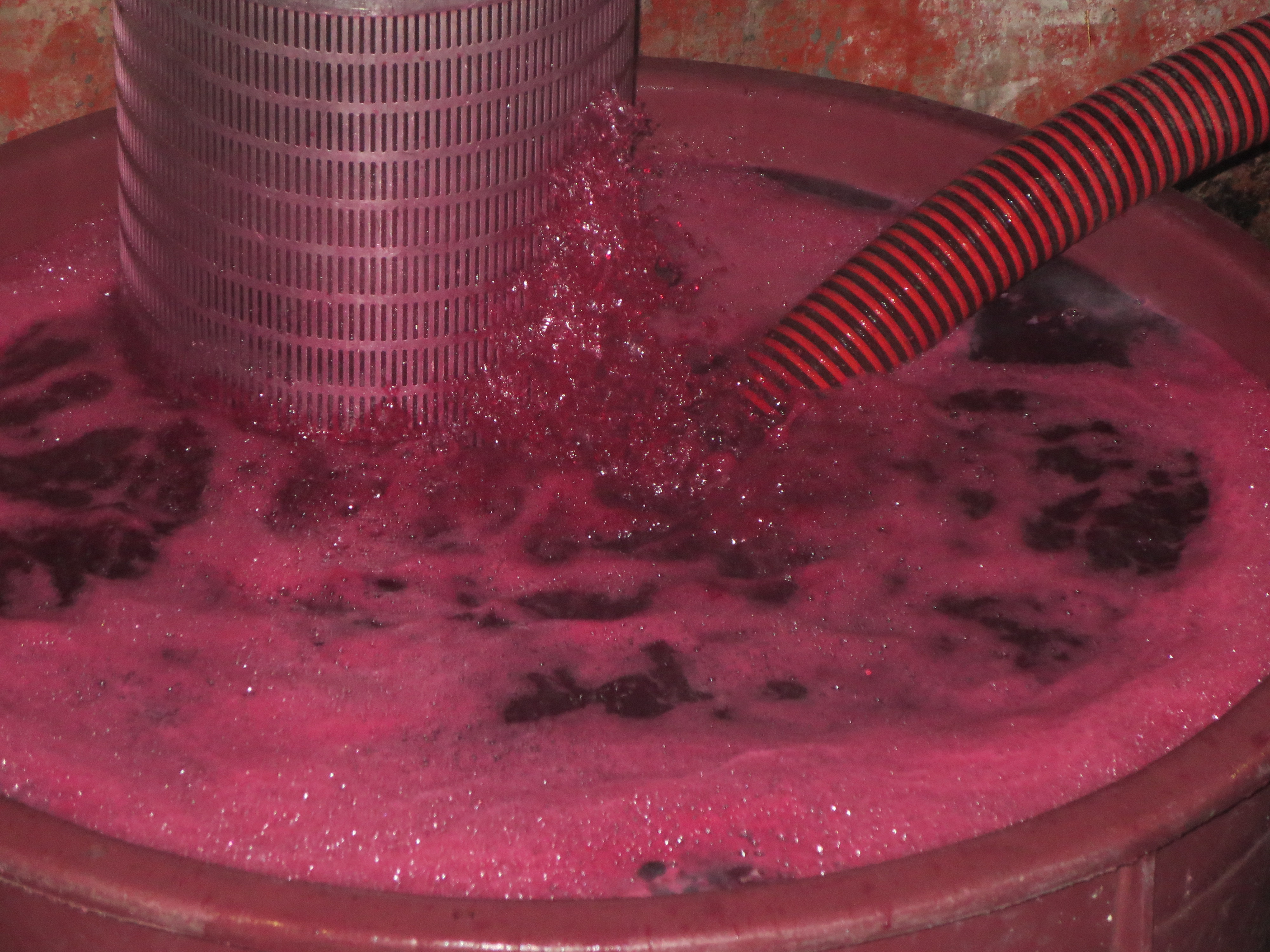
Instead Jeff, Michel and Cameron were hard at work in the cellar for the two days. There is lots to do there so it was an opportunity to get everything on track. Lots of remontage, sous tirage etc. On Monday the 14th the Syrah which was to be made with carbonic maceration was pressed after its few days in tank with the fermentation inside the skins.
The Syrah being pressed
The video shows Michel in the cuve moving the grapes to the front where Jeff forks them into the pump. You will see the grapes moving through the pipe into the press.
By Wednesday 16th the weather had turned much clearer and good winds meant that the grapes and soil were beginning to dry out nicely and so picking recommenced. The centre of attention was Rec D’Oulette known locally as Chemin De Pailhès and the Carignan grapes which grow there. These are the grapes which make the excellent cuvée «Flambadou», perhaps the outstanding wine of 2013 (and Jeff tells me of 2014 too). The bunches which arrived were excellent in quality, so fingers crossed for another great wine.
Picking the Carignan
Carignan
The Carignan in tank
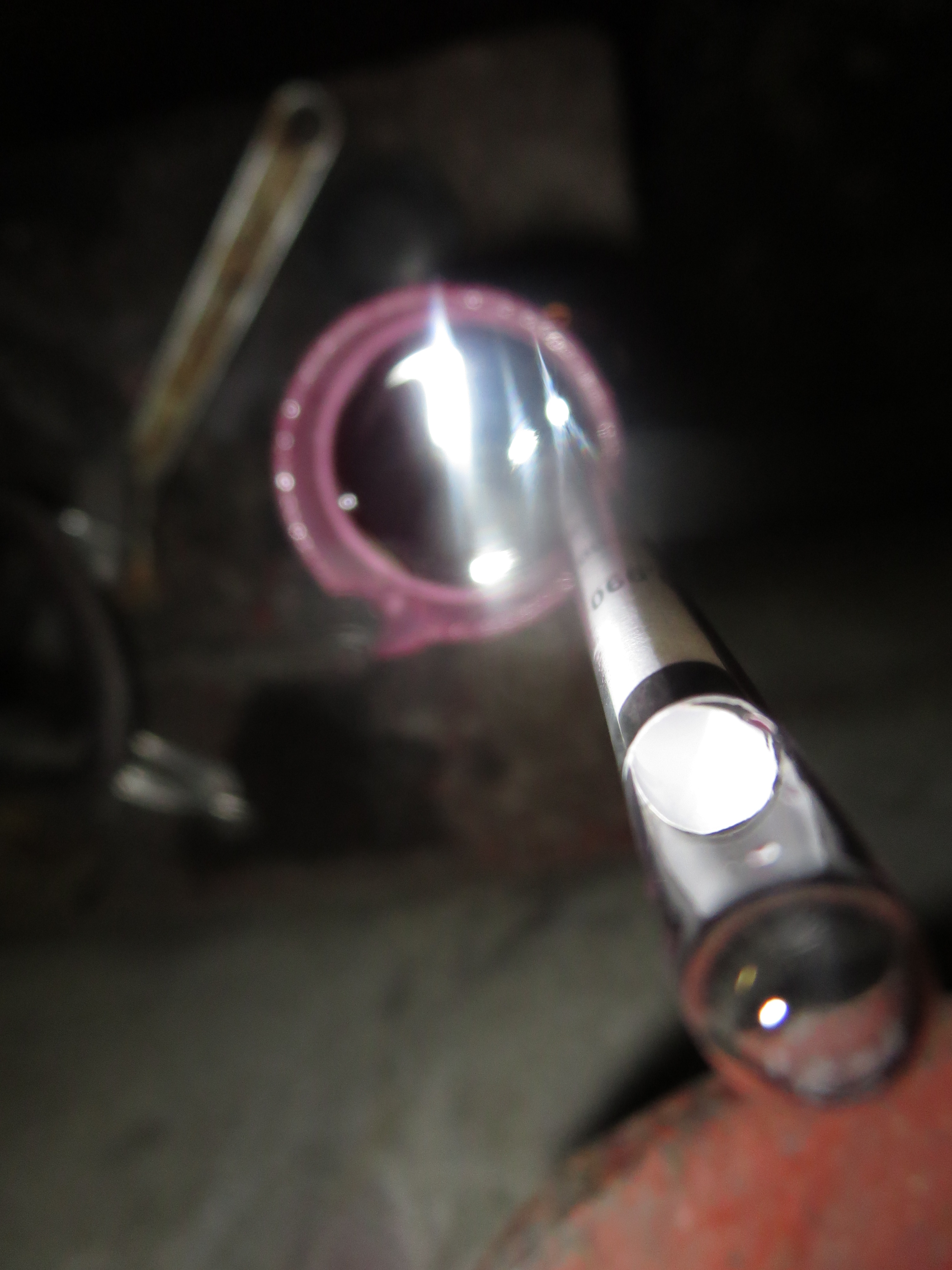
Analysing the Carignan
Meanwhile cellar work continued as Cameron carried out more remontages and analyses. Today one of the wines to be moved was the Merlot which was bright, fresh and colourful.
Délestage of Merlot
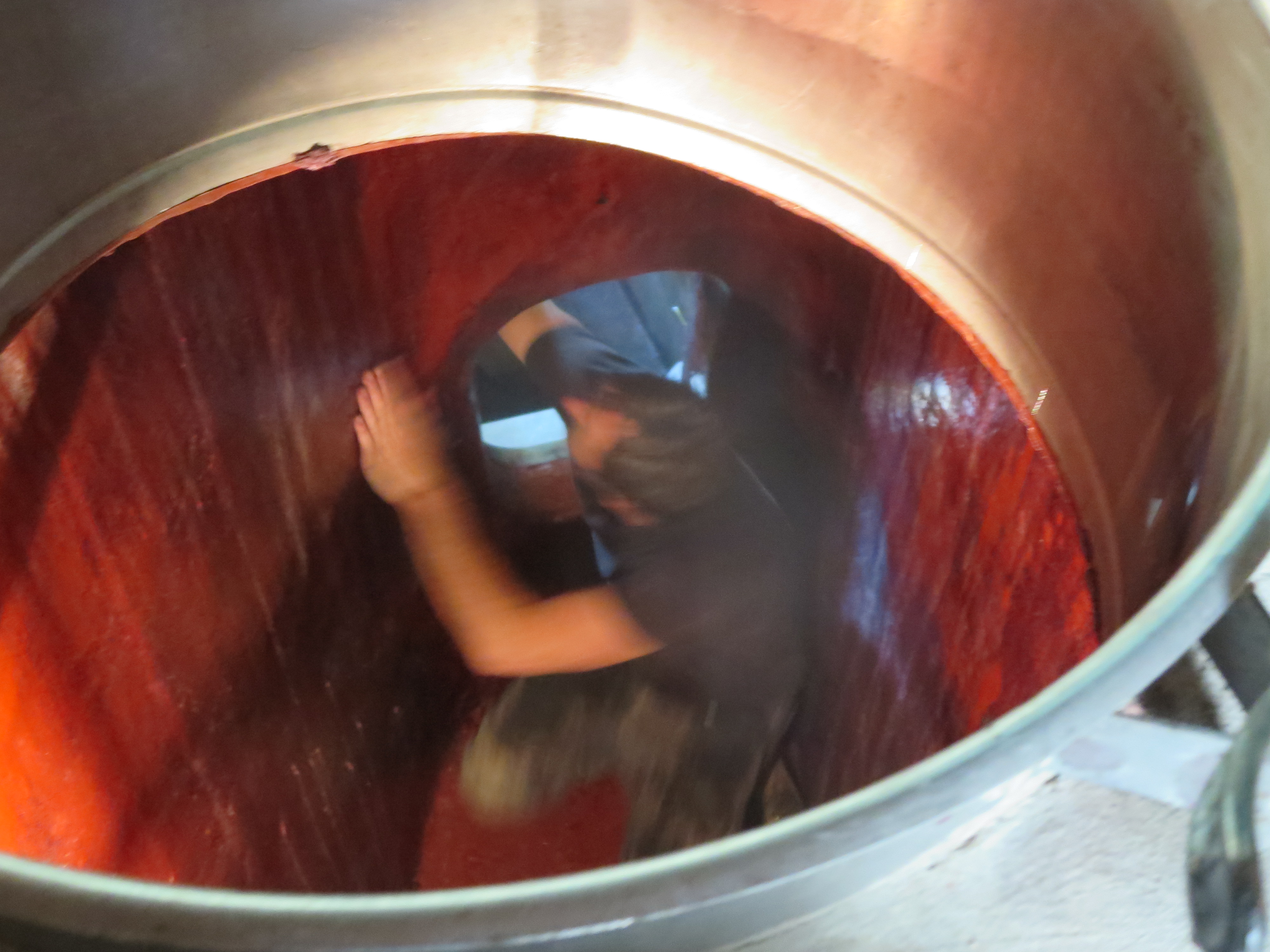
As each wine is moved around the cellar, for example to take it off its skins, each cuve has to be cleaned thoroughly and then it will be filled with another set of grapes or fermenting wine. There is a seemingly never ending merry-go-round of wines and quite how Jeff keeps track of them all remains a mystery to me. Each move has to be planned to ensure that cuves are available, cleaned and big enough.
Cleaning from the inside
As a former teacher it reminds me of planning a timetable fitting in students, teachers and classrooms into the correct combination. Add in working as a mechanic to keep all the machines ticking over and the work of a vigneron becomes more complex, the job description is long.
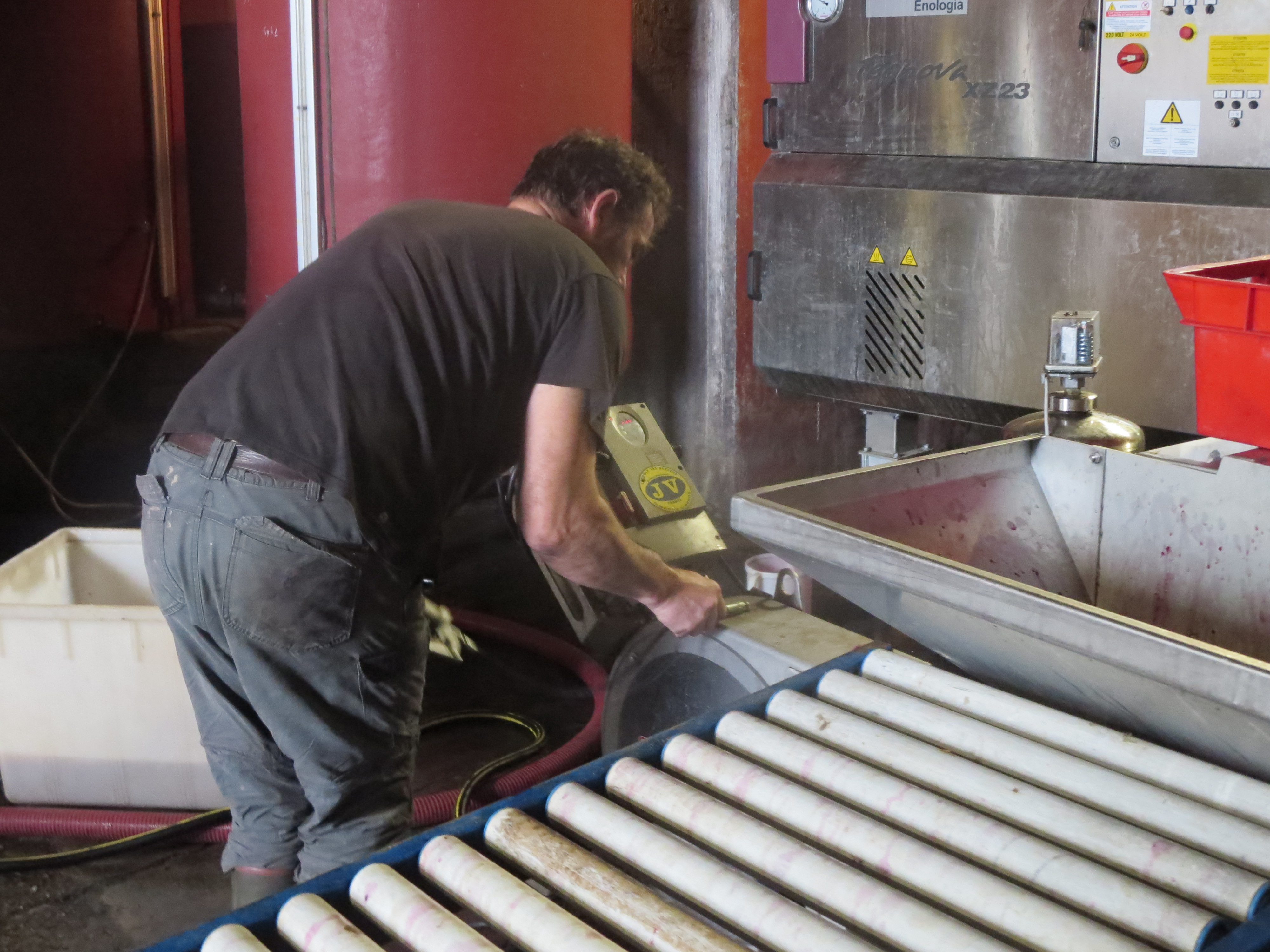
Maintenance of the égrappoir
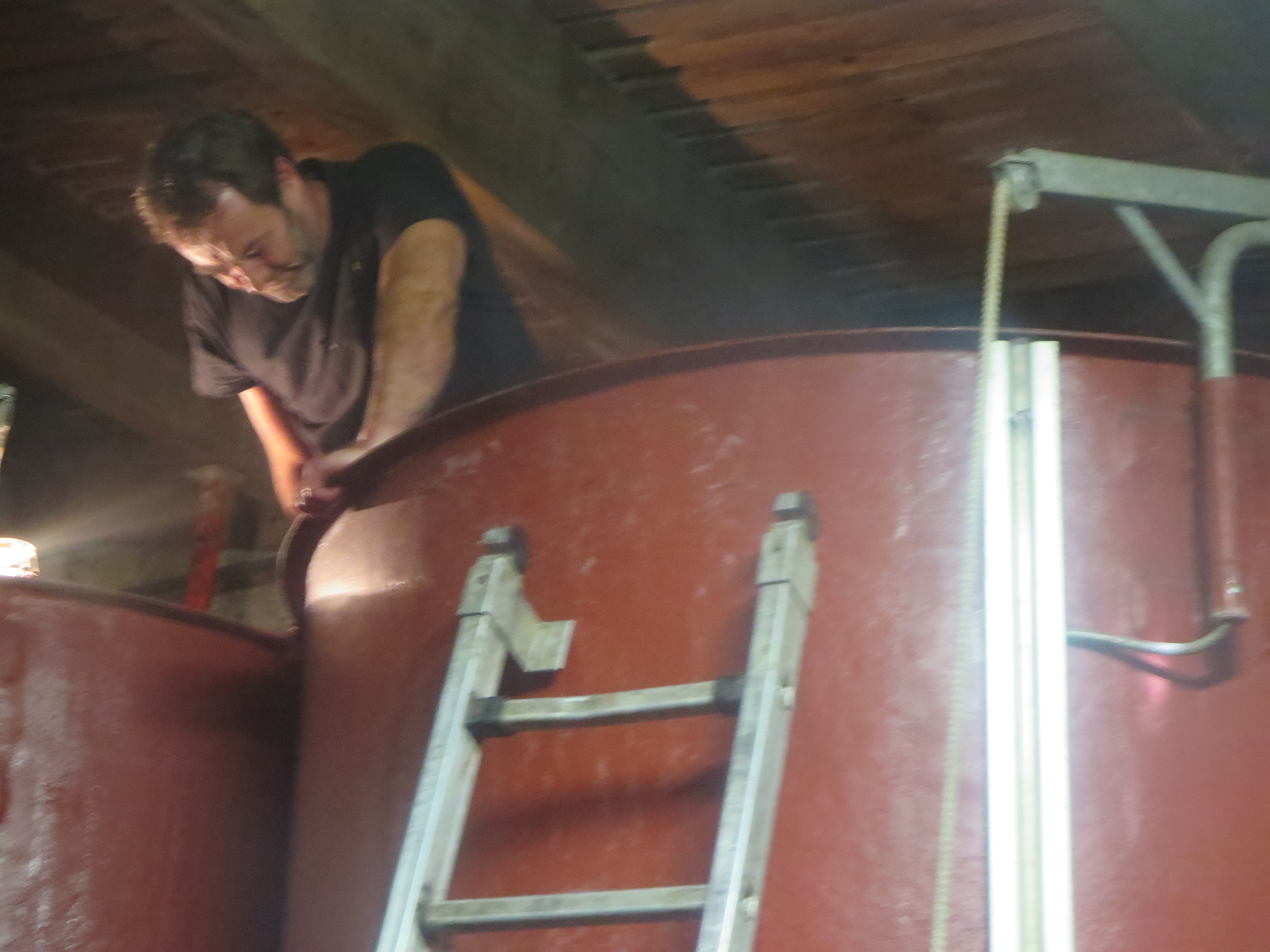
Thursday 17thbrought Grenache from Sainte Suzanne (Metaierie), again carbonic maceration was to be used so back to the top of the cement tanks. Thomas was back and he, Cameron and I shared duties up there filling the tank.
l-r Cameron, Michel and Thomas
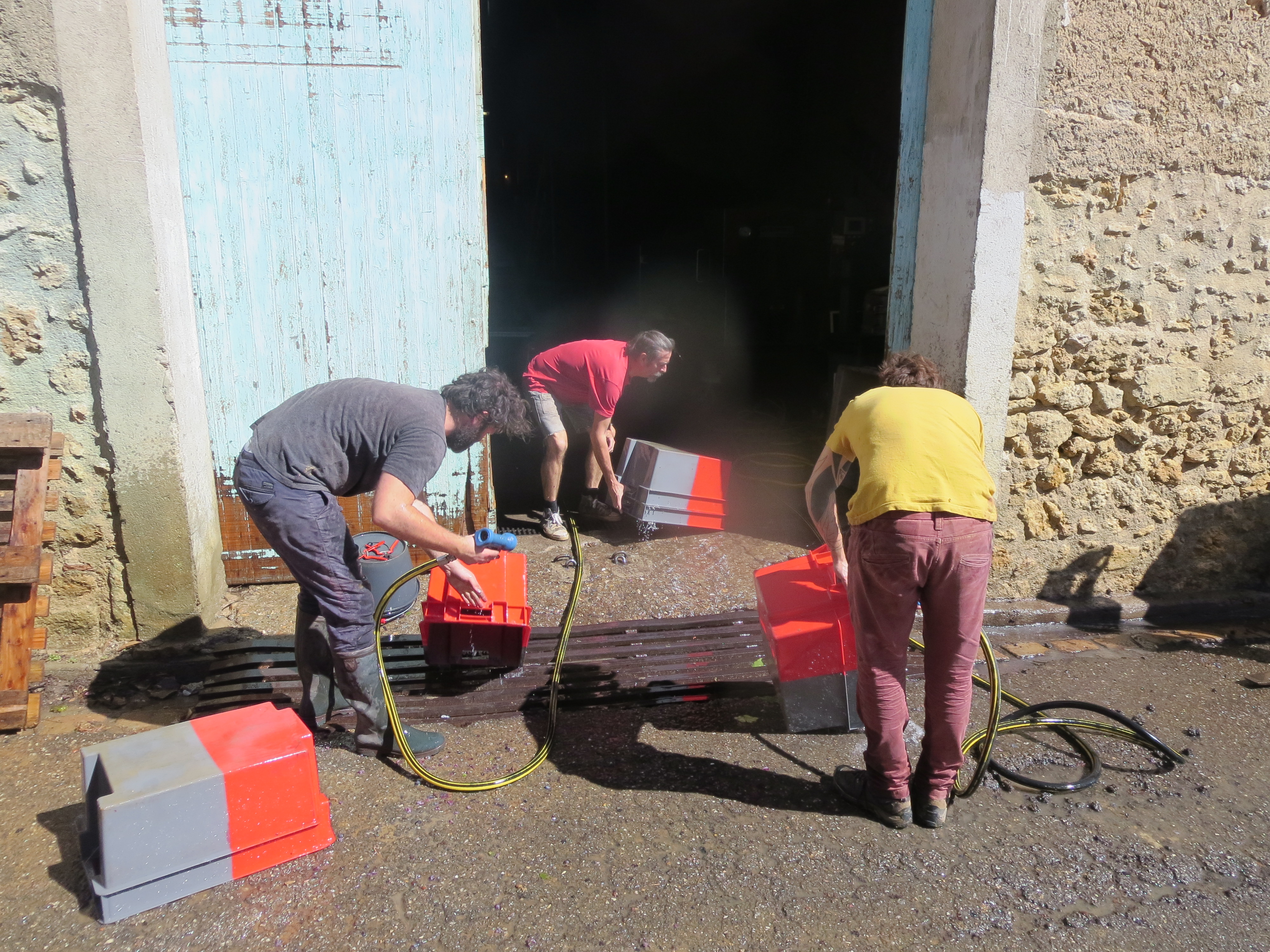
Then cleaning of the cagettes ready for the next new cépage. Following the Carignan of Wednesday it was time to harvest the Mourvèdre from Segrairals. One of my favourite grapes, somewhat fickle in character but when grown by good producers it adds a complexity and depth with a hint of dark mystery. The bunches which arrived were certainly amongst the best of the whole harvest at Mas Coutelou.
Magnificent Mourvedre
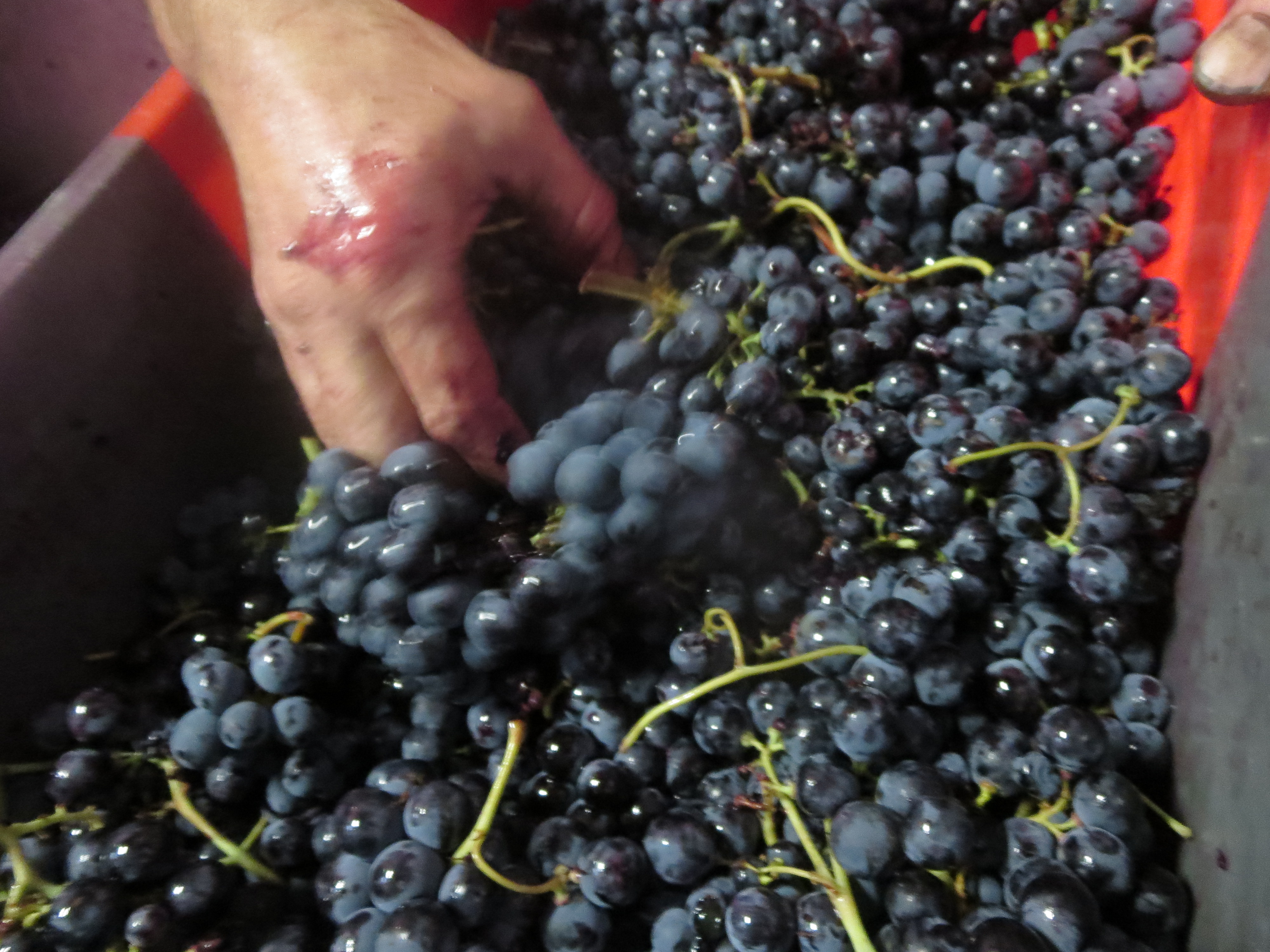
They were clean, big bunches, the grapes with thick skins and smelling already of spice and blackcurrants. Some of the bunches were very heavy and it wouldn’t take many to produce a bottle of wine, on average you need about 1.25kg of grapes to make the 75cl of a normal wine bottle. Sorting was quick and easy, the pickers had done a good job and the fruit was in such good condition. I look forward eagerly to finding out what Jeff has in mind for these grapes, when I have asked he simply smiles mysteriously, something is afoot!
Friday 18th brought the rest of the Mourvèdre still in tip top condition. When the pickers reached some of the lower parts of that parcel the quality did begin to dip a little so these bunches were taken away to be used separately, possibly for a rosé wine. I say possibly because final plans are a long way from being ready. Other jobs included pressing the Cinsault grapes which will make a rosé (definitely!!) and more remontages and analyses.
Remontage
We were joined today by Charles, a young Frenchman who works in a restaurant in Berlin, and whose mother was a former colleague of Jeff when he was a teacher in Paris. Coincidentally his boss in Berlin was a student of Jeff! Charles added a real sense of fun and worked hard.
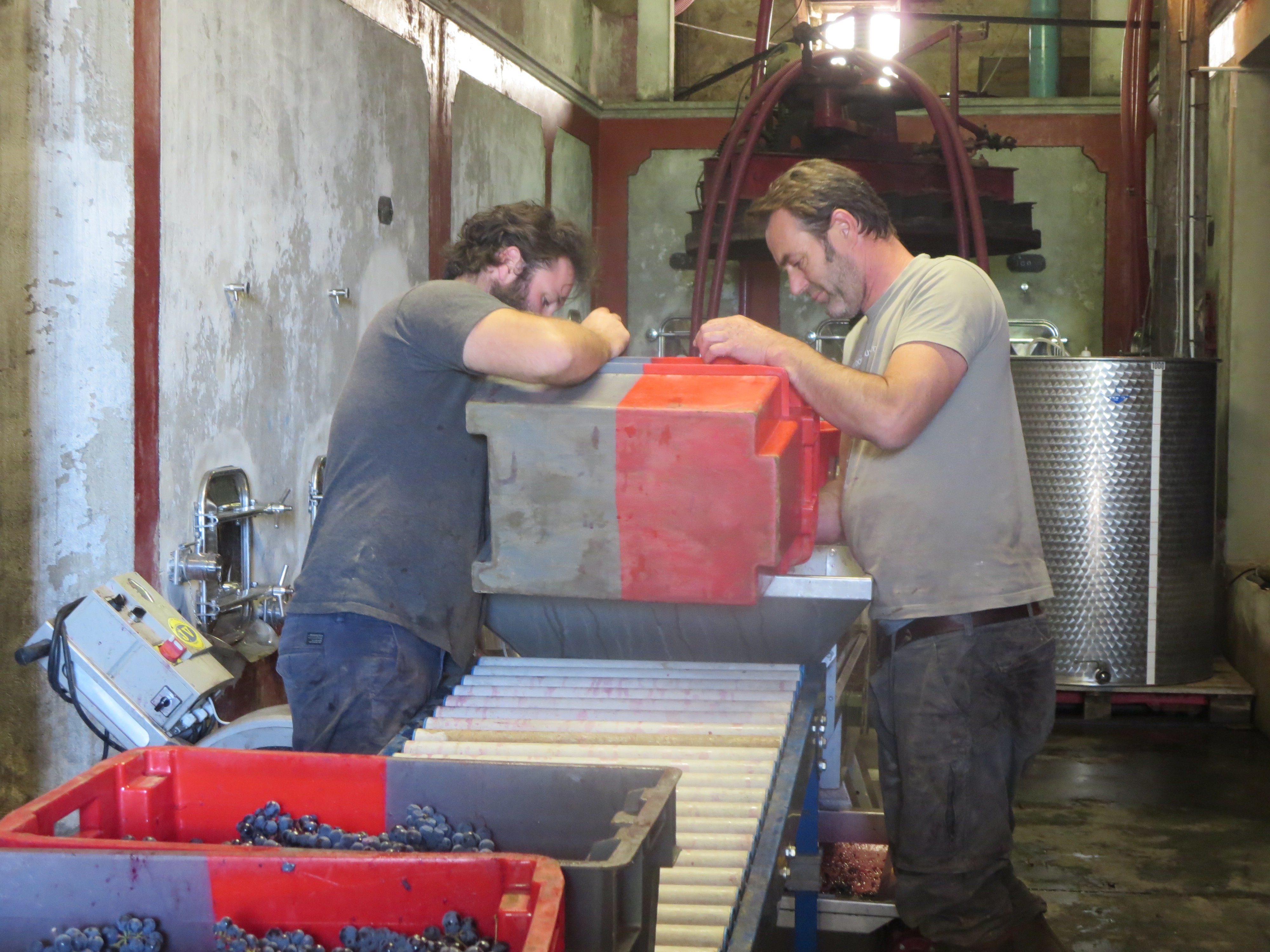
Charles fills the press
By Saturday I was ready for a rest and so the 19th was the work of the Jeff, Michel and Cameron as they processed the last red grapes from Peilhan. Some of these will be used for blending but amongst them was the famous Castets. This you might remember is a cépage produced by only two winemakers in France, Chateau Simone in Palette and Mas Coutelou. The first harvest was in 2014 and we had watched eagerly its development. In fact we have been drinking some during harvest lunches and it is very promising, brooding with deep, dark fruit flavours and a freshness to lift it. Only 3hl was produced again this year, the same as last year.
Castets in tank
On Sunday 20th Jeff carried out a débourbage of the Cinsault rosé which was pressed on Friday. Débourbage means taking out the pips and skins etc to leave the juice on its own. The harvest is starting to slow down a little though much work remains to be done in the cellar. Jeff and the ‘Coutelou Gang’ will have certainly benefited from a little siesta in Sunday.
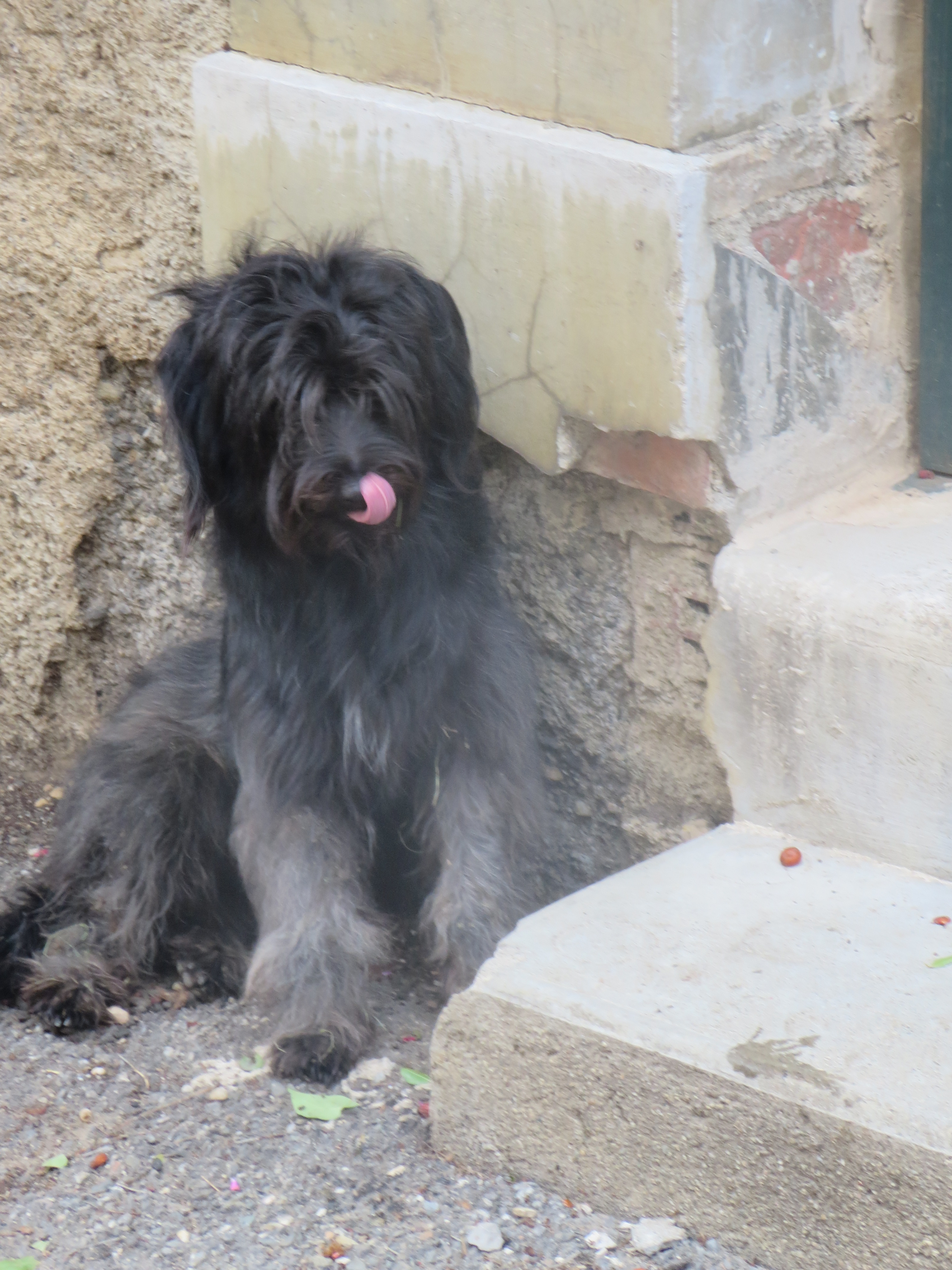
Icare licking his lips at the great wine being made (maybe)
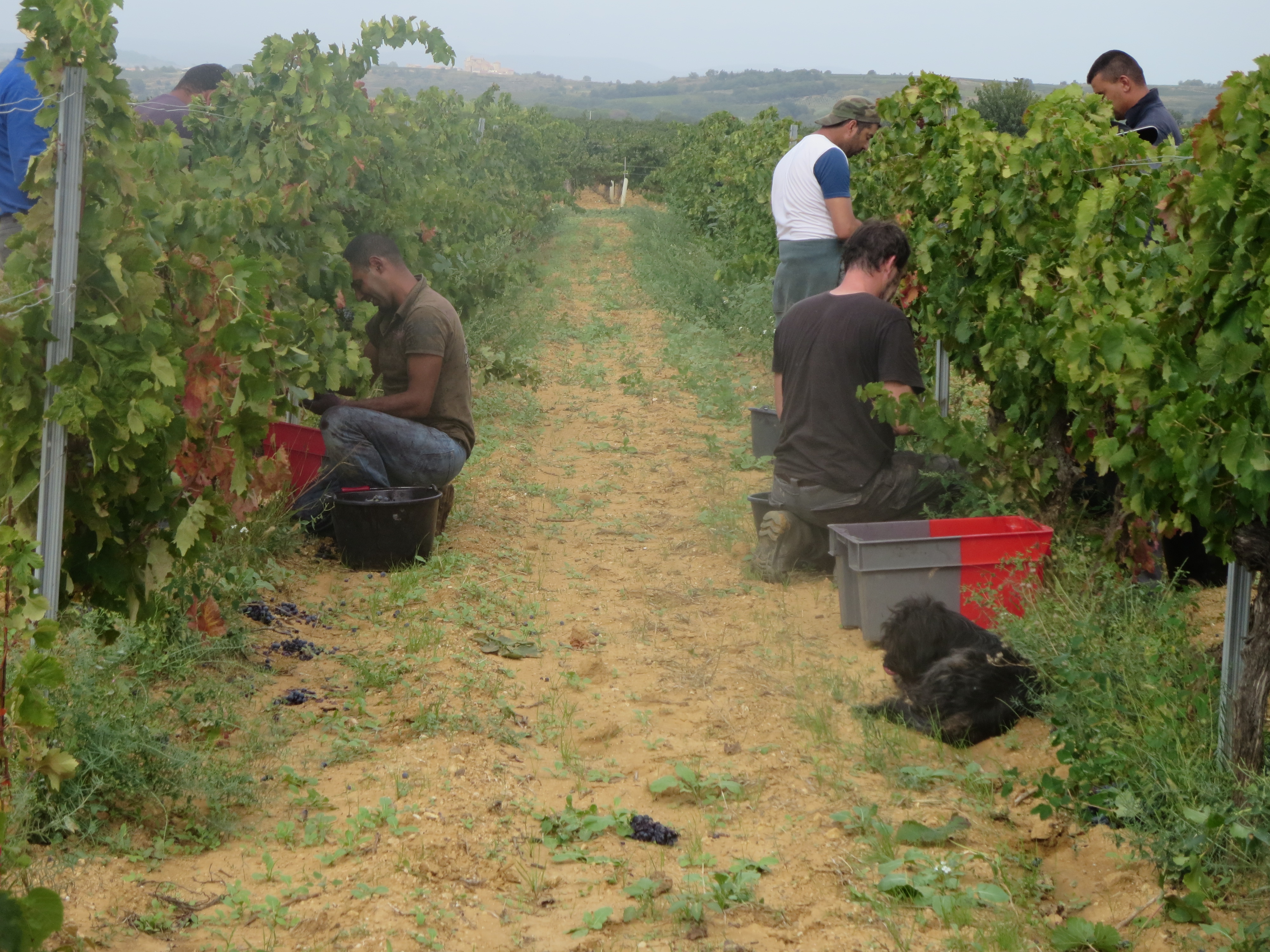
This was the busiest week of the vendanges and required long hours of picking, sorting, pressing, remontage as well as lots and lots of carrying, lifting and often in confined spaces. In short it was hard work.
Why so busy? Well, Syrah which was the first of the red wine grapes to ripen makes up around a third of all the vines at Mas Coutelou and Grenache, the next to ripen, is also the next main cépage with up to 12% of the harvest. Together this meant that around half the 2015 harvest would be picked this week. Add in other smaller picking and the parcel of Merlot and this was definitely the crunch time.
Sunday September 6th was a day of rest for most but Cameron and Jeff were in the cellar working as usual, carrying out checks and analyses and remontages as necessary.
Monday 7th was a long day at work. It was around 8.45pm before we stopped. Syrah in Segrairals makes up around 2ha in total, though as with all land there are some prime areas whilst other vines, around the edges and in a few hollows where water gathers, are not of the same quality. In a typical year these would go towards cuvées such as Classe and 7, Rue De La Pompe but, as ever, plans are fluid.
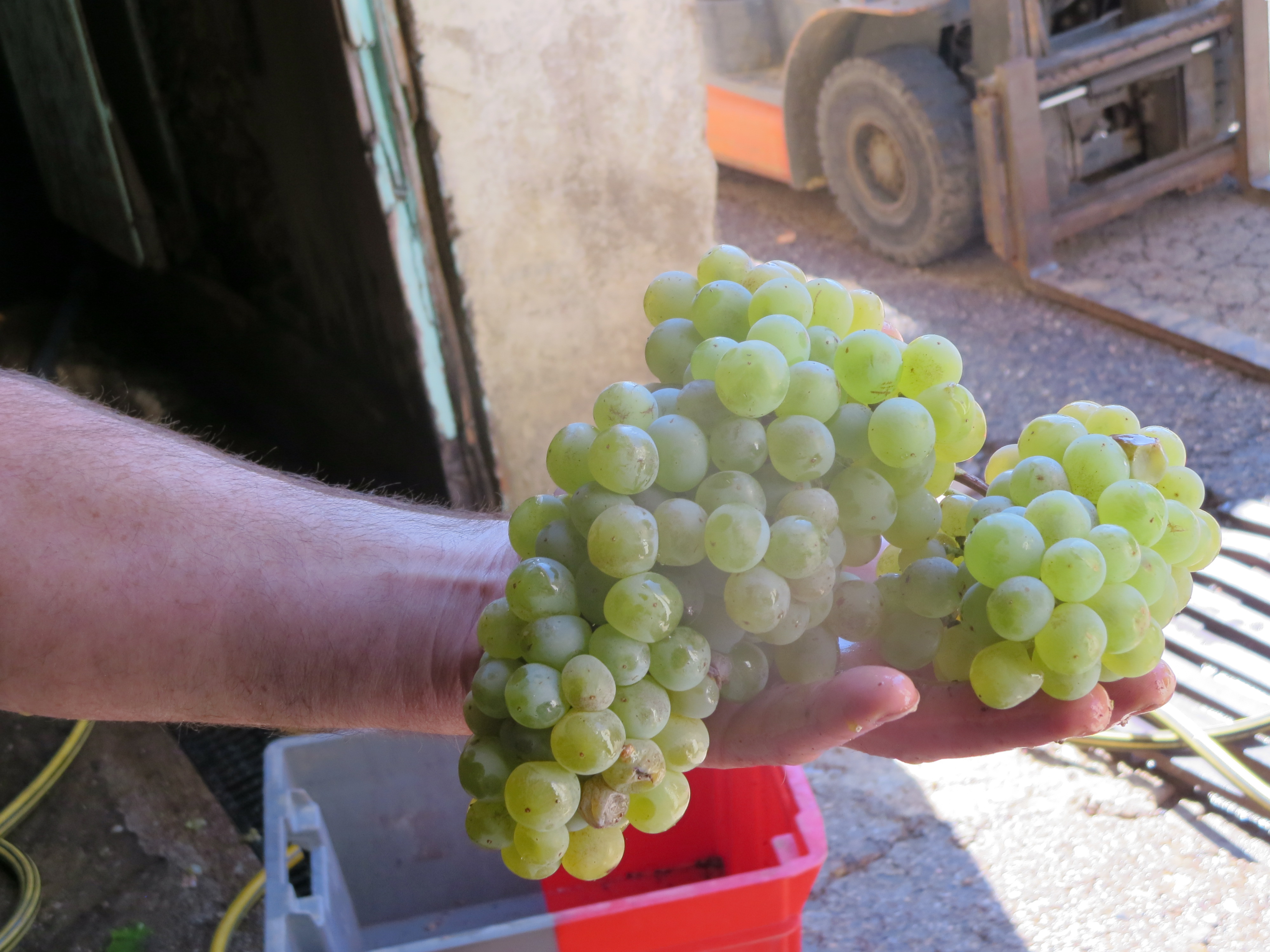
Superb bunch of Carignan Blanc
In addition a parcel of Carignan Blanc was harvested from Peilhan vineyard. There were some wonderful grapes and they were given special treatment, carefully sorted and then pressed using the small hydraulic press. The juice ran very clear and green and then gradually took on a slightly brown colour as it developed light oxidation. This is actually good as it helps to protect the juice later in its life and prevents damaging oxidation. Moreover, the effects of the oxidation from the pressing are removed through fermentation. Around 600l were produced in total, around 750 bottles worth. This makes a very good wine, something I was to be reminded of on Tuesday night, as we shall see.
This was a long day but much good work had been done.
Tuesday 8th brought more Syrah to the cellar, this time from La Garrigue. These are the vines I have described before which face north on a slight slope to preserve the freshness and fruit flavours, good quality grapes which are often used for my favourite cuvée, La Vigne Haute, so I was even more keen to help to sort carefully and there were some lovely bunches of healthy fruit. Here’s hoping for a good vintage of LVH, as ever Jeff will make the call.
Cameron unloading some Grenache Gris
Yet again another smaller harvest was done, again from Peilhan, this time with Grenache Gris. The lovely pink, grey berries are flexible in their use and might produce, white or rosé wines or be added to red wine as you will remember from my special cuvée post.
Grenache Gris after being pressed
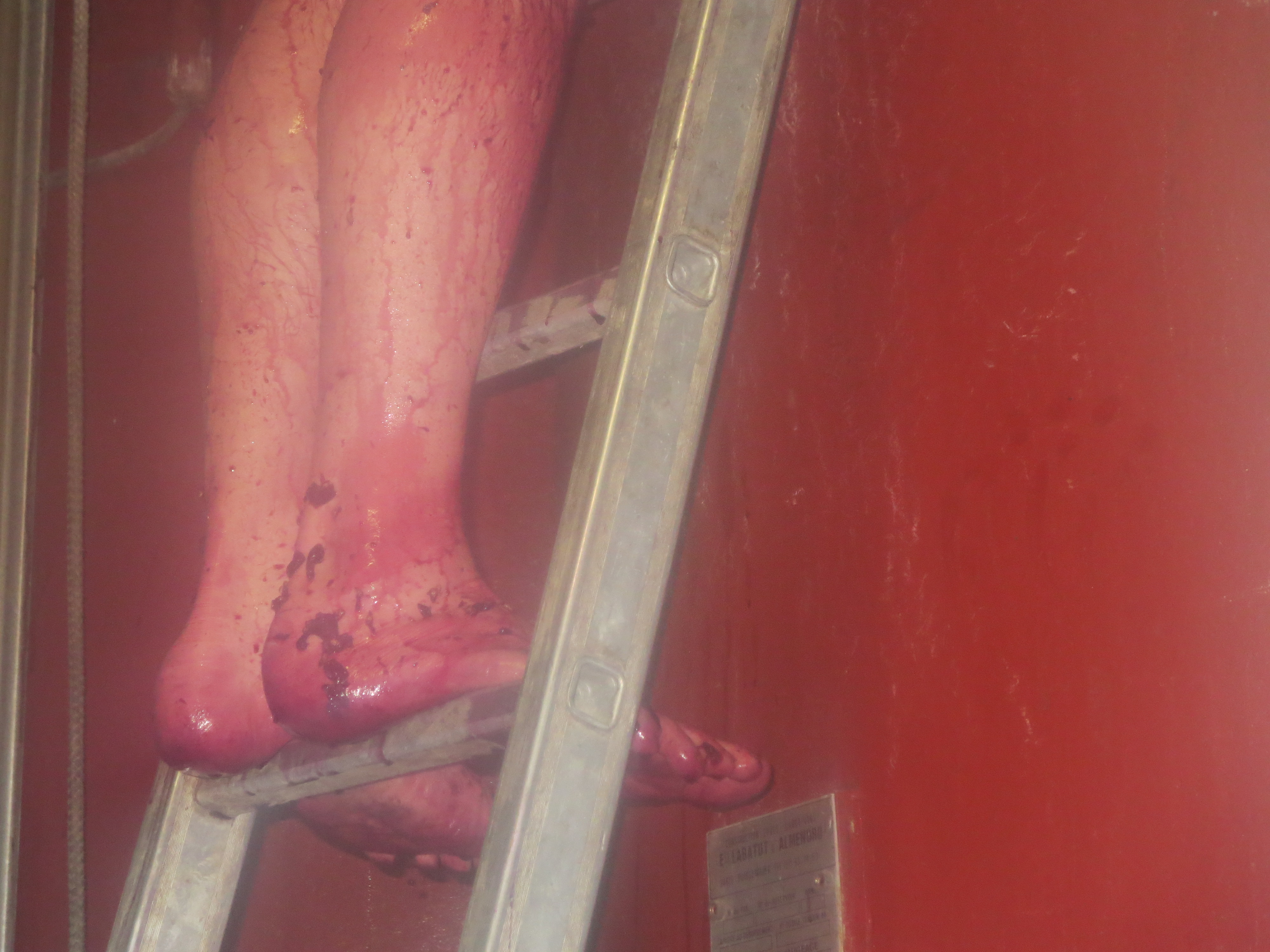
Meanwhile lots of analysis of the wines in tank and work to ensure that they are in good health. This even involved Jeff removing his trousers and jumping into the Flower Power tank to do some pigeage! Modesty means that I shall not share these photographs!
Cameron getting a sample for analysis
The after effects
And of course there was plenty of this… (I couldn’t resist adding the tune)
Error
This video doesn’t exist
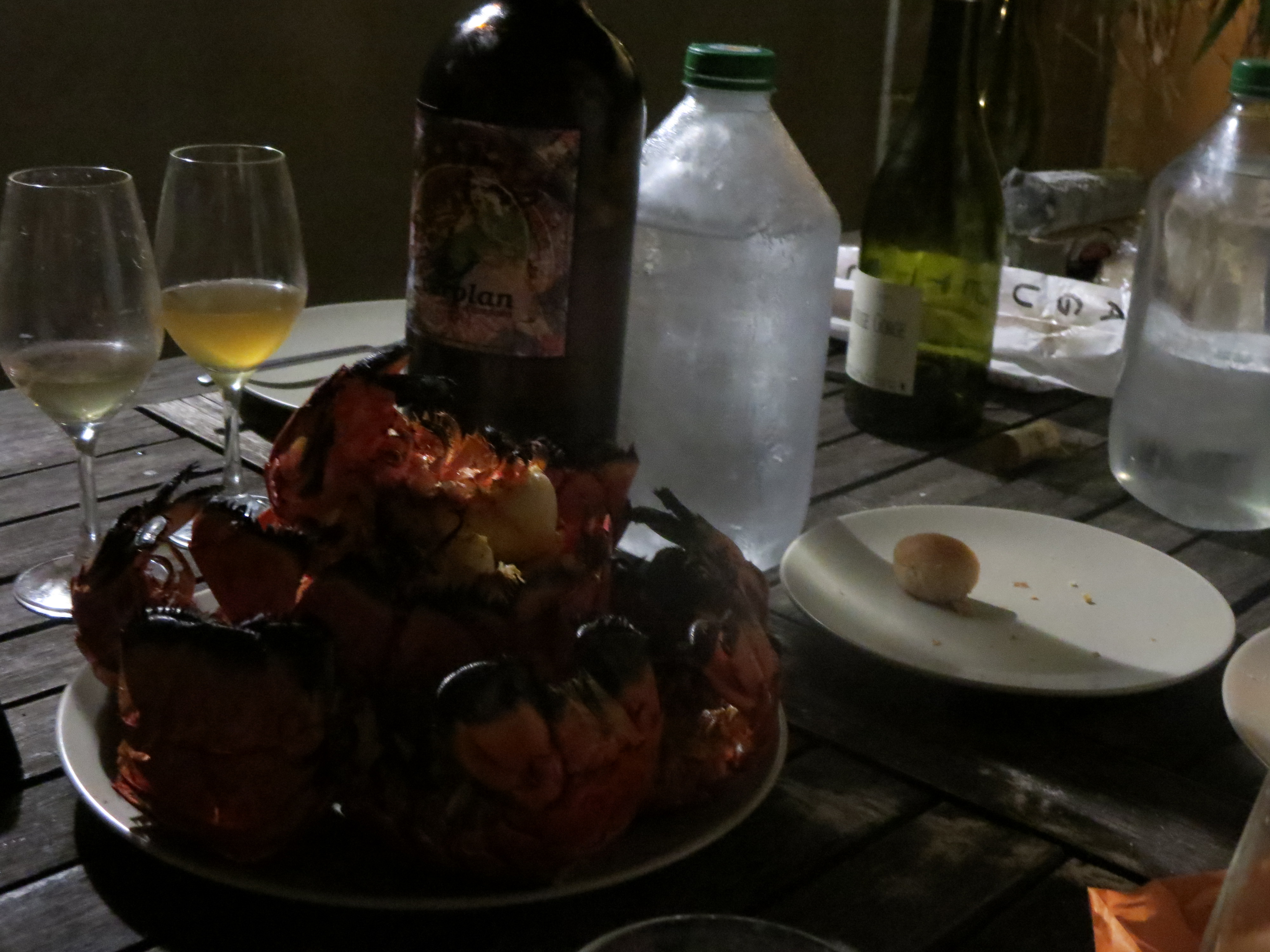
A bonus was to come though. We had been joined by two new additions to the team. Thomas is from Toulouse originally but has been working as a sommelier in the Languedoc and spent most of the week with us and will return next week. Karim is a fishmonger from Tours with an extensive knowledge of natural wines. He spent the week in Puimisson and brought a lovely surprise in the form of lobsters and scallops which made a wonderful dinner on Tuesday as Karim is also an excellent cook. We shared a magnum of Casa Pardet Chardonnay to accompany the shellfish as well as two Carignan Blancs, one from Mas Coutelou and the other from Jeff’s friend Cyril Fahl of Domaine Rouge Gorge in Roussillon. It was a special and hugely enjoyable meal, thanks to Karim and Jeff for the food and wine.
September 3rd began with further picking at the southern quarter of the vineyards of Mas Coutelou, Peilhan and Font D’Oulette, followed by an afternoon of picking in the northern end in Segrairals.
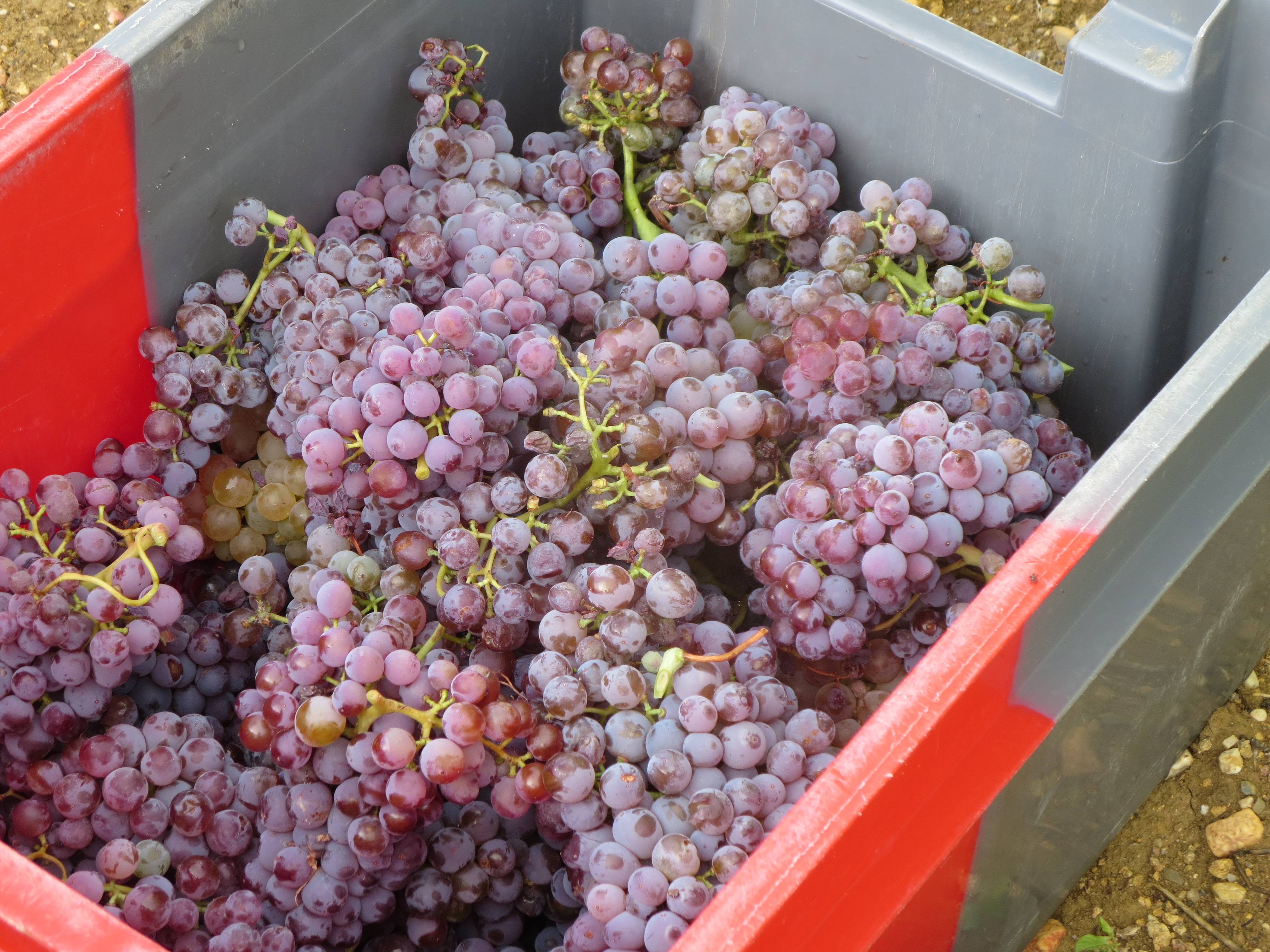
Peilhan and Font D’Oulette are both complanted, ie they have lots of different grape varieties being grown and often in the same rows. However it was the Grenache Gris in Peilhan which was being picked first to provide the juice for a rosé wine. Grenache Gris is, in my opinion, one of the most interesting cépages in the Languedoc Roussillon providing many of its best white wines. It also has a grey, pink skin which can provide a little colour to the wine if the juice is allowed to stay in contact with those skins for a few hours. In this case it would provide a very pale rosé wine, I heard the style described recently as a gris de gris. How this turns out we shall see, it could yet make a white wine.
Cameron loading the press with the Grenache Gris
Error
This video doesn’t exist
When the Grenache Gris was through the press it was time to bring in the grapes from Font D’Oulette. This has a whole variety of cépages from the traditional Aramon Noir to the more unusual Oeillade Muscat, Clairette Blanche and Aramon Gris along with many others.
Clairette Blanche
Clairette Musquée
Aramon Gris
Oeillade Muscat
Oeillade Noir
This assemblage will be added to some Cinsault (perhaps from Rome vineyard, perhaps not) to make Flower Power which was made for the first time in 2014 and has proved to be a big success. Indeed we shared a magnum on Friday at lunch and it was excellent, starting to really open up.
Syrah from Segrairals
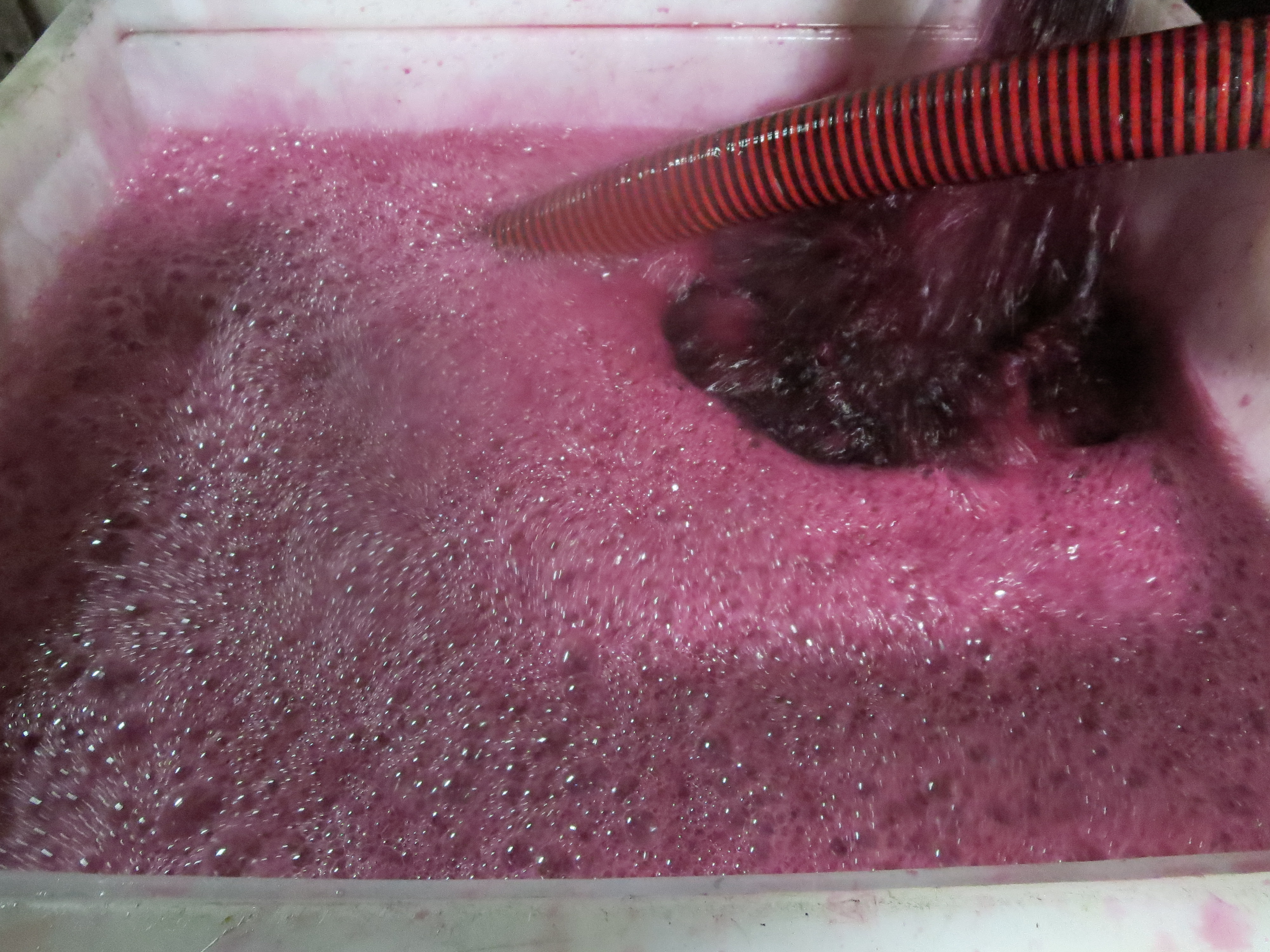
Then onto Syrah, some lovely bunches from Segriarals and Caraillet, the biggest of the Coutelou vineyards. The rich juice provided plenty of colour as you might see!
And then, of course….
Cameron and Michel are becoming a true double act
This was a long day, we finished around 7.15 pm, the day starts at 7.30am. I slept well that night.
September 4th brought a whole day of Syrah grapes from Segrairals and Caraillet again. It was also the last day we had the superb Carole with us for the harvest as she heads to Champagne for picking there. Carole is a true expert in all aspects of the vineyard and cellar and she is always willing to teach and to share, she will be a big miss.
Boxes of Syrah waiting for destemming on Friday (Sept. 4th)
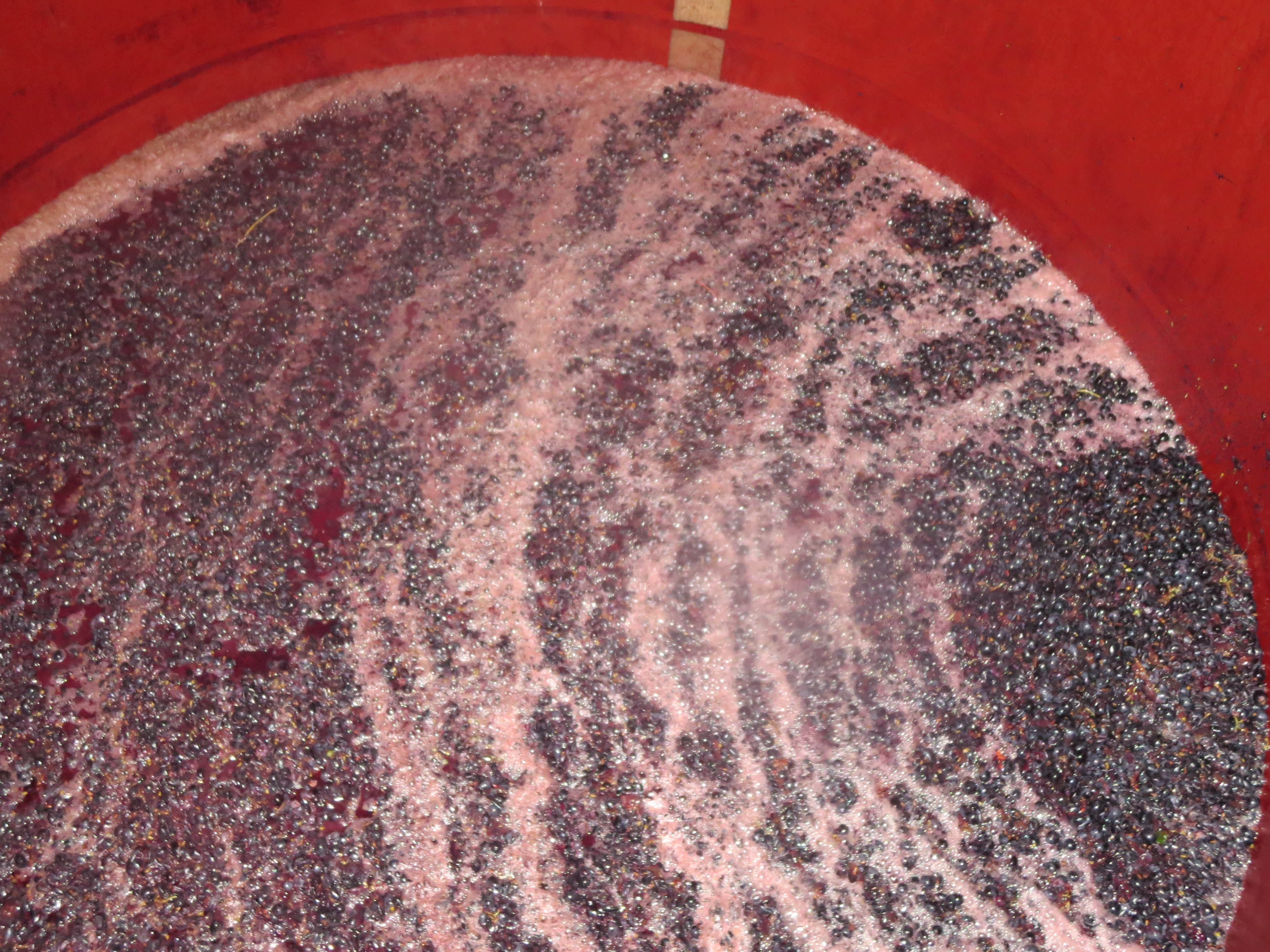
Whilst we worked on the sorting of the Syrah Jeff and Cameron set about testing and remontage (pumping over the grapes already in the tanks).
Remontage of Flower Power grapes
We also tasted samples from the various tanks. The Syrah shows real fruit and is already developing different characteristics. Segrairals was gaining weight and power, Sainte Suzanne much more floral and elegant. The white juice from the complanted Peilhan, still in contact with skins, is beginning to ferment quickly as the yeasts get to work, perhaps because the yeasts are on those skins. It is a treat to watch the development of these wines from infancy as they take their first steps towards the final wine.
And of course….
We finished around 6.15 and then went to Jeff’s for a special treat to send off Carole in some style. Oysters and mussels together with some Chardonnay from the brilliant Spanish domaine, Casa Pardet, lovely. Even the sky responded.
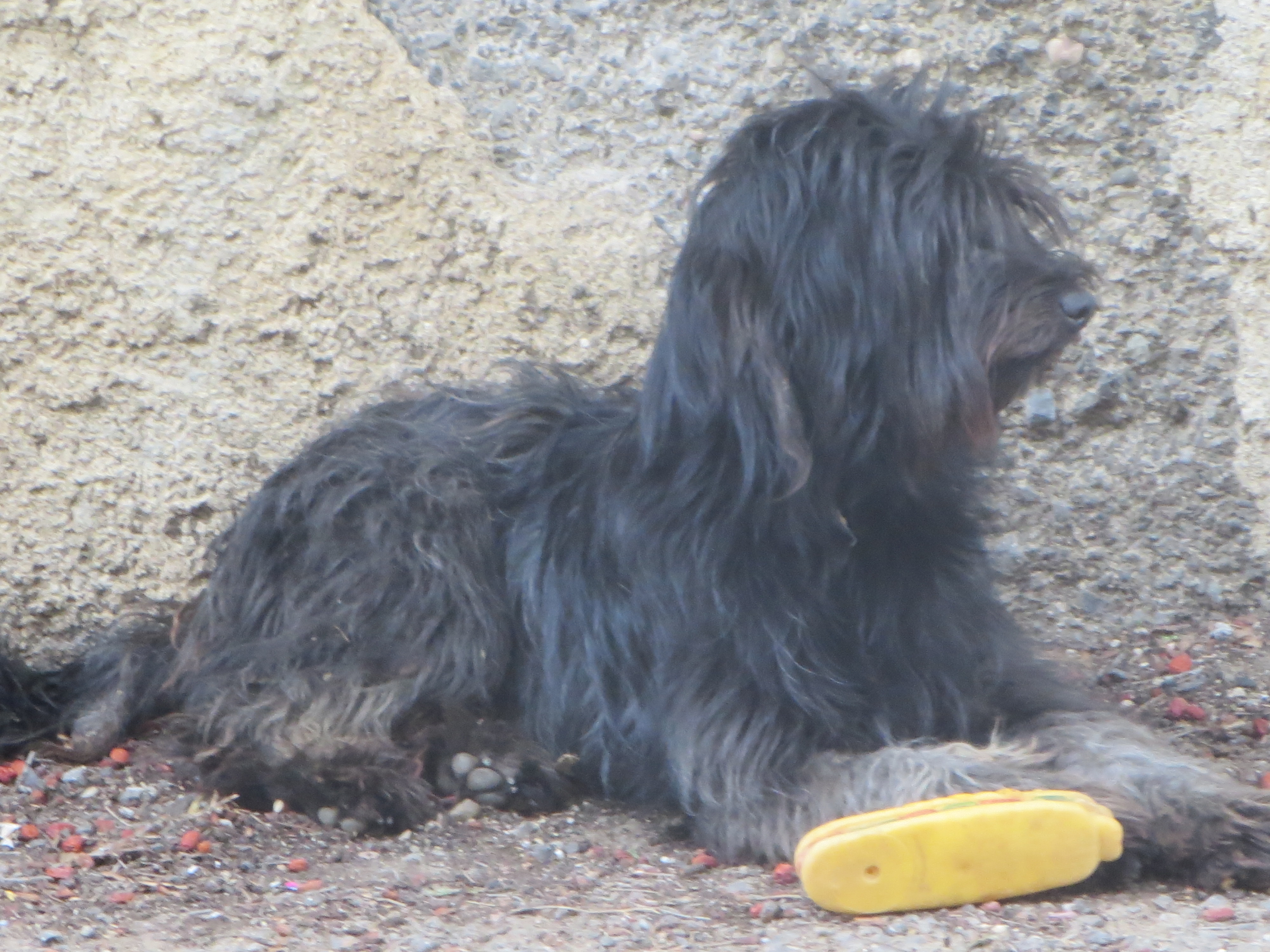
Meanwhile Icare fans, your hero was guarding his favourite toy, a plastic, squeaky sandwich. And sleeping, it is fun to watch him as he dreams because his tail wags furiously.
Saturday September 5th was a day off for me but not for the rest as they continued to process the Syrah form Segrairals, I did say it is a big parcel. The Grenache and Cinsault are still not quite ready and they will dictate when the team can start to harvest them but that will not be before Tuesday. The weather forecast is good for next week so conditions should be right.
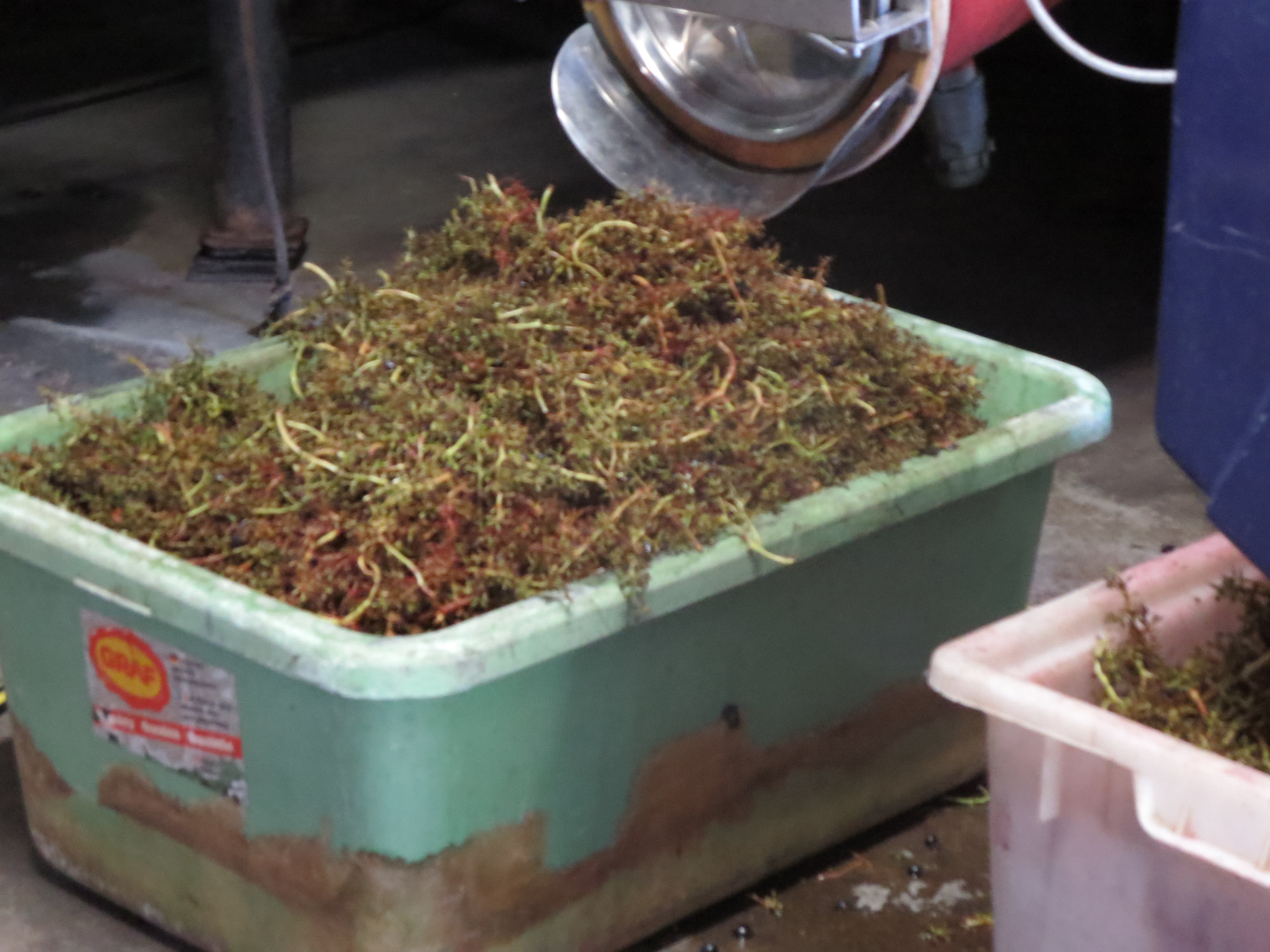
I did call round however and the work had certainly been going on as you can see from the bacs of the stalks (rafle) .
And of course….
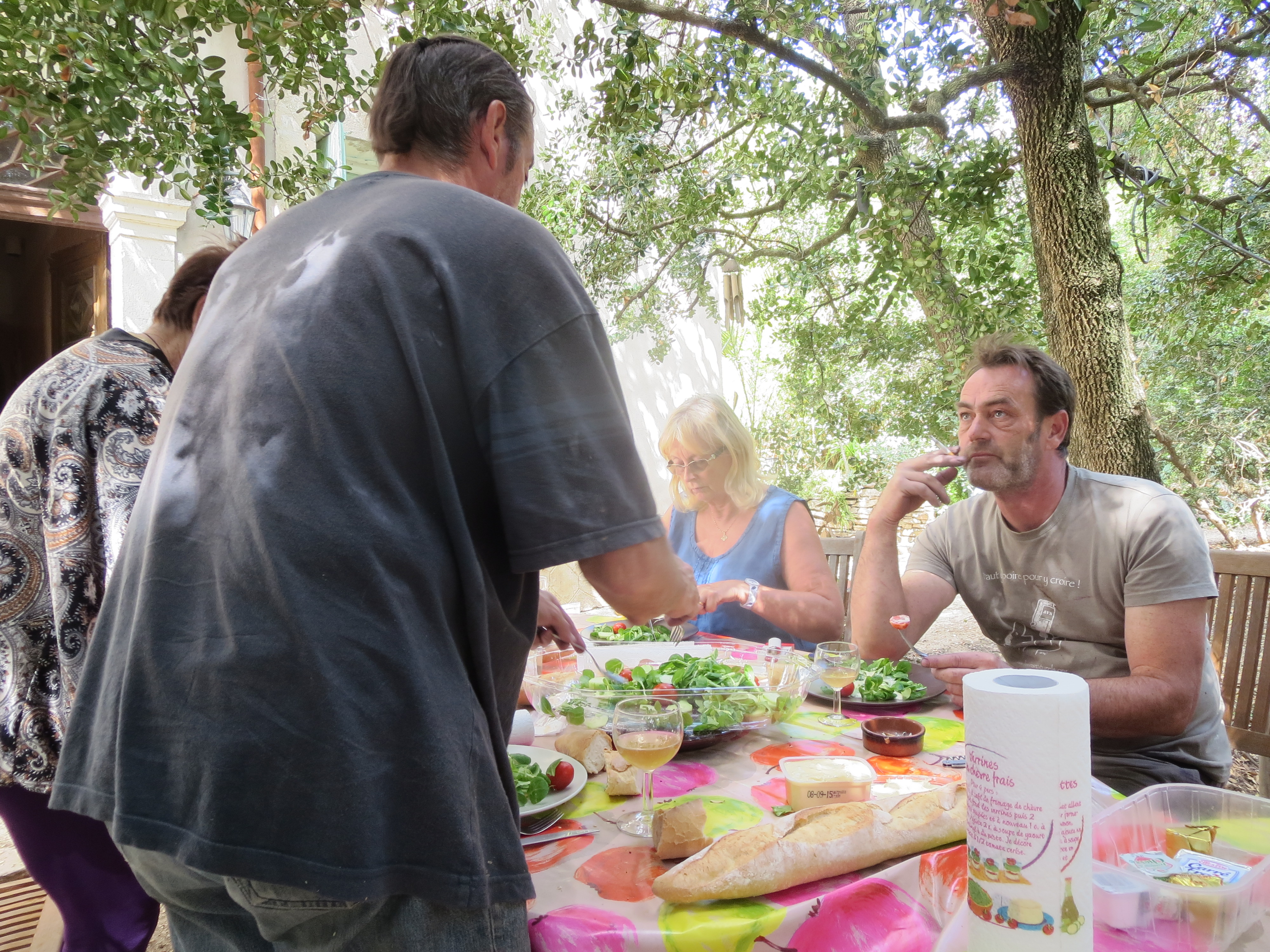
I did manage to sneak into lunch however. These are a highlight of the harvest season, with food prepared by Marie France from Puimisson and bottles opened including a terrific bottle of Castets, that rare grape I have described before. We sit at a big table int he garden of Jeff’s father, right next to the cellar.
Sunday will be a day of rest except for Jeff and Cameron who will do a round of the tanks to check on their progress and carry out more remontage. There is already a lot for Jeff to be thinking about, which wines are where, how are they progressing, have the remontages been done, are the analyses done. Plus all the options about which grapes to blend, what cuvées to make and, for example, whether the Grenache Gris will be white or rosé. Then off to the vineyards to check on the grapes and their readiness for harvest. Pressure, worries, and hard work – spare a thought for the vigneron.
Even during lunch Jeff is up and down checking on things in the cellar
Aug 30th was a Sunday so no picking but Jeff was still in the cellar working. The early wines needed to be checked and moved as necessary.
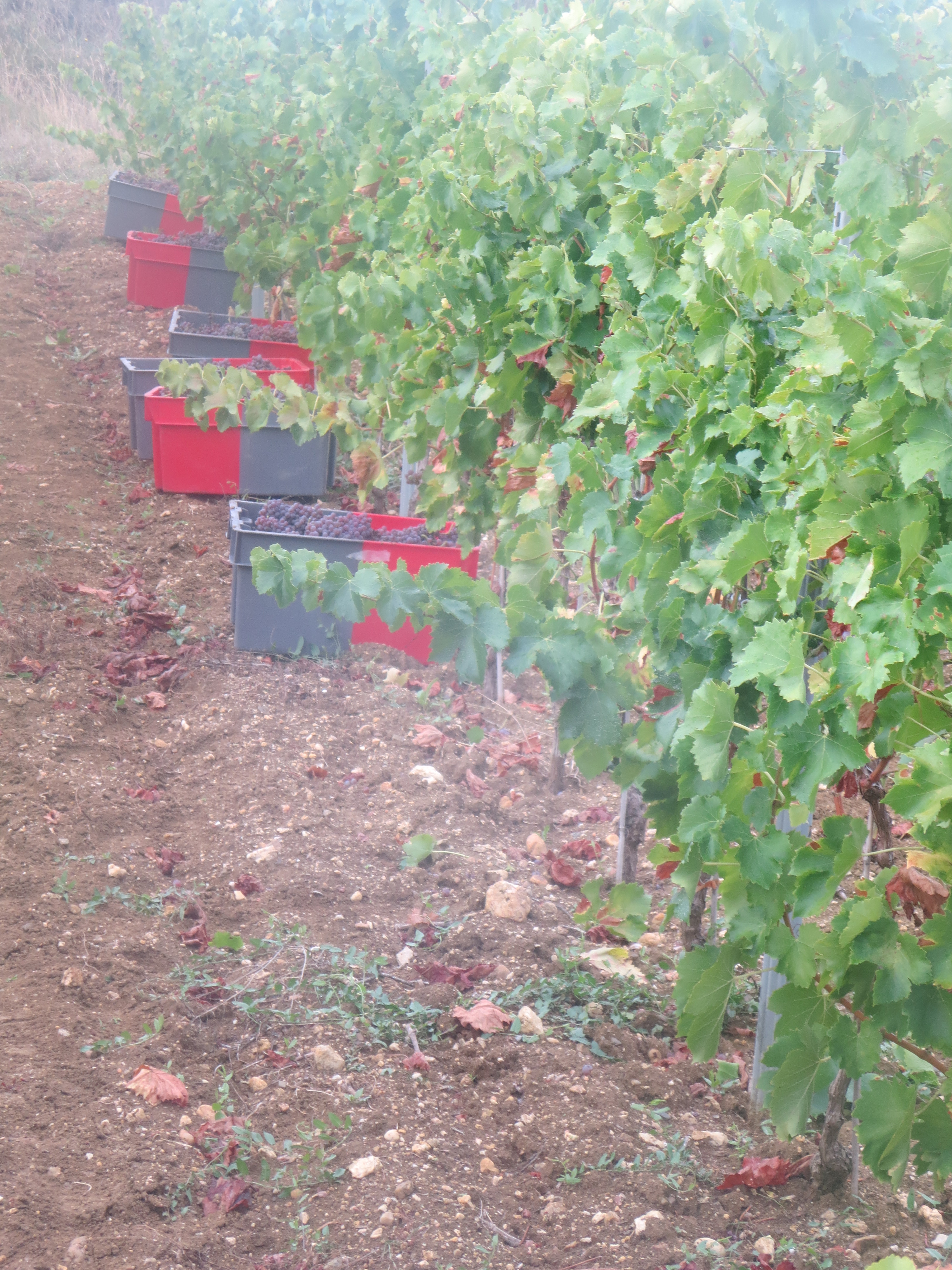
Monday 31st dawned cloudy again and it was time to tackle the biggest of the vineyards at Mas Coutelou, Segrairals. The Syrah was ready to be picked and Jeff had decided to use carbonic maceration to ferment the grapes which are probably not of the same top quality as those from La Garrigue or Sainte Suzanne which were picked last week.
Grapes which are pressed like those described last week ferment in tank as yeasts react with the juice to change the sugar to ethanol, ie alcohol. The yeasts are natural from the skins of the grapes and the atmosphere of the cellar. In the case of Mas Coutelou and many artisanal winemakers this is the case though other winemakers will buy yeasts some of which are designed to add particular flavours to the wine. None of that in Puimisson, these are natural wines.
Carbon dioxide pumped into the tank
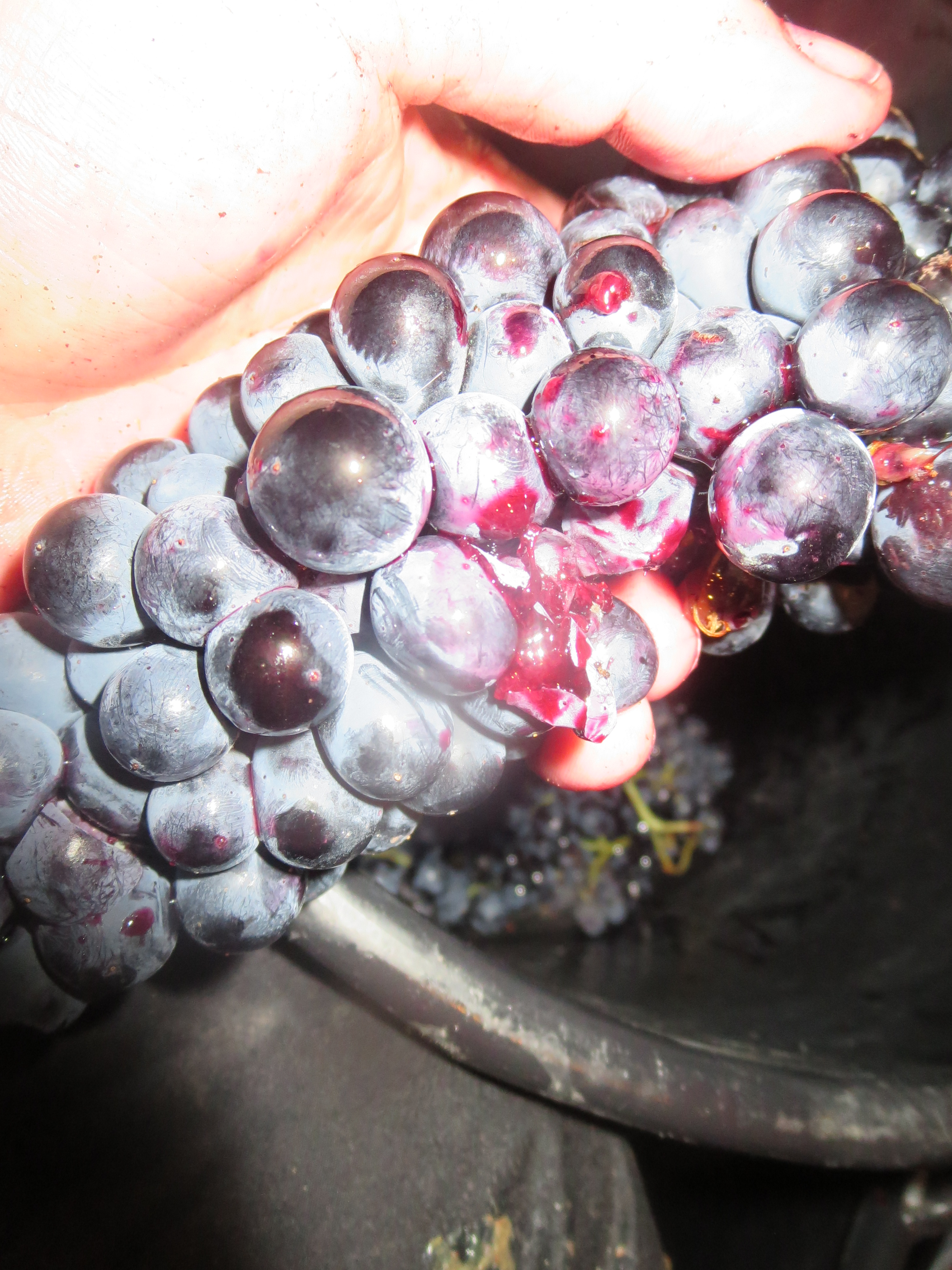
Carbonic maceration means that the whole bunches go into the tanks, grapes and stalks alike. The tank is filled with carbon dioxide which permeates the grape skins and starts the fermentation within the cells of the berry. Some of the berries at the bottom of the tank will be crushed by the weight of the grapes and so there will be some conventional fermentation too.
Whole bunches in the tank
All the grapes are given a light crushing later by which time ethanol will have formed inside the skins and so the resultant juice is ready made wine. The result is often more fruity and juicy wine.
Grapes arrive through the little back door above the cement tanks
To achieve this the tanks are filled from above so we worked in the space above the cement tank with the grapes arriving at the back door which is a level higher than the front door. The space is smaller and the heat from the grapes was high. It was hard work, believe me. Sorting still had to be done before the grapes could go into the tank, quality comes first.
Some of the rejected bits
The pipe carries the CO2 into the tank
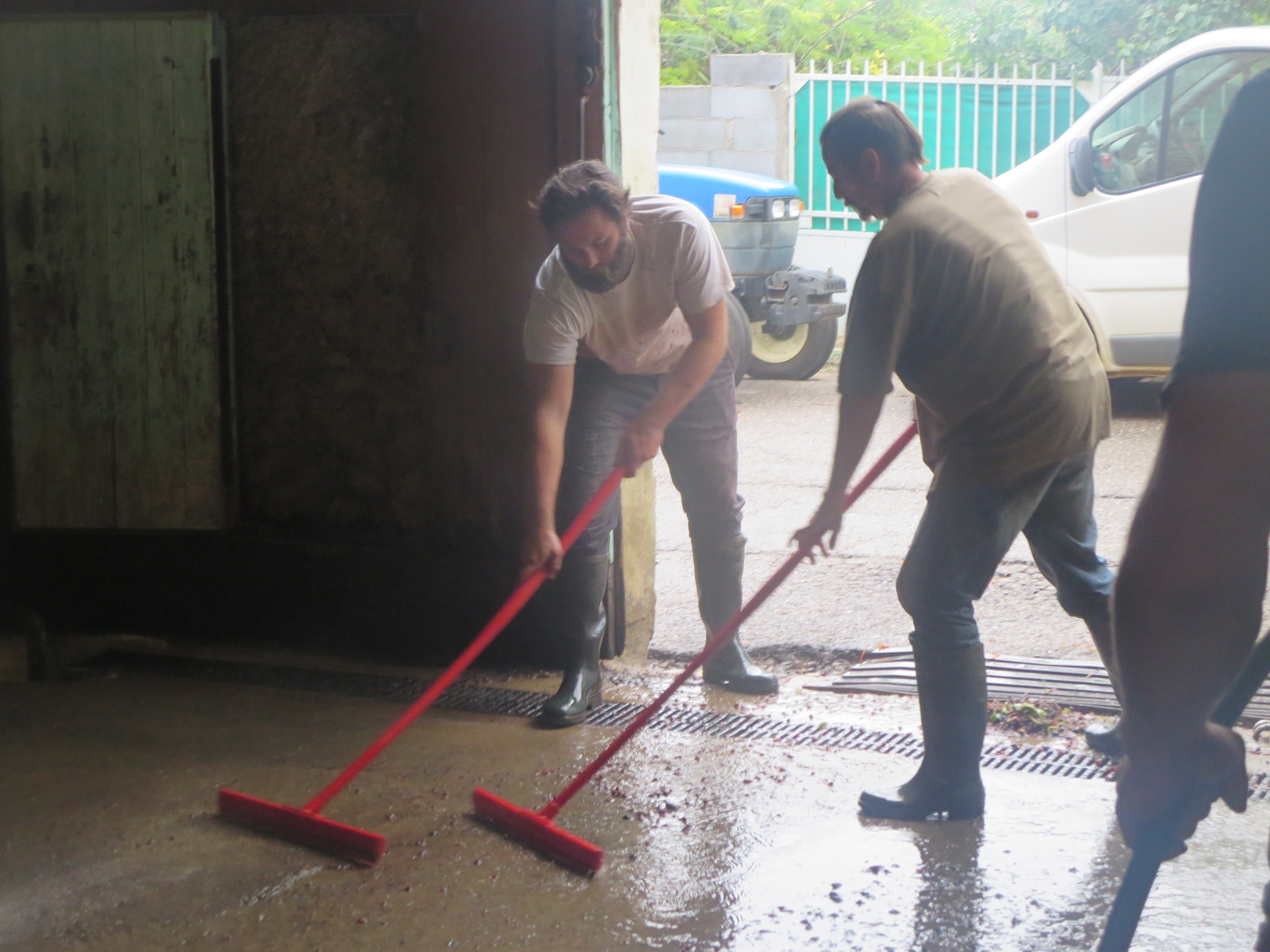
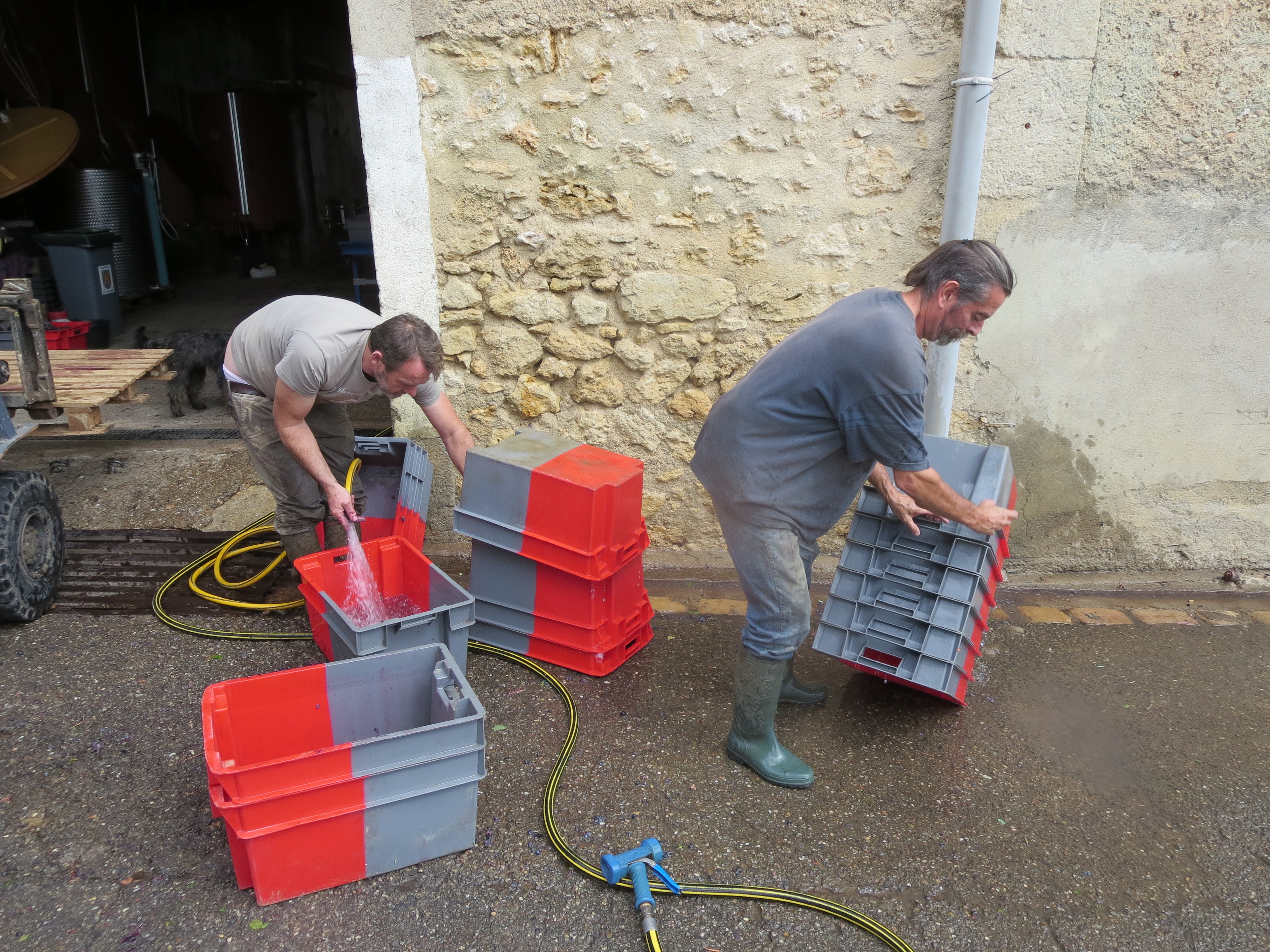
And after 9 hours of back breaking lifting, carrying and sifting it was, as ever, time to clean everything from top of the cellar to bottom as we see here with Jeff and Michel.
One visitor from the vineyard
The boss letting us know we should get a move on
The night of the 31st brought a big storm with lots of rain, not the ideal conditions for harvest at all. Rain can cause rot and problems. However, it could have been much worse as news arrived of huge damage caused by hail in the Chablis region. For all the forecasts of how the harvest might turn out it is only when the grapes are safely in the tank that a vigneron can be assured of the quality of wine they might make. Commiserations to the Chablis producers.
September 1st was a quiet day as the rains from the storms meant the grapes were too wet to harvest. In the cellar more checking and remontage, the process of pumping the wine over the cap of skins and must. Further analysis of the wines showed that the yeasts are acting quickly and the fermentation is progressing very well.
Hard work!
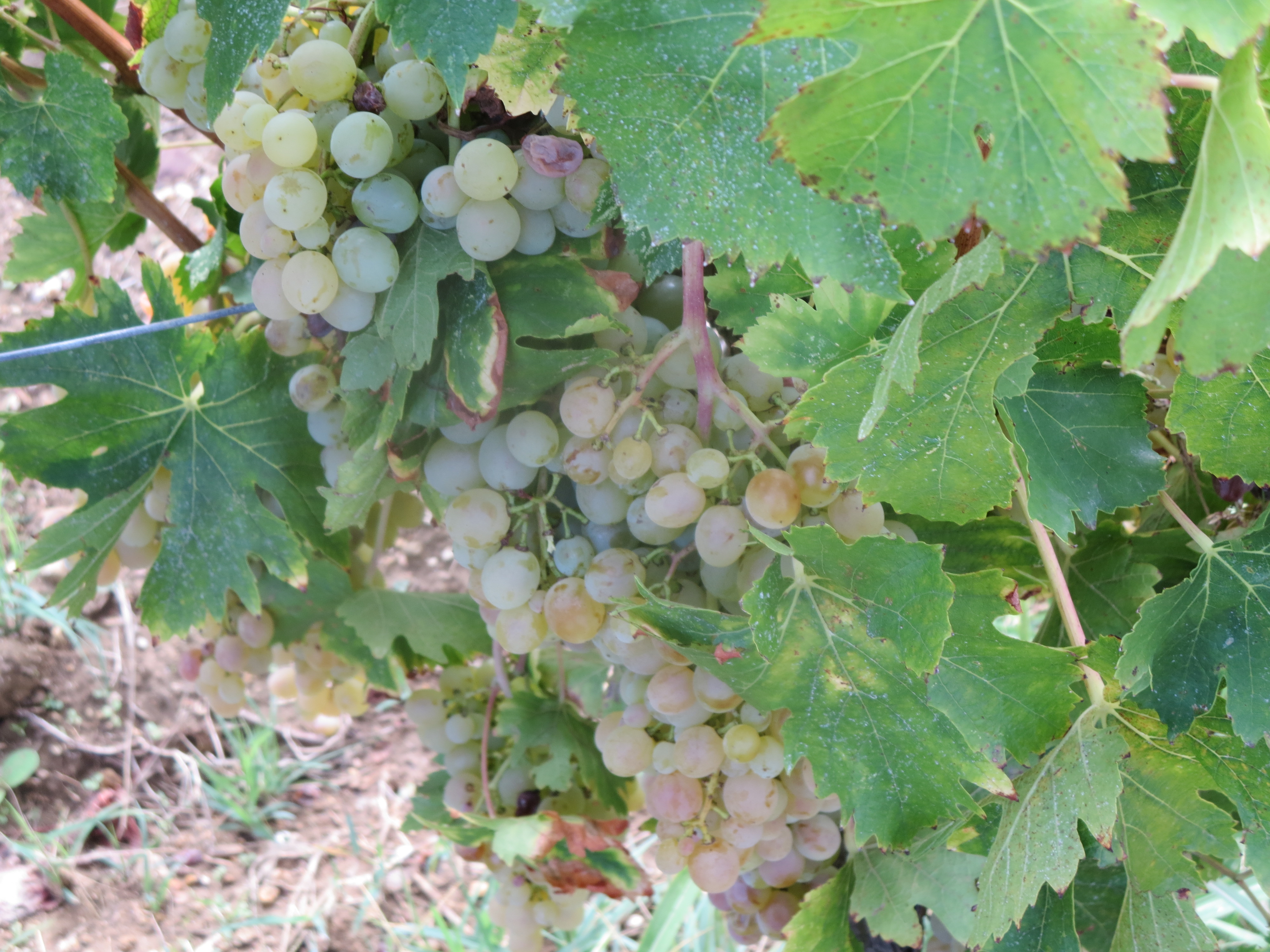
Today, September 2nd, the remaining white grapes, Grenache Blanc, from La Garrigue. Then on to Peilhan to gather some of the white grapes there, Maccabeu, Grenache Gris, Carignan blanc and Clairette Musquée.
Grenache Gris
Clairette Musquée
Michel
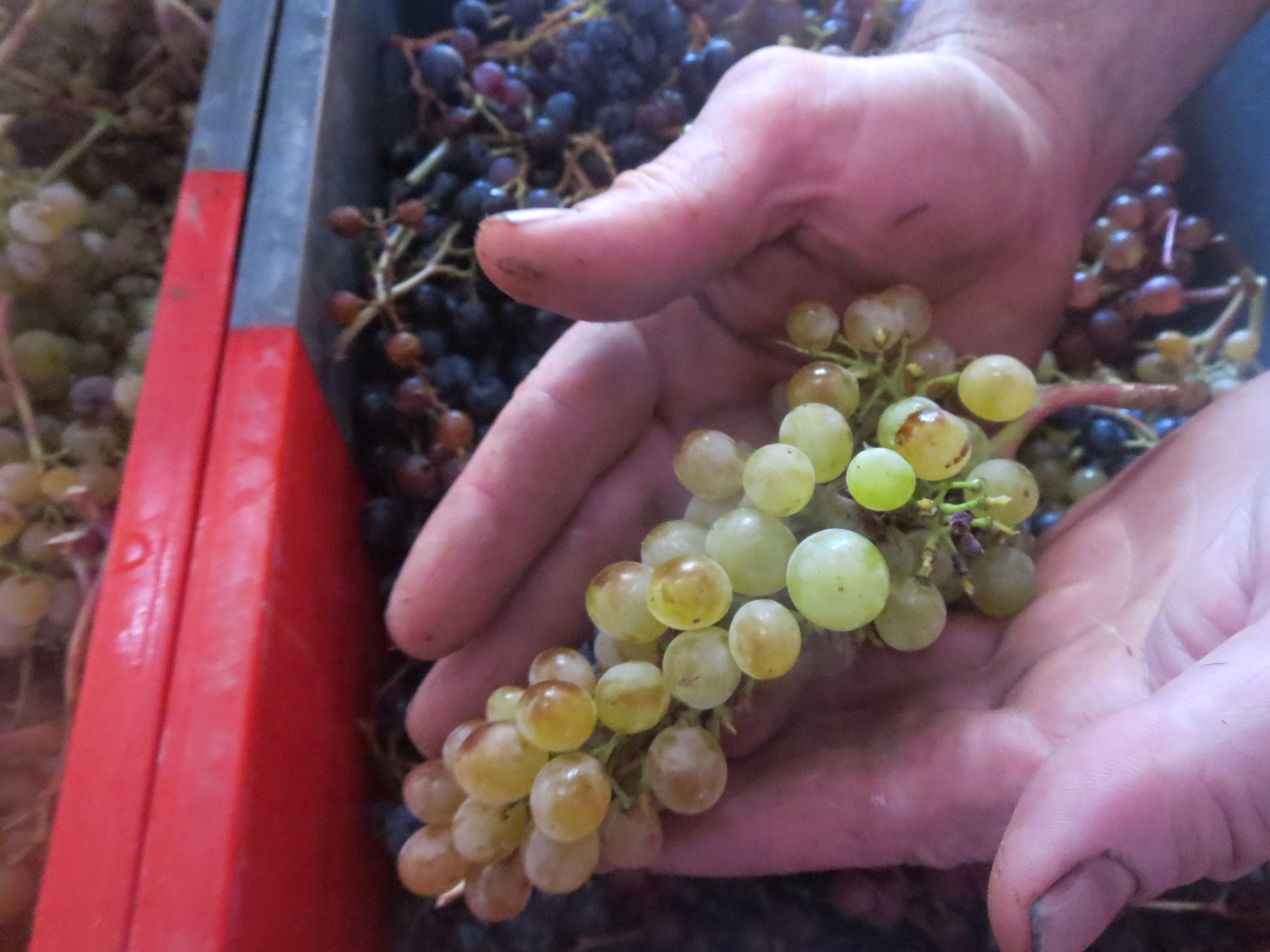
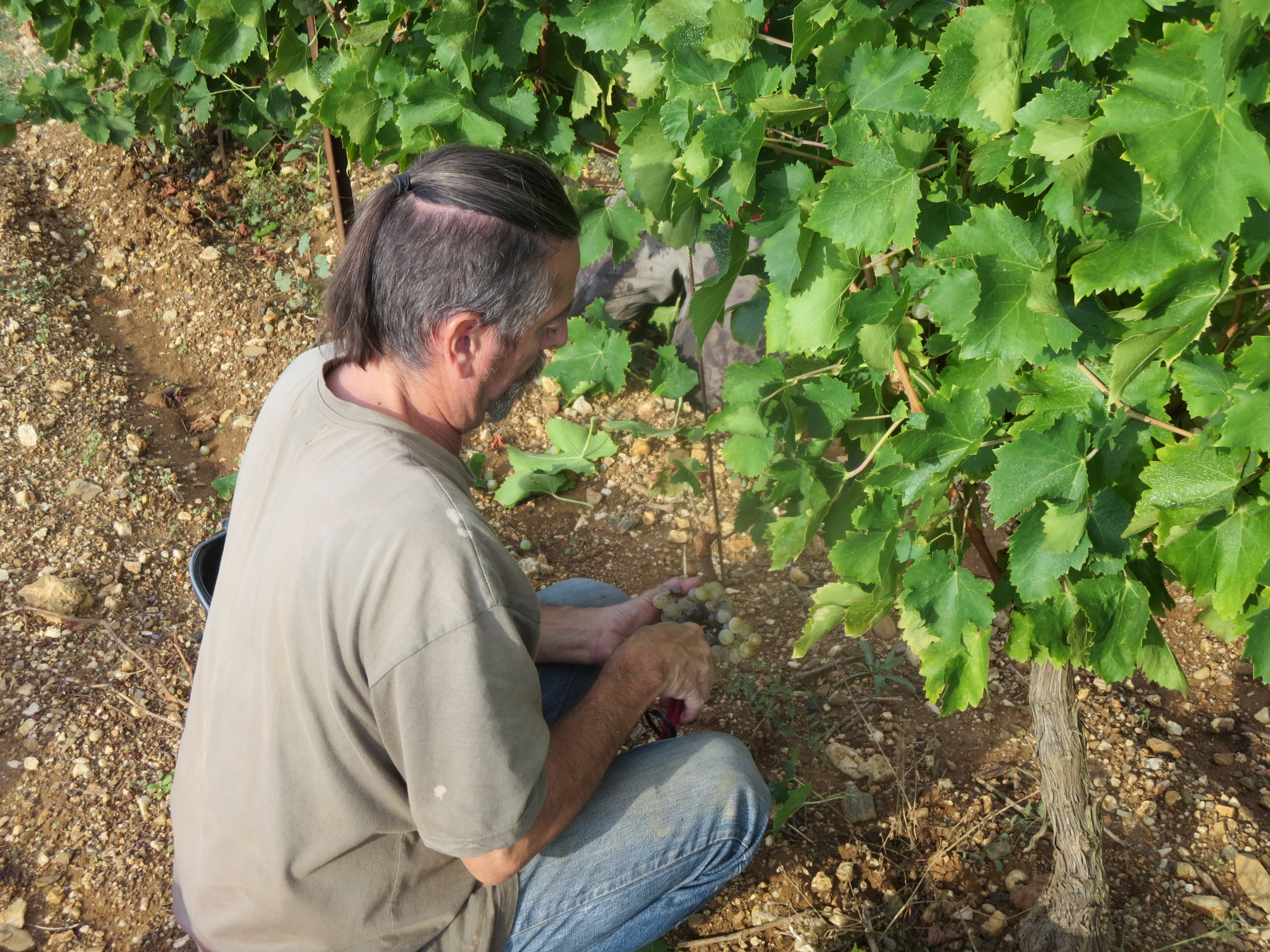
The core team of Jeff, Carole, Michel, Cameron and myself were joined by Matthieu who has worked the harvest before here. There were some lovely bunches though the wet weather has caused some rot inside some of them, Careful sorting took place in the vineyard to take only the best grapes which tasted really sweet and juicy, the Clairette was especially tasty.
Cameron especially pleased with this bunch of Clairette
The white grapes were taken back to the cellar and placed in tank after being destemmed. It is possible that Jeff will make his first orange wine with them. An orange wine is a white wine made like a red wine, ir the wine is fermented on the skins thus extracting more colour, texture and flavour from them and giving the wine an orange tint. However, analysis and the next few days will be needed before the final decision is made.
In tank and the future might be orange
In the afternoon, Matthieu, Jeff and myself did more remontage of the Syrah grapes harvested in the last week, which is already tasting well, with very healthy technical analysis and beautiful aromas. And, then, as ever, the cleaning.








































 amarchinthevines