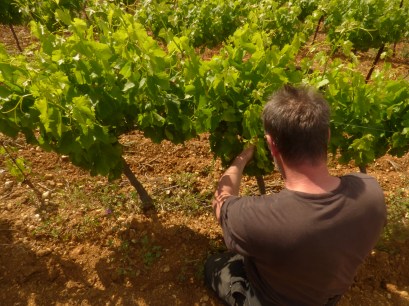
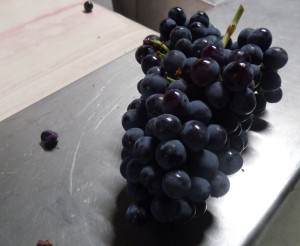
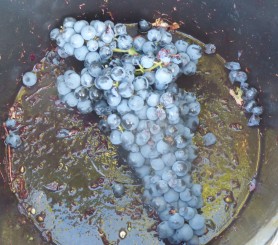
No more racing metaphors I promise but today, Thursday August 24th, the Mas Coutelou 2017 harvest began. Just a gentle canter rather than a full gallop start to events with several rows of Sauvignon Blanc and Muscat vines picked. They will be vinified separately, the Sauvignon went into the large press immediately, the Muscat is lying on skins for a few hours. Julien made the first cut just after 7.30 this morning (photos above).
Jeff, Max, Julien, Vincent
Vincent, Ambroise, Jeremy
Selene
Jeff and Icare
There was a good team of helpers available coming from Italy, Spain, France and, of course, the UK. Carole was back too which always brightens the day. The day was rather overcast and humid, which made the back breaking job of picking all the more tiring but we pressed on until the vines were finished at around 1pm, so five and a half hours of work.
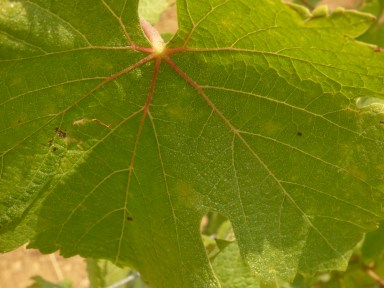
My own first bucket with leaf to identify the Sauvignon Blanc
In the cellar Jeff was anxious about how ripe the grapes were in La Garrigue so was a little relieved when the first readings came in around the 14° potential alcohol mark. There was a generous aroma of green apples coming from the press which augurs well. The Muscat was certainly riper, the grapes full of that hallmark Muscatty taste – they are the wine grapes which taste of grapes!
Caisses unloaded, grapes put into the press and the first juice flows
So, a good start, the team found its rhythm, gelled through conversation and over lunch and we attack the Muscat of Peilhan tomorrow. The bit is between the teeth, the finishing line is still far in the distance but on we go.
And for fans of Icare! Well, he’s still firmly in charge.
Other than wine my main interest is horse racing and I couldn’t help feeling a similarity as I toured the vineyards at Mas Coutelou this morning. The trainer has prepared his charges to the best of his ability throughout the year, faced up to problems of weather and disease, been up all night tending them and must now carefully select when they are at their peak for the big challenge ahead. Meanwhile his assistants and stable hands gather together, friends old and new to lend a hand to the master and to learn from him.
Old Cinsault vines of Rome
OK, maybe I am getting carried away. However, there is a feeling on the eve of my 4th vendanges of excitement that the race is on to bring in the best possible harvest from the grapes. Through winter, spring and early summer all went well, the rain came, the sun shone, the vines grew well. Latterly there have been setbacks it must be said. There has been next to no rain since June and the ground is once more parched. Some of the vines are stressed and their sap has lowered. This means that instead of concentrating energy into the grapes and ripening them fully the vines are protecting themselves. That is a real shame as everything was set for a top class vintage, now we have to wait and see what the next few weeks bring along. Rain is currently absent from the weather forecast, let’s hope that the meteorologists are mistaken.
Flower Power and ‘friends’
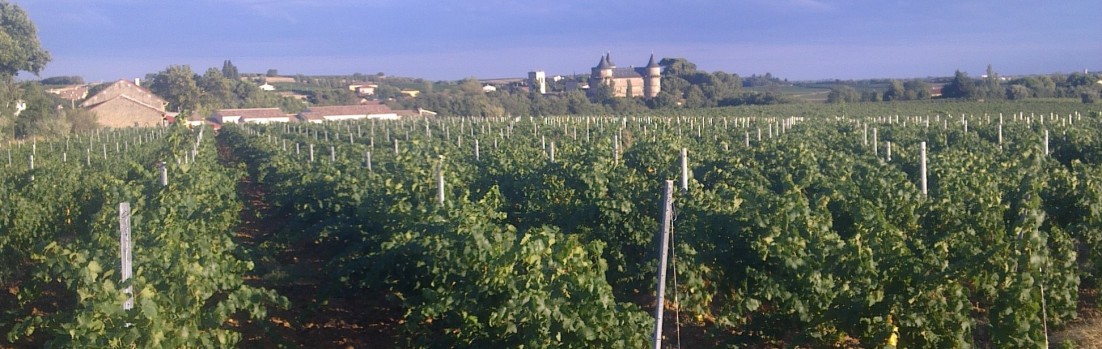
That said as I toured the vines I was impressed by the quality of the grapes. Yes the vines look tired, they should at this time of year as they ought to be giving everything to the fruit rather than the plant.
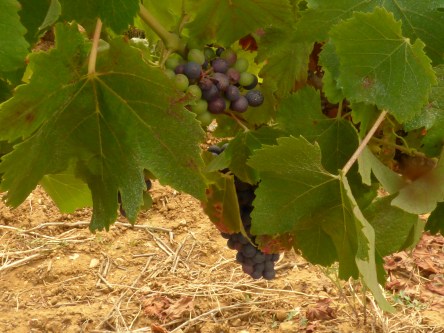
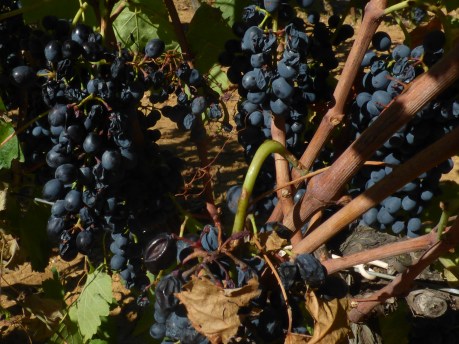
The grapes though look healthy, big bunches in the Carignan vineyard (above) for example though there is still some greenness in the juice and the pips. The Muscat is yellow, orange and flecked with gold and tastes very characteristic with its floral, sweet notes. They will be harvested on Friday, the Carignan in weeks to come.
Ones to follow? Well, in Peilhan the Castets looked lovely and tasted even better. Flower Power has so much more fruit this year though the snails are still present. The Grenache of La Garrigue, Syrah of Sainte Suzanne and the splendid old Cinsault vines of Rome would be my tips for future winners. There will be others which will surprise and delight, and hopefully few will prove lame and disappointing. (That racing metaphor just won’t go away!)
Meanwhile back at the cellar; cleaning, checking the equipment (the large press being serviced above) and even bottling the skin contact Carignan Blanc which James took charge of last year.
James served his time here in Puimisson, learned and has just completed his first vendanges with his own wines in the Adelaide hills in Australia. Vincent’s vines in the Béarn are easing towards maturity, Julien has his vines here in the Languedoc. The team are back in Puimisson though, together with Michel and myself. And joining us this year is Ambroise from the Loire, come to learn too (in the photo with Vincent).
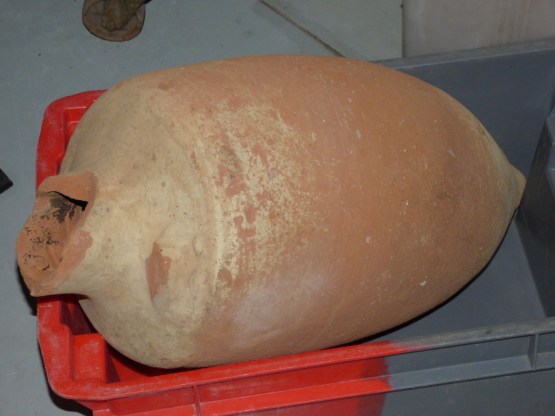
And even Jeff will be learning as two new arrivals from Spain will mean a new form of vinification this year. They will take their place alongside the (much) smaller amphora dating back to Julius Caesar which was donated to Jeff during the winter.
So we are under starter’s orders, Jeff will press the button on Thursday morning and we’ll be off. Let’s hope for a classic year.
Orange wine is very, very fashionable. Often associated with the natural wine movement that is not strictly true as many conventional winemakers are experimenting with orange wines too. Perhaps the fact that they have both emerged into the spotlight in recent years has brought the two such an association. I must say I like the idea but I have not always been convinced by the wines themselves, so here are some recent experiences.
Muscat Petits Grains
James carrying out a pigeage of the Muscat
First of all we should clarify what orange wine means. They are made from white wine grapes which are left on the skins for an extended period in order to extract more flavour. This long maceration also adds tannin and colour to the wine just as happens with red grapes when making red wine. The length of time for skin contact and the type of grapes will add more or less colour, flavour and texture to the wine.
This was how wines were made many years ago, the current trend is a revival of ancient practices. Some countries such as Georgia have always made wines like this. I have had the opportunity to taste such wines from all over the world including Georgia. Mostly I find them pleasing the mind and appreciating the technique rather than pleasing my palate. Academic rather than pleasurable. Often they lack charm, taste very dry and with no fruit, perhaps the result of overlong maceration.
However I have recently tasted some very attractive orange wines. Les Choix 2014 came from Turner Pageot in Gabian, a very well judged wine as there was still plenty of apricot fruit as well as being dry and textured, made from Marsanne grapes. Very good. Ora(n)ge Sur Les Canilles 2016 is made by Domaine Ribiera in Aspiran. Régis and Christine Pichon make this delicious wine from Clairette and Terret grapes, again they have extracted good texture and dry flavours as well as white fruit flavours. Both wines have the slightest note of Fino sherry which really appealed to me.
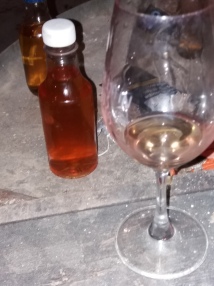
At Mas Coutelou in 2015 and 2016 Jeff used white grapes such as Muscat Petits Grains to make orange wines, usually supervised by our two Australian assistants Cameron in 2015 and James in 2016. The result in 2015 went to make OW1, a blend of eight grape varieties macerated for a couple of weeks. It is a bright colour, has good texture and plenty of fruit along with a herbal note. The following year James made the Muscat based wine and this is a real success, the muscat notes are there but restrained to give white fruit flavours which linger with good spicy notes and a dry finish.
Cameron and me
Orange, skin contact, long maceration. Whatever name you give this style these are wines requiring judgement and skill from the winemaker. I encourage you to try them but select ones from winemakers you trust.
For more information from someone who knows orange wines much beter than me I would recommend this website from Simon J Woolf.
In 1957 Eugène Mas moved the family winery into 6, Rue de l’Estacarède, Puimisson and made his first wines there having constructed the cement cuves the year before. It was much easier for wagins to collect the wines fromt here than from Rue De la Pompe where the wines were made before. In 1987 Jean Claude Coutelou converted the whole domaine to organic production, one of the first in the country. In 2017 Jeff Coutelou completed the renovation of those cellars and decided it was time to celebrate his family and their wonderful wines.
The cellars and garden were decorated, the wine flowed, music played. Friends and family gathered together to honour the history of the domaine and its future. Old vintages, jereboams and magnums matched the excellent food.
Christian Venier and the rugbymen
OW1
OW1
Yanick
Cyril and Camille
It was a great night, a celebration of all that is good in the world of wine – friends and family enjoying themselves around good bottles. ‘Grapes, work and love’ is one of Jeff’s sayings and Saturday night showed how many people love the work and care which Jeff gives to his grapes, and love Jeff himself. This was a celebration of the past but the wines and the work in the cellar show that there is a sparkling future ahead for Mas Coutelou.
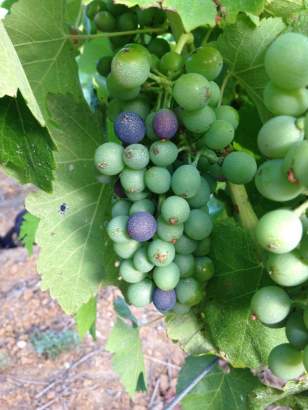
The summer heat is settled and the vines are entering their final stage of the year. They have pushed out long stems, tendrils reaching around supporting wires, foliage at its maximum size and fruit has turned from tiny, green, pea-like balls into round, plump grapes. Taste them and they are still highly acidic, sour and sharp. Pips have formed and the red grapes are just beginning to change colour.
Vines in La Garrigue reaching 2m into the air
This process of véraison is one of the magical turning points of the year, the grapes are now becoming the focus of the vine’s energy. It will spend less time growing and reaching out and more time in creating sugars for the grapes. The bunches are tightening up, the grapes swelling. From now until vendanges they will continue to grow and to store more sugar. The reason, of course, is to attract birds and animals to eat them and scatter the pips to allow the vines to reproduce. It is humans who have learned that this energy from sun and soil can be directed to the creation of wine, we encourage the sugars to change into alcohol and the juice to become wine.
Grapes 2 weeks ago above, and now (below)
Neighbouring vines to Mas Coutelou show dark green foliage, fed by nitrates. the natural evolution on this domaine means that they are a lighter colour but they are vigorous, healthy and all is set fair. Small outbreaks of mildew have been managed by a few organic tisanes. Most of the disease has formed on the new growth which has not been treated, so Jeff has been around affected areas cutting back the foliage to remove the mildew and its spores which could bring back the disease if rain splashed them onto the vines in the next few weeks.
Some mildew on outer leaves, these will be cut away
2017 has been relatively kind, much more so than the drought affected 2016 vintage. Yet other regions have been hit by frost and hail, Beaujolais recently damaged by the latter for example. Remember it was August last year when a hail storm hit the Languedoc and wiped out much of the production in Pic St. Loup and some vines in Puimisson. So, it is still to early to say that 2017 is set fair but it is promising. The vines are a-changin’, time to start getting excited.
Grapes and vines battered by hail in Ste Suzanne 2016
With UK importer Leon Stolarski in attendance Jeff offered us the chance to taste through the 2016 wines which are largely still in tank. Fermentations have been slow from last year, some are still bubbling away gently, finally eating up the last sugars. Jeff thinks the very dry winter and spring and heat of July meant that the yeasts were perhaps weakened meaning fermentation has been slower. The key point is, how does that affect the quality?
Even from when I tasted them a month ago they have changed in nature, more streamlined, less opulent, more complex. And, as always chez Coutelou, very drinkable. The whites show lots of fruit but restrained and serious too, the long maceration Muscat a definite highlight. Sadly, quantities are down, another result of the dry winter and spring. Reds show fruit and complexity, the Carignan beginning to emerge as a star (true of so many recent vintages) and the Mourvèdre continuing to shine bright.
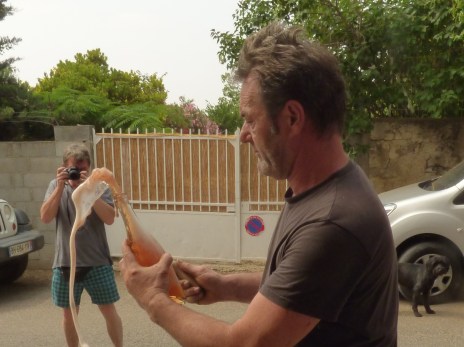
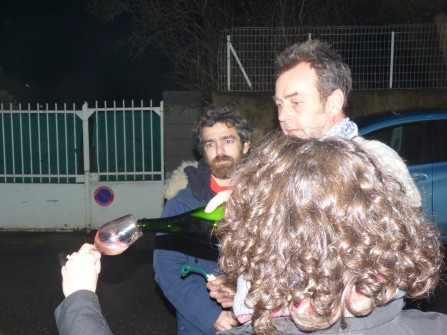
In the afternoon a new treat. Bibonade is Jeff’s PetNat, a natural sparkling wine. The white and rosé version have been sitting in bottle for a while and it was time to disgorge them. Sparkling wines, including champagne, age in bottle rather than tank and as they do so they throw a sediment. Still wines do the same, the sediment (lees) falls to the bottom of the tank and the wine is then taken out leaving the sludge behind. In bottle the sediment also falls to the bottom, if the bottle is laid flat the sediment will coat the inside. To gather the lees the bottles are placed in special racks (pupitres) with the neck pointing down. By turning the bottle 90° every day the winemaker can ensure that the sediment doesn’t stick to the sides and all gathers in the neck above the capsule.
Fermentation in bottle produces carbon dioxide which in turn creates the fizz in there. By opening the bottle, the release of pressure forces the sediment out of the bottle. Obviously this has to be controlled or you lose too much of the wine as well, so Jeff quickly covers the bottle as soon as he sees the sediment is gone.
The bottle can then be topped up from others and resealed.
It is a messy business, the small steel tank stops the capsule from flying off and the wine from coating the whole cellar. Jeff’s arms were quickly covered in flecks of lees. However, the result is delicious, refreshing and Bibonade is a firm favourite chez March.
After a month back in the UK due to bereavement I apologise for not posting for the last two weeks.
Ancient Cinsault in Rome
Grapes forming
It was good to return to the Languedoc even in the midst of a midsummer heatwave. After a day’s acclimatisation I was at Jeff’s on Thursday morning, good and early. Well I thought so though he and Julien had been at work in the vines from 6am! Michel and Vincent were busy labelling some bottles of 7, Rue De La Pompe.
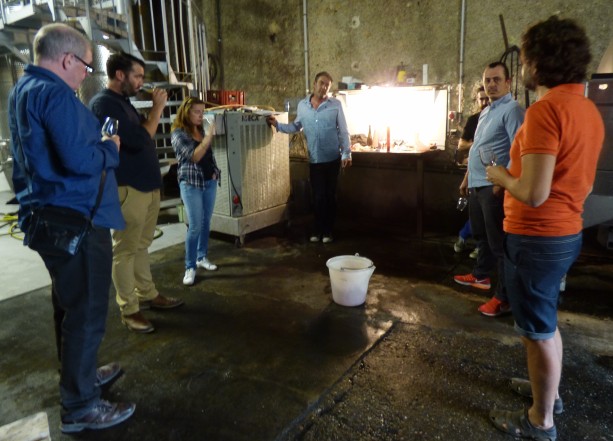
Leon Stolarski and his wife Diane arrived to meet up with Jeff, I can reveal that Leon will be the importer of Mas Coutelou wines in the UK along with Noble Rot bar in London. I showed them the updated cellar and Jeff led us on a tasting through the 2016 wines, of which more next time.
Peilhan May
Peilhan June
Almost as much as the people I missed the vineyards. They offer such variety, calm and beauty. The one advantage of being away for a while is to see the change over a month. The sun has seen off the wildflowers, the greenery of the vines now contrasting sharply with the parched grass. The flowers on the vines have also long gone and the grapes are now well formed and starting to swell, the size of peas. There is no sign yet of the red grapes starting to change colour (véraison).
Grape flowers May
Grapes June
Flower Power May
Flower Power June
Carignan May
Carignan June
Rome May
Rome June
The vines look to be in very good health. The 700mm of rain through the winter, the spell of very cold weather too have helped them to rest and be strong, a vibrant green colour. The humidity of recent days brings the threat of mildew and oidium (downy and powdery mildew respectively) and Jeff has sprayed the vines with organic treatments to help them fight against the disease.
Mildew spots
The other main risk is from snails. In 2016 they ravaged Flower Power vineyard for example, reducing the harvest there to virtually nil. There is less evidence of them there this year but there are huge numbers in Peilhan and Segrairals. In the former they are covering the trees which Jeff planted around the vines a couple of years ago, feasting on the greenery amidst the parched vegetation.
Nevertheless so far so good, 2017 promises to be a good vintage.
After my sojourn in Alsace it was great to return to the Languedoc. Sadly I was already aware that due to a bereavement I would have to leave within a couple of days to return to the UK. However, I was able to spend one of my two days there with Jeff and amongst those vines which I had missed so much.
It was a great time to be there, the vines were in full flower, many already past that stage showing the new grapes, firstly with their brown hoods and then just the green baby berry itself.
The vines were looking very healthy, plentiful rain in the winter and a sharp frost in early spring had allowed the vines to rest, to gather their strength for the season ahead – a sharp contrast to 2016. Greenery aplenty, wild flowers blooming and, during my visit to Peilhan, I saw a young deer running through the vines and a pheasant. Clearly the Coutelou vines attract wildlife to its oasis amongst the surrounding desert of chemically treated soils.
Flower Power
Flower Power May
Rome May
Carignan May
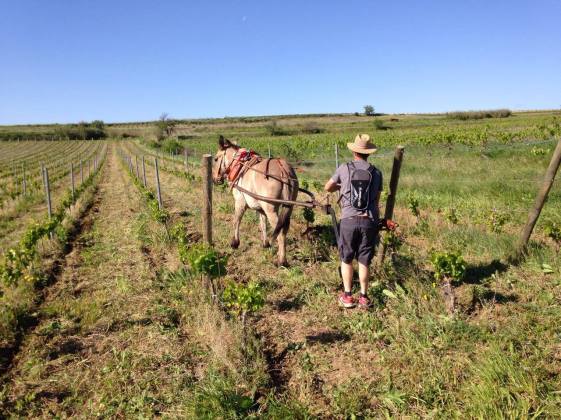
During the previous weeks the soils of Peilhan had been ploughed, by a horse. Gentler on the soils Jeff asked a local man to till.
He himself was giving the soil a light rotivation that afternoon, turning the plants and flowers amongst the vines into the soil, a natural composting. Icare, with an injured paw, and I watched on in the sunshine.
The only real problem this year has been the return of the snails. Last year they ravaged Font D’Oulette (the Flower Power vineyard) so that only a few cases of grapes could be picked. Fortunately, that vineyard has been spared this year but they are out in force in the largest vineyard, Segrairals. It was there that I also found Michel, Julien and Vincent working, tightening the wires of the palissage and removing side shoots etc from the vines.
In the afternoon we tasted through the 2016 vines and, they are so different even from February when I tasted them last. The whites are splendid, highlight a hugely successful long maceration Muscat. The reds such as the Carignan were very good and the top wine of the year will be the Mourvèdre, a silky, complex wine with huge depth of flavour – a treat for the short and long term. 2016 was a difficult year but Jeff has still produced some great wines.
So, I look forward to getting back to Puimisson as soon as possible, to follow the vintage further and see the latest progress. There is bottling to be done and plenty more besides.
The cellar is transformed, painted with the new office and floor and the stainless steel cuves plumbed in for temperature control. And perhaps, most interesting of all, there is an amphora. This is the trendy method of vinification around the world. However, very few winemakers have an amphora dating from the time of Julius Caesar with which to make wine. Jeff plans to use it this year, connecting his wine to those made 2,000 years ago. Wines with links to the past, present and future, Mas Coutelou has soul!
It was a year of difficulties as I have reported on here many times. From a virtually arid winter and spring to a chilly early summer and then a very hot summer the vines had a struggle to cope with the bizarre climate. Add in a hail storm, snails eating away large numbers of grapes and mildew. No surprise then that the quantity of wine produced was much reduced, bottles will be much scarcer than previous years – so when you get the chance buy them. If quantity is down then what about quality?
I have had the good fortune to taste through the range of wines on two occasions. On September 27th the wines were in their infancy settling in tank, the team got together to gain first impressions. In late January and in February this year I tasted them again with a number of visitors. What I tasted was the wine from the different vineyards before it was then assembled into the various cuvées which Jeff will eventually put out. Therefore, my notes are about the ingredients rather than the finished dish.
Tasting January 28th
I decided to simply publish my notes as I wrote them on the two occasions – no editing, just my personal impression at the time. Already these wines had changed a great deal after 4-5 months and they will have changed again even before being assembled into Le Vin Des Amis etc. I have chosen only the main wines, there are several other cuves with other wines but these are the main wines of Mas Coutelou.
September 2016
January / February 17
Muscat Petits Grains – 2 weeks maceration, fairly neutral nose but fresh Muscatty flavour with tannins / texture. Orange flavour in there – G
Nose is Muscatty and orange blossom. No real grapey Muscat flavours but a dry wine, fresh, direct and clean. Little drying on finish but coming together well. – G
Carignan Blanc – little reduced on nose, nice fresh acidity and appley fruit. Still cloudy – G
This has improved, white flower aromas, fresh, white fruits, very long – VG
Maccabeu/Grenache Gris/ Muscat – Lovely pears and red apples. Fresh acidity, lovely. Full, nice texture – VG
Some residual sugar still but direct fresh fruit – pears and apples – G
Cinsault (Segrairals) – assembled with marc from Syrah. Nice fresh acidity – OK
Not tasted
5. Grenache Ste Suzanne – Little green, quite acid, some spicy after notes. A bit tart – OK
11.5%, light but fruity and grapey, lost its tartness, more round – QG
Grenache just picked
6. Syrah Ste Suzanne – Nice, perfumed, red fruits, good acidity and soft tannins – G
Very attractive red fruit nose, has some heft yet only 12%, rich and easy to drink – G
Syrah from Ste Suzanne
7. Flower Power (plus others) – Round red fruits, lively, red fruit flavours – QG
Syrah and Cinsault in there too, nose is lovely, really attractive with red fruits and floral. Nice round easy fruits – G
8. Syrah Segrairals – Still fermenting, quite a lot of residual sugar. Nice, fresh acidity, red fruits – G
Not tasted
9. Syrah La Garrigue – Slight acetate nose, Round dark fruits. Nice texture and mouth filling – G
Dark, ripe round fruits on nose and flavour, plummy, a little closed, good tannins – G
10. Grenache La Garrigue – Nice ripe cherry aromas, good acidity and texture. Ripe – G+
Very fresh and open, round ripe fruits. A little residual sugar still – G+
11. Mourvedre – Very attractive floral aromas, some sugar still, raspberry fruit – G
Improved a lot, a little reduced but liquorice flavours, dark and how it builds in the mouth, could be a surprise star – VG
Mourvedre I picked
12. Carignan – lovely dark fruit, very fruity and fresh flavours. Very clean finish, almost slatey minerality – VG
Still working, a little spritz. Quite acidic as yet but there are dark ripe fruits and these are playing together on the palate, will develop well – G
Still fermenting
Overall, the general impression is of good quality with plenty of freshness and fruit to balance. Mourvedre could provide the star wine of the year which would be a surprise, though the Carignan will no doubt improve and be a star once again. The whites, in various styles, are again showing how good white wines can be in this region. After a very problematic year it is surprising that the wines emerged so well, testament to healthy vines and a skilled winemaker.
It’s a while since I wrote about the happenings at Mas Coutelou, so time for an update. I am thankful to Jeff, Vincent and Julien for keeping me up to date in my absence.
The first few months of 2017 have been damp in the Languedoc, a contrast to the arid 2016. The photos by Julien above show water standing a week after rain and his feet sinking into the soil as he pruned. Jeff had planned to plant a vineyard of different types of Aramon at Théresette next to La Garrigue which has lain fallow for the last few years. However, the soil remains very damp and planting has not been possible, unless things change quickly the project will be postponed until next year. For the same reason, the first ploughing would have begun by now in most years, but is on hold for drier conditions.
Pruning the last vines (photo and work by Julien)
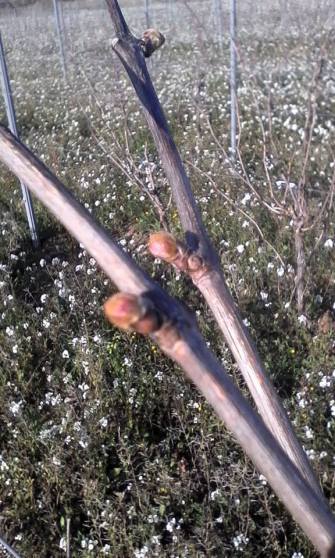
Julien completed pruning (taille) around March 10th. He photographed the first budding (débourrement) amongst precocious varieties such as the Muscat. However, Jeff told me this week that, generally, budding is later this year, the damper, cooler weather again responsible. That is not necessarily a bad thing. Remember that frost can cause great damage to vines, especially buds, and the Saints De Glace (date when traditionally frost risk is over) is May 11-13. I recall visiting the Loire last April and seeing frost damage, whole vineyards with no production for the year.
Julien photographed some early buds
The weather conditions are favourable for something, sadly not good news either. Snails, which ravaged large numbers of buds and leaves in Flower Power and Peilhan last year, have found the damp much to their advantage. They are a real pest, a flock of birds would be very welcome or we’ll see more scenes like these from 2016. Of course, one of the reasons why birds and hedgehogs are lacking is the use of pesticides by most vignerons in the region.
In the cellar the new office and tasting room is complete. Our friend Jill completed a montage of Mas Coutelou labels which we gave to Jeff as a gift. Hopefully that may decorate the walls of the new rooms.
The floor which was half covered in resin last year has been finished all over and another new inox (stainless steel) cuve has arrived. (photos by Vincent).
On March 22nd the assemblages of the 2016 wines took place. Or at least most of them. One or two cuves still have active fermentation with residual sugar remaining but otherwise the wines were ready and the conditions were favourable. I won’t reveal what cuvées are now blended, that is for Jeff to unveil. However, I can say that the reduced harvest of 2016 means fewer wines are available and fewer cuvées made. In the next article I shall be giving my thoughts on the 2016 wines from tastings in October and February.
Finally, there was an award for Jeff himself. On March 30th he was made an official ambassador for the Hérault by the Chamber of Commerce of the département. This was an honour for Jeff himself and the generations of the Mas and Coutelou families who made the domaine what it is. Founded in the 1870s at 7, Rue De La Pompe by Joseph Étienne Mas who planted vines and kept cows after he had fought in the Franco – Prussian War of 1870-1. Five generations later Jeff is an ambassador for Puimisson, vignerons and the Hérault and with his wines he is really spoiling us.























 amarchinthevines