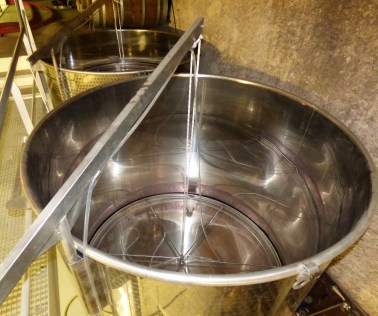
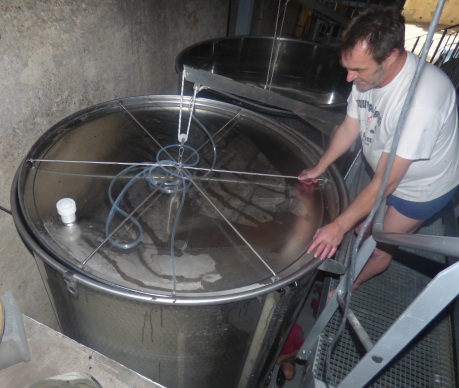
Cuves containing new wine including, potentially, La Vigne Haute. Note how the near one is far from full, this is 2018!
A hectic and busy week, including 12 hour days. The picking team had reduced in number therefore Jeff Coutelou had to make the time work to best advantage. Grenache Gris was amongst grapes picked on Monday to head towards rosé and other cuvées. The main focus though was the Carignan of Flambadou, the flagship of the domaine for the last few years. It may well be joined in cuve by the small, juicy berries of that rare Cépage, Castets.
Cabernet Sauvignon followed on Tuesday and Wednesday with more Syrah and Cinsault from different parts of the vineyards. Mourvèdre was the last big block of vines to be tackled and took a very full day on Thursday to pick. This parcel in Segrairals has varied topography, the lower parts become a little damp and are more prone to rot. It is important for Michel to convey not just the grapes but also the location of the grapes picked so that triage is made more efficient.
Top left – Carignan, top right – Castets, below Grenache Gris
By now Jeff was concerned that some of the vines were becoming so stressed by all the issues this year, mildew above all, that they were struggling to ripen the grapes. In order to ensure the health of the vines for next year it was no longer worth pushing them that little bit further so that next year would be compromised. Vines are fragile, living things which need to be looked after, Jeff nurtures them carefully.
Whilst picking was in full swing and cases were stacked up for sorting there was plenty of activity in the cellar. Wines in cuve or tank need treating carefully too, ensuring the juice ferments into wine with nothing added to it requires the vigneron makes good decisions about, for example, levels of acidity and alcohol, exposure to air and skins. I shall be coming back to this in the next post in a couple of days time.
And, after all that work, it is all too tiring for some of us!
Some serious hard work. A lot of grapes came through the cellars in these two days and we worked longer hours than usual. I can almost hear regular readers thinking, “Hang on, you said there were fewer grapes this year!” That is, sadly, still the case. Whereas in previous years all the grapes that came through in similar quantities might have been from one or two parcels this time it was grapes from several different parcels. All the grapes from those parcels. What might have taken three or four days was done in two.
White grapes from Peilhan, Cinsault from Segrairals came in thick and fast on Friday. Cinsault is a generous grape with big, floppy leaves and big, juicy grapes to match. Problematically the size of those grapes means that bunches can grow to quite a size but with large gaps between the round berries. Into those gaps rot, leaves, insects and moths find their way. Therefore it needs careful sorting, the rolling sorting table was needed. Amongst the usual leaves, grass, snails, earwigs and spiders I spotted an unwelcome visitor.
Lobesia botrana or European grape moth (ver de la grappe in French) lays its eggs inside bunches of grapes and the cocoon resembles cotton wool. They emerge as worms which eat into the grapes for nourishment, leaving a trail of juice which can attract rot. The moth’s main predators are birds and bats which is why Jeff Coutelou and others try to attract these species into their vineyards. As you can see I found one worm clinging to its Cinsault grape. I need to add this is rare, you will not be drinking worm juice in your wine!
So keen to bring home the Syrah and part of the van!
Saturday and more parcels. My favourite wine of Jeff’s is La Vigne Haute, the pure Syrah from La Garrigue vineyard with its north facing vines with some villefranchien soils. Jeff only makes this when the grapes are very good, seven times in the last seventeen years, this decade there are only three. I love LVH and always hoped to help to make it and last year was the first time, having tasted it in bottle (not yet released) I can promise that the wait was worth it. Surprisingly, despite the problems of 2018, the Syrah from this vineyard is in very good shape and might just make it as La Vigne Haute. A lot less sorting, healthy bunches, fingers crossed for the first star wine of this troublesome vintage.
Syrah from La Garrigue
The afternoon brought in the Grenache from La Garrigue. Sadly, this is not of the same quality as Grenache was most susceptible to and damaged by the mildew epidemic. The juice will receive a short maceration before being separated from its skins and then used for a project as yet undecided. There were some lovely bunches harvested, you can only think of what might have been. That the Grenache and Syrah from this vineyard was picked in one day tells its own story.
Lovely bunch of Grenache which Julien and Élise help to sort
Meanwhile soutirages, débourbages and pressings all take place, the cellar is a hive of activity. And of course there is the endless cleaning of everything. Analyses of the wines so far are positive and the juices taste very good, I particularly liked the Flower Power / Rome assemblage.
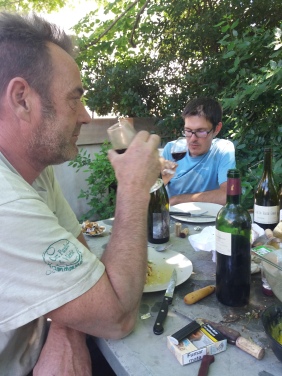
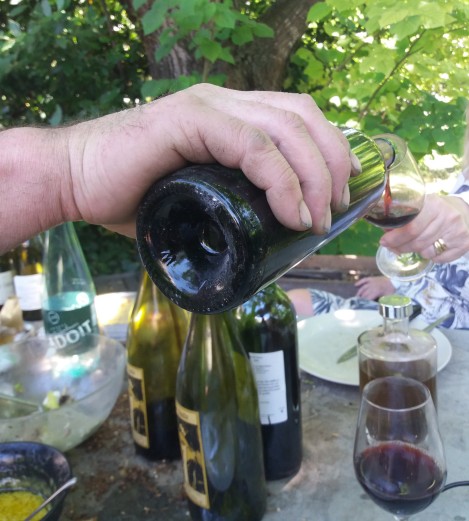
As I said long hours, hard work, aching back, stained hands and dirty fingernails. In between there were the usual laughs and camaraderie, bottles shared at lunchtime and after work. Despite everything the year has thrown at the Languedoc and Coutelou we know that there will be some good wines.
My fifth vendanges with Jeff Coutelou, time has flown and instead of a complete ignoramus helping where I can without getting in the way I now understand the different jobs and skills needed and can tackle most, if not all. This year’s reduced harvest (possibly up to 50% less than average) means we need a reduced team and so I hope I can put those years of experience to use to support Jeff along with Michel, Julien, Nathan and the team of pickers.
This year has been difficult due to the weather as I have tried to explain on here before. The long period of rain during the Spring meant that mildew hit hard across the region. Some friends have lost all their grapes, others significant amounts. Those in organic and biodynamic farming have been hit hardest as synthetic anti-mildew treatments proved more effective than organic ones. A couple of bursts of hail during thunderstorms triggered by the heatwave of July/August also damaged vines and bunches of grapes. One of the effects of both these problems is damage to the foliage, making it more difficult for the vine to have photosynthesis to produce energy to ripen the grapes easily.
Top left – mildew dried bunch on the left, top right – hail damage to grapes and leaves underneath
All of this meant that unlike other regions of France the vendanges began later than usual, the first picking was August 29th a full two weeks after 2015 for example. We began with white grapes, Sauvignon Blanc, Carignan Blanc and Muscat from La Garrigue vineyard. I did a little picking and then moved to the cellar for sorting.
The pickers in action, my bucket and case, back to the cellar and first analysis
With the problems of 2018 sorting might have been very difficult but actually not so much so far. The ripened grapes are healthy, the dry heat of summer means there is no evidence of rot. Instead we are looking for grapes dried by mildew, many bunches have clusters of them, they can be easily separated from the healthy grapes. Another issue is the number of unformed grapes, like little hard, green peas amongst the bunches. This is due a problem called millerandage, where the flower was unable to set the fruit, a product of the rainy, cold Spring and early mildew.
Cinsault with millerandage left side
The first red grapes soon followed, the Grenache from Sainte Suzanne, often the backbone of Le Vin Des Amis. This was the parcel hardest hit by mildew and the quantities are heartbreakingly reduced. Nonetheless there was enough to take picking on the afternoon of Wednesday and the Thursday morning. The sorted grapes were passed through the new destemmer (mercifully quieter than the previous one) and then sent for a short, cold maceration.
In the video Michel is putting the chapeau into the tank to cover the grapes. Dry CO2 has been added to make the grapes cold so that they do not get too hot and ferment too wildly. The juice was run off the skins on Saturday morning. Jeff has a number of options for using this juice, which was never going to be serious enough for using in a classic red wine.
We restart picking on Tuesday, September 4th. There are lots of healthy parcels ahead and things will perk up. This initial burst was a useful warm up, mechanical problems with the press and pump are now sorted and we head towards the main event. Wish us well.
There are plenty of healthy, juicy grapes to look forward to like this Carignan for Flambadou
And one member of the team just loves this time of year, with lots of attention.
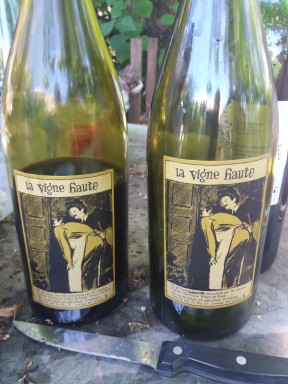
The last article described the ongoing problems in the Languedoc with mildew spoiling vines and grapes. Last Saturday Jeff invited me over to try and beat the blues a little. Steve from Besançon was staying with Jeff for a week to learn a bit more about being a vigneron. They had opened a bottle of La Vigne Haute 2013 on the previous evening and Jeff invited me over to try the last glass from the bottle.
When I arrived on the Saturday morning Jeff was spraying the Flower Power vineyard, Font D’Oulette. When he had finished we returned to his house and I had the remaining 2013, delicious it was too, still youthful but starting to add tertiary notes to the fruit. Jeff decided to open the 2010 to show how age helps La Vigne Haute to reveal its quality and depth; fruit, spice and leathery complexity. A bottle demonstrating perfectly why La Vigne Haute is my favourite wine of all. However, that was not the end. From his personal cellar emerged a 2001 LVH with no label. Still vibrant with fruit singing and yet more complexity of spice, classic black pepper notes. Simply excellent.
So, was that the end? Not at all. More Syrah from older vintages, 1998, 1997 and 1993. Each was still alive with black fruit and those spicy notes. The 91 was Jeff’s first solo bottling, a real privilege to taste it. He had added, all those years ago, a total of 5mg of SO2, pretty much absorbed now, and would certainly qualify as natural wine from a time when it was virtually unknown. A treasure trove of history as well as further proof of how well these wines do mature, there were no off notes at all. Indeed, they were delicious.
A 1999 Cabernet Sauvignon showed the quality of that grape from the region and how well it aged. There were still currant flavours, violets and more spice. A fresh acidity cleansed the palate. I hadn’t known what to expect, I was bowled over.
Legendary Roberta
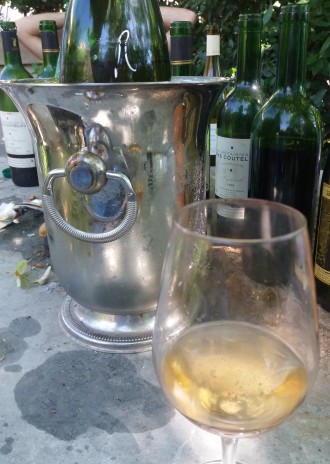
And to finish the 5 hour lunch a bottle of Roberta, the 2003 white wine made from all three Grenache grapes, one of Jeff’s first no added sulphite wines, aged in a special barrel which gives the wine its name. It is a treat I have tasted on a handful of special occasions, its nutty, round fruit was a perfect ending to a special day. Whatever 2018 brings this was a reminder of the special Coutelou wines.
After eight months away from Puimisson and the Coutelou vines it was definitely a case of being very happy to return. As I stood in Rome vineyard there was the chorus of birdsong, hum of insects, flash of colour from butterflies and flowers. A resounding reminder of why this is one of my favourite places on Earth, capable of making me joyful just by being there.
Rome
In Font D’Oulette (Flower Power), the vines are maturing well, many now sturdy and thriving in their gobelet freedom. The change from when we grafted some of them just two years ago is dramatic, perhaps more to me as I haven’t seen them since last October.
Grafted vine 2016, same vine now
In Peilhan and Rec D’Oulette (Flambadou’s Carignan) the roses were still just in bloom at the end of the rows but starting to wilt under the hot sun.
Carignan left and top right, Peilhan bottom right
And there lies the rub. The hot sun has really only been out in the region for the last week, it has been a catastrophic Spring. Rain has fallen dramatically, almost three times the usual level from March onwards after a wetter winter than usual. The annual rainfall average has been surpassed just halfway through the year. Moreover the rain was not in sudden bursts but steady, regular, in most afternoons. Vineyards all over the region are sodden, tractors and machines unable to fight their way through the mud making vineyard work difficult if not impossible. Even after a week of sun if I press down onto the soil I can feel the dampness on the topsoil.
Mix damp and warmth around plants and there is a sadly inevitable result, mildew.
Look again at the photo of Peilhan, zoom in on the wines at the bottom,
there are the tell tale brown spots.
This downy mildew lives as spores in the soil and the rain splashes them up onto the vines. Jeff had warned me of the damage which I described from afar in my last post. Seeing the tell tale signs of brown spots on the upper leaves on such a scale across vineyards all over the Languedoc is another matter though. All those vines touched will yield nothing (though some will still put them into production, so be confident of your producer). I have heard that some producers have effectively lost most of their vines for this year and similar stories from right across the region. Grenache seems particularly susceptible to mildew and it has been devastated at Jeff’s, the Maccabeu too.
Meanwhile Jeff has been struggling against nature, not a normal situation. He has sprayed all kinds of organic products from seaweed, nettles, essential oils such as orange and lavender, horsetail, clay. He has used the two natural elements permitted under organic rules, copper and sulphur. Jeff is particularly reluctant to use copper but such is the battle this year that it was necessary. Unfortunately like Sisyphus the task is uphill. He sprays, it rains and the effects of the spray are greatly lessened by washing it off the vines, so he has to start again. At least this week that is no longer the case and Jeff has been working all hours to save what he can, to roll that rock uphill once more. He is discouraged, even heartbroken to see the state of some of the vines he tends and cares for so much.
Dare I mention that now is the time when oidium, powdery mildew makes itself known? Please, not this year.
So, production will be down enormously this year, we hold out best hope for Syrah, Mourvèdre, Carignan Noir. Lower production means lower income too, so expect price rises and please do not complain as now you are aware of the reasons.
So happy returns? Well on a personal level yes. To see my great friend again, to have Icare waiting to be tickled, to see the good side of nature. But. This is not a happy time for vignerons across this region and it hurts to see my friends knocked about like this. Let us hope for northerly, drying winds, sunshine and no more disease so that something can be rescued this year, for Sisyphus to reach his summit.
It really is Flower Power now. Jeff sowed wildflowers and plants to help the soils of that vineyard retain moisture, ironic given the Spring.
Reflecting still on my trip down under, my thoughts turned to the question of taste. It is personal of course, a wine which appeals to me may not be to your palate and vice versa. I was delighted to receive an email from Peter Gorley about his recent trip to New Zealand and specifically his tastings of Pinot Noir. Peter is someone whose wine knowledge and appreciation I have great respect for and trust in. His book on the Languedoc is a must buy based on his experience of living there for many years.
It was clear that Peter was much more enthusiastic about the Pinots he tasted than I was. There were a few we tasted in common though Peter’s tastings were far more extensive especially in the North Island and Marlborough. I honestly trust Peter’s judgements, so why was I less convinced?
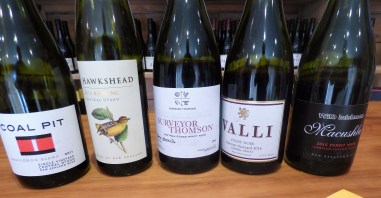
The Surveyor Thomson was one we both tasted
I think it is fair to say that Jeff Coutelou has changed my taste in wine. And I am very happy that he has done so before anyone thinks that sounds like a complaint. Before I really got to know Jeff 10 years ago my taste in wine was very conventional and I rated most highly the wines which garnered praise and were ‘typical’ of their type, variety and place. After sharing so much with Jeff, his own fabulous wines and wines from many other natural producers, I know that my taste has altered.
I rate enjoyment and excitement much more highly than other factors these days. Does the wine taste good? Is it fruity, clean? Does it make me want to try another glass? Is there a vibrancy about the wine?
I taste wines, both natural and conventional, that can give me positive answers to those questions and much more besides. I taste wines, both natural and conventional, which unfortunately do not. These days it is natural wines which form the majority of wines which fall into the first category. In New Zealand I found too many Pinot wines trying to be aged Burgundy rather than a genuine expression of their place. There is a convention of how good wine tastes and many producers, not just Kiwis, seem to want to be included in that convention. I get more excitement from those who let the grapes speak and produce wine where they are not manipulated to meet a convention.
Kindeli, one of the NZ producers I enjoyed most. I have bought some since returning to the UK
That is not to criticise Peter in any way. He included Jeff in his book, has an open mind about wine and I share many of his favourites. We are different. I have spent so much time with Jeff that my palate is inevitably the one which has changed to prefer the natural style. That doesn’t make me right or wrong. We are different, taste is different. Chacun à son gout.
It’s a simple explanation honestly. The tank of Mourvèdre was ready for remontage. That is where juice from the bottom of the tank is pumped over the cap of grape skins, pips etc (the must) which rise during fermentation. That cap becomes hard and there is a risk of bacterial infection plus the whole idea of having the skins in there is to extract tannins, colour and flavour so it’s pointless having them separated from the juice.
A normal pigeage
You may recall that this was the tank where Jeff had to improvise last Monday when the érafloir broke down. Some of the bunches were destemmed, others went in whole bunch. There is therefore a higher than usual amount of solid material in the tank. This had formed a solid cap and Jeff needed it to be pushed back into the juice. A fork was used at first as is normal (the process called pigeage), but the crust was too firm. So, Jeff took off his boots and socks and climbed in.
This is dangerous for two reasons. He could fall through the cap and into the juice and, secondly, there is a lot of carbon dioxide coming from the fermentation which, as I found out, can make you ill. So hanging on to the sides and with myself and Matthieu ready to catch hold Jeff pushed down with his feet onto the cap.
He described the cap as cold but underneath the fermentation meant that the juice was hot. As Jeff pushed down the cap it was fascinating to see the gentle bubbling of the fermentation process, sadly it was too dark for the camera to pick up. As he pushed the cap down, Jeff needed to push lower so, off came the trousers. Moving around the tank the cap began to sink bit by bit.
Out he came and a normal remontage took place though in his briefs!
And the wine? Well it tastes very good, perhaps with more legs in the glass than usual.
Last Monday (September 11th) we were joined at Mas Coutelou by winemakers Charlotte and Louis Pérot and of their friends. You might recall that their Cahors domaine L’Ostal is one which has appeared on these pages before. I first met Louis in spring 2015 at La Remise in Arles where I was taken by his wines and was eager to spread the word of how good they were. Happily Jeff agreed with my judgement and a friendship grew between the winemakers.
Cabernet Sauvignon 2017
Sadly the spring of 2017 brought 3 nights of frost to the vines of L’Ostal damaging the young growth and buds, up to 80% of the vines were damaged meaning huge losses on the year. Jeff decided to help out and offered the Pérots the opportunity to come to Puimisson and take some Cabernet Sauvignon grapes to ensure they had more wine. I hasten to add that this was a gift, free of any charge, offered simply to help out a colleague and friend. I have heard of similar stories for other winemakers affected but it was humbling to see this fraternity in action for myself.
Heading home
Louis and Charlotte picked around 60 cases and drove them back to Puy L’Evêque where I am sure they will make another very good wine. We actually opened one of their magnums the following day at lunch, and very good it was too. If you thought Cahors wines are too difficult I urge you to try and find one from L’Ostal, it will change your mind.
In a year when Jeff himself will lose up to 40% of his average production he showed no hesitation in helping out someone who was in a worse situation than himself. A mark of the man.
After my sojourn in Alsace it was great to return to the Languedoc. Sadly I was already aware that due to a bereavement I would have to leave within a couple of days to return to the UK. However, I was able to spend one of my two days there with Jeff and amongst those vines which I had missed so much.
It was a great time to be there, the vines were in full flower, many already past that stage showing the new grapes, firstly with their brown hoods and then just the green baby berry itself.
The vines were looking very healthy, plentiful rain in the winter and a sharp frost in early spring had allowed the vines to rest, to gather their strength for the season ahead – a sharp contrast to 2016. Greenery aplenty, wild flowers blooming and, during my visit to Peilhan, I saw a young deer running through the vines and a pheasant. Clearly the Coutelou vines attract wildlife to its oasis amongst the surrounding desert of chemically treated soils.
Flower Power
Flower Power May
Rome May
Carignan May
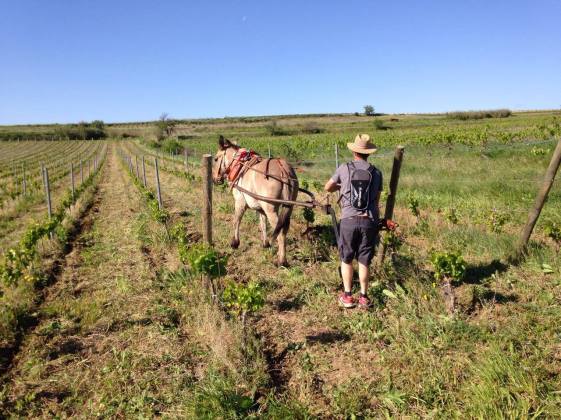
During the previous weeks the soils of Peilhan had been ploughed, by a horse. Gentler on the soils Jeff asked a local man to till.
He himself was giving the soil a light rotivation that afternoon, turning the plants and flowers amongst the vines into the soil, a natural composting. Icare, with an injured paw, and I watched on in the sunshine.
The only real problem this year has been the return of the snails. Last year they ravaged Font D’Oulette (the Flower Power vineyard) so that only a few cases of grapes could be picked. Fortunately, that vineyard has been spared this year but they are out in force in the largest vineyard, Segrairals. It was there that I also found Michel, Julien and Vincent working, tightening the wires of the palissage and removing side shoots etc from the vines.
In the afternoon we tasted through the 2016 vines and, they are so different even from February when I tasted them last. The whites are splendid, highlight a hugely successful long maceration Muscat. The reds such as the Carignan were very good and the top wine of the year will be the Mourvèdre, a silky, complex wine with huge depth of flavour – a treat for the short and long term. 2016 was a difficult year but Jeff has still produced some great wines.
So, I look forward to getting back to Puimisson as soon as possible, to follow the vintage further and see the latest progress. There is bottling to be done and plenty more besides.
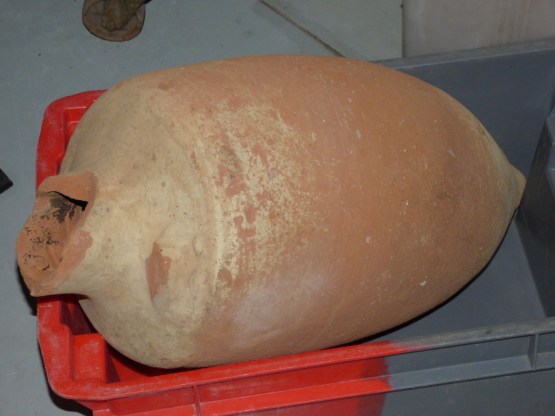
The cellar is transformed, painted with the new office and floor and the stainless steel cuves plumbed in for temperature control. And perhaps, most interesting of all, there is an amphora. This is the trendy method of vinification around the world. However, very few winemakers have an amphora dating from the time of Julius Caesar with which to make wine. Jeff plans to use it this year, connecting his wine to those made 2,000 years ago. Wines with links to the past, present and future, Mas Coutelou has soul!
It’s a while since I wrote about the happenings at Mas Coutelou, so time for an update. I am thankful to Jeff, Vincent and Julien for keeping me up to date in my absence.
The first few months of 2017 have been damp in the Languedoc, a contrast to the arid 2016. The photos by Julien above show water standing a week after rain and his feet sinking into the soil as he pruned. Jeff had planned to plant a vineyard of different types of Aramon at Théresette next to La Garrigue which has lain fallow for the last few years. However, the soil remains very damp and planting has not been possible, unless things change quickly the project will be postponed until next year. For the same reason, the first ploughing would have begun by now in most years, but is on hold for drier conditions.
Pruning the last vines (photo and work by Julien)
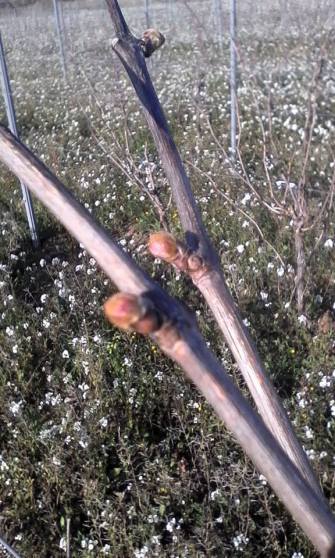
Julien completed pruning (taille) around March 10th. He photographed the first budding (débourrement) amongst precocious varieties such as the Muscat. However, Jeff told me this week that, generally, budding is later this year, the damper, cooler weather again responsible. That is not necessarily a bad thing. Remember that frost can cause great damage to vines, especially buds, and the Saints De Glace (date when traditionally frost risk is over) is May 11-13. I recall visiting the Loire last April and seeing frost damage, whole vineyards with no production for the year.
Julien photographed some early buds
The weather conditions are favourable for something, sadly not good news either. Snails, which ravaged large numbers of buds and leaves in Flower Power and Peilhan last year, have found the damp much to their advantage. They are a real pest, a flock of birds would be very welcome or we’ll see more scenes like these from 2016. Of course, one of the reasons why birds and hedgehogs are lacking is the use of pesticides by most vignerons in the region.
In the cellar the new office and tasting room is complete. Our friend Jill completed a montage of Mas Coutelou labels which we gave to Jeff as a gift. Hopefully that may decorate the walls of the new rooms.
The floor which was half covered in resin last year has been finished all over and another new inox (stainless steel) cuve has arrived. (photos by Vincent).
On March 22nd the assemblages of the 2016 wines took place. Or at least most of them. One or two cuves still have active fermentation with residual sugar remaining but otherwise the wines were ready and the conditions were favourable. I won’t reveal what cuvées are now blended, that is for Jeff to unveil. However, I can say that the reduced harvest of 2016 means fewer wines are available and fewer cuvées made. In the next article I shall be giving my thoughts on the 2016 wines from tastings in October and February.
Finally, there was an award for Jeff himself. On March 30th he was made an official ambassador for the Hérault by the Chamber of Commerce of the département. This was an honour for Jeff himself and the generations of the Mas and Coutelou families who made the domaine what it is. Founded in the 1870s at 7, Rue De La Pompe by Joseph Étienne Mas who planted vines and kept cows after he had fought in the Franco – Prussian War of 1870-1. Five generations later Jeff is an ambassador for Puimisson, vignerons and the Hérault and with his wines he is really spoiling us.
























 amarchinthevines