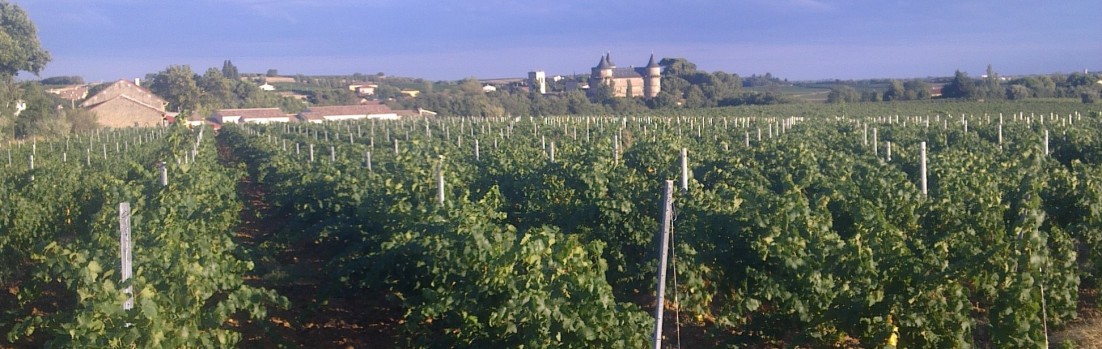
No more racing metaphors I promise but today, Thursday August 24th, the Mas Coutelou 2017 harvest began. Just a gentle canter rather than a full gallop start to events with several rows of Sauvignon Blanc and Muscat vines picked. They will be vinified separately, the Sauvignon went into the large press immediately, the Muscat is lying on skins for a few hours. Julien made the first cut just after 7.30 this morning (photos above).
Jeff, Max, Julien, Vincent
Vincent, Ambroise, Jeremy
Selene
Jeff and Icare
There was a good team of helpers available coming from Italy, Spain, France and, of course, the UK. Carole was back too which always brightens the day. The day was rather overcast and humid, which made the back breaking job of picking all the more tiring but we pressed on until the vines were finished at around 1pm, so five and a half hours of work.
My own first bucket with leaf to identify the Sauvignon Blanc
In the cellar Jeff was anxious about how ripe the grapes were in La Garrigue so was a little relieved when the first readings came in around the 14° potential alcohol mark. There was a generous aroma of green apples coming from the press which augurs well. The Muscat was certainly riper, the grapes full of that hallmark Muscatty taste – they are the wine grapes which taste of grapes!
Caisses unloaded, grapes put into the press and the first juice flows
So, a good start, the team found its rhythm, gelled through conversation and over lunch and we attack the Muscat of Peilhan tomorrow. The bit is between the teeth, the finishing line is still far in the distance but on we go.
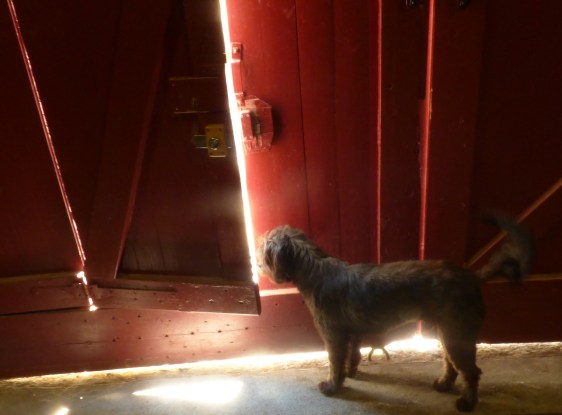
And for fans of Icare! Well, he’s still firmly in charge.
A few weeks ago I wrote about some wines from 2009 and how good they were. Ageing wines is a tricky business for a number of reasons:
Storing wines is fraught with risk; temperature, light, vibration and humidity (or lack of it) can all spoil bottles so care must be taken.
Some wines benefit from keeping, others are designed to be drunk fairly early.
How long to keep them so that they are at their best? Some people prefer younger wines when fruit is more upfront, others prefer more flavours from age; leathery, earthy, more complex perhaps.
If possible it can be interesting to have a few bottles of the same wine and drink some early, some over time. I have done this with 1990 Bordeaux wines and still have a couple of bottles of cases I bought all those years ago. It has been interesting to watch their development from tough and tannic, through balanced and fruitful with classic cigar box notes to the dry, mushroom and port like flavours when tasted this year. The colour too changed from purple/red to claret and ruby to orange brown. The last bottles need drinking now, they are less pleasurable perhaps than even 2-3 years ago though they are still enjoyable and pleasing in a more academic manner.
However, buying a case is not always possible or desirable. Some wines are intended to be aged for a few years, certainly the more expensive bottles from classic regions of Bordeaux, Burgundy and the Rhone. Sweet wines too age well and develop richer flavours (I generalise of course). Wines from grapes such as Mourvèdre, Syrah, Grenache, Carignan can age very well because of the levels of tannin in the wine, Italian grapes such as Nebbiolo likewise. Back labels might offer advice about how long to keep the wines, otherwise search vintage charts or the producer’s website. Some like Domaine Treloar offer clear advice on each vintage of each wine.
I bring this all up because this week I opened two bottles of Languedoc wines from 2007. Both were excellent and were perfect examples of the advantages of ageing wines.
Domaine D’Aupilhac in Montpeyroux is one of the most famous of Languedoc wine producers. Sylvain Fadat has long produced a range of very good wines. Les Cocalières 2007, a blend of Syrah, Mourvèdre and Grenache it was still fruity but had aromas of herbs and the age had developed leathery, earthy notes. Very good, the flavours lingered long.
Even better, one of the best wines I have tasted this year was Domaine La Marfée’s Les Vignes Qu’On Abat 2007. Pure Carignan made by this domaine on the outskirts of Montpellier by Thierry Hasard. If you need proof of how good Carignan can be (other than Flambadou) then make a beeline for this wine. Brambly, liquorice flavours with almost citrus freshness, the wine improved over the course of several hours, developing yet more flavours and aromas. This would have kept for many more years, the colour was still bright ruby and there was no sign of tiredness. Truly excellent.
I am sure these wines would have been excellent a few years ago, though would have needed to be opened for a while to allow their flavours to open up, perhaps by decanting which can be an alternative to keeping bottles for a long time and is something I do with many, even most, wines.
Orange wine is very, very fashionable. Often associated with the natural wine movement that is not strictly true as many conventional winemakers are experimenting with orange wines too. Perhaps the fact that they have both emerged into the spotlight in recent years has brought the two such an association. I must say I like the idea but I have not always been convinced by the wines themselves, so here are some recent experiences.
Muscat Petits Grains
James carrying out a pigeage of the Muscat
First of all we should clarify what orange wine means. They are made from white wine grapes which are left on the skins for an extended period in order to extract more flavour. This long maceration also adds tannin and colour to the wine just as happens with red grapes when making red wine. The length of time for skin contact and the type of grapes will add more or less colour, flavour and texture to the wine.
This was how wines were made many years ago, the current trend is a revival of ancient practices. Some countries such as Georgia have always made wines like this. I have had the opportunity to taste such wines from all over the world including Georgia. Mostly I find them pleasing the mind and appreciating the technique rather than pleasing my palate. Academic rather than pleasurable. Often they lack charm, taste very dry and with no fruit, perhaps the result of overlong maceration.
However I have recently tasted some very attractive orange wines. Les Choix 2014 came from Turner Pageot in Gabian, a very well judged wine as there was still plenty of apricot fruit as well as being dry and textured, made from Marsanne grapes. Very good. Ora(n)ge Sur Les Canilles 2016 is made by Domaine Ribiera in Aspiran. Régis and Christine Pichon make this delicious wine from Clairette and Terret grapes, again they have extracted good texture and dry flavours as well as white fruit flavours. Both wines have the slightest note of Fino sherry which really appealed to me.
At Mas Coutelou in 2015 and 2016 Jeff used white grapes such as Muscat Petits Grains to make orange wines, usually supervised by our two Australian assistants Cameron in 2015 and James in 2016. The result in 2015 went to make OW1, a blend of eight grape varieties macerated for a couple of weeks. It is a bright colour, has good texture and plenty of fruit along with a herbal note. The following year James made the Muscat based wine and this is a real success, the muscat notes are there but restrained to give white fruit flavours which linger with good spicy notes and a dry finish.
Cameron and me
Orange, skin contact, long maceration. Whatever name you give this style these are wines requiring judgement and skill from the winemaker. I encourage you to try them but select ones from winemakers you trust.
For more information from someone who knows orange wines much beter than me I would recommend this website from Simon J Woolf.
Back in the UK and its grey climate after the blue skies of the Languedoc, the need for some colour was apparent. Other than friends and family it was a vintage and some videos which helped me to find some.
The vintage was 2009. I first opened a bottle of one of my favourite wines the Cuvade Préciouse from Domaine Montesquiou, a dry Jurancon. This would be just about my house white wine, I love its dry, zesty flavours with just the faintest hint of sweetness on the finish. I often drink my bottles fairly quickly as it is so attractive but I tucked a few away and found this 2009 lurking on my wine racks. Lesson learned, I need to age more of these bottles. The years had added a directness, softened the zestiness a little and with the slight oak notes this was very much a Burgundy like wine. Just lovely.
I then opened a 2009 Motus from Domaine Treloar. 96% Mourvèdre (with a touch of Grenache) this was smooth as silk, tannins melted into a cocktail of red fruit flavours with great length and complexity. A wine truly at its peak and delicious. A prime example of the quality of the vintage in the Languedoc Roussillon region and of how good Mourvèdre can be.
Intrigued by the success of those two bottles I then opened (all on different nights I should say) a Rhone 2009. It was Jeff who encouraged me to visit Domaine Du Cayron in Gigondas a few years ago. Run by the Faraud sisters their wines are made from the same grape varieties as the Languedoc and it is interesting to compare the regions. Very peppery, liquorice notes and dark red fruits this softened through the evening and still has the ability to age further. Classic Rhone, a lovely wine.
2009 was a good vintage and the benefits of maturing wine were clear with these bottles. A coincidence of two bottles became a mini examination of a vintage and it passed with flying colours.
The other thing which brightened the days was the blog post of Jacques Bonum Vinum after a visit to Mas Coutelou, in particular the accompanying interviews. Well worth listening to, (it will stretch your French it must be said), it captures the passion and spirit of sharing which typifies Jeff. A very good piece of work, highly recommended.
In 1957 Eugène Mas moved the family winery into 6, Rue de l’Estacarède, Puimisson and made his first wines there having constructed the cement cuves the year before. It was much easier for wagins to collect the wines fromt here than from Rue De la Pompe where the wines were made before. In 1987 Jean Claude Coutelou converted the whole domaine to organic production, one of the first in the country. In 2017 Jeff Coutelou completed the renovation of those cellars and decided it was time to celebrate his family and their wonderful wines.
The cellars and garden were decorated, the wine flowed, music played. Friends and family gathered together to honour the history of the domaine and its future. Old vintages, jereboams and magnums matched the excellent food.
Christian Venier and the rugbymen
OW1
OW1
Yanick
Cyril and Camille
It was a great night, a celebration of all that is good in the world of wine – friends and family enjoying themselves around good bottles. ‘Grapes, work and love’ is one of Jeff’s sayings and Saturday night showed how many people love the work and care which Jeff gives to his grapes, and love Jeff himself. This was a celebration of the past but the wines and the work in the cellar show that there is a sparkling future ahead for Mas Coutelou.
Bottling time again, la mise en bouteille. Descending moon is the time for bottling and appropriately Monday was the appointed day, I know other domaines were doing the same. I have described the bottling process before for standard 75cl bottles, Jeff’s own bottling line means that we could at least carry out the process in the shelter of the cellar rather than the full sun and very hot temperatures outdoors. Jeff told me though that he sets the gauge on the bottling line according to the temperature. Hot days like Monday mean that the wine expands a little so you have to actually put a little more into the bottle than normal so when it cools down there is still 75cl of actual wine. And the reverse for cold days. Always learning!! The video below shows the line in action.
Today was the day for bottling the star wine of recent years, Flambadou the Carignan Noir from Rec D’Oulette. Before that came the Maccabeu 2015 which was aged in different barrels and then assembled recently.
There are lots of jobs to do during the process from putting the bottles into the machine, filling corks, checking levels of wine in the tank (no lees or gunge) to stacking the bottles. Now this latter job is more difficult than it first appears. There are two methods; a pallet with moulded plastic sheets which make the job easy as you lay the bottles in the space provided and then there’s the palox. This wooden crate can store more bottles so is preferable to use in some ways but it is a devil to arrange the bottles in it. You lay the first row down and it has to be level or as you add more layers the crate resembles a stormy sea with bottles sticking up all over the place. I have done this job and believe me it not easy. Vincent here shows how it should be done, a masterclass.
Magnums are too big to go on the bottling line so have to be bottled using a different machine, more labour intensive (the price of a magnum reflects extra costs). Here we can follow the process, note how magnums are stored on end.
Afterwards there’s lots of cleaning to be done, the machines but also the cuves from where the wine came, with its lees and sediment. Another tank ready for this year’s harvest whilst last year’s now wine slowly matures in bottle.
And on such a hot day one part of the team ensured that the door stayed closed to keep the heat out.
The annual wine event in the village of Faugères took place last weekend and I duly went along on Sunday for the tasting. Twenty five vignerons with stands along the streets and corners of the medieval village, all sharing their finest products, what is not to like? I have said many times before on these pages that Faugères is my favourite appellation in the region. The schist based vines produce deep flavours and a final twist of refreshment which leaves you wanting to taste more of the wine. I am looking for clean fruit, depth and compexity and that enjoyable palate cleansing finish.
Some of my favourite domaines were not present at the event, Barral, Clos Fantine, Domaine des Capitelles but that meant the opportunity to try other domaines as well as reacquainting myself with other favourites. * Rosemary George was present signing copies of her authoritative book on Faugères and asked me whether I had discovered anything new, happily I had.
* (plus Mas Sibert based in Fos but whose wines are more Pézenas and not strictly appellation wines either)
Domaine De L’Ancienne Mercerie is one I have tasted previously and is a firm favourite of my friend Graham Tigg whose palate I trust implicitly. These wines wee certainly on good form today; a refeshing Blanc 16, a big oaky Couture 13 but best for me was the Petites Mains 15. This is a classic Faugères full of long flavours of dark fruits with an earthy note and that lick of acidity to cleanse the mouth. An assemblage of Carignan, Syrah, Grenache and Mourvèdre Petites Mains would be a excellent introduction to the Languedoc and to Faugères. Website
Chateau Des Peyregrandes is based in Roquessels. With 25ha this is a large domaine and there were multiple bottles on taste. These ranged from a good Blanc 16 to big oaky reds. Personally two wines stood out for me. The Rosé 16 was much darker than many rosés, the Syrah had given it colour. Nice red fruits and a long textured finish, this would be a good aperitif or match many foods. I also liked Prestige 13 with good character and complexity from Syrah, Carignan and Mourvèdre. Website
Domaine Valambelle was new to me though it is a well established, independent producer in Laurens since 2002. Another large domaine with many cuvées I tried a handful. Millepeyres 15 offered a classic Carignan with red fruits, an earthiness too. I also liked the Mourvèdre led Caprice 15 (well named for this grape) with plummy fruits. Keenly priced, good wines. Website
Domaine Du Causse Noir is the Cabrerolles domaine of Jérome Py and he always greets me with a big smile and firm handshake. His wines are regulars on my table and firm favourites, indeed I had opened a bottle two nights before. It was good to meet this great guy again and share his wines with some Arbroath converts who were at the stand at the same time. Low yields of 20-25 hl/ha give a rich full bodied fruit profile in the cuvées. 3,14 (a pun on π) 2015 is so complex for an entry wine, full of fruit and life. Caius 14 was even fresher and Mathias 13, serious and lovely. Favourites again. Website
Jérome Rateau makes wines under his own name as well as his domaine Haut Lignières. Based at the top of the village of Faugères Jérome’s wines are always good. New to me this year was a premium white Empreinte Carbone (same name as the prestige red). Made with the same juice as the Petites Plumes white but given 9 months in a very lightly charred new barrel with acacia top and bottom. The effect was certainly impressive, very little oak flavour surprisingly but lots of nutty complexity. Website
Domaine De Cébène was one of the first Languedoc domaines I visited and remains a favourite. Brigitte Chevalier has made a name for herself and her wines through hard work and skill, she has lovely vines high on the hills around Caussiniojouls along with a brand new chai. Brigitte showed the wines of her partner who makes St. Martin D’Agel whose traditional red I like very much. Brigitte was showing the excellent Carignan Belle Lurette 15 with fruit, complexity and a long life ahead. She explained that the schist soils mean the vines send out very long roots to fins nourishment and their contact with the soils adds complexity. My personal favourite of the Cébène wines is Les Bancels, classic combination of Grenache, Syrah and Mourvèdre. The 14 was expressive, round with full fruits and the classic Faugères refreshing finish. Brigitte kindly opened a 15 to compare, and it will be great. Still a little reticent it packs flavour and, yes, that finish. Website
Mas Angel / La Graine Sauvage is the domaine of Alexandre Durand and Sybil Baldassarre also based in Caussiniojouls. Sybil is, first and foremost, an oenologue and I have been privileged to meet her and Alexandre numerous times at Mas Coutelou and various events. They have ventured into winemaking for themselves and the results are impressive. The white Rocalhas was star of the day. Grenache Blanc, Roussanne and Marsanne grapes blended to give a gorgeous fruit nose with soft, peachy fruit and a nice sharp finish. Very drinkable, very good. A lovely red fruits and textured Prestige 15 red (Carignan/Grenache) and very deep, complex Syrah Marius 15 converted me completely. These are very good Faugères wines, very good natural wines. If you want proof that natural wines can express terroir then here you are. Facebook
A very enjoyable morning, lots of parades, stalls, music and fun. But most of all, a reminder that Faugères is so good. Incidentally all of these domaines are organic, other than Haut Lignières, this really is a pioneering appellation.
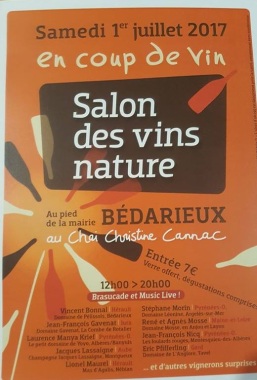
It was good to be able to attend a local tasting after being in NE England for so long, I’m afraid they are rare in my home region. Christine Cannac runs a wine bar, which offers good food too, in Bédarieux. These sort of caves/restos are to be found all over France and are my favourite eating places of my time in France. Places such as Christine’s, Cave St Martin (Roquebrun), Pas Comme Les Autres (Béziers) and Picamandil (Puissalicon) offer good wines with quality food in the Languedoc. Not to mention Verre Volé and Cave Insolite in Paris, Aux Crieurs in Troyes and the peerless Papilles Insolites in Pau. Highly recommended.
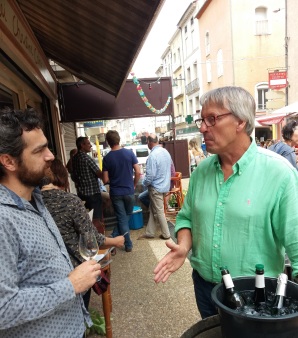
Christine organised a dégustation of some of her producers as she regularly does. There were 9 winemakers present and they offered a high standard of wine.
Domaine Léonine (Roussillon) had some very good red wines with my favourite the Bottle Neck, a full, complex combination of Grenache and Syrah with plenty of fruit and power.
Bernard talking with my friend Vincent
Domaine Plageoles (Gaillac) is a domaine rightly renowned for its quality, pioneering work and championing of local and old grape varieties. Bernard Plageoles was present and it was good to chat with him. The Mauzac Nature 16 seems richer than usual and truly delicious. However, his Contre Pied 16, made from Duras was my highlight. Made to be drunk young it is refreshing, light, fruity with typicity of the grape and its dusty aromas.
Domaine Mosse (Anjou) offered bright, clear Chenin wines. The highlight was the Rouchefert with round, full apple and honey notes, a wine which will develop for many years.
Yannick Pelletier (St Chinian) is a regular on these pages. His wines are always good, often excellent with concentrated fruits, local character and very drinkable. As so often Engoulevent was my favourite, classic St Chinian notes of dark fruit and lovely depth.
Mas D’Agalis (Hérault) is a long term favourite too, Lionel Maurel offered Yo No Puedo, perhaps his most famous wine. Largely Carignan but with Syrah,Grenache and Cinsault it is classic Languedoc and the 2016 has really come together from when I tasted it in Montpellier in January.
Domaine Yoyo (Roussillon) with yields of less than 10hl/ha in places has serious wines and features one of my favourite grapes, Grenache Gris. However, it is made into a light and darker red by maceration on skins. Both are very good but the lighter La Vierge Rouge is a favourite, lots of red fruits with power and a refreshing finish.
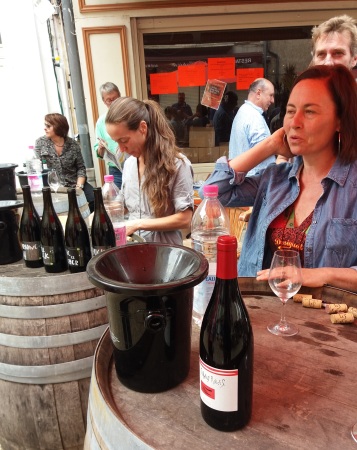
Léonine (left), Foulards Rouges served by Laurence Manya Krief who makes Yoyo wines
Les Foulards Rouges (Roussillon) is another well known producer. I really like Glaneurs, pure Grenache with dark, complex fruits and a clean, refreshing finish.
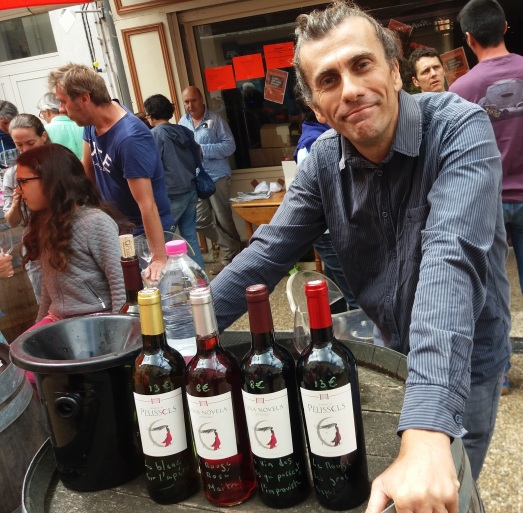
Justifiably proud Vincent
Domaine De Pélissols (Bédarieux), the local boy done good. Vincent Bonnal has really upped his game and these were very good wines. I liked everything, would happily drink his Luna Novela red at any time. However, star was the clairet style rosé. 36 hours maceration gives the Grenache (and tiny amount of Syrah) time to extract a deep colour with a depth of flavour to match. Lots and lots of fruit, not many wines will be more suited to the Languedoc summer, a real success.
Champagne Jacques Lassaigne (Montgueux near Troyes). I first tasted Lassaigne champagnes at the aforementioned Aux Crieurs in Troyes and have sought them out since. Pure Chardonnay they are wines of pure fruit, concentration, complexity and sunshine in a glass. Jacques was present and I loved his Blanc De Blancs from 10 parcels, La Colline with added complexity from the barrel ageing and the blend of 2010, 2011 and 2012. Star though was the vintage 2008. Such power, fruit; pleasure for the palate and mind. I have been lucky enough to enjoy some fantastic champagnes this year and these rank as high as any.
So, a small friendly tasting with a lovely mussel brasucade to add to the pleasure. If you are in the Bédarieux area seek out Chai Christine Cannac.
With UK importer Leon Stolarski in attendance Jeff offered us the chance to taste through the 2016 wines which are largely still in tank. Fermentations have been slow from last year, some are still bubbling away gently, finally eating up the last sugars. Jeff thinks the very dry winter and spring and heat of July meant that the yeasts were perhaps weakened meaning fermentation has been slower. The key point is, how does that affect the quality?
Even from when I tasted them a month ago they have changed in nature, more streamlined, less opulent, more complex. And, as always chez Coutelou, very drinkable. The whites show lots of fruit but restrained and serious too, the long maceration Muscat a definite highlight. Sadly, quantities are down, another result of the dry winter and spring. Reds show fruit and complexity, the Carignan beginning to emerge as a star (true of so many recent vintages) and the Mourvèdre continuing to shine bright.
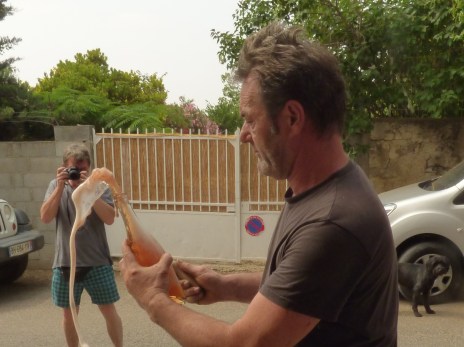
In the afternoon a new treat. Bibonade is Jeff’s PetNat, a natural sparkling wine. The white and rosé version have been sitting in bottle for a while and it was time to disgorge them. Sparkling wines, including champagne, age in bottle rather than tank and as they do so they throw a sediment. Still wines do the same, the sediment (lees) falls to the bottom of the tank and the wine is then taken out leaving the sludge behind. In bottle the sediment also falls to the bottom, if the bottle is laid flat the sediment will coat the inside. To gather the lees the bottles are placed in special racks (pupitres) with the neck pointing down. By turning the bottle 90° every day the winemaker can ensure that the sediment doesn’t stick to the sides and all gathers in the neck above the capsule.
Fermentation in bottle produces carbon dioxide which in turn creates the fizz in there. By opening the bottle, the release of pressure forces the sediment out of the bottle. Obviously this has to be controlled or you lose too much of the wine as well, so Jeff quickly covers the bottle as soon as he sees the sediment is gone.
The bottle can then be topped up from others and resealed.
It is a messy business, the small steel tank stops the capsule from flying off and the wine from coating the whole cellar. Jeff’s arms were quickly covered in flecks of lees. However, the result is delicious, refreshing and Bibonade is a firm favourite chez March.
After my sojourn in Alsace it was great to return to the Languedoc. Sadly I was already aware that due to a bereavement I would have to leave within a couple of days to return to the UK. However, I was able to spend one of my two days there with Jeff and amongst those vines which I had missed so much.
It was a great time to be there, the vines were in full flower, many already past that stage showing the new grapes, firstly with their brown hoods and then just the green baby berry itself.
The vines were looking very healthy, plentiful rain in the winter and a sharp frost in early spring had allowed the vines to rest, to gather their strength for the season ahead – a sharp contrast to 2016. Greenery aplenty, wild flowers blooming and, during my visit to Peilhan, I saw a young deer running through the vines and a pheasant. Clearly the Coutelou vines attract wildlife to its oasis amongst the surrounding desert of chemically treated soils.
Flower Power
Flower Power May
Rome May
Carignan May
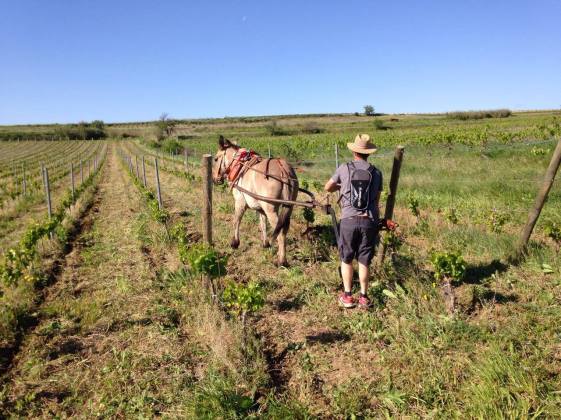
During the previous weeks the soils of Peilhan had been ploughed, by a horse. Gentler on the soils Jeff asked a local man to till.
He himself was giving the soil a light rotivation that afternoon, turning the plants and flowers amongst the vines into the soil, a natural composting. Icare, with an injured paw, and I watched on in the sunshine.
The only real problem this year has been the return of the snails. Last year they ravaged Font D’Oulette (the Flower Power vineyard) so that only a few cases of grapes could be picked. Fortunately, that vineyard has been spared this year but they are out in force in the largest vineyard, Segrairals. It was there that I also found Michel, Julien and Vincent working, tightening the wires of the palissage and removing side shoots etc from the vines.
In the afternoon we tasted through the 2016 vines and, they are so different even from February when I tasted them last. The whites are splendid, highlight a hugely successful long maceration Muscat. The reds such as the Carignan were very good and the top wine of the year will be the Mourvèdre, a silky, complex wine with huge depth of flavour – a treat for the short and long term. 2016 was a difficult year but Jeff has still produced some great wines.
So, I look forward to getting back to Puimisson as soon as possible, to follow the vintage further and see the latest progress. There is bottling to be done and plenty more besides.
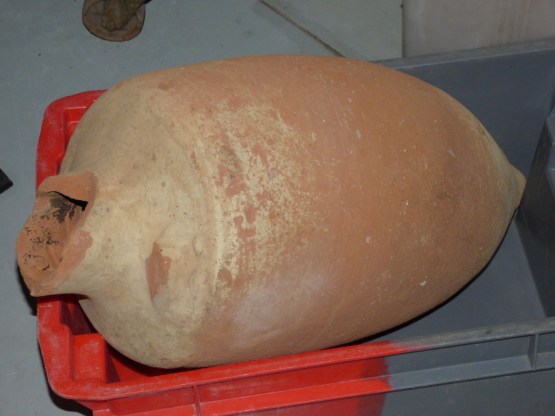
The cellar is transformed, painted with the new office and floor and the stainless steel cuves plumbed in for temperature control. And perhaps, most interesting of all, there is an amphora. This is the trendy method of vinification around the world. However, very few winemakers have an amphora dating from the time of Julius Caesar with which to make wine. Jeff plans to use it this year, connecting his wine to those made 2,000 years ago. Wines with links to the past, present and future, Mas Coutelou has soul!



















 amarchinthevines