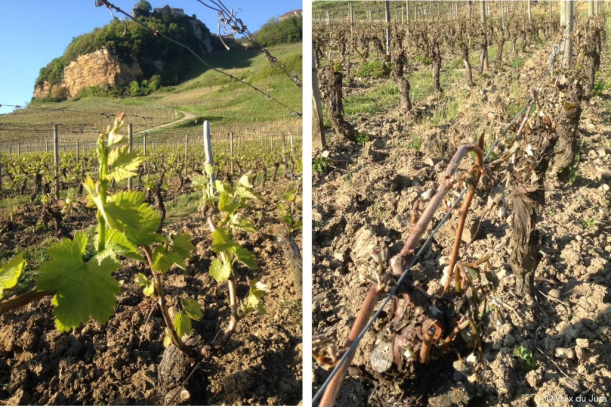
Sad to hear reports of widespread frost damage to vines all over France and Italy on Tuesday and Wednesday nights. Temperatures plummeted to -6ºC in Chablis and the Jura for example. And at a time when vines have begun to bud and the leaves unfurl. The result, of course, is damage to these buds which will not produce grapes this year. No grapes means no money for the winemaker. And in some regions this is two years on a row. I was in the Loire at this time last year and saw the damage it can do for myself, some vignerons losing whole vineyards.
Jura before and after the frost (Véroselles)
Two weapons have been deployed by some vignerons. Firstly, impressive photos from Burgundy and Chablis where, perhaps more wealthy, vignerons used fires amongst the vines to try to keep temperatures higher.
Burgundy (Ulysse Paris)
Chablis (Titouan Rimbault)
The other tactic, more counter intuitive, is too spray the vines with water so that the buds and leaves are immediately covered in ice and this protects them from further damage.
Chablis spraying (Ulysse Paris)
Chablis (Météo89)
Large scale producers such as Roederer in Champagne are reporting losses of 10-20% of their vines for the year. Some smaller scale winemakers will have lost proportionally much more. I can only sympathise. Let’s hope things turn better for them soon.
Addendum 3.15 pm
I have seen some photos of the Languedoc being hit too.
It appears that hail also struck some areas last night too. The frost risk will last until Saturday.
It’s a while since I wrote about the happenings at Mas Coutelou, so time for an update. I am thankful to Jeff, Vincent and Julien for keeping me up to date in my absence.
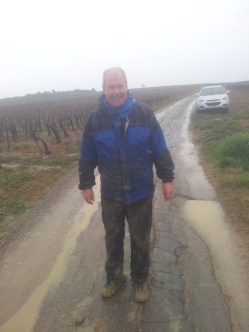
The first few months of 2017 have been damp in the Languedoc, a contrast to the arid 2016. The photos by Julien above show water standing a week after rain and his feet sinking into the soil as he pruned. Jeff had planned to plant a vineyard of different types of Aramon at Théresette next to La Garrigue which has lain fallow for the last few years. However, the soil remains very damp and planting has not been possible, unless things change quickly the project will be postponed until next year. For the same reason, the first ploughing would have begun by now in most years, but is on hold for drier conditions.
Pruning the last vines (photo and work by Julien)
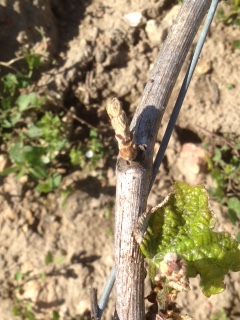
Julien completed pruning (taille) around March 10th. He photographed the first budding (débourrement) amongst precocious varieties such as the Muscat. However, Jeff told me this week that, generally, budding is later this year, the damper, cooler weather again responsible. That is not necessarily a bad thing. Remember that frost can cause great damage to vines, especially buds, and the Saints De Glace (date when traditionally frost risk is over) is May 11-13. I recall visiting the Loire last April and seeing frost damage, whole vineyards with no production for the year.
Julien photographed some early buds
The weather conditions are favourable for something, sadly not good news either. Snails, which ravaged large numbers of buds and leaves in Flower Power and Peilhan last year, have found the damp much to their advantage. They are a real pest, a flock of birds would be very welcome or we’ll see more scenes like these from 2016. Of course, one of the reasons why birds and hedgehogs are lacking is the use of pesticides by most vignerons in the region.
In the cellar the new office and tasting room is complete. Our friend Jill completed a montage of Mas Coutelou labels which we gave to Jeff as a gift. Hopefully that may decorate the walls of the new rooms.
The floor which was half covered in resin last year has been finished all over and another new inox (stainless steel) cuve has arrived. (photos by Vincent).
On March 22nd the assemblages of the 2016 wines took place. Or at least most of them. One or two cuves still have active fermentation with residual sugar remaining but otherwise the wines were ready and the conditions were favourable. I won’t reveal what cuvées are now blended, that is for Jeff to unveil. However, I can say that the reduced harvest of 2016 means fewer wines are available and fewer cuvées made. In the next article I shall be giving my thoughts on the 2016 wines from tastings in October and February.
Finally, there was an award for Jeff himself. On March 30th he was made an official ambassador for the Hérault by the Chamber of Commerce of the département. This was an honour for Jeff himself and the generations of the Mas and Coutelou families who made the domaine what it is. Founded in the 1870s at 7, Rue De La Pompe by Joseph Étienne Mas who planted vines and kept cows after he had fought in the Franco – Prussian War of 1870-1. Five generations later Jeff is an ambassador for Puimisson, vignerons and the Hérault and with his wines he is really spoiling us.
Two years ago I wrote an article whose title was a quote by my historical hero Louis Pasteur, “Wine is the most healthful and most hygienic of beverages.” Well my recent visit to the Languedoc gave me cause to doubt that Pasteur was wrong, in at least half of his statement.
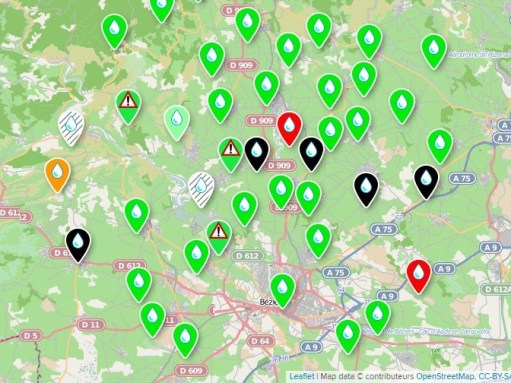
A friend (Chris) drew my attention to a website showing the quality of water in every commune throughout France. The results for the area of the Hérault centred around Puimisson, Puissalicon, Espondeilhan and Thézan-lès-Béziers showed that they along with other communes in the area have poor quality drinking water.
So why is that? Simply put it is agricultural pollutants and in this area what that means is pollutants from vineyards. In particular it means pesticides getting into the drinking water.
The area is full of vineyards, mostly managed under a régime of chemical intervention. Weedkillers, herbicides, fertilisers are all used to ensure maximum yields as vignerons are paid by the quantity of grapes they produce, though they do have to respect the maximum yields permitted by, for example, AOP regulations. Unfortunately when it rains, and it often rains very hard in the Hérault, the chemicals are often washed from the vineyards onto the surrounding roads and into the drains and sewers.
I was talking to an Italian vigneron in January and he was telling me that, as an organic producer, he was shocked at the last vendanges. His lovely grapes were growing on vines which had already begun to shed their leaves or were changing colour as the energy of the plant had been channelled into the fruit rather than the leaves. He felt somewhat embarrassed as his neighbours’ vines were pristine, bright green and laden with grapes. That was the result of the chemicals and nitrates sprayed on to those vines, whereas his were treated only with organic tisanes.
That is the same experience which I have observed in the area around Mas Coutelou. Jeff’s vineyards are surrounded in the main by conventionally tended vines. I remember him telling me as we stood in Rec D’Oulette (the Carignan vineyard) to look around at the bright green sea of vines with his own vines looking rather tired in comparison.
Well, the chemicals which make the greenery and heavy crops are polluting the water. The drinking water of the very place where the vignerons and their families live. When Pasteur spoke about wine being healthy and hygienic he was speaking at a time when most drinking water was polluted, even untreated. He was right, wine was healthier and cleaner than the water. And now, ironically, it is wine production which is making the water of ‘very bad quality’. Nevermind the 100+ additives which are legally allowed into wine, the wine is also a pollutant. That is why I challenge Pasteur’s claim.
I am amazed that this report created so little reaction, surely the very water which nourishes the vines and slakes the thirst of wine producers should be be safe to drink? At what cost are we producing wine unless producers take more seriously the effects of their farming methods. And you wonder why I prefer to drink mainly organic and natural wines?
After almost three months away it is good to be back in the Languedoc, and especially to be back in Puimisson, the home of Mas Coutelou. Jeff and Icare greeted us warmly and it didn’t take me long to get back into the vines.
Carole and Julien were hard at work pruning in Rome vineyard, my favourite of all, I was happy to see them all. Fortunately, the day I was there (24th January) was a lovely, sunny afternoon and quite warm but recent weeks have seen freezing temperatures overnight and pruning on such mornings is brutal. However, it is vital work.
Dead vines removed, their place ready for new ones
The vine needs to be trained for the season to come, cutting away dead wood and restricting the growth of the vine so that it is does not overproduce which would reduce the quality of the wine. Pruning also offers the opportunity to check the health of each vine and to identify vines which need to be replaced.
The vine is studied, first cuts remove the growth of last year and then decisions made about which branches to remove and which to leave as spurs, which direction the growth will take and, also, about which spurs might be prepared for the following year too. All with freezing fingers and aching back.
Much work had already been done but much remains ahead. In the photos below the Grenache of Sainte Suzanne has been pruned but the Syrah remains to be done. Similarly, the reds of Peilhan are pruned but the white parcel remains to do.
Work has also begun on preparing a parcel next to Sainte Suzanne which has remained fallow for a few years giving recovery to the soil. Known as Théresette this parcel will be planted with Aramon (Noir and Gris) which is what used to be planted in this parcel many years ago and which was well suited to the soil.
The ‘new ‘ parcel under preparation. La Garrigue in the background.
The winter also offers the chance to see the bare vineyards and their topography. When people talk about the value of a particular parcel or vineyard it is easy to overlook how even within a small area there are variations of slope and gradient which would alter drainage and exposition to the sun. Vines are all different even within a parcel and the pruning process treats each vine on its own merits to help it to produce the best fruit it can.
Syrah of La Garrigue
Flower Power
Peilhan
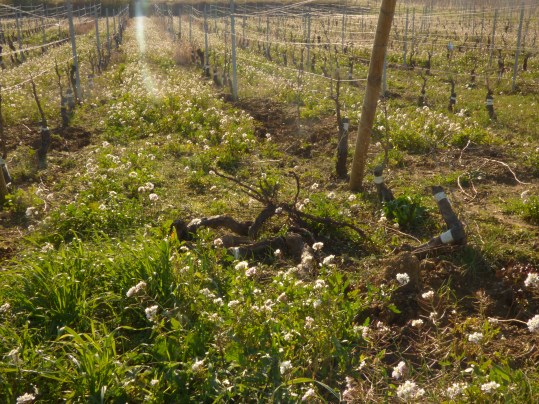
The vineyard soils are covered in white this January, not with snow, not here in the Languedoc at least. The white flowers of wild rocket form a spectacular blanket contrasting with the stark wood of the vines themselves. Even in winter there is something special and beautiful about being in this place, a march in the vines is so fulfilling.
If only winemaking was like this! Bottles, however, do not produce themselves. The year round process of winemaking I have previously described on this blog. Readers will be aware of the work, effort and stress involved.
As 2017 began Julien returned from his travels in Iberia to Puimisson to start the long, finger numbing job of pruning (la taille). He will be joined by Carole who also returned to the village and who has pruned for many years at Mas Coutelou.
Jeff tells me that there is plenty of other work going on. I referred in a previous post to January being named after the Roman god, Janus. He was two faced, one looking to the old year, the other looking forward. So too in winemaking.
The pruning, for example, is finishing off the work of the vines of 2016, cutting away the last vestiges if that vintage whilst preparing the vines for the year ahead. Normally the wines of the previous vintage would be approaching readiness for bottle, the first wave. However, Jeff tells me that they have developed more slowly from 2016 and he is likely to wait until they tell him that they are ready. That may happen when I return to the area at the end of this month or maybe later. In which case he will have to prepare wines for the major salons ahead straight from the tank.
Floor renewal
Other work is taking place in the cellars. Half of the floor was replaced in early 2016 and the rest will now be done. Other changes will add more facilities such as an office.
Meanwhile the weather is not playing its part so far. It has been warm again allowing no rest to the vines. However, a forecast I saw today suggests that freezing conditions will arrive this weekend. Perhaps, after two years, the vines will finally shut down and rest. This would certainly help 2017 be a more promising vintage. New year, new hopes.
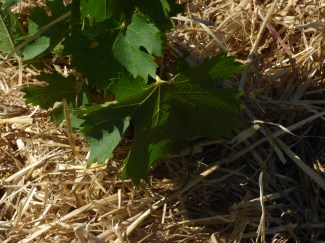
Young vines freshly grafted in March (see above) surrounded by straw? What is going on? The weather was so hot and dry over a prolonged period that the vines were stressed. As these young vines would not be producing any grapes they could be watered to protect them, the straw keeps the moisture in the soil.
The grapes continued to grow though and July saw véraison, the colouring of the red grapes. They were smaller than most years but healthy in the main. Other than those vines affected by the widespread mildew of the spring and early summer, those grapes were dried and shrivelled by the disease.
August
More grape ripening, Carignan to the left, Grenache to the right. There were some beautiful bunches despite the weather problems of the year. Time to start thinking about harvest and that work began in the cellar itself where Jeff had taken out some very large fibre tanks and replaced them with smaller stainless steel tanks with a new steel staircase to take us above the tanks to place in the grapes and to carry out pigeage or remontage during the vendanges. And on the 24th Jeff was testing the grapes to check for ripeness and acidity to see if they were ready for harvest to begin (they weren’t quite!).
September
As dawn rose over Rome vineyard probably the most important month of the year began.
Vendanges means hard work, fun, pressure, grapes and cleaning amongst other things. Selecting the best fruit from the vines’ year of growth, making the best of that fruit in the cellar to make a natural process work by using care, patience and analysis.
For each of the three harvests in which I have now taken part at Mas Coutelou my main memory is of the people, the teams who work to support Jeff. Friends all, and so many happy memories.
October
Cellar work continues as this year’s wines ferment and start their journey to bottle. Meanwhile time to prepare bottles of more of the 2015s, this time magnums. And in both photos Julien to the left and Michel to the right. The two figures who have been most present in Puimisson working at Mas Coutelou through the year. Two of the best, kindest people you would ever meet. Is it a coincidence that good people congregate together and that the best wines come from the best people?
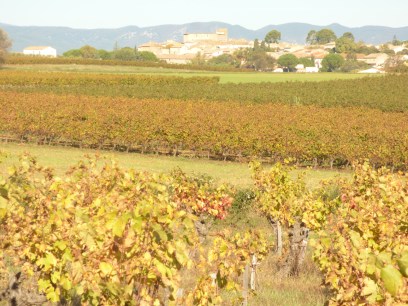
Meanwhile autumn arrives in the vines, Puimisson in the background.
November
Cases of wine leave Puimisson to head around the world. Mas Coutelou is sold in Australia, Japan, the USA, all over Europe and at the cellar door. As the end of year and Christmas holidays approach merchants want their wines and exporting the cases involves planning, spreadsheets and collation of the various cases.
Meanwhile, in one corner of North East England one happy vineyard worker sorts his own collection of Coutelou treasures.
December
A photo from Camille Rivière who imports Jeff’s wines into the USA, those cases above have arrived safely and Camille shares her happiness with the bottles she has opened and enjoyed.
Jeff tells me that there has been a lot of rain in recent weeks, 400mm last month. That is certainly welcome but the weather has also been very mild. Reports of mimosa blossoming (it should happen in February) and Jeff told me he had seen a neighbour’s vines preparing to bud!! Frost is needed for the vines to enter a dormant stage and rest, recover after a difficult year. More mild weather would mean two years of non-stop activity, which would weaken the vines.
A fantastic year, a memorable year, a complex year in the vines. But also a year marked with sadness at the passing of Jean-Claude Coutelou. I raise my glass once more in his memory.
The year begins with a series of wine salons and assembling wines for those tastings from the previous year. Jeff took me through the various cuves to see how the 15s were developing. Meanwhile the serious work of pruning (la taille) dominates the early months of the year and Julien was hard at work, patiently shaping the vines to enable them to produce their best. This was especially important in such a mild winter where the vines were unable to lie dormant.
February
Bottling of the 2015s began, this time Vin Des Amis, perennial favourite. Jeff has his own bottling line and the full crates of wine now head to storage for a few months to get over the ‘shock’ of bottling (mise en bouteille).
March
A March in the vines for sure. One of the highlights of 2016 was also the wettest and filthiest I could possibly be. Grafting vines (la greffe) in Flower Power (Font D’Oulette) on a day when it became impossible to lift the pioche because of all the mud stuck on it. I learned a lot and I loved the whole day.
April
Spring brings the vines truly to life (though the mild winter meant they were restless all winter). Look at the tendril extending from the pink bud on the left, this vine is already growing fast. Small shoots in Rome vineyard and also the ladybirds, sign of a healthy vineyard. (ébourgeonnage)
May
The grappes begin to form in clusters and spring flowers are everywhere around the various vineyards of Mas Coutelou. May is perhaps the most beautiful month of all in the vine, warm days, clear light and the colourful natural world – blossom, flowers, butterflies, birds. There is literally no place on earth I would rather be.
June
In the vines the flowering season (fleuraison) lasts just a few days. They are very delicate and easily damaged by strong winds or heavy rain. Here the Carignan vines of Rec D’Oulette (which make Flambadou) are in full flower.
Meanwhile in the cellar the bottling season restarts and the tanks are emptied and then cleaned with a vivid colouring for the floor. And welcome visitors arrive sometimes bringing delicious gifts of food with which we can accompany the wines. It’s a hard life, believe me.
In Parts 1 & 2 I have tried to explain some of the difficulties encountered at Mas Coutelou during 2016 due to natural influences such as climate and disease. In this final part of the series I look at pests which have added to those woes.
Vers de la grappe
These are literally grape worms, more specifically caterpillars, which form and grow on bunches of grapes. The caterpillars are the larvae of Eudémis moths which prefer to lay their eggs on shiny surfaces, so grapes are the target more than the rest of the vine. The larvae obviously damage the grapes themselves but that damage is worsened because of juice running on the bunches attracting infection and disease.
The warm weather and humidity of 2016 definitely encouraged vers de la grappe though it is an ongoing problem. It can be treated chemically of course though that is not an option for organic producers. Substances such as clay can be sprayed in spring to add a chalkier, duller surface to new grapes so that moths are not attracted to them. However, the solution favoured by Jeff Coutelou is to plant hedges and trees. These not only act as barriers to less environmentally aware neighbours, add polyculture to a region which can appear solely planted by vines but also they can shelter bats.
Bat shelter in Sainte Suzanne
Bats feed on Eudémis larvae and moths and can eat thousands every day. Bat shelters are to be found around Mas Coutelou, eg in Sainte Suzanne and Rome vineyards.
The photographs above show a vers de la grappe cocoon and, on the right distinctive holes showing where the moth laid its eggs. When the vendanges begin the pickers and sorters must look out for signs such as these but also damaged, shrivelled grapes in bunches where the larvae have been.
Snails
If I could have named 2016 in the Chinese form I would have called it the year of the snail. They were everywhere. The two photos below show an olive tree in Segrairals. This was one of many which were completely covered by snails, blanched by the sun and feeding on the greenery and moisture in the tree.
However, vines were equally attractive to them. I spent whole mornings picking snails from vines during the Spring only to find them covered again a day or two later. Flower Power (Font D’Oulette) was particularly badly affected with the snails heading straight for the new growth and buds in April and May.
The virtual drought in the first six months of 2016 meant that the snails were desperate for moisture and food and so the healthy, young vines were too good to miss. The consequence was obvious, production of this much lauded new wine was reduced drastically, partly by the weather but equally the work of the snails. Birds and other predators would help solve the problem but the monoculture of the area (outside of Mas Coutelou) means there are, sadly, no great numbers of them.
Vendangeurs and sorters must try to pick off snails as they hide in the bunches. Dozens get through to the cellar especially in the early morning when there is moisture around. The photo on the right shows a lot of rejected material, leaves, poor grapes but lots of snails as you will see if you enlarge it. Just imagine how many get through into the wine with machine picking and limited triage.
Neighbours
Yes they can be included under the title of pests. Well, one of them can be. As regular readers will know 2016 has been punctuated by two occasions of vandalism by one particular neighbour, both upon the Carignan Noir vineyard of Rec D’Oulette. First he mowed a patch of wildflowers which Jeff had sown to encourage insects and birds (for reasons identified above). Then he took a machine to some of the young trees Jeff planted around the vines, destroying four year old trees such as hazelnut.
Vandalised trees with tyre tracks revealing the culprit
Jeff was justifiably upset by these attacks. He was simply trying to enrich the area, bring diversity to it but that was clearly too much for a traditionalist, more used to destroying wildlife for his own short term gain and dreadful wine. However, he was encouraged and revitalised by the massive support of friends and colleagues around the world. The flowers grew back and more densely, the trees replanted in greater numbers and Jeff Coutelou stands tall as the man trying hard to improve the reputation of Puimisson and its wines.
The mild weather over winter was followed in the Languedoc by a slow start to summer heat. The resulting warm, humid weather brought disease as it did in many regions of France. Mildew, oidium and couloure are all vine diseases which occur regularly and 2016 was no different but with a bigger hit than usual.
Mildew (downy mildew)
Sadly, humid days in the mid 20s and cool nights are exactly the conditions favoured by downy mildew, and it prospered. The humidity in the soils created ever more favourable conditions for mildew. Downy mildew lives as spores in the soils and any rain splashes them onto the vines. Mildiou is not a fungus as commonly believed, it is a one celled spore which germinates in warm, humid conditions especially between 16 and 24 Centigrade – exactly the conditions we saw in April and May of this year.
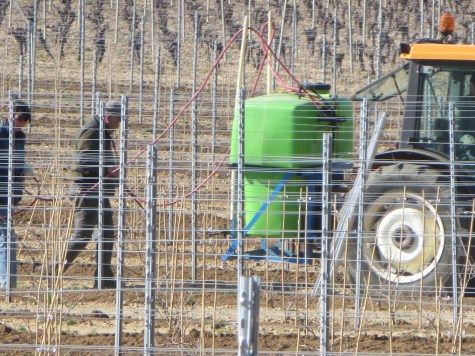
Jeff Coutelou spent many nights out on his tractor spraying the vines to try to protect them. As an organic producer (and much more) he cannot (and does not want to) use manufactured, chemical sprays. Instead he used sprays based on rainwater with seaweed, nettles, horsetail and essential oils of sweet orange and rosemary. These are better absorbed by the vines in the cool of the night.
Mildew on top of leaf
Mildew on the under side
Mildew appears as small yellow / green spots on the upper surface of the leaf which gradually turn brown and spread to leave an unsightly vine. Underneath downy white /grey spots appear, the mildew is well established by this point. It affects the grape bunches and leaves them dried out and shrivelled.
Mildew on a Carignan bunch, organic spray residue on the leaves
By the time harvest arrives the bunches contain a mix of healthy and diseased grapes. Severe triage is required. Bunches such as the one in the photo above will be discarded immediately. Where there are health sections though the bunches will arrive at the triage table and be sorted rigorously. Jeff reckoned that in some vineyards, especially the white vines of Peilhan, losses were up to 60% from mildew. Seriously damaging.
Here is a clear demonstration of the advantage of hand harvest (vendange manuelle), machines would simply swallow the lot and in less thorough domaines or caves the bunches will all go into the wine.
Oidium (powdery mildew)
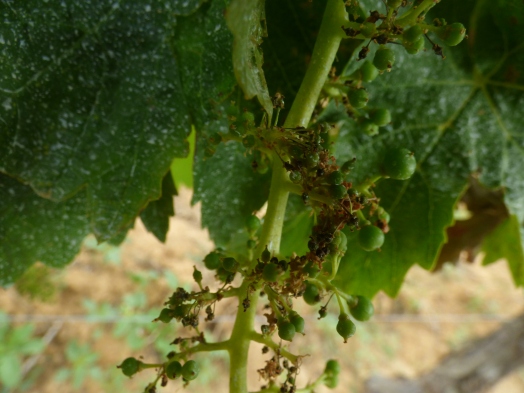
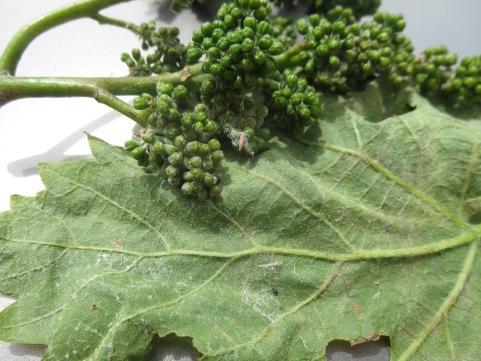
Oidium on buds and leaf
Oidium is a related problem to mildew but slightly different. It too thrives in warm days and cold nights (so springtime is its peak period) , it too loves humidity. So, spring 2016 was ideal though oidium was less rampant than mildew. Unlike mildew it is a fungal based spore.
Conventional treatments would be chemical and even organic producers will use sulphur, a naturally occurring element. Organic producers are limited to the amounts they can use as sulphur does damage the fauna of the soils. Jeff Coutelou uses less than a quarter of the permitted amounts because he sees it as a last resort. Instead he prefers treatments based on horsetail weed, nettles and other beneficial plants made into a tisane which can be sprayed. It may not be as all-destroying as synthetic chemicals but Jeff prefers the soils to be healthy in the long term by using these natural plant based treatments.
These photos show grape bunches hit by oidium in 2016, the powdery residue is clear though the bunches are less damaged than mildew affected ones. Nevertheless oidium is destructive and spoils wine so, again, careful work in the vineyard and cellar is needed to keep oidium out of the grape juice.
Coulure
Like most fruit plants vines grow flowers which then develop into the fruit. Vine flowers are very beautiful but also very delicate and don’t live long on the plants, a matter of a few days.
If heavy rain and wind hits the vines at this stage of their development then the flowers can be easily damaged or broken off the plant.
Peilhan 2016
La Garrigue 2016
The result is that fruit cannot develop where there is no flower, coulure. Where flowers are damaged then berries might grow very small and seedless, this is called millerandage. Similarly berries might ripen unevenly within a bunch, green berries alongside healthy, ripe grapes.
There is nothing that the vigneron can do of course, the damage is done by the weather and no producer can successfully combat weather. Nature wins in the end. So, once again, the vendangeur and those sorting in the cellar are crucial in ensuring that only healthy fruit goes into the wine.
I cannot emphasise enough the importance of all stages of wine growing and production. From their budding through to vendanges the vines must be tended, and in the cellar observation, determination and care are needed too. To make good wine requires hard work, healthy grapes and love as Jeff has said many times.
And have a look at one of those last photos again.
In the top right corner you will see another of 2016’s natural problems, one subject of the final part of this series.
The stunning BBC Planet Earth II television programme of snakes attacking baby marine iguanas was a recent reminder of how cruel nature can be. 2016 has seen vineyards across France attacked by a multitude of problems and in this series of three articles I want to show how the vines and the grapes are affected by these problems. Firstly, the weather.
The year began with no frost in the Languedoc throughout the winter. This meant that the vines found it hard to recuperate from 2015’s exertions as they could not sleep. When pruning got under way in earnest during January many vignerons reported sap flowing from the vines. This was bad news, the sap and the vines should have been resting, storing their energy for the year ahead. Consequently, when other problems arrived during the course of the year the vines were always vulnerable, struggling to resist them.
Frost damaged vine in the Loire
Ironically, after such a warm winter, frost and hail damaged vines across France. The Loire, Rhone, Cahors and Pic Saint Loup were all hit at various stages, Burgundy and Champagne too. When I visited the Loire in early May it was sad to see many vineyards hit by frost, especially those adjacent to other crops whose humidity helped frost to form. Some vignerons faced huge losses of vines and potential grapes.
Trou dans la feuille
On August 17th hail hit the Languedoc, especially the Pic St Loup region where vines laden with grapes were smashed leaving some producers with no harvest at all in 2016. Mas Coutelou in Puimisson was also damaged though not so seriously. The storm ran through a corridor across Sainte Suzanne to La Garrigue and on to Segrairals. Even here vine branches were snapped, grapes shredded and bunches ruined. It was possible to see how one side of the vines was damaged where they faced the storm, yet the leeward side was virtually unscathed. Jeff was forced to pick these damaged vines much earlier than normal before the damaged grapes brought disease and rot to them.
Hail damage
Grapes punctured by hail
Hail damage, disease risk
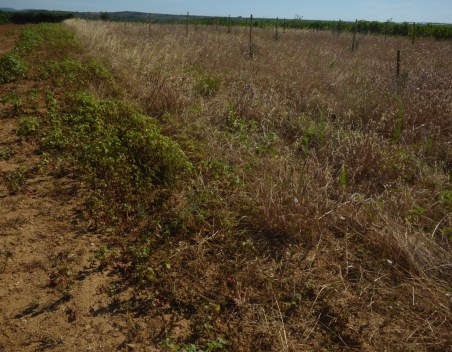
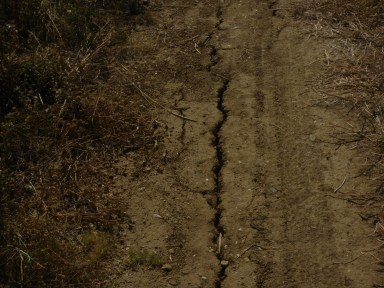
The other major weather problem was drought. There was virtually no rain for months in the Languedoc, especially from winter to early summer. Cracks appeared in the soil, plants turned brown. The lack of rainfall meant that when the grapes began to mature the vines could not provide much water, small berries with little juice were the norm. Vignerons everywhere in the region reported much reduced yields, at Mas Coutelou reds down by 20-30%, some whites down by as much as 60%. Rain just before vendanges saved the day but massaged rather than cured the problem.
When rain did come it was often in the form of storms. Sharp, heavy rainfall does not absorb into the soil so easily. Moreover where vignerons spray herbicides on their land the soils often wash away as there is nothing to hold the soil in place. For more environmentally aware producers this can be frustrating as chemically treated soils could wash onto their land.
This is one reason why Jeff plants trees, bushes and flowers and digs ditches, to protect his vines from the risk of contamination.
Le Carignan de Jeff a coté
The combination of sun (and even sunburned grapes), drought, rain, frost and hail made this a difficult year. However, that is not the end of the story. Climate conditions bring disease and it is that aspect of nature which I shall examine next.































 amarchinthevines