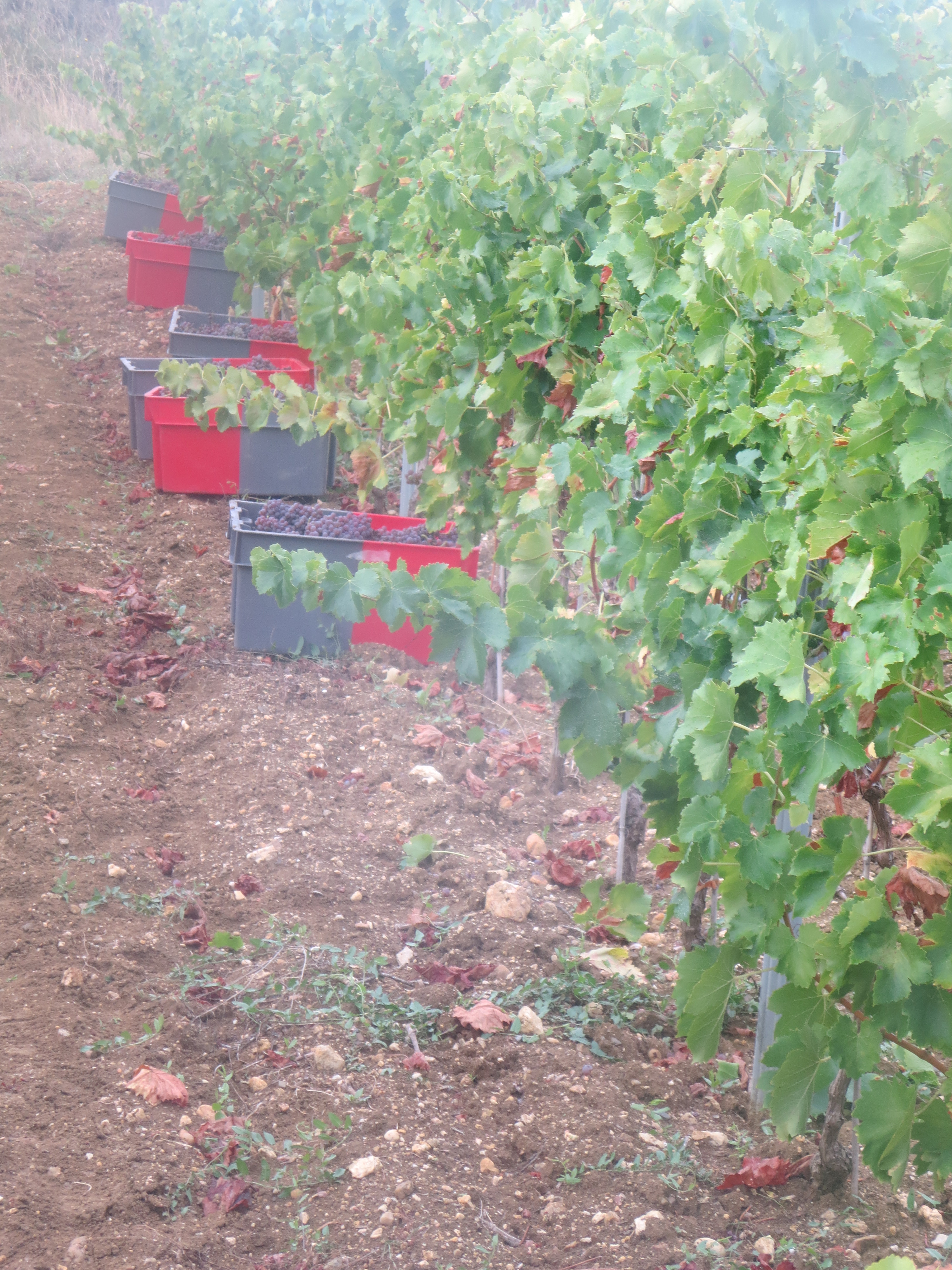
September 3rd began with further picking at the southern quarter of the vineyards of Mas Coutelou, Peilhan and Font D’Oulette, followed by an afternoon of picking in the northern end in Segrairals.
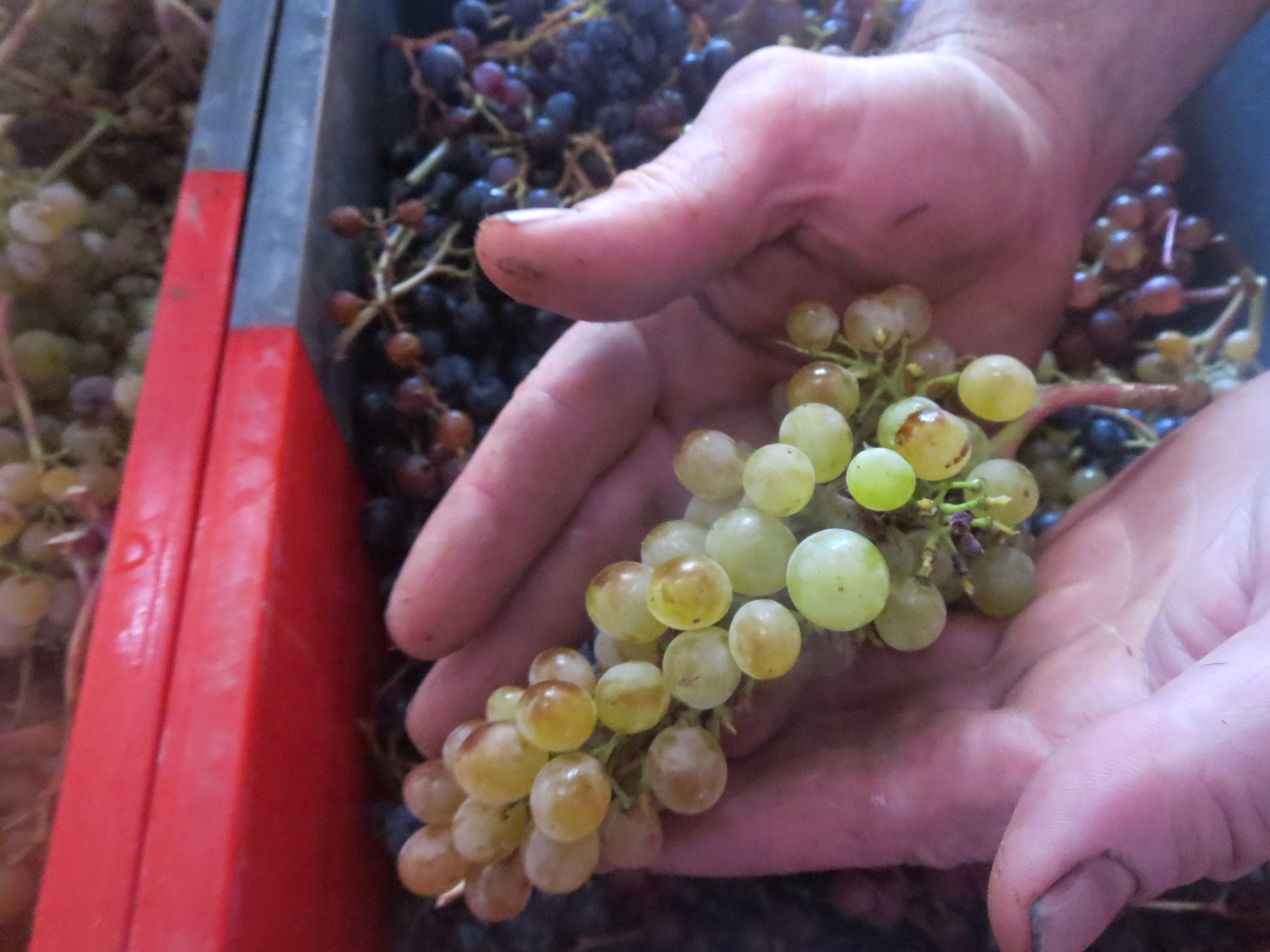
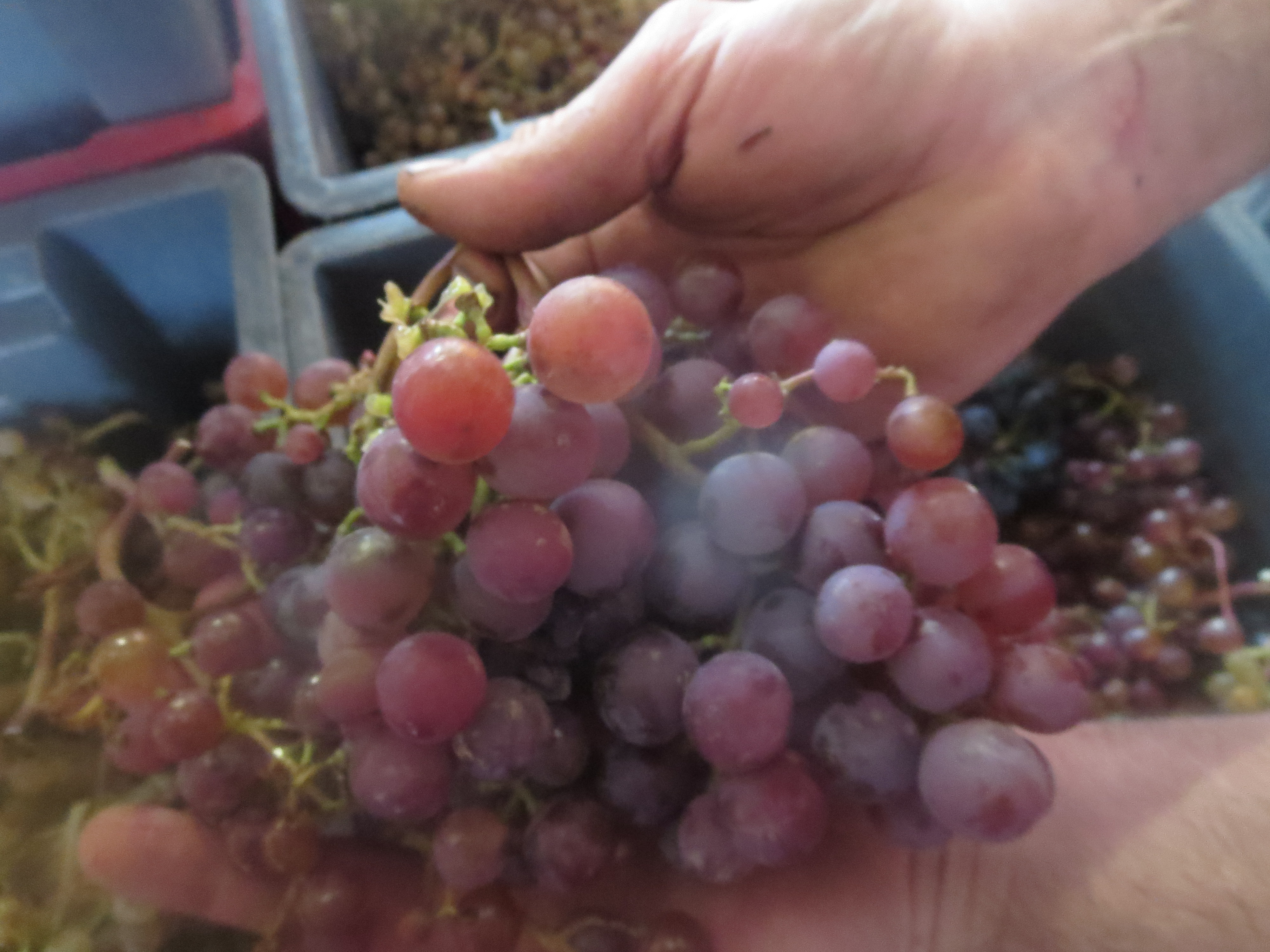
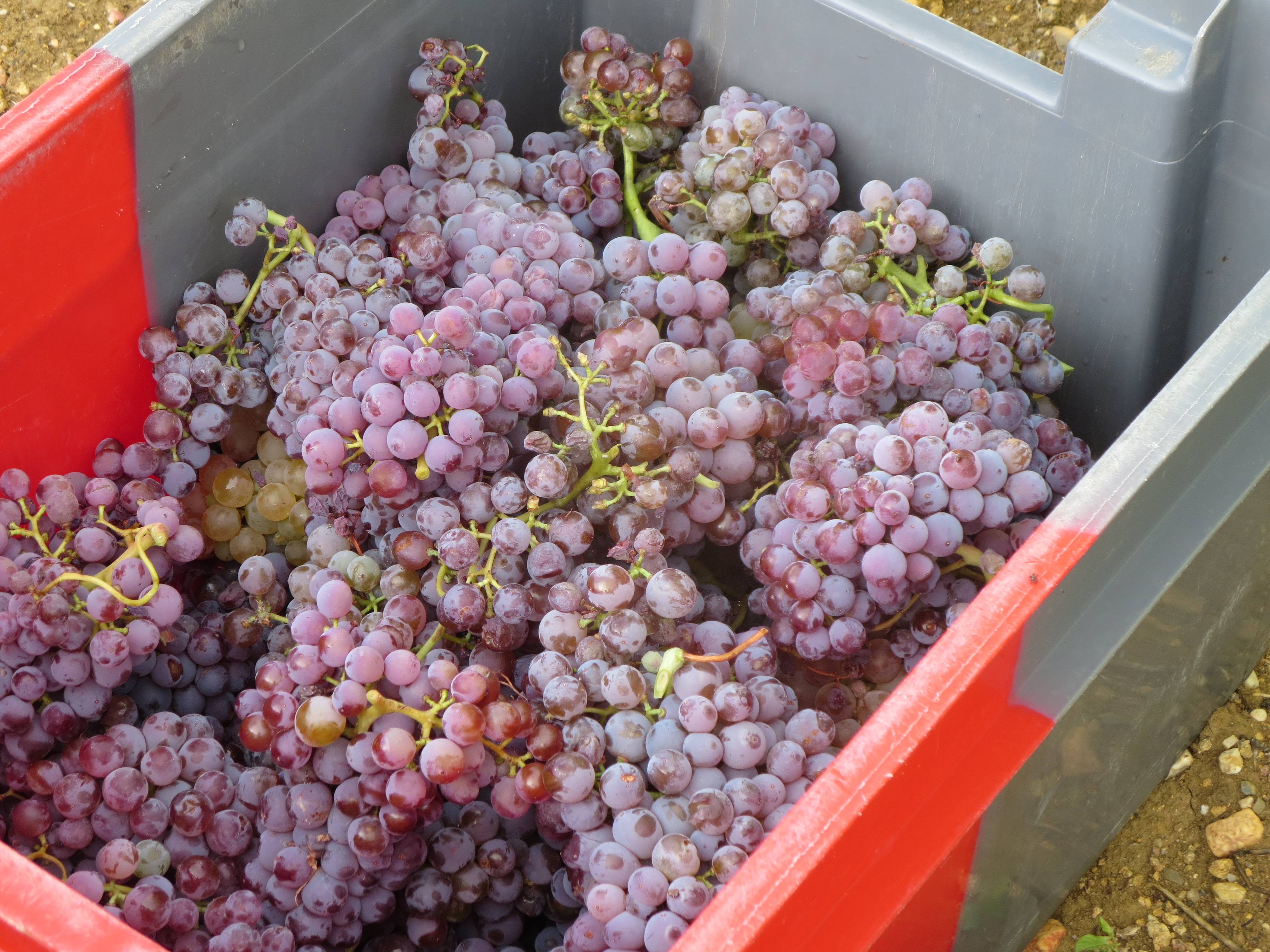
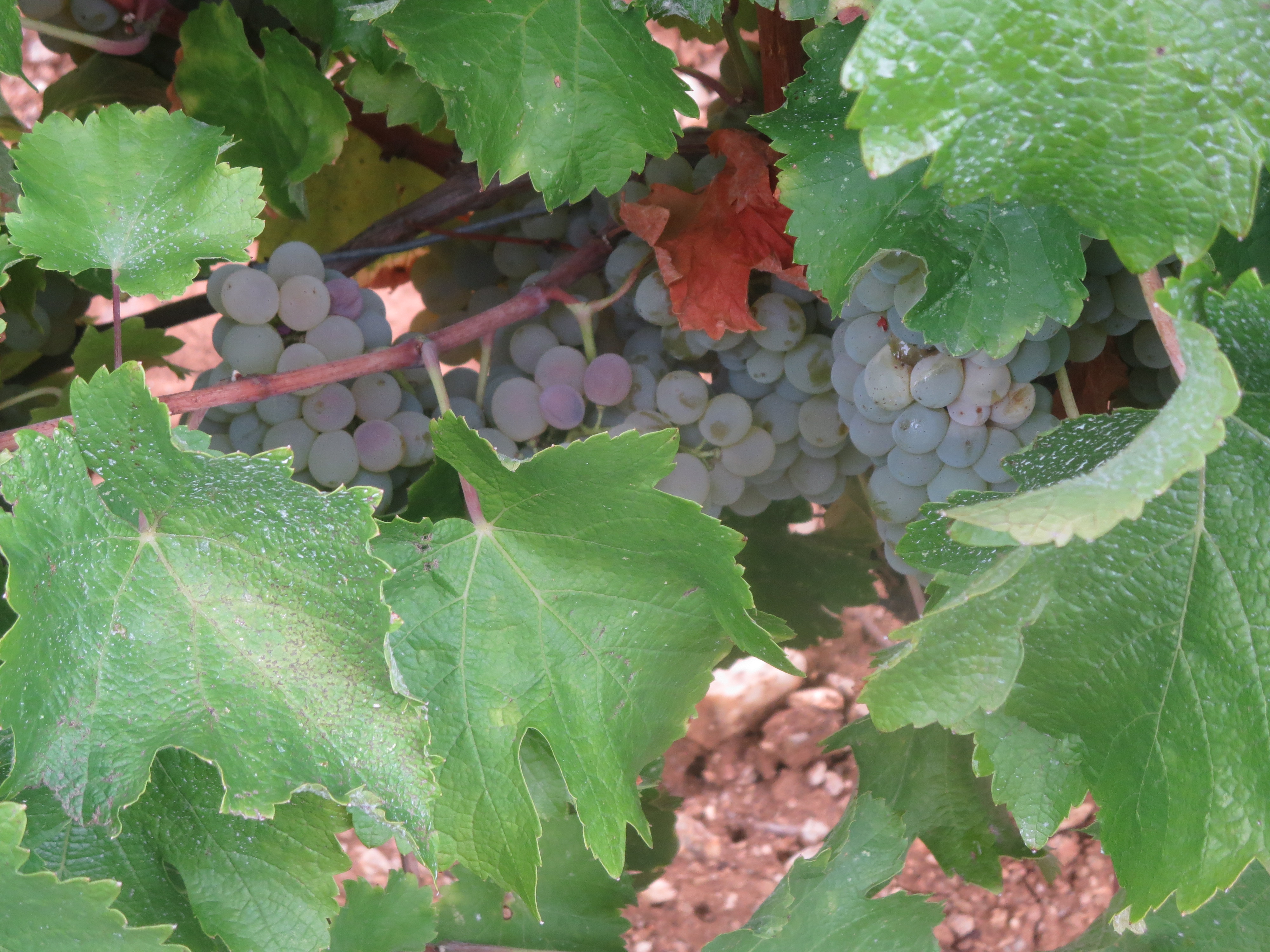
Peilhan and Font D’Oulette are both complanted, ie they have lots of different grape varieties being grown and often in the same rows. However it was the Grenache Gris in Peilhan which was being picked first to provide the juice for a rosé wine. Grenache Gris is, in my opinion, one of the most interesting cépages in the Languedoc Roussillon providing many of its best white wines. It also has a grey, pink skin which can provide a little colour to the wine if the juice is allowed to stay in contact with those skins for a few hours. In this case it would provide a very pale rosé wine, I heard the style described recently as a gris de gris. How this turns out we shall see, it could yet make a white wine.
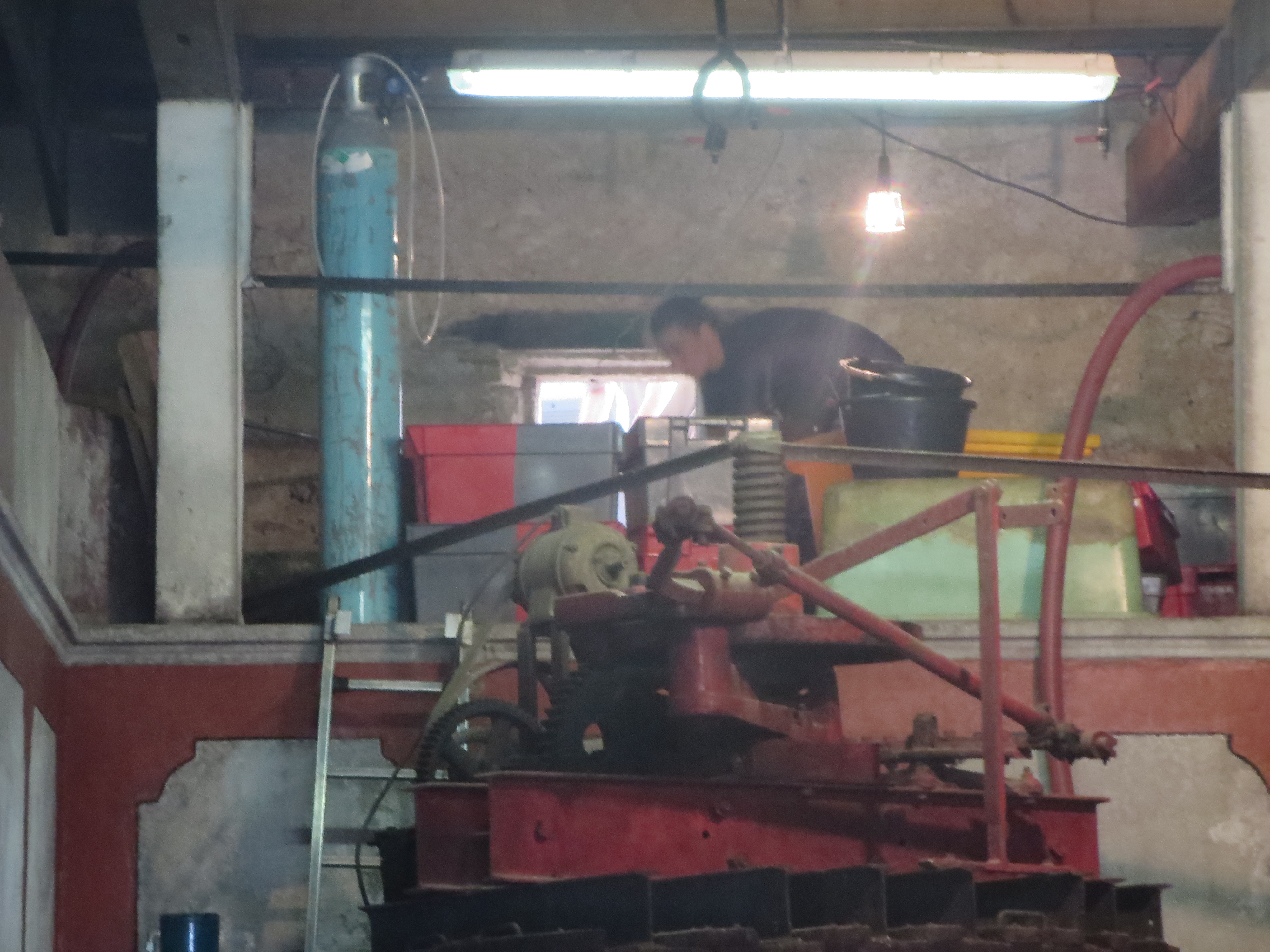
Cameron loading the press with the Grenache Gris
Error
This video doesn’t exist
When the Grenache Gris was through the press it was time to bring in the grapes from Font D’Oulette. This has a whole variety of cépages from the traditional Aramon Noir to the more unusual Oeillade Muscat, Clairette Blanche and Aramon Gris along with many others.
Clairette Blanche
Clairette Musquée
Aramon Gris
Oeillade Muscat
Oeillade Noir
This assemblage will be added to some Cinsault (perhaps from Rome vineyard, perhaps not) to make Flower Power which was made for the first time in 2014 and has proved to be a big success. Indeed we shared a magnum on Friday at lunch and it was excellent, starting to really open up.
Syrah from Segrairals
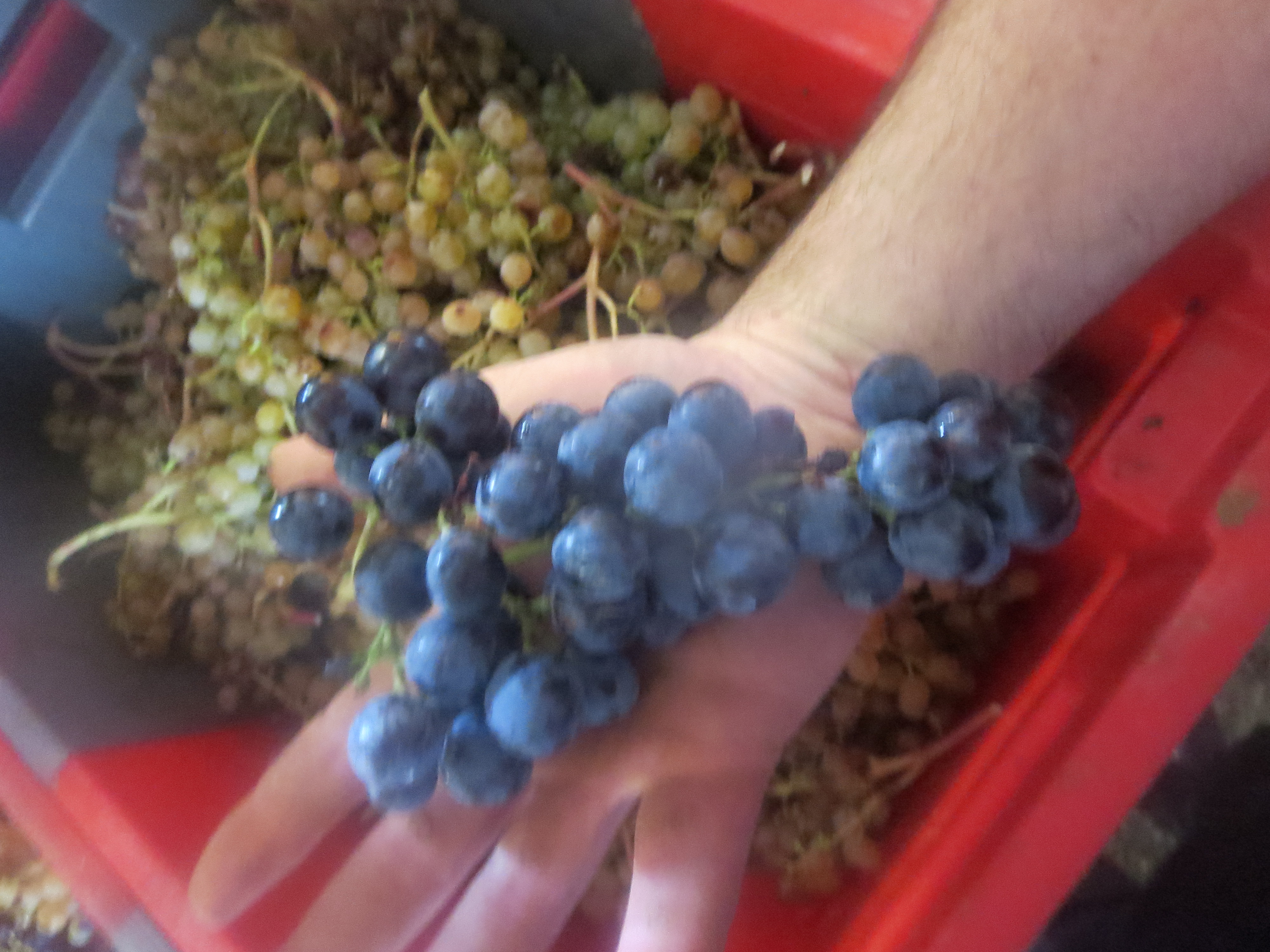
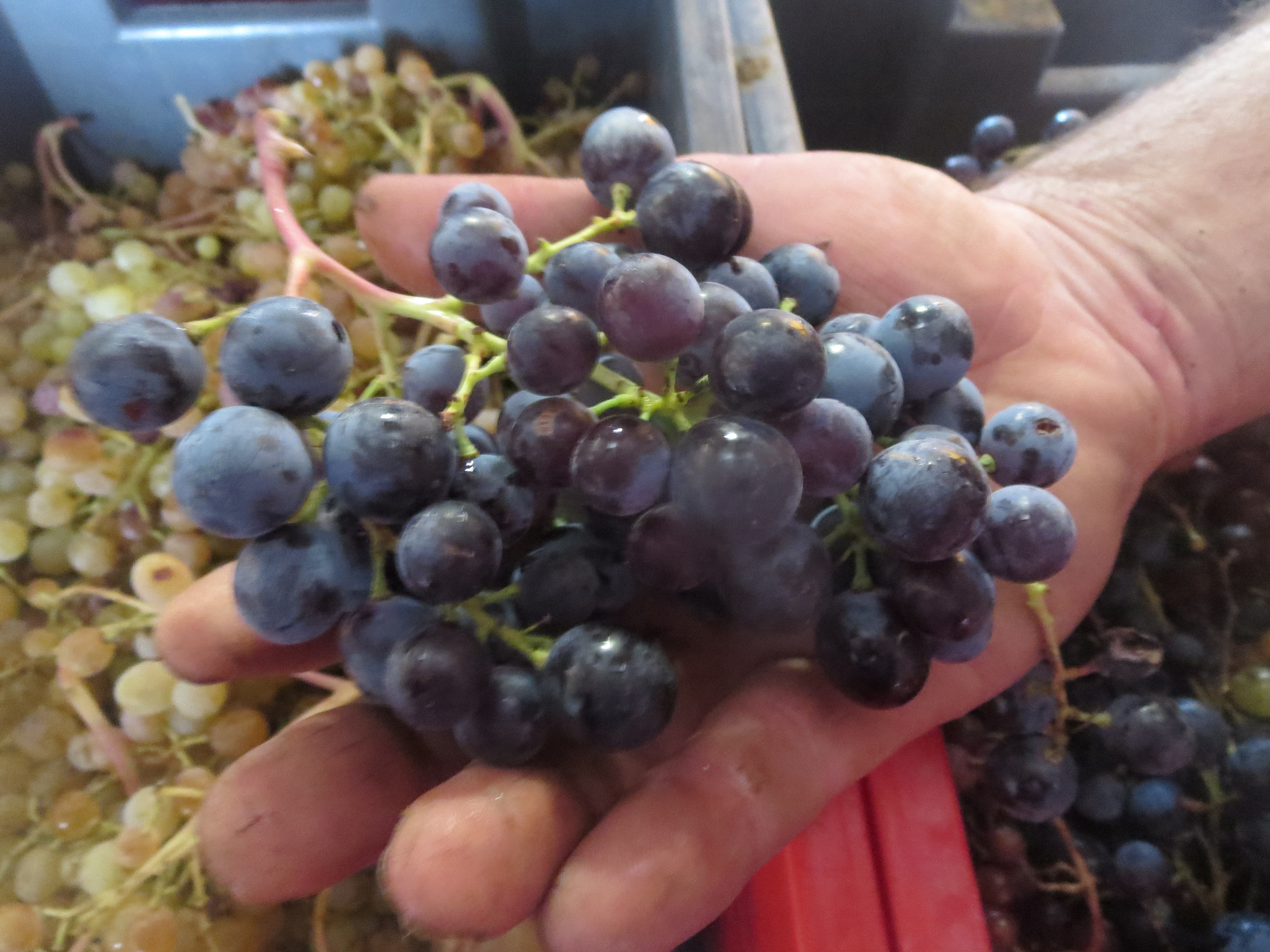
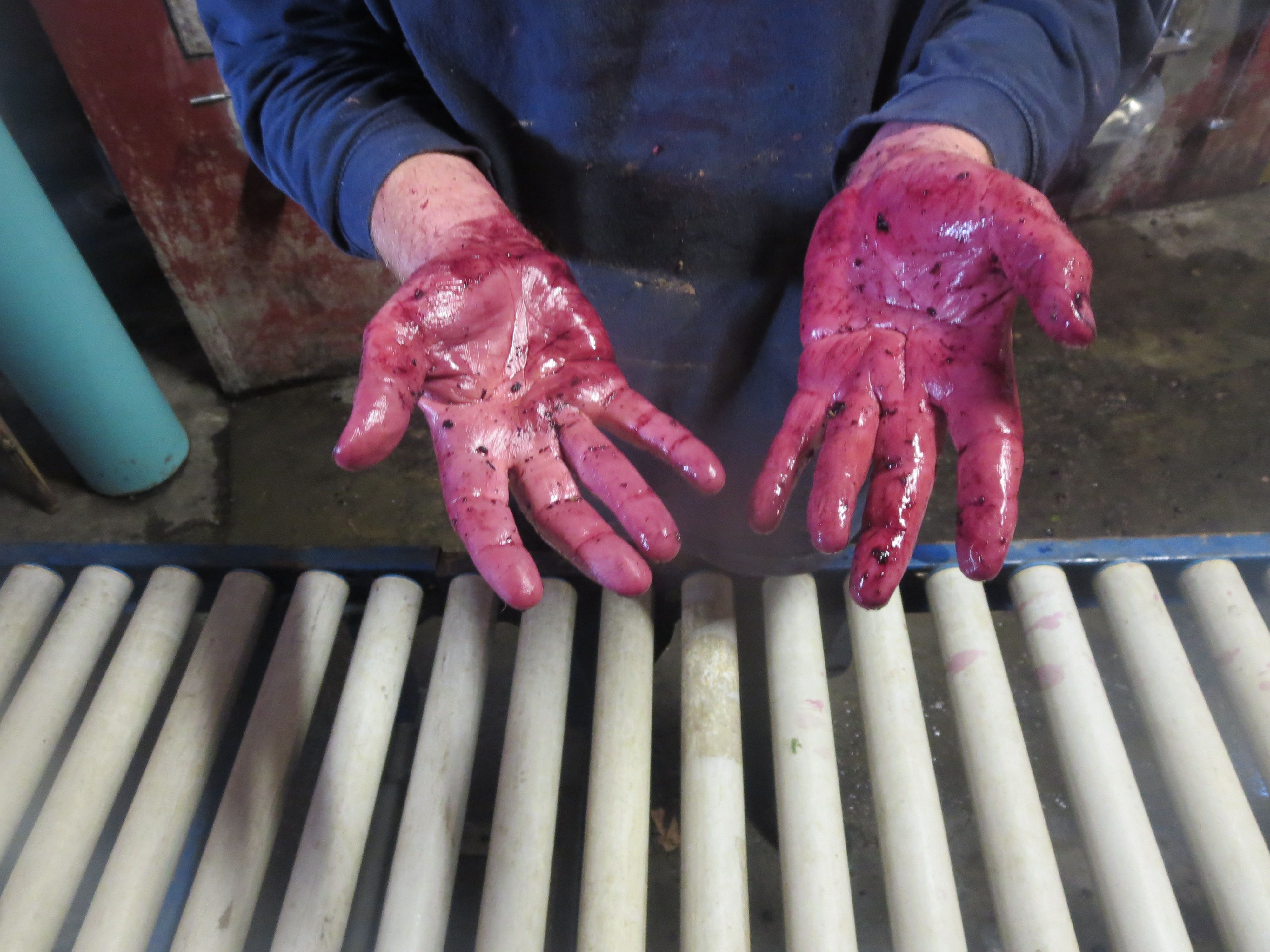
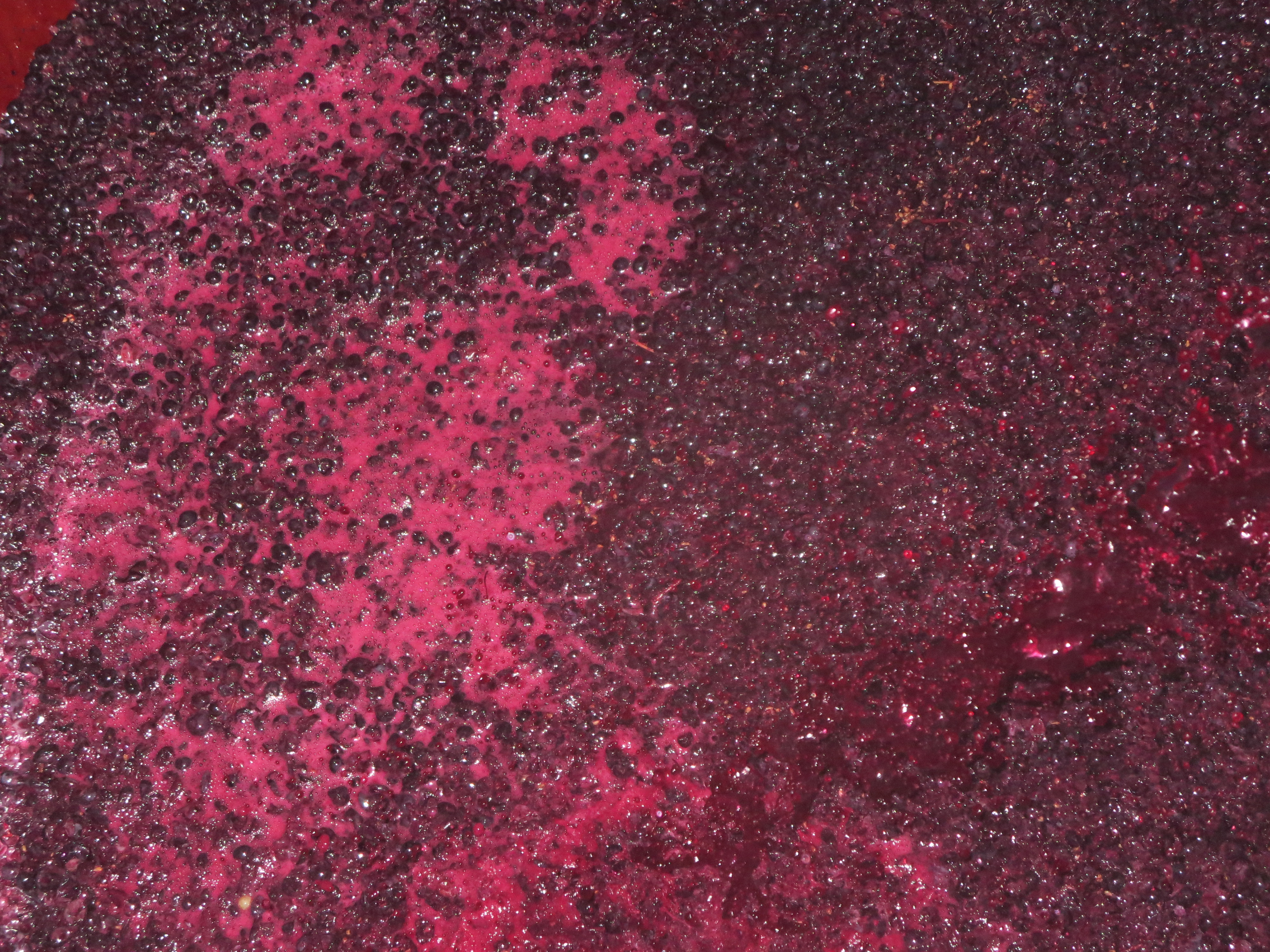
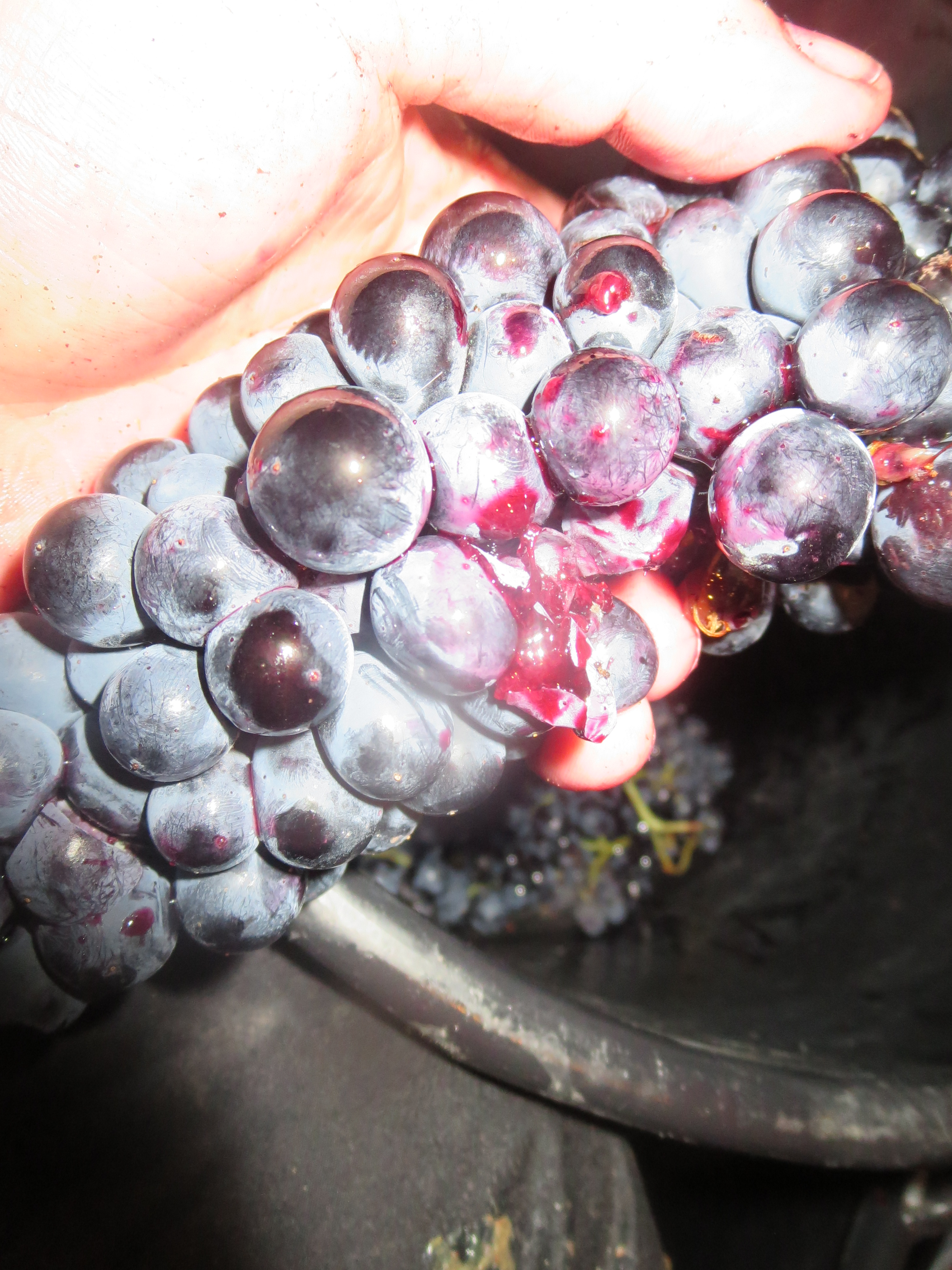
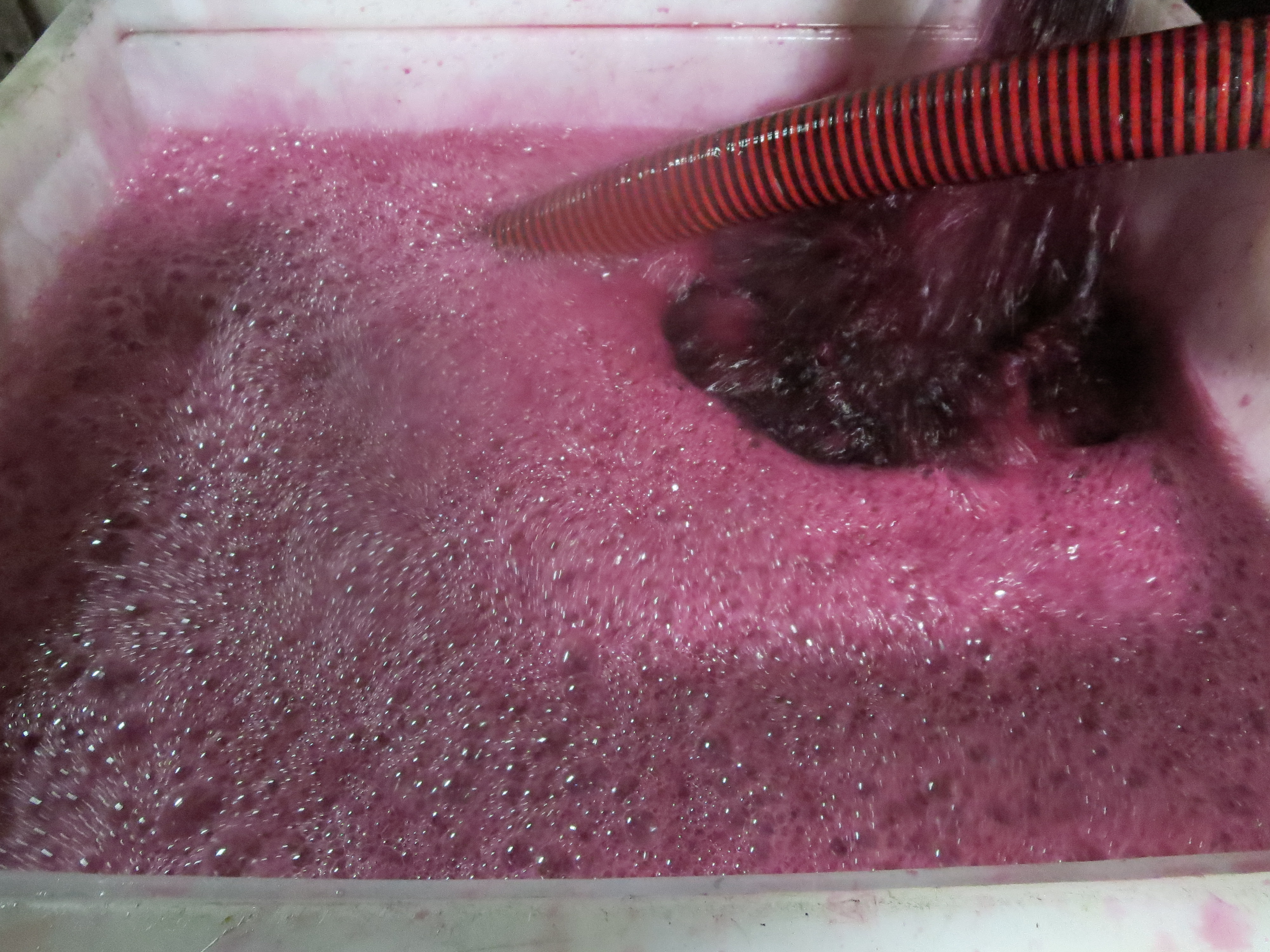
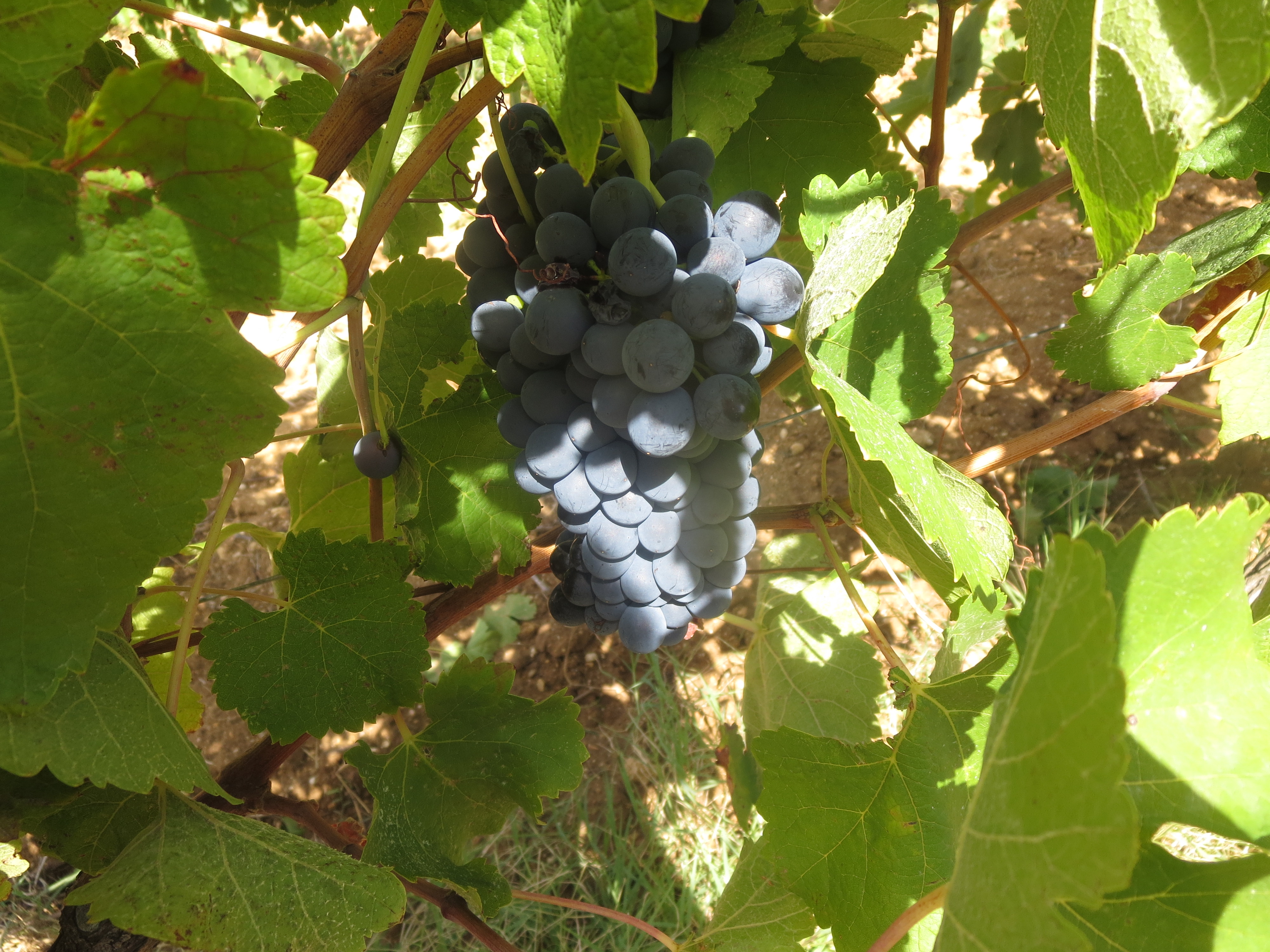
Then onto Syrah, some lovely bunches from Segriarals and Caraillet, the biggest of the Coutelou vineyards. The rich juice provided plenty of colour as you might see!
And then, of course….
Cameron and Michel are becoming a true double act
This was a long day, we finished around 7.15 pm, the day starts at 7.30am. I slept well that night.
September 4th brought a whole day of Syrah grapes from Segrairals and Caraillet again. It was also the last day we had the superb Carole with us for the harvest as she heads to Champagne for picking there. Carole is a true expert in all aspects of the vineyard and cellar and she is always willing to teach and to share, she will be a big miss.
Boxes of Syrah waiting for destemming on Friday (Sept. 4th)
Whilst we worked on the sorting of the Syrah Jeff and Cameron set about testing and remontage (pumping over the grapes already in the tanks).
Remontage of Flower Power grapes
We also tasted samples from the various tanks. The Syrah shows real fruit and is already developing different characteristics. Segrairals was gaining weight and power, Sainte Suzanne much more floral and elegant. The white juice from the complanted Peilhan, still in contact with skins, is beginning to ferment quickly as the yeasts get to work, perhaps because the yeasts are on those skins. It is a treat to watch the development of these wines from infancy as they take their first steps towards the final wine.
And of course….
We finished around 6.15 and then went to Jeff’s for a special treat to send off Carole in some style. Oysters and mussels together with some Chardonnay from the brilliant Spanish domaine, Casa Pardet, lovely. Even the sky responded.
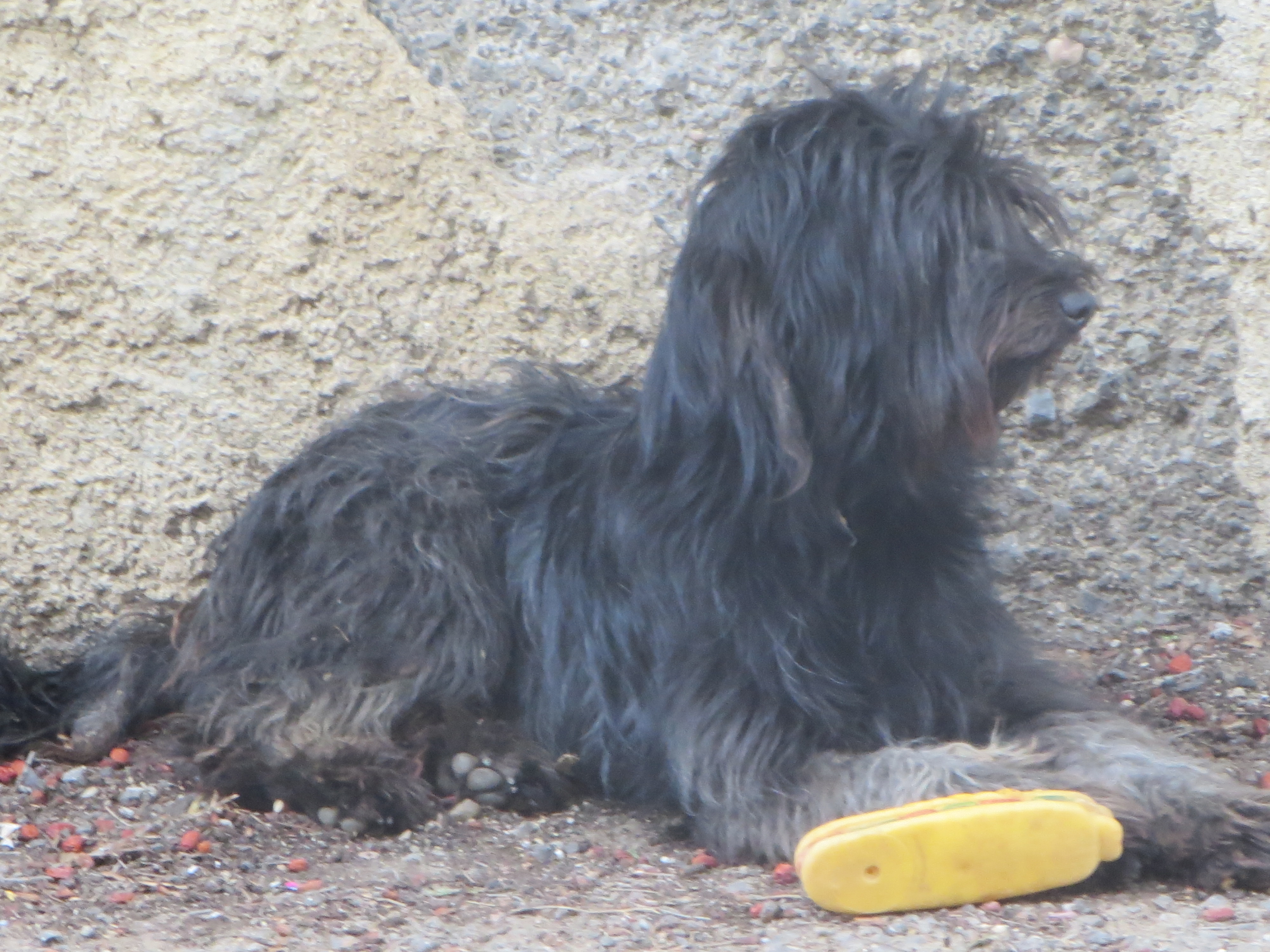
Meanwhile Icare fans, your hero was guarding his favourite toy, a plastic, squeaky sandwich. And sleeping, it is fun to watch him as he dreams because his tail wags furiously.
Saturday September 5th was a day off for me but not for the rest as they continued to process the Syrah form Segrairals, I did say it is a big parcel. The Grenache and Cinsault are still not quite ready and they will dictate when the team can start to harvest them but that will not be before Tuesday. The weather forecast is good for next week so conditions should be right.
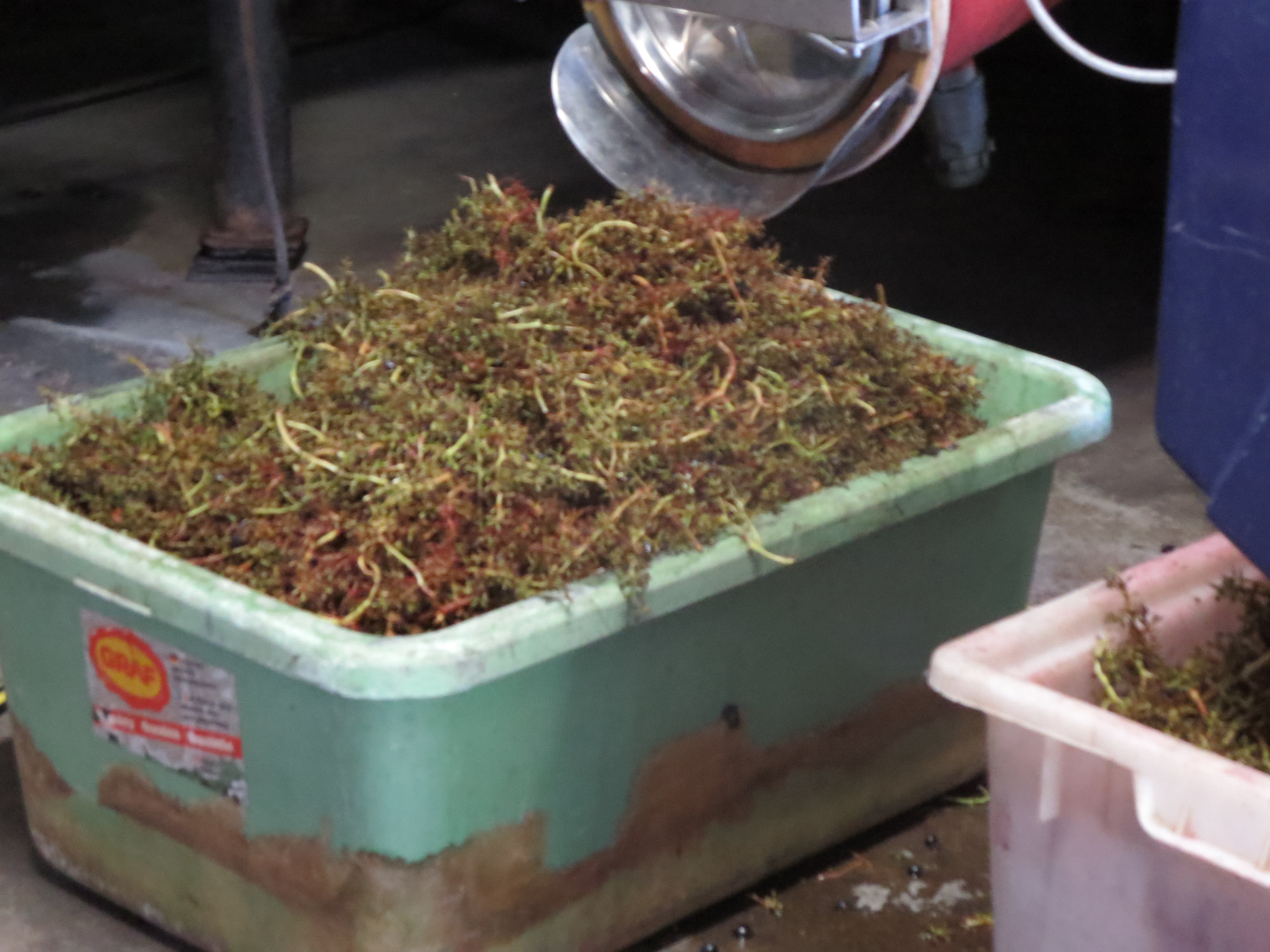
I did call round however and the work had certainly been going on as you can see from the bacs of the stalks (rafle) .
And of course….
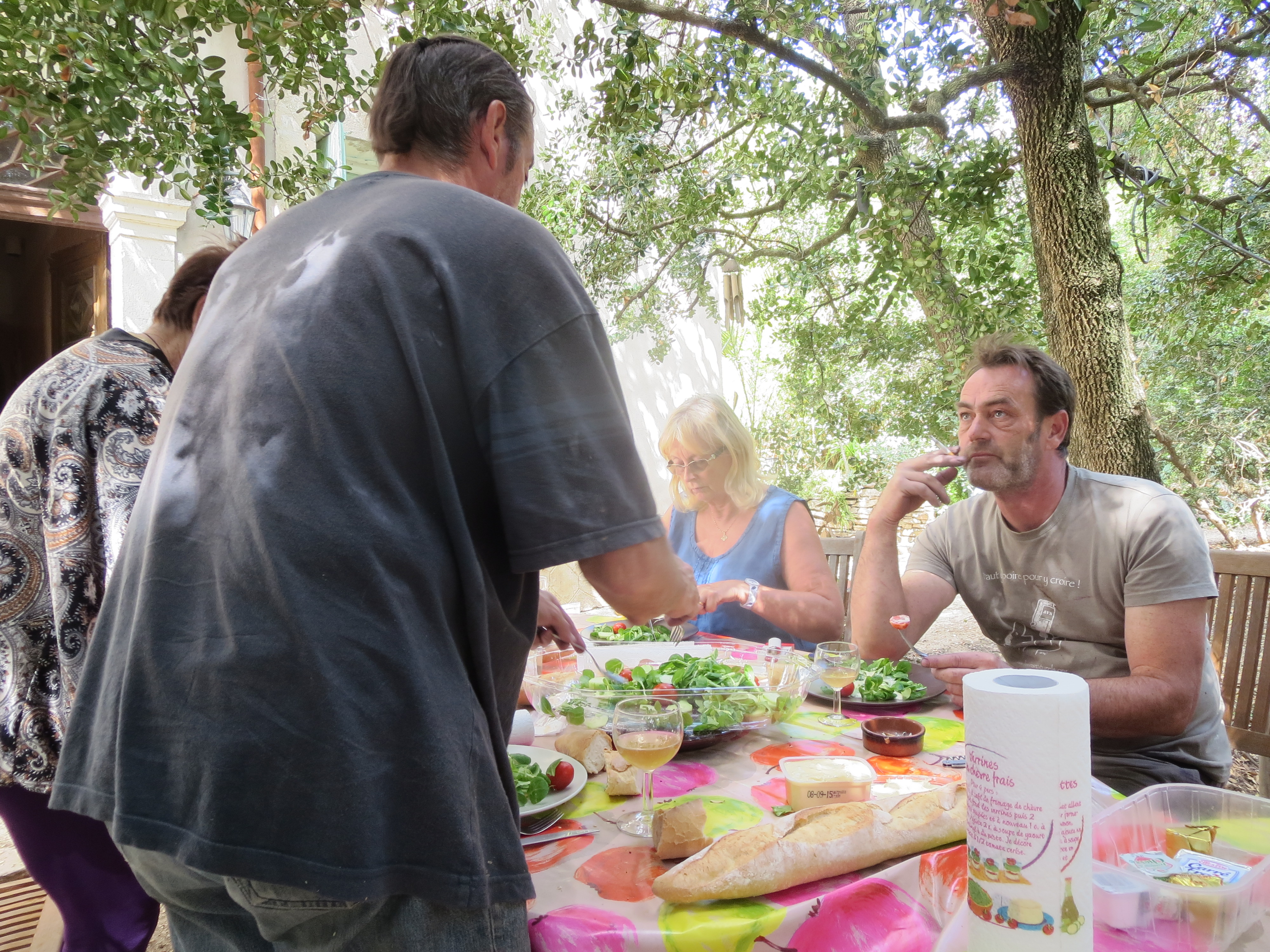
I did manage to sneak into lunch however. These are a highlight of the harvest season, with food prepared by Marie France from Puimisson and bottles opened including a terrific bottle of Castets, that rare grape I have described before. We sit at a big table int he garden of Jeff’s father, right next to the cellar.
Sunday will be a day of rest except for Jeff and Cameron who will do a round of the tanks to check on their progress and carry out more remontage. There is already a lot for Jeff to be thinking about, which wines are where, how are they progressing, have the remontages been done, are the analyses done. Plus all the options about which grapes to blend, what cuvées to make and, for example, whether the Grenache Gris will be white or rosé. Then off to the vineyards to check on the grapes and their readiness for harvest. Pressure, worries, and hard work – spare a thought for the vigneron.
Even during lunch Jeff is up and down checking on things in the cellar
Aug 30th was a Sunday so no picking but Jeff was still in the cellar working. The early wines needed to be checked and moved as necessary.
Monday 31st dawned cloudy again and it was time to tackle the biggest of the vineyards at Mas Coutelou, Segrairals. The Syrah was ready to be picked and Jeff had decided to use carbonic maceration to ferment the grapes which are probably not of the same top quality as those from La Garrigue or Sainte Suzanne which were picked last week.
Grapes which are pressed like those described last week ferment in tank as yeasts react with the juice to change the sugar to ethanol, ie alcohol. The yeasts are natural from the skins of the grapes and the atmosphere of the cellar. In the case of Mas Coutelou and many artisanal winemakers this is the case though other winemakers will buy yeasts some of which are designed to add particular flavours to the wine. None of that in Puimisson, these are natural wines.
Carbon dioxide pumped into the tank
Carbonic maceration means that the whole bunches go into the tanks, grapes and stalks alike. The tank is filled with carbon dioxide which permeates the grape skins and starts the fermentation within the cells of the berry. Some of the berries at the bottom of the tank will be crushed by the weight of the grapes and so there will be some conventional fermentation too.
Whole bunches in the tank
All the grapes are given a light crushing later by which time ethanol will have formed inside the skins and so the resultant juice is ready made wine. The result is often more fruity and juicy wine.
Grapes arrive through the little back door above the cement tanks
To achieve this the tanks are filled from above so we worked in the space above the cement tank with the grapes arriving at the back door which is a level higher than the front door. The space is smaller and the heat from the grapes was high. It was hard work, believe me. Sorting still had to be done before the grapes could go into the tank, quality comes first.
Some of the rejected bits
The pipe carries the CO2 into the tank
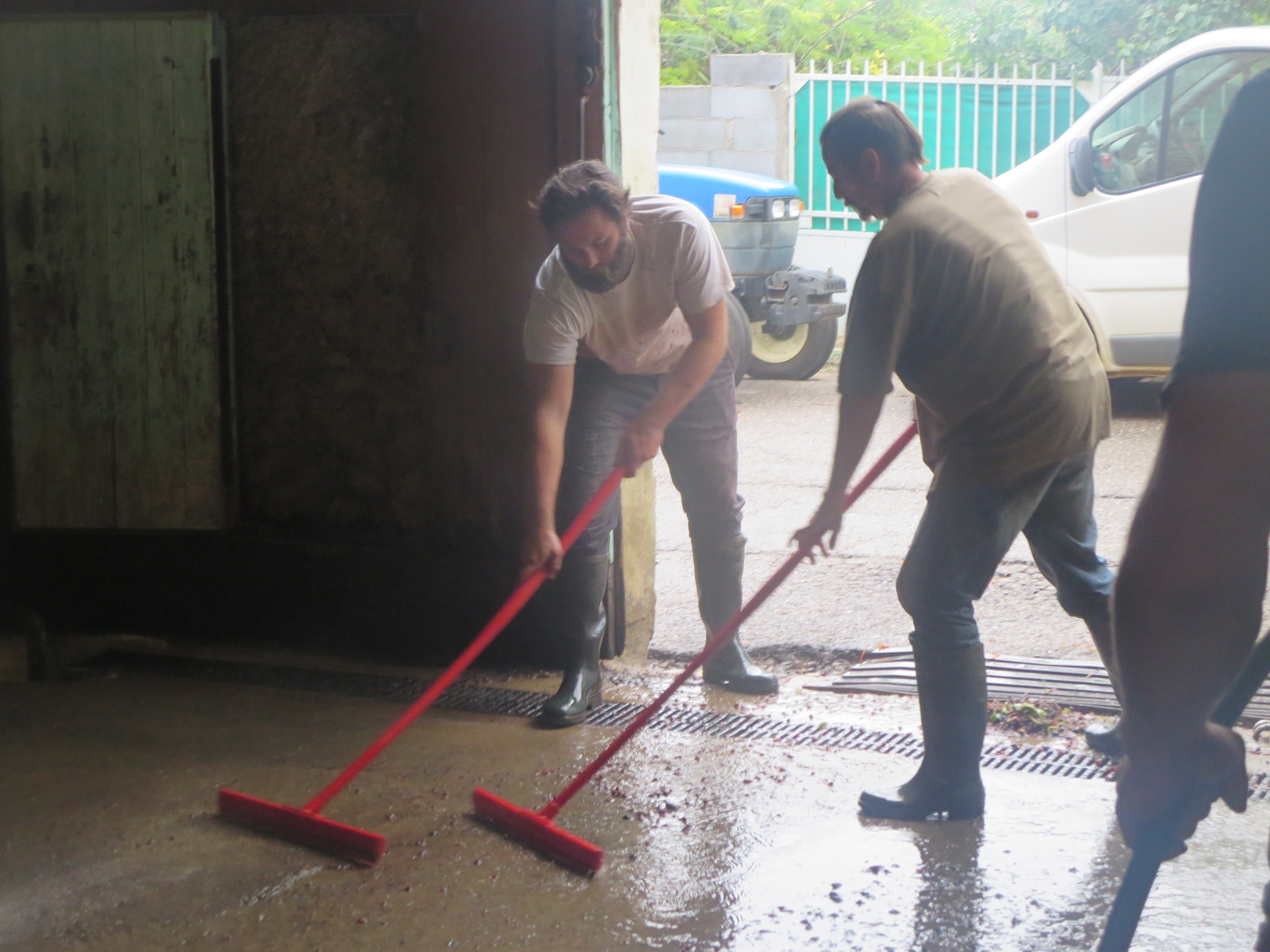
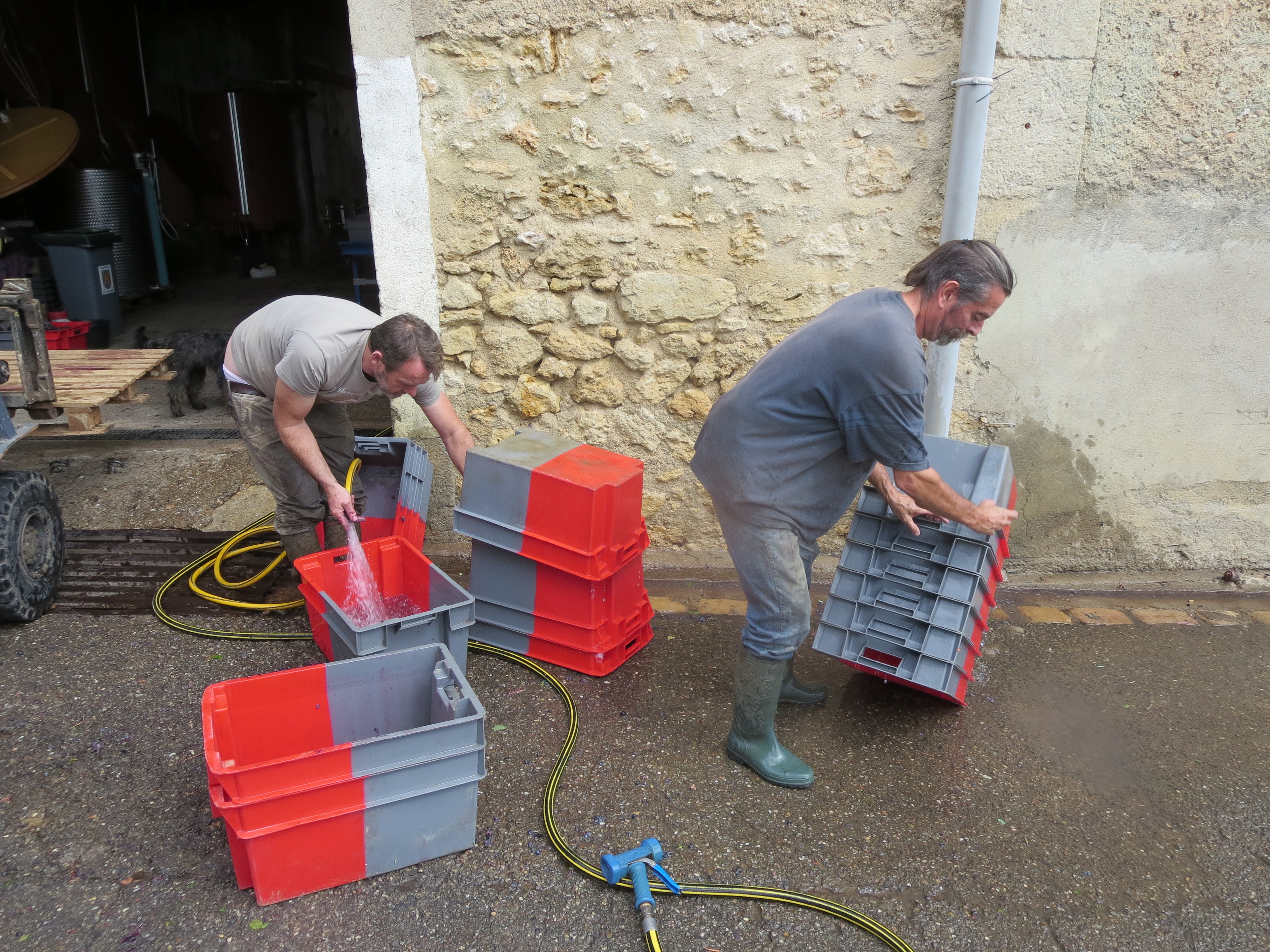
And after 9 hours of back breaking lifting, carrying and sifting it was, as ever, time to clean everything from top of the cellar to bottom as we see here with Jeff and Michel.
One visitor from the vineyard
The boss letting us know we should get a move on
The night of the 31st brought a big storm with lots of rain, not the ideal conditions for harvest at all. Rain can cause rot and problems. However, it could have been much worse as news arrived of huge damage caused by hail in the Chablis region. For all the forecasts of how the harvest might turn out it is only when the grapes are safely in the tank that a vigneron can be assured of the quality of wine they might make. Commiserations to the Chablis producers.
September 1st was a quiet day as the rains from the storms meant the grapes were too wet to harvest. In the cellar more checking and remontage, the process of pumping the wine over the cap of skins and must. Further analysis of the wines showed that the yeasts are acting quickly and the fermentation is progressing very well.
Hard work!
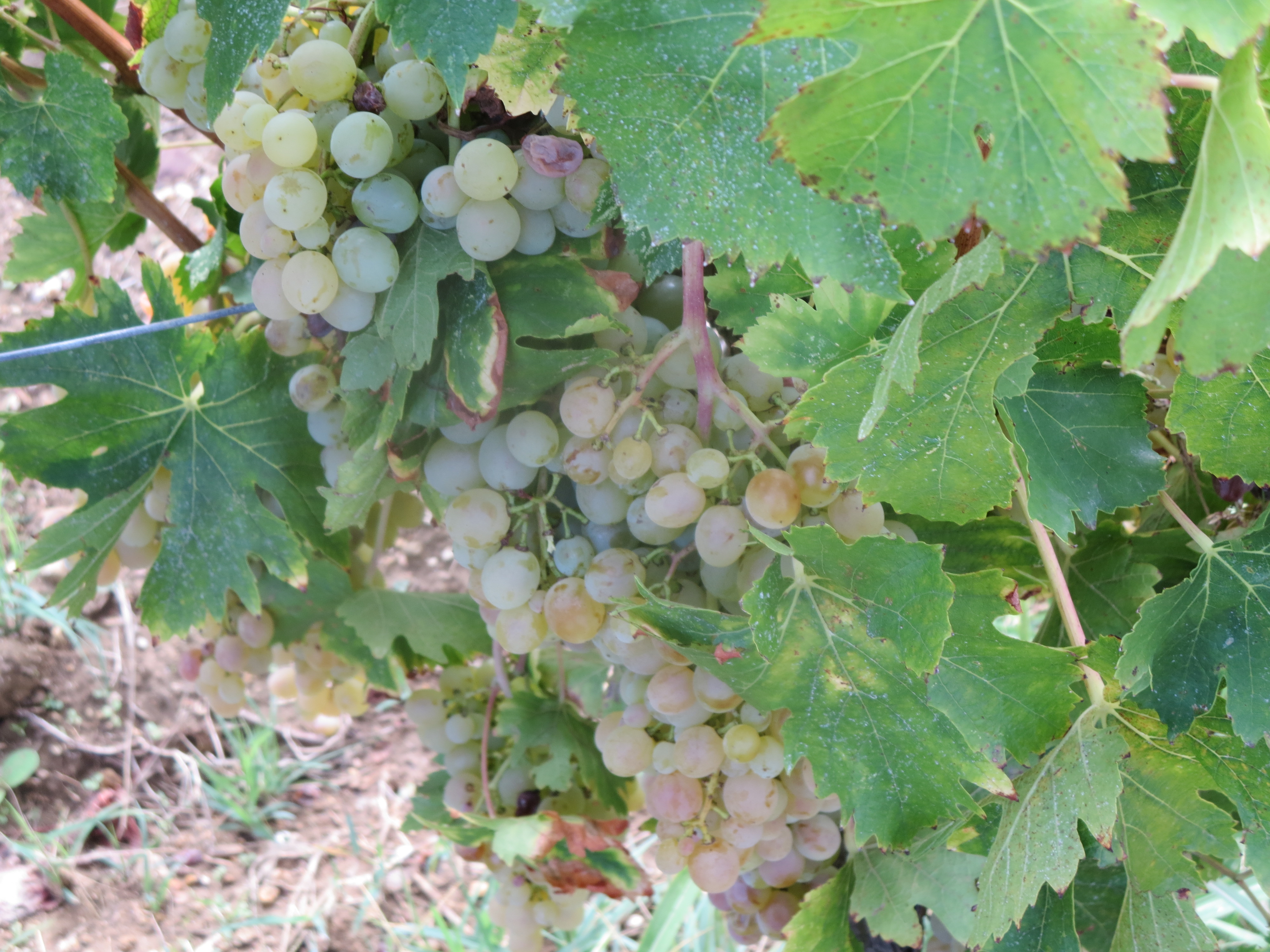
Today, September 2nd, the remaining white grapes, Grenache Blanc, from La Garrigue. Then on to Peilhan to gather some of the white grapes there, Maccabeu, Grenache Gris, Carignan blanc and Clairette Musquée.
Grenache Gris
Clairette Musquée
Michel
The core team of Jeff, Carole, Michel, Cameron and myself were joined by Matthieu who has worked the harvest before here. There were some lovely bunches though the wet weather has caused some rot inside some of them, Careful sorting took place in the vineyard to take only the best grapes which tasted really sweet and juicy, the Clairette was especially tasty.
Cameron especially pleased with this bunch of Clairette
The white grapes were taken back to the cellar and placed in tank after being destemmed. It is possible that Jeff will make his first orange wine with them. An orange wine is a white wine made like a red wine, ir the wine is fermented on the skins thus extracting more colour, texture and flavour from them and giving the wine an orange tint. However, analysis and the next few days will be needed before the final decision is made.
In tank and the future might be orange
In the afternoon, Matthieu, Jeff and myself did more remontage of the Syrah grapes harvested in the last week, which is already tasting well, with very healthy technical analysis and beautiful aromas. And, then, as ever, the cleaning.
The harvest (vendange) began on Friday August 21st with a small parcel of Muscat grapes as described here. The next few days saw further preparations for the main harvest, for example clearing space in the barrels of the solera system for this year’s grapes. I shall write more about the solera later in the year.
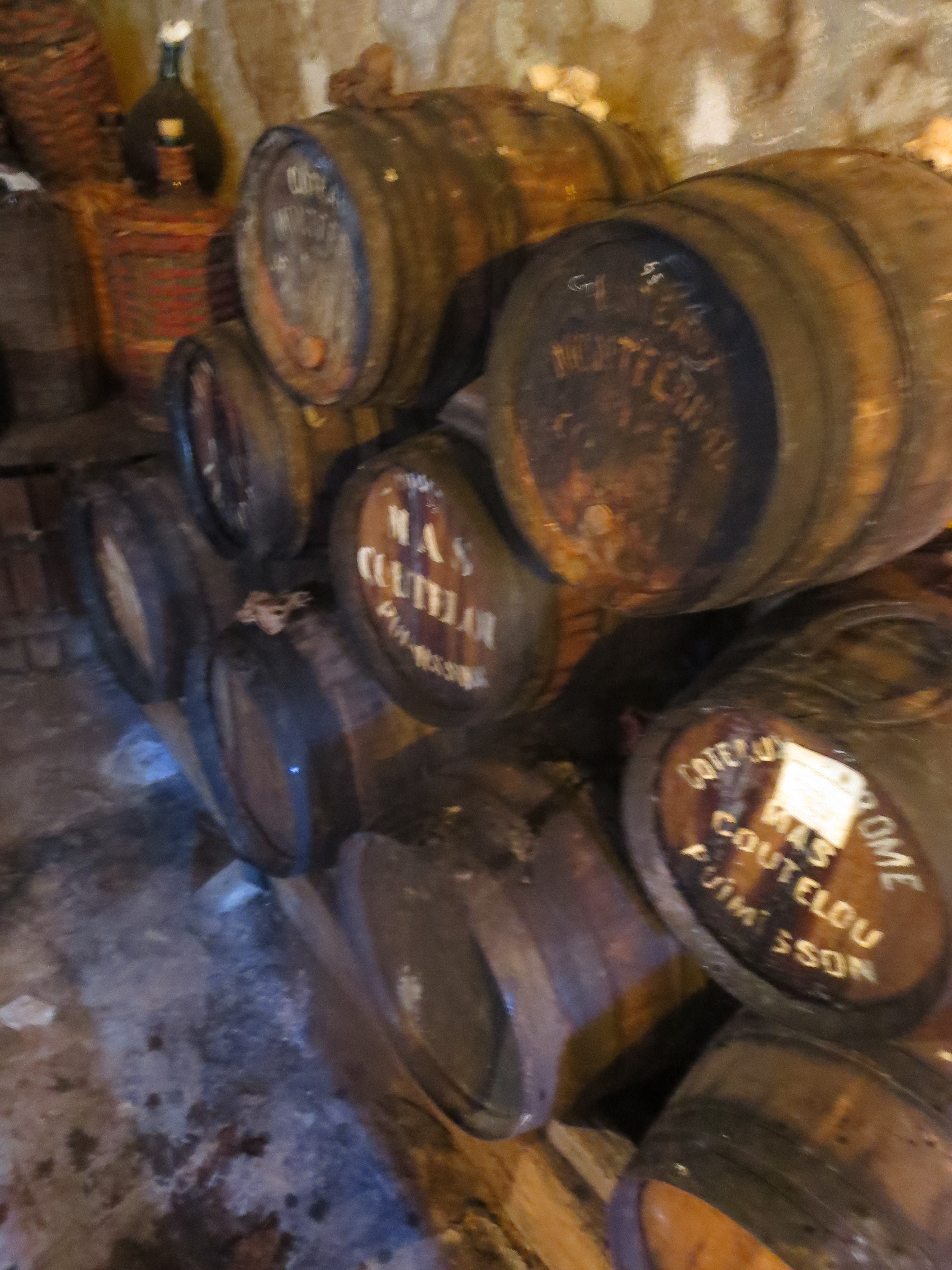
Solera system
So, it was Thursday 27th which was the start of the real vendanges with parcels of white and Syrah grapes collected from La Garrigue. This day was described here.
Friday 28th saw more Syrah being harvested, this time the Syrah of Metaierie usually referred to as Sainte Suzanne by Jeff. This is the vineyard of Vin Des Amis though options are always open. The pickers, led by Carole and Julien, worked through a cloudy morning to collect some high quality bunches.
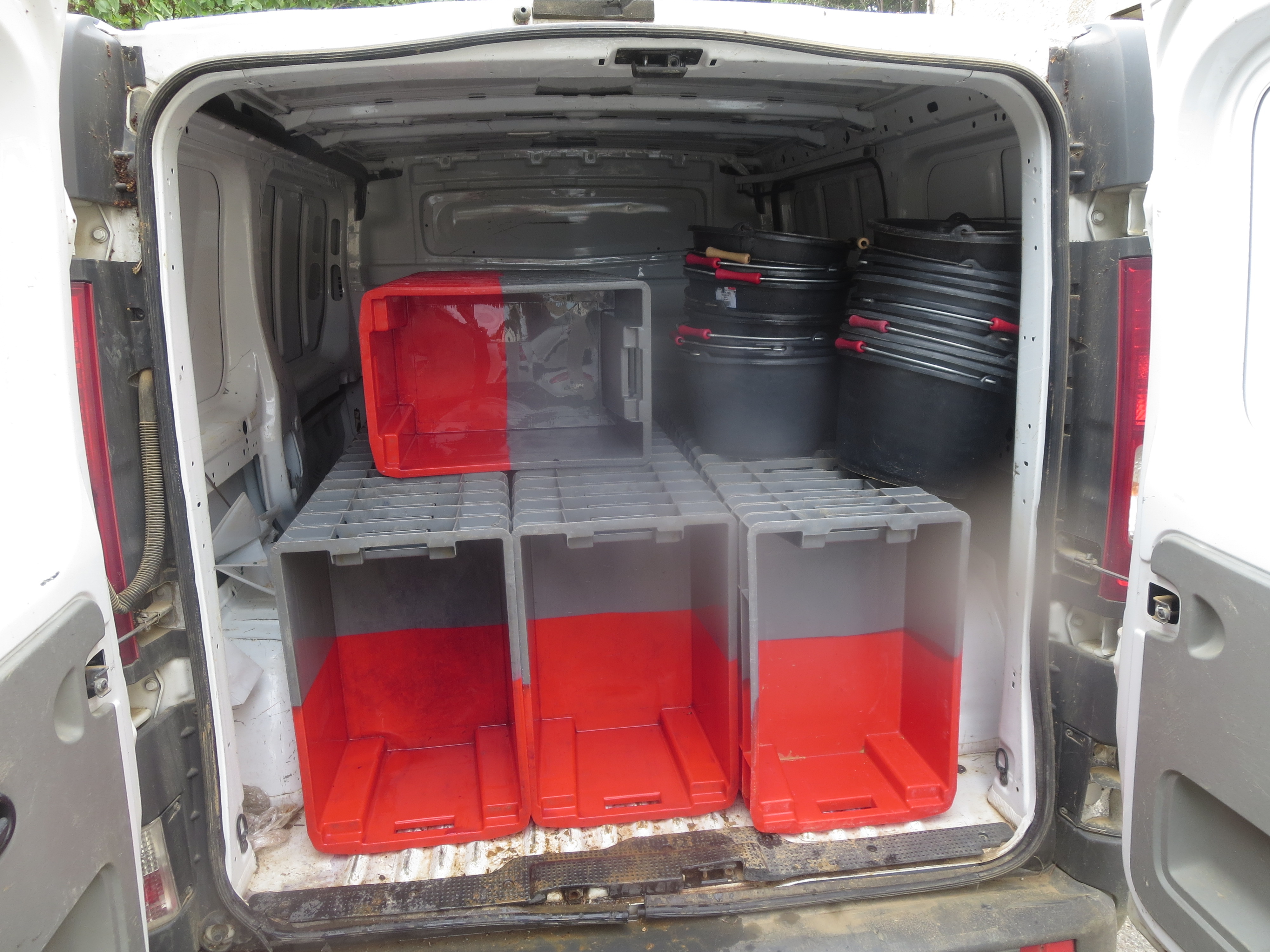
Michel transported the cagettes back to the cellar as quickly as possible. The cagettes are about two thirds filled so as not to overload the grapes in there which might damage them.
No, these cagettes are not full!
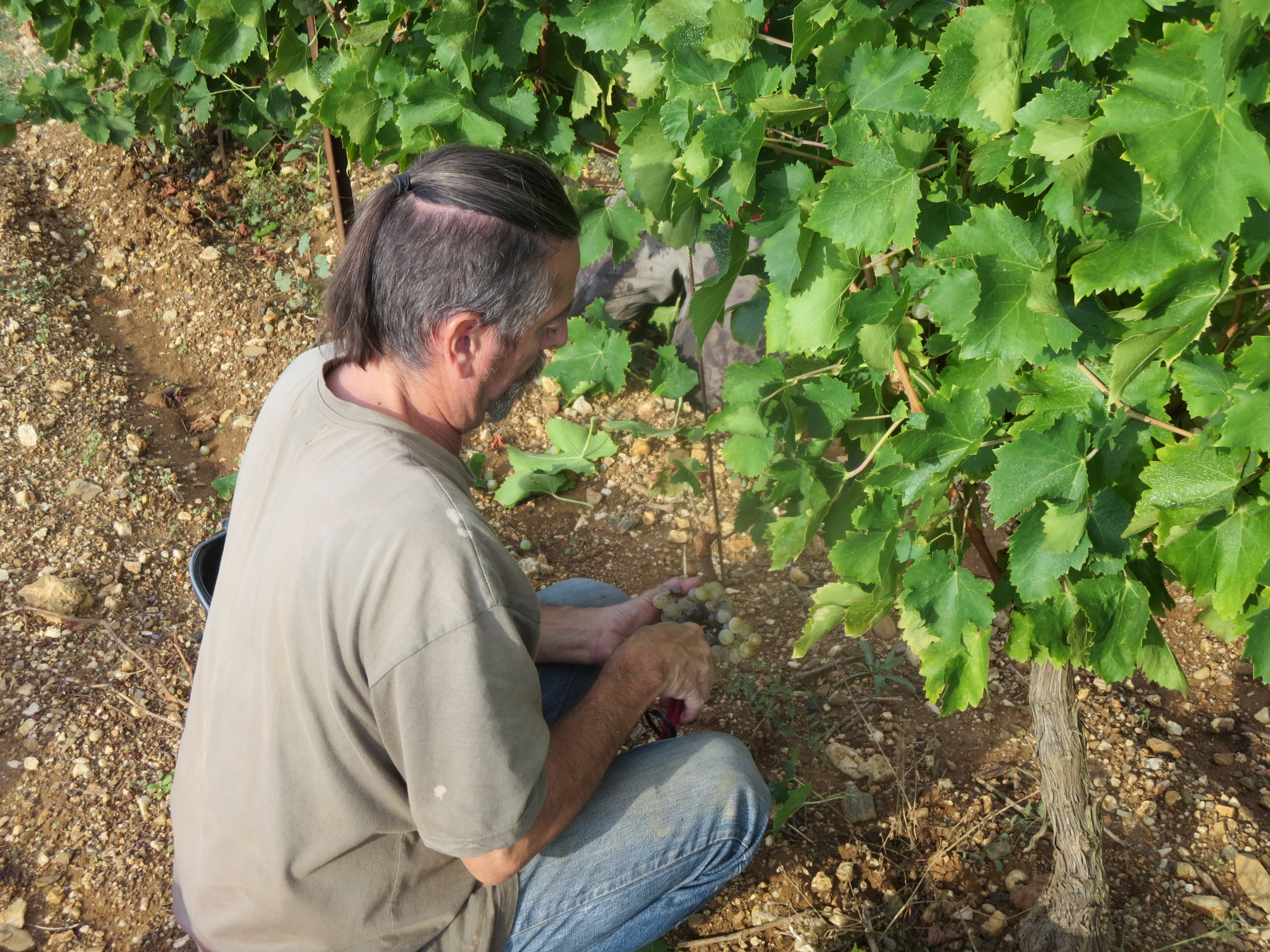
Upon arrival at the cave the cagettes are quickly taken for triage, sorting through the grapes to select only the best quality. Foreign objects such as snails and spiders are removed as are unripe grapes, any damaged or rotten grapes. It is important that only the best goes into the wines to keep them fresh and at the high quality we expect from Mas Coutelou. Two people sift through the cagette, removing any inferior grapes for further sorting by a third person. Jeff, Cameron and I took these roles on Friday. It is hard work, on your feet all day and lifting, carrying and sorting requires physical effort and also full concentration. There is, happily, also time to chat and laugh.
Cameron is from Melbourne, Australia and has been living and working in London as a sommelier for four years. He decided to learn more about the winemaking process and to “get his hands dirty”. He is already proving his worth and is a great addition to the team.
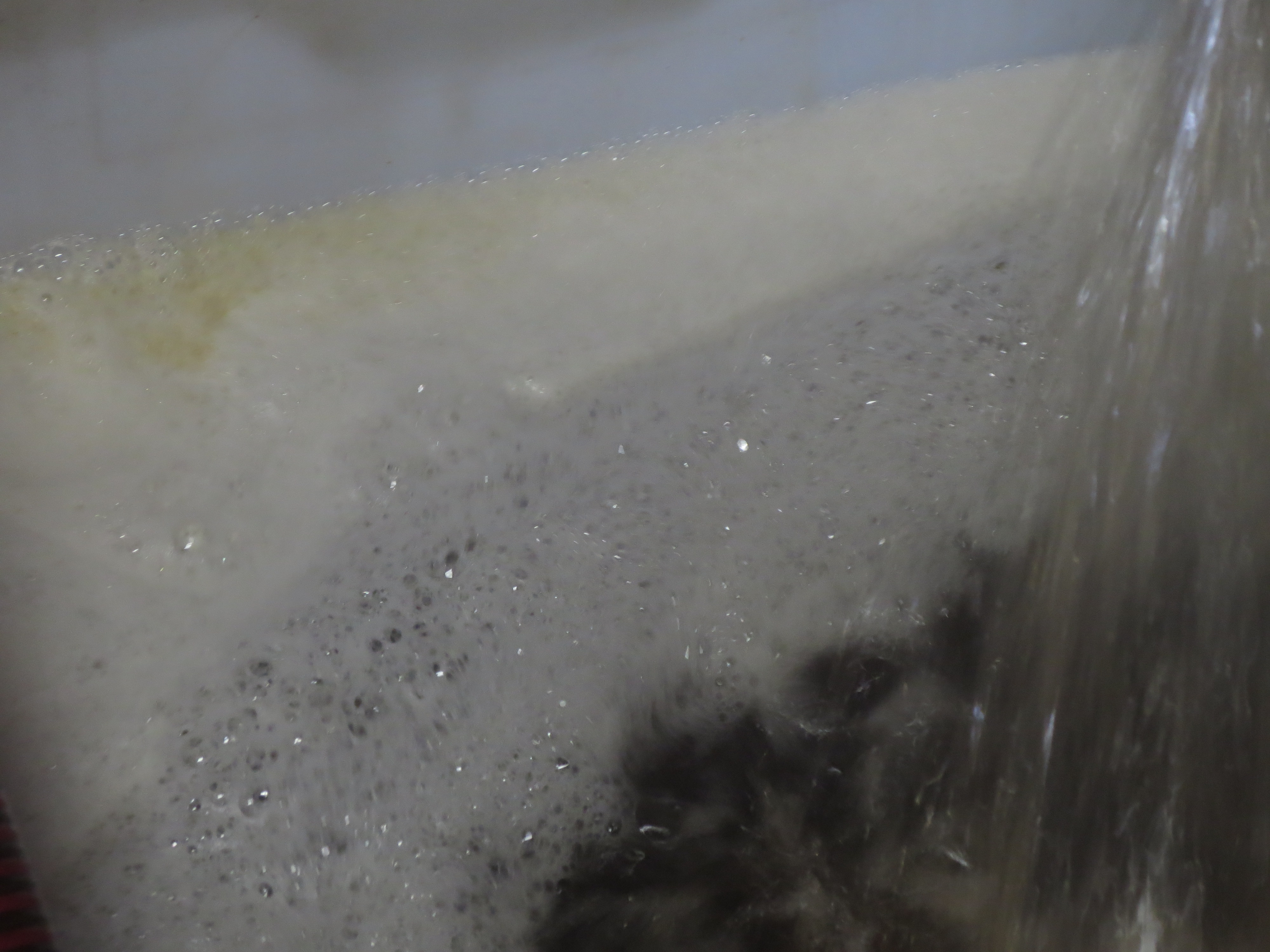
Meanwhile, the grapes which had gone to vat (cuve) have to be taken care of. Fermentation has started and the wine is already producing material which needs to be removed to keep the wines clean. They are, therefore, pumped out of their original cuve into another to allow the waste to be cleaned away and the fresh, juice ready to settle for its longer journey of fermentation.
Fermentation beginning in the Sauvignon Blanc grapes collected yesterday (Thursday)
And at the end of the day the cleaning work is intense. Everything is cleaned throughout the day but at its end another full clean takes place. This removes the risk of contamination from dirt or damaged fruit which would ruin the wine. It is laborious but necessary.
Julien cleaning the cagettes
Ready for tomorrow
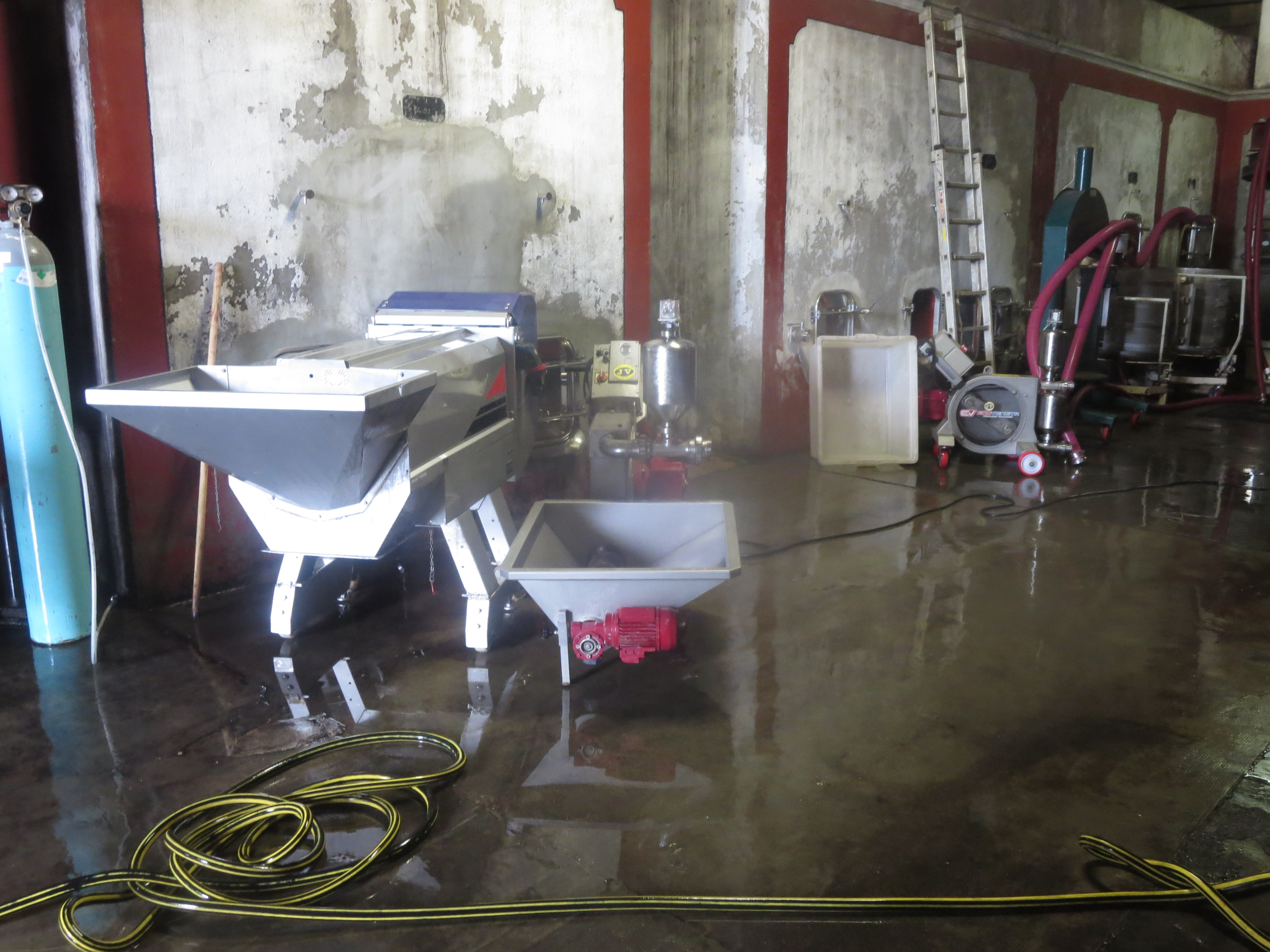
The égrappoir (destemmer) ready for tomorrow too
What else needs cleaning? Proof that I did work!
Analysis of the Syrah showed that the alcohol level was around 12.7% with medium levels of acidity. Later picking would have added more sugar and more potential alcohol but would have lowered levels of acidity. The skins are essential to the quality of the wine as they contain the colour, tannin and much of the flavour of the wine. These were in excellent condition according to the analysis, good news.
Jeff’s own calculations from cellar tests. Samples go to the oenologue for full analysis
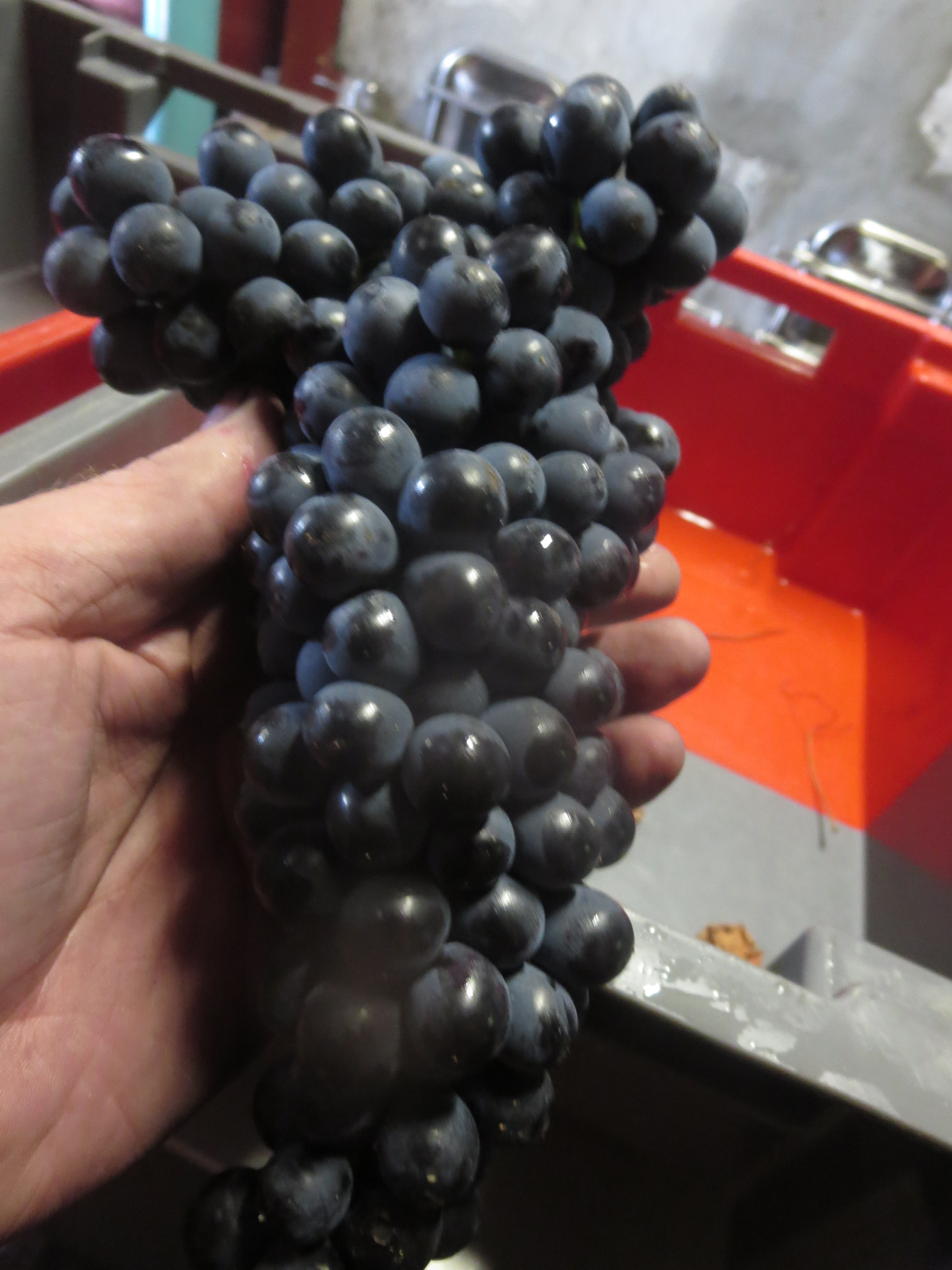
Classic shape for a bunch of Syrah grapes
There have already been some concerns expressed by winemakers and analysts that the heat of 2015 might affect the quality of wines around France especially regarding acidity. The decision to harvest the Syrah was therefore the right one, fresh, cleansing acidity is a hallmark of Jeff’s wines. Many winemakers have been waiting to start harvest as, on August 30th, the moon is at a perigee, the time when it is closest to Earth in its orbit. As it begins to wane and move away from Earth many winemakers will start their harvest. Jeff has chosen to put the quality of the grapes first rather than principles about biodynamics.
Moon over Margon at its perigee on August 30th
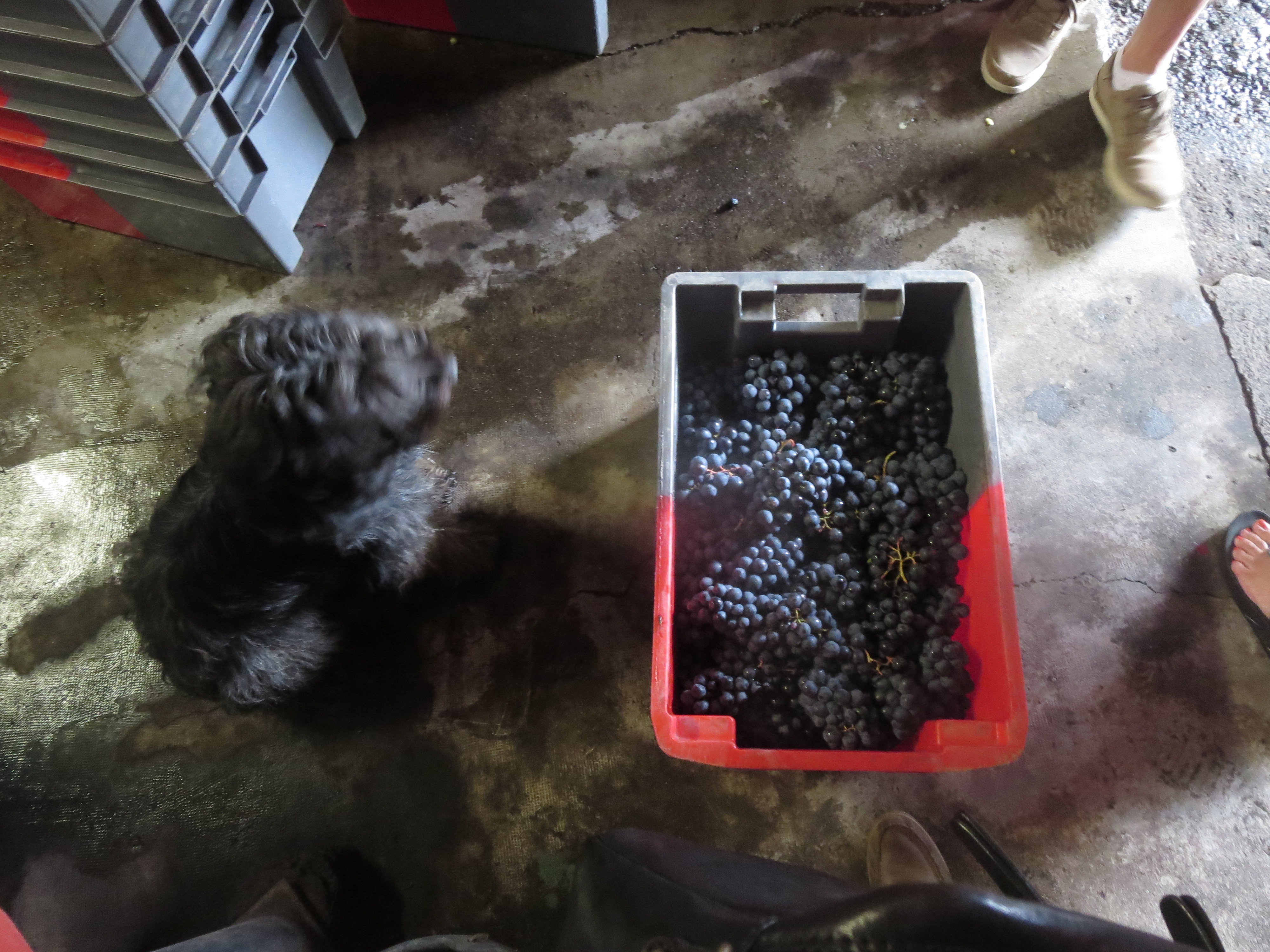
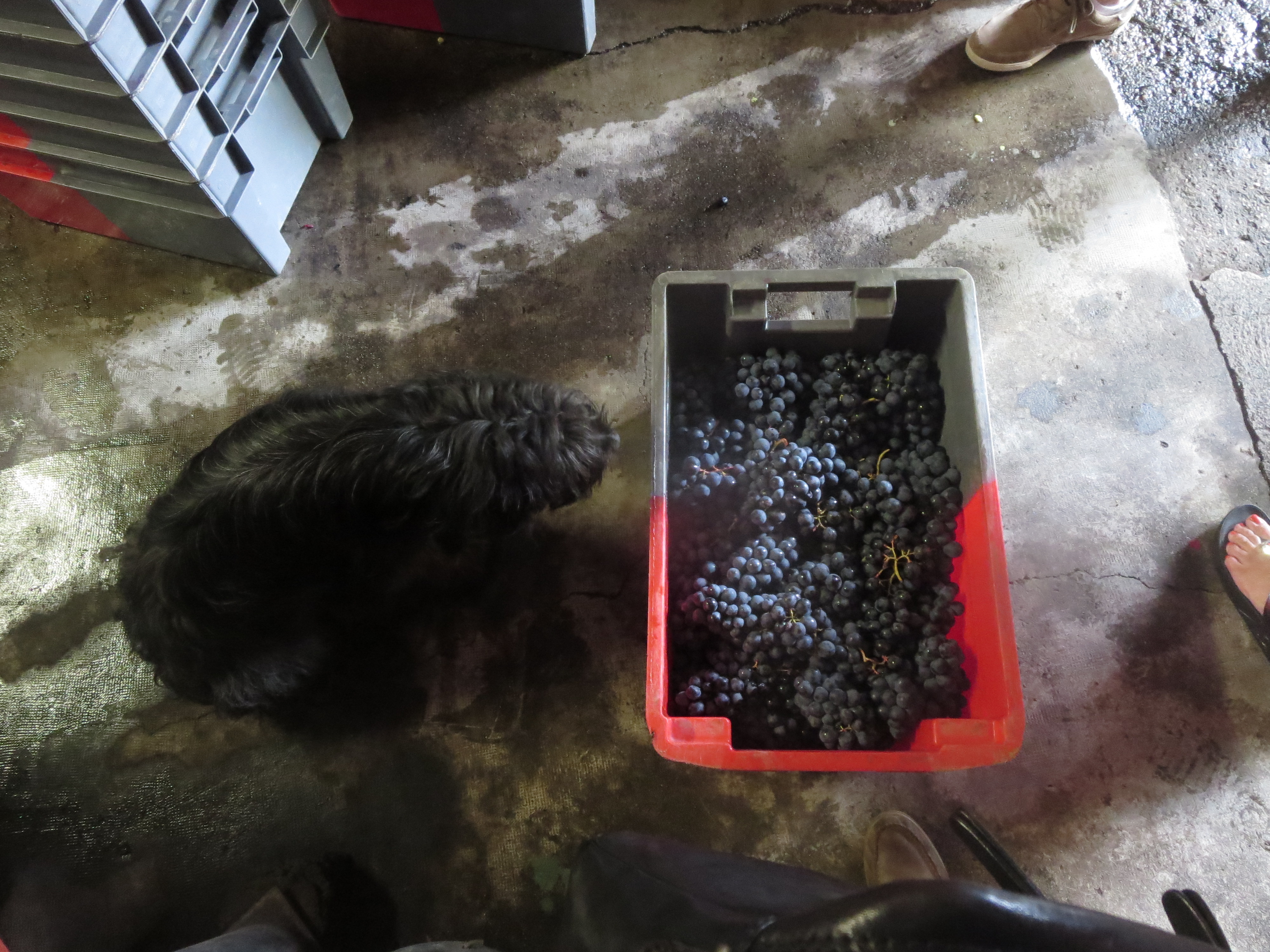
Saturday 29th was a work day for the cellar and the pickers and saw the harvesting of Cinsault grapes from my favourite vineyard, Rome. The grapes were big and juicy though some were uneven and needed more careful sorting. Clearly these were precious grapes as Icare was guarding and watching over them assiduously. The harvest was not as big as many years and so the pickers moved onto Sainte Suzanne again for more Syrah grapes whilst yesterday’s grapes have begun to ferment already.
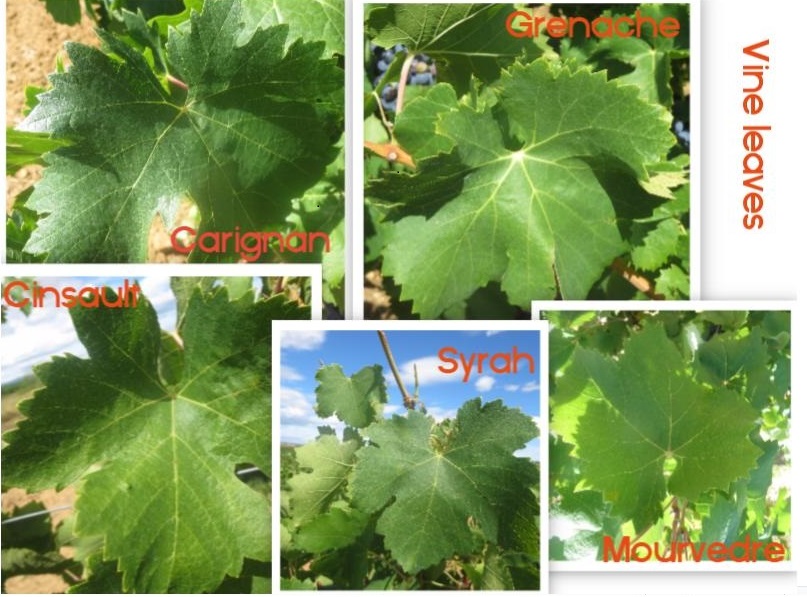
In my last post I described the leaves and some other features of the five main red grape varieties to be found in the Languedoc Roussillon region. This is all part of my attempt to learn how to identify different vines more easily. So what about other varieties which are to be found at Mas Coutelou?
Red grapes
Cabernet Sauvignon
Usually associated with Bordeaux and other regions of France there is Cabernet to be found in the Languedoc. Much was planted in the 1980s and 90s as Cabernet Sauvignon, Merlot and Chardonnay were the big sellers on world markets and vignerons here tried to make money from that market. It is easy to deride this move but vignerons have to make a living and if they can sell grapes then who is to blame them? Besides the domaine which first brought the Languedoc to the world stage, Mas de Daumas Gassac, uses these international varieties as part of their blends. I have to admit that it is not my favourite wine, certainly not the domaine’s red, but it has made an impact.
Anyway, to ampelography. I love Cabernet Sauvignon leaves, they are so easy to identify with their two eyes in the leaf which makes them look like a startled face.
Cabernet Sauvignon in Segrairals
A rich green colour the leaves have more lobes than most and the lower lobes overlap to cover the base of the pétiole sinus (the space where the stalk meets the leaf) giving the mouth like appearance you can see in the photo above. Generous teeth around the lobes are noticeable but it is the two spaces in the leaf which makes this easy for me to recognise. The grapes are small with hard skins and form small clusters too.
Recommended wines
Mas Coutelou – Buvette À Paulette
Others – Casa Pardet, Cabernet Sauvignon (Spain)
Cabernet Sauvignon grapes
Merlot
Poor old Merlot seems to be currently out of fashion. Seemingly everybody’s favourite in the 1990s I regularly hear people now say how it is their least favourite variety, and I confess it is one of my least popular grapes. It is capable of great things on the right bank of Bordeaux and elsewhere but it is little seen here in the Languedoc. Jeff has one parcel, Colombié, entirely planted with Merlot which is mainly used for restaurant blends and bag in box wine.
Merlot in La Colombé
The leaf in the photo shows that these are rich green in colour with 5 or 7 lobes. The sinus around the stalk is open and U shaped with a large white spot where the veins come together just above this sinus. In this photo the veins are quite green as they spread out. Medium sized teeth surround the leaves. Grapes are medium sized and so are the bunches so few clues there.
Mas Coutelou – 7, rue de la Pompe (small amount)
Others – Fons Sanatis, Coudereu
Aramon
This local grape was once widely planted in the Languedoc but was grubbed up in recent years as its reputation spread as wines with little flavour. This was unfair as it was often grown to give big yields and so flavours were diluted but there are many who still scorn it. Nevertheless, with low yields it can make good wines and there is a recent trend to replanting Aramon.
Aramon Noir in Font D’Oulette
The leaves are almost trefoil in character with big veins which stand out against the dark green colour. The teeth are quite large in the lower lobes and taper gently to the top. The pétiolar sinus is big and V shaped. It is the grapes which make Aramon identifiable. They are big in size and form large cylindrical clusters. This reinforces the reputation as a big cropper of light red wines, one of its synonyms is Pisse – Vin which needs no translation. However, this is unfair and Aramon is starting to make some interesting wines again.
Less than 30% of wine produced in Languedoc Roussillon is white, I was actually surprised at how high that figure is. The last few years has seen Picpoul De Pinet become very trendy around the world, reaching prices over £30 in some UK restaurants for wine which costs around 5-6€ around here. Improvements in vinification and the use of temperature controls means that the quality of white wine being made here is improving and there are plenty of excellent examples.
Jeff produces a few cuvées of white wine but many of the white grapes are complanted, mixed together in the vineyard, to add complexity to the blend and an expression of terroir. In terms of identifying these varieties the challenge is, therefore, more complex, as they are mixed up I tend to be too! Therefore, I have only included the main white varieties of the domaine here, there are many, many others!
Muscat
There are actually many different varieties of Muscat just to make identification even more difficult, e.g. Muscat A Petits Grains, Muscat d’Alexandrie and there’s even a Muscat Noir just to completely baffle me. Muscat is usually used to make sweet wines such as Muscat De Rivesaltes, Muscat De Frontignan and Muscat De St. Jean De Minervois. Jeff uses it in dry blends, is considering using it for a pétillant wine this year and also uses it in his sensational solera system to make rich, sweet and dry old Muscats.
Muscat from La Garrigue
Muscat Noir, Font D’Oulette
Muscat has quite dark green leaves and can be in 5 lobes though both the photos above show just 3, almost like a maple leaf. There are some big teeth around the leaf edge. The leaf is also relatively long compared to the width at the base and the sinus around the stalk is V shaped. The other distinctive feature is the crinkly, dimpled appearance between the veins. The grapes are actually fairly medium in size (despite the Petits Grains name) but form small clusters. The grapes are distinctive in colour as they become golden and bronzed in the sunshine with freckles too!
Muscat grapes, admittedly more green than golden. These were picked early for dry wine.
Mas Coutelou – Vieux Muscat blends
Others – Treloar, One Block Muscat; Clos Gravillas, Muscat de St Jean de Minervois
Sauvignon Blanc
Not a variety much found in the Languedoc as it tends to prefer slow ripening and cooler climates. In Mas Coutelou it is used for blending with other white grapes to add a little zest and bite to the mix, picked early to keep that freshness as you can read here.
Sauvignon Blanc, La Garrigue
Quite round in shape with 5 lobes and teeth which are sizeable but more round than angular. The veins stand out as they are not coloured, reaching down to the stalk sinus which is often closed or barely open. One distinguishing feature which is observable in the photo is that the leaf tends to curl a little at the edge, note how one lobe is curling under the other on the right of the photo. Small bunches of oblong but small grapes.
Recommended – Turner Pageot, La Rupture
There are many other white varieties which I could add but these suffice for my needs. Carignan Blanc and Grenache Gris and Blanc are related to their black grape cousins and have similar appearances. Maccabeu, Picpoul etc are for another day but I think that is enough studying for the moment!
Viognier grapes in La Garrigue
There is a very pleasing trend in the Languedoc Roussillon towards replanting old varieties of vines. Terret, Ribeyrenc, Piquepoul Noir, for example were all planted at Mas Coutelou in March. And there remains the very rare Castets, brought in from Chateau Simone in Provence to be only the second vineyard to have this variety.
The famous Castets grapes of Peilhan
So ampelograhy is an ongoing lesson for me, if you want to find out more these websites are worth a visit.
Friday was a warm up, today (August 27th) was the real beginning. White grapes, mainly Sauvignon Blanc, and Syrah from La Garrigue vineyard were picked and pressed.
My first bucket full of Sauvignon Blanc
Back to the cellar, straight into the press.
The Syrah looks especially good this year with a good balance of acidity and sugars. Some were ready and so in they came today. Great quality, 2015 is looking good, let’s hope the next month confirms it.
Coincidentally it was the official celebrations for the start of harvest in the Faugères appellation this evening with a ceremonial cutting of the first grapes. Good fun, especially getting to taste the wines of Clos Fantine again.
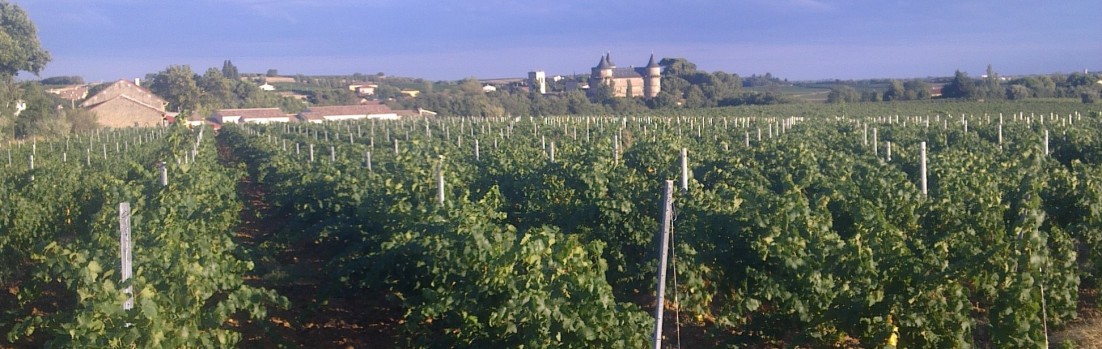
When you live in the Languedoc you are surrounded by vines. They are everywhere and form the world’s biggest vineyard area, producing one third of all France’s wine. Vines stretch over hill and valley, coastline and plains. As you walk around it is easy to think of vines as all being the same, part of one big plantation, but when we have received visitors and we go on walks through the vineyards they often ask me what sort of vine we are passing. Cue guesswork on my part unless I am in the vineyards of Mas Coutelou. To remedy this ignorance and to meet the brief at the top of this blog that I should be “learning about wine, vines and vignerons” I set myself the challenge of being able to identify the main types of vine in the region.
Ampelography is the study of identifying and classifying grapevines. There are many learned books on the subject, some running to hundreds of pages. However, I wanted a simple guide, to learn the basic varieties before expanding to others. I took some photographs in the parcels of vines of Mas Coutelou and using the internet and Jeff himself I hope I have put together a simple reference piece. As we enter harvest it has proved useful to me so that I know what I am picking or sorting. Hopefully it will be useful to you too, whether you visit vineyards or just take an interest in wine and vines.
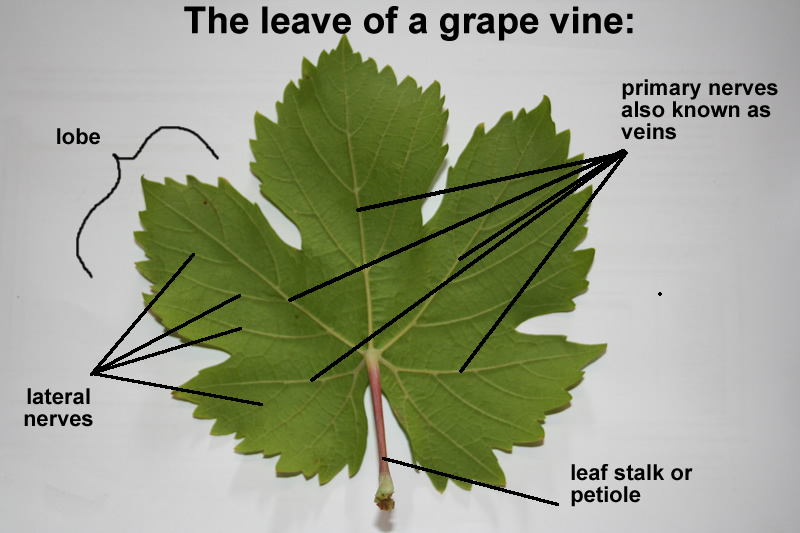
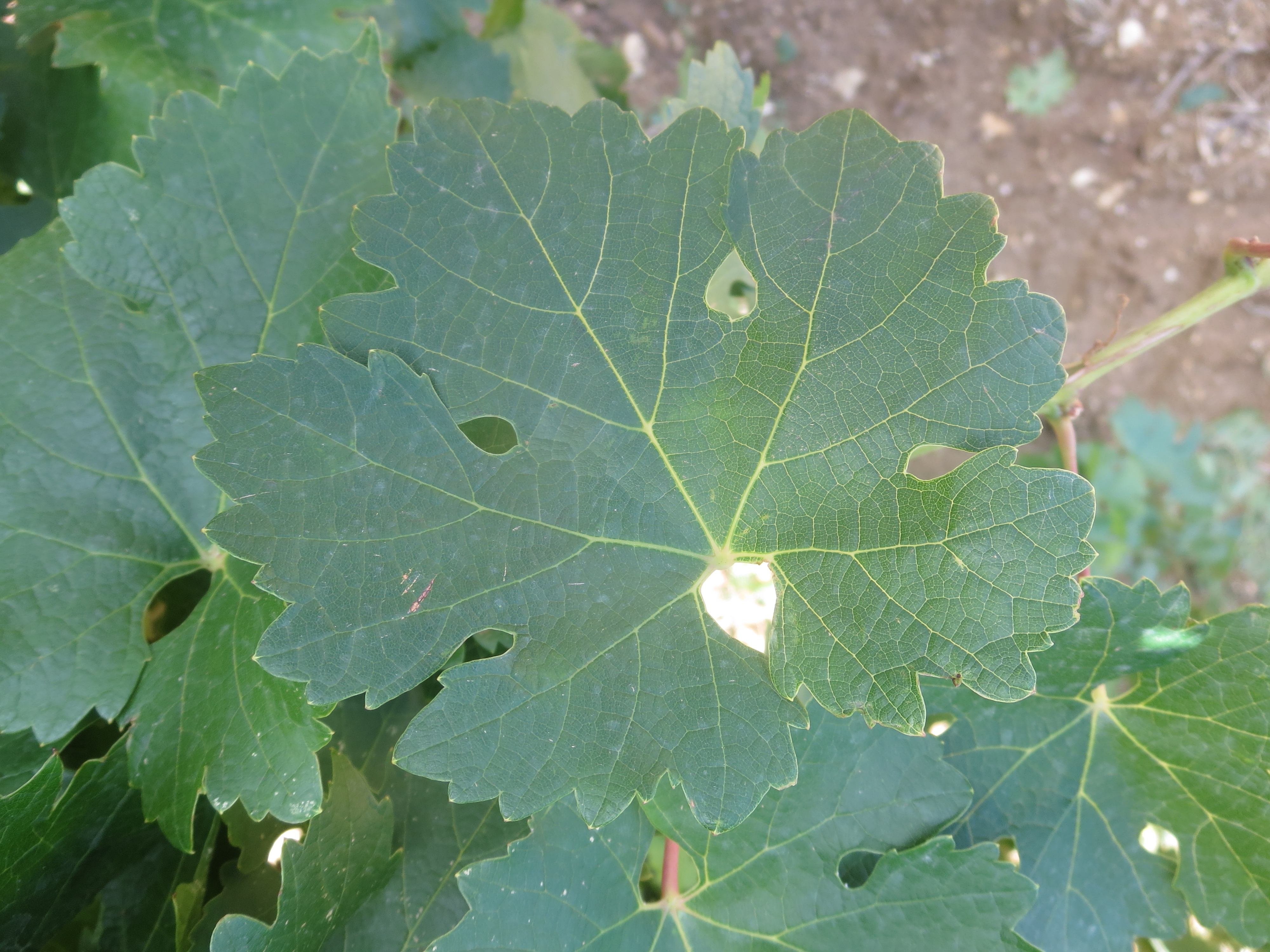
Experts use features such as the shape of the grape bunches, size and colour of the grapes. However, for me the most obvious way of distinguishing between vines are the shape of the leaves.
The colour of leaves varies but so too the number of lobes (from just one to seven), the colour of the veins and the shape of the sinus around the stalk (pétiole). The sinus is the gap between the lobes. So here is my simple guide to identifying some Languedoc vines. I have started in this post with the five main red wine varieties.
Red wine vines
Syrah
Syrah in Segrairals vineyard
Syrah is one of the great varieties of the Languedoc. Famous for its wines in the Rhone Valley and around the world (Shiraz in Australia) Syrah produces great wines here too. The leaves are quite a light green in colour with 5 lobes which are well separated out including a big sinus (V shaped) around the stalk (pétiole). The veins are quite light and stand out. The leaf edge has small, gentle teeth shapes. The grapes tend to be oblong shaped and fairly small in size. Syrah is one of the earlier red varieties to ripen.
Recommended wines:
Mas Coutelou – La Vigne Haute
Others – Sylvain Bock, Raffut; Plan De L’Homme, Alpha; Haute Lignières, Sur Le Fil; Terre Inconnue, Sylvie
Syrah grapes
Grenache
Grenache in La Garrigue
A variety which loves the heat, very much a Spanish and Mediterranean grape. Grenache leaves have a more round appearance than Syrah with big, wide lobes which are not so separated as the Syrah giving the impression of a big, whole leaf. There is a wide sinus around the stalk. The leaf edges have saw teeth which are quite marked. Light veins and round, medium sized grapes. Grenache is a late ripening variety. Often used to blend it is not often used for single variety wines.
Mas Coutelou – Grenache, Mise De Printemps
Others – Engelvin, Même-Si and Vieux Ronsard; Treloar, One Block Grenache;
Grenache grapes
Mourvèdre
Mourvedre in Segrairals
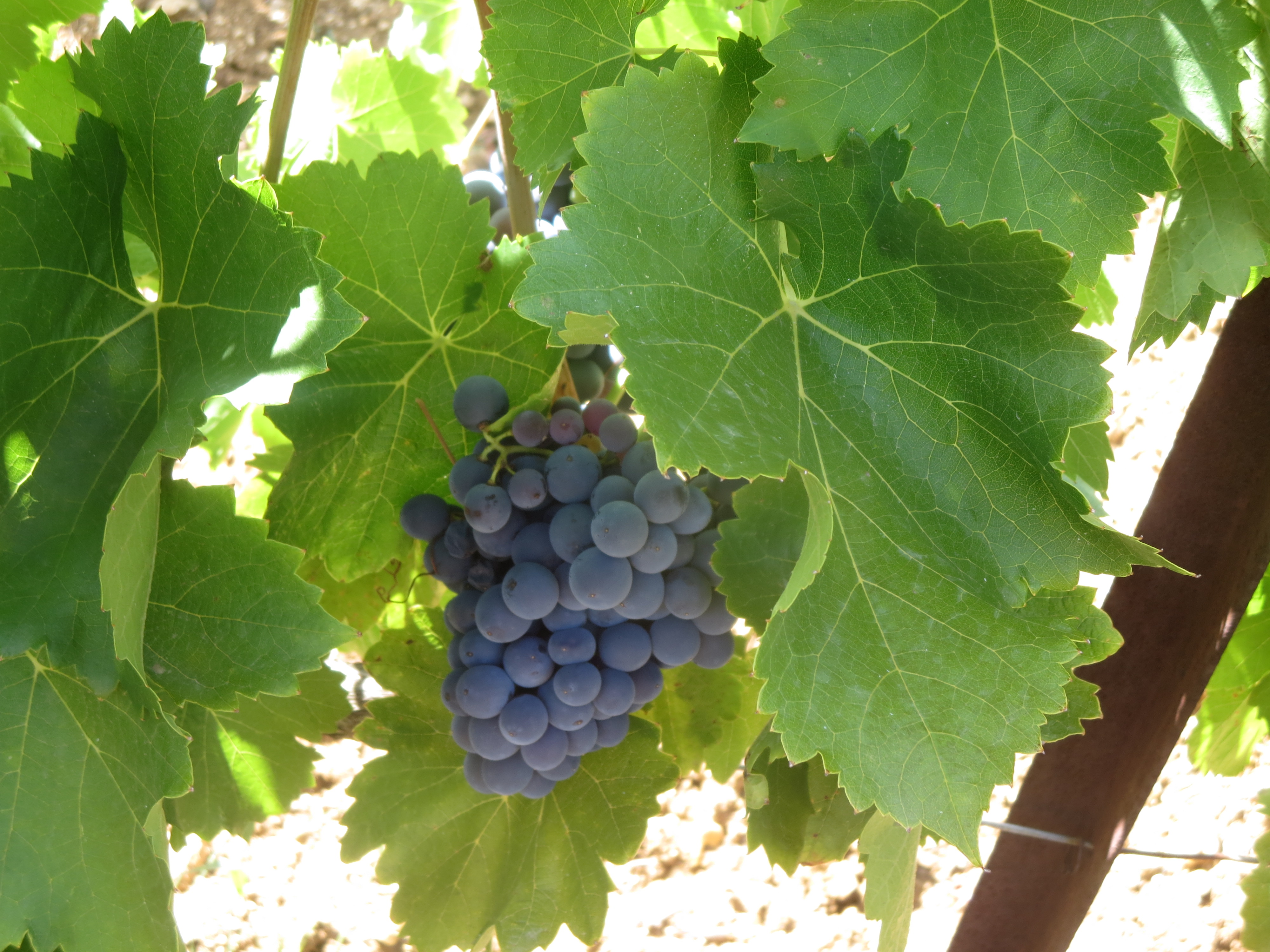
Mourvèdre is a late ripening and, sometimes, a difficult grape to ripen. The lobes are broad and form three rather than five as you can see in the photo on the right of the page above. There is a little green colouring in the veins and the sinus around the stalk is a lyre shape. The teeth around the edge are distinct and quite big all around. The grapes come in biggish bunches though the grapes are medium in size.
Mas Coutelou – Sauvé De La Citerne
Others – Clos Fantine, Cuvée Courtiol; La Liquière, Tucade; Treloar, Motus
Mourvedre grapes
Carignan
Carignan in Rec D’Oulette
Carignan has big leaves which are quite hairy underneath and have a more dimply appearance than most in the upper surface. Five lobes usually though in the photo above the lower lobes are small with big upper lobes and a distinct top lobe. The teeth are tapered and distinct. The veins are hardly coloured. This is a late ripening variety and you can see the grapes below which are still turning black, even though this was taken at the same time as the other photos. The grapes and clusters are medium to large in size.
Carignan grapes
Mas Coutelou – Flambadou
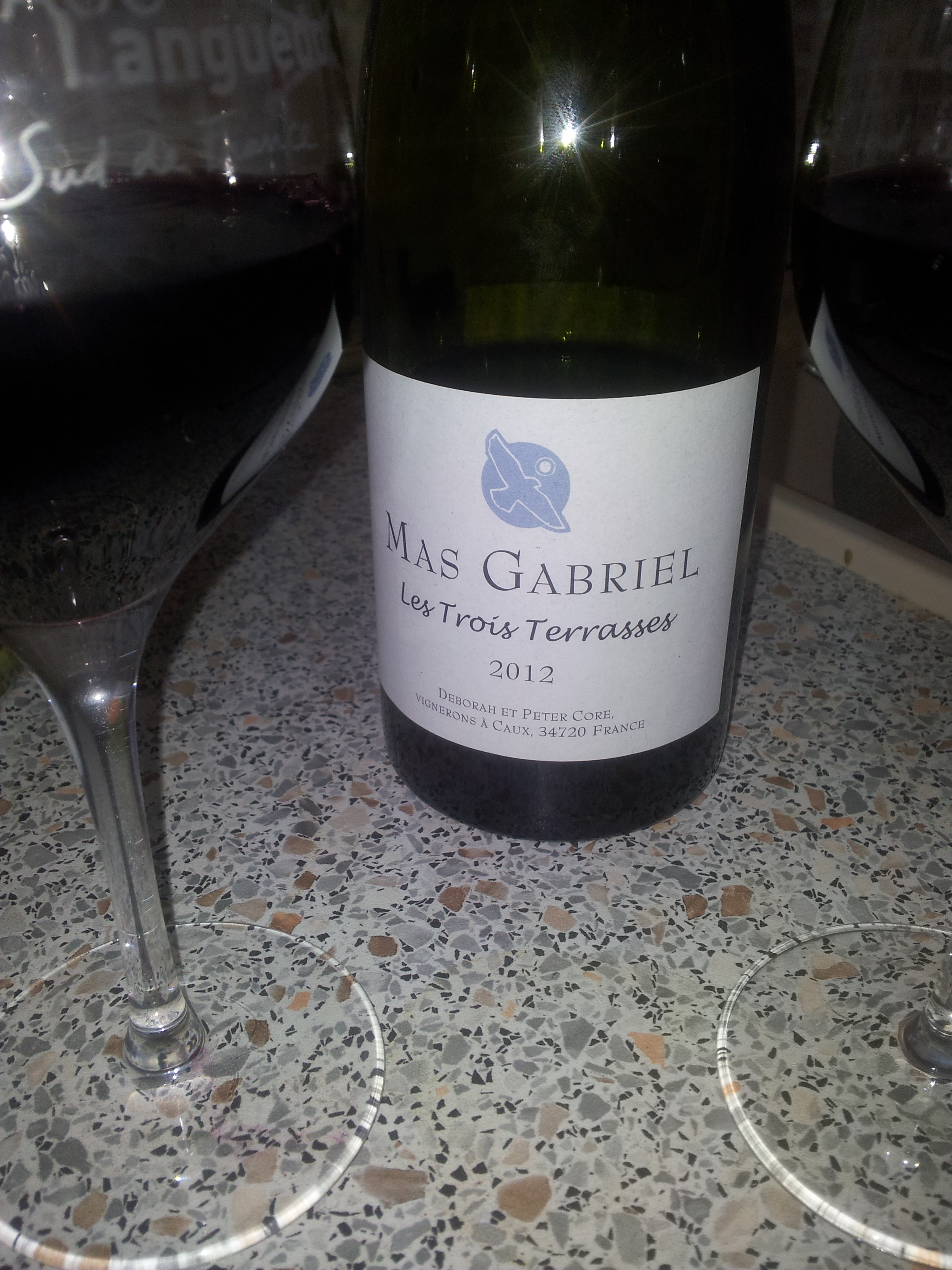
Others – Mas Des Capitelles, Loris; Coume Mayou, La Loute Mas Gabriel, Trois Terrasses Deux Ânes – L’Enclos
Cinsault
Cinsault in Segrairals
I like to think of Cinsault leaves as being very like the grape’s flavours, open, friendly and welcoming. These are big widely spaced lobes and a deep, open sinus around the stalk. The veins are light and clear and the teeth are big, almost rounded which cover all the leaf edge. Often used in rosé wines Cinsault is starting to be used to make some great red wines in the region.
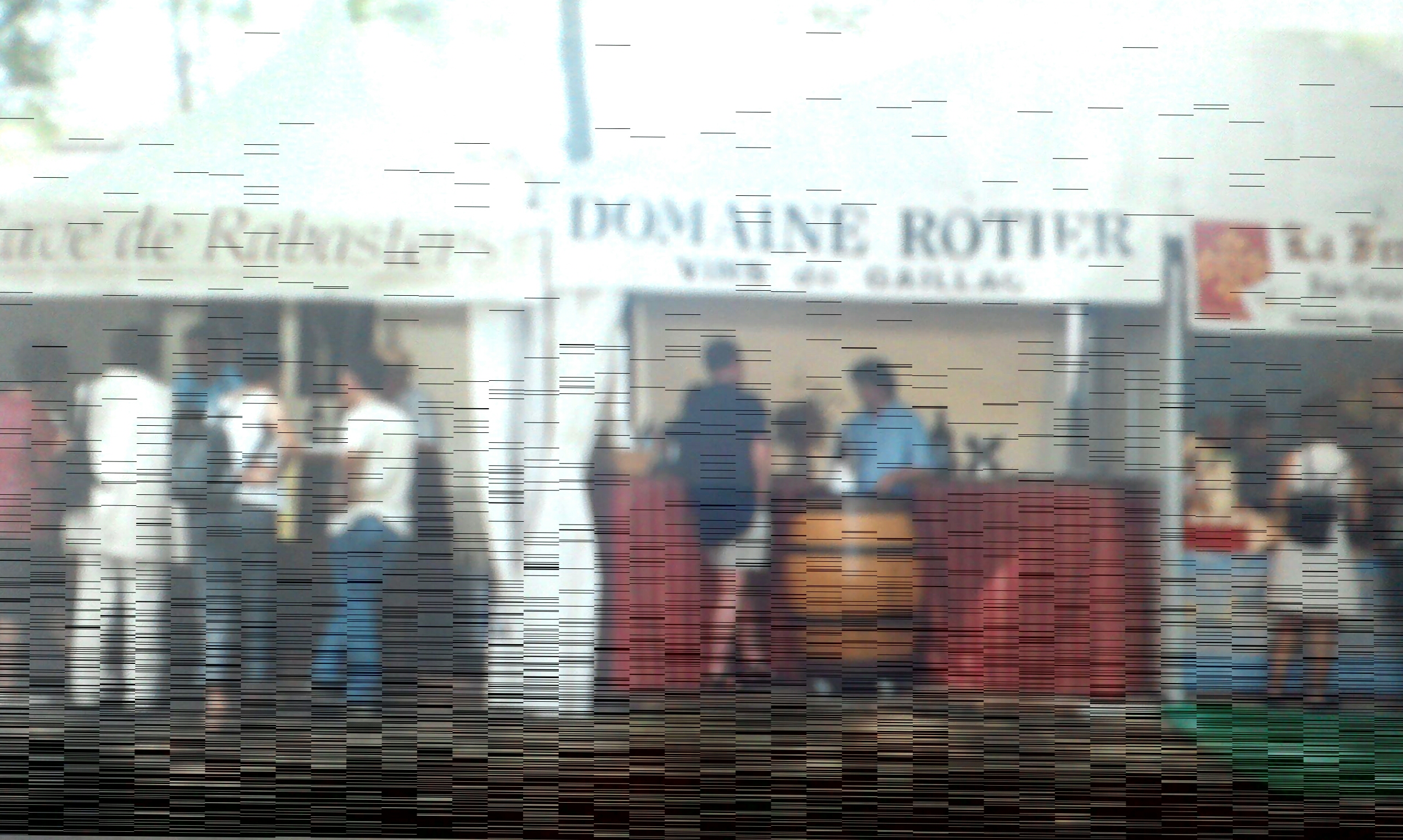
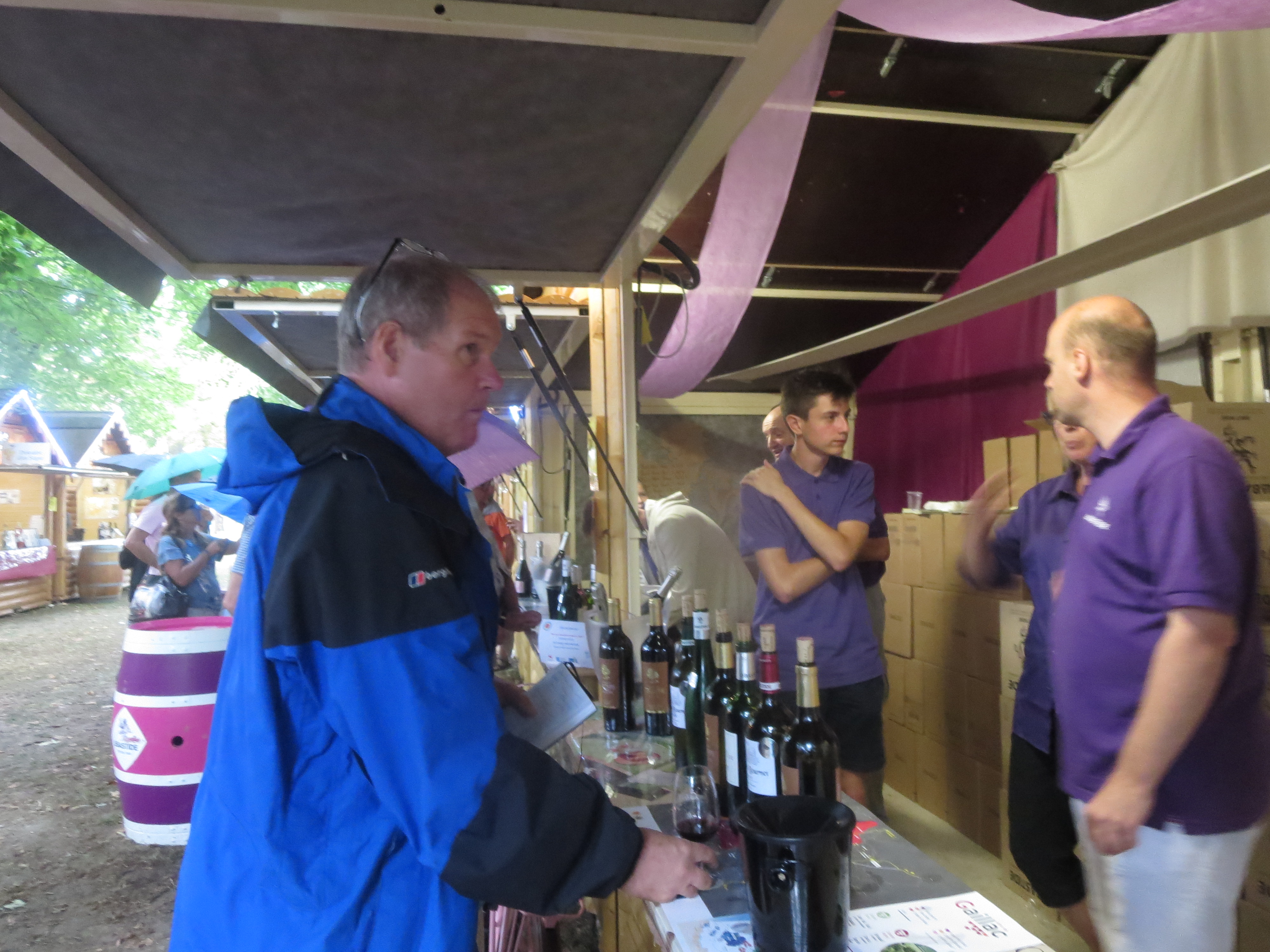
The annual Fête Des Vins de Gaillac was held this weekend and as it was almost 20 years since I last attended and now live just 100 miles away it was a welcome opportunity to return. This photo taken at the time shows that the event then was a simpler affair but I always remember it fondly.
No less so this year though my damp shoes and muddy trousers may take some sorting out. It poured down. Most of Saturday afternoon and a little more on Sunday morning for good measure. The vines needed it but it was less than ideal for an outdoor wine tasting.
Wooden lodges replace the tents.
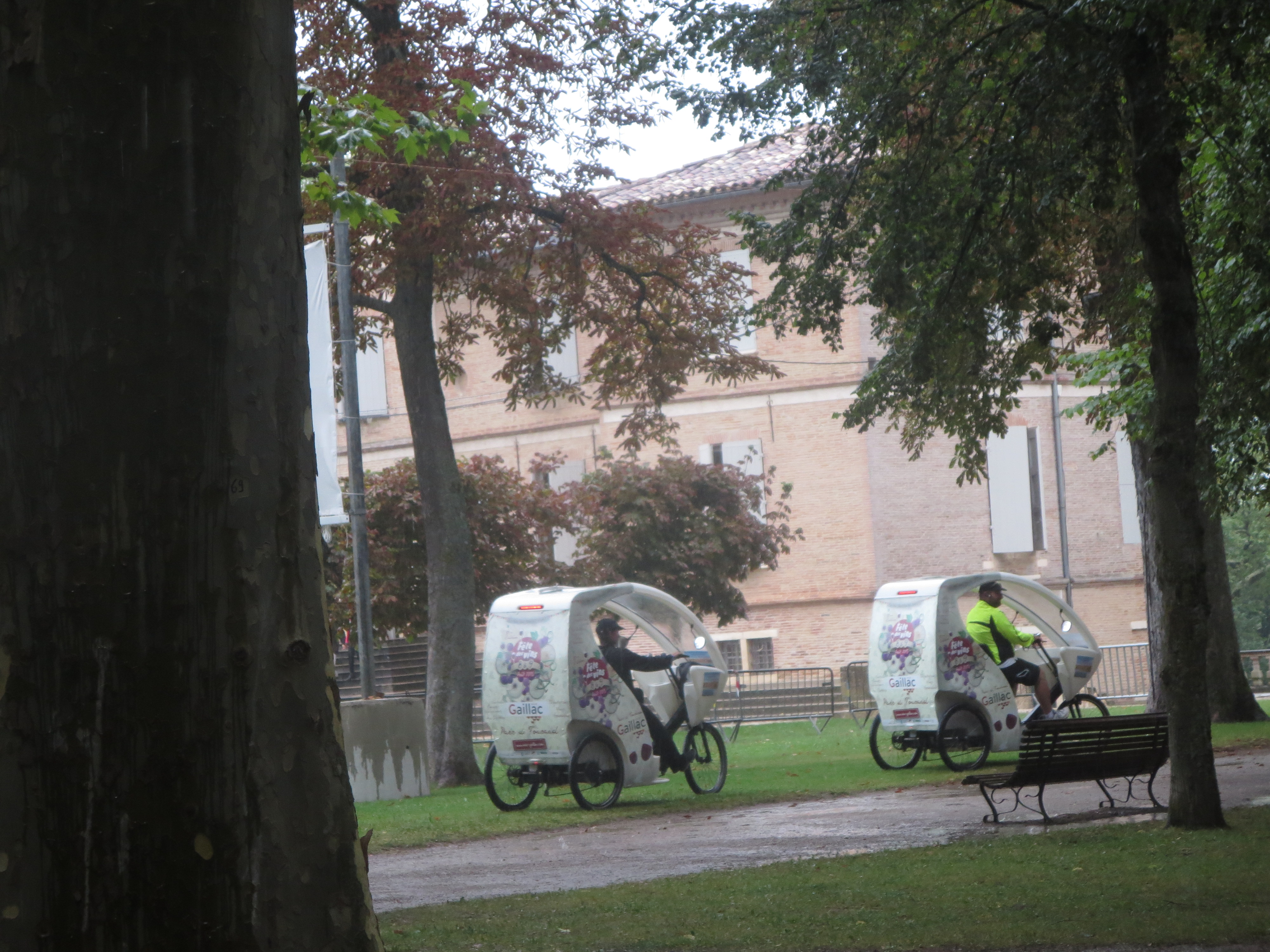
Anyway the weather failed to spoil the event which was well organised with plenty of food tents, handy cycle powered rickshaws to carry wine back to your car, (fortunately powered by someone else!) and wooden lodges for each producer with handy panels to provide a roof which was, mainly, waterproof. Certainly a step on from the tents 20 years ago. Plus free delivery within France if you bought 24 bottles, a very helpful gesture.
Straw to dry up the muddy walkway which made Saturday afternoon resemble the Glastonbury Festival
I enjoyed the Fête, I enjoyed some of the wines and bought two cases of various bottles. I could have bought more, so though I do have some negative comments please bear in mind that I am a fan of Gaillac and its wines. Tough love.
So, to the wines. One reason I remember Gaillac so fondly is that it was the first time I had come across white grapes such as Loin D’Oeil (sometimes written as Len De L’El), Mauzac and Ondenc and red grapes such as Duras, Braucol and Prunelart. These provided a welcome change to the Chardonnay, Cabernet Sauvignon and Merlot wines which dominated in the 80s and 90s. In fact local winemakers had started to take out some of these local varieties and plant the more common grapes along with Syrah and Sauvignon Blanc. Commercially this made sense at the time but it has left the region with a bit of an identity crisis which this weekend highlighted for me. The local varieties still dominate but winemakers differ as to the use of the new varietieses, do they use them to blend or to dominate their wines. It was noticeable that many wines are moving back to the traditional varieties, suggesting the incomers are being taken back out? Lots of different routes being taken but choice is good, there are some wines you might not like but others which you certainly will. Just a little confusing in places. More can be read about these grape varieties on this excellent site from the Gaillac wine organisation.
Some have also gone down the route of monocépage, single varietal, wines which did not show that well to my taste at least. Blends worked best and often the ones using local grapes only. Or is that my prejudice at work in that I prefer the idea of using vieux cépages?
A third issue was the use of oak. It is very common in Gaillac to age wine in wood, usually oak though some acacia barrels too. I found some good examples of well judged use of wood to enhance flavours and add complexity but there were quite a lot of wines which were dominated by the wood which had only served to dry out the wines and make them feel a little tired. There were some good, fresh wines but it seems to be a badge of honour to have used oak, you’re not a serious winemaker unless you have. Again for my personal taste I disagree.
The sheer range of wine types also offers some sense that this is a region trying to do all things. I tasted the range of wines from around 20 vignerons, around 130 wines in total. Yet I didn’t taste the sparkling wines and only a few sweet wines. There are so many different white, red, rosé, sparkling and sweet wines that I was a little lost, and that despite being based in the Languedoc with its great variety.
To add to the difficulties facing Gaillac winemakers they have suffered two fairly poor years weather wise. 2013 was bad, very wet and many reds didn’t ripen sufficiently, one owner I spoke to said she had written off all reds that year, others have reduced their production to preserve quality. 2014 was better but not much. So, the wines on show tended to be 2012 or older, interesting for the taster to drink more mature wines though, in fact, many would have offered 2012 wines in any case due to the amount of barrel ageing that takes place. I wish them well as the damage inflicted by the weather will be a big financial blow in the next few years.
The white wines were, sadly, mostly disappointing. The weather should have made less difference to these in 2013 and 2014, the vintages which were usually being shared here. Loin D’Oeil and Sauvignon Blanc blends dominated but somehow lacked a fresh edge. This was true even in the perlé wines, the local speciality where fermentation is stopped to leave some sugars to ferment a little in bottle and produce a spritz or pearl of bubbles, And then there were the oaked whites, often dominated by the wood. Nevertheless, there were some very nice white wines. Mauzac was often behind some of my preferred wines, a grape I normally associate with Limoux sparkling wines. That was a concern to me as I am not a fan of Limoux sparkling wines but Mauzac proved to be a grape which really attracted me.
Best white wines for me:
Labastide de Levis, the cooperative, – Homage A La Truffe Blanche 2014, Loin d’Oeil, Mauzac and Sauvignon Blanc with 4 months in wood. Very zesty, very fresh with a big grapefruit aroma, well made and very good. 11,50€
At the stand of Labastide De Levis
Clos Rocailleux, only 4 years old but producing some of the best wines on offer at the Fête. Their Reserve Blanc 2012 is 100% Mauzac from old vines and was a wine I bought. White fruits, round with a clean, direct finish. Lovely. 10€
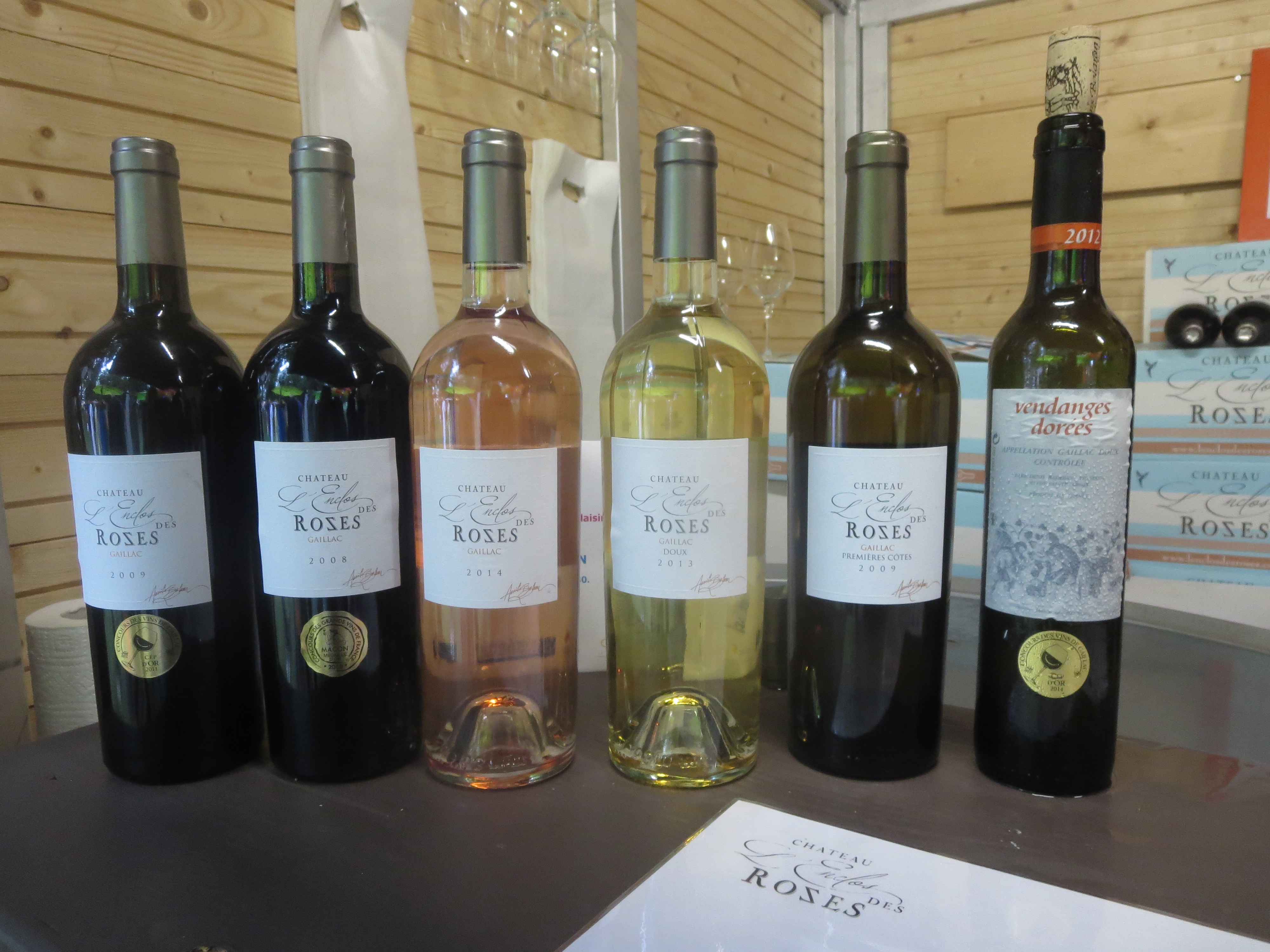
L’Enclos Des Roses, Blanc Sec 1er Cotes, once again 100% Mauzac. The vintage was 2009 as the producer stocks her wines until she feels they are ready, a brave and no doubt expensive decision but it certainly paid off here. This was round, appley and fresh but long with almost creamy and toasty notes developing from some oak age. 13,80€
Castel de Brames, Len De Lel 2013, fresh, white stone fruits, almost liquoricey finish. 6€
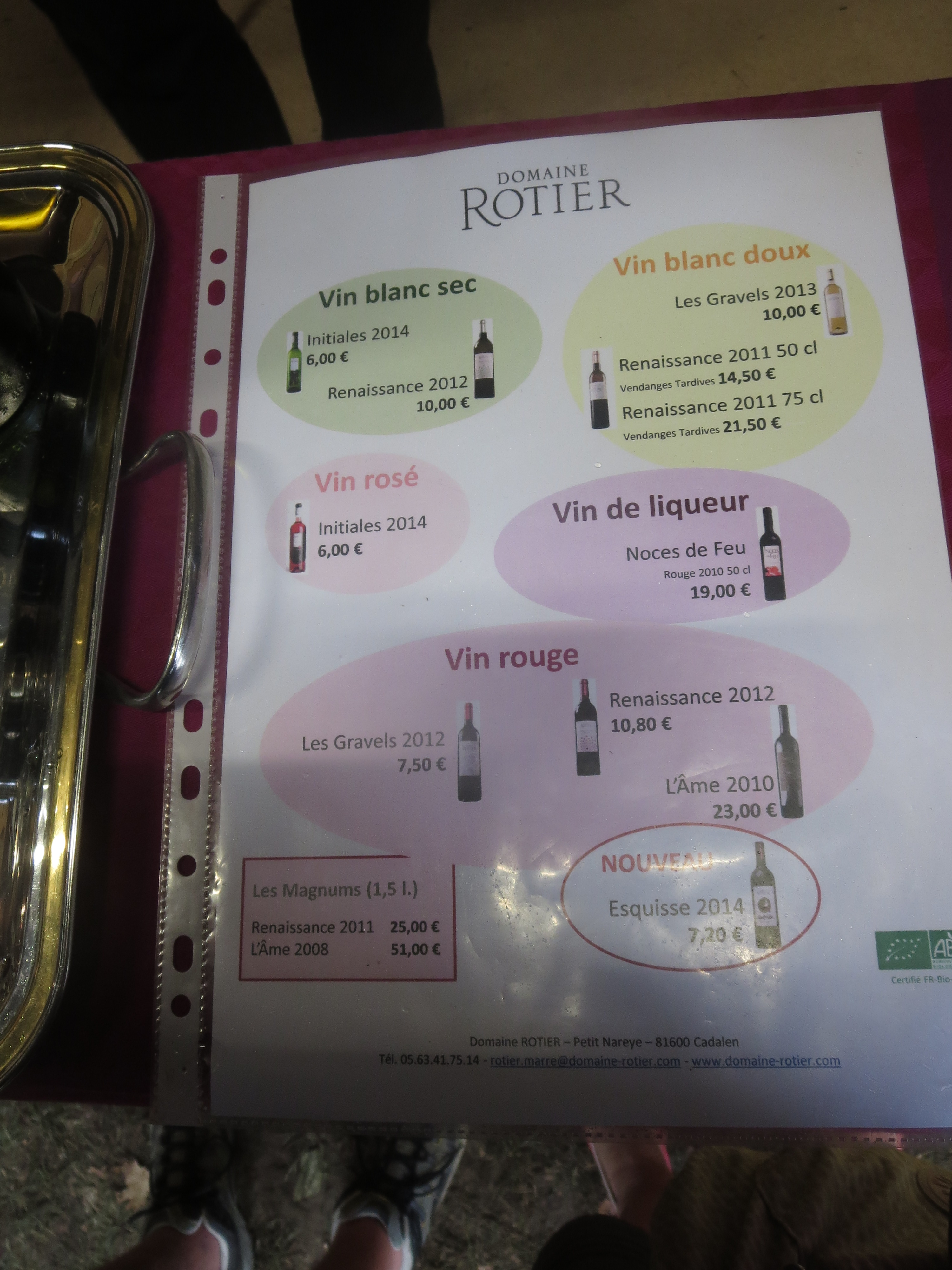
Domaine Rotier, Renaissance 2012, Loin D’Oeil with 30% Sauvignon Blanc, white fruits, peachy and a clean, direct and fresh finish. 11,40€
Domaine De Lamothe, Blanc Sec 2014, Sauvignon Blanc and Mauzac, nice dry, clean and zesty. I liked their Perlé 2014 too, it was much drier than others at the Fête with a real spritz. Fresh. clean and quite long. Both of these wines were just 3,80€, real bargains.
Domaine De Brin, Pierres Blanches 2014, Mauzac and Len De L’El. Very round and full, long flavours of white fruits and a dry, clean finish. Natural wine, tiny amount of SO2 added at bottling, but would please non natural fans. 12€
Rosés were possibly the unexpected star of the show for me. I like dry, citrussy rosés which really do refresh, preferably with a little texture and body from contact with the red grapes. And that’s what I found in many cases. Perhaps the red grapes which suffered in 13 and 14 had been used to make the rosé quality higher but they were, more commonly, of a good standard. Highlights included:
Clos Rocailleux, Rosé Braucol 2013 and Rosé Duras 2014. The Braucol was textured, fresh yet full, good rosé at 6€. I actually preferred the Duras with a little more zesty character and plenty of red fruit flavours. 8, 50€ and well worth it, indeed I bought some.
Domaine D’Escausses, Sous La Tonnelle 2014, fruity, round with strawberry notes but a clean finish, 5,10€
L’Enclos Des Roses, Rosé Des Roses 2014, Duras and Braucol with a very dry, zesty character, almost citrussy. 6,50€
Domaine De Brin, La Vie En Rosé 2014, Gamay with full flavours of ripe, red fruit, lovely dry finish with a long lasting strawberry note. Good, I bought some. 6,50€
Red wines provided the very best single wines however, though not always consistently. It was interesting to hear Duras described by different producers as either rustic and big or light and elegant, another example of the differences between the wines of Gaillac. Braucol was the other main grape used, this is often known as Fer Servadou in other areas of South West France. At their best the wines offered complexity, good red fruits, soft tannins and long flavours often with spicy, interesting aromas. My favourites were:
Clos Rocailleux, the Classique 2012was good with a real balance between fruit, freshness and depth of flavour. Nice, long, very well made red wine with interesting flavours from Syrah and Braucol, good at 7€. Even better was the Réserve 2012 with Braucol added to the Syrah and Duras and 9 months barrel ageing. Here the wood added to the roundness and flavour, it was a nuance not a dominant flavour, chapeau to Jack and Margeret for learning to use the barrels so well so quickly.
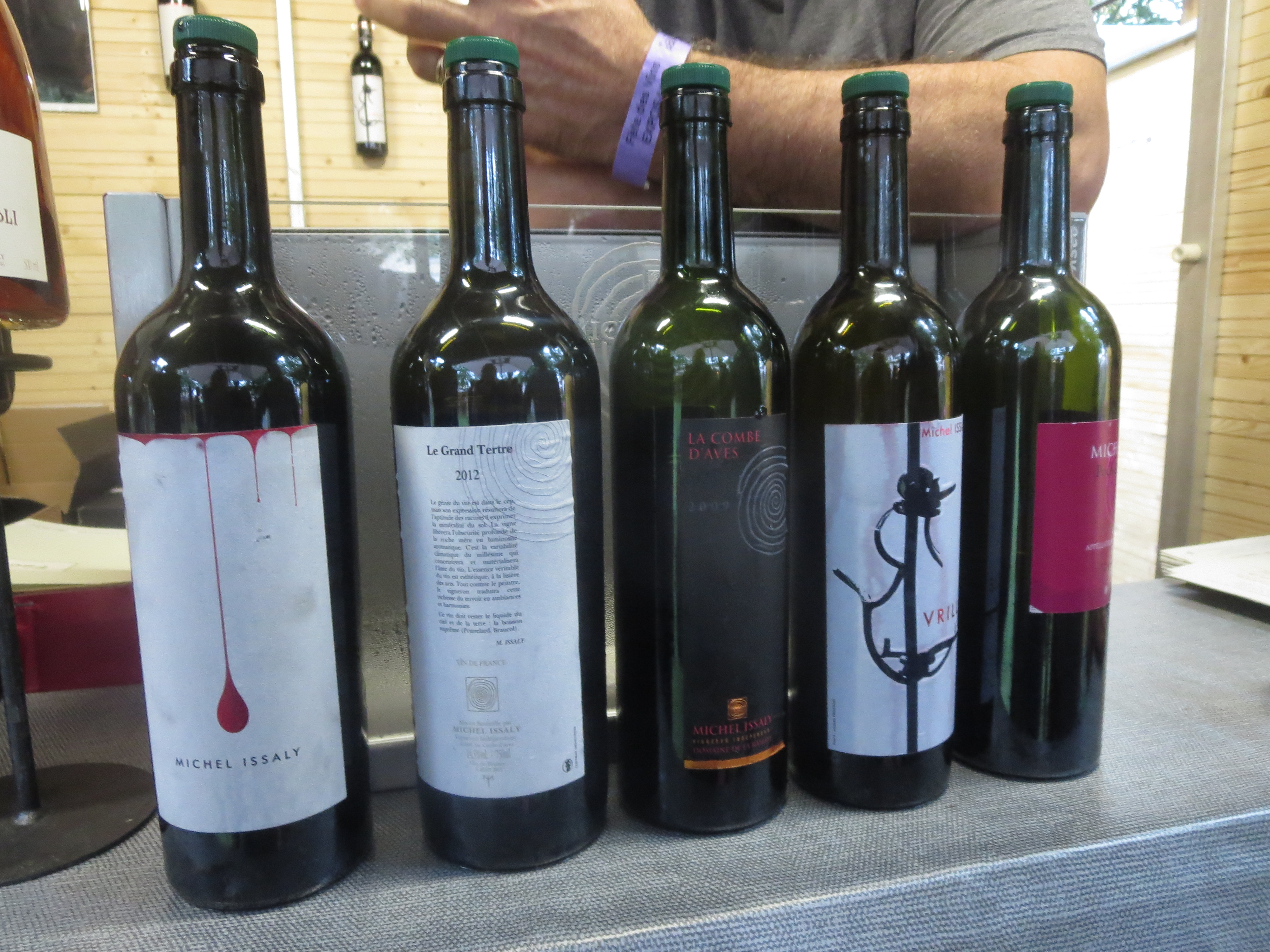
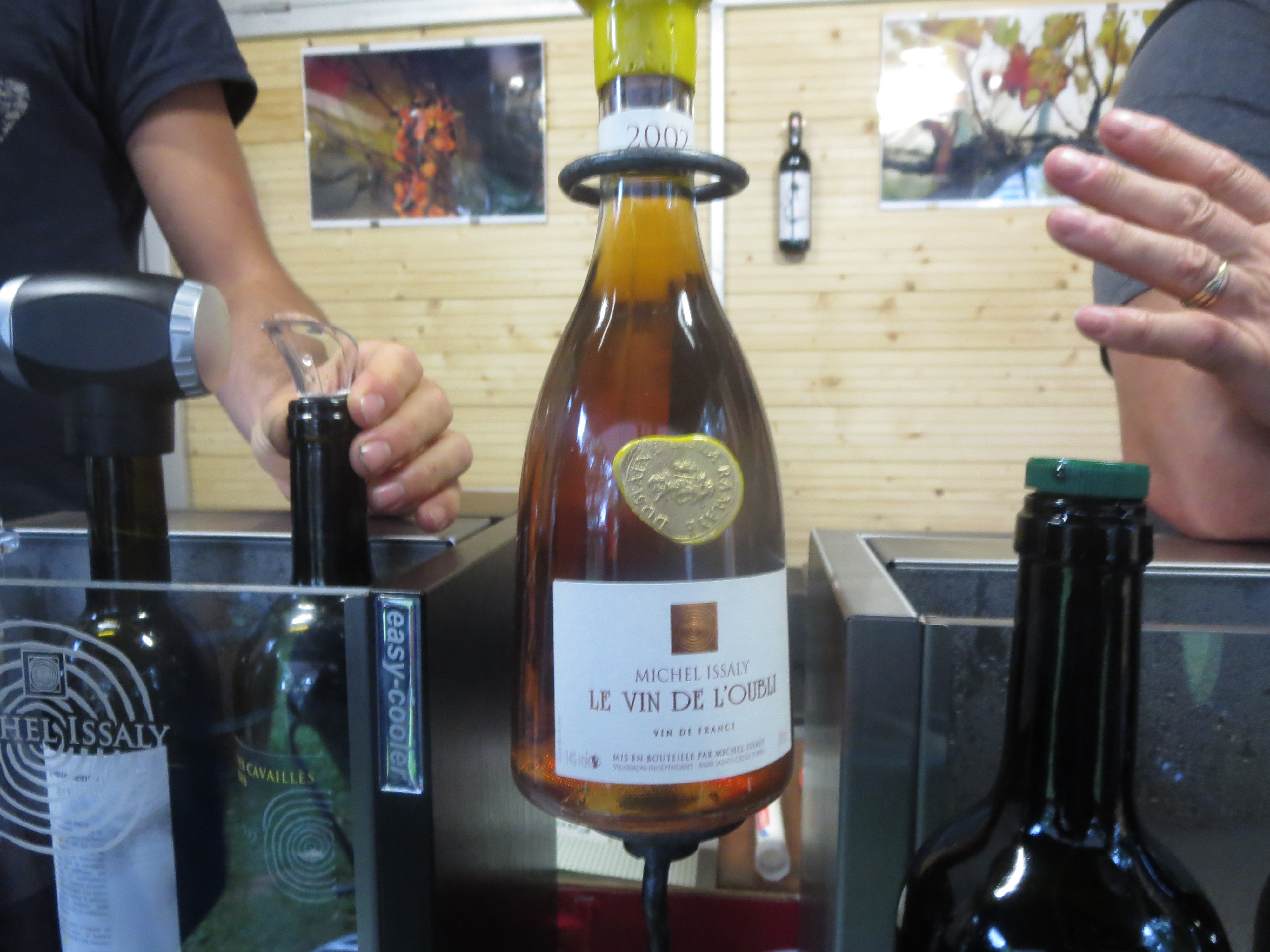
Domaine Ramaye / Michel Issaly, is a natural wine producer whose wines I had tasted before. Vrille 2013, Braucol, Prunelart and Duras produce a raspberry, fruity and very long flavour which was fresh with complexity. 14€. La Combe d’Avès 2009, Braucol and Duras was also fresh and round wearing the years very well and the 24 months of barrel ageing were discreet, 16€. Le Grand Tertre 2012 is 85% Prunelart with some Duras. Aromatic, almost perfumed with deep rich fruits, very good though 25€. Top of the range is Le Sang 2012 85% Braucol and the rest Prunelart, raised ina variety of new and older barrels. Very deep, complex and long, 45€. Fair to say I really enjoyed all of these and they showed off the local varieties very well. A perfect riposte to those who say that natural wines mask the true varietal flavours.
l-r Le Sang, Grand Tertre, Combe d’Aves, Vrille, Pech De La Tillette
Domaine Rotier are organic producers who now make a nice natural red, Esquisse 2014, classic fresh notes and raspberry fruits, not obviously natural this would appeal to those wanting to try a natural wine, 8,60€. The Renaissance 2012 is raised in oak from Duras, Syrah and Braucol. Round, full red fruits, eg strawberry, fresh and very good, 12,10€. I prefer this to their top of the range L’Ame 2010 which is much bigger and complex, 24,40€.
Domaine De Brin, I liked Vendemia 2013 but preferred Anthocyanes 2013, Braucol and Syrah showing well with a perfumed nose of red fruits and forest fruits. Round and long it developed very nicely, 10€, no rush to drink up. Brin De Temps 2013 of Duras and Cabernet Sauvignon had deep, spicy notes with round fruits and long lasting too, 14€. Proof that even in 2013 good wines could be made, clearly a very talented winemaker.
L’Enclos Des Roses, Roses 2008, further proof of the benefits of ageing. This showed no sign of being old or tired, it had fresh, dark fruits and is very well balanced. 12€.
There were some very good sweet wines and one example of a rarity a Vin De Voile. Vin De Voile is a white wine aged in barrels where a layer of yeast is allowed to cover the wines as they evaporate in barrel. The yeast prevents the wine from being completely oxidised but there is some which adds nutty, sherry like flavours. I really like this style of wine, like the vin jaune of the Jura region. So it was a treat to taste one at Michel Issaly’s Domaine La Ramaye. Almond and hazelnut aromas with dry, nutty flavours and long, complex after tastes. Lovely.
My favourite sweet wine was also unusual. Made from very very late picked Cabernet Sauvignon grapes, it was a sweet rosé wine from Domaine de Brin called Brin De Folie 2014. Sweet strawberry flavours and yet clean, refreshing after tastes. A great credit to the winemaker to make something so good from such an unusual circumstance.
Vileo from Albi provided these cycle powered rickshaws to carry you back to the car with your wines
And there lies Gaillac’s great hope. There are many talented winemakers harnessing the best of the area. Unusual grape varieties which should offer the market something different. Making the most of those flavours and aromas, letting them speak for themselves rather than too much oak, whilst concentrating on providing well balanced, refreshing wines. That is what I like about producers such as Rotier, de Brin, Ramaye, Rocailleux but many others too. There are some interesting stories about some of these producers too. Rocailleux with its English owners who are following up their interest and studies in wine and making some of the best wines in the area. D’Escausses and Enclos Des Roses owned by two sisters who run their domaines separately but help each other. Rotier was my favourite domaine 20 years ago and remains one of the best. De Brin is certainly one to follow. I wish them plenty of good weather for a successful 2015 vintage. Meanwhile look out for Gaillac wines, especially from these producers.
All photos taken on August 2nd unless otherwise stated
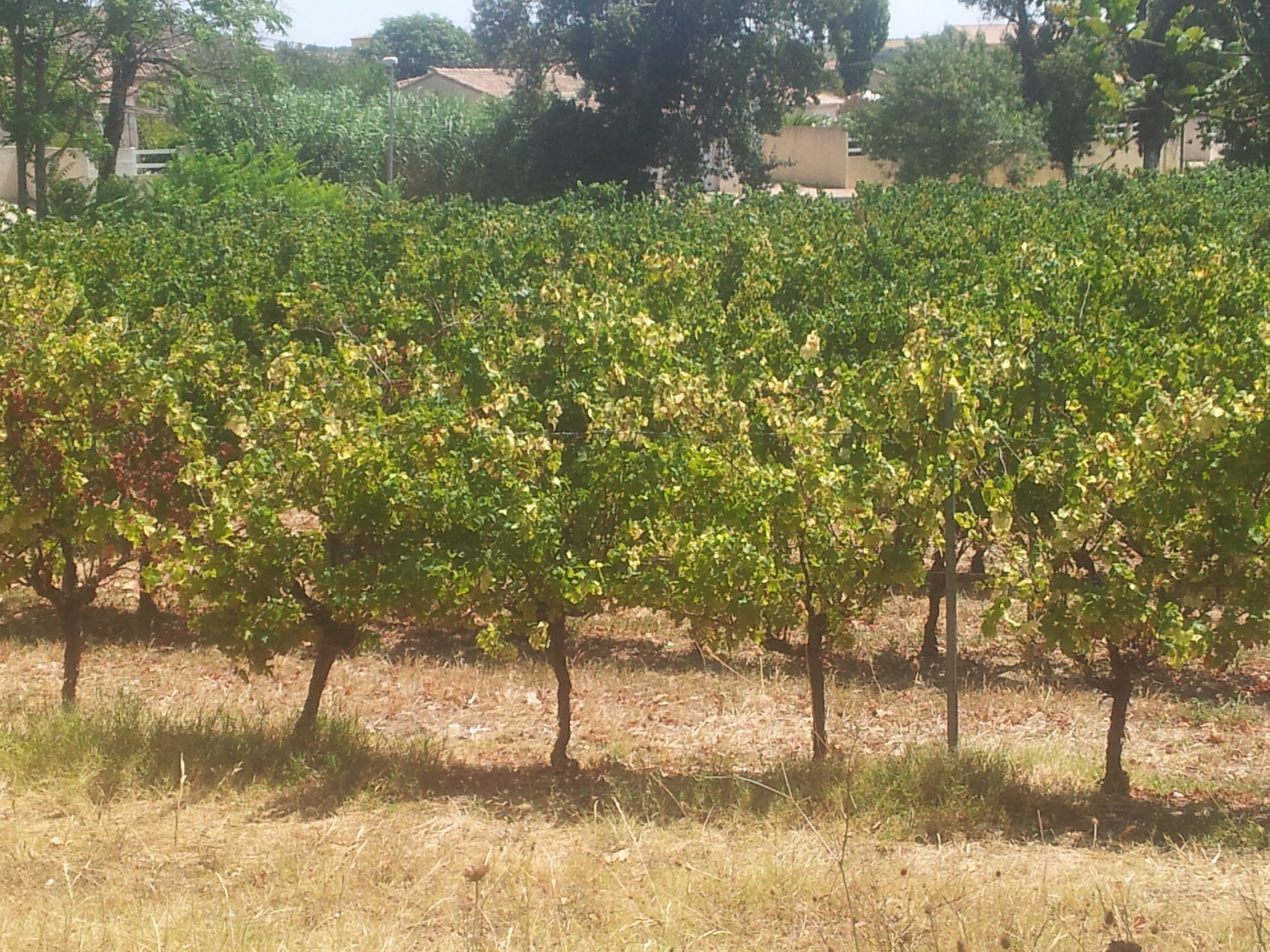
It was June 12th when rain last fell on Margon and the vines in the region, although generally doing well, were starting to show signs of fatigue and heat stress; leaves curled in upon themselves, some yellowing, a slight shrivelling.
Vines near Pézenas showing some stress
Vines in Margon which were not pruned in spring and are really suffe
A few drops fell on July 25th but the skies had been very dark and had promised much more, it was almost cruel to have that rain, a tease of what might have been. However, July 31st brought around 10mm to Puimisson. A decent rainfall, enough to give the vines a drink and to stop the drying out process. Not enough of course after weeks of lack of moisture and some more rain in the next few weeks would be very much welcome to swell the grapes and the harvest. The vines are now pouring their energy into their fruit rather than their vegetation, but they need the nutrients to do so.
So, how had the vines responded to the rain which fell? Well a tour on Sunday (August 2nd) showed the vineyards of Mas Coutelou to be in rude health, a decent harvest is now predicted though that extra rain would be most welcome.
Segrairals in full bloom, healthy, happy vines
Segrairals, biggest of the vineyards, showed some healthy Cinsault, Syrah and Grenache with no signs of stress or disease. As the home of Classe, 7,Rue De La Pompe and 5SO this is especially welcome, as they are some of the big sellers.
Cinsault in Segrairals
To Rome, my favourite vineyard. The gobelets were looking well, plenty of grapes both the white varieties and the Cinsault. There was a little mildew around the entrance but minimal, no cause for concern. Could there be a cuvée of Copains in 2015? Jeff tells me that no decisions are made as yet, caution prevails and he will wait to see what the harvest gives him before he makes final choices about how to use the grapes and the wines which result.
Rome’s centurion vines in good health
Muscat Noir grapes, a tiny bit of mildew top left
Sainte Suzanne (Metaierie) suffered from coulure in May with the strong winds blowing off some of the flowers on the vines, which will reduce yields a bit. However, the grapes there are growing well, what might have been a problem looks now a much brighter picture, good news for fans of Vin Des Amis.
Peilhan, just a little more tired and suffering
The only vineyard parcel which has shown stress is Peilhan, There was a lot of regrafting and replanting in the spring and the dryness has caused problems for these new vines. There was also oidium in this parcel, the only vineyard to be attacked by this powdery mildew. Yet amongst those problems there are plenty of healthy grapes, some careful picking and sorting will be needed but it will produce good wine.
The famous Castets grapes of Peilhan
La Garrigue was blooming, the white varieties such as the Muscats are swollen and changing hue to lovely golden shades.
Muscat a Petits Grains in La Garrigue
The Syrah is well advanced, a dark purple colour across virtually the whole bunches, the pips though betray a little immaturity as they taste and look green and sappy. A little more time and patience will pay dividends. As the world’s biggest fan of La Vigne Haute, I have my fingers crossed.
Syrah in La Garrigue, ripening beautifully in the shade of the vine
The Grenache in La Garrigue, despite facing south, is a little more delayed in colour but getting there and very healthy.
Grenache in La Garrigue
In fact despite risks of disease earlier in the year (see here) Jeff has been able to use minimal treatments in 2015. Oidium and mildew (powdery and downy mildew) can be controlled by copper sulphate, sometimes called the Bordeaux mix when added to slaked lime. This is a bluish colour when sprayed by conventional and organic vignerons and is often seen on the leaves of vines. Vignerons might also use chemical fungicides if they are not organic producers.
Neighbouring vineyard which was given herbicide shortly after harvest last year and whose new vines have been treated regularly
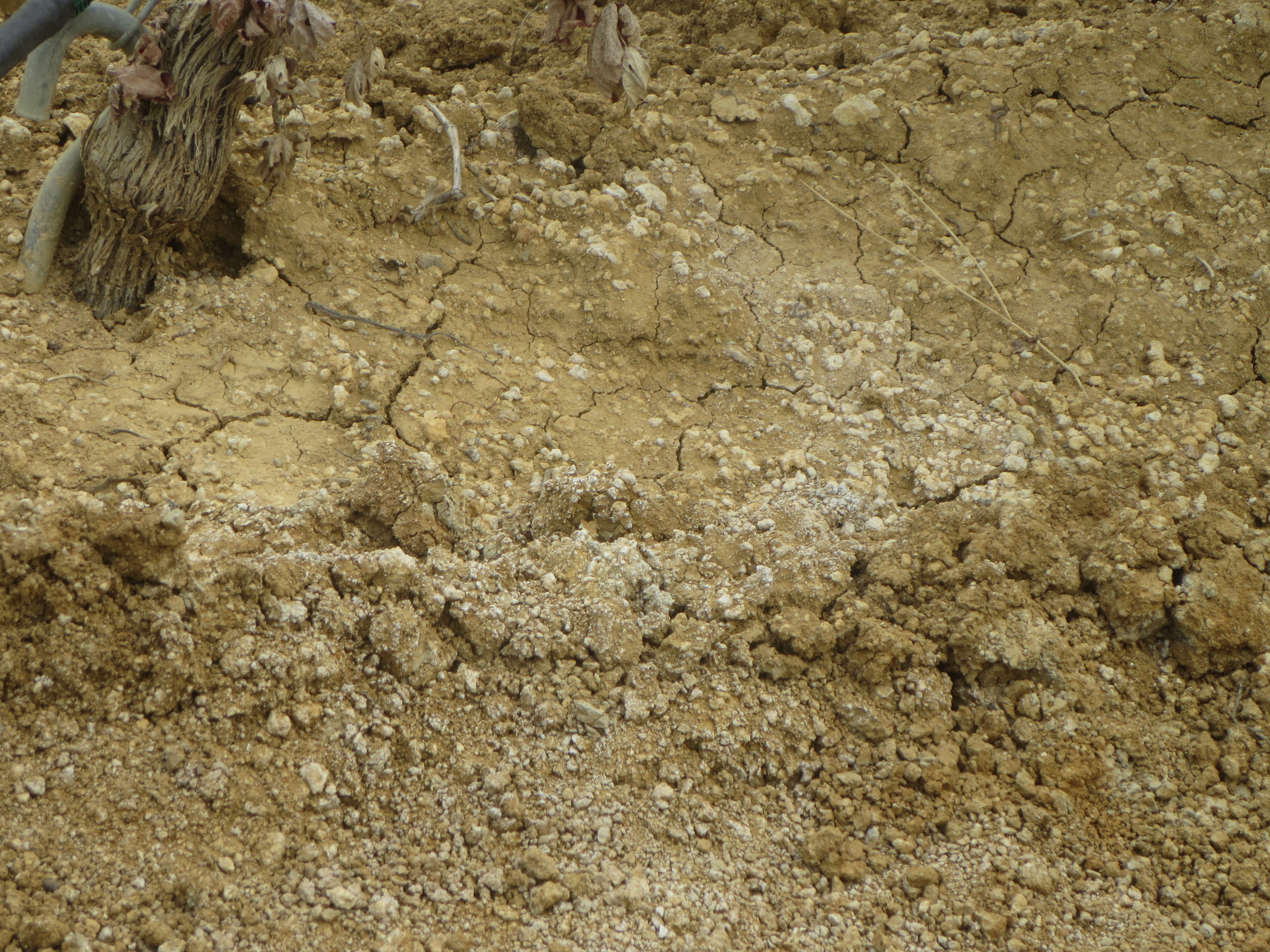
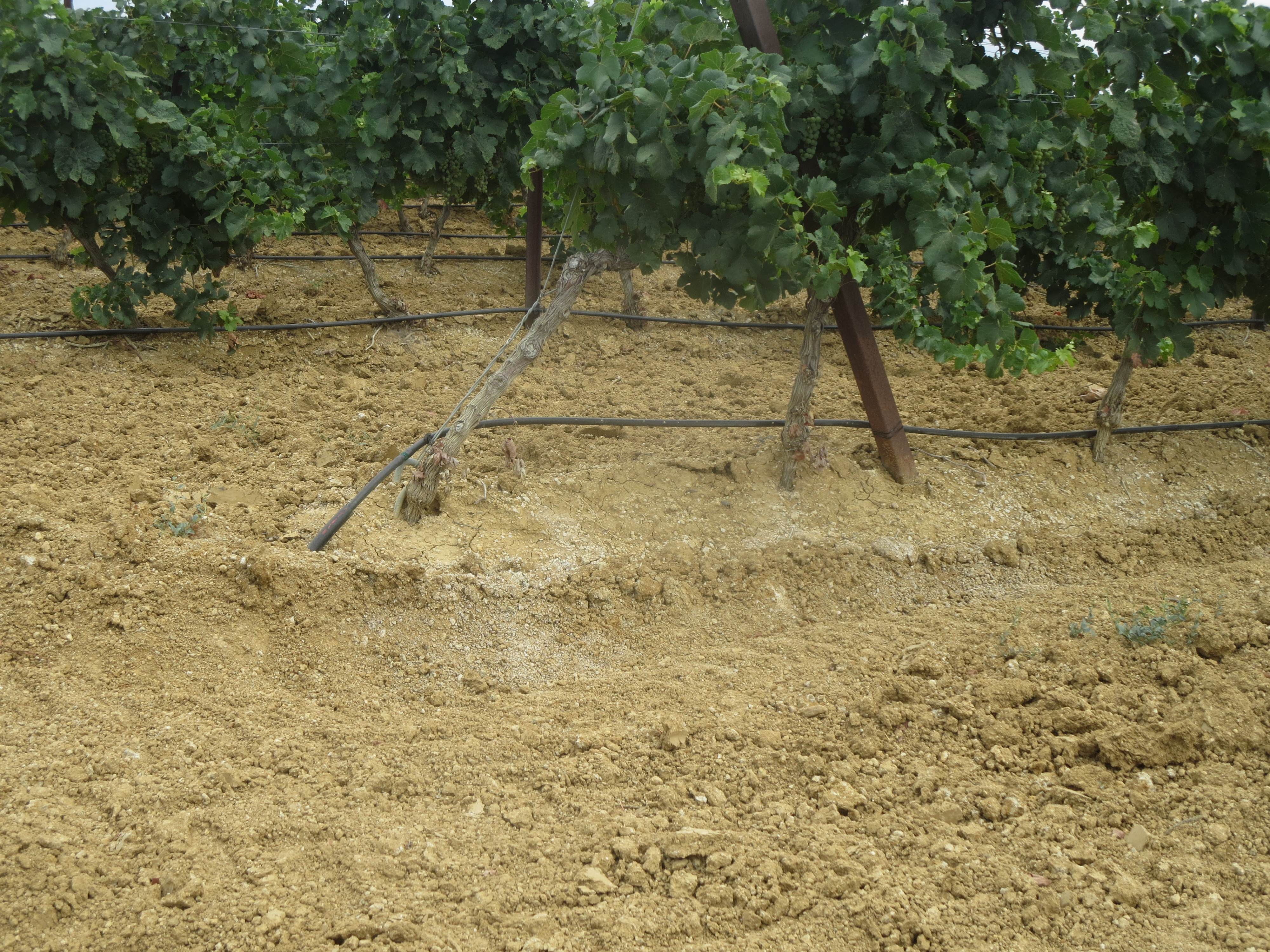
Some neighbours have also irrigated their vines and one alarming consequence is the changing of the soil and its pH as the calcium carbonate in the water shows through, you can see it in the white parts of the soil in this photo taken on July 22nd.
The irrigation is also causing the vines to grow quickly and tall with thin trunks as seen below. It should be acknowledged that there are many conventional producers who take great pride in the health of their soils and vines and would be horrified by some practices described here.
As a proud holder of Ecocert organic status and as a natural wine maker Jeff must use natural products only. Tisanes of plants which fight mildew such as horse tail, fern and nettles can be sprayed and this is the basis of many biodynamic treatments. However, the two main weapons in the armoury of organic producers are copper and sulphate, both natural products.
Copper is used against mildew, but is harmful to the soils and kills life in them if used in significant quantities. Organic producers are limited to 30kg per hectare over a 5 year period, allowing more to be used in years with more downy mildew for example but only if less is used in the other years. In fact Jeff has used just 200g per hectare in 2015 and this after years of well below average use, his use of copper is on a major downward trend. He is reluctant and very careful in using copper as he is aware of its danger to the soils, yet mildew has not been a major threat this year.
Oidium seen in May
Similarly Jeff has used sulphur in soluble form at doses much lower than the permitted level, three treatments over the course of the growing season. In addition one dose of sulphur powder was sprayed when the risk of oidium was high (May) and a second spraying for Peilhan only as it is the vineyard which was attacked by oidium. In contrast to neighbouring vignerons who have sprayed every 10 days including after the bunches closed up (so more than a dozen treatments) this really is minimal intervention.
So July’s parting gift of 10mm of rain was welcome, August might like to follow by offering some rain soon. Too near the harvest is bad as it would dilute the juice rather than help the grapes to reach a good size. Things look promising, let us hope that nature completes its bounty. There is an old saying that June makes the wine and August makes the must, ie the character of the wine with its colour, yeast and flavour. With 3 weeks or so until picking begins it is an exciting, and nervous, time, waiting to see what that character will be.
No Icare this time but look what we found amongst the vines, he’s been here!
NB there are lots of reports about recent wine tastings here.
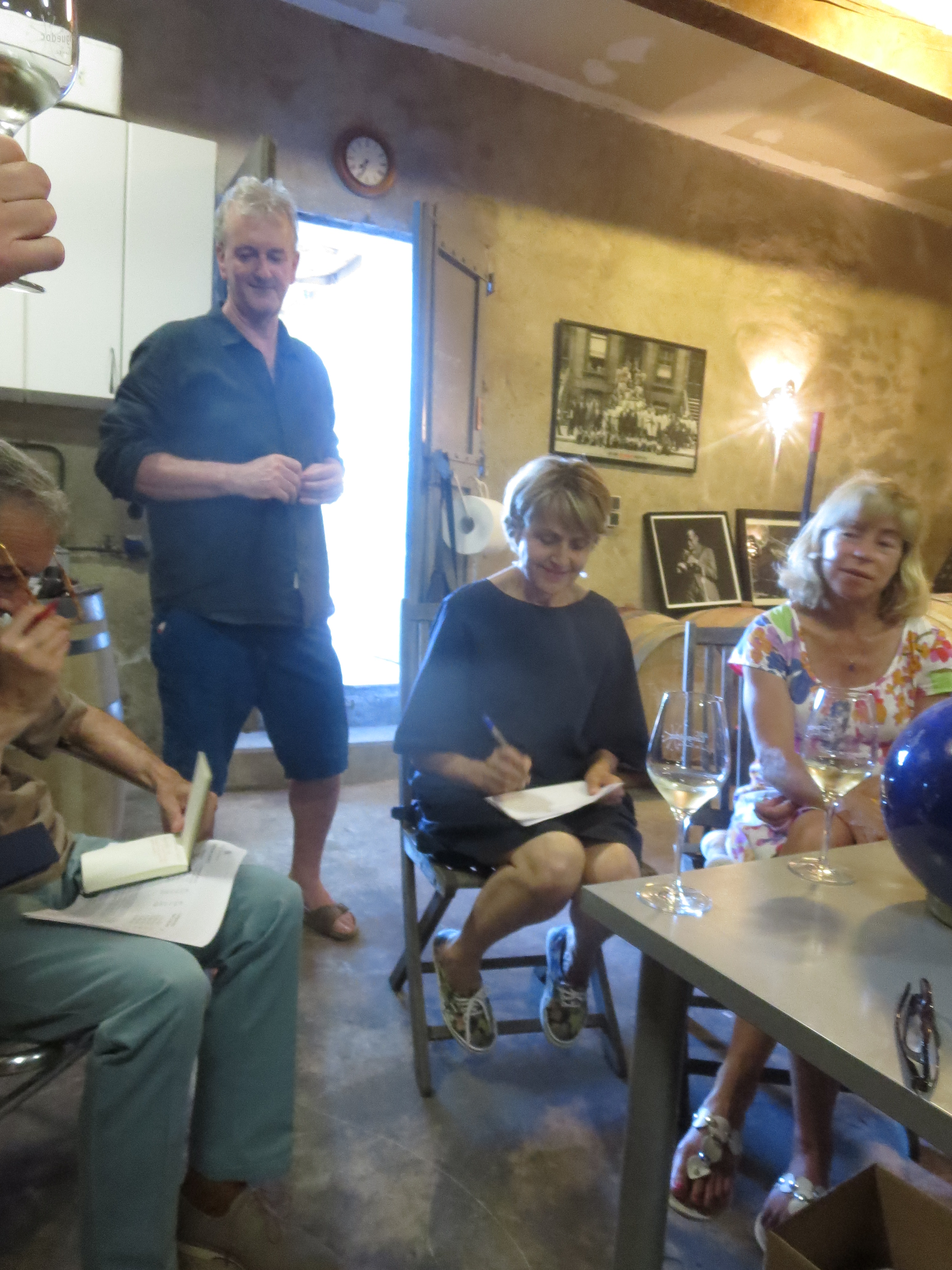
Deborah and Peter Core have been making wine in Caux (34) for 10 years, a cause for celebration. I was truly honoured to be invited to share their celebration evening with a vertical tasting of their Carignan led wines and a dinner held in their cave and garden. Present were luminaries such as Rosemary George, Michel Smith, Andrew Jefford, Catherine Roque of Domaine Clovallon, Gary Voss and Annette Atkins of Voss Estate in Martinborough, New Zealand along with Helen Deneuve who works for Coteaux Du Languedoc and other wine groups and is a good friend of Deborah’s, as well as Wendy Gedney, owner of Vins en Vacances, a wine tours company, Christopher Gallaway, wine expert and Bernard Degioanni, wine and food journalist, so it was a true privilege to be amongst their company.
l-r Christopher, Gary, Annette and Wendy
Michel, Andrew and Rosemary at work whilst Peter pours
l – r: Bernard (just), Peter, Catherine and Helen
Mas Gabriel has long been one of my top Languedoc wine domaines and I have purchasing from there over many vintages. I have huge respect for the Cores who gave up successful careers in London in law and finance to follow their dream of making wine. Having trained and studied in New Zealand and France, they decided on the Languedoc as the region which would offer them what they were seeking in making their wines. Land was bought around Caux and the work began. What courage to embark on such a venture and the going must have been immensely difficult at times in the ten years which have followed. Learning about your vineyards, making wine in different vintages, mastering the bureaucracy in a second language and, not least, finding markets. That they remain so passionate about their land and wines whilst being the most courteous and charming people is testament to two people of strength, determination and talent. Their wines are produced organically, indeed biodynamically, and are marked by freshness and fruit.
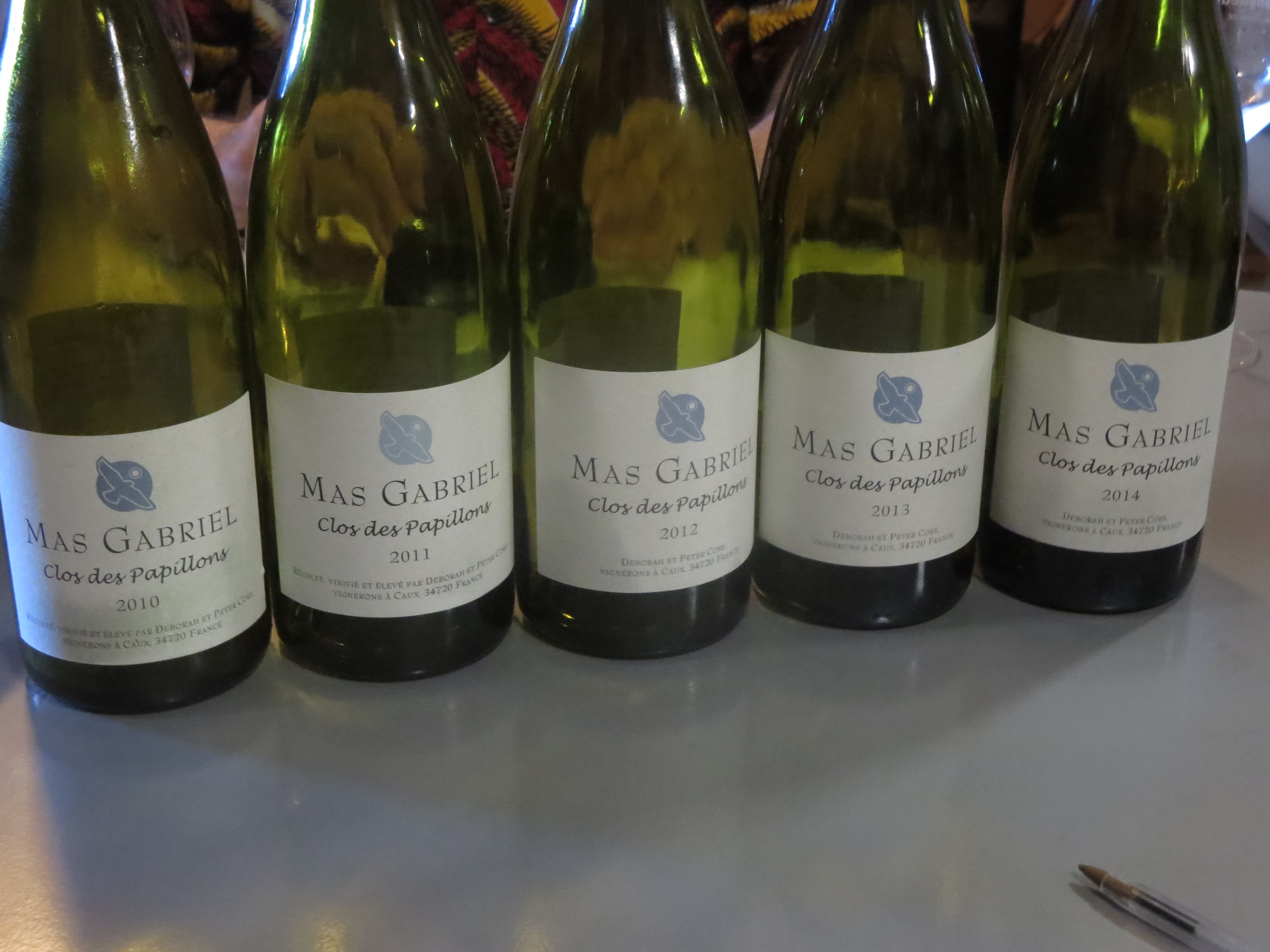
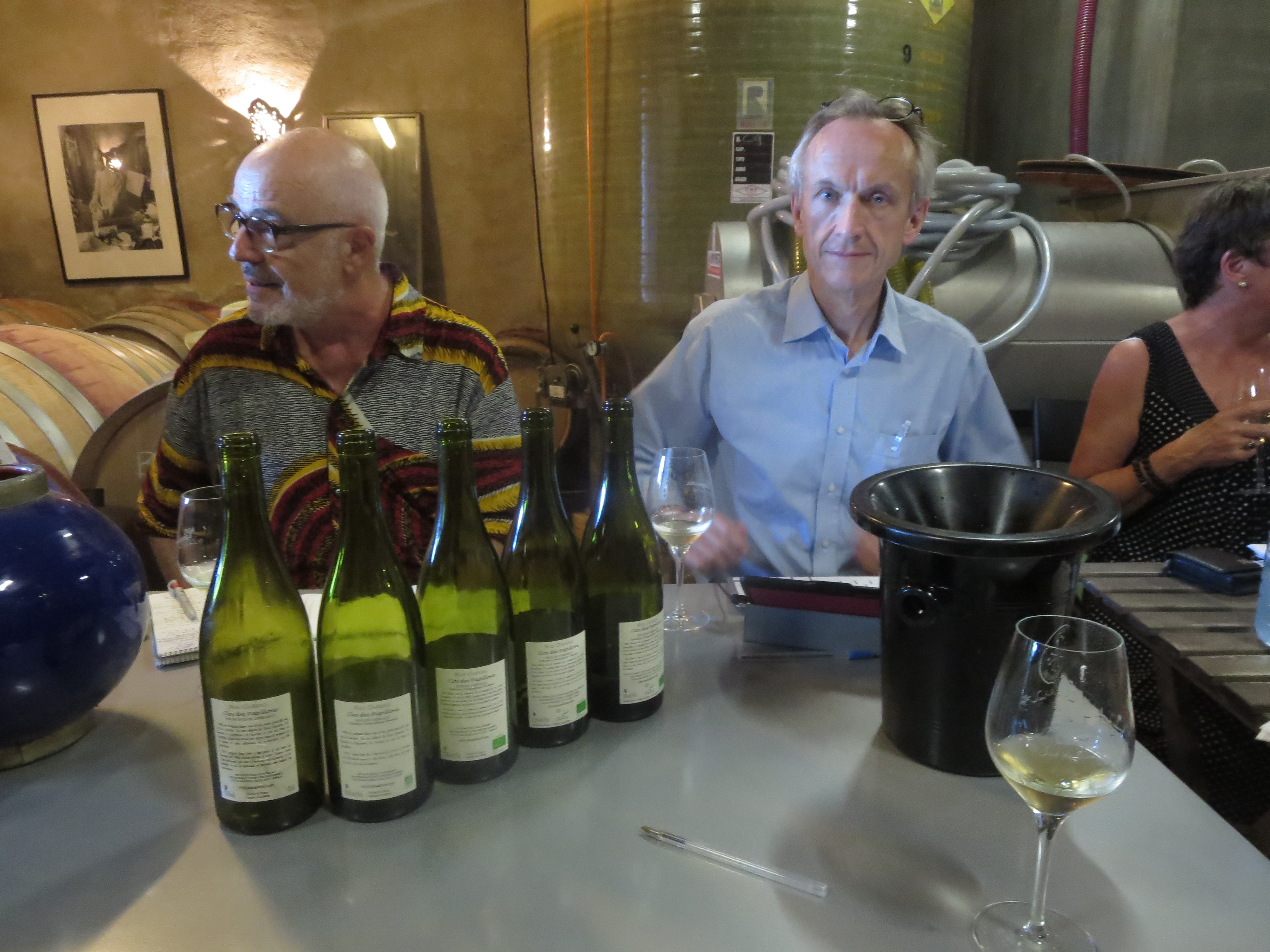
We gathered in the cave for the tasting and began with a flight of 5 vintages of Clos Des Papillons, the white wine of the domaine (though joined by a new white cuvée in 2014, Champ Des Bleuets). Papillons has long been one my favourite white wines of the region so this was a special treat for me.
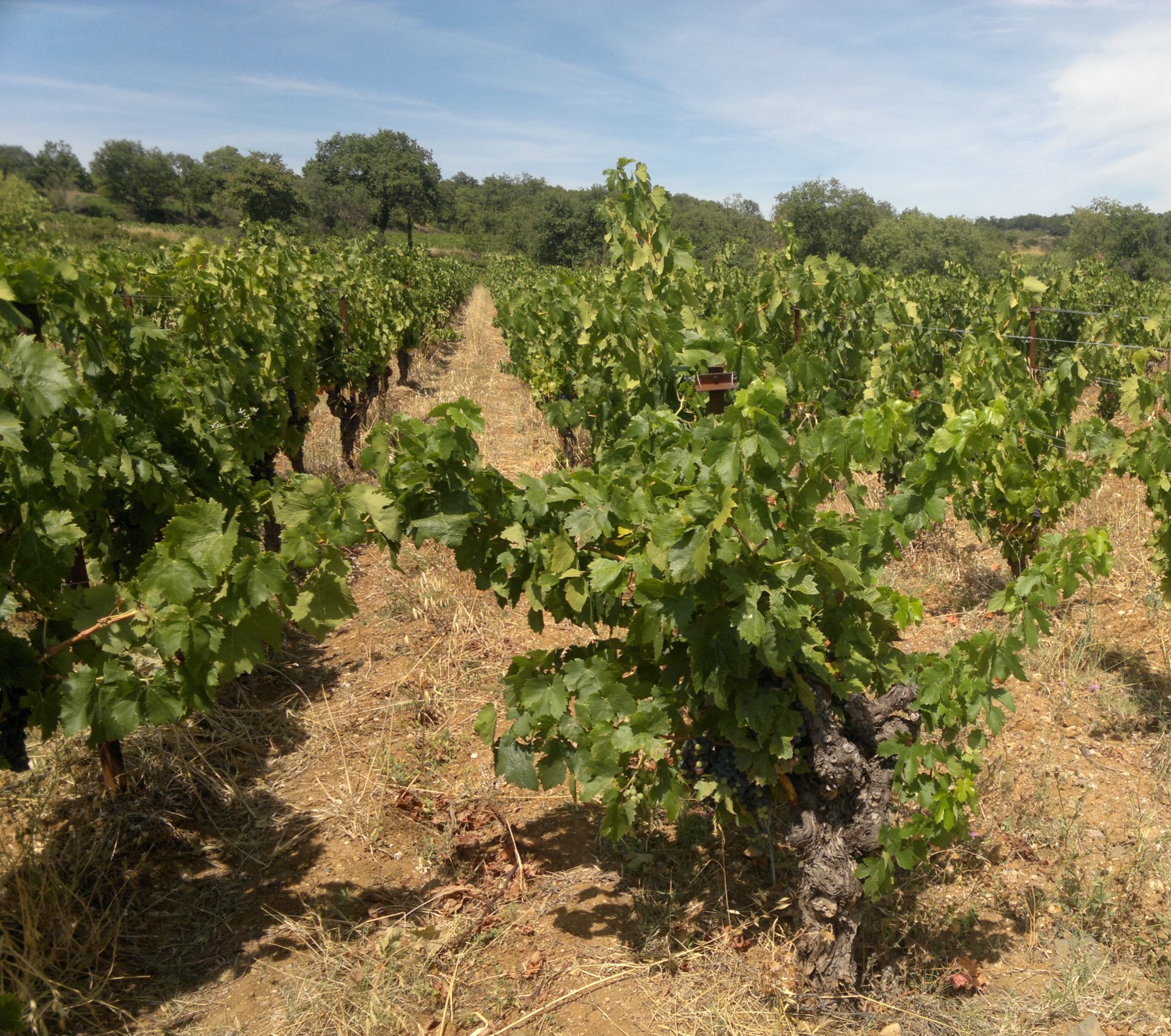
Until 2014 the Carignan was given a small 5% addition of Viognier but in 2014 the Cores changed this to 15% Vermentino. Around a third of the Carignan Blanc is aged in acacia barrels to add a little complexity without oak flavours. There is no malolactic fermentation as they seek to reflect the freshness and natural acidity of Carignan Blanc. When the wine was first made yields were tiny at 12 hl/ha but much work and even more cow manure has helped to boost yields to 20-25 hl/ha. There are only around 0,4ha of the vines (more have been planted) and this is a variety with only about 40ha in the Languedoc so Mas Gabriel has around 1% of them all. Peter and Deborah actively sought out the parcel after tasting the Carignan Blanc of neighbour Conte De Floris, who does make excellent wines also. The parcel they found is made up of 40 year old vines in gobelet on a sandy, limestone soil.
So, the wines:
2014 – The first Clos Des Papillons with 15% Vermentino, which is grown in soil with galets, large round flat stones. The wine is very young still and a fresh, lively aroma is matched by a dry, very mineral initial taste. Fresh, fleshy fruits then fill the mouth to round out the dry core of the Carignan, like a peach with the fruit around the stony centre. The Vermentino certainly appears to provide that fruity roundness though the Carignan was slightly less acidic than usual in 2014 too. The wine comes together to form a lovely, refreshing, clean taste. It is very young, it will fill out further and I really like it.
2013 – A big rush of freshness leaps from the glass. Green and yet apricotty. It settles down quickly and lovely fruity, dry aromas emerge. The harvest was quite late in 2013, September 16th, so the nights were fresher as the grapes reached the optimum ripeness, and this is reflected in the fruit itself. Huge flavours of yellow and white fruits mixed with fresh acidity – always in balance, always with a delicious tension. Lovely, a very good wine.
2012 – Yellow, almost light golden in colour. I could detect a little more evidence of wood on the nose but nothing out of balance and it provided yet more complexity, there was no obvious taste of wood. The acidity appeared less obvious, though it was actually a lower pH than usual, the result of an extra year in bottle? Juicy, yellow fruits, with an edge of citrus and agrume. Stony, clean and delicious. I smiled in relief that I have resisted temptation and kept a bottle or two of this vintage, excellent.
2011 – Woh, what a nose, almost ‘Riesling’ in character with hints of kerosene. Happily, Wendy Gedney agreed with me, it’s not just me! Full flavours, lingering lime and lemon fruit flavours add that delicious freshness, definitely more so than 2012. Long, refreshing, balanced, poised! This was the earliest picked vintage (August 24th). It has years of life ahead if anyone still has a bottle (sadly, not me). I loved this.
2010 – Lively, this is certainly not on a downward slope, far from it. Still a yellow/green Starburst citrus edge. the highest acidity of any of the Carignan vintages yet the wine has rounded out a little. There is a saline, mineral edge in there too but then as you drink (and I did drink some!) an almost waxy, oily finish which helps to coat the mouth with the yellow and white fruit flavours. Lingering, clean and lovely.
Clos Des Papillons ages well, no question about it. The freshness and acidity surely help this and whilst difficult to resist drinking in a year or two I am now determined to hold back some bottles. Interestingly, Andrew Jefford was slightly less in agreement with most and would welcome some malolactic fermentation to round out the flavours more. For me, I love it as it is. To choose one vintage? I really like them all, there is nothing here to which I would not give at least 4/5 on my personal scale. 2011 perhaps but maybe 2013 just wins with the freshness, sorry Andrew.
In the Trois Terrasses vines with Peter in 2012
So to Trois Terrasses, the first of two red wines made at the domaine, the other being Clos Des Lièvres, a Syrah led wine which is bigger and more powerful, and also excellent I hasten to add (deserved Gold Medal winner at Millésime Bio this year). The first two vintages in 2008 and 2009 were 100% Carignan but in 2010 came a change with 20% Syrah and afterwards up to 30% of the wine is Syrah and Grenache. These are vinified separately in cuves, the Carignan cuve being cement the others fibreglass. Peter explained that yields of the Carignan were only 10 hl/ha at first but they have built this up, with more hard work and cow manure, to 25 to 30 hl/ha on average. This is reflected in gradually lowered alcohol levels in the Carignan with slightly higher acidity.
2013 – Slightly reductive at first but that blew away within a few seconds to leave a torrefacted nose with plummy, dark fruits which carried over into the flavours along with those coffee notes. There was an almost citrus freshness on the finish refreshing the palate. Spicy, peppery notes developed too and though this needs a little time yet, it is already good and will grow into something very good in a couple of years.
2012 – Rounder, darker, deeper. Complex nose of dark fruit with freshness evident even on the nose. Full in the mouth, rounding out with lots of fruit and minerality and always the trademark freshness which I love so much in Mas Gabriel wines. It is a characteristic which reminds me so much of biodynamic and organic wines, dare I say natural wines too! It certainly appeals to me.Still youthful, this is a wine which has been a big hit with friends and family when I have shared a bottle with them. Very good.
Here’s one I shared earlier
2011 – Rounder aromas, hints of cassis. Perfumed and fruity, very heady in a pleasing manner. It tastes round and full too, ripe plums and a raspberry fresh note. Liquorice with pepper sprinkling the range of flavours too. As the wine evolved in the glass there were even smoky notes emerging. Very complex, but all working well together, always lovely to drink and, yes, that fresh finish. Very good.
2010 – The year in which Syrah was first added to the Carignan. Fruit aromas spring out from the glass, cassis, blackberry and red fruits too, lively acidity. Ironically, given the blending, Carignan characters emerge, a slightly leathery, wild edge to add to the complexity. Plummy but not too fruity. No sign of being old, still very much a wine reaching its peak with a long time to enjoy it. Harmony despite all the complexity, balance and freshness, of course. Very good.
2009 – 100% Carignan. Almost restrained on the nose, the wine colour is garnet and fresh, no signs of starting to age. A wine reaching its prime but still plenty of life ahead. Pure, direct, lovely fruit with some dusty, round tannins. The acidity is still fresh but beautifully balanced with fruit profiles such as raspberry, cassis, blackberry, plums – round, ripe and delicious. Deep, complex, full. Superb. There was a noticeable lull in conversation as we tasted this wine, it stopped us in our tracks and we had to simply stop and admire, hallmark of very, very good wine.
2008 – The first ever Trois Terrasses, pure Carignan. I detected a little more alcohol on the nose but nothing off putting. Soft, easy to drink with black fruits and a little gaminess, tannins still present but soft and supportive to the wine. Very much alive and kicking, it will continue to grow. I liked it, a lot, though perhaps overshadowed by the previous glass of 2009.
My favourite, most peoples’ favourite, was the 2009. Joyful wine, the sort of glass which makes you realise why you find wine so fascinating and rewarding. Of the blends, I particularly like the 2010 and the 2012 but I am happy to have some bottles of all of them left.
At dinner in the garden with a refreshing breeze
An interesting discussion followed as we compared favourites. Andrew Jefford had chosen the 08 and 09 and suggested a return to pure Carignan. Much thought for Peter and Deborah but they must have been delighted at how well the wines all performed, worthy of anyone’s cellar, certainly in the top rank of the Languedoc. I was so pleased for them, they deserve every little bit of credit and praise. I gather the thought of a pure Carignan was already in their heads, maybe this evening will influence them.
And so to dinner, made by Deborah and her friend Helen Deneuve. They even provided me with a superb vegetarian main course which was one of the best I have eaten in a long time. To accompany dinner the Cores served their Carignan rosé, Fleurs Sauvages, so popular that it disappears very rapidly out of the cellar every year, and justifiably. Various bottles of Clos Des Papillons and Trois Terrasses also appeared on the table to be drunk not just tasted. A fitting end to a fantastic evening. The conversation flowed, Michel entertained us royally (am I allowed to use that adjective for a Frenchman?) and then provided a beautiful Banyuls Mas Blanc 2003 to accompany a delicious chocolate gâteau.
Deborah, Michel and a photo of Rosemary taking a photo
Thank you so much for the invitation Deborah and Peter, it was such a privilege to be present. There was talk of reassembling in another 5 years for ten vintages and that would be a dream. So raise your glass to Mas Gabriel, and make sure it is filled with one of their wines, you deserve nothing but the best, and so do they.
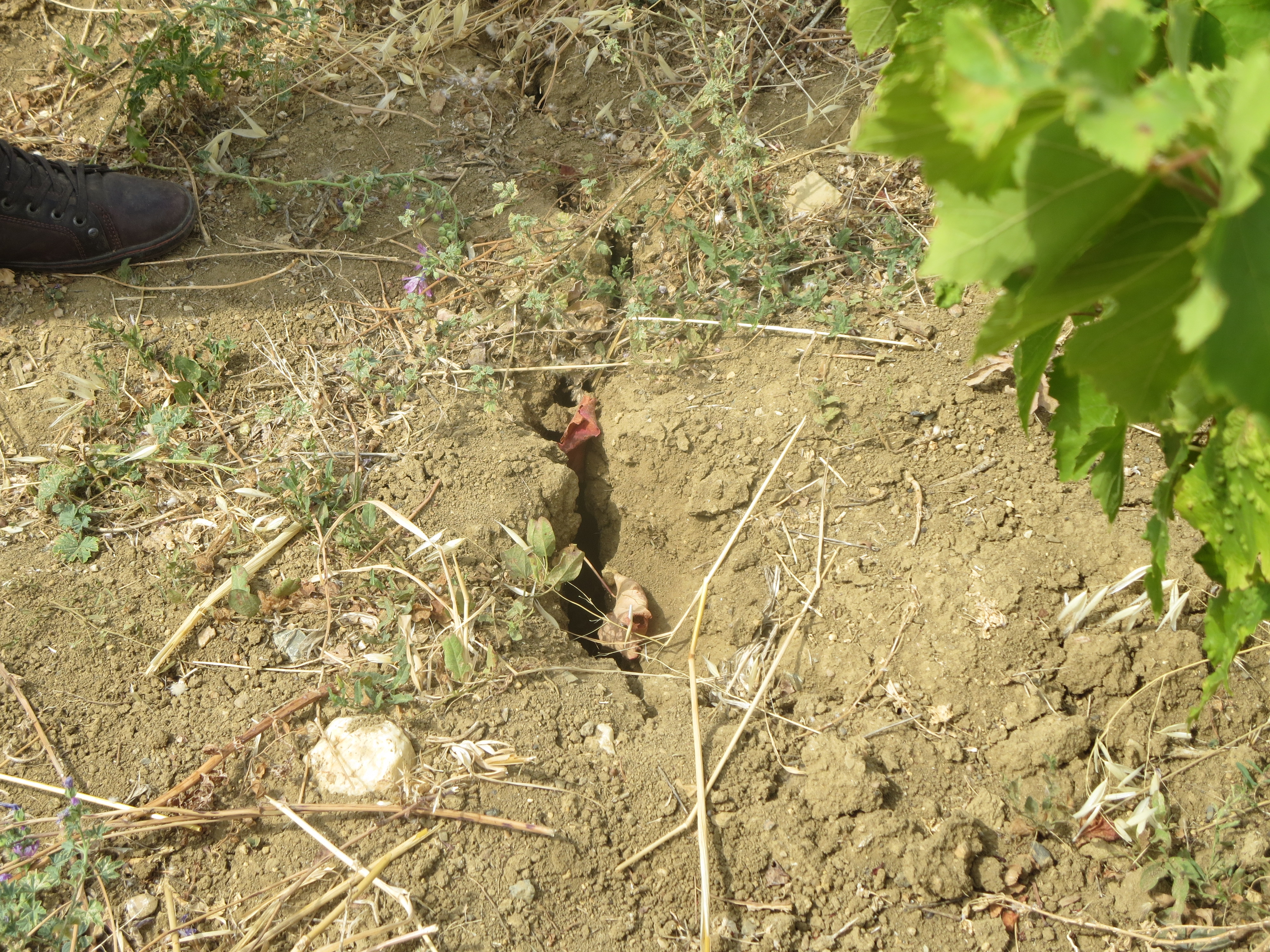
The weather in the Languedoc has been a talking point, apparently it is not just a topic for us British people. No rain since June 12th, very high temperatures, 39C one day last week. Fires in the garrigue, vineyards and even towns, including our neighbouring village of Roujan. The result of this has been fissures in the ground, e.g. the photograph below in one of Jeff’s vineyards.
This crack in the soil is over 30cm deep, a sign of the drought conditions
Some of the vignerons in the area have been irrigating their vines and a sign of this has been evident too. If you look at the photos below you will see white traces in the soil. This is calcium carbonate which is a product of the water imported to irrigate the vines. In other words the irrigation is changing the nature of the soil itself.
The vines themselves are remarkably resistant and strong even in the face of the lack of water. This summer is nothing unusual for the Languedoc but it builds on a fairly dry year in 2014 too. The leaves of the vines are curling in on themselves, a sign of some stress.
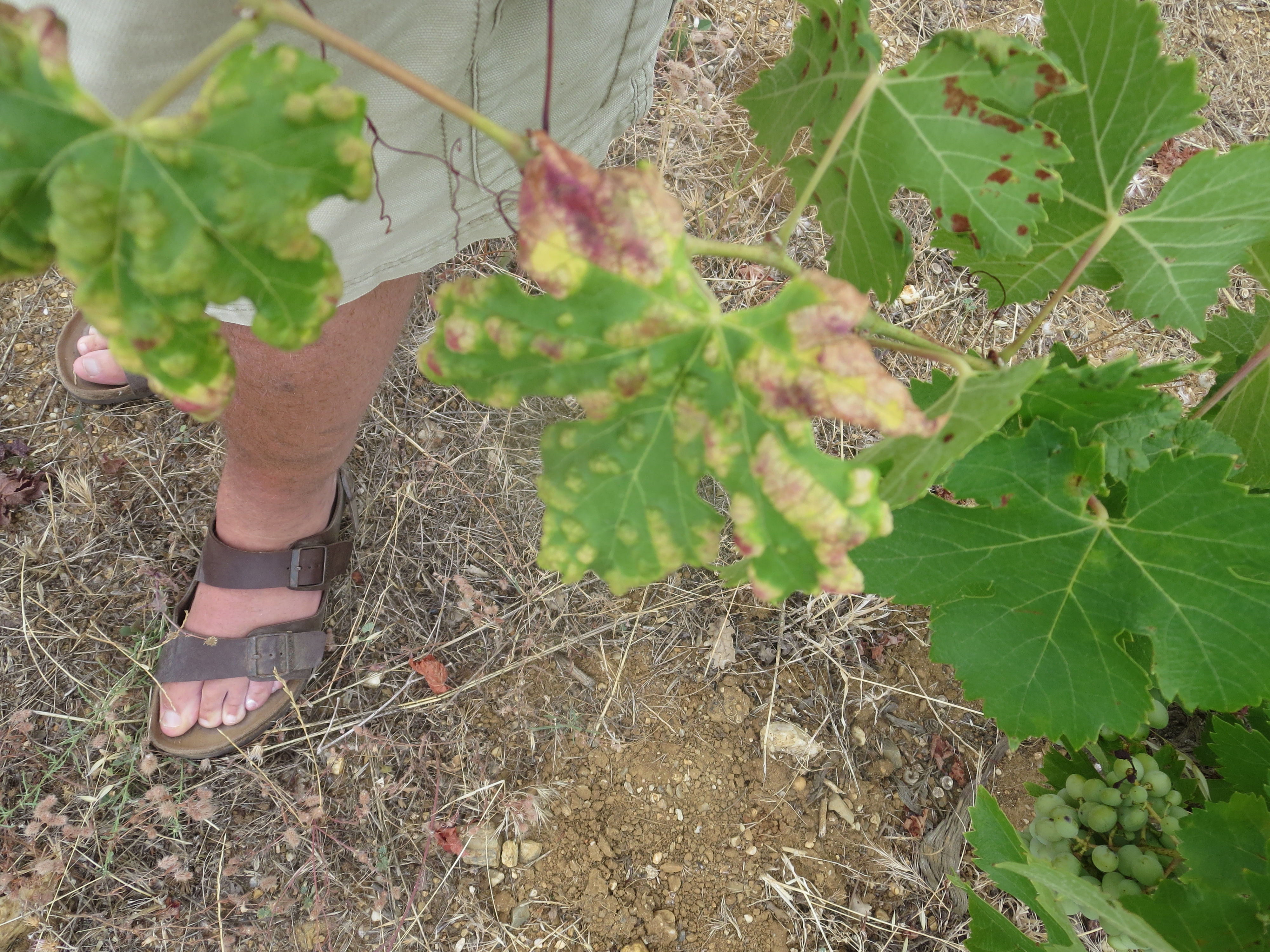
Other problems are showing too. Esca is a virulent wood disease which is a major threat to the vineyards of France, working like a cancer inside the wood. It suddenly emerges and affects the leaves and causes the grapes to shrivel and drop off.
Esca showing on vine leaves in the Languedoc, July 21st
Some have linked its spread with rainy springs and higher summer temperatures, such as 2015. There is no cure, it was formerly treated with arsenic but that has, understandably, been banned. It is thought that 10 – 20% of French vines may be infected by the fungus, they have to be replaced and, of course, they take time to grow and don’t produce the same quality as older vines would have produced.
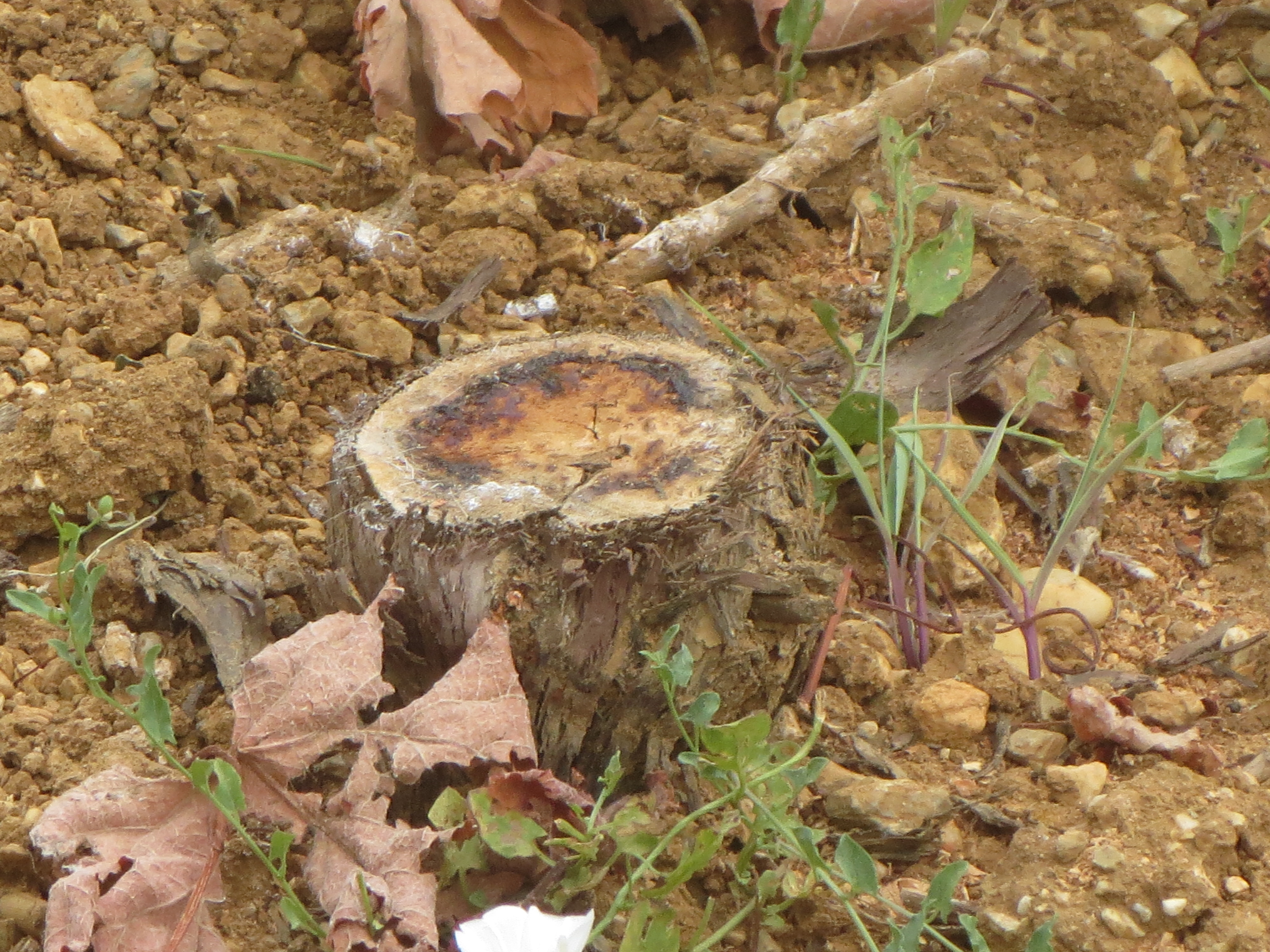
Vine stock showing the signs of esca after being cut
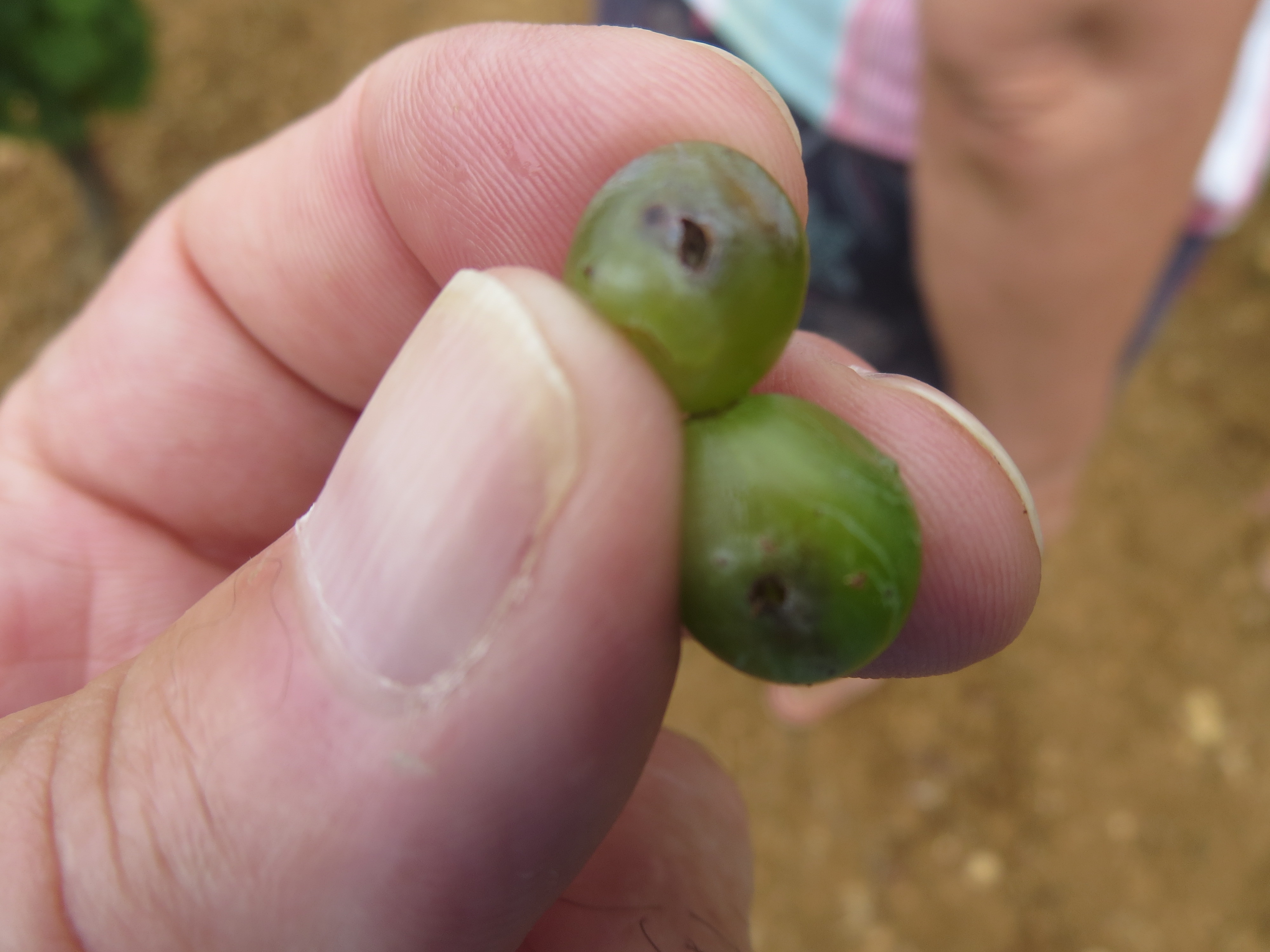
One perennial problem is vers de la grappe. These are the larvae of butterflies and they grow in coccoons amongst the grape bunches, leaving a white filament as proof of their residence. They pierce the skins of some grapes causing them to be ruined.
Characteristic puncture marks of vers de la grappe, July 21st
Careful pruning must follow.
July 21st
Bats and other predators eat these pests which is why Jeff, amongst others, encourages bats to live near his vines by putting up bat houses and encouraging the growth of plants, trees etc around and amongst their vineyards.
Bat house at Ste. Suzanne, (Metaierie)
The main concern is that the lack of water will reduce yields, rain would help to swell the grapes and produce more wine. Some rain was forecast on July 22nd but in Puimisson and many other areas, none arrived.
Not all bad news however. The vines are resistant and the careful management of soils, unlike the irrigated vines above, means that their roots go deep into the soil searching for water. Struggling vines produce the most interesting wines. Let us hope that this is the case in 2015.
Diversity amongst the vines at Mas Coutelou continues, less than 10 metres from the fissure in the ground above were these partridge eggs which had hatched recently.
And in the cellars work has begun to replace the leaky roof, which is built on timbers hundreds of years in age. It is a beautiful roof and happily the timbers have been saved, most tiles will be recycled. I will write more about the changes in the cellar as preparations for the vendange begin.
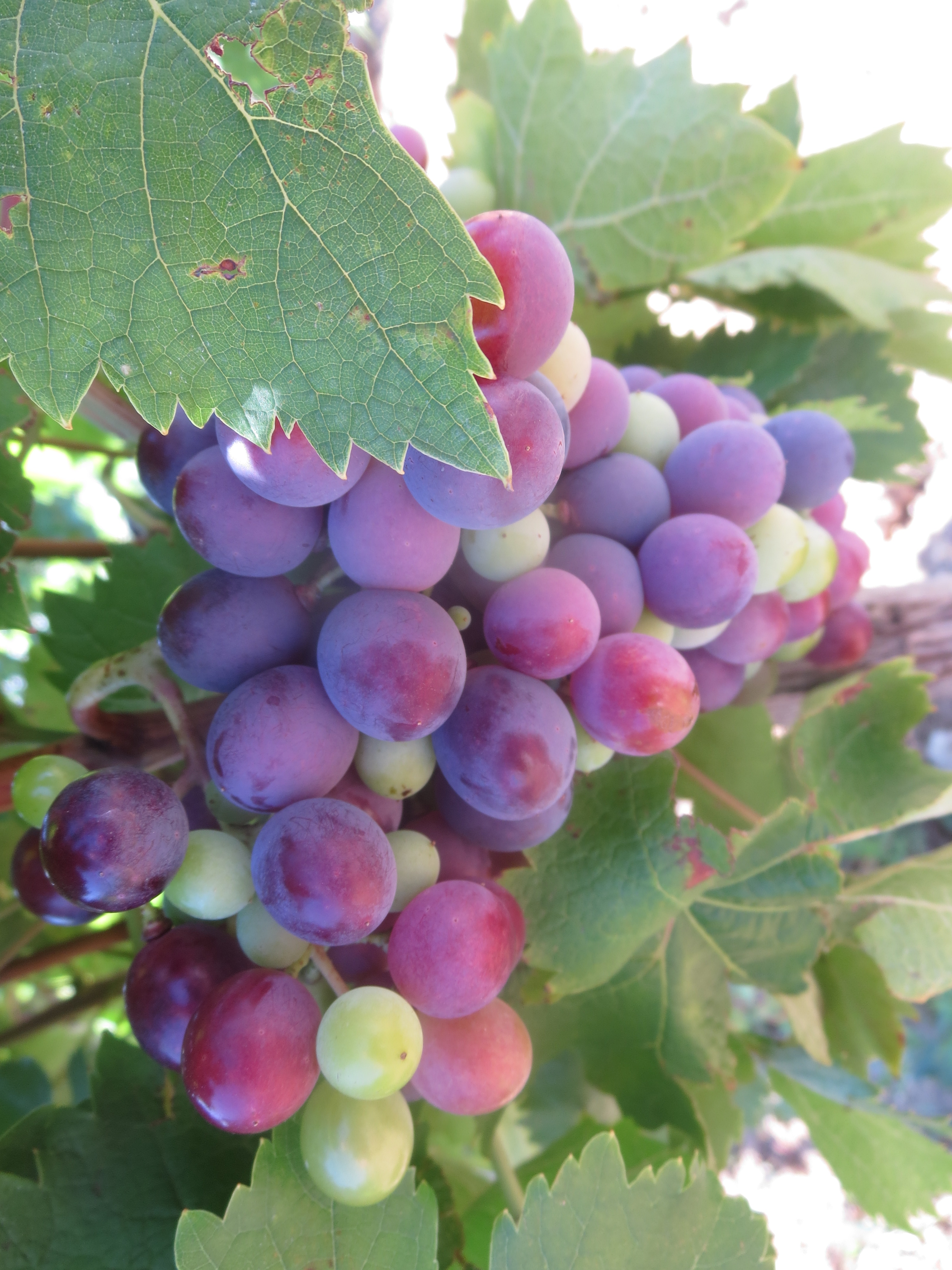
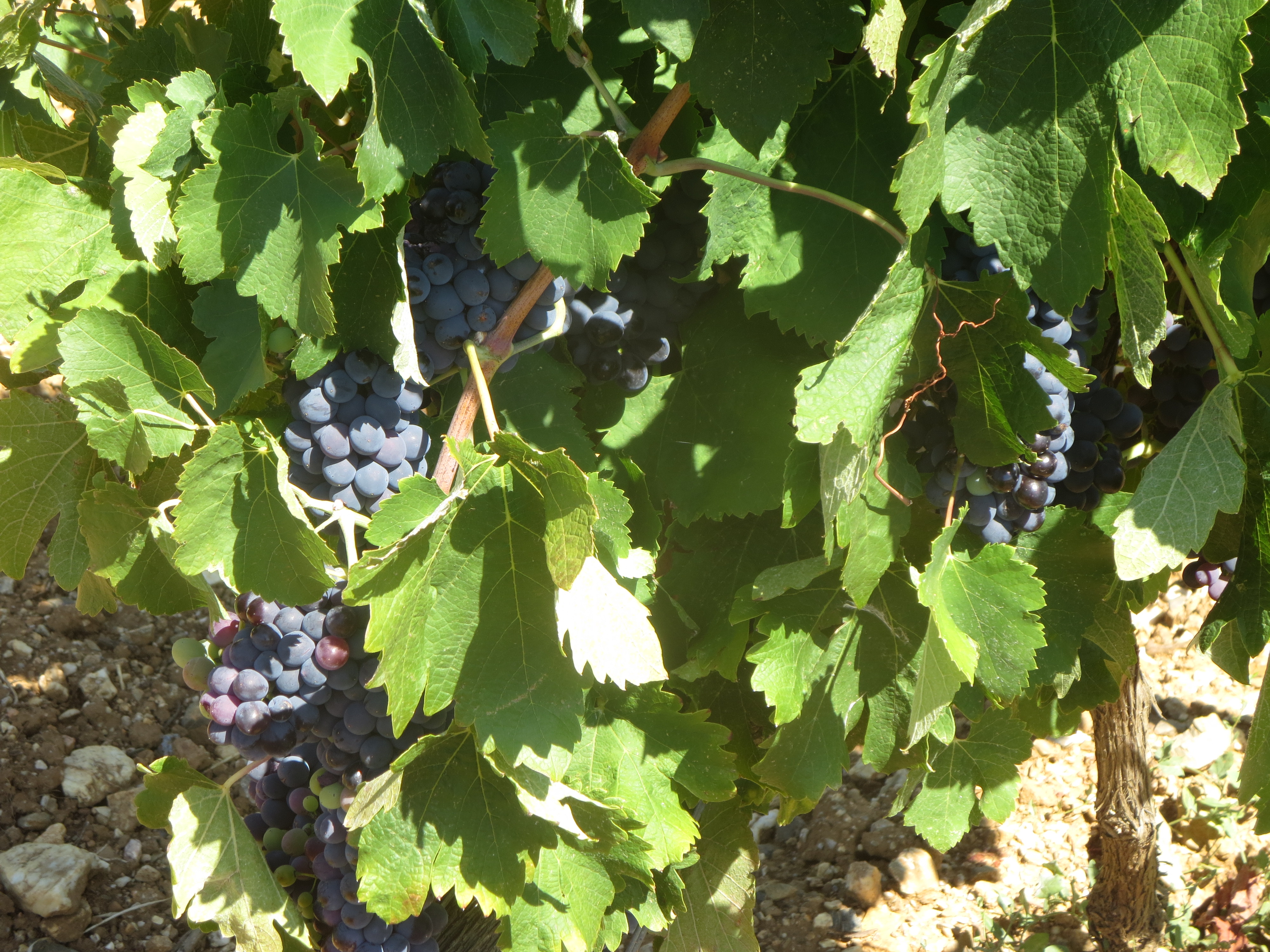
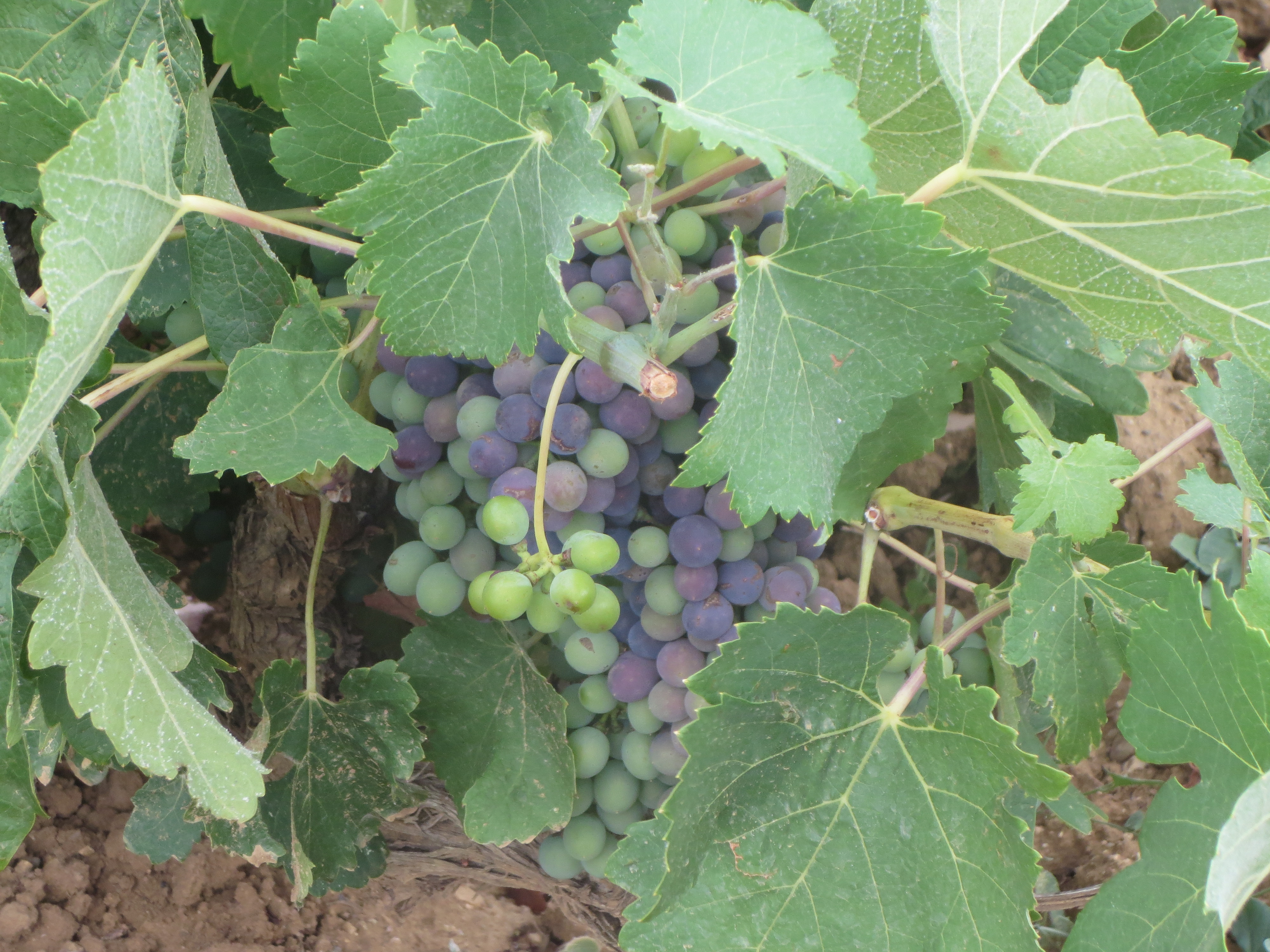
And finally véraison is in full swing. The change of colour of the red grapes is one of the key events in their development as they approach maturity. This marks the change in growth of the berries, they are now producing sugars within the grape rather than concentrating on simply growing and producing acidity. It is certainly one of the most noticeable and landmark changes in the grapes.
Note the curling leaves, the vines are feeling the lack of water.
Véraison and the increase in sugar levels also attracts more animals to eat them, birds, insects etc. Problems, problems everywhere. Who would be a vigneron?
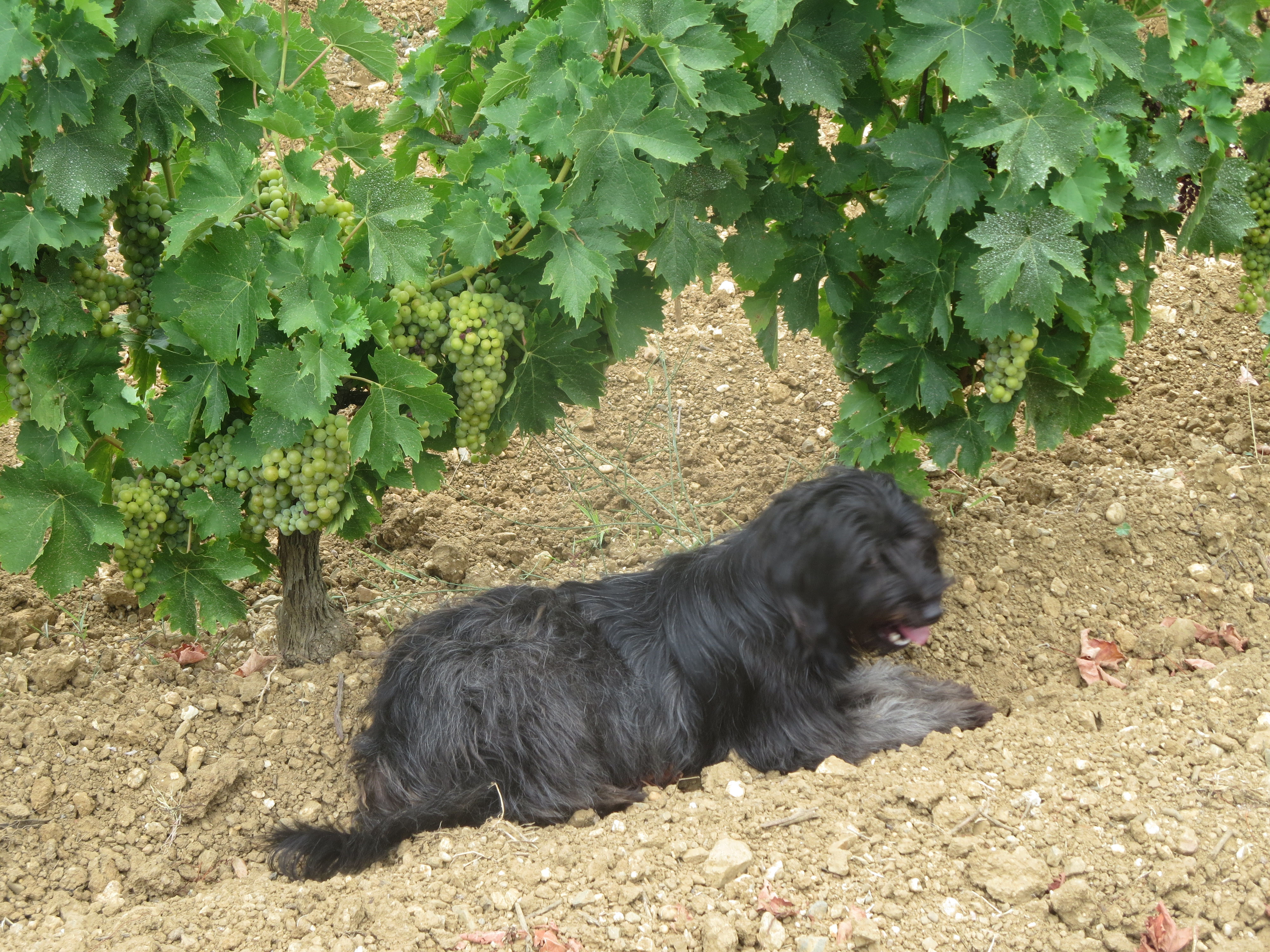
Two creatures love being in the vines for sure, me to watch their growth and, more importantly, Icare who loves to be in amongst the dirt and, in this heat, he loves the shade of the vines.





















































 amarchinthevines