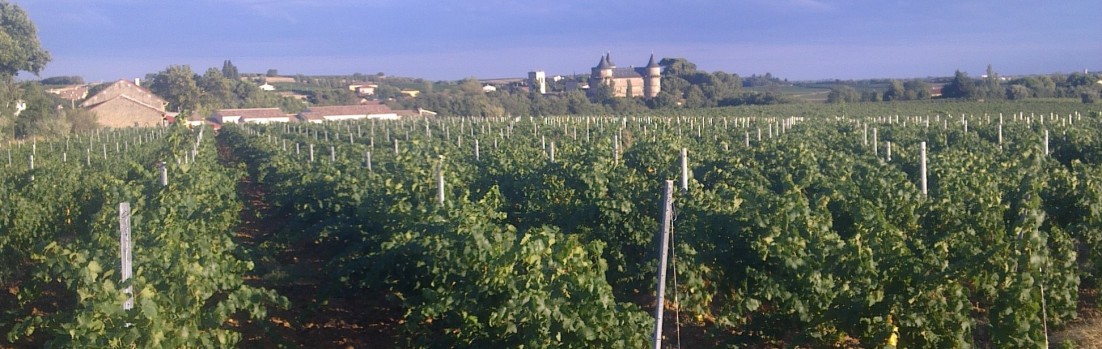
This photo was taken on October 6th in Font D’Oulette, the 0.6ha Flower Power vineyard. It tells a number of stories.
Look at the vineyard itself. Small, youthful vines, only six or seven years old with a rich variety of cépages including some rare ones such as different varieties of Oeillade, Clairette Musquée and one known simply as Inconnue as its origin is unknown. This complantation of cépages was typical of the old ways of growing vines. The use of gobelet training rather than the use of wired trellises (palissage) is another example of traditional viticulture. This vineyard tells a story of how old ways are often better, its wine has already garnered much praise.
Look also at the vineyard behind Font D’Oulette. You will see vines looking very different. The vines are a rich green in colour and their foliage is still lush. This forms a contrast with the autumnal yellow of Flower Power. This is the result of neighbours’ vineyards being treated with large quantities of chemical fertilisers, especially nitrates. These artificially boost the growth and colour of the vine. Flower Power’s vines, on the other hand, are allowed to develop at their natural pace.
The vineyard is surrounded by olive and fruit trees as well as ditches. This is deliberate on Jeff’s part because he wants to create a barrier to the neighbouring vineyards. When it rains in the Languedoc, it often rains hard causing the soils to wash away. Sometimes, the soils are compacted by machinery and the treatments on the vines are washed away with the rain. Since Font D’Oulette is in a bowl this would mean that neighbours soils and chemicals would run onto Jeff’s parcel so he uses the ditches and vegetation to prevent his vines from being affected.
One of the winemaking trends of recent years has been a return to the learning of our forefathers. The revival of old grape varieties, use of horses for ploughing, many of the practices of natural winemaking are references to the past. As a historian these practices are very welcome to me.
Another welcome revival has been the use of amphorae for fermenting or ageing wines. Of course this was the methodology of the Greeks and Romans thousands of years ago but they had all but disappeared in western Europe. Certainly the practice survived in the East, especially Georgia, partly due to the poverty of Soviet times. The fall of communism and this search for the past has brought about a revival of interest in the amphora.
The advantage is that clay is porous and allows an exchange of the wine with air/oxygen. This is why wooden barrels have been used but the advantage of amphorae is that they do not give the familiar taste of oak. Many producers who have used amphorae claim that they keep wines fresher than barrels.
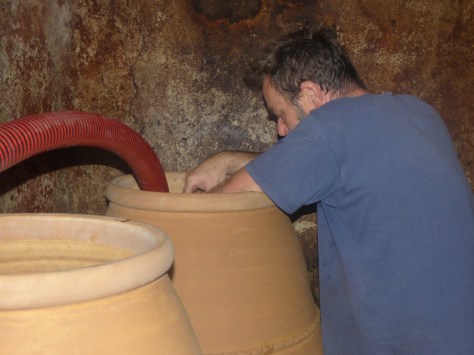
Earlier this year I reported how Jeff had been given a present by a diving friend who discovered a Roman (time of Julius Caesar) amphora in the Mediterranean. I had hoped that it could be used for winemaking but it needs a lot of reconstruction as well as disinfection. However, it seemed to inspire Jeff who went to Spain in order to buy two 400l amphorae. On September 29th it was time to fill them.
They had been filled with water for several weeks to remove dust but also to moisten the clay so that it would not soak up the wine. A cuve of Carignan and the very rare Castets was the wine to enter the amphorae which are about 1m50 high. Filled almost to the brim each was sealed with a stainless steel chapeau bought for the job. And so we await the results, regular tasting will allow Jeff to decide how long the wine will be aged.
A new departure, a return to the ways of the ancients.
I started my coverage of the 2017 vendanges with racing terminology and, so, I finish in the same way.
It’s definitely over. Vendanges 2017 with all its quality, with so little quantity.
On September 27th the final press of the grapes was completed. It was the turn of the Cabernet Sauvignon, two weeks after picking. The skins, pips and other solids had done their work in giving up flavour, colour, tannins and so much more. The yeasts had started their work of fermentation. Now it was time to press before that grape must started to be problematic rather than beneficial.
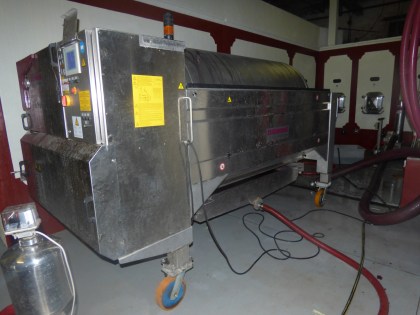
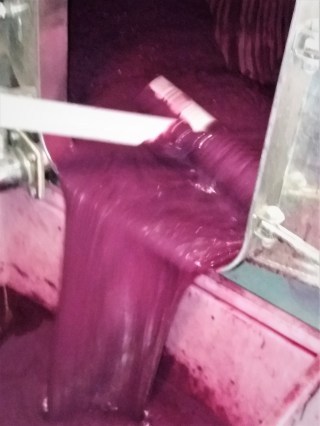
The must was pumped from the cuve by the powerful pompe à marc directly into the press. Julien ensured that the press was filled in all corners and then the press began. It inflates a membrane inside which gently presses the must to extract the juice without releasing the more bitter, astringent tannins left in the skins and pips.
Sediment after the must has gone to press
The grape variety (cépage) will determine the amount of pressure applied, Cabernet has small berries and thicker skins so needs a little more pressure than juicier, thinner skinned Cinsault for example.
Error
This video doesn’t exist
The juice flows and is sent to another cuve to continue its fermentation, then its malolactic fermentation (which removes the more acid flavours). Indeed the analyses of the 2017 wines show that fermentations have gone through quickly, without fuss or problem. There is no sign of volatility or any other problem, the wines look on course to be as high quality as the grapes themselves. Which, of course, is the goal. Jeff believes in letting the grapes express themselves with as little intervention as possible. This year interventions are minimal, the grapes have done the work.
Sadly, the quantities do not reflect the quality and that will bring a financial blow to the domaine and to virtually all domaines in the region. When you are asked to pay a few euros for a bottle of 2017 Mas Coutelou, I hope that you will recall all the work which I have described, the stresses and strains, the love and care which has gone into that bottle and you will consider it money well spent.
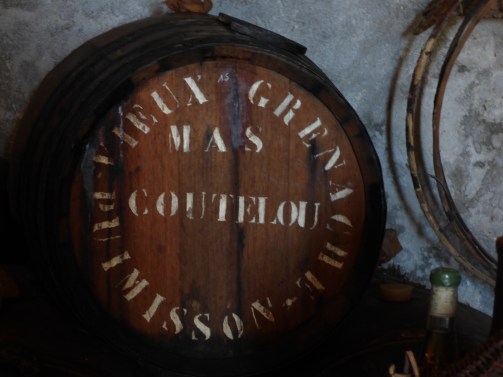
Many visitors to Mas Coutelou would cite their time in the cave des soleras as the most memorable of all. This, for new readers, is the cellar where barrels are stored containing Muscat and Grenache from many vintages. There it ages gently to make Vieux Grenache or Muscat, or a blend of course.
The system works with new wine being put into barrique as normal but the older wines are blended with wines from previous years. Evaporation and bottling means that some of the wine in the barrels disappears each year so they need to be topped up with younger wines. Gradually, as the years pass, the wines become older and more concentrated and are passed on to older barrels. Some of the wine in the oldest barrels is 100 years old blended in with slightly younger wines.
Archimedes principle to move wine from cuve to barrel by gravity
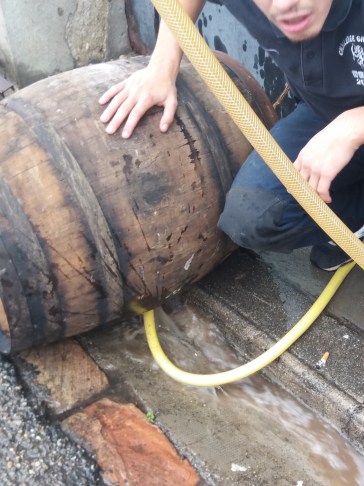
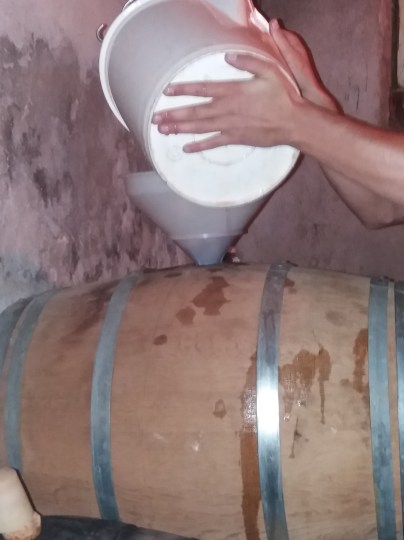
On September 20th it was time to clear space in the cellar; barrels topped up, new wine added to the system. Some of the barrels were given a soutirage, emptied of their wine leaving behind the sediment in the bottom. The barrel is then cleaned, the wine returned and topped up.
Matthieu fills the barrel with water to clean it ready for refilling with wine
Two days later we were back and amongst the barrels being refreshed was one containing the Grenaches (all three varieties) wine I made in 2015. Time to taste. This was the new barrel which permits more oxygen into the wine than the more seasoned barrel. There was definitely a sherry influence to the wine, the effect of the oak and air but still there was good fruit and length. It will soon be topped up with wine from the older barrel which should add more fruit to the profile. The wine in the 27l bottle will be even more fruity and fresh, the blending should be an interesting time.
The new barrel of the Grenaches being emptied
Matthieu supervises
The wine
Refilling the Grenaches newer barrel
The cellar is a true treasure trove of great wines, and I don’t mean mine. Time spent there is always time well spent. And the guard dog of all guard dogs ensures it is well protected.
On Tuesday I was delighted to be asked to give a presentation on the 2017 vendanges at Mas Coutelou and the problems of the vintage which had been widely reported. Around 60 people were in attendance at The Tuesday Club in Pézenas and I gave a talk about the events of the vendanges, the decisions which must be made by Jeff as well as a report on the problems nationwide and Puimisson. This was followed by a tasting of Bibonade, Flambadou 2015 as well as two samples straight from tank, Cinsault and Cabernet Sauvignon to demonstrate the change in structure and taste after fermentation.
I have uploaded the presentation as a video to Youtube which you can see here.
It’s a simple explanation honestly. The tank of Mourvèdre was ready for remontage. That is where juice from the bottom of the tank is pumped over the cap of grape skins, pips etc (the must) which rise during fermentation. That cap becomes hard and there is a risk of bacterial infection plus the whole idea of having the skins in there is to extract tannins, colour and flavour so it’s pointless having them separated from the juice.
A normal pigeage
You may recall that this was the tank where Jeff had to improvise last Monday when the érafloir broke down. Some of the bunches were destemmed, others went in whole bunch. There is therefore a higher than usual amount of solid material in the tank. This had formed a solid cap and Jeff needed it to be pushed back into the juice. A fork was used at first as is normal (the process called pigeage), but the crust was too firm. So, Jeff took off his boots and socks and climbed in.
This is dangerous for two reasons. He could fall through the cap and into the juice and, secondly, there is a lot of carbon dioxide coming from the fermentation which, as I found out, can make you ill. So hanging on to the sides and with myself and Matthieu ready to catch hold Jeff pushed down with his feet onto the cap.
He described the cap as cold but underneath the fermentation meant that the juice was hot. As Jeff pushed down the cap it was fascinating to see the gentle bubbling of the fermentation process, sadly it was too dark for the camera to pick up. As he pushed the cap down, Jeff needed to push lower so, off came the trousers. Moving around the tank the cap began to sink bit by bit.
Out he came and a normal remontage took place though in his briefs!
And the wine? Well it tastes very good, perhaps with more legs in the glass than usual.
Last Monday (September 11th) we were joined at Mas Coutelou by winemakers Charlotte and Louis Pérot and of their friends. You might recall that their Cahors domaine L’Ostal is one which has appeared on these pages before. I first met Louis in spring 2015 at La Remise in Arles where I was taken by his wines and was eager to spread the word of how good they were. Happily Jeff agreed with my judgement and a friendship grew between the winemakers.
Cabernet Sauvignon 2017
Sadly the spring of 2017 brought 3 nights of frost to the vines of L’Ostal damaging the young growth and buds, up to 80% of the vines were damaged meaning huge losses on the year. Jeff decided to help out and offered the Pérots the opportunity to come to Puimisson and take some Cabernet Sauvignon grapes to ensure they had more wine. I hasten to add that this was a gift, free of any charge, offered simply to help out a colleague and friend. I have heard of similar stories for other winemakers affected but it was humbling to see this fraternity in action for myself.
Heading home
Louis and Charlotte picked around 60 cases and drove them back to Puy L’Evêque where I am sure they will make another very good wine. We actually opened one of their magnums the following day at lunch, and very good it was too. If you thought Cahors wines are too difficult I urge you to try and find one from L’Ostal, it will change your mind.
In a year when Jeff himself will lose up to 40% of his average production he showed no hesitation in helping out someone who was in a worse situation than himself. A mark of the man.
In other words, the finish. Well, the finish of the picking. Tuesday September 12th was so much calmer than the previous day as the Cabernet Sauvignon from Segrairals arrived.
Thoughout the vendanges the grapes have been good, smaller than the norm because of the dryness, but in excellent health. The Cabernet was no exception. Sorting was all about snails and dry leaves rather than any problems with the grapes and the vat filled gradually, problem – free, as the day progressed. The stalks were brown showing the maturity of the bunches as the third érafloir of yesterday completed its job efficiently.
Myself and Jeremy
As we awaited the first cases Jeff and I went around some of the vats and took samples for analysis as well as tasting the wines. I wish that I could convey the bready aromas filling the cellar of the yeasts at work, they give such a sense of change, optimism, alchemy.
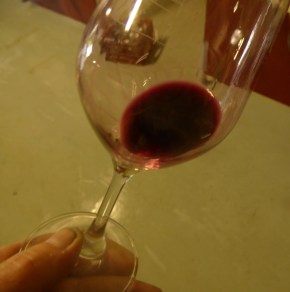
Amongst the wines we tasted were two from 2016, Syrah and Grenache, which have been sparked back into fermentation by the very presence of this year’s grapes in the cellar. The process is truly amazing. The glass in the photo below shows the top Syrah from La Garrigue harvested two weeks ago, which just may become La Vigne Haute. It is a stunner.
Quality across the board is undoubtedly high though Jeff is counting the cost of the quantity, his first estimates are that the overall yield will be around 39 hectolitres per hectare. Average years would give between 50 and 60 hl/ha.
Joining us on the day was a former student of Jeff and Vincent restaurateur Régis Lamazère and his wife and baby. Régis runs his autonymous restaurant in Berlin where Charles who was here for vendanges 2016 used to work.
After the grapes were in and the last cases sorted by Julien and Vincent it was time to start serious cleaning of all the equipment which will be put away for 2018. The picking may be over but the work never stops. A full programme of pressing, remontages etc is in place for the next week. Stay tuned.
“Quelle journée!” That was how Jeff messaged me on Monday evening. Safe to say things didn’t go exactly to plan, nor did Plan B work so it was Plan C in the end. What am I talking about? Let me explain a day which shows how impromptu thinking is important.
Mourvedre waiting to be picked
Plan A was straightforward and, maybe, things had gone too smoothly up till then. I wrote recently how the team was in the groove and the grapes were being harvested efficiently. Monday was the day for the Mourvèdre to be picked, a real star of the 2016 crop, hopes were high for a repeat.
Jeff surveys the Mourvèdre under a gorgeous sky
Everything began well. A silvery dawn revealed grapes in tip top condition though smaller yields in keeping with the vintage. The first cases arrived and I was sorting through them with Matthieu, a trainee sommelier on work placement. And then the destemmer (érafloir) suddenly stopped. On opening the main body Jeff found the fan belt off and one of the wheels sheered away. No easy fix.
These cases were sorted Plan A ; the offending mechanics
We had already destemmed 20 cases or so and the grapes were in stainless steel tank. With no érafloir, however, we could not destem. Jeff declared that we would have to move to whole bunches. We moved upstairs to the new mezzanine floor created in the cellar renovations of the last two years. Trapdoors in the floor are positioned above the tanks and big plastic chutes are connected so that the bunches can fall through into the tank. The cases are brought by Michel to the upper floor via the garden and then sorted just as carefully.
The tank was now filled with destemmed bunches and lots of juice but also whole bunches in amongst that. This was Plan B. A neighbour then offered the use of his destemmer which was brought down and put in place whilst Plan B was working. We started this and did a few cases of destemming again but it was a big machine, meant for huge quantities of grapes and was too powerful for the amount we were processing.
Jeremy and Matthieu sort whole bunches
Lunchtime. Reflection. Back to Plan B, whole bunches.
Meanwhile Jeff took the original destemmer to the repairers who declared it unrepairable! However, these were the same people who had renovated the cellar and they kindly offered Jeff the use of a third érafloir. Plan C. This proved just the job, even quieter and more efficient than the original. So, we have an interesting tank of Mourvèdre, a millefeuille of grapes, juice and stems. No doubt it will still produce very good wine as the grapes were healthy and of very good quality. However, it had been a day to try Jeff’s patience whilst other tanks also demanded his attention.
The third érafloir of the day ; Matthieu and Ambroise
He had also damaged one of the large tubes used for pumping the grapes and juice first thing, I think a black cat must have crossed his path on the walk to the cellar that morning! All’s well that ends well however, but it was certainly proof that you need to have contingencies and how experience can help a vigneron to overcome adversity.
There are numerous different tasks during the vendanges, I thought I’d expand on a few as I reflect on the last two days. Both Thursday and Friday began with lovely sunrises over the vines as we picked, almost worth the early start to the day.
Picking was done by the half dozen Moroccan workers who work non-stop and chatter away even faster. This year there was a more stable team working with Jeff, on previous vendanges there has been a core of people with lots of others coming to spend a couple of days and then moving on. Many of these did sterling work, such as Thomas and Charles, but with an unchanging team for three weeks progress has been smooth.
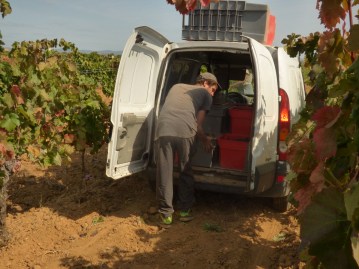
In the vineyard Julien and Vincent took charge along with Selene, Max, Roxane, Ambroise and Jeremy. Michel ferried the grapes to the cellar where Jeff controls the process of turning fruit into wine. The team (including myself) would also help out in the cellar as needed, Jeff aiming to give opportunities to learn about the winemaking process to everyone. Ever the teacher.
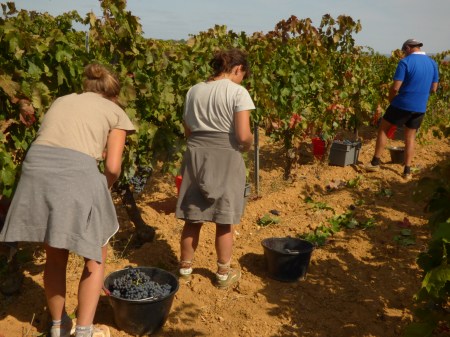
This photo shows Roxane, Selene and Max picking Carignan. Roxane is cutting the bunches whilst Selene and Max carefully sort through their bunches to remove anything untoward such as insects, leaves, rotten or dried berries. On the other side of the vines are other pickers to ensure everything is taken. The bunches go into buckets and when they are filled they are emptied into the cases stored under the vine.
Muscat D’Alexandrie
Michel arrives in the vineyard and drives between two rows to collect the cases, often supported by Julien. The grapes are returned to the cellar as quickly as speed limits allow, unloaded and subjected to further sorting.
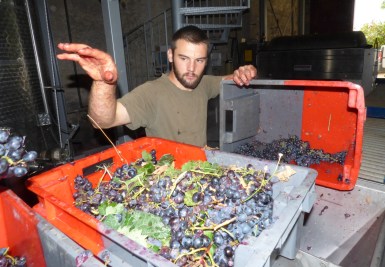
In the photo below Ambroise is checking for anything which escaped the pickers or fell into the cases whilst waiting to be collected. This year the grapes have been very healthy and so no need for the sorting table to be used. However, snails often sneak into the bunches and cases seeking some nourishment in the very dry weather.
The bunches are either pressed immediately, eg for white wine or sent to vat. In the latter case they will be destemmed first or sent as whole bunches depending on the style of wine Jeff decided will be most suited to the grapes. They will spend a day or two there before the process of debourbing or délestage. The juice has now been sitting on the skins, flesh and pips which form a cap on the top of the juice or sink to the bottom of the vat. Délestage involves removing the juice from this mass when it has absorbed as much colour, flavour, tannin as Jeff deems optimal. The juice heads to a new tank to recover. In the video below you will see that it passes through a machine which cools down the juice. Fermentation produces a lot of heat, too much can bring problems which would spoil the wine. That is the main reason why Jeff also invested in new temperature controlled stainless steel tanks this year, especially for white wines.
Error
This video doesn’t exist
The fermentation begins promptly, the healthy yeasts produced by the grapes themselves triggers the process of turning grape juice and its sugars into alcoholic wine. Odours of bread making and fresh fruits fill the cellar, hints of the pleasures of Mas Coutelou 2017 wines ahead.
Skins after pressing
Meanwhile, after pressing the grapes skins are recovered from the press itself and put into a large container. There they will ferment and produce the base for brandy and spirits, nothing is wasted.
Muscat D’Alexandrie
Carignan Blanc
Carignan
Cinsault
Castets
More interesting varieties were harvested these two days. Top left above is Muscat D’Alexandrie, large oval grapes tasting of pure grape juice. Carignan Blanc is one of my favourite white grapes from the region, it makes dry, complex wines. The middle row shows Carignan and Cinsault picked these days. Last but certainly not least, Castets is a rare red variety, less than 1 hectare in the world and much of that is in Peilhan. Sadly, it too has been hit by the dry summer, lovely quality but lacking in volume, a summary of this vintage.
And, after a hard day for some of us my T shirt shows the fruit of the day. Whilst Icare takes things at his own pace.

























 amarchinthevines