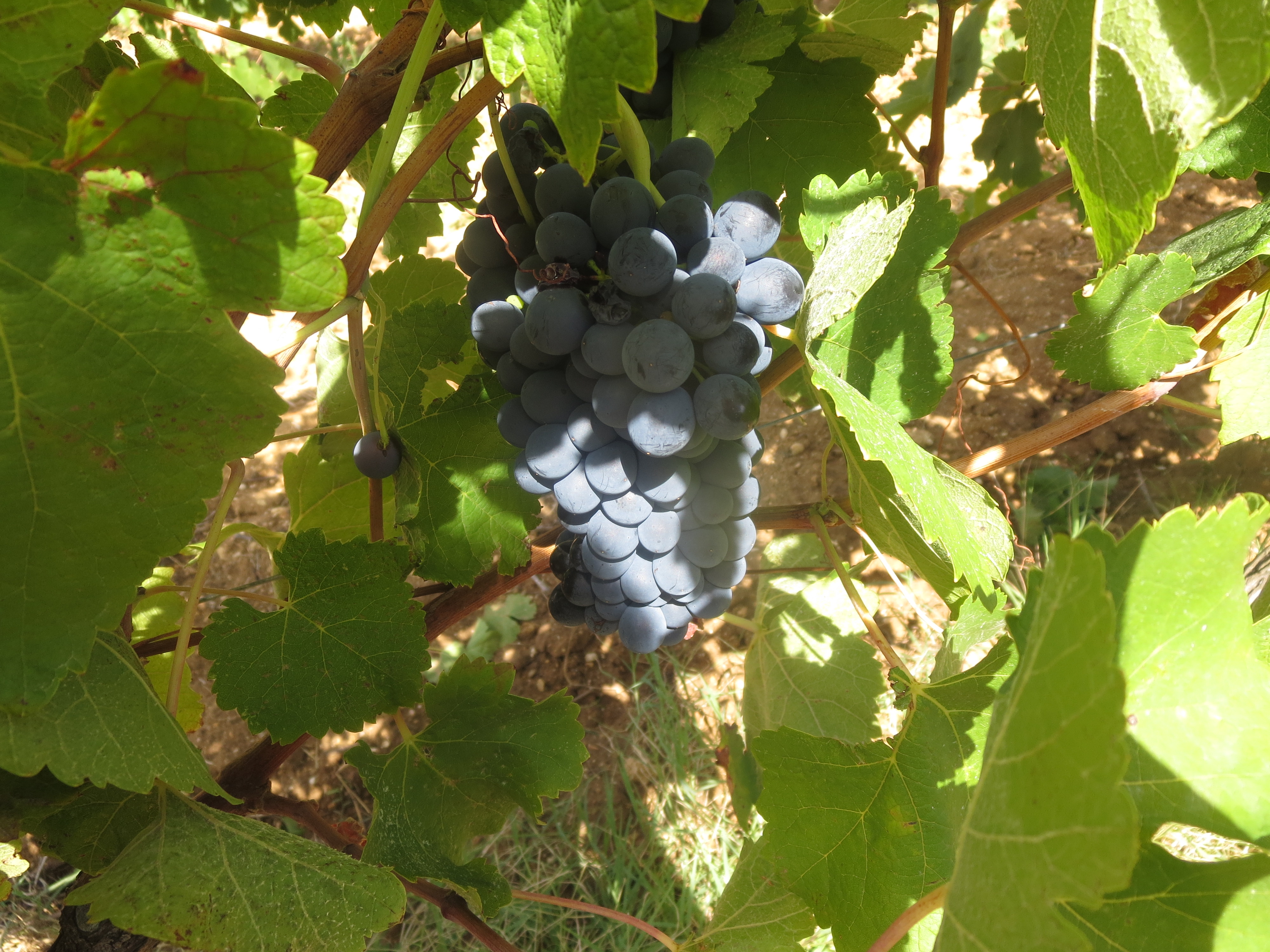
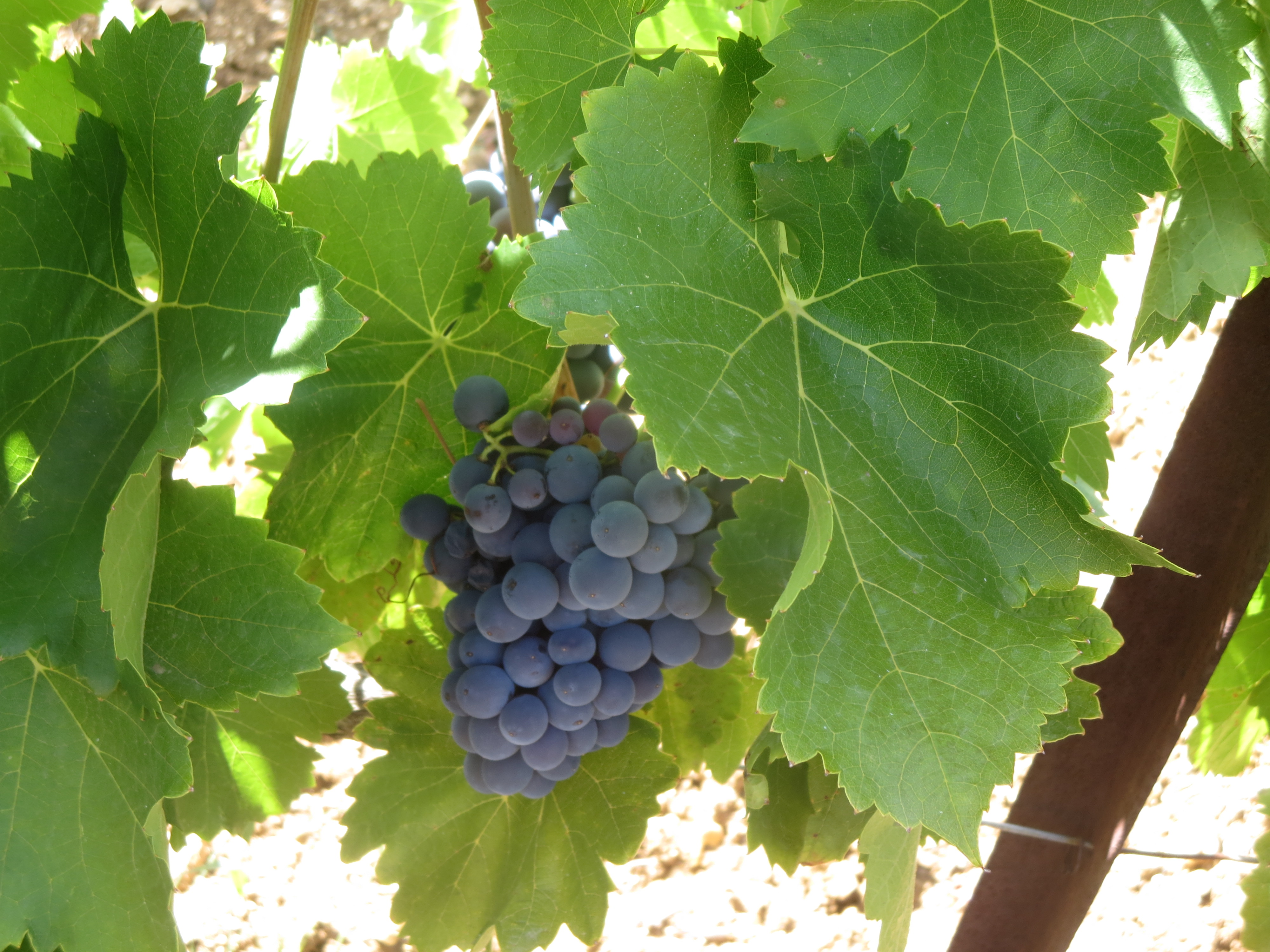
This was the final big week of harvest and it centred around Cabernet Sauvignon. There is a big parcel (around 1.5ha) of the grape in Segrairals and it is not a variety which really excites Jeff for a Mas Coutelou wine. It has done especially well in 2015 though the small berries have swollen with the rains and the alcohol levels had therefore fallen a little to around 14%. They taste sweet and juicy and came in fantastic bunches, not the same size as the Cinsault and Mourvèdre from this vineyard, but small and healthy nonetheless.
Cabernet Sauvignon on the vine in Segrairals
Cabernet Sauvignon
Partof it was picked on Monday 21st September which will be used by Jeff, purpose as yet unknown though Cameron may be flexing his winemaking muscles with some. The other major work on Monday was to use the Muscat d’Alexandrie grapes from Peilhan which were also in good health.
Muscat d’Alexandrie
They have very thick skins so the pressing took longer than usual to extract the juice. They were mixed with some Muscat À Petits Grains grapes. I will come back to these grapes and the juice later in this article.
Michel loads the Muscat into the press
Muscat juice after pressing
Tuesday 22ndwas the big day for the Cabernet Sauvignon. I have explained before that Jeff sells most of these grapes to London Cru, an English winery as the name suggests. London Cru buy grapes from around Europe, eg Chardonnay from Limoux, Albarino from Rias Baxas, Grenache from Spain. This is the third vintage of the project and the grapes were ready at last. In 2014 they had been ready on September 4th, my first day at Mas Coutelou after our move to the Languedoc. This year the rain had delayed them so Gavin and Alex flew into Béziers on Monday evening. They had been in Italy on Saturday and only just got back to London before flying here. The refrigerated wagon was in situ as I arrived on Tuesday morning, waiting to be loaded with the grapes.
Confidence was high amongst the London Cru team after some very good reviews including one last week by Dr. Jamie Goode who gave the top mark (94/100) to the Cabernet Sauvignon using Jeff’s grapes. The fruit for 2015 should bring more high marks and good wine. We tasted the 2014 over lunch and it was very good, clear, direct fruit with ripe tannins which mean that the wine will be at its best in 2 to 3 years.
Alex and Gavin loading the grapes
Gavin, Alex and Jeff directed and led the picking carried out by the Moroccan team as usual but also by Cameron and myself together with two excellent new additions to the team in Fabrice and Romain. Fabrice puts on shows (spectacles) around France whilst Romain is an artist. They have picked here before and were good fun and hard working, more new friends. (Fabrice on the left, Romain to the right.
After picking the 6 tonnes or so of grapes they were driven straight off to London under refrigerated conditions to keep them fresh. Gavin and Alex flew back to London that evening ready to receive them at their base. London Cab, fine fare.
Fine bunch of Cab I picked
Lunch was excellent with the London Cru wine and a magnum of Flambadou 2014 which was excellent, still in its infancy but already drinking well. Afterwards Cameron and I did some pigeage of the Carignan grapes amongst others. It was also Cameron’s birthday, hopefully it was one he will remember with affection.
Birthday boy Cameron looking for his present
Pigeage of the Carignan
Wednesday 23rd was a day for working the cellar. Jeff was keen to aerate the Syrah a little and to start to maximise the cuves by assembling some of the tanks and filling the new ones. Thursday saw similar work whilst Jeff also did some admin work.
On Friday 25th I returned to the cellar. Cameron was enjoying a well earned break and so I joined Jeff and Michel. They were continuing to fill the tanks, aerate some wine and then we moved to the muscats from Monday.
Aerating some Syrah
Muscats macerating with a little older Muscat wine
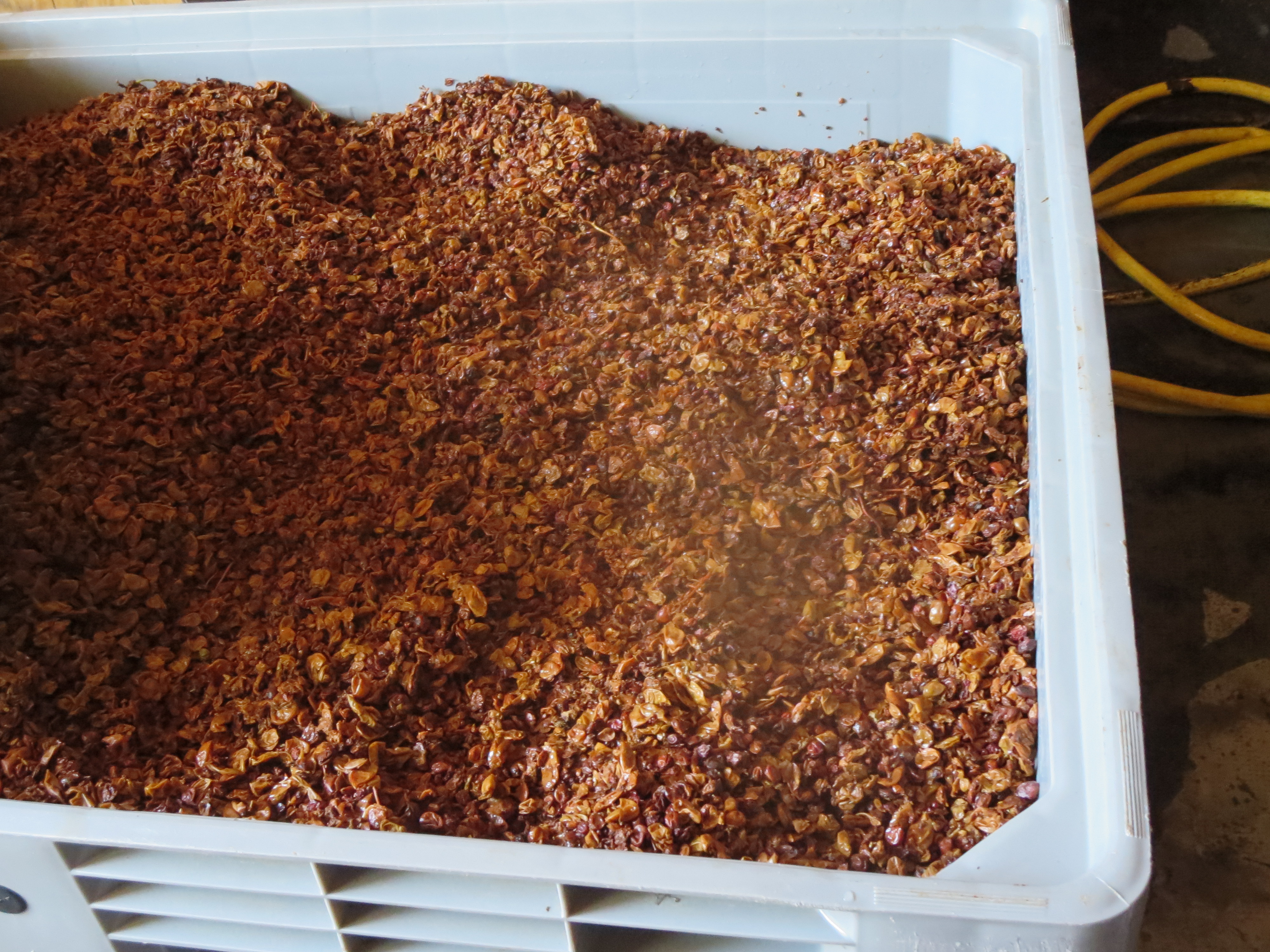
The Muscats are destined for the solera system and after a few days maceration they were showing lovely aromas, already slightly sherry-like due to being mixed with some older wine. The juice went straight into barrel whilst the marc was pressed again to extract more juice and flavour. Tasted straight from the press these included lovely apricot, plum fruits along with the slight oxidised note which adds complexity. Truly delicious, I’m afraid my description fails to do it justice.The barrel will allow the wine to age and gain contact with oxygen and the wine will develop into a luscious sweet wine. As stated previously I shall write more about the solera in the near future.
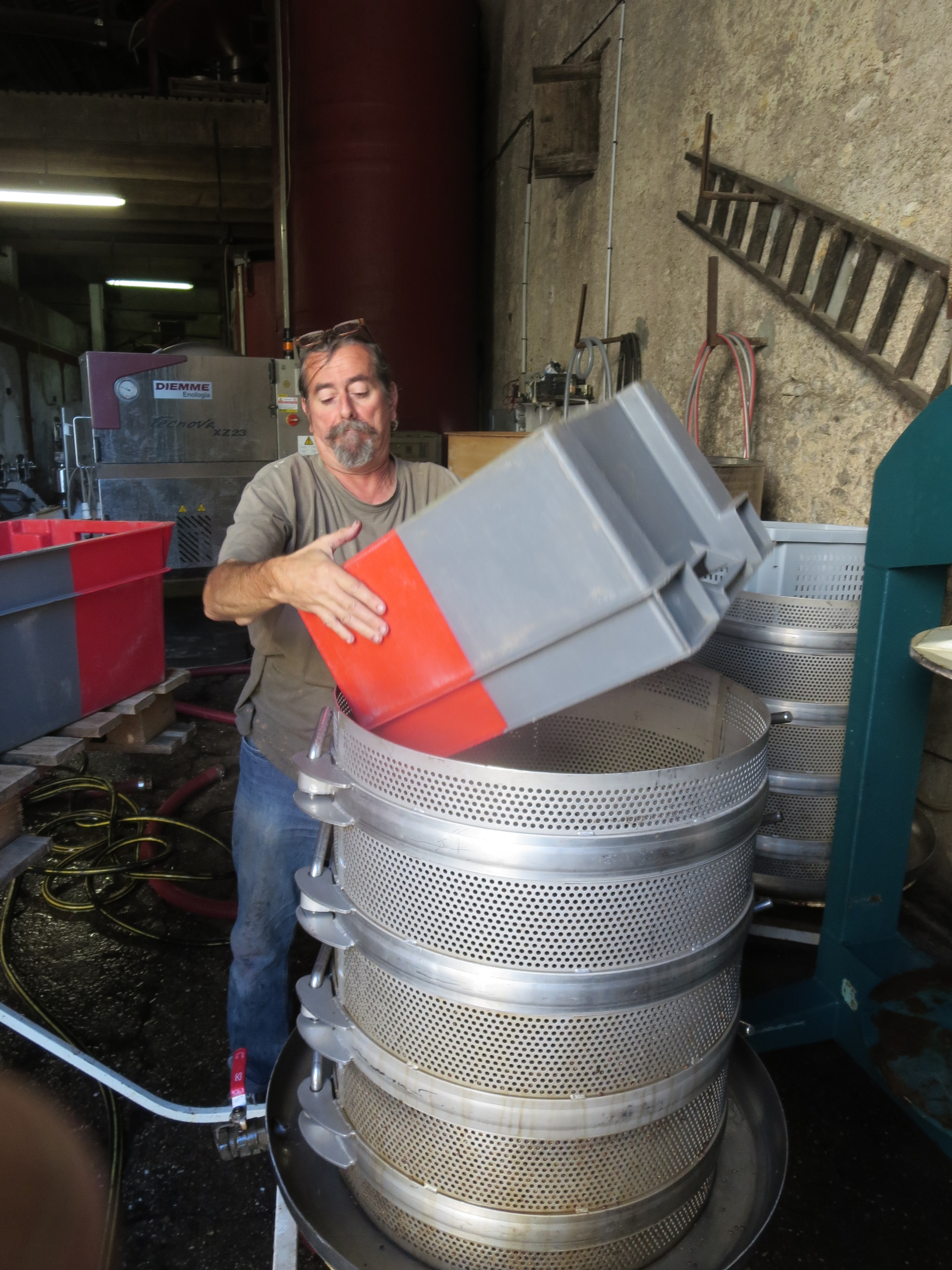
Michel removes the skins for pressing
Michel then loads the press
Gateau de Muscat
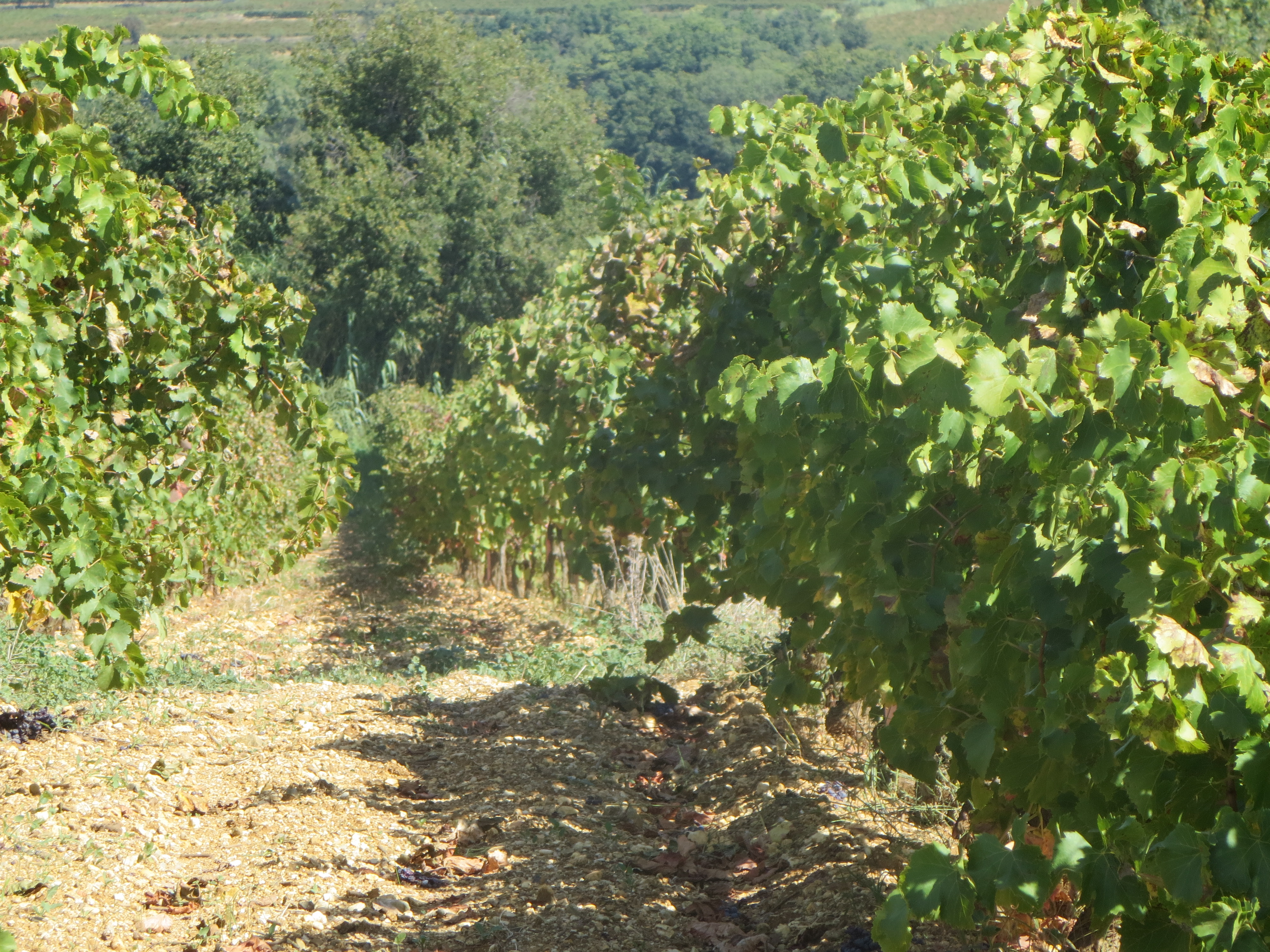
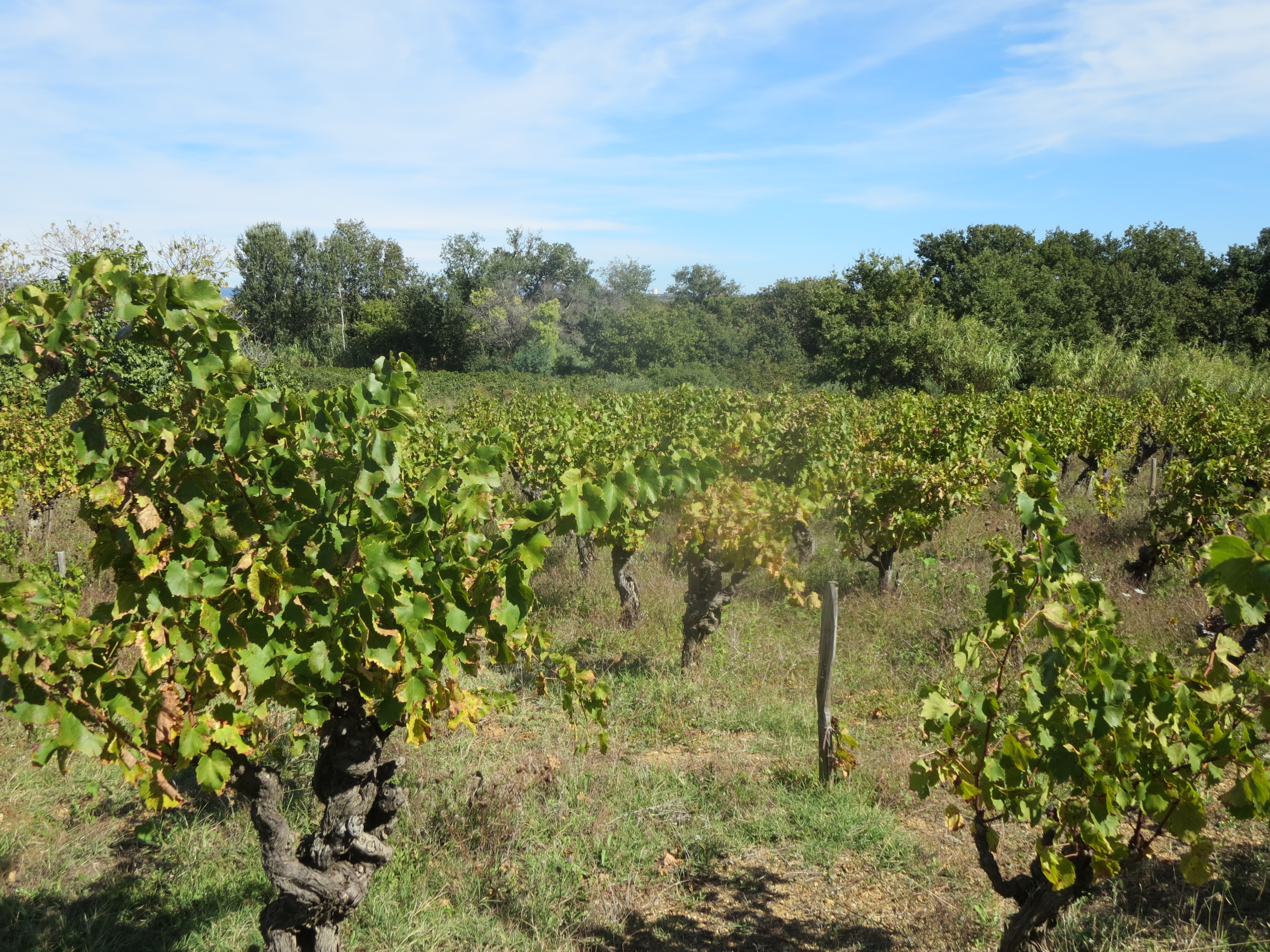
There are one or two small parcels still to pick but the main harvest is now over. It began back on August 21st so lasted just over a month. I shall be reflecting upon it and the lessons I have learned from it in the next article. Meanwhile I look forward to picking the Muscat from Rome and went to the vineyard on Friday lunchtime to take some photos. I was met by a family of partridges, butterflies and birdsong – Rome really is a magical place. In La Garrigue the vines are starting to show their autumnal colours, their work is done for 2015. The vines have given everything to their fruit in the last month and the leaves which remain after harvest are looking tired after a long, hot summer. All, or nearly all, is safely gathered in.
La Garrigue, Friday. The grass across the centre marks the ridge with Grenache near side and Syrah far side.
Grenache leaves showing that autumn approaches, harvest is over
The storms which brought so much rain to Puimisson and the Languedoc on Saturday meant that there would be no picking on Monday or Tuesday the 14th and 15th.
Preparations for cellar work
Instead Jeff, Michel and Cameron were hard at work in the cellar for the two days. There is lots to do there so it was an opportunity to get everything on track. Lots of remontage, sous tirage etc. On Monday the 14th the Syrah which was to be made with carbonic maceration was pressed after its few days in tank with the fermentation inside the skins.
The Syrah being pressed
The video shows Michel in the cuve moving the grapes to the front where Jeff forks them into the pump. You will see the grapes moving through the pipe into the press.
By Wednesday 16th the weather had turned much clearer and good winds meant that the grapes and soil were beginning to dry out nicely and so picking recommenced. The centre of attention was Rec D’Oulette known locally as Chemin De Pailhès and the Carignan grapes which grow there. These are the grapes which make the excellent cuvée «Flambadou», perhaps the outstanding wine of 2013 (and Jeff tells me of 2014 too). The bunches which arrived were excellent in quality, so fingers crossed for another great wine.
Picking the Carignan
Carignan
The Carignan in tank
Analysing the Carignan
Meanwhile cellar work continued as Cameron carried out more remontages and analyses. Today one of the wines to be moved was the Merlot which was bright, fresh and colourful.
Délestage of Merlot
As each wine is moved around the cellar, for example to take it off its skins, each cuve has to be cleaned thoroughly and then it will be filled with another set of grapes or fermenting wine. There is a seemingly never ending merry-go-round of wines and quite how Jeff keeps track of them all remains a mystery to me. Each move has to be planned to ensure that cuves are available, cleaned and big enough.
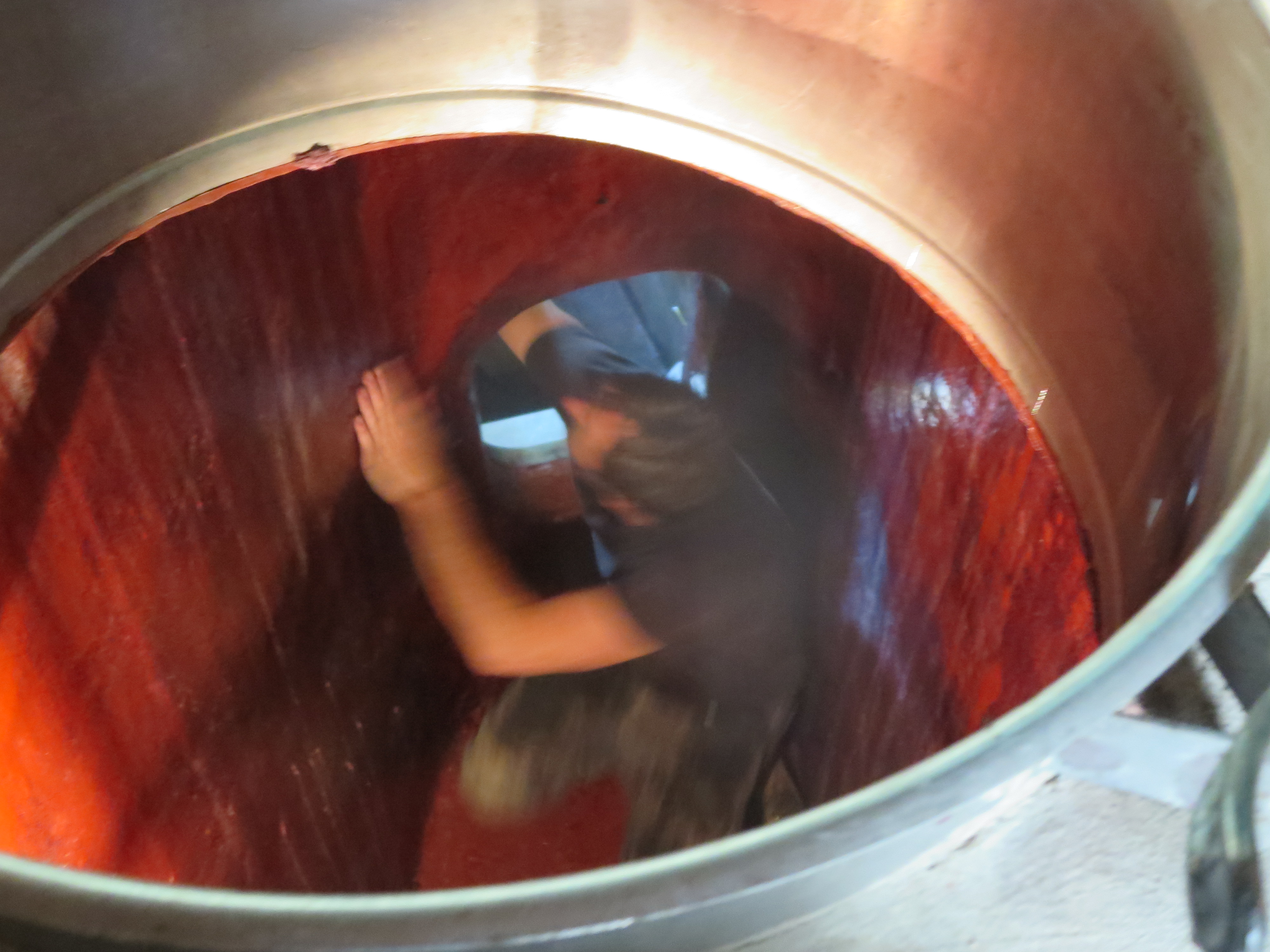
Cleaning from the inside
As a former teacher it reminds me of planning a timetable fitting in students, teachers and classrooms into the correct combination. Add in working as a mechanic to keep all the machines ticking over and the work of a vigneron becomes more complex, the job description is long.
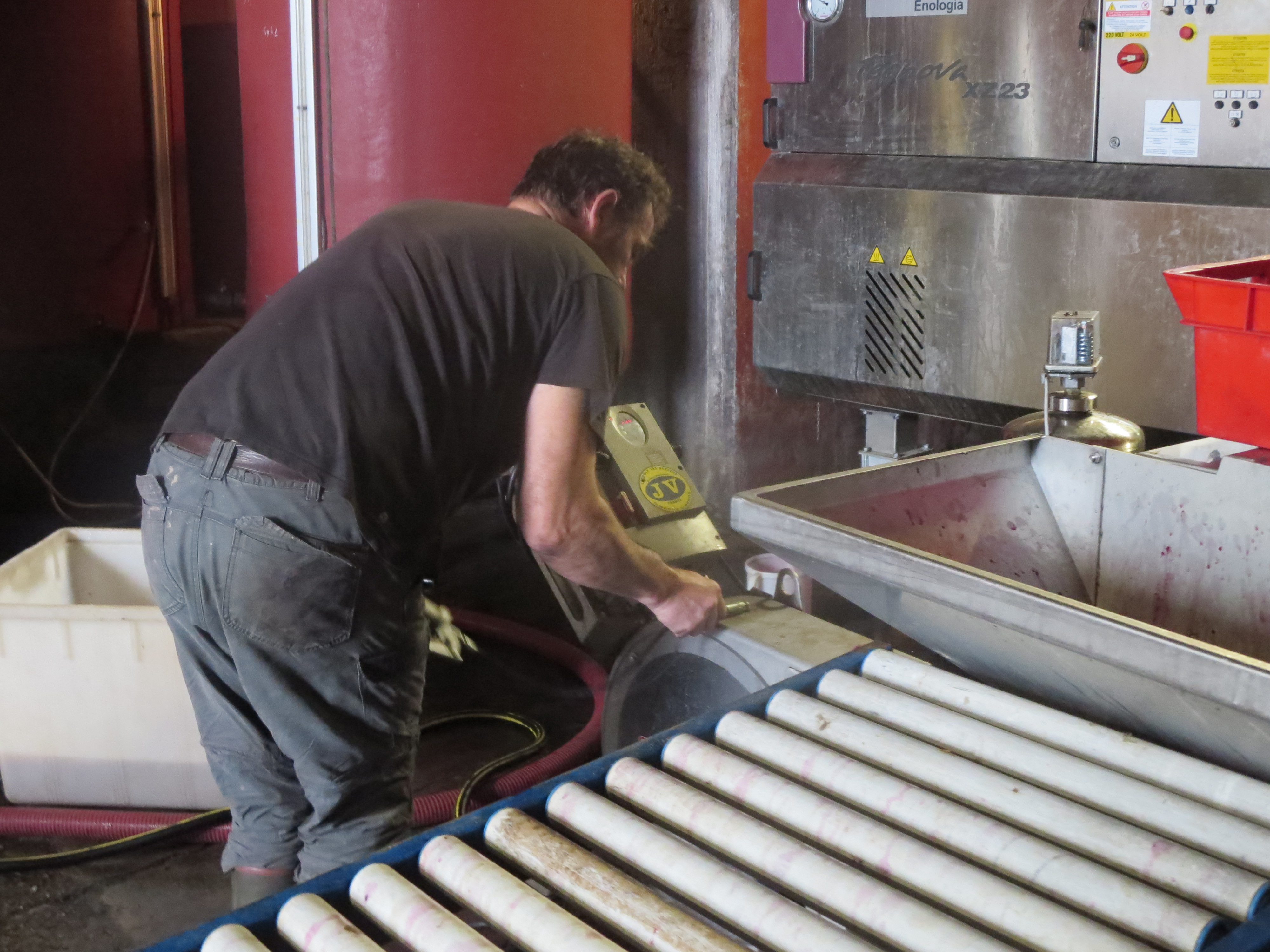
Maintenance of the égrappoir
Thursday 17thbrought Grenache from Sainte Suzanne (Metaierie), again carbonic maceration was to be used so back to the top of the cement tanks. Thomas was back and he, Cameron and I shared duties up there filling the tank.
l-r Cameron, Michel and Thomas
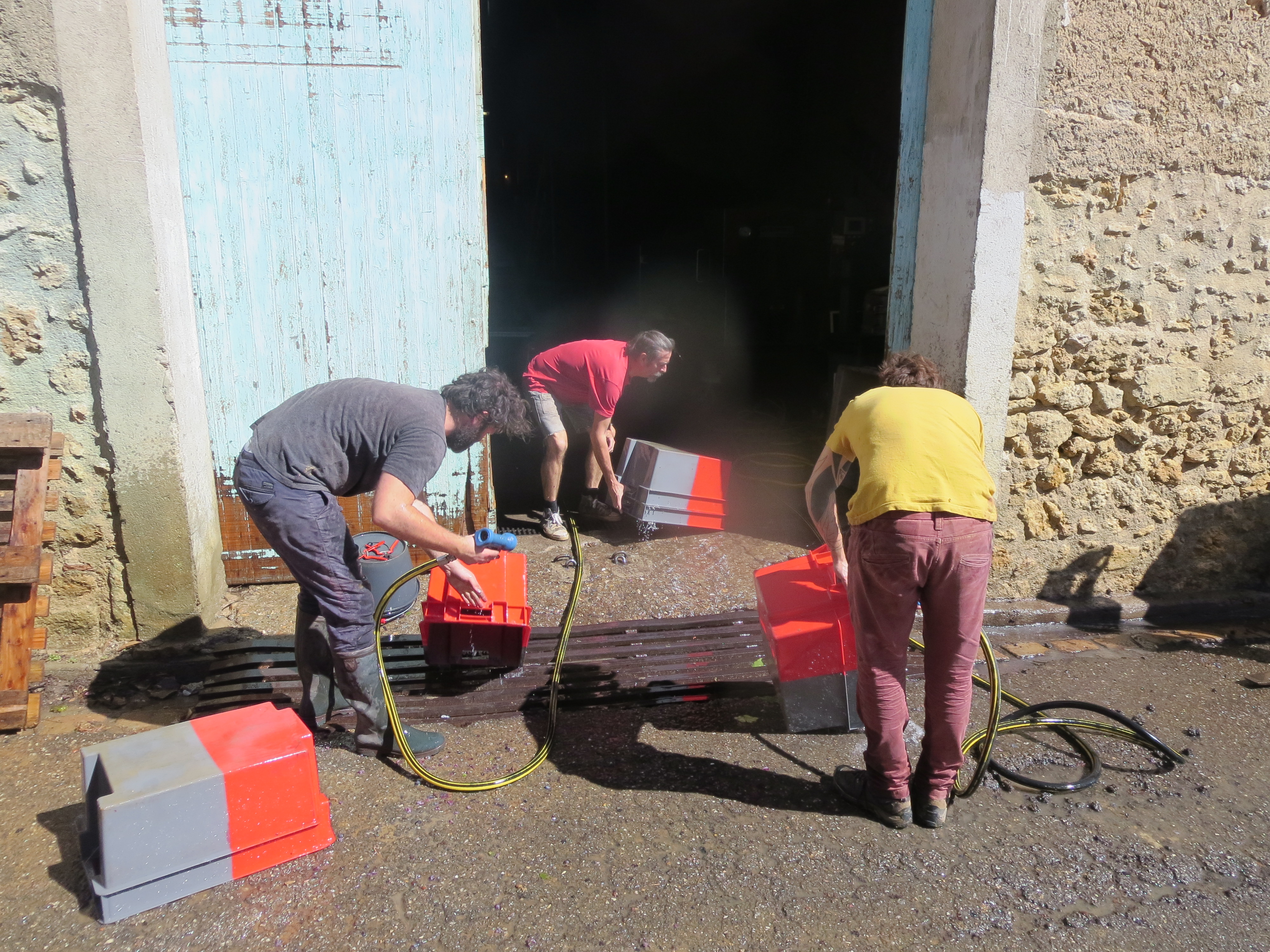
Then cleaning of the cagettes ready for the next new cépage. Following the Carignan of Wednesday it was time to harvest the Mourvèdre from Segrairals. One of my favourite grapes, somewhat fickle in character but when grown by good producers it adds a complexity and depth with a hint of dark mystery. The bunches which arrived were certainly amongst the best of the whole harvest at Mas Coutelou.
Magnificent Mourvedre
They were clean, big bunches, the grapes with thick skins and smelling already of spice and blackcurrants. Some of the bunches were very heavy and it wouldn’t take many to produce a bottle of wine, on average you need about 1.25kg of grapes to make the 75cl of a normal wine bottle. Sorting was quick and easy, the pickers had done a good job and the fruit was in such good condition. I look forward eagerly to finding out what Jeff has in mind for these grapes, when I have asked he simply smiles mysteriously, something is afoot!
Friday 18th brought the rest of the Mourvèdre still in tip top condition. When the pickers reached some of the lower parts of that parcel the quality did begin to dip a little so these bunches were taken away to be used separately, possibly for a rosé wine. I say possibly because final plans are a long way from being ready. Other jobs included pressing the Cinsault grapes which will make a rosé (definitely!!) and more remontages and analyses.
Remontage
We were joined today by Charles, a young Frenchman who works in a restaurant in Berlin, and whose mother was a former colleague of Jeff when he was a teacher in Paris. Coincidentally his boss in Berlin was a student of Jeff! Charles added a real sense of fun and worked hard.
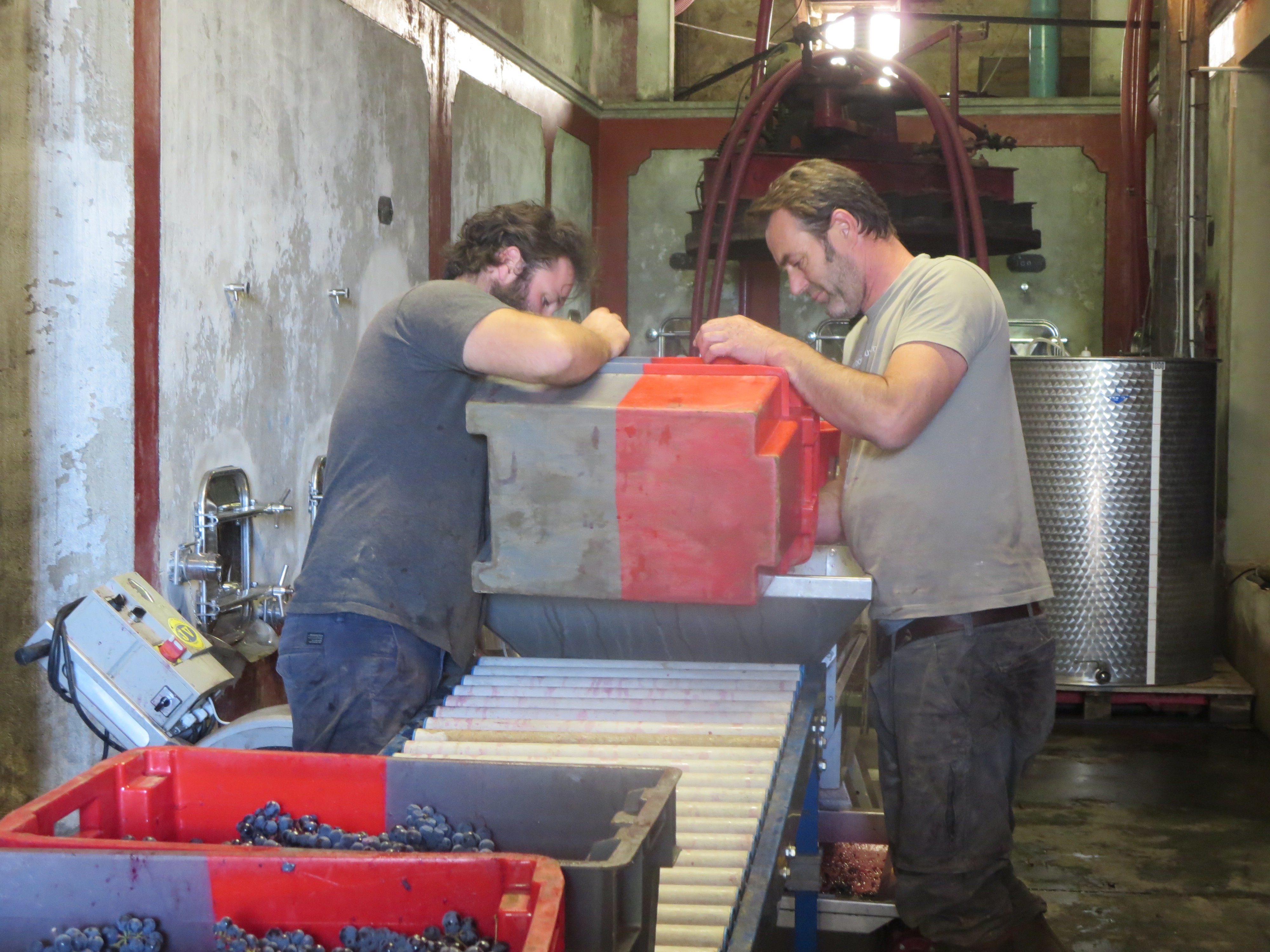
Charles fills the press
By Saturday I was ready for a rest and so the 19th was the work of the Jeff, Michel and Cameron as they processed the last red grapes from Peilhan. Some of these will be used for blending but amongst them was the famous Castets. This you might remember is a cépage produced by only two winemakers in France, Chateau Simone in Palette and Mas Coutelou. The first harvest was in 2014 and we had watched eagerly its development. In fact we have been drinking some during harvest lunches and it is very promising, brooding with deep, dark fruit flavours and a freshness to lift it. Only 3hl was produced again this year, the same as last year.
Castets in tank
On Sunday 20th Jeff carried out a débourbage of the Cinsault rosé which was pressed on Friday. Débourbage means taking out the pips and skins etc to leave the juice on its own. The harvest is starting to slow down a little though much work remains to be done in the cellar. Jeff and the ‘Coutelou Gang’ will have certainly benefited from a little siesta in Sunday.
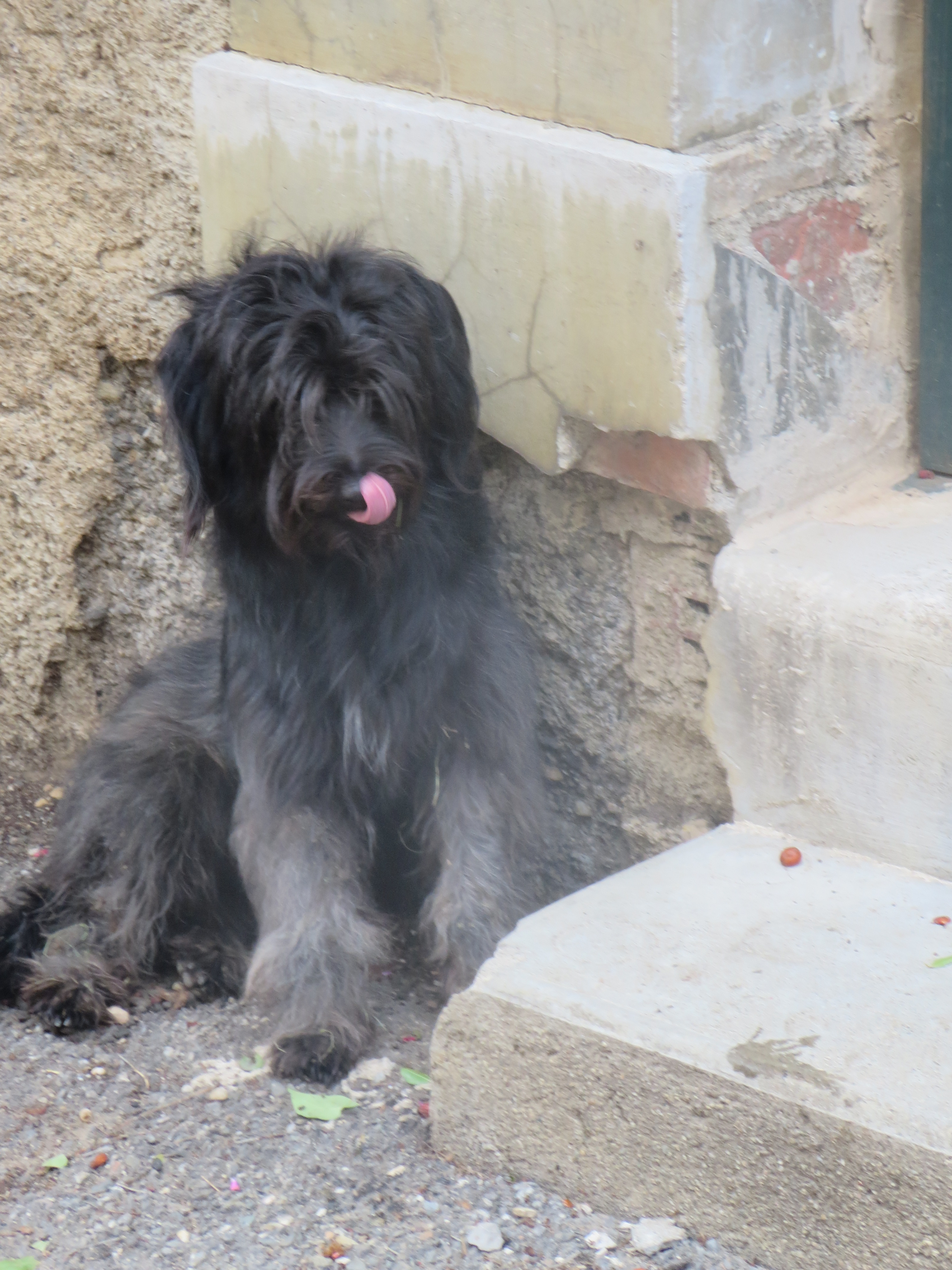
Icare licking his lips at the great wine being made (maybe)
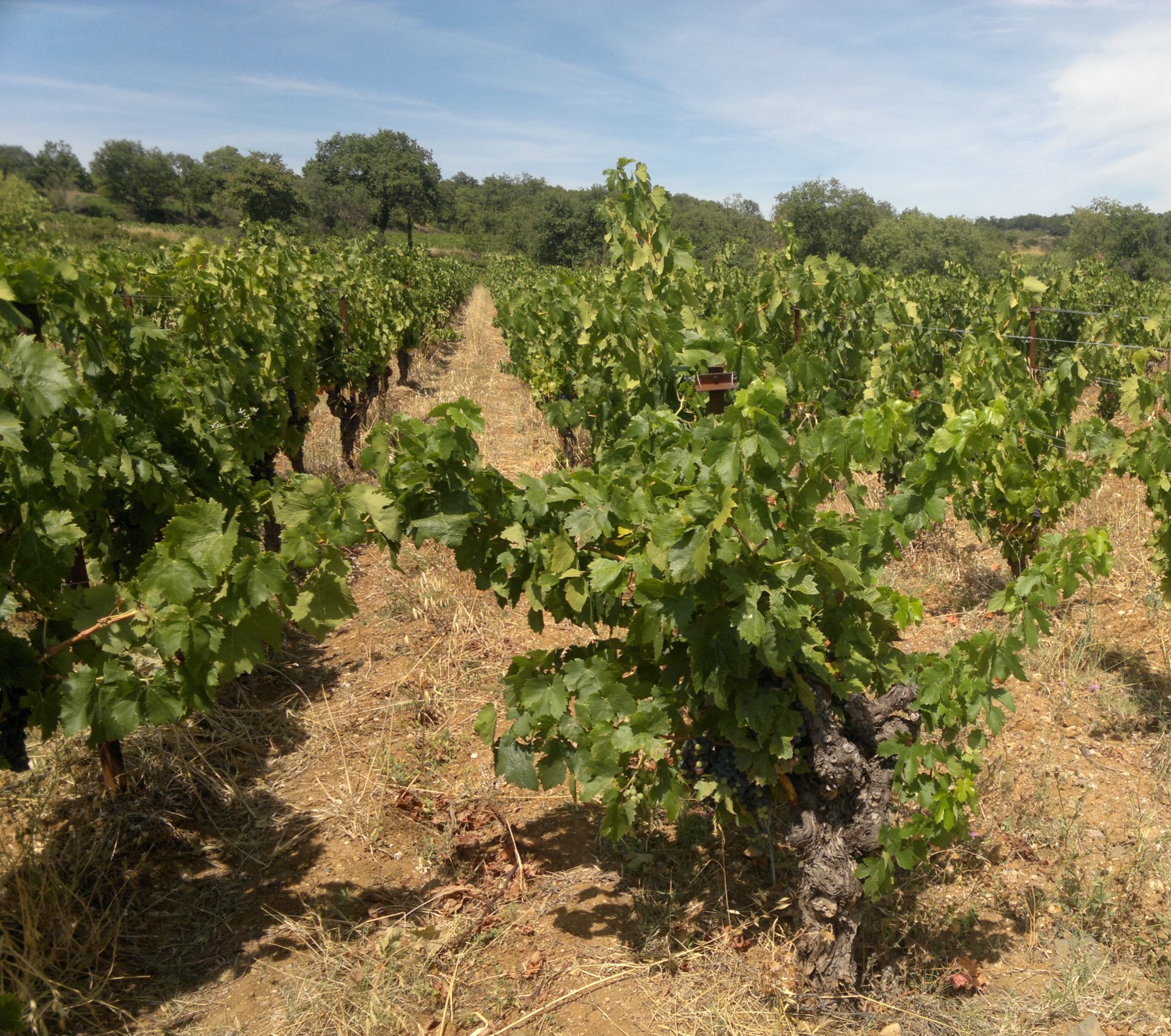
When you live in the Languedoc you are surrounded by vines. They are everywhere and form the world’s biggest vineyard area, producing one third of all France’s wine. Vines stretch over hill and valley, coastline and plains. As you walk around it is easy to think of vines as all being the same, part of one big plantation, but when we have received visitors and we go on walks through the vineyards they often ask me what sort of vine we are passing. Cue guesswork on my part unless I am in the vineyards of Mas Coutelou. To remedy this ignorance and to meet the brief at the top of this blog that I should be “learning about wine, vines and vignerons” I set myself the challenge of being able to identify the main types of vine in the region.
Ampelography is the study of identifying and classifying grapevines. There are many learned books on the subject, some running to hundreds of pages. However, I wanted a simple guide, to learn the basic varieties before expanding to others. I took some photographs in the parcels of vines of Mas Coutelou and using the internet and Jeff himself I hope I have put together a simple reference piece. As we enter harvest it has proved useful to me so that I know what I am picking or sorting. Hopefully it will be useful to you too, whether you visit vineyards or just take an interest in wine and vines.
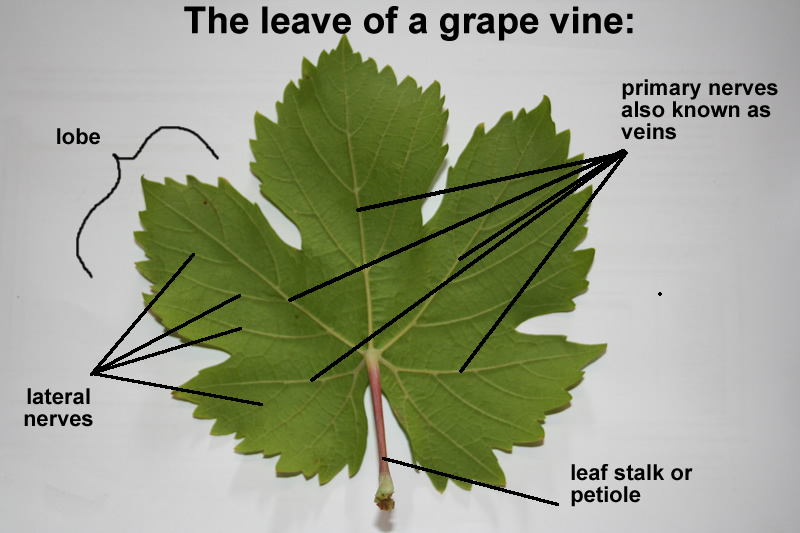
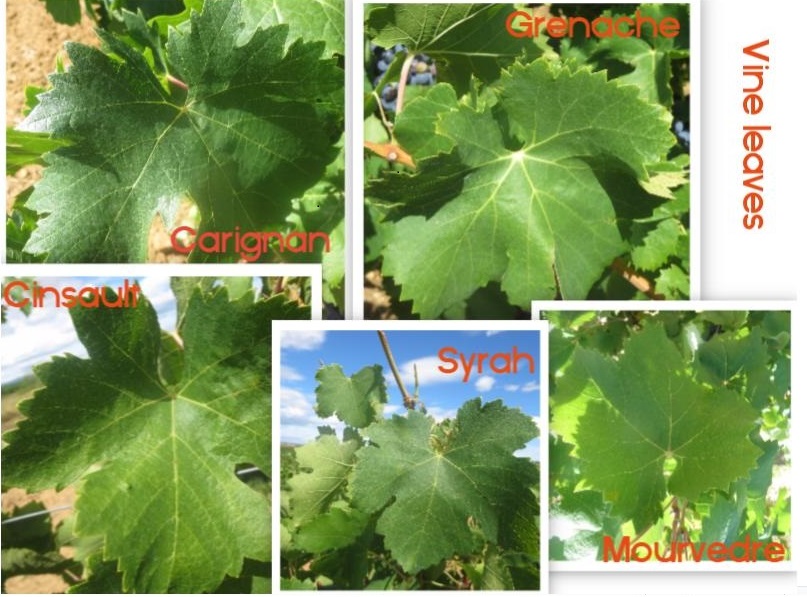
Experts use features such as the shape of the grape bunches, size and colour of the grapes. However, for me the most obvious way of distinguishing between vines are the shape of the leaves.
The colour of leaves varies but so too the number of lobes (from just one to seven), the colour of the veins and the shape of the sinus around the stalk (pétiole). The sinus is the gap between the lobes. So here is my simple guide to identifying some Languedoc vines. I have started in this post with the five main red wine varieties.
Red wine vines
Syrah
Syrah in Segrairals vineyard
Syrah is one of the great varieties of the Languedoc. Famous for its wines in the Rhone Valley and around the world (Shiraz in Australia) Syrah produces great wines here too. The leaves are quite a light green in colour with 5 lobes which are well separated out including a big sinus (V shaped) around the stalk (pétiole). The veins are quite light and stand out. The leaf edge has small, gentle teeth shapes. The grapes tend to be oblong shaped and fairly small in size. Syrah is one of the earlier red varieties to ripen.
Recommended wines:
Mas Coutelou – La Vigne Haute
Others – Sylvain Bock, Raffut; Plan De L’Homme, Alpha; Haute Lignières, Sur Le Fil; Terre Inconnue, Sylvie
Syrah grapes
Grenache
Grenache in La Garrigue
A variety which loves the heat, very much a Spanish and Mediterranean grape. Grenache leaves have a more round appearance than Syrah with big, wide lobes which are not so separated as the Syrah giving the impression of a big, whole leaf. There is a wide sinus around the stalk. The leaf edges have saw teeth which are quite marked. Light veins and round, medium sized grapes. Grenache is a late ripening variety. Often used to blend it is not often used for single variety wines.
Mas Coutelou – Grenache, Mise De Printemps
Others – Engelvin, Même-Si and Vieux Ronsard; Treloar, One Block Grenache;
Grenache grapes
Mourvèdre
Mourvedre in Segrairals
Mourvèdre is a late ripening and, sometimes, a difficult grape to ripen. The lobes are broad and form three rather than five as you can see in the photo on the right of the page above. There is a little green colouring in the veins and the sinus around the stalk is a lyre shape. The teeth around the edge are distinct and quite big all around. The grapes come in biggish bunches though the grapes are medium in size.
Mas Coutelou – Sauvé De La Citerne
Others – Clos Fantine, Cuvée Courtiol; La Liquière, Tucade; Treloar, Motus
Mourvedre grapes
Carignan
Carignan in Rec D’Oulette
Carignan has big leaves which are quite hairy underneath and have a more dimply appearance than most in the upper surface. Five lobes usually though in the photo above the lower lobes are small with big upper lobes and a distinct top lobe. The teeth are tapered and distinct. The veins are hardly coloured. This is a late ripening variety and you can see the grapes below which are still turning black, even though this was taken at the same time as the other photos. The grapes and clusters are medium to large in size.
Carignan grapes
Mas Coutelou – Flambadou
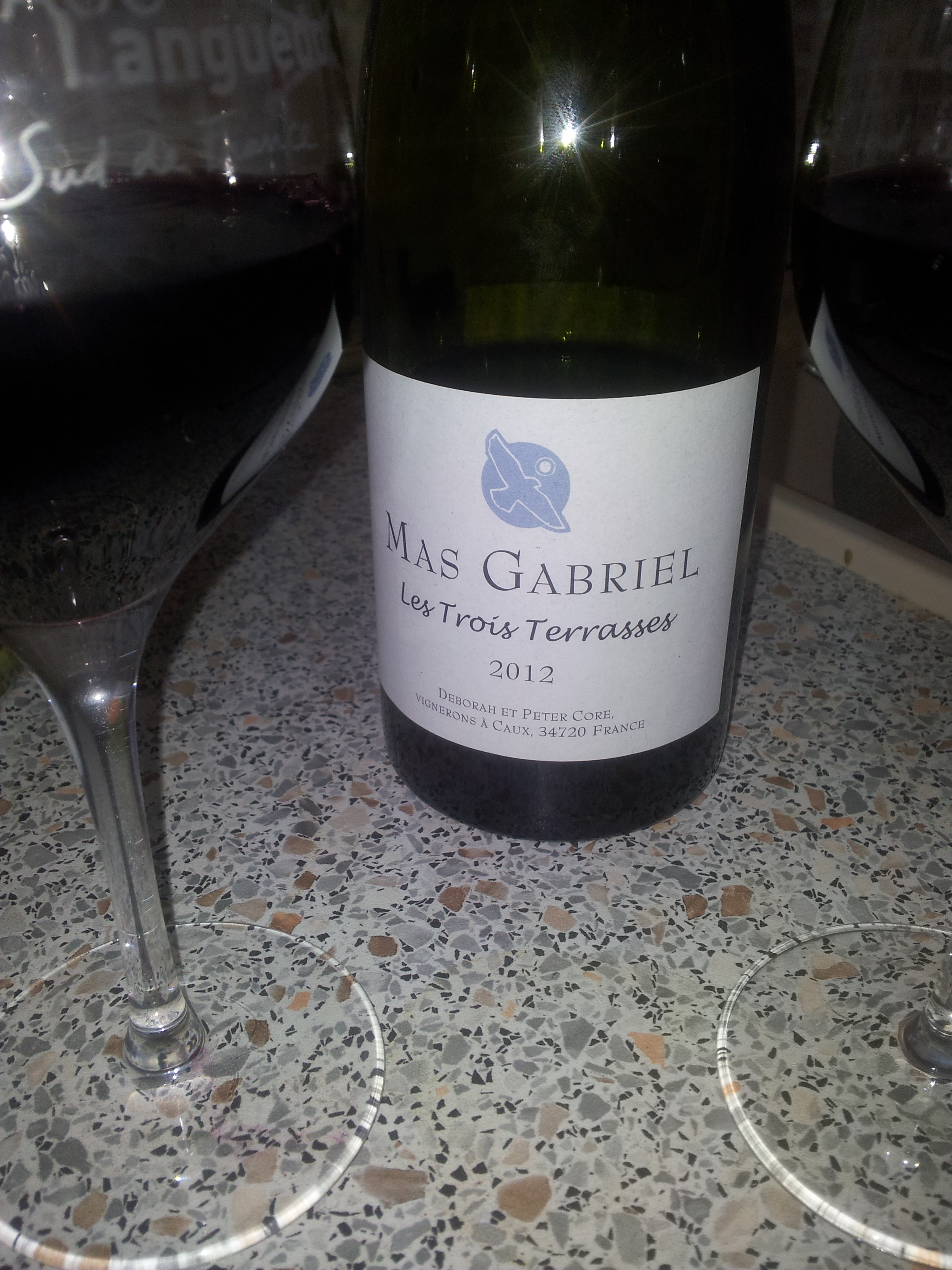
Others – Mas Des Capitelles, Loris; Coume Mayou, La Loute Mas Gabriel, Trois Terrasses Deux Ânes – L’Enclos
Cinsault
Cinsault in Segrairals
I like to think of Cinsault leaves as being very like the grape’s flavours, open, friendly and welcoming. These are big widely spaced lobes and a deep, open sinus around the stalk. The veins are light and clear and the teeth are big, almost rounded which cover all the leaf edge. Often used in rosé wines Cinsault is starting to be used to make some great red wines in the region.
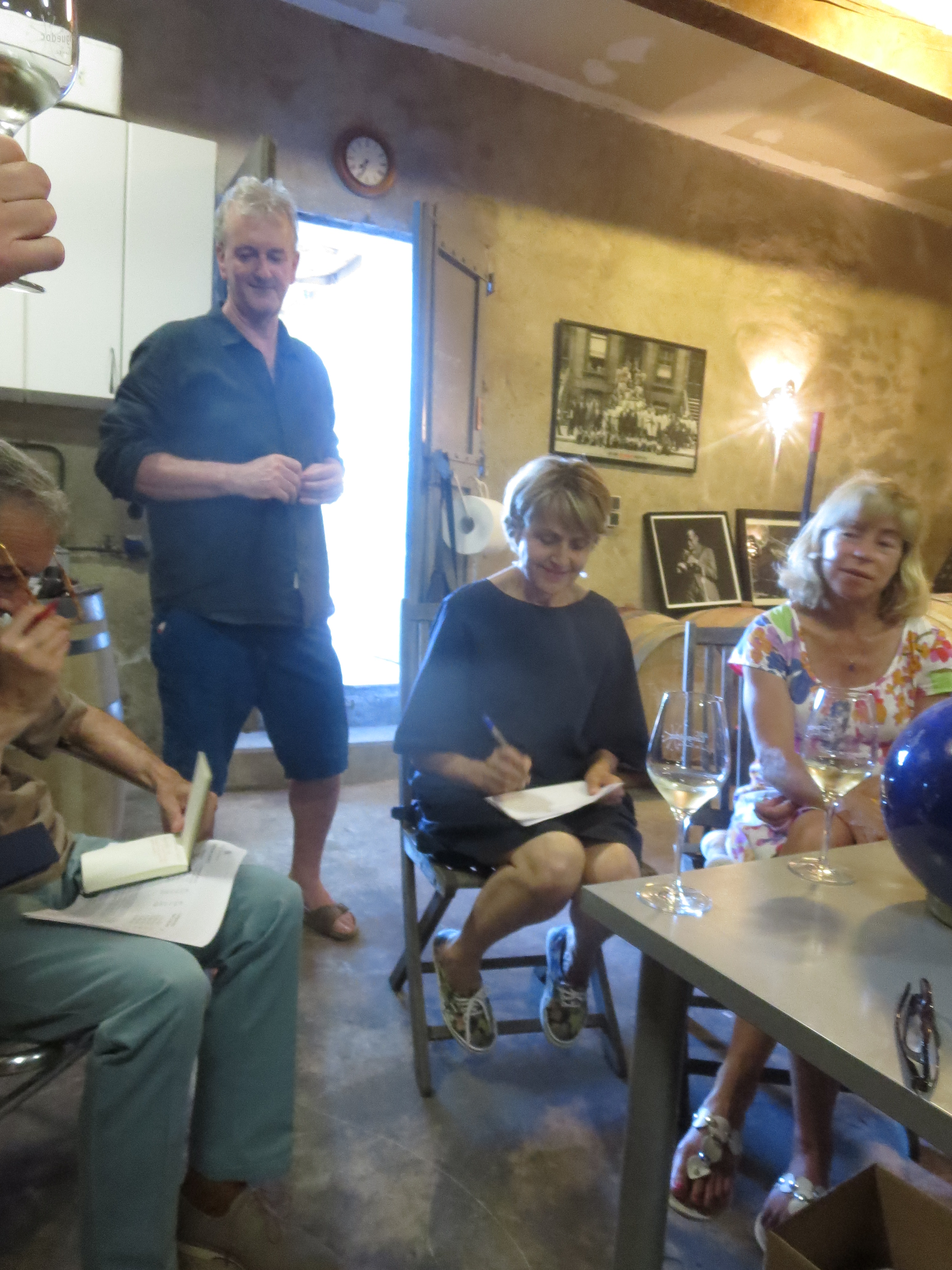
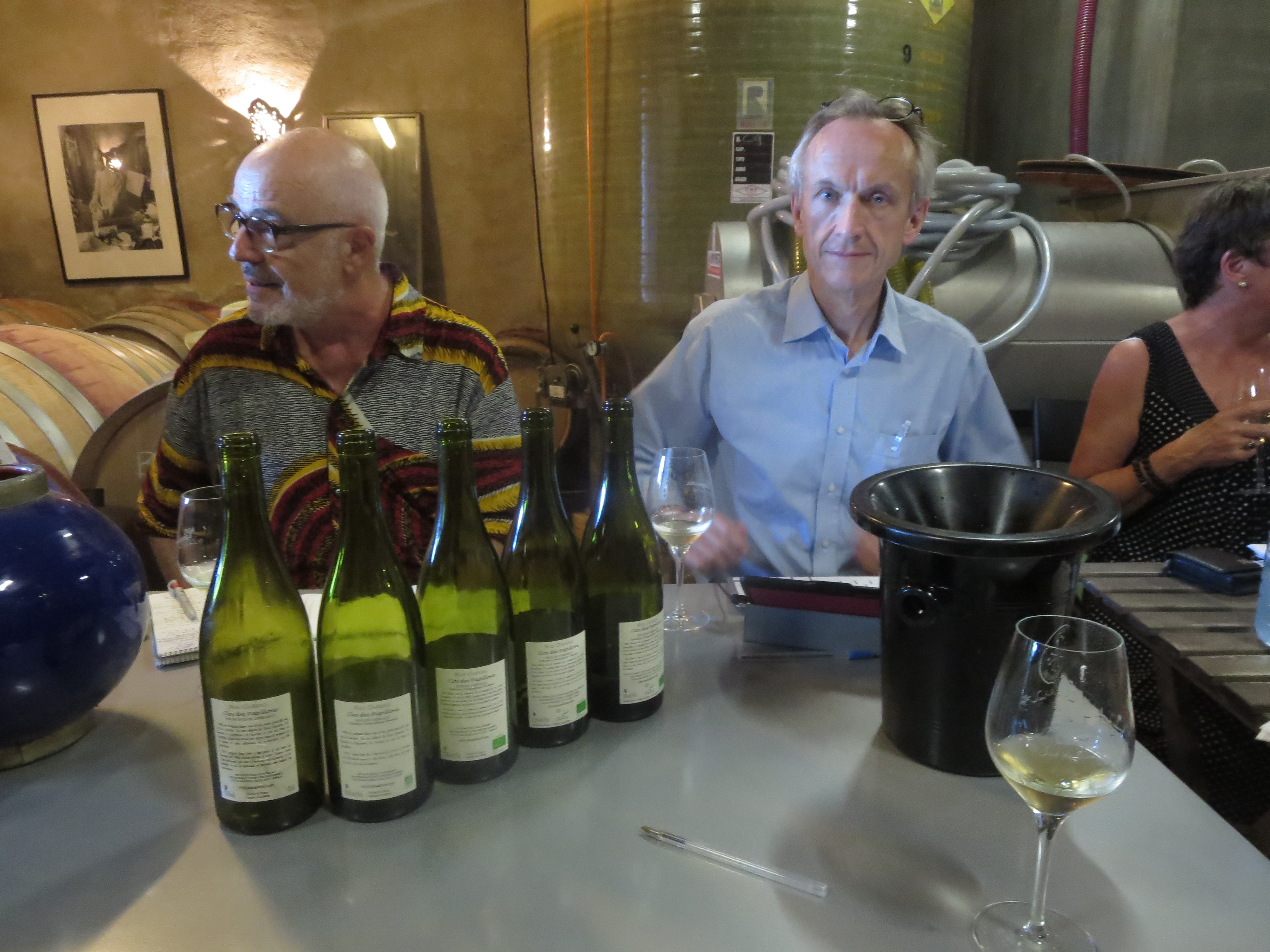
Deborah and Peter Core have been making wine in Caux (34) for 10 years, a cause for celebration. I was truly honoured to be invited to share their celebration evening with a vertical tasting of their Carignan led wines and a dinner held in their cave and garden. Present were luminaries such as Rosemary George, Michel Smith, Andrew Jefford, Catherine Roque of Domaine Clovallon, Gary Voss and Annette Atkins of Voss Estate in Martinborough, New Zealand along with Helen Deneuve who works for Coteaux Du Languedoc and other wine groups and is a good friend of Deborah’s, as well as Wendy Gedney, owner of Vins en Vacances, a wine tours company, Christopher Gallaway, wine expert and Bernard Degioanni, wine and food journalist, so it was a true privilege to be amongst their company.
l-r Christopher, Gary, Annette and Wendy
Michel, Andrew and Rosemary at work whilst Peter pours
l – r: Bernard (just), Peter, Catherine and Helen
Mas Gabriel has long been one of my top Languedoc wine domaines and I have purchasing from there over many vintages. I have huge respect for the Cores who gave up successful careers in London in law and finance to follow their dream of making wine. Having trained and studied in New Zealand and France, they decided on the Languedoc as the region which would offer them what they were seeking in making their wines. Land was bought around Caux and the work began. What courage to embark on such a venture and the going must have been immensely difficult at times in the ten years which have followed. Learning about your vineyards, making wine in different vintages, mastering the bureaucracy in a second language and, not least, finding markets. That they remain so passionate about their land and wines whilst being the most courteous and charming people is testament to two people of strength, determination and talent. Their wines are produced organically, indeed biodynamically, and are marked by freshness and fruit.
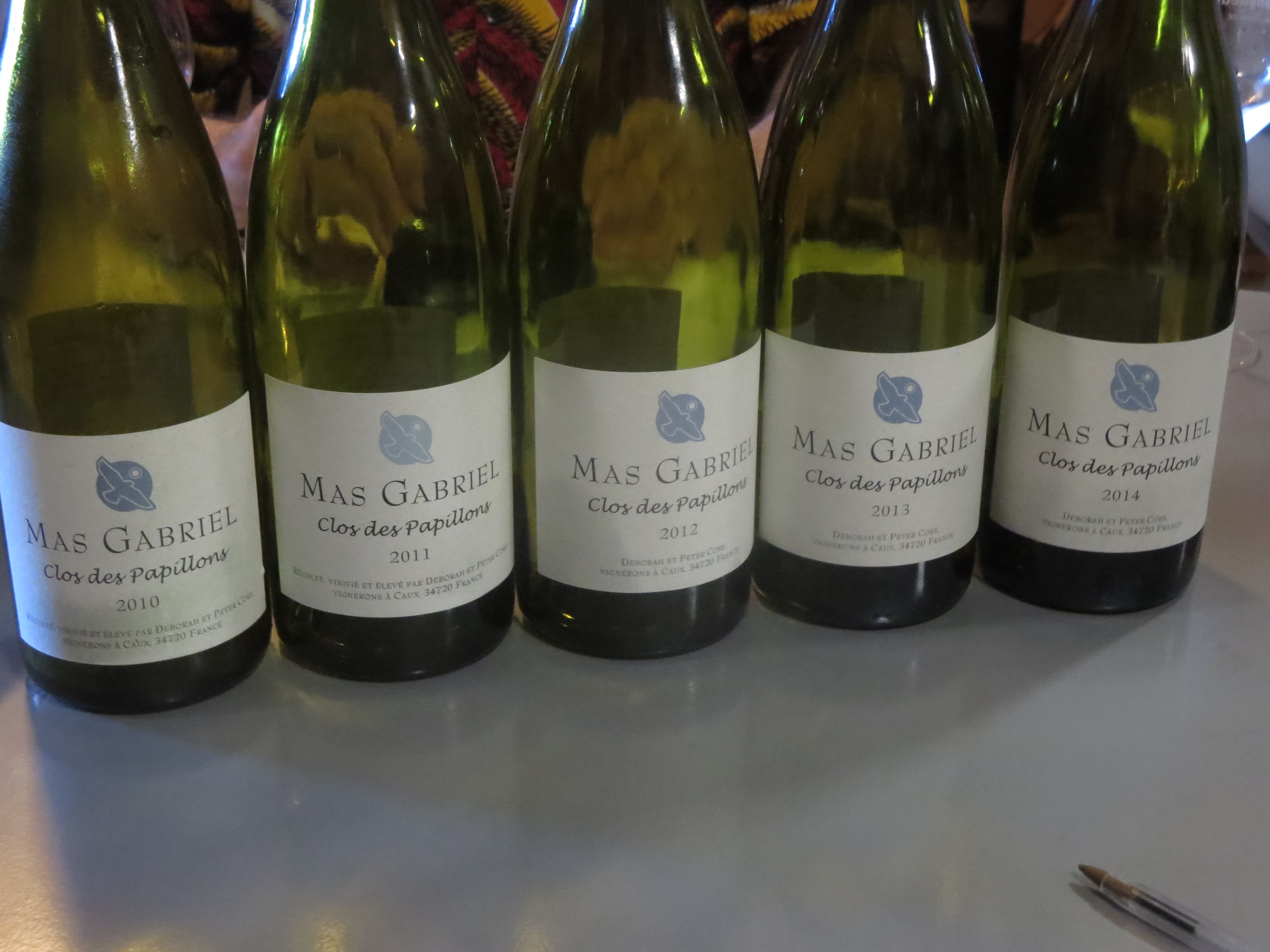
We gathered in the cave for the tasting and began with a flight of 5 vintages of Clos Des Papillons, the white wine of the domaine (though joined by a new white cuvée in 2014, Champ Des Bleuets). Papillons has long been one my favourite white wines of the region so this was a special treat for me.
Until 2014 the Carignan was given a small 5% addition of Viognier but in 2014 the Cores changed this to 15% Vermentino. Around a third of the Carignan Blanc is aged in acacia barrels to add a little complexity without oak flavours. There is no malolactic fermentation as they seek to reflect the freshness and natural acidity of Carignan Blanc. When the wine was first made yields were tiny at 12 hl/ha but much work and even more cow manure has helped to boost yields to 20-25 hl/ha. There are only around 0,4ha of the vines (more have been planted) and this is a variety with only about 40ha in the Languedoc so Mas Gabriel has around 1% of them all. Peter and Deborah actively sought out the parcel after tasting the Carignan Blanc of neighbour Conte De Floris, who does make excellent wines also. The parcel they found is made up of 40 year old vines in gobelet on a sandy, limestone soil.
So, the wines:
2014 – The first Clos Des Papillons with 15% Vermentino, which is grown in soil with galets, large round flat stones. The wine is very young still and a fresh, lively aroma is matched by a dry, very mineral initial taste. Fresh, fleshy fruits then fill the mouth to round out the dry core of the Carignan, like a peach with the fruit around the stony centre. The Vermentino certainly appears to provide that fruity roundness though the Carignan was slightly less acidic than usual in 2014 too. The wine comes together to form a lovely, refreshing, clean taste. It is very young, it will fill out further and I really like it.
2013 – A big rush of freshness leaps from the glass. Green and yet apricotty. It settles down quickly and lovely fruity, dry aromas emerge. The harvest was quite late in 2013, September 16th, so the nights were fresher as the grapes reached the optimum ripeness, and this is reflected in the fruit itself. Huge flavours of yellow and white fruits mixed with fresh acidity – always in balance, always with a delicious tension. Lovely, a very good wine.
2012 – Yellow, almost light golden in colour. I could detect a little more evidence of wood on the nose but nothing out of balance and it provided yet more complexity, there was no obvious taste of wood. The acidity appeared less obvious, though it was actually a lower pH than usual, the result of an extra year in bottle? Juicy, yellow fruits, with an edge of citrus and agrume. Stony, clean and delicious. I smiled in relief that I have resisted temptation and kept a bottle or two of this vintage, excellent.
2011 – Woh, what a nose, almost ‘Riesling’ in character with hints of kerosene. Happily, Wendy Gedney agreed with me, it’s not just me! Full flavours, lingering lime and lemon fruit flavours add that delicious freshness, definitely more so than 2012. Long, refreshing, balanced, poised! This was the earliest picked vintage (August 24th). It has years of life ahead if anyone still has a bottle (sadly, not me). I loved this.
2010 – Lively, this is certainly not on a downward slope, far from it. Still a yellow/green Starburst citrus edge. the highest acidity of any of the Carignan vintages yet the wine has rounded out a little. There is a saline, mineral edge in there too but then as you drink (and I did drink some!) an almost waxy, oily finish which helps to coat the mouth with the yellow and white fruit flavours. Lingering, clean and lovely.
Clos Des Papillons ages well, no question about it. The freshness and acidity surely help this and whilst difficult to resist drinking in a year or two I am now determined to hold back some bottles. Interestingly, Andrew Jefford was slightly less in agreement with most and would welcome some malolactic fermentation to round out the flavours more. For me, I love it as it is. To choose one vintage? I really like them all, there is nothing here to which I would not give at least 4/5 on my personal scale. 2011 perhaps but maybe 2013 just wins with the freshness, sorry Andrew.
In the Trois Terrasses vines with Peter in 2012
So to Trois Terrasses, the first of two red wines made at the domaine, the other being Clos Des Lièvres, a Syrah led wine which is bigger and more powerful, and also excellent I hasten to add (deserved Gold Medal winner at Millésime Bio this year). The first two vintages in 2008 and 2009 were 100% Carignan but in 2010 came a change with 20% Syrah and afterwards up to 30% of the wine is Syrah and Grenache. These are vinified separately in cuves, the Carignan cuve being cement the others fibreglass. Peter explained that yields of the Carignan were only 10 hl/ha at first but they have built this up, with more hard work and cow manure, to 25 to 30 hl/ha on average. This is reflected in gradually lowered alcohol levels in the Carignan with slightly higher acidity.
2013 – Slightly reductive at first but that blew away within a few seconds to leave a torrefacted nose with plummy, dark fruits which carried over into the flavours along with those coffee notes. There was an almost citrus freshness on the finish refreshing the palate. Spicy, peppery notes developed too and though this needs a little time yet, it is already good and will grow into something very good in a couple of years.
2012 – Rounder, darker, deeper. Complex nose of dark fruit with freshness evident even on the nose. Full in the mouth, rounding out with lots of fruit and minerality and always the trademark freshness which I love so much in Mas Gabriel wines. It is a characteristic which reminds me so much of biodynamic and organic wines, dare I say natural wines too! It certainly appeals to me.Still youthful, this is a wine which has been a big hit with friends and family when I have shared a bottle with them. Very good.
Here’s one I shared earlier
2011 – Rounder aromas, hints of cassis. Perfumed and fruity, very heady in a pleasing manner. It tastes round and full too, ripe plums and a raspberry fresh note. Liquorice with pepper sprinkling the range of flavours too. As the wine evolved in the glass there were even smoky notes emerging. Very complex, but all working well together, always lovely to drink and, yes, that fresh finish. Very good.
2010 – The year in which Syrah was first added to the Carignan. Fruit aromas spring out from the glass, cassis, blackberry and red fruits too, lively acidity. Ironically, given the blending, Carignan characters emerge, a slightly leathery, wild edge to add to the complexity. Plummy but not too fruity. No sign of being old, still very much a wine reaching its peak with a long time to enjoy it. Harmony despite all the complexity, balance and freshness, of course. Very good.
2009 – 100% Carignan. Almost restrained on the nose, the wine colour is garnet and fresh, no signs of starting to age. A wine reaching its prime but still plenty of life ahead. Pure, direct, lovely fruit with some dusty, round tannins. The acidity is still fresh but beautifully balanced with fruit profiles such as raspberry, cassis, blackberry, plums – round, ripe and delicious. Deep, complex, full. Superb. There was a noticeable lull in conversation as we tasted this wine, it stopped us in our tracks and we had to simply stop and admire, hallmark of very, very good wine.
2008 – The first ever Trois Terrasses, pure Carignan. I detected a little more alcohol on the nose but nothing off putting. Soft, easy to drink with black fruits and a little gaminess, tannins still present but soft and supportive to the wine. Very much alive and kicking, it will continue to grow. I liked it, a lot, though perhaps overshadowed by the previous glass of 2009.
My favourite, most peoples’ favourite, was the 2009. Joyful wine, the sort of glass which makes you realise why you find wine so fascinating and rewarding. Of the blends, I particularly like the 2010 and the 2012 but I am happy to have some bottles of all of them left.
At dinner in the garden with a refreshing breeze
An interesting discussion followed as we compared favourites. Andrew Jefford had chosen the 08 and 09 and suggested a return to pure Carignan. Much thought for Peter and Deborah but they must have been delighted at how well the wines all performed, worthy of anyone’s cellar, certainly in the top rank of the Languedoc. I was so pleased for them, they deserve every little bit of credit and praise. I gather the thought of a pure Carignan was already in their heads, maybe this evening will influence them.
And so to dinner, made by Deborah and her friend Helen Deneuve. They even provided me with a superb vegetarian main course which was one of the best I have eaten in a long time. To accompany dinner the Cores served their Carignan rosé, Fleurs Sauvages, so popular that it disappears very rapidly out of the cellar every year, and justifiably. Various bottles of Clos Des Papillons and Trois Terrasses also appeared on the table to be drunk not just tasted. A fitting end to a fantastic evening. The conversation flowed, Michel entertained us royally (am I allowed to use that adjective for a Frenchman?) and then provided a beautiful Banyuls Mas Blanc 2003 to accompany a delicious chocolate gâteau.
Deborah, Michel and a photo of Rosemary taking a photo
Thank you so much for the invitation Deborah and Peter, it was such a privilege to be present. There was talk of reassembling in another 5 years for ten vintages and that would be a dream. So raise your glass to Mas Gabriel, and make sure it is filled with one of their wines, you deserve nothing but the best, and so do they.
Since moving down to Margon it has been evident to me that many of my favourite bottles have been based around Carignan. A variety which received so much scorn for many years is now fighting back. The excellent wine writer Michel Smith has been in the vanguard by writing a series of articles called Carignan Story on the les5duvin blog, championing the variety and the people who produce great bottles of it. Moreover he is producing some himself in the Roussillon. (The blog is a must follow incidentally).
I shall start with Mas Coutelou this time as Flambadou is the star of the 2013 vintage at the domaine and is a wine which ages brilliantly as a memorable 2007 testified during a vendange lunchtime. If you opened the link to Michel’s Carignan Story you will have already seen his support for this wine too.
Jeff himself rates Cyril Fahl’s Clos du Rouge Gorge as one of the outstanding Carignan wines and based on my tasting in November (see Day 5) I would not argue. Domaine d’Aupilhac in Montperoux is another which has championed Carignan, blended in some cuvées or on its own in Le Cargnan which is a lovely wine showing the leathery, dark fruit flavours of the grape.
I must mention the wine ‘Les vignes qu’on abat’ of Domaine La Marféeproduced in Murviel lès Montpellier, a deep, dark joyful wine which needs a little patience in cellaring.
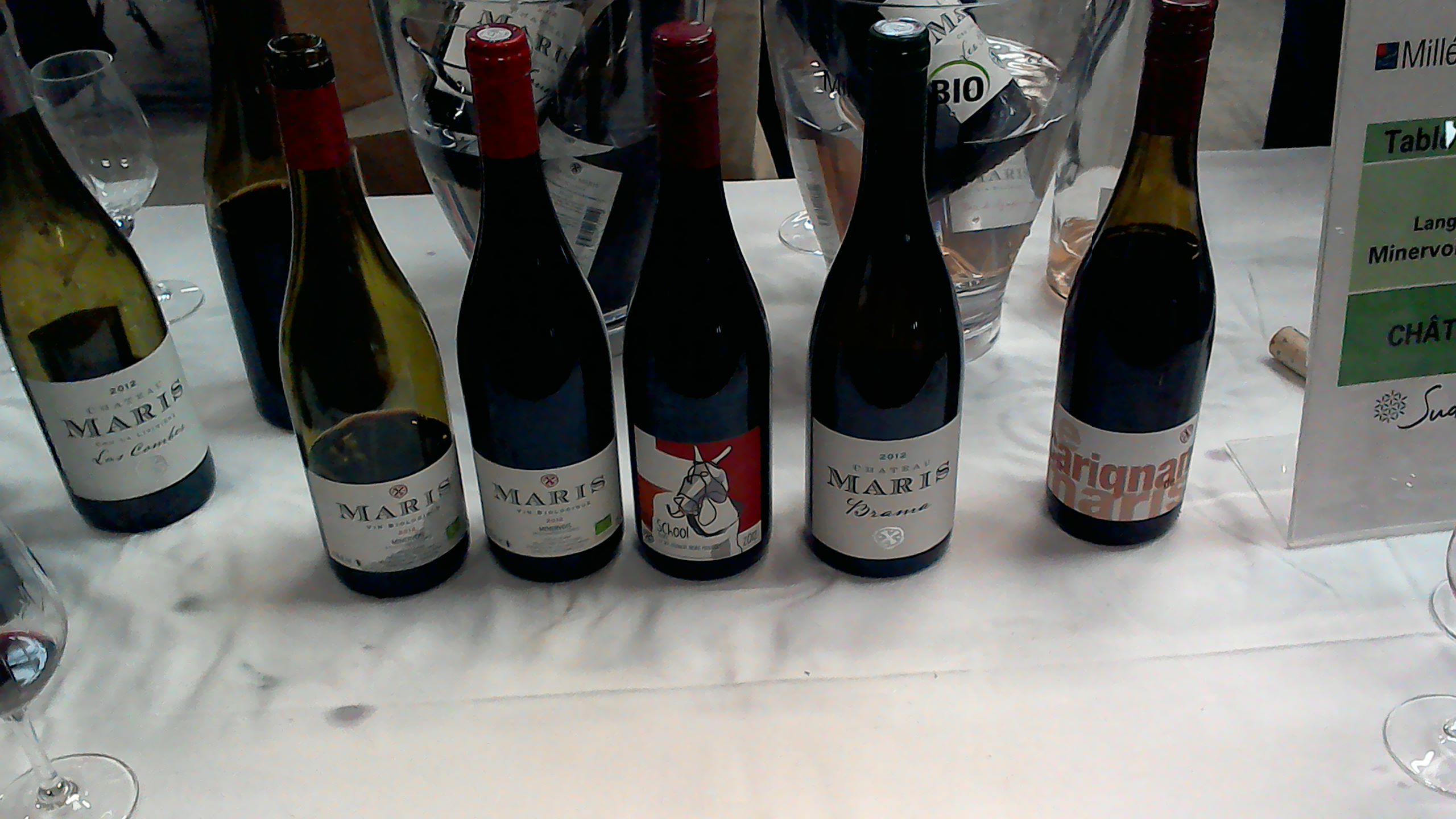
Other lovely Carignan bottles tasted include Cébene‘s Belle Lurette and Treloar‘s Le Maudit, plus the cuvées Les Premiers Pas and Fontanilles from Les 2 Anes. Domaine Sainte Croix (see Corbieres, Day 3) produces a couple of Carignan – led wines Magneric and Le Carignan, both express the wild garrigue of the Corbieres hillsides, lovely wines. In the Minervois, Chateau Maris also produces lovely Carignans such as Anciens and (again) Le Carignan.
Finally, I should mention a domaine close to me in Gabian, Cadablès run by Bernard Isarn is starting to produce some really good wines not least the Carignan led Champ de Pierres.
These are all wines I would heartily recommend, but that’s not the end of the story.
Carignan Blanc is fairly unsual in the region but two of my favourite white wines come from this grape and both from Caux where we started. Mas Gabriel‘s Clos Des Papillons is dry, fruity and clean, with a rich texture that fills the mouth, simply delicious. Le Conte De Floris produces Lune Blanche which is just as good and I was happy to find some bottles in the wine bar in Pézenas recently. So Carignan, red and white, is a variety to investigate. Dare I mention that Jeff produces another very good example of Carignan Blanc? Well I did leave him out of my 7Cs so I think it’s only fair.
So those are my 7Cs, villages, areas and grapes which are all a source of great wine pleasure. I could have added more with St Chinian as just one example. Proof that Languedoc Roussillon is a region of great variety, a region of great excitement as winemakers rediscover and redevelop the character of wine in this fabulous part of France. Any feedback is always welcome.
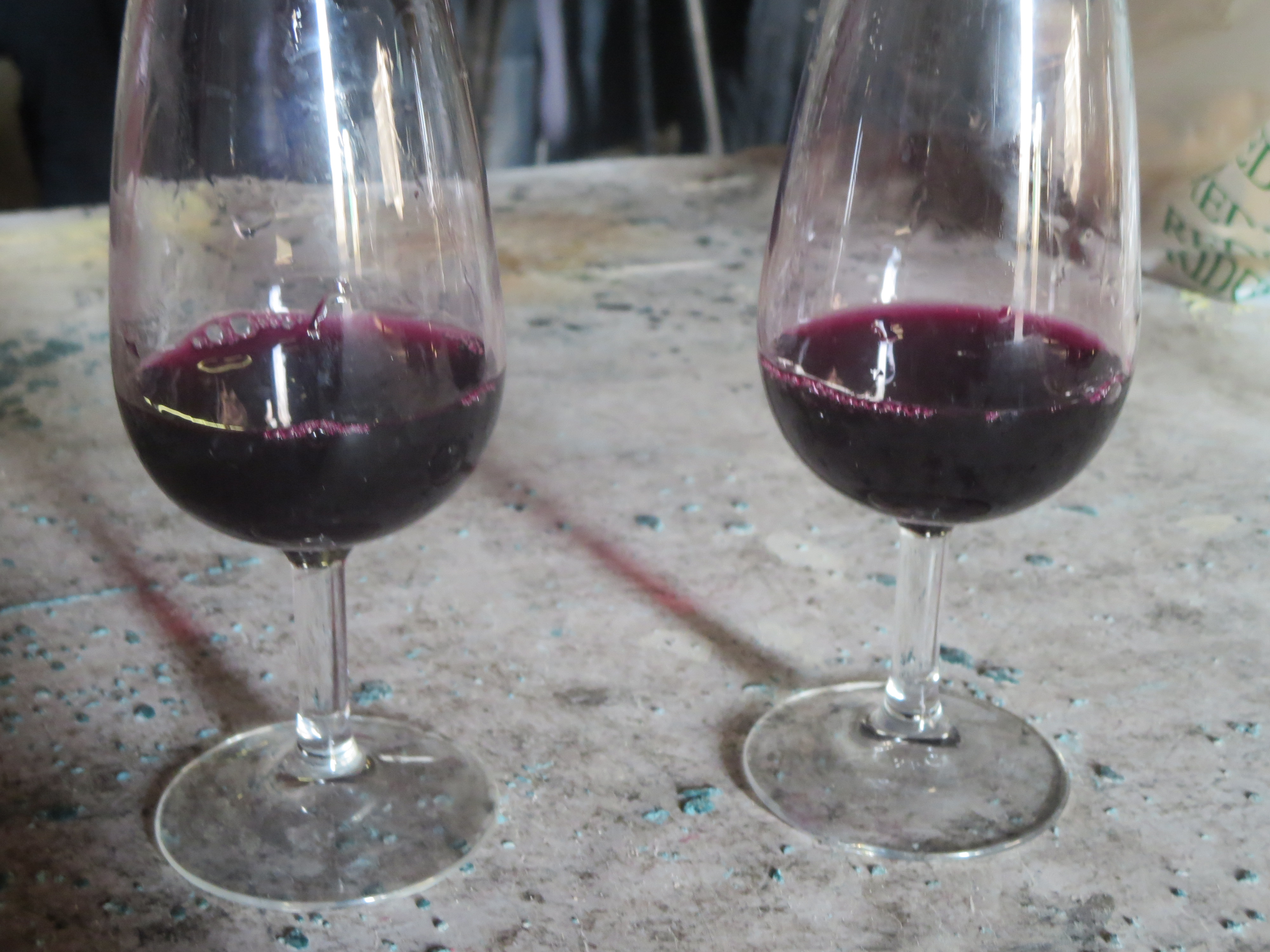
The assemblage for the 2014 wines is well under way, the wines are settling in tank for some of the well known cuvées such as Classe and Vin Des Amis. (Above are glasses of richly coloured Vin Des Amis). Both are delicious already and in the few days since I first tasted them they have shown development as they marry together. The fruit and freshness which characterise Mas Coutelou wines are evident and there is a marked concentration which shows that the wines will mature well.
Jeff has published his vintage report for 2014. Winter, spring and early summer were exceptionally dry (less than 150mm or 6 inches of rain in the 9 months to the end of June) and at that moment Jeff was far from sure that he would be able to harvest any grapes. Some relief came from a summer which was not too hot and peppered by storms. However, the vines had to dig deep into their reserves of energy in order to produce grapes. Troubles continued with some storms towards the end of harvest time and then the Marin wind with their warmth and high pressure meant that through the autumn and into December the wines in tank were not able to truly rest. It was a difficult year in short, a reminder that nature rules the life of the vigneron. Indeed some local producers have seen their crops virtually wiped out by hail and mildew so the wines that Jeff has produced are to be even more cherished.
Nevertheless there are some drawbacks. The harvest was smaller especially for Syrah, (down by 40%), Carignan and Mourvedre. Syrah is a major part of many Coutelou wines so Jeff has had to improvise and make the most of what he has. The lack of Mourvedre may mean that one of his popular wines ‘Sauvé De La Citerne’ will not be made. In addition the effort made by the vines means that they would benefit from a rest and yet this winter (thus far) has been so mild that they are starting to show signs of producing buds even in January (débourrement). Instead of resting they are starting to work hard already.
The wines I tasted from tank are marked by concentration and minerality. The vines had to push deep into the soil for water in the arid early part of 2014 so they have drawn up minerals from the soil’s depths. The mineral flavours are evident when drinking. A difficult vintage has produced some highly promising wines but in smaller quantity, so guard what you already have and appreciate the quality of the new wines.
Two wines to note.
PM, the rosé, is already gorgeous, full of fruit and perfume yet dry and absolutely delicious. At only 11% alcohol it is a wine to drink and enjoy.
A new wine made from old Cinsault, Aramon, Oeillade and Muscate. Tasted from tank this was already sensational, a red wine with grapey, perfumed scents and deep, concentrated red fruits. Can’t wait to see how this develops.
Jeff will be showing some of these new wines at a couple of tastings in the next 10 days, in Montpellier and the Loire. Today Jeff put the bottles together for those tastings, including some corking by hand. Nothing was easy about 2014!!
When Jeff suggested that I should attend Latour De France I was rather surprised as I was unaware of his love of cycling. A quick correction of gender and I was patiently told that it was a village in the Pyrenées Orientales where 12 of 13 winemakers are organic producers and several make natural wines. An opportunity not to be missed. Combined with visits to one of my favourite French villages, Banyuls, and also to Collioure this made for a great weekend.
Saturday by the coast proved to be a lovely, sunny day – unbelievably warm for November.
Vineyards in Banyuls stretching down to the Mediterranean Sea
Collioure
Sunday was cooler and grey but a great day for wine tasting. We arrived before the start of the event and the car park was already pretty full. Despite this the crowds were never too large and there was every opportunity to get round the various caves without much hassle. Each of the village organic producers had their cellar open and each also contained invitees from Roussillon but also from Fitou and Burgundy. This spread out the crowds as we walked through the streets between caves. In addition to the wines there were street entertainers and various food outlets including, to my delight, a vegetarian outlet. So, all in all, a very well organised event catering for everyone (sorry about the pun).
I am not a professional wine journalist and I am not great at writing tasting notes so I won’t! Instead I offer overall impressions and suggest some of my favourites from the 120 or so wines which I tasted (it was hard but someone has to do it on your behalf dear reader).
What struck me most was how much I enjoyed the white wines, I had expected the reds to be the outstanding wines, and some were, but the whites were much more consistent and interesting overall. One Carignan Blanc stood out (Clos Du Rouge Gorge, Cyril Fahl of whom more later) but what emerged was the splendour of Grenache Gris. Often combined with Maccabeu it was Grenache Gris which provided a series of fresh, deep, long lasting and flavourful wines with hints of minerality, sweetness and fruits of all kinds depending on the producer. Excellent examples from Padié (very expensive though), Calimas, Tribouley, Rivaton and Deux Chateau. There was also a very nice Maccabeu based white from Troullier. I would happily seek out and drink any of these and would advise anyone to do so.
There were also a few strange white wines ranging from cloudy and sulphury to the downright sharp and tooth decaying.
Talking with Nikolaus Bantlin of Les Enfants Sauvages
There were some excellent red wines on offer.
Cyril Fahl (Clos Du Rouge Gorge) produces a high class range of (quite expensive) wines based mainly on Carignan and Grenache. Tasting Cyril’s wines proved that his reputation and garnered praise were well merited, his Carignan based wines were delicious, nothing more to add to that. Top winemaker.
As with Grenache Gris in the white wines there was an outstanding red grape which stood out in many of the top wines and it was, as with Cyril, the Carignan. Time and again the wines with fruit, flavour and long finish were based around Carignan or had a large proportion of it in the assemblage. Not long ago Carignan was being grubbed up around the region and dismissed as a variety of little potential. La Bande de Latour showed how nonsensical that was. Carignan is a great and noble variety, again seek it out from good producers.
Other favourite reds which I tasted came from Domaine du Possible (C’est Pas La Mer A Boire), Opi D’Aqui (from Clermont L’Hérault) and Maramuta.
The problem with a number of red wines, in my view, was the use of oak. This may be a personal thing as I really do not like obvious oaky flavours. It can add complexity and structure to wines when used carefully but a lot of winemakers seem to rush to use barrels so that they can be seen as ‘serious’ winemakers. And add many euros to the price of their ‘special’ cuvées. Sadly I felt a number of wines were spoiled by injudicious use of oak. The wines appeared thin and dry with their fruit stripped out.
I would like to mention 3 other winemakers whose bottles I enjoyed.
Les Enfants Sauvages is the wine domaine of Nikolaus and Carolin Bantlin, a German couple based in Fitou. I enjoyed talking to Nikolaus and warmed to his passion for his wines and I could understand that passion when I tasted them. I liked all of the wines, white and red, but especially Roi Des Lézards, which is, you guessed it, 100% Carignan. I would definitely like to visit the Domaine in future.
The range of Les Enfants Sauvages
Domaine De La Chappe is a Burgundy domaine run by Vincent Thomas a young winemaker who has built on the work of his father and used natural methods as well as biodynamic practices. He is based in Tonnerre and offered Bourgogne Pinot Noir and Petit Chablis amongst other wines. The prices were very reasonable for Burgundy, around the 10-12€ mark. The wines were far more rewarding than many Burgundies I have tasted at much higher prices. I would love to try these wines again when I have more time to devote to them. You can read more about Vincent from an article on the very good louisdressner website.
Listening to Vincent Thomas of Domaine De La Chappe
Saskia van der Horst runs Les Arabesques in Montner not far from Latour. She was a sommelier in London at Gordon Ramsay’s restaurant at Claridge’s and also ran a wine bar there. She returned to France to make wine rather than just sell it and drink it. These were amongst my favourite wines of the day, all 3 were rich, full and refreshing. What amazed me was that these were Saskia’s first wines, the 2013 vintage was her first. Saskia can certainly be proud as her wines were as high in quality as most of those I tasted at Latour.
It was a great day. I liked the way the event was run, I loved the focus of organic and natural wines and the enthusiasm of the winemakers for their work and their wines. I tasted some excellent wines and discovered plenty of new winemakers whose work I look forward to sampling in future.
Jeff (Jean Francois if you want to be formal) Coutelou is passionate about nature, about plants and trees as well as vines. He sees his job very much as making the best from nature whilst doing as much as possible to protect and enhance it. Mas Coutelou has been organic since 1987, long before it became fashionable. Jeff has now gone further and has been making natural wines for a number of years, the first small tests in 2003. Natural wines are wines which have minimal chemical or mechanical intervention. To prevent or combat diseases only natural products are allowed to be used. Equally, in the cellar minimal intervention is required for example in using, for example, only natural yeasts. The wine which results is the natural result and product of the grapes. There are bad natural wines for sure but winemakers such as Jeff pour huge efforts into their vineyards to make sure that the grapes are as healthy as nature allows and, in cellar, hygiene and close supervision ensure that quality prevails and top quality wine is produced. Moreover, in recent years he has gone further and has used no added sulphur. This is usually used by vignerons to fight the risk of oxidation and help preserve the wine. Many people don’t like sulphur in wines, some are sensitive to its effects. It is a risk not to add it but Jeff has been able to avoid it for the last few years.
My first visit to Mas Coutelou many years ago included a tour of the vineyards in Jeff’s van with my wife sat on a concrete block in the back and Héro, Jeff’s previous dog, keeping her company. As we travelled around and stopped to look at vines and grapes what shone out was Jeff’s passion for the land, the vines and the olive and fig trees which he has planted to ensure polyculture and a varied landscape. At one point he stopped the van and pointed to two sets of vines. To the left was a neighbour’s vines, They looked beautiful; vivid brown soil with bright green vines in straight rows, all cut to the same shape and size, all neat and tidy. So beautiful that a film company was actually filming with them as a background. But Jeff asked us to look closer. There was no life in the vines or the soil, it was devoid of insects, butterflies, herbs, nothing. Next to these vines were Jeff’s. They looked, to my untrained eyes, much more messy – the vines weren’t regular, there was grass and herbs and flowers between the rows. But they were absolutely teeming with life, insects, butterflies and, as if on cue, partridges running through them. And it’s that life which emerges in the wines. As soon as I tasted them I was blown away by their vivacity. powerful fruit and flavour. These are not just in your face wines though. They have complexity and age very well. I have tasted some from 2001 which are still drinking well and show no sign of being tired. Jeff opened a Flambadou (100% Carignan) from 2007 at lunch last week which was still bright, lively but deep and with layers of flavour. I find it hard to not drink these wines young because they are so delicious young. Vin Des Amis I have usually drunk in the first few months after purchase. Yet a 2010 magnum tasted on Saturday was still full of that freshness but also with more complex flavours. A lesson for me that I must put some bottles away.
As part of his determination to look after his land and plants (of all kinds) Jeff is interested in preserving wine varieties. He is one of only two vignerons in the world to have a variety called Castets (Break your head, or skull crusher as I have liberally translated. In fact it is named after the man who developed and spread the variety). (The other is Chateau Simone in Palette neat Aix-en-Provence).
Jeff with some Casse Tete grapes
There are only a few rows of the grapes and not enough to vinify separately so they are being blended with Carignan. Can’t wait to taste the results.
Castets being prepared for pressing by Michael, a fellow Liverpool fan and genuine top class Scouser
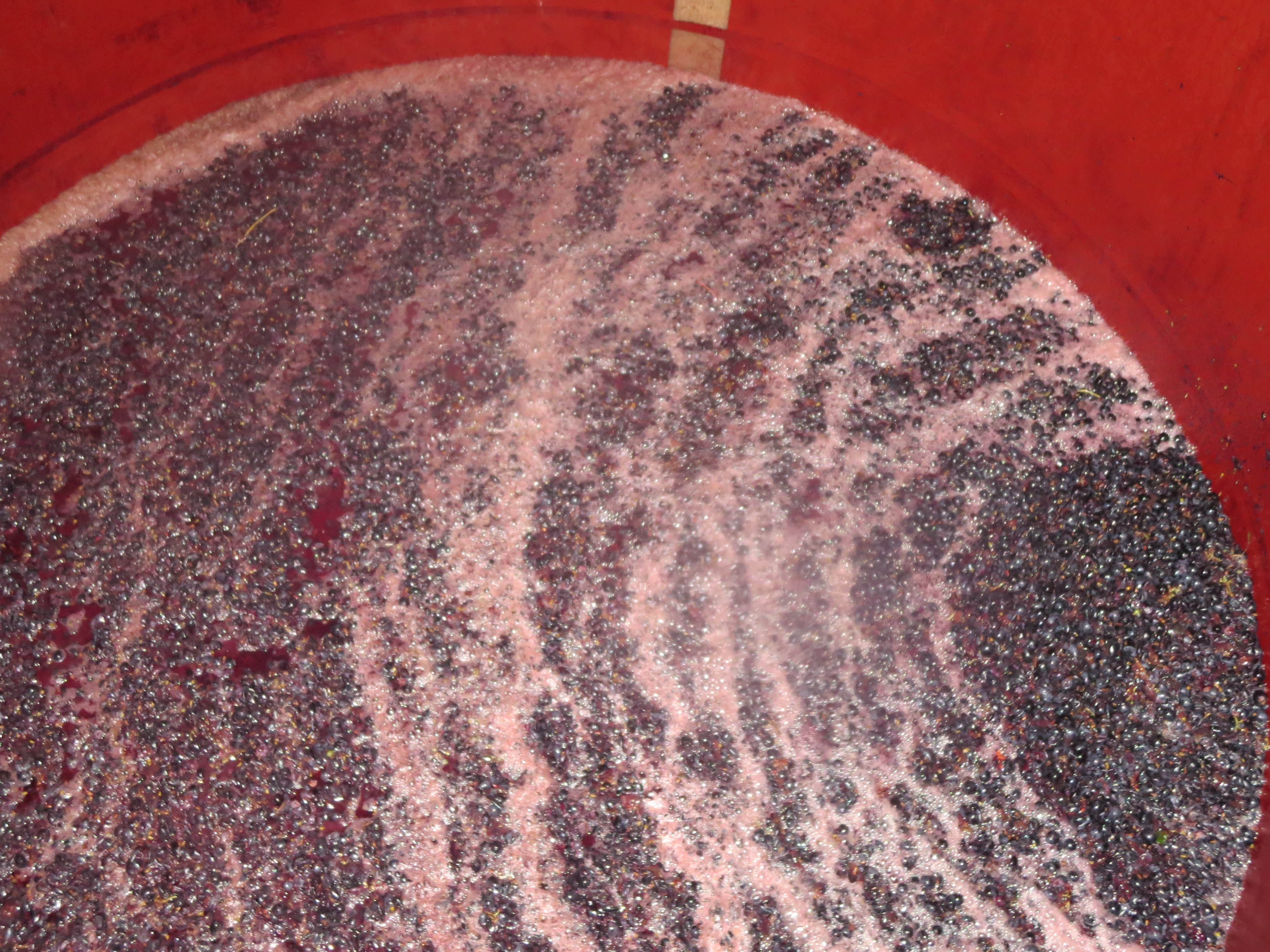
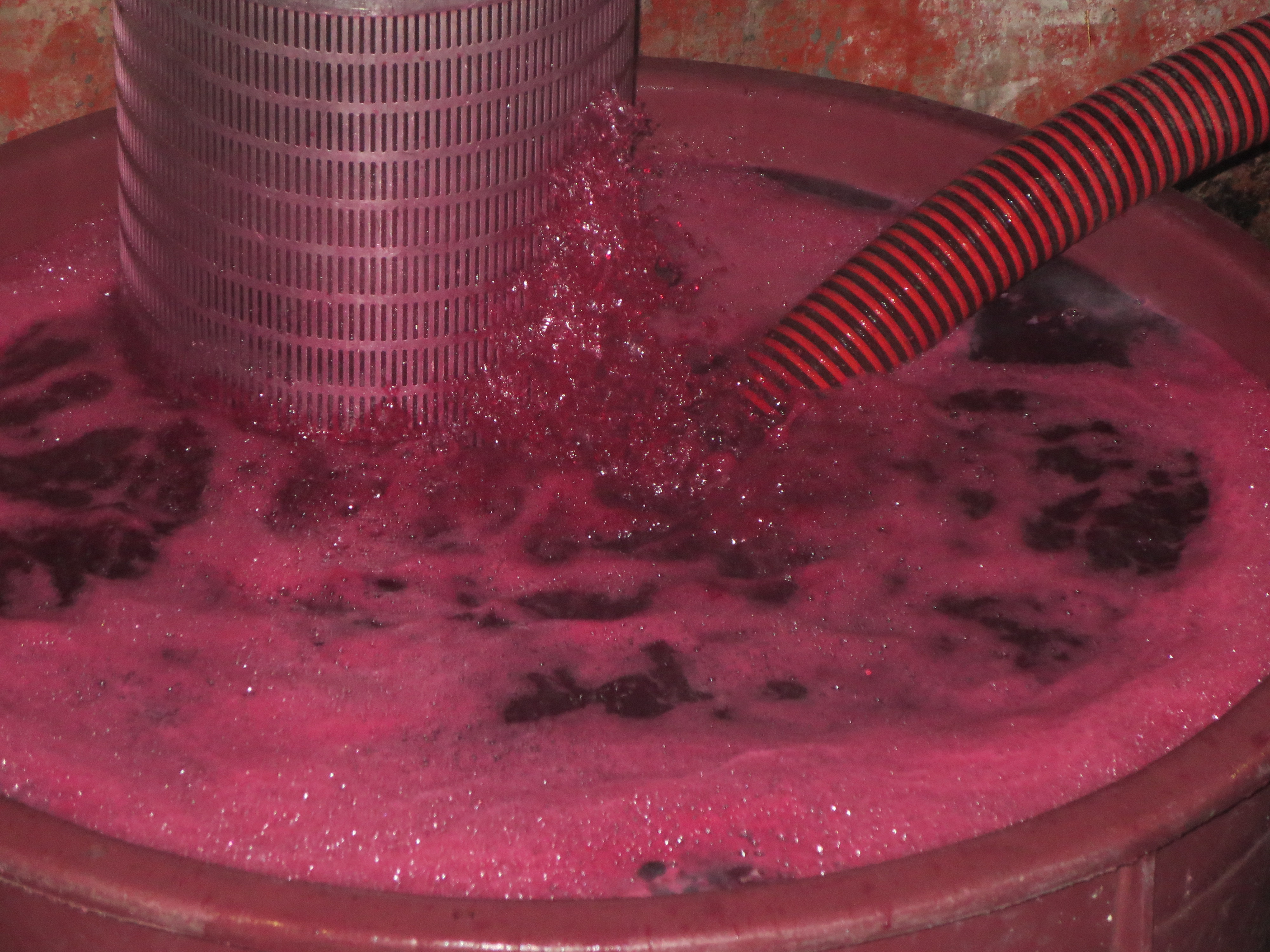
Castets in tank, the skins, pips etc on top of the wine
The chapeau is really tough and so Tina has to really force it down into the juice (pigeage)


































 amarchinthevines