amarchinthevines

Learning about wine, vines and vignerons whilst living in the Languedoc


1 Comment

RAW too

57BE3FB1-5D66-4FEE-A232-536F9366F6BD

And so to the wines at RAW which contain sulfites above 20mg/l, in other words sulfites added. Reading Alice Feiring’s book ‘Naked Wine’ she tells of how the founding father of natural wine Jules Chauvet used SO2 as do some of the movement’s well-known figures such as Foillard and Puzelat if they feel they need to do so in order to protect that particular wine. Natural wine is about more than just sulfites though its reputation seems to be bound with that additive. RAW’s own charter is worth reading on the subject.

I did enjoy many wines at RAW which are above my artificial 20mg/l mark. There are a dozen domaines worthy of mention so I shall be brief in describing them. Again I refer you to the RAW website for more information (via links) and also to David Crossley’s website for more detailed descriptions on some.

Vinca Minor (RAW link)
IMG_4376_large

Sonoma Chardonnay (from domaine website)

Confounding all my prejudices about big, sweet California wines this domaine’s hallmark was freshness and a light touch. Whether a peach aroma Sonoma Valley Chardonnay 2016 or a juicy, red fruit Redwood Valley Carignan 2015 and even a Cabernet Sauvignon 2015 Santa Cruz Mountains – all these wines delivered everything you’d want in flavour and drinkability together with some complexity. Together with The Scholium Project I am converted to West Coast wines.

Okanagan Crush Pad (RAW link)

And Canada too. This is an interesting project where as well as making their own wine new winemakers are helped to make theirs too. Read more at the link above. Their Haywire wines were very good, providing an interesting contrast for me. As stated before I am not the biggest fan of extended skin contact wines, but here was a Free Form Sauvignon Blanc 2015 of 9 months maceration which was fruity as well as having texture, very good. I preferred it to a more traditionally made Pinot Gris. On the other hand the red skin contact was outshone by a beautifully fresh Water And Banks Pinot Noir 2015, classic grape character with red fruits and an earthy crunch. Lovely.

Vins Du Jura Thill (RAW link)

Jura wines are very on trend and with good reason, there are many excellent wines being produced there. I visited the region 20 years ago when Jura wines were hard to find because nobody was interested, now they are hard to find because they are in demand. I have had the good fortune to taste many excellent producers before including La Pinte, present at RAW. This domaine was new to me however, and another name to add to my list of must buys.

The Crémant Cuvée Adrian 2014 would certainly fit nicely into any occasion, refreshing tasty sparkling Chardonnay. The Chardonnay Sur Montboucon 2015 was even better with round , green and yellow fruits, great character. Perhaps my favourite wine was the Poulsard 2014, very light like a rosé in colour but packing dense rose and red fruit aromas and long red fruit flavours. One of my wines of the event. A word too for Vinum Paléas 2015, Éric’s straw wine with a slight honey note but dry and refreshing. Skilled winemaking.

Yves Duport (RAW link)

I don’t recall drinking wines from Bugey before. I will again. Again wines marked by a freshness and pure fruit . A lovely, fresh Chardonnay les Côtes 2016– more direct and zesty than the Jura style but a good food wine. The Pinot Noir Tradition 2016 made another comparison with the Jura and again it was more direct, good red fruits, ripe and clean. My favourite was the Altesse De Montagnieu “en Chinvre” 2016 which is quite a mouthful! Roussette is the grape and there was a grapefruit, citrus attack with a soft finish, really good.

It really is good to see a region fighting back led by a producer who lets nature speak.

Le Vignoble Du Rêveur (RAW link)

I was delighted to bump into Mathieu Deiss again. I have met him at a couple of tastings before when he was showing the wines of the family domaine with his father at the helm. I love those wines and their philosophy of place rather than grape. He is a passionate young winemaker and I am happy, but not surprised, to say that his own wines are crackers too.

Singulier is a blend of various white grapes, mostly Riesling made by carbonic maceration. The 13 was nice but the 15 was even better, singing with zesty fruit and character with mo SO2 either. It was another skin contact wine which made sense adding that characteristic texture to the fruit. Vibration 2013 was a Riesling with quite the best aromas of any wine at the Fair. Classic Riesling, zesty and long fresh flavours which grew in the mouth. Pierres Sauvages 2013 is a blend of Pinots; Blanc, Gris and Noir but made as a white wine so no long skin contact with the Noir grapes. This filled the senses, it is still developing in bottle I would say, lovely.

Hauts Baigneux et les Tètes (RAW link)

D4E4E489-8A7A-4554-8780-095E13EE138E

To the Loire, that hotbed of natural wine and another new domaine to me based in Azay Le Rideau. I liked the reds but Loire reds are often a blindspot for me and it was the white wines which really stuck out, based on Chenin Blanc. The Azay Le Rideau ‘Les Chênes’ 2015 was a classic Loire white with zest and minerality, textured and fruity. I also liked the Blanc Chenin 2015 made in concrete eggs which seemed to have a richer depth. More young winemakers making an impact, the future looks good.

Chandon de Briailles (RAW link)

I have bought wines from this domaine in the past and was pleased to see them here at RAW. This is a classic Burgundy domaine and I love good Burgundy. No disappointments here, lovely Savigny and Pernand Vergelesses but there were two stand out wines. Corton Blanc 14 was a reminder of why Chardonnay in Burgundy can be just about perfect. The aromas and flavours seemed to have limitless depth, from apple and green fruits to rich, round hazelnuts. A stunner. And the Corton Bressandes Grand Cru 2014, just makes me smile thinking of it. Still a baby, but delivering forest aromas, dark red fruits, earthy notes – it’s one of those Pinot Noirs which just says this is as good as red wine gets. Tannins aplenty still but in a few years? I would love a supply of these to follow the wine’s progress. Top class biodynamic wine with producers cutting back on sulfites too. Love it.

Wines from classic old world regions and new world upcoming areas too. The world of wine is embracing natural wine.

Final selections soon.


7 Comments

Vinisud 2017

bandeau_fr

En francais

January and February see wine fairs, or salons, appearing regularly including some of the bigger events. For some reason best known to themselves two of the larger fairs, Millésime Bio and Vinisud, fell out and decided to hold their events simultaneously, meaning that Millésime Bio moved to Marseilles from its usual Montpellier home. However as Many of the offline events remained in Montpellier I decided to attend those and Vinisud. (It was announced on Feb. 4th that a rapprochement has been found and next year will see both events back in Montpellier).

Vinisud is a huge event, 900+ producers from all around the Mediterranean gather and professional wine buyers, cavistes, restaurateurs and journalists make appointments with them, it is big business. For someone like me, who cannot offer to buy thousands of bottles it is a little daunting so I prefer to attend some of the help yourself areas such as the sparkling zone which is self- explanatory. Sadly, there was little of any real interest for me in this zone, some neutral Limoux and Proseccos which offered nothing exciting. Sadly neither did the Picpoul zone really offer much of interest.

19

There was also the Palais Méditerranéan where hundreds of bottles from some of the producers are available to serve yourself. If a bottle appeals then you can always pop along to the stand of that producer. I tasted almost a hundred wines here. Some decent white wines from:

  • Crouseilles co-op (Pacherenc du Vic Bilh)
  • Chateau Estanilles (Faugères), Inverso 2015, nice use of wood to add complexity
  • Jacques D’Albas (Minervois), Blanc 2013, fresh and zesty
  • Frères Laffitte, Côtes De Gascogne 2016, really well balanced demi-sec
  • Domaine Barreau (Gaillac), Caprice D’Automne 2014, nice clean, sweet wine

And reds from:

  • Dondona, ‘Chemin Des Cayrades’ 2014, a nice, fresh pure Carignan (Montpeyroux)
  • Cébène, ‘Ex Arena 2015’, (IGP Pays D’Oc from Faugères), fresh, full fruits
  • Mas Champart, ‘Causse Du Bousquet’ 2015 (St. Chinian), soft red fruits

22

My favourite area was that of Wine Mosaic, an organisation which promotes rare and unusual grape varieties. Again, you can serve yourself wines from unusual and rare grapes from Turkey, Greece, France etc. A real opportunity to try something different and to promote the growth of these cépages oubliés. Mollard, Viosinho, Sidalan, Kotsifali were just some of the cépages I had never even heard of before. Ironically, it was the very familiar Carignan which provided my favourite wine produced by Domaine Nizas near Pézenas.

I did also attend some producer stands notably Mas Des Capitelles, the Faugėres domaine which I really like. The Laugé family have converted to organic production in the last couple of years but they have been making classic Faugėres for many years. They reward patience in bottle developing real complexity and maintaining an admirable freshness. They are big, well-structured wines but they remain balanced between fruit and power ensuring you can enjoy them in the short or long term. My particular favourite is the Carignan based Loris 2013 but other older bottlings of special vintages (cuvées such as No.1 and No.2) are a real treat and deserve the multiple awards they garner.

Corvezzo is another domaine which captured my attention and admiration at the 2016 event, like Capitelles. This large Prosecco producer (125 hectares of vines) is again organic and, unlike any other Prosecco I have tried, these cuvées have depth, fruit, freshness and length. They hold their own against many champagnes. The Extra Dry, for example, has lovely spice and lemongrass notes, very good. They also produce some lovely white wines such as Manzoni and their Pinot Grigio Ramato full of fresh fruit flavours.

23

Even better was an amazing red, Rosso Riserva, produced in Amarone style with dried Robosa grapes and had great flavours and aromas of dark fruits along with a leathery complexity and which built in the mouth long after drinking the wine. A truly excellent wine.

8

The other stand of interest for me was Les Beaux Nez Rouges, a group of natural wine producers under the umbrella of oenologue Hervé Chabert. I declare an interest as I know some of these producers quite well, eg, Regis and Christine Pichon of Domaine Ribiera, Grégory White, David Caer (Clos Mathélisse) and Lionel Maurel (Mas D’Agalis). Hervé kindly gave up half an hour to lead me through tastings from Ribiera, Domaine Henry (St Georges D’Orques) and his own wines, Wine Drop.

Ribiera is a favourite of mine and wines such as Causse Toujours 2015 shows lovely fruit with some complexity. The Cartagène was also dangerously drinkable. Top on the day though was La Vista 2016 a pure Cinsault of lovely sweet fruit with a touch of tannin too. Lovely.

Domaine Henry was new to me and I really liked wines such as the fruity Paradines 2015 (not yet bottled for sale). Fascinating was a cuvée called Vermeille (pictured top left) which is a saignée from all the cuves of the year, ie they run some of the juice from each tank – sounds mad but it is an old practice in the region and Vermeille was light, fruity and delicious. Equally of interest was Le Mailhol 2015, a complantation of old Languedoc cépages which gave lovely fruit with a touch of raisin to add complexity.

Hervé’s own Wine Drop bottles were good, Cuvée No.5 2014 had lovely Cinsault red fruits with a touch of body from some Grenache. Grenache to the fore in No.6 2014 which had lovely aromas and a touch of spice and fruit. The 2013 No.4 had more structure and shows how well natural wines can develop with time, good balance of fruit, power and complexity.

20

Vinisud offered a very interesting day for me after the offline events I had visited the previous two days. There is much to offer the visitor from classic wines to natural, wines from all around the Mediterranean, business opportunities, masterclasses, seminars and the chance to match wine and food amongst others. A valuable day in my wine education.


1 Comment

Vendanges 2016 #9 – Days Like This

“When all the parts of the puzzle start to look like they fit
Then I must remember there’ll be days like this”               (Van Morrison, Days Like This)

As we approached the end of vendanges a number of the team were moving on. It was an inspired move to have a farewell day, picking, tasting and celebrating together, though we were already missing some like Charles, Carole and Maylis.

The morning dawned over Peilhan and the vineyard which we planted in March 2015. Rows of Terret Blanc and Noir, Riveyrenc Gris and Noir, Piquepoul Noir and Morastel produced grapes this year. They cannot be used in major cuvées sold to the public as they are too youthful. However, Jeff decided to pick them to make something for himself out of interest. So, on a bright, warm autumnal morning we gathered, picked, chatted and laughed.

Interesting to see how some varieties produce more than others already, more precocious perhaps, the Terret Noir being especially shy. Altogether we picked around six cases only but there was a real mix of colour and some nice looking fruit which went into a small cuve in whole bunches.


Later that day we gathered again, this time in the main cellar along with Thierry Toulouse, Jeff’s oenologue. We tasted through the whole range of 2016 wines in cuve before heading to a local restaurant for a meal. The results of the tasting were fascinating. Clearly, they are in a stage of transition, fermentations still progressing. Nonetheless the wines were already showing their character. I won’t go into too much detail here, though I did take notes to help me record how the wines change in coming months.

In summary though I was amazed. I have said many times on here how difficult this year has been. A very warm winter, drought, mildew, delayed summer being just some of the problems. Yet here we tasted some lovely fresh fruit, lively acidity and other promising signs. I would mention the Carignan Blanc, lovely Syrah and Grenache from La Garrigue, juicy Mourvèdre and in particular the wonderful Carignan Noir of Flambadou. All those puzzles which Jeff had to hold in his head about harvesting dates, moving wines, possible assemblages etc, well those puzzles were solved in the glass. I had expected some disappointments but somehow Jeff has conjured some potentially top quality wines.

138da189-1095-4227-969a-8356828039df

2003 Roberta

At the end of the current wines Jeff also shared a 2003 bottle of white wine based on Grenache Blanc, Noir and Gris, called Roberta (it’s a long story!). This was one of three cuvées which were the first that Jeff made sans sulfites. Yet it was complex; fresh, fruity, nutty. A wine which made my heart sing, proof that SO2 is not required for ageing wines as we are often told. Perhaps in 13 years time we shall be tasting the 2016 wines and marveling at them too.

A fitting way to close the vendanges period, a team rightly proud of what it had achieved.

“When all the parts of the puzzle start to look like they fit
Then I must remember there’ll be days like this”

p1020104


Leave a comment

Vendanges 2016 #7 – Last Pickings

p1010935

Cabernet Sauvignon sheltering the Moroccan pickers

En français

Wednesday (September 21st) was officially the last day of summer and, appropriately, the last day of picking at Mas Coutelou. It was, as in 2015, the Cabernet Sauvignon of Segrairals which was the last major parcel gathered in. Lovely, clean bunches of small, healthy berries, classic Cabernet and virtually nothing to sort in the vineyard or in the cellar. 

p1010923

Cabernet Sauvignon

The day before had seen the start of the Cabernet in the afternoon following a morning of picking Mourvèdre, also from Segrairals. As I hadn’t ventured into the vineyard much in 2016 I took the opportunity to do so that morning. Our friend Jill had expressed a wish to do some grape picking and Jeff kindly agreed so I accompanied her (so at least there was one less experienced picker than me!). I really enjoyed being out in the fresh air but it was also good to get a grip on how the vineyard topography can have such an impact upon the grapes.

The Mourvèdre grows on an easterly slope with the rows running down the slope. The vines at the bottom of the slope gave lower quality bunches than those at the top, indeed we stopped picking the last few vines at the bottom of each row. The reason was that when it does rain the water runs down the slope taking nutrients etc. The grapes there tend to ripen much sooner with more humidity in the ground, it was a clear example of terroir. Rest assured that only good grapes went into cuve, much was left behind in the vineyard and at the side of the sorting table.

p1010931

The slope in the Mourvedre vines, rejected fruit on the ground

On Monday the lovely Carignan Noir of Rec D’Oulette (Chemin De Pailhès) was added to the tanks. The quality was high and signs are promising for yet another good vintage of Flambadou, arguably the domaine’s best wine in recent years.

Since the last article the other major harvest was some bountiful, good quality Grenache from La Garrigue on Saturday 17th.

lovely-grenache

Gorgeous Grenache

There remain a few rows here and there with some grapes left and they may or may not be picked in coming days and weeks. However, the Cabernet marked the last of the major picking. Time to say farewell to the Moroccan pickers, part of the Coutelou crew for the last month.

p1010896

Stage 1 is therefore over. Stage 2 the cellar work of remontages and pigeage continues apace as most cuves are now full and need looking after. Stage 3, pressing, is also in full swing as grapes from previous weeks have now gone through fermentation on skins and need to be pressed to take the juice away. I shall be writing about this more in the next article.

So, we head into autumn, the vines are fatigued after a very stressful year. The leaves are already changing colour and the Languedoc will be an even more beautiful place in coming weeks. The picking may be over but the vendanges are not. 

p1010930

Mourvedre in autumnal glory


1 Comment

Last of the summer wine


Flower Power

Flower Power 2015

En français

As work on the cellar ratchets up a notch in the next few weeks it was time to bottle the last of the 2015 wines which will be made for the moment.

The framework for the new mezzanine floor is in place and actually looks quite beautiful. It will be reinforced with concrete however, and the metal cross bars will disappear (which might stop us knocking our heads). Plumbing has also been tidied up and improved. Cuves will be placed below and on top of the structure. More work on stairs, flooring and around the cellar will happen soon. As I am heading back to the UK for a couple of weeks or so, it will be exciting to see the changes upon my return.

P1010407

Peilhan June 30

The vines continue their growth in the sunshine and heat. Mildew problems are largely contained though some humidity leads to sporadic outbreaks (apologies for the pun). Sadly, there is a new threat of oïdium (powdery mildew) which likes that humidity and the warm days with cool nights we have been having. Powdery mildew shows as grey, white spots on the leaves and the grappe. Certain cépages are more vulnerable, including some of the traditional Languedoc varieties such as Carignan. The treatment is to spray sulphur powder and Jeff Coutelou made the first treatment this week in an effort to contain the problem, a job completed on Saturday morning. 2016 certainly has been a struggle.

P1010422

Meanwhile 2015 wines such as Flower Power and L’Oublié went into bottle on Wednesday June 29th. You might recall that the L’Oublié assemblage was made a few weeks ago and after spending time in tank, marrying together, it is now in bottle. Both of these wines are extremely good, well worth waiting for when they are finally released which won’t be for a while.

Jeff also put together a new cuvée exclusively for the French market, it will come in litre sized, Bordeaux style bottles as a «vin de table». An assemblage of various cépages it will be cheap, very drinkable and very desirable. The size of the bottles meant that they had to be filled by hand rather than the machine so Thursday was fully occupied with this cuvée. Jeff refers to it as a vin de gauche, after wine writer Vincent Pousson referred to Jeff as one of the last vignerons de gauche (left wing winemakers) because of his low prices making his wines accessible to all. It will be a wine to share and it will disappear down that litre bottle very quickly.

vin de table 2

The new litre bottle of the vin de gauche

2015 seems increasingly like a golden year, its wines are certainly glittering. 2016, well despite all it has thrown at us, there is hope. Meanwhile the summer wine is bottled and the heat is getting to some of us, even after his haircut.


4 Comments

The Forgotten art of assemblage


IMG_0022

One of the more interesting wines at Mas Coutelou is L’Oublié. It is also one of my favourite wines. On Thursday, June 9th Jeff called in his oenologue, Thierry Toulouse, to help to decide on the blending (assemblage) of the new version of L’Oublié.

P1010228

So what is L’Oublié? It is a blend of grapes just like the vast majority of Languedoc wines and, indeed, Mas Coutelou wines. However, it is also a blend of wines from different years. For example the Carignan is a blend of wine from 2001, 2007 and 2010 which has been stored and aged in a barrel called a demi muid. Add in a similar blend of Grenache and Syrah from different years and then other wines to add even more complexity and depth. The name means ‘the forgotten one’ referring to the original barrel of wine which had been, well, forgotten.

P1010234

This is how I described L’Oublié in my article about the Coutelou cuvées:

“It has aromas of dark fruits and leathery, spicy notes too. It is dark flavoured too, blackberries, liquorice and even coffee are just some of the many complex flavours. It benefits from decanting to allow that complexity to resolve itself a little, and it will stay fresh for days after opening. There are not many wines like this around and I honestly don’t know why. It is unusual and one of my favourite wines because of its complexity, its balance of older and more youthful flavours. Terrific.”

It is the mix of darker flavours with the hallmark Coutelou freshness which really appeals to me about this wine. So, how is it made?

Jeff had taken samples from the demi muid barrels of old Carignan, Grenache and Syrah and also samples of other wines which he had, for example Copains 2013. This is a pure Cinsault, from Rome vineyard, released in 2014 but Jeff had aged some of it in barrel too. Younger wines were on the table too, available to be used. We tasted these separately first to get a feel of the flavours which would be in the mix. Frankly, the barrel aged Copains was so good I’d have made a wine just of that!

Using the base wines of the old blends the oenologue measured out the proportions based on the quantities of each wine available for the final cuvée.

The wine was left to mix for a few minutes and then we tasted. The first was very good but, perhaps, edging a little too much towards the dark side of flavours. So, some 2015 wine was added to freshen it up and … voilà. The characteristics of previous versions of L’Oublié but made with newer wines on top of the base wines.


The decision on the blend made, Jeff then set about blending the components together in tank where it will sit for a while to marry together. This will be bottled at a future date, yet to be determined as it depends upon when the wine is ready. It will tell Jeff the right moment. Yet another wine to look forward to.

P1010240

The secret code of L’Oublié

If you don’t want to take my word for how good L’Oublié is then here are other reviews and tasting notes:

http://www.lsfinewines.co.uk/acatalog/Mas_Coutelou.html

http://www.leblogdolif.com/archive/2011/12/05/grain-grain-le-petit-raisin-gnan-gnan.html


Leave a comment

Busy times

busy

En français

Busy times. In the vines and in the cellar.

I mentioned recently that the cooler weather had delayed some of the growth in the vines and that flowering was late. Well, recent hotter weather has brought sudden change. Flowering happened around the turn of the month and was over very quickly, perhaps catching up lost time. In particular there was a heavy thunderstorm on Saturday June 4th which brought a torrent of rain. The water and the sunshine has really got the vines going. Tendrils reach for the skies and there is more bushiness to the vines.

The flowers gave way to the little hoods which cover the nascent grapes, capuchons. These quickly fall away too revealing the grapes for 2016. On some vines all of this is happening at the same time such as this Carignan (above) in Rec D’Oulette. The weather has also encouraged the growth of the grafted vines which we did back in March.

This brings work too. The palissage has to be lifted to support the vines, hard physical labour. And, sadly, the heat and rain bring problems of disease. Mildew has been around for a couple of weeks and I mentioned that Jeff was spraying in the very early hours and late at night last week. He worked until 1am Friday/Saturday and started again at 6am. Just as things seemed to be settling a big attack of mildew on the Grenache at Ste. Suzanne meant more treatment on Tuesday morning. This ‘curious’ year is proving to be hard work.

Not all negatives though. The storm brought such a downfall that I was fearful for the flowering bunches. damage to them means no grapes. I happened to be in Puimisson during the storm (next article!) and the rain was lashing down, converting streets and roads to waterfalls and lakes. Yet as the rain eased I went to a couple of vineyards and the flowers were coping just fine. A trip round the vines on Monday morning revealed healthy growth and the soils had absorbed the rainfall.

This is not true of everyone. Much of the water on the roads was also full of clay from vineyards nearby, hence the yellowy brown colour. Vineyards which are treated with weedkillers, where the soils are ploughed deeply, even irrigated, were unable to cope so well with the heavy rain. Soils were carried away. Compare these photographs of Jeff’s vineyards with the parcel next door belonging to someone else. The difference is marked. Water can help or can damage.

Meanwhile back in the cellar there was more work to be done. Recent changes to the fabric of the cellar, especially the floor, have brought more efficient drains and a smoother surface, easier to clean. Further work will soon be done to the rest of the floor so the bottling of the next wave of wines had to be brought forward to allow the works to be done and dusted before vendanges.

The spring bottling of wines such as 5SO, PM Rosé, 7 Rue De La Pompe I described earlier. These are wines for early drinking, vins de plaisir. Now it was time for wines with a little more body. On Thursday June 2nd 10,000 bottles of Classe were made, and it is really something special in 2015. It took almost 12 hours and went very smoothly but believe me it is a hard day’s work. On Friday, Flambadou, made from the Carignan vines above, was bottled along with other smaller cuvées.

Before anyone rushes in with orders Jeff will let these bottles rest for a few months to allow them to be at their peak when released, Flambadou probably in 2017 for example. There remains one or two cuvées still in tank which need a little more time, Flower Power being one.

So, most of the 2015  wine is now in bottle, the vines are revealing the grapes for 2016 and there are wines stored for 2017. Busy times at Mas Coutelou for everyone, well except one.


6 Comments

Young, gifted and natural

In March and April I was able to visit a number of wine tastings with the emphasis on natural wines, in Bédarieux, Arles and London. The latter, Real Wine Fair, I wrote about recently and also featured organic and biodynamic wines. One of the features of all three events, upon reflection, was the rise of a number of talented younger vignerons. Now, that should be no surprise, there have always been a number of young vignerons attached to the natural wine scene. Indeed there is a youthful core to the crowds who attend though, again noticeable, the age profile of attendees this year seemed to me to be much higher.

The buzz around natural wines has certainly created interest in the whole world of wine and been an entry point to many younger people who like the ideas and principles of many vignerons who seek to make wine with as little intervention as possible in the vineyard and cellar. It has struck a chord with many. As natural wines have become more widespread, vignerons more experienced in making wines without a safety net then their appeal has broadened. Many wine enthusiasts were put off by the (in my view false) reputation that natural wines were often faulty and wrong. I do believe that winemaking has improved and that consumers have more confidence in the wines, hence the arrival of a broader cross section of clients. As an older wine enthusiast myself I welcome the fact that I am, usually, not the oldest person in the room.


In the three salons there were many familiar faces, vignerons whose wines I have tasted, drunk and bought many times. Others whose wines are not for me. I shall return to these people in the next article. Many moons ago I likened the natural wine movement to punk rock in that it was creating an alternative scene and would introduce change on the whole industry. Just as punk was followed by a new wave of music, artists such as Joy Division, Talking Heads, Blondie and Elvis Costello who were influenced by punk but channelled its energy in a different way, I believe that there is a new wave of younger winemakers in the natural movement who are building on the work of the pioneers, the punk winemakers. Some for better, some for worse.

Here are some of those winemakers from the salons whom I would heartily recommend as vignerons to follow, whose wines I would gladly drink.

IMG_3790

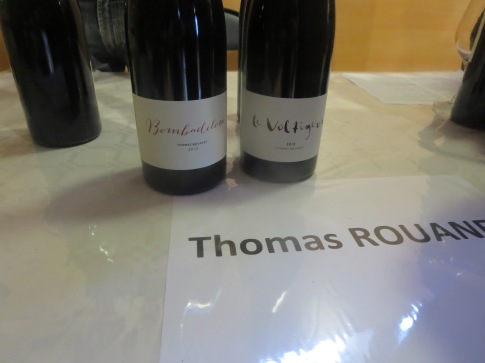
Thomas Rouanet from the St Chinian area I met at Bédarieux and enjoyed his wines especially the pure Carignan of ‘Le Voltigeur’ 14 with lovely fruit and freshness. I look forward to trying more from him.

Bastien Baillet has a 2ha domaine called La Bancale in the Fenouillèdes area of Roussillon. I gather he has been working with Jean Louis Tribouley, a very good producer himself of course. I very much enjoyed his ‘En Carême’ a Carignan based wine with plenty of red fruits and a nice balanced finish.

IMG_3827

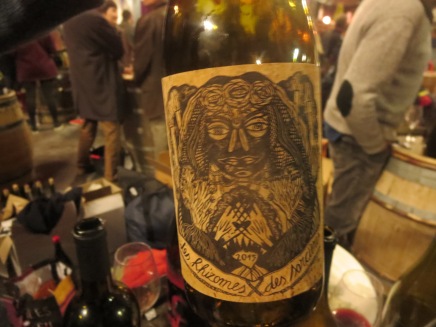
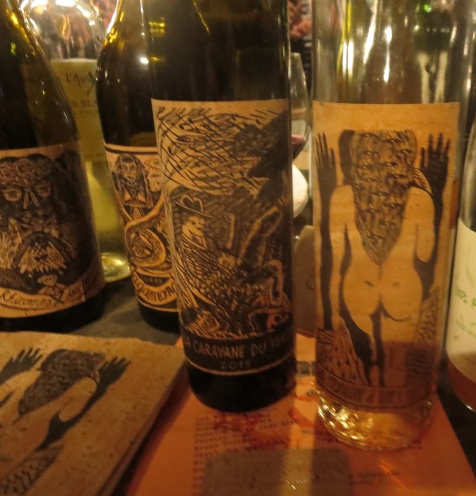
La Cave Des Nomades is also in Roussillon but this time in one of my favourite French towns, Banyuls sur Mer. Run by a young Portuguese and Polish couple their wines were without any question one of the big hits of La Remise. I tasted them on the Sunday and by the evening word was out just how good they were. On Monday I saw a number of prominent cavistes at the stand. With only 3ha their wines will run out quickly I am sure. José and Paulina’s domaine is part of the excellent 9 Caves project in Banyuls. A lovely range including an excellent vin doux naturel, my favourites were a very deep, balanced and fresh Grenache Noir 15 and a beautiful Grenache Gris 15 called ‘Les Rhizomes des Sorcières’, real depth of fruit with a delicious, clean finish. Fascinating labels too, one of my favourite range of wines this year.

IMG_3828

John Almansa runs Zou Mai in the Gard. He has worked with the excellent Philippe Pibarot and so, like Bastien Baillet above, he has learned about winemaking from a good teacher. Surely this must be a huge help. His first wine is a Cinsault and it was a very drinkable, fruity wine with a clean finish.

IMG_3845

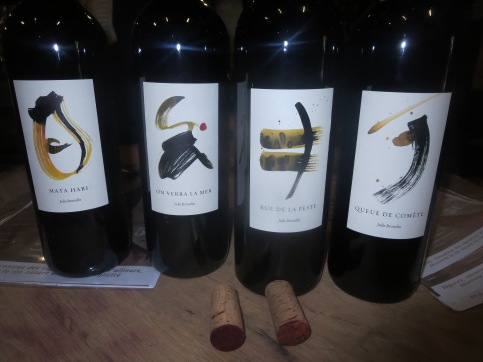
Julie Brosselin used to work with another domaine in Montpeyroux but has now struck out on her own. A number of people told me to go taste her wines, including excellent judges such as sommelier Sandra Martinez, and I am glad that they did so. Her white wine ‘Mata Hari’ was good and also the unusual combination of Cinsault and Mourvèdre in ‘Queue de Comète, full of juicy fruit. As a new domaine these were both 2015s and will improve still further.

Thierry Alexandre has been working with Les Miquettes in the Ardèche and has now produced wines of his own from just 1ha of vines. His Pet Sec (Marsanne/Roussanne) 15 was one of the best PetNats on offer at La Remise, fresh pears, clean and round. He showed the 14 and 15 St Joseph and they were both good, the 14 more rounded of course but both with good fruit and a round but clear finish, classic Syrah.

Most links I can find to Samuel Boulay say he is a Loire producer but the address given at La Remise was for Ardèche. A good Viognier/Marsanne was deliciously fresh and a Grenache / Merlot blend was very good, lots of round fruits and a fresh aftertaste.

Most of these winemakers were in a group of young producers invited by La Remise, an idea which I find encouraging and supportive. More salons should follow. From last year’s group a number returned as part of the main salon in 2016.

IMG_3821

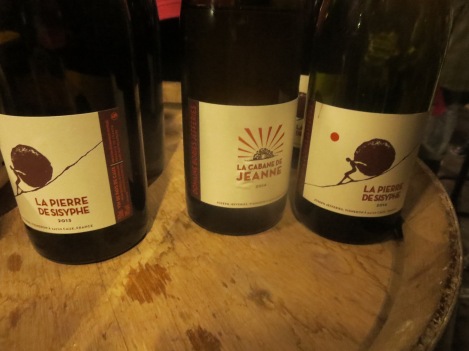
Firstly, Christelle Duffours of Mas Troqué, whose wines from Aspiran in the Languedoc are really starting to express themselves very well, improving all the time. Equally so Joe Jefferies of Bories Jefferies in Caux whose wines sell out quickly. I know Joe and so declare a partisanship, but I can honestly say that his white Pierre De Sisyphe (mostly Terret) is one of the best natural white wines I know. The reds are very good too.

One other domaine from that group in 2015 was L’Ostal from near Cahors. I wrote about them then and again after Labande De Latour in November. It was great to hear from Louis and Charlotte Pérot that they are doing well and that a 3* Michelin restaurant has taken their wine. I am not surprised. They are extremely talented winemakers as well as lovely people. Their wines are very drinkable, even young, and yet retain the spine of Malbec and Cahors which is traditionally a tough wine. Wines such as ‘Anselme’ and ‘Zamble’ are of high quality but there is always a refreshing lick of acidity which makes them so good to drink.

On my return from Arles I was talking to Jeff Coutelou about the wines I had tasted and he told me that he was very impressed by L’Ostal and that it is rare to find such talented winemakers as Louis and Charlotte. That was good to hear, as it meant I wasn’t mistaken in my praise for them but in particular it was good for the Pérots.

These are all skilled winemakers, I would happily drink their wines anytime. I do hope that I don’t patronise them by calling them young winemakers as though that makes them lesser producers. With more experience they will surely be looking to improve their wines still further and in their hands the future of natural wine looks healthy and successful.


4 Comments

Vendanges Diaries – #9 Dream

IMG_2773

Our last picking of 2015, Rome vineyard, October 9th; Michel, Cameron and Jeff

Version française

The very last week of vendanges, definitely.

Lots of work continued in the cellar during the week, pigeage and remontage as described in the previous post, and more wines which are now completing fermentation and being put into tanks to mature or to allow malolactic fermentation if it hasn’t already happened. This fermentation produces softer lactic acid which will make the wine taste more supple and fruity. The cellar is now much quieter and there is a sense of job done.

IMG_2720

                              Pigeage

IMG_2732

                      Carignan in tank

IMG_2734

Cameron cleaning tanks, cleanliness remains the priority

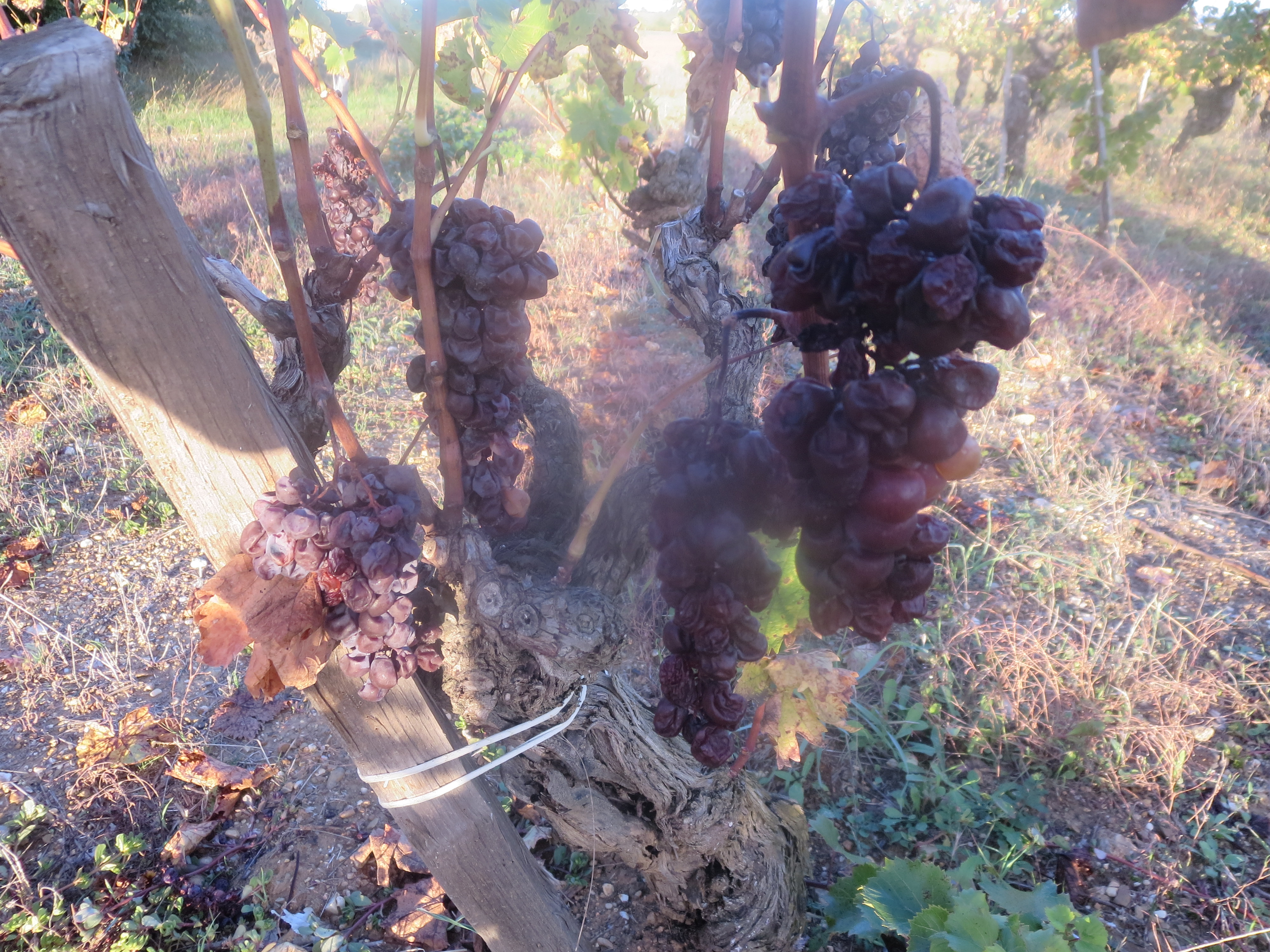
However, the final wine remained as grapes in the vineyards. Muscat grapes in Rome vineyard and Grenache in Sainte Suzanne have concentrated their sugars, developed a little noble rot even. So, on Friday October 9th Jeff, Michel, Cameron and myself ventured out to pick the Muscat and some of the Grenache. (The remaining Grenache was picked by the experienced Moroccan team on Saturday morning.) A beautiful autumnal morning cast shafts of sparkling sunlight on to the myriad colours of the leaves. It was incredibly peaceful and dreamlike.

IMG_2776

IMG_2777


IMG_2784

The Muscat was dried out in the main, the berries now like raisins with a lot of sweetness but not too much juice. The Grenache would give more juice to produce around 4.5hl of sweet wine in the end, which Jeff was happy with.

IMG_2780

IMG_2778


IMG_2781

                     My first bucket of Muscat

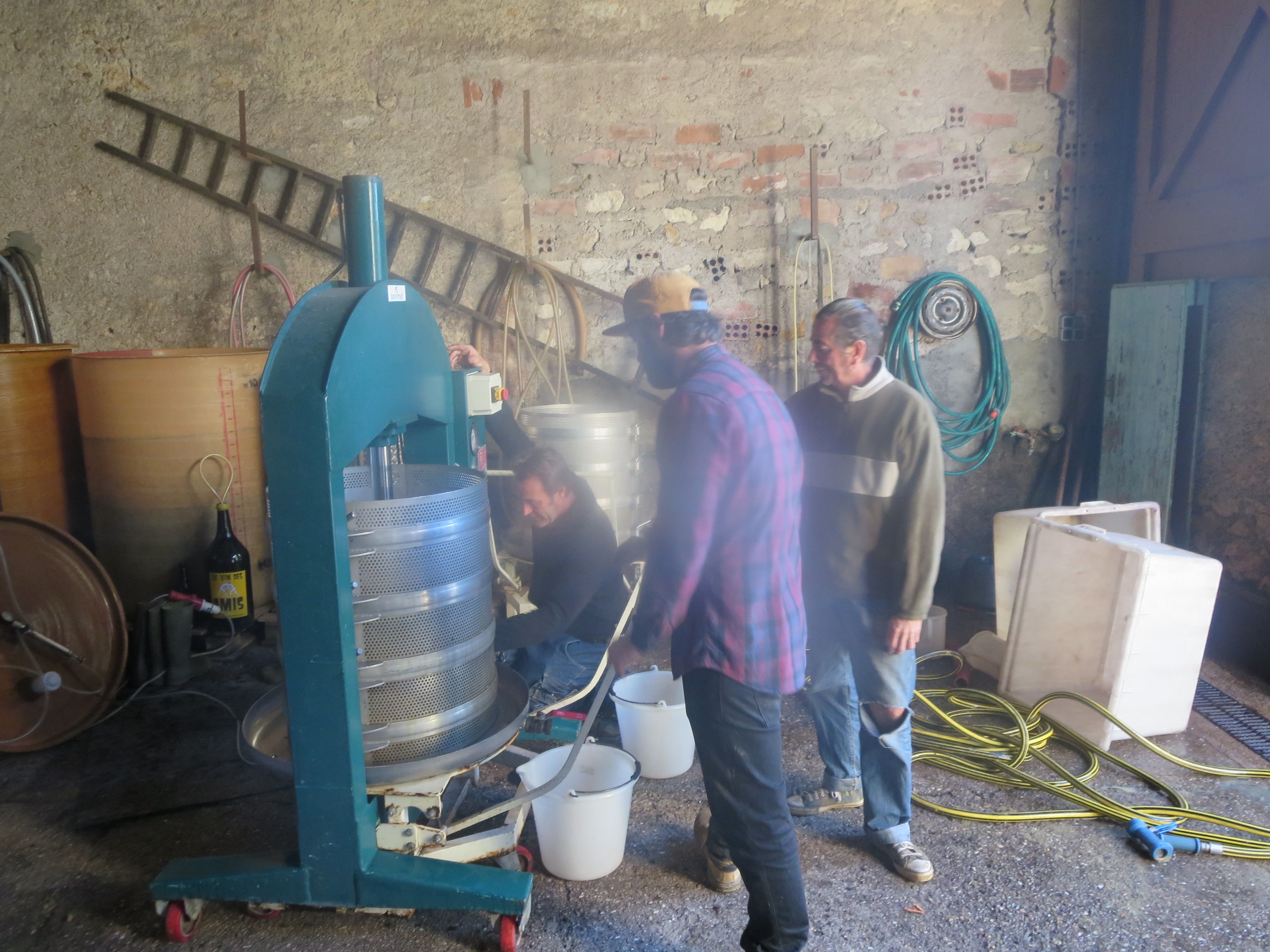
In the press the Muscat and Grenache were added one on top of the other in successive layers to give more complexity and allow the Grenache to fill out the Muscat. The juice was slow in emerging but eventually arrived in a lovely, light red colour with strong aromas of sweet raspberries.

IMG_2790

IMG_2793

The following day, Saturday 10th, the Grenache arrived and the last cagette of 2015 grapes entered the press.

IMG_2787

                   Grenache in Saint Suzanne

IMG_2799

  The last cagette of 2015 grapes goes into the press

IMG_2796

IMG_2801

     Pressing the button for the last time this year

It was a moment to breathe a sigh of relief, to feel a sense of pride in what has been achieved in the last 2 months and, a hint of sadness as the bonds of a team, which worked so hard and so well together, are gently loosened.

The relief also showed in recent days by getting together with other vignerons. An evening in Roquebrun at the excellent Cave St. Martin and then on Thursday a visit to Domaine Vassal, a conservatory of vines, with a who’s who of natural producers in the area. I shall write more about Vassal in a future post.

IMG_2714

Vignerons including Julien Peyras, Alain Castex, Axel Prufer, Yannick Pelletier, Jean Marie Rimbert, Carole Andrieu celebrate with Raymond Le Coq (red shirt) at his Cave St Martin

IMG_2767

l-r Rémy Poujol, Jeff, Yannick Pelletier, Julien Peyras, Joe Jefferies, Bernard Bellahsen (Fontedicto), Olivier Andrieu (Clos Fantine)

Then, on Sunday, team Coutelou gathered at Le Terminus in Cruzy, one of the best restaurants in the Languedoc. Jeff kindly paid for our celebration lunch together, the food and wine were excellent (including Clos Fantine and Julien Peyras wines) and the company could not be better. Cameron will be heading back to London this week though hopefully returning soon. So, it was an occasion to say ‘au revoir’ too.

Terminus

    l-r me, Cameron, Michel, Jeff – team Coutelou

IMG_2813

Jeff wondering how Cameron got a bigger glass! (It’s actually a decanter)

And to show that we really are moving into the next stage after vendanges Monday October 12th saw the first bottling of 2015 wines. Bibonade rosé is a sparkling, sweetish wine with 20 grams of residual sugar to produce 4 bars of pressure and, consequently, the sparkle. Jeff stopped the fermentation on Sunday and bottling under capsule took place this morning.

IMG_2820

IMG_2826

           Bibonade rosé, bottled and stored

So 2015 vendanges is done, 2015 wines are on the way. Job very well done. It has been a joyful experience for me to take a full part, thanks to Jeff, Michel, Cameron, Carole and everyone else who has been part of the team. A dream come true.
IMG_2617


4 Comments

Vendanges, values and valued

still

             Photo courtesy of #QCQBM (see below)

Version française

There will be one more vendanges diary entry as the parcel of Muscat awaits, ready to make some sweet, delicious wine. However, after a month of work, the grapes are nearly all gone. Their juice lies quietly fermenting or sulkily just waiting in the tanks. So what have I learned from this month of effort? Well, reflecting on it I remembered last year’s vendanges and a video. Both are linked below. The title I used then seems, a year later, the right one so no apologies for using it again, though in French this time.

grapes

                                           Now That’s What I Call Grapes 2015


The main feature has been the grapes themselves. It was not the easiest year for growing in terms of weather. Strong winds at flowering damaged some vines, a real heatwave for a month in June/July with months of dry weather too, then rain just as harvest began. There have been moments of doubt, it has been a slippery road as this Pézenas road sign suggests.

slippery road

The berries were small and perhaps lacking in some acidity as harvest approached and then the rains threatened rot and damage. At times the tri had to be severe both in the vineyard and in the cellar. And yet. I remember beautiful bunches of Syrah, of Cinsault (almost 1kg in weight some of them), Cabernet Sauvignon and Muscat. In particular I remember some champion Carignan and magnificent Mourvèdre. Much needs to be done with vinification but, happily, the wines they produced are already showing the same quality, promising some great 2015s.

Syrah from Segrairals

                                      Syrah

IMG_2267

Even when the juice was in the cuves it misbehaved at times, like naughty students in a classroom. There were moments when volatile acidity threatened and then when acidity was low. Through it all Jeff kept his head. And I recall his words at the time, “Il faut avoir la confiance en les raisins” / “You have to trust in your grapes”. No clever tricks, no resorting to sulphur dioxide to act as a safety net – just have faith that the work that has been done in the vineyard over the last years and recent months will bring healthy grapes which will make healthy wine. The pruning (taille), ploughing (labour), careful spraying at 3 in the morning – all of this effort leads to the grapes being able to produce high quality wines. Like a winner of the Tour De France you don’t just turn up on the day, it takes months of planning, training and hard work, so too the vigneron who produces top quality wine. And that faith has been rewarded, any problems have sorted themselves out, with a guiding hand from time to time.

Getting to the heart of the vine

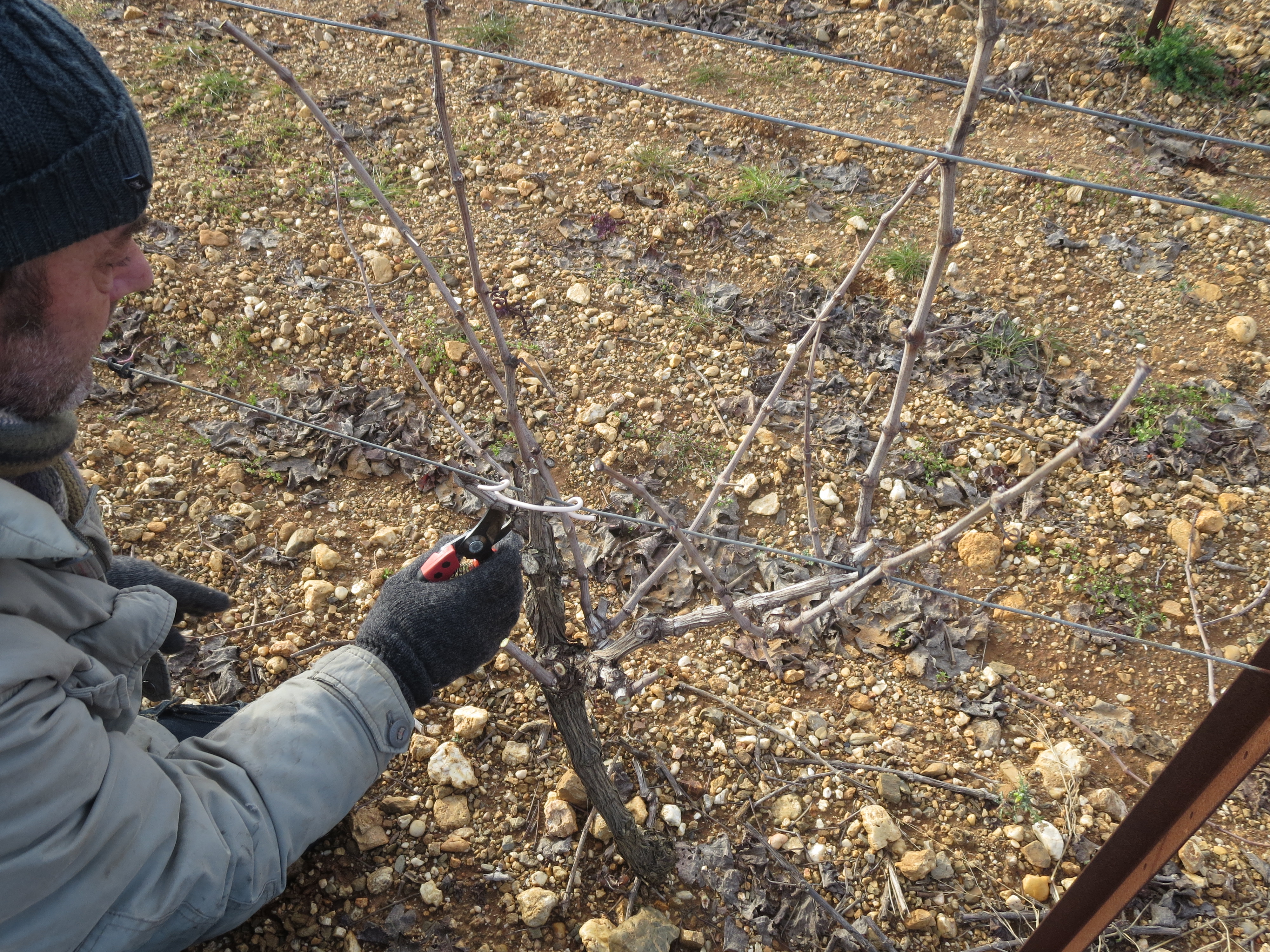
                            Taille (February)

IMG_0798

                              Labour (March)

IMG_2582

         Filled cuves containing the 2015 wines                                                  (September)

That means hard work and this is the second lesson I have learned. The vendanges are hard work. There is a glamour to them. As an enthusiastic wine amateur I often used to think how nice it must be to take part in the harvest. Sunshine, grapes, drinking wine – idyllic. The reality is all of those things but it is not all idyllic; it is back breaking, physically gruelling, hard work. Picking means bending over vines, insect bites, whilst trying to not cut your fingers instead of the grapes. In the cellar, long hours of standing to sort grapes, lifting and carrying heavy cases and twisting around with them, sometimes in confined spaces. The heat above a tank is tiring and sweaty. The drenching as you clean everything again and again. And I worked less than most. Add in all those hours of vineyard work, the background work in sorting the equipment, labour, paperwork and then the pressure of making the right decisions – you have to love this job to make a success of it.

IMG_2400

            Bent backs (Martin and Céline)

IMG_2393

    Standing for long hours while sorting (Karim     and Cameron)

IMG_2550

          Twisting to lift a cagette (Michel)

IMG_2386

Confined space, hot, back breaking – Thomas, Cameron

IMG_2526

     Soaked, Cameron, Michel and Thomas                cleaning

And love is the third and final part of my lesson. The love which Jeff has for his vines and his commitment to making them the best they can be in order to produce the wines which people around the world will love. It is no coincidence that during the harvest we welcomed many friends who arrived to spend a few days with us, to play their part in the vendanges. They do so because they love the wines and they are friends of Jeff. He makes his wines to share, the best wines are those which you share with other people. Le Vin des Amis! Copains! the names of the cuvées tell a story.
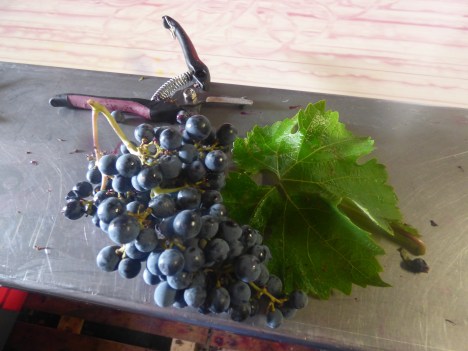
IMG_2620

Remember the story of the Chaud Doudou from last harvest? Well, I have been lucky to share the experience of the vendanges with a fantastic group of people over the last month. The camaraderie and friendship are part of the process of making the wine. And that spirit vanquishes any aches and pains.

IMG_2585

         My boots join the team (a proud moment)

IMG_2431

        Happy times

So, grapes, work and love. And if you don’t believe me, have a look at the video on this link to the excellent #QCQBM website. It is in French but the message is clear. Grapes. work and love.

Des raisins, du travail et de l’amour – Jeff Coutleou