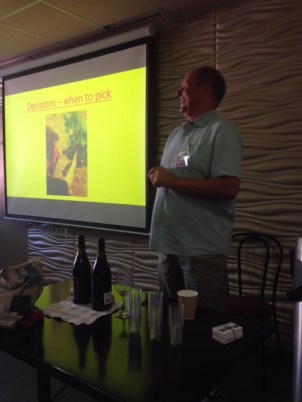
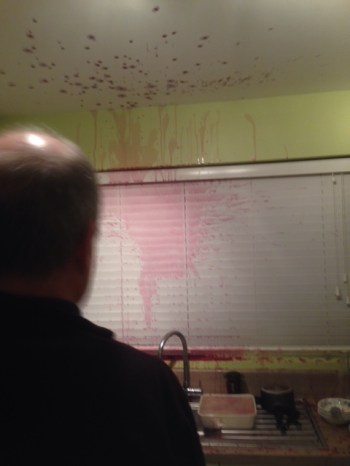
In September I gave a talk to The Tuesday Club in Pézenas about the 2017 vendanges. Jeff bottled some Cinsault and Cabernet Sauvignon for me, the latter still fermenting. When I opened a bottle at the talk it overflowed because of the CO2 being produced. Well, on Saturday I opened the other bottle and I did say it might produce a lot of foam so I opened it over the sink. In fact all but about 5cm of the bottle flew out of the bottle and went everywhere. The power of fermentation! Thank you to Linda and Iain for helping to clean up. I can say that the wine which survived was very good!!
On a cleaner note. I don’t often buy wine from the high street these days. However, I read a report about a Georgian white vinified in amphorae or qvevri as they are called in Georgia. As orange wines have been one of my highlights of 2017 I decided to buy a bottle. Well, it was really good. Made from the Rkatsiteli grape it had a lovely long flavour of pear and apple with nice tannins and real character. Hats off to Marks & Spencer, I went back and bought some more bottles.
I may be away from the action of the Coutelou vineyards but my fascination with wine, and particularly natural wine, continues to grow. I have recently read two things which I thought were worth sharing on here.
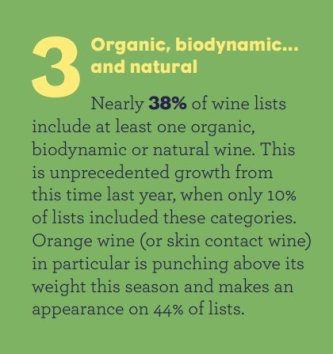
Firstly from Bibendum came this piece of information about the UK.
This growth of interest in natural wines is, of course, very pleasing to me, a long time advocate of the style. Not all these wines are natural but the interest in this sector shows a shift in demand and, also, realisation from merchants that the demand is there.
Caveat emptor! Not all wines labelled as ‘natural’ are that, a consequence of the lack of regulation. In particular beware high street retailers with wines from big companies. Artisans who practice natural methods in the vineyard and cellar are what matter to me. To identify such producers you could do worse than look at the website ‘vinsnaturels’ which is in French and English. The app Raisin is another useful way to locate producers and retailers.
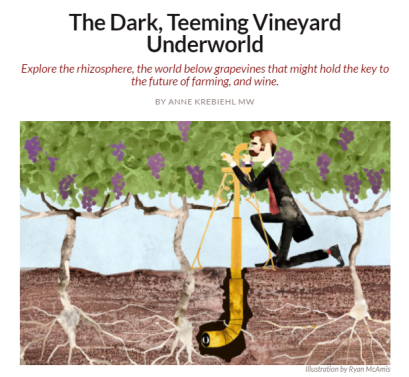
The most interesting article I have read though was from The Wine Enthusiast, written by Anne Krebiehl MW. In it she describes what we are learning about soils and the life which is in there. The rhizosphere is the soil immediately surrounding the vine roots and research is revealing the microbial and fungal life in there. This is something which Jeff has described to me over the years and it is fascinating to look at soils with small white fungal fibres which form a network around the vines, supporting them with nutrition and chemicals whilst benefiting themselves from the vines in a symbiotic relationship. Encouraging life in the soils is, therefore, hugely important; reducing their compaction from tractors etc as much as possible, composting them, avoiding chemicals where possible.
Mycorrhizae in Rome vineyard
There is much research still to be done and we are in the early days of understanding how the soils influence the vine and, consequently, the wine. However, early research supports the careful management of soils and vines by vignerons such as Jeff Coutelou. Respect the environment, encourage life. As he said after the recent damage done to his vineyards the best response is to plant. Trees, bushes, flowers, any plants. Encourage ecosystems and they will repay our guardianship.
In typically moderate and generous fashion Jeff Coutelou’s response to the vandalism on his vineyard was to remind us of his philosophy for viticulture.
He reminded us that generations of vignerons, as with agriculture in general, were persuaded that mass production aided by mechanisation, chemical fertilisers was the way forward. Grubbing up hedgerows and trees to create space for more vines would boost production and income. Irrigation by water from the Rhone was just the latest of these modernisations.
The consequences have shown how those generations were misled. Compacted soils with little or no life in them, falling numbers of birds and insects, diseases spread through waves of monoculture, vines hooked on fertilisers to keep production high.
In 1987 when Jean-Claude Coutelou made the leap to organic viticulture there were only 200ha of organic vines in the Hérault. Now there are 20,000ha. A tide has turned but it is not easy for everyone to accept that mistakes were made. Those who have returned to traditional methods, planting hedges, bushes, flowers and trees for diversity are, ironically, viewed with suspicion. The birds, bats and insects which shelter there help to fight disease. Thirty years of organic practice make for soils rich with life. And yet some don’t get it.
Abri de chauve souris
It is a privilege to stand in Rome vineyard in Spring, listening to the birdsong, bees and cicadas, watching the butterflies and bats, enjoying the colours of the flowers. Knowing that this rich diversity helps the vines makes it even more special. It is the right path aesthetically, morally but, crucially, for the wines too. Nature wins and benefits us as all.
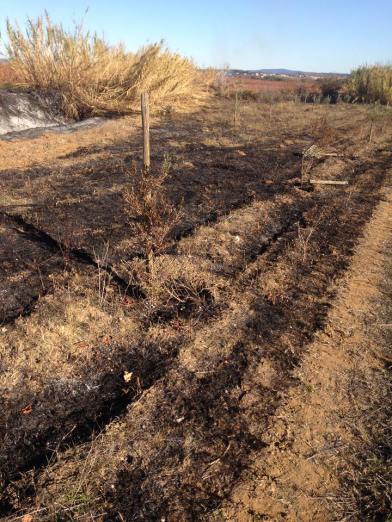
When Jeff contacted me on Saturday he passed on shocking news. On Wednesday, whilst he was in Paris someone deliberately set fire to a hedgerow and olive plantation in Segrairals vineyard. The man (Jeff does know who it was) used petrol to burn them down. This was arson, pure and simple, an evil act.
Arson
Just the previous month there had been another incident, this time accidental. A neighbour was burning waste and it spread onto Peilhan vineyard destroying young trees and some vines.
October
Once is bad enough but two incidents is almost unbearable. That the second was an act of malice makes it even worse. When someone is trying to develop the environment with new planting one would imagine they would be encouraged. Instead Jeff has met with acts of vandalism and now arson. Fortunately he is a strong man and will fight on but he deserves our support.
Last weekend I should have been in the Languedoc with Jeff and attending a wine tasting at Latour De France. Sadly, a 48 hour bug put a stop to that.
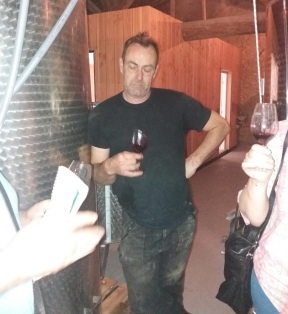
Instead I reflected on a tasting we did at Jeff’s on October 3rd of all the 2017 wines in cuve. Regular readers will recall that they vintage is of high quality but low quantity. Quantities will be in short supply of what will be seriously good wines. There was a tinge of sadness about that as we tasted through the range.
These were my notes on the evening.
Maccabeu / Grenache Gris – still some residual sugar. Fresh nose, Fruity, pears. Slight sweetness which will disappear. Clean and lovely.
Sauvignon Blanc – fresh apple, bright and zesty. A true Sauvignon character, refreshing.
Carignan Blanc – lovely, full, clean, direct – fresh and fruity. Very good.
Rosé – very pale, flowery aroma, fresh and clean, exactly what you’d want from a rosé.
Syrah (Ste Suzanne) – whole bunch, red fruit, round tannins, good finish, full, very good.
Cinsault – lovely, fresh and juicy red fruit, cherry, 13,5% but tastes lighter. Good.
Syrah (Segrairals) – amazing passion fruit nose which carries into taste. Fresh, citrus and lovely red fruit, a real star.
Syrah (La Garrigue) – La Vigne Haute (fingers crossed). Terrific, direct full tannnins, splendid fruit, full, long – stunner.
Flower Power – Maccabeu, Syrah (St Suz), Grenache (St Suz), Grenache Gris, Cinsault, Terret Noir and Flower Power – Despite the different assemblage this has the character of previous Flower Power – fruity, silky tannin and very appealing. Lovely.
Grenache – blend of Ste Suzanne / La Garrigue – 2015 St Suz provided 80hl, this year the 2 vineyards made 60hl. Lovely, fresh cherry flavours with a spicy finish.
Mourvėdre – crunchy, spicy good tannins and dark fruits. Very true to the grape. Good.
Carignan – top of the class. Lovely fresh red and black fruits, excellent balance of freshness and complexity. Star yet again.
Merlot – lovely fruit nose, fresh, touch of wildness which should settle. Nice.
Cabernet Sauvignon – still some sugar, plenty of fruit, easy to drink with classic blackcurrant notes.
We went on to drink a couple of the 2016 wines which were still in cuve, a very floral and spicy Syrah and an assemblage of Grenache, Syrah and Mourvèdre which had good fruits with a soft tannin finish.
Reflections on the evening? The quality of 2017 is clear it is up there with the 2015s, just such a shame that fewer people will get to drink them. The whites are very good but the reds shine especially the future La Vigne Haute and Flambadou. The wines had all fermented beautifully causing few worries. A vintage to cherish, can’t wait until it is in bottle.
So much of wine enjoyment is personal taste, but chance plays a role too. It is often ignored but some recent wine experiences brought the issue to mind.
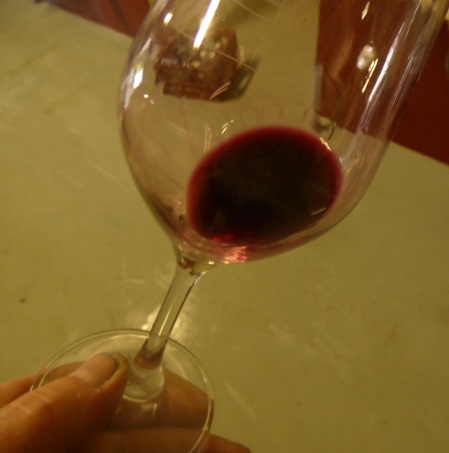
A dinner with friends. I took one of my favourite wines, a chance to share it with others. Remove the cork, pour, swirl … alarm bells. There’s a dry, musty aroma. Sip, and yes, there it is: the wretched mushroom, wet cardboard taste of a corked wine. Previous bottles of this wine and vintage have been excellent, this was a one off. Sadly, it spoiled my evening, such a disappointment, expectations dashed by TCA.
Two bottles opened in successive nights, a 1990 Chateau D’Angludet and a 2005 Cahors, Chateau de Cayrou. The last bottle of the Angludet I opened had been disappointing, showing its age, brown in colour and dried out. This one was dark red with a brown edge, fruit still to the fore coupled with interesting notes of nuts and dark plums. It was a lovely surprise, expectations had been low based on the previous bottle. These two bottles had been stored together, the bottle variation like chalk and cheese. If I had only tasted the first I would have a bad impression of this venerable wine. How many times must that have happened to me?
The second bottle comes from a stellar vintage in Cahors and a domaine with a good reputation. The result? Meh. It was OK, nothing more. Little character, no charm. A food wine some would call it. Which to me is a wine lacking fruit and personality. I bought that bottle many years ago on recommendation, was it a disappointing bottle like that first Angludet? Or was it just a dull wine? Would I spend my money to buy another and find out the answer, certainly not. There are Cahors wines which appeal far more, notable from Charlotte and Louis Pérot’s Domaine L’Ostal.
Wine drinking is personal taste, this bottle of 2009 Faugères was one my wife enjoyed but I found dull. However, before being definitive let us admit that sometimes fortune can influence our wine experience.
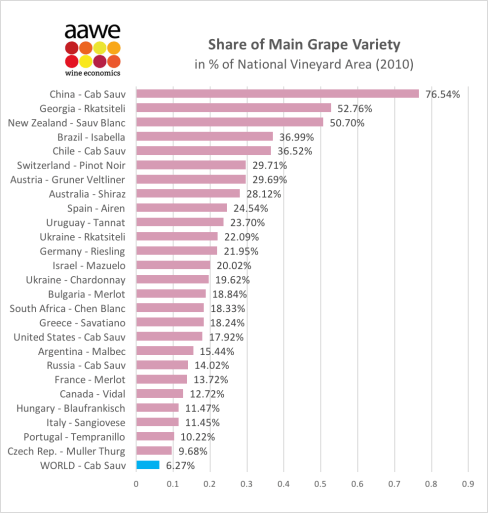
This chart was published two weeks ago even though the information refers to 2010. I found it fascinating (I am a sad case I understand). Some of the information would be expected, New Zealand with its Sauvignon Blanc for example, Australia with its Shiraz. I was rather surprised to see Merlot as 13.7% of the French vineyard area however. Admittedly this is partly because it is one of my least favourite grape varieties, though, as always, fine examples are available from good vignerons.
Merlot, like Cabernet Sauvignon, Chardonnay and Viognier, were in vogue in the 80s and 90s when I became interested in wine. Languedoc producers reacted to this popularity by planting these cépages, it was commercial sense. One of those producers was Jean-Claude Coutelou and Mas Coutelou still has his Cabernet and Merlot parcels.
However, one of the more recent trends in the region has been the revival of older and rare grape varieties. At Mas Coutelou Jeff has planted grapes such as Riveyrenc Noir, Riveyrenc Gris, Morastel, Piquepoul Noir and Terret Noir in Peilhan (see photos below).
Earlier this year Jeff received a visit from Domaine De Vassal, guardian of the national treasury of grape vines. They record and keep examples all grape varieties as I described after a visit to Vassal. On this occasion they were intrigued by two vines in particular; firstly Clairette Musquée, planted in Peilhan and, secondly, the unknown variety in Segrairals. These are just part of the programme of replanting and grafting which has taken place at Mas Coutelou. The photos below show grafting of other cépages in Flower Power such as Aramon Noir and one unknown variety.
After months of research the experts at Vassal have concluded that Clairette Musquée has its origins in Hungary where it was known as Org Tokosi. It was planted in the Maghreb and after Algerian independence it was probably brought to France by those who repatriated to France.
The unnown variety turns out to be an Italian cépage, quite rare, called Delizia Di Vaprio. This is, according to my copy of Pierre Galet’s “Dictionnaire Encyclopédique des Cépages”, a grape authorised in Italy and Portugal. Under the rules of France’s AOC system it would not be allowed. Jeff, however, chooses to issue his wines under the Vin De France label which means he is free to choose his own methods and grape varieties. Whereas a Languedoc AOC wine must include grapes such as Syrah and Grenache Jeff can choose what to put in his wines including wines from just one grape variety. It also means he can plant these rare grapes and make wines from them which he truly loves and wants to make.
Interestingly one AOC, Burgundy, is starting to show signs of concern that Vin De France is becoming more popular. They have started a campaign criticising Vin de France. To my mind they should be looking to their own failings and regulations. For example, as climate change bites harder vignerons will have to adapt, investigating different grape varieties will be part of that.
So, yes Merlot has its place (and thrives in the Colombié vineyard in Puimisson) but is it not exciting to see rare, old, traditional grapes being cherished and brought back to prominence? Let us appreciate the range and variety of grapes and the vignerons who bring out their best.
This is one corner of Segrairals vineyard, found in the North East corner of Puimisson. I took the photo on October 6th and it clearly shows a demarcation in this part of the vineyard. The far side of it still has green vines, further towards me the vines are changing colour as Autumn arrives. Why are the vines at different stages of development? Even a month before on September 7th there was a clear line.
The reason is that a stream used to run down here many years ago. Its legacy is to have left richer soil behind in the corner where the cannes de Provence now stand. The vines planted on that richer soil find life easier than their peers. They remain greener, feed their grapes more easily. All good?
Well, no. The grapes can be too well fed, ripen earlier than their neighbours, become too sweetened. They will also begin to deteriorate earlier if not picked. So, in one small corner of one vineyard we see how the terroir makes a difference to the vines. We see how a vigneron must know his / her vines to ensure that the highest quality is maintained. The vigneron is part of the whole mystique of terroir and it is a subject to which I shall be turning soon.
This photo was taken on October 6th in Font D’Oulette, the 0.6ha Flower Power vineyard. It tells a number of stories.
Look at the vineyard itself. Small, youthful vines, only six or seven years old with a rich variety of cépages including some rare ones such as different varieties of Oeillade, Clairette Musquée and one known simply as Inconnue as its origin is unknown. This complantation of cépages was typical of the old ways of growing vines. The use of gobelet training rather than the use of wired trellises (palissage) is another example of traditional viticulture. This vineyard tells a story of how old ways are often better, its wine has already garnered much praise.
Look also at the vineyard behind Font D’Oulette. You will see vines looking very different. The vines are a rich green in colour and their foliage is still lush. This forms a contrast with the autumnal yellow of Flower Power. This is the result of neighbours’ vineyards being treated with large quantities of chemical fertilisers, especially nitrates. These artificially boost the growth and colour of the vine. Flower Power’s vines, on the other hand, are allowed to develop at their natural pace.
The vineyard is surrounded by olive and fruit trees as well as ditches. This is deliberate on Jeff’s part because he wants to create a barrier to the neighbouring vineyards. When it rains in the Languedoc, it often rains hard causing the soils to wash away. Sometimes, the soils are compacted by machinery and the treatments on the vines are washed away with the rain. Since Font D’Oulette is in a bowl this would mean that neighbours soils and chemicals would run onto Jeff’s parcel so he uses the ditches and vegetation to prevent his vines from being affected.
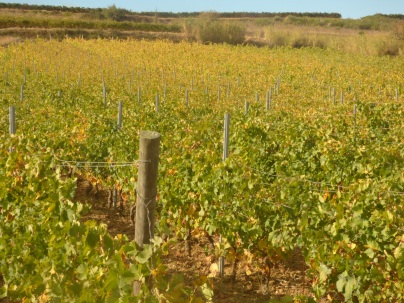
The 18thC German physicist’s words struck home to me after visiting the vineyards for one last look around before I head back to the UK. They are a beautiful sight at this time of year, a rainbow of colours as I hope my photos will show. And all under a golden, morning sun, of which more later.
That the vineyards are so stunning at this time of year came as no surprise but they had one or two lessons to teach me, my fourth autumn here but still learning.
There is truth in Lichtenberg’s words. The vines are giving back to the earth some of what they took from it during the year, the leaves mulch into the soil, a repayment yet also an investment for next year. Together with the discarded bunches and berries left from vendanges, they will add life to the earth, indeed there were insects and butterflies, birds and worms aplenty. Healthy soils.
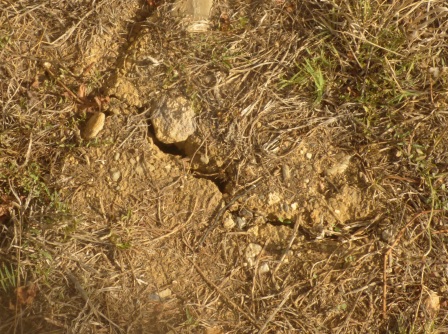
BUT. They are very, very dry. Cracks in the earth in October. Two mornings of light rain, otherwise next to nothing for four to five months. Parts of the Hérault are already being declared as an emergency situation because of the drought. The temperatures remain in the mid to high 20s, lovely for visitors but the local population and the earth need steady rain to arrive soon. The forecast shows no rain.
My other major lesson was the variation in varieties, not a tautology I promise.
Compare the two halves of Ste Suzanne taken from La Garrigue, to the left is the Syrah, to the right Grenache. In La Garrigue these two cépages show a difference, the Syrah losing its leaves, the Grenache still mainly green.
La Garrigue – Syrah left and Grenache right
Meanwhile the Carignan leaves turn a vivid red colour, much more so than any other variety.
And in my favourite vineyard, Rome. The birds are back in numbers after the summer. Birdsong rings around the bowl of the parcel, the fig tree has given its two crops and the olives are turning colour just like those in Font D’Oulette, the Flower Power vineyard.
















 amarchinthevines