amarchinthevines

Learning about wine, vines and vignerons whilst living in the Languedoc


2 Comments

2019 – my favourite wines

Three posts to celebrate the great wines I have enjoyed in 2019 which I would recommend without hesitation. Obviously I could include lots of Jeff Coutelou’s wines but I will restrict myself to just one, I shall keep that choice for the last of the posts.

I shall start with red wines and a classic region. Bordeaux and Burgundy are still the benchmarks for world wines, steeped in tradition. However, Chateau Le Puy is in the Cotes De Francs, east of Pomerol and Saint Emilion, not one of the higher regarded regions. Being right bank Merlot is the dominant grape and my choice of wine is an example of that. Barthélémy 2016 showed great fruit as well as classic Bordeaux weight and depth boosted by the 15% of Cabernet Sauvignon. Where this wine differs from classic Bordeaux is that this long established biodynamic domaine used no sulphites.

To Italy, more specifically Gambellara between Verona and Vicenza. Angiolino Maule was one of the pioneers of natural winemakers in Italy and his La Biancara domaine is now run by his three sons. I met Alessandro and his partner Emma Bentley in London and loved their wines but one stood out to me. This was what I wrote at the time, “Star of the show for me was So San 2016, made from Tocai Rosso grapes, the local name for Grenache. Aged in barrel for 15 months this was a big wine with lovely fruit up front backed by ripe tannins which will surely allow the wine to age for many years. It was perfectly balanced, a terrific wine from one of my favourite grapes.”. Congratulations to them too on their first child in 2019.
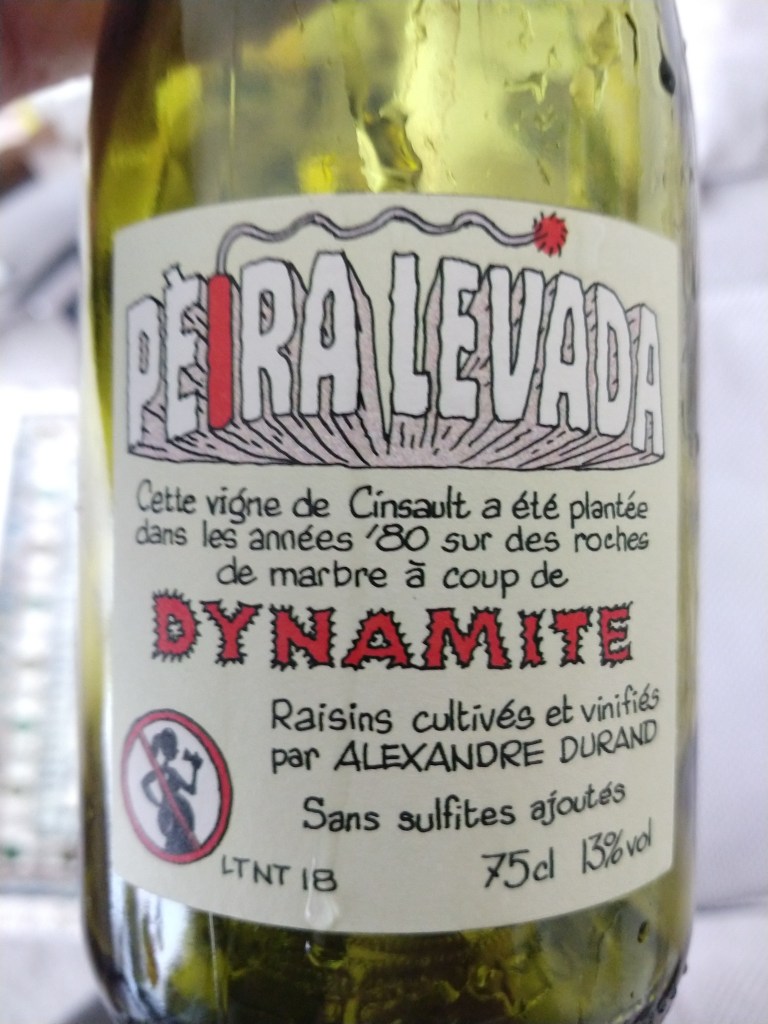
Around the world again, this time to South Africa whose wines are starting to make a big impact. Testalonga is the domaine of Craig Hawkins and I have had their wines before but the 2018s really were a breakthrough. Chin Up is a Cinsault wine and this example was full of lovely fruit with a nice fresh acidity and light tannins. Very pleasurable and very drinkable. On similar lines was Dynamite 2018 from Peira Levada the domaine of Alexandre Durand in Faugeres. Pure Cinsault too but this time grown in soils with an unusually high percentage of marble. I loved this, a wine to simply enjoy but also with a serious side. Definitely the year of Cinsault for me.

Staying in the Languedoc, Gregory White is based in Aspiran, one of a number of very good producers there. His White Is Rouge 2017 was my favourite red wine this year for sheer pleasure. A blend of Grenache and Syrah the wine is fruity with a lovely aroma of blueberries and strawberries too. There is a depth with hints of liquorice and more red fruits. Just lovely.

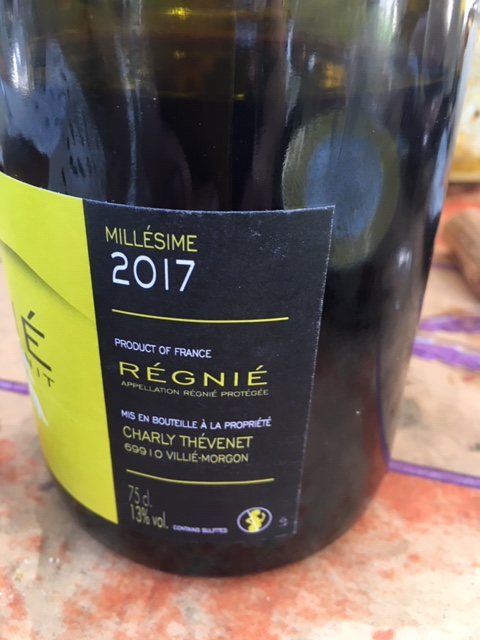
One more light red which carries more weight than might be expected. Gamay from Beaujolais is famous for its light, fruity juice. The region is a hotbed of natural winemaking and one such is Charly Thévenet, son of one of the original Gang Of Four producers Jean-Paul Thévenet. His Régnié Grain et Granit 2017 was classic Beaujolais, fun but with a serious side, good tannins and well structured.

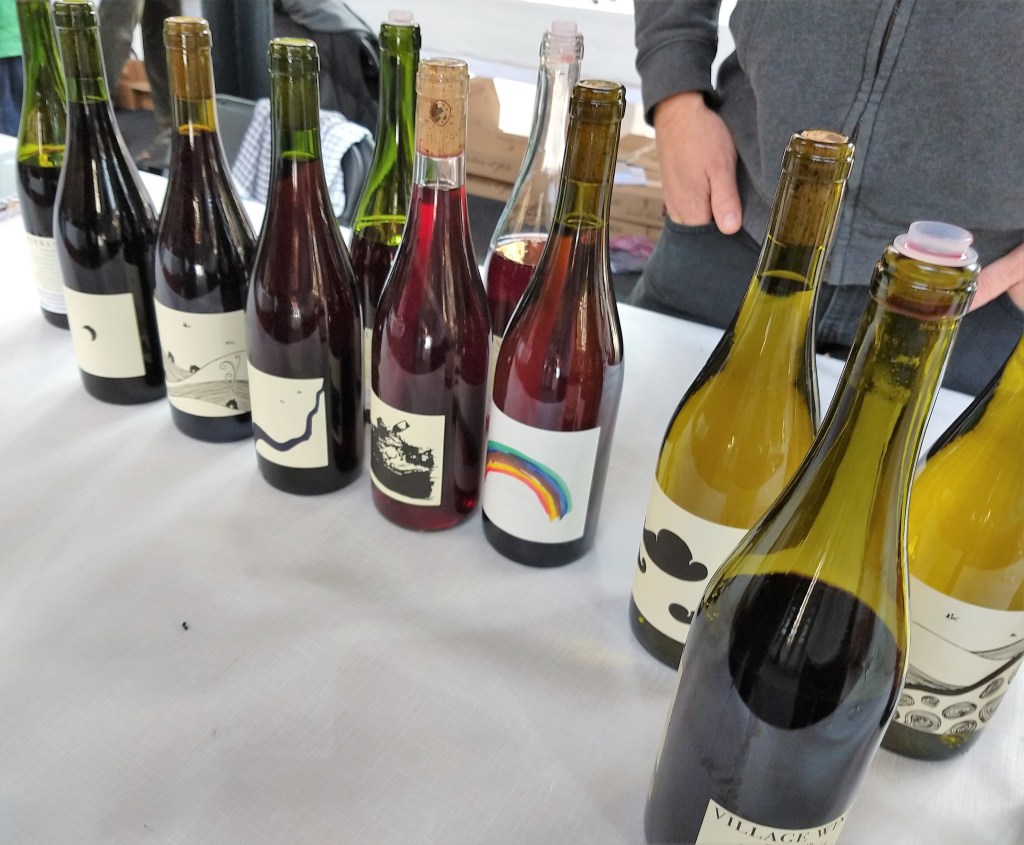
I shall finish with a wine from the Adelaide Hills. I first encountered Gentle Folk’s 2018 Village Pinot Noir when I visited Gareth Bolton’s domaine in the Hills and this very wine was newly harvested and fermenting away. This Spring I tasted the wine in London and was hugely impressed. Pinot Noir is my favourite red grape and this showed that Aussie producers can rival any in making the most of it. You will have noticed that I like red wines with a serious, contemplative side but also with pleasing fruit to make the wine enjoyable. The best Pinots have red and black fruit flavours, lots of rich aroma but also have tannins and a minerality. Gareth’s wine is all that is good about Pinot Noir.

Next time, on to the white wines.


10 Comments

Natural news

As a result of my interest in wine, natural wine in particular, I read lots of articles, tweets and other media sources. Quite often these include attacks on the whole idea of natural wine, clichés about it being a fashion rather than serious wine and generalisations about faults. There are some writers and wine industry people who get very worked up about the idea of people enjoying wine and dismissing such people and their ability to appreciate good wine.

One issue which regularly upsets such critics is the very term ‘natural wine’. It involves human activity, vines don’t grow naturally in rows, fermenting in vats or barrels – all are not natural processes so the term is misleading they cry. Recently I read about one Chilean minimal intervention producer criticising the term because it diminishes the role of the winemaker.

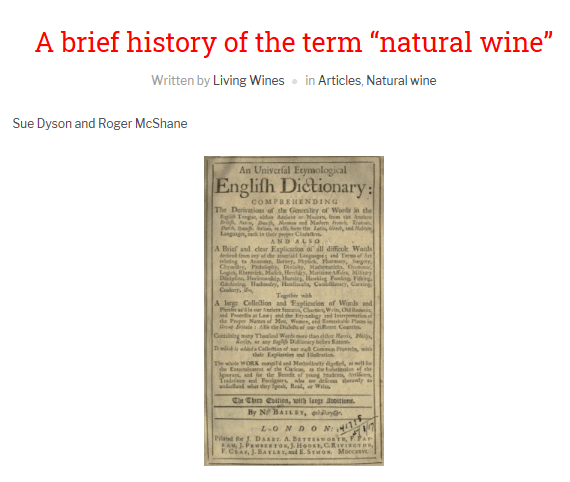
It was interesting, therefore, to read a tweet from wine writer Simon J. Woolf about an Australian article on the term natural wine. In it writers Sue Dyson and Roger McShane outline their research which shows that the term ‘natural wine’ has been used for centuries. They found it used at the end of the 17thC by a Swiss writer who abhorred the ‘abuse’ of wine by adding things to it or ‘refinement’. In 1731 an English Dictionary defined “Natural wine is such that it comes from the grape without any mixture or sophistication”. By 1869 the article shows a French description, “Natural wine is the term applied to the product which contains no other matter than the grape when fermented produces“.

These definitions could apply today and show, to my mind, that modern natural wines are simply a return to classic winemaking. The lack of definition of what constitutes a natural wine leaves them open to criticism and abuse. And, this point was further highlighted in a recent article by Alice Feiring entitled ‘Is Natural Wine Dead?’.

In this New Yorker article Feiring expresses regret that many have jumped on the natural wine bandwagon and how many of those are taking shortcuts to cash in. Bigger companies seeing marketing opportunities sell wines labelled natural since they contain no added sulphites though the base wine may be machine harvested, artificial yeasts added etc. Other winemakers are trying to make wine without experience and the results are often faulty which adds to the generalisations mentioned above.

I think Feiring has a point. I see wines on UK retail shelves promoted as natural which I would not consider to be so. I have tasted faulty wines at fairs events but then I have done at conventional wine fairs and far more dull, characterless wines. However, the lack of definition does facilitate this usurping of the natural wine label.

That said there are waves of new winemakers who are producing great wines. Just this week I had a terrific Cinsault from Alexandre Durand of Peira Levada in Faugeres, Dynamite. Fruity, enjoyable but with a lovely mineral streak of freshness and complexity. With this new wave in France and around the world those of us who enjoy natural wine are still in safe hands.


Leave a comment

Oddities #4

En francais

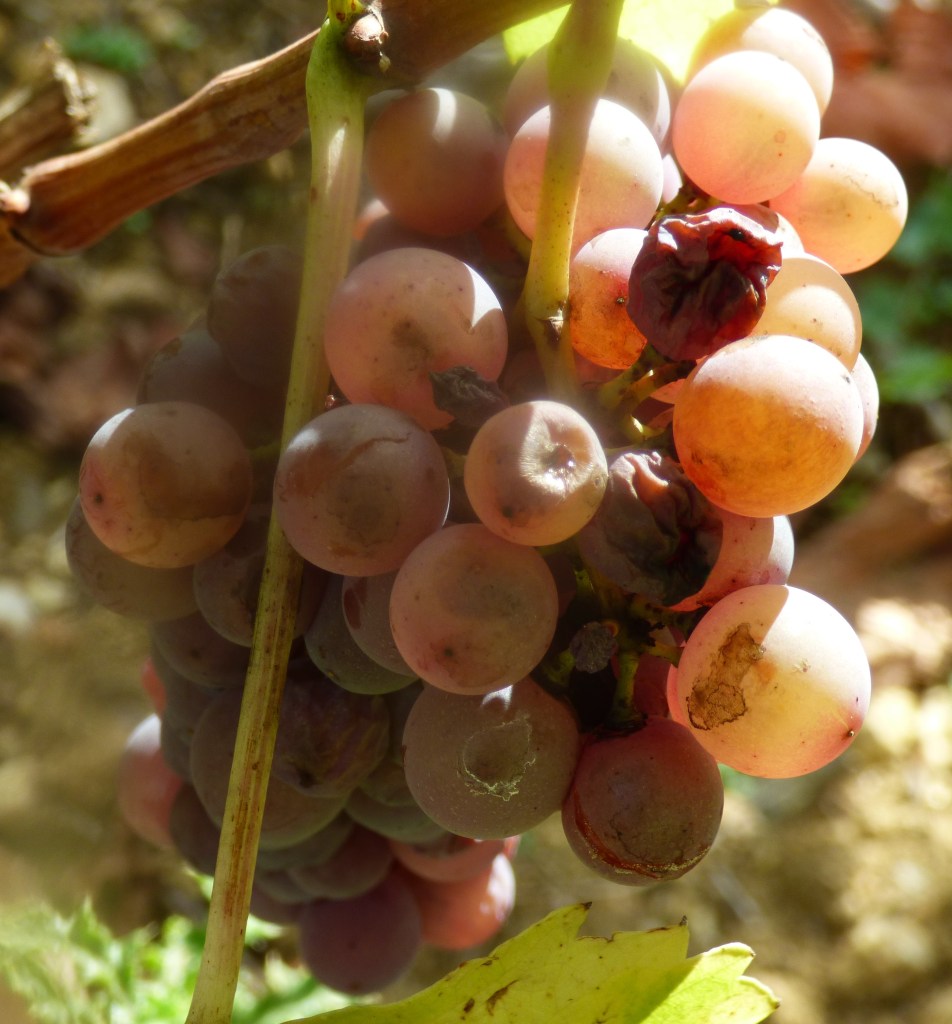
Puimisson is on the plain north of Béziers. The foothills of the Montagne Noire lie a few kilometres further north towards St. Chinian so it was a surprise to me when we came across this bunch during the vendanges. Why?

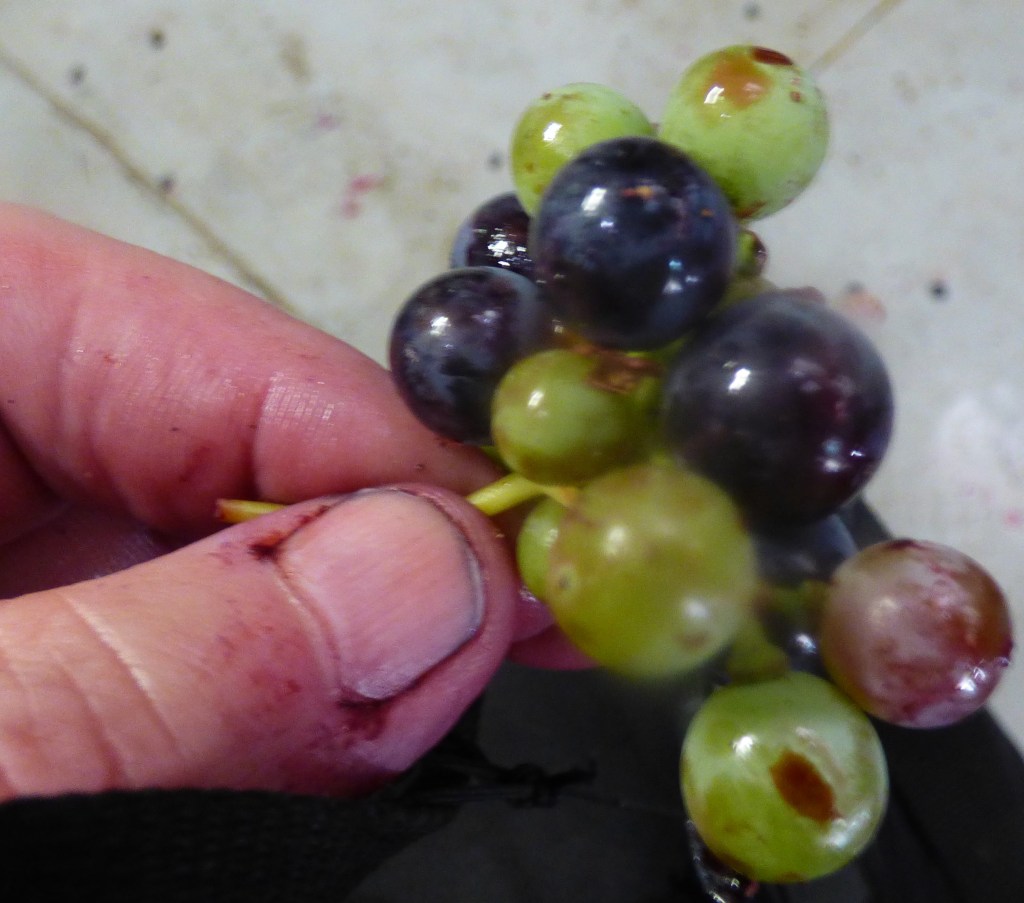
As you may know if you read my harvest reports this year was problematic because of the summer heat but also a spell of bad weather during flowering and fruit set in Spring. This led to problems of coulure and millerandage. This means that the new berries either don’t develop at all or very little, bunches look very uneven.

In the photos above you see evidence of this. A bunch with gaps where grapes should be, some grapes which have not changed colour and matured.

The photo above shows the aftermath of a sorting table after destemming. You will see lots of green unformed berries, coulure.

Moths were also busy ravaging some of the grapes, laying their eggs in the bunch gaps, the larvae then eating into the grapes. The photos below show one of the moths and then you can see a grape in the centre of the bunch with a hole where the worm has buried through, the juice then spoiling the bunch as it falls over it. Incidentally the bunch with the moth shows damage to the bunch caused by the late June heatwave.

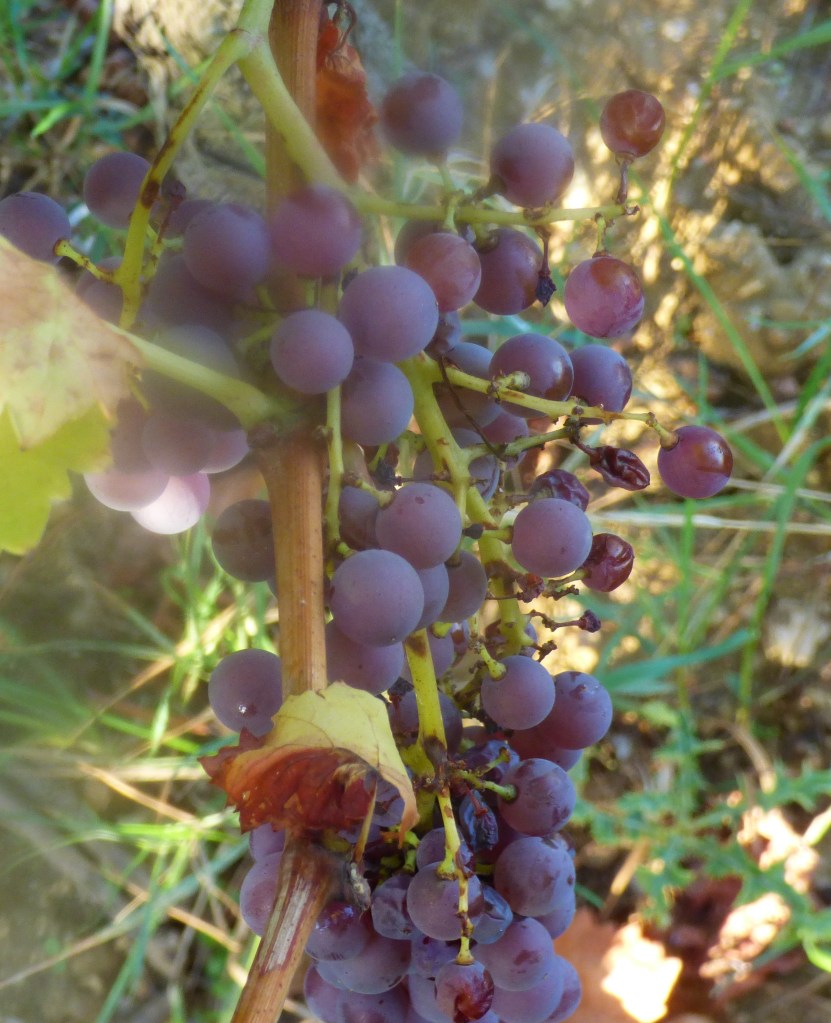
However, the headline bunch was something different. I had to ask. Was it birds which had eaten the grapes? Well, I was on the right track but actually it was the work of a wild boar. These animals cause real damage in some parts of the Languedoc eating large quantities of grapes, some vignerons use electric fencing to keep them out. But that is mainly in the hills and wooded areas. Here on the plain they are much rarer but they are still around, perhaps the dry weather brought some further down to seek food.


Leave a comment

Oddities 3

En francais

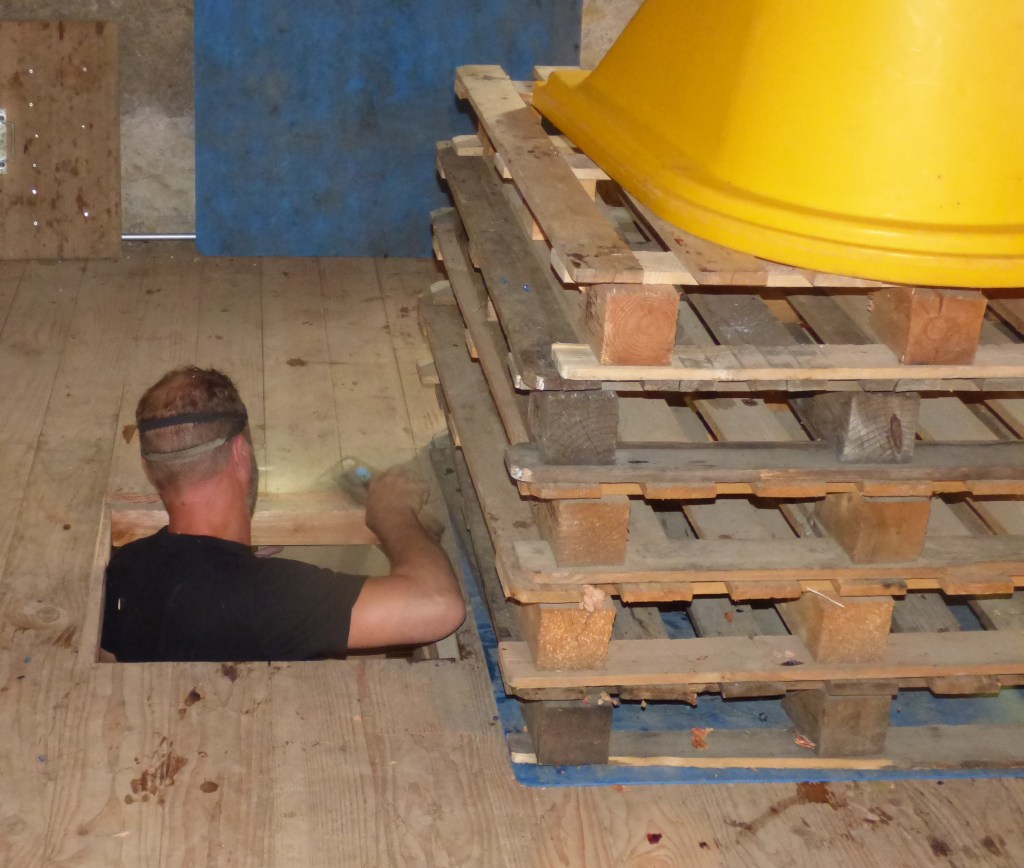
Fabrice disappearing through the floor. What is going on?

Carbonic maceration is a winemaking method most associated with Beaujolais where it has long been the traditional technique. Its ability to draw out fruity, fresh flavours helped make the name of the region especially when railways carried the wines to Paris in the late 19thC. In the 1960s Jules Chauvet carried out research into the technique and his scientific studies showed that Gamay and Grenache were especially suited to carbonic maceration. (He was, incidentally, also the man who pioneered no sulphur or natural wines).

The tank is filled with carbon dioxide

And, Grenache was the grape which had Fabrice climbing down through the floor. Underneath the top floor of the cellar is the top of the wine tanks. The yellow funnel is where the grapes are placed after being sorted, falling through into the tanks. When the tank is filled carbon dioxide gas is added to it. As well as creating an oxygen free atmosphere the CO2 seeps into the grapes and encourages them to start to ferment inside their skins rather than on the skins in traditional winemaking. Some grapes at the bottom of the tank will be crushed by the weight of the others so there is some conventional fermentation.

If the grapes are removed and pressed before fermentation is complete this is known as semi carbonic maceration, a method which Chauvet identified as suitable for grapes such as Mourvedre, Pinot Noir and Syrah.

The popularity and spread of natural wines has brought a renaissance in interest in carbonic maceration because of its ability to produce very drinkable wines, ‘glou glou’ as they are often described. Search any wine bar or merchant list and you will find many such wines listed.

So, Fabrice was checking on how much the tank was filled.


Leave a comment

Oddities 2

En francais

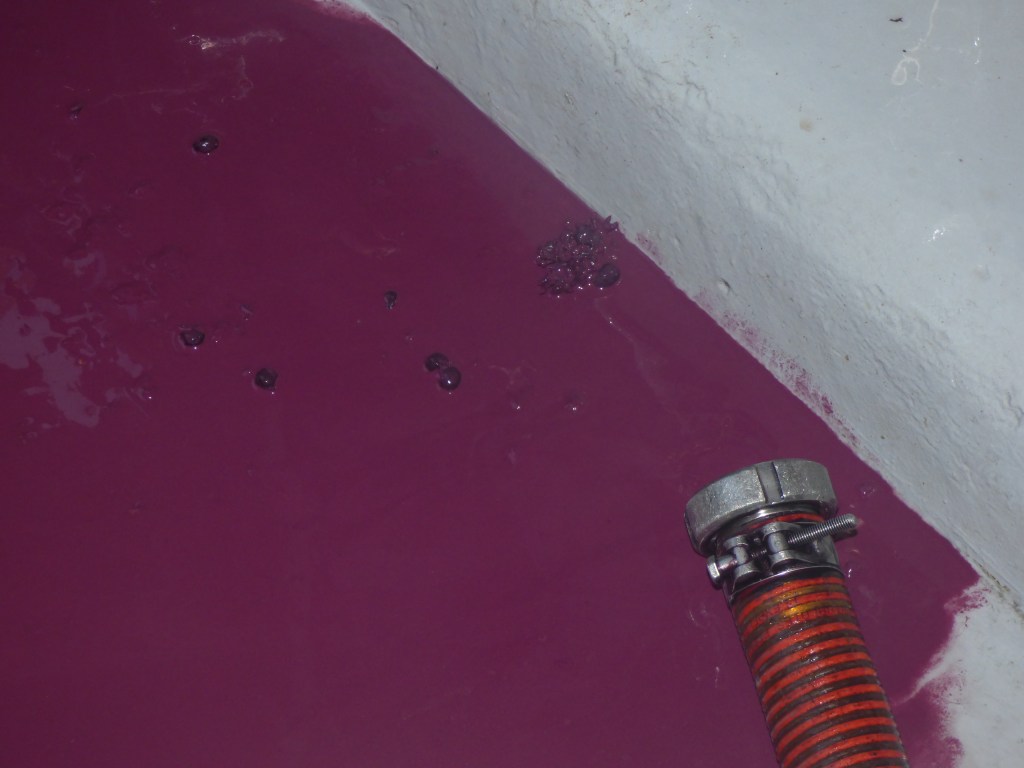
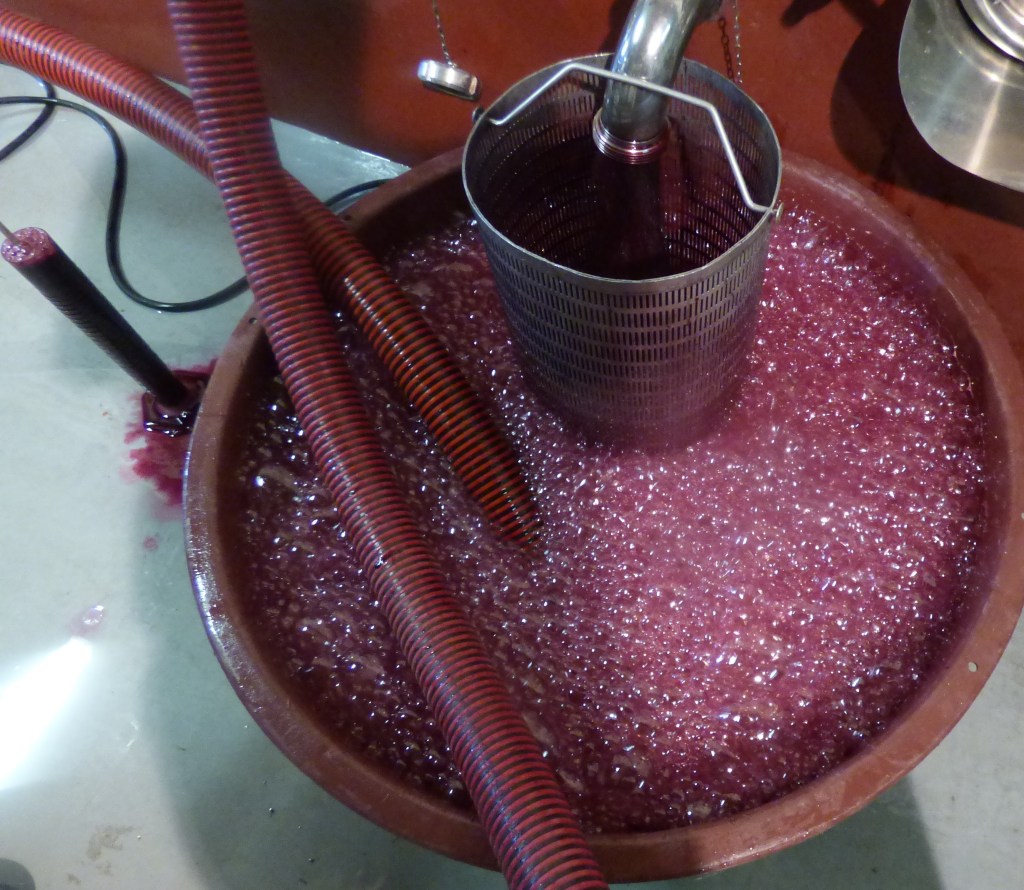
This photograph was taken on September 5th, so fairly early in the period of the vendanges. It shows white wine being run off its lees after being in tank.

Regular readers will recall that to make a white wine the grapes are usually pressed immediately after picking. The resulting juice heads to tank and ferments. The juice will contain some pulp and various natural substances from the skins such as the yeasts which kick start the fermentation process. As it continues the exhausted and dead yeast cells fall down into the bottom of the tank, these are the lees.

You can see the wine still fermenting because of all the bubbles in the container as it is run off the tank. Leaving the wine on the lees too long can be self defeating, risking bacterial contamination. However, the lees can add a creamy depth to the wine so it is matter of judgement as to how long to leave the wine in contact with them.

I love the golden colour in the photo, offering promise and hope to the wine which will follow. Having tasted the wine I know that the promise will be fulfilled.

Red wines spend time on their skins to extract colour and flavour from them during fermentation. The wine is run off and the skins removed when the winemaker decides. In the photo the skins are being removed by Jeff. However, after that the process is the same. There will be lees in the runoff wine and they will settle as did the white wine lees.

The sludge with lees and some juice


Leave a comment

Oddities

En francais

In the next couple of posts I am going to look at some photos taken during vendanges which highlight some oddities and insights into vines and wines which I have not covered in the story of the harvest.

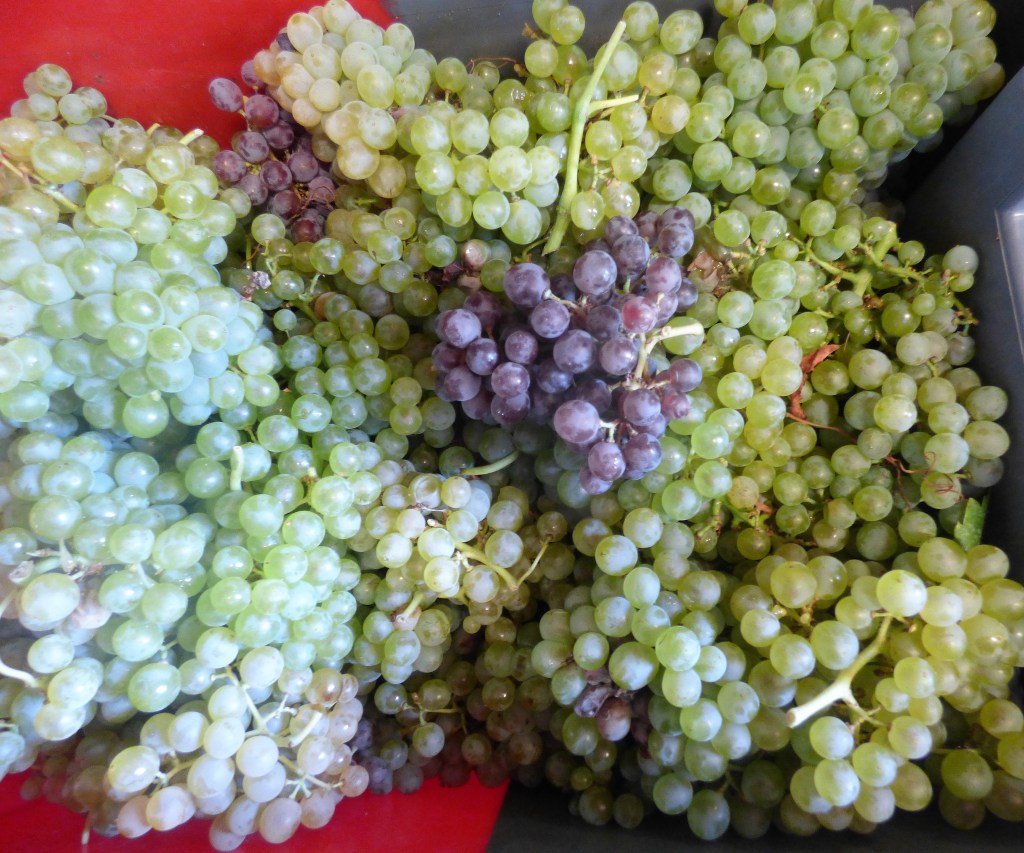
This photo may look like a bunch of red grapes has been placed in amongst bunches of white grapes. The oddity is in fact that they came from the same vines. The grapes are mainly Grenache Blanc, the others are Grenache Gris. Grape varieties are basically variations of one another.

The Grenache family (Noir, Gris and Blanc) are all the same DNA, with the slightest mutation between them. This is also true of the Pinot family for example. In this case one or two of the Grenache Blanc vines has somehow produced one of the mutations in some of the bunches, the result is that a Grenache Blanc vine produced Grenache Gris grapes.

Grape breeding is a very inexact science. The crossing of grape varieties produces new varieties, eg Sauvignon Blanc and Cabernet Franc produced Cabernet Sauvignon. However, if I was to try to cross Sauvignon Blanc and Cabernet Franc it is unlikely that I would produce Cabernet Sauvignon vines, the original cross is a unique event.

The vines we see across vineyards worldwide are often cuttings propagated from successful vines which show characteristics favoured by the producer, such as quality or quantity of grapes. These clones are planted but, again, slight variety amongst the billions of cells in the vine means that they could well be different to the original vine, not identical clones at all.

Therefore, this case of grapes was fascinating to me. It is not that unusual for this to happen, but it certainly piques my interest as I learn more about grape varieties and grape growing.


Leave a comment

Reflections on the vintage

En francais

Back in the UK, back in the wet and cold weather, though the Languedoc has suffered severe bad weather itself. Jeff kindly gave me many bottles to bring back, so the Coutelou wines are never far from my mind. And with a little time to reflect on the 2019 vendanges and the wines which are in tank.

The year began brilliantly, healthy rainfall over the winter meant a promising start, the vines were healthy and disease free through budding and flowering. Jeff was hopeful of an excellent vintage. Some damage from winds during flowering took a little of the shine away. And then came months of no rain and the promising start withered away in the heat, the nadir being June 28th with 45˚C temperatures. Though this canicule was worse for other parts of the Languedoc, Jeff’s Carignan was affected too. The continuing drought meant that the grapes were small, lacking in juice and very concentrated.

The positive was that disease such as mildew never formed so the grapes were healthy and clean. There will always be the odd problem, vines are natural, living things and, so, there will be problems. Most reports of wine harvests only ever show beautiful, clean grapes. There is no such thing as completely perfect grapes, every wine domaine will have problems. Jeff and I believe in showing the truth. The risk is that problems can appear worse than the reality. You will have to believe me that in 2019 98% of all bunches were good and healthy and whilst these photos show what problems we did meet they should not be exaggerated.

The wines which were produced will be very good. There is plenty of fruit and the wines are concentrated because of the lack of rain. They are quite high in alcohol and so careful picking and blending by Jeff was necessary to give the wines balance. There is good acidity and freshness despite the concentration. 2019, in my opinion, will not have the great quality of 2017 and the 2018s which taste tremendous at the moment. However, there is plenty of great wine to look forward to, cheers.


Leave a comment

Glass and bottle

En francais

October 2nd proved to be an interesting day in the cellar in two distinct phases. In the morning we were pressing the grapes which had gone into amphorae and then, in the afternoon, we bottled the first 2019 wine! That may sound odd but there is a reason which I shall explain.

The new amphorae had been filled with Piquepoul Gris and Terret Blanc grapes on September 12th and after macerating for three weeks it was time to run off the juice. This is straightforward in a normal wine vat but amphorae take a lot more work. The grape skins and pulp had to be lifted out by hand into the press, a laborious task.

After the bulk of the grapes were removed the rest of the juice could be run off by siphoning it out from the amphorae. The skins were put into the two basket presses and the juice put into a stainless steel tank with the siphoned juice. Some Cinsault grapes had been put aside to add to the mix and they added to the press, making a colourful gâteau after the press. This gateau is then broken up and repressed to add more juice and tannins to the wine.

Just a very gentle press the second time so as not to extract too much bitterness from the pips. The resultant wine, a light pink/orange in colour, tastes really good, there is something textural about the wine as well as the pear and apple flavours. I am really looking forward to trying this when it is finished.

Glass like appearance

One very odd note about the amphorae. Some sugars from the wine had actually managed to seep through the clay to the outside of the vessel. This resulted in a shiny layer of glass like appearance forming. It tasted like honey on the outside of the amphorae, bizarre.

In the afternoon, bottling. Now you may well ask, as I did, why on earth were we bottling a wine which had been grapes hanging on a vine exactly a month earlier? Too soon?

That would certainly be the case for a still wine but what Jeff was making was a PetNat, a sparkling wine made in the bottle. The juice goes into bottle and although the main fermentation is complete there will still be more taking place inside the bottle. The resulting carbon dioxide gas becomes the bubbles. In a few weeks the bottles will be disgorged removing any lees and leaving behind the sparkling wine which will be topped up and resealed. I described this process in this post in 2017. A cap is used as the pressure from the CO2 would push out a normal cork.

We filled a thousand bottles with the wine from La Garrigue’s white grapes such as Sauvignon Blanc and Muscat. This must be one of the earliest bottlings of 2019 in France but, hopefully, you now understand why.


1 Comment

Jeff and Icare, Netflix stars

En francais

The Netflix series “Rotten” released new episodes last weekend, one of which features Jeff Coutelou. The series examines the food and drink industry and problems associated with it. Previous episodes have featured items such as peanuts, cod, and milk. Series 2 includes an episode about wine called, ‘Reign Of Terroir’.

The programme examines the role of Languedoc Roussillon in supplying wine. It produces a staggering 20% of the wine drunk in the world according to the programme. However, the region faces increasing competition from around the world. ‘Rotten’ looks at how cheap imports from Spain have undermined Languedoc producers and have even been sold fraudulently as French wine. The direct action of some producers against such imports is examined in detail. The programme goes on to look at how new competition is emerging from Chinese wineries.

The film makers came to Puimisson during the vendanges of 2018 and spent a few hours filming Jeff and our harvest lunch. Interviews explain how Jeff and his father, Jean-Claude, moved away from the bulk wine production of most Languedoc vignerons to more specialised organic winemaking, even grubbing up vines to plant trees and plants to diversify the environment of the vineyards. This section of the programme serves as a balance to the winemaking we see at the huge L’Occitane co-operative in nearby Servian.

One of the vans loaded with filming equipment

It is beautifully filmed and the final scenes in Rome vineyard where Icare bounds around amongst the vines are charming. Jeff issues his mantra that love is the secret to good winemaking, a contrast to some of what we see elsewhere in the programme.

Should you watch? Well, of course, it is an interesting programme. It highlights the issues and differing points of view, fitting well into the context of the series’ themes. Call me biased but the stars are clear and obvious.

See for yourselves here, with a Netflix subscription.


Leave a comment

Harvest 2019 – The End

En francais

Julien loads the last case of 2019

Life is full of surprises.

I went along to the cellars on Monday 23rd September in order to take some photographs of the pressing and progress with the making of the wines. When I arrived Jeff and Julien were on their own pressing the marc from the Cinsault. The free juice had been run off already into tank but the grape skins and pulp contain a lot of juice still so they are pressed adding more tannins and colour to the finished wine.

However, shifting tons of grape skins from a tank through a small doorway and then pumping it into the press is hard work and though they were managing well enough I decided to help out and get stuck in. It’s a proper workout pitchforking all that pulp, it gets very messy (bad news for my trainers) but job done. More remontages in the afternoon but also the chance to taste through the tanks before sending samples off for analysis.

Tasting wines from tank during or immediately after fermentation is challenging. Jeff is used to it and knows how a wine will emerge. I taste a lot of wines and know his very well by now but all I seek to achieve is an idea of acidity, tannin and fruit presence, to see if these elements are balanced. Happily it is good news all round. The wines tasted good, very promising for the vintage following on from last year’s excellent quality. The analyses are also good, there have been one or two scares along the way but the wines have worked themselves out with a little help from Jeff.

A week later I was a little surprised to hear that there was to be one last pick. This has happened in previous years, often picking Muscat for the solera. However, there were a few rows of Grenache Gris unpicked and so on September 30th, a month after harvest began we started over.

I picked all morning with the Moroccan team of four, my aching back a reminder of how quickly we get out of practice and rhythm. Then back to the cellar where the grapes, with a few vines of Macabeu, were pressed.

Grenache Gris is one of my favourite grapes, its pinkish colour marks it out and many of my favourite white wines from the Languedoc, and especially Roussillon, are made with the grape. The bunches were healthy, the wine should be very good.

In the afternoon we used the marc from the Grenache Gris. It was passed back through the destemmer and the grapes placed into a container with a little bit of water. This will make a piquette wine, a light quaffing wine. I was surprised to read a couple of days later that piquette wines are the new trend in the USA. It is something of a tradition in Puimisson. On Wednesday the piquette was already fermenting when we looked in the container.

There still remains much to do in the cellar but this was definitely the end, the final cases are in. I think.