Mas Coutelou has been organic since 1987, recognised as number 670 in the whole of France, i.e. the 670th of any type of organic production not just wines. Therefore, Jeff’s father, Jean-Claude, was one of the pioneers of the need to practise more sustainable agriculture and winemaking. Carrying the label ‘agriculture biologique’ is important to many customers who now choose to buy organic products, it is also important to a domaine which has such a rich history of organic viticulture and has now gone further by producing natural wines.
On Thursday Jeff was visited by the inspector for organic winemakers in the Hérault. Despite the long history of organic Mas Coutelou the domaine is checked each year by ecocert to ensure that it is sticking to organic practice. The inspection lasted 3 hours with 2 hours in the office going through paperwork to ensure that all activities are compatible with organics. It was gruelling and Jeff had to have proof and paperwork to support his claims. New parcels of vines, treatments in established vineyards, what grapes went into which cuves and which bottles – all were checked. Calendars of treatments (using organic materials such as nettle manure) for each of the last 3 vintages, analyses of the wines to ensure there are no outlawed chemicals, quantity of production – all were checked. Jeff produced spreadsheets to show how a wine was pressed, put in tank, vinified and then bottled. Satellite maps and images were used to identify vineyards and verify the production matched the origin.
A visit to the cellars to check that bottles matched the production and that tanks were in order and that labels gave accurate information was followed to one of the vineyards which was checked against the satellite photo to ensure that it matched production figures and was in good health. This really was a thorough test.
Happily Jeff emerged with flying colours and because he does not filter his wines and since he has not added sulphur to the wines he is actually entitled to higher than the normal award of organic status. So the story of Mas Coutelou from father to son continues.
The amount of paperwork and IT work in producing spreadsheets etc was stunning. This adds many, many hours to what we wine drinkers imagine is the workload of the vine grower and wine maker. So when you see this label on a bottle (or indeed any food or drink) please spare a moment to think of all the hard work which has gone into your glass (or plate) to ensure that it is of the highest quality.
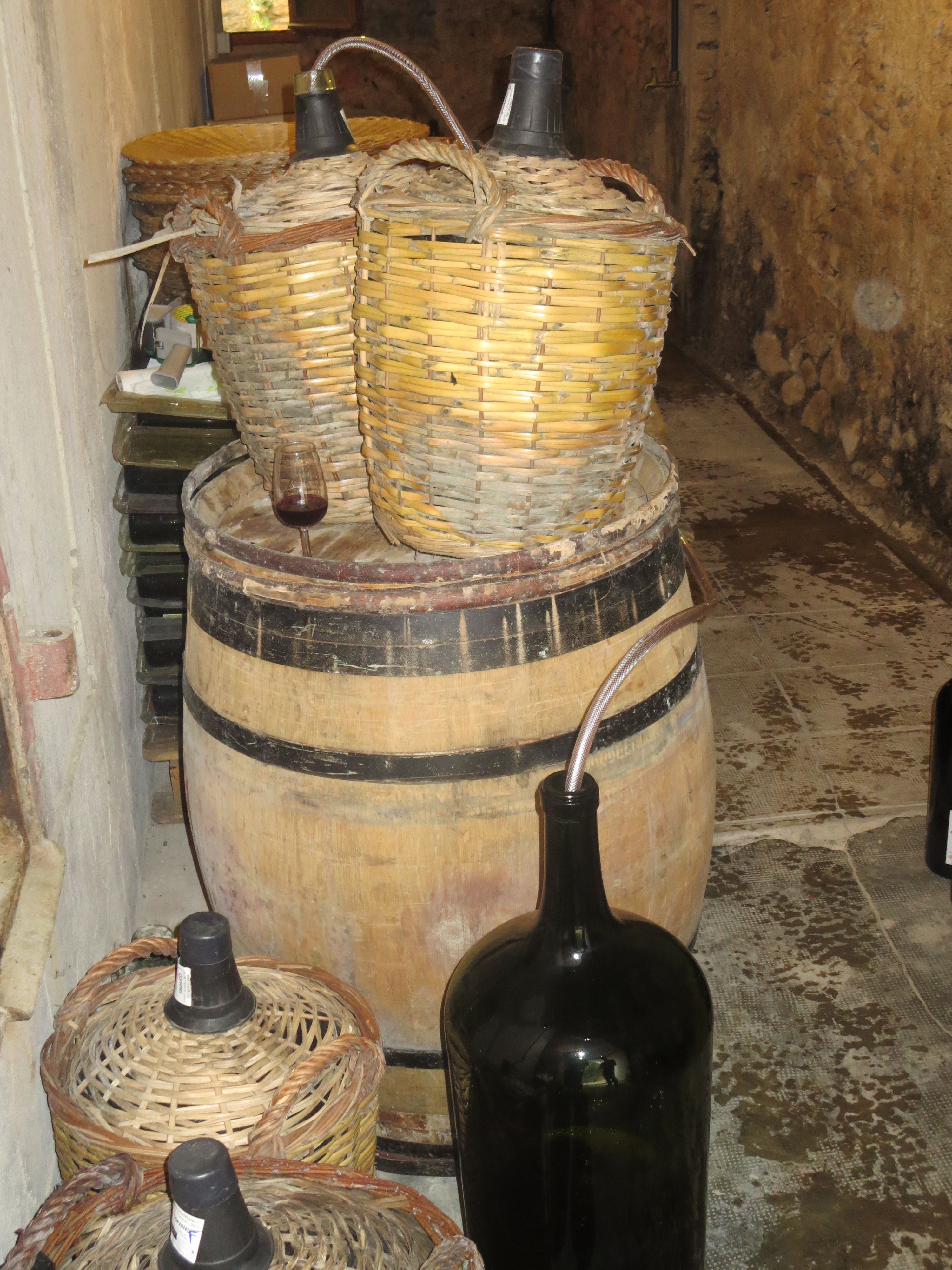
The Grenache you harvested and pressed has been added to large 26 litre bottles and is beginning its journey towards maturity and drinking.
Moving from bonbonnes to bottles
Yesterday was a superb day to be at Mas Coutelou.
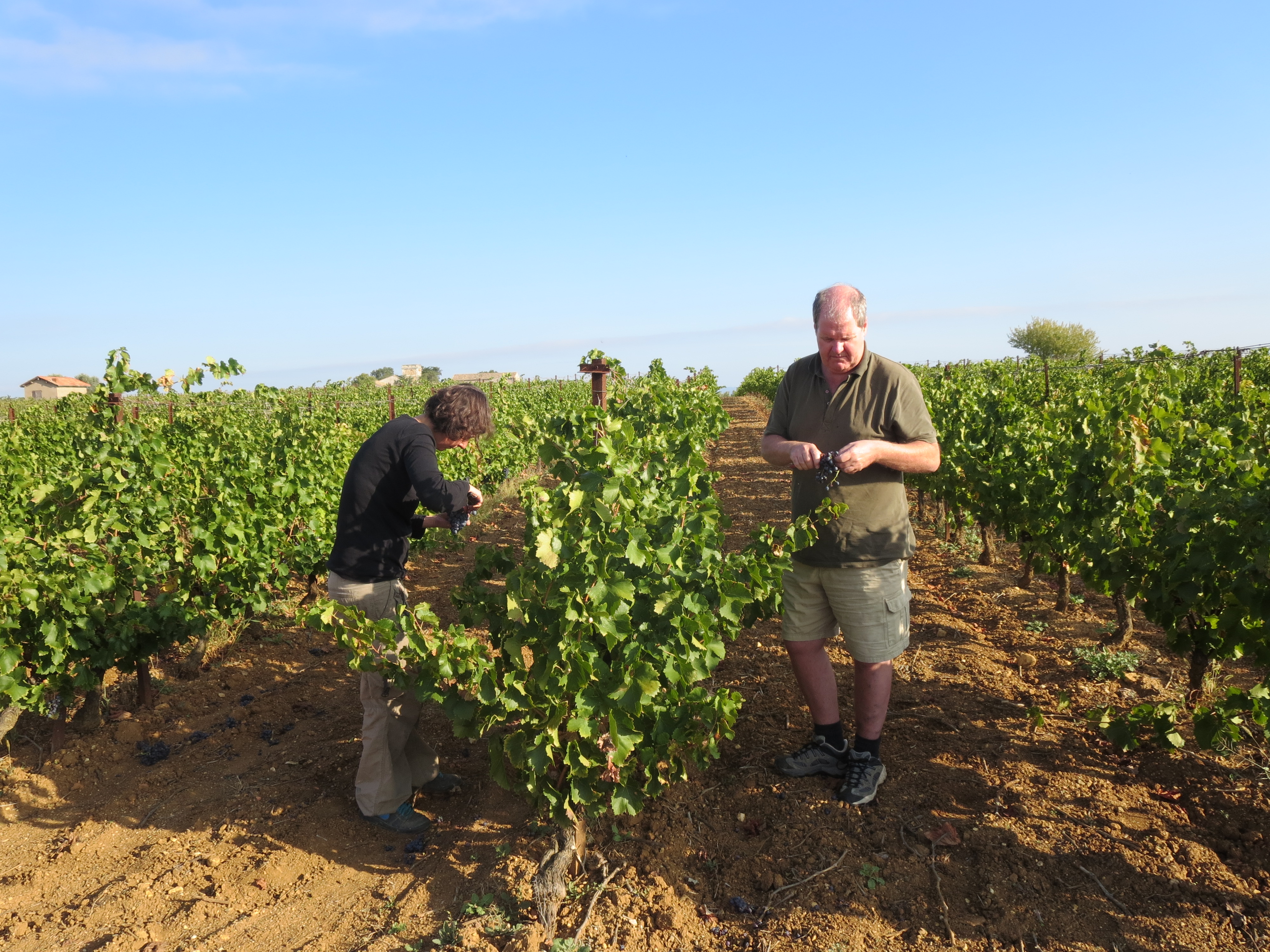
It started fairly routinely by continuing habillage, preparing bottles for sending to merchants around the world. But then Jeff took me out into the vineyards to meet up with Michel who was already out there. He was in a vineyard of young vines, including some of the almost forgotten variety Aramon Noir as well as other cépages. There is a mix of ages too with vines from this year and the last two or three years. Michel, and then Jeff, were checking each vine to check on their health and progress since they were grafted. If the graft had not taken then they will be replaced later. If everything was looking good then stakes were added to support the young vines in their growth. As it was a lovely, warm and sunny day it was good to be out in the open air.
Michel has checked that this vine is healthy and will add a wooden stake
Jeff and Icare get to work
The weather has been remarkably mild and the vineyards were full of unusual sights for mid November such as flowering roses, wild leeks and wild rocket.
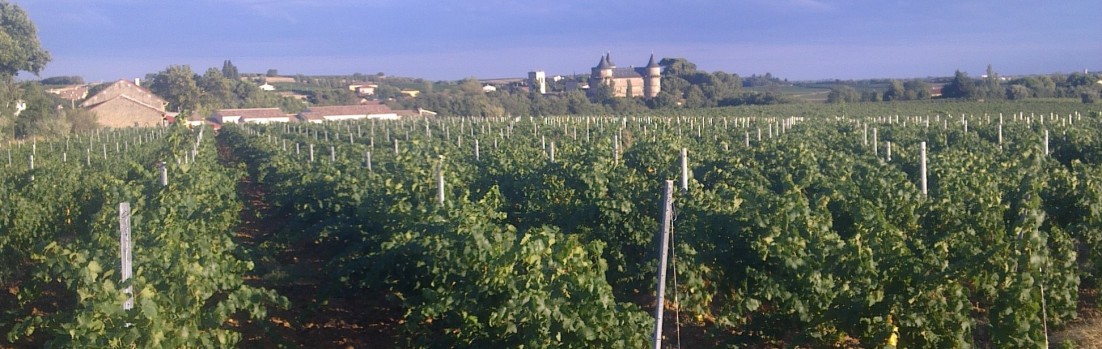
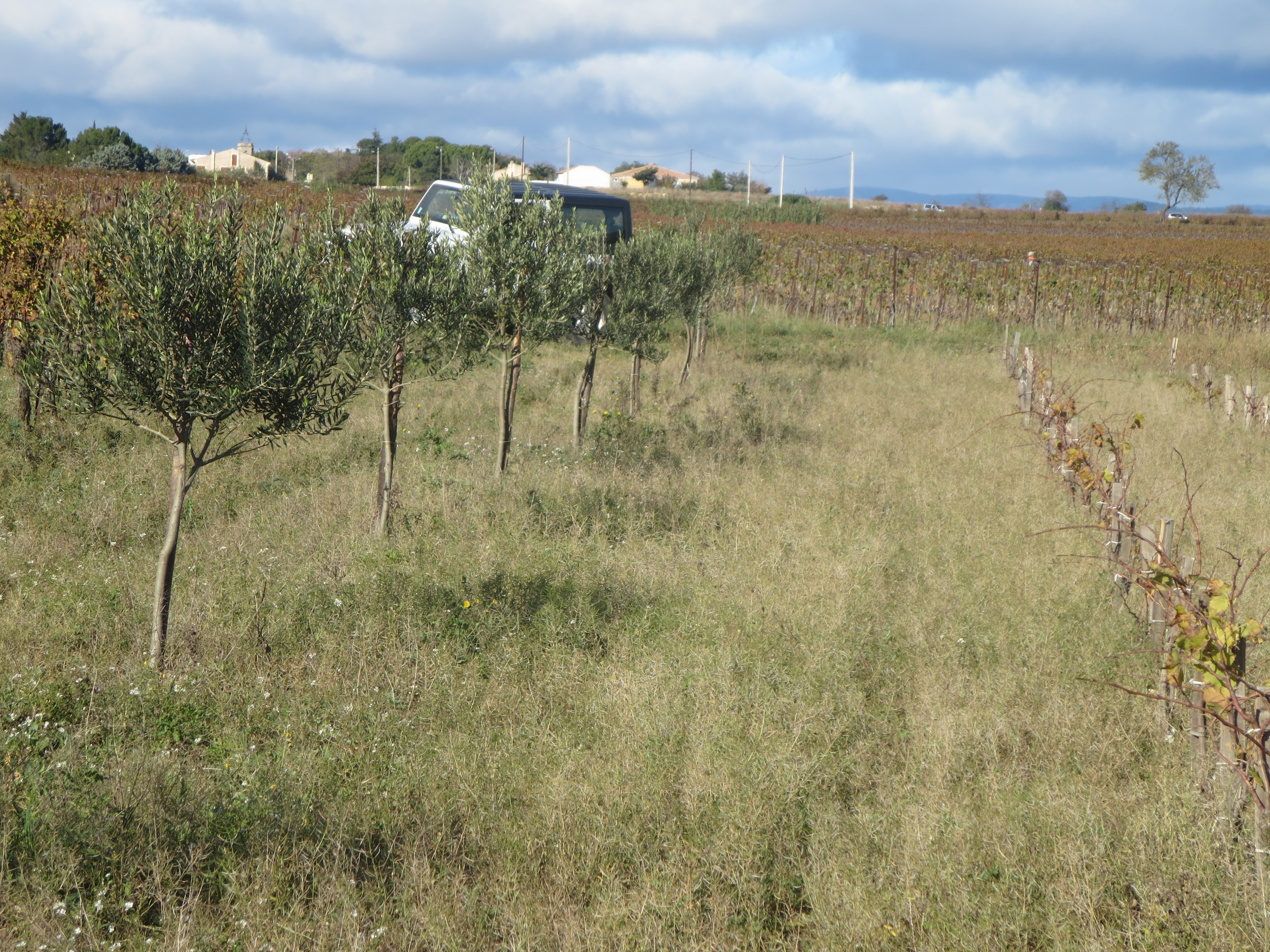
It was interesting to note the differences between two neighbouring vineyards. Jeff’s has vines living in soil which supports wildlife and olive trees for diversity. A neighbour’s vineyards show clean soils with neat rows of vines. How are they so clean? Fertilisers and chemicals. Here are obvious differences in ideas about wine and agriculture in general. Personally I am becoming ever more convinced that organic, minimal intervention is the way to healthy and tasty wines but others will disagree.
Biodiversity
A regiment of vines
After lunch Jeff decided it was time to put into bottles the Grenache harvested in late September by the Rugbymen and ourselves. The wine had been placed in a series of bonbonnes after pressing and we tasted each one to look for the best assemblages, eg bonbonnes B and E had a sweeter edge so were mixed together in a large 26 litre bottle. The bottles were enormous and 8 were filled with the Grenache.
Michel tasting the Grenache as we agree on best assemblages
Bottles, sample bottles and emptied bonbonnes
As the work finished for the afternoon we were joined by Jeff’s niece Flora, a talented photographer. Jeff opened some Vieux Grenache as he checked on the progress of some new small barrels used in a new solera system to supplement the older more established one. Some bottles from 20, 30 and even 40 years ago were sampled and were truly delicious, rich with layers and layers of different flavours and varying from dry to sweet. Finally he took a sample of a very special bottle, Sélection Des Grains Nobles 2012 made with Grenache Noir. Apparently some of the Grenache was affected by noble rot that year and Jeff and Michel spent a whole day doing triage to ensure only the right grapes were selected. The result even after two years is astonishing. My mind was truly blown. How to describe something so stunning, ethereal and rewarding? One of the very best wines I have tasted and a fitting climax to a truly memorable day which was full of sunshine, teamwork and friendship.
When Jeff suggested that I should attend Latour De France I was rather surprised as I was unaware of his love of cycling. A quick correction of gender and I was patiently told that it was a village in the Pyrenées Orientales where 12 of 13 winemakers are organic producers and several make natural wines. An opportunity not to be missed. Combined with visits to one of my favourite French villages, Banyuls, and also to Collioure this made for a great weekend.
Saturday by the coast proved to be a lovely, sunny day – unbelievably warm for November.
Vineyards in Banyuls stretching down to the Mediterranean Sea
Collioure
Sunday was cooler and grey but a great day for wine tasting. We arrived before the start of the event and the car park was already pretty full. Despite this the crowds were never too large and there was every opportunity to get round the various caves without much hassle. Each of the village organic producers had their cellar open and each also contained invitees from Roussillon but also from Fitou and Burgundy. This spread out the crowds as we walked through the streets between caves. In addition to the wines there were street entertainers and various food outlets including, to my delight, a vegetarian outlet. So, all in all, a very well organised event catering for everyone (sorry about the pun).
I am not a professional wine journalist and I am not great at writing tasting notes so I won’t! Instead I offer overall impressions and suggest some of my favourites from the 120 or so wines which I tasted (it was hard but someone has to do it on your behalf dear reader).
What struck me most was how much I enjoyed the white wines, I had expected the reds to be the outstanding wines, and some were, but the whites were much more consistent and interesting overall. One Carignan Blanc stood out (Clos Du Rouge Gorge, Cyril Fahl of whom more later) but what emerged was the splendour of Grenache Gris. Often combined with Maccabeu it was Grenache Gris which provided a series of fresh, deep, long lasting and flavourful wines with hints of minerality, sweetness and fruits of all kinds depending on the producer. Excellent examples from Padié (very expensive though), Calimas, Tribouley, Rivaton and Deux Chateau. There was also a very nice Maccabeu based white from Troullier. I would happily seek out and drink any of these and would advise anyone to do so.
There were also a few strange white wines ranging from cloudy and sulphury to the downright sharp and tooth decaying.
Talking with Nikolaus Bantlin of Les Enfants Sauvages
There were some excellent red wines on offer.
Cyril Fahl (Clos Du Rouge Gorge) produces a high class range of (quite expensive) wines based mainly on Carignan and Grenache. Tasting Cyril’s wines proved that his reputation and garnered praise were well merited, his Carignan based wines were delicious, nothing more to add to that. Top winemaker.
As with Grenache Gris in the white wines there was an outstanding red grape which stood out in many of the top wines and it was, as with Cyril, the Carignan. Time and again the wines with fruit, flavour and long finish were based around Carignan or had a large proportion of it in the assemblage. Not long ago Carignan was being grubbed up around the region and dismissed as a variety of little potential. La Bande de Latour showed how nonsensical that was. Carignan is a great and noble variety, again seek it out from good producers.
Other favourite reds which I tasted came from Domaine du Possible (C’est Pas La Mer A Boire), Opi D’Aqui (from Clermont L’Hérault) and Maramuta.
The problem with a number of red wines, in my view, was the use of oak. This may be a personal thing as I really do not like obvious oaky flavours. It can add complexity and structure to wines when used carefully but a lot of winemakers seem to rush to use barrels so that they can be seen as ‘serious’ winemakers. And add many euros to the price of their ‘special’ cuvées. Sadly I felt a number of wines were spoiled by injudicious use of oak. The wines appeared thin and dry with their fruit stripped out.
I would like to mention 3 other winemakers whose bottles I enjoyed.
Les Enfants Sauvages is the wine domaine of Nikolaus and Carolin Bantlin, a German couple based in Fitou. I enjoyed talking to Nikolaus and warmed to his passion for his wines and I could understand that passion when I tasted them. I liked all of the wines, white and red, but especially Roi Des Lézards, which is, you guessed it, 100% Carignan. I would definitely like to visit the Domaine in future.
The range of Les Enfants Sauvages
Domaine De La Chappe is a Burgundy domaine run by Vincent Thomas a young winemaker who has built on the work of his father and used natural methods as well as biodynamic practices. He is based in Tonnerre and offered Bourgogne Pinot Noir and Petit Chablis amongst other wines. The prices were very reasonable for Burgundy, around the 10-12€ mark. The wines were far more rewarding than many Burgundies I have tasted at much higher prices. I would love to try these wines again when I have more time to devote to them. You can read more about Vincent from an article on the very good louisdressner website.
Listening to Vincent Thomas of Domaine De La Chappe
Saskia van der Horst runs Les Arabesques in Montner not far from Latour. She was a sommelier in London at Gordon Ramsay’s restaurant at Claridge’s and also ran a wine bar there. She returned to France to make wine rather than just sell it and drink it. These were amongst my favourite wines of the day, all 3 were rich, full and refreshing. What amazed me was that these were Saskia’s first wines, the 2013 vintage was her first. Saskia can certainly be proud as her wines were as high in quality as most of those I tasted at Latour.
It was a great day. I liked the way the event was run, I loved the focus of organic and natural wines and the enthusiasm of the winemakers for their work and their wines. I tasted some excellent wines and discovered plenty of new winemakers whose work I look forward to sampling in future.
It has been a busy time in the cellars over the last few weeks despite my lack of updates. The reason is that the work has been mainly putting together orders of wine to be sent around the world. This is partly due to orders building up over the vendange period but also, no doubt, to merchants wanting stocks ahead of the Christmas and New Year period.
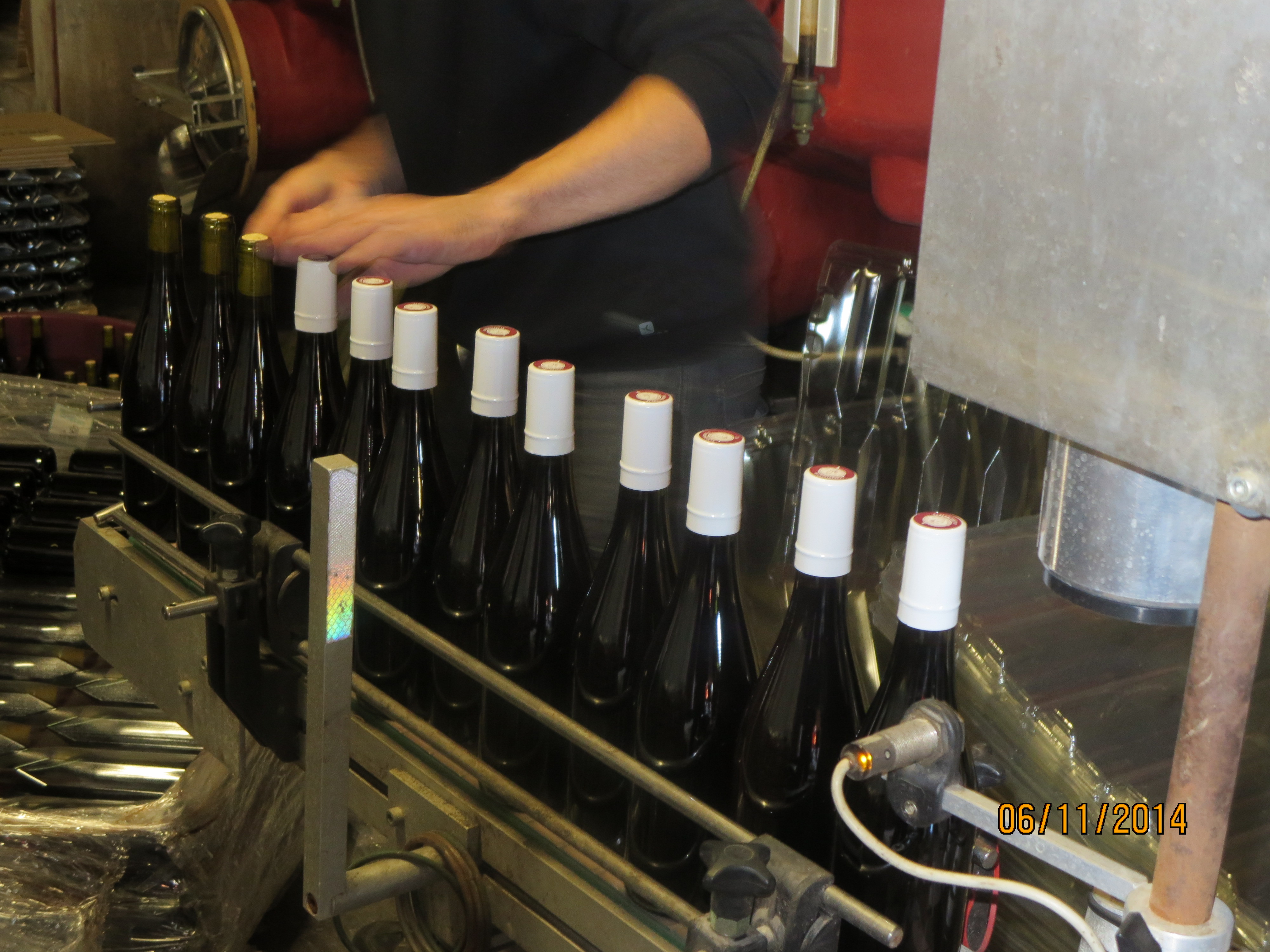
Adding labels and capsules
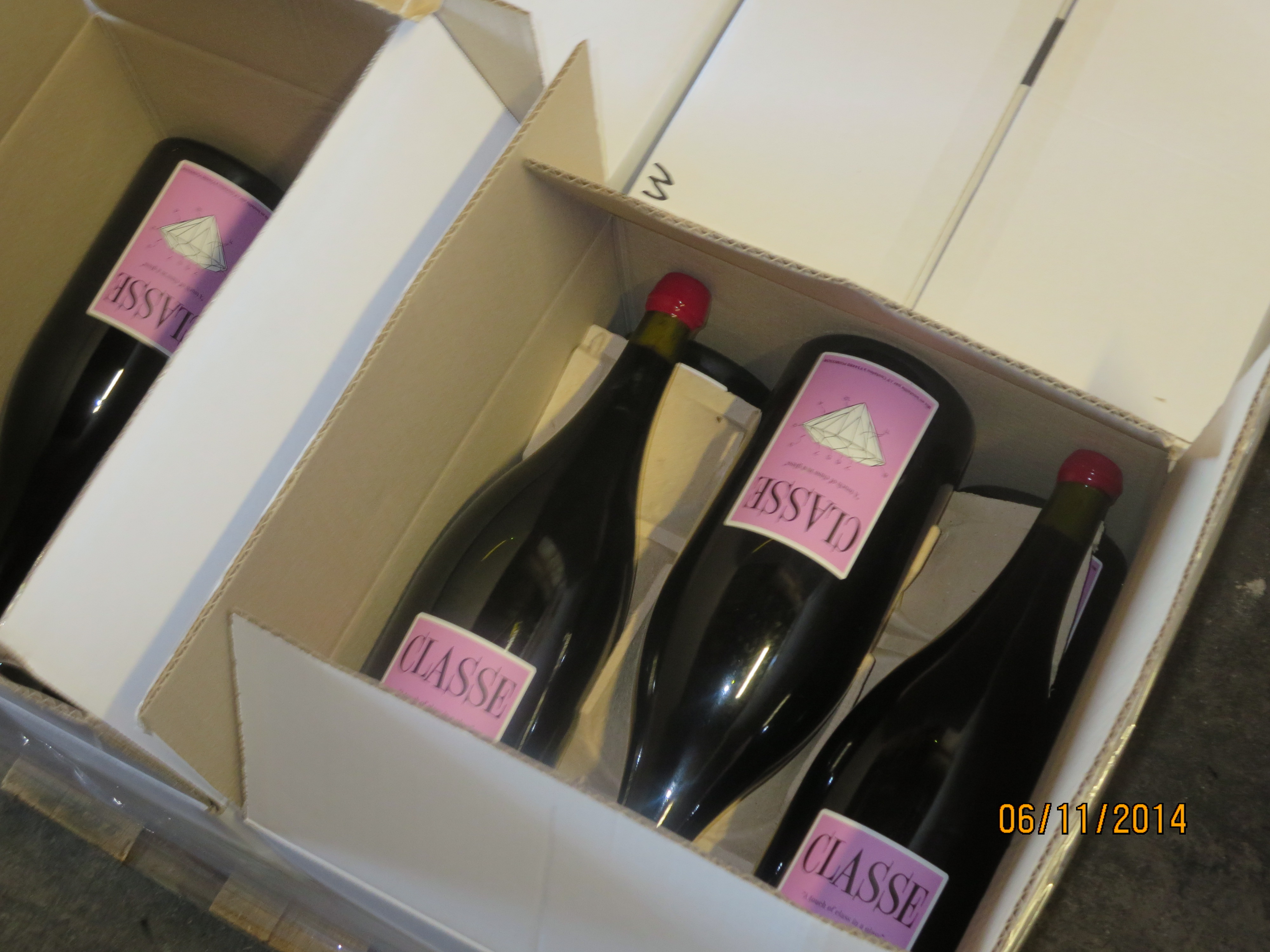
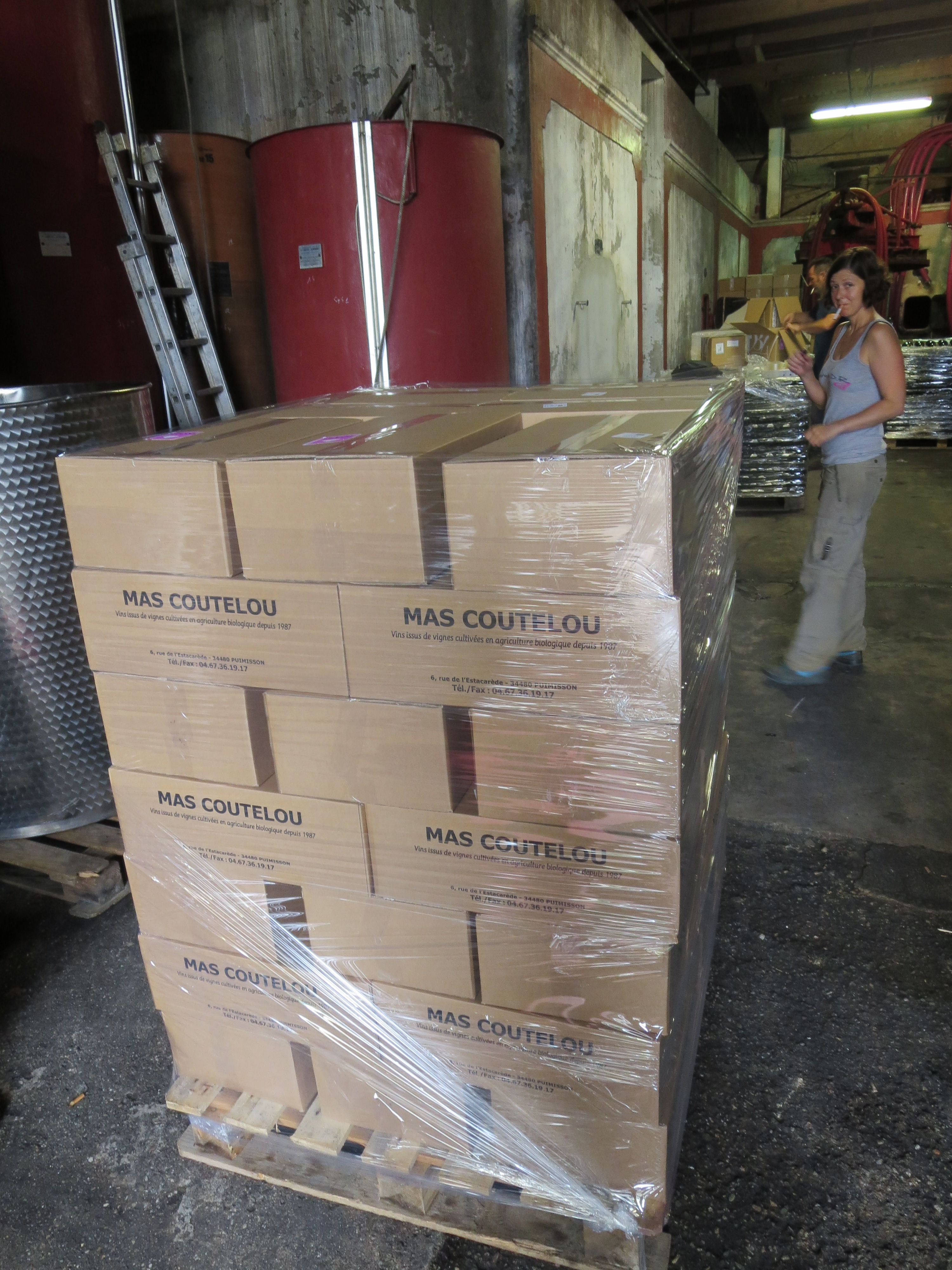
Orders have gone to Germany, Sweden, UK, various regions of France and these pictures show bottles being prepared for export to New York importer Camille Riviere who has an excellent range of French producers on his list. No doubt I have omitted other markets too.
Magnums of Classe ready for the Big Apple
Jeff and Michel packing cases with the help of some…er…. high technology
Palettes coming together for New York
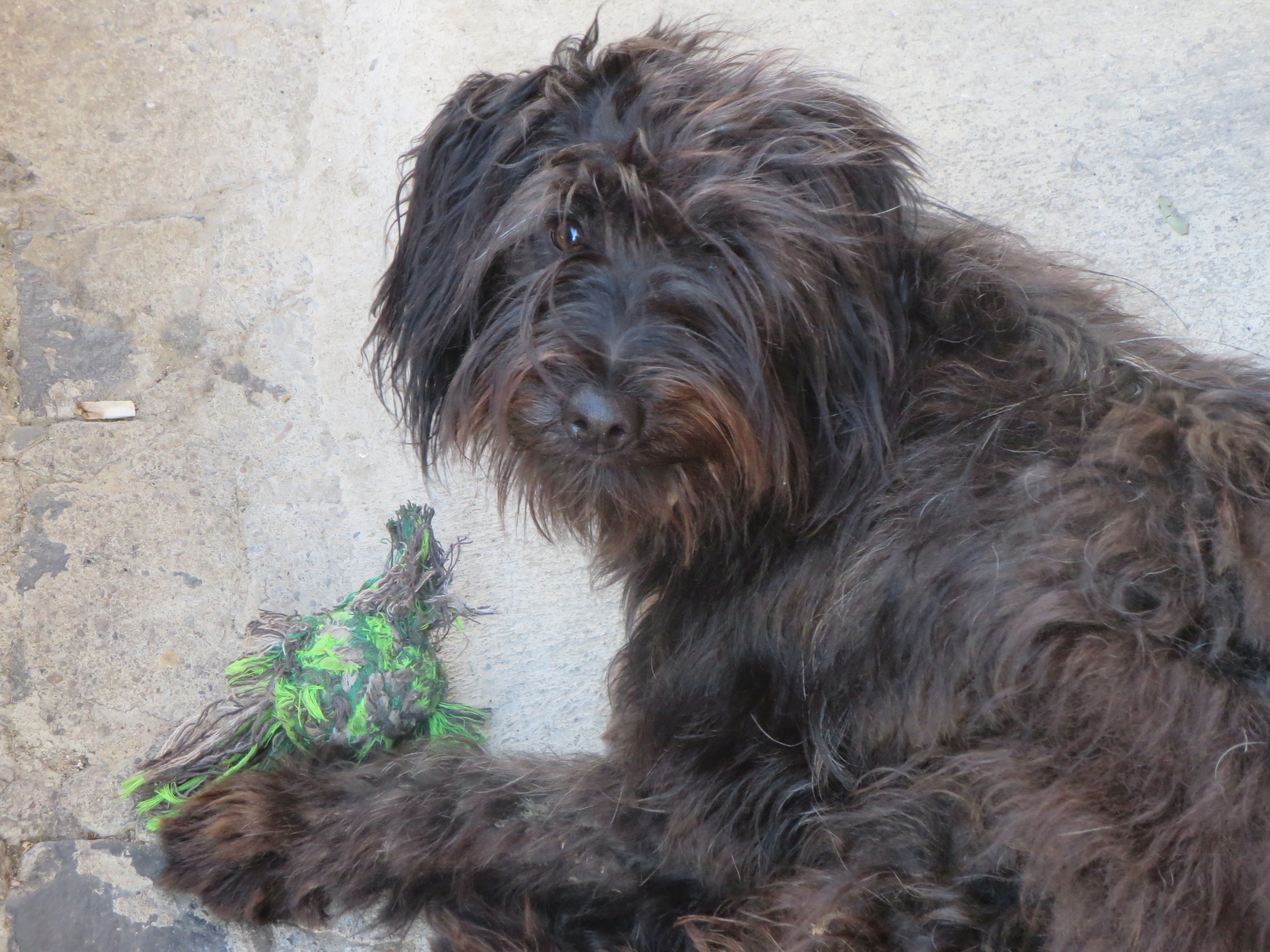
This is not glamorous but it is essential work. Meanwhile Jeff’s phone keeps ringing with requests for wine which are becoming more difficult to meet as stocks are running dry, some cuvées are already sold out. Other visitors arrive at the cave to taste and to buy a case or two and to be entertained by Icare’s antics.
Playing with a ball of wool
Meanwhile Jeff still goes into the vineyards every day to check what is happening there and to ensure that all is well. The real work there will begin in January with pruning of the wood (taillage) which will last until March and I shall report then. But if you think Jeff is having an easy time, please think again. Long, long days of vineyard, cellar and admin work as well as sorting orders, dealing with everyday problems. So spare a thought for your winemaker, s/he works hard with their vocation.
Meanwhile I have been visiting a number of other winemakers and a wine fair and I shall report back soon. Thanks for reading.
Ernest Hemingway had a theory that writing the simple story whilst not explaining deeper themes would help the reader understand the story . Instead they would implicitly see the bigger picture and work things out for themselves. This was the Iceberg Theory (or my interpretation of it!).
Making wine has some parallels. The wine that is drunk is the final product but not the whole story. And what makes the wine great is what is missing. You might remember that in the vineyard Jeff insisted that pickers should eliminate any grapes of poor quality, they were left behind on the ground and even cut out of bunches. Remember that Jeff and Michel have already spent many hours in the vineyard making sure that the vines produce top quality grapes. This involves, for example, pruning and cutting off bunches of grapes if the vines are too productive, as this would produce more dilute wines.
Grapes left behind
Cutting poor quality grapes out of bunches
Then in the cellar the grapes were sorted carefully to make sure that any inferior quality grapes that were missed by the pickers were removed before they were put into vats. This is called triage.
Triage
Therefore, Jeff can be confident that only healthy, top quality grapes are used to make his wines. This allows him to avoid chemical interference in his winemaking and to fulfill the grapes’ natural potential.
The last few weeks have seen a further stage of taking things out. After the vineyard management, after the careful harvesting, after the triage.
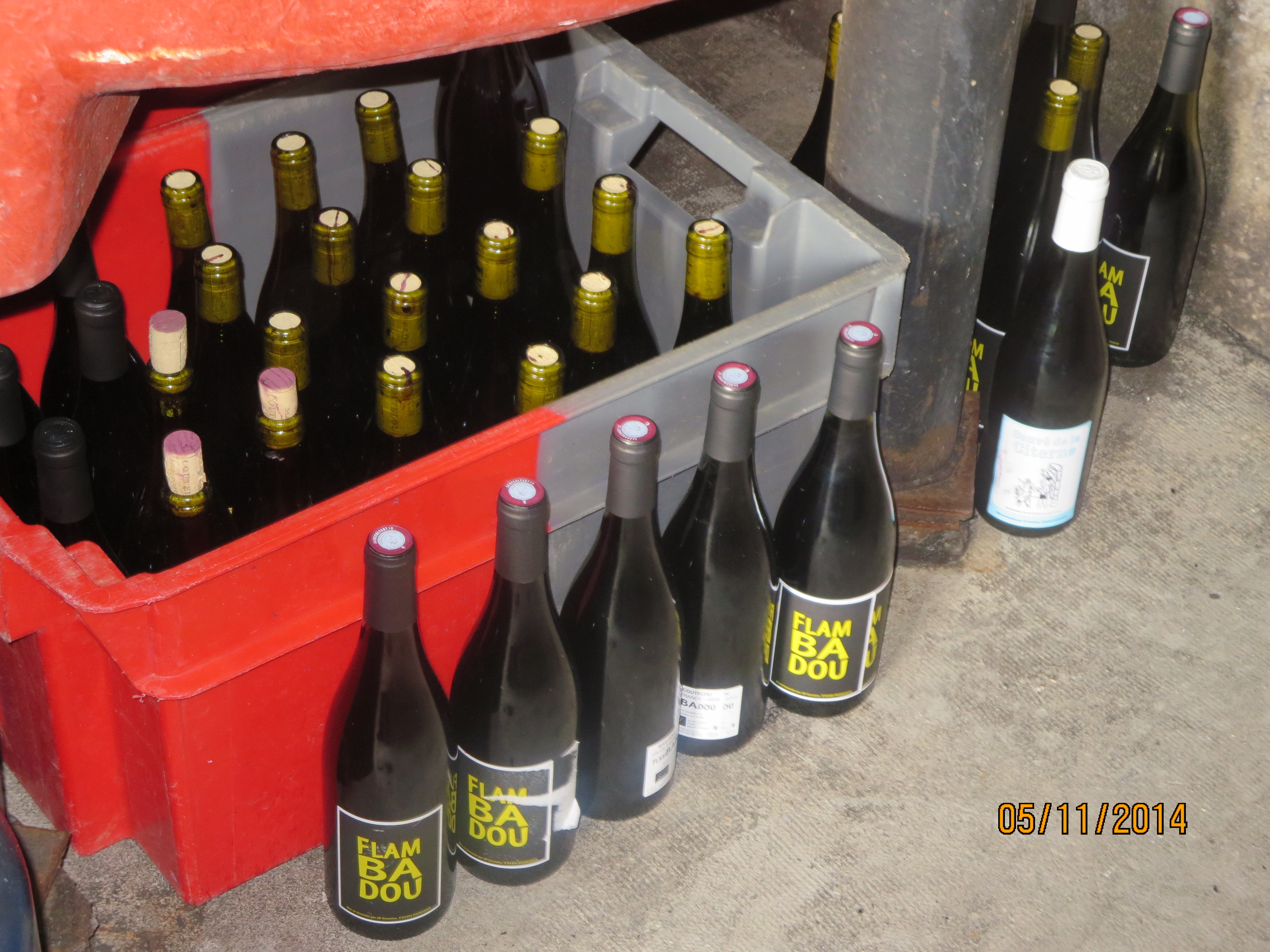
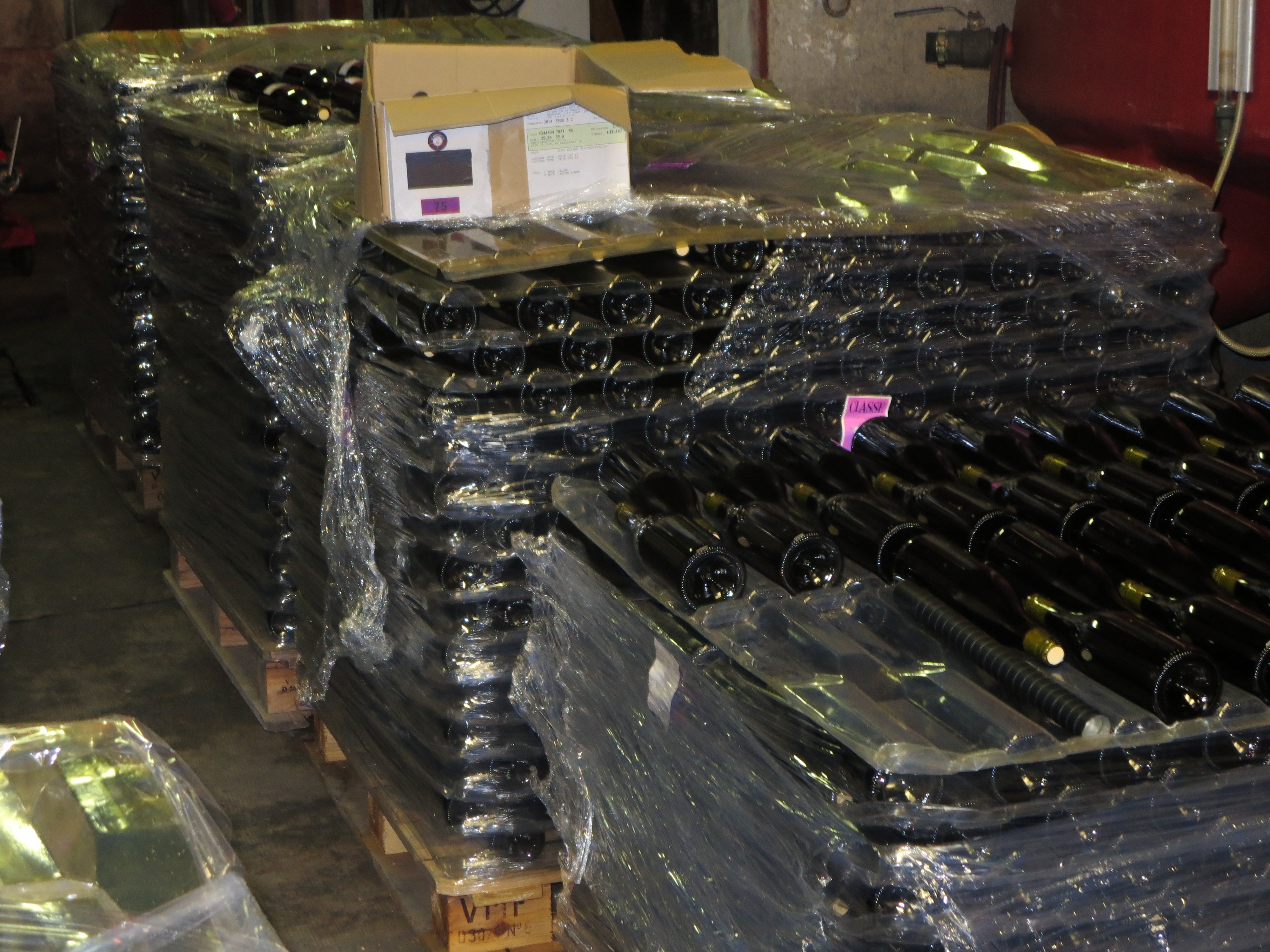
Bottles that are good but not good enough
As the wines settle in their cuves, fermenting and working their magic the cellars have been busy with packing pallets of wine to send to merchants around France, the UK, USA and many parts of Europe and the Far East. Today I took the photo above. As every bottle is dressed (habillée) with capsule and labels it is checked for any sign of damage, eg small holes in the cork or slight leakage. These bottles are removed and can be used for wine tasting for visitors to the cellar in the next few weeks. Therefore, what reaches the buyer and the drinker should be of top quality and wines which they can trust to be of the high standard expected from Mas Coutelou. They do not have to worry about all the work that has gone on to ensure their satisfaction and delight, though maybe now they know a little more about it.
The iceberg theory in practice. Cheers Papa Hemingway!
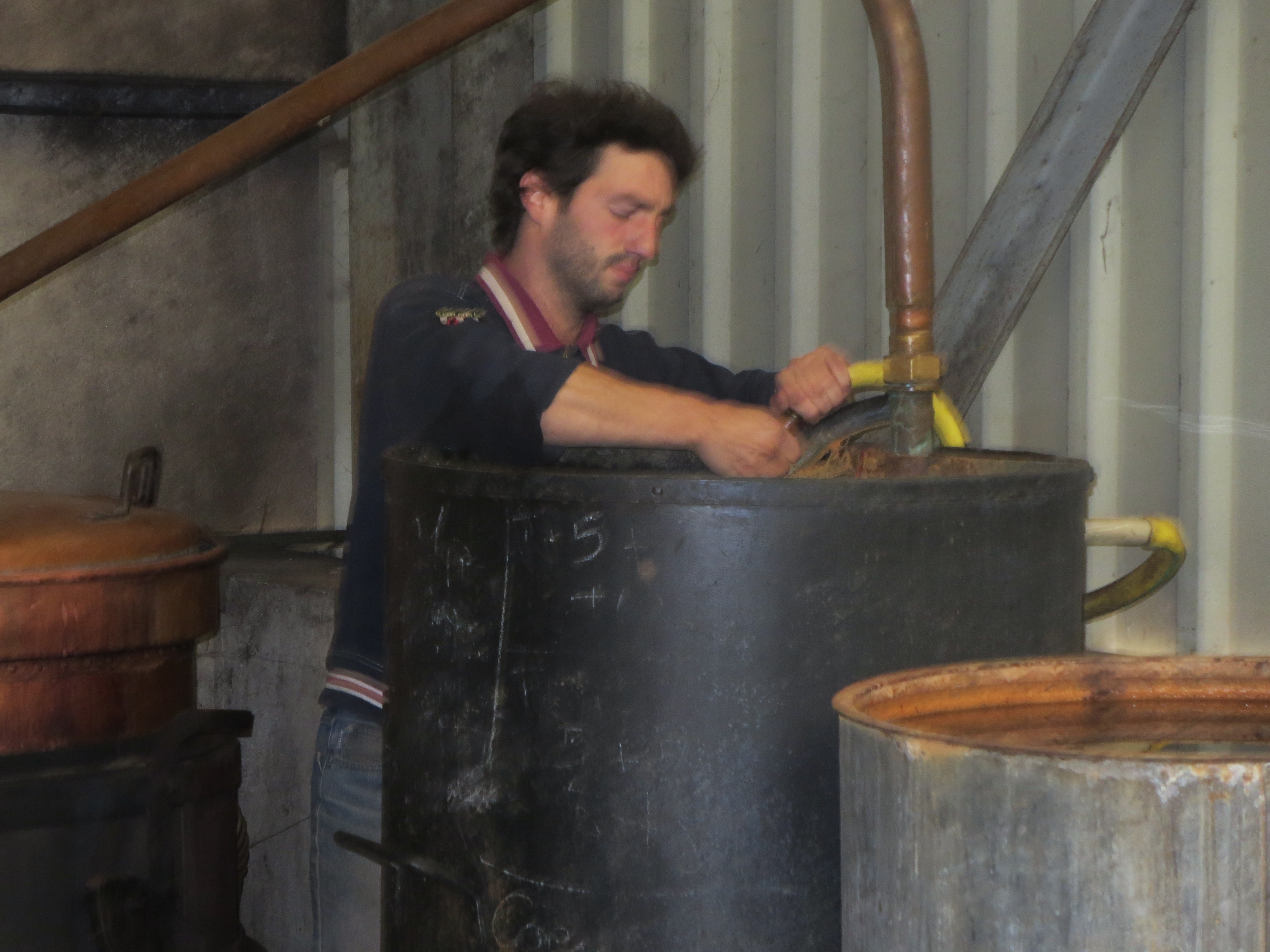
One of the by products of winemaking is the grapeskins, pips and stalks left over after pressing. This is called the ‘marc’ and can be used to make brandy or eau de vie just as fruit is used in some parts of France. The Hérault has more vines than any other French département so there, naturally, a huge amount of marc left in the autumn. A new distillery, L’Atelier du Bouilleur, has opened in the area at Autignac, the only private distillery in the Hérault. Although private it is run on a cooperative basis and overseen by Quentin Le Cléac’h and Martial Berthaud. They use methods developed in Cognac and by the expert Matthieu Frecon.
Rafle ready to be distilled
Jeff has decided to send his marc to the distillery and Quentin kindly agreed to show me around and explain the distilling process. The building was the former site of a large state run distillery and some of the huge industrial tanks remain. Quentin works on a much smaller scale and is passionate about his work in just the same way a winemaker is about his métier.
Quentin at work
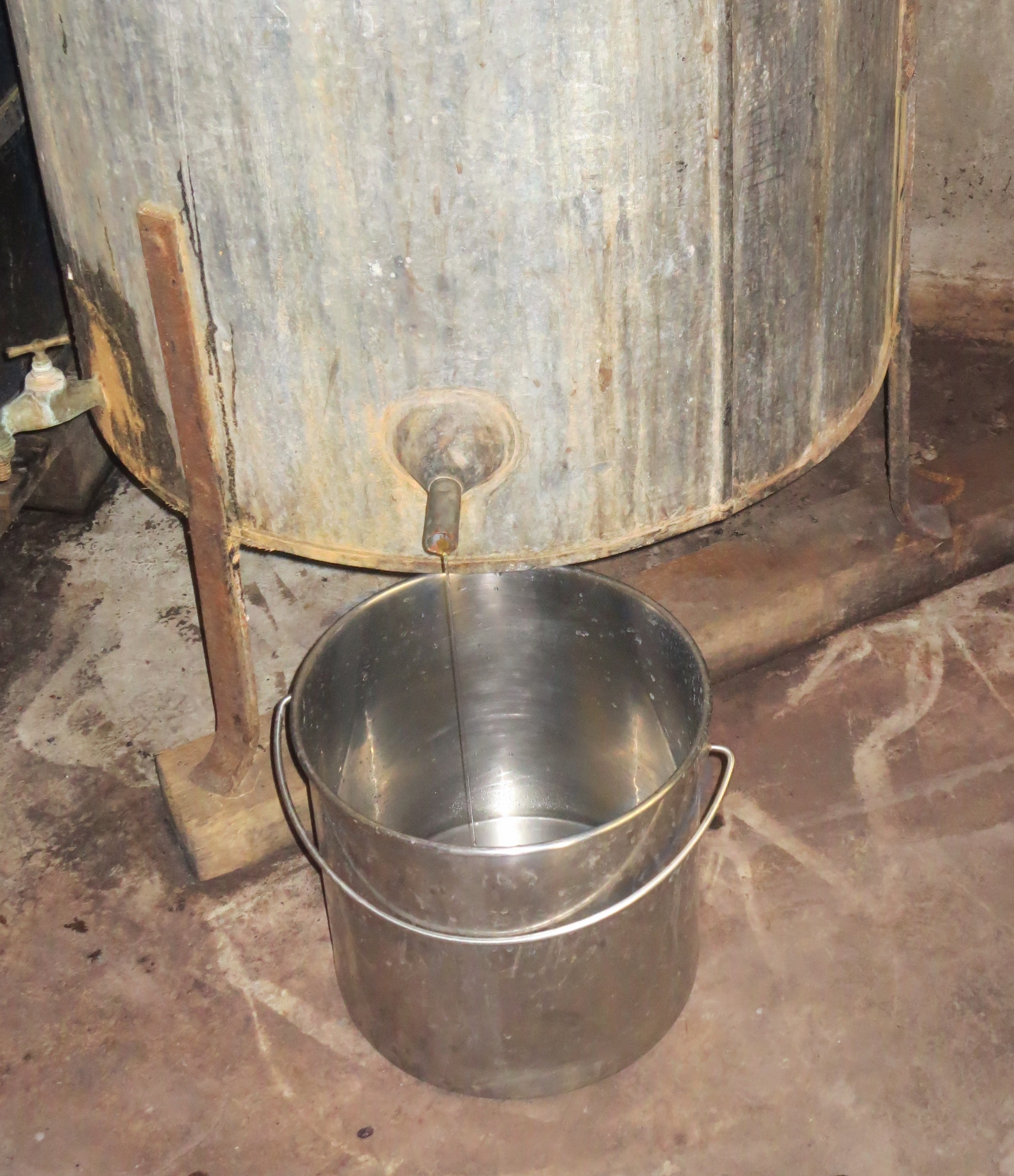
Alcohol running free after the first heating
The marc is heated and the alcohol which runs off (see above) is at about 30 degrees proof. It is reheated to bring the level up to around 6o degrees. Many of the winemakers of Faugeres are using the distillery to produce their eau de vie Fine De Faugeres and the faith placed in L’Atelier by producers such as these and Jeff so soon after setting up shows that Quentin and friends have quickly shown their skill. Quentin prefers to use organic grapes though not all Faugeres producers are organic so the eaux de vie are not wholly certified as organic.
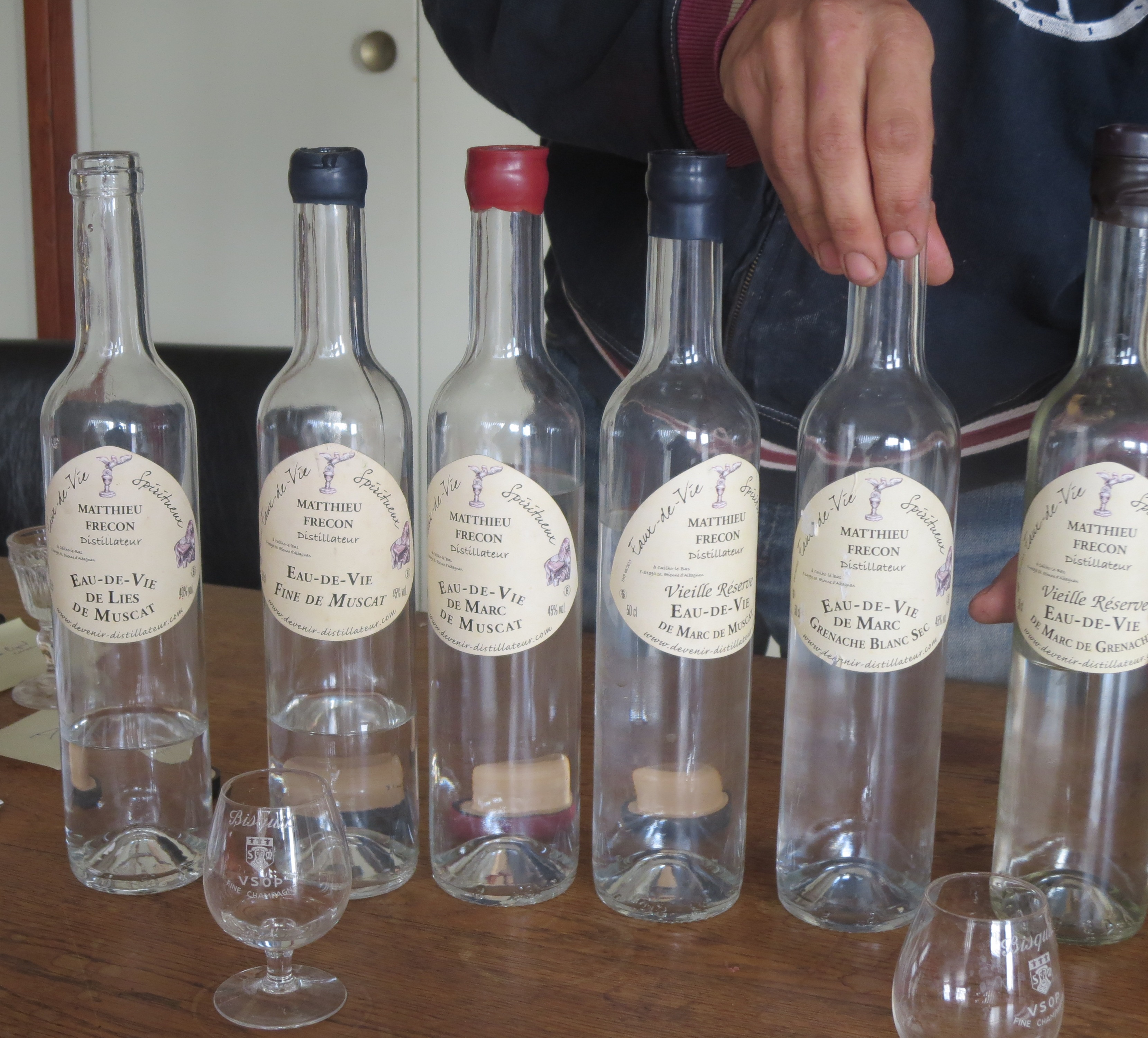
The proof (sorry) is in the drinking though and therein lay a problem as I don’t drink spirits. However in the interests of yourselves, dear readers, I sipped some of the finished bottles. Those in the picture are fine de marc and are clear. Other bottles were amber coloured after being aged in barrels previously used in winemaking. I must admit I enjoyed the sips I took. There was no aggression in the drink which is what I expect from spirits. Instead it was smooth, had fruit aromas and left a pleasant, clean aftertaste. My wife, who does like eaux de vie, thought they were excellent.
I am sure the Atelier will continue to flourish, its products are already on sale in Paris and around France. Worth seeking out.
I have often said that Pic Saint Loup is one of my favourite wine growing areas, and that I have rarely had a disappointing wine from there. Domaines such as Mas Bruguiere, Hortus and Foulaquier are some of my personal favourites. It is also a beautiful area to visit with stunning scenery.
Hortus and Pic Saint Loup dominate the area
I was delighted to see, therefore, that the village of Valflaunès was holding its Festa De La Vendemia. It was a great opportunity to go along and try out more PSL domaines.
What we found when we got there was so much more than a wine festival though. There were lots of great food stalls selling everything from cheese, honey and bread to chestnut tapenade and vegetable pakoras. This made it easy for people to put together picnics or choose from local cafés or the village restaurant.
There were some really well put together exhibitions on a range of subjects such as how the region was involved in World War 1, 19thC local dress, what a vigneron’s cave would have looked like in 1930, local wildlife and so on. Street musicians, folklore dancing, choirs and other street animations meant that the whole village was full of life and activity and it seemed like everyone who lives there was involved in the events. Top class organisation, a real model of how a village can show itself at its best.
Of course, wine was our principal reason for being there and there were plenty of domaines represented. I could not get round them all especially in the afternoon when the crowds around the stalls became larger. These are some impressions from the tastings I did.
White wines were rather disappointing to be honest. They were not ideal conditions for serving white wine of course, temperatures in the low to mid 20s and wines standing on stalls for a while. However, many white wines seemed a little flabby and almost sweet. Roussanne and Marsanne (the main grapes used in the area) would be expected to produce drier, fresher wines than most of those I found here. The exception was Chateau Lancyre’s La Rouvière 2012 which did offer the elusive freshness I personally want in white wine. Otherwise, the best two whites I tasted included a Sauvignon Blanc, not something I expected, and a Chardonnay/Viognier/Roussanne blend from Hortus. I honestly was not tempted to buy any white wine that I tasted. At around 10€ I expected better. Perhaps the conditions were to blame but …
Red wines were much better though there were few outstanding wines. All wines were variations of Syrah and Grenache usually blended with other varieties such as Mourvedre and Carignan. Hortus and Bruguiere showed their entry level wines and neither really shone. My preferred wines were Domaine Mortiès’ classic Pic St Loup 2012 and Chateau de Moucheres’ Tradition 2012 both wines I would happily buy, again priced around 10€. Hats off to Domaine Zumabum Tomasi for showing a 2006 wine, it is rare to be offered older vintages and this wine showed how well PSL can age. I was less impressed by one producer who ignored visitors, not just me!, so that she could chat with a friend, I shan’t give a name but I wouldn’t go back. There were a number of quite thin wines from other domaines too, so I now know that Pic St Loup, like every area, has its good and weaker producers.
Top of the class was an easy choice. Domaine Saint Daumary is in the village of Valflaunès itself and was recommended to me by one of the Rugbymen. Thank you for the recommendation Romain, you were right. Julien Chapel is a young producer and I thought the two reds he offered for tasting were both delicious; full, satisfying wines with the silkiness I associate with my favourite Pic St Loup wines. I was especially taken by the Syrah dominant wine Troisième Mi-Temps. I returned to buy some of the wine but Julien was surrounded by large numbers of people wanting to taste his wine. I shall definitely make a return journey to buy.
Overall, a really enjoyable day out. The wine kept me happy but there was so much going on that children, families and non wine drinkers would be entertained. Well done to Valflaunès and thank you.
In a previous post on October 1st (Fin de Vendanges a Mas Coutelou, One Day Like This) I described the hugely enjoyable day spent harvesting Grenache Noir grapes in the company of the Rugbymen of Béziers. Well, the grapes were placed in tank and left to ferment using carbonic maceration. After 3 weeks it was time to press the grapes and the Rugbymen were back.
The grapes in tank, the cage and press stand ready
Jeff kickstarts the pressing, with very clean boots!
The grapes tasted wonderful, full of fruit but with added layers of strength and alcoholic sweetness from fermenting within their skins. Then it was time for the Rugbymen to show the results of all that training.
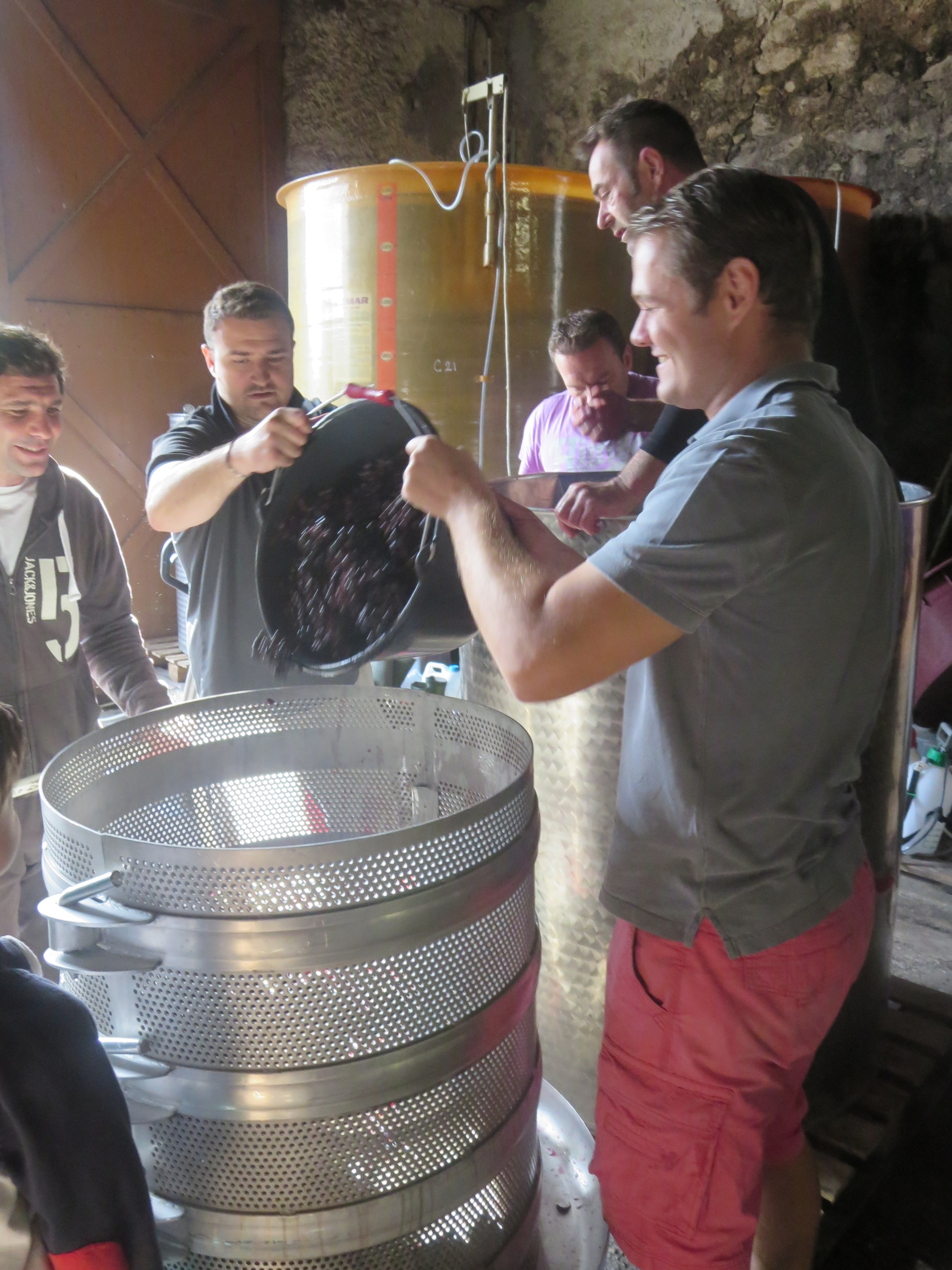
Loading the grapes into the cage
The juice ran freely even as the cage was being loaded and then the press began its work.
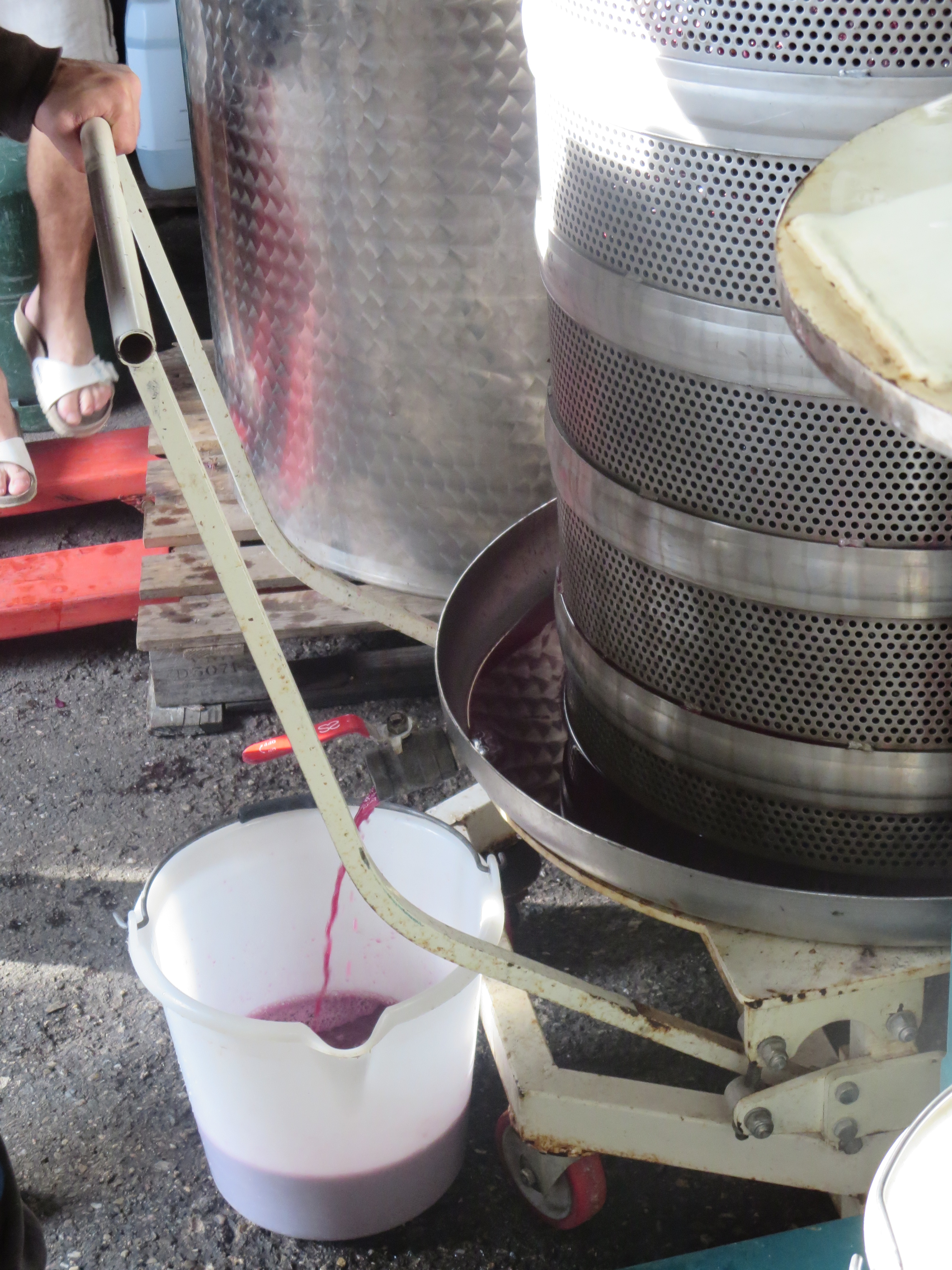
First juice runs freely even before the pressing
Look at that stunning colour!
The wine was put into bidons (bonbonnes) of glass wrapped in straw for safe keeping and to avoid light damaging the wine. Each bonbonne was carefully marked to ensure that it will be possible to taste the different stages of the wine pressing, from the first freely flowing juice to the last of the pressed wine. It was interesting to taste the wine as it appeared through these stages, there were distinct differences. Various Rugbymen, Jeff and myself all had their own,differing preferences. It will be fascinating to monitor their evolution.
Transferring wine into the bonbonnes
Once again thanks to the Rugbymen, they really are good fun, warm hearted and top men!
Preparing the grapes for a final pressing, called a rebeche
It was also a good opportunity to taste the wine from Castets, the rare variety which is grown by Jeff as one of only two producers in the world.
WOW! This is already something special. Fruit, light at first just grows in flavour and depth as it coats the mouth and lingers there for a long time. It is amazing and with time in tank and then in bottle (magnums are the likely future) this is a wine I really want to drink when it is mature.
Remember the photo above from the last post? Well, I was delighted to see this post on Facebook from a wine merchant called La Nature Du Vin showing the arrival of some of the cases we packed and the evident delight of the merchant as well as customers. So, I thought I’d complete the picture. The Cave is at 3 route des Vignes, Saint Julien en Genevois, Rhone-Alpes, near the Swiss border. I would definitely call off there if in the area as they have an excellent range of wines.
No you haven’t missed Parts 1 & 2! It is widely acknowledged that the work of a vigneron involves three locations; the vineyard, the cellar and the office. The first two parts are the most well known of course and what people like me think of first when we think about the ‘glamorous’ lifestyle of winemakers. However, if you don’t sell the wine and get it delivered safely to merchants, restaurants etc then it is pointless trying to make wine.
Now that harvest is done and the wines are stored in tanks, either fermenting or maturing, the more mundane, but equally important, aspect of a winemaker’s job comes to the fore. Wines have to be bottled, packaged, sent to market and, above all, sold. Jeff said to me that this was not especially interesting but, for me, it was.
Bottles waiting to be packaged
Classe bottles waiting
Jeff has built a strong demand for his wines both in France and abroad. Our recent visit to Paris and the fact that his wines are sold out there proved the case. Visitors to the cellars call on a regular basis looking for wine, merchants phone wanting to place orders – his mobile phone is never far from Jeff’s ear.
On Friday last week a new ‘toy’ arrived to help the packaging. It seals the cardboard cartons and prints the name of the wine on the side, speeding up the packaging process. Nonetheless teamwork and humour keep that process very human.
The job is hard, repetitive, physical work. In the video you will see Jeff at one point to place 4 bottles in the box at a time, routines and practice are everything. But without the boxes of wine the rest of the business cannot happen. It is less attractive but it is as important as harvesting or winemaking.
Two new wine treats came to the fore this week. Firstly, a slightly sparkling white wine, blanc frisant made from Macabeu and Grenache Gris. Secondly a cuvée made for the first time since 2003, Copains, made mostly from Cinsault but with Grenache and Syrah grapes vinified all together – truly delicious with the latter grapes adding body and depth to the Cinsault and giving the bottle longevity I would think.
Parts 1 & 2 of winemaking are still very strong, Part 3 too and I shall investigate more about commercial decisions in future.
Ready to go
Icare remains underwhelmed by the new packaging machine





















 amarchinthevines