amarchinthevines

Learning about wine, vines and vignerons whilst living in the Languedoc


4 Comments

Hail

P1010525

En français

2016 has provided one problem after another. On Wednesday August 17th a hail storm hit Puimisson and the surrounding area. It was very violent and very localised, seeming to have taken a path from east to west across La Garrigue, Sainte Suzanne /Metaierie (worst hit) and on to Segrairals.

Untitled


The damage is obvious when you look at the vines: holes in the leaves like bullet holes; stalks bruised making the bunch unstable on the vine; grapes flailed, beaten and emptied or dashed to the ground.

The amount of damage depended often on the direction of the vine row. Those planted east to west were damaged on the end but the hail fell mainly down the rows. However, those planted north to south faced directly into the hail and suffered damage especially those facing east, the direction from which the storm came. Thus if you look at the rows vegetation on one side looks thrashed, the other side looks normal.

P1010533

Damaged easterly facing (right), undamaged facing west (left)

The damage means that the vendanges will start a few days earlier than expected as the grapes need to be harvested. Jeff sprayed the affected vines with a tisane of wild rosemary, arnica, propolis and tea tree. All of these are used to treat bruises and cuts in humans as well as plants. The idea was to help to heal the grapes and it seems to have worked well.

After a year of no frost, drought, snails, mildew and vers de la grappe 2016 kept this surprise until late in the day.

P1010539

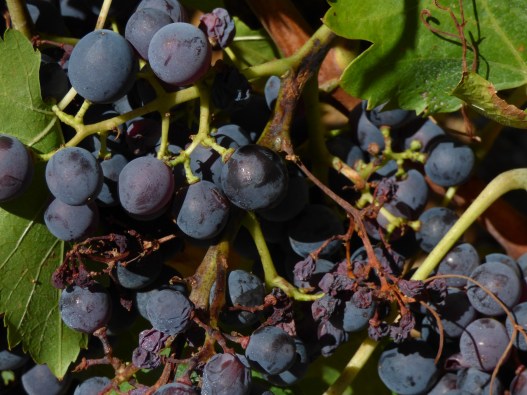
Mildew damages bunch, the black stalk will break soon

However, as Jeff said as we toured the vines, compared to others around Pic St Loup he got off lightly. Vineyards there were ruined by hail the same afternoon. The photos below show the horrific damage done at Mas Thélème in Pic St Loup.

Indeed there was one benefit to the storm. 70mm of rain fell in an hour and the rain was much needed. The grapes have swollen with juice as a consequence and the amount of extra wine gained by the rain will more than compensate for the losses due to hail.

P1010543

Healthy Cinsault grapes


5 Comments

Neighbours

En français

“Neighbours, everybody needs good neighbours”. So went the theme tune to a very popular Australian Television show. Well, it seems the message has not reached Puimisson.

Back in the spring I reported that the Carignan vineyard, Rec D’Oulette (also known as Chemin De Pailhès), had been vandalised. Jeff had planted lots of trees and flowers to create biodiversity in an area of grapevine monoculture. A neighbour decided to mow the flower patch one night.  And he has struck again.

P1010059

In happier days

On Monday evening Jeff messaged me to say that two trees had been destroyed. He planted the trees (a pomegranate and a hazelnut) five years ago, watered them, looked after them. Now his money, his time and his care lie in crushed and broken wood on the ground. His neighbour had taken a crushing machine to them, a girobroyeur.

What sort of neighbour would do such a thing? Certainly not the co-operative sort which he would claim to be (if you understand what I am saying). Rather, a neighbour driven by jealousy, suspicion, anger. A neighbour whose own vines are pumped high and deeply coloured with chemicals and irrigation. A neighbour who cannot understand that somebody else might think and act differently. A man with no respect for his neighbour, his colleague nor for the land and nature which gives him his living. What sort of vigneron is that? But let us leave that wretched individual and turn to Mas Coutelou and its future.

Jeff was understandably upset, angry and disheartened by his neighbour’s actions. He wondered whether he should just give up, tired of providing the lone oasis of sustainability in a desert of land damaged by chemicals, erosion and overworking.

Happily, the support of many, via Facebook for example, has heartened him and he has a plan in place which will help to fight back with your help. I shall leave him to announce that plan. Meanwhile I urge you to read Jeff’s words, published on August 4th which explains his determination and motivation in fighting for nature.

Ode To Biodiversity

“Thank you all for your messages of support for the testing time I have just come through.

I do not proselytize about my way of working and I do not demand that my colleagues should join me but I feel I have the right to do what I want on my land. When in 1987 my father took the decision to join Nature and Progress, he was considered as some kind of extraterrestrial. The department of Hérault at that time had less than 200 hectares of vines grown organically, there are more than 20,000 today. (500 acres / 50,000 acres)

I do not think that we can correct nature because it is always stronger than man and in the end will  win every time. Just consider the viticulture textbooks from the start of the 20thC which suggested that with two treatments of sulfur and one of copper would see you through to harvest. By trying to produce more, by using increasingly powerful products, we have created such resistance to them in the vines that today some need more than 15 chemical treatments to achieve the same result.

We cannot blame the previous generation, they did not know. Modern agriculture has brought social progress for farmers. The replacement of the horse by the tractor, weed killers to replace the pick and hoe, chemical fertilizers to produce more at a lower cost, modern agriculture has helped to soften drudgery.

But now everyone knows. Groundwater is increasingly polluted and you have to go further and further to find barely drinkable water which must go through ever more costly treatments to just about meet the required safety standards. The land is less and less fertile and requires ever increasing amounts of fertilizer to be able to produce the same quantities.
P1000439

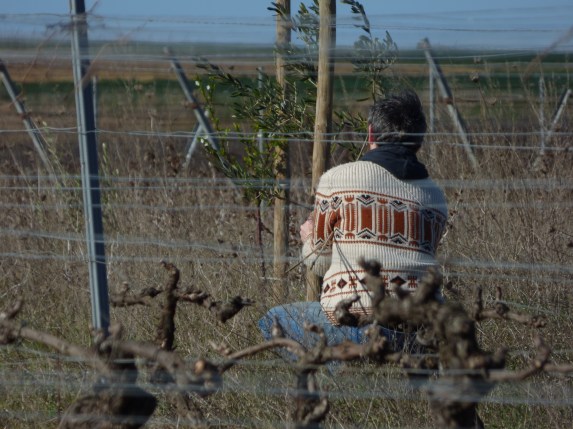
Vincent staking the olives in Rec D’Oulette

Since we cannot change nature, we must try to adapt to climate change and seek solutions to continue making wine as naturally as possible. Planting trees, shrubs, flowers, increasing plant life is part of a considered approach for the future.
P1010197

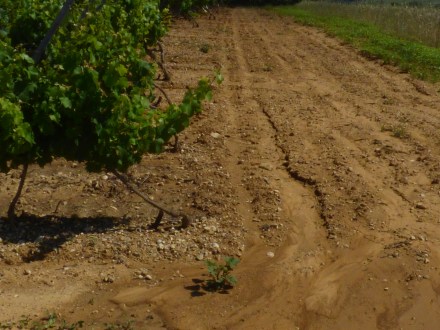
Erosion in a neighbouring parcel

It is about recreating areas of biodiversity … By continually removing hedges, fruit trees, paths, streams, to create larger and larger parcels, we create areas of vine monoculture which only make them more vulnerable, requiring more and more interventions and more exposed to erosion. We have removed balanced spaces where everything had its place in order to create spaces shaped by man which certainly made it possible to work more efficiently but, also, where man is obliged to act, to correct. For example, a bat can eat 2,000 insects per night, if we had only maintained their habitat we would not have to spray and to fight against vers de la grappe. (A disease caused by those insects)

It is about fighting against global warming … You have all at some time, when the summer sun is hot, enjoyed taking shelter in the shade of a tree. It is the same for the parcels of vines. By planting trees around the vines, we protect them from the drying summer winds. Moreover, passing through the trees, the wind naturally cools down. This is an alternative, sustainable approach to that of putting in place a system of irrigation, which may well effective in the short term but one day may well be limited or banned, as the water table is polluted by this water which comes from the Rhône.

It is about restoring beauty to the landscape …. Work in vineyards is certainly mechanized but is also done on foot. The person who works in a parcel needs to have something which marks the horizon, which allows them to see the end … As plots have become larger, they are no longer on a human scale and the work becomes mechanical, automatic, without love … To look up and see a bird land on a tree, to cool off under an olive tree at the end of a row of vines, to see butterflies and bees in the spring coming to rest on patches of flowers; these are the small pleasures which allow those who work there to feel better and to give more love to their work.

It is about an investment in the future …. In the digital age where everything is about the immediate, it is almost a militant act to plant trees that we will not see fully grown. There was a saying not so long ago, “the olive tree of your grandfather, the mulberry tree of your father, the grapevine of yourself.” Today we see a fashion for displacing ancient olive trees from where they first grew to decorate city roundabouts. We live so much in the now, demanding quick results, that we want to apply the same to nature … To plant a tree involves work, care, money but, especially, a lot of fun. To watch it grow, to attach it to a stake, to prune it to give it shape, to look after it so that it grows, to imagine it fully mature after we have gone; it’s so many things that may seem trivial for some (certainly for the bastard who this week destroyed the trees I had planted 5 years ago), but which mean so much to me.

P1000431

Apple tree in Rec D’Oulette

So, what to do? Give up? Surely not …. I said when they crushed my flowers in spring, that in the next year we would plant kilometres of flower patches … Well , though some might not like to hear it, we will continue in the Autumn (Fall) to plant more trees around the vineyards. We will continue to look after them. We will continue to imagine them when they are fully grown. And it will be with great pleasure that we will share this love of nature with you when you come to visit us.”


2 Comments

Between a rock and a hard place

Error
This video doesn’t exist

En français

Back in the Languedoc and, the first morning, I went over to see the vines. Jeff had sent me a message that they were in real stress because of the lack of rainfall. Ironically we had driven south through France under leaden skies and through fairly steady rain, until we reached the Languedoc where the skies turned blue and the temperatures rose. It has been very hot here throughout the three weeks I was away and, following a very dry autumn last year and not much rainfall in 2016, the vines are definitely in need of a good drink.

P1010439

Stressed vines

P1010435

Clear signs of drought

I have written many times this year about the vine stress due to very unusual seasons, the warm winter, cool spring. Sadly, summer has also added to their difficulties. Sure enough the vines look dry. The apex of the vine is often a good way to tell their health and they look tired and bare, almost burned.

To safeguard the health of the young, newly planted or grafted vines Jeff and Julien were busy watering them in the Flower Power vineyard, Font D’Oulette. This is allowed as they are not grape producing this year. Straw was then placed around them to keep the moisture inside. Julien showed his dedication by doing more of this work at night time.

P1010431

Even Icare was feeling the heat despite his haircut, he kept hold of the stick when it was thrown as if to say I’m not chasing after this anymore.

Jeff also informed me of yet another problem, ver de la grappe. This is the larvae of a moth which feeds on the grape. I took a photo of an affected grape last year.

images

There are chemical treatments available to prevent and to treat the problem, no use to an organic producer of course and these chemicals are especially harmful, you can’t use the grapes until 21 days after spraying.

So, for Jeff the treatment involved spraying clay onto the vines to try to make the grape skins less attractive to the moth so it will lay the eggs elsewhere. This was only the second time in twenty years that he had sprayed against ver de la grappe. Also in the spray was fern and seaweed, the fern is a natural insecticide and the seaweed gives a health boost to the vine. However, having sprayed this morning (July 31st) Jeff was hoping that the much needed rain would hold off for a couple of days to allow the spray to work.

You can guess what happened next. A storm, heavy rain, much of the spray washed off the grapes. It is that sort of year, nothing seems to be going right. The rain which did fall was minimal and only undid the good work. The worst of all worlds. To spray or not to spray? To rain or not to rain? Caught between a rock and a hard place.

P1010432

Colour and life remains


As I made my way around the vineyards there were plenty of good grapes to see, véraison (the changing colour of red grapes) has begun especially amongst the Syrah and Grenache of La Garrigue.

And I spent some time in Rome, a very parched looking vineyard but the ideal place to reflect upon its creator, Jean-Claude. There are some things to be thankful for even in this difficult year.

P1010456


Leave a comment

Natural terroir

P1010223

En français

The choice of my recent wine of the week, Olivier Leflaive’s Burgundy Oncle Vincent 2012, made me think about how wines change. When I used to regularly visit Leflaive and Burgundy in the 1990s the style of wine was very oak influenced, a response to the New World oaked wines and to the influence of Parker / Rolland in Bordeaux. The wines smelled of vanilla and tasted of wood. Subtlety was often lost, especially on the lower ranked wines. Happily those days are in the past (though I still come across some very heavily oaked wines even in the Languedoc) and this bottle was zesty and fresh with a little oak adding creaminess.

onc-1

Similarly if I choose to drink a Riesling from Alsace I can find two wines from grapes grown side by side in the same vineyard which will taste very different. One producer might prefer a lean, dry style of wine whilst his/her neighbour makes wine in a rounder style with more residual sugar. The same can be said of wines from any region of course. So where does that leave the notion of terroir?

Terroir is that elusive term which describes soil, micro-climate, slope etc. Effectively it means the location, the ‘in situ’ of the wine. However, some will also add the influence of the local culture upon the winemaking in the concept of terroir, Alsace with its traditional residual sweetness for example. However, different winemakers choose different methods and styles according to not just local tradition but outside influences, wines tasted, travels etc.

yellow tail

Amongst those influences has been the growth of the natural wine movement. I have read and heard numerous accounts by natural winemakers of how they came to choose this philosophy for their métier. Most include their discovery of a natural wine which made them tear up the rulebook and decide that this was the style of wine which they wanted to make because of their freshness, drinkability and flavours. A typical account can be found here.

Yet those who still find fault with natural wines are wont to declare that natural wines mask the flavour of grape and place because they often taste of natural wine and nothing else. Take this remark by Rosemary George*, English wine journalist and Languedoc resident, “if there is one thing that I reproach natural wines, it is that they all, irrespective of provenance, have a tendency to a similarity of style.  The best have that delicious mouth-watering freshness, but that somehow seems to mask their origins.”

geology

You will not be surprised to read that I disagree. I do accept that some, less well made natural wines do have aromas and flavours which resemble each other regardless of origin. However, I think in the vast majority of cases that natural winemaking has progressed and reflect their terroir and grape(s) much better than most conventional wines. How can it be otherwise? If a winemaker adds enzymes, artificial yeasts and SO2 how can than not be adding an extraneous element to the flavour of the wine which is nothing to do with the place? If you add oak chips or staves does that make the wine more Burgundy, Bordeaux or Barossa? Or does it simple meet the established concept of what a wine from those areas ought to taste like?

Winemakers will often aim for a flavour, they want their wine to be the same year after year. That is how the big companies retail Yellow Tail, Blossom Hill etc, the customer expects a certain flavour if wine and that is what they will be given. Like Coca Cola. This does not reflect terroir or vintage at all and, to be fair, the big companies would not claim otherwise. However, I do get the impression that many smaller winemakers follow a similar recipe.

A recent visit to a wine fair in Vouvray was a very disheartening experience. I tasted wine after wine which lacked character but did taste very much like the next sec or demi-sec from the next producer. The conformity was alarming. There was a Vouvray style common to most producers but it was bland and dull. There were one or two exceptions where a winemaker had taken deliberate steps to change their winemaking and vineyards, D’Orfeuilles for example.

P1010117

Healthy wines come from healthy soils including microbial life as here at Mas Coutelou’s Rome vineyard

So give me a wine of character. Give me a wine with nothing added where the vineyards’ health is reflected in the grape juice which makes the wine. Give me that grape juice with nothing extraneous added,  natural yeasts for example. Let that wine be carefully nurtured and not messed around with, no added flavourings. If it is aged in barrel then I would expect it to reflect that influence but not be dominated by it. I want to drink wines which reflect the vitality of healthy grapes in healthy vineyards. The wines will alter from year to year because nature alters from year to year. That is terroir and why natural wine reflects terroir in as pure a state as possible.

*(To be fair to Rosemary she does like some natural wines and it was her writing that first introduced me to Jeff Coutelou so I have much to thank her for.)


1 Comment

Last of the summer wine


Flower Power

Flower Power 2015

En français

As work on the cellar ratchets up a notch in the next few weeks it was time to bottle the last of the 2015 wines which will be made for the moment.

The framework for the new mezzanine floor is in place and actually looks quite beautiful. It will be reinforced with concrete however, and the metal cross bars will disappear (which might stop us knocking our heads). Plumbing has also been tidied up and improved. Cuves will be placed below and on top of the structure. More work on stairs, flooring and around the cellar will happen soon. As I am heading back to the UK for a couple of weeks or so, it will be exciting to see the changes upon my return.

P1010407

Peilhan June 30

The vines continue their growth in the sunshine and heat. Mildew problems are largely contained though some humidity leads to sporadic outbreaks (apologies for the pun). Sadly, there is a new threat of oïdium (powdery mildew) which likes that humidity and the warm days with cool nights we have been having. Powdery mildew shows as grey, white spots on the leaves and the grappe. Certain cépages are more vulnerable, including some of the traditional Languedoc varieties such as Carignan. The treatment is to spray sulphur powder and Jeff Coutelou made the first treatment this week in an effort to contain the problem, a job completed on Saturday morning. 2016 certainly has been a struggle.

P1010422

Meanwhile 2015 wines such as Flower Power and L’Oublié went into bottle on Wednesday June 29th. You might recall that the L’Oublié assemblage was made a few weeks ago and after spending time in tank, marrying together, it is now in bottle. Both of these wines are extremely good, well worth waiting for when they are finally released which won’t be for a while.

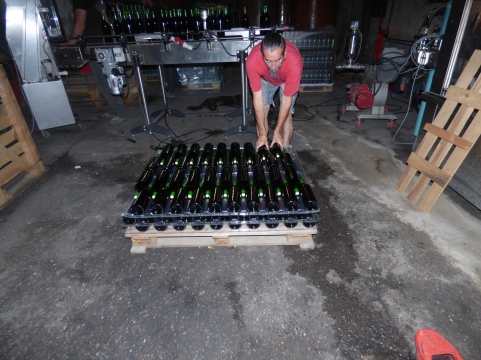
Jeff also put together a new cuvée exclusively for the French market, it will come in litre sized, Bordeaux style bottles as a «vin de table». An assemblage of various cépages it will be cheap, very drinkable and very desirable. The size of the bottles meant that they had to be filled by hand rather than the machine so Thursday was fully occupied with this cuvée. Jeff refers to it as a vin de gauche, after wine writer Vincent Pousson referred to Jeff as one of the last vignerons de gauche (left wing winemakers) because of his low prices making his wines accessible to all. It will be a wine to share and it will disappear down that litre bottle very quickly.

vin de table 2

The new litre bottle of the vin de gauche

2015 seems increasingly like a golden year, its wines are certainly glittering. 2016, well despite all it has thrown at us, there is hope. Meanwhile the summer wine is bottled and the heat is getting to some of us, even after his haircut.


3 Comments

Let’s be Candide

“Il faut cultiver notre jardin.”

19380

En français

Voltaire’s character Candide uttered this phrase as his philosophy to express the delights in, and benefits of, taking care of the small things in life. To occupy oneself with gardening is to take your mind off troublesome thoughts leaving one happier as a consequence.

Never has this phrase been more apt than the last week when my home country has lurched from its traditional sense of fair play, tolerance and progression towards isolationism, ignorance and prejudice. We are told, by  a former Education Minister, that British people ‘have had enough of listening to experts’ (Gove). Just remind yourself there, that’s a former Education Secretary advocating ignorance over education. We are told Britain will continue to welcome Europeans whilst some Leave supporters abuse migrants from all around the world.

baa13fqf2zrg85chz2dp

When I studied ‘Candide’ at university I was free to travel, live and work in Europe, now that freedom will be much more restrictive for our young people. And, life will be harder for those of us who have had the joy of living in Europe. Meanwhile US Presidential candidate Donald Trump tweeted:

“Just arrived in Scotland. Place is going wild over the vote. They took their country back, just like we will take America back.”

In fact Scotland voted overwhelmingly to Remain in the EU. Be very afraid.

That sounds more like Martin’s gloomy philosophy in the book that evil will win over good. Hence the need to look after our garden, to balance my spirit. What better way than by looking at the vines?

Hot temperatures and strong winds have helped to diminish the threat of mildew. Jeff completed his final spray against the disease last Tuesday, his battle has been a hard one but hopefully he has won the war. The vines themselves are making up for lost time, the young grapes swelling in size rapidly. There is a real vigour and energy there at present.

In the cellar work has begun to create a mezzanine floor at one side. This will allow the grapes to be put into the tanks from above rather than having to be pumped. Access to the tanks for pigeage. cleaning etc will be much easier too.

Martin was wrong, there are many good things in the world, the wonders of nature, not least in the vines. Pangloss, his counterbalance in the book, was wrong too, all is not for the best in this best of all possible worlds. Looking after the vines, and the wines, has never looked to be such a wise choice. Candide was right after all.

aaliberation-xlarge_trans_hs-gdo9an2vml8a2d7wio_o1cchhxari50txb6eoa0


2 Comments

Mildew

Su mildew

As I have posted regularly in 2016, this has been a most unusual year weather wise. After no real autumn in 2015, no real winter, no true spring we have had a stop start summer in June. Yes there have been a few hot sunny days but lots of rain and cloud too with many days in the mid 20s.

Sadly, humid days in the mid 20s and cool nights are exactly the conditions favoured by downy mildew, and it has prospered in 2016. Jeff Coutelou has spent many nights out on his tractor spraying the vines to try to protect them. As an organic producer (and much more) he cannot (and does not want to) use manufactured, chemical sprays. Instead he has used sprays based on rainwater with seaweed, nettles, horsetail and essential oils of sweet orange and rosemary. These are better absorbed by the vines in the cool of the night.

P1000885

On June 3rd Jeff spent much of the night spraying only for it be ruined by a storm on the 4th which had the effect of washing away the spray from the vines. The rainwater created other problems however. The humidity in the soils created ever more favourable conditions for mildew, the disease spread. And, there was a third effect; downy mildew lives as spores in the soils and the rain splashes them onto the vines. Mildiou is not a fungus as commonly believed, it is a one celled spore which germinates in warm, humid conditions especially between 16 and 24 Centigrade.

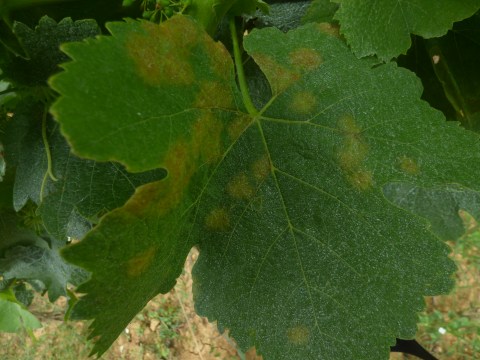
Once the spores are on the vine they attack the new growth and can create a downy white covering. Leaves show a mottled surface with oily spots, first of light green or yellow and then turning to brown as the mildew dries out. Underneath the leaf appears a downy white or grey growth.

The big question was whether to spray with copper. This is effective against mildew but has an effect on the soils, killing the micro organisms which live in them. It is allowed for organic production as long as no more than 25kg per hectare is used in a five year period, it is a natural product. Jeff has used hardly any in the last few years and was very reluctant to start this year. His belief was that it was better to have some losses this year from mildew than lose the life in the soils for a longer period. However, as the mildew spread so quickly he was forced to relent and use a little copper.

His long nights of unpleasant work have helped Jeff to contain the problem but there have been damages. In some parcels as much as 50% of the crop is lost. Mildew thrives on the leaves but spreads to the actual grapes and destroys them. We may go into the vines and cut away damaged bunches.When harvest arrives we will have to be even more vigilant than ever to ensure that affected bunches do not make their way into the  vats and, ultimately, the wines.

Car dead bunch

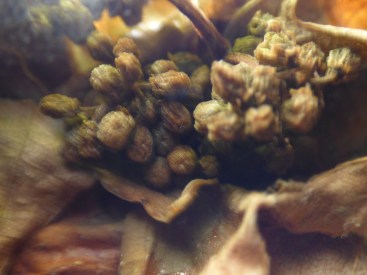
Dried out leaves and grappe

Meanwhile the sprays do not kill wildlife, such as that photographed below after the treatment.

The north wind which so often helps to dry out the vines has finally started to blow, though even it was humid for much of the past fortnight. The forecast is for hot, sunny weather which will stop mildew, so the threat should now diminish but it has left the vines looking mottled and a bit sickly. After a restless winter where the sap has been constantly on the move they have been less able to resist mildew’s effects.

The wire trellises which are used in many parcels have helped to ensure that air can circulate amongst the bunches to stop them becoming too humid and prone to mildew. Everything has been done but it has been a hard fight and losses suffered.

However, all is not doom and gloom. Most of the vines are now lush with growth. Flowering (fleuraison) was very late but last week the vines made up for lost time and the small grapes swelled greatly. Let’s hope for smoother progress in the next three months.


Leave a comment

Busy times

busy

En français

Busy times. In the vines and in the cellar.

I mentioned recently that the cooler weather had delayed some of the growth in the vines and that flowering was late. Well, recent hotter weather has brought sudden change. Flowering happened around the turn of the month and was over very quickly, perhaps catching up lost time. In particular there was a heavy thunderstorm on Saturday June 4th which brought a torrent of rain. The water and the sunshine has really got the vines going. Tendrils reach for the skies and there is more bushiness to the vines.

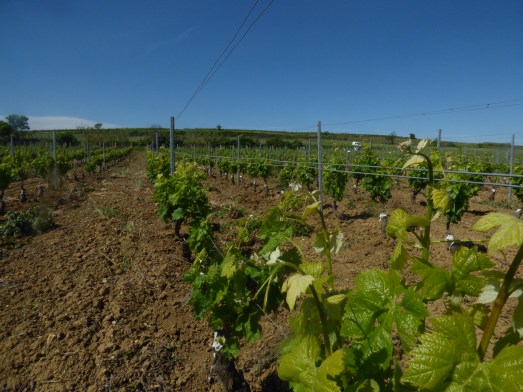
The flowers gave way to the little hoods which cover the nascent grapes, capuchons. These quickly fall away too revealing the grapes for 2016. On some vines all of this is happening at the same time such as this Carignan (above) in Rec D’Oulette. The weather has also encouraged the growth of the grafted vines which we did back in March.

This brings work too. The palissage has to be lifted to support the vines, hard physical labour. And, sadly, the heat and rain bring problems of disease. Mildew has been around for a couple of weeks and I mentioned that Jeff was spraying in the very early hours and late at night last week. He worked until 1am Friday/Saturday and started again at 6am. Just as things seemed to be settling a big attack of mildew on the Grenache at Ste. Suzanne meant more treatment on Tuesday morning. This ‘curious’ year is proving to be hard work.

Not all negatives though. The storm brought such a downfall that I was fearful for the flowering bunches. damage to them means no grapes. I happened to be in Puimisson during the storm (next article!) and the rain was lashing down, converting streets and roads to waterfalls and lakes. Yet as the rain eased I went to a couple of vineyards and the flowers were coping just fine. A trip round the vines on Monday morning revealed healthy growth and the soils had absorbed the rainfall.

This is not true of everyone. Much of the water on the roads was also full of clay from vineyards nearby, hence the yellowy brown colour. Vineyards which are treated with weedkillers, where the soils are ploughed deeply, even irrigated, were unable to cope so well with the heavy rain. Soils were carried away. Compare these photographs of Jeff’s vineyards with the parcel next door belonging to someone else. The difference is marked. Water can help or can damage.

Meanwhile back in the cellar there was more work to be done. Recent changes to the fabric of the cellar, especially the floor, have brought more efficient drains and a smoother surface, easier to clean. Further work will soon be done to the rest of the floor so the bottling of the next wave of wines had to be brought forward to allow the works to be done and dusted before vendanges.

The spring bottling of wines such as 5SO, PM Rosé, 7 Rue De La Pompe I described earlier. These are wines for early drinking, vins de plaisir. Now it was time for wines with a little more body. On Thursday June 2nd 10,000 bottles of Classe were made, and it is really something special in 2015. It took almost 12 hours and went very smoothly but believe me it is a hard day’s work. On Friday, Flambadou, made from the Carignan vines above, was bottled along with other smaller cuvées.

Before anyone rushes in with orders Jeff will let these bottles rest for a few months to allow them to be at their peak when released, Flambadou probably in 2017 for example. There remains one or two cuvées still in tank which need a little more time, Flower Power being one.

So, most of the 2015  wine is now in bottle, the vines are revealing the grapes for 2016 and there are wines stored for 2017. Busy times at Mas Coutelou for everyone, well except one.


3 Comments

Curiouser and curiouser

curious-curiouser-featured (1)

A detail from an illustration by Sir John Tenniel depicting Alice with the March Hare, Hatter and Dormouse at the Mad Tea Party. From Alice’s Adventures in Wonderland by Lewis Carroll.

It has been a most curious year and as it goes on it becomes curiouser and curiouser, just as Alice said. *

P1010116

To quote another famous character, a certain Jeff Coutelou, during these last few months there was no proper autumn, no real winter, no true springtime. The last few months of 2015 and early 2016 were abnormally warm, not one single day of frost in Puimisson. Plant life started very early, there was blossom on trees in February, mimosa everywhere. People recorded their vines starting to ‘cry’ as the sap rose. And then, it all stopped. As March and April unfolded the weather was chilly with cold northerly winds. The plant life closed down its growth to a minimum. Budding (ébourgeonnage) was late even after the mild winter.

May is usually warm in the Languedoc and we have had some hot, sunny days but interspersed with cooler days and plenty with a lot of cloud cover. The vines pushed quickly some days, 25 – 30 cm the week before last and then… cooler weather slowed the growth again. Flowering (fleuraison) began last year around May 5th but this year Jeff and I spotted the first flowering on May 26th. Appropriately that was in the Flower Power vineyard, Font D’Oulette. Yet in the white grape vines, such as the Muscat in Peilhan, there is no flowering.

It is likely that most of the vines will flower at the beginning of next week, most varieties at the same time which is, again, most unusual. Curiouser and curiouser. As the vendanges are calculated at 100 days after flowering, the likely date for harvest to get under way is now well into September, ie 10 – 14 days behind 2015. After a very precocious start to the year!

So why does this matter? Well, the vines have been unable to rest since last harvest. The lack of frost or cold weather in winter meant that the vines did not shut down fully. The sap has been on the move for months. Those early reports of vines crying in February, then delayed growth. Vines have sent out a lot of growth but the lack of sunshine has not produced much photosynthesis, the vines are often green in lower parts but lighter green higher up. The grafted vines in Font D’Oulette have been slow to send out growth, the sap flows and then cooler weather arrives.

P1010010

Peilhan, note the lighter green near the tops

Humidity and grey clouds means a threat of mildew and some spots are evident on leaves in certain parcels. Jeff spent the night of May 20 spraying from 9pm to 1am, starting over again at 6am the next day. Why then? During the night and early morning the vines are more receptive to the influence of the spray as the pores are open in cooler temperatures. Not the usual spray of course. Mas Coutelou has been organic since 1987 and Jeff has gone much further. This spray was of nettles, horsetail, seaweed mixed with a tiny amount of sulphur and copper (allowed in organic farming). And also in that mix were essential oils of sweet orange and rosemary, pampered vines indeed. This prompt action has mastered the problem supported by timely sunshine and northerly winds.

P1010003

Spots of mildew on the leaves and on the grappe

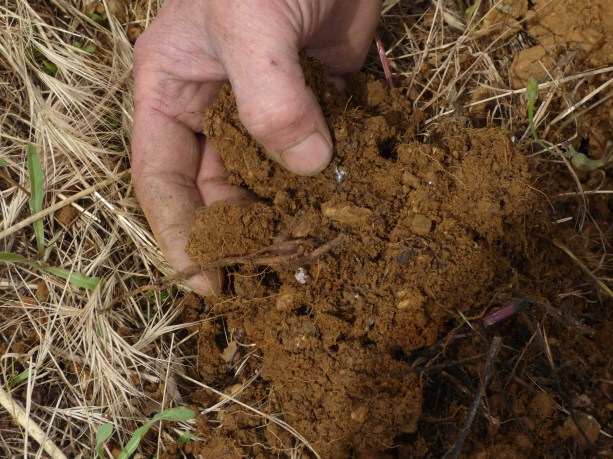
Whilst in Rome vineyard the other day we looked at the soils and Jeff pointed out the growth of good mushrooms and fungal life in there. The photos show this life, the white spots. Scientific research shows that it is through fungal life such as this that the vines communicate with each other and support each other. This has taken a lot of soil nurturing and management.

And to further demonstrate the health of the vineyards, remember the vandalism of the Carignan vineyard and the flowers that were planted there? Well they are growing back stronger than ever. Nature wins in the end. We can only choose to support it or fight it, but in the end nature will win.

P1010071

Cinsault in Rome

At present despite this most curious of years the vines are in good health. The next three months will decide whether the grapes will be of good quality or not. Jeff reckons that the period from April 15 to July 15 the vigneron must be always present, always monitoring the vines to ensure that any problems can be sorted as soon as possible. That will make or break the vintage.

P1010008 Collage

Flowers in the Coutelou vineyards

Meanwhile we have been treated to some beautiful flowers in the wild and around the vineyards. As well as birdsong in Rome vineyard. Nature at its best despite the curious year.

That is if the problems can be solved. Just this week Sancerre and Burgundy were hit by massive hail storms causing damage which means that the year is a write off in some vineyards. The third such storm this year in some of these areas. And on Saturday, May 28th Beaujolais was badly hit too. Again nature decides.

beaujo hail

Hail damaged vines in Beaujolais (photo with permission from @duc_lionel)

A curious year, yes. But a disastrous one for some.

*  (No rude comments about mad March please).


6 Comments

Open Up Your Door

En français

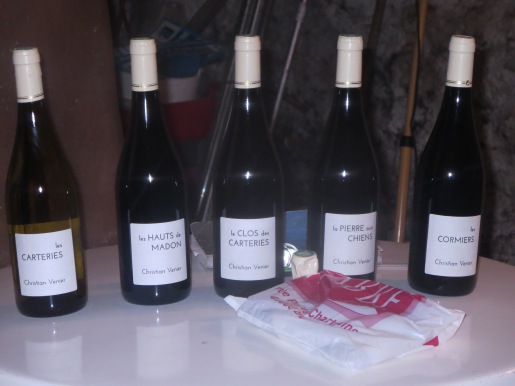
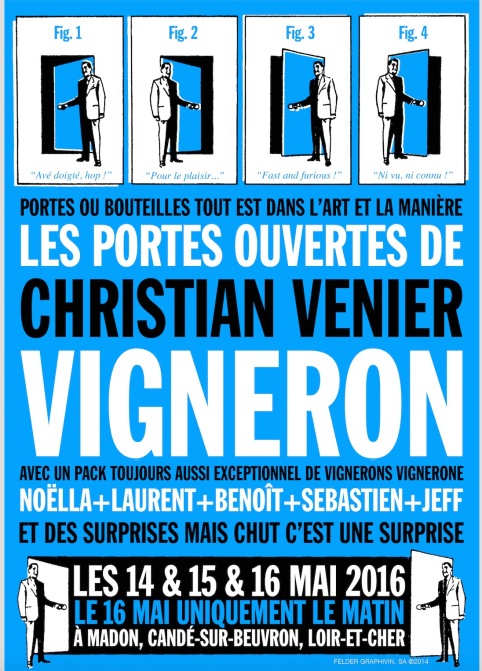
The weekend of Pentecost was spent in the Loire. Christian Venier hosted a Portes Ouvertes at his domaine in Madon, Touraine along with his partner Marie-Julienne.

It was an opportunity for winemakers and friends to get together and there was a lot of fun, food and frolics. Jeff Coutelou and most of his team were present including Michel, Vincent and many of the people who spent time in Puimisson during the vendanges such as Céline, Carole and Karim.

C5617594-909B-418C-B1EF-5A6DEE0E17F8

Michel struts his stuff

I know that Jeff and some others did not get to bed much before 4am on those three mornings. It was also quite amusing to see a lot of French people dancing to ‘Waterloo’ of all songs! Good to know that history is safely in the past. It was easy to make new friends too, as always there is a real energy and friendliness in the natural wine crowd.

The Veniers were great hosts, many thanks to them for their generosity.

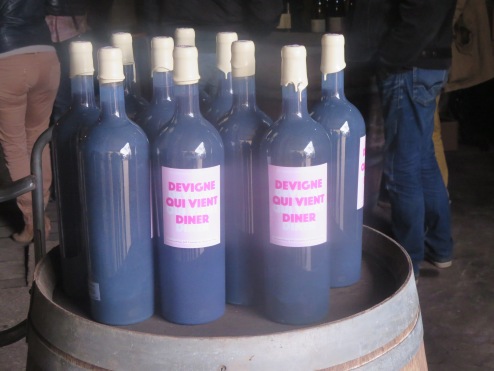
To mark the event Christian and Jeff Coutelou made a special cuvée, ‘Devigne Qui Vient Dîner’ (a play on Guess Who’s Coming To Dinner). Gamay and Pinot Noir from Christian assembled with Grenache, Syrah and Cinsault from Jeff and made only in magnums. Very nice too.

IMG_3998

Christian’s wines are a great combination of fruit and complexity with plenty of texture. His La Roche 2011 in magnum was a true highlight of the year’s  wines for me, a great Gamay which I wrote about as Wine Of The Week. I will be coming back to this later in the article.

IMG_3994

A number of winemakers joined the event and having just written an article about how there was a promising new wave of young producers it was good to see my statement supported by yet more up and coming talent.

One of those was a friend from the Languedoc, Sébastien Benoit-Poujad of Domaine de la Banjoulière. Sébastien bottles his wines at Jeff’s cellar and his wines are starting to show real quality, his light, fresh Aramon 15 and, especially, his lovely Carignan 13 were on great form. Sébastien’s partner Tina is also a familiar figure on these pages as she worked at Jeff’s during the 2014 vendanges, that’s where the pair met.

Of the Loire new wave there was:

Noella Morantin whose old vine 2014 Sauvignon Blanc ‘LBL’ was especially good

Benoit Courault, very good reds especially the Grolleau 2014 ‘La Couléé’.

Laurent Saillard, whose wines spoke of their grape and terroir. ‘Scarlett’ (Gamay and Pinot d’Aunis) and the Sauvignon Blanc ‘Lucky You’ 15 were especially good.

Finally there was Cédric Bernard who has worked with Christian and is now venturing out on his own. In an act of incredible support and  generosity Christian has given his La Roche vineyard to Cédric to help him. This is the parcel of Gamay whose 2011 I so enjoyed. What a spirit of sharing and humanity. And the first Gamay from that parcel was lovely, named ‘La Cabane À Marcel’. After the 2011 it was my favourite wine of the weekend and as a bonus it comes in a litre bottle! I look forward to drinking the bottles I bought. I very much liked the Chenin Blanc ‘Brin De Chèvre’ too. If this was Cédric’s debut year as a winemaker he is definitely a talent to watch.

It was interesting to compare notes with Vincent and find out that La Roche and the Gamay of Cédric were his two favourite wines. Every one of these winemakers is someone whose wines I would gladly buy and recommend.

36802CBE-190D-43FD-8C2F-878069C21856

My friend Vincent

A sad postscript was the news that the April frosts hit La Roche vineyard hard and unfortunately there will be no wine from there this year. The vicissitudes of life as a vigneron, a tough break for a man starting out.

Christian took Jeff and myself out to look at his vineyards on the Sunday morning. His passion for his land and vines was evident. It was interesting to see the vines surrounded by parcels of wheat and other crops such as asparagus which grows well in the more sandy areas of the land. Christian showed us some of the frost damage on his parcels though happily he has not been too badly affected.

D78C4190-182F-43D3-B09A-12102503D2B8

Frost damaged

Ironically a parcel more prone to frost was left untouched this time. He showed a few rows that were touched because they were next to the wheat which created humidity which in turn encouraged the frost. However, the positives shone through and it was a great experience to spend time with Christian.

Finally, it was also good to be left in charge of the Coutelou stand and share wines with the people who wanted to try them out. I even completed some sales. My education continues.

IMG_4010

A lovely weekend, shared with great people in a relaxed and spirited environment. Christian, I hope I’ll be coming to dinner next year too.

PortesO-CV14-16.5