The grapes are picked, how do we make this become wine? That has become the main objective now at Mas Coutelou.
The grape skins, pips, flesh and solids are with the juice in the tank (cuve) for as long as Jeff feels that they will benefit the juice. They give the juice chemicals such as anthocyanins which give colour to the juice (for rosé and red wines), tannins and flavour compounds. The solid parts of the mix tend to rise to the top of the tank and float on the juice. This cap must be kept moist, a dry must would give unpleasant flavours and is more prone to harmful bacteria. That is why remontage and pigeage have to be carried out, as explained before.
Charles carries out remontage
Jeff will taste from each cuve every day and samples are sent to oenologue Thierry Toulouse for analysis.
With Thierry
When he is happy that the right balance of sugars, acidity, colour and flavours is achieved it is time to press the wine. Some of the must is left behind in cuve and will be collected to use again, for example in distilling.
Michel removing must from the cuve
The pressed juice goes into a new cuve and will continue its fermentation into wine. The yeasts on the grape skins and in the atmosphere of the cellar change the grape sugars into alcohol. The fermentation will have begun when the must was in contact but will continue when just the juice remains.
Michel
Vincent
I wish I could convey the smell of the fermenting juice via the page you are reading. It is like walking into a boulangerie in the early morning, bready aromas fill the air as the yeasts go about their work. One of the real highlights of the whole process.
Fragrant, yeasty fermenting wine
Whilst that is all going on the equipment which has been used so much in the last month is checked over, taken apart and given a thorough cleaning. Not a pip, not a grape skin must be left in the sorting table, presses, égrappoir (destemmer) or anything else. No chance of bacteria gathering.
It is not straightforward. The process of grape juice to wine is a natural one and things can go wrong. Any vigneron who had a year where the process went without any hiccoughs would be either the luckiest alive or a liar. Yeasts can suddenly stop working, fermentations become too hot, bacteria (both helpful and harmful) are unpredictable. Jeff must be aware of every cuve and of their analyses, he must use his experience to tackle any issue which springs up at any time of day or night. He rejects the use of sulphur dioxide (SO2) to act as an antiseptic or stabiliser for the wine, therefore that experience is tested time and again. No wonder he wears an air of fatigue.
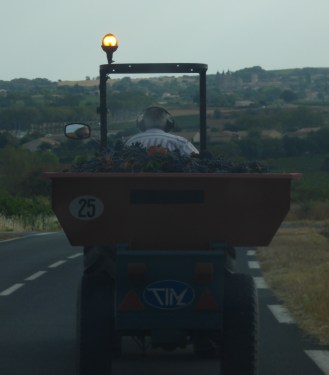
Wednesday (September 21st) was officially the last day of summer and, appropriately, the last day of picking at Mas Coutelou. It was, as in 2015, the Cabernet Sauvignon of Segrairals which was the last major parcel gathered in. Lovely, clean bunches of small, healthy berries, classic Cabernet and virtually nothing to sort in the vineyard or in the cellar.
Cabernet Sauvignon
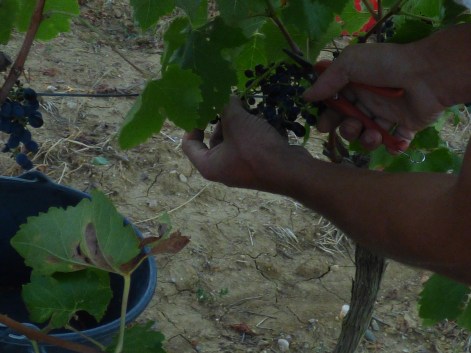
The day before had seen the start of the Cabernet in the afternoon following a morning of picking Mourvèdre, also from Segrairals. As I hadn’t ventured into the vineyard much in 2016 I took the opportunity to do so that morning. Our friend Jill had expressed a wish to do some grape picking and Jeff kindly agreed so I accompanied her (so at least there was one less experienced picker than me!). I really enjoyed being out in the fresh air but it was also good to get a grip on how the vineyard topography can have such an impact upon the grapes.
Jill in action
Sticky hands, lovely Mourvedre
Mourvedre juice with more Mourvedre on the table
The Mourvèdre grows on an easterly slope with the rows running down the slope. The vines at the bottom of the slope gave lower quality bunches than those at the top, indeed we stopped picking the last few vines at the bottom of each row. The reason was that when it does rain the water runs down the slope taking nutrients etc. The grapes there tend to ripen much sooner with more humidity in the ground, it was a clear example of terroir. Rest assured that only good grapes went into cuve, much was left behind in the vineyard and at the side of the sorting table.
The slope in the Mourvedre vines, rejected fruit on the ground
On Monday the lovely Carignan Noir of Rec D’Oulette (Chemin De Pailhès) was added to the tanks. The quality was high and signs are promising for yet another good vintage of Flambadou, arguably the domaine’s best wine in recent years.
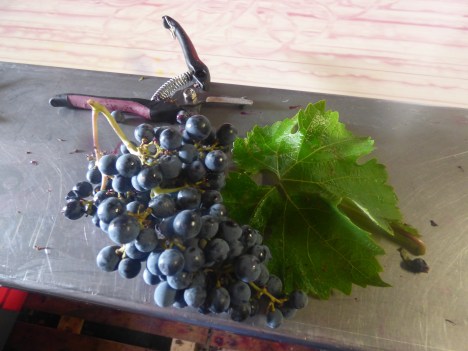
Carignan bunches
A Carignan leaf
Since the last article the other major harvest was some bountiful, good quality Grenache from La Garrigue on Saturday 17th.
Gorgeous Grenache
There remain a few rows here and there with some grapes left and they may or may not be picked in coming days and weeks. However, the Cabernet marked the last of the major picking. Time to say farewell to the Moroccan pickers, part of the Coutelou crew for the last month.
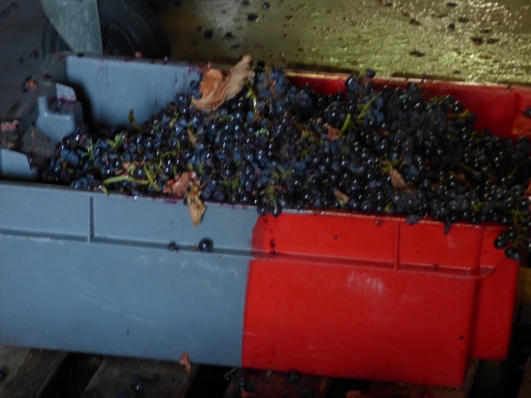
Last cases arrive
Last case
Sorting the last case, (clockwise from left) Vincent, James, Morgane, Julien, Charles, Priscilla
Stage 1 is therefore over. Stage 2 the cellar work of remontages and pigeage continues apace as most cuves are now full and need looking after. Stage 3, pressing, is also in full swing as grapes from previous weeks have now gone through fermentation on skins and need to be pressed to take the juice away. I shall be writing about this more in the next article.
So, we head into autumn, the vines are fatigued after a very stressful year. The leaves are already changing colour and the Languedoc will be an even more beautiful place in coming weeks. The picking may be over but the vendanges are not.
What do you look for when hundreds of bunches of Grenache grapes come towards you? What is your job on the sorting table?
Every winemaker wants the healthiest grapes to go into their vats to make the best possible wine. In some of the smartest chateaux and domains in Bordeaux and Burgundy each grape is sorted, even scanned. However, those are wineries which charge hundreds of pounds for a bottle of wine. For a natural Languedoc wine producer such expense is not feasible, so no scanners at Mas Coutelou. However, the need for only healthy fruit to go into tank is even more important for those who will not use additives such as SO2.
The sorting table is new this year, previously we sorted direct from the case. The table means that you can see more of the grapes, move them around and search for any problems with greater ease. Undoubtedly it has led to better triage of the grapes which should help the wines. In a very difficult vintage such as 2016 the table has easily repaid its cost.
So, what are you looking for?
Michel brings in the cases and information about the grapes
Well, first of all you get information from Michel as he brings the cases direct from the vines. He talks to the pickers and they will tell him if they have been in a good part of the vineyard with few problems or, conversely, if they have had to do a lot of sorting and cutting themselves. Michel relays this information to us on the sorting table with warnings to look out for snails or rot for example. Forewarned is forearmed.
In the video you see Vincent empty the case onto the table. He immediately looks for leaves, snails, spiders etc and removes them. Priscilla starts to sort. I or someone else would be on the other side so that we can see the bunches from different angles and turn them over to inspect.
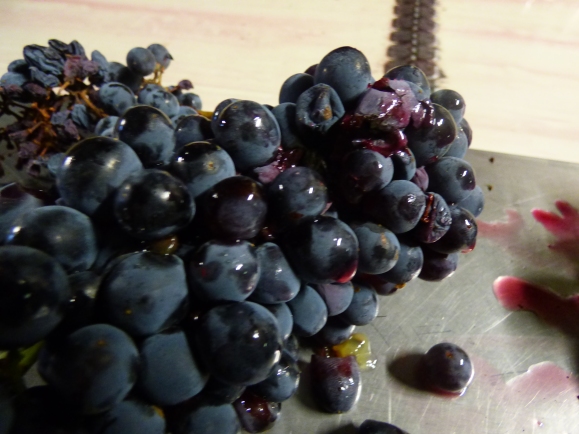
Some squishy grapes
When I first joined the Coutelou team in millésime 2014 it was Carole who taught me what to look for. There are the obvious things, more snails and leaves but then look at the bunches. Or rather, not so much look, but touch and smell. Feel the bunch, are the grapes firm and springy or squishy? In the latter case warning bells ring. Is the squishiness due to juice or to rot? Smell the bunch. Does it have aromas of clean fruit or vinegary, rotten odours? Obviously if that is the case you cut into the bunch and seek out the rot and remove any affected grapes. Usually cut some of the ones around too as they might have been tainted by the rot.
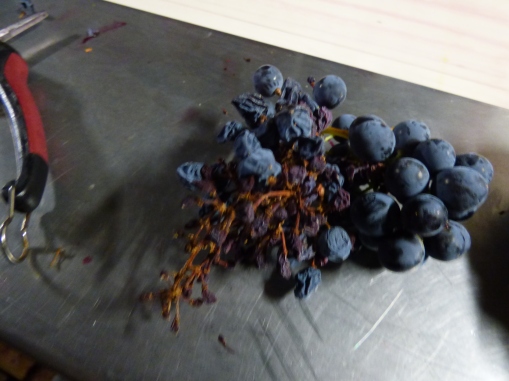
Mildewed grapes
Look out too for mildewed grapes which have dried and become unpleasant. There are grapes which have naturally dried out and their raisiny sweetness is actually good in the wine, so you have to learn what you are looking for. Are there hail damages grapes? Grapes with holes from vers de la grappe (grape worms)? Black rot? Oidium? In a future article I shall be looking at how these problems show themselves on the final grapes.
Lovely Grenache bunch but check the interior
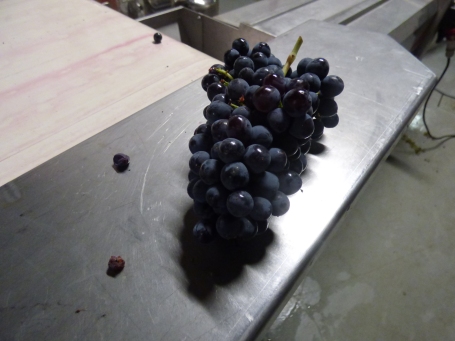
Of course, the vast majority of bunches are great, no problems at all, just lovely fruit. But, beware, those big closed up bunches are the very ones where problems might lurk inside. Don’t be deceived by something which looks good, you must still check it over.
Nice, loose bunches – air can circulate to keep the grapes healthy
And meanwhile, whilst you look at that bunch another one is passing you on the table. Work fast, eyes, fingers, nose on the alert. Secateurs cutting whilst your fingers are already touching the next bunch. Be careful, no blood on those grapes please.
The weather has had its say and threatens to shout out loud in the next few days. Should we expect anything different in this most problematic of years? Saturday (Sept. 10th) was supposed to be a day for picking but a heavy shower fell in the morning and that was enough to stop the day in the vineyards. Grapes covered in rainwater would provide diluted juice, no good for quality producers though that did not stop some in the area.
Some picked on Saturday
Charles
Remontage
Priscilla
James and Charles
However, there was still work to do in the cellar, remontages and pressing. The previous day some of the team had been clearing space in the solera cave so that the Muscat and Grenache picked from Rome vineyard would have room.
Michel moves my Grenaches wine
Charles bottles some solera wine
Sunday was a day off though more remontage and cellar work was done. There is no rest. Today (Monday 12th) was a normal day for many vignerons but at Mas Coutelou a big part of the team are the Moroccan pickers and it is Eid Mubarak. Therefore Jeff decided that they deserved the opportunity to celebrate their holy day and so no major picking. An act of respect which deserves mention.
Remontage
Sadly, that act seems unlikely to be rewarded by the weather. There is a major threat of a large storm on Wednesday which would halt work again and require a few days for the grapes to recover before they could be harvested. More careful triage will also be required. Let us hope that the storm weakens or diverts.
Carignan Noir Saturday
Meanwhile Carole, James, Vincent and Charles were out picking Carignan Blanc this morning in Peilhan and the Grenache from Sainte Suzanne was pressed. Work continues despite everything this year throws at us. Tomorrow will see the harvest of Syrah from La Garrigue, the grapes which usually make La Vigne Haute.
In 2015 vendanges began on August 21st, in 2016 things kicked off on August 30th. The protracted cool spring and the drought contributed to a later harvest though not so late as predicted because of the hail on 17th August. This damaged some grapes especially in Sainte Suzanne (Metaierie) and Jeff decided that the grapes needed to be picked as they would lose acidity if left on the vine.
On the 30th it was the Syrah which was picked, unusual for a vendanges not to start with white grapes. Syrah normally produces small berries but these were especially small. The cagettes in which the grapes are transported back to the cave are usually running with grape juice, requiring regular cleaning. Today they were virtually dry. Jeff calculated that the volume of juice produced was around half of the normal harvest which is not good news. Hopefully other grapes in other vineyards have fared better but we shall see. This is all the result of the protracted dry spell in the region. Rainfall, other than the occasional storm where the rain comes too heavily. has been pitiful. The vines have found it hard to cope and give water to swell the grapes. The hail confounded the problem by shredding leaves which would help to nourish the grapes.
The good news was that the grapes gave lovely juice; fresh, very raspberry fruit and they smelled of beautiful warm spices. The measure showed potential alcohol of 12% so it will make a light, fresh Syrah wine or blend.
There was a full house to help out. Michel, Julien and Vincent as usual. We were joined by James, an Australian who is staying for the harvest to help his learning for making wine in the future. Charles who spent a few days with us last year is also here for a longer spell, he adds humour and energy. Jeff’s primary school classmate Maylis was also present spending the day in the vineyards. And Céline, Brice and their two girls were here on the way back from their holidays, it is always fun to see them.
Vincent and Charles
Cé;ine
One or two bits of machinery creaked under the strain of a new harvest but the changed cellar made cleaning so much easier. The team is taking shape for the challenges ahead. The Syrah sits in cuve 2A, I shall keep you up to date with its progress and path to the bottle.
Egrappoir in action
The rafle
Hard day’s work
Day 2, August 31st
The last of the Syrah was picked first. If you look at the photo of the vines with James picking you will notice the lack of foliage and therefore why Jeff felt the need to harvest now. First official analysis of the Syrah from yesterday showed healthier than expected acidity and potential alcohol, a welcome fillip.
Julien
James
Then came the Grenache from Ste. Suzanne, in many ways more problematic than the Syrah due to mildew earlier in the year. However, when it came in there were many good firm bunches of healthy fruit with possibly a little more juice than the Syrah. It was a very hot day so Jeff worked some magic by using frozen pellets of CO2 to stop the juice from starting to ferment too soon so that it doesn’t extract too much of the flavours of the dryer grapes before it is moved for the first time. This was the first time that Jeff has tried this method due to the nature of the vintage and its drought. Difficult to take a photo as all you could see was the mist of the frozen gas.
The juice tasted healthy and fresh with red fruits, a little vegetation still present. Yesterday’s Syrah was already darker, more weighty and very different to yesterday. Wine alchemy. It now sits in cuve 2B next door to the Syrah.
Grenache grapes
Grenache at 13%
TWednesday – Grenache right, Syrah left
Tomorrow (September 1st) is a new moon and so no picking or work. It is also the 2nd anniversary of my arrival in France, days like this remind me why that decision was a good one.
Thursday, August 11th was the last day before Jeff shut up shop for a few days as he does every year to celebrate the Béziers Féria. A few days of rest and recuperation before the preparations really start for the vendanges. As he had received a number of requests for visits Jeff decided to group them all together and have a tour of the vines and tasting with lunch.
Visitors from Grenoble, Orléans and Nanterre assembled at the cave along with my friend and sommelier Sandra Martinez and we set off around some of the vineyards. Jeff explained his philosophy and vineyard work and it’s worth repeating a couple of points of note. I mentioned the problem of vers de la grappe a few weeks ago which Jeff treated with a spraying of clay to discourage the moth from laying its eggs. We found a bunch in La Garrigue which was affected and Jeff opened it up to reveal the cocoon of the larvae.
Vers de la grappe cocoon
He also explained how bats are the ideal solution and why he provides shelters, each bat would eat around 2,000 insects a day including the moths responsible for vers de la grappe.
Grenache
Castets
Clairette Musquée
We also looked around at the majority of vineyards and their dark green colour at a time when the vine is putting its resources into the grapes to get them to maturity, as that is how they reproduce. So, in a natural state the leaves start to look pale and tired as the vine is not channelling energy into the leaves. The dark green, attractive vines are so coloured because of the nitrogen feeds and, in some cases, irrigation.
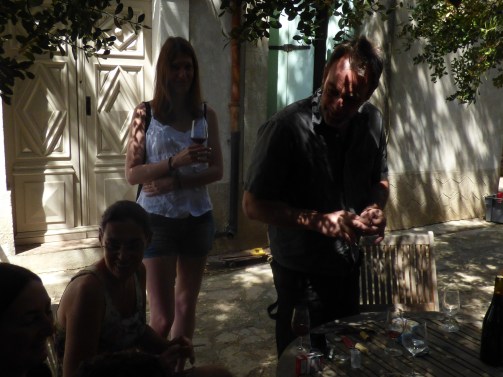
We returned to the domaine where we were joined by a group of wine professionals. In the garden we tasted a range of Mas Coutelou wines as well as some lovely salads and (for the carnivores) some charcuterie.
Jeff leads the tasting accompanied by his sister and niece
The list of wines shared, all from 2015 except the last, was: Bibonade (rosé and white), Peilhan Blanc, Maccabeu, OW1, 5SO Simple, Sauvé De La Citerne, On Peut Pas Vraiment Dire Que, Classe, La Buvette À Paulette, Flower Power, Flambadou, L’Oublié, Devigne Qui Vient Diner, 5J
I missed the Bibonades and Peilhan as I was getting the Maccabeu from tank. I had a bottle of Peilhan at home recently though and it was lovely, really strong evidence of the quality of 2015. All apples and pears and fresh acidity with a long finish. Even by Coutelou standards it is an exceptional wine.
Maccabeu
The Maccabeu is, if anything, even better. Cooked apple and cinnamon flavours, fresh acidity, almost smoky. There is so much going on here and, as the jug I collected the wine in was in front of me, I kept being drawn back to it through lunch. The wine changed and opened out with more fruit and spice. This will develop beautifully when it is bottled, a stunner, my new favourite.
OW1 is Jeff’s first skin contact wine. He was reluctant to join the trend and didn’t want an orange wine but this spent plenty of time on skins, I remember Cameron and I carrying out a manual pigeage. Now bottled the wine has texture and tannins from that skin contact but there is plenty of fruit and remains balanced and fresh. Very good.
Manual pigeage of OW1
5SO was on good form. The boisterous, chatty group became quiet for the first time, captured by its fruit profile and drinkability on a hot summer’s day, which essentially is what it was designed to do.
Citerne was one I didn’t have last week and it had been some time since I had tasted it. It showed well, the Mourvedre adding a real plummy depth. Another wine which will emerge in coming months, another to look forward to. OPPVDQ was on great form, another to quieten the crowd. It confirmed my opinion that this is a wine which will really benefit from some time in bottle, hang on to some if you have them. La Buvette À Paulette was last week’s big surprise and another bottle confirmed the pleasure, really showing its quality.
Flower Power not yet properly labelled. What a colour!
Flower Power took some time to come around but now that it has done so I can confirm that this will strengthen the reputation which it earned in its first vintage in 2014. The vineyard is still young and will continue to improve the wine it delivers, if the snails leave it alone. The ten grape varieties give a complex story of light and shade, red and dark fruits, floral and sappy.
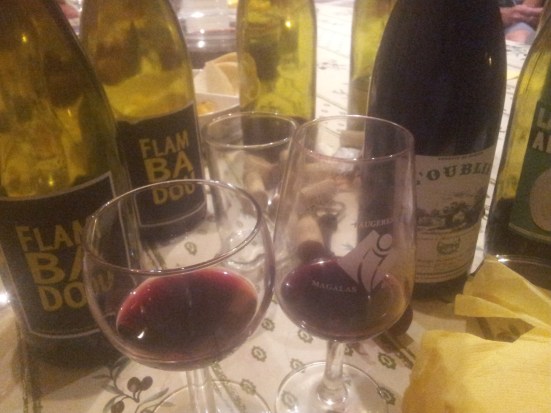
Flambadou was once again a star, showing the lightness of touch in this Carignan. Jeff describes it as like a Pinot Noir. There is depth and character packed into quite a light structure. The vineyard has a light layer of limestone beneath the fine clay and it is this limestone which adds the complexity to the wine. A grand cru of Carignan.
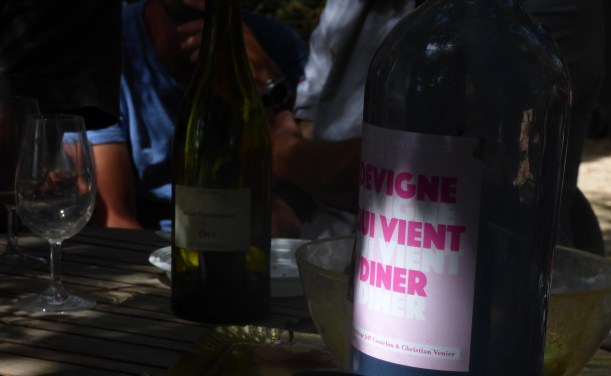
L’Oublié and its story once again captured the imagination of everyone, its secondary flavours beguiling the tastebuds. Devigne Qui Vient Diner is the wine which Jeff made in partnership with Christian Venier from the Loire, Gamay added to some Languedoc grapes such as Cinsault. My, this has improved with a few months in bottle (magnum), really delivering a rounder more harmonious blend with zappy fruit and lovely sweet fruit.
Finally 5J the Grenache Gris from 2012 aged in barrel made to reflect a Spanish fino to accompany the best hams. Oxidised notes, barrique notes and a flash of clean fruit, quince and apple.
A great day, much longer than most were expecting but nobody showed any signs of fatigue or willingness to depart. Many joined us in the cave des soleras to taste some of the old wines there. And poignantly, some wine of Jean-Claude on what would have been his 80th birthday. His legacy will live on.
I enjoyed reading the Facebook post of one of the visitors Benoit who described Jeff as a magician and an artist. The day was a success.
Friends Ceredig and Lesley were staying with us in Margon and our neighbours Martin and May had relatives and guests staying too so I thought it was a good time to organise a Mas Coutelou tasting.
Carignan during the tour with Cora and Brian
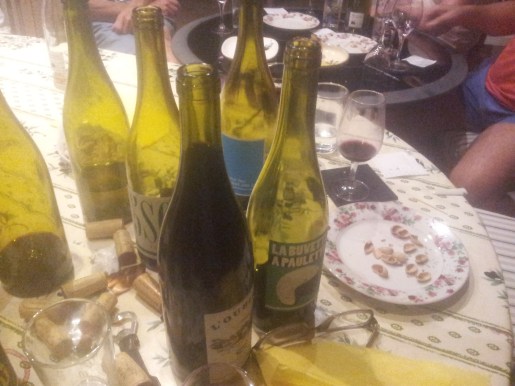
Brian and Cora had shown an interest in the vines and we had made a tour of the vineyards and cellar on Tuesday 2nd. Jeff kindly invited us to take a few bottles from the cave and I made up a series of ten bottles. They were served in the following order, nine from 2015, one from 2014 to show vintage difference:
2015: Carignan Blanc / Grenache Gris; PM Rosé; 5SO Simple; Buvette A Paulette; On Peut Pas Vraiment Dire Que; Le Vin Des Amis; Classe; Flambadou; Flambadou 2014; L’Oublié.
Martin initiated a scoring system and at the end of the evening the results showed some agreement about the top wines but some differences too. Wine is personal and that is one reason why I am becoming more sceptical about scores generally. However, this was in fun and here were the results of the Anglo-Irish jury.
At number 10, the Carignan Blanc / Grenache Gris. My fault this, I had a bottle from the first six off the bottling line and it contained a little water so came across dilute. However, there were some lovely apple and pear characteristics and it was a hit with one guest who doesn’t usually like white wines. I know from other bottles that this is a lovely wine which wasn’t done justice on the night.
8= PM Rosé An interesting result, perhaps showing that rosé finds it hard to be taken seriously (or just that people loved the reds). PM is so much more aromatic and punchy than most rosés that perhaps it confounded expectations. For me it is a cracking wine, with real character and heft as well as being bone dry and perfect on a summer’s evening.
8=5SO Simple Another surprise for me as 5SO is really hitting its stride. I served it slightly chilled and everyone liked it though some found it too light for a red. I love the cherry bright fruits and clean finish, it is a great alternative to summer rosés.
7 On Peut Pas Vraiment Dire Que Liked by all, loved by some, a little austere for a couple of people. My opinion is changing on this wine. I thought it was a light Syrah which was for short term drinking but the last couple of bottles seem to suggest it is entering a phase of taking on weight and a serious side. Certainly I shall be keeping the rest of my bottles for a few years to see how it develops, I think it will become something special. It may not be La Vigne Haute but it is a serious Syrah of real quality.
6 Flambadou 15 Well liked though suffered by comparison with the 2014 which was more developed. There is an elegance to this, perhaps the best cuvée from Mas Coutelou in the last several vintages. Jeff likens it to Pinot Noir at time, there is a limestone layer beneath the fine clay soils of the vineyard and this seems to add the lightness and elegance. Red fruit aromas and flavours with a streak of tannins. This is very youthful and will develop with time, complexity is already there. A great wine from a great vintage.
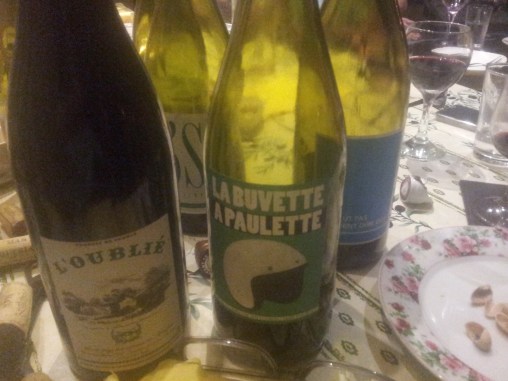
5 La Buvette À Paulette Round, blackcurranty, juicy, very enjoyable. This was popular because of its sheer drinkability though some found it a little green. No doubt the Cabernet Sauvignon will develop further but this was on song already. It won’t be released until January 2017 and it is definitely one to wait for, a cuvée I hadn’t realised could be so good.
4 Flambadou 14 The extra year added more roundness to the wine making it more enjoyable in the short term. The extra complexity appealed to many of us as well as the red fruits. It is lovely though I do think the 15 will become better, being such a good vintage.
3 L’Oublié Another recently bottled wine which we assembled a few weeks ago. The aromas were immediately a sign of complexity, hints of tobacco, coffee, dark fruits, there are notes from the barrel and you can tell there is some older wine in here but there is also a freshness from the 2013 Cinsault. The story of the wine and its assemblage I wrote about recently and the air of mystery about L’Oublié added to its appeal at the tasting.
2 Classe No label on as this was another bottle recently put together and has not yet been prepared for sale. As soon as it was opened the exuberant fruits, blackcurrant and raspberry, almost leaped from the glass. There is a depth, richness and a darker profile in there too, this is one of the very best cuvées of Classe. Not hard to see why it appealed so strongly on the night with everybody.
1 Le Vin Des Amis Ever popular, ever first choice. When I serve Coutelou wines to friends it is almost always Vin Des Amis which is the most appreciated. The open, fruity nature makes it immediate and the complexity gives it a sense of being special. Which, of course, it is. It really was on good form here and a clear winner on the night.
A great evening. Lovely people around a series of great bottles, how could it not be? And wow those wines are great, hopefully more people converted to natural wines and to Jeff’s in particular.
A word to for the 2015 vintage. I am, of course biased as this was my first full vintage, but it is proving to be top class, everything is drinking well and the bottles still to come will highlight its class still further.
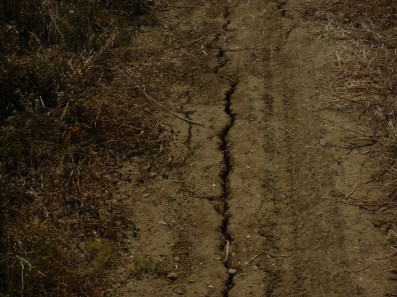
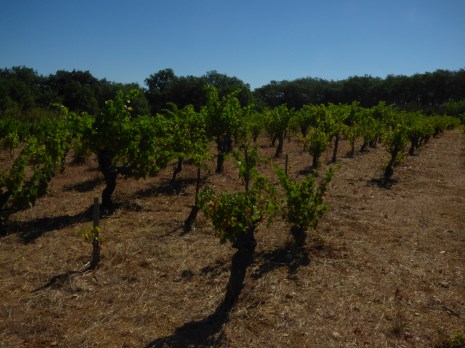
Back in the Languedoc and, the first morning, I went over to see the vines. Jeff had sent me a message that they were in real stress because of the lack of rainfall. Ironically we had driven south through France under leaden skies and through fairly steady rain, until we reached the Languedoc where the skies turned blue and the temperatures rose. It has been very hot here throughout the three weeks I was away and, following a very dry autumn last year and not much rainfall in 2016, the vines are definitely in need of a good drink.
Stressed vines
Clear signs of drought
I have written many times this year about the vine stress due to very unusual seasons, the warm winter, cool spring. Sadly, summer has also added to their difficulties. Sure enough the vines look dry. The apex of the vine is often a good way to tell their health and they look tired and bare, almost burned.
Photographié de Rec D’Oulette
To safeguard the health of the young, newly planted or grafted vines Jeff and Julien were busy watering them in the Flower Power vineyard, Font D’Oulette. This is allowed as they are not grape producing this year. Straw was then placed around them to keep the moisture inside. Julien showed his dedication by doing more of this work at night time.
Even Icare was feeling the heat despite his haircut, he kept hold of the stick when it was thrown as if to say I’m not chasing after this anymore.
c/o agro.basf.fr
c/o gourgazaud.fr
Jeff also informed me of yet another problem, ver de la grappe. This is the larvae of a moth which feeds on the grape. I took a photo of an affected grape last year.
There are chemical treatments available to prevent and to treat the problem, no use to an organic producer of course and these chemicals are especially harmful, you can’t use the grapes until 21 days after spraying.
So, for Jeff the treatment involved spraying clay onto the vines to try to make the grape skins less attractive to the moth so it will lay the eggs elsewhere. This was only the second time in twenty years that he had sprayed against ver de la grappe. Also in the spray was fern and seaweed, the fern is a natural insecticide and the seaweed gives a health boost to the vine. However, having sprayed this morning (July 31st) Jeff was hoping that the much needed rain would hold off for a couple of days to allow the spray to work.
You can guess what happened next. A storm, heavy rain, much of the spray washed off the grapes. It is that sort of year, nothing seems to be going right. The rain which did fall was minimal and only undid the good work. The worst of all worlds. To spray or not to spray? To rain or not to rain? Caught between a rock and a hard place.
Colour and life remains
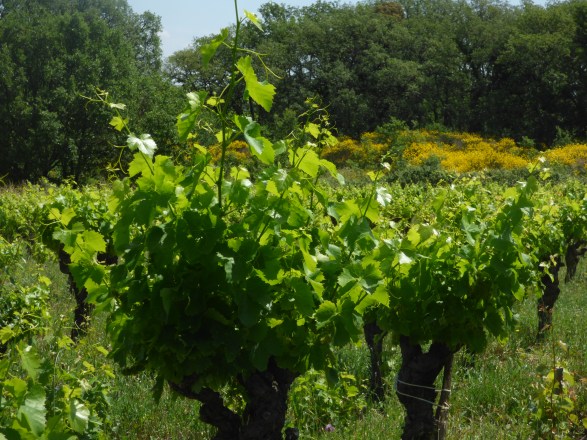
As I made my way around the vineyards there were plenty of good grapes to see, véraison (the changing colour of red grapes) has begun especially amongst the Syrah and Grenache of La Garrigue.
And I spent some time in Rome, a very parched looking vineyard but the ideal place to reflect upon its creator, Jean-Claude. There are some things to be thankful for even in this difficult year.
The choice of my recent wine of the week, Olivier Leflaive’s Burgundy Oncle Vincent 2012, made me think about how wines change. When I used to regularly visit Leflaive and Burgundy in the 1990s the style of wine was very oak influenced, a response to the New World oaked wines and to the influence of Parker / Rolland in Bordeaux. The wines smelled of vanilla and tasted of wood. Subtlety was often lost, especially on the lower ranked wines. Happily those days are in the past (though I still come across some very heavily oaked wines even in the Languedoc) and this bottle was zesty and fresh with a little oak adding creaminess.
Similarly if I choose to drink a Riesling from Alsace I can find two wines from grapes grown side by side in the same vineyard which will taste very different. One producer might prefer a lean, dry style of wine whilst his/her neighbour makes wine in a rounder style with more residual sugar. The same can be said of wines from any region of course. So where does that leave the notion of terroir?
Terroir is that elusive term which describes soil, micro-climate, slope etc. Effectively it means the location, the ‘in situ’ of the wine. However, some will also add the influence of the local culture upon the winemaking in the concept of terroir, Alsace with its traditional residual sweetness for example. However, different winemakers choose different methods and styles according to not just local tradition but outside influences, wines tasted, travels etc.
Amongst those influences has been the growth of the natural wine movement. I have read and heard numerous accounts by natural winemakers of how they came to choose this philosophy for their métier. Most include their discovery of a natural wine which made them tear up the rulebook and decide that this was the style of wine which they wanted to make because of their freshness, drinkability and flavours. A typical account can be found here.
Yet those who still find fault with natural wines are wont to declare that natural wines mask the flavour of grape and place because they often taste of natural wine and nothing else. Take this remark by Rosemary George*, English wine journalist and Languedoc resident, “if there is one thing that I reproach natural wines, it is that they all, irrespective of provenance, have a tendency to a similarity of style. The best have that delicious mouth-watering freshness, but that somehow seems to mask their origins.”
You will not be surprised to read that I disagree. I do accept that some, less well made natural wines do have aromas and flavours which resemble each other regardless of origin. However, I think in the vast majority of cases that natural winemaking has progressed and reflect their terroir and grape(s) much better than most conventional wines. How can it be otherwise? If a winemaker adds enzymes, artificial yeasts and SO2 how can than not be adding an extraneous element to the flavour of the wine which is nothing to do with the place? If you add oak chips or staves does that make the wine more Burgundy, Bordeaux or Barossa? Or does it simple meet the established concept of what a wine from those areas ought to taste like?
Winemakers will often aim for a flavour, they want their wine to be the same year after year. That is how the big companies retail Yellow Tail, Blossom Hill etc, the customer expects a certain flavour if wine and that is what they will be given. Like Coca Cola. This does not reflect terroir or vintage at all and, to be fair, the big companies would not claim otherwise. However, I do get the impression that many smaller winemakers follow a similar recipe.
A recent visit to a wine fair in Vouvray was a very disheartening experience. I tasted wine after wine which lacked character but did taste very much like the next sec or demi-sec from the next producer. The conformity was alarming. There was a Vouvray style common to most producers but it was bland and dull. There were one or two exceptions where a winemaker had taken deliberate steps to change their winemaking and vineyards, D’Orfeuilles for example.
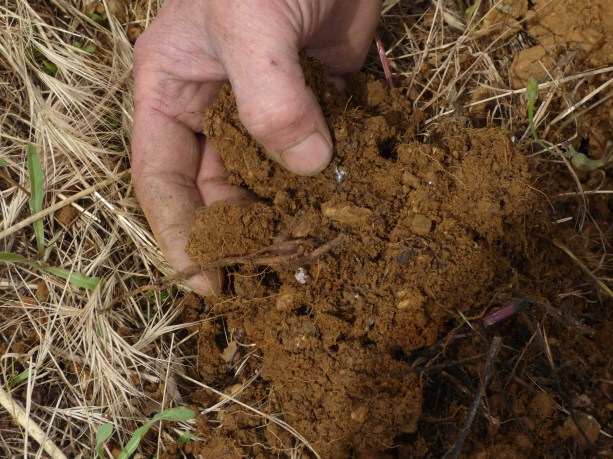
Healthy wines come from healthy soils including microbial life as here at Mas Coutelou’s Rome vineyard
So give me a wine of character. Give me a wine with nothing added where the vineyards’ health is reflected in the grape juice which makes the wine. Give me that grape juice with nothing extraneous added, natural yeasts for example. Let that wine be carefully nurtured and not messed around with, no added flavourings. If it is aged in barrel then I would expect it to reflect that influence but not be dominated by it. I want to drink wines which reflect the vitality of healthy grapes in healthy vineyards. The wines will alter from year to year because nature alters from year to year. That is terroir and why natural wine reflects terroir in as pure a state as possible.
Flambadou 2007
*(To be fair to Rosemary she does like some natural wines and it was her writing that first introduced me to Jeff Coutelou so I have much to thank her for.)
One of the more interesting wines at Mas Coutelou is L’Oublié. It is also one of my favourite wines. On Thursday, June 9th Jeff called in his oenologue, Thierry Toulouse, to help to decide on the blending (assemblage) of the new version of L’Oublié.
So what is L’Oublié? It is a blend of grapes just like the vast majority of Languedoc wines and, indeed, Mas Coutelou wines. However, it is also a blend of wines from different years. For example the Carignan is a blend of wine from 2001, 2007 and 2010 which has been stored and aged in a barrel called a demi muid. Add in a similar blend of Grenache and Syrah from different years and then other wines to add even more complexity and depth. The name means ‘the forgotten one’ referring to the original barrel of wine which had been, well, forgotten.
This is how I described L’Oublié in my article about the Coutelou cuvées:
“It has aromas of dark fruits and leathery, spicy notes too. It is dark flavoured too, blackberries, liquorice and even coffee are just some of the many complex flavours. It benefits from decanting to allow that complexity to resolve itself a little, and it will stay fresh for days after opening. There are not many wines like this around and I honestly don’t know why. It is unusual and one of my favourite wines because of its complexity, its balance of older and more youthful flavours. Terrific.”
It is the mix of darker flavours with the hallmark Coutelou freshness which really appeals to me about this wine. So, how is it made?
Jeff had taken samples from the demi muid barrels of old Carignan, Grenache and Syrah and also samples of other wines which he had, for example Copains 2013. This is a pure Cinsault, from Rome vineyard, released in 2014 but Jeff had aged some of it in barrel too. Younger wines were on the table too, available to be used. We tasted these separately first to get a feel of the flavours which would be in the mix. Frankly, the barrel aged Copains was so good I’d have made a wine just of that!
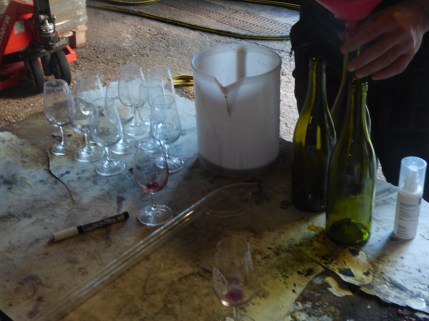
Using the base wines of the old blends the oenologue measured out the proportions based on the quantities of each wine available for the final cuvée.
The wine was left to mix for a few minutes and then we tasted. The first was very good but, perhaps, edging a little too much towards the dark side of flavours. So, some 2015 wine was added to freshen it up and … voilà. The characteristics of previous versions of L’Oublié but made with newer wines on top of the base wines.
Premier assemblage
L’assemblage qui compte
The decision on the blend made, Jeff then set about blending the components together in tank where it will sit for a while to marry together. This will be bottled at a future date, yet to be determined as it depends upon when the wine is ready. It will tell Jeff the right moment. Yet another wine to look forward to.
The secret code of L’Oublié
If you don’t want to take my word for how good L’Oublié is then here are other reviews and tasting notes:



























 amarchinthevines