After my everyday case it is time to select my case of wines representing my favourite wines tasted (and drunk) in 2015. It has been a fantastic year for me, I love my life in the Languedoc and the opportunity to spend time alongside someone I consider to be a truly great winemaker and, I am fortunate to say, my friend. Through various tastings, meals and purchases I have also been fortunate to discover many top class wines. So here is my final selection of twelve. I have omitted Jeff’s wines as that will form the next article and they would fill much of this case. It should also be said that my choice would probably vary day to day, I was torn between a number of great wines.
The Languedoc Roussillon is perhaps best known for its red wines and yet looking through my notes it was often white wines which excited me most in 2015. Indeed I will start with two wines from the region.
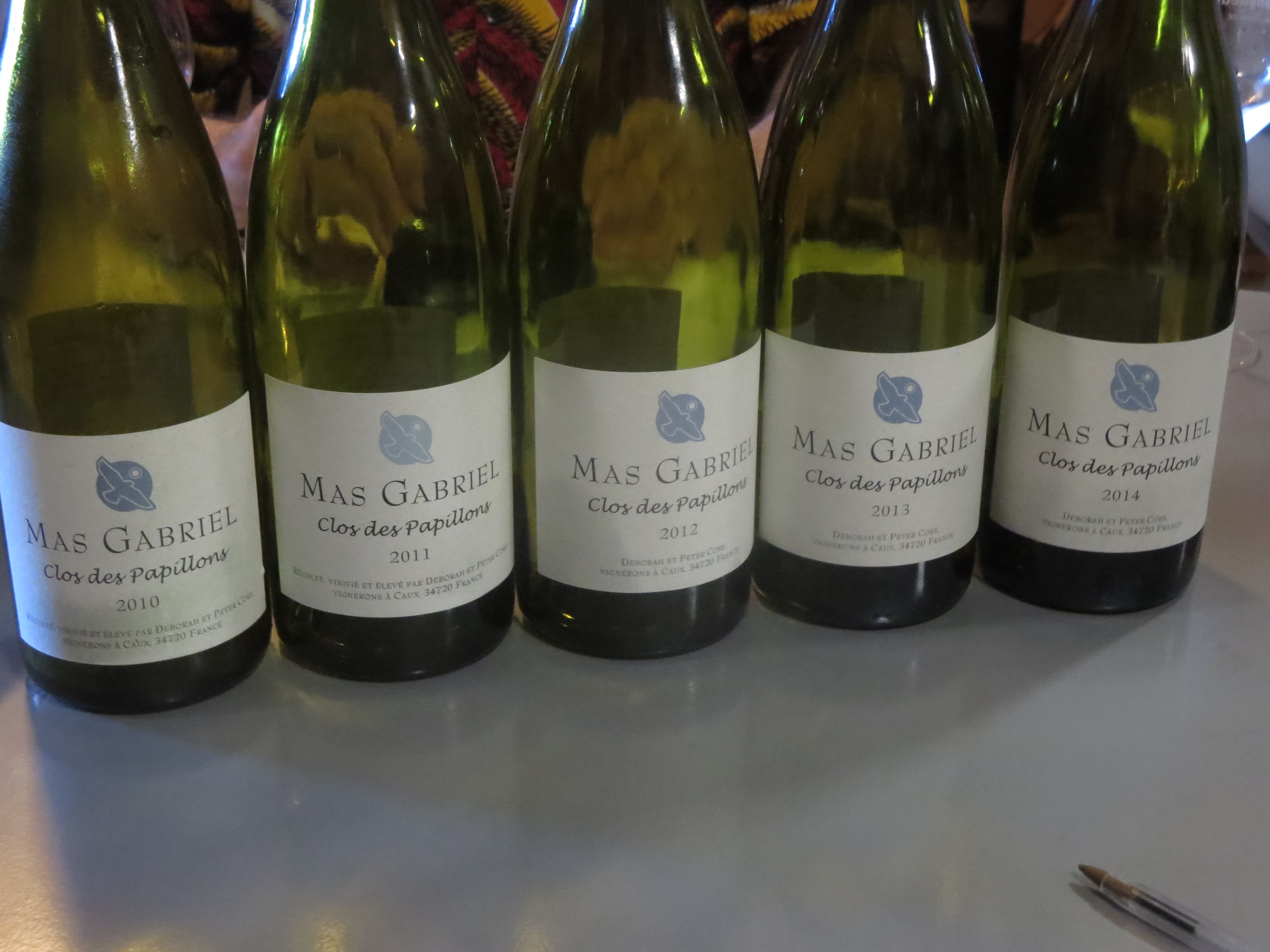
Mas Gabriel, Clos Des Papillons 2013. No surprises here, this also featured in my everyday case. It has been a favourite wine of mine for many years, I love the Carignan Blanc grape with its freshness and white fruits and Peter and Deborah Core have mastered a wine which brings out its best. Every vintage from 2010 to 2014 tasted at the Domaine’s tenth anniversary dinner was excellent but the 2013 stole the show for me.
The 5% Viognier adds a little mystery but it is the Carignan Blanc which gives the fruitiness, freshness and longevity. The reds of Mas Gabriel are lovely too but this remains my favourite and I’m also looking forward to the development of the new white wine Champ Des Bleuets. It is not just loyalty which earns Clos Des Papillons its place here though, the wine genuinely thrills me no matter how often I drink it. It claims first place ahead of another exciting Carignan Blanc from Caux, Lune Blanche of the Conte De Floris.
Clos Du Rouge Gorge, Sisyphe 2014. Cyril Fhal produces great red wines especially his Carignans in Latour De France in the Roussillon. However, this year it was his white wine Sisyphe which really captured me. Grenache Gris is the cépage behind most of my favourite wines in the region and this wine adds a clean, fruity yet racy edge. A wine you could drink alone or with food and one which leaps out as something special from the first sniff to the last sip.
Domaine Montesquiou, Terre De France 2014.I could probably include every wine made by Montesquiou, so high is the quality of this Jurancon domaine. It was a thrill to visit Fabrice and Sébastien in Monein and to tour the vineyards and cellars, I had long been a great fan of their wines. The excitement and enjoyment found in the wines is so obviously a reflection of the land and the family, the brothers are passionate about their vines and restless in seeking to make their wines even better. The raciness of the dry wines, the skilful use of oak, the tightrope balance of the sweet wines, every bottle offers a treat. I chose this wine as it walks that fine tightrope with lime, lemon and white fruits just offset by a trace of sweetness. Masterful.
With Olivier Humbrecht
Zind Humbrecht, Clos Windsbuhl Riesling 2011. I love Riesling, I love Alsace wines. Most of my favourite Rieslings are from the Mosel, others from Australia but this wine blew me away, apt on a day when gales were threatening the tent where the tasting took place near Montpellier for Biodyvin. I had tasted some Zind Humbrecht wines before and enjoyed them but this was one of those moments when the lightbulb lit above my head. Classic fresh aromas, so clean tasting and those flavours of fruit with a thrilling edge of acidity and, yes I know it makes no sense, minerality. There really is a texture and saltiness which reminds me of minerals. It is a very young wine, it will age for decades I would think but it is already packed with so much complexity and pleasure. It is everything I would ever want from a white wine.
Domaine Huët, Clos Du Bourg Demi-Sec 2005. At the same tasting as the Zind Humbrecht I tasted this beauty. I admit to some bias as Vouvray was my first wine village visited in France and long a favourite. The sweeter style moelleux which I tasted that day were excellent, a 2008 Haut Lieu for example but I love the demi-sec style which balances the dry appley side of Chenin Blanc with its capacity to produce a sweet side with hints of honey balancing the zestiness. This Clos Du Bourg was so deep and complex and so long lasting, it was like tasting several different wines in one glass. This will again age for a long time, I’d imagine it will develop more sweetness but right now I love this balance of dry and sweet. I often resist the big names of a region but this Huët just stood out as an example of great winemaking.
Pierre De Sisyphe of Joe Jefferies
Other dry white wines close to selection included Pierre De Sisyphe 2014 from Bories Jefferies (again from Caux!), the Greco 2013 from Giardino (Campania, Italy), Casa Pardet’s Chardonnay 2013 (Costers del Segre, Spain), Loin D’Oeil 2014 from De Brin (Gaillac) and a lovely Chenin Blanc from Testalonga (Swartland, Soith Africa), tasted on a beach in Marseillan, called El Bandito but no vintage noted whilst there I’m afraid.
I’m including Champagne Franck Pascal Quintessence 2004. Long, yeasty, rich but with a great freshness which cleansed the palate and left me wanting more. Yet another biodynamic producer, I loved all the wines I tasted but this vintage champagne with its Pinot Noir dominance had the extra complexity and depth which marks great wine of any type. The 2005 was almost as good but this 2004 was extra clean and long. I tasted a lot of very good champagnes this year, Barbichon, Leclerc Briant, Drappier, Lassaigne being some, but Quintessence was special.
So, six white wines which have given me great pleasure in 2015. Next the reds.
This was the busiest week of the vendanges and required long hours of picking, sorting, pressing, remontage as well as lots and lots of carrying, lifting and often in confined spaces. In short it was hard work.
Why so busy? Well, Syrah which was the first of the red wine grapes to ripen makes up around a third of all the vines at Mas Coutelou and Grenache, the next to ripen, is also the next main cépage with up to 12% of the harvest. Together this meant that around half the 2015 harvest would be picked this week. Add in other smaller picking and the parcel of Merlot and this was definitely the crunch time.
Sunday September 6th was a day of rest for most but Cameron and Jeff were in the cellar working as usual, carrying out checks and analyses and remontages as necessary.
Monday 7th was a long day at work. It was around 8.45pm before we stopped. Syrah in Segrairals makes up around 2ha in total, though as with all land there are some prime areas whilst other vines, around the edges and in a few hollows where water gathers, are not of the same quality. In a typical year these would go towards cuvées such as Classe and 7, Rue De La Pompe but, as ever, plans are fluid.
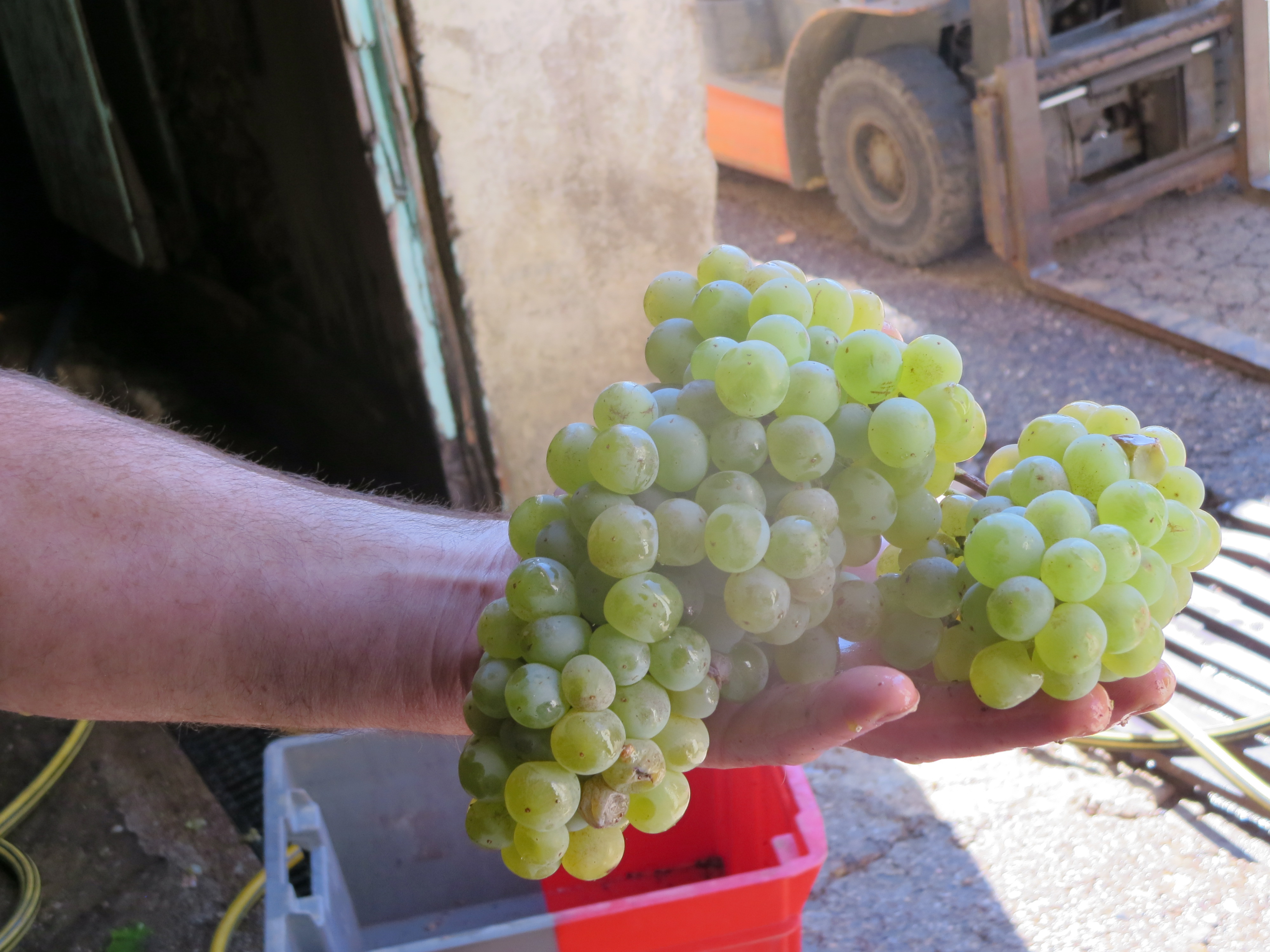
Superb bunch of Carignan Blanc
In addition a parcel of Carignan Blanc was harvested from Peilhan vineyard. There were some wonderful grapes and they were given special treatment, carefully sorted and then pressed using the small hydraulic press. The juice ran very clear and green and then gradually took on a slightly brown colour as it developed light oxidation. This is actually good as it helps to protect the juice later in its life and prevents damaging oxidation. Moreover, the effects of the oxidation from the pressing are removed through fermentation. Around 600l were produced in total, around 750 bottles worth. This makes a very good wine, something I was to be reminded of on Tuesday night, as we shall see.
This was a long day but much good work had been done.
Tuesday 8th brought more Syrah to the cellar, this time from La Garrigue. These are the vines I have described before which face north on a slight slope to preserve the freshness and fruit flavours, good quality grapes which are often used for my favourite cuvée, La Vigne Haute, so I was even more keen to help to sort carefully and there were some lovely bunches of healthy fruit. Here’s hoping for a good vintage of LVH, as ever Jeff will make the call.
Cameron unloading some Grenache Gris
Yet again another smaller harvest was done, again from Peilhan, this time with Grenache Gris. The lovely pink, grey berries are flexible in their use and might produce, white or rosé wines or be added to red wine as you will remember from my special cuvée post.
Grenache Gris after being pressed
Meanwhile lots of analysis of the wines in tank and work to ensure that they are in good health. This even involved Jeff removing his trousers and jumping into the Flower Power tank to do some pigeage! Modesty means that I shall not share these photographs!
Cameron getting a sample for analysis
The after effects
And of course there was plenty of this… (I couldn’t resist adding the tune)
Error
This video doesn’t exist
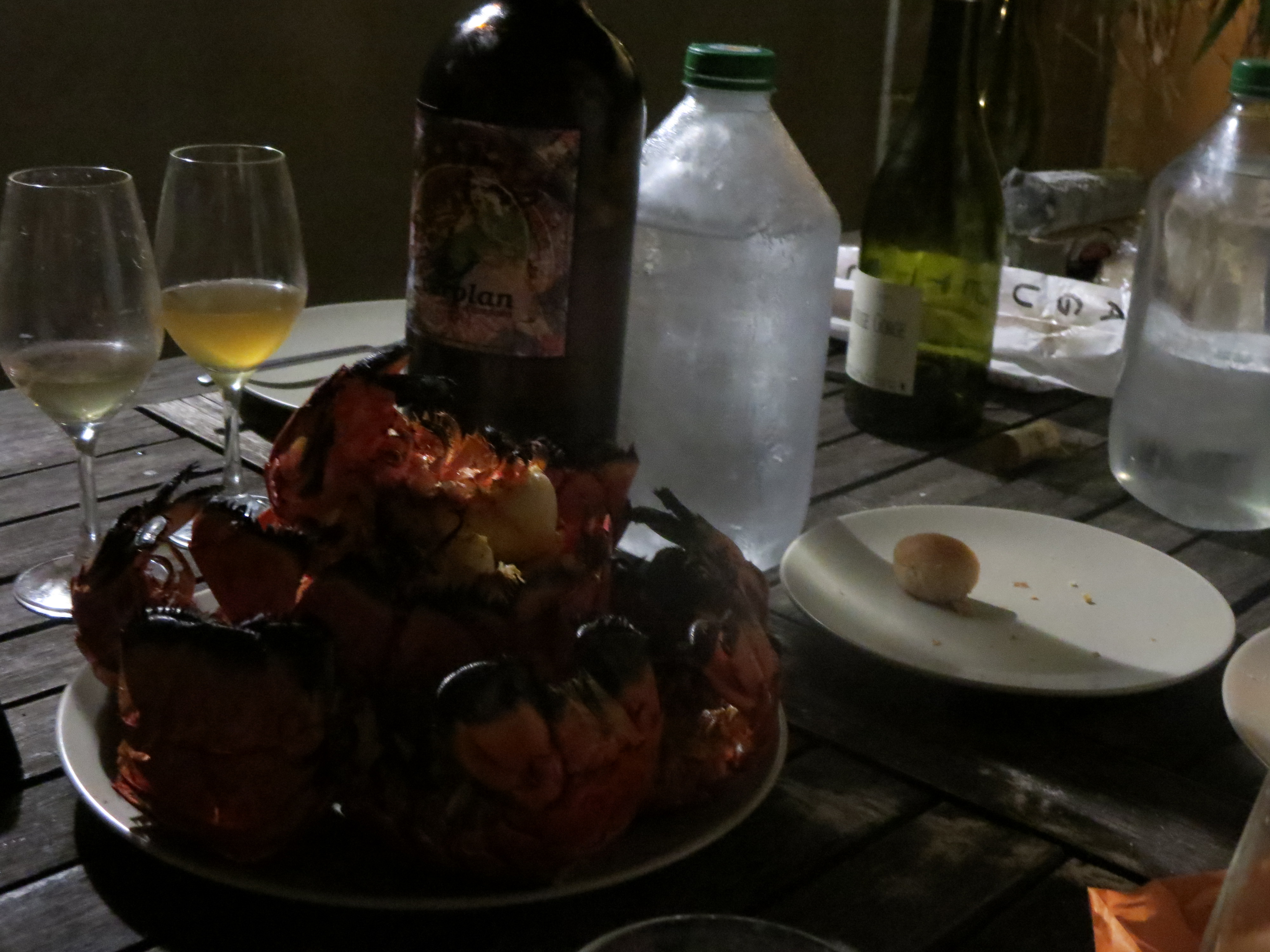
A bonus was to come though. We had been joined by two new additions to the team. Thomas is from Toulouse originally but has been working as a sommelier in the Languedoc and spent most of the week with us and will return next week. Karim is a fishmonger from Tours with an extensive knowledge of natural wines. He spent the week in Puimisson and brought a lovely surprise in the form of lobsters and scallops which made a wonderful dinner on Tuesday as Karim is also an excellent cook. We shared a magnum of Casa Pardet Chardonnay to accompany the shellfish as well as two Carignan Blancs, one from Mas Coutelou and the other from Jeff’s friend Cyril Fahl of Domaine Rouge Gorge in Roussillon. It was a special and hugely enjoyable meal, thanks to Karim and Jeff for the food and wine.
Aug 30th was a Sunday so no picking but Jeff was still in the cellar working. The early wines needed to be checked and moved as necessary.
Monday 31st dawned cloudy again and it was time to tackle the biggest of the vineyards at Mas Coutelou, Segrairals. The Syrah was ready to be picked and Jeff had decided to use carbonic maceration to ferment the grapes which are probably not of the same top quality as those from La Garrigue or Sainte Suzanne which were picked last week.
Grapes which are pressed like those described last week ferment in tank as yeasts react with the juice to change the sugar to ethanol, ie alcohol. The yeasts are natural from the skins of the grapes and the atmosphere of the cellar. In the case of Mas Coutelou and many artisanal winemakers this is the case though other winemakers will buy yeasts some of which are designed to add particular flavours to the wine. None of that in Puimisson, these are natural wines.
Carbon dioxide pumped into the tank
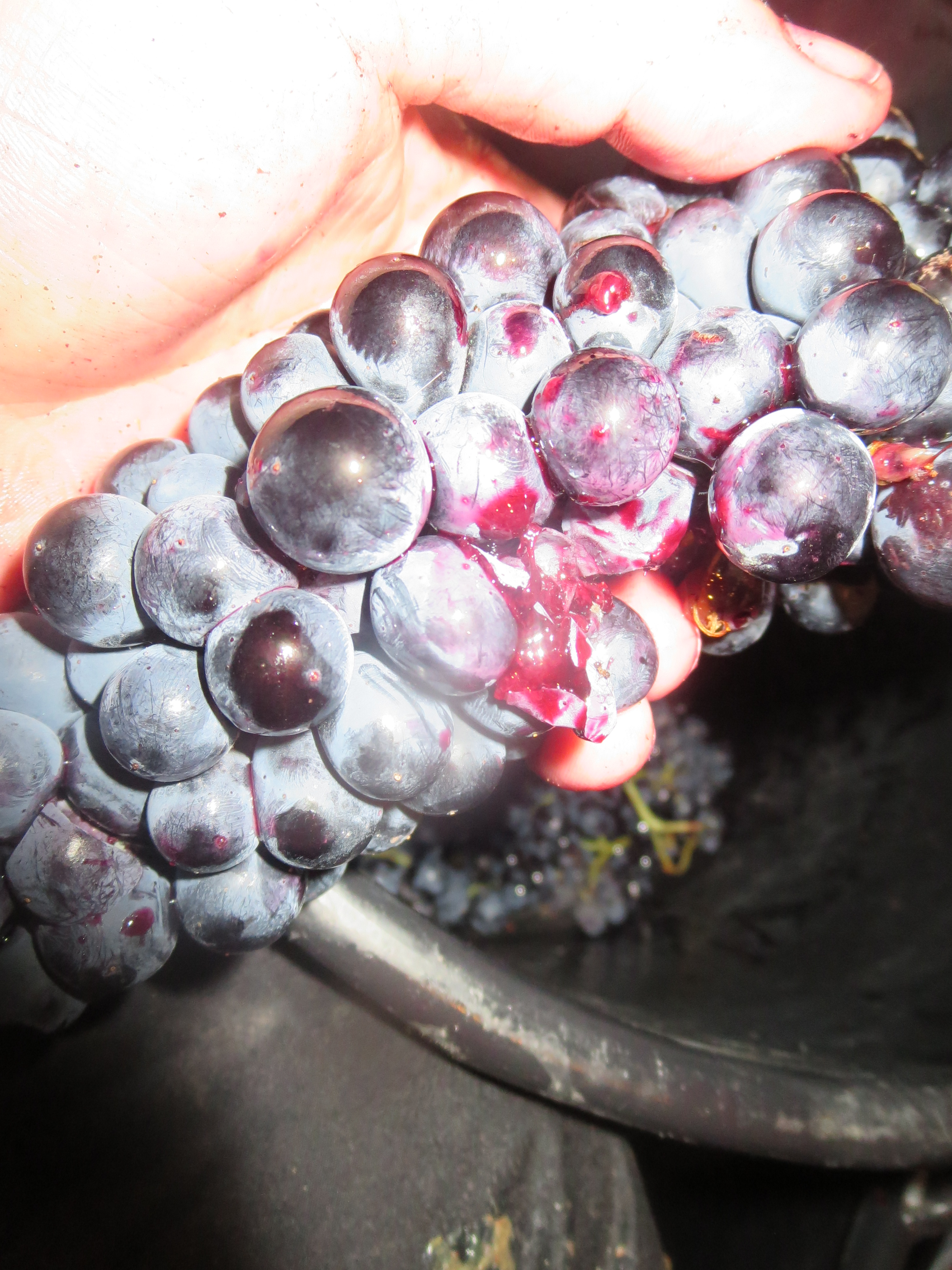
Carbonic maceration means that the whole bunches go into the tanks, grapes and stalks alike. The tank is filled with carbon dioxide which permeates the grape skins and starts the fermentation within the cells of the berry. Some of the berries at the bottom of the tank will be crushed by the weight of the grapes and so there will be some conventional fermentation too.
Whole bunches in the tank
All the grapes are given a light crushing later by which time ethanol will have formed inside the skins and so the resultant juice is ready made wine. The result is often more fruity and juicy wine.
Grapes arrive through the little back door above the cement tanks
To achieve this the tanks are filled from above so we worked in the space above the cement tank with the grapes arriving at the back door which is a level higher than the front door. The space is smaller and the heat from the grapes was high. It was hard work, believe me. Sorting still had to be done before the grapes could go into the tank, quality comes first.
Some of the rejected bits
The pipe carries the CO2 into the tank
And after 9 hours of back breaking lifting, carrying and sifting it was, as ever, time to clean everything from top of the cellar to bottom as we see here with Jeff and Michel.
One visitor from the vineyard
The boss letting us know we should get a move on
The night of the 31st brought a big storm with lots of rain, not the ideal conditions for harvest at all. Rain can cause rot and problems. However, it could have been much worse as news arrived of huge damage caused by hail in the Chablis region. For all the forecasts of how the harvest might turn out it is only when the grapes are safely in the tank that a vigneron can be assured of the quality of wine they might make. Commiserations to the Chablis producers.
September 1st was a quiet day as the rains from the storms meant the grapes were too wet to harvest. In the cellar more checking and remontage, the process of pumping the wine over the cap of skins and must. Further analysis of the wines showed that the yeasts are acting quickly and the fermentation is progressing very well.
Hard work!
Today, September 2nd, the remaining white grapes, Grenache Blanc, from La Garrigue. Then on to Peilhan to gather some of the white grapes there, Maccabeu, Grenache Gris, Carignan blanc and Clairette Musquée.
Grenache Gris
Clairette Musquée
Michel
The core team of Jeff, Carole, Michel, Cameron and myself were joined by Matthieu who has worked the harvest before here. There were some lovely bunches though the wet weather has caused some rot inside some of them, Careful sorting took place in the vineyard to take only the best grapes which tasted really sweet and juicy, the Clairette was especially tasty.
Cameron especially pleased with this bunch of Clairette
The white grapes were taken back to the cellar and placed in tank after being destemmed. It is possible that Jeff will make his first orange wine with them. An orange wine is a white wine made like a red wine, ir the wine is fermented on the skins thus extracting more colour, texture and flavour from them and giving the wine an orange tint. However, analysis and the next few days will be needed before the final decision is made.
In tank and the future might be orange
In the afternoon, Matthieu, Jeff and myself did more remontage of the Syrah grapes harvested in the last week, which is already tasting well, with very healthy technical analysis and beautiful aromas. And, then, as ever, the cleaning.
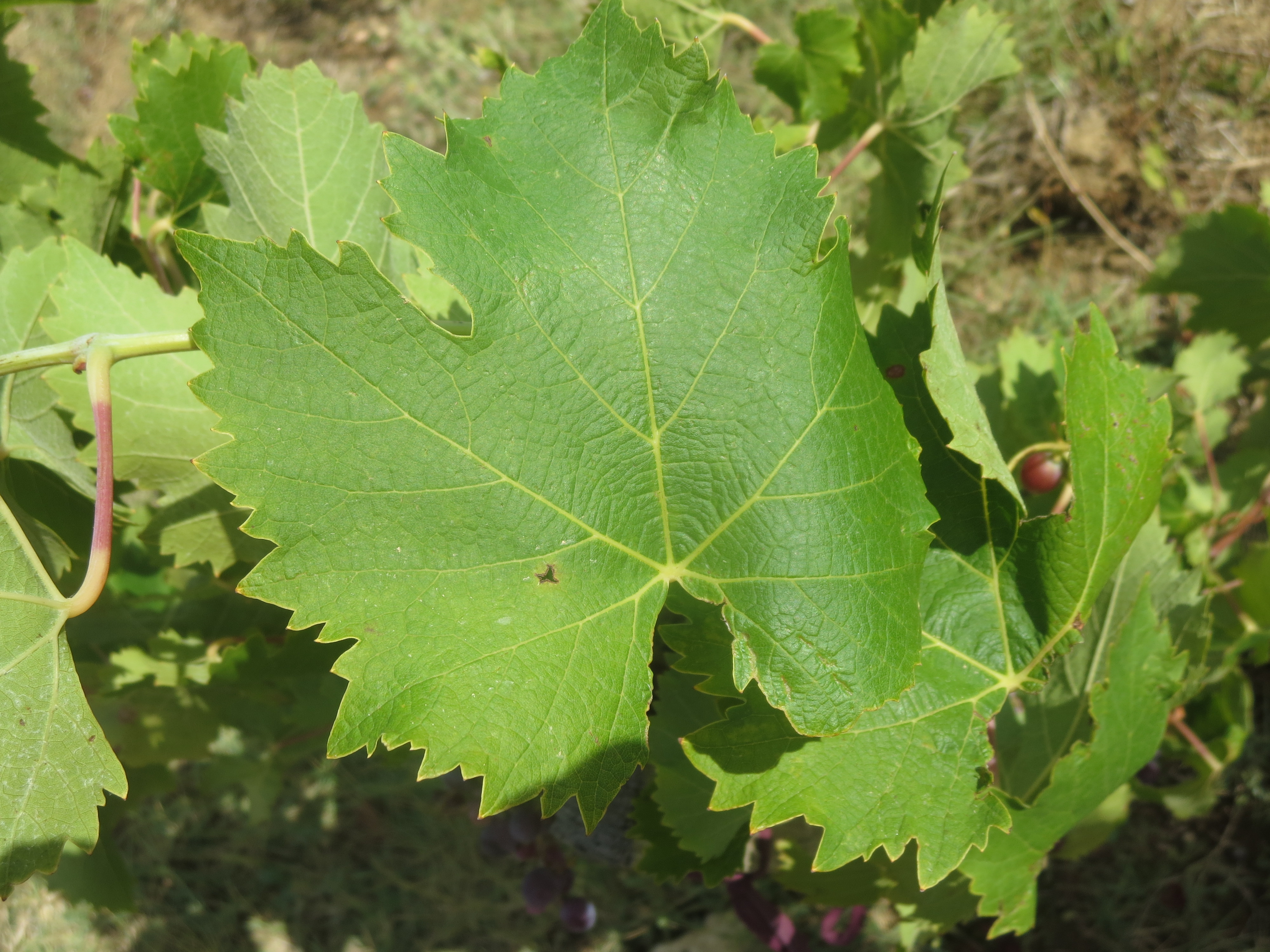
In my last post I described the leaves and some other features of the five main red grape varieties to be found in the Languedoc Roussillon region. This is all part of my attempt to learn how to identify different vines more easily. So what about other varieties which are to be found at Mas Coutelou?
Red grapes
Cabernet Sauvignon
Usually associated with Bordeaux and other regions of France there is Cabernet to be found in the Languedoc. Much was planted in the 1980s and 90s as Cabernet Sauvignon, Merlot and Chardonnay were the big sellers on world markets and vignerons here tried to make money from that market. It is easy to deride this move but vignerons have to make a living and if they can sell grapes then who is to blame them? Besides the domaine which first brought the Languedoc to the world stage, Mas de Daumas Gassac, uses these international varieties as part of their blends. I have to admit that it is not my favourite wine, certainly not the domaine’s red, but it has made an impact.
Anyway, to ampelography. I love Cabernet Sauvignon leaves, they are so easy to identify with their two eyes in the leaf which makes them look like a startled face.
Cabernet Sauvignon in Segrairals
A rich green colour the leaves have more lobes than most and the lower lobes overlap to cover the base of the pétiole sinus (the space where the stalk meets the leaf) giving the mouth like appearance you can see in the photo above. Generous teeth around the lobes are noticeable but it is the two spaces in the leaf which makes this easy for me to recognise. The grapes are small with hard skins and form small clusters too.
Recommended wines
Mas Coutelou – Buvette À Paulette
Others – Casa Pardet, Cabernet Sauvignon (Spain)
Cabernet Sauvignon grapes
Merlot
Poor old Merlot seems to be currently out of fashion. Seemingly everybody’s favourite in the 1990s I regularly hear people now say how it is their least favourite variety, and I confess it is one of my least popular grapes. It is capable of great things on the right bank of Bordeaux and elsewhere but it is little seen here in the Languedoc. Jeff has one parcel, Colombié, entirely planted with Merlot which is mainly used for restaurant blends and bag in box wine.
Merlot in La Colombé
The leaf in the photo shows that these are rich green in colour with 5 or 7 lobes. The sinus around the stalk is open and U shaped with a large white spot where the veins come together just above this sinus. In this photo the veins are quite green as they spread out. Medium sized teeth surround the leaves. Grapes are medium sized and so are the bunches so few clues there.
Mas Coutelou – 7, rue de la Pompe (small amount)
Others – Fons Sanatis, Coudereu
Aramon
This local grape was once widely planted in the Languedoc but was grubbed up in recent years as its reputation spread as wines with little flavour. This was unfair as it was often grown to give big yields and so flavours were diluted but there are many who still scorn it. Nevertheless, with low yields it can make good wines and there is a recent trend to replanting Aramon.
Aramon Noir in Font D’Oulette
The leaves are almost trefoil in character with big veins which stand out against the dark green colour. The teeth are quite large in the lower lobes and taper gently to the top. The pétiolar sinus is big and V shaped. It is the grapes which make Aramon identifiable. They are big in size and form large cylindrical clusters. This reinforces the reputation as a big cropper of light red wines, one of its synonyms is Pisse – Vin which needs no translation. However, this is unfair and Aramon is starting to make some interesting wines again.
Less than 30% of wine produced in Languedoc Roussillon is white, I was actually surprised at how high that figure is. The last few years has seen Picpoul De Pinet become very trendy around the world, reaching prices over £30 in some UK restaurants for wine which costs around 5-6€ around here. Improvements in vinification and the use of temperature controls means that the quality of white wine being made here is improving and there are plenty of excellent examples.
Jeff produces a few cuvées of white wine but many of the white grapes are complanted, mixed together in the vineyard, to add complexity to the blend and an expression of terroir. In terms of identifying these varieties the challenge is, therefore, more complex, as they are mixed up I tend to be too! Therefore, I have only included the main white varieties of the domaine here, there are many, many others!
Muscat
There are actually many different varieties of Muscat just to make identification even more difficult, e.g. Muscat A Petits Grains, Muscat d’Alexandrie and there’s even a Muscat Noir just to completely baffle me. Muscat is usually used to make sweet wines such as Muscat De Rivesaltes, Muscat De Frontignan and Muscat De St. Jean De Minervois. Jeff uses it in dry blends, is considering using it for a pétillant wine this year and also uses it in his sensational solera system to make rich, sweet and dry old Muscats.
Muscat from La Garrigue
Muscat Noir, Font D’Oulette
Muscat has quite dark green leaves and can be in 5 lobes though both the photos above show just 3, almost like a maple leaf. There are some big teeth around the leaf edge. The leaf is also relatively long compared to the width at the base and the sinus around the stalk is V shaped. The other distinctive feature is the crinkly, dimpled appearance between the veins. The grapes are actually fairly medium in size (despite the Petits Grains name) but form small clusters. The grapes are distinctive in colour as they become golden and bronzed in the sunshine with freckles too!
Muscat grapes, admittedly more green than golden. These were picked early for dry wine.
Mas Coutelou – Vieux Muscat blends
Others – Treloar, One Block Muscat; Clos Gravillas, Muscat de St Jean de Minervois
Sauvignon Blanc
Not a variety much found in the Languedoc as it tends to prefer slow ripening and cooler climates. In Mas Coutelou it is used for blending with other white grapes to add a little zest and bite to the mix, picked early to keep that freshness as you can read here.
Sauvignon Blanc, La Garrigue
Quite round in shape with 5 lobes and teeth which are sizeable but more round than angular. The veins stand out as they are not coloured, reaching down to the stalk sinus which is often closed or barely open. One distinguishing feature which is observable in the photo is that the leaf tends to curl a little at the edge, note how one lobe is curling under the other on the right of the photo. Small bunches of oblong but small grapes.
Recommended – Turner Pageot, La Rupture
There are many other white varieties which I could add but these suffice for my needs. Carignan Blanc and Grenache Gris and Blanc are related to their black grape cousins and have similar appearances. Maccabeu, Picpoul etc are for another day but I think that is enough studying for the moment!
Viognier grapes in La Garrigue
There is a very pleasing trend in the Languedoc Roussillon towards replanting old varieties of vines. Terret, Ribeyrenc, Piquepoul Noir, for example were all planted at Mas Coutelou in March. And there remains the very rare Castets, brought in from Chateau Simone in Provence to be only the second vineyard to have this variety.
The famous Castets grapes of Peilhan
So ampelograhy is an ongoing lesson for me, if you want to find out more these websites are worth a visit.
Deborah and Peter Core have been making wine in Caux (34) for 10 years, a cause for celebration. I was truly honoured to be invited to share their celebration evening with a vertical tasting of their Carignan led wines and a dinner held in their cave and garden. Present were luminaries such as Rosemary George, Michel Smith, Andrew Jefford, Catherine Roque of Domaine Clovallon, Gary Voss and Annette Atkins of Voss Estate in Martinborough, New Zealand along with Helen Deneuve who works for Coteaux Du Languedoc and other wine groups and is a good friend of Deborah’s, as well as Wendy Gedney, owner of Vins en Vacances, a wine tours company, Christopher Gallaway, wine expert and Bernard Degioanni, wine and food journalist, so it was a true privilege to be amongst their company.
l-r Christopher, Gary, Annette and Wendy
Michel, Andrew and Rosemary at work whilst Peter pours
l – r: Bernard (just), Peter, Catherine and Helen
Mas Gabriel has long been one of my top Languedoc wine domaines and I have purchasing from there over many vintages. I have huge respect for the Cores who gave up successful careers in London in law and finance to follow their dream of making wine. Having trained and studied in New Zealand and France, they decided on the Languedoc as the region which would offer them what they were seeking in making their wines. Land was bought around Caux and the work began. What courage to embark on such a venture and the going must have been immensely difficult at times in the ten years which have followed. Learning about your vineyards, making wine in different vintages, mastering the bureaucracy in a second language and, not least, finding markets. That they remain so passionate about their land and wines whilst being the most courteous and charming people is testament to two people of strength, determination and talent. Their wines are produced organically, indeed biodynamically, and are marked by freshness and fruit.
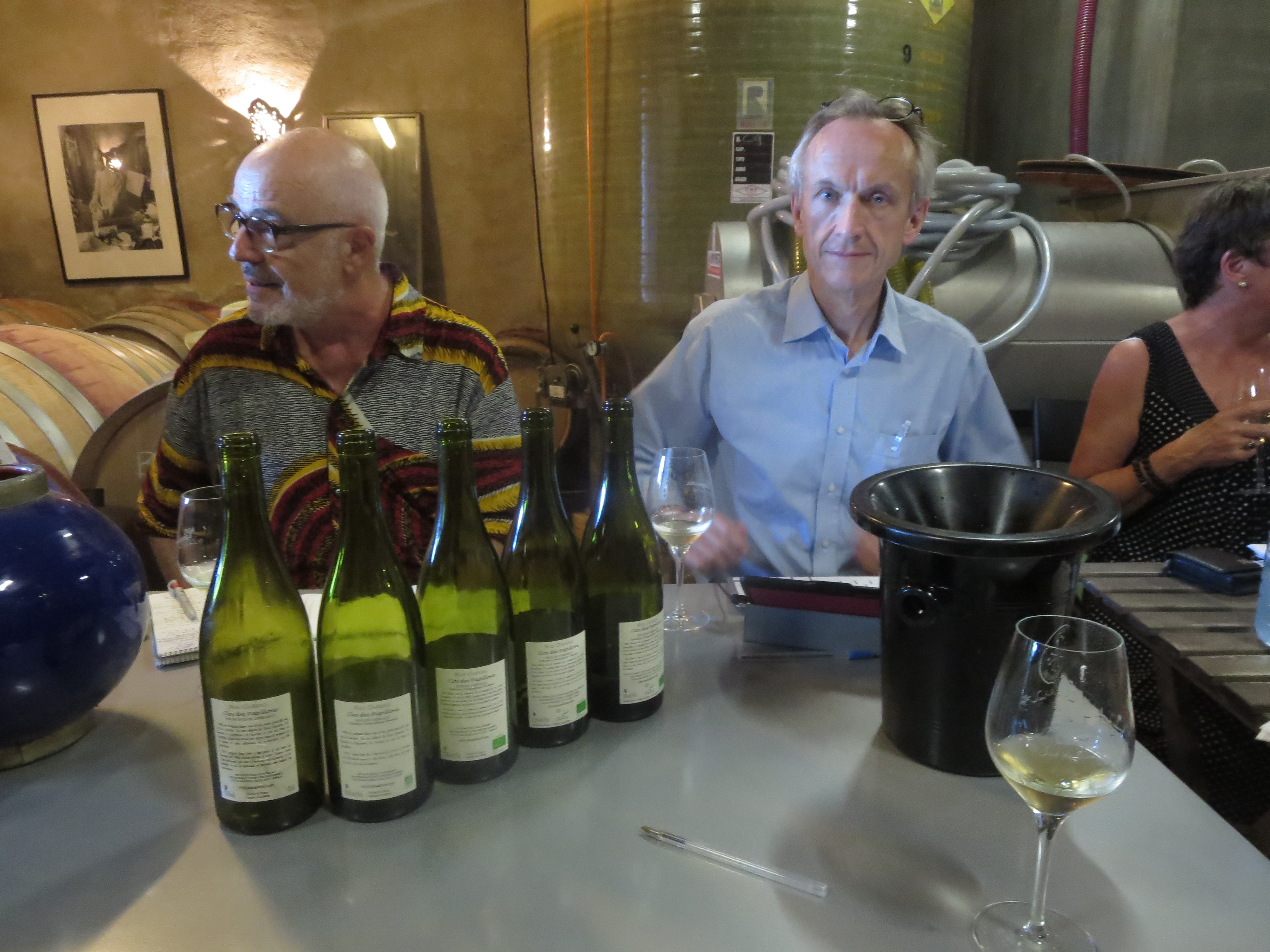
We gathered in the cave for the tasting and began with a flight of 5 vintages of Clos Des Papillons, the white wine of the domaine (though joined by a new white cuvée in 2014, Champ Des Bleuets). Papillons has long been one my favourite white wines of the region so this was a special treat for me.
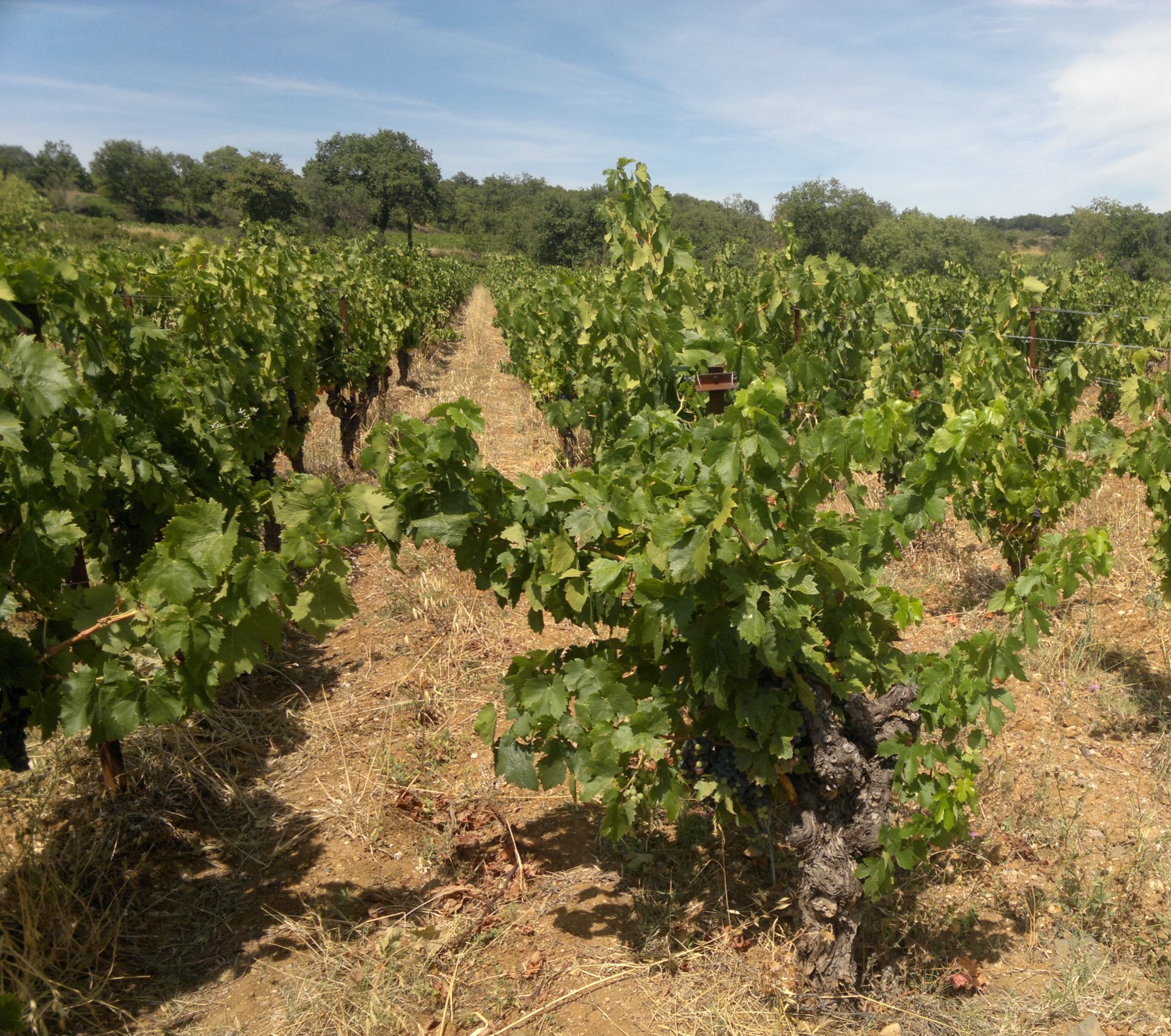
Until 2014 the Carignan was given a small 5% addition of Viognier but in 2014 the Cores changed this to 15% Vermentino. Around a third of the Carignan Blanc is aged in acacia barrels to add a little complexity without oak flavours. There is no malolactic fermentation as they seek to reflect the freshness and natural acidity of Carignan Blanc. When the wine was first made yields were tiny at 12 hl/ha but much work and even more cow manure has helped to boost yields to 20-25 hl/ha. There are only around 0,4ha of the vines (more have been planted) and this is a variety with only about 40ha in the Languedoc so Mas Gabriel has around 1% of them all. Peter and Deborah actively sought out the parcel after tasting the Carignan Blanc of neighbour Conte De Floris, who does make excellent wines also. The parcel they found is made up of 40 year old vines in gobelet on a sandy, limestone soil.
So, the wines:
2014 – The first Clos Des Papillons with 15% Vermentino, which is grown in soil with galets, large round flat stones. The wine is very young still and a fresh, lively aroma is matched by a dry, very mineral initial taste. Fresh, fleshy fruits then fill the mouth to round out the dry core of the Carignan, like a peach with the fruit around the stony centre. The Vermentino certainly appears to provide that fruity roundness though the Carignan was slightly less acidic than usual in 2014 too. The wine comes together to form a lovely, refreshing, clean taste. It is very young, it will fill out further and I really like it.
2013 – A big rush of freshness leaps from the glass. Green and yet apricotty. It settles down quickly and lovely fruity, dry aromas emerge. The harvest was quite late in 2013, September 16th, so the nights were fresher as the grapes reached the optimum ripeness, and this is reflected in the fruit itself. Huge flavours of yellow and white fruits mixed with fresh acidity – always in balance, always with a delicious tension. Lovely, a very good wine.
2012 – Yellow, almost light golden in colour. I could detect a little more evidence of wood on the nose but nothing out of balance and it provided yet more complexity, there was no obvious taste of wood. The acidity appeared less obvious, though it was actually a lower pH than usual, the result of an extra year in bottle? Juicy, yellow fruits, with an edge of citrus and agrume. Stony, clean and delicious. I smiled in relief that I have resisted temptation and kept a bottle or two of this vintage, excellent.
2011 – Woh, what a nose, almost ‘Riesling’ in character with hints of kerosene. Happily, Wendy Gedney agreed with me, it’s not just me! Full flavours, lingering lime and lemon fruit flavours add that delicious freshness, definitely more so than 2012. Long, refreshing, balanced, poised! This was the earliest picked vintage (August 24th). It has years of life ahead if anyone still has a bottle (sadly, not me). I loved this.
2010 – Lively, this is certainly not on a downward slope, far from it. Still a yellow/green Starburst citrus edge. the highest acidity of any of the Carignan vintages yet the wine has rounded out a little. There is a saline, mineral edge in there too but then as you drink (and I did drink some!) an almost waxy, oily finish which helps to coat the mouth with the yellow and white fruit flavours. Lingering, clean and lovely.
Clos Des Papillons ages well, no question about it. The freshness and acidity surely help this and whilst difficult to resist drinking in a year or two I am now determined to hold back some bottles. Interestingly, Andrew Jefford was slightly less in agreement with most and would welcome some malolactic fermentation to round out the flavours more. For me, I love it as it is. To choose one vintage? I really like them all, there is nothing here to which I would not give at least 4/5 on my personal scale. 2011 perhaps but maybe 2013 just wins with the freshness, sorry Andrew.
In the Trois Terrasses vines with Peter in 2012
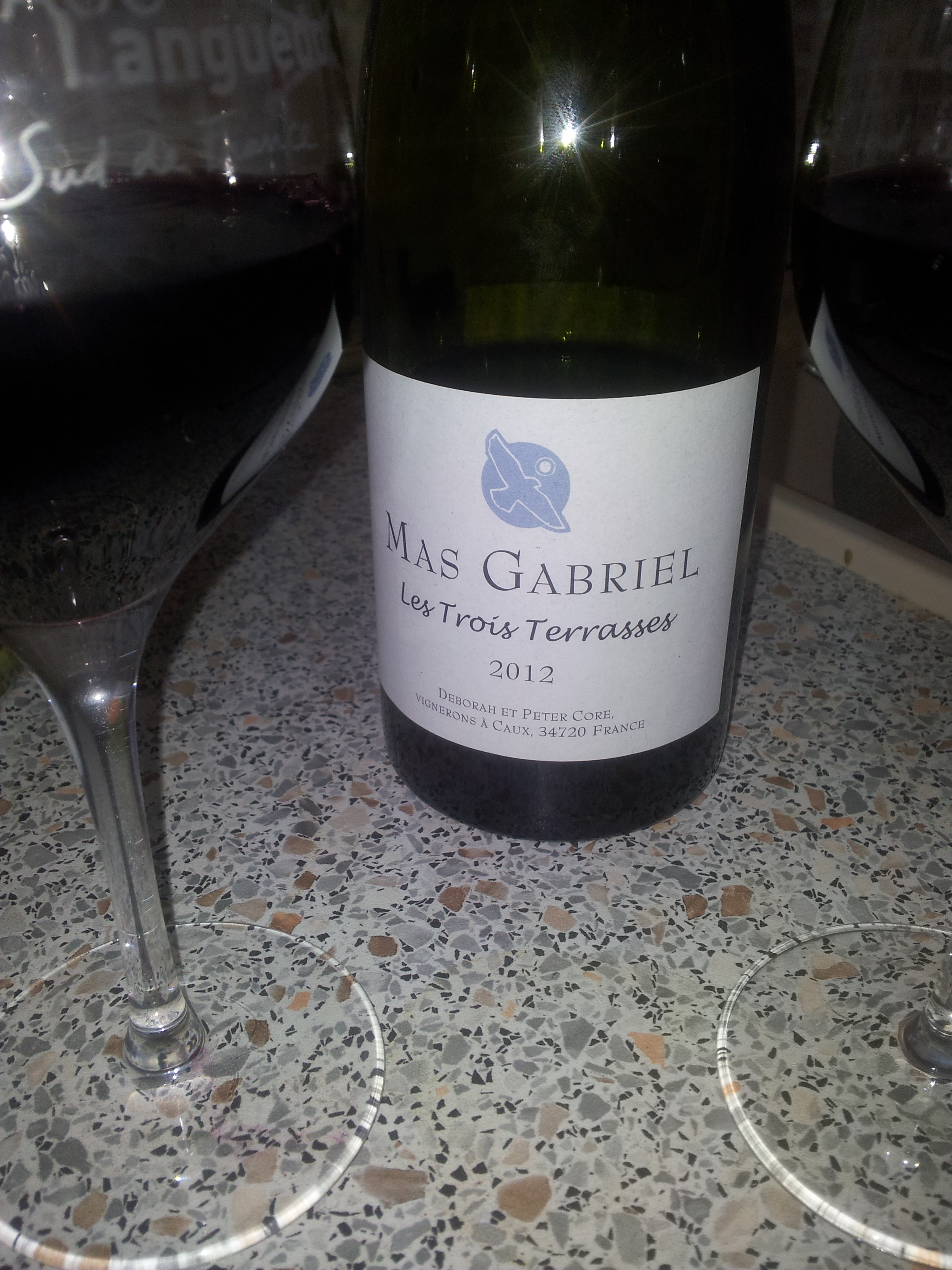
So to Trois Terrasses, the first of two red wines made at the domaine, the other being Clos Des Lièvres, a Syrah led wine which is bigger and more powerful, and also excellent I hasten to add (deserved Gold Medal winner at Millésime Bio this year). The first two vintages in 2008 and 2009 were 100% Carignan but in 2010 came a change with 20% Syrah and afterwards up to 30% of the wine is Syrah and Grenache. These are vinified separately in cuves, the Carignan cuve being cement the others fibreglass. Peter explained that yields of the Carignan were only 10 hl/ha at first but they have built this up, with more hard work and cow manure, to 25 to 30 hl/ha on average. This is reflected in gradually lowered alcohol levels in the Carignan with slightly higher acidity.
2013 – Slightly reductive at first but that blew away within a few seconds to leave a torrefacted nose with plummy, dark fruits which carried over into the flavours along with those coffee notes. There was an almost citrus freshness on the finish refreshing the palate. Spicy, peppery notes developed too and though this needs a little time yet, it is already good and will grow into something very good in a couple of years.
2012 – Rounder, darker, deeper. Complex nose of dark fruit with freshness evident even on the nose. Full in the mouth, rounding out with lots of fruit and minerality and always the trademark freshness which I love so much in Mas Gabriel wines. It is a characteristic which reminds me so much of biodynamic and organic wines, dare I say natural wines too! It certainly appeals to me.Still youthful, this is a wine which has been a big hit with friends and family when I have shared a bottle with them. Very good.
Here’s one I shared earlier
2011 – Rounder aromas, hints of cassis. Perfumed and fruity, very heady in a pleasing manner. It tastes round and full too, ripe plums and a raspberry fresh note. Liquorice with pepper sprinkling the range of flavours too. As the wine evolved in the glass there were even smoky notes emerging. Very complex, but all working well together, always lovely to drink and, yes, that fresh finish. Very good.
2010 – The year in which Syrah was first added to the Carignan. Fruit aromas spring out from the glass, cassis, blackberry and red fruits too, lively acidity. Ironically, given the blending, Carignan characters emerge, a slightly leathery, wild edge to add to the complexity. Plummy but not too fruity. No sign of being old, still very much a wine reaching its peak with a long time to enjoy it. Harmony despite all the complexity, balance and freshness, of course. Very good.
2009 – 100% Carignan. Almost restrained on the nose, the wine colour is garnet and fresh, no signs of starting to age. A wine reaching its prime but still plenty of life ahead. Pure, direct, lovely fruit with some dusty, round tannins. The acidity is still fresh but beautifully balanced with fruit profiles such as raspberry, cassis, blackberry, plums – round, ripe and delicious. Deep, complex, full. Superb. There was a noticeable lull in conversation as we tasted this wine, it stopped us in our tracks and we had to simply stop and admire, hallmark of very, very good wine.
2008 – The first ever Trois Terrasses, pure Carignan. I detected a little more alcohol on the nose but nothing off putting. Soft, easy to drink with black fruits and a little gaminess, tannins still present but soft and supportive to the wine. Very much alive and kicking, it will continue to grow. I liked it, a lot, though perhaps overshadowed by the previous glass of 2009.
My favourite, most peoples’ favourite, was the 2009. Joyful wine, the sort of glass which makes you realise why you find wine so fascinating and rewarding. Of the blends, I particularly like the 2010 and the 2012 but I am happy to have some bottles of all of them left.
At dinner in the garden with a refreshing breeze
An interesting discussion followed as we compared favourites. Andrew Jefford had chosen the 08 and 09 and suggested a return to pure Carignan. Much thought for Peter and Deborah but they must have been delighted at how well the wines all performed, worthy of anyone’s cellar, certainly in the top rank of the Languedoc. I was so pleased for them, they deserve every little bit of credit and praise. I gather the thought of a pure Carignan was already in their heads, maybe this evening will influence them.
And so to dinner, made by Deborah and her friend Helen Deneuve. They even provided me with a superb vegetarian main course which was one of the best I have eaten in a long time. To accompany dinner the Cores served their Carignan rosé, Fleurs Sauvages, so popular that it disappears very rapidly out of the cellar every year, and justifiably. Various bottles of Clos Des Papillons and Trois Terrasses also appeared on the table to be drunk not just tasted. A fitting end to a fantastic evening. The conversation flowed, Michel entertained us royally (am I allowed to use that adjective for a Frenchman?) and then provided a beautiful Banyuls Mas Blanc 2003 to accompany a delicious chocolate gâteau.
Deborah, Michel and a photo of Rosemary taking a photo
Thank you so much for the invitation Deborah and Peter, it was such a privilege to be present. There was talk of reassembling in another 5 years for ten vintages and that would be a dream. So raise your glass to Mas Gabriel, and make sure it is filled with one of their wines, you deserve nothing but the best, and so do they.
Since moving down to Margon it has been evident to me that many of my favourite bottles have been based around Carignan. A variety which received so much scorn for many years is now fighting back. The excellent wine writer Michel Smith has been in the vanguard by writing a series of articles called Carignan Story on the les5duvin blog, championing the variety and the people who produce great bottles of it. Moreover he is producing some himself in the Roussillon. (The blog is a must follow incidentally).
I shall start with Mas Coutelou this time as Flambadou is the star of the 2013 vintage at the domaine and is a wine which ages brilliantly as a memorable 2007 testified during a vendange lunchtime. If you opened the link to Michel’s Carignan Story you will have already seen his support for this wine too.
Jeff himself rates Cyril Fahl’s Clos du Rouge Gorge as one of the outstanding Carignan wines and based on my tasting in November (see Day 5) I would not argue. Domaine d’Aupilhac in Montperoux is another which has championed Carignan, blended in some cuvées or on its own in Le Cargnan which is a lovely wine showing the leathery, dark fruit flavours of the grape.
I must mention the wine ‘Les vignes qu’on abat’ of Domaine La Marféeproduced in Murviel lès Montpellier, a deep, dark joyful wine which needs a little patience in cellaring.
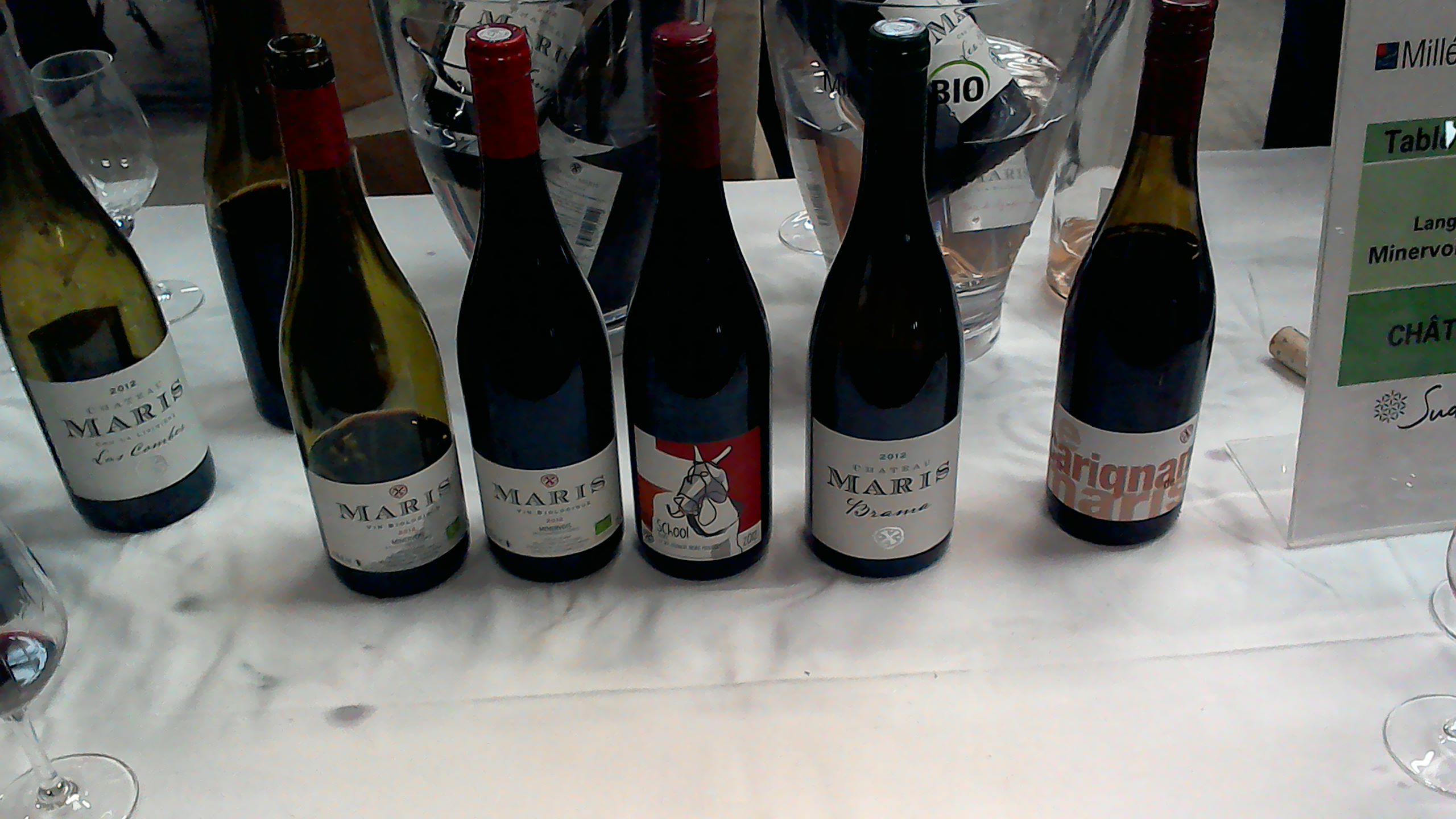
Other lovely Carignan bottles tasted include Cébene‘s Belle Lurette and Treloar‘s Le Maudit, plus the cuvées Les Premiers Pas and Fontanilles from Les 2 Anes. Domaine Sainte Croix (see Corbieres, Day 3) produces a couple of Carignan – led wines Magneric and Le Carignan, both express the wild garrigue of the Corbieres hillsides, lovely wines. In the Minervois, Chateau Maris also produces lovely Carignans such as Anciens and (again) Le Carignan.
Finally, I should mention a domaine close to me in Gabian, Cadablès run by Bernard Isarn is starting to produce some really good wines not least the Carignan led Champ de Pierres.
These are all wines I would heartily recommend, but that’s not the end of the story.
Carignan Blanc is fairly unsual in the region but two of my favourite white wines come from this grape and both from Caux where we started. Mas Gabriel‘s Clos Des Papillons is dry, fruity and clean, with a rich texture that fills the mouth, simply delicious. Le Conte De Floris produces Lune Blanche which is just as good and I was happy to find some bottles in the wine bar in Pézenas recently. So Carignan, red and white, is a variety to investigate. Dare I mention that Jeff produces another very good example of Carignan Blanc? Well I did leave him out of my 7Cs so I think it’s only fair.
So those are my 7Cs, villages, areas and grapes which are all a source of great wine pleasure. I could have added more with St Chinian as just one example. Proof that Languedoc Roussillon is a region of great variety, a region of great excitement as winemakers rediscover and redevelop the character of wine in this fabulous part of France. Any feedback is always welcome.
Friday March 6th brought a hot sunny afternoon and the birth of a new vineyard at Mas Coutelou. Well, a new section of vineyard at least. Peilhan is the most southerly of Jeff’s parcels and already contains a variety of grape varieties ranging from Carignan planted in 1992 to fairly new white grapevines such as Maccabeu, Grenache Gris, and Carignan Blanc. However, also planted are some rarer old varities such as Clairette Muquée and the Castets which I have so praised before.
Peilhan
If you look in the photo towards the top you will see a sloping area of land just beyond the planted vines and it was this section which, after lying fallow for many years, was to be planted. I have highlighted it below.
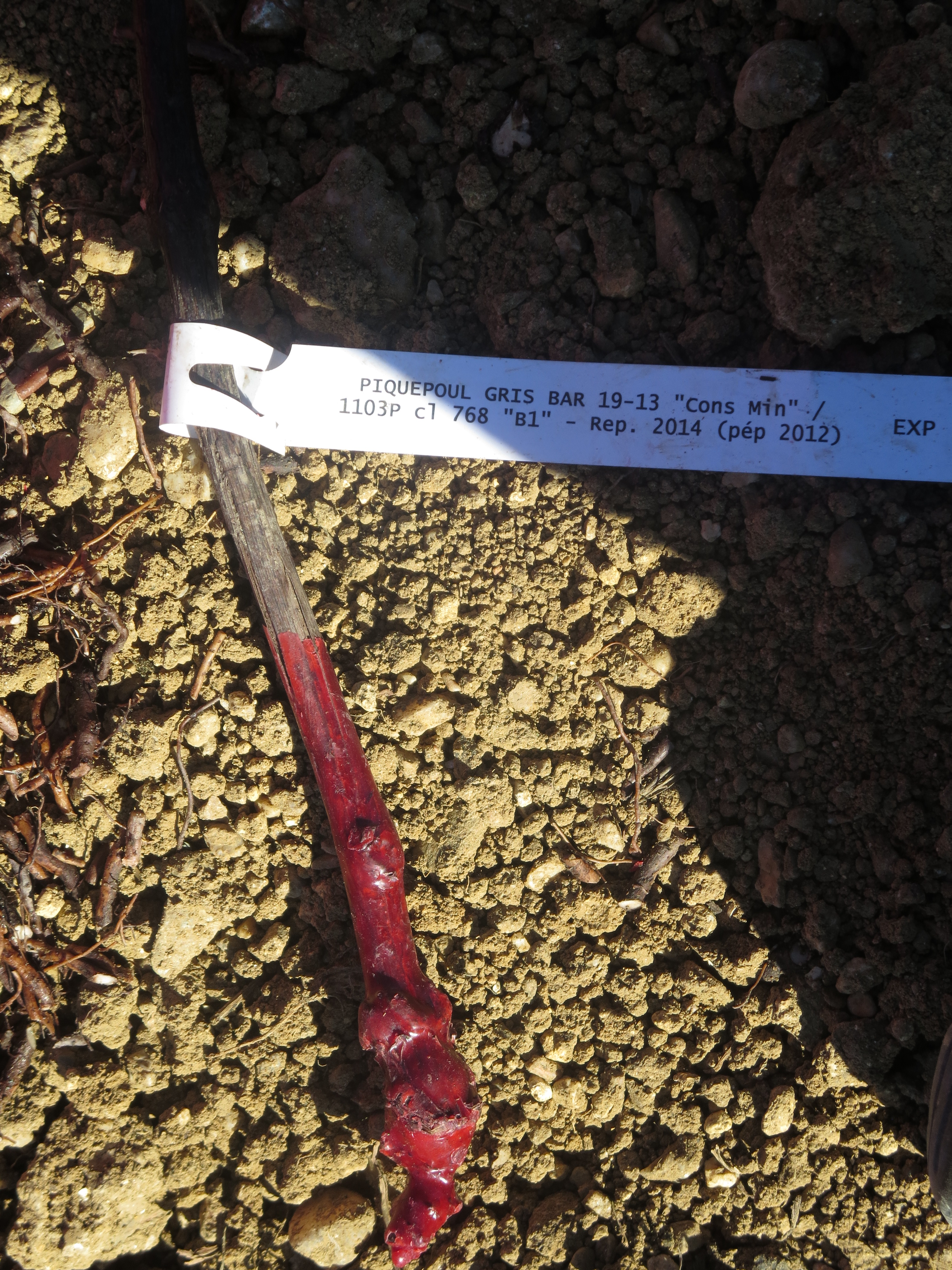
Being Jeff Coutelou though this would not be a simple planting of Grenache, Syrah or Mourvedre but instead he wants to increase the diversity of vines in the vineyard and contribute to the movement of restoring old Languedoc vines to a prominent role in the region. So 24 rows of vines would be planted, almost 2,500 plants of 6 cépages ;
Terret Blanc 1 row
Piquepoul Gris 6 rows
Riveyrenc Gris 2 rows
Riveyrenc Noir 6 rows
Terret Noir 3 rows
Morastel 6 rows
They would be planted as a mix to help resist disease as well as diversity.
Piquepoul Gris vine
The plants are laid out ready, roots in water. Renaud, Michel, Carole and Jeff lead the way. Jeff, as usual, is on the phone as someone wants some wine!
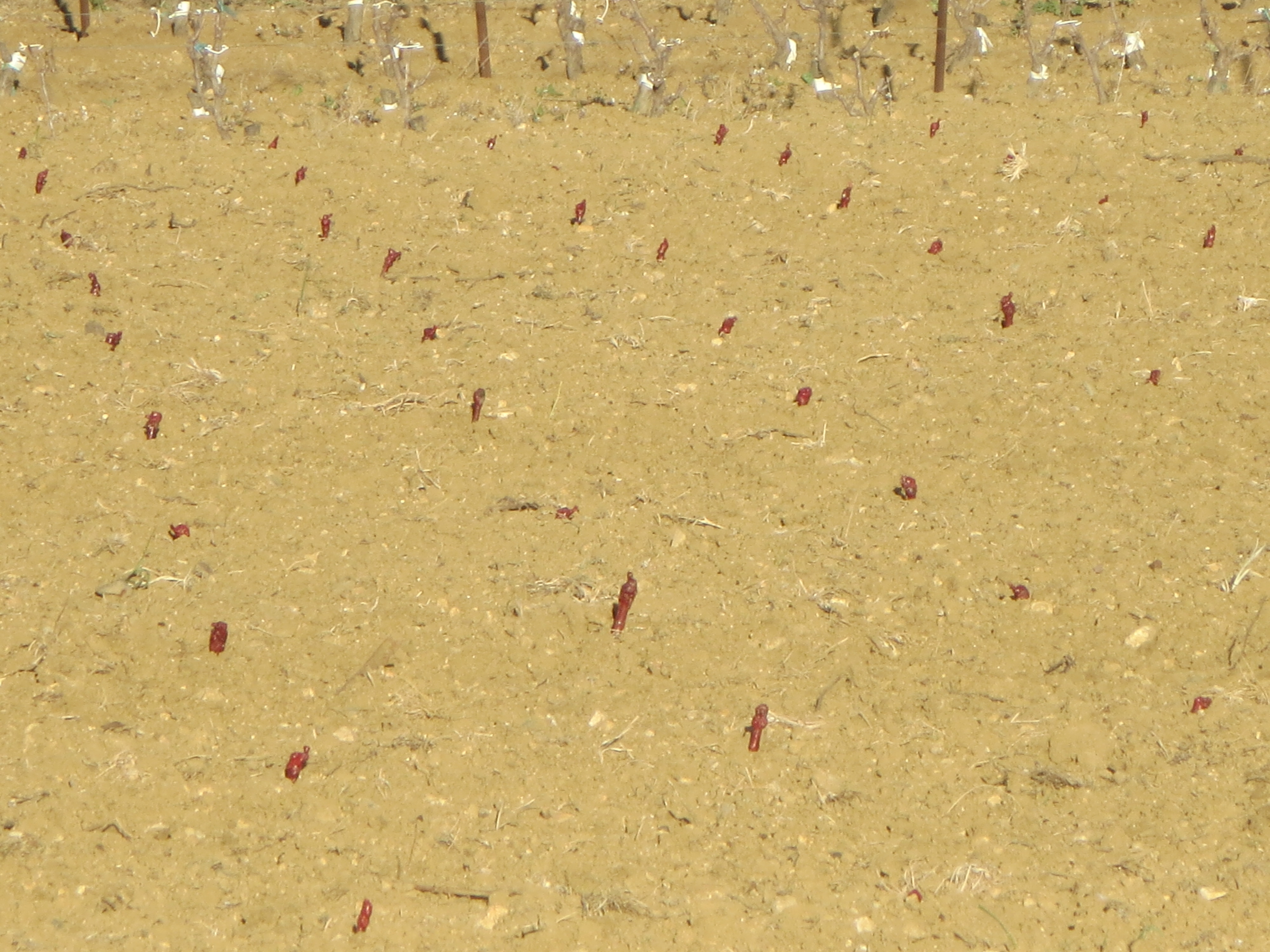
The vines came from a trusted supplier in Carcassonne and resembled large matchsticks. The vine foot is an American rootstock, the only ones capable of resisting the phylloxera beetle which almost wiped out French vineyards in the 19thC. The plant is grafted onto this root stock and then covered with the red wax to protect the grafting stopping air getting between the plant and the root stock. The wax will fall away naturally in the next few days. As you can see they arrived with long roots and we had to cut these down to make them easier to plant.
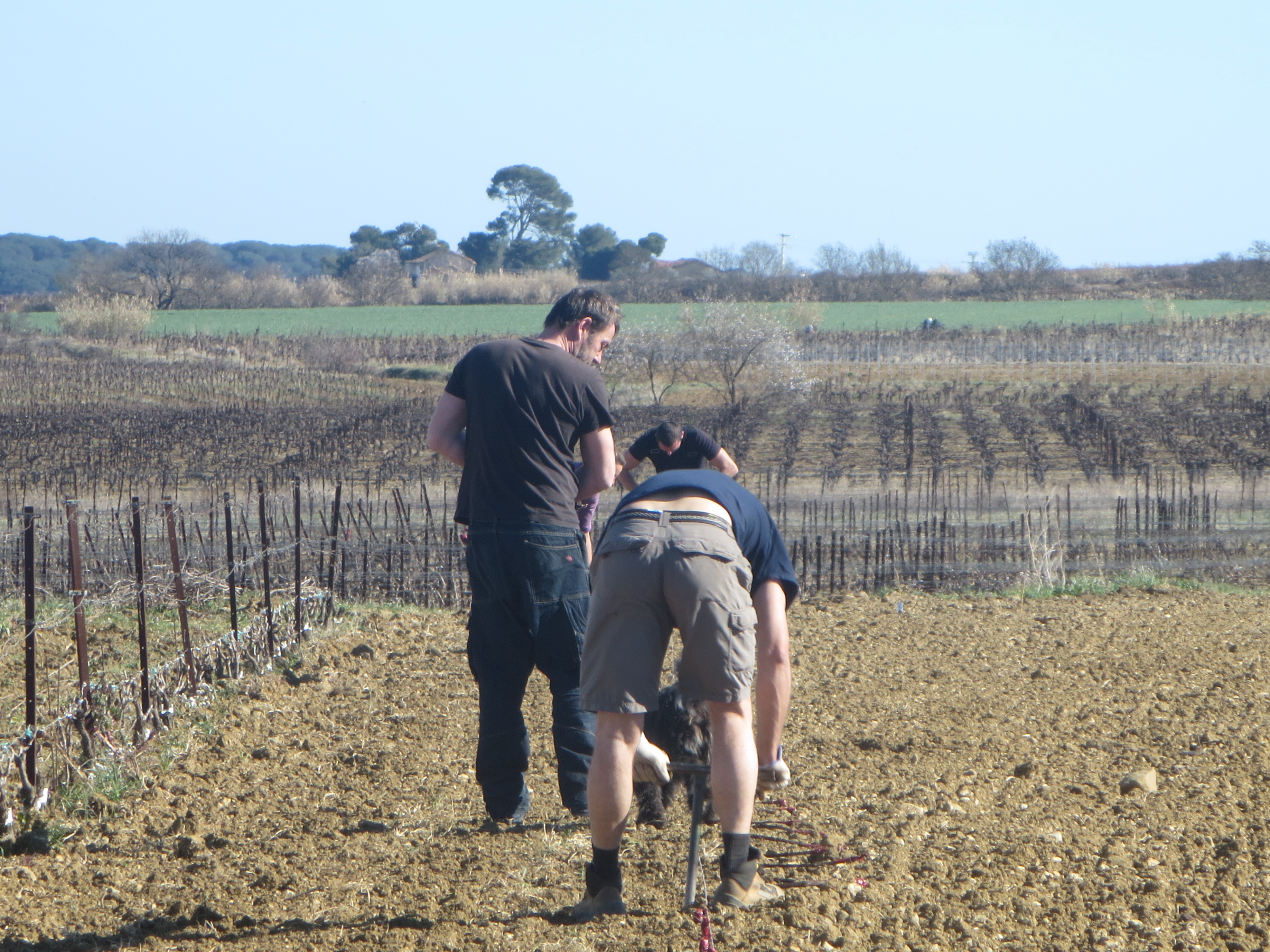
Jeff had hired two expert plantsmen to lead the way, the two to the right in the photo above. They demonstrated how short the roots should be and left Renaud, Michel and myself to carry on whilst Jeff and Carole (in the photo) went to help the planting.
The field was marked out to show where the vines would be planted. Each variety was to be planted at different intervals according to its specific needs, some need wider planting such as the Piquepoul Gris, others should be planted more densely such as the Terret Noir. The spaced to the right of the rope will be planted with hedges, including rose trees. These will provide shelter for birds and bats, natural predators of damaging insects and vers de grappe (worms) as well as providing a natural boundary to the parcel.
Wire cables ran along where each row was to be planted, in the photo you will see a blue mark where the vine was to be planted. The two experts did the planting with Jeff and Carole (later Michel) dropping the vine for them to plant.
This video shows just how fast they work, on a hot day it very impressive. There was a welcome beer break (with English beers from County Durham no less!) but the work continued solidly for 4 hours.
New vineyard takes shape
Icare supervised, of course
The new plants need water of course so Jeff and Carole set to work. 1500 litres were used for 2 rows of vines!
Jeff asked me at the end of the day what my thoughts were about the planting, how I felt about it. I had to think about it for a while. It had seemed like hard work but it was with a real sense of being present at a new beginning. The vines have a 99%+ survival rate and they will in a few years be producing white and red wine of great quality. And I was there for the birth of this project, a privilege. It was impossible not to feel excitement about what was to come and to wonder at how these small sticks would become beautiful vines. And to feel proud that Jeff is willing to plant something which reaches back into the past as well as providing for the future. Let’s hope we are here to enjoy the wine in a few years.
As if to crown my day of feeling close to nature I was able to take these photos of bees on the rocket flowers in the main parcel at Peilhan. This is one corner of the Languedoc where nature still rules, with a little help.
When Jeff suggested that I should attend Latour De France I was rather surprised as I was unaware of his love of cycling. A quick correction of gender and I was patiently told that it was a village in the Pyrenées Orientales where 12 of 13 winemakers are organic producers and several make natural wines. An opportunity not to be missed. Combined with visits to one of my favourite French villages, Banyuls, and also to Collioure this made for a great weekend.
Saturday by the coast proved to be a lovely, sunny day – unbelievably warm for November.
Vineyards in Banyuls stretching down to the Mediterranean Sea
Collioure
Sunday was cooler and grey but a great day for wine tasting. We arrived before the start of the event and the car park was already pretty full. Despite this the crowds were never too large and there was every opportunity to get round the various caves without much hassle. Each of the village organic producers had their cellar open and each also contained invitees from Roussillon but also from Fitou and Burgundy. This spread out the crowds as we walked through the streets between caves. In addition to the wines there were street entertainers and various food outlets including, to my delight, a vegetarian outlet. So, all in all, a very well organised event catering for everyone (sorry about the pun).
I am not a professional wine journalist and I am not great at writing tasting notes so I won’t! Instead I offer overall impressions and suggest some of my favourites from the 120 or so wines which I tasted (it was hard but someone has to do it on your behalf dear reader).
What struck me most was how much I enjoyed the white wines, I had expected the reds to be the outstanding wines, and some were, but the whites were much more consistent and interesting overall. One Carignan Blanc stood out (Clos Du Rouge Gorge, Cyril Fahl of whom more later) but what emerged was the splendour of Grenache Gris. Often combined with Maccabeu it was Grenache Gris which provided a series of fresh, deep, long lasting and flavourful wines with hints of minerality, sweetness and fruits of all kinds depending on the producer. Excellent examples from Padié (very expensive though), Calimas, Tribouley, Rivaton and Deux Chateau. There was also a very nice Maccabeu based white from Troullier. I would happily seek out and drink any of these and would advise anyone to do so.
There were also a few strange white wines ranging from cloudy and sulphury to the downright sharp and tooth decaying.
Talking with Nikolaus Bantlin of Les Enfants Sauvages
There were some excellent red wines on offer.
Cyril Fahl (Clos Du Rouge Gorge) produces a high class range of (quite expensive) wines based mainly on Carignan and Grenache. Tasting Cyril’s wines proved that his reputation and garnered praise were well merited, his Carignan based wines were delicious, nothing more to add to that. Top winemaker.
As with Grenache Gris in the white wines there was an outstanding red grape which stood out in many of the top wines and it was, as with Cyril, the Carignan. Time and again the wines with fruit, flavour and long finish were based around Carignan or had a large proportion of it in the assemblage. Not long ago Carignan was being grubbed up around the region and dismissed as a variety of little potential. La Bande de Latour showed how nonsensical that was. Carignan is a great and noble variety, again seek it out from good producers.
Other favourite reds which I tasted came from Domaine du Possible (C’est Pas La Mer A Boire), Opi D’Aqui (from Clermont L’Hérault) and Maramuta.
The problem with a number of red wines, in my view, was the use of oak. This may be a personal thing as I really do not like obvious oaky flavours. It can add complexity and structure to wines when used carefully but a lot of winemakers seem to rush to use barrels so that they can be seen as ‘serious’ winemakers. And add many euros to the price of their ‘special’ cuvées. Sadly I felt a number of wines were spoiled by injudicious use of oak. The wines appeared thin and dry with their fruit stripped out.
I would like to mention 3 other winemakers whose bottles I enjoyed.
Les Enfants Sauvages is the wine domaine of Nikolaus and Carolin Bantlin, a German couple based in Fitou. I enjoyed talking to Nikolaus and warmed to his passion for his wines and I could understand that passion when I tasted them. I liked all of the wines, white and red, but especially Roi Des Lézards, which is, you guessed it, 100% Carignan. I would definitely like to visit the Domaine in future.
The range of Les Enfants Sauvages
Domaine De La Chappe is a Burgundy domaine run by Vincent Thomas a young winemaker who has built on the work of his father and used natural methods as well as biodynamic practices. He is based in Tonnerre and offered Bourgogne Pinot Noir and Petit Chablis amongst other wines. The prices were very reasonable for Burgundy, around the 10-12€ mark. The wines were far more rewarding than many Burgundies I have tasted at much higher prices. I would love to try these wines again when I have more time to devote to them. You can read more about Vincent from an article on the very good louisdressner website.
Listening to Vincent Thomas of Domaine De La Chappe
Saskia van der Horst runs Les Arabesques in Montner not far from Latour. She was a sommelier in London at Gordon Ramsay’s restaurant at Claridge’s and also ran a wine bar there. She returned to France to make wine rather than just sell it and drink it. These were amongst my favourite wines of the day, all 3 were rich, full and refreshing. What amazed me was that these were Saskia’s first wines, the 2013 vintage was her first. Saskia can certainly be proud as her wines were as high in quality as most of those I tasted at Latour.
It was a great day. I liked the way the event was run, I loved the focus of organic and natural wines and the enthusiasm of the winemakers for their work and their wines. I tasted some excellent wines and discovered plenty of new winemakers whose work I look forward to sampling in future.
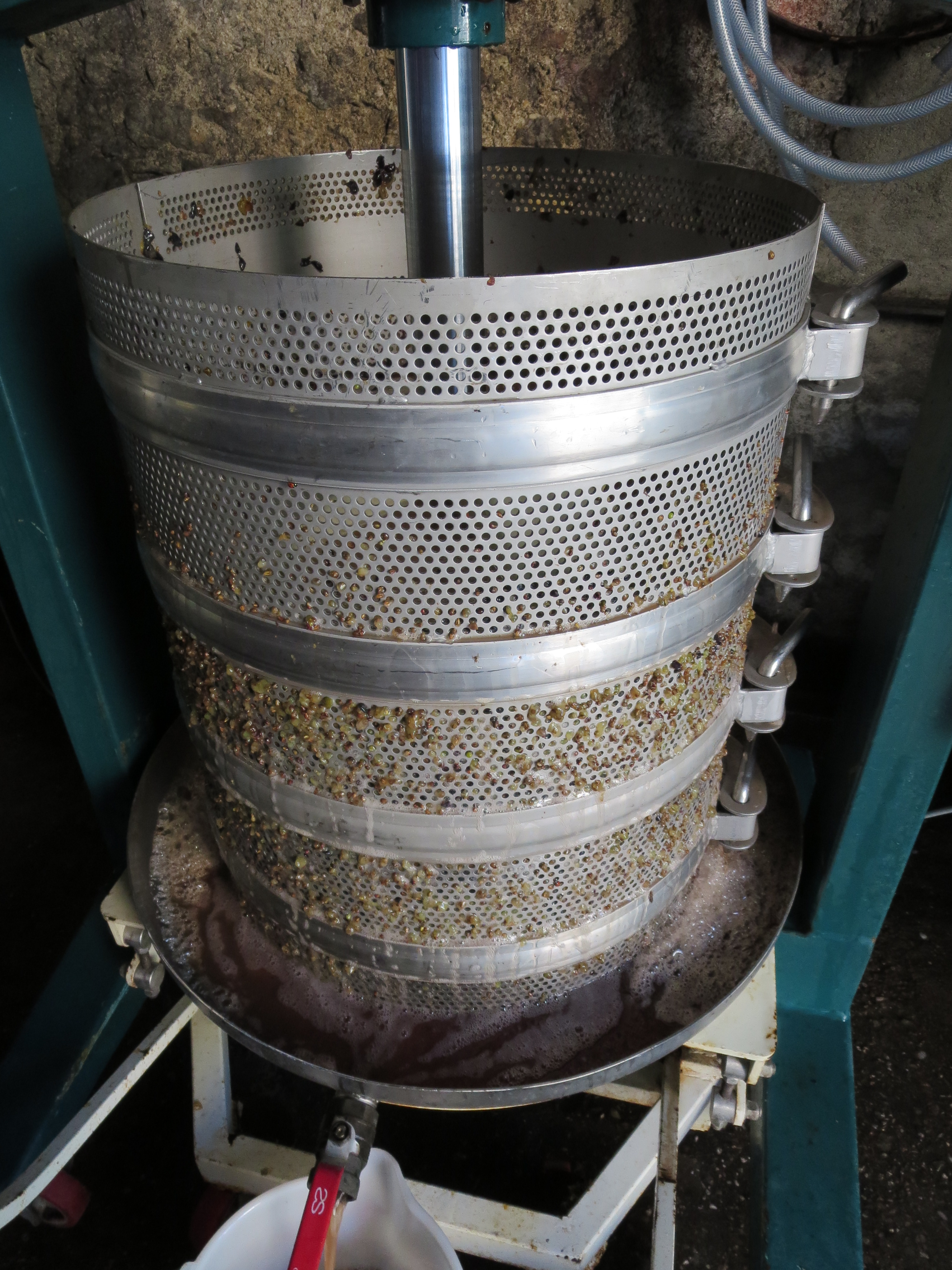
Both of these objects are wine presses, one more modern than the other. Whilst the large press has taken the bulk of the work in recent weeks the small press has its role too. It is also an olive press incidentally. It is used mainly for small production wines and I was lucky enough to be trusted to supervise its use for the pressing of muscat and grenache grapes which will make into the fortified wines which Jeff Coutelou produces in addition to his table wines. The ‘vieux grenache’ wines are made in different methods as I shall describe in future posts including a fantastic solera type system with wines dating back many, many years to previous generations of the Coutelou family. They are, of course, delicious.
Michel unloads the grapes, he is in Jeff’s words his ‘main gauche’ (left hand)
Grenache and muscat grapes ready for pressing
The grapes are sorted and then loaded into the cage and wheeled into place. The press is lowered and the juice begins to flow.
Pressing
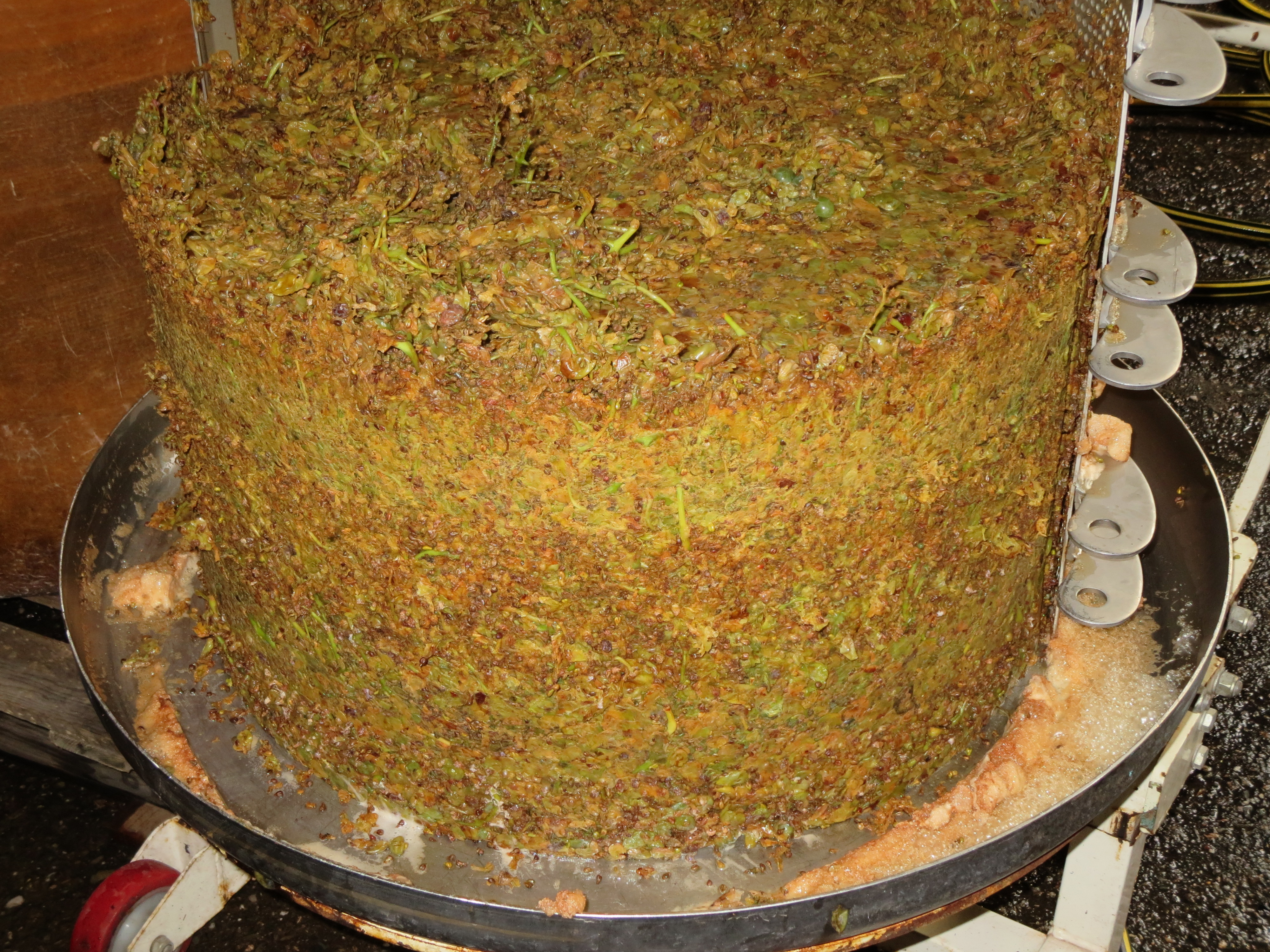
The major lesson is to be careful about how much pressure is used as if you press too hard the mass of grapes, stalks and pips becomes too hard and the juice will not flow freely. I confess to pressing a little too hard at first but fortunately rectified it before any damage was done. The juice is taken to container for fermentation and the pressed grapes, the gateau, is disassembled and returned to press for a second and third time. The gateau becomes almost a work of art.
Gateau in the sunshine
The wine begins its fermentation in the tank and after this has finished the wine is put into barrel for the first time. Depending on its development Jeff will blend this wine with previous vintages or allow it to develop in barrel for a number of years.
Tina transfers the fermented wine into barrel
The other pressing I supervised was the Carignan Blanc. Jeff was pleased with this crop and decided that he would make a new white wine using only these grapes. The procedure was identical though I thought I’d highlight one extra feature. Many people commented after a previous post that they were disappointed I did not get my socks and shoes off and start to tread the grapes. Well I was rather shocked to see that treading does still happen! Instead of bare feet though new, perfectly clean wellington boots do the job, a light pressing (so that ruled me out!) to start the process moving even before the press gets to work.
Treading
Yours truly at the press
The gateau was just as spectacular and you can see in the photo below the layers created by the 3 pressings.
A serious point. Jeff was keen to point out that the Carignan Blanc grapes took 10 people 2 hours to pick. We took a whole day to press the grapes, myself and supervision from the patron with others helping to take the gateau apart and then reassemble it for the various pressings. The grapes will be fermented, pumped over, stored in barrel. So when we think twice about the price of wine think about the amount of work which has gone into it, especially for crafted, artisanal wines such as these. And after all that only 420 litres were produced, around 500 bottles or so.
On a less serious note, we now know who is the patron, let me introduce Icare, the real driving force behind Mas Coutelou.





























 amarchinthevines