In my last blog entry I wrote about the planting of a new vineyard with a range of old varieties of vine. The parcel of land is part of the Peilhan vineyard and sad to say it is under threat together with the vineyard (Rec D’Oulette) which provides the Carignan grapes for the Flambadou cuvée, one of the most highly rated bottles of Mas Coutelou.
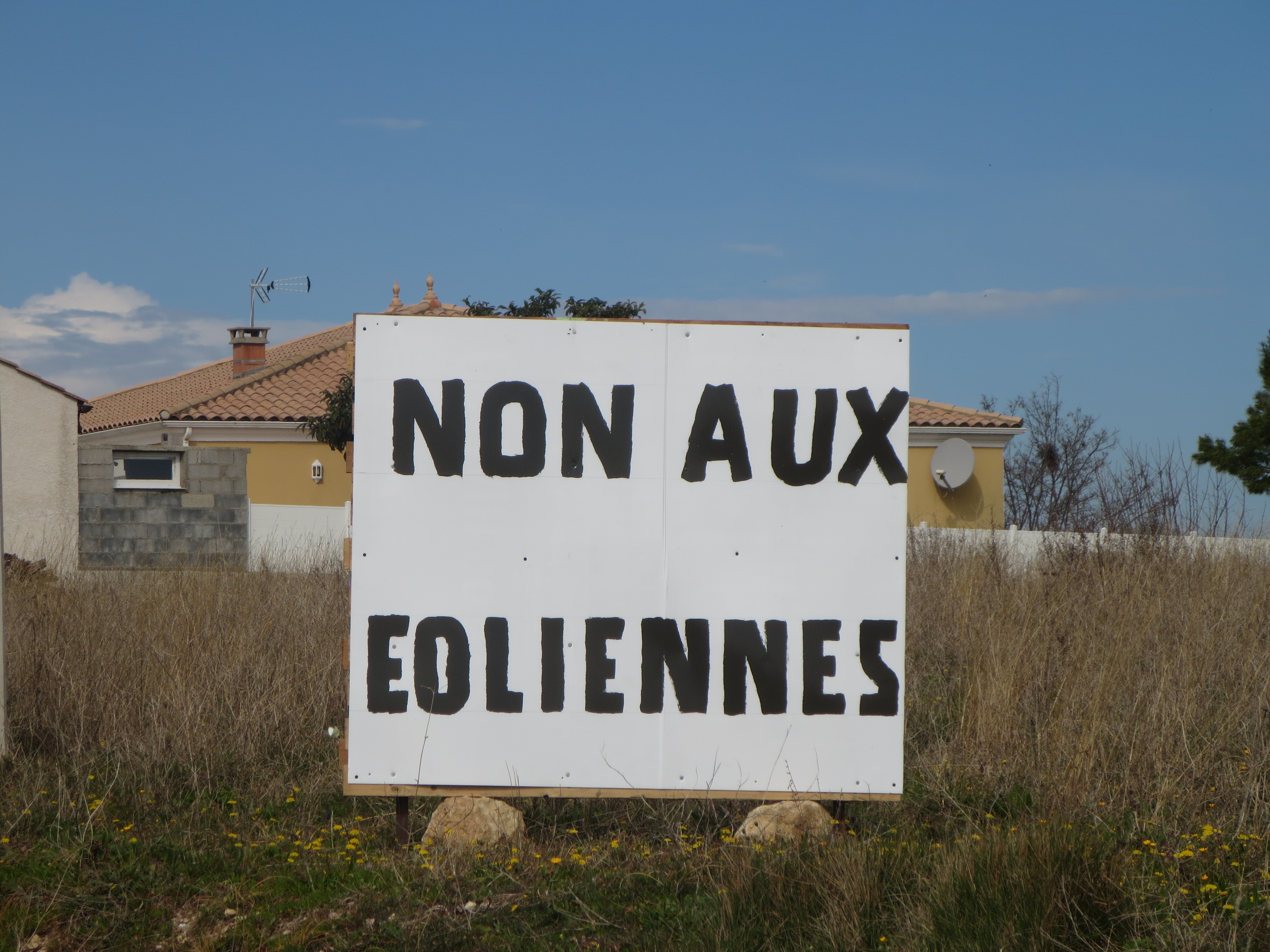
The threat comes from a plan by the company Quadran to plant 6 or 7 wind turbines on the plain behind the commune of Corneilhan. Ironically the village of Corneilhan will profit from the plan but is on the other side of a small hill from where the turbines will be situated, therefore the impact upon Corneilhan will be minimal unlike that upon neighbouring villages such as Pailhes and Puimisson whose residents will have to look at the turbines every day. Planning restrictions means that the turbines would have to be built on a stretch of land running across the area where Peilhan and RecD’Oulette are to be found.
Some neighbouring viticulteurs might be tempted to have a turbine on their land as they will receive a payment of 3000€ per megawatt per year created as compensation for not being able to produce wine from their vineyard. Jeff, and others, will not do so but the turbines will have a significant effect on the climate and terroir of his vineyards, if the project comes to fruition. Air turbulence, noise and the movement of the turbines will clearly alter growing conditions such as temperature and humidity but there are other consequences. Jeff has been working to provide biodiversity in the form of hedges, trees and plant life which shelter birds, bats and insects that provide a means of controlling vine pests such as ver de grappe and wasps. This helps to prevent the use of chemical pesticides and thus helps the environment. The presence of these ‘environmentally friendly’ turbines will undoubtedly upset the healthy ecosystem provided by these birds, bats and insects.
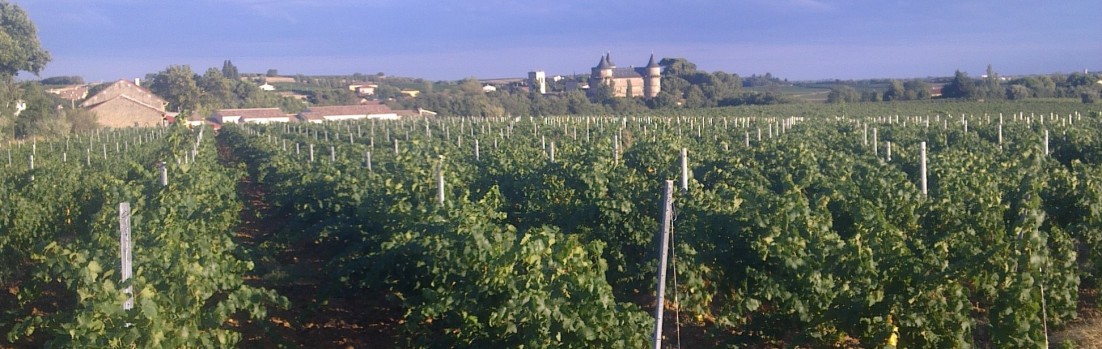
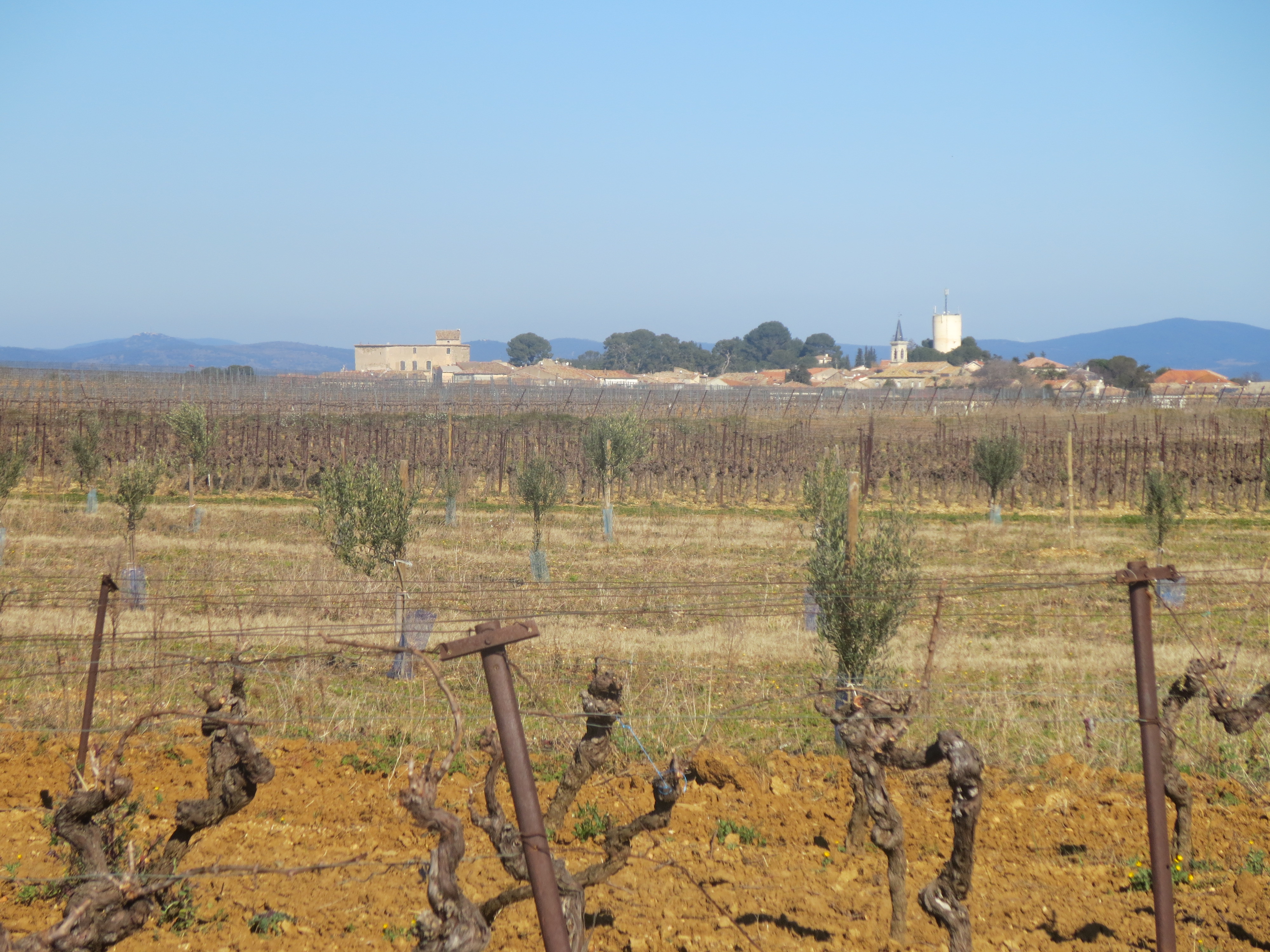
Puimisson from Peilhan, how much would wind turbines dominate this landscape!!
Trees and plants border the vineyard
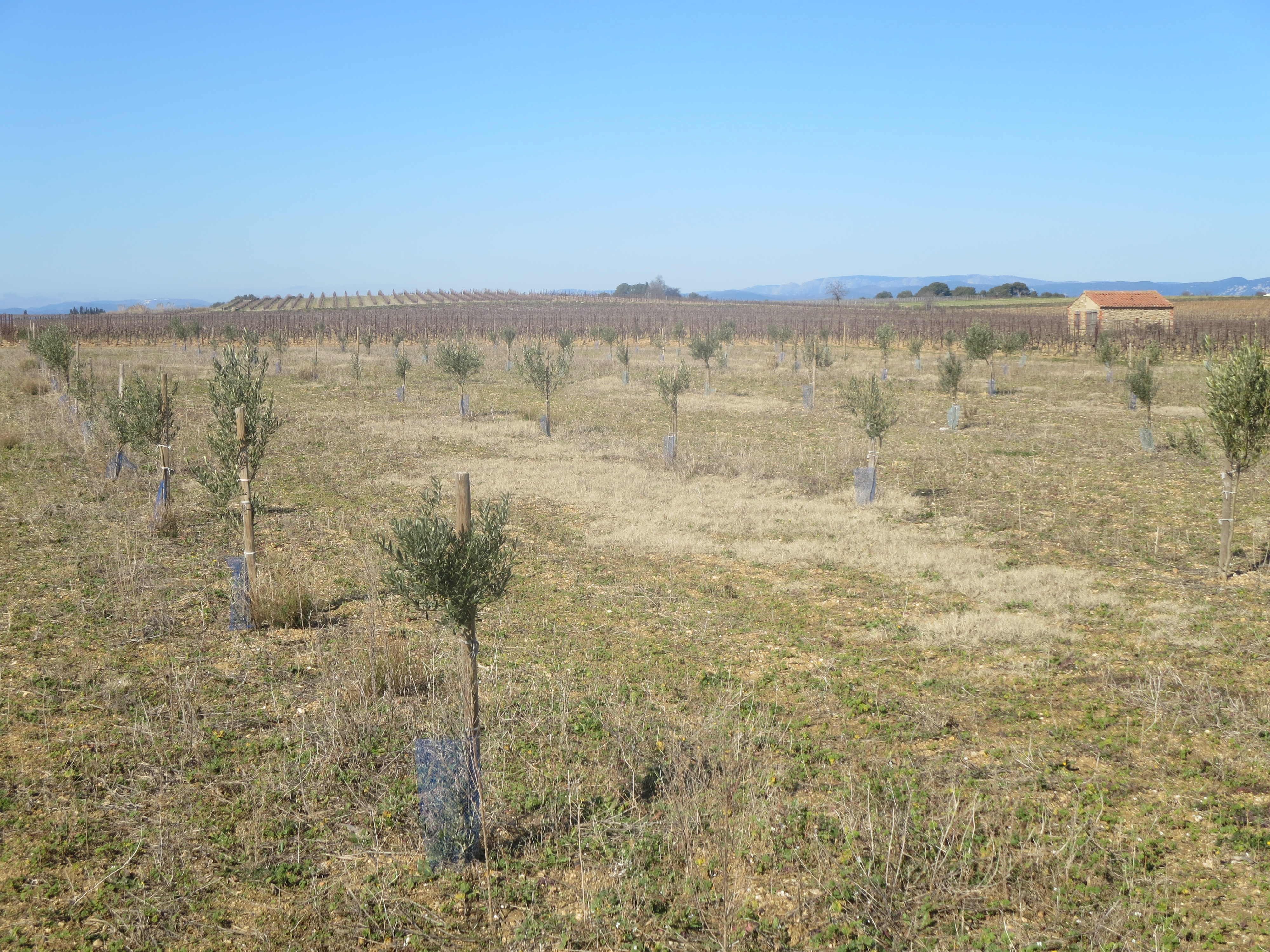
Olive trees in Rec D’Oulette
However, Jeff’s main concern is simply for the visual and auditory impact upon the area as a whole rather than just his personal loss. The area will be completely changed by the project and it does seem strange that they would build wind farms on agriculturally useful land rather than unproductive land elsewhere. It is ironic that so called green energy threatens the local environment. Without mentioning the threat to tourism which is economically important in the area.
In any case the best renewable energy is the one you don’t consume!
To show support for the people of the area as well as the vineyards you can sign this epetition now. I shall, of course, update with further news.
Friday March 6th brought a hot sunny afternoon and the birth of a new vineyard at Mas Coutelou. Well, a new section of vineyard at least. Peilhan is the most southerly of Jeff’s parcels and already contains a variety of grape varieties ranging from Carignan planted in 1992 to fairly new white grapevines such as Maccabeu, Grenache Gris, and Carignan Blanc. However, also planted are some rarer old varities such as Clairette Muquée and the Castets which I have so praised before.
Peilhan
If you look in the photo towards the top you will see a sloping area of land just beyond the planted vines and it was this section which, after lying fallow for many years, was to be planted. I have highlighted it below.
Being Jeff Coutelou though this would not be a simple planting of Grenache, Syrah or Mourvedre but instead he wants to increase the diversity of vines in the vineyard and contribute to the movement of restoring old Languedoc vines to a prominent role in the region. So 24 rows of vines would be planted, almost 2,500 plants of 6 cépages ;
Terret Blanc 1 row
Piquepoul Gris 6 rows
Riveyrenc Gris 2 rows
Riveyrenc Noir 6 rows
Terret Noir 3 rows
Morastel 6 rows
They would be planted as a mix to help resist disease as well as diversity.
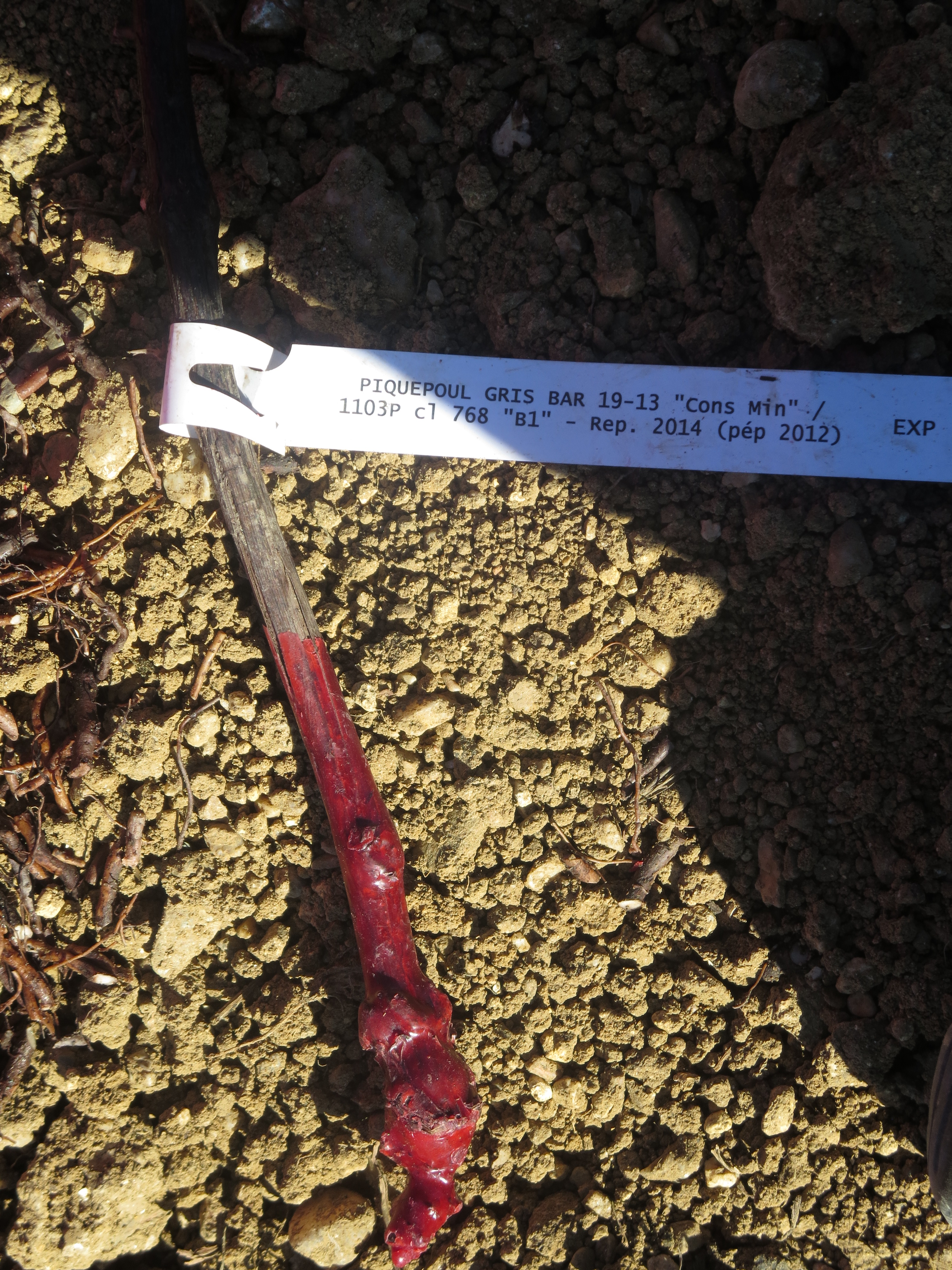
Piquepoul Gris vine
The plants are laid out ready, roots in water. Renaud, Michel, Carole and Jeff lead the way. Jeff, as usual, is on the phone as someone wants some wine!
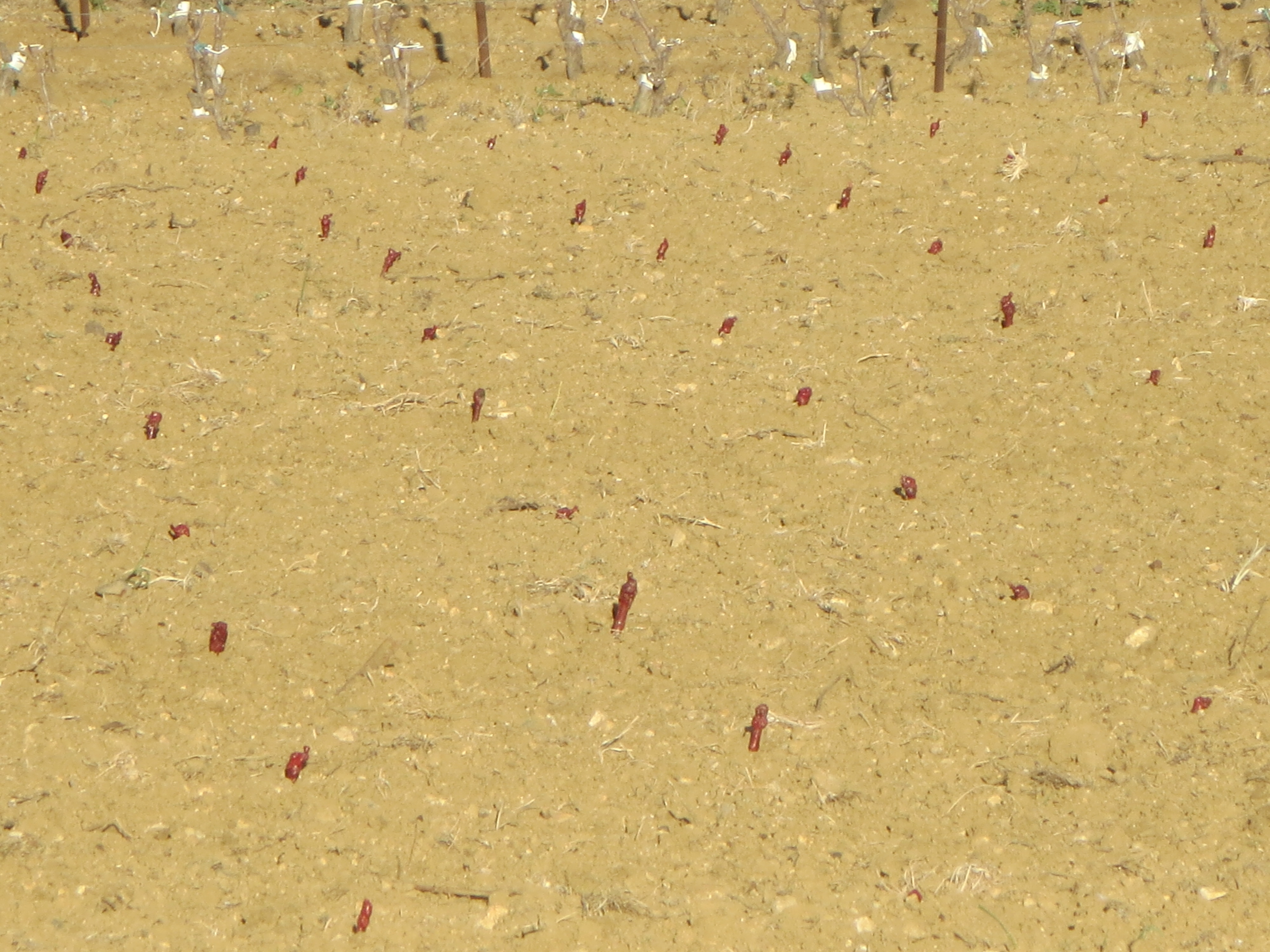
The vines came from a trusted supplier in Carcassonne and resembled large matchsticks. The vine foot is an American rootstock, the only ones capable of resisting the phylloxera beetle which almost wiped out French vineyards in the 19thC. The plant is grafted onto this root stock and then covered with the red wax to protect the grafting stopping air getting between the plant and the root stock. The wax will fall away naturally in the next few days. As you can see they arrived with long roots and we had to cut these down to make them easier to plant.
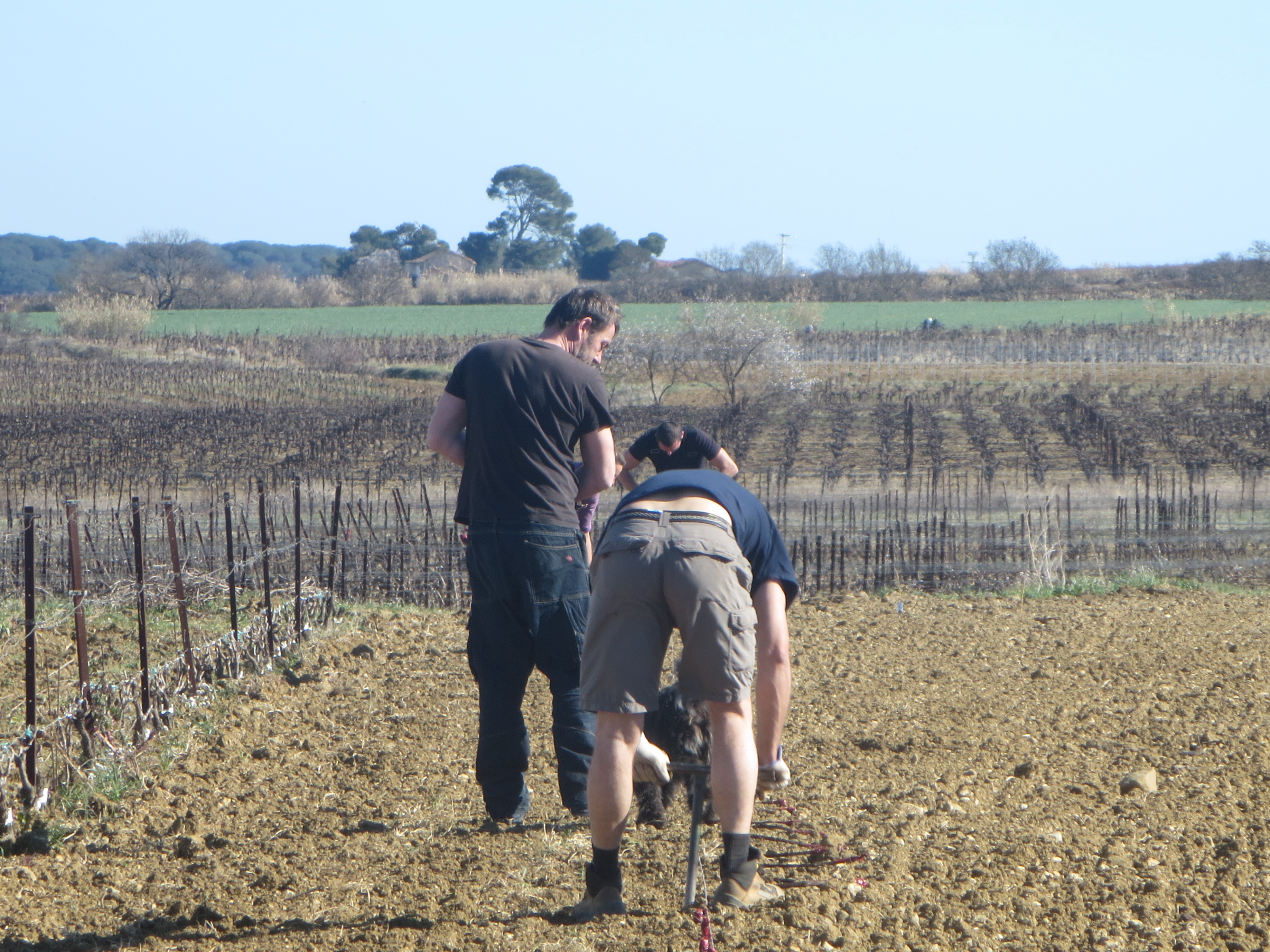
Jeff had hired two expert plantsmen to lead the way, the two to the right in the photo above. They demonstrated how short the roots should be and left Renaud, Michel and myself to carry on whilst Jeff and Carole (in the photo) went to help the planting.
The field was marked out to show where the vines would be planted. Each variety was to be planted at different intervals according to its specific needs, some need wider planting such as the Piquepoul Gris, others should be planted more densely such as the Terret Noir. The spaced to the right of the rope will be planted with hedges, including rose trees. These will provide shelter for birds and bats, natural predators of damaging insects and vers de grappe (worms) as well as providing a natural boundary to the parcel.
Wire cables ran along where each row was to be planted, in the photo you will see a blue mark where the vine was to be planted. The two experts did the planting with Jeff and Carole (later Michel) dropping the vine for them to plant.
This video shows just how fast they work, on a hot day it very impressive. There was a welcome beer break (with English beers from County Durham no less!) but the work continued solidly for 4 hours.
New vineyard takes shape
Icare supervised, of course
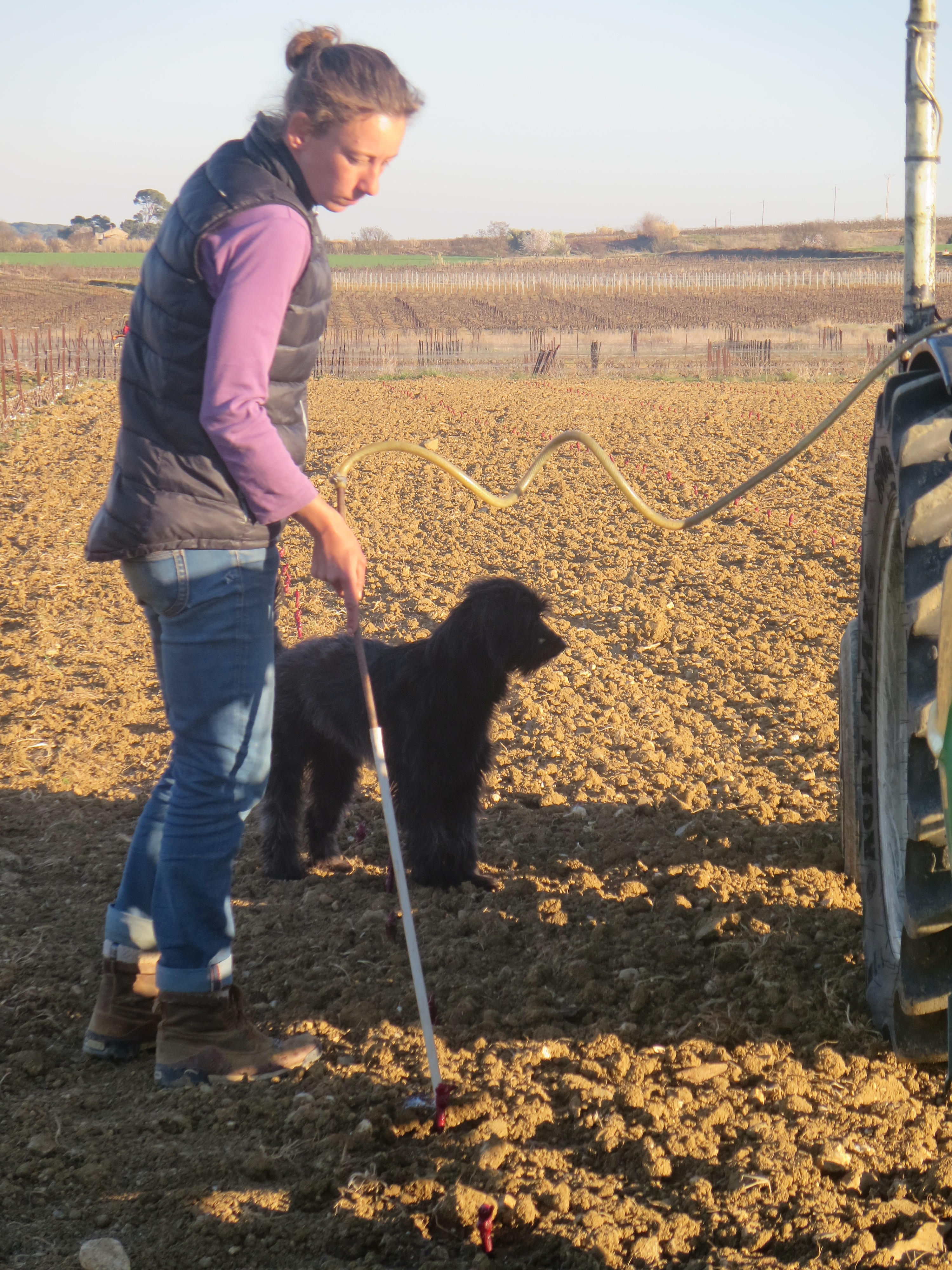
The new plants need water of course so Jeff and Carole set to work. 1500 litres were used for 2 rows of vines!
Jeff asked me at the end of the day what my thoughts were about the planting, how I felt about it. I had to think about it for a while. It had seemed like hard work but it was with a real sense of being present at a new beginning. The vines have a 99%+ survival rate and they will in a few years be producing white and red wine of great quality. And I was there for the birth of this project, a privilege. It was impossible not to feel excitement about what was to come and to wonder at how these small sticks would become beautiful vines. And to feel proud that Jeff is willing to plant something which reaches back into the past as well as providing for the future. Let’s hope we are here to enjoy the wine in a few years.
As if to crown my day of feeling close to nature I was able to take these photos of bees on the rocket flowers in the main parcel at Peilhan. This is one corner of the Languedoc where nature still rules, with a little help.
In my last post I published this photograph showing a vineyard in Margon. I thought it was a lovely picture of a healthy vineyard with biodiversity in the spring warmth. Celandines (yellow), wild rocket (white) and marigold (orange) all growing nicely in the sunshine.
Well, it turns out I was wrong! A certain M. J-FC from Puimisson tells me that the marigolds are actually a possible problem. (Incidentally the word for marigold in French is souci, which also meanscare or worry so these are living up to their name). Marigolds grow in soil with a lot of nitrogen, perhaps the result of nitrogen based fertilisers. Nitrogen is vital for plant growth, helping to boost photosynthesis for example, but too much is not good for vines. Why? Time to do some homework.
As the vine grows it must develop greenery in the form of shoots (to support the vine which is a climbing plant) and leaves (for photosynthesis) as well as its fruit, the grapes. Too much nitrogen produces a surplus of sugars which may cause the vine to favour its greenery over the fruit. Too much greenery can cause too much shade, therefore grapes don’t ripen properly. Too much greenery also increases the risk of fungal disease as air cannot circulate so easily.
Getting the balance right is one of the many tightropes the viticulteur must walk. Getting nitrogen into the soil is important and crop covers can help which is why ploughing plant life into the soil is useful (see post Teamwork) but too much nitrogen and you can cause problems for later in the season. The winegrower’s life is, indeed, plein de soucis!
Meanwhile can anyone tell me why this guyot trained vine has its cane replanted back into the earth at its tip? It was one of a whole vineyard trained like this near Faugeres. Is it to support the vine which is untrellised? To keep the fruit close to the ground?
As the support title for the blog says I am “Learning about wine, vines and vignerons whilst living in the Languedoc”. I have a lot more learning to do, so thank you for this lesson Jeff!
I am trying to regularly update the Out and About page with photos and thoughts about my travels and experiences (often not wine related believe it or not). So please click on there from time to time and have a look. As ever any comments and thoughts will be gratefully received. There are two photos which need explaining on today’s update, and I admit one of them is wine related! The photo above contains one of the questions on the Out and About page.
The other big change is the addition of a tastings page. Rather than post lots of notes about wines I drink on the main page I will post on that page if you are interested in my amateur opinions. Starting with a very enjoyable tasting at Le Wine Shop in Pézenas.
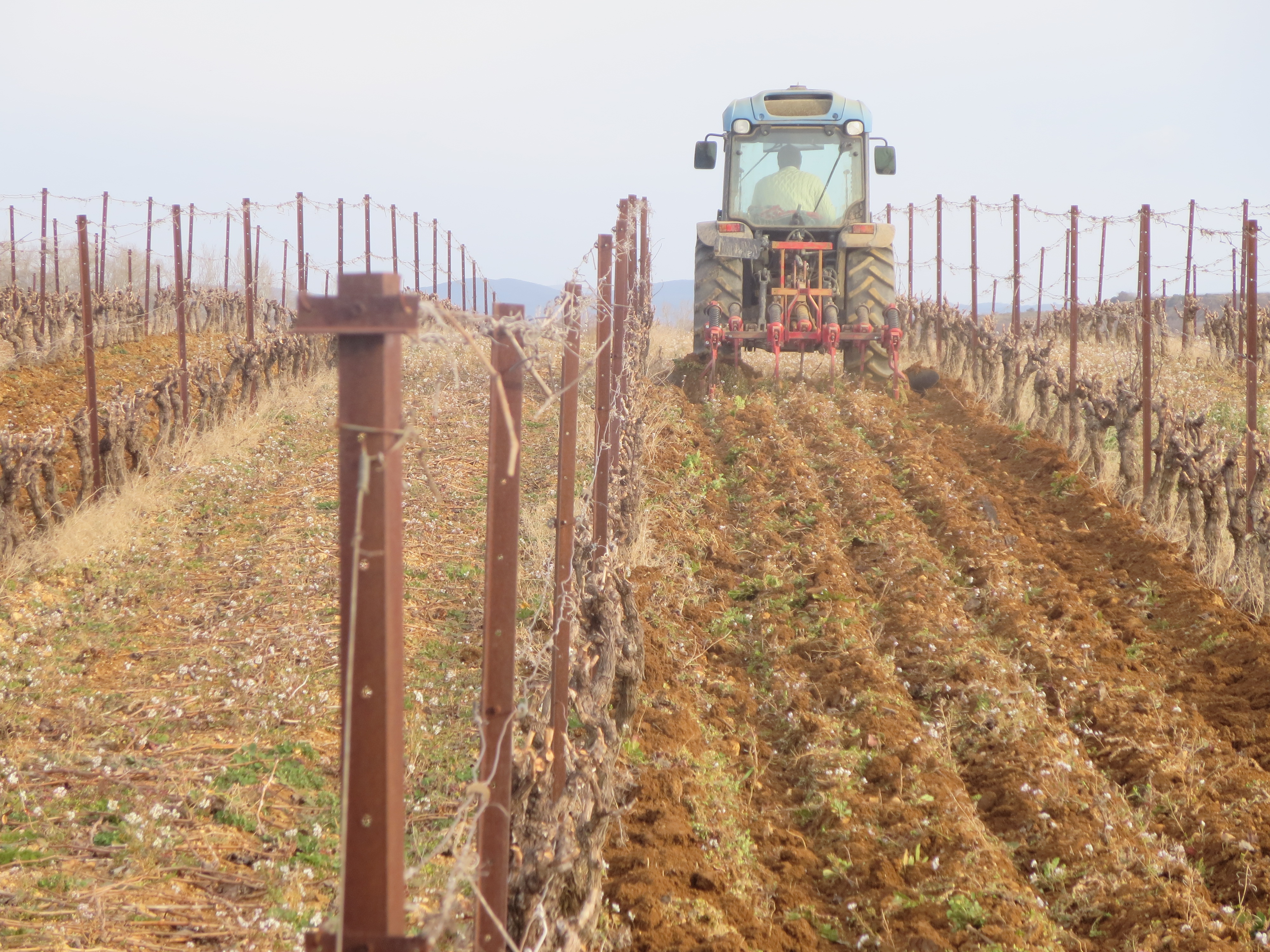
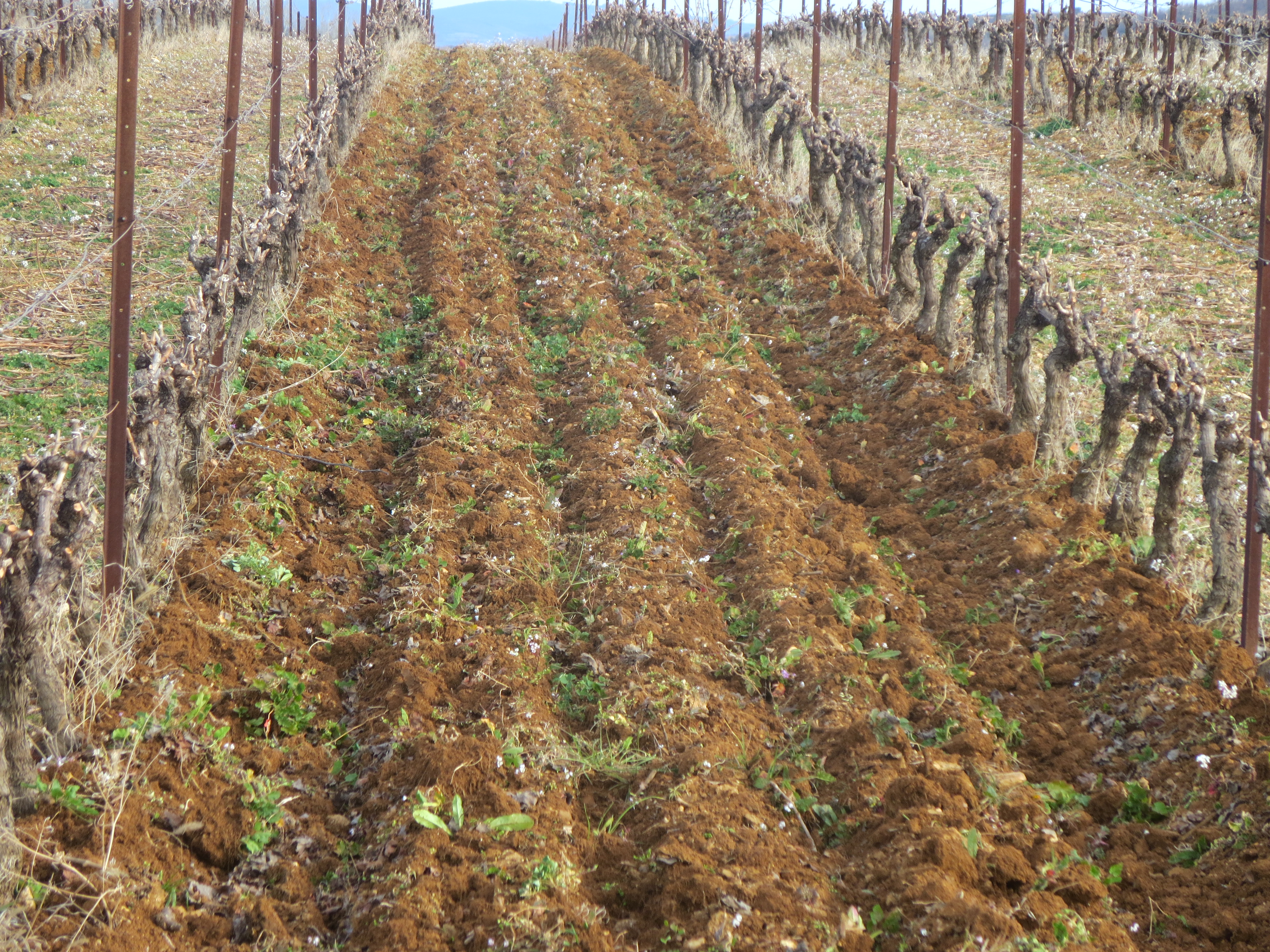
So February is turning out to be a very busy month in the vines. On Wednesday Jeff invited me over to see the first ploughing (labour)of the year. The plant cover of winter is ploughed into the soil to add organic matter. This has been a long established practice and as scientific research continues it is proving to be another example of traditional practice being based unwittingly in sound theory. According to research** by leading soil expert Claire Chenu in 2011 the organic matter which is ploughed into the soil helps to boost microbial and animal life in the soil. In turn this adds air to the soil which the vine roots can use to help them take up water and nutrients. Healthy vines make good wine and will hopefully be able to resist diseases. Certainly as the plough turned over the soil some big worms were speedily digging back into the earth, a clear sign of healthy soils.
The plough was set to a very shallow depth,no more than 20cm as this is a first plough of the year. Jeff worked the soil in every two rows allowing the tractor to turn easily, the other row will be ploughed in two or three days. The tractor is not a full size that you might see farmers using but more lightweight to try to minimise compaction of the soil.
Blades set to be shallow
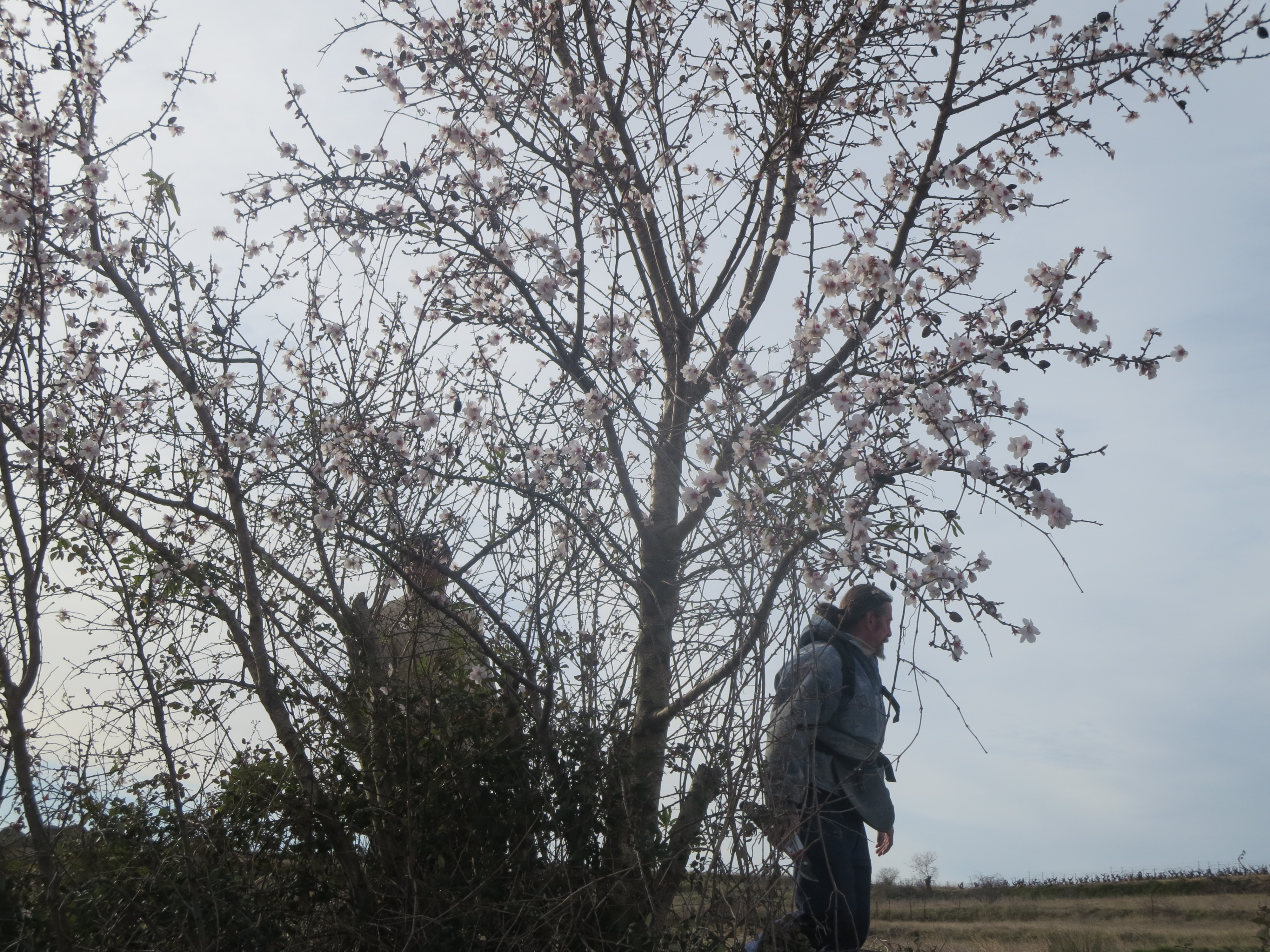
Meanwhile at the Peilhan vineyard Michel and Renaud were busy working on the trees and plants which guard part of the parcel.They were cutting down cannes de provence, pruning the blossoming almond trees and strimming the plants between them. All part of the effort Jeff makes to improve the ecology of his vineyards.
Renaud and Michel at work
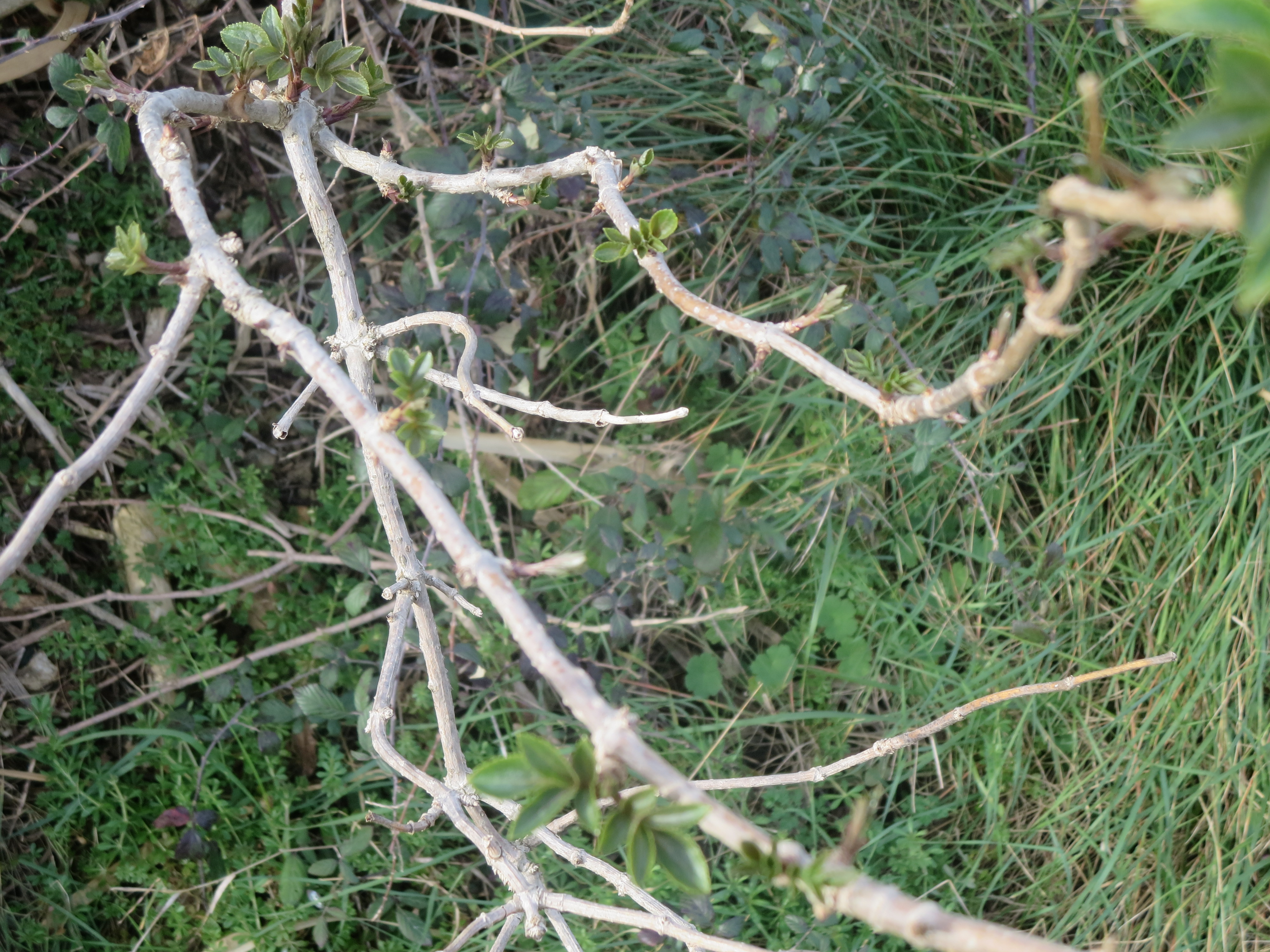
Elderflower just starting to bud at Peilhan
Carole was busy over in La Garrigue vineyard pruning the grenache section. She talked me through the decisions she was making at each cut to explain how the vines would benefit. What struck me was how she was thinking ahead to how the vine would grow not just this year but in the next 2 – 3 years. A skilled worker is always great to watch in action and I was honoured to listen to Carole explain it to me. You can see her at work in the video here.
So,the patron, Carole, Michel and Renaud were hard at work. What about me? Well, Jeff offered to let me drive the tractor but I doubt I could afford to pay him the compensation for all the vines I would have ripped up! Meanwhile there was one very critical observer, a crucial part of the team.
I wasn’t expecting to add anything to the previous post but on our walks around the area this week I have been struck by the amount of viticulteurs busy with a task that I had not included. So, as I hoped this blog would reflect what I saw rather than just theory I felt that I ought to add this post.
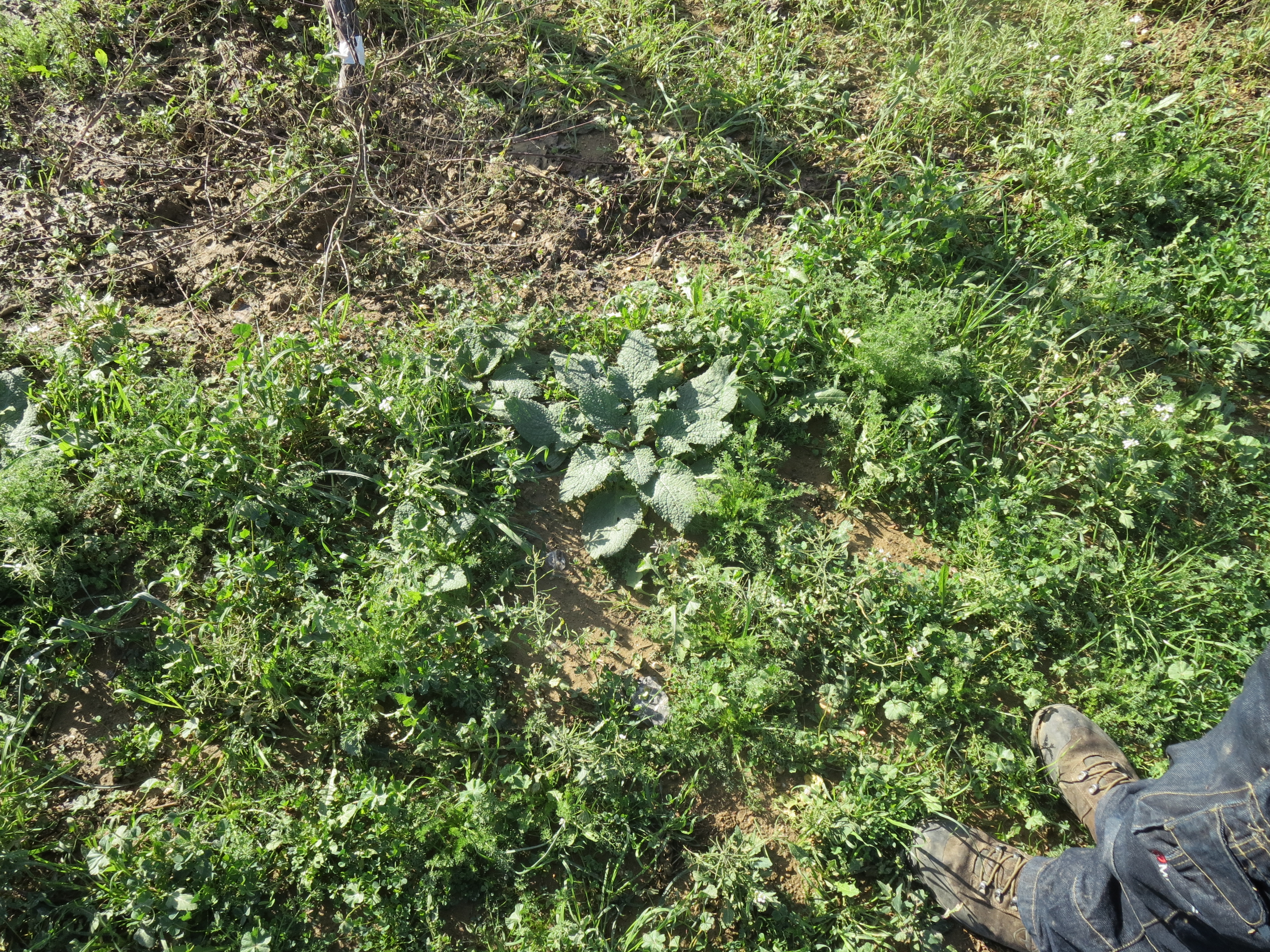
Soil in Jeff’s vineyard Peilhan with over 30 types of plant per square metre
So what has been the extra February task, getting rid of grass and weeds (désherbement). A normal task for gardeners but a controversial one for viticulteurs. I have posted many photos over the last few months showing grass growing between vines, not least those of Mas Coutelou. Twenty years ago this was relatively rare but modern viticultural practice reflects concern for the environment and less use of weedkillers etc. It has also been shown that grass (plus other herbs and wild flowers) has benefits for the vineyard; controlling weeds, conserving water and conserving the soil itself by binding it to prevent erosion. The grass can also help to provide competition to the vines forcing them to push their roots deeper into the soil to search for water and nutrients.
As spring seems to be with us already the grass will start to grow soon and viticulteurs want to control it so that it does not compete too much as the vines emerge from their dormancy. The amount of plant material a viticulteur would want will depend upon a number of factors such as the age of the vines as s/he would not want to hinder their growth and development. The nature of the vineyard too will affect the amount of grass you would allow. The viticulteur knows the vineyard and will make the decision as they see fit. Those who follow more reasoned approaches (my choice of words and my bias) do so carefully using strimmers to cut it down or pickaxes and hoes. Some will plough the soil so that the organic matter will provide a form of compost in the soil. I have asked a few winemakers I know and these are their methods. Manu Pageot, for example, will not start to weed until the soil has warmed up a little. Even then he will work by hand or using very light machinery so as not to compact the soil.
Jeff and Manu studying the grass Manu sowed between his vines
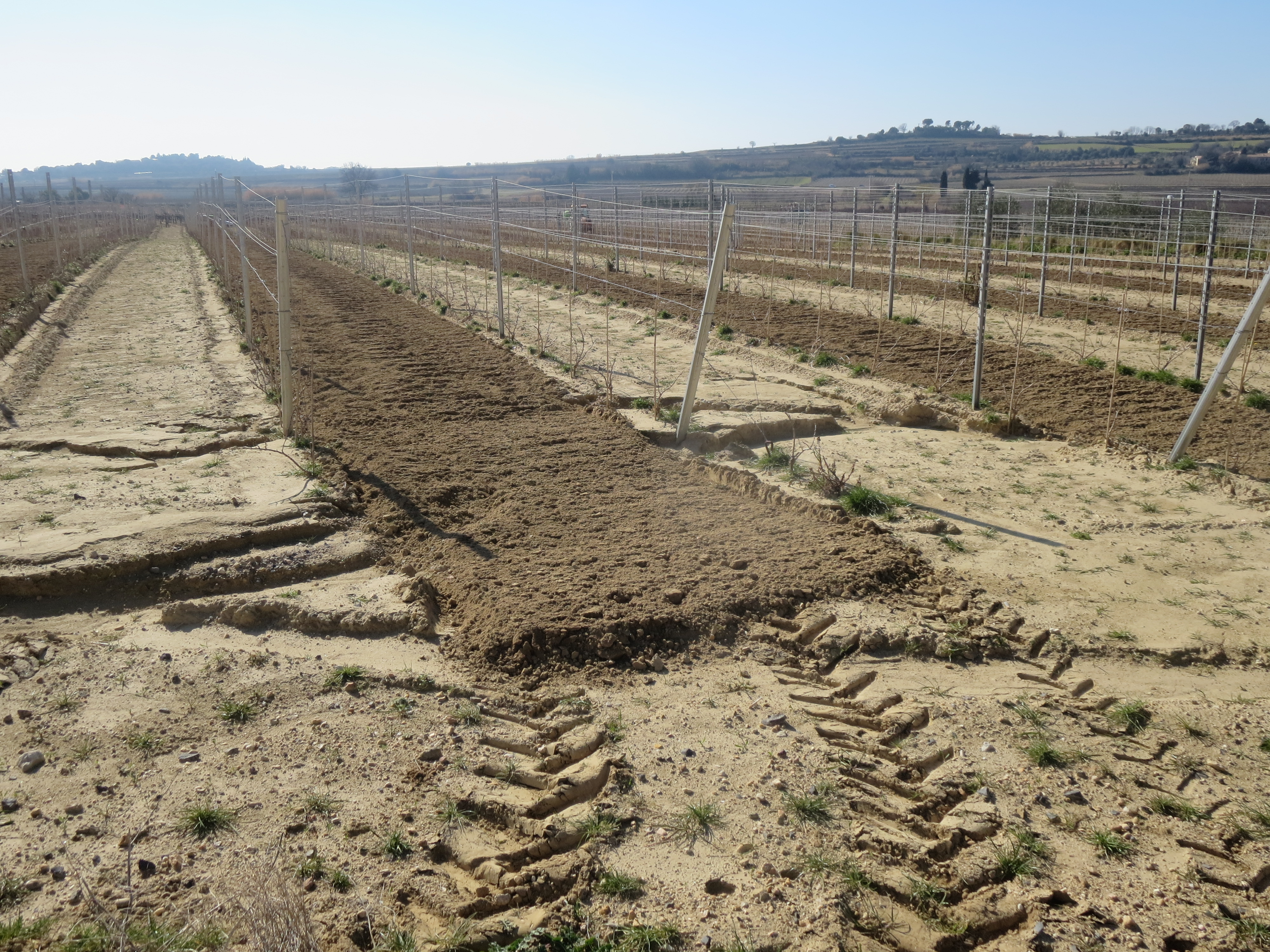
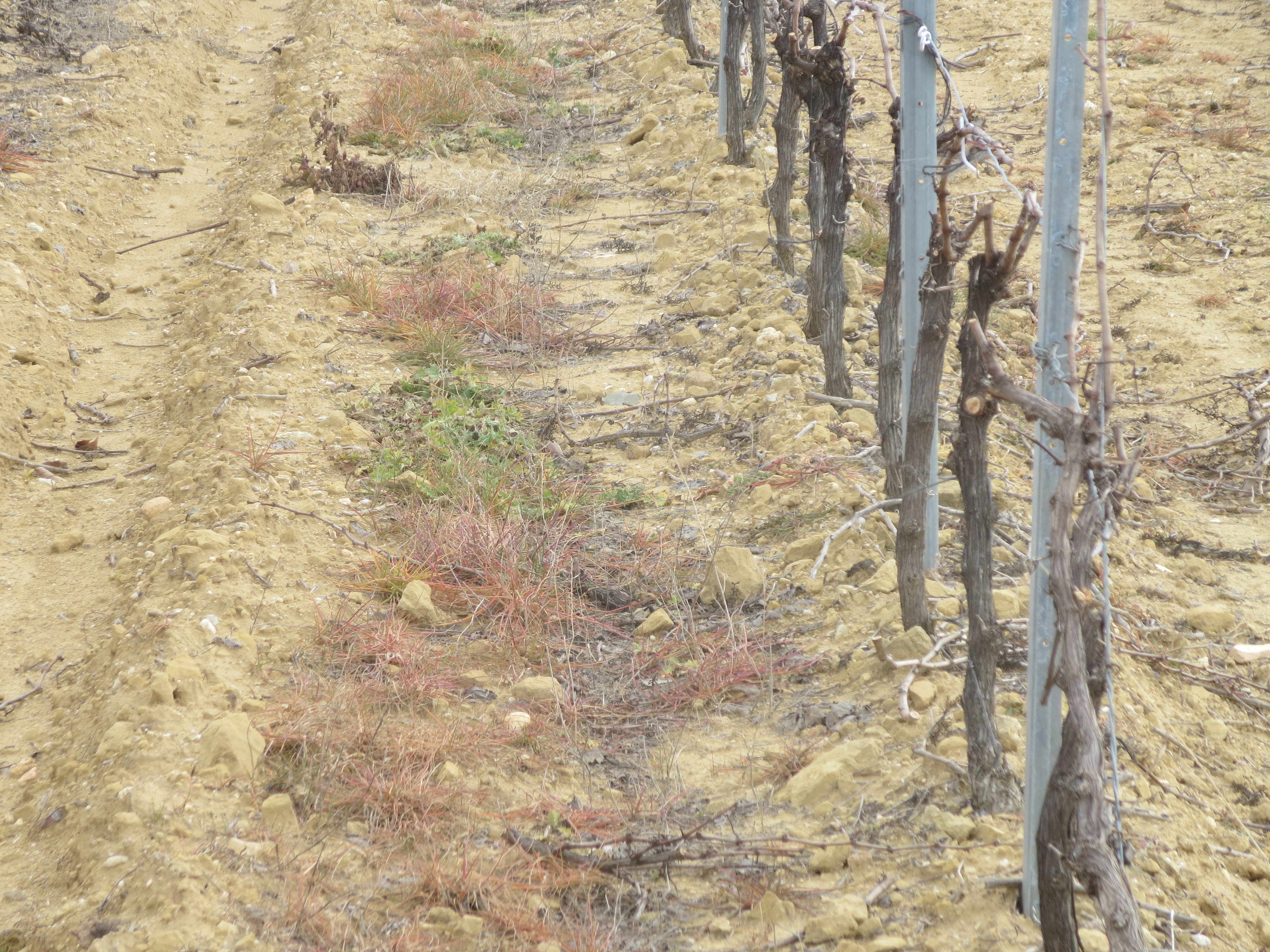
However, others take a more radical approach using chemicals. I took these photos on a recent walk around Alignan du Vent and Margon. Chemicals have been used to kill the growth and also a method of piling up soil to stop growth. I am not criticising these viticulteurs, they have to work as they see fit though clearly I am not personally sympathetic to their methods.
Chemical spraying to kill off any plant life in a new vineyard
Soil piled up to smother any growth. Note the compaction of the soil by the tractor
The photos below show a vineyard in November (top picture) and then below it you will see the row with the plants having been treated to kill them, changing colour as they die in the middle photo. If you look between the vines in the bottom photo you will see the grass turning to a straw colour.
So to finish,a lovely memory of a more gentle approach to grass management!
The Romans were late to add February as a month to their calendar having previously put together December, January and February as one long winter month. When it did become a distinct month February was seen as a month of purification, the end of winter feasting and preparation for the year ahead (February was actually seen as the last month of the year for a long time). In the Christian calendar the beginning of Lent and the tradition of Mardi Gras reflect this Roman influence.
Similarly, in the vineyard the work reflects the calendar. The Languedoc vineyards are still dormant. White vans are dotted amongst them containing the workers and their tools seeking to prune and to palisade their vines in preparation for the growing season ahead. I have described this work in detail recently so I won’t repeat myself but la taille proceeds all around us. (See here and here)
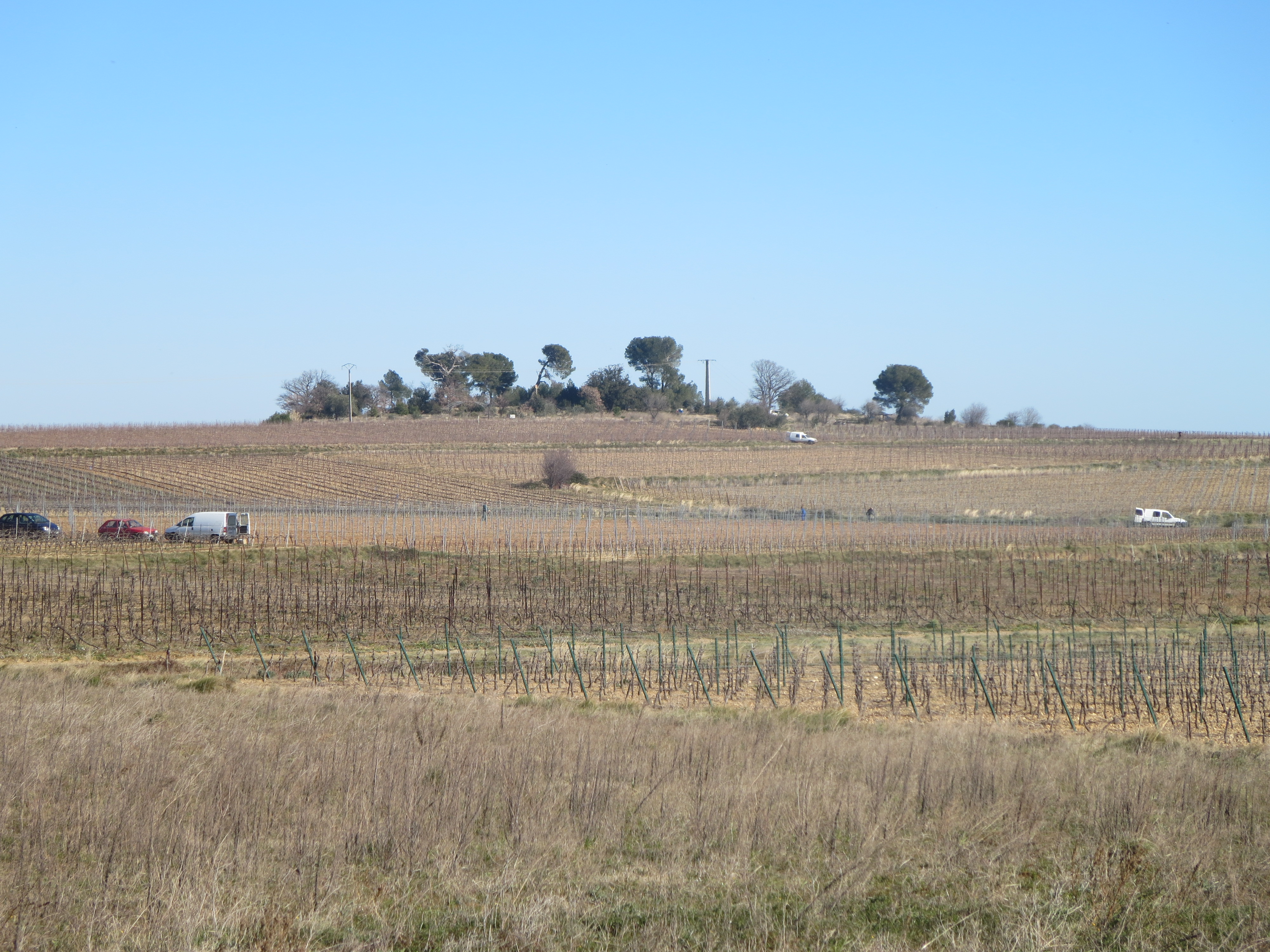
Vans and cars parked among the vines
Sauvignon Blanc vines (at Turner Pageot) grafted short to reduce the yield and so concentrate flavours
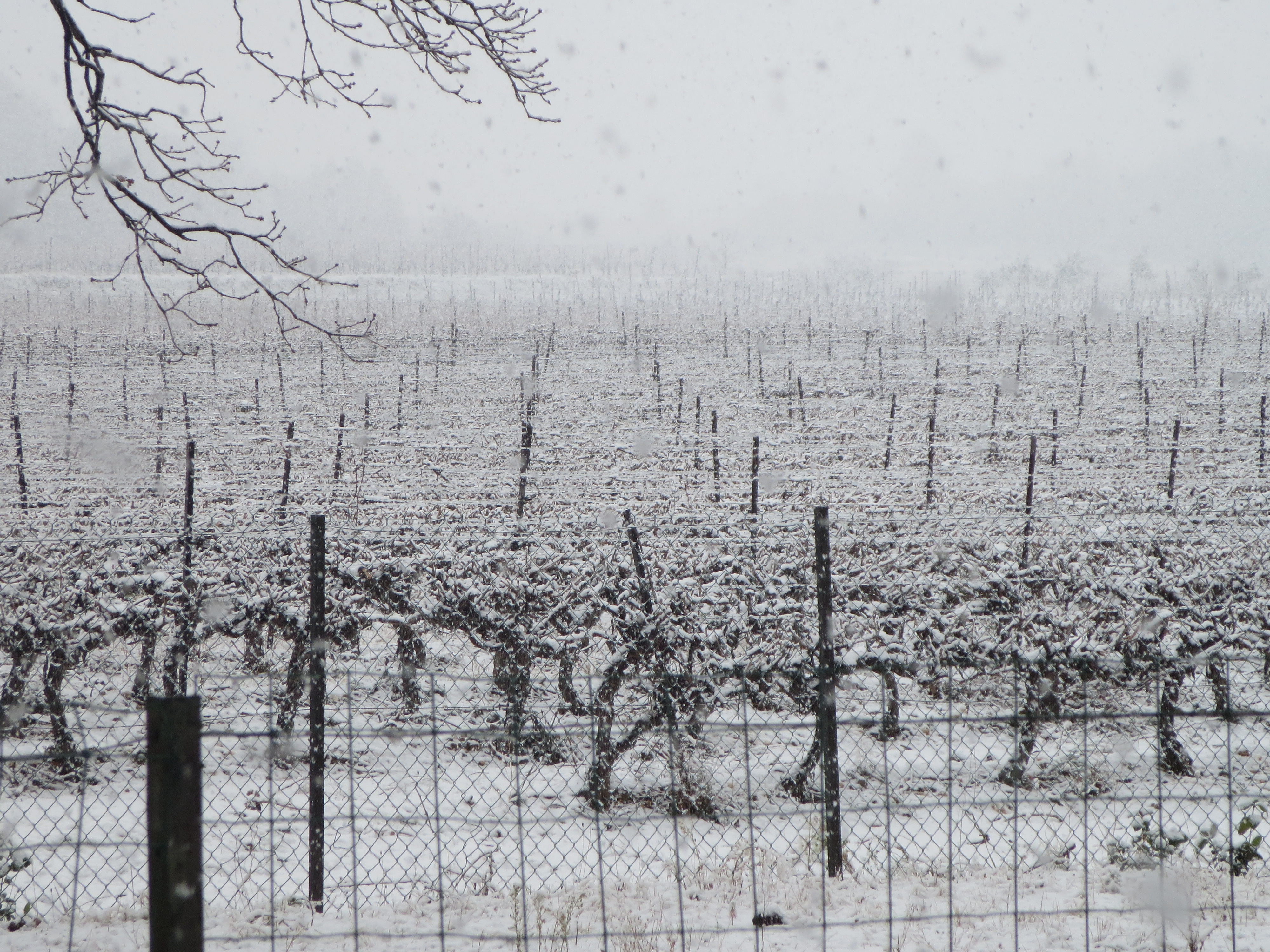
The month began with very cold northerly and easterly winds and even one morning of snow (Feb 3rd).
February 3rd – the view from our back window
The cold was needed to remind the vines not to start to emerge from their hibernation too soon. Early budding (bourgeonnement) can be disastrous as frosts can hit for a couple of months yet, traditionally it is mid May when the risk of frost is said to be over in the region. Those who pruned early run more risk as budding can sometimes happen sooner. Whether there was enough cold weather remains to be seen as by February 9th we were enjoying temperatures between 15C and 18C. I have heard of almond trees budding already, the mimosas were out for the festival in their name at Roquebrun on the 8th and so the vines may well be stirring already.
The mimosa is out to the left of the tower at Roquebrun
At Mas Coutelou there was also work to be done in preparing new vine canes to be grafted onto older vine stocks. Jeff is trying to establish some parcels with a mix of grape varieties as these cross pollinate during flowering and help to protect each other in resisting disease. He wants to bring older varieties (cépages) into his vineyards such as Aramon (noir and gris) and the Castets I wrote about in October. These are already producing great results in the quality of wine produced so far, even if it is in small quantity so far. Therefore, some old Cabernet Sauvignon vines are being removed from a vineyard such as Peilhan and being replaced by these more traditional Languedoc cépages.
Michel, Renaud and Jeff work amongst the wild rocket
Believe it or not it was quite warm despite Jeff’s attire
The grafting itself will not take place until around May time. For those who are interested in the technical side of this I can highly recommend this article which raises some interesting points and questions about grafting, vines and terroir. Steve Slatcher has a very good blog, well worth reading.
February also continues to bring lots of paperwork, customs and taxes for example. Many hours of such work are certainly unglamorous. Selling wine is also vital and Jeff took some cases to Gabian on the 13th to Domaine Turner Pageot to form a groupement (a pallet of wines made up from different producers) to head to Leon Stolarski, a very good merchant based in Nottingham. I have sung the praises of Turner Pageot many times on here and so it was a pleasure to see two of my favourite winemakers come together and visit Manu’s vineyards as well as tasting his wines.
Jeff and Manu study the grass which Manu has sewn between vines. This will retain moisture in summer, strengthen the structure of the soil and attract helpful insects amongst other advantages
There is also a belief that February is named after Febris the Latin for fever. Jeff has been suffering from flu, there is an epidemic in the Hérault at present, and Manu too was far from well. Fortunately their passion for their vines and wines shone through, a reminder that February also has its other big date on the 14th.
A warm, sunny birthday for me on February 9th but snow in the mountains still lingers
The main salon of Millésime Bio took place in Montpellier from January 26 to 28th. It was a fun event with a huge range of winemakers. I had long lists of the I hoped to taste from but sadly didn’t get near completing it. I took the opportunity to try wines from outside the Languedoc Roussillon though I tasted many of those too. It was good to renew my love of Alsace and Burgundy, to remember why Champagne is very much the best sparkling wine and to enjoy delicious white wines and, especially, sweet wines from the Loire. I hadn’t expected Italy to provide some of my highlights but you will see that it did indeed, I must visit more Italian wines and the vineyards themselves!
A personal highlight was seeing Mas Gabriel win a Gold medal for Clos Des Lievres 2012, Peter and Deborah Core make lovely, rich, fruity wines and it is a range which gets better and better as their work on the land shows through increasingly. A new Grenache Gris white wine was a worthy addition. Congratulations.
What follows is a list of producers I particularly enjoyed visiting. There were many other individual wines but they would make this post even longer. I heartily recommend these producers and if you get the chance try their wines.
Italy
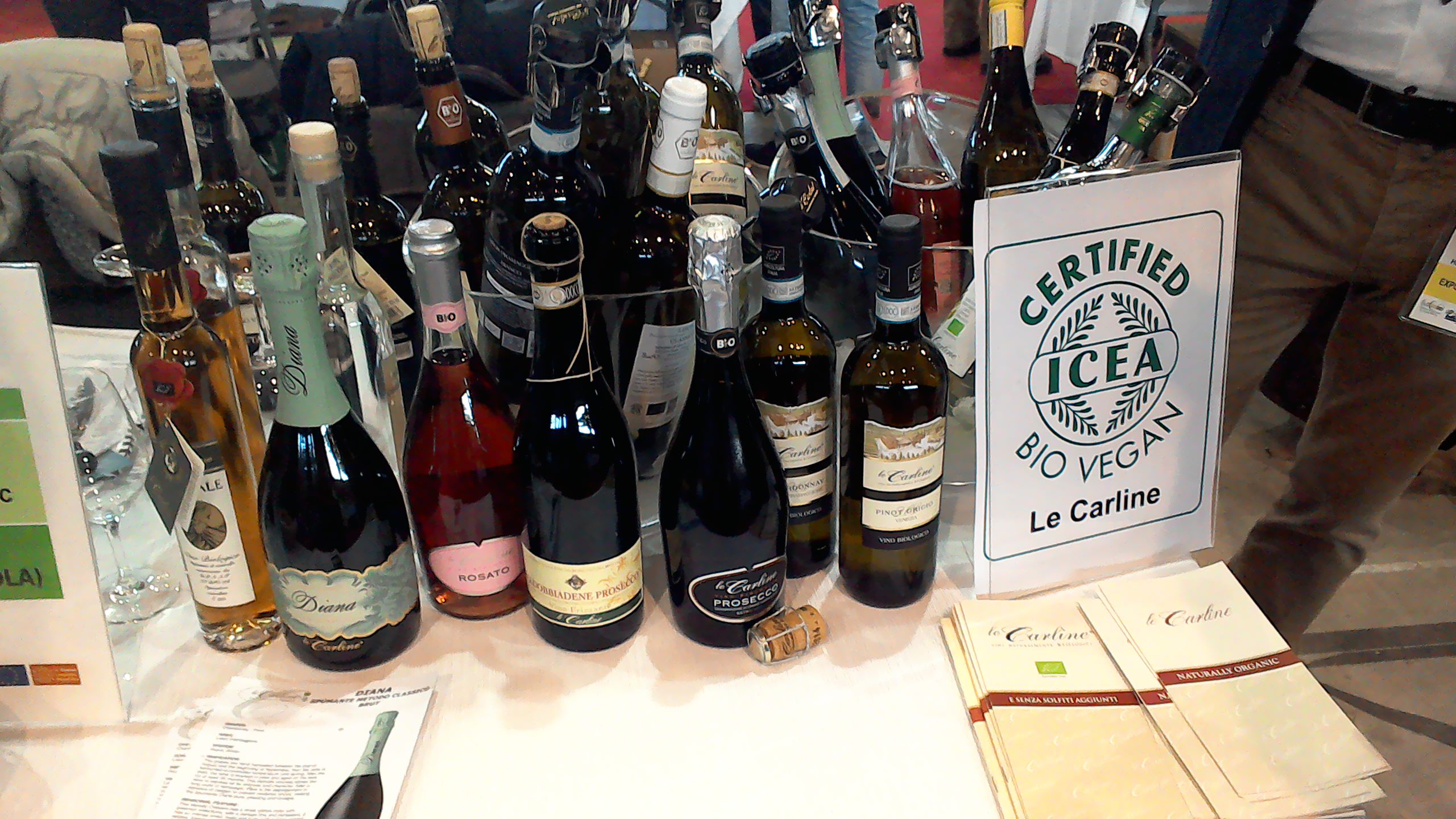
Az Ag Le Carline (Venezia) I have to say that this was my favourite tasting of the whole event. I knew nothing about Daniele Piccinin’s Azienda beforehand other than reading a little in Isabelle Legeron’s book. Daniele was helpful, enthusiastic and is a top class winemaker.
Daniele explaining his terrific wines
There were lots of wines on offer but the highlights for me were
Pinot Grigio, clear direct and flavoursome
Lison, a new grape to me and a lovely, refreshing but full white
Amicitia, Chardonnay aged for 6 months in barrel and a rich but clean wine,certainly a Burgundy rival, 2008 but still felt very young and expressive
Lison Pramaggiore, no sulphites and this was a full wine, lots of fruit with a clean, refreshing edge
Merlot, no sulphites. I am not particularly a fan of the grape but this was rich,, expressive red fruit and lovely to drink
Refosco, another new variety to me and I loved it. It carries fruit and rich flavours but with a classic Italian acidity to refresh
Cabernet Franc, now if there is a grape I find hard to like it is this. But this was lively, clean and full not the lean, green wines I am used to from CF. Aged 2 months in oak and then 2 years in barrel but felt freshness
Carline Rosso, a stunning wine. Cabernet, Merlot and Refosco, aged for 3 years in barrel but so clean, lively and beautifully balanced totally delicious
You had no reason to look worried Daniele, everything I wrote was complimentary
Cascina Zerbetta (Piemonte)
Quattrocento Sauvignon Blanc was classic but there was a version which had been macerated on skins and had lovely apricotty aromas and flavours, lovely
Barbera del Monferrato 13 – rich classic barbera with dark fruits, lively acidity and very enjoyable fruit
Piangalardo 09 -Rich stewed dark fruits with refreshing acidity, felt like a very young wine. Excellent
Champagne Leclerc Briant – another good champagne range especially the vintage 06 clean and refreshing and the special cuvée Les Chèvres Pierreuses which was deep, biscuity and very fine
Rhone
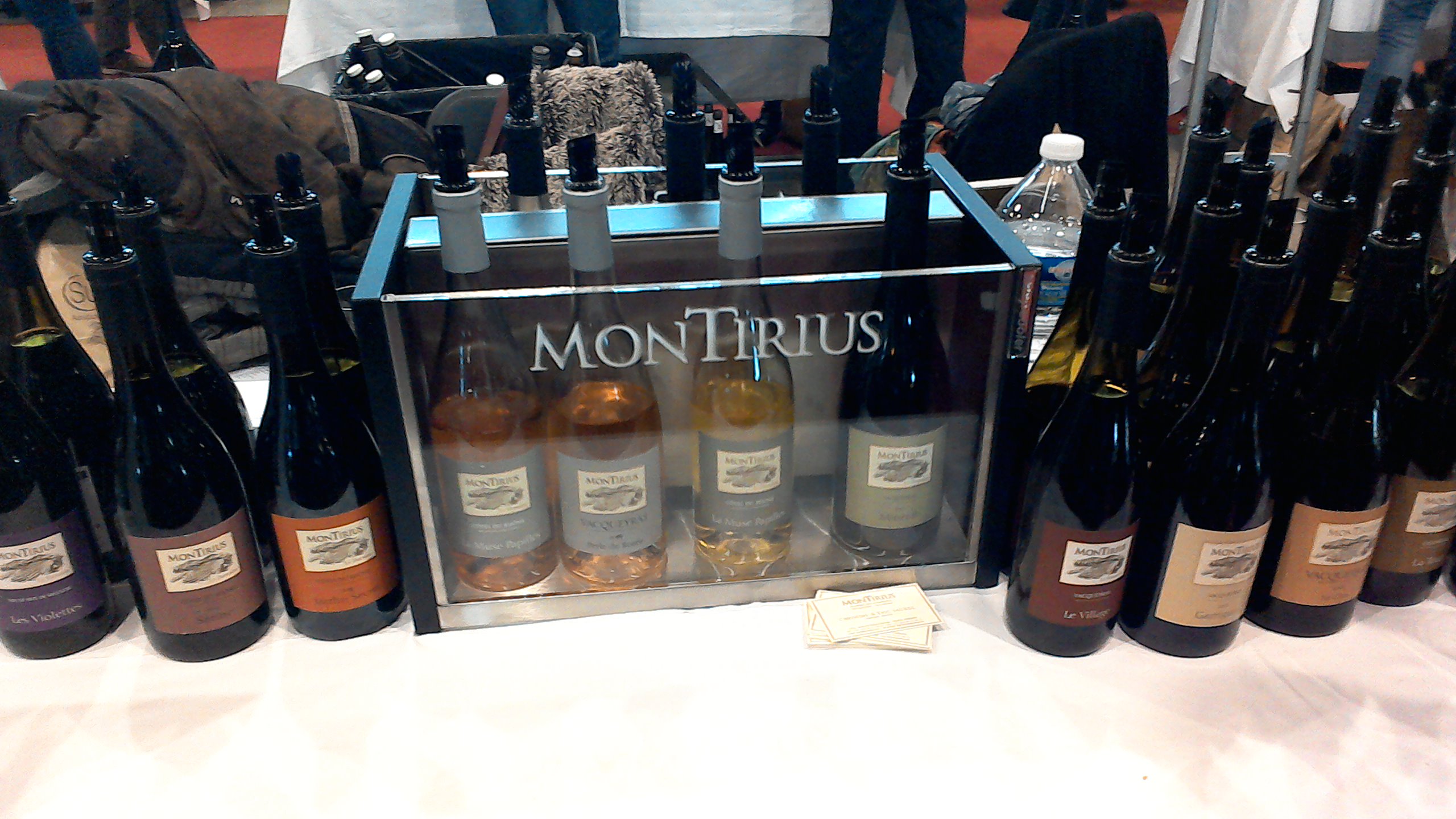
Montirius – some lovely wines made with a natural style
Cotes du Rhone La Muse Papilles in white and red
Minéral Vacqueyras Blanc (Bourboulenc 50%) and the Vacqueyras Garrigues
Vincent Achard – I hadn’t expected Clairette De Die to figure amongst my favourites but these were lovely, refreshing and fruity sparkling wines especially
Bio Sûre which grew in flavour in the mouth and lasted long
P’tite Gaby a sulphite free version which had lots of fruity, floral pleasures and a great balance of sweetness and dry finish.
Austria
Sepp Moser – after the excellent Austrian wines tasted at offlines here was another this time from Kremstal. A very ripe Zweigelt Reserve 2011 which was all red fruits and refreshment. It was the whites which shone bright though
Grüner Veltliner von den Terrassen 13 – good, mineral and refreshing
Grüner Veltliner Gebling Erste Lage 13 – clean, direct and mineral
Grüner Veltliner Breiter Rain Erste Lage 12 – richer, oak aged and even drier
Grüner Veltliner Schnabel Erste Lage 12 – good, refreshing and long
Riesling Gebling Erste Lage 13 – Very clean, dry and mineral. Lovely.
Languedoc
Grand Guilhem – some nice clean white and rosé wine but the reds stood out
Fitou 13 was rich and dark,needing time but very deep fruit
Angels 13 with its Carignan majority was deep and dark but red fruits were clear and enjoyable
Le Pointilliste is a blend of Grenache, Syrah and Maccabeu which is aged in concrete eggs. Very complex and rich in flavours, hugely interesting
Deux Ânes (Corbières) A domaine situated near the sea and I am sure it is a coincidence but there is a refreshing, cleaning finish to these wines like a sea breeze blowing through them.
Premiers Pas – Carignan dominant, excellent balance of freshness and rich spicy fruit
Fontanilles – the wine which first got me interested in 2 Anes, more Gren / Syrah but still Carignan domainant. Lovely
L’Enclos – Grenache led and extra warmth and spice but still fresh and balanced
Les Cabrioles – Mourvedre / Carignan and all the depth that implies with a hint of sweet ripeness cleansed by the freshness
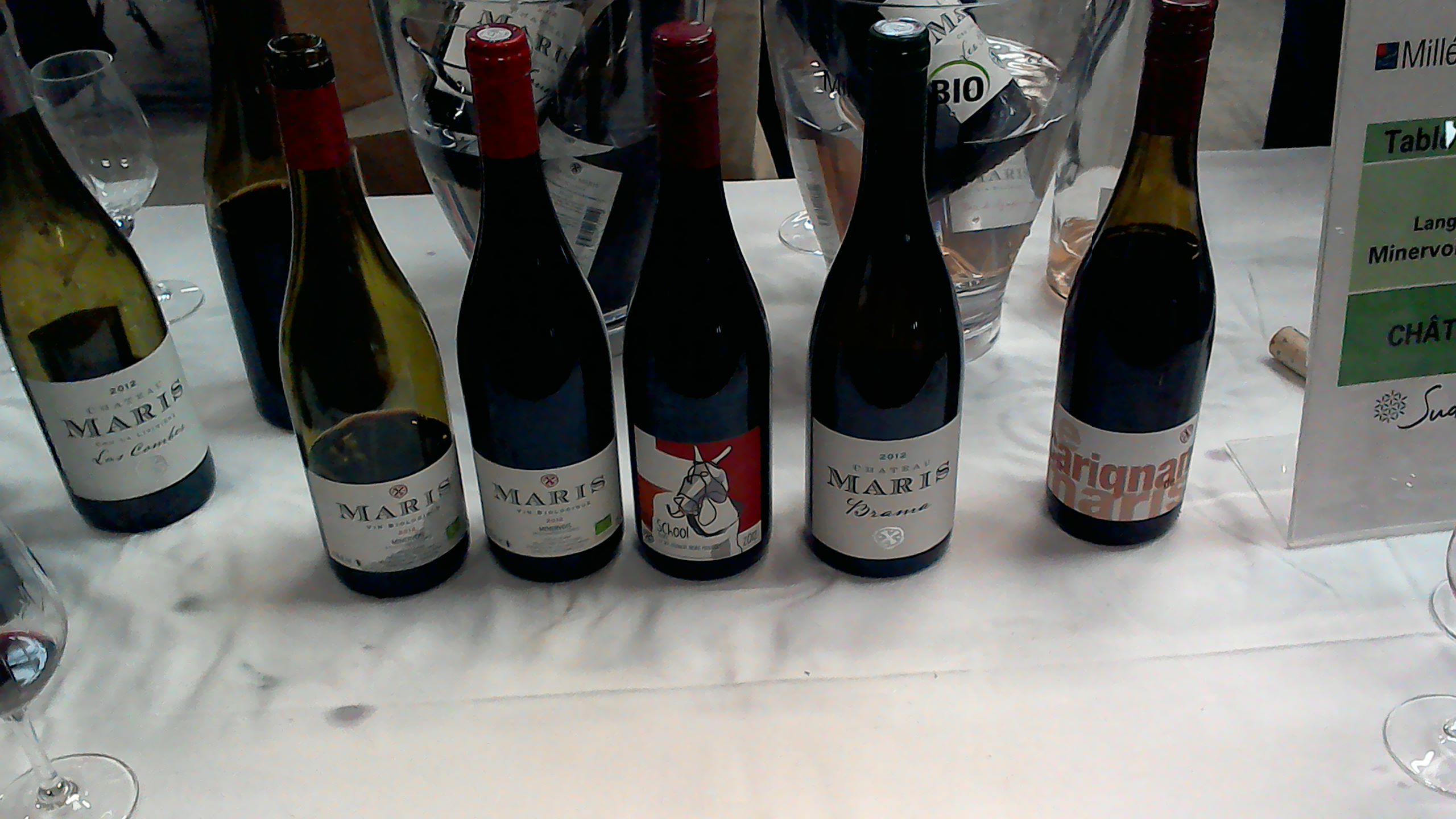
Chateau MarisAll good especially Minervois13 – classic clear Le Carignan 13. – really good balanced and long La Touge – lovely clear expression of syrah fruity but serious Planels – oak aged syrah should be heavier than Touge but actually delivered a strawberry and cream lick with power behind Anciens – mainly Carignan and the dark fruits were there but with really smooth, creamy delivery. Lovely
Vignerons d’ Estézargues – an innovative co-operative in the east of the Languedoc where local producers’ wines are made separately (as well as some joint blends) according to their wishes, but often in a natural style.
Domaine Fées – rich Grenache/Syrah, ripe and good
Bacchantes – Syrah / Grenache – good
Sarrelon – Grenache dominated with some striking red fruits and strawberry notes, lovely
La Baronne Corbières, yet another interesting Corbières estate. Interesting and fresh white wines especially the pure Grenache Gris which is partly macerated on skins and very expressive.
Las Vals pure Mourvèdre was lovely with classic leather and dark fruit
Les Chemins was a classic Languedoc blend, restrained and refreshing dark fruits
Les Chemins De Traverse waspure Cinsault with no sulphites and a lovely, red fruit and refreshing wine
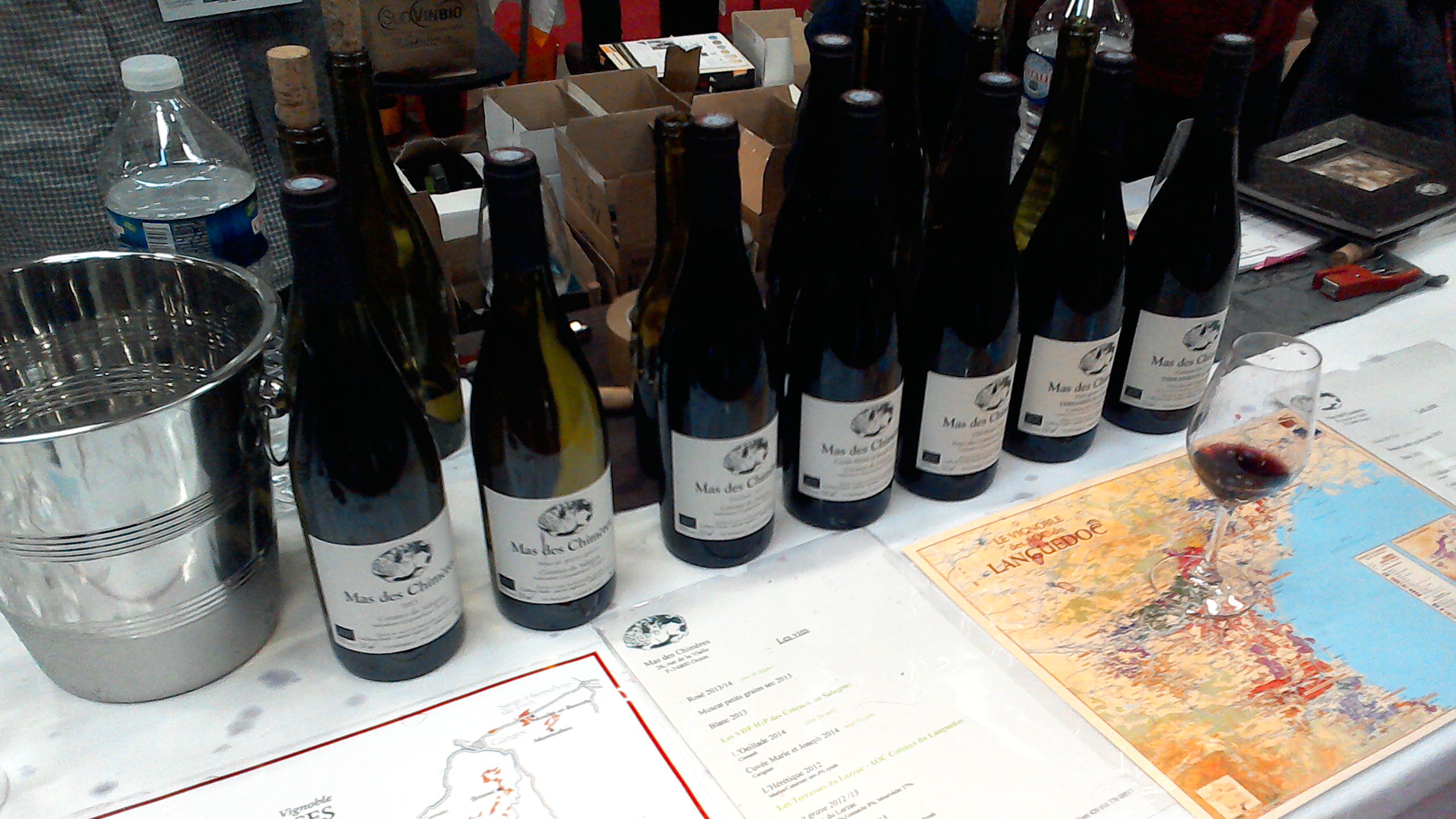
Mas des Chimères – a long time favourite of mine for its cuvée L’Oeillade a great summer red
L’Oeillade 14 – sampled from tank but already rich, round and refreshing. I love this cuvée.
Terrasses de Larzac Nuit Grave 13 – such a great balance between rich, ripe and refreshing
Terrasses De Larzac Caminarèm 13 – an equal blend of 5 grapes and a lovely wine
Terre des Chardons from eastern Languedoc, a range I know from Leon Stolarski. I have always liked the freshness of these wines, they are rich but so well made they leave you always wanting more
Bien Luné 14 – often my favourite in the range and this from tank was up to the usual high standard
Marginal 13 – lovely ripe fruit, dense and still that refreshing balance
Chardon Marie 12 – rich and dense but lovely again
Domaine Réveille (Roussillon)a natural style of winemaking and full of wild, exciting flavours
The rosé Herbes Folles 14 is Cab Sauvignon first press with no sulphites, bright, floral and dry, a food wine
Herbes Folles 13 was more settled and excellent, probably my favourite rosé of the salon
Peau Rouge 12 Syrah and Carignan was wild in aromas, amazing aromas. Dry, steely but fruit balanced. Lovely. The 13 was darker and more acid but nice.
Ultra Violet is a pure Syrah. The 12 was a little too wild and animal but the 13 was amazing. Tannic yes but fruit aromas and flavours leapt out of the glass and in the mouth these just exploded into something exciting
Mas Des Agrunelles – an isolated domaine allowing real control of their land and organic grapes.I only tasted the whites and they were very good, even a 100% viognier was fresh and clean. I must taste the reds soon.
La Fleur Blanche 13 was lovely, a blend of Chardonnay and Roussanne with length and citrussy flavours. Good
Zélige – Caravent
Ikabena – a lovely Cinsault dominated wine, full ripe and enjoyable
Burgundy
Moreau – a clear reminder of how Chablis is such a great white wine area with richness and fruit bit always that clean, refreshing balance and, yes, minerality. Tasting took off beyond the merely good at the 1er and Grand Cru levels.
Vaillons 1er Cru 13 – some grapes oak aged adding hints of richness to a delicious, clean and mineral wine
Vaudésir grand Cru 12 – more oak but so well judged to add richness but allow the refreshing mineral acidity to cleansed
Valmur Grand Cru 12 – my favourite, clean, direct and refreshing
Les Clos Grand Cru 12 – slightly more rich and less mineral but still lovely
Domaine d’ Ardhuy – a big range of wines on offer, some average but really enjoyed these
Ladoix Le Rognet 1er Cru Blanc 12 – open with lovely oak and refreshing clean fruit
Corton Charlemagne Grand Cru 12 – wonderful already with long flavours but there is a restraint here suggesting a full life ahead
Corton Clos Du Roi Grand Cru 12 – still closed and tannic but the fruit does open up and there is such beautiful Pinot power and elegance. I can only imagine how lovely this will turn into
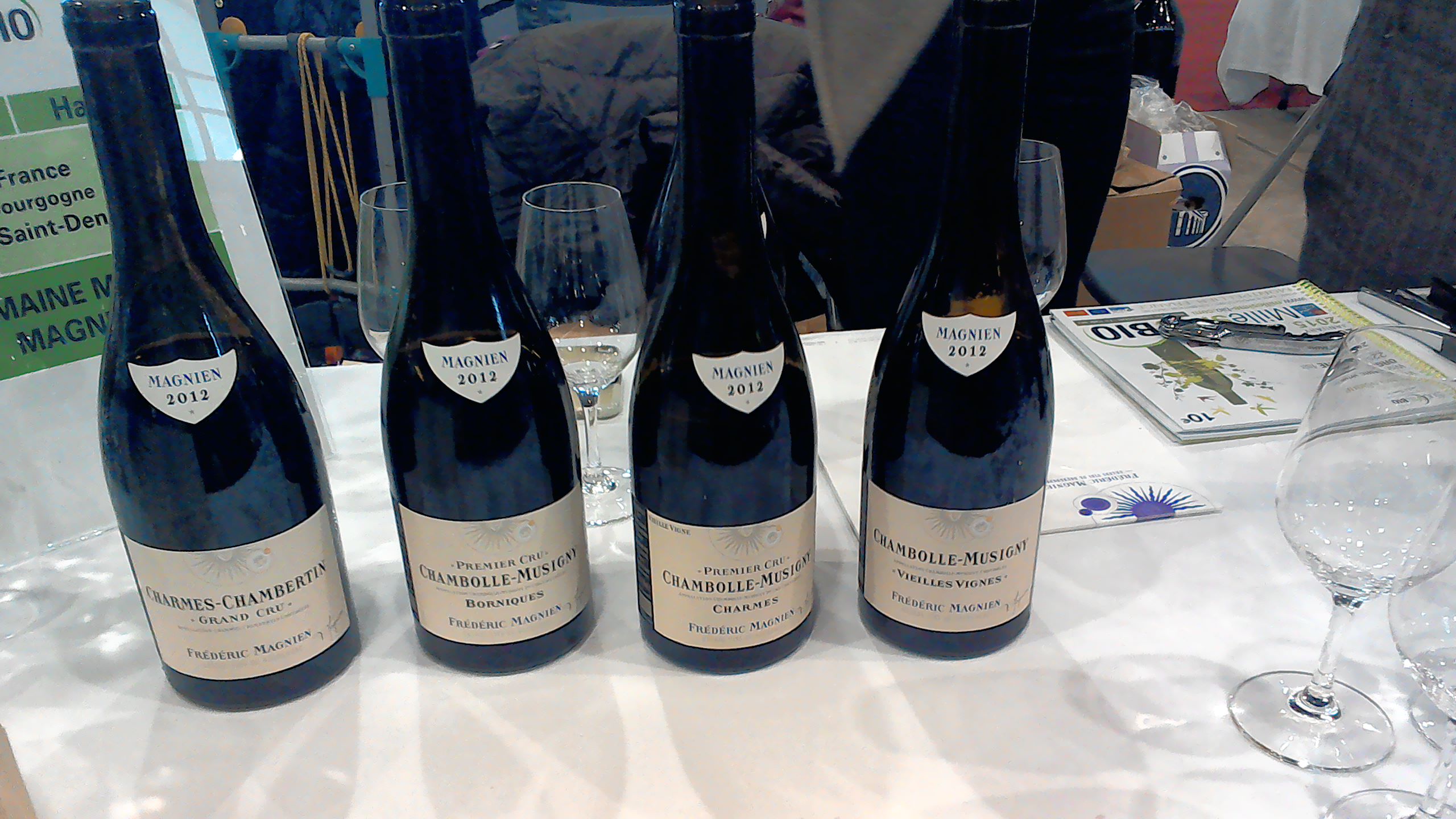
Michel Magnien -nice range but gets really interesting above village level. All 2012. Great balance between freshness and rich Pinot fruit. Lively aromas too.
Morey Saint Denis Les |Millandes 1er Cru was full rich and just lovely
Morey Saint Denis Les Chaffots 1er Cru even richer, ripe and round, Lovely.
Gevrey Chambertin Les Seuvrées Vieilles Vignes was still closed, naturally, but ripe and rich
Chambolle Musigny Charmes 1er Cru was indeed charming and rich
Chambolle Musigny Bornigues 1er Cru – direct at first but then blossoms in the mouth
Clos De La Roche – just a terrific glass of wine even now but with such power and elegance that I can only imagine how it will develop beautifully over the years.
Loire
Domaine de Reuilly – Eastern Loire
Reuilly Les Fossiles 2012 – everything you want from Sauvignon Blanc, clean, green and fresh. Lovely.
I was also offered a Pinot Gris macerated longer on skins than usual, a vineyard in process of conversion to bio, and lovely it was too
Vincent Carème – I’m a big fan of Vouvray, my first real experience of French wine. These were lovely.
Peu Morier 13 – clean, direct full dry Vouvray
Le Clos 13 – rich, mouthfilling lots of fruit and lingering. Oaked but just hints showing.
L’Ancestrale – Pétillant, lovely, fresh mouth filling pleasure. My favourite non Champagne sparkling wine of the salon
The Anjou dry wines were clean, direct and full of lovely fruit especially Pierrebise 12 and Coteaux De Treilles 11. Nice Savennières too.
Coteaux Du Layon 13 was rich, with clean acidity to balance
Quarts De Chaume 13 was even better, with concentrated honey, rich flavours but a clean finish
Clos De la BriderieNice whites including a Sauvignon Gris and restrained Sauvignon Blanc. However the reds shone brightest ● 1877 Gamay sans sulfites 13 ● a Gamay / Cot blend sans sulfites 14 rich and deep ● Cot single variety again 2014 so young but fruity, ripe and lovely
Bordeaux
Clos Puy Arnaud – Bordeaux is not often my thing these days and I usually prefer left bank Cabernet Sauvignon to right bank Merlot yet these were lovely Merlot dominated wines, another prejudice blown away.
Pervenches 13 was enjoyable, a good food wine
Cuvée Bistrot 13 was made using natural methods and I liked the extra edge
Grand Vin 11 was rich, lively and lovely
New Zealand
Clos Henri – New Zealand and a different take to most wines on offer. No worse for that.
Sauvignon Blanc 13 – classic NZ full.
Bel Echo 13 Sauvignon Blanc – riper with passion fruit flavours, so rich and v enjoyable
Petit Clos Pinot Noir 13 – ripe fruit and rich sweet yet clean, nice
Alsace
Faller, Henri et Luc – an unsung domaine but a lovely range fro simple varietal wines to gorgeous sweet wines.
Sylvaner Vieilles Vignes 12, rich, grapey and full from a variety which is not known for being so
Pinot Blanc, mineral and fine. The En Barrique version was lovely with rich flavours
Pinot Gris 13, restrained and delicate,lovely balance. En Barrique, full and rich yet still restrained and hints of things to come
Riesling 13, classic steely, minerally, young. The Vieilles Vignes Fruehmess 11 was lovely, complex and classy Riesling.
Muscat Vieilles Vignes and Gewurztraminer VV were both restrained and full of fresh fruity flavours rather than the blousy style we often see
Vendanges Tardives Cuvée Matthieu and VT Gewurz, both delicious, sweet but no stickiness, fruit, and a clean finish
Muscat Selection De Grains Nobles, fantastic. Sweet wines often get an easy ride but this really was special. A sweet, clean and fresh delight
Barmès Beucher – another good flight of wines
Rieslings shone, Clos Sand was classic Riesling, Leimenthal was richer and rounder but still restrained and fine. Hengst was lovely with classic mineral flavours hinting at sweet notes.
Gewurztraminer Steingrubler was a gorgeous wine with some typical flavours which were restrained with a dryness to balance
Jura
Champ Divin – I tasted a few Jura wines in the main salon and this was easily my favourite especially the whites wines though there was also a very fruity Pinot Noir
Champ d’ Etoiles 11 a mix of Chardonnay and Savaginin had classic fruit with oxidative notes adding to the complexity, lovely
Champ d’ Etoiles 12 was just as good but lighter
Champ d’ Etoiles 10 was better still with age adding richness and complexity
Remember that there were even nore delicious wines at the offline events which, if you haven’t read before, are described here.
It was the 30th January and having promised to write about vineyard work in each month of the year, I felt that a deadline was looming! After tasting wines in Montpellier for a few days it was definitely time to get back to the vineyard the key component of those wines. Jeff took me to the vineyard called La Garrigue which is to the south east of Puimisson, home of Mas Coutelou. It is one of around a dozen parcels of land which Jeff owns, though some are home to olive and fig trees as well as hedgerows and other methods of reintroducing biodiversity into a district which has become one large vineyard. I shall be writing soon about the various parcels and Jeff’s work to safeguard and boost the local environment and biodiversity.
La Garrigue is rather like a small pyramid in form with a peak in the middle and vines around the sides.
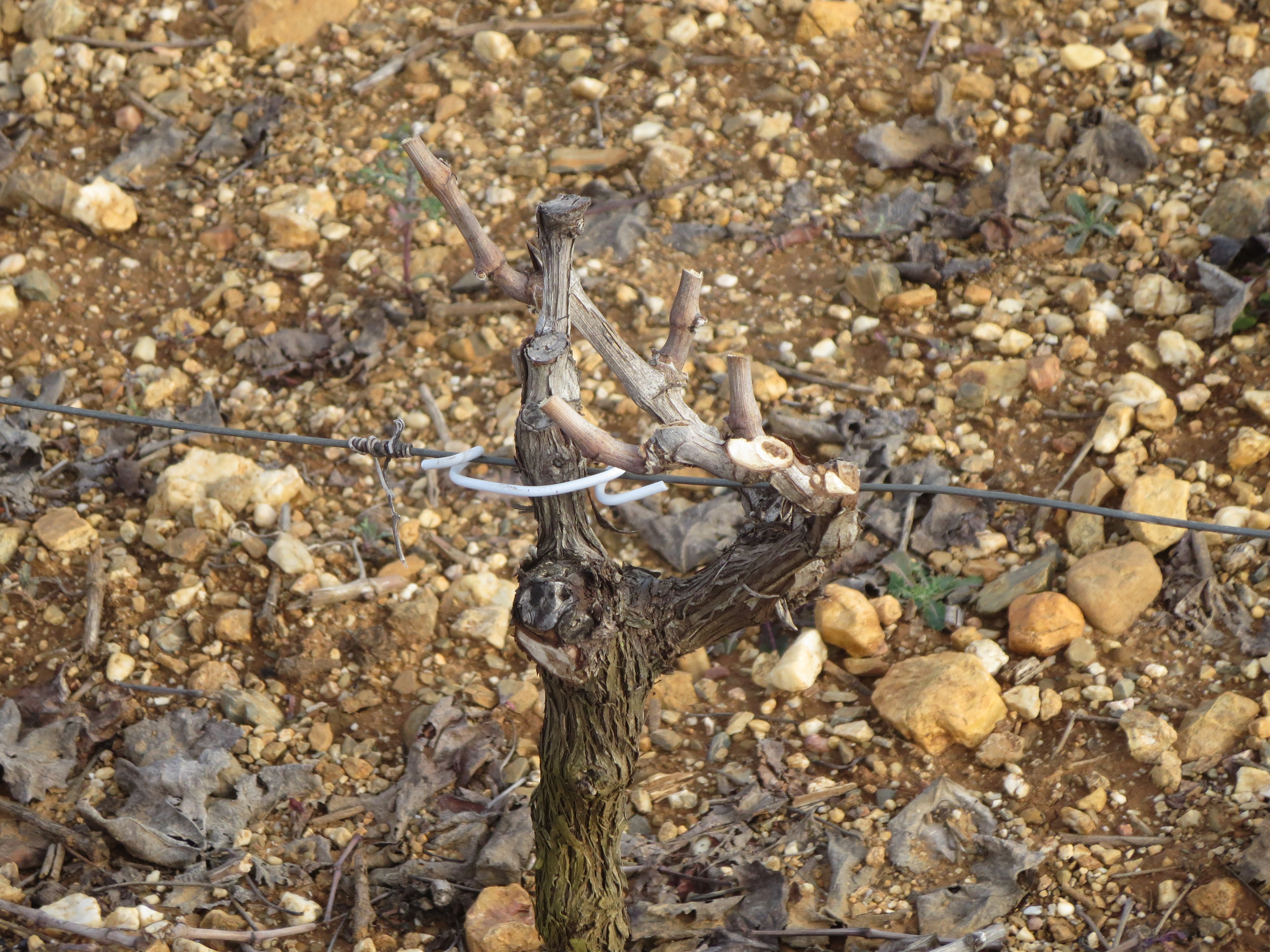
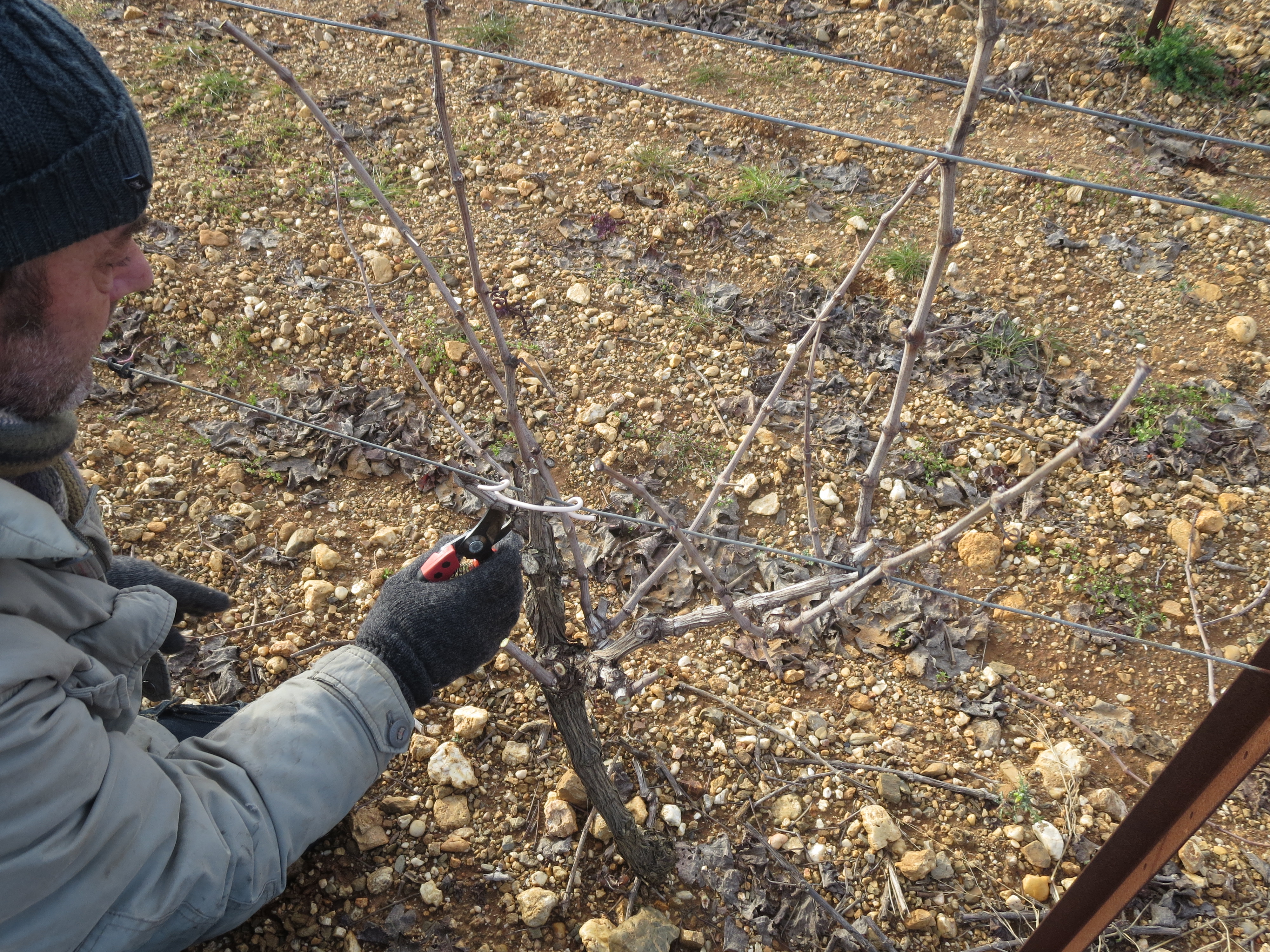
Facing north is a parcel of Syrah planted in 2006, so the vines are still young. They face north so that the freshness and spiciness of the grape variety are preserved rather than being overcooked. They are also planted in rows facing north to south so that the wind blows down the rows, helping to prevent disease and to dry the grapes after rain. Carole was busy pruning this area and the preferred method is the gobelet style. This is the traditional and most natural way of growing vines in the Languedoc and Jeff has preferred to use this method for his vines for a number of years and so these Syrah vines are grown using gobelet.
Syrah vine pruned in the gobelet style
However, as you will see in the video, Carole studies each vine carefully and if she feels it would benefit from a different style she will prune in the more suitable way. This may be because the vine canes are growing too vigorously between the rows of vines and need shaping along the rows. As these are young vines they are being supported by wire trellising. In this case a cordon de royat system might be used.
Syrah vine pruned in cordon rather than the gobelet style which most of the Syrah vines are. It was felt its needs suited cordon better
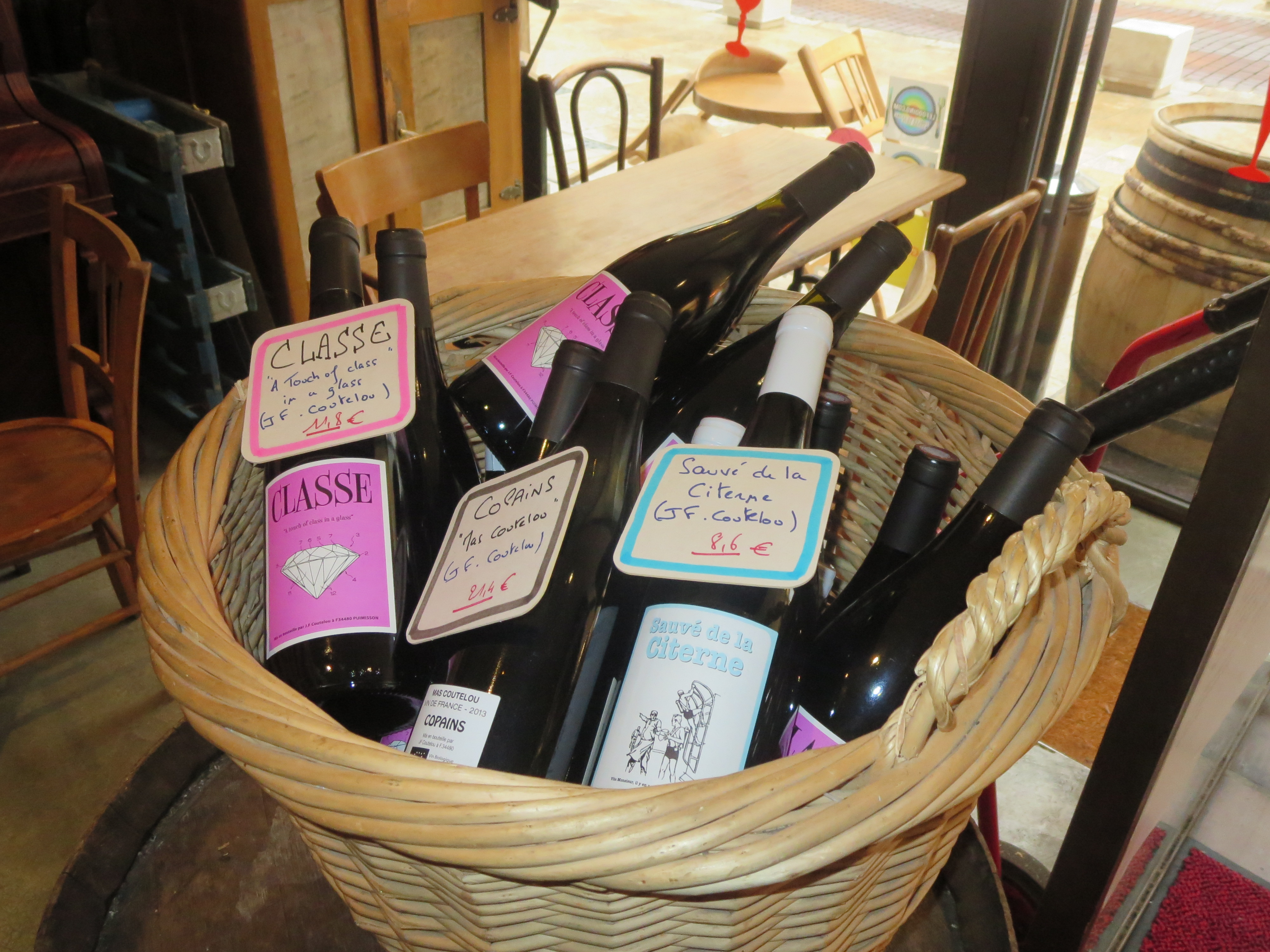
Facing south is a parcel of Grenache vines. This is a variety which welcomes heat and is grown through Spain and around the Mediterranean. It adds spice and complexity to wines and, facing south, the sunshine brings out these characteristics. In this parcel cordon de royat is used as the pruning method. This was the system used when the Grenache vines were planted back in 2000 and so they continue to be grown in that style as it is not advisable or even possible to change them to gobelet now. The Grenache is usually used in the popular cuvee Classe.
Grenache vines,cordon pruning
A magnum of Classe
To the easterly side of La Garrigue is a block of Sauvignon Blanc. This is not a variety often grown in the Languedoc as it gives green, fresh almost acidic notes in its wines and the region is often too hot for it to show those qualities. Facing east, however, means that the sun hits the grapes in the morning so does not overheat or over ripen them, preserving the freshness of the fruit. In this parcel guyot is the preferred system of pruning. This system allows more air to circulate around the grapes and as the white grapes are more fragile guyot training helps to protect their health. The white grapes are usually used in the white blend, PM.
Sauvignon Blanc vines pruned in guyot style up the wire trellising
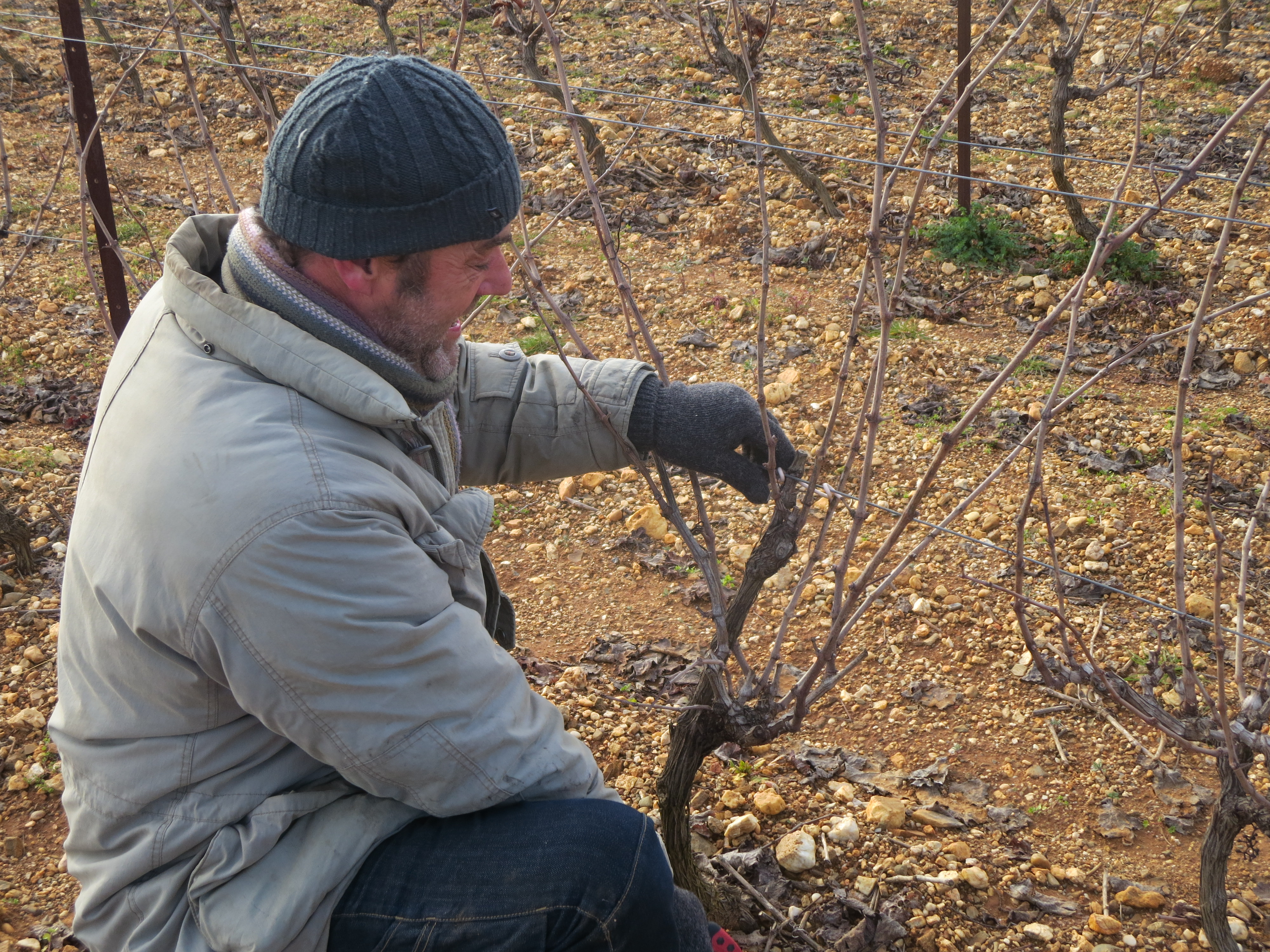
What struck me most, other than a bitingly cold, northerly wind, was how carefully Carole and Jeff study each vine to ensure that it is given a pruning which suits its needs. Direction, quality of the wood, crowding are all considered before they decide what to cut and at what length the remaining cane should be left. Some canes were cut very short, others had 8 to 10 eyes which will produce bunches of grapes. It depended upon the capability of the vine to bear such fruit. It is this care and attention which characterises the work of the skilled artisanal vineyard worker and winemaker.
Jeff studying a Syrah vine
First cuts
Getting to the heart of the vine
The finished vine
I would compare this with a machine I watched around Margon which cut the vines to the same shape and size regardless of their health and
needs. The cutting was fast and much easier work but the pruning was brutal and imprecise with no regard for the individual vines. For vignerons producing cheap, bulk wines I can understand their actions.However, it confirmed in my mind that artisanal vignerons are the ones producing the wines I want to drink
Machine pruning vines, the yellow arm contains the blades
Pruning is not glamorous. But is a vital part of the winemaking year, preparing the vines for when they reawaken in spring and enabling them to produce the right quantity of healthy grapes which in turn will produce great wine.
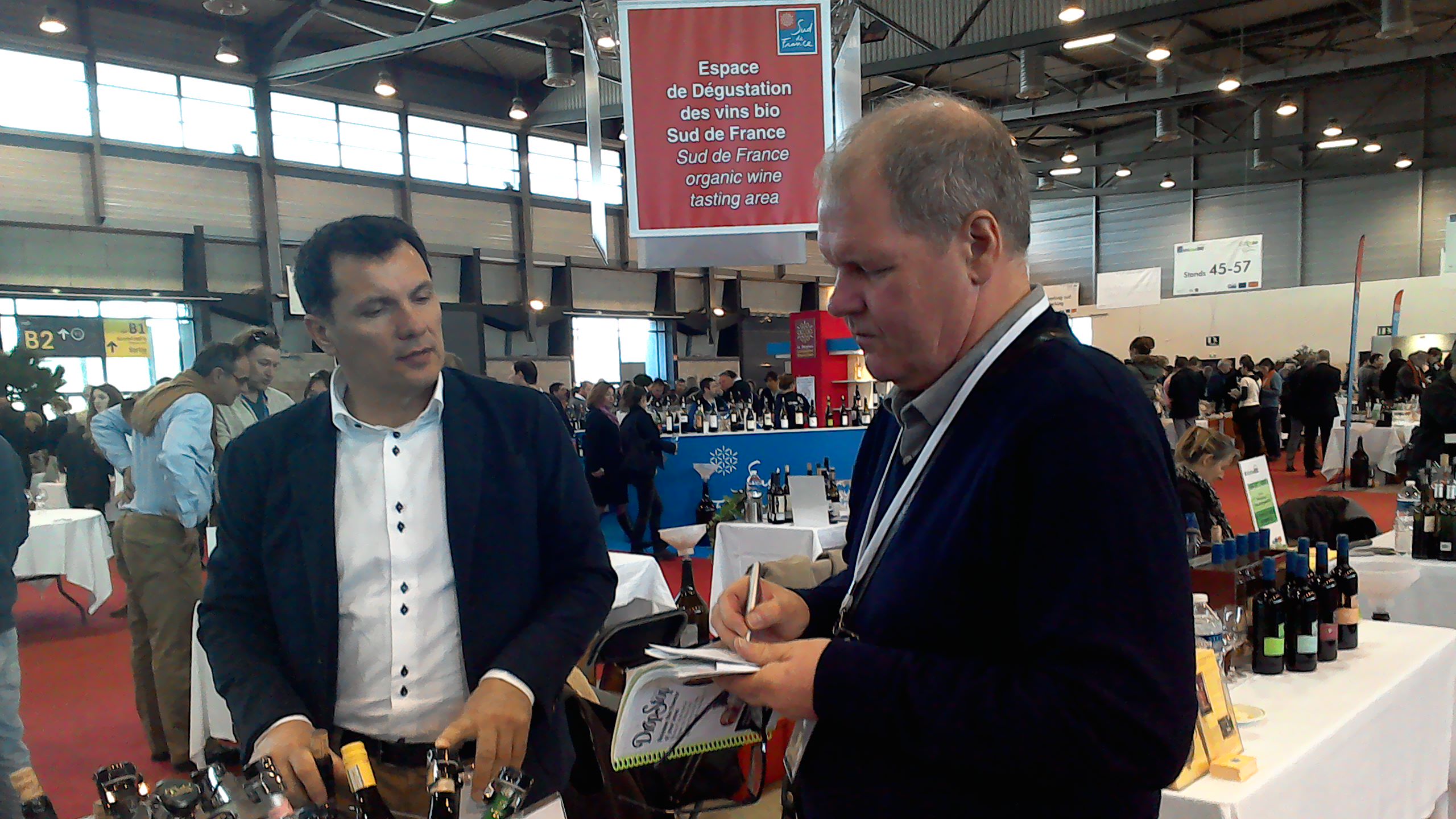
Millésime Bio is the world’s largest wine event for organic wine producers. There were around 800 producers at this year’s event in Montpellier, most in the main salon across 3 huge halls. Each was given the same size table on which to present their wines so that there were no big displays, a nod to equality which I find refreshing. In addition there are a number of ‘offline’ events rather like the Fringe at the Edinburgh Festival. Even over 3 days of tasting I did not get to sample wines from all the producers I wanted to visit.
I attended 4 offline events though sadly missed some I would have liked to attend such as ‘Vin de mes amis’ with producers such as Didier Barral, Yannick Pelletier and Maxime Magnon. However, I greatly appreciated those I did attend and thank those responsible for organising them.
Biodyvin was held next to the Etang des Moures, a lovely location and featured an excellent buffet. The event is based around biodynamic producers and some of the very best wine domaines of France were represented. There were some stunning wines on offer, these were amongst my favourites;
Zind Humbrecht(Alsace) – Olivier Humbrecht was present to explain 5 fantastic wines including a very good Muscat Goldert 2012, a stunning Riesling Clos Windsbuhl 2011 and equally stunning Pinot Gris Rangen Clos St Urbain 2011 all of which are Grand Crus and worthy of the name. Brilliant wines.
Talking with Olivier Humbrecht, great winemaker, nice man
Huet (Vouvray) – a good range of styles with a Le Mont Sec, 2005 Clos Du Bourg Demi Sec, 2008 Le Haut Lieu Moelleux and 2005 Le Mont Premiėre Trie. All were excellent with thrilling minerality and great balance between richness and freshness.
Other great white wines came from:
Marc Kreydenweiss (Alsace) with his Riesling Grand Crus, Wiebelsberg and Kastelberg from 2008
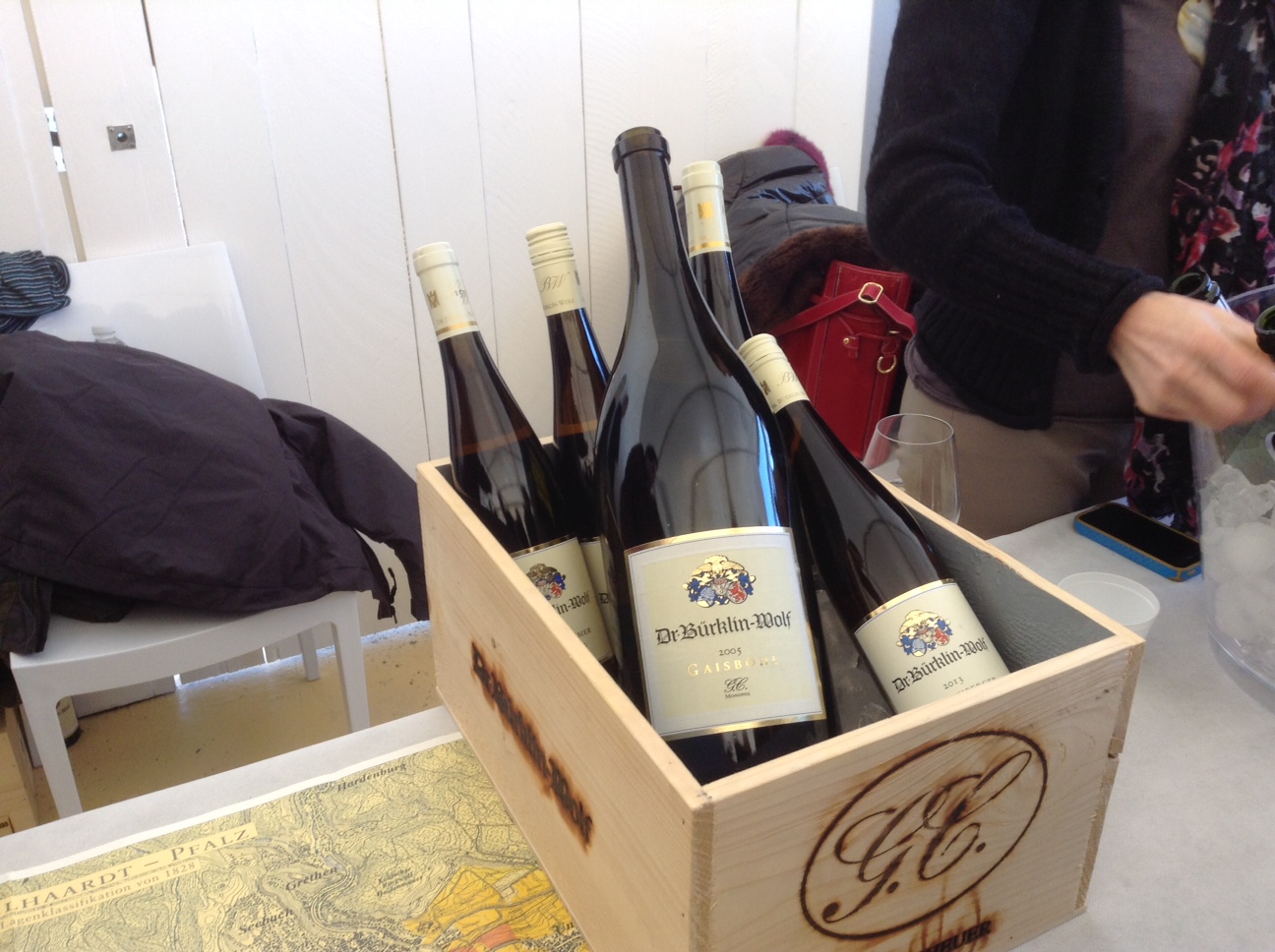
German estate Bȕrklin Wolff with Guisburg Grand Crus from 2012 and 2005
Roussillon producer Olivier Pithon’s Cuvée Lais and La D18 (both largely Grenache Gris based)
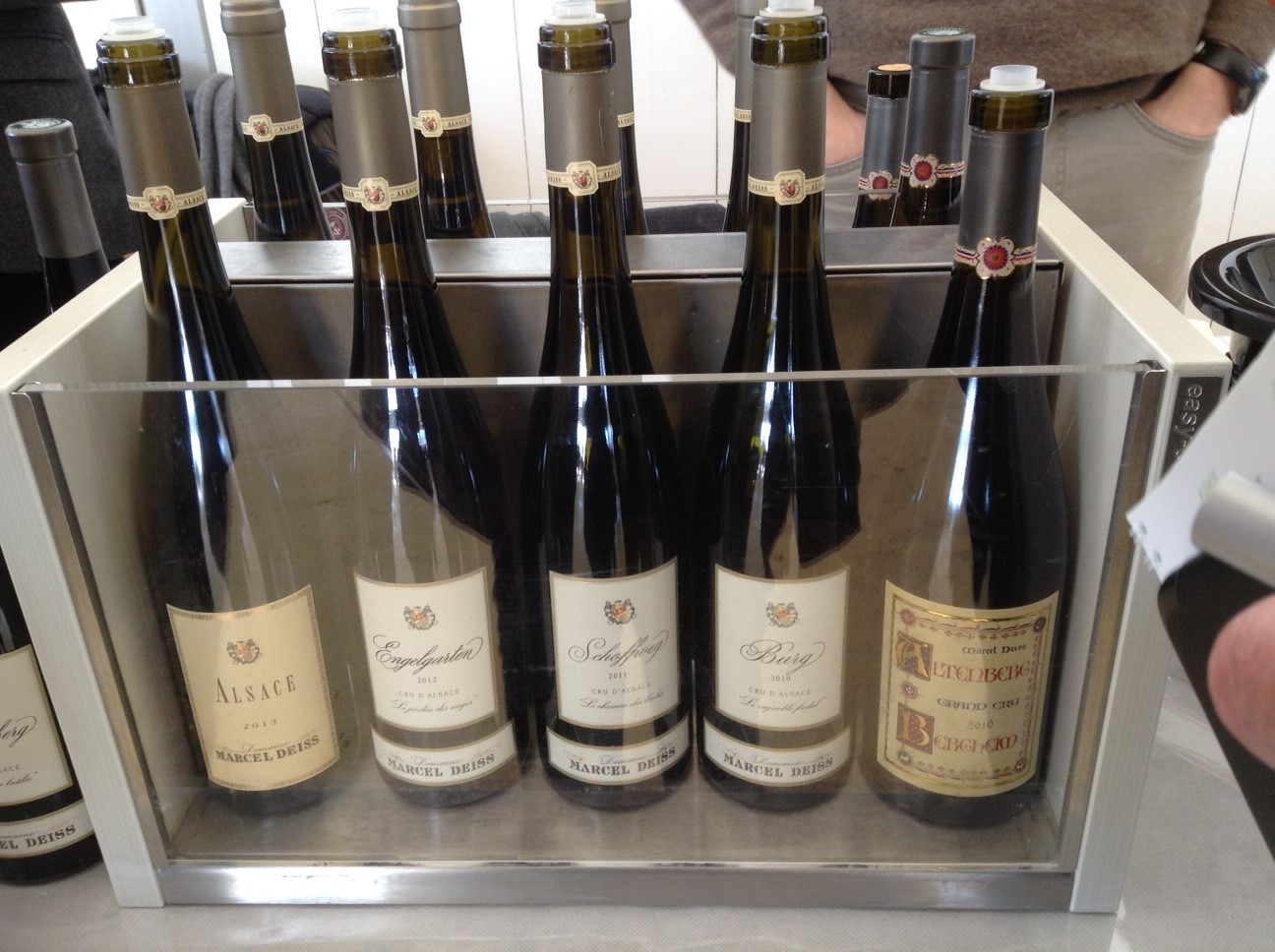
Marcel Deiss Burg 2012
Strangely I enjoyed the whites much more than reds. My favourite reds came from Domaine La Marfée especially Les Gamines and Della Francesca both 2012.
One final recommendation would be the champagnes of Domaine Françoise Bedel, especially the vintage cuvees especially the 2003 and 2004.
Les Affranchis saw a collection of winemakers from around Europe brought together, many of whom were biodynamic or natural producers. My friend Jeff Coutelou of Mas Coutelou (Languedoc) was present though I have not included him in these favourites on the grounds of impartiality!
Chatting with Jeff
I enjoyed many excellent wines here including:
Weingut Werlitsch (Ewald Tscheppe) an Austrian producer who makes excellent white wines based around Sauvignon Blanc and Chardonnay, the cuvées called Ex Vero I, II and III depending on the soil. They were all excellent plus a natural wine made with maceration on skins which was very complex and elegant, named Werlitsch.
I would also add recommendations for another Austrian producer, Weingut Strohmeier another very good range.
Champagne Barbichon offered a series of excellent bottles which brought complexity, richness and freshness to their cuvées of which my favourites were based around Pinot Noir.
Hausherr(Alsace) produce wines with the same philosophy as Marcel Deiss, ie preferring their wines to reflect the terroir rather than just grape varieties as most Alsace producers do. They do have single varietals but also like to blend different grapes from one vineyard. A wine such as Colline Céleste 2012 was delicious, complex and mineral.
Domaine des Bodines (Jura) some lovely white wines including a classic Jura Savagnin 2013 and also a lovely red, Poulsard 2013.
Lemasson Les Vins Contés (Loire) – I am a fan of Loire white wines and have a real difficulty with reds from the region especially those based on Cabernet Franc. However, here there were two reds which appealed particularly, R13 a blend of Grolleau, Gamay and Cot and Cheville De Fer a pure Cot, both 2013.
La Ferme St Martin (Beaumes De Venise, Rhone) had a good range especially the reds Les Romains and two vintages of Les Terres Jaunes mainly Grenache and Syrah based wines. I enjoyed their whole range but these stood out.
Domaine de la Ramaye (Gaillac) showed some lovely wines, again the reds appealed most with the Duras grape offering variety to most reds tasted over the three days. La Pech De La Tillette 2013 and La Combe d’Aves 2009 were excellent wines of power and elegance.
Philippe Tessier (Loire) I particularly enjoyed the Cour Cheverny wines based on Romorantin grapes.
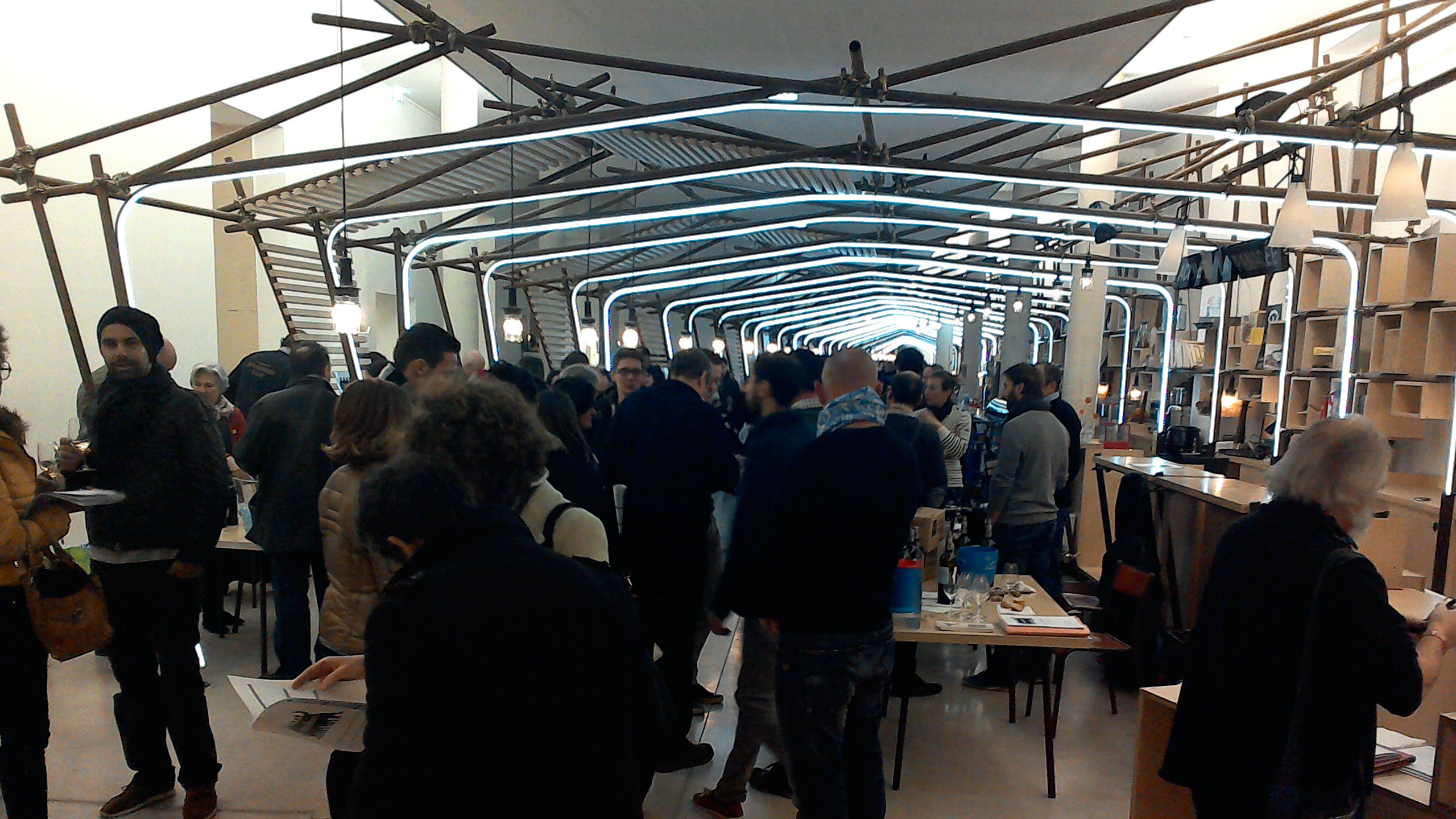
The Outsiders is a group of Languedoc Roussillon producers whose origins are outside of the region. I have enjoyed many of their wines in the past and there are two of my favourite Languedoc producers involved. Held in a very hip and lively venue with good food this was a very enjoyable evening.
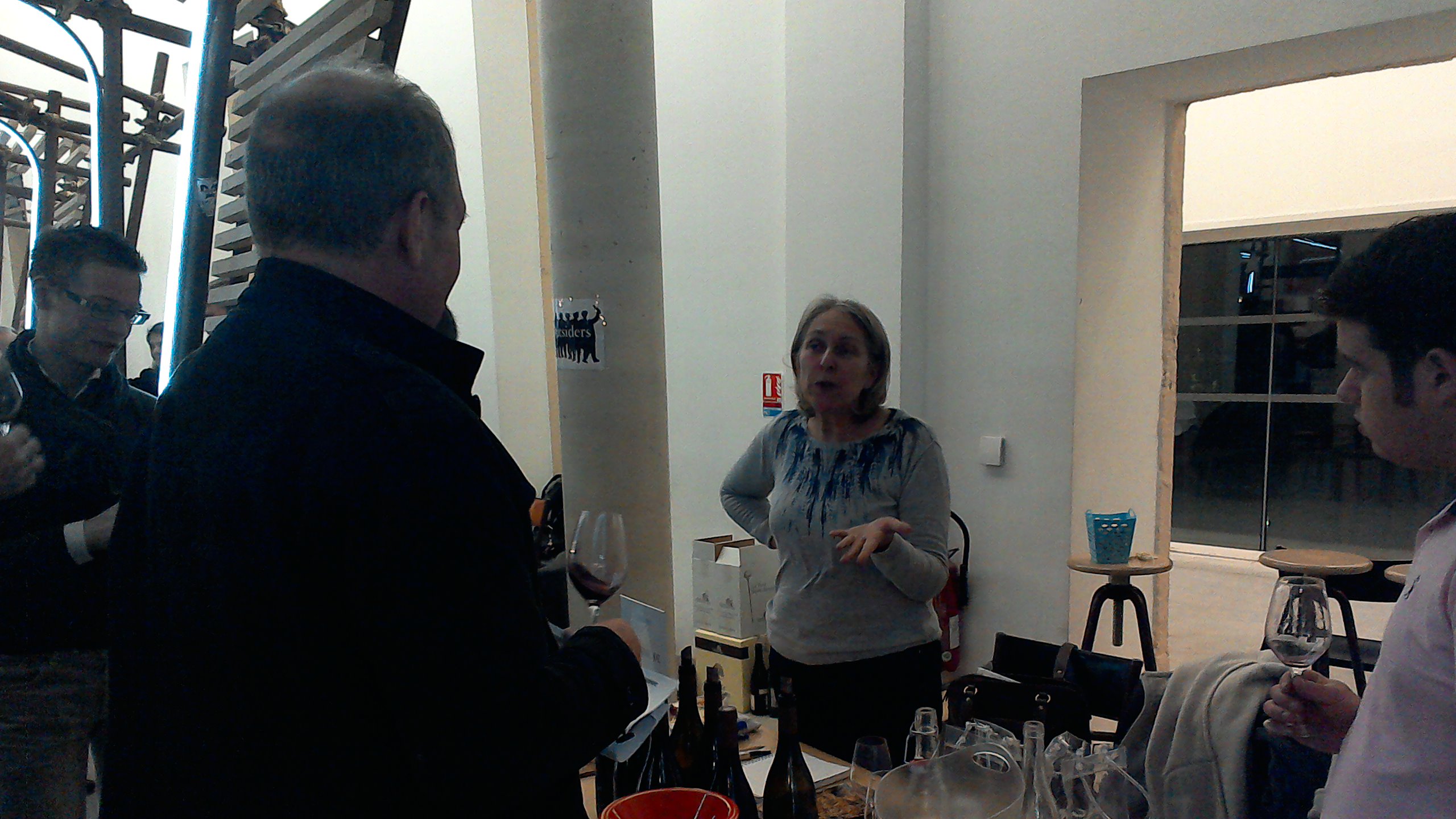
Domaine de Cébėne (Faugères), run by Brigitte Chevalier, produces wines with power and freshness. I have enjoyed all of her wines over many years and this evening was especially by the Carignan dominated Belle Lurette 2013 and the classic Languedoc blend of Syrah, Grenache and Mourvèdre in Les Bancels 2012.
Brigitte tells me how it is
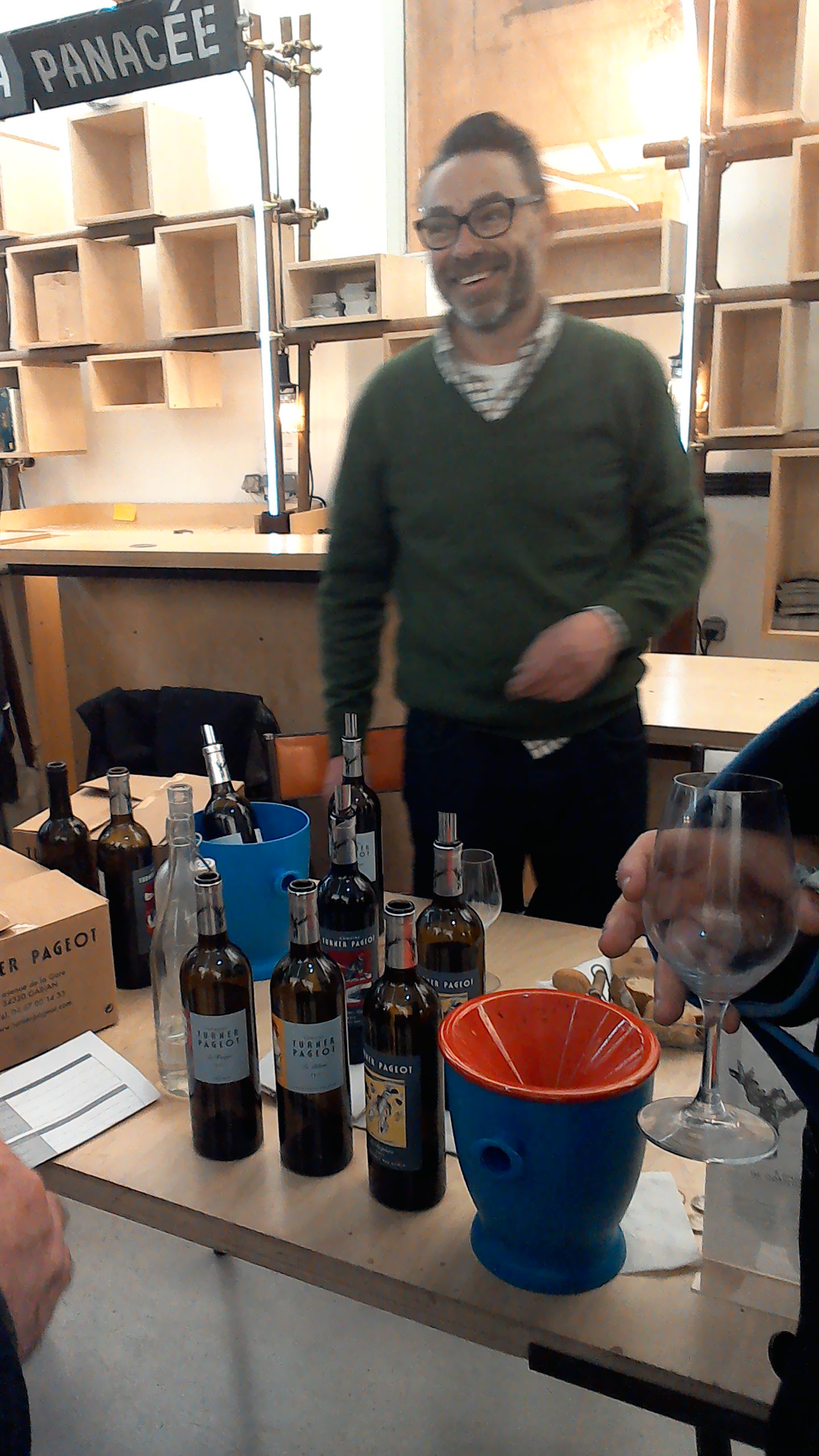
Turner Pageot (Pézenas) is run by Emmanuel Pageot and his Australian wife Karen Turner, winemaker at the Prieuré St Jean de Bébian. Manu is a terrific winemaker, restless in his search to improve his wines and explore his terroir. Every one of his wines is a pleasure to drink, personal favourites were La Rupture 2013, a unique Sauvignon Blanc vinified not to taste of the standard varietal flavours and also Carmina Rouge 2012 a powerful, spicy fresh wine which needs time to develop but is already excellent. I tasted more of the range at the main salon including a new orange style wine which I found stunning and a new Grenache based wine which was profund.
Manu Pageot, winemaker extraordinaire and wearing the same colour jumper as I was!
I also enjoyed the wines of Domaine Sainte Croix from Corbières, powerful yet refreshing and complex. Big wines with a touch of wildness reflecting the Corbieres countryside. Other wines came from guests of the group including some good Pouilly Fumés from JD Pabiot.
Finally I attended Biotop another collection of winemakers sharing a belief in organic, biodynamic and natural ideals. Held in the Phare at Palavas with stunning views along the coast. Three wine ranges really caught my imagination here along with many other wines.
Champagne Franck Pascal is a small domaine which produces a range with a light, floral touch and yet long lasting flavours. Much more complexity than most marque champagnes I have tasted. Non vintage wines were lovely, the vintage wines such as Quintessence 2004 and 2005 were deep, refreshing and rich in flavour and simply delicious. Other bottles included a lovely natural champagne, Serenité. If I was looking for top class champagne this is where I would look first.
Juchepie (Coteaux du Layon, Loire) produces Chenin Blanc wines ranging from dry to vins liquoreux . The dry Anjous were excellent, the Moelleux wines showed brilliance with richness and acidity and long long long lasting flavour. The two cuvées were Les Churelles and Les Quarts, both 2011. Then came two vins liquoreux which were both wines which will stay in my memory forever. They had such depth, such complexity and were just beautiful. I like sweet wines but these were very special. The unctuous sweetness was balanced by a clear line of acidity making the wines lovely to drink. Such wines make you stop and think, wow.
Le Conte De Floris (Languedoc, Pézenas). These are wines which remind me of Burgundy, especially the reds. They contain minerality and freshness and, despite having a light appearance in the glass compared to most Languedoc wines, they have real power and depth. The whites were clean, direct, long and mineral with the 100% Carignan Blanc Lune Blanche 2013 the star wine. The reds are based mainly on blends of Grenache, Syrah and Carignan and carry powerful aromas of strawberries, red fruits and spice with a clean, direct approach which grows in complexity as the wine fills the mouth. Cuvées such as 6 Rats Noirs, Villefranchien and Carbonifère are wines to seek out and enjoy.
I also enjoy the wines made by Les Arabèsques in Roussillon which are full, powerful and show great freshness. Le Roi Pecheur and Les Champs d’Andrillou are excellent wines and will develop beautifully with time.
Saskia van der Horst talks me through her wines. It was good to taste even more of them than I had at Latour De France in November.
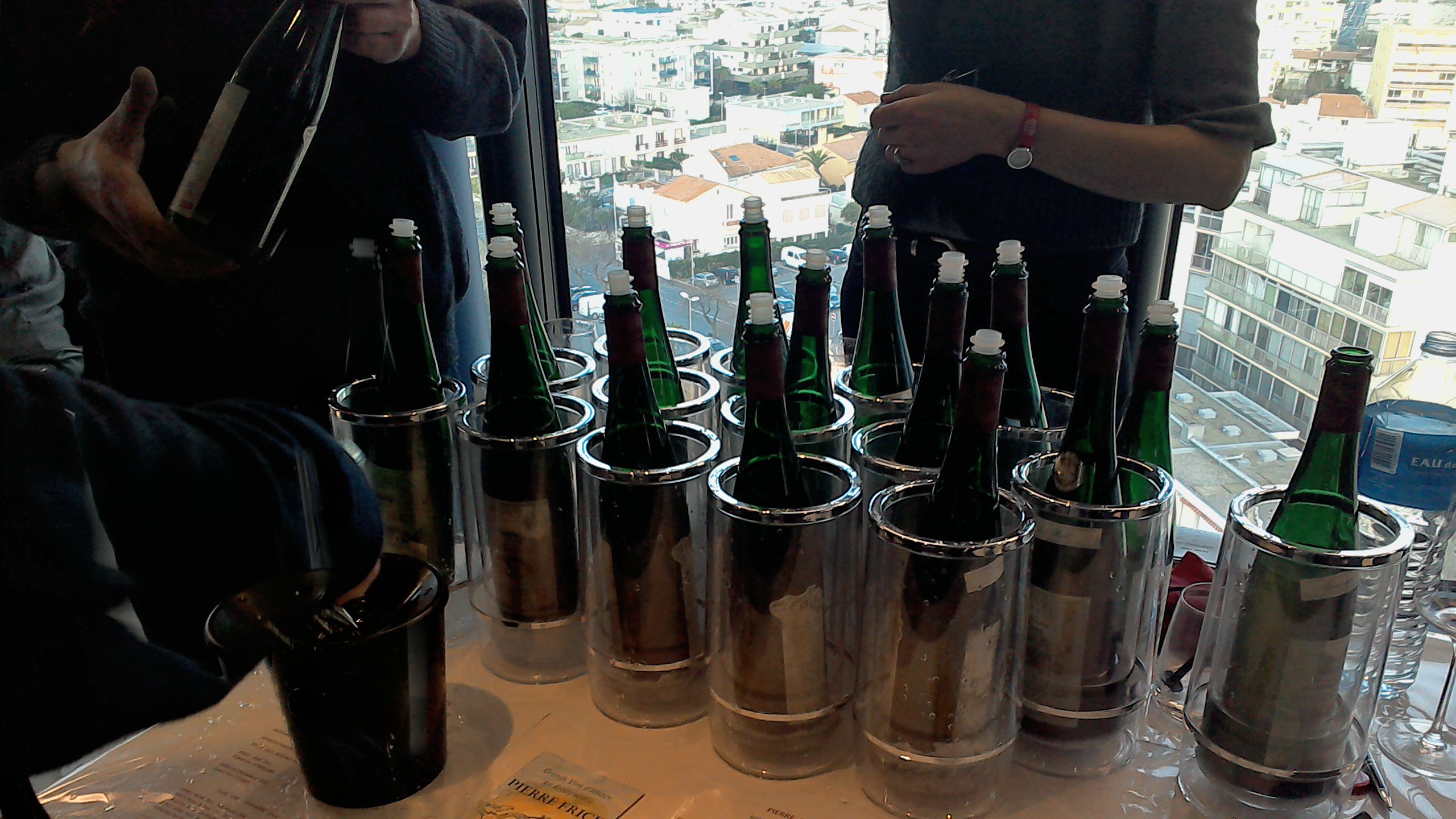
Pierre Frick is another excellent Alsace producer, he showed a huge range of wines, many natural. The Grand Crus Gewurztraminer and Pinot Gris wines were especially good and showed again that the Grand Crus vineyards of Alsace do indeed stand out in the right hands.
Part of the extensive range of Pierre Frick, a major tasting in itself
More lovely Austrian wines from Meinklang including a lovely 2012 Zweigelt red, a very refreshing St Romain 2013 from Emmanuel Giboulot and more good Chenins from La Grange Tiphaine helped to make this another very enjoyable tasting.







































 amarchinthevines