amarchinthevines

Learning about wine, vines and vignerons whilst living in the Languedoc


2 Comments

Vendanges 2016 #4 -cellar and weather

p1010780

En français

The weather has had its say and threatens to shout out loud in the next few days. Should we expect anything different in this most problematic of years? Saturday (Sept. 10th) was supposed to be a day for picking but a heavy shower fell in the morning and that was enough to stop the day in the vineyards. Grapes covered in rainwater would provide diluted juice, no good for quality producers though that did not stop some in the area.

p1010791

Some picked on Saturday

However, there was still work to do in the cellar, remontages and pressing. The previous day some of the team had been clearing space in the solera cave so that the Muscat and Grenache picked from Rome vineyard would have room.

Sunday was a day off though more remontage and cellar work was done. There is no rest. Today (Monday 12th) was a normal day for many vignerons but at Mas Coutelou a big part of the team are the Moroccan pickers and it is Eid Mubarak. Therefore Jeff decided that they deserved the opportunity to celebrate their holy day and so no major picking. An act of respect which deserves mention.

Sadly, that act seems unlikely to be rewarded by the weather. There is a major threat of a large storm on Wednesday which would halt work again and require a few days for the grapes to recover before they could be harvested. More careful triage will also be required. Let us hope that the storm weakens or diverts.

p1010783

Carignan Noir Saturday

Meanwhile Carole, James, Vincent and Charles were out picking Carignan Blanc this morning in Peilhan and the Grenache from Sainte Suzanne was pressed. Work continues despite everything this year throws at us. Tomorrow will see the harvest of Syrah from La Garrigue, the grapes which usually make La Vigne Haute.

p1010785

La Garrigue, Syrah on the left


3 Comments

Vendanges 2016 #3 – Press review

En français

In the last vendanges update I wrote about stages 1-3 of harvest; picking, care in the cuve and pressing. Well, all three are moving on apace.

p1010736

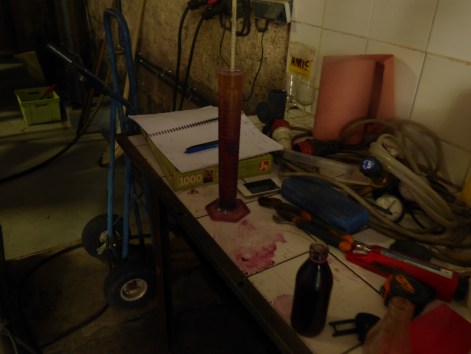
More and more wines to analyse, Jeff can’t keep up!

Today (Sept. 9th) was the first pressing of the year. In the small basket press was the Grenaches from Rome vineyard picked earlier this morning. These were the same vines as the ones I picked last year for my special cuvée. By chance, or design, the younger barrel of that cuvée was given a soutirage this morning. It tasted very well just showing the influence of the barrel. As the other barrel and 27 litre glass bottle are much more fruity the eventual assemblage should be nicely balanced. Here is last year’s Grenache saying hello to its younger brother.

p1010754

In the big press was the white picked last week, Maccabeu, Muscat (Alexandrie and Petits Grains) and Grenache Gris. The press is big but the bladder inside lightly squeezes the grapes to release the juice, a gentle giant. The juice now goes into cuve and will ferment into the finished wine.

p1010751

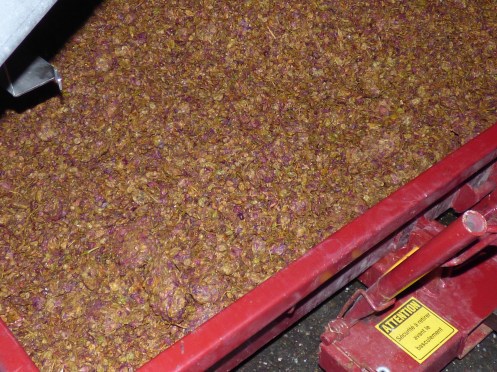
Skins after pressing, the pinkish coloured ones are Grenache Gris

Meanwhile stage 2 continues apace with remontage and pigeage of the growing number of wines now in cuve. Stages 2&3 require increasing effort, there was very little picking today though tomorrow will be busy again.

p1010738

Jeff and Louis Pérot working on the cuves

Wednesday saw a full day of Syrah from Segrairals. The grapes were good and often very juicy. There are sections of the parcel which seem to retain moisture and help the grapes even in such a dry year as 2016.

Thursday was the busiest day so far. A morning of picking Peilhan white grapes, mostly Maccabeu, Grenache Gris and Muscat. These had suffered through the attack of mildew in spring time and some careful triage was necessary. Nevertheless, small in quantity but good quality.

p1010733

5SO 2015 greets this year’s grapes

In the afternoon arrived the Cinsault from Segrairals which makes 5SO Simple. Cinsault gives bigger berries with lots of juice. The juice came in at around 10.5%, Jeff said that it would be a ‘vin dangereux’ as it would be very easy to just keep drinking it.

p1010757

Team Coutelou

p1010761

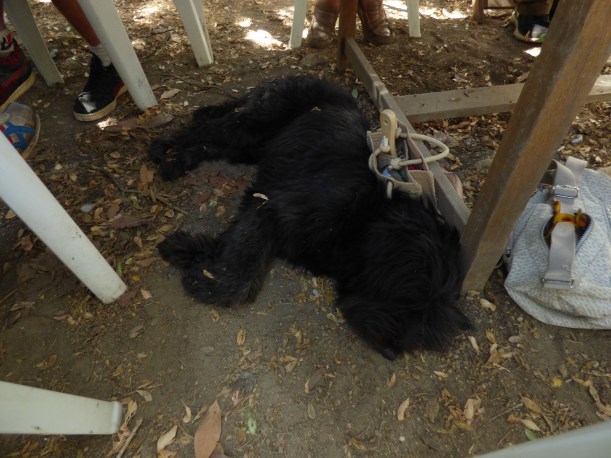
Plus one sleepy dog


Leave a comment

Vendanges 2016 #2 – adolescence

En français

When I mention vendanges to most people they think of grape picking and, maybe, putting the grapes into a tank (cuve). However, vendanges means much more than that and we are now entering stage two of the process.

When the grapes have been picked and sorted they are stored in a cuve where the juice interacts with the skins extracting flavour, colour and also coming into contact with the yeasts which grow naturally on the skins. These yeasts then begin the process of fermentation which turns the sugars in the juice into an alcoholic wine. This mix of juice, skins, pips and flesh is known as must.

p1010698

Checking progress

So, whilst picking continues at Mas Coutelou Jeff must already plan what is happening to those cuves of grapes which were picked a few days ago, You will remember from #1 that we picked Grenache and Syrah on days 1 and 2 and that they were in cuves 2A and 2B. They are picking up colour and the fermentation means that the sweet grape juice of last Wednesday is already very different. Still plenty of raspberry and red fruit flavours but the sugar levels have fallen and the liquid is now more austere, a little acidic and with a weight of alcohol. It has turned from child into young adult.

p1010697

Today – Grenache and Syrah has matured

To ensure that the grape skins do not give unpleasant flavours, volatility etc., Jeff must ensure they do not dry out as they float on the juice, forming what is known as the cap (chapeau). Therefore, wine is pumped from the bottom of the cuve over the top of the chapeau to push it down a little and to moisten it. This is known as remontage.

p1010696

Carole carries out a remontage

Alternatively, an instrument or hand can be used to push the chapeau down into the juice, a process called pigeage.

p1010670

James performs a pigeage

When Jeff is satisfied that the juice is ready and has had optimal skin contact he will begin pressing the must to leave the final juice. We await the first press as yet but it will be in the next couple of days as the Grenache and Syrah are already showing their adolescence.

Meanwhile picking continues. Friday saw Sauvignon Blanc and Muscat À Petits Grains as the first white grapes of 2016 at the domaine. Monday saw the picking of the Merlot from Colombié which will, unusually, find its place in the Coutelou cuvées. I am no great fan of Merlot but the grapes were lovely and the juice tastes especially rich and full.

Today (Tuesday) was Flower Power day, sadly the snails won the battle this year. They ate so many of the buds in Spring that the vines struggled to produce much. The dryness merely confirmed Font D’Oulette would be low yielding in 2016. Around twenty cases is not much return for such a lovely parcel of vines. High quality grapes from the various cépages but very low quantity.

Clairette and Oeillade from Peilhan with some Grenache Gris and Muscat Noir was added to the mix. Also picked was the Cinsault from Rome which was in good condition with nice big berries. So my two favourite vineyards are already harvested.

p1010694

James models the lovely Segrairals Syrah

Finally, some lovely Syrah from Segrairals was picked and there will be much more of this tomorrow. This Syrah is such good quality that Jeff is already excited about what he can do with it. Segrairals is the biggest vineyard of the domaine and is also serving up some of its best fruit.

p1010688

Charles, Vincent and the new sorting table

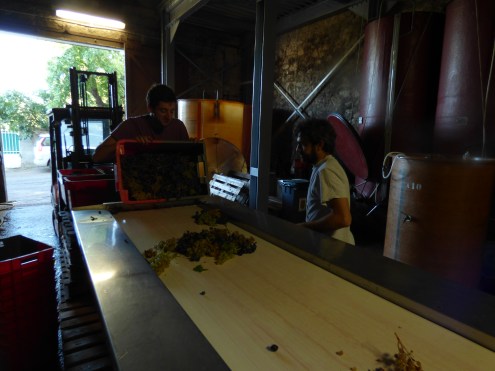
A new sorting table was brought into play this week and it is certainly much more efficient than the previous method of sorting from the cases themselves. Triage of better quality but also much speedier too. The table is already paying for itself.

So, stage 1 (picking) is well under way, stage 2 (the must in cuve) is under way for some and stage 3 (pressing) will shortly begin. The jigsaw is already becoming more complicated for Jeff Coutelou.

p1010667

There really is a puzzle under there


Leave a comment

Vendanges 2016 #1

P1010563

First cuts of 2016 at Mas Coutelou

In 2015 vendanges began on August 21st, in 2016 things kicked off on August 30th. The protracted cool spring and the drought contributed to a later harvest though not so late as predicted because of the hail on 17th August. This damaged some grapes especially in Sainte Suzanne (Metaierie) and Jeff decided that the grapes needed to be picked as they would lose acidity if left on the vine.

On the 30th it was the Syrah which was picked, unusual for a vendanges not to start with white grapes. Syrah normally produces small berries but these were especially small. The cagettes in which the grapes are transported back to the cave are usually running with grape juice, requiring regular cleaning. Today they were virtually dry. Jeff calculated that the volume of juice produced was around half of the normal harvest which is not good news. Hopefully other grapes in other vineyards have fared better but we shall see. This is all the result of the protracted dry spell in the region. Rainfall, other than the occasional storm where the rain comes too heavily. has been pitiful. The vines have found it hard to cope and give water to swell the grapes. The hail confounded the problem by shredding leaves which would help to nourish the grapes.

The good news was that the grapes gave lovely juice; fresh, very raspberry fruit and they smelled of beautiful warm spices. The measure showed potential alcohol of 12% so it will make a light, fresh Syrah wine or blend.

P1010583

There was a full house to help out. Michel, Julien and Vincent as usual. We were joined by James, an Australian who is staying for the harvest to help his learning for making wine in the future. Charles who spent a few days with us last year is also here for a longer spell, he adds humour and energy. Jeff’s primary school classmate Maylis  was also present spending the day in the vineyards. And Céline, Brice and their two girls were here on the way back from their holidays, it is always fun to see them.

One or two bits of machinery creaked under the strain of a new harvest but the changed cellar made cleaning so much easier. The team is taking shape for the challenges ahead. The Syrah sits in cuve 2A, I shall keep you up to date with its progress and path to the bottle.


Day 2, August 31st

P1010610

The last of the Syrah was picked first. If you look at the photo of the vines with James picking you will notice the lack of foliage and therefore why Jeff felt the need to harvest now. First official analysis of the Syrah from yesterday showed healthier than expected acidity and potential alcohol, a welcome fillip.

Then came the Grenache from Ste. Suzanne, in many ways more problematic than the Syrah due to mildew earlier in the year. However, when it came in there were many good firm bunches of healthy fruit with possibly a little more juice than the Syrah. It was a very hot day so Jeff worked some magic by using frozen pellets of CO2 to stop the juice from starting to ferment too soon so that it doesn’t extract too much of the flavours of the dryer grapes before it is moved for the first time. This was the first time that Jeff has tried this method due to the nature of the vintage and its drought. Difficult to take a photo as all you could see was the mist of the frozen gas.

P1010615

The juice tasted healthy and fresh with red fruits, a little vegetation still present. Yesterday’s Syrah was already darker, more weighty and very different to yesterday. Wine alchemy. It now sits in cuve 2B next door to the Syrah.

P1010626

Grenache grapes

Tomorrow (September 1st) is a new moon and so no picking or work. It is also the 2nd anniversary of my arrival in France, days like this remind me why that decision was a good one.

Salut to Jean-Claude, tu nous manques

P1010624

The guardian


2 Comments

Full steam ahead

En français

There was something of the nautical in these two photographs hence the title.

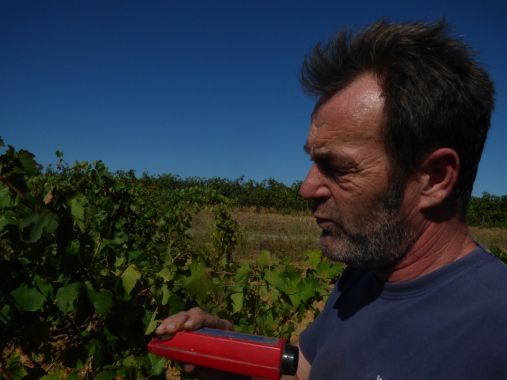
The preparations for the vendanges are in full swing, the hail has speeded up the start date as damaged grapes, especially, the Grenache in Sainte Suzanne, need to be picked earlier than foreseen. A tour of the vineyards on Wednesday morning with Jeff was an opportunity for him to taste the grapes and use the refractometer to measure the sugar and potential alcohol in them.

P1010534

Picking will require even more care than usual in some parcels as the bunches will need to be checked thoroughly for any damage due to mildew, hail, vers de la grappe or any other issue. Many grapes will be left on the ground. The rest will be sorted back in the cave and Jeff has invested in a new sorting table to ensure scrutiny can be absolute. No chances will be taken as always, only healthy fruit will go into the wine. That is the how natural wines have to be, made from the healthiest fruit as nothing will be added to it to disguise faults, unripe grapes or unhealthy grapes.

P1010510

Karcher washer has been well used

In similar vein everything has been cleaned down, washing equipment is a time consuming but vital part of ensuring healthy grapes. Harmful bacteria are the enemy, with no SO2 antiseptics we have to make sure that everything is spotless.

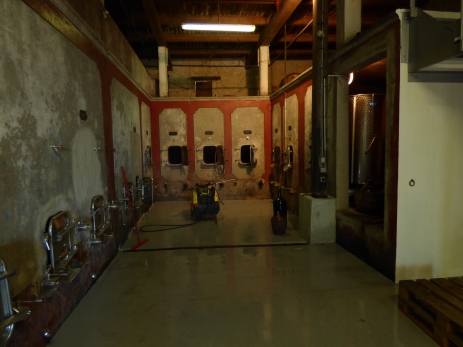
And there have been plenty of other changes in the cellar to ensure that the winemaking will be top quality. Out has gone the old press and some big tanks (cuves) as I have mentioned before. In has arrived new stainless steel cuves, temperature controlled. There is more room, a new resin covered floor to make cleaning easier.

Steel gantries have been erected to make it easier to access the cuves from above. This will make it easier for any whole bunch winemaking as the grapes can be put in tank much more simply and with more checks on quality. It will also be easier to carry out pigeage (punching the grape skins, pips etc down into the juice) and remontage (where the juice is pumped over the top of the cap of grape skins etc). A new staircase to the gantry makes life a lot easier and safer too.

Some of the big cement cuves have been divided to enable Jeff to make smaller quantity wines which will offer more options at the time of assemblage.


So, Monday. We are ready. The grapes will be ready. Let the vendanges begin.


5 Comments

Neighbours

En français

“Neighbours, everybody needs good neighbours”. So went the theme tune to a very popular Australian Television show. Well, it seems the message has not reached Puimisson.

Back in the spring I reported that the Carignan vineyard, Rec D’Oulette (also known as Chemin De Pailhès), had been vandalised. Jeff had planted lots of trees and flowers to create biodiversity in an area of grapevine monoculture. A neighbour decided to mow the flower patch one night.  And he has struck again.

P1010059

In happier days

On Monday evening Jeff messaged me to say that two trees had been destroyed. He planted the trees (a pomegranate and a hazelnut) five years ago, watered them, looked after them. Now his money, his time and his care lie in crushed and broken wood on the ground. His neighbour had taken a crushing machine to them, a girobroyeur.

What sort of neighbour would do such a thing? Certainly not the co-operative sort which he would claim to be (if you understand what I am saying). Rather, a neighbour driven by jealousy, suspicion, anger. A neighbour whose own vines are pumped high and deeply coloured with chemicals and irrigation. A neighbour who cannot understand that somebody else might think and act differently. A man with no respect for his neighbour, his colleague nor for the land and nature which gives him his living. What sort of vigneron is that? But let us leave that wretched individual and turn to Mas Coutelou and its future.

Jeff was understandably upset, angry and disheartened by his neighbour’s actions. He wondered whether he should just give up, tired of providing the lone oasis of sustainability in a desert of land damaged by chemicals, erosion and overworking.

Happily, the support of many, via Facebook for example, has heartened him and he has a plan in place which will help to fight back with your help. I shall leave him to announce that plan. Meanwhile I urge you to read Jeff’s words, published on August 4th which explains his determination and motivation in fighting for nature.

Ode To Biodiversity

“Thank you all for your messages of support for the testing time I have just come through.

I do not proselytize about my way of working and I do not demand that my colleagues should join me but I feel I have the right to do what I want on my land. When in 1987 my father took the decision to join Nature and Progress, he was considered as some kind of extraterrestrial. The department of Hérault at that time had less than 200 hectares of vines grown organically, there are more than 20,000 today. (500 acres / 50,000 acres)

I do not think that we can correct nature because it is always stronger than man and in the end will  win every time. Just consider the viticulture textbooks from the start of the 20thC which suggested that with two treatments of sulfur and one of copper would see you through to harvest. By trying to produce more, by using increasingly powerful products, we have created such resistance to them in the vines that today some need more than 15 chemical treatments to achieve the same result.

We cannot blame the previous generation, they did not know. Modern agriculture has brought social progress for farmers. The replacement of the horse by the tractor, weed killers to replace the pick and hoe, chemical fertilizers to produce more at a lower cost, modern agriculture has helped to soften drudgery.

But now everyone knows. Groundwater is increasingly polluted and you have to go further and further to find barely drinkable water which must go through ever more costly treatments to just about meet the required safety standards. The land is less and less fertile and requires ever increasing amounts of fertilizer to be able to produce the same quantities.
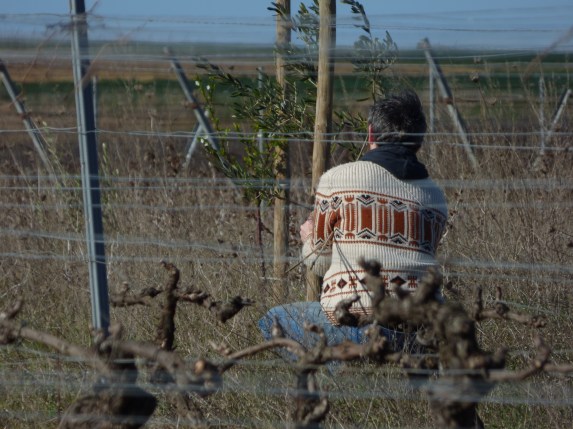
P1000439

Vincent staking the olives in Rec D’Oulette

Since we cannot change nature, we must try to adapt to climate change and seek solutions to continue making wine as naturally as possible. Planting trees, shrubs, flowers, increasing plant life is part of a considered approach for the future.
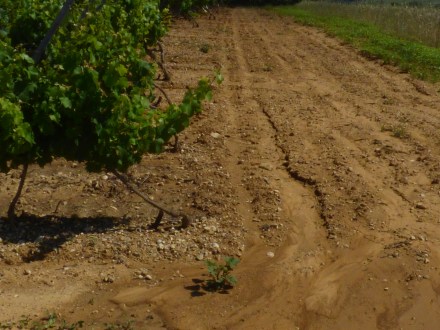
P1010197

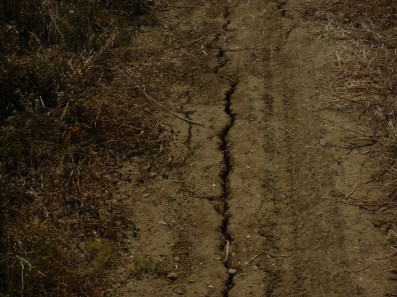
Erosion in a neighbouring parcel

It is about recreating areas of biodiversity … By continually removing hedges, fruit trees, paths, streams, to create larger and larger parcels, we create areas of vine monoculture which only make them more vulnerable, requiring more and more interventions and more exposed to erosion. We have removed balanced spaces where everything had its place in order to create spaces shaped by man which certainly made it possible to work more efficiently but, also, where man is obliged to act, to correct. For example, a bat can eat 2,000 insects per night, if we had only maintained their habitat we would not have to spray and to fight against vers de la grappe. (A disease caused by those insects)

It is about fighting against global warming … You have all at some time, when the summer sun is hot, enjoyed taking shelter in the shade of a tree. It is the same for the parcels of vines. By planting trees around the vines, we protect them from the drying summer winds. Moreover, passing through the trees, the wind naturally cools down. This is an alternative, sustainable approach to that of putting in place a system of irrigation, which may well effective in the short term but one day may well be limited or banned, as the water table is polluted by this water which comes from the Rhône.

It is about restoring beauty to the landscape …. Work in vineyards is certainly mechanized but is also done on foot. The person who works in a parcel needs to have something which marks the horizon, which allows them to see the end … As plots have become larger, they are no longer on a human scale and the work becomes mechanical, automatic, without love … To look up and see a bird land on a tree, to cool off under an olive tree at the end of a row of vines, to see butterflies and bees in the spring coming to rest on patches of flowers; these are the small pleasures which allow those who work there to feel better and to give more love to their work.

It is about an investment in the future …. In the digital age where everything is about the immediate, it is almost a militant act to plant trees that we will not see fully grown. There was a saying not so long ago, “the olive tree of your grandfather, the mulberry tree of your father, the grapevine of yourself.” Today we see a fashion for displacing ancient olive trees from where they first grew to decorate city roundabouts. We live so much in the now, demanding quick results, that we want to apply the same to nature … To plant a tree involves work, care, money but, especially, a lot of fun. To watch it grow, to attach it to a stake, to prune it to give it shape, to look after it so that it grows, to imagine it fully mature after we have gone; it’s so many things that may seem trivial for some (certainly for the bastard who this week destroyed the trees I had planted 5 years ago), but which mean so much to me.

P1000431

Apple tree in Rec D’Oulette

So, what to do? Give up? Surely not …. I said when they crushed my flowers in spring, that in the next year we would plant kilometres of flower patches … Well , though some might not like to hear it, we will continue in the Autumn (Fall) to plant more trees around the vineyards. We will continue to look after them. We will continue to imagine them when they are fully grown. And it will be with great pleasure that we will share this love of nature with you when you come to visit us.”


2 Comments

Between a rock and a hard place

Error
This video doesn’t exist

En français

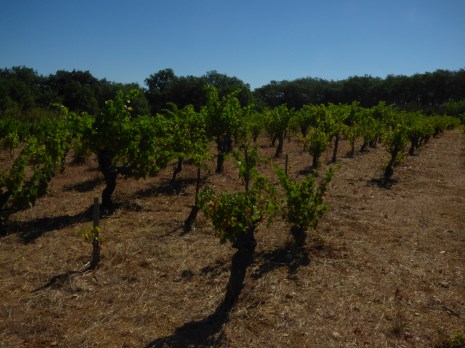
Back in the Languedoc and, the first morning, I went over to see the vines. Jeff had sent me a message that they were in real stress because of the lack of rainfall. Ironically we had driven south through France under leaden skies and through fairly steady rain, until we reached the Languedoc where the skies turned blue and the temperatures rose. It has been very hot here throughout the three weeks I was away and, following a very dry autumn last year and not much rainfall in 2016, the vines are definitely in need of a good drink.

P1010439

Stressed vines

P1010435

Clear signs of drought

I have written many times this year about the vine stress due to very unusual seasons, the warm winter, cool spring. Sadly, summer has also added to their difficulties. Sure enough the vines look dry. The apex of the vine is often a good way to tell their health and they look tired and bare, almost burned.

To safeguard the health of the young, newly planted or grafted vines Jeff and Julien were busy watering them in the Flower Power vineyard, Font D’Oulette. This is allowed as they are not grape producing this year. Straw was then placed around them to keep the moisture inside. Julien showed his dedication by doing more of this work at night time.

P1010431

Even Icare was feeling the heat despite his haircut, he kept hold of the stick when it was thrown as if to say I’m not chasing after this anymore.

Jeff also informed me of yet another problem, ver de la grappe. This is the larvae of a moth which feeds on the grape. I took a photo of an affected grape last year.

images

There are chemical treatments available to prevent and to treat the problem, no use to an organic producer of course and these chemicals are especially harmful, you can’t use the grapes until 21 days after spraying.

So, for Jeff the treatment involved spraying clay onto the vines to try to make the grape skins less attractive to the moth so it will lay the eggs elsewhere. This was only the second time in twenty years that he had sprayed against ver de la grappe. Also in the spray was fern and seaweed, the fern is a natural insecticide and the seaweed gives a health boost to the vine. However, having sprayed this morning (July 31st) Jeff was hoping that the much needed rain would hold off for a couple of days to allow the spray to work.

You can guess what happened next. A storm, heavy rain, much of the spray washed off the grapes. It is that sort of year, nothing seems to be going right. The rain which did fall was minimal and only undid the good work. The worst of all worlds. To spray or not to spray? To rain or not to rain? Caught between a rock and a hard place.

P1010432

Colour and life remains


As I made my way around the vineyards there were plenty of good grapes to see, véraison (the changing colour of red grapes) has begun especially amongst the Syrah and Grenache of La Garrigue.

And I spent some time in Rome, a very parched looking vineyard but the ideal place to reflect upon its creator, Jean-Claude. There are some things to be thankful for even in this difficult year.

P1010456


Leave a comment

Natural terroir

P1010223

En français

The choice of my recent wine of the week, Olivier Leflaive’s Burgundy Oncle Vincent 2012, made me think about how wines change. When I used to regularly visit Leflaive and Burgundy in the 1990s the style of wine was very oak influenced, a response to the New World oaked wines and to the influence of Parker / Rolland in Bordeaux. The wines smelled of vanilla and tasted of wood. Subtlety was often lost, especially on the lower ranked wines. Happily those days are in the past (though I still come across some very heavily oaked wines even in the Languedoc) and this bottle was zesty and fresh with a little oak adding creaminess.

onc-1

Similarly if I choose to drink a Riesling from Alsace I can find two wines from grapes grown side by side in the same vineyard which will taste very different. One producer might prefer a lean, dry style of wine whilst his/her neighbour makes wine in a rounder style with more residual sugar. The same can be said of wines from any region of course. So where does that leave the notion of terroir?

Terroir is that elusive term which describes soil, micro-climate, slope etc. Effectively it means the location, the ‘in situ’ of the wine. However, some will also add the influence of the local culture upon the winemaking in the concept of terroir, Alsace with its traditional residual sweetness for example. However, different winemakers choose different methods and styles according to not just local tradition but outside influences, wines tasted, travels etc.

yellow tail

Amongst those influences has been the growth of the natural wine movement. I have read and heard numerous accounts by natural winemakers of how they came to choose this philosophy for their métier. Most include their discovery of a natural wine which made them tear up the rulebook and decide that this was the style of wine which they wanted to make because of their freshness, drinkability and flavours. A typical account can be found here.

Yet those who still find fault with natural wines are wont to declare that natural wines mask the flavour of grape and place because they often taste of natural wine and nothing else. Take this remark by Rosemary George*, English wine journalist and Languedoc resident, “if there is one thing that I reproach natural wines, it is that they all, irrespective of provenance, have a tendency to a similarity of style.  The best have that delicious mouth-watering freshness, but that somehow seems to mask their origins.”

geology

You will not be surprised to read that I disagree. I do accept that some, less well made natural wines do have aromas and flavours which resemble each other regardless of origin. However, I think in the vast majority of cases that natural winemaking has progressed and reflect their terroir and grape(s) much better than most conventional wines. How can it be otherwise? If a winemaker adds enzymes, artificial yeasts and SO2 how can than not be adding an extraneous element to the flavour of the wine which is nothing to do with the place? If you add oak chips or staves does that make the wine more Burgundy, Bordeaux or Barossa? Or does it simple meet the established concept of what a wine from those areas ought to taste like?

Winemakers will often aim for a flavour, they want their wine to be the same year after year. That is how the big companies retail Yellow Tail, Blossom Hill etc, the customer expects a certain flavour if wine and that is what they will be given. Like Coca Cola. This does not reflect terroir or vintage at all and, to be fair, the big companies would not claim otherwise. However, I do get the impression that many smaller winemakers follow a similar recipe.

A recent visit to a wine fair in Vouvray was a very disheartening experience. I tasted wine after wine which lacked character but did taste very much like the next sec or demi-sec from the next producer. The conformity was alarming. There was a Vouvray style common to most producers but it was bland and dull. There were one or two exceptions where a winemaker had taken deliberate steps to change their winemaking and vineyards, D’Orfeuilles for example.

P1010117

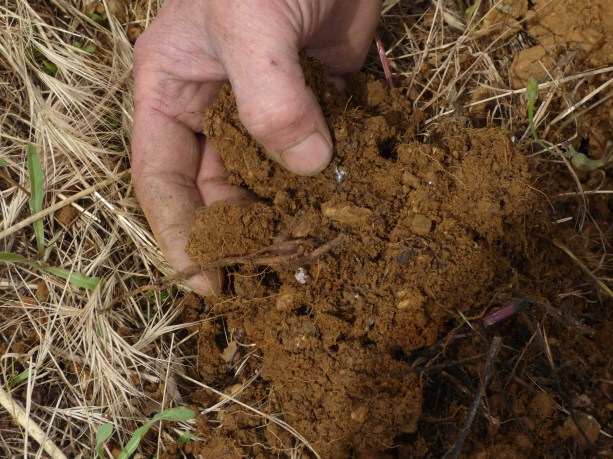
Healthy wines come from healthy soils including microbial life as here at Mas Coutelou’s Rome vineyard

So give me a wine of character. Give me a wine with nothing added where the vineyards’ health is reflected in the grape juice which makes the wine. Give me that grape juice with nothing extraneous added,  natural yeasts for example. Let that wine be carefully nurtured and not messed around with, no added flavourings. If it is aged in barrel then I would expect it to reflect that influence but not be dominated by it. I want to drink wines which reflect the vitality of healthy grapes in healthy vineyards. The wines will alter from year to year because nature alters from year to year. That is terroir and why natural wine reflects terroir in as pure a state as possible.

*(To be fair to Rosemary she does like some natural wines and it was her writing that first introduced me to Jeff Coutelou so I have much to thank her for.)


1 Comment

Last of the summer wine


Flower Power

Flower Power 2015

En français

As work on the cellar ratchets up a notch in the next few weeks it was time to bottle the last of the 2015 wines which will be made for the moment.

The framework for the new mezzanine floor is in place and actually looks quite beautiful. It will be reinforced with concrete however, and the metal cross bars will disappear (which might stop us knocking our heads). Plumbing has also been tidied up and improved. Cuves will be placed below and on top of the structure. More work on stairs, flooring and around the cellar will happen soon. As I am heading back to the UK for a couple of weeks or so, it will be exciting to see the changes upon my return.

P1010407

Peilhan June 30

The vines continue their growth in the sunshine and heat. Mildew problems are largely contained though some humidity leads to sporadic outbreaks (apologies for the pun). Sadly, there is a new threat of oïdium (powdery mildew) which likes that humidity and the warm days with cool nights we have been having. Powdery mildew shows as grey, white spots on the leaves and the grappe. Certain cépages are more vulnerable, including some of the traditional Languedoc varieties such as Carignan. The treatment is to spray sulphur powder and Jeff Coutelou made the first treatment this week in an effort to contain the problem, a job completed on Saturday morning. 2016 certainly has been a struggle.
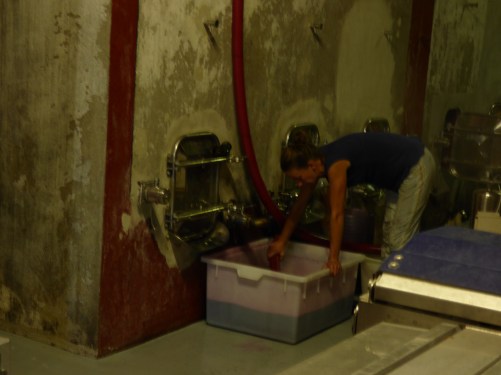
P1010422

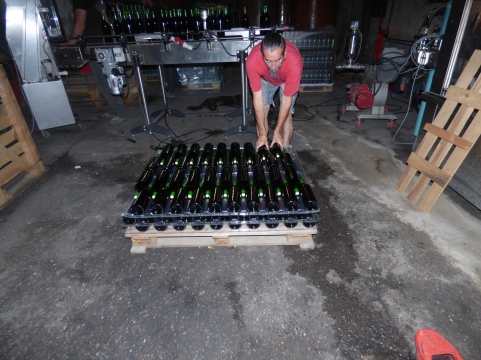
Meanwhile 2015 wines such as Flower Power and L’Oublié went into bottle on Wednesday June 29th. You might recall that the L’Oublié assemblage was made a few weeks ago and after spending time in tank, marrying together, it is now in bottle. Both of these wines are extremely good, well worth waiting for when they are finally released which won’t be for a while.

Jeff also put together a new cuvée exclusively for the French market, it will come in litre sized, Bordeaux style bottles as a «vin de table». An assemblage of various cépages it will be cheap, very drinkable and very desirable. The size of the bottles meant that they had to be filled by hand rather than the machine so Thursday was fully occupied with this cuvée. Jeff refers to it as a vin de gauche, after wine writer Vincent Pousson referred to Jeff as one of the last vignerons de gauche (left wing winemakers) because of his low prices making his wines accessible to all. It will be a wine to share and it will disappear down that litre bottle very quickly.

vin de table 2

The new litre bottle of the vin de gauche

2015 seems increasingly like a golden year, its wines are certainly glittering. 2016, well despite all it has thrown at us, there is hope. Meanwhile the summer wine is bottled and the heat is getting to some of us, even after his haircut.


2 Comments

Mildew

Su mildew

As I have posted regularly in 2016, this has been a most unusual year weather wise. After no real autumn in 2015, no real winter, no true spring we have had a stop start summer in June. Yes there have been a few hot sunny days but lots of rain and cloud too with many days in the mid 20s.

Sadly, humid days in the mid 20s and cool nights are exactly the conditions favoured by downy mildew, and it has prospered in 2016. Jeff Coutelou has spent many nights out on his tractor spraying the vines to try to protect them. As an organic producer (and much more) he cannot (and does not want to) use manufactured, chemical sprays. Instead he has used sprays based on rainwater with seaweed, nettles, horsetail and essential oils of sweet orange and rosemary. These are better absorbed by the vines in the cool of the night.

P1000885

On June 3rd Jeff spent much of the night spraying only for it be ruined by a storm on the 4th which had the effect of washing away the spray from the vines. The rainwater created other problems however. The humidity in the soils created ever more favourable conditions for mildew, the disease spread. And, there was a third effect; downy mildew lives as spores in the soils and the rain splashes them onto the vines. Mildiou is not a fungus as commonly believed, it is a one celled spore which germinates in warm, humid conditions especially between 16 and 24 Centigrade.

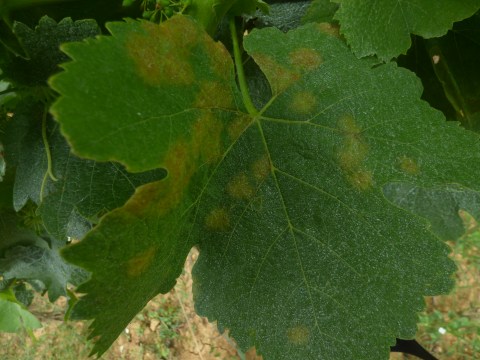
Once the spores are on the vine they attack the new growth and can create a downy white covering. Leaves show a mottled surface with oily spots, first of light green or yellow and then turning to brown as the mildew dries out. Underneath the leaf appears a downy white or grey growth.

The big question was whether to spray with copper. This is effective against mildew but has an effect on the soils, killing the micro organisms which live in them. It is allowed for organic production as long as no more than 25kg per hectare is used in a five year period, it is a natural product. Jeff has used hardly any in the last few years and was very reluctant to start this year. His belief was that it was better to have some losses this year from mildew than lose the life in the soils for a longer period. However, as the mildew spread so quickly he was forced to relent and use a little copper.

His long nights of unpleasant work have helped Jeff to contain the problem but there have been damages. In some parcels as much as 50% of the crop is lost. Mildew thrives on the leaves but spreads to the actual grapes and destroys them. We may go into the vines and cut away damaged bunches.When harvest arrives we will have to be even more vigilant than ever to ensure that affected bunches do not make their way into the  vats and, ultimately, the wines.

Car dead bunch

Dried out leaves and grappe

Meanwhile the sprays do not kill wildlife, such as that photographed below after the treatment.

The north wind which so often helps to dry out the vines has finally started to blow, though even it was humid for much of the past fortnight. The forecast is for hot, sunny weather which will stop mildew, so the threat should now diminish but it has left the vines looking mottled and a bit sickly. After a restless winter where the sap has been constantly on the move they have been less able to resist mildew’s effects.

The wire trellises which are used in many parcels have helped to ensure that air can circulate amongst the bunches to stop them becoming too humid and prone to mildew. Everything has been done but it has been a hard fight and losses suffered.

However, all is not doom and gloom. Most of the vines are now lush with growth. Flowering (fleuraison) was very late but last week the vines made up for lost time and the small grapes swelled greatly. Let’s hope for smoother progress in the next three months.