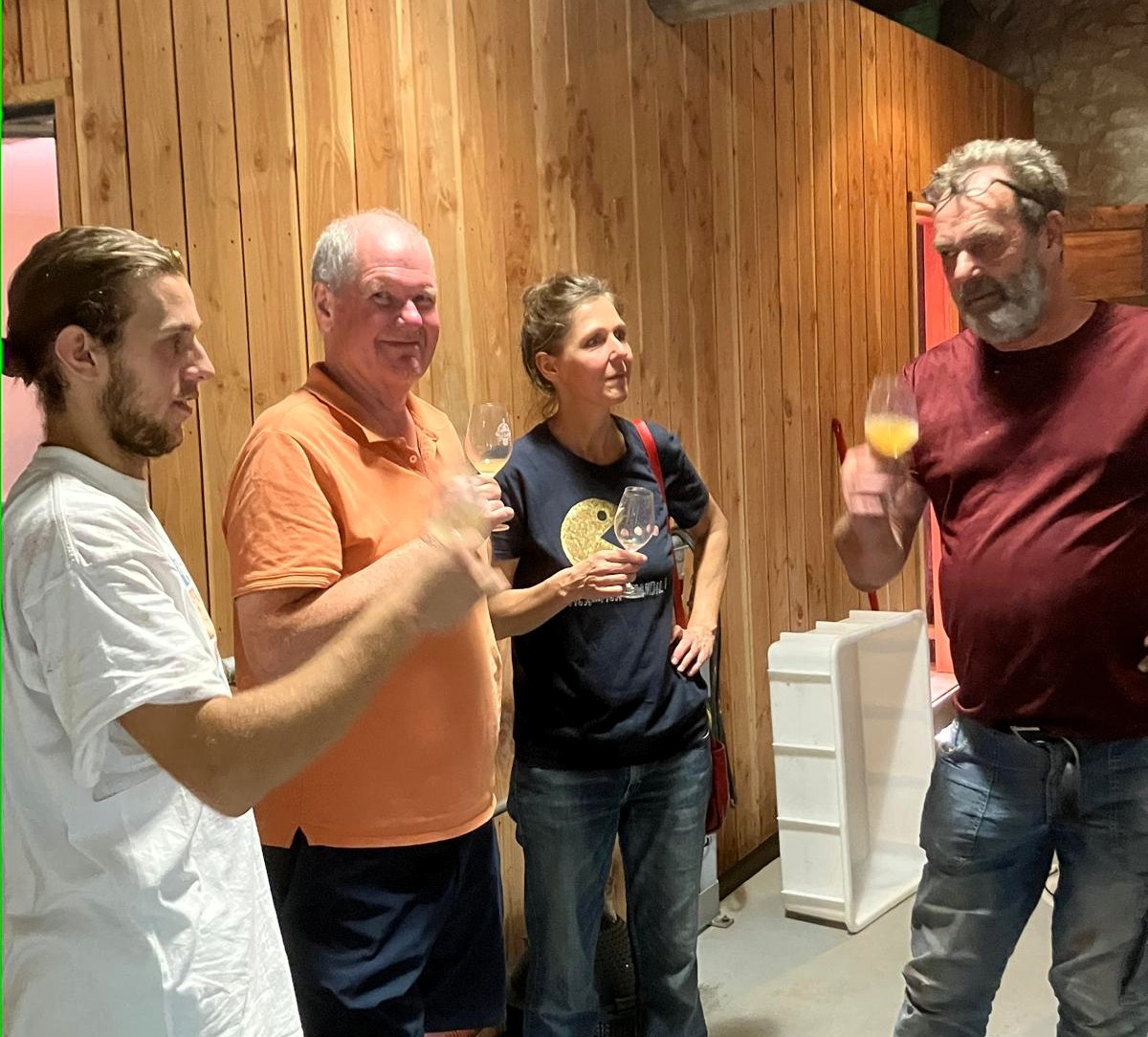
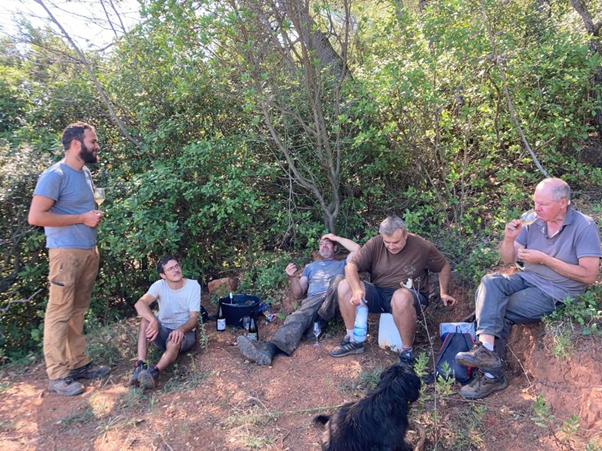
Before leaving the Languedoc to return home Jeff Coutelou kindly invited me to join the team for lunch at Picamandil, the excellent wine bar / restaurant in Puissalicon and then to join him in tasting through the wines from this year’s crop. Obviously I accepted and was delighted to welcome Tina along. She worked harvest back in my first year, 2014, and now works in Picamandil.
In 12 years of vendanges I have never seen Jeff so relaxed about the whole process and so happy about the wines at this early stage. Fermentations have proceeded smoothly, where one or two were slow to get started a small amount of the wine and must from another tank were able to kickstart the process. However, that was very much the exception.
Flora combining her photography and winemaking
Pièr
One reason for Jeff’s serenity has been the team for 2025. Gils’ experience has served him well for years now. Flora has grown into the role with confidence in what she has to do. Pièr, with the experience from his family winery, has been a tremendous asset so Jeff is able to delegate so much more.
Tasting very young wines, some still going through fermentation, is incredibly difficult. The wines are changing in character and profile at a rapid rate. Colour, aroma and flavours are in their infancy and will change as the wine settles and matures. Making judgement on how they will develop is, therefore, for more experienced tasters than me. Jeff though was very happy with how they are and their potential across the whole range.
So, what can I add? The wines are all healthy, no off flavours or volatility at all. There is a depth of fruit and freshness, acidity which cleanses without any sharpness. Some were more straightforward to appreciate. Amongst the white wines it was easy to enjoy what will be TSCA (Terret, Servant, Clairette and Aramon) but all were good. The reds were easier to taste, the fruit more upfront. Two stood out but, again, all were clearly in good health. The Cinsault should be 5SO Formidable rather than 5SO Simple like last year, juicy red fruit obvious. And, of course, I was especially happy about the Syrah from La Garrigue, a potential La Vigne Haute. Interestingly the new plantation there has produced very appealing Syrah fruit, not ready for LVH of course but promising for the future.
TSCA
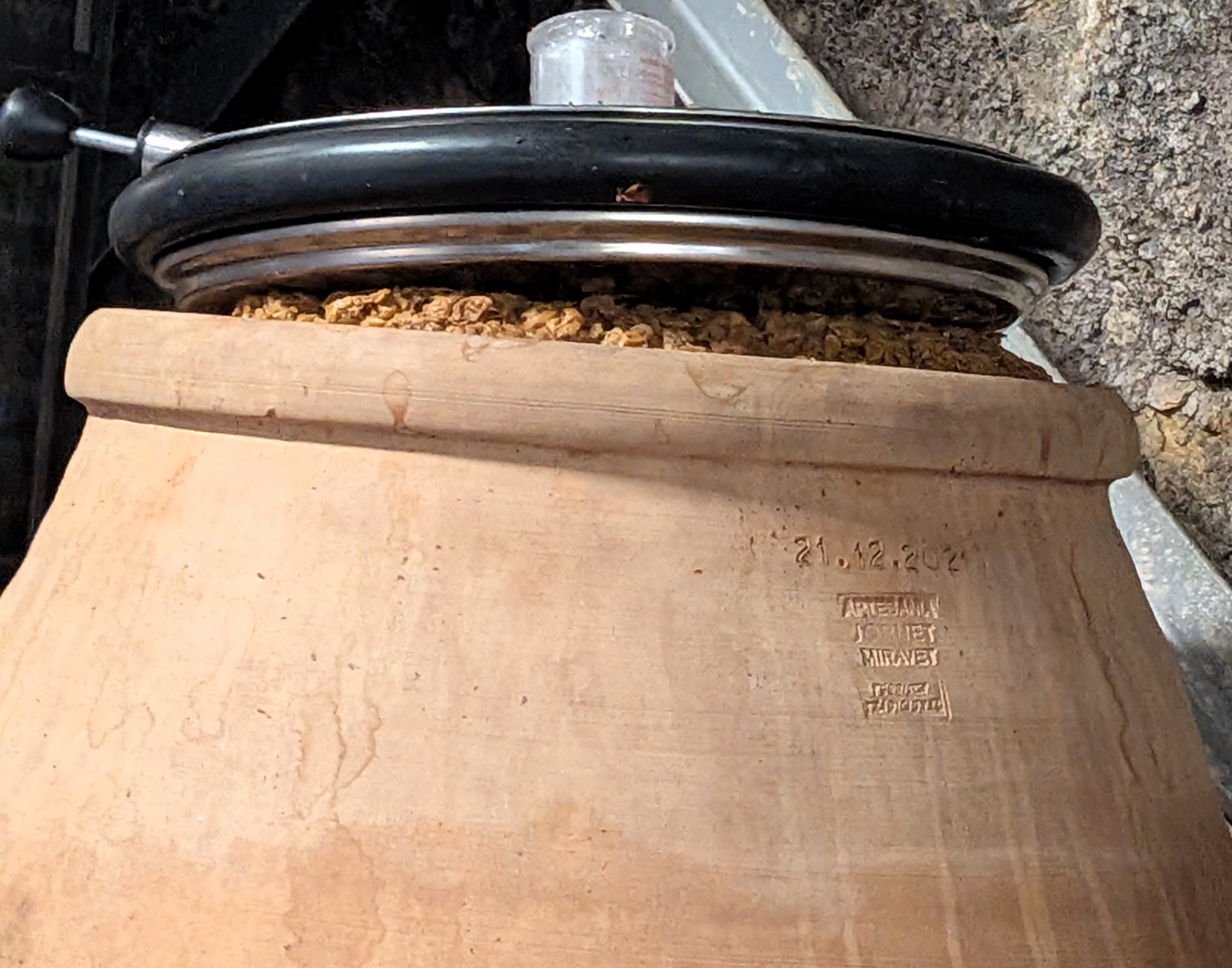
Some fermentations were possibly going too well. This amphora with Muscat has pushed the, very secure, lid off such is the force produced by the process. Pièr is having to do a pigeage to calm things down.
After a most enjoyable time working in vendanges it is truly pleasing to see the rewards for Jeff and the team. 2025 had its problems with heat and mildew but it has worked out extremely well. When we are surrounded by so much bad news that was good reason to raise a glass in celebration. Santé!
With so much work to do in the cellar I left Jeff Coutelou and the gang to get on. I was waiting for the harvest of my favourite vineyard, Rome and made a tour just beforehand. It was dry in there and the grapes were, unfortunately, quite scant. There was some lovely looking Cinsault but the white grapes, Muscat mainly, were looking a bit tired. I had actually opened a bottle of Jeff’s Rome 22 the night before and it was superb, attractive red fruits with a nice complexity and depth, it will age well. I could see this year would not warrant a cuvée of its own and, a couple of days later, a mere forty cases of grapes or so were gathered. Therefore it would need to be supplemented with grapes from elsewhere.
CinsaultGrenache BlancMuscat d’Hambourg
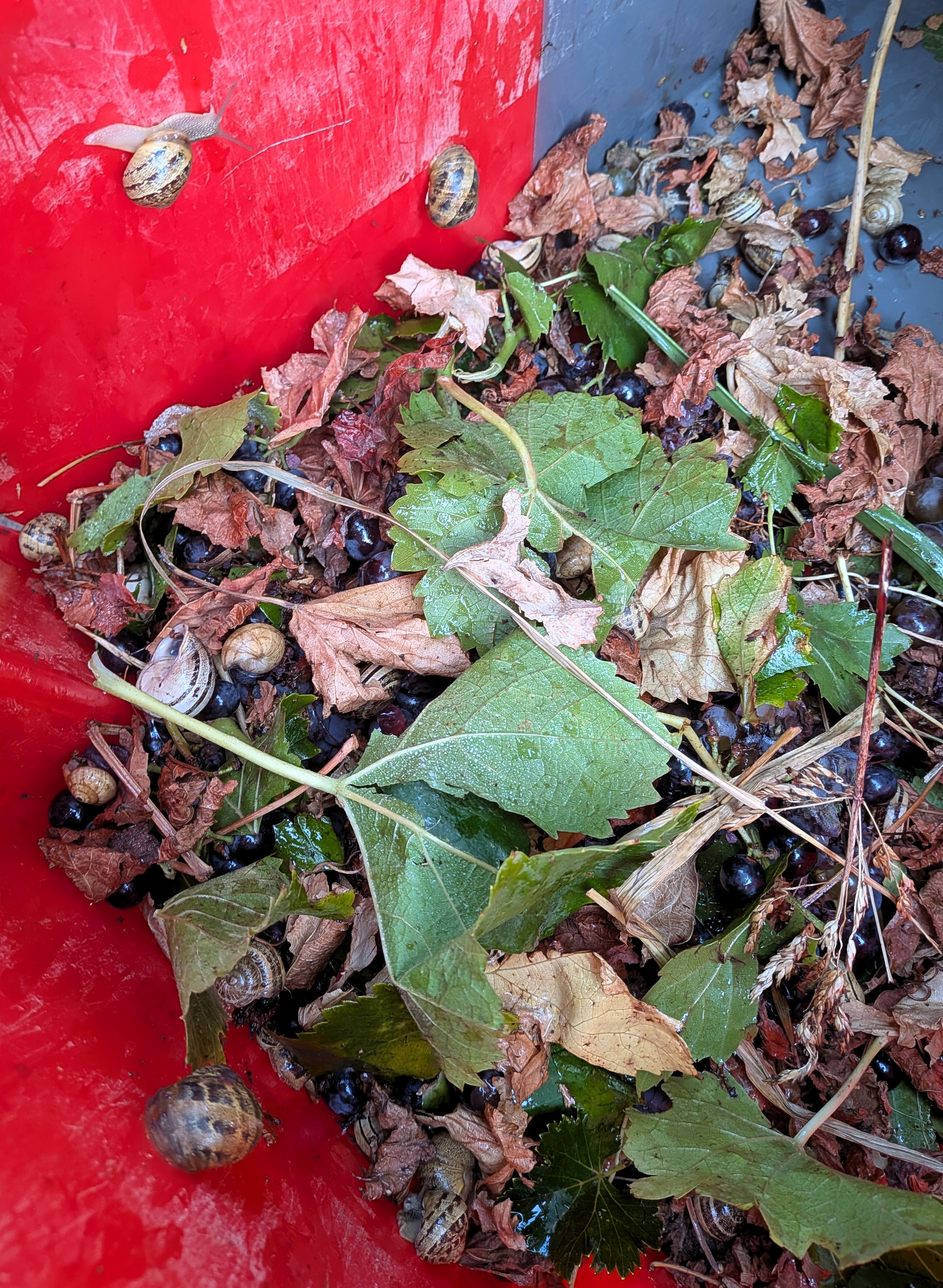
The hot, dry summer meant that snails were in abundance, they had been seeking moisture and the grapes were the obvious source. Fortunately, they were easily removed with the aid of the vibrating sorting table and our eagle eyes.
Rome’s colours
Given the complantation of Rome, with Cinsault, the three Grenache types, various forms of Muscat it made sense that Jeff opted to blend in grapes from the terrasse of Peilhan with its mix of varieties; different colours of Riveyrenc and Terret, Piquepoul Gris and Morastel.
Planting the terrasse in 2015
Morastel
Riveyrenc Gris
It was lovely to see Louis back with the team, he worked for Jeff during the Covid pandemic and for a year or so afterwards and still pops back from time to time. Like me he was taken aback by the changes to vineyards, for example the grubbing up of Sainte Suzanne, but happy to see some lovely fruit coming into the cellar. We had been joined for a couple of weeks by Raphael doing a work placement from his studies as a sommelier. As a former teacher in a college for hospitality Jeff welcomes a stagiaire each year, Raphael being the latest. A keen worker he is too.
Me, Raphael and Louis (photo by Flora Rey)
Raphael carrying out pigeage
Meanwhile a lot of Grenache Gris was also arriving from Peilhan. Pièr, Flora and Jeff were busy putting it straight into the press.
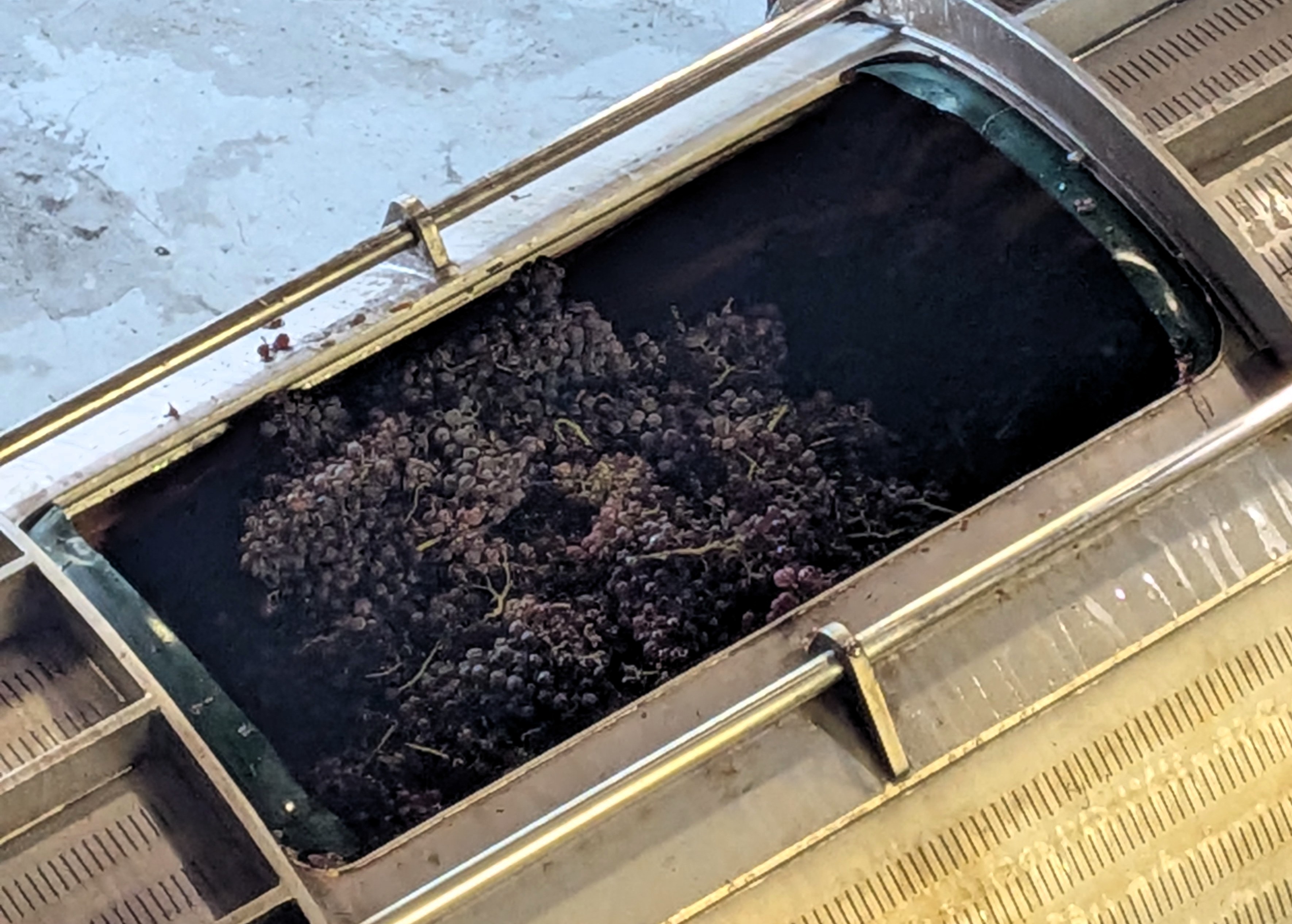
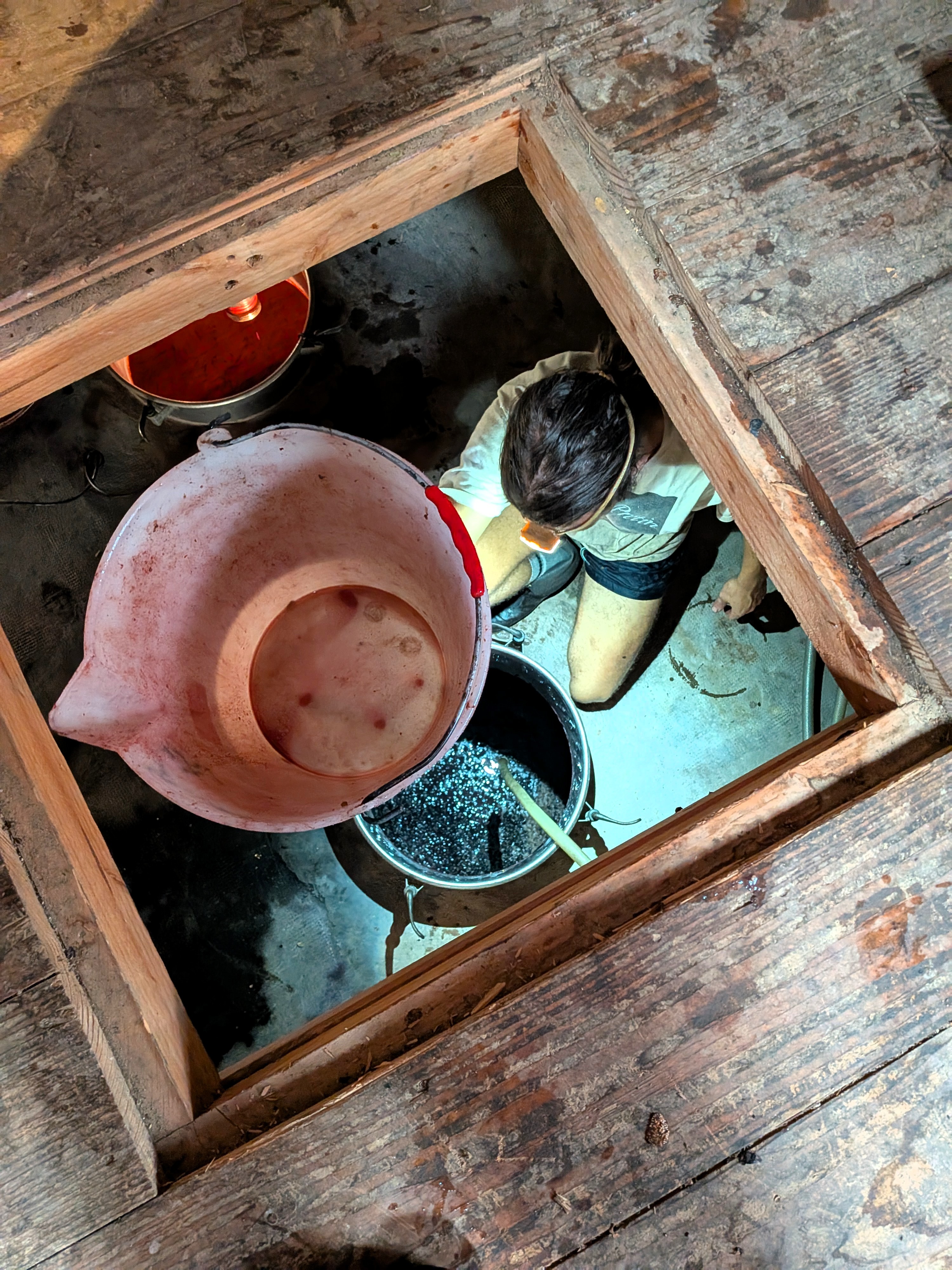
In the afternoon Jeff decided to add some whole bunches of the Grenache Gris into the tank as the skins are such a lovely colour and add to the wine. This meant reorganising all the equipment to work inside so that the grapes can be sorted but quickly put into the tank. I’d be lying if I said that was my favourite job as working inside is more uncomfortable with heat coming from the tank, less light and more cramped conditions. But that’s what Jeff wanted so we got on with it. To be fair this is how we used to process all the grapes back in my early years of vendanges and before the changes made to the cellar in 2017.
Grenache Gris, whole bunch and me sorting some. (Photo on right by Flora Rey)
We put a lot of fruit into the tank that day and it was no surprise, but very welcome, to see the following notice on one of the tanks.
FULL!
A long, hard day but a good way for me to finish my vendanges 25. I may not be a full time vendangeur these days but five days was a good spell for a pensioner. The fruit looks great despite the issues of mildew and heat through the year and there seems to be good volume too. Jeff has been relaxed and content throughout despite the occasional setback. And, I can honestly say, it has been one of the very best teams to work alongside since I began. So, thank you to Jeff, Gils, Flora, Pièr, Boris, Marie, Jean-Jacques, Raphael, Louis and Catherine for your friendship and fun. And, of course, Icare.
Myself, Jean Jacques and Marie at the sorting table (photo by Flora Rey)
Wednesday September 3rd and the team had been busy with Cinsault, one of my favourite grapes. It is very juicy and generous. Perhaps too much at times as it can turn from full and ripe to rotten and overripe in a day. Jeff has a lot of Cinsault mainly in Segrairals, the one nearest the village. This is partly because it makes it easier to transport the grapes quickly to the sorting table and into the vat. It is used for 5SO which is called 5SO Simple in most years and 5SO Formidable in the best vintages. 2024 was Formidable and it has quickly sold out, a light, fruity wine giving lots of pleasure. It also goes into Le Vin Des Amis and lifts the more serious, darker Syrah and Grenache.
I love Cinsault leaves, big, open and generous like the wines
On Thursday, when I returned to work there was still some of the Cinsault to process and Jeff is pleased with a good crop which gives him plenty of winemaking options. It is interesting how a vineyard can be divided into parts which produce different results from the same grape. The extreme version of this is the bewildering confusion of Bourgogne vineyards with almost every row of vines named and vinified separately. Whilst certainly not comparing Segrairals Cinsault to a fiercely expensive Chambertin Grand Cru, the principle still applies. There are a couple of rows within the vineyard where the soil, shadows from trees, drainage etc make a difference. The first cases which returned to the cellar that morning were poorer quality Cinsault and Jeff wanted to ensure it was kept separate from the high quality which goes into the cuvées named above. So, it was pressed direct, getting the juice away from any fragile, poorer quality skins and stalks. That juice can then be used to make something lighter, perhaps a rosé, still decent quality just not benefitting from further contact with that grape must.
Some of the more fragile Cinsault
And then it was on to the fine looking Grenache from La Garrigue which had soaked up the sunshine and heat of the summer in keeping with its Spanish origins. There’s not much to add to that, it really was good quality and will be the backbone of some seriously good bottles, perhaps Grenache Mise De Printemps which is terrific in 2024 and is moving towards the top of my list of favourite Coutelou wines.
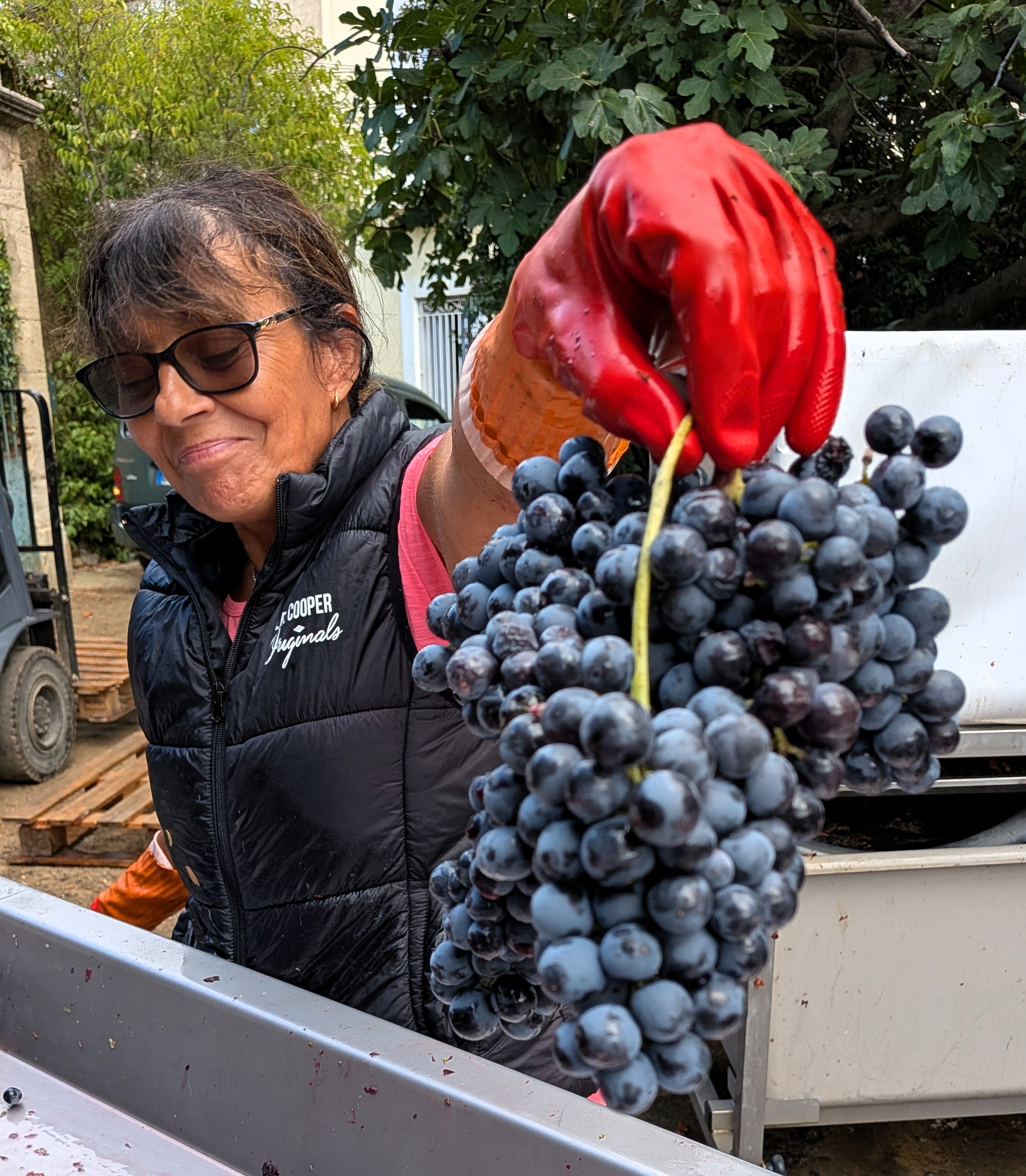
Mari and a very big Grenache bunch
Fill up the tank! Pierre checking the level
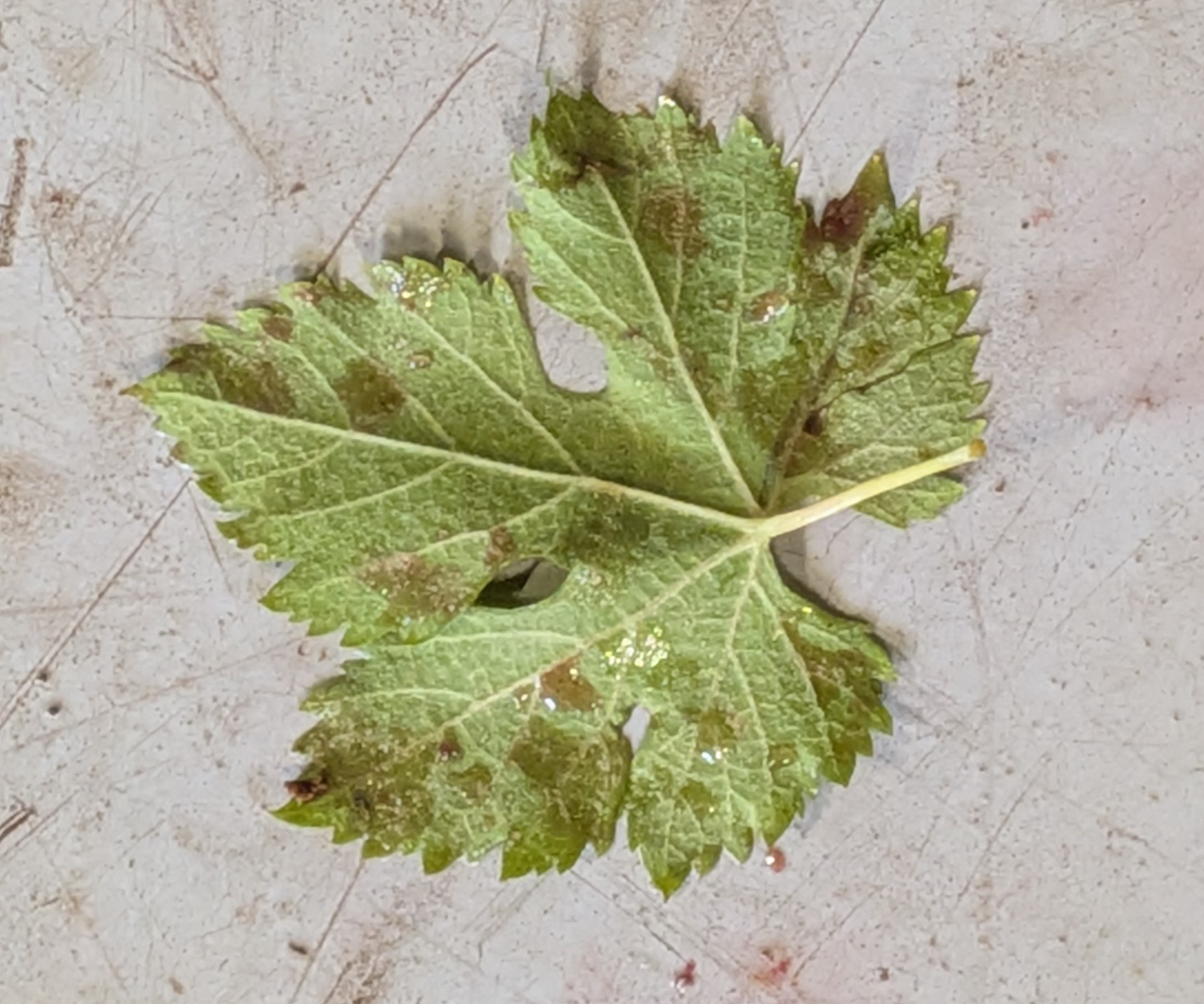
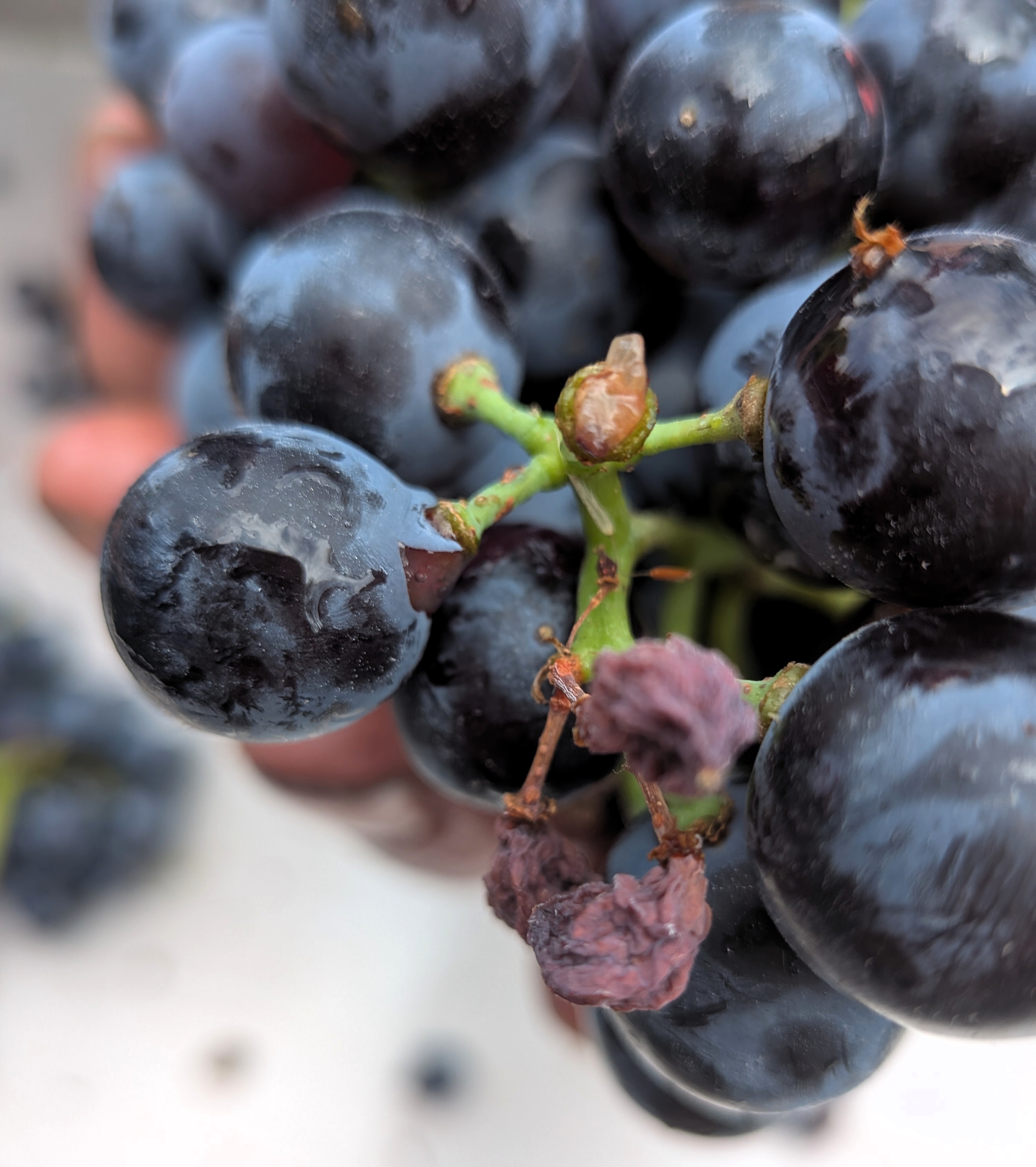
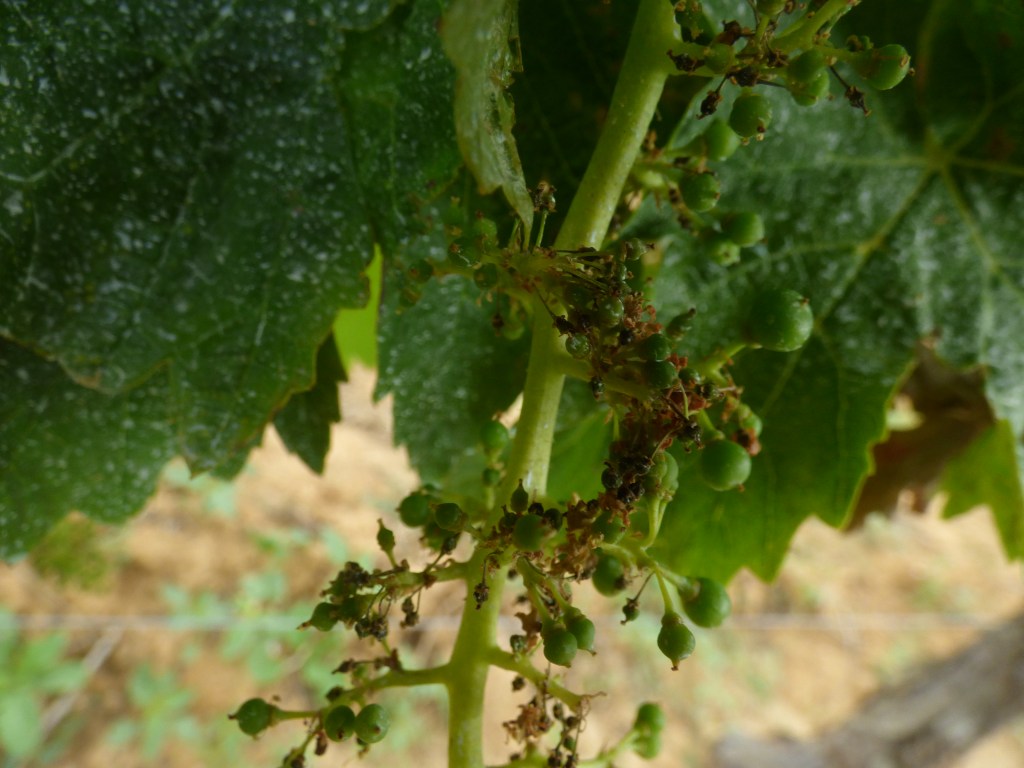
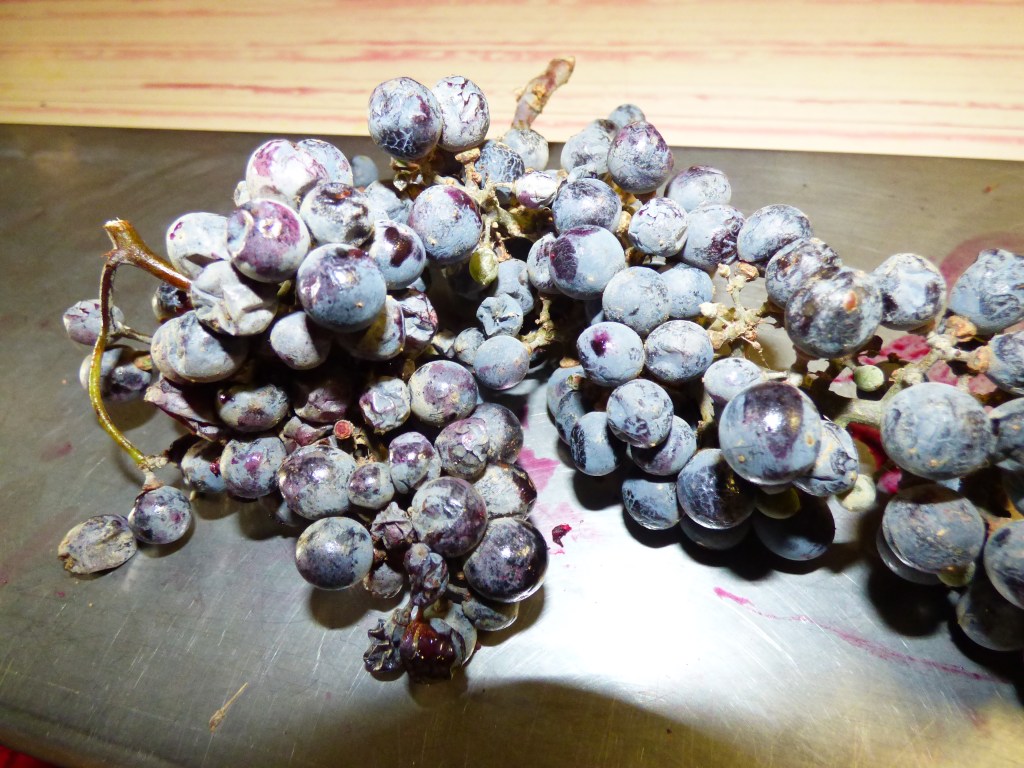
We worked through a lot of grapes that afternoon. One noteworthy point was the effects of downy mildew. Most noticeable on leaves with yellow and brown patches the disease also has an effect on the bunches too sometimes, drying out the budding berries or causing them to abort. So, there are bunches with a completely dried out stalk or large gaps between grapes as you can see in the photos.
Friday was given over to all the cellar work, most of the harvest is done and the young wines in tank need to be cared for. Removing the juice from the must is the main task and, unfortunately, one of the pumps had taken the opportunity to break down and repairs would take a few days so Jeff used the remaining two for the cellar. The wine can remain on skins and flesh for a long time if you want to, for example an orange wine has white grapes on their skins for even a year in Georgia and other countries. Most wines though are given a few days to extract flavours, tannins and strength and then removed as the must can become a source of spoiling bacteria or over extract the tannins and dry out the taste. With Gils, Flora, Boris and the excellent Pièr in harness there were enough hands without mine that day. The good news was that the analyses of the wines were coming back with encouraging figures for alcohol, acidity and health.
Lovely, fermenting juice left whilst the lower juice and lees are extracted right
Onto Saturday and a harvest I had been anticipating. Four or five years back Jeff planted Xarel-lo in a parcel at the top end of Peilhan next to the wildlife reservoir. It has been a conscious decision on his part to plant Spanish varieties given how the climate has changed in the last few years. From the outset these young vines were in great shape and produced their first wine in 2024, a refreshing, dry white called Sauve Qui Pleut, a pun on the French expression for ‘save what you can’ and rain, which is fairly self explanatory. As the vines age they will add more character to the wine, it is a variety which I enjoy from so many Catalonia producers.
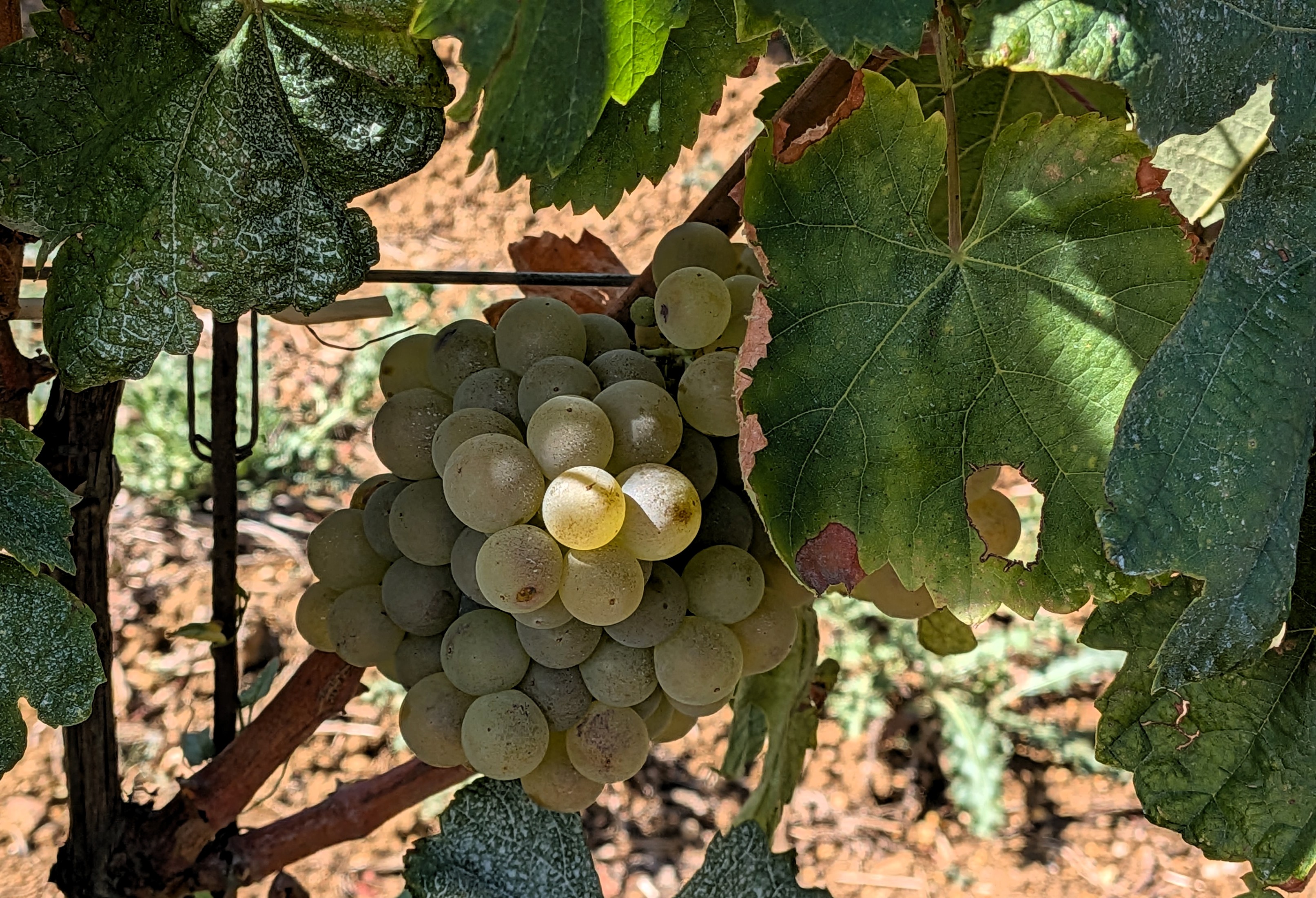
Xarel-lo before harvest
The Xarel-lo was sent to sorting table and then into tank to spend some time on skins, I look forward to the results. Other white varieties were being picked and sent straight to press. Carignan Blanc and Terret Blanc, also from Peilhan, were both looking healthy. Another small tank to give Jeff choices. And then a full afternoon with the rest of the Grenache from La Garrigue.
Xarel-lo
Carignan Blanc, Terret Blanc
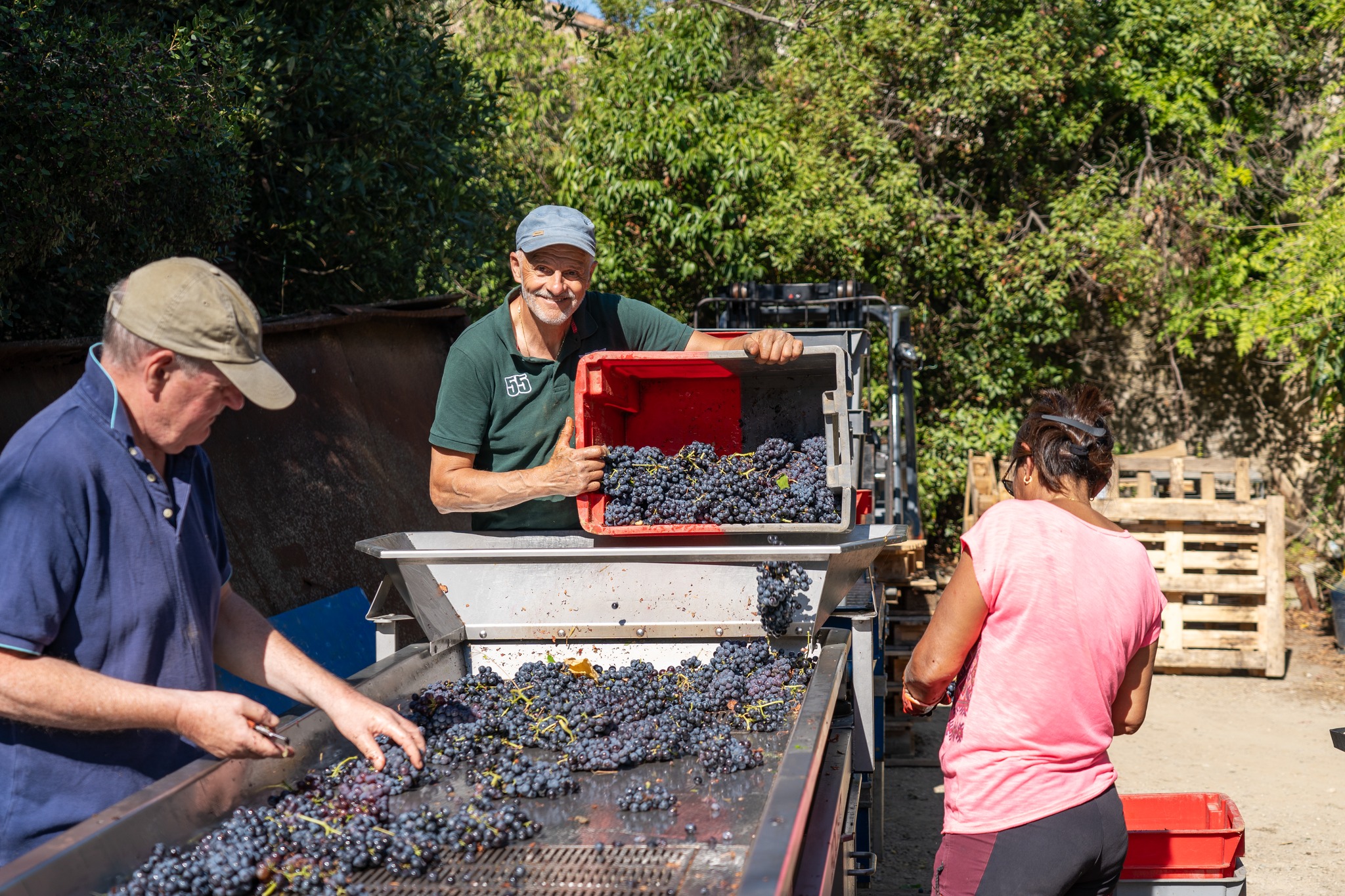
Working on the sorting table you get used to the noises it makes. As it vibrates to separate leaves and other extraneous material a steady rhythm occurs. Occasionally that it broken by a rattling noise and we know to seek out snails. As 2025 has been so dry and hot the snails have sought out moisture and bunches of grapes offer exactly that. La Garrigue must have seemed like an oasis to them, there were hundreds, hiding inside bunches, clinging to their juicy berry.
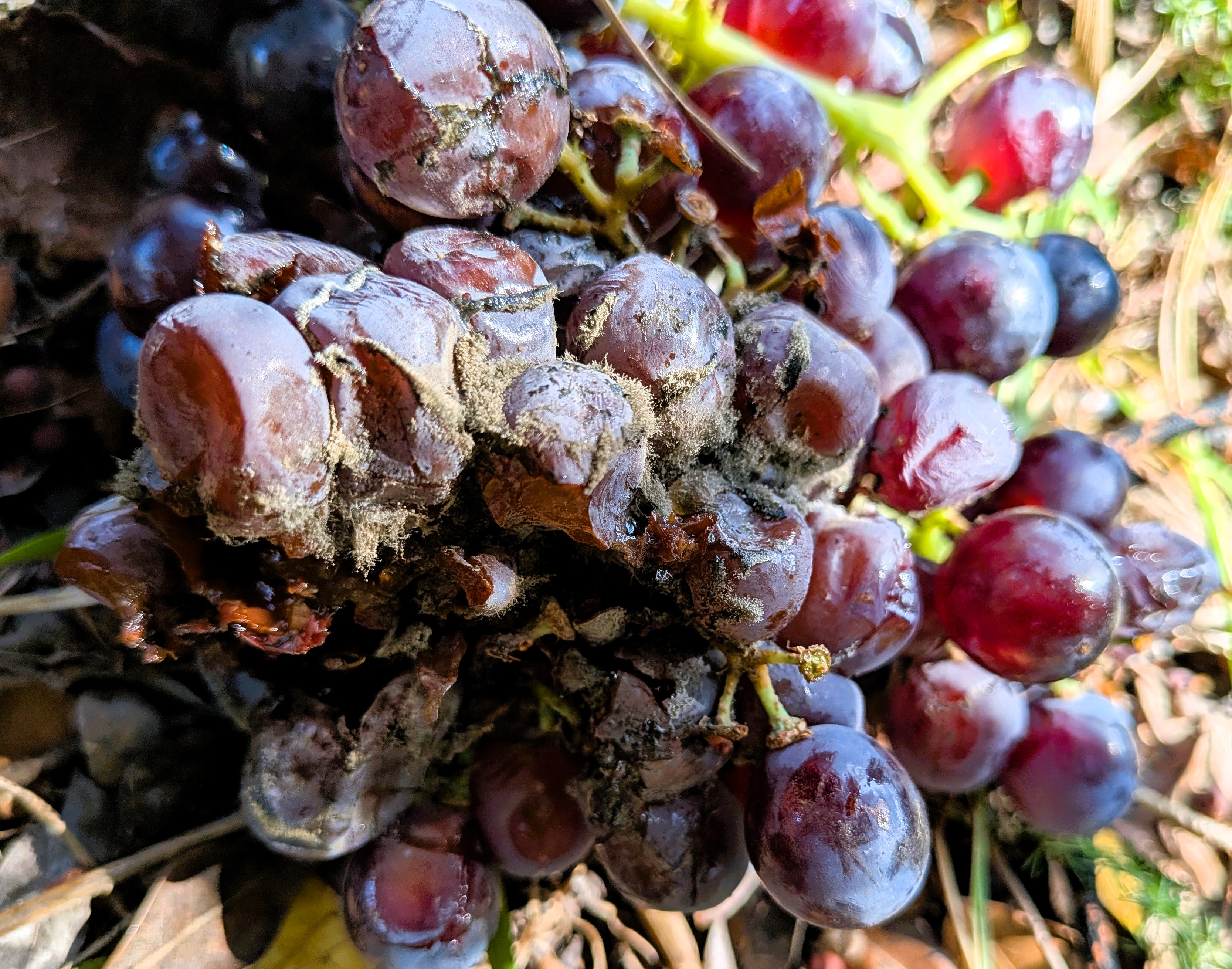
The powdery, rotten mess caused by ver de la grappe
Unlike the Tuesday there was not much damage caused by ver de la grappe but this bunch shows the damage to a bunch which it causes. Fortunately, we are an experienced team on the sorting table and if you break open a bunch, especially when it looks tightly packed, any damage can be found. Alternatively you use fingers to fell inside the bunch and if the grapes feel squishy or powdery then you break up the bunch. It is done off the table so that any rot does not get mixed in with the good fruit.
So vibrations from the table and good vibrations from the analyses and Jeff himself. We look set for a good vintage despite the tricky conditions which this, and almost every year, threw up. There should be some top wines to look forward to, Wouldn’t It Be Nice?
An experienced and fun team (photo by Flora Rey)
Flora, Jeff’s niece takes some fabulous photos, you can seek them out on her Facebook and Instagram page, it’s well worth a look.
In previous years I have selected whole cases of wine but this year I am going to share just my favourite wine of each colour and type. I hope you find it of interest.
Let’s start with Jeff Coutelou. As readers know this blog is based around Jeff’s vineyards and wines and my experiences with both as well as with Jeff and the people who share in his generosity and friendship. I get to experience just about all of his wines, those sold commercially and the ones made for himself and friends. I genuinely love them, the range is staggering but the quality remains consistently high. This year we enjoyed some lovely wines at lunch during vendanges, such as old vintages of La Vigne Haute, amphora aged wines and others. The one that really stands out though was a surprise.
‘Une Syrah‘ – beautifully understated
As I have reported many times my favourite wine of all is La Vigne Haute, made from Syrah grapes in La Garrigue vineyard but only in exceptional years. In other years those grapes can be used to make a wine labelled as something else or blended with others. In 2015 they made On Peut Pas Vraiment Dire Que, labelled in simple blue. It was good but when I opened a bottle this month it was exceptionally good. I could be accused of recency bias in choosing this bottle but it was a genuine surprise. Age has softened some of the acidity though the wine was still fresh and clean. The fruit had rounded out to deliver red and black fruits with great depth. It carried weight to accompany a lasagne with ease but could be consumed on its own with pleasure. If I had tasted this blind I would have opted for La Vigne Haute and one of the best vintages. I chose it as my Jeff wine of the year because it shows how age can boost a natural wine as any other wine, because it shows the wonderful fruit of that vineyard and the skills and quality of Jeff himself. I have one bottle remaining, I shall treasure it.
To my favourite red wine of the year. I used this year’s wine buying to explore regions and countries which I did not know so well, Portugal, Australia, Greece, the Canary Islands. There were some very good wines from producers such as Filipa Pato, Niepoort, Brash Higgins, Envinate and Boesch. However, my favourite wine of the year was much closer to ‘home’.
Belle Lurette on the left at the domaine in September
I have known Brigitte Chevalier of Domaine De Cébène in Faugeres for ten years, having first bought her wines from Leon Stolarski in England. Her wines have always been favourites. Her transformation of the vineyards she took over after moving from Bordeaux is now reaping rewards in terms of the quality of grapes. Combine those biodyamically grown grapes with Brigitte’s growing expertise in the cellar and the result is a range of exceptional wines which I described here after a recent visit. The wine which sang for me was Belle Lurette 2018. Based on Carignan grown near the winery on schist soils, typical of Faugeres, Brigitte added Grenache and Mourvedre which form 30% of the final wine. In the glass the aromas of herbs and spices and red fruits were backed up by a palate of bright fruits. The wine is light in body but, rather like a good Burgundy, is packed with power and length which will enable the wine to age well if you can resist drinking it now as it is delicious. A real stunner, bravo Brigitte.
I probably drank more white wines this year than red, somewhat unusual for me. Great Alsace and New Zealand wines were a highlight together with more from Portugal, Savoie and the Jura. The wine which sticks in my memory though is from Slovakia and is actually a skin contact or orange wine. A visit to a relatively new wine shop / delicatessen, Kork in Whitley Bay, resulted in me purchasing Slobodne Vronski 2018. Made from Sauvignon Blanc grapes, macerated on skins for a week and then aged in a concrete egg for a whole year. The skin contact added texture and mouth feel but the fruit and freshness burst out on the palate. Exceptionally good. I know nothing about winemakers Agnes Lovecka and Mišo Kuropka but I am seeking out more of their wines and this bottle has made me very keen to travel to central Europe to discover more of the exciting wines there.
May I wish you a very Happy Christmas and thank you again for reading my blog in such numbers, I appreciate your time.
As my stay in France was coming to a close Jeff invited me to taste the 2020 wines as well as some of the recently harvested whites I had helped to bring in. Leon Stolarski and his wife Diane were also in the region and came along as Leon is an importer of Jeff’s wines to the UK. We gathered in the tasting room upstairs at the cellars in Rue De L’Estacarade, one of the improvements of recent years with its fine furniture recycled from barrels. You can see an example in the photo above. Two hours of tasting, chat and laughter – is there a better way to spend time?
In the last couple of weeks I have had a number of requests from people who sell Jeff’s wines to inform them about the cuvées which Jeff is offering at present and which will be heading to market soon, therefore I decided to reproduce my thoughts to a wider audience. Please bear in mind that I am biased, I don’t recall any wines of Jeff that I didn’t like a little bit at least but these are my views based on the notes I took at the time.
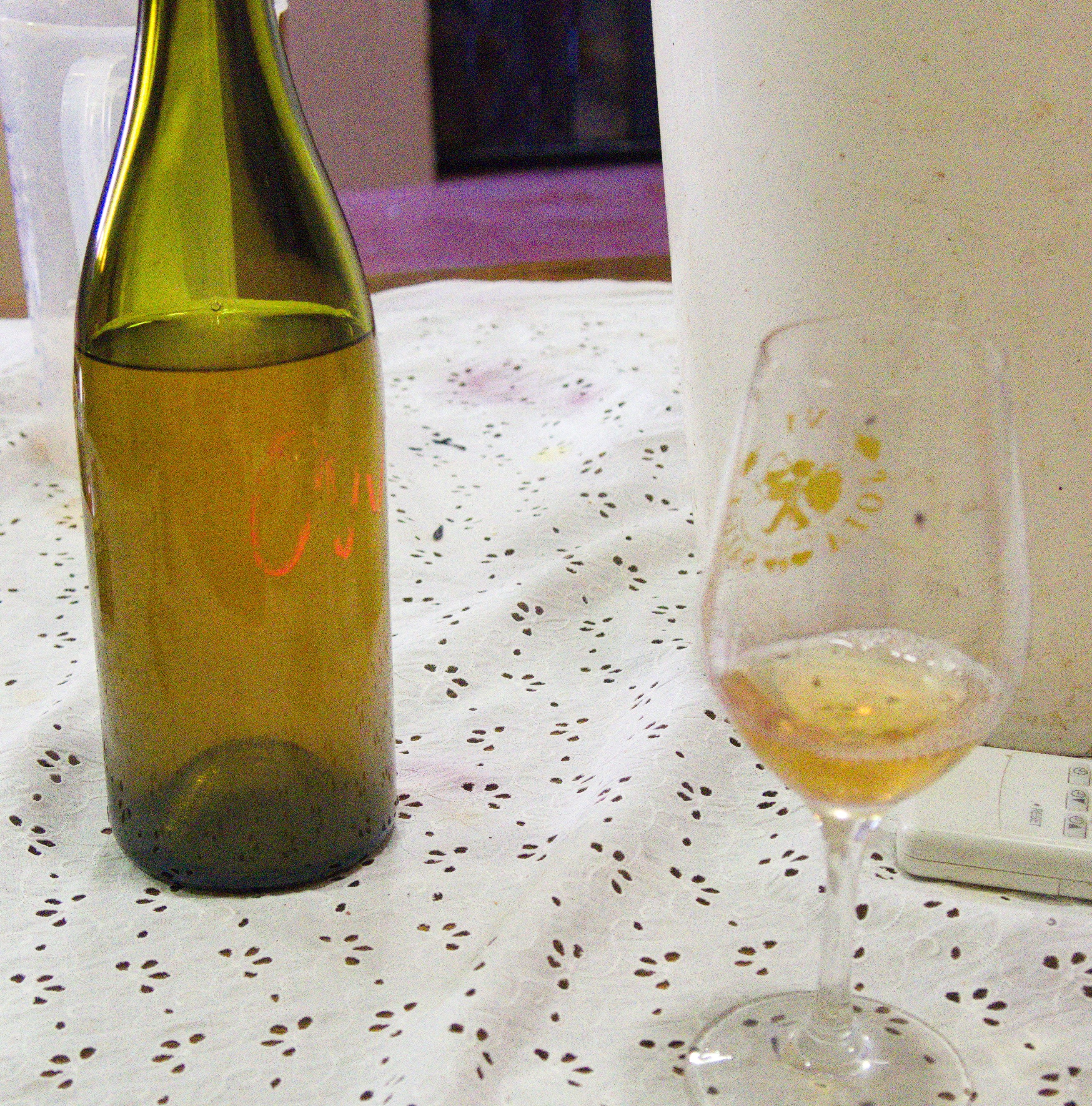
We started with the Macabeu which is ageing in the concrete egg, another recent innovation. It had been in there just five days when we tasted so has a long way to go before being ready, still cloudy in the glass. There was a fresh, liquorice note and all is set fair. The Macabeu from tank was more ready, more winey with apple and pear flavours. Continuing the Macabeu run was a skin contact wine, aged for five days on those skins after harvesting in the new plantation of Ste. Suzanne. The skins’ influence was clear, much more texture and graininess and a real depth of flavour already, impressive for juice from such young vines. Macabeu is becoming the backbone of Jeff’s white wines, a grape suited to the influence of climate change in liking heat. In recent years he has also planted a lot of Clairette, a local Languedoc speciality and it formed the next new wine we tasted, a blend of grapes from Segrairals and Ste. Suzanne’s new plantation. These grapes had been pressed directly, there was a distinct saline note and good freshness. The last 2021 baby was more Clairette but this time blended with Muscat à Petits Grains, the other white grape which Jeff loves so much. This had been intended to make a PetNat but lacked the acidity, a fortunate happenstance perhaps as this was lovely, full of fruit (the Muscat influence for sure) and the most pleasurable of these five wines. It is not easy to taste new wines, it is an art learned through experience, and there is a long way to go before these young wines go into bottle but all seemed promising.
Macabeu skin contact
So, on to the 2020s. A vintage which will be remembered for a global context and, by me, with regret for not being there. The grapes were good, the quantities were a little down on average but nothing compared to this year. Fermentations were much more straightforward than the 2019s even though the grapes were not as consistently high quality as 2019. Jeff is very keen on the 20s, he believes the wines are very good.
We started with OW, Orange Wine. This is based on Muscat, aged on skins for three weeks, and needs a little time still to settle the tannins. That said it is lovely, full of floral notes typical for Muscat. A nice reminder that orange / skin contact wines can be true to their grape and not just about texture.
OW
On to the red wines. To begin with was a new cuvée, now named Matubu (a play on words for the expression m’as tu vu? (Do you get me). This is a blend of Carignan, Grenache and some whole bunch fermented Syrah. In all honesty this blend was made because it was what was left over after the other wines were put together, the idea was to make a cheap wine for early drinking. And it achieves its aim with ease, very drinkable, good forward fruit and nice and fresh. It will be cheap and worth every penny or centime. Next was a Sauvé De La Citerne, the name suggesting that this was the original wine made from the leftovers and now a regular label from Jeff. This is half made up from a blend of Carignan and Grenache made whole bunch and the other half from destemmed Grenache and Syrah. Before finding that out I had written down ‘Good balance’ and having heard the complicated blend it seems appropriate. There is a little greenness (from the stems perhaps?) but balanced by the red fruit profile. Good.
Le Vin Des Amis is a signature cuvée of course. The 2020 version is a blend of half Cinsault and the other half comes from previously blended Syrah and Grenache. Cinsault often adds the distinguishing lift and lightness of Vin Des Amis and this vintage is trademark for that, a lovely lightness of flavour and fresh, clean fruit. Really lovely. On to another new cuvée, given the name Quoi qu’il en goutte which translates as ‘no matter what’, perhaps a reference to the year’s events. This is another example of Jeff’s experimental nature, his willingness to try something different to achieve good wines. He took Carignan and Syrah from 2019 and added some more Syrah but this time from 2020. The Carignan was clear with its deep, leathery and cherry notes but the Syrah lifts the fruit profile further. A definite success.
Couleurs Réunies
The next wine was has been labelled as Couleurs Réunies, a cuvée familiar in recent years. This time Jeff has blended some white grapes into the red majority, as done in the Rhone for example. The grapes come from the 2015 plantation in Peilhan a mix of Morastel and Terret Noir but with Terret Blanc and Riveyrenc Gris added. There is also the Castets from the main Peilhan planting. I really liked this, the red fruit flavours were followed up by deeper notes but there was a lightness (from the Terret Blanc?) on the finish. There is a lot going on here and I suspect that is why Jeff has held it back to settle down a little but I am eager to follow its progress. Classe, the other signature Coutelou wine, came next. Syrah, Mourvèdre blended with previously blended Carignan and Grenache for the 2020 version. This was the star of the show, silky tannins, full of fruity notes and the Syrah showing through particularly. This is excellent. More Mourvèdre, this time bottled on its own, from Segrairals vineyard. Black cherry fruits, good depth and long lasting in the mouth, it will benefit from a little ageing perhaps. Good.
Amphorae arrived at the domaine four or five years ago and Jeff aged some of his Syrah in one of them, I think from La Garrigue given that there is no La Vigne Haute in 2020. The results were excellent. If Classe was the star then this Amphora runs it close. The fruit was forward and sweet but lingered long. Freshness, depth and real pleasure. I’ll be eagerly seeking this out. Finally, another classic, L’Oublié. As most readers will know this is a wine made by blending a mix of grapes and vintages, going back to Carignan from 2012. I wrote about the making of this wine here. The blend changes every year, this time Jeff went for a higher proportion of older wines and sought a more oxidative profile. It is typical of the label and, if you like oxidative wines like me, a treat.
All wines are sealed with a cork marked Le Plus Dur Est Fait (the hard part is done), a reference to the events of 2020
A lovely morning spent in great company and great wines too. I hope you will find these notes of use, I must add that the wines will continue to evolve but I have enough experience of Jeff’s wines to be confident of my thoughts. The 20s will be worth your money, and provide something far more pleasurable to recall that vintage than the circumstances in which the wines were made.
I had intended to write about the new developments by Jeff Coutelou to follow the article about the new vineyard at St. Chinian. Sadly, that plan was foiled by the incident at Peilhan which I reported last time. However Jeff’s determination to carry on and continue his plans is undimmed. So, what’s going on?
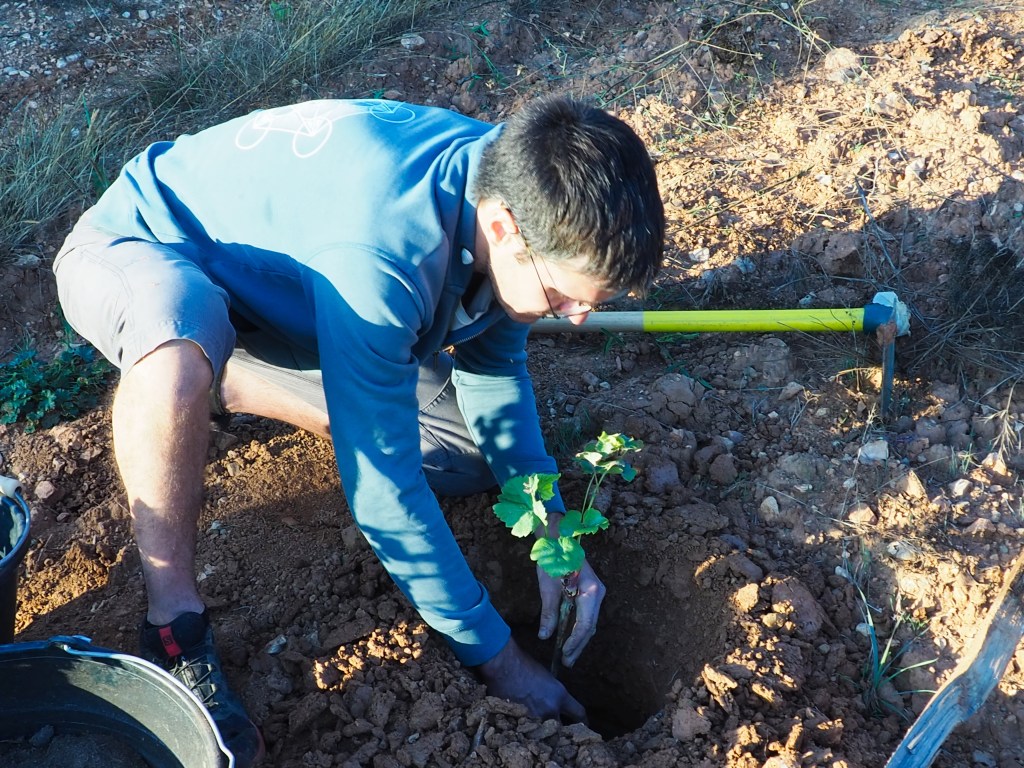
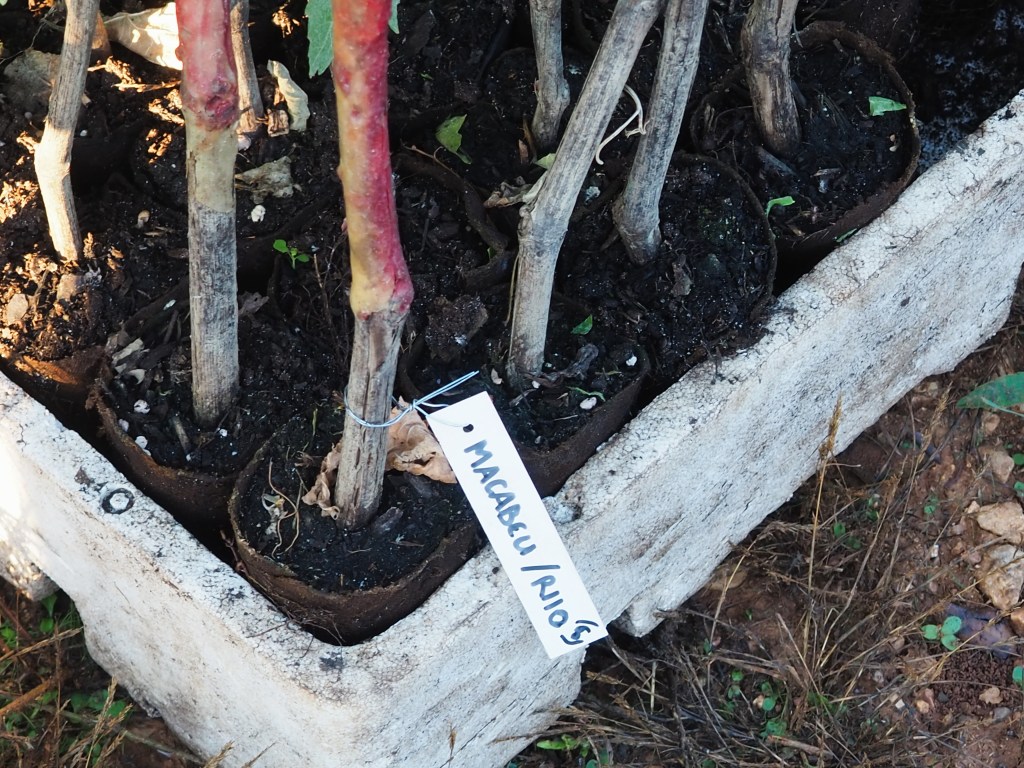
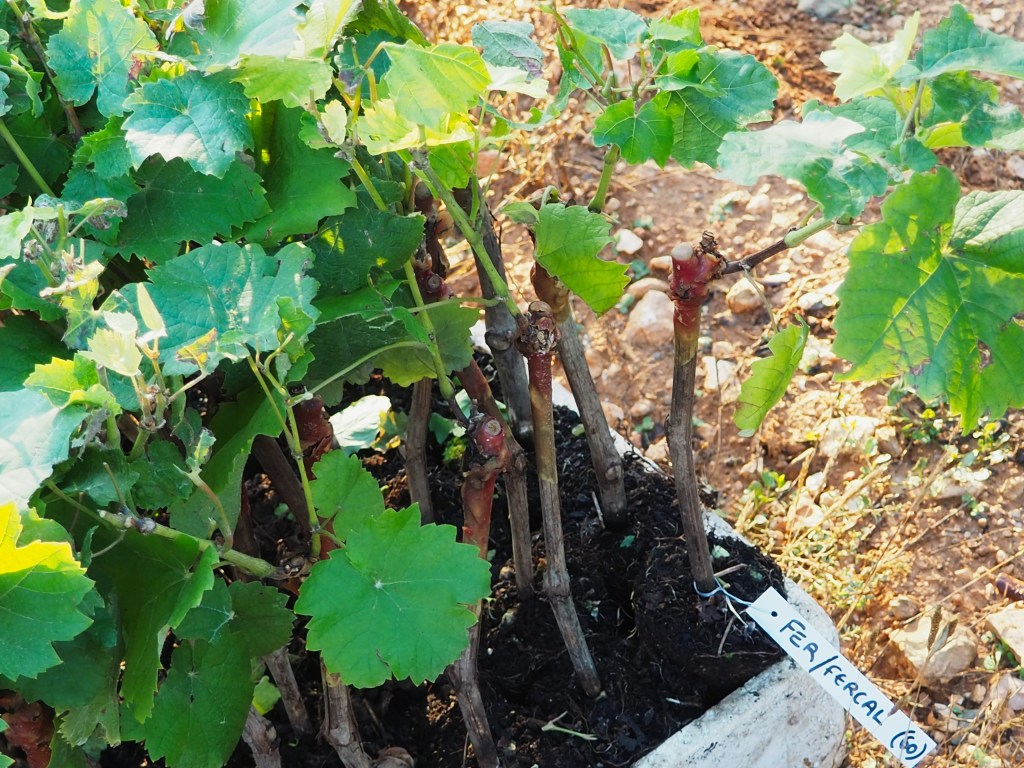
Let’s start with the regular renewals. Every year vines die off for various reasons, e.g. age, disease and drought. In some vineyards such as Rec D’Oulette where all the vines are Carignan Noir then clearly they are replaced by more Carignan Noir vines. However, the pattern for some vineyards recently has been for Jeff to diversify planting. The model is Flower Power where over twenty varieties are planted, all mixed up. That is what we were doing at St Chinian by adding varieties such as Mauzac and Fer Servadou to the range of vines already in place.
In larger vineyards such as Segrairals and Peilhan there are a number of different areas. In Segrairals for example there were areas of Mourvedre, Cinsault, Cabernet Sauvignon and Syrah. Jeff decided to grub up the Cabernet as it is not a traditional grape of the Languedoc and he replaced it with plantings of Oeillade, Aramon and others.
Planting new vines in Segrairals 2020, the new vines growingin 2021
I have already mentioned that there is a new parcel below Sainte Suzanne which we harvested this year for Jeff’s PetNat, Bibonade. The new vines are Macabeu and Clairette, white grapes which originate in Spain and the local area and will hopefully stand up well to climate change. The Syrah of La Garrigue which goes to make La Vigne Haute in good years is going to be expanded. The parcel next to it has been purchased by Jeff, former vines taken out and ploughed. Syrah vines will be planted there in coming months, the north facing slope helping this southern grape to produce well. All the new parcels need time to grow and it takes three years for them to be also certified as organic.
Matteo in the new Ste Suzanne white vines, the new parcel of La Garrigue ready for Syrah
This type of expansion is not new to Jeff, I reported upon the expansion of Peilhan back in 2015 when I helped to plant the terrace area with varieties such as Morastel, Riveyrenc Noir and Gris, Terret Blanc and Noir and Piquepoul Gris. These vines are now healthy, mature and producing good fruit. The parcels of Ste. Suzanne and La Garrigue will hopefully produce more great wine for us to enjoy.
The 2015 vines on the terrace at Peilhan
The most exciting developments though are in the Peilhan vineyard. Jeff has purchased the large plot next door to his existing vineyards and work has begun to transform them. The old vines are torn out and will be replaced with more unusual varieties, this is Jeff’s work after all. At the ends of the rectangular plot trees have been planted already, for example with olive trees, there will be one tree at the end of each set of two rows, roughly 1m-2m apart. On the eastern side various types of tree were planted. Unfortunately these were part of the arson attack two weeks ago and will need to be replanted.
Olives planted on the south side, there are partner trees on the north side
Fruit trees to the east, now burned
Most spectacularly, to the west a large earth bank has been constructed. It creates a large basin behind which will be lined and used as a water reservoir, storing rainfall. The slope will be gentle in order that wildlife can gain easy access to drink. Jeff described this project to me proudly as his “legacy to the area”. Ironic then that the attack should happen here. Be sure that Jeff will press on and it will be fascinating to watch this project develop.
I was in a positive mood about the blog yesterday, very high reading figures after my article about the St. Chinian vineyard. I had a post in preparation about the new Puimisson vineyards of Jeff Coutelou, especially the exciting project to boost nature in the Peilhan vineyard. This photo taken at the end of September shows the hedge and fruit trees which Jeff has nurtured there to bring biodiversity to an area which is very much a monoculture of vines.
This work had been disrupted back in 2016 and 2017 by the acts of a vandal who set fire to the first trees and plants which Jeff put in. That person also burned other parts of Jeff’s vineyards, destroying more trees, plants and vines. I was based in France at that time and spent much of my time with Jeff. I know how hurt he was by those attacks for doing something which he, and all right minded people, saw as helping to improve the area. Whether jealousy, bitterness or madness the acts of the vandal or vandals were criminal. Then things seemed to stop, there were no more attacks. Until yesterday.
The same scene yesterday
It was a shock to receive a message from Jeff in the afternoon that he had just returned from Peilhan to find 500m of the hedgerow destroyed and still smoking when he was there, 500 trees included. To burn that much plantation the criminal had planned their actions, using petrol to target the length of the hedge.
It is just sickening, I am angry and frustrated and I can only imagine how Jeff must feel at this attack on everything he stands for. The messages of support he has received will boost his morale but I can only hope that he feels strong enough to fight back.
Nature still resists
Quick update – Jeff just posted this photo, he will fight back and trust in nature
Many winemakers state that they are custodians of their land rather than owners. The emphasis is on the land rather the winemaker. The land has been there, often as a vineyard before the winemaker and will be there for a long time after the winemaker has departed. Therefore, the human interaction with that land is one of care and nourishment rather than exploitation. Whilst many say that, not all of them fulfil that important statement. It is a fact that as winemakers age the future of their vineyards becomes an issue, what will happen to them, who will take over?
Jeff Coutelou is aware that as he gets older there is a question mark over the future. He has no children and his nephew and niece are not interested in becoming winemakers. Jeff is the 4th generation of Coutelous and has built upon the work of his family to create a domaine renowned around the world. After 20 years of making the wine himself he is also looking to the future. I will explore some of the new vineyards he has purchased in the last year or two but in this post I want to describe how work has begun for his own personal future.
The Coutelou family have their origins in St. Chinian and Jeff himself attended school there. The family home is still there with its small vineyard but there is also a vineyard just outside of the village itself. When he retires Jeff would like to have that vineyard so that he can look after himself without the need to employ others and the associated bureaucracy and social charges of the current large domaine. The vineyard is in a quiet valley, on a slope looking over towards St Chinian and the dividing line in the appellation, there is schist soil to the right in the photo below and limestone to the left. At a couple of hectares it would keep him busy but not overwhelmed.
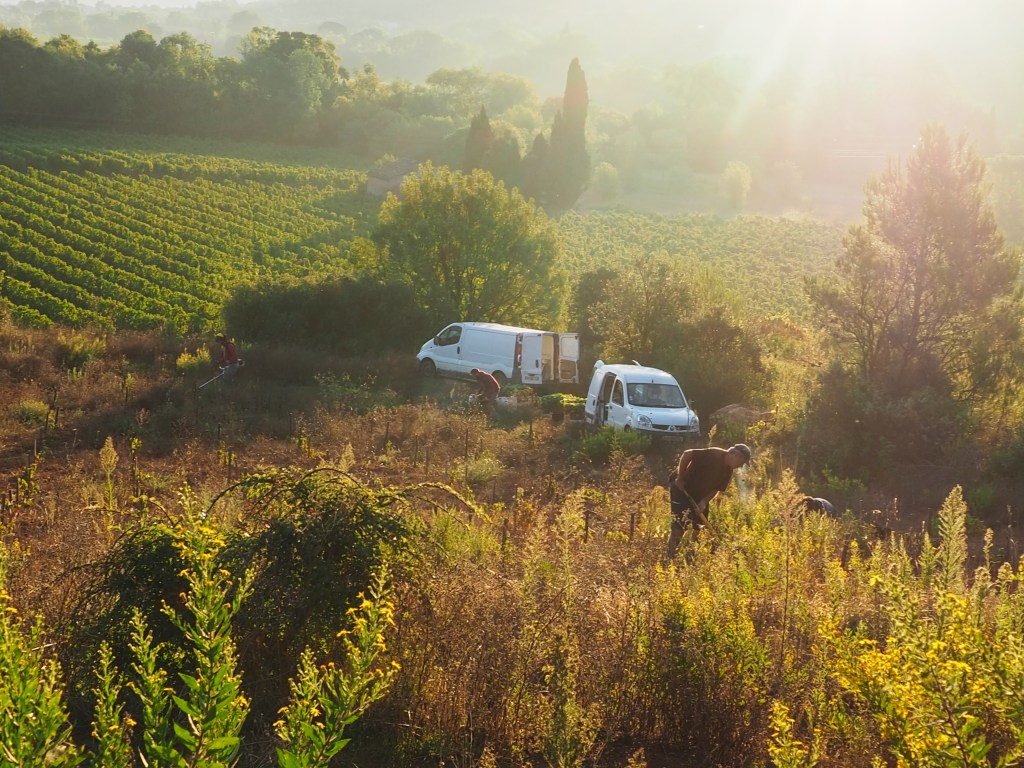
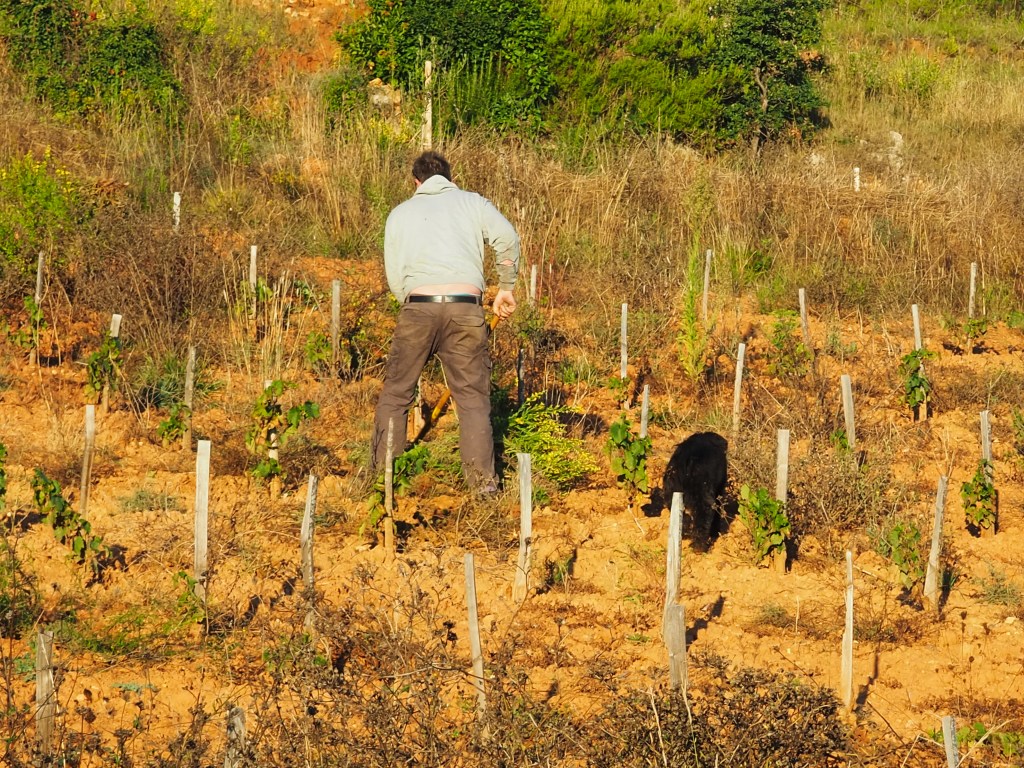
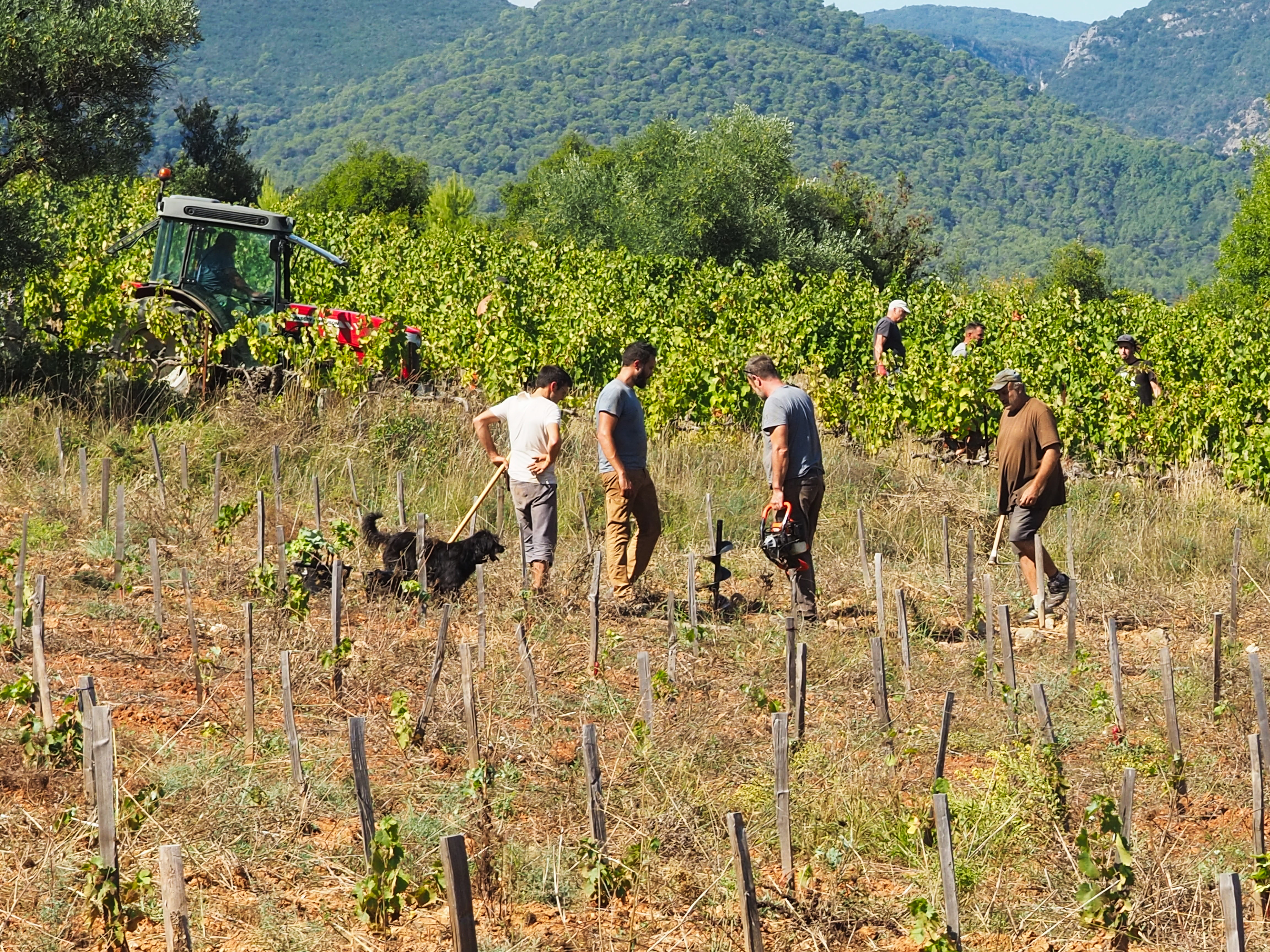
Back in 2019 the vineyard was cleared and planted with some classic Languedoc grapes. However, due to the pandemic the vineyard has not had the attention Jeff would have liked until we went there on September 23rd. A bright, sunny day started off chilly but by mid afternoon we were working at almost 30c temperatures and were in the direct sun. It was hard work. The vineyard had overgrown with weeds, brush. Quite a few of the young vines planted in 2019 had died, as is the norm, and needed to be replaced. A full day’s hot and sweaty work lay ahead.
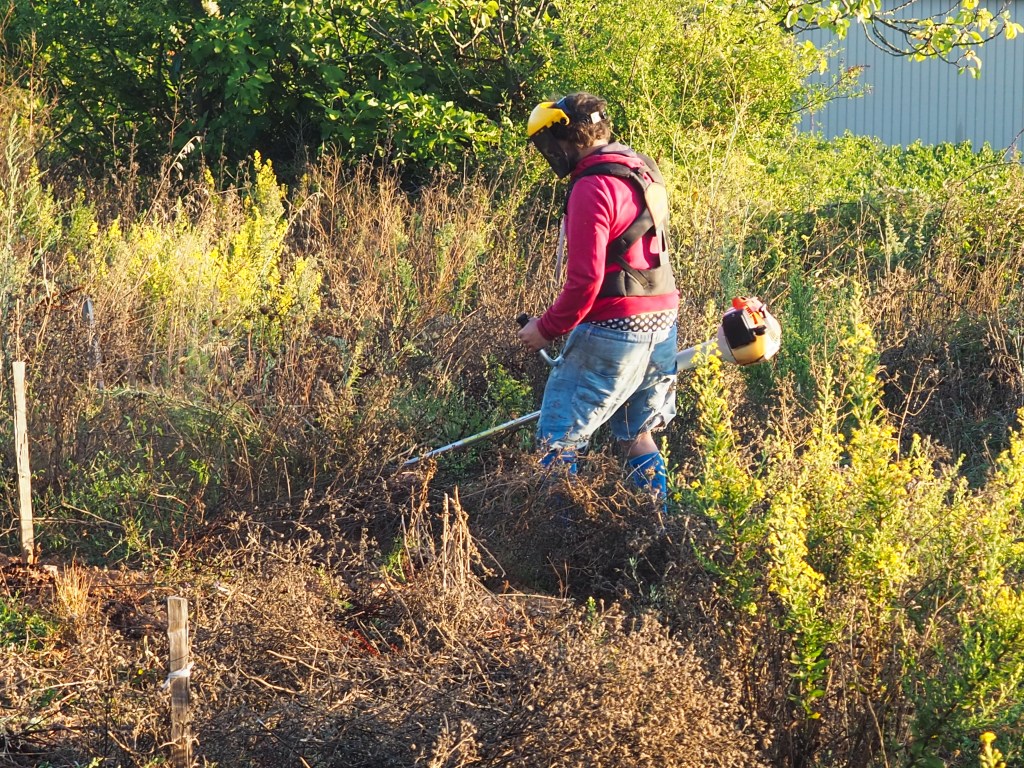
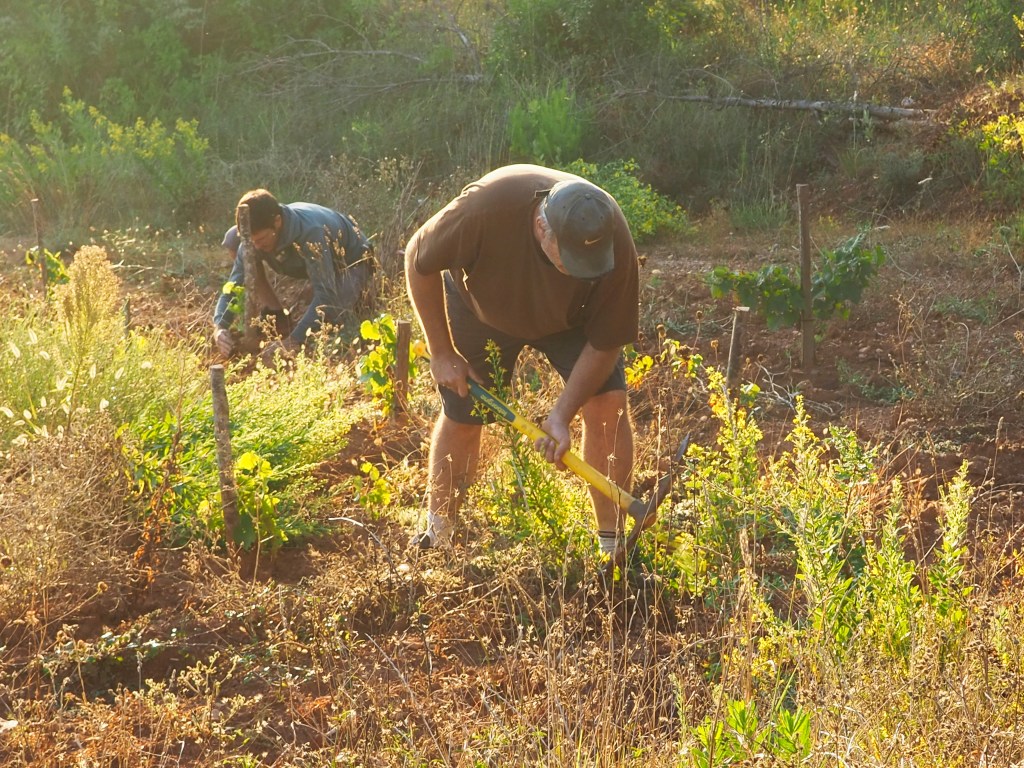
Manu, had rejoined us towards the end of the vendanges and he spent a lot of the morning with Gilles strimming away large clumps of weeds and brush and using a pick and pioche to dig some out. Matteo was hard at work on the drill which was a heavy machine, vibrating heavily as it scooped out the hole which would be used to plant the replacement vines. Steeve, Joffroi and myself busied ourselves mainly with the planting.
As ever these days Jeff wanted to create a complantation on the site. Mixed in with the traditional varieties planted in 2019 would be some Grenache, Macabeu and Muscat d’Alexandrie, one of Jeff’s favourite grapes, but also Fer Servadou and Mauzac. Fer Servadou (often just called Fer) is relatively unknown, mostly found in Marcillac and Gaillac between Languedoc and Bordeaux. I like it as a grape as I am fond of wines from both areas and it gives a distinct spicy, peppery flavour to wines and, maybe its name is suggestive, but a sense of iron filings. Mauzac is widely planted in the Limoux area as well as Gaillac again. A white grape, usually made into sparkling wine, it adds weight to blends with its white fruit flavours.
We were under strict instructions from Jeff to spread the new plantings around the vineyard and avoid clumps of the same variety, forming a true field blend but also hopefully reducing the risk of disease spreading from one variety to another as some are more resistant to mildew than others. Into the hole went the young vine, organic fertiliser and the hole was refilled. New plants need watering, especially on a hot day like that so Jeff was to and fro with containers. Matteo and Steeve have returned regularly to the vineyard to ensure these tender plants have been watered and are healthy.
Before and after
By 4pm we were tiring and the machine must have been to, a part sheered off and we had to abandon the work with just a few rows to finish. They were completed the following day with a repaired machine.
The broken drill with harvesting going on next door
It was hard work but rewarding for many reasons. It is good to see a vineyard developing with its promise for the future, especially this one as it will mean a lot to my dear friend in years to come. The views over the St Chinian hills were a treat and the camaraderie was, as ever, fulfilling – sharing lunch and wine whilst looking out over our work and the scenery with great people. Living in the moment but also looking to the future.
When I first became interested in wine vintages were one of the mysteries which intrigued and infuriated in equal measure. Back in the 80s and 90s Bordeaux and Burgundy ruled the world of wine (plus ca change) and anyone wanting to buy such wines looked at vintage reports, vintage charts and vintage prices to research which wines to seek out. A 1989 or 1990 Bordeaux (my first venture into en primeur purchases) was superior to a 1987 or 1994 simply because of the weather in those years. Things have changed.
Climate change is an obvious cause, it is a rare year now where grapes don’t ripen in cool conditions. Indeed we are in a situation where Bordeaux now allows different grapes, such as this blog’s favourite Castets, to temper the (over)ripe Cabernet and Merlot. Burgundy producers worry about the future of Pinot Noir in their region, a grape which now thrives in cooler Alsace and Germany for example.
Better winemaking and vineyard care are the other major reasons why wines tend to be more consistent year on year. Science, technology and the education of new generations of winemakers mean that vines are given cover crops, different canopy systems, grapes are fermented cooler or longer or on skins more than they used to be. Winemakers through skill (and maybe some artifice) are able to smooth out those vintage chart curves, very few years would now be as scorned as those 87s.
Mildew and oidium affected grapes
For Jeff Coutelou in the hot Languedoc you’d assume that vintages weren’t that important either. There is hot sunshine every year, grapes ripen ready for harvesting by early September. But there subtle differences, sometimes less subtle. 2017 had a big outbreak of mildew, 2019 saw temperatures reach 45c (I remember it well). Those 2019 grapes were actually harvested in prime condition, the best of any of the seven vintages I have helped with, as good as any Jeff can recall. There was little sorting to do. Yet, those grapes proved difficult in the cellar, fermentations slowed and got stuck, not all but many. The fermentations were not completed until the temperatures picked up again in the Spring of 2020. Was that a product of the overheating of the previous summer?
Outstanding Grenache in La Garrigue this year
Every year is different. Similar problems arise due to climate and disease, drought, mildew, oidium, ver de la grappe. The scale of those issues varies though and in different vineyards. The Grenache of La Garrigue was badly hit in 2020 and produced tiny yields. This year when most vineyards suffered that Grenache was beautiful and abundant. Such vagaries are what keeps a vigneron on her/his toes. What quantities of wine will there be from each vineyard? Will there be some outstanding grapes that should be used for a special cuvée? What might be blended to provide the wine for popular cuvées such as Classe or Le Vin Des Amis? With twenty tanks full of fermenting grapes Jeff must juggle figures, analyses, tastings in order to decide what to do with those wines.
Decisions, decisions
2021 was undoubtedly a vintage which reflects most the circumstances of the year, in my opinion more than any of those seven I have witnessed. It was shaped by the frost of April 12th. That single night wreaked havoc upon the vineyards, throughout France yes, certainly for Jeff. Havoc all the worse in that it was unexpected, there was no warning that it would hit the area. 50-70% of potential fruit was wiped out in those few hours, hitting the vines as they flowered and began to bud. From there on 2021 was a year of catch up. Yes the vines, some of them anyway, produced secondary bunches but nothing like the quality and quantity of what was lost. The vines though were weakened by that night, a situation compounded by ongoing drought. Jeff told me that there was only one significant rainfall in Puimisson from the previous October through to the end of summer. This is a perennial issue in the Languedoc now, climate change in action. The consequence of frost and drought was vines pushing energy towards survival rather than fruit and that when summer’s heat and humidity combined to produce oidium (powdery mildew) the vines had little resistance.
Peilhan, dry and with small yields, we harvested the Carignan in an hour or two. Yet it produced lovely red and white grapes
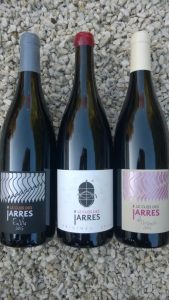
Doom and gloom. And yet there was that Grenache. And most of the fruit was decent quality and fermented well (though with delayed malolactic fermentation in some cases). And the resulting wines taste very well after those fermentations. Jeff will make good wines. He will have to juggle those figures again and no doubt produce different final wines to the norm, there isn’t the quantity to make all the usual bottles. Indeed I can report that Jeff bought in some grapes to bulk out his own this year. Carignan and Syrah were brought back from the Minervois thanks to Vivien Hemelsdael of Le Clos Des Jarres, an excellent producer of natural wines himself. That area was relatively untouched by the frost and Vivien kindly agreed to provide grapes to his friend. Matteo, Steeve, Louis and Jeff went to pick those grapes and were enthusiastic about them, especially the Carignan. Incidentally I can honestly recommend seeking out the Clos Des Jarres wines.
2021 will certainly be a year that Jeff recalls with little fondness. Personally I was delighted to be back there after missing out in 2020. Moreover it was an excellent team to work with, I thoroughly enjoyed being a part of it. The white wines which I tasted from tank just before I left Puimisson are in fine fettle, Jeff assures me that the reds are too. Perhaps vintage is less important to wines these days, but do remember unfortunately there won’t be much of them from Jeff Coutelou. There were new aspects of winemaking in 2021 though and I shall be reporting on how Jeff is looking to the future as well as getting the best out of this year. 2021’s wines were certainly a reflection of the difficult year, maybe vintage does matter after all.
The rather gloomy nature of my last post might have made you think that we’re all doomed and no good wine will emerge from the Coutelou vats this year. Of course, that is not the case, there are still 50% of the grapes and Jeff can conjure up magical wines from just about any grape juice. So, let’s be positive and report on what is happening here with the 2021 vendanges.
Jeff has assembled a big team of assistants, as he told me it’s rather ironic that should be the case in this vintage. Firstly there’s Matteo, from Rome, who has been in Puimisson with Jeff since January. He helped to prune the vines this year, together with Englishman Matt who I sadly did not get to meet. Matteo, therefore, knows the vines and vineyards well and leads the team equallly well. Steeve is a friend who has visited Jeff many times and done harvest before with us. From the Jura region, Steeve has decided to change career and is spending the next few months with Jeff to learn more about his new vocation. Gilles, an ebullient and cheerful local man, has been working with Jeff for some time, happy amongst the vines after having his own vineyards for many years. Louis is from Narbonne, did harvest here last year and has returned. He is hard working, cheerful and speaks excellent English. Boris is another local who comes every year to help with vendanges, a lovely guy who works with nature conservation in his full time job.
Steeve, Jeff, Matteo, Boris, Louis and Gilles
We are also fortunate to have Jeff’s sister Catherine helping with picking and looking after us as well as her daughter Flora Rey. You will have seen photos from this talented artist on my blog before as shse has been recording the story of the vines and domaine through her photography and film. I urge you to have a look at this film which Flora put together showing the harvesting of Sainte Suzanne Syrah with music composed by Catherine. Consider subscribing to the Youtube site Vins et Spiritueux Coutelou for more great videos about events in Puimisson.
As I mentioned previously the first stage of the vendanges was to focus on Syrah, most affected by frost. Sainte Suzanne, the young vines of Segrairals and my beloved Syrah from La Garrigue were picked on August 30th and 31st. One third of the normal yield and quite concentrated, Jeff will have to consider how to use it in blending.
The glass on the far side contains Syrah from Ste. Suzanne, very good it was too.
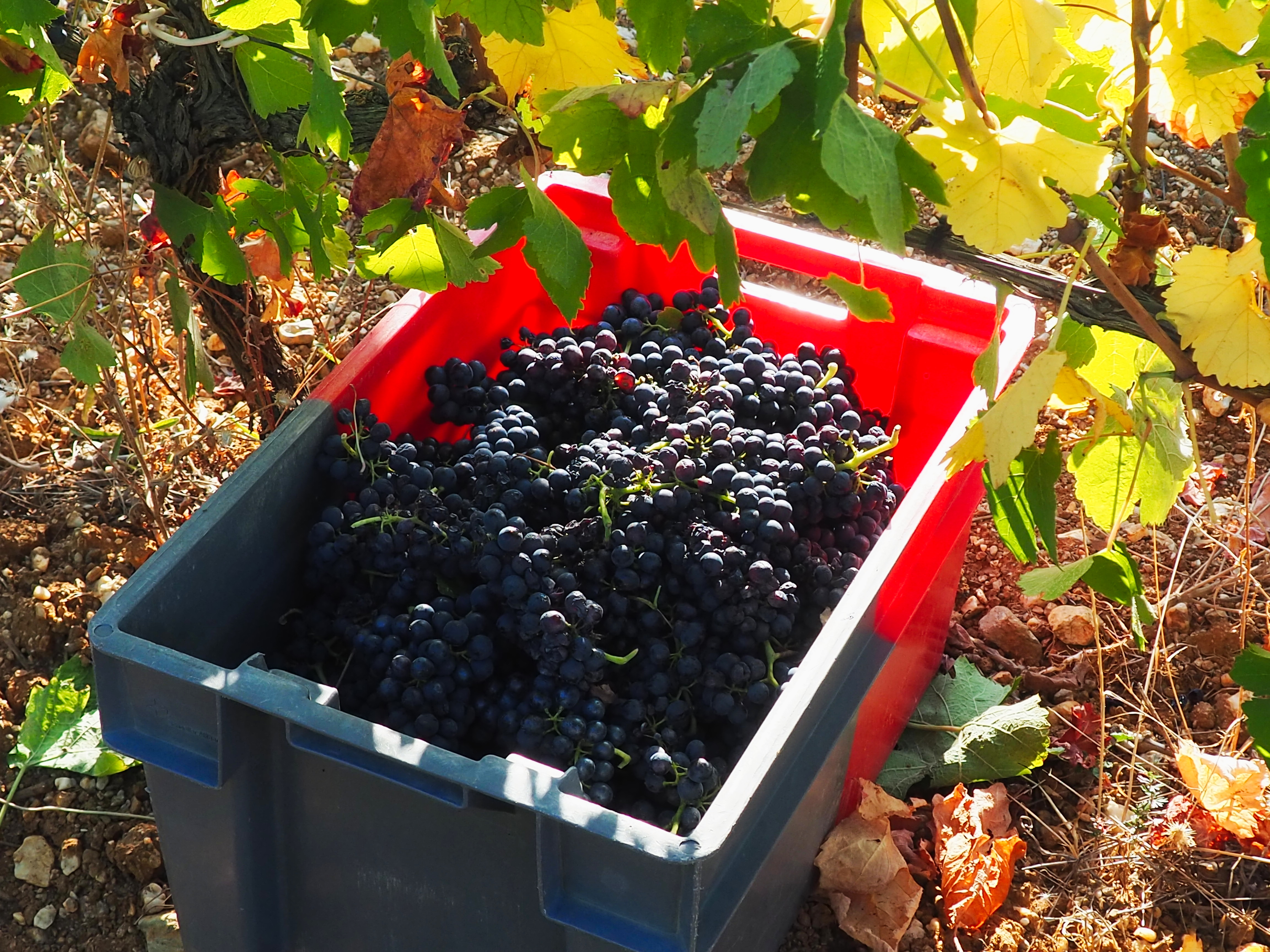
I joined the team on September 1st appropriately in Rome vineyard, my favourite. We collected the Cinsault, Grenaches of three colours and some Muscat before heading to the last few bunches of the La Garrigue Syrah and then on to the complanation of 20+ grape varieties, known now as Flower Power, more correctly as Font D’Oulette. That the few of us picked those three vineyards in one morning is not good news. In the afternoon the Moroccan team went to Segrairals and collected some of the Cinsault grapes of the younger vines. These were full and generous and will add much needed bulk to the grapes from the morning. The Cinsault filled the tank though much of that is pulp and the quantity will fall as the juice emerges.
Rome vineyard with Grenache Blancamongst many others
Me in La Garrigue attacking the Syrah
On September 2nd Jeff wanted some fresh white grapes to make into the PetNat (sparkling), Bobonade. Muscat, Macabeu and Grenache Gris from Peilhan were in good condition and then we moved to the new plantation at the bottom of Sainte Suzanne. These were newly planted when I saw them last but they have grown quickly. The young vines managed to twist themselves round the wires of the trellising so it wasn’t the easiest to pick but the Clairette and Macabeu were fresh and acidic, just what is needed for sparkling wine. They were sent direct to press.
(Left)Macabeu, (centre) Macabeu, Muscat and Grenache Gris, (right) Steeve putting the grapes into press
And that brought the first act to a close. Pressing followed the next couple of days but picking resumed on Tuesday September 7th. So, until shortly after then, there will be an intermission.






































 amarchinthevines