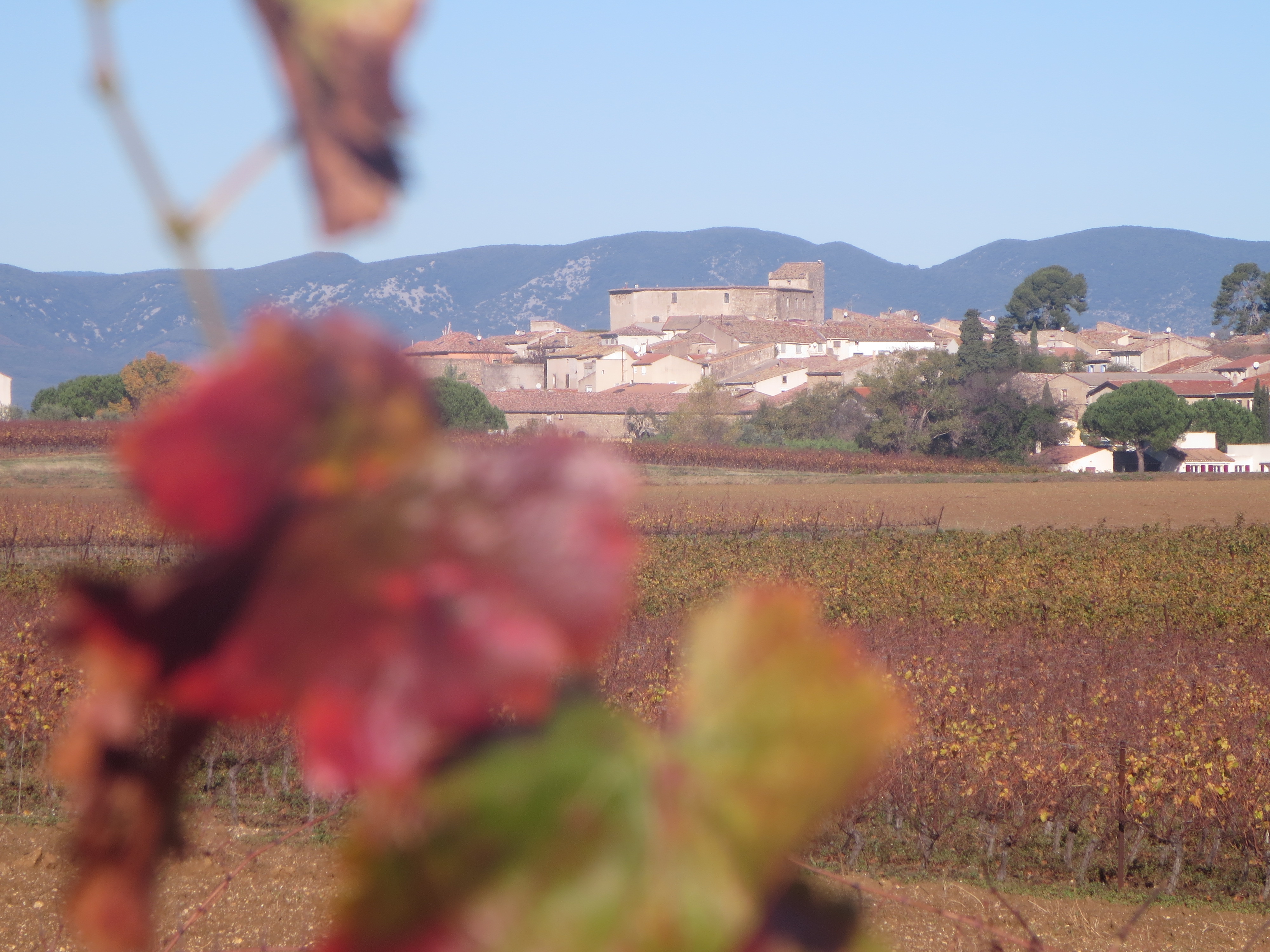
Autumn is often a melancholy time as the days shorten, temperatures drop and the first signs of winter approach. And yet 2015 in the Languedoc has seen a most untypical autumn. Last week the warmest November day ever was recorded and we have enjoyed blue skies, warm sunshine and hot afternoons, 26°C has been regularly seen on our garden thermometer. The resulting sunshine has produced the most breathtaking scenery, with colours across a wide spectrum of autumn. As I wrote on the Out And About page, every time you turn a corner there is another heart stopping view.
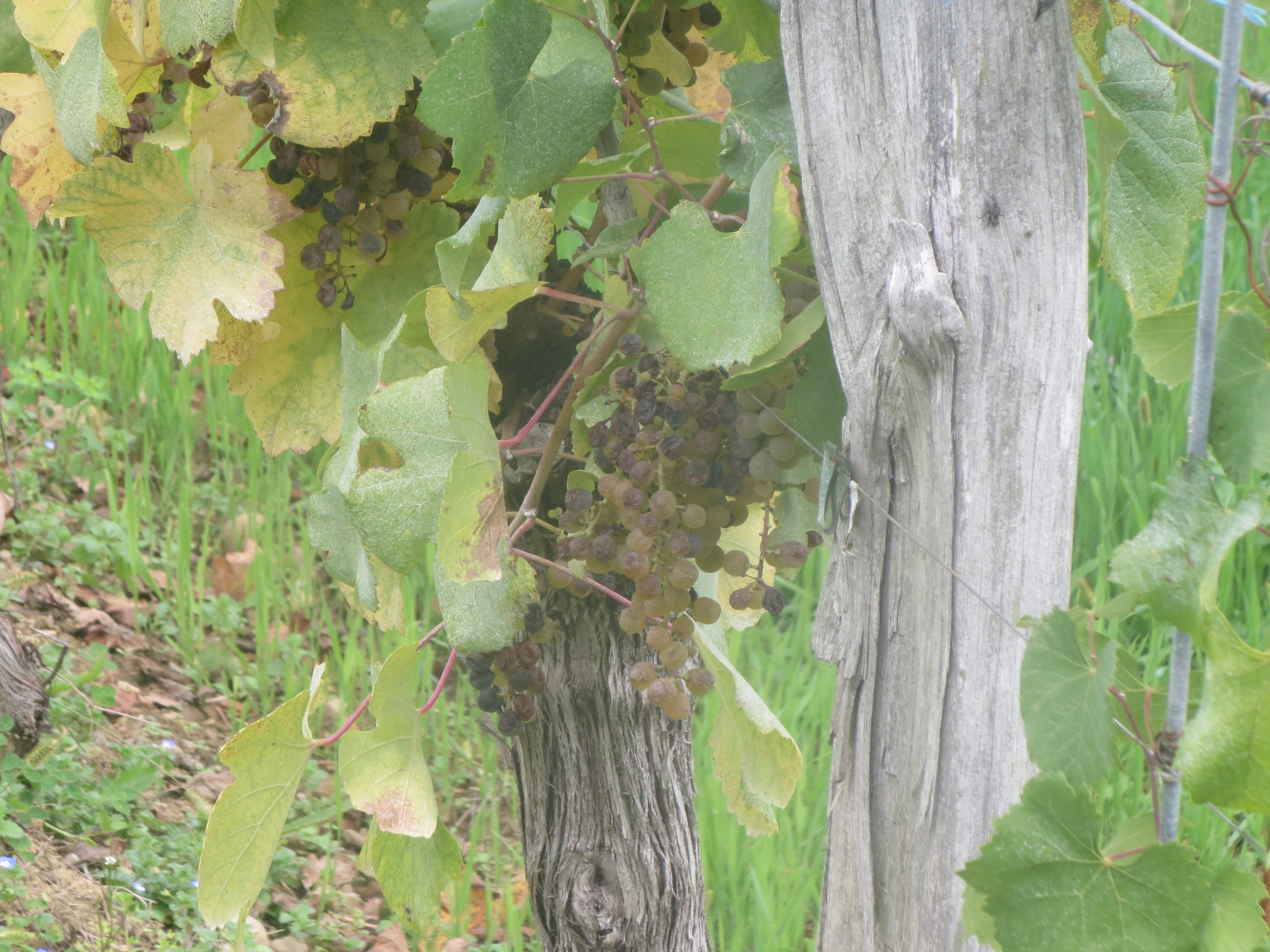
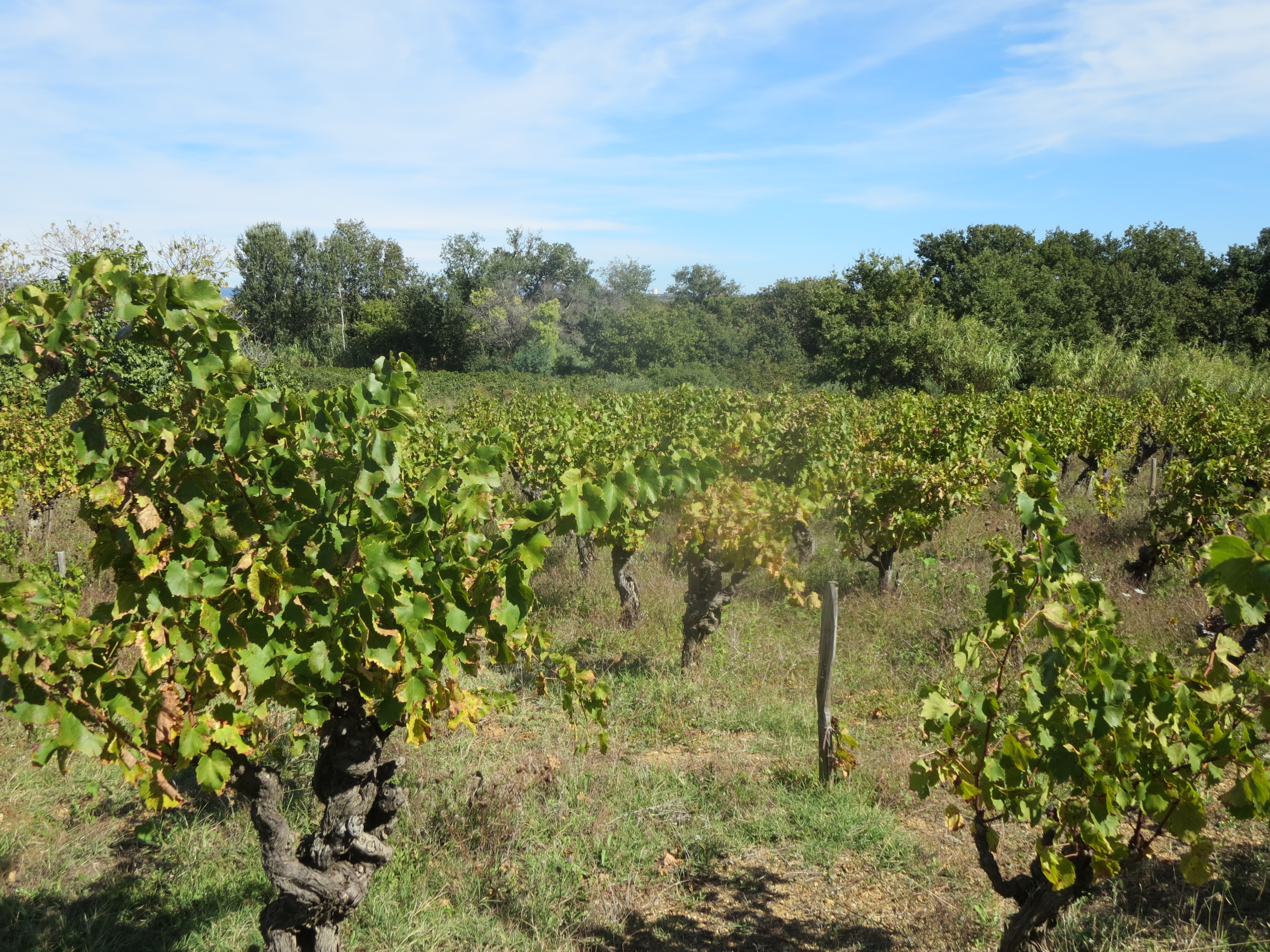
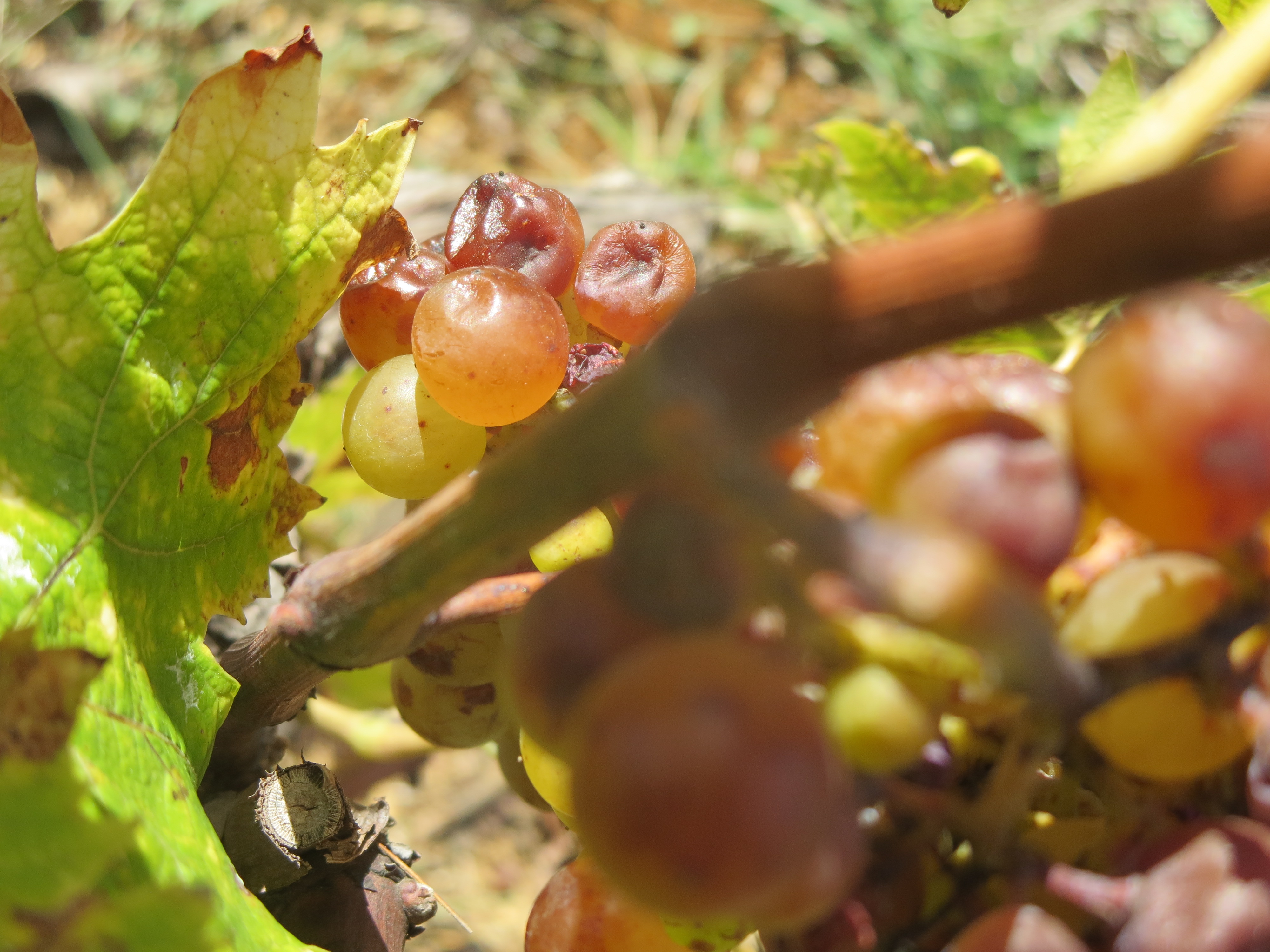
The vines are now closing down, preparing for winter. Their fruit has gone except for a few overlooked grapes which the birds, wasps and insects have been enjoying. Their leaves are shedding and the skeleton of the vine stands out again for the first time since early May, their form revealed, cordon or guyot for example.
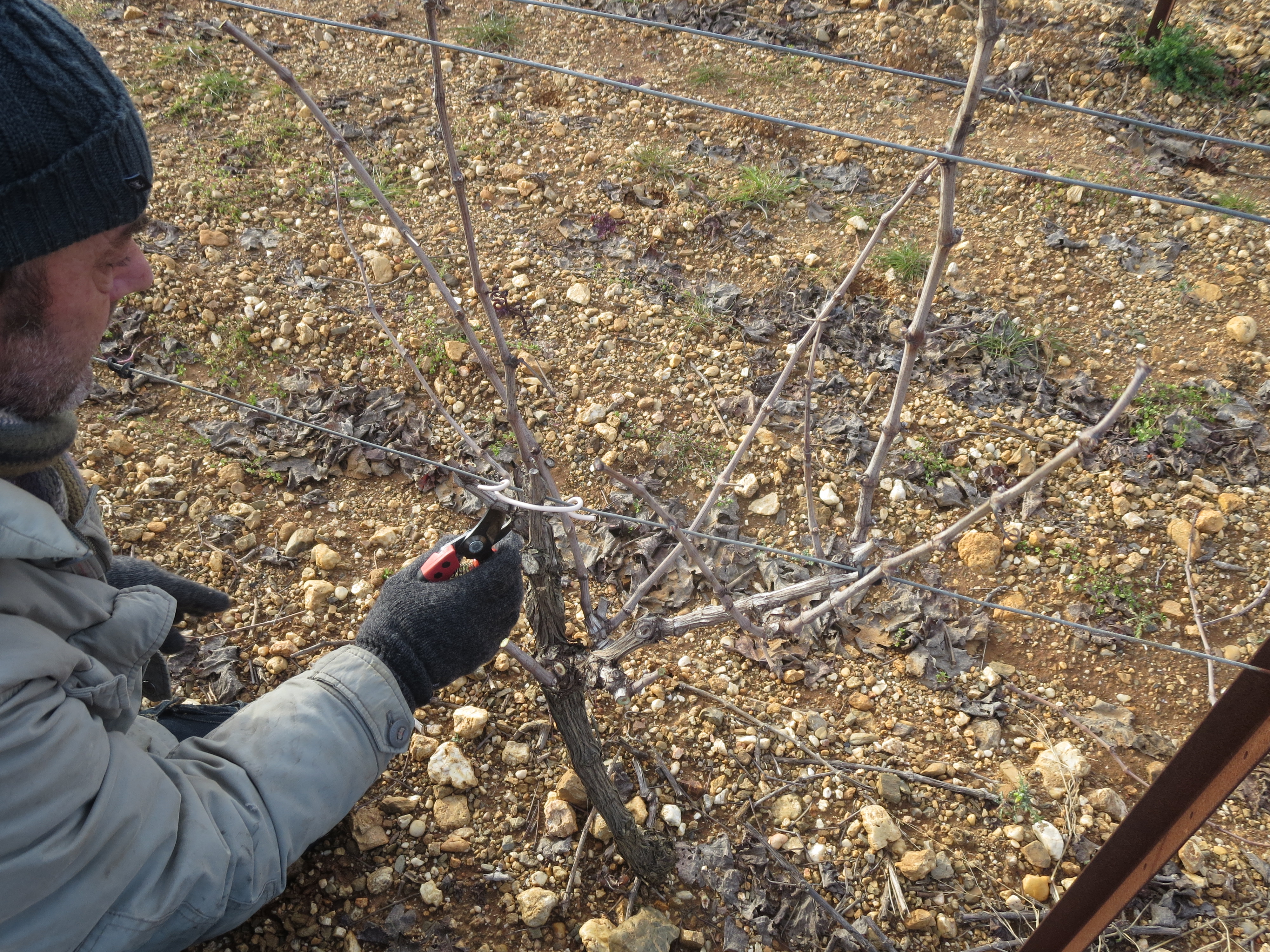
First taille of autumn 2015, guyot vines
Indeed, some vignerons have actually started to prune again ready for 2016. I suspect they are working to a pre-prepared timetable as the vines have been slow to lose their leaves and still show some life. At Mas Coutelou the taille will not take place until next year and most top vignerons will leave it until then, just before the growing season. The extra wood helps to protect against frosts for example. Some vignerons are starting to cavailloner, in other words to move earth from between the rows of vines towards the plants themselves, the extra soils will again act as a blanket against the frosts.
Puimisson basks in autumn sunshine
Dew on some Grenache Blanc grapes left behind in Rome
Other jobs remain to be done. After the months of busy vineyard work and harvest it is a time for sending wine to be sold. Pallets have left Puimisson to cavistes and restaurants around the world. Last Friday, November 6th, they set off to Germany, Finland and various regions of France. More have already gone to New York, London, Melbourne amongst many cities.
The season of salons has started in earnest too. This weekend I was in the Roussillon for La Bande De Latour, highlighting many of the best natural wines of the Roussillon and elsewhere.
The following day I was in Autignac for a tasting of some of the best Faugères wines and also their fines or brandies. I shall post about these soon. I was talking to the excellent Hausherrs, vignerons who had driven to the Pyrenees from Alsace for La Bande, a long, long way. Hard work.
In the next few weeks Jeff will be starting to assemble the wines for the main cuvées of 2015, the likes of Classe and Vin Des Amis. Decisions to be made about what proportions of which cuves to blend for the wines. Sadly, I shall miss this process as we head back to the UK for a wedding. Into every life a little rain must fall.
It has been a beautiful autumn, the weather and the vendanges have made it a magical time. Thanks as ever to Jeff for allowing me to share the experiences and insights of the season.
Messrs Coutelou, Aubry, Poujol, Bellahsen and Prufer
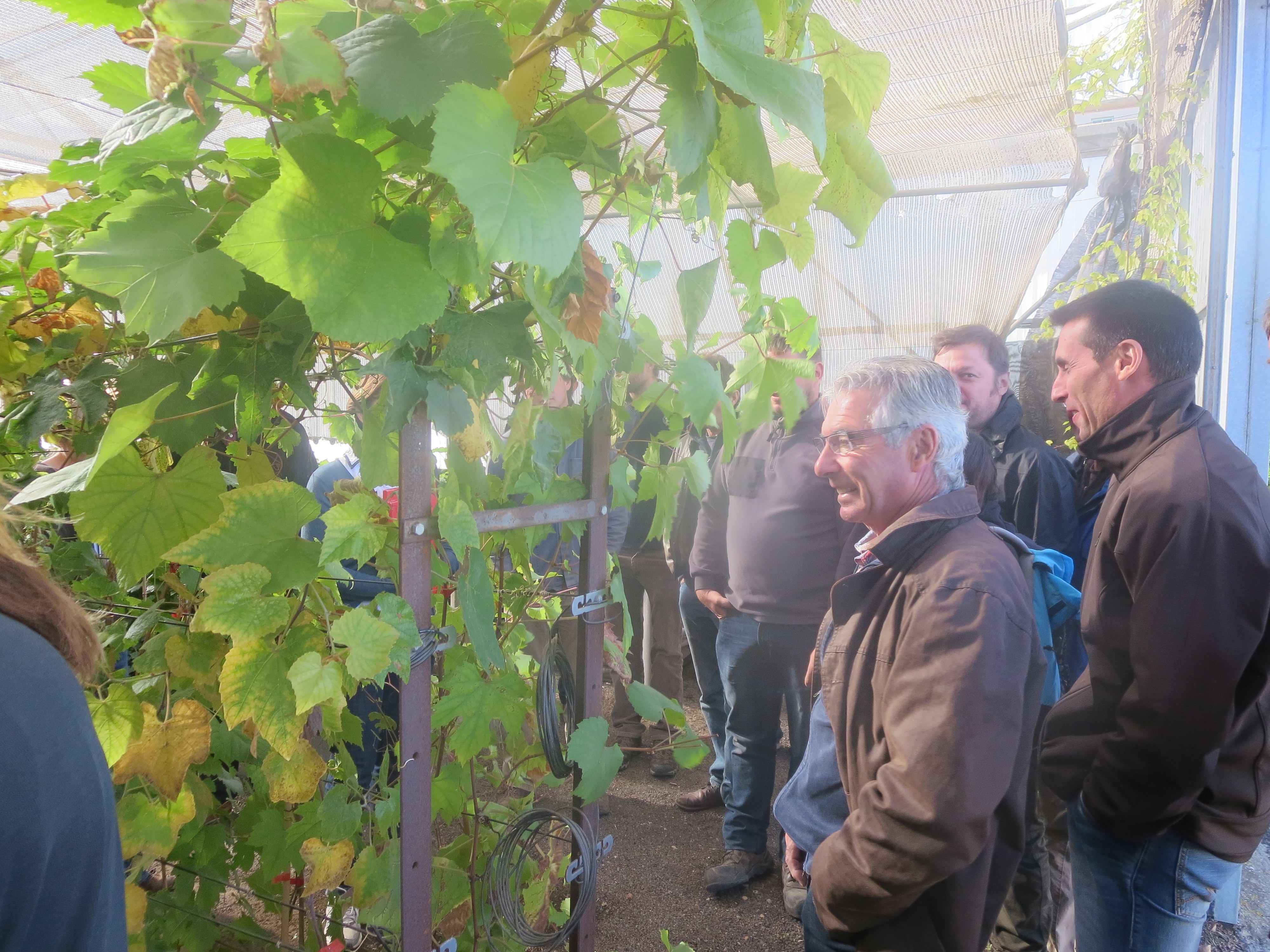
On October 8th a group of vignerons paid a visit to Domaine Vassal in Marseillan Plage, I was happy to be invited to join them. The visit boosted my growing interest in ampelography as well as being great fun, of which more later.
Domaine Vassal was founded in 1949 and is the largest collection of resources about grapes and vines in the world. Its own roots (apologies for the pun) lie in a collection gathered in Montpellier University after the outbreak of phylloxera. This was the disease which almost wiped out the wine industry in France when it arrived in 1863. It is the work of an aphid which lives in the roots of vitis vinifera the original vines of France and Europe including the cépages with which we are familiar such as Chardonnay, Syrah and Cabernet). Sadly, this aphid arrived from the USA, via England (those Anglo-Saxons!), and ate its way through France’s vineyards. Montpellier started to conserve vitis vinifera and to study it and found the cause of phylloxera by doing so. It was also discovered that American rootstock was resistant to the aphid so, by grafting vitis vinifera onto American rootstock, vignerons could grow the traditional cépages rather than hybrid vines of lesser quality.
The other feature noticed about the aphid was that it could not live in sand and so the decision was taken to transfer the collection from Montpellier to Marseillan, Domaine Vassal’s grounds are sand. This means that the vines which are grown there can be grown directly from the sand, no grafting onto American rootstock is needed. Since 1949 some 14,000 species of vine have been collected together.
The sands of Vassal
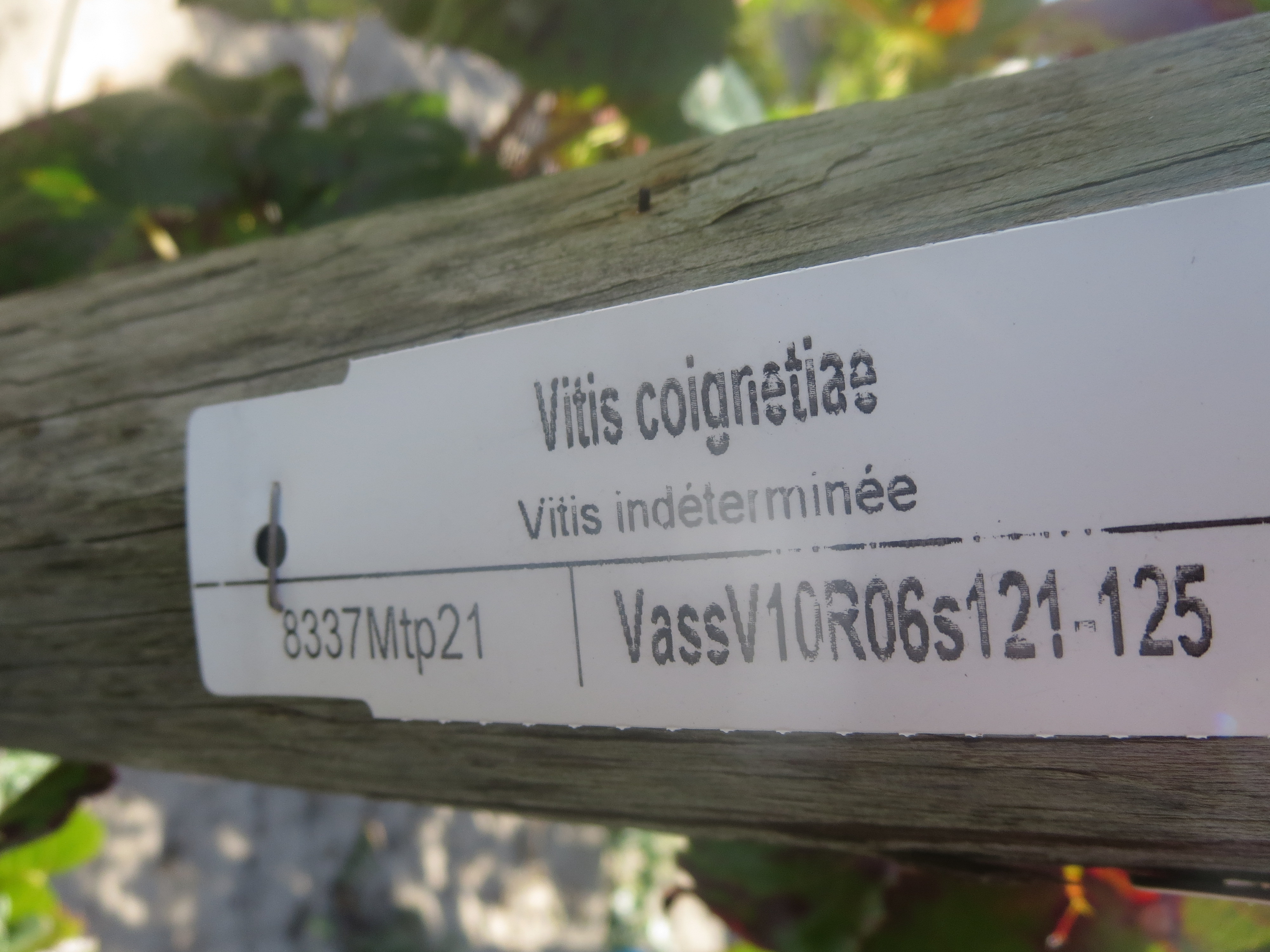
Genetics now means that they can be identified more accurately and 7,700 species remain, many of the species having been shown to be doubles. Cépages are frequently called by different names in different parts of France let alone different countries so it is easy to think of cépages as being different when in fact they are the same. (For example, Cinsault has over 40 different names around the world according to Pierre Galet’s authoritative Dictionnaire des Cépages.)
The aim of Vassal is to:
Acquire
Conserve
Classify
Valorise (ie develop and show the worth of the vines)
The Domaine receives donations of vines every year, five examples are required for each arrival. Last year there was a higher than average number of arrivals (up to 900 plants), indicating that new varieties are still waiting to be added to our knowledge. Researchers also go out to old vineyards to see if other vines can be found. These acquisitions are then planted. At first they may be placed in insect proof greenhouses to protect them and to be nursed.
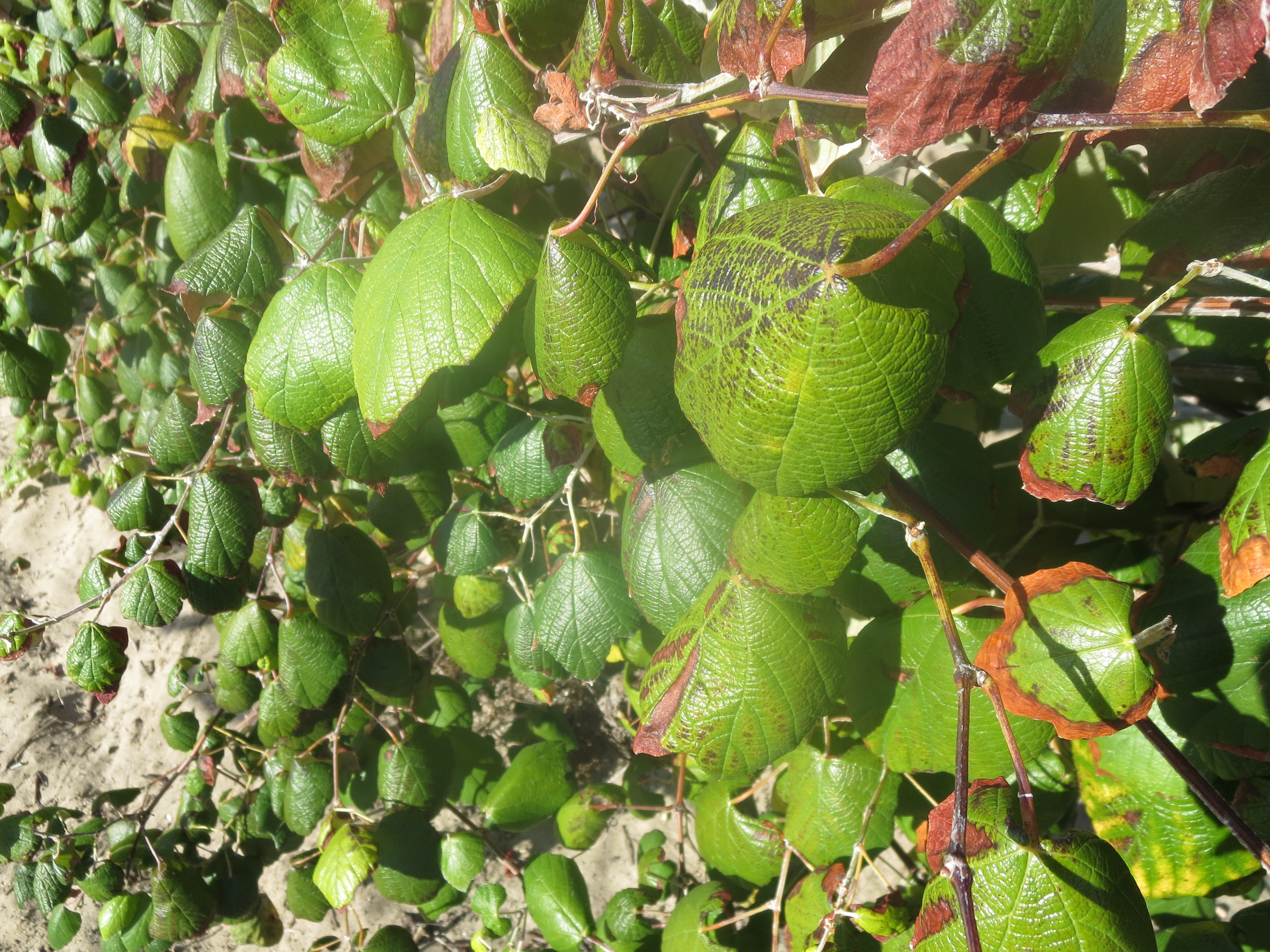
The plants are then placed on one of the fifteen parcels of land at the Domaine which covers around 27 hectares. Most of these are vitis vinifera but there are also hybrids, wild vines and rootstocks.
Hybrid
The vines are studied carefully by genetics and by identification through the leaves, grapes and other features so that they can be classified as new or doubles of already recognised vines. Samples of all aspects are taken and preserved in files to make a unique collection which is being digitised. Further studies look to reveal how the cépage might be best grown, what yields it might offer, would they be commercial?
Hybrid vines with waxy leaves
With so many vines there are losses, but very few, and replacement plants are grown in the nurseries, almost 6,000 were planted last year. This is a vast undertaking and a hugely valuable resource. Vignerons are encouraged to visit and see whether they would like to trial some of the cépages in Vassal, trials which will run with a few plants and over 3 years.
Joe Jefferies takes an interest
Jeff Coutelou is keen to do just that and is looking at what cépages might mix well into the array of different vines which he already grows. Indeed, when talking with staff at Vassal, he discovered that he might have one or two cépages which are not in their collection! This could be mutually beneficial.
Remi Poujol and Francois Aubry amongst the vines
It was a fascinating place to visit and I applaud the work of Domaine Vassal. Unfortunately there is a cloud on the horizon, the collection is going to have to move. A site has been identified at Pech Rouge near Gruissan but every vine will need to be transferred and, as the new site will not be sandy, will also have to be grafted. This is a massive undertaking which will take a few years to accomplish and the staff are determined that no species will be lost. The professionalism and skill I see at Vassal will be tested, I am sure they will pass that test.
Messrs White, Poujol and Maurel
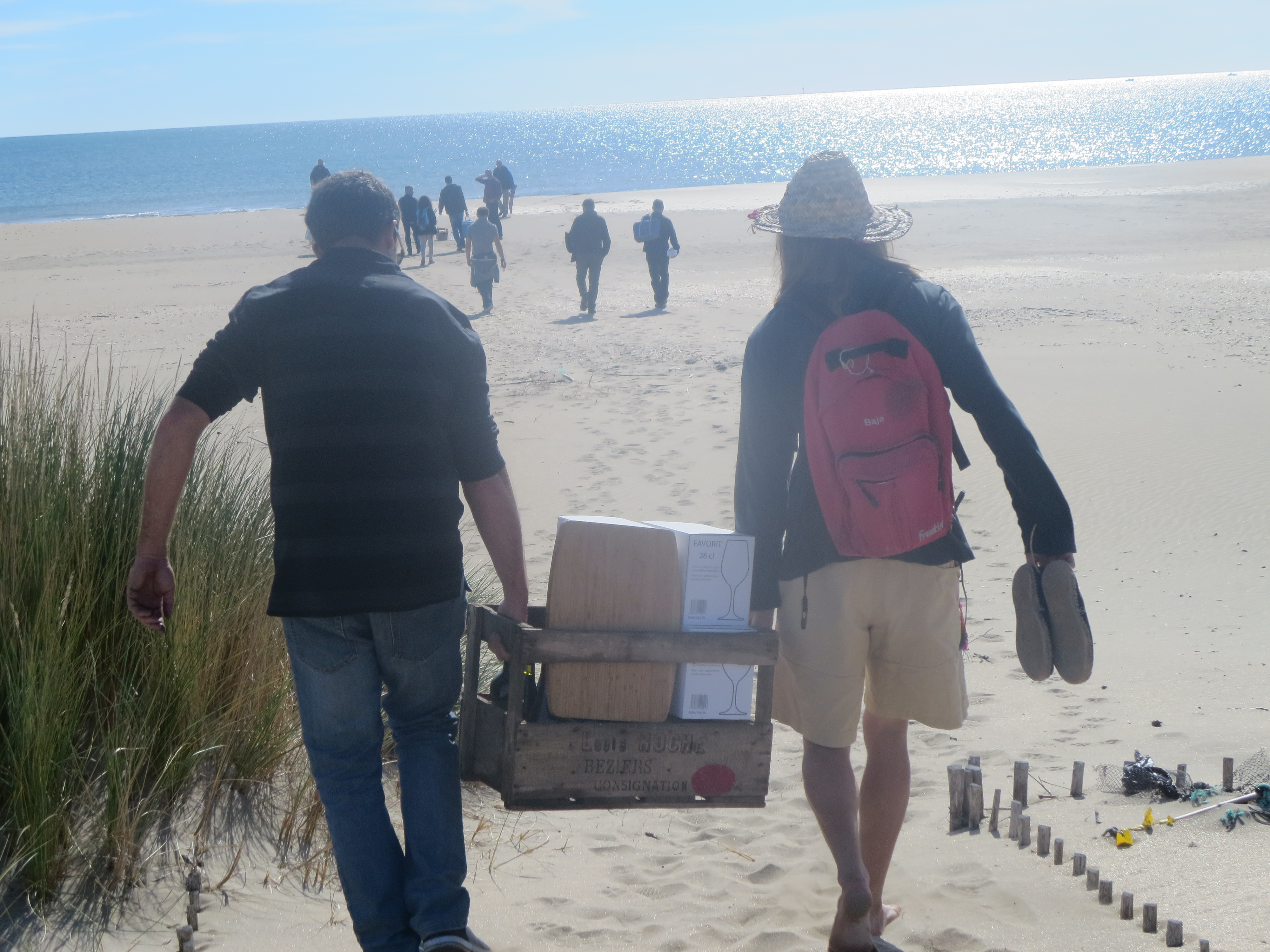
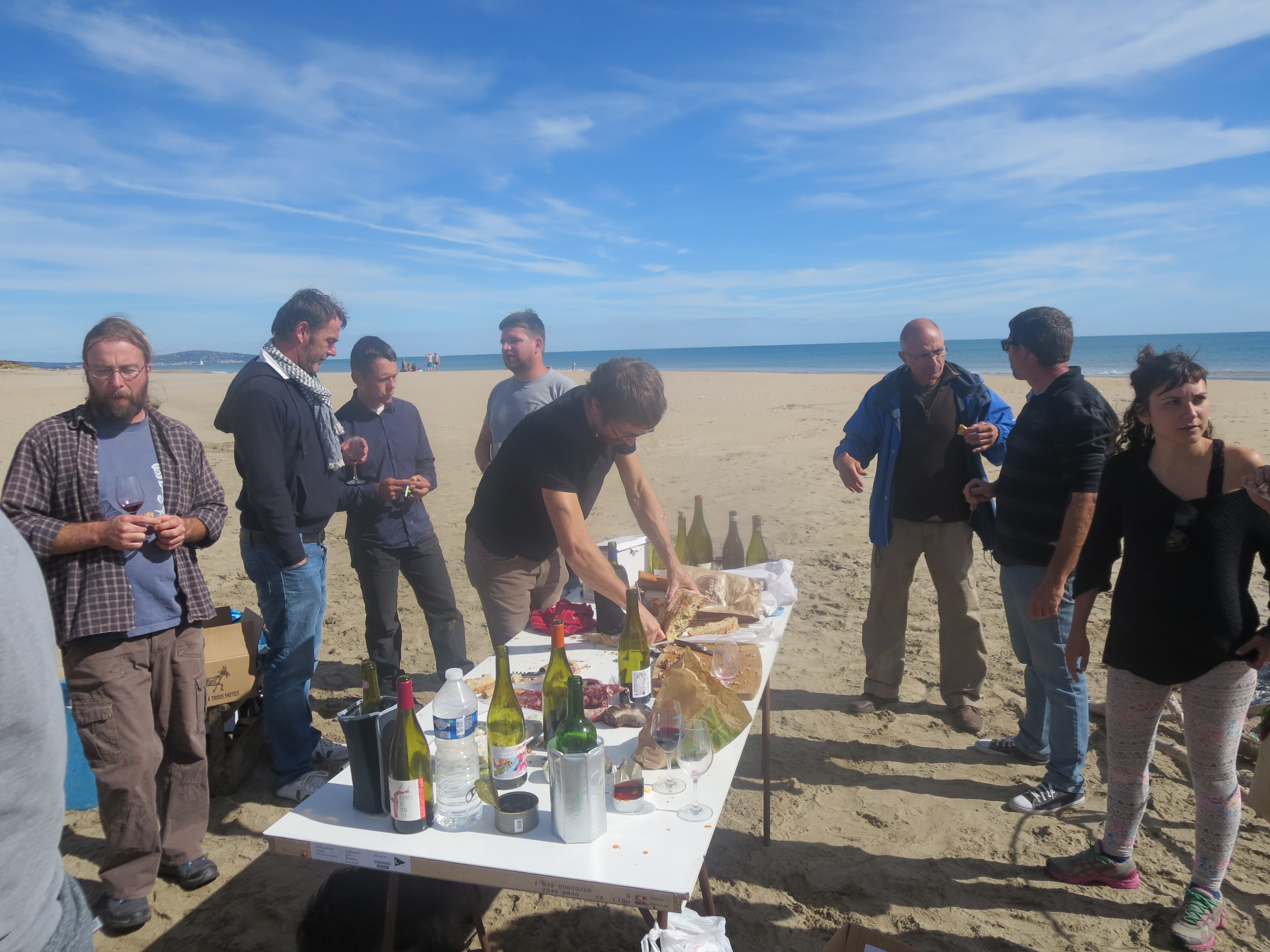
After the visit the vignerons decamped to the nearby beach, a fire was lit and a barbecue enjoyed. Accompanied, of course, by examples of many excellent wines appropriately from many cépages. There was no cloud on the horizon here. As well as Mas Coutelou there was Mas D’Agalis (Lionel Maurel), Fontedicto (Bernard Bellahsen), Julien Peyras, Grégory White, Yannick Pelletier, Fontude (Francois Aubry), Le Temps Des Cerises (Axel Prufer), Remi Poujol, Bories Jefferies (Joe Jefferies), Clos Fantine (Olivier Andrieu). In other words the great and the good of Languedoc natural winemakers. It is interesting to see that this group is to the fore in promoting and conserving old and rare cépages, a natural fit.
For a fuller account of Domaine Vassal’s work read this article by Ken Payton.
Soutirage? It’s where you take wine from one container and move it to another. Traditionally this was done from barrel to barrel by gravity but these days it applies to moving the wine by other methods too. Why? Well the wine has been fermenting on lees, the dead yeast cells and other parts of the grapes. The wine needs to be removed from these as they cause cloudiness and you don’t want to drink wine full of lees. The lees can also cause off flavours in the wine so once they have served their purpose in helping to ferment and flavour the wine in a positive way they need to be separated.
All pumps to the full
By moving the wine you also add oxygen to it and remove the risk of carbon dioxide building too much in the cuve which might cause issues such as reduction, a wine fault leading to odours of rotten eggs, rubber, struck matches or worse. That oxygen acts as a kind of inoculation too, a little bit helps to reduce the risk of wine oxidising later.
Julien checking the level of wine in the recipient cuve
Therefore, on Friday 30th October, Jeff decided to carry out soutirage. Also, as the weather has been very warm they will continue to ferment a little longer in their new home before the colder weather does arrive. This means that there will still be some CO2 in the wine. Too much is bad but a little is good and this is the core of winemaking – finding the balance between all these different pros and cons. CO2 in small quantities helps to stabilise a wine and makes not using SO2 easier (important at Mas Coutelou) and also adds a little freshness and sense of texture, possibly a sense of acidity too. Oxygen, carbon dioxide, lees – you want to get just the right amount but no more.
Cuve being emptied to another
What this did mean was more planning and more of the puzzles of what wine goes where. My last post showed how complex this is. And here we bring in the surchargé part of the title. Jeff has had a busy week with lots of paperwork, orders to sort, bottles to label, package and get ready for sending out to cavistes around the world. Add in administration work for customs, taxes and many other agencies. The side of being a winemaker that people don’t really see.
Same wine before (left) and after (right) soutirage, there was a noticeable difference in taste
I went to the vineyards on Thursday to take some photos of the beautiful colours in the vine leaves, unexpectedly I found Jeff in Peilhan digging out cannes de provence near a stream with a pick. He said this was his break from the paperwork, he needed some fresh air.
Looked like more hard work to me, and people ask me if I would not want to become a vigneron!
Please note that I have updated the Out And About and Tastings pages recently, click the links at the top of the page to see what’s been happening.
The immediate period after harvest could easily be perceived as a time to relax a little. The hard work of picking, transporting, sorting, crushing and pressing grapes is done. The remontages, délestages, pigeages are memories. The wines quietly ferment in cuve, gently moving to their magical transformation into wine.
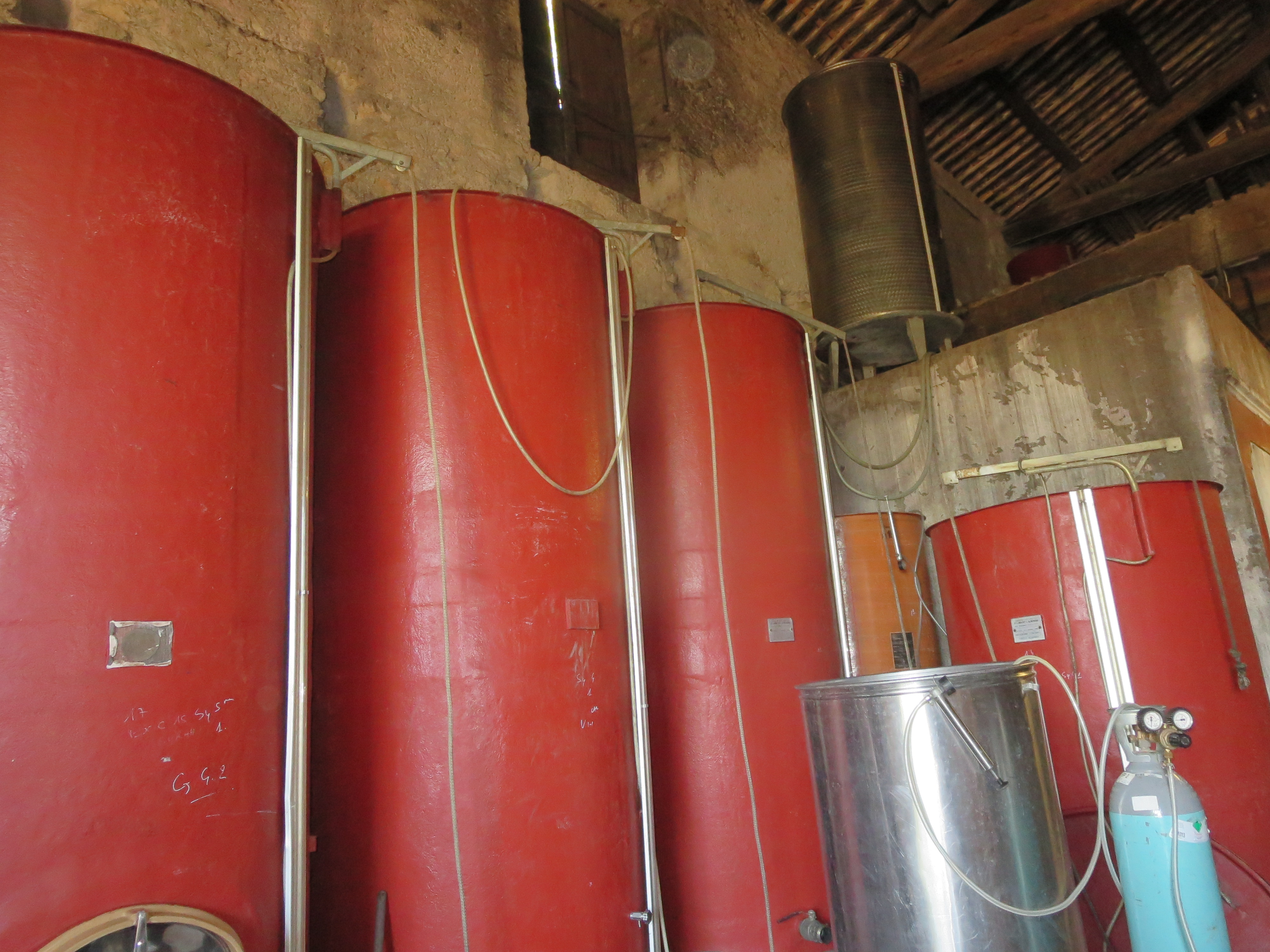
Cuves now containing wines such as Syrah and Flambadou
Sadly, that is not the case. The work continues apace, there is no time to relax just yet. The wines are in a delicate stage, fermentation is a violent chemical reaction and lots could go wrong. Therefore, they are checked frequently and analyses are sent away to ensure that everything is proceeding as it should. This is the top of the sheet which comes back from the analysis laboratory.
For each sample you receive information about the amount of residual sugar, alcohol, volatile acidity, the pH of the wine and the amount of Sulphur Dioxide (SO2) in total and free in the wine. SO2 is the controversial additive which most winemakers add to their wines to stabilise it and to provide elements of prevention against oxidation. Natural winemakers, such as Jeff Coutelou, are against using SO2 as they want wines as natural as they can be without additions.
SO2 is a natural product of grapes and winemaking so there will always be a small amount of SO2 in any wine. It combines with the chemicals of wine and so most is absorbed (bound). The rest which is free is what conventional producers use as an anti-oxidative and anti-bacterial agent in the wine. They might add sulphur at various points of the winemaking process but most likely at crushing, fermentation and bottling.
EU regulations limit the amount of sulphur as you can see in the table below. Red wines produce their own natural anti-oxidants so less SO2 is allowed. Sweet wines contain more sugar which binds SO2 so more is added so that free SO2 can work. Levels of permitted SO2 rise according to the type of sweet wine. The figures are all mg per litre.
Organic regulators allow less SO2 to be used as you can see, indeed some organic bodies such as Demeter have even more strict limits than those below.
Natural wine guidelines are exactly that, guidelines. There are no official rules for natural producers as there are no rules for any aspect of natural wines. The figures in the table are those suggested by AVN one of the groups which some producers have established.
Type of wine
EU
Organic rules (Demeter)
Natural guidelines
Red
160
100 (70)
30
White, rosé
210
150 (90)
40
Sweet
200+
170+ (80+)
40
Some natural wine makers have gone further and eschew any use of added SO2. Jeff is one of those producers.
I have chosen not to identify the figures for the analyses of particular wines he received on October 15th from which the heading is shown above, as they are not mine to share. I can say that the highest SO2 figure is 10mg/l and that is for one cuve only. Fifteen of the nineteen wines analysed contained 3 mg/l or less. In other words every cuve has negligible levels of free SO2, humans cannot taste it at less than 11mg/l in water let alone wine. No sulphites are added. Mas Coutelou wines are natural wines but also very healthy wines. The analyses showed they are all 13.5% to 15% in alcohol and volatile acidity is well under the guidelines, one or two cuves were a little elevated but that is normal during fermentation.
Cement tanks including one which contains Flower Power
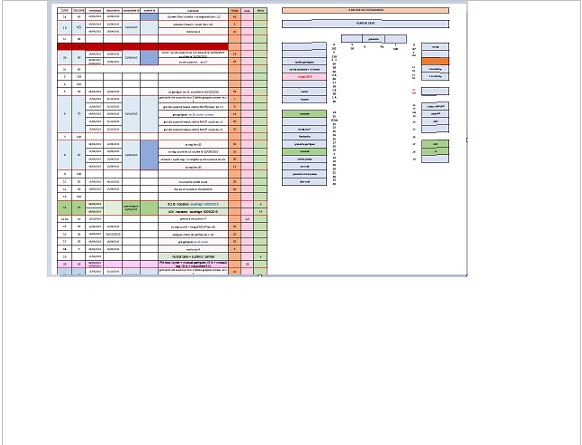
So the wines are progressing well, it looks like a very good vintage. They have been put into the cuves appropriate for them to spend the winter. Jeff produces a plan to show where they all are.
On the left is a spreadsheet showing each cuve, how much wine is in it, when it was harvested, when it was moved, when assembled with other wines, date of sous-tirage, the wine and grapes, and quantities for red, rosé and white. I have made it a little hazy so as not to spoil the surprises which the patron will unleash in the next few months.
To the right is a map of the cellar showing where the wines are.
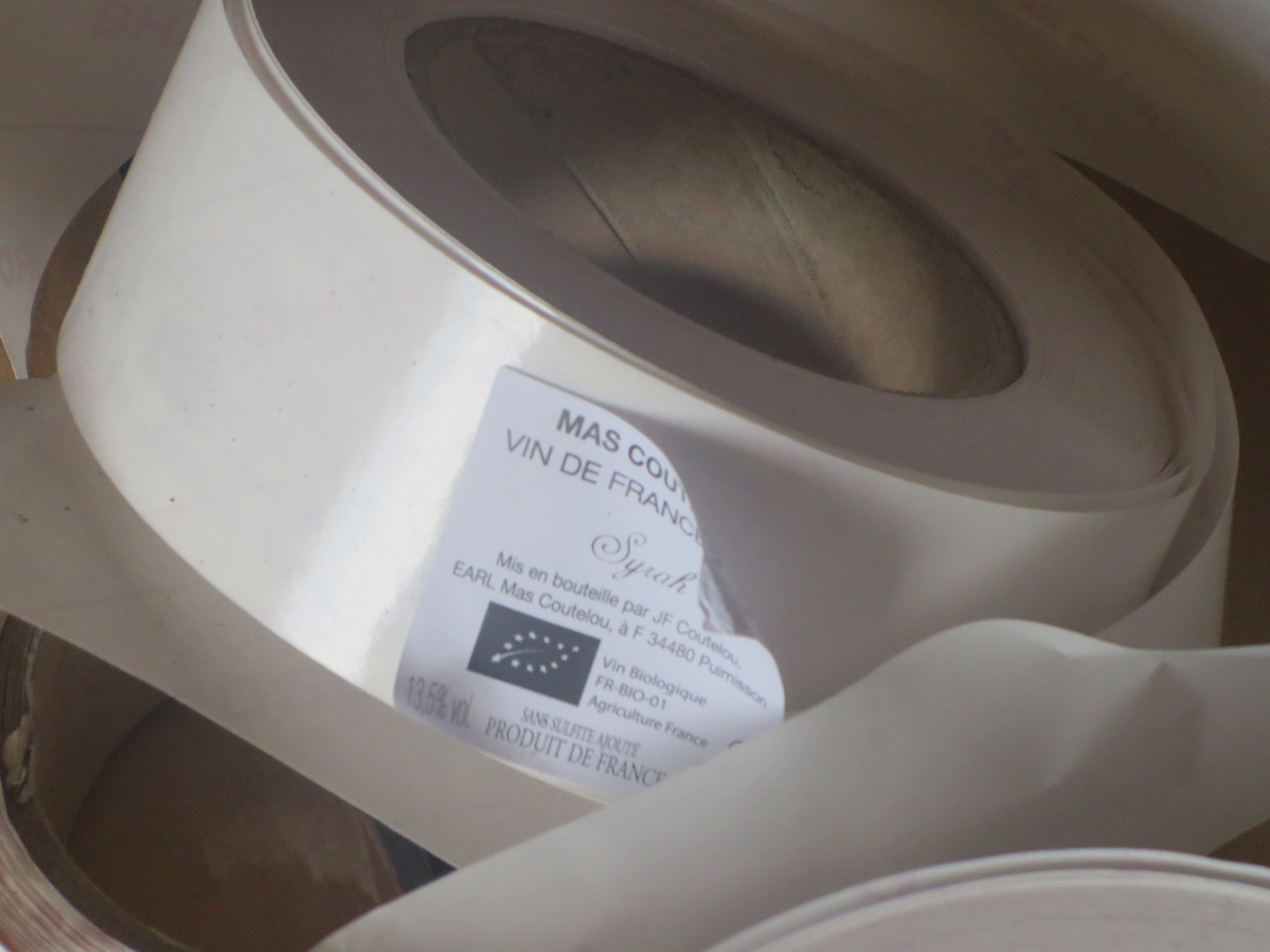
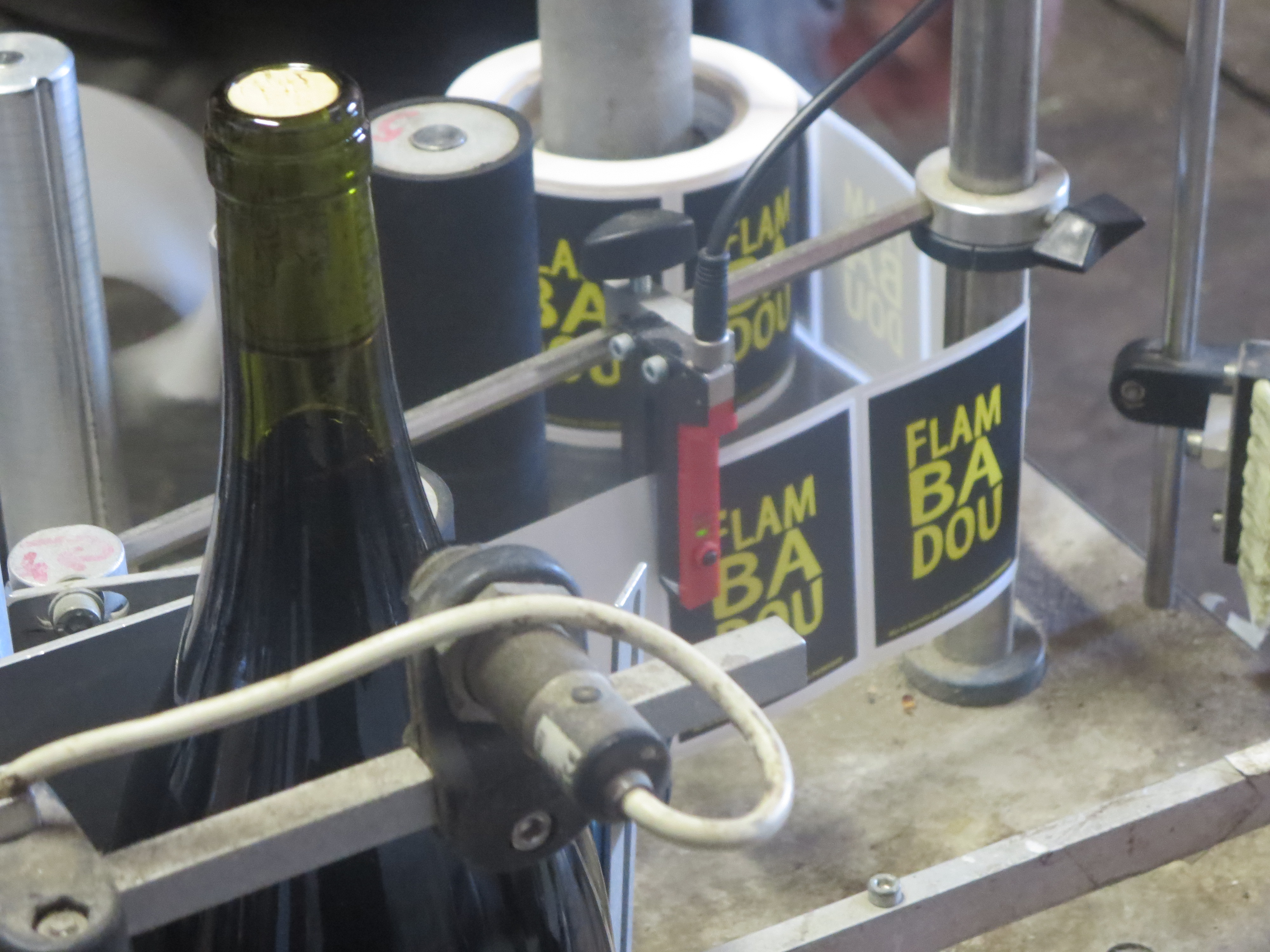
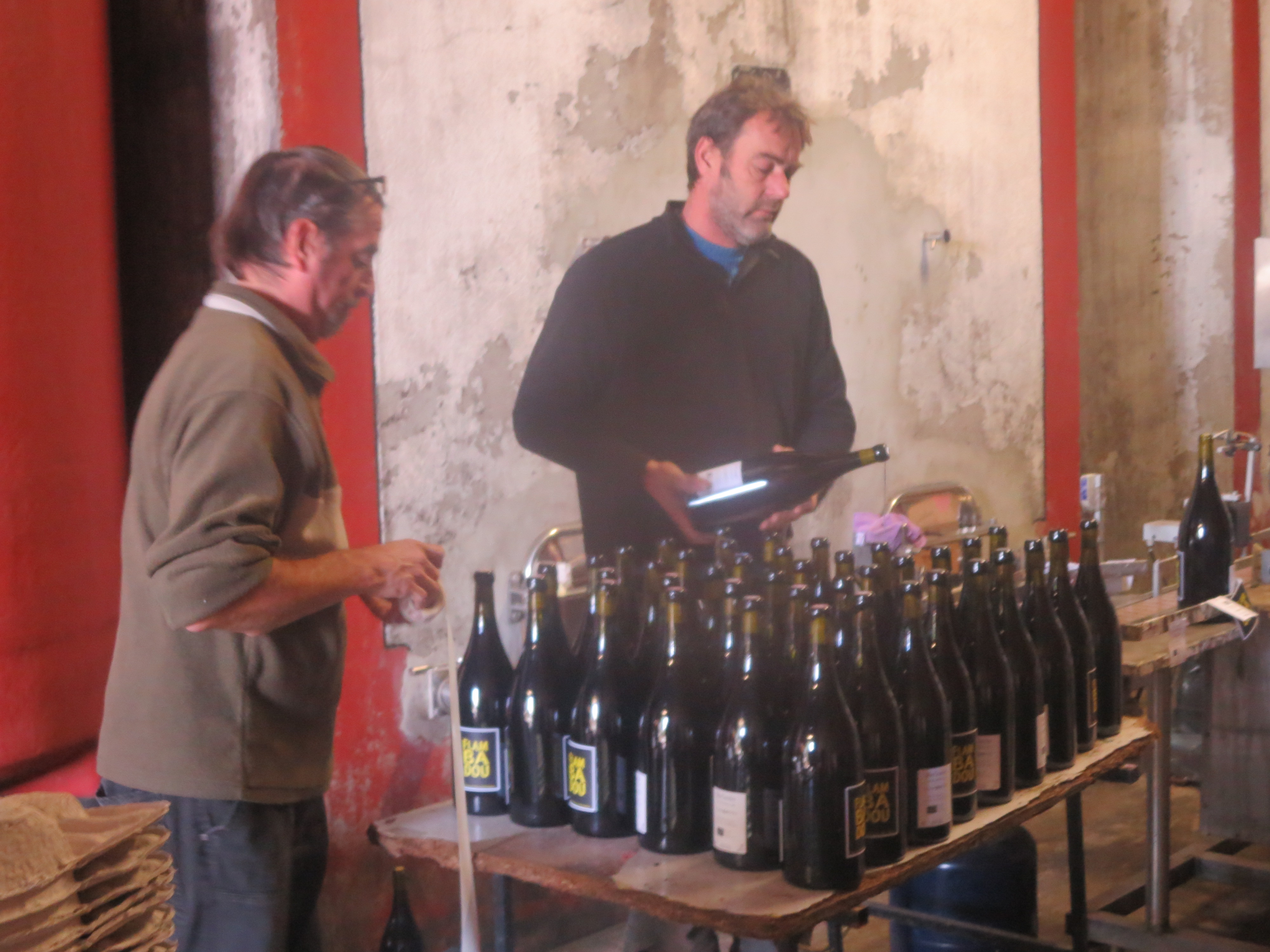
Jeff has also been receiving plenty of phone calls. It is now several months since wines left Puimisson to head to cavistes and merchants in France, Europe, the USA, Asia and Australia. Now stocks are low there is a demand for wines to be sent to them. Therefore, the 2014s which were bottles earlier this year are now being furnished with their labels and capsules and then packaged into boxes. Different regions, eg the EU, UK and USA, all have different requirements even for this packaging so even this job is not as simple as it may seem. For more on the process and a video I took last year see here.
Thursday October 22nd was a day for preparing magnums and for some markets these are sealed with wax. Appropriately Flambadou, named after a barbecue implement, was therefore held over the flames of the gas burner which heated the wax.
Jeff and Michel, waxing lyrical
On Friday Jeff was due to head north on the long drive to Nancy and a wine salon. We are entering the season for these events and that means more journeys, more selling and more work. The vendanges may be over, the work certainly is not.
Jurancon was long known for its sweet wines and indeed if you only see the name Jurancon on the bottle label it will be a sweet wine. However, in recent years the popularity of the region has grown because of its dry wines which will carry ‘Jurancon Sec’ in the label. All Jurancon wines are white, red wines are made in the area but they carry other names such as Coteaux Du Béarn.
Nets protect the late harvest grapes from the birds
Jurancon is grown to the west and south of the city of Pau in the Pyrénées – Atlantiques. The vines are to be found in small parcels around the tops of hills and ridges and these vineyards were so different to the monoculture of the Hérault or Bordeaux, Burgundy and the other more famous French regions. Other crops such as maize and fruit are more widespread than vines along with plenty of cows and sheep.
It makes for a truly lovely countryside, admittedly the autumn colours of the trees and vines highlighted that beauty to best effect. The soils are clay and gravel though some areas also have pudding stones, big pebbles which retain heat.
Petit Manseng
One of Jurancon’s attractions is its unusual grape cépages. Gros Manseng makes up around 60% of the region’s grapes, with its close relative Petit Manseng forming around 35% of the rest. Gros Manseng is often the main force of the dry wines and Petit Manseng is the most important grape behind the sweet wines. Petit Courbu is the third main variety with Camaralet and Lauzet being the minority cépages, described as accessory grapes by Jean – Louis Lacoste at Domaine Nigri. These grapes give Jurancon wines a sense of place and also a sense of being different to the rest of the world.
Carving at Domaine Montesquiou
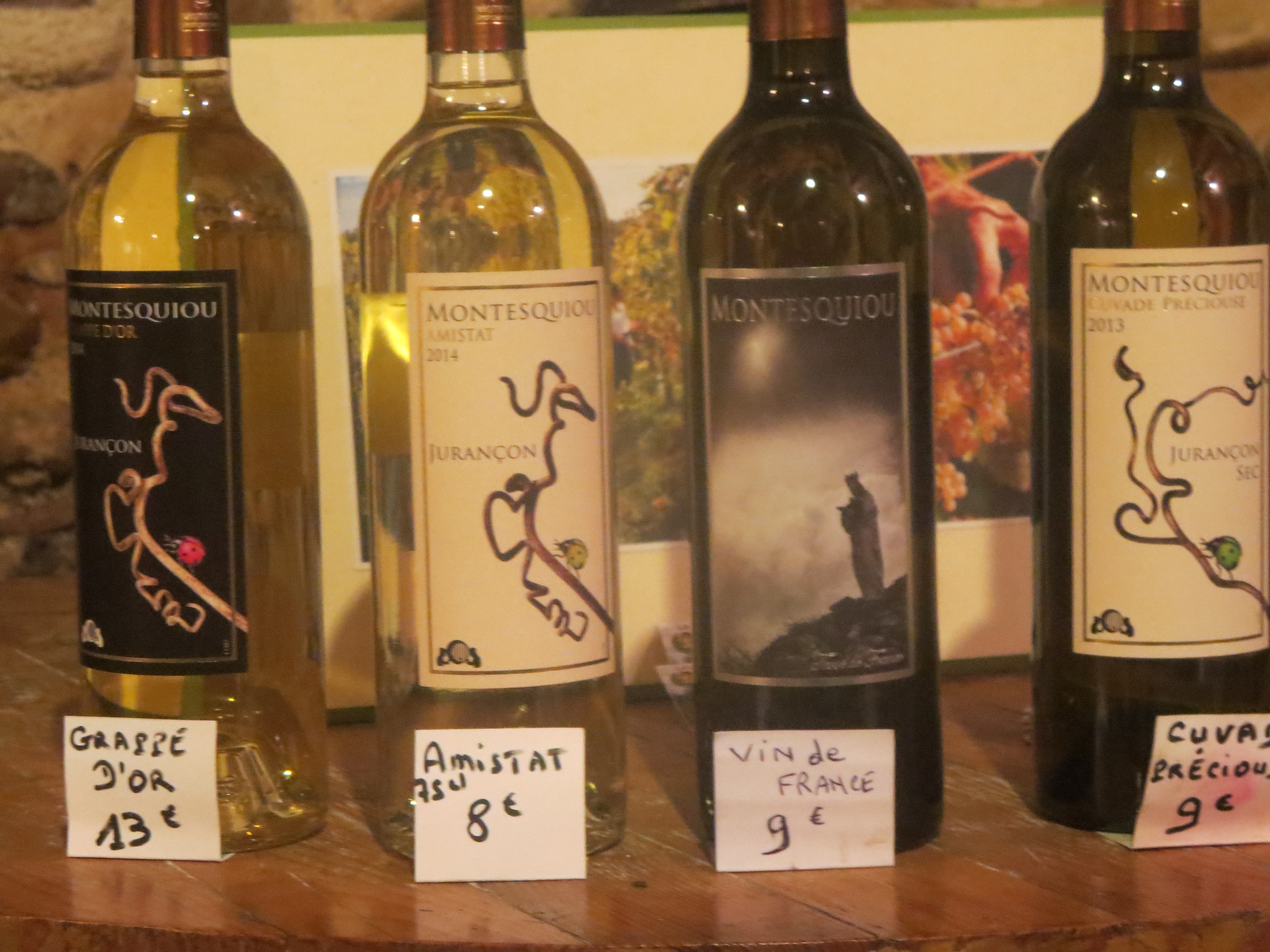
It was the dry wines of Domaine Montesquiouwhich first attracted me to the region and made me want to visit the Jurancon. I bought them in the UK from Leon Stolarski, an excellent online merchant with a range of excellent small, independent growers. After buying one or two bottles as a change I became convinced that these were wines of the highest quality, amongst my favourite white wines in the world. Therefore my first visit to a domaine had to be to Montesquiou, which is found on a hill in the commune of Monein.
Sébastien Bordenave Montesquiou
I was greeted by Sébastien Bordenave Montesquiou and his brother Fabrice who run the domaine these days, as well as their father. I felt somewhat guilty as even though the vendanges were finished in the Languedoc, here they were still in full swing. The dry wines are in cuve but they had only started to pick grapes for the sweet wines 2 or 3 days before my visit and will be picking for another month. However, there was no vendange on the day of my visit (October 19th) and Sébastien generously gave his time and showed me into some vineyards as well as the winery itself.
The tall Manseng vines, oats and grass between them
The vines themselves were different to those I am more accustomed to in the Languedoc. They are tall, with the bunches of grapes at waist height, much easier for picking! Those left on the vines were being left to dry in the autumn sunshine, becoming passarillé, concentrating the sugars in the juices. The vines face mostly eastwards , not overly exposed. Between the vines oats had been sown in spring to provide competition for the vines so that they have to compete and struggle a little rather than becoming too vigorous. The oats are not allowed to develop fully but the leaves were still evident. As Jurancon vineyards receive more rainfall than any other French region these crops also help to avoid soil erosion on the steep slopes where the vines are found. Ploughing is therefore rare too. Most vines are pruned with Guyot double though Sébastien told me the trend is towards Guyot simple.
Sébastien shows how the Petit Manseng grows quite spaced out in the bunch. Botrytis is therefore unusual, the grapes become sweet by drying on the vine
The dry wines are fermented in stainless steel and cement tanks, some then being aged in barrel some left in the tanks for different cuvées (L’Estela is the non oak aged, Cuvade Préciouse the oak aged). We tasted some of the 2015 wines from tank and they are already losing their puppy fat and becoming lean, spicy, zesty wines with a range of long flavours filling the mouth. Both of these wines are dominated by Gros Manseng with L’Estela also containing 40% Courbu (and a small amount of Petit Manseng) whilst Cuvade Préciouse also has 30% Petit Manseng. These are thrilling wines, full of spice, citrus and a delightful clean finish.
Fresh from the tank
Sébastien took us into the barrel room where the wines were literally hissing as they fermented inside. I am very wary of oak barrels I must admit. Too many heavily oaked wines in the 1980s and 1990s left me preferring fresh, unoaked flavours. However, even I will admit that when used judiciously, oak barrels can add complexity and depth to a wine, the interaction with the wood and the small amount of oxidation bringing extra nuances.
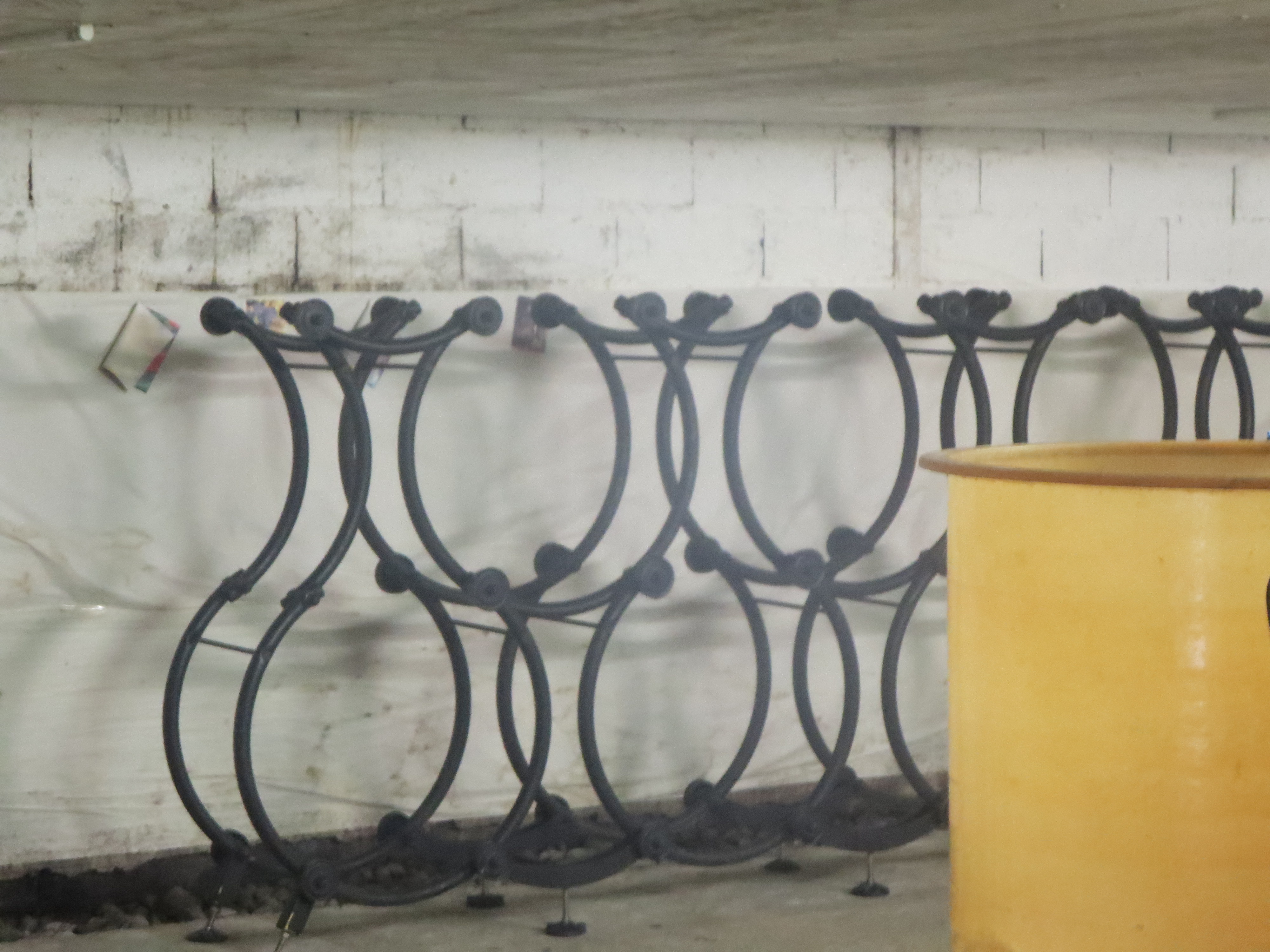
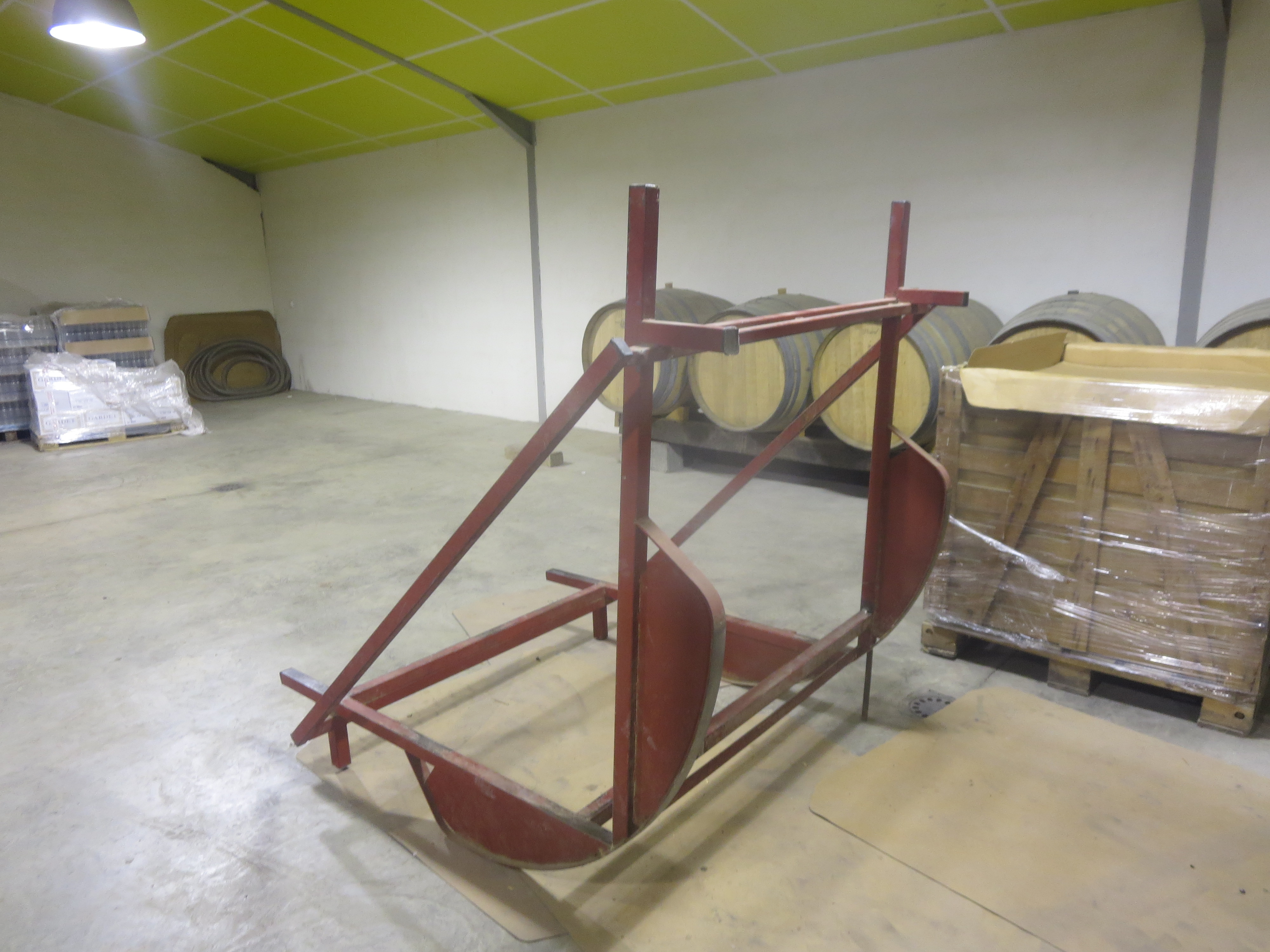
This metal rack will be filled with barrels
And here the use of oak is masterful. Cuvade Préciouse is still zesty and has a delicious clean flavour but the oak adds a roundness and a slight nutiness. Brilliant stuff. I would drink L’Estela every day, it is my ‘go to’ white wine.
As I talked to him Sébastien’s enthusiasm and passion were evident and he reminded me of Jeff Coutelou in his love of the vines, land and his wines. He spoke about the use of oak and how he is like a choirmaster with the grapes, wood, oxygen and yeasts all voices which could compete and clash but with careful training and guidance these different voices become harmonious to produce a sound which is greater than any single element.
Onto the sweeter wines. Amistat is a 100% Gros Manseng wine which is more a demi-sec rather than a moelleux. It starts as a dryish wine with exotic fruits and a lean, clean streak and then a little sweetness establishes itself in your mouth on the finish. This would make a great apéritif wine, lovely. Vin De France has a lovely photograph on its label. It is unclassified Jurancon wine because there is slightly too much residual sugar for a Jurancon sec, again it would strike me as a demi sec style wine. I loved this, it had a real length and yet despite that residual sugar it remained refreshing and balanced. Finally, onto La Grappe D’Or and the archetypal Jurancon wine made from Petit Manseng. Luscious and sweet with spice and apricots yet with a refreshing line of acidity to cleanse the palate, it lingers and grows in the mouth. Brilliant winemaking. The grapes for this year’s wine are still on vine and will be harvested into November, though all the vines are a week or so ahead of the average year.
A great range of white wines
Sébastien’s parting shot was that he seeks to allow the grapes to express themselves, a reminder to me of Jeff’s words near the end of harvest that you should always have faith in the grapes that you have grown, they will do the job of making great wine if you help them rather than seek to control them. Kindred spirits. Indeed the brothers are starting to experiment a little with natural winemaking. This is one of my favourite domaines, every single wine is top quality and Montesquiou are, in my view, the producers of the very best Jurancon secs.
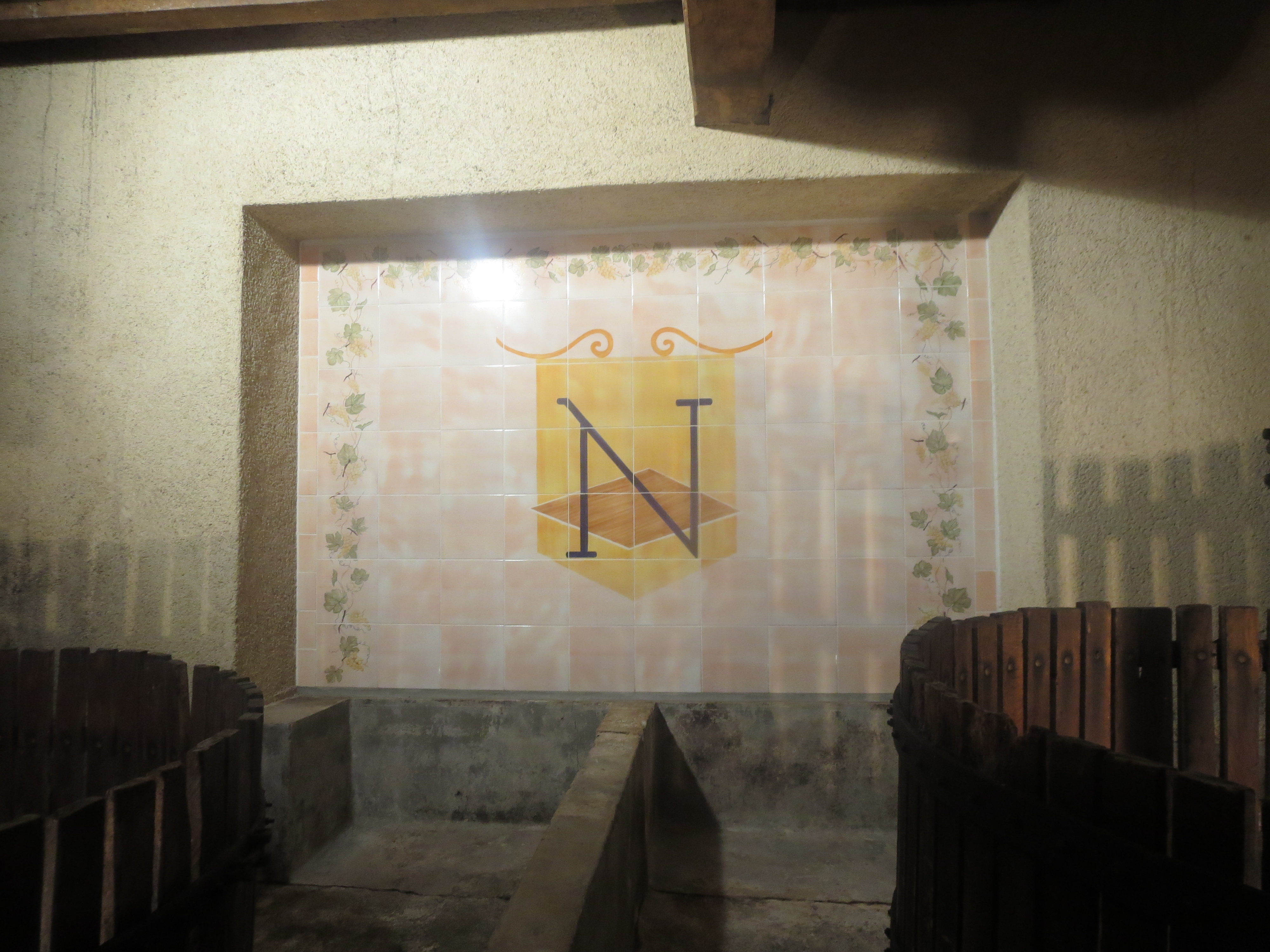
The Nigri symbol
Domaine Nigri building 1689
The following day we went along to Domaine Nigri. Jean-Louis Lacoste runs the domaine which has been in the family since 1685. Now organic, like Montesquiou, the domaine is unusual in the region in having mostly Petit Manseng. I think this is reflected in the quality of the sweeter wines which are the mainstay of Nigri and are wines of the very top quality.
Much attention is given to training the vines to ensure as much aeration as possible and the land between vines has a grass covering for aeration and to avoid erosion. The cépages are harvested separately and the parcels vinified separately to express the terroir. The wines rest on ther lees for 6 to 11 months to maximise the expression of the wine. Again the use of barrels for ageing is carefully done allowing slight oxygen exchange without overpowering the flavour of the grapes themselves.
After a tour of the winery we tasted the range.
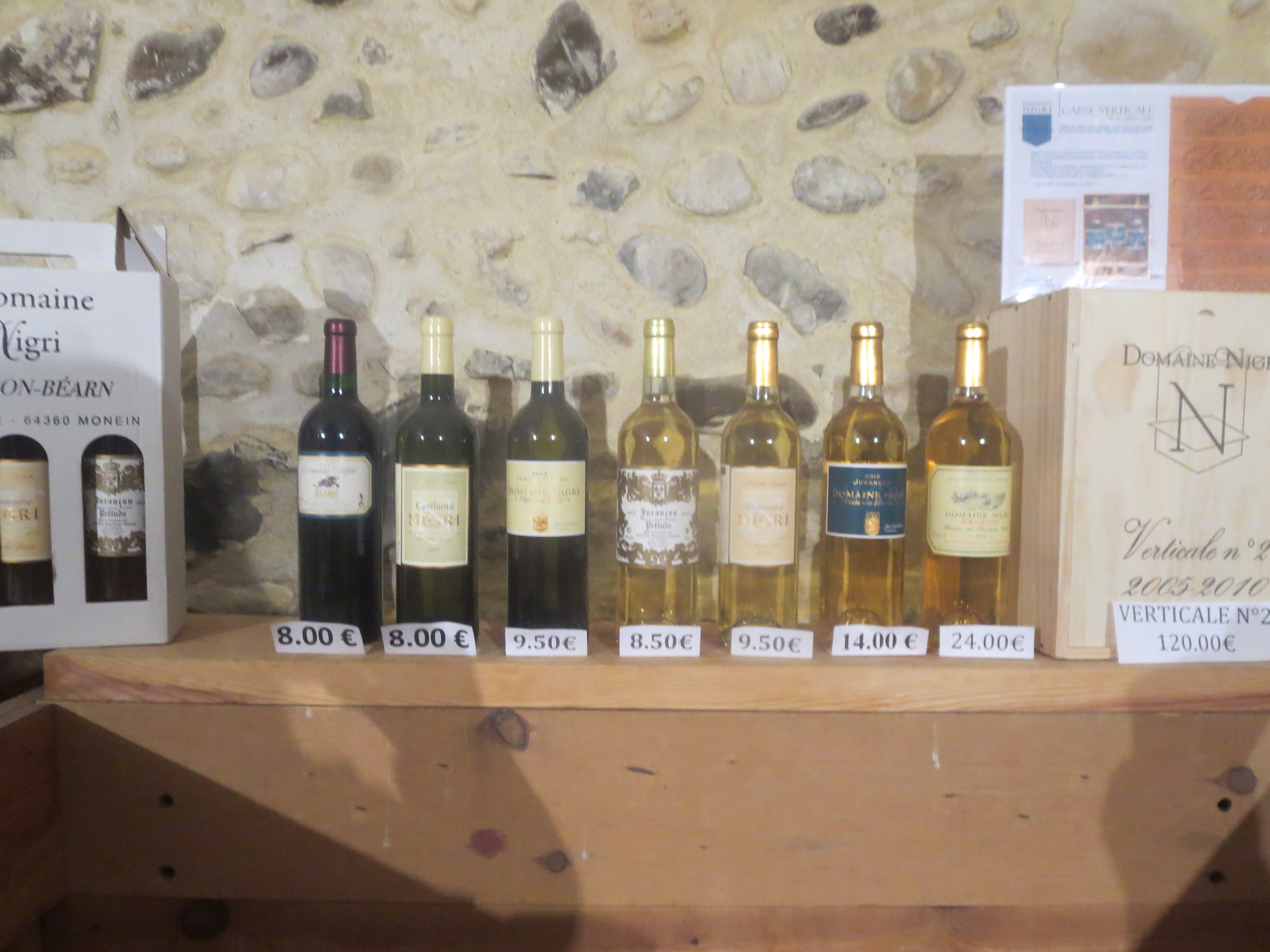
Confluence is a Jurancon Sec and unusually contains 10% each of Camaralet and Lauzet, grapes not found in most domaines, the majority being Gros Manseng. Clear, fruity and with a very refreshing finish. The other dry wine is Pierre De Lune which is oak aged unlike Confluence. This time the 80% Gros Manseng is joined by 20% of Petit Manseng which perhaps adds the slight hint of sweetness, another demi-sec like wine. Yet there is a lovely, zesty finish which leaves you wanting more. Very good.
The sweeter wines are, perhaps, the strong point of Nigri. First in the range was Pas De Deux, 40% Petit Manseng which is oak aged and 60% Gros Manseng which is unoaked. This is sweet but slightly so, a great aperitif wine or accompaniment to cheeses. Honey notes are balanced by citrus freshness, perfectly balanced and a wine you would drink more and more of. Toute Une Histoire is the main sweet wine of Nigri, 100% Petit Manseng fermented and matured in oak for 11 months. The grapes come from 3 different soils for complexity. Richer, more honeyed and viscous in texture yet always a very refreshing finish, the wine does not cloy at all. It would balance cheese but even Asian foods perhaps. Truly delicious. Hors De Piste is the top wine, again pure Petit Manseng, the best of the grapes go into this cuvée. It actually looks a little less golden in colour but is more intense and full. It fills the mouth with sweetness but once again the freshness kicks in and the wine lingers leaving delicious flavours of quince, orange and apricot. Exceptional.
The more I visit wine domaines the more convinced I become that the wines reflect the vigneron. Jean-Louis is a quiet, reflective man but passionate about his vines and wines. The wines show that same subtlety but open out into full flavours, welcoming and expressive. As at Montesquiou I was happy to buy the range of wines.
Pallets of Nigri wines in the ageing room
This device moves the pallets onto their sides
I tasted a number of other wines in the area, some were frankly disappointing, some OK. I would mention Domaine Bellegarde’s Jurancon Sec which offered a citrus, fresh and fruity range of flavours.
These two domaines stand out to me and I enjoyed every single one of their wines. They are great to drink now but will also age well, and the sweeter wines especially will broaden their flavours. Seek out, buy and enjoy the wines of Domaines Nigri and Montesquiou.
Jurancon, a beautiful wine region with wines to reflect its nature.
A celebration of all who joined in the 2015 vendanges of Mas Coutelou, hopefully a vintage year in every sense. Jeff believes that the vines and the team have been very good. Of course, he is the one who makes that possible.
Jeff
Michel
Cameron
Me
Lots of others: Carole, Vincent, Julien, Thomas, David, Charles, Pat, Martin, May, Delphine, Céline, Fabrice, Romain and, of course, Icare.
And I hope you’ll watch this video compilation with music from:
Steph Des Mar – Couper Le Raisin
Neil Young – Harvest Moon
The Isley Brothers – Harvest For The World
Enjoy the Mas Coutelou 2015s when you can, we worked hard for it!
Lots of work continued in the cellar during the week, pigeage and remontage as described in the previous post, and more wines which are now completing fermentation and being put into tanks to mature or to allow malolactic fermentation if it hasn’t already happened. This fermentation produces softer lactic acid which will make the wine taste more supple and fruity. The cellar is now much quieter and there is a sense of job done.
Pigeage
Carignan in tank
Cameron cleaning tanks, cleanliness remains the priority
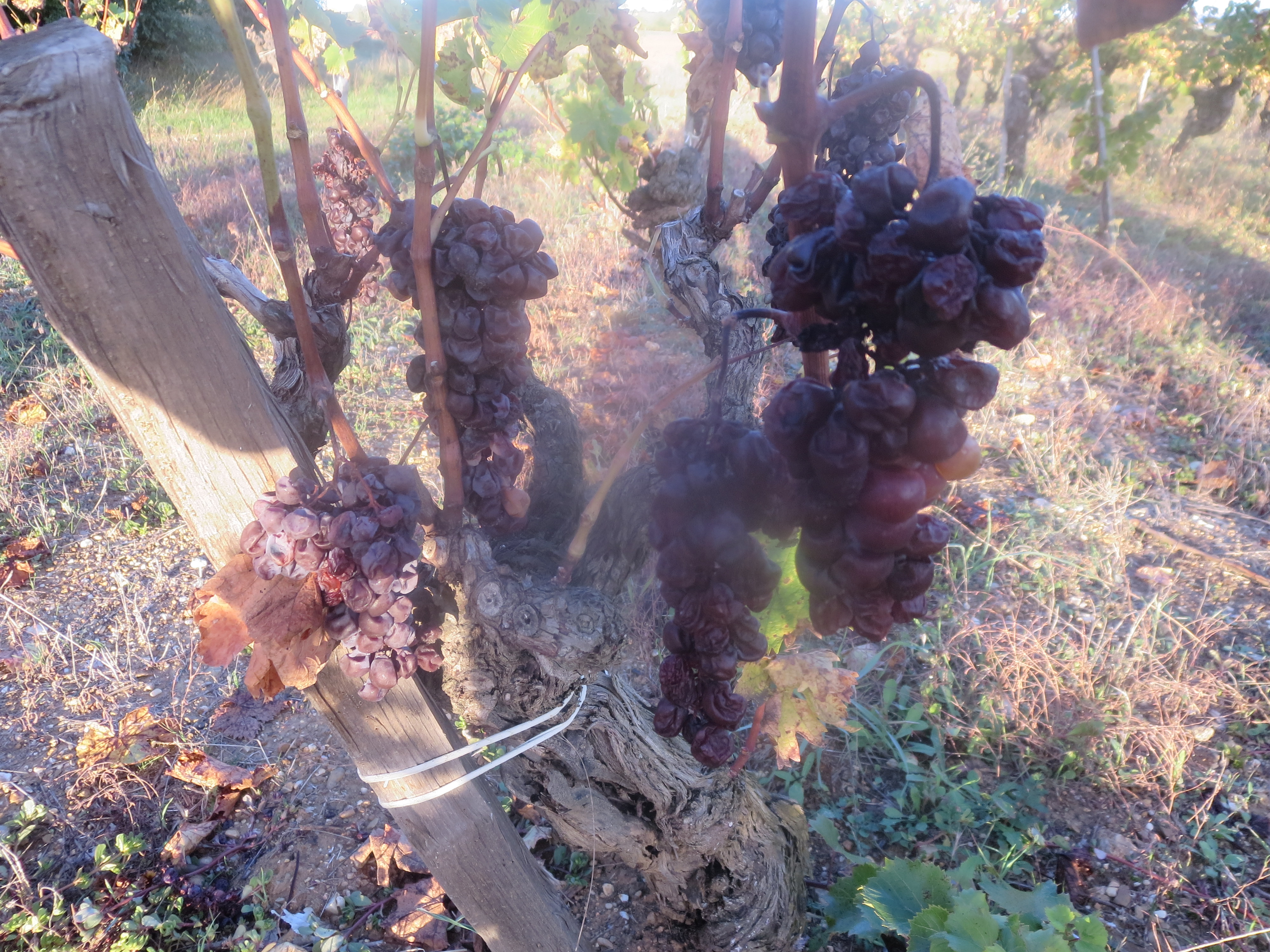
However, the final wine remained as grapes in the vineyards. Muscat grapes in Rome vineyard and Grenache in Sainte Suzanne have concentrated their sugars, developed a little noble rot even. So, on Friday October 9th Jeff, Michel, Cameron and myself ventured out to pick the Muscat and some of the Grenache. (The remaining Grenache was picked by the experienced Moroccan team on Saturday morning.) A beautiful autumnal morning cast shafts of sparkling sunlight on to the myriad colours of the leaves. It was incredibly peaceful and dreamlike.
The Muscat was dried out in the main, the berries now like raisins with a lot of sweetness but not too much juice. The Grenache would give more juice to produce around 4.5hl of sweet wine in the end, which Jeff was happy with.
My first bucket of Muscat
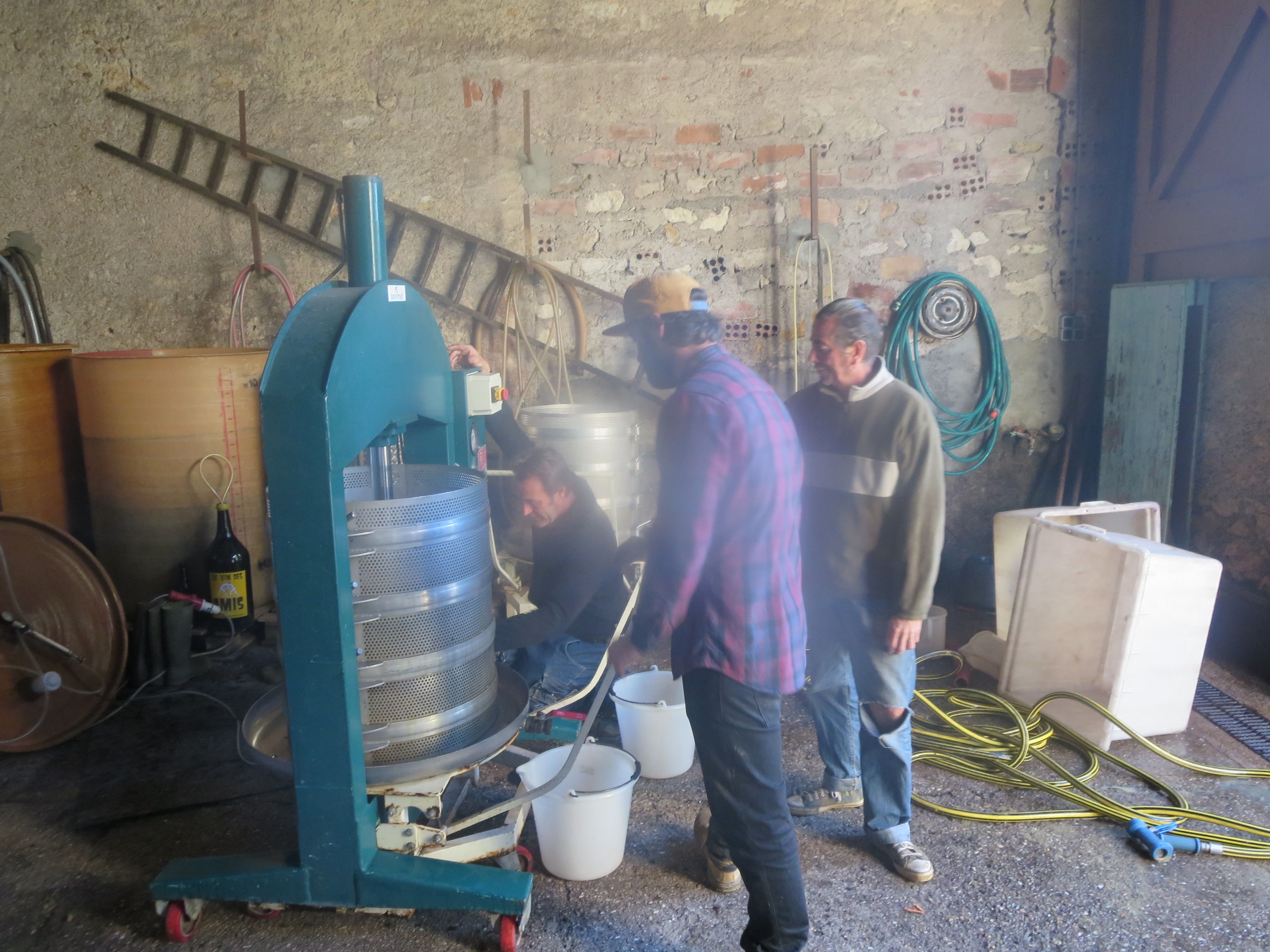
In the press the Muscat and Grenache were added one on top of the other in successive layers to give more complexity and allow the Grenache to fill out the Muscat. The juice was slow in emerging but eventually arrived in a lovely, light red colour with strong aromas of sweet raspberries.
The following day, Saturday 10th, the Grenache arrived and the last cagette of 2015 grapes entered the press.
Grenache in Saint Suzanne
The last cagette of 2015 grapes goes into the press
Pressing the button for the last time this year
It was a moment to breathe a sigh of relief, to feel a sense of pride in what has been achieved in the last 2 months and, a hint of sadness as the bonds of a team, which worked so hard and so well together, are gently loosened.
The relief also showed in recent days by getting together with other vignerons. An evening in Roquebrun at the excellent Cave St. Martin and then on Thursday a visit to Domaine Vassal, a conservatory of vines, with a who’s who of natural producers in the area. I shall write more about Vassal in a future post.
Vignerons including Julien Peyras, Alain Castex, Axel Prufer, Yannick Pelletier, Jean Marie Rimbert, Carole Andrieu celebrate with Raymond Le Coq (red shirt) at his Cave St Martin
l-r Rémy Poujol, Jeff, Yannick Pelletier, Julien Peyras, Joe Jefferies, Bernard Bellahsen (Fontedicto), Olivier Andrieu (Clos Fantine)
Then, on Sunday, team Coutelou gathered at Le Terminus in Cruzy, one of the best restaurants in the Languedoc. Jeff kindly paid for our celebration lunch together, the food and wine were excellent (including Clos Fantine and Julien Peyras wines) and the company could not be better. Cameron will be heading back to London this week though hopefully returning soon. So, it was an occasion to say ‘au revoir’ too.
l-r me, Cameron, Michel, Jeff – team Coutelou
Jeff wondering how Cameron got a bigger glass! (It’s actually a decanter)
And to show that we really are moving into the next stage after vendanges Monday October 12th saw the first bottling of 2015 wines. Bibonade rosé is a sparkling, sweetish wine with 20 grams of residual sugar to produce 4 bars of pressure and, consequently, the sparkle. Jeff stopped the fermentation on Sunday and bottling under capsule took place this morning.
Bibonade rosé, bottled and stored
So 2015 vendanges is done, 2015 wines are on the way. Job very well done. It has been a joyful experience for me to take a full part, thanks to Jeff, Michel, Cameron, Carole and everyone else who has been part of the team. A dream come true.
Now that (nearly) all the grapes are picked the vendanges enter a new chapter. The grapes, bunches and juices are all in tanks in various forms and in various tanks or cuves. Some wines were pressed immediately, e.g. most whites, and the rosé after just a few hours on their skins to extract the rosé colour. These wines now sit in their cuve and are fermenting gently, changing from grape juice to wine. The sugars are changing to alcohol and, naturally, the result tastes different. One of the most interesting things about the last fortnight has been to monitor the change in flavours from pure sweetness of fruit to a cleaner, drier, infant wine.
Some baby wines
The decisions which face vignerons such as Jeff now are about what to make of the wines. The reds could be made for aging with lots of tannins and colour extracted from the chapeau de marc, (the cap of grape skins, pips and, possibly, stalks) which is still in tank with the juice (also called the moût). Alternatively they might want a fruitier, more immediate wine and so the juice will be separated earlier from the marc.
Processes such as pigeage and remontage, which I have mentioned before, help to extract colour, tannin and flavour from the skins. The marc contains chemical compounds such as anthocyanins which are what gives red wine its colour. To keep all of the juice in contact with the marc these processes can be used.
Pigeage is where someone pushes the chapeau down, breaking it up into the juice by using tools such as a fork or even by using your feet. This can be dangerous, if you fall in there is a real risk of death due to the carbon dioxide being given off by fermentation. The chapeau does become incredibly tough and hard so it takes a real effort to carry out pigeage. I speak from experience.
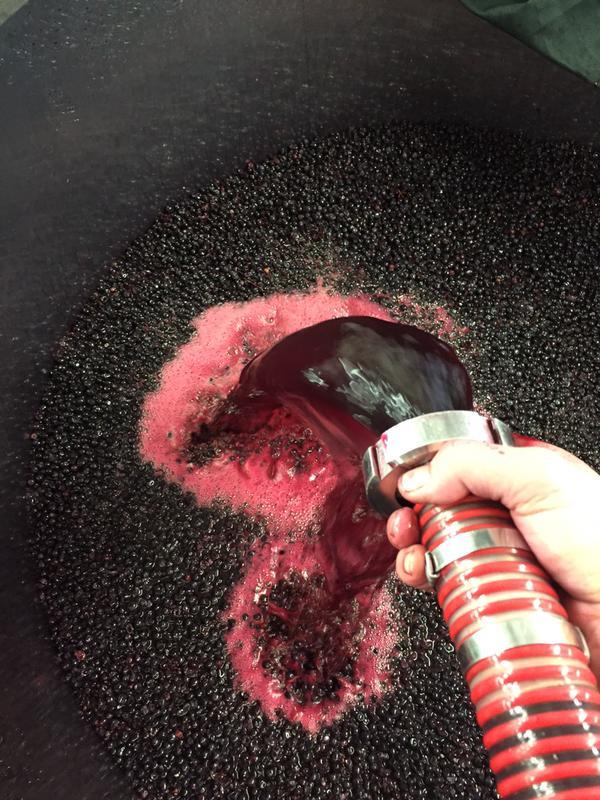
Remontage is the process of pumping the juice from the bottom of the cuve up and over the top of the chapeau, soaking it and allowing interaction between the chapeau and moût. Both processes also stop the chapeau from drying out on the top of the tank.
Me, doing a remontage of Flower Power
However, if you carry out these processes too often and too long you can end up with harder, more astringent wine. A decision has to be made about the style of wine you want. There is a third option, délestage, where the juice (moût) is pumped into a separate cuve and the chapeau settles in the original cuve. Its own weight causes some crushing and so when the moût is pumped back into the tank a couple of hours later it comes into contact with the pips etc from this crushing, having added extra weight to the chapeau when first pumped back into the cuve. This process can produce a lighter, fruitier wine with a little more body. Jeff has used this for just one tank of Syrah, he thinks it can be harsher on the grapes. Pigeage and remontage are the more usual methods at Mas Coutelou.
So, over the last week Jeff, Cameron and Michel have been very busy doing all of this work as Jeff decides which methods best suit the grapes which were harvested. The best fruit will stand more work but even that will suffer if overworked. As someone who wants the grapes to reveal their health and terroir Jeff would choose to do only what is necessary.
So, on Friday October 2nd the Grenache from Sainte Suzanne which were put into cuve as whole bunches (carbonic maceration) were pumped out and then pressed, a long day of hard work. Pumping juice, lifting out the marc by fork and shovel, pressing the marc, sending the juice to a new tank. This was one day of many, the same processes repeated many times and between each one … lots and lots of cleaning, to reduce any risk of contamination and spoilage.
The Mas Coutelou name continues to expand globally, visitors to the cellar on Friday came from Sweden and Canada. There have been others in recent weeks from the UK, Australia and other regions of France. Selling the wine which is being made is another aspect of the whole process.
Other work last week included sorting the solera cellar on Wednesday October 1st. Wines were moved and blended, barrels were emptied and filled – more complexity for Jeff to get his around. A vineyard visit also unveiled a few rows of Grenache in Saint Suzanne which had not been picked. The grapes are starting to shrivel and concentrate their juices, possibly to be blended with the Muscat of Rome vineyard which are now well on the way to being dried out.
These grapes now taste like raisins, sweet but with not much juice so the Grenache would give volume. Rain which fell on Saturday, 3rd might change this plan, we shall see.
Two updates.
The Grenaches of my 100th blog post are progressing well. The barrels were racked to take the wine off the lees and leave a clearer wine. The smaller barrel was more cloudy than the big barrel, possibly due to it being pressed earlier but everything is going well and they now continue their slow fermentation. The 27l bottle stands in the main cellar and the fermentation is still bubbling through the equipment given to me by my friend Barry when I left the UK.
I tasted the wines today (Monday 5th). The bigger barrel produced a fruitier light red wine with the sugars still obvious. The smaller barrel was a little darker, with more texture and drier. Fascinating to see them adopt different personalities at such a youthful stage.
The team from London Cru tweeted to say that the Cabernet Sauvignon which they took back to London is really starting to show well as you may see from this photograph of remontage.
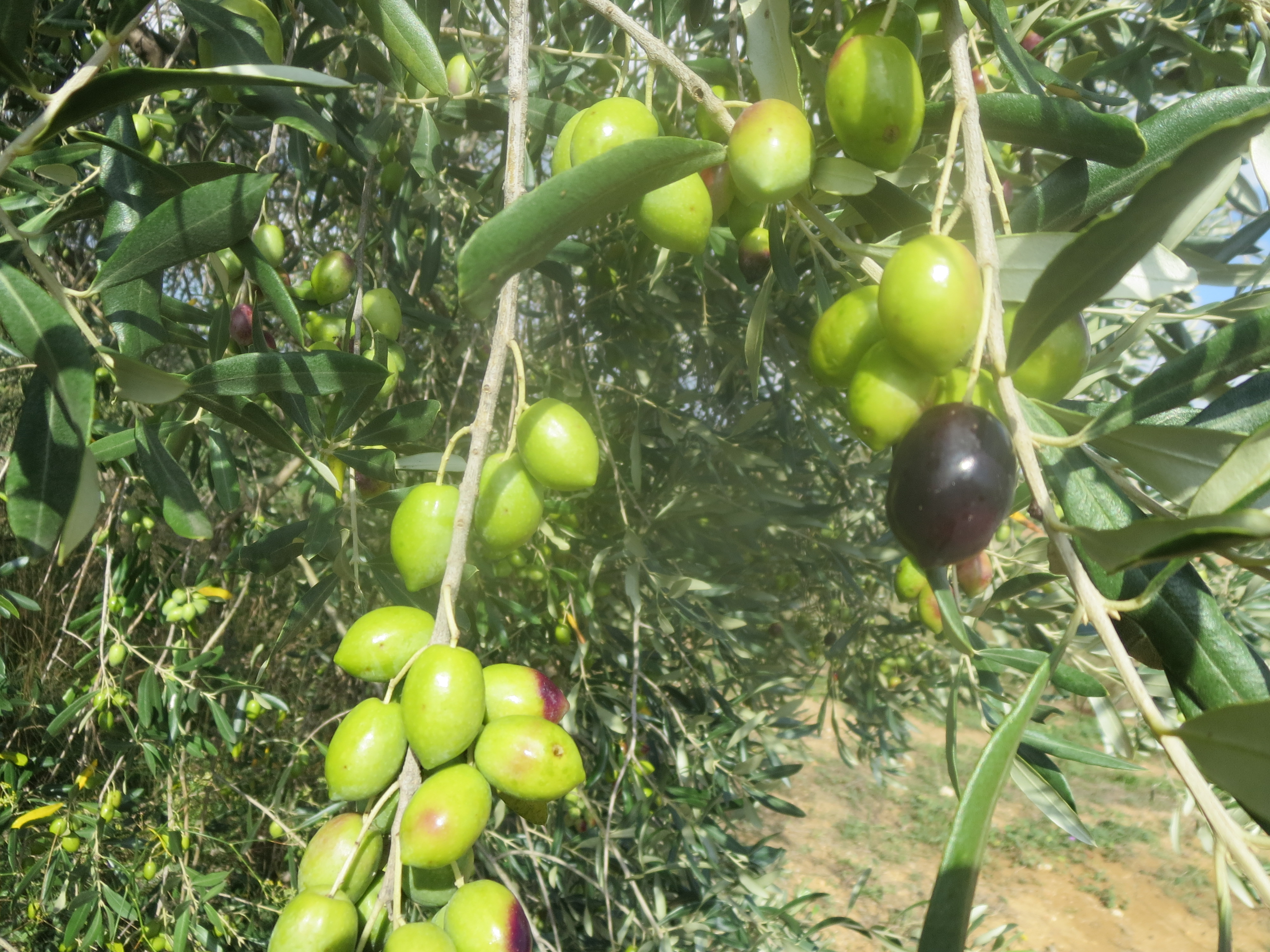
Meanwhile back in Puimisson autumn is really starting to show in the colours of the vines, they are stunning at present. The partridge family were waiting for me as I visited Rome on Friday, hopefully they will survive the hunting season which is getting under way in France. The olives are also ripening in some of the groves, these were in Sainte Suzanne on Friday. Unfortunately the olive flies which damaged so much of the harvest across southern France last year have been causing damage again in other groves.
And one hungry member of the team can be relied upon to brighten up any day.
There will be one more vendanges diary entry as the parcel of Muscat awaits, ready to make some sweet, delicious wine. However, after a month of work, the grapes are nearly all gone. Their juice lies quietly fermenting or sulkily just waiting in the tanks. So what have I learned from this month of effort? Well, reflecting on it I remembered last year’s vendanges and a video. Both are linked below. The title I used then seems, a year later, the right one so no apologies for using it again, though in French this time.
Now That’s What I Call Grapes 2015
The main feature has been the grapes themselves. It was not the easiest year for growing in terms of weather. Strong winds at flowering damaged some vines, a real heatwave for a month in June/July with months of dry weather too, then rain just as harvest began. There have been moments of doubt, it has been a slippery road as this Pézenas road sign suggests.
The berries were small and perhaps lacking in some acidity as harvest approached and then the rains threatened rot and damage. At times the tri had to be severe both in the vineyard and in the cellar. And yet. I remember beautiful bunches of Syrah, of Cinsault (almost 1kg in weight some of them), Cabernet Sauvignon and Muscat. In particular I remember some champion Carignan and magnificent Mourvèdre. Much needs to be done with vinification but, happily, the wines they produced are already showing the same quality, promising some great 2015s.
Syrah
Even when the juice was in the cuves it misbehaved at times, like naughty students in a classroom. There were moments when volatile acidity threatened and then when acidity was low. Through it all Jeff kept his head. And I recall his words at the time, “Il faut avoir la confiance en les raisins” / “You have to trust in your grapes”. No clever tricks, no resorting to sulphur dioxide to act as a safety net – just have faith that the work that has been done in the vineyard over the last years and recent months will bring healthy grapes which will make healthy wine. The pruning (taille), ploughing (labour), careful spraying at 3 in the morning – all of this effort leads to the grapes being able to produce high quality wines. Like a winner of the Tour De France you don’t just turn up on the day, it takes months of planning, training and hard work, so too the vigneron who produces top quality wine. And that faith has been rewarded, any problems have sorted themselves out, with a guiding hand from time to time.
Taille (February)
Labour (March)
Filled cuves containing the 2015 wines (September)
That means hard work and this is the second lesson I have learned. The vendanges are hard work. There is a glamour to them. As an enthusiastic wine amateur I often used to think how nice it must be to take part in the harvest. Sunshine, grapes, drinking wine – idyllic. The reality is all of those things but it is not all idyllic; it is back breaking, physically gruelling, hard work. Picking means bending over vines, insect bites, whilst trying to not cut your fingers instead of the grapes. In the cellar, long hours of standing to sort grapes, lifting and carrying heavy cases and twisting around with them, sometimes in confined spaces. The heat above a tank is tiring and sweaty. The drenching as you clean everything again and again. And I worked less than most. Add in all those hours of vineyard work, the background work in sorting the equipment, labour, paperwork and then the pressure of making the right decisions – you have to love this job to make a success of it.
Bent backs (Martin and Céline)
Standing for long hours while sorting (Karim and Cameron)
Twisting to lift a cagette (Michel)
Confined space, hot, back breaking – Thomas, Cameron
Soaked, Cameron, Michel and Thomas cleaning
And love is the third and final part of my lesson. The love which Jeff has for his vines and his commitment to making them the best they can be in order to produce the wines which people around the world will love. It is no coincidence that during the harvest we welcomed many friends who arrived to spend a few days with us, to play their part in the vendanges. They do so because they love the wines and they are friends of Jeff. He makes his wines to share, the best wines are those which you share with other people. Le Vin des Amis! Copains! the names of the cuvées tell a story.
Remember the story of the Chaud Doudou from last harvest? Well, I have been lucky to share the experience of the vendanges with a fantastic group of people over the last month. The camaraderie and friendship are part of the process of making the wine. And that spirit vanquishes any aches and pains.
My boots join the team (a proud moment)
Happy times
So, grapes, work and love. And if you don’t believe me, have a look at the video on this link to the excellent #QCQBM website. It is in French but the message is clear. Grapes. work and love.
This was the final big week of harvest and it centred around Cabernet Sauvignon. There is a big parcel (around 1.5ha) of the grape in Segrairals and it is not a variety which really excites Jeff for a Mas Coutelou wine. It has done especially well in 2015 though the small berries have swollen with the rains and the alcohol levels had therefore fallen a little to around 14%. They taste sweet and juicy and came in fantastic bunches, not the same size as the Cinsault and Mourvèdre from this vineyard, but small and healthy nonetheless.
Cabernet Sauvignon on the vine in Segrairals
Cabernet Sauvignon
Partof it was picked on Monday 21st September which will be used by Jeff, purpose as yet unknown though Cameron may be flexing his winemaking muscles with some. The other major work on Monday was to use the Muscat d’Alexandrie grapes from Peilhan which were also in good health.
Muscat d’Alexandrie
They have very thick skins so the pressing took longer than usual to extract the juice. They were mixed with some Muscat À Petits Grains grapes. I will come back to these grapes and the juice later in this article.
Michel loads the Muscat into the press
Muscat juice after pressing
Tuesday 22ndwas the big day for the Cabernet Sauvignon. I have explained before that Jeff sells most of these grapes to London Cru, an English winery as the name suggests. London Cru buy grapes from around Europe, eg Chardonnay from Limoux, Albarino from Rias Baxas, Grenache from Spain. This is the third vintage of the project and the grapes were ready at last. In 2014 they had been ready on September 4th, my first day at Mas Coutelou after our move to the Languedoc. This year the rain had delayed them so Gavin and Alex flew into Béziers on Monday evening. They had been in Italy on Saturday and only just got back to London before flying here. The refrigerated wagon was in situ as I arrived on Tuesday morning, waiting to be loaded with the grapes.
Confidence was high amongst the London Cru team after some very good reviews including one last week by Dr. Jamie Goode who gave the top mark (94/100) to the Cabernet Sauvignon using Jeff’s grapes. The fruit for 2015 should bring more high marks and good wine. We tasted the 2014 over lunch and it was very good, clear, direct fruit with ripe tannins which mean that the wine will be at its best in 2 to 3 years.
Alex and Gavin loading the grapes
Gavin, Alex and Jeff directed and led the picking carried out by the Moroccan team as usual but also by Cameron and myself together with two excellent new additions to the team in Fabrice and Romain. Fabrice puts on shows (spectacles) around France whilst Romain is an artist. They have picked here before and were good fun and hard working, more new friends. (Fabrice on the left, Romain to the right.
After picking the 6 tonnes or so of grapes they were driven straight off to London under refrigerated conditions to keep them fresh. Gavin and Alex flew back to London that evening ready to receive them at their base. London Cab, fine fare.
Fine bunch of Cab I picked
Lunch was excellent with the London Cru wine and a magnum of Flambadou 2014 which was excellent, still in its infancy but already drinking well. Afterwards Cameron and I did some pigeage of the Carignan grapes amongst others. It was also Cameron’s birthday, hopefully it was one he will remember with affection.
Birthday boy Cameron looking for his present
Pigeage of the Carignan
Wednesday 23rd was a day for working the cellar. Jeff was keen to aerate the Syrah a little and to start to maximise the cuves by assembling some of the tanks and filling the new ones. Thursday saw similar work whilst Jeff also did some admin work.
On Friday 25th I returned to the cellar. Cameron was enjoying a well earned break and so I joined Jeff and Michel. They were continuing to fill the tanks, aerate some wine and then we moved to the muscats from Monday.
Aerating some Syrah
Muscats macerating with a little older Muscat wine
The Muscats are destined for the solera system and after a few days maceration they were showing lovely aromas, already slightly sherry-like due to being mixed with some older wine. The juice went straight into barrel whilst the marc was pressed again to extract more juice and flavour. Tasted straight from the press these included lovely apricot, plum fruits along with the slight oxidised note which adds complexity. Truly delicious, I’m afraid my description fails to do it justice.The barrel will allow the wine to age and gain contact with oxygen and the wine will develop into a luscious sweet wine. As stated previously I shall write more about the solera in the near future.
Michel removes the skins for pressing
Michel then loads the press
Gateau de Muscat
There are one or two small parcels still to pick but the main harvest is now over. It began back on August 21st so lasted just over a month. I shall be reflecting upon it and the lessons I have learned from it in the next article. Meanwhile I look forward to picking the Muscat from Rome and went to the vineyard on Friday lunchtime to take some photos. I was met by a family of partridges, butterflies and birdsong – Rome really is a magical place. In La Garrigue the vines are starting to show their autumnal colours, their work is done for 2015. The vines have given everything to their fruit in the last month and the leaves which remain after harvest are looking tired after a long, hot summer. All, or nearly all, is safely gathered in.
La Garrigue, Friday. The grass across the centre marks the ridge with Grenache near side and Syrah far side.
Grenache leaves showing that autumn approaches, harvest is over































































 amarchinthevines