I was in a positive mood about the blog yesterday, very high reading figures after my article about the St. Chinian vineyard. I had a post in preparation about the new Puimisson vineyards of Jeff Coutelou, especially the exciting project to boost nature in the Peilhan vineyard. This photo taken at the end of September shows the hedge and fruit trees which Jeff has nurtured there to bring biodiversity to an area which is very much a monoculture of vines.
This work had been disrupted back in 2016 and 2017 by the acts of a vandal who set fire to the first trees and plants which Jeff put in. That person also burned other parts of Jeff’s vineyards, destroying more trees, plants and vines. I was based in France at that time and spent much of my time with Jeff. I know how hurt he was by those attacks for doing something which he, and all right minded people, saw as helping to improve the area. Whether jealousy, bitterness or madness the acts of the vandal or vandals were criminal. Then things seemed to stop, there were no more attacks. Until yesterday.
The same scene yesterday
It was a shock to receive a message from Jeff in the afternoon that he had just returned from Peilhan to find 500m of the hedgerow destroyed and still smoking when he was there, 500 trees included. To burn that much plantation the criminal had planned their actions, using petrol to target the length of the hedge.
It is just sickening, I am angry and frustrated and I can only imagine how Jeff must feel at this attack on everything he stands for. The messages of support he has received will boost his morale but I can only hope that he feels strong enough to fight back.
Nature still resists
Quick update – Jeff just posted this photo, he will fight back and trust in nature
Many winemakers state that they are custodians of their land rather than owners. The emphasis is on the land rather the winemaker. The land has been there, often as a vineyard before the winemaker and will be there for a long time after the winemaker has departed. Therefore, the human interaction with that land is one of care and nourishment rather than exploitation. Whilst many say that, not all of them fulfil that important statement. It is a fact that as winemakers age the future of their vineyards becomes an issue, what will happen to them, who will take over?
Jeff Coutelou is aware that as he gets older there is a question mark over the future. He has no children and his nephew and niece are not interested in becoming winemakers. Jeff is the 4th generation of Coutelous and has built upon the work of his family to create a domaine renowned around the world. After 20 years of making the wine himself he is also looking to the future. I will explore some of the new vineyards he has purchased in the last year or two but in this post I want to describe how work has begun for his own personal future.
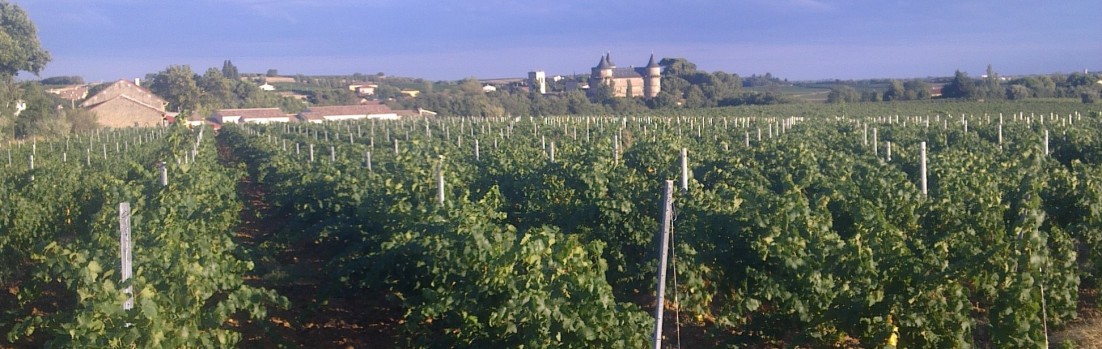
The Coutelou family have their origins in St. Chinian and Jeff himself attended school there. The family home is still there with its small vineyard but there is also a vineyard just outside of the village itself. When he retires Jeff would like to have that vineyard so that he can look after himself without the need to employ others and the associated bureaucracy and social charges of the current large domaine. The vineyard is in a quiet valley, on a slope looking over towards St Chinian and the dividing line in the appellation, there is schist soil to the right in the photo below and limestone to the left. At a couple of hectares it would keep him busy but not overwhelmed.
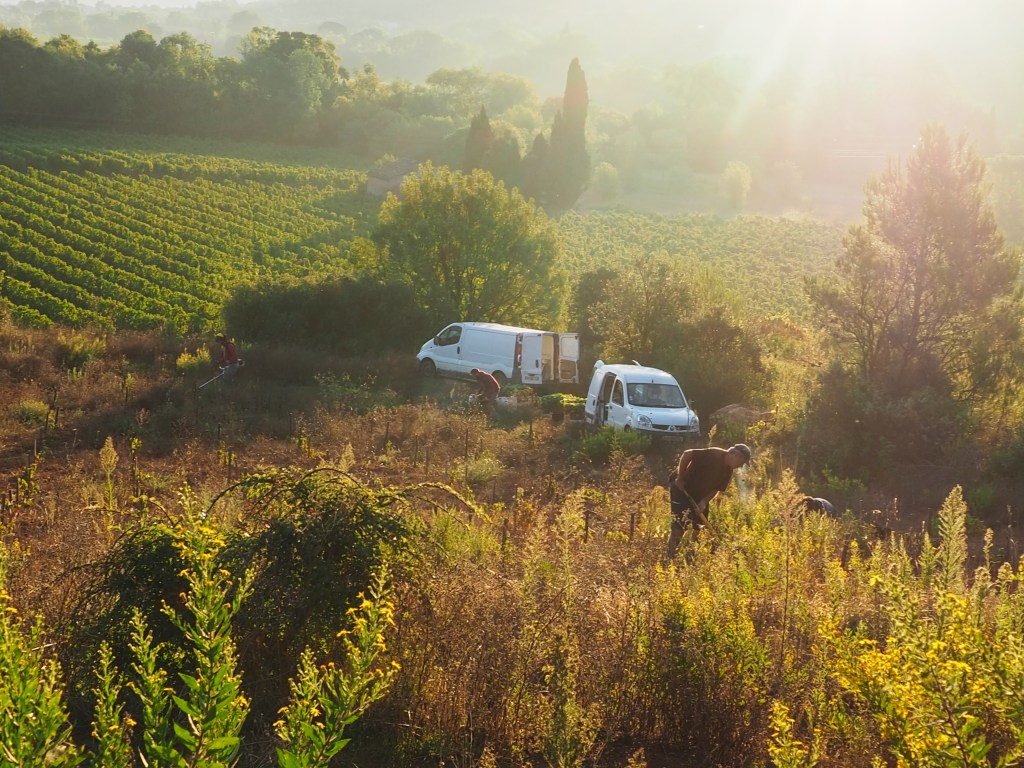
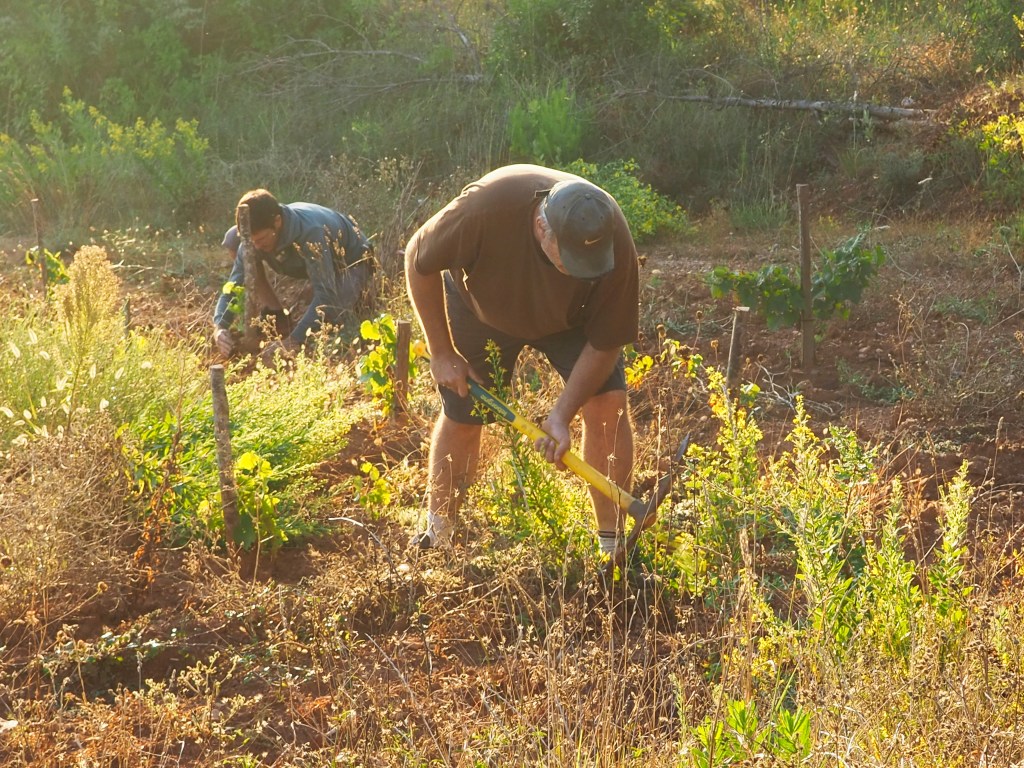
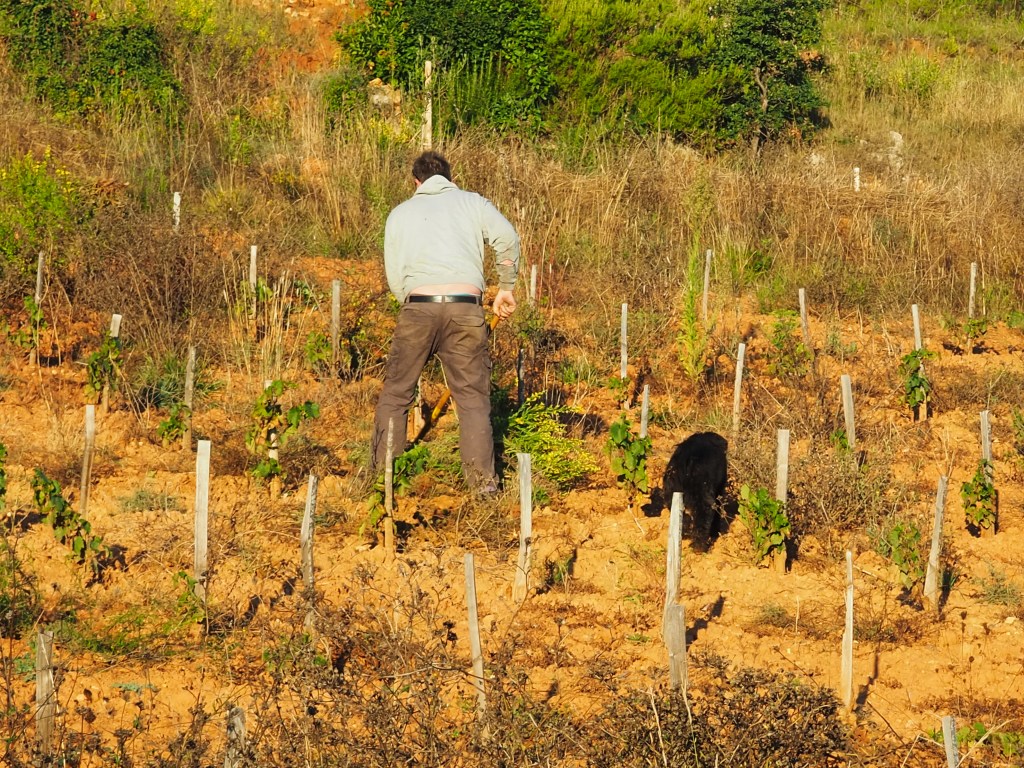
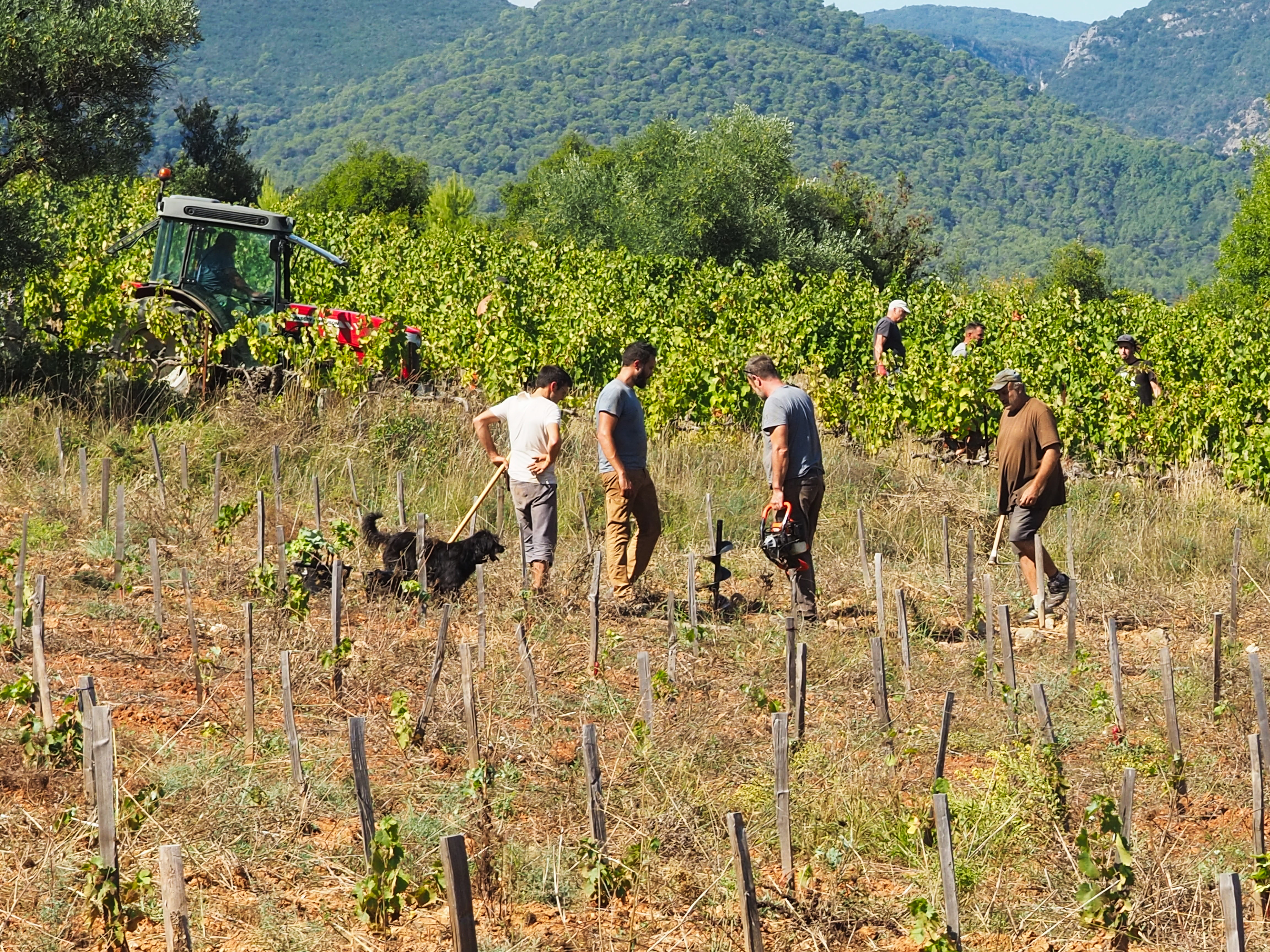
Back in 2019 the vineyard was cleared and planted with some classic Languedoc grapes. However, due to the pandemic the vineyard has not had the attention Jeff would have liked until we went there on September 23rd. A bright, sunny day started off chilly but by mid afternoon we were working at almost 30c temperatures and were in the direct sun. It was hard work. The vineyard had overgrown with weeds, brush. Quite a few of the young vines planted in 2019 had died, as is the norm, and needed to be replaced. A full day’s hot and sweaty work lay ahead.
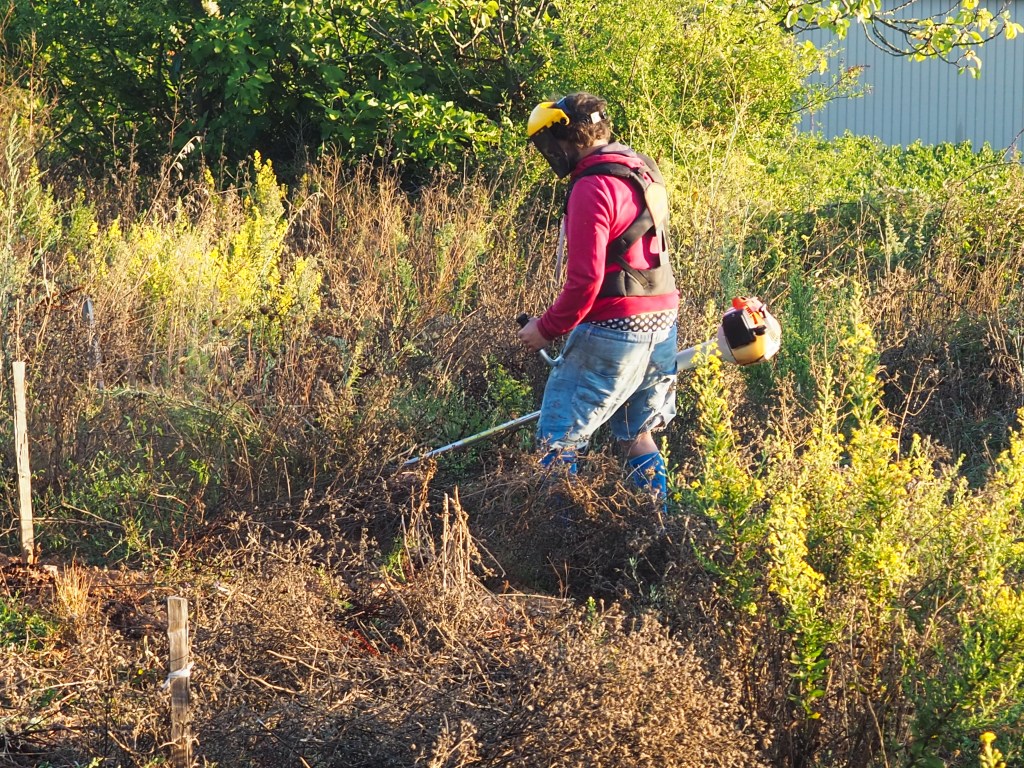
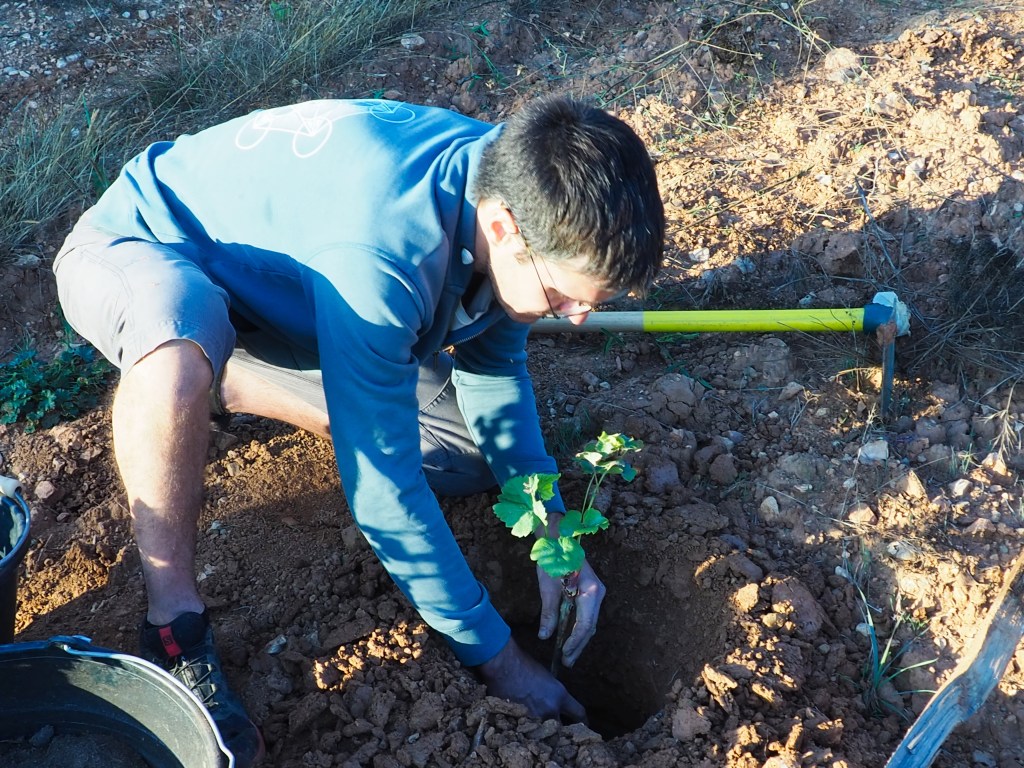
Manu, had rejoined us towards the end of the vendanges and he spent a lot of the morning with Gilles strimming away large clumps of weeds and brush and using a pick and pioche to dig some out. Matteo was hard at work on the drill which was a heavy machine, vibrating heavily as it scooped out the hole which would be used to plant the replacement vines. Steeve, Joffroi and myself busied ourselves mainly with the planting.
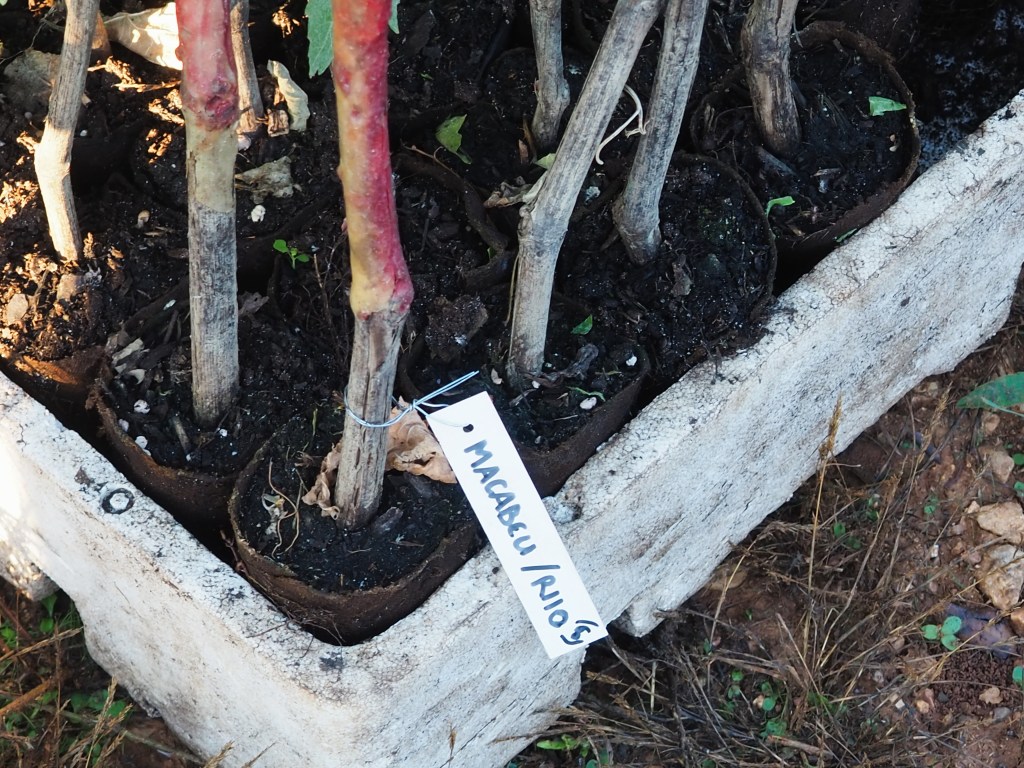
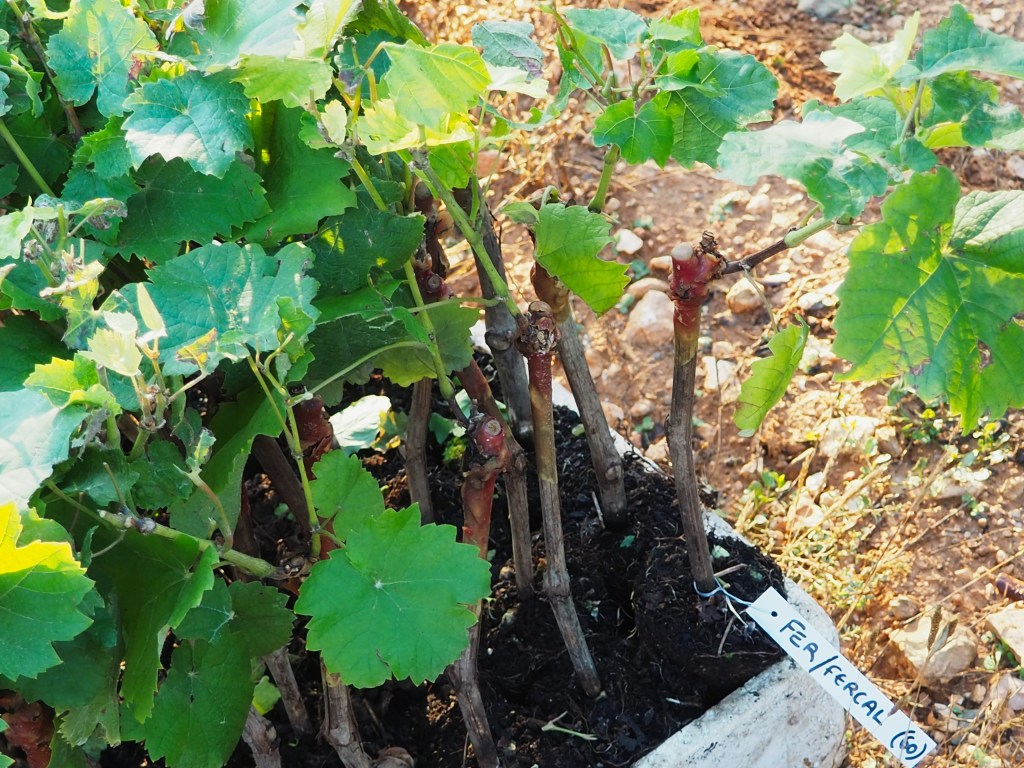
As ever these days Jeff wanted to create a complantation on the site. Mixed in with the traditional varieties planted in 2019 would be some Grenache, Macabeu and Muscat d’Alexandrie, one of Jeff’s favourite grapes, but also Fer Servadou and Mauzac. Fer Servadou (often just called Fer) is relatively unknown, mostly found in Marcillac and Gaillac between Languedoc and Bordeaux. I like it as a grape as I am fond of wines from both areas and it gives a distinct spicy, peppery flavour to wines and, maybe its name is suggestive, but a sense of iron filings. Mauzac is widely planted in the Limoux area as well as Gaillac again. A white grape, usually made into sparkling wine, it adds weight to blends with its white fruit flavours.
We were under strict instructions from Jeff to spread the new plantings around the vineyard and avoid clumps of the same variety, forming a true field blend but also hopefully reducing the risk of disease spreading from one variety to another as some are more resistant to mildew than others. Into the hole went the young vine, organic fertiliser and the hole was refilled. New plants need watering, especially on a hot day like that so Jeff was to and fro with containers. Matteo and Steeve have returned regularly to the vineyard to ensure these tender plants have been watered and are healthy.
Before and after
By 4pm we were tiring and the machine must have been to, a part sheered off and we had to abandon the work with just a few rows to finish. They were completed the following day with a repaired machine.
The broken drill with harvesting going on next door
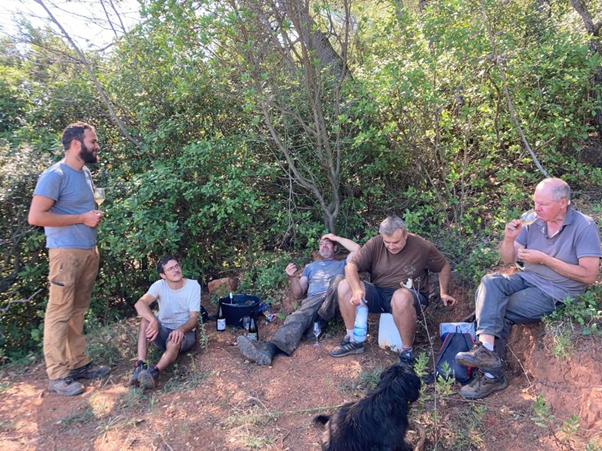
It was hard work but rewarding for many reasons. It is good to see a vineyard developing with its promise for the future, especially this one as it will mean a lot to my dear friend in years to come. The views over the St Chinian hills were a treat and the camaraderie was, as ever, fulfilling – sharing lunch and wine whilst looking out over our work and the scenery with great people. Living in the moment but also looking to the future.
When I first became interested in wine vintages were one of the mysteries which intrigued and infuriated in equal measure. Back in the 80s and 90s Bordeaux and Burgundy ruled the world of wine (plus ca change) and anyone wanting to buy such wines looked at vintage reports, vintage charts and vintage prices to research which wines to seek out. A 1989 or 1990 Bordeaux (my first venture into en primeur purchases) was superior to a 1987 or 1994 simply because of the weather in those years. Things have changed.
Climate change is an obvious cause, it is a rare year now where grapes don’t ripen in cool conditions. Indeed we are in a situation where Bordeaux now allows different grapes, such as this blog’s favourite Castets, to temper the (over)ripe Cabernet and Merlot. Burgundy producers worry about the future of Pinot Noir in their region, a grape which now thrives in cooler Alsace and Germany for example.
Better winemaking and vineyard care are the other major reasons why wines tend to be more consistent year on year. Science, technology and the education of new generations of winemakers mean that vines are given cover crops, different canopy systems, grapes are fermented cooler or longer or on skins more than they used to be. Winemakers through skill (and maybe some artifice) are able to smooth out those vintage chart curves, very few years would now be as scorned as those 87s.
Mildew and oidium affected grapes
For Jeff Coutelou in the hot Languedoc you’d assume that vintages weren’t that important either. There is hot sunshine every year, grapes ripen ready for harvesting by early September. But there subtle differences, sometimes less subtle. 2017 had a big outbreak of mildew, 2019 saw temperatures reach 45c (I remember it well). Those 2019 grapes were actually harvested in prime condition, the best of any of the seven vintages I have helped with, as good as any Jeff can recall. There was little sorting to do. Yet, those grapes proved difficult in the cellar, fermentations slowed and got stuck, not all but many. The fermentations were not completed until the temperatures picked up again in the Spring of 2020. Was that a product of the overheating of the previous summer?
Outstanding Grenache in La Garrigue this year
Every year is different. Similar problems arise due to climate and disease, drought, mildew, oidium, ver de la grappe. The scale of those issues varies though and in different vineyards. The Grenache of La Garrigue was badly hit in 2020 and produced tiny yields. This year when most vineyards suffered that Grenache was beautiful and abundant. Such vagaries are what keeps a vigneron on her/his toes. What quantities of wine will there be from each vineyard? Will there be some outstanding grapes that should be used for a special cuvée? What might be blended to provide the wine for popular cuvées such as Classe or Le Vin Des Amis? With twenty tanks full of fermenting grapes Jeff must juggle figures, analyses, tastings in order to decide what to do with those wines.
Decisions, decisions
2021 was undoubtedly a vintage which reflects most the circumstances of the year, in my opinion more than any of those seven I have witnessed. It was shaped by the frost of April 12th. That single night wreaked havoc upon the vineyards, throughout France yes, certainly for Jeff. Havoc all the worse in that it was unexpected, there was no warning that it would hit the area. 50-70% of potential fruit was wiped out in those few hours, hitting the vines as they flowered and began to bud. From there on 2021 was a year of catch up. Yes the vines, some of them anyway, produced secondary bunches but nothing like the quality and quantity of what was lost. The vines though were weakened by that night, a situation compounded by ongoing drought. Jeff told me that there was only one significant rainfall in Puimisson from the previous October through to the end of summer. This is a perennial issue in the Languedoc now, climate change in action. The consequence of frost and drought was vines pushing energy towards survival rather than fruit and that when summer’s heat and humidity combined to produce oidium (powdery mildew) the vines had little resistance.
Peilhan, dry and with small yields, we harvested the Carignan in an hour or two. Yet it produced lovely red and white grapes
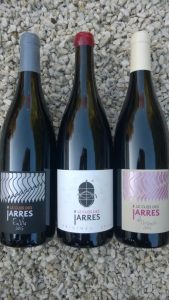
Doom and gloom. And yet there was that Grenache. And most of the fruit was decent quality and fermented well (though with delayed malolactic fermentation in some cases). And the resulting wines taste very well after those fermentations. Jeff will make good wines. He will have to juggle those figures again and no doubt produce different final wines to the norm, there isn’t the quantity to make all the usual bottles. Indeed I can report that Jeff bought in some grapes to bulk out his own this year. Carignan and Syrah were brought back from the Minervois thanks to Vivien Hemelsdael of Le Clos Des Jarres, an excellent producer of natural wines himself. That area was relatively untouched by the frost and Vivien kindly agreed to provide grapes to his friend. Matteo, Steeve, Louis and Jeff went to pick those grapes and were enthusiastic about them, especially the Carignan. Incidentally I can honestly recommend seeking out the Clos Des Jarres wines.
2021 will certainly be a year that Jeff recalls with little fondness. Personally I was delighted to be back there after missing out in 2020. Moreover it was an excellent team to work with, I thoroughly enjoyed being a part of it. The white wines which I tasted from tank just before I left Puimisson are in fine fettle, Jeff assures me that the reds are too. Perhaps vintage is less important to wines these days, but do remember unfortunately there won’t be much of them from Jeff Coutelou. There were new aspects of winemaking in 2021 though and I shall be reporting on how Jeff is looking to the future as well as getting the best out of this year. 2021’s wines were certainly a reflection of the difficult year, maybe vintage does matter after all.
Most of the focus of the posts on Vendanges 21 is on the picking and sorting of grapes, exploring the different varieties and how they are gathered and sent to tank. However, these are the early stages of vendanges and there is much work to follow, not so glamorous but just as important. I have heard a number of vignerons say that their job is to ensure that quality grapes which arrive at the cellar are allowed to express that quality and not to mess up their potential. So, what happens?
The making of wine begins with decisions about how to transform the fruit. The most obvious influence on how to proceed is the colour of the grape. There are some white wines made from red grapes but those are rare. Quality and quantity of the grapes will also determine decisions but let us start with that primary difference.
White grapes will go into white or orange wines. For white wines the grapes will be pressed (usually) soon after picking and the juice is sent to tank for fermentation. For dry whites the winemaker might seek to have only the alcoholic fermentation, not the malolactic in order to keep the freshness of the malic acid. Again, that is a decision for the vigneron. There will still be pulp and pips in that fermentation tank and after fermentation the lees or dried yeast cells will fall to the bottom of the tank after completing their work.
The young wine will be run off that rather dramatic looking sludge to avoid the danger of it spoiling the wine. The vigneron will then decide how to age the white wine, the type of container to use, stainless steel, barrel, amphora, egg, glass. The choice will again be based on the quality of the wine and what the vigneron wants to achieve, a commercial large scale wine or a smaller, more specialised or select wine.
A range of containers for the white wines of Jeff Coutelou
I described the process of orange wine in a recent post. The white grapes will stay on skins to extract tannin, flavour and colour. The length of time will depend upon the preference of the winemaker. Again, the juice will be run off the skins either naturally or by press.
Orange wine
For rosé wines red grapes (perhaps combined with white grapes) will be used. They might be allowed to spend time on skins to extract more colour or they will be pressed directly for a lighter colour. (I recall Emmanuel Pageot in Gabian making a wine called 48h where its name reflected the time on skins to extract a dark pink/light red colour.) Rosé wines are mostly designed for freshness and early drinking so they will usually be fermented and then go to a neutral container to settle and then be bottled.
Red grapes give vignerons more decisions to make. Will they be destemmed totally, partially or not at all? The latter will be whole bunch fermentation and the stems will add a green, sappy touch to the wine. Whole bunch wines might be fermented using carbonic maceration, as in Beaujolais where the grapes ferment in the skins with carbon dioxide added to the tank. Jeff prefers a semi carbonic maceration, some of the grapes will be broken and will ferment as usual whilst others ferment inside their skins. Wines using carbonic maceration tend to have a more upfront fruit profile. That style might be what the vigneron wants to create or it might be that lesser quality fruit would not respond well to traditional fermentation.
Whole bunch (left), the égraineur working (centre and right)
Most red grapes at Coutelou are destemmed. Indeed, the new (2020) égraineur takes stems not just from the bunch but from every grape to reduce the amount of stalk in tank during fermentation (some will get through no matter what). The grapes will spend days in a fermentation tank. The red grapes with skins, pulp, pips and yeasts form a bigger quantity of material so Jeff uses the large cement tanks for this. The juice will be carefully monitored to ensure fermentation is happening. For red wines, winemakers want both fermentations to happen, malic acid would make them too tart. Malic fermentation usually happens alongside the alcoholic one or quickly afterwards. This year’s malic fermentation at Coutelou was the first time that it was slightly delayed, happily only a short delay but a surprise nontheless.
Fermentation tanks used for red wines
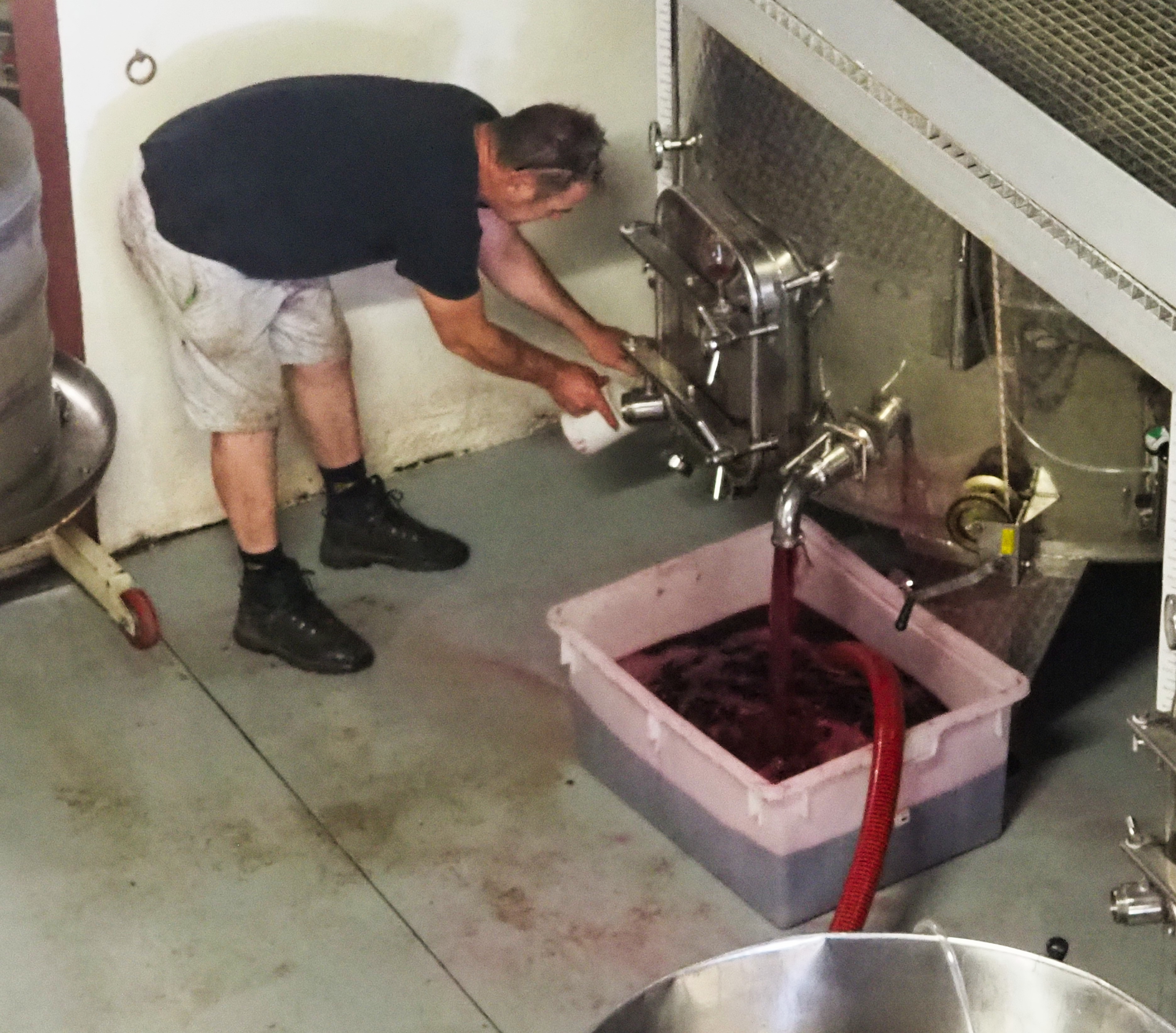
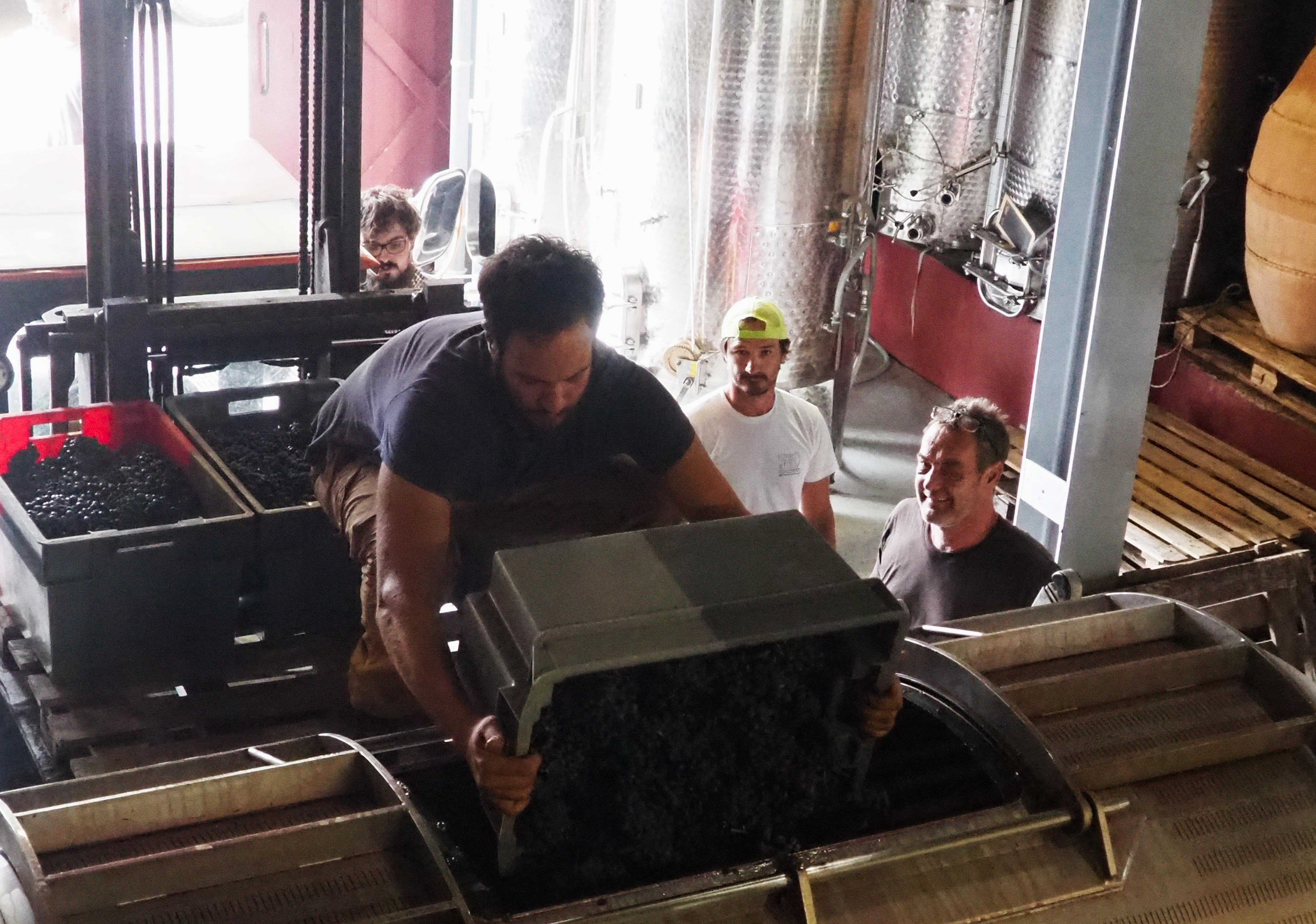
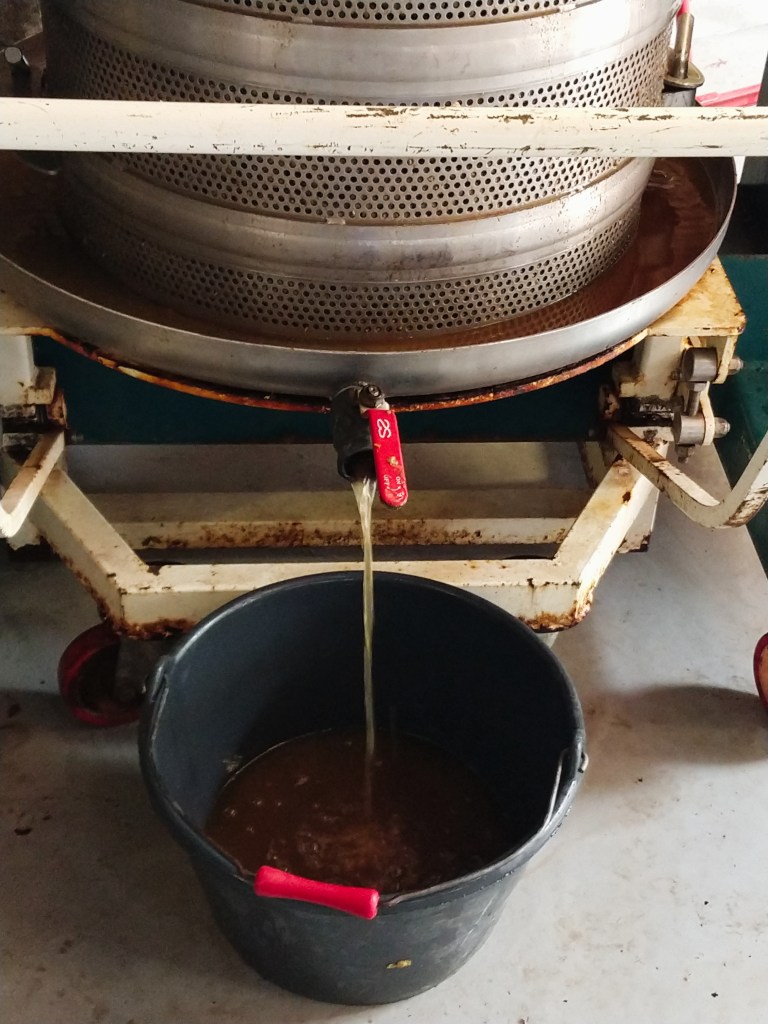
The bulky pulp has to be then sent to press. Ideally it would travel naturally by gravity but in most cellars a pump is needed, and a heavy duty one at that. The pompe à marc is powerful and noisy but does its work. The press then sends the juice to a tank or other container but usually a tank at this early stage. More tasting and analysis will determine what the winemaker thinks should happen next. Quality, quantity, commercial needs will all play a part in shaping that decision.
Analyses outside the fermentation tanks, the press red with juice
Let us not underestimate the commercial aspect of winemaking. The livelihood of the winemaker, their dependants and staff depend on selling the wine. Some cuvées will be made for easy drinking in large quantities, the wine will still be good quality of its type. Le Vin Des Amis and Classe are perennial wines from Jeff Coutelou and are always very good (try the 2020 VdA for proof) but they also provide a financial security. As well as covering costs of equipment, personnel, utilities etc the money helps to subsidise the smaller production wines which often also cost more to produce, eg barrels and longer ageing.
So, though my articles have focussed on the first stages of the vendanges, please don’t think that is the end of the story.
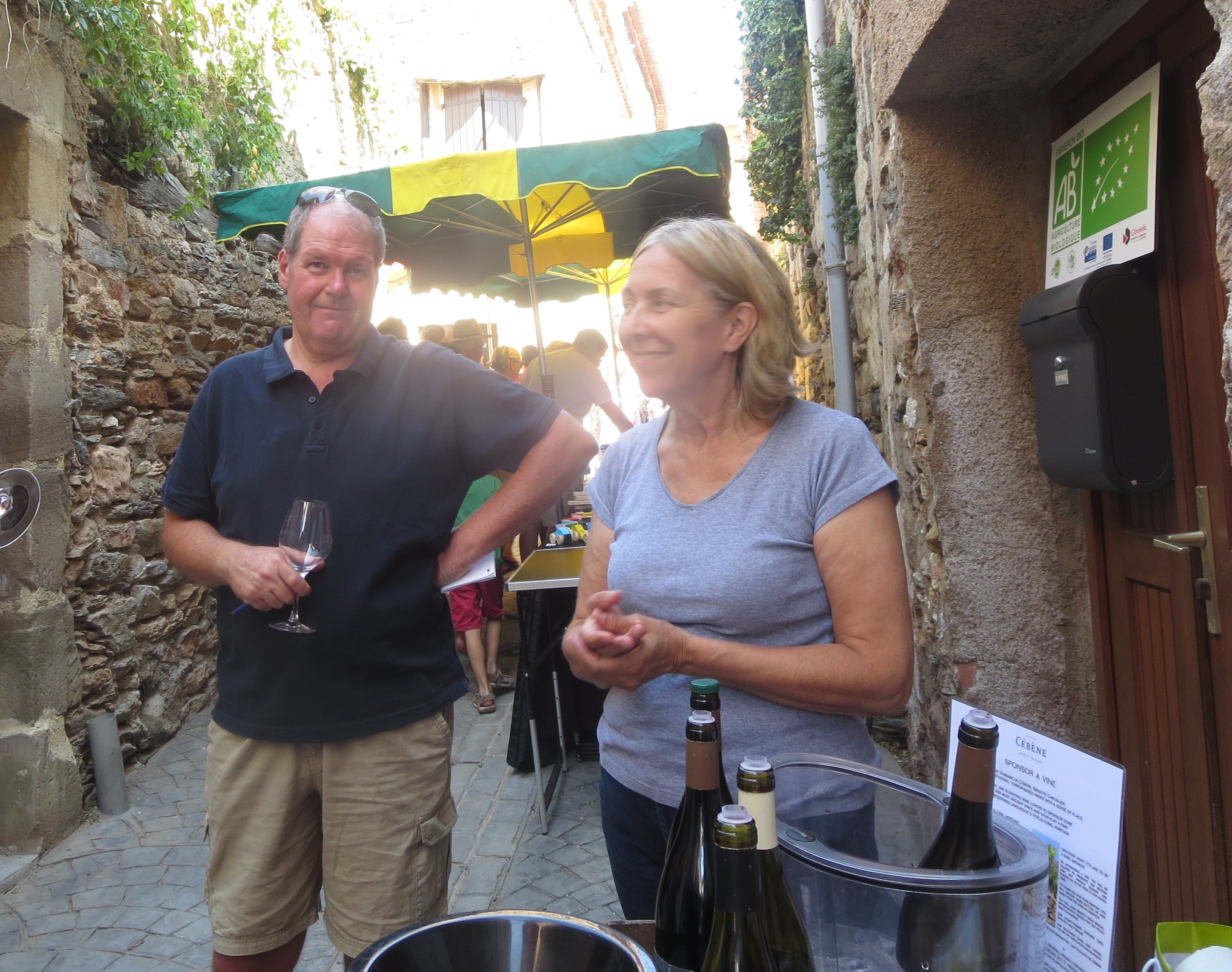
When I first became interested in Languedoc wines it is fair to say that Leon Stolarski was the catalyst. I became aware of his online wine sales and bought bottles from his list from a number of producers such as Turner Pageot, Treloar and Domaine De Cébène. When we first came down here on holiday in 2010 and 2011 it was to those producers that I made visits.
Brigitte Chevalier runs Cébène having bought her first vineyards in Faugères around 2007 and making her first vintage in 2008. Visiting her in 2011 she took us round the vineyards and was clearly excited by the potential of the schist soils and old vines. At the time Brigitte worked from an older cellar though it was still able to work through gravity for the grapes to fall into tank when returned to the cellar. Brigitte’s talents were soon recognised around the world and critics such as Jancis Robinson have been very supportive.
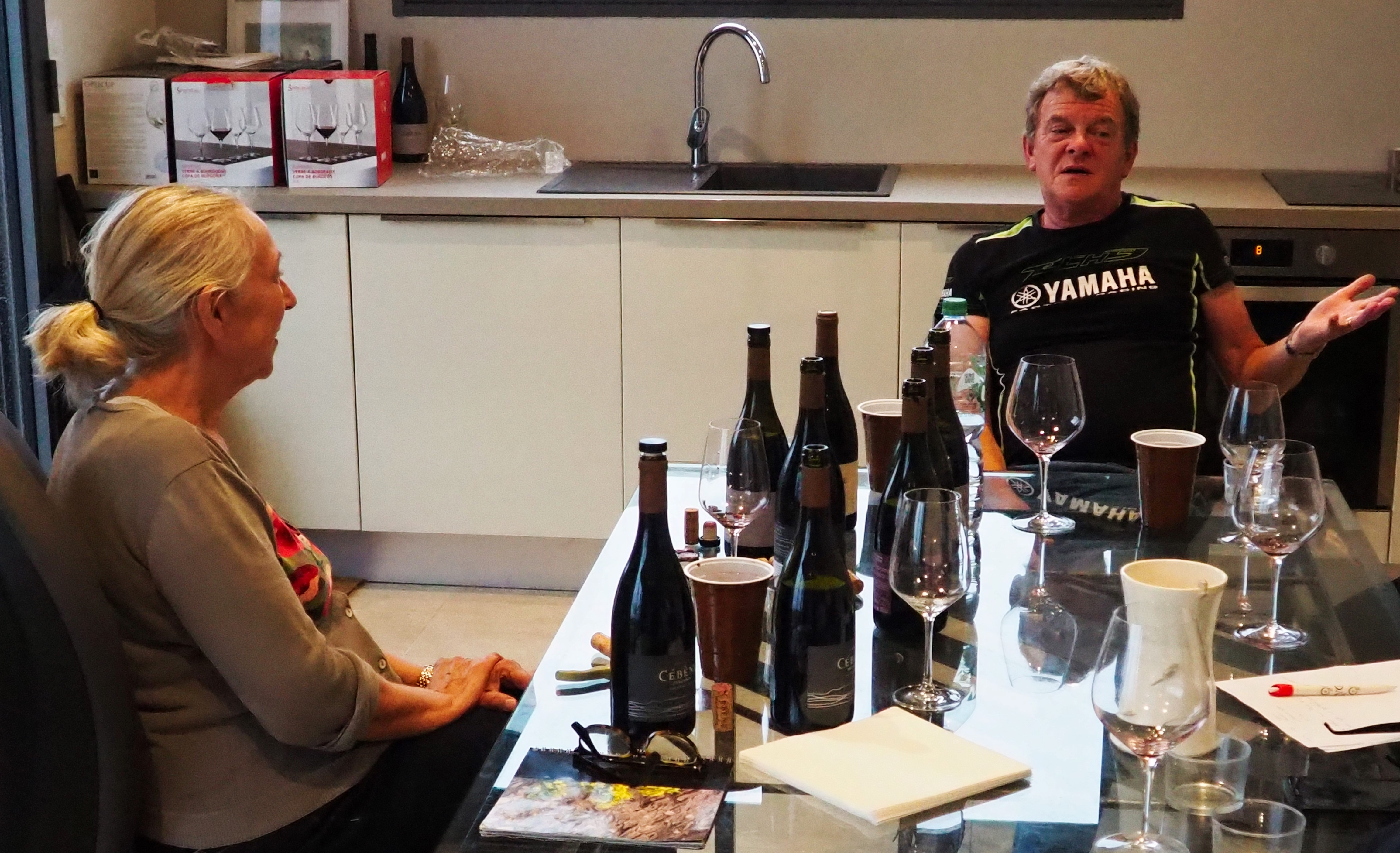
I have been fortunate to meet Brigitte many times over the years and her wines are always of such high quality. It was a real treat for me though when Leon contacted me on Saturday from his holiday home down here to invite me to go along with him to taste recent wines at Cébène. It was actually a wet and grey day and mist hung around the new cellars and tasting room at the domaine. However, Brigitte’s welcome was warm despite suffering from an injured foot having slipped in the cellar a couple of weeks ago.
As we talked Brigitte repeatedly talked about her belief in biodynamics and how she feels that the preparations and practices of the philosophy have improved the soils and health of the vines. For example, having checked with the previous owner, Brigitte thinks that some of the Mourvèdre vines are around 100 years old but their yields remain generous and their health excellent. She is relentless in seeking to improve her wines and has invested in amphorae and concrete eggs for fermentations. These vessels from history have become a tool for modern winemakers. Many believe that the shape of amphorae and eggs helps the purity of the wine as there are no angles in the vessel meaning that the wine continuously moves, like a vortex. Brigitte mentioned that she wanted to remove secondary, clashing flavours in the wine, eg oak flavours from barrels, even old barrels. The aim is to produce a more precise, pure wine, the taste of the grapes alone. This desire to improve quality is what shapes her talent.
Brigitte kindly opened examples of all five of the Cébène range. I have to confess that my sheet of notes was lost in the rain so I will keep my assessments brief.
First came Ex Arena 2020, 85% Grenache made from vines outside of the Faugères appellation (actually not far from Jeff Coutelou) on villefranchien limestone soil. Generous, open and plummy fruits this wine is ready to drink now or keep for a few years.
Next, a new bottle to the range is À La Venvole, first produced in 2019 though we tasted the 2020. The name of the wine is from old French meaning by chance, a whim but Brigitte liked the fact that ‘vent’ is is the name, a reference to the winds which are a feature high in the hills. A blend of Syrah, Grenache, Carignan and Mourvèdre, the wine is meant to be drunk young and as a simpler style. I really enjoyed this, yes it is easy to drink young but it has real quality and depth, a lovely blend of grapes and style.
To Bancels, a wine which I have always enjoyed most of all Brigitte’s wines. It was interesting to hear her tell us that this reflects the domaine perhaps most of all the wines. Grenache, Syrah and Mourvèdre grapes from vines around the heart of the vineyard Brigitte keeps the bottles herself in storage until she feels that the wine is ready. It is tempting to open bottles as soon as you buy them and Brigitte wants her customers to enjoy Bancels at its best, not too young. A costly but thoughtful and principled stand by her. The 2017 was still energetic and will age well but is drinking well now with blackberry, spice and floral notes. The 2019 was still a baby and tighter as you’d expect but nice liquorice notes, perhaps a little weightier than the 17, will it stay that way as it develops?
Belle Lurette is the showcase for the Carignan grape, and my word, this was a treat. The 2018 is as good a wine as I have tasted in a long time. To keep the Faugères appellation Brigitte has to add some other grapes but Carignan dominates to the maximum 85% demanded by the appellation. This is the perfect example of how the vines and wines have improved in her care, Belle Lurette has blossomed into a real star. The 2018 was poised, elegant, direct yet rich and powerful with persistent fruit and freshness. Stunning. The 2020 is obviously a baby but drinking well now, though I’d keep it tucked away for a few years. I picked up more dark fruits than the 18 but that poise was evident again. And both bottles showed how good Carignan can be, the altitude (300m), sun and wind combining so well. As Brigitte said it is a terroir made for Carignan and also climate change proof (hopefully).
Finally Felgaria, the flagship wine and a demonstration of the quality of Mourvèdre which makes up at least half of the wine along with Syrah and Grenache. Brigitte credits three factors for producing top quality Mourvèdre, the altitude, the schist soils and the old south facing vines soaking up sunshine. Most of her vines face north, including the Syrah and Grenache topping up Felgaria but Mourvèdre, and especially these very old vines, seems to enjoy a dry, warm situation. It also produces a vibrant red coloured juice and Felgaria is rich in colour with equally enticing aromas and flavours ranging from blackcurrant to citrus, spicy with hints of meatiness, leather and herbs. The 2017 we tasted was plummy, rich and still an infant. Felgaria demands patience and time for it to reach its peak.
A wet and misty view over the vines
It was a terrific couple of hours spent with a winemaker of singular talents, passion and warmth. Wines of elegance, drinking pleasure but also wines which reflect the land upon which the grapes are grown. Brigitte’s wines would be very high on my list of recommendations for people asking for the best Languedoc and Faugères wines. That Belle Lurette 18 will stay in my memory for a long time to come, reflecting its name. Merci Brigitte.
Wednesday September 15th was a day of further meticulous sorting grapes for an amphora. Piquepoul Gris and Terret Blanc from Peilhan vineyard arrived first and the early cases went directly to press ready for use in blending some of the white wines of 2021. Peilhan is becoming a real hub of the domaine, the original lower level of red and white grapes added to by a terrace in 2016 with a range of grapes. In a future post I shall explain how Peilhan is to be developed further.
Piquepoul Gris and Terret Blanc
After an hour or so the pickers moved from the terrace of Peilhan to the white grape plot and the Muscat d’Alexandrie, some of Jeff’s personal favourites. Amphorae wines are, perhaps, most associated with the country of Georgia where whole bunches of grapes go into the vessels often buried in the ground. Jeff takes a more cautious approach to his amphorae and, as last week, the Muscat would go through a series of sorting to ensure all stalks and stems are removed. Stalks can add astringency and, in a complicated year such as this, he was taking no chances.
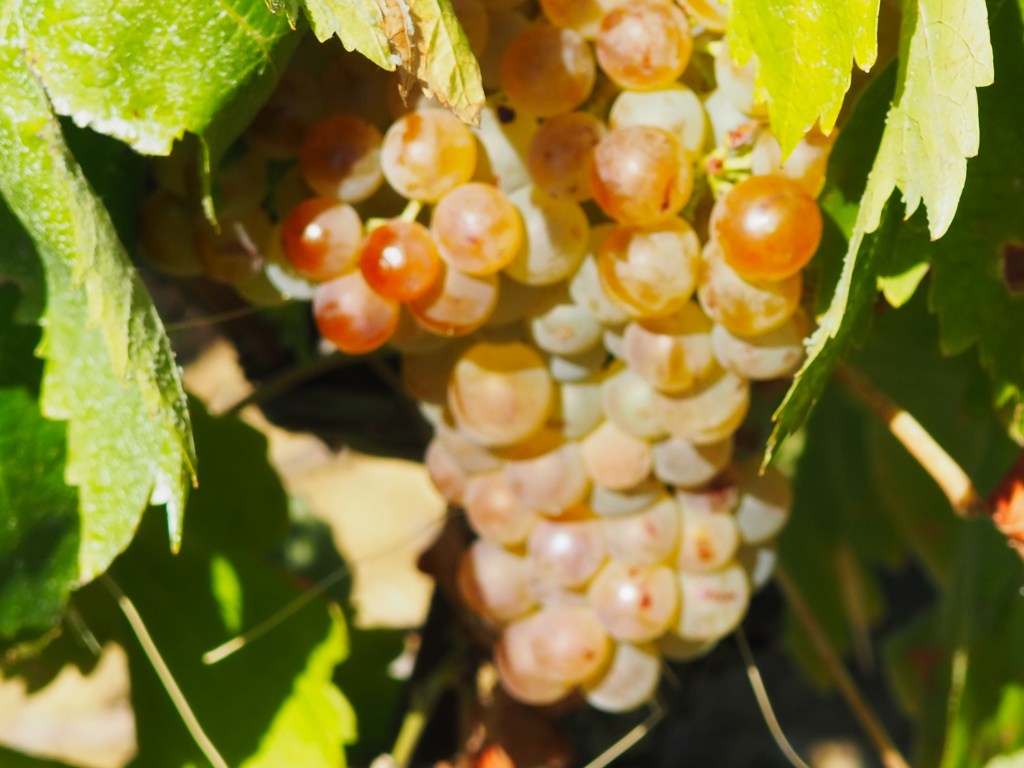
Muscat d’Alexandrie
The grapes were sorted at the vine, then at the égrappoir and then a bunch (sorry!) of us went through the destemmed grapes to pick out every little bit of remaining stalk. Cathérine, Jeff’s sister, joined us in the task as we sat on cagettes and chatted. Also, part of the group was Jofre a young man studying hotel and catering. Jeff used to teach this course himself many years ago and always takes a student to do a placement. Jofre wants to become a sommelier, has a good deal of experience in restaurants and has worked hard during his three weeks with us.
Saturday 18th was to be the final day of picking for vendanges 21. Like the Wednesday it began with white grapes going directly to press. This time there were a range of varieties, Olivette, Servant, Terret Blanc and Clairette Rose amongst others. There are now a good number of small stainless steel tanks with small amounts of wine, a palette from which Jeff will produce the final picture of 2021 white wines.
Olivette, Clairette Rose, Servant
Riveyrenc Noir
We then moved on to the terrace at Peilhan again and picked the Riveyrenc Noir, Riveyrenc Gris and Morastell Noir (not to be confused with Monastrell, the Spanish name for Mourvèdre). The Riveyrencs were large grapes in big bunches whereas the Morastell was mainly small grapes in small, tight bunches. The latter was much easier to sort, the smaller grapes tend to be less prone to disease. As the day progressed the final section to be picked was the Castets. I wrote about this variety a few years ago when it was still unknown and rare, Jeff having some of the very few vines. Fast forward to 2021 and Castets is now an officially permitted grape in Bordeaux and its fame is growing. More small grapes in healthy bunches, a good way to complete the vendanges.
Castets, early morning on the 18th
It has been a somewhat stop start harvest due to the weather, the inconsistent ripening caused by frost and drought. Through it all this has proved to be one of the best teams to work with, hard working, fun and supportive of each other. I thank them for welcoming me in as part of the team. It was a joy to be back.
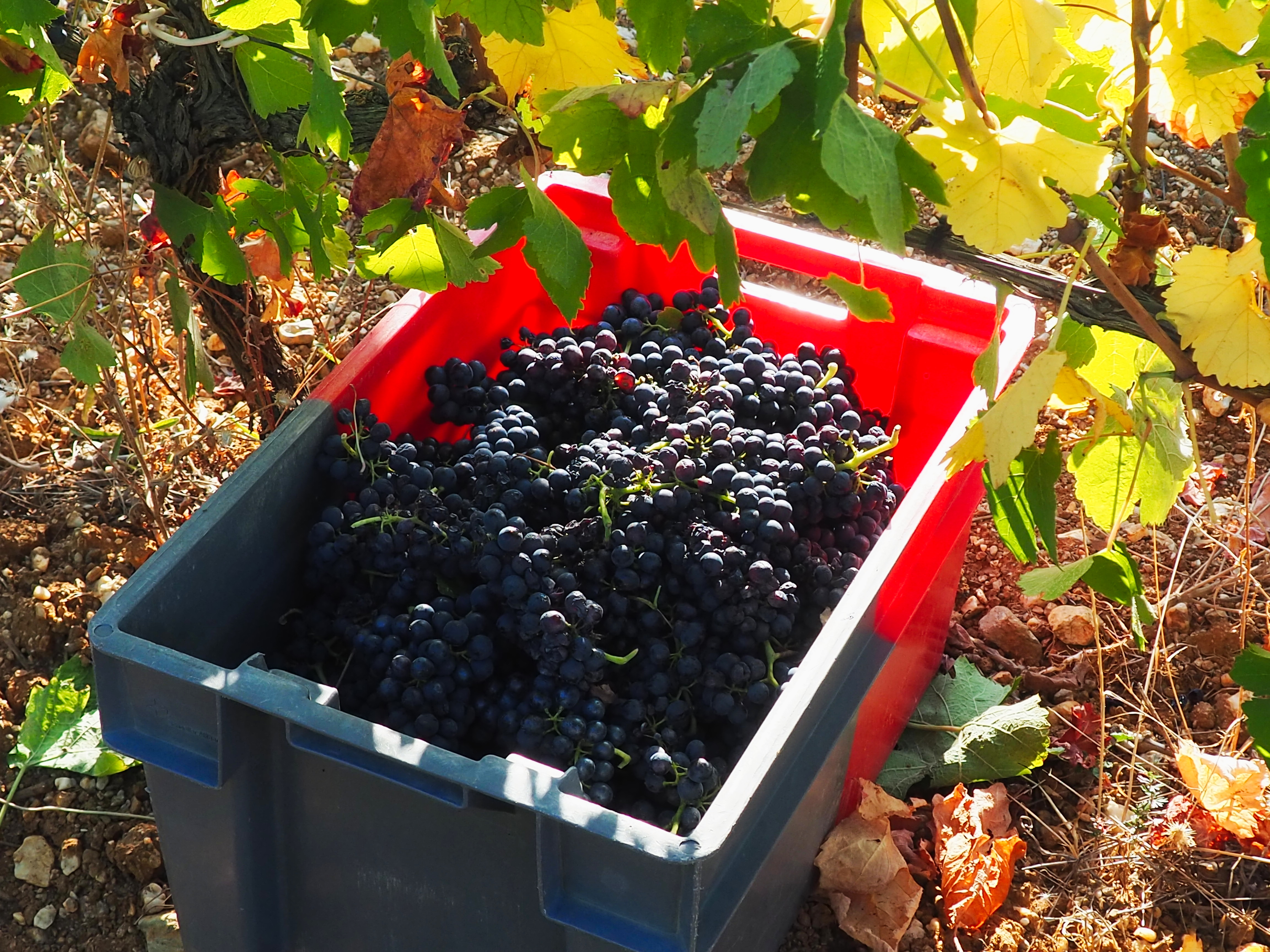
Having talked about new varieties of grape planted at Jeff Coutelou’s domaine in Puimisson the last few days have been about a variety of different activities, vintages and grapes too. After the rain break on the 9th, we restarted on Friday 10th by spending the morning in the vineyards of Segrairals and Peilhan picking Cinsault and Carignan respectively.
Cinsault, big bunches and those rejected
The Cinsault often comes in large berries and bunches and, as a consequence, the open bunches can be prone to disease and ver de la grappe. As we picked, therefore, we took great care to conduct a triage on the spot leaving a lot of the grapes behind as you can see. To paraphrase the old John West advert, ‘It’s the grapes we reject that make Coutelou the best.’ Even in a year with much reduced quantity the emphasis has to be on quality, clean grapes if the wines are to be good.
Carignan loaded straight into press by Matteo as Louis, Boris and Jeff look on
Peilhan was quite badly hit by the April frost and the Carignan was particularly damaged. Some vines had no fruit, others still produced well. Again we sorted the grapes carefully in the vineyard. Both harvests went into the press directly. When grapes are not of the highest quality it is not worth destemming and fermenting separately as any taint will spoil the wine. Without the comfort blanket of SO2 Jeff wanted to get the juice from the grapes quickly, likely to produce rosé rather than red after spending so little time on skins extracting colour.
In the afternoon, the Moroccan pickers moved on to the Mourvèdre back in Segrairals. Meanwhile I and some of the team were given a different direction altogether. Jeff had selected some of the best white Macabeu grapes of 2019 for ageing in barrel, they had recently been moved to stainless steel tank in the white wine section of the cellar. The juice was run off the top of the tank and then the marc (skins, pulp, pips etc) were brought to the basket presses.
The Leaning Tower of Puimisson
The free wine on top of the marc is run off from the tank above to a new one by gravity as Steeve supervises
Operating these presses was one of the first jobs Jeff gave me in 2014 and so I set about extracting more juice from the marc. The pressing must be light as the marc contains more tannins which might make the overall wine more bitter. It is surprising how much extra comes out of the marc, and even more surprising to see whole grapes still amongst it after 2 years. The final wine tasted great and I can’t wait to open a bottle and see how it develops further.
Basket press loaded and extracting the rest of the 2019 white
The following day, Saturday, brought more variety and a new job for me. Macabeu and Grenache Gris from Peilhan was brought to cellar and the first couple of rows of vines were sent to press. Jeff, however, decided that the rest was higher quality and wanted to use these grapes for fermenting and maturing in amphora. There have been 4 of these for a while now and Jeff is convinced they do improve the quality of some wines. However, he did not want anything but the grapes themselves in the amphora. Therefore, we used the égrappoir to destem the bunches but then had to pick through every grape to remove any remaining pieces of stalk or stem. Painstaking, meticulous work.
1
2
3
4
5
6
1- Grenache Gris, 2– Matteo and I sort the grapes into the égrappoir, 3- Destemmed but still some stalks remain, 4- Jofre and others pick through every grape, 5- The thrice sorted grapes, 6- Macabeu and Grenache Gris in amphora
In the afternoon it was time to bring in the Grenache of La Garrigue. I identified this as the best parcel of the vintage in my first blog of this year’s vendanges, the grapes were of very high quality. You might recall that apparently this was hard hit last year and it was as if nature was offering compensation. The quality brought a smile to Jeff’s face and raised the morale of the whole team. The grapes went through the égraineur (which separates each berry not just the whole bunch like the égrappoir), and the juice already tasted especially good, confirmed by the technical analyses.
Grenache from La Garrigue, best of the bunch
Monday 13th brought the longest and hardest day of the vendanges for me personally. It started in typical fashion with the remaining Grenache being sent to a separate tank for using with other wine. However, we then moved to the Carignan of Rec D’Oulette, the parcel which produces Flambadou in good years. Unfortunately, this is not a good year, unless you’re a fan of Grenache and white wines. Jeff decided that the Carignan should be made in whole bunch, carbonic maceration style. Instead of destemming the bunches, everything goes into tank and is protected by CO2 which also kicks off fermentation in the berries themselves.
Carignan
That meant we set up sorting above the tank which would hold the grapes. On a hot, sultry day that meant working inside and above the rising heat from the grapes. Matteo and I spent the best part of six hours processing the Carignan, it was back breaking, sweaty work and tested this 62-year-old man but I made it through. Just.
From direct press to basket press, destemming single grapes to whole bunches, whites to reds and orange wine too, even grapes from an older vintage. This was a period of the vendanges which was all about variety.
Sorting Carignan whole bunch, Flora stepped in for me for a few minutes
Vendanges continued for the next couple of days, September 7th and 8th, but there was a literal dark cloud on the horizon in the form of a stormy forecast on the 9th. The predicted rainfall would do even more damage to this benighted vintage. Two varieties are especially vulnerable to rain, Aramon Noir and Cinsault. These varieties have big juicy berries and thin skins so with rain they swell and become dilute and prone to disease. Therefore, the team picked it by that evening.
Steeve, Flora and Matteo at work
The new plantation of Sainte Suzanne was revisited too, some of the bunches having been used for the PetNat a few days earlier. Clairette and Macabeu grapes were finished off, as the vines are young we left one bunch on each vine to help the vines mature.
Aramon Noir and Gris behind, Clairette leaf, Clairette Gris grapes
Some lovely Grenache followed those white grapes to the cellar tanks, just next door in Sainte Suzanne itself. There is one more big parcel of Grenache to come from La Garrigue, it looks the best parcel of the year to my eyes. Then came the move to Segrairals to collect the Cinsault and Aramon. In recent years that vineyard has been transformed. Out went the Cabernet Sauvignon to be replaced by a myriad of varieties including the Aramon. Amongst the Noir was also Aramon Gris and some Aramon Rose, just to provide a little diversity and interest.
Segrairals
I have mentioned new plantations in Ste. Suzanne and Segrairals, there are others which will come on stream soon too. The Coutelou vineyards are being transformed year on year. This reflects Jeff’s philosophy and his passion for nature, different grapes and moving towards an era where varieties will have to respond to climate change which some of the imported grapes like Cabernet and Merlot might not do so well in the Languedoc. Aramon, of course, was widely planted in the region at the start of the 20thC, it was used to provide the light wine given to soldiers in World War 1. The Aramon picked here weighed in at a light 10% alcohol, the large berries providing much needed juice.
Another of the grapes from Segrairals was Mauzac, known more around Limoux and Gaillac, bright green in colour and very healthy. It looks an interesting addition to the Coutelou collection along with Grand Noir De La Calmette with its intense red juice from quite small berries. These small quantities will be blended together, Jeff will have a bigger colour palette with which to create his art. Blending is a skill, there have never been many single variety wines but it looks like there will be even fewer.
Mauzac and Grand Noir De La Calmette
The forecast storm and rainfall proved to be lighter than expected though there was enough water to delay picking for a day. Cellar work is pressing ahead with the team carrying out the remontages etc. Fermentations have kicked off well, the small slates on each tank revealing the lowering of density in the juice as it turns to alcohol.
More bad weather is unfortunately predicted for next week, yet another problem to add to this year of non-stop problems. The pressure is on to use the next few days to harvest provided the grapes are right. The plot thickens.
The rather gloomy nature of my last post might have made you think that we’re all doomed and no good wine will emerge from the Coutelou vats this year. Of course, that is not the case, there are still 50% of the grapes and Jeff can conjure up magical wines from just about any grape juice. So, let’s be positive and report on what is happening here with the 2021 vendanges.
Jeff has assembled a big team of assistants, as he told me it’s rather ironic that should be the case in this vintage. Firstly there’s Matteo, from Rome, who has been in Puimisson with Jeff since January. He helped to prune the vines this year, together with Englishman Matt who I sadly did not get to meet. Matteo, therefore, knows the vines and vineyards well and leads the team equallly well. Steeve is a friend who has visited Jeff many times and done harvest before with us. From the Jura region, Steeve has decided to change career and is spending the next few months with Jeff to learn more about his new vocation. Gilles, an ebullient and cheerful local man, has been working with Jeff for some time, happy amongst the vines after having his own vineyards for many years. Louis is from Narbonne, did harvest here last year and has returned. He is hard working, cheerful and speaks excellent English. Boris is another local who comes every year to help with vendanges, a lovely guy who works with nature conservation in his full time job.
Steeve, Jeff, Matteo, Boris, Louis and Gilles
We are also fortunate to have Jeff’s sister Catherine helping with picking and looking after us as well as her daughter Flora Rey. You will have seen photos from this talented artist on my blog before as shse has been recording the story of the vines and domaine through her photography and film. I urge you to have a look at this film which Flora put together showing the harvesting of Sainte Suzanne Syrah with music composed by Catherine. Consider subscribing to the Youtube site Vins et Spiritueux Coutelou for more great videos about events in Puimisson.
As I mentioned previously the first stage of the vendanges was to focus on Syrah, most affected by frost. Sainte Suzanne, the young vines of Segrairals and my beloved Syrah from La Garrigue were picked on August 30th and 31st. One third of the normal yield and quite concentrated, Jeff will have to consider how to use it in blending.
The glass on the far side contains Syrah from Ste. Suzanne, very good it was too.
I joined the team on September 1st appropriately in Rome vineyard, my favourite. We collected the Cinsault, Grenaches of three colours and some Muscat before heading to the last few bunches of the La Garrigue Syrah and then on to the complanation of 20+ grape varieties, known now as Flower Power, more correctly as Font D’Oulette. That the few of us picked those three vineyards in one morning is not good news. In the afternoon the Moroccan team went to Segrairals and collected some of the Cinsault grapes of the younger vines. These were full and generous and will add much needed bulk to the grapes from the morning. The Cinsault filled the tank though much of that is pulp and the quantity will fall as the juice emerges.
Rome vineyard with Grenache Blancamongst many others
Me in La Garrigue attacking the Syrah
On September 2nd Jeff wanted some fresh white grapes to make into the PetNat (sparkling), Bobonade. Muscat, Macabeu and Grenache Gris from Peilhan were in good condition and then we moved to the new plantation at the bottom of Sainte Suzanne. These were newly planted when I saw them last but they have grown quickly. The young vines managed to twist themselves round the wires of the trellising so it wasn’t the easiest to pick but the Clairette and Macabeu were fresh and acidic, just what is needed for sparkling wine. They were sent direct to press.
(Left)Macabeu, (centre) Macabeu, Muscat and Grenache Gris, (right) Steeve putting the grapes into press
And that brought the first act to a close. Pressing followed the next couple of days but picking resumed on Tuesday September 7th. So, until shortly after then, there will be an intermission.
Most readers will already know that this has been a difficult year for winemakers across France and Germany amongst others. Here in France a series of frosts in April damaged vines in regions from the Jura to Provence. When I spoke to Jeff Coutelou on April 11th he was reassured that Puimisson had avoided such calamity, but then disaster struck. On April 12th the frost, unforeseen by forecasters, struck many parcels with temperatures sinking to -7˚C. The Languedoc is no stranger to frosts even if not as vulnerable as other regions but this was sharp and the timing was disastrous. Vines had begun budding and flowering in the previous couple of weeks and the young growth was dried to a crisp by the cold. Jeff predicted that yields might be down as much as 70%.
Photo of a frost hit vine in 2015 from my blog
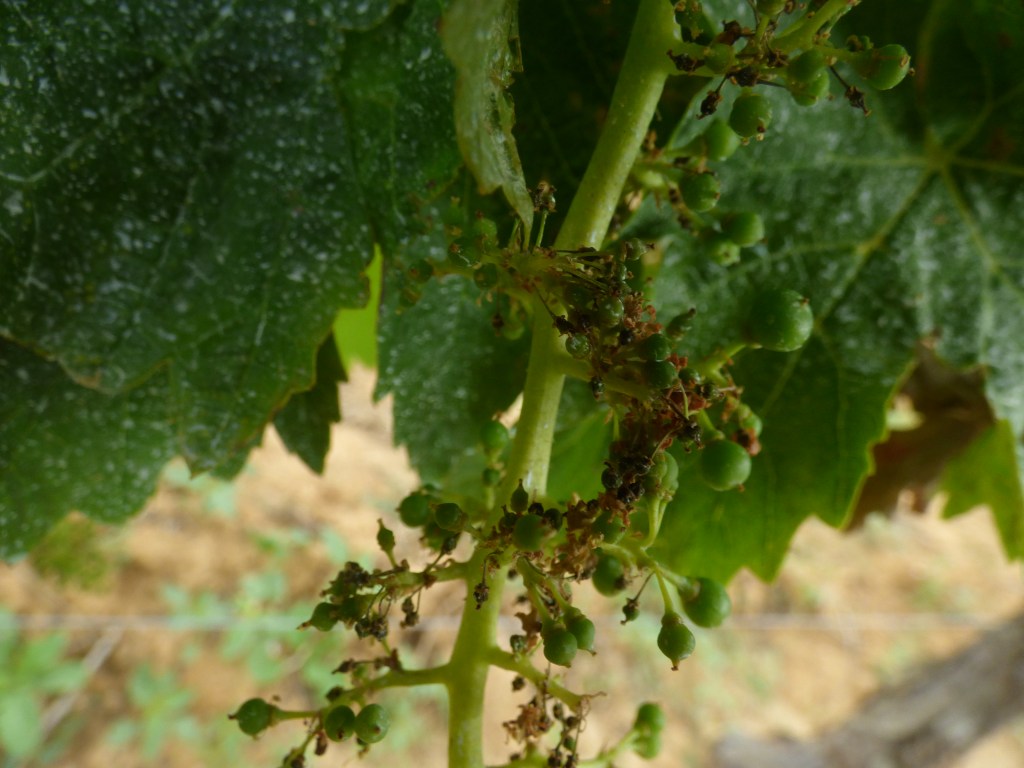
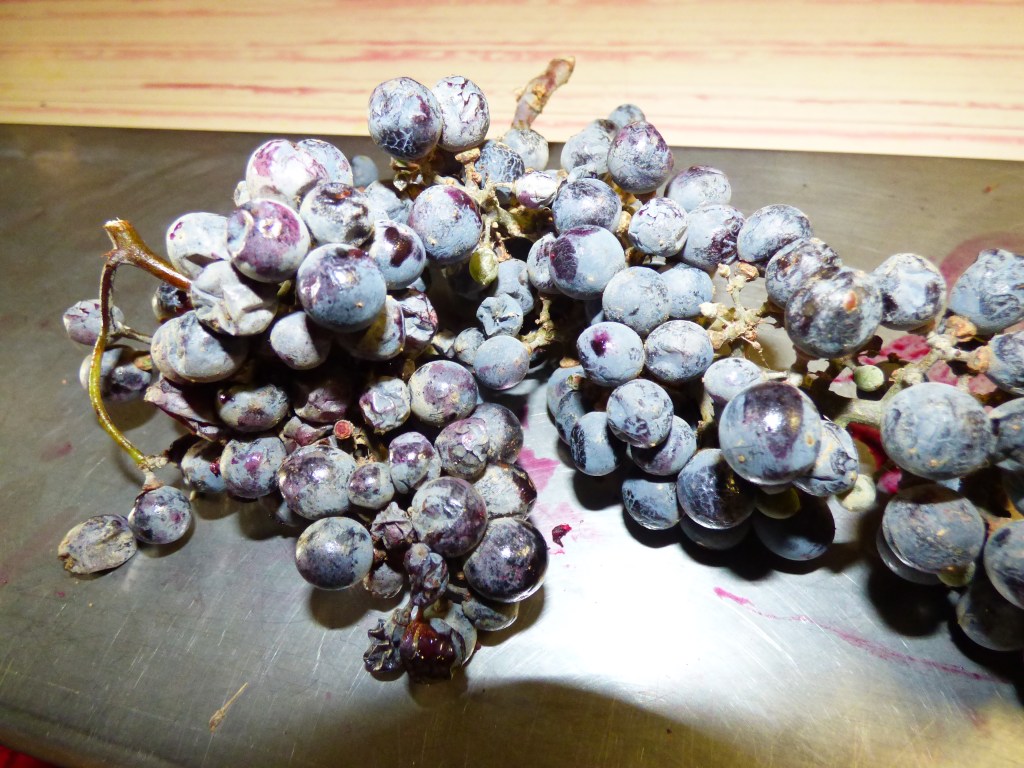
The vines fought back a little through Spring and Summer, secondary bunches forming but they cannot replace the original growth properly, being smaller and of lesser quality. However, the frost was also part of an ongoing problem with lack of water. Jeff told me that there had been little rain since the end of vendanges 2020, with just one sustained period of rainfall this year. Vines, weakened by drought and frost, become susceptible to other problems too. Every summer downy mildew and oidium (powdery mildew) are present and they found easy targets in 2021.
Oidium on a leaf this year, and on the right a bunch with grey oidium from 2016
Ironically, after my first tour of the vineyards this year, it was the Grenache of La Garrigue which stood out as being the best with healthy foliage and beautiful, good sized bunches of grapes. Ironically because last year that was the parcel worst hit by mildew, nature was giving back a little this year in compensation. La Garrigue is also the home of the Syrah which makes my favourite wine, La Vigne Haute. Unfortunately those vines had been damaged this year and were looking sorry for themselves. Syrah does seem to have been particularly badly affected. The first days of this year’s harvest concentrated on Syrah from Sainte Suzanne, Segrairals and, then, La Garrigue. Yields were one third of last year.
OLYMPUS DIGITAL CAMERA
OLYMPUS DIGITAL CAMERA
La Garrigue 2021, Grenache to the left with verdant foliage, Syrah to the right with struggling vines
In the last 5-6 years Jeff has replanted many vineyards, some of which had been fallow for some years. The fruit of these young vines can be used this year to help produce wines such as the PetNat, Bibonade, that will boost production a little. The estimate is now that there will be just under 50% of a normal year. So, the scene is set. I wish I had a prettier picture to paint, it is the least promising of the seven vintages I have witnessed here. Let us hope for a twist in the tale.




























 amarchinthevines