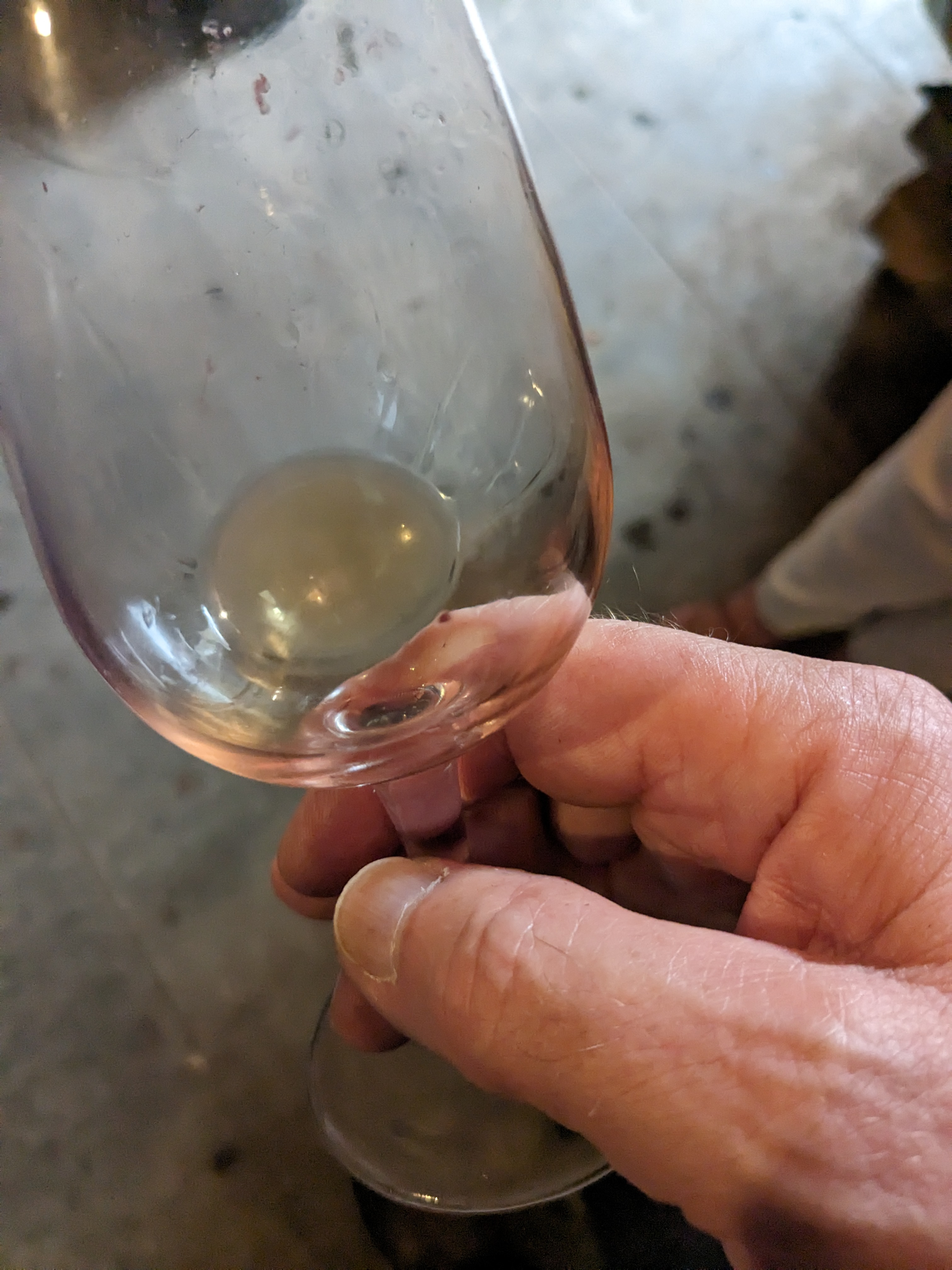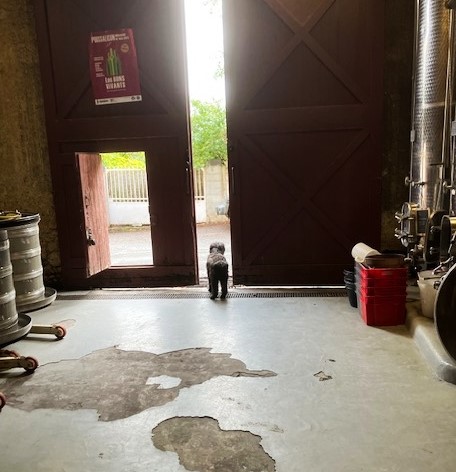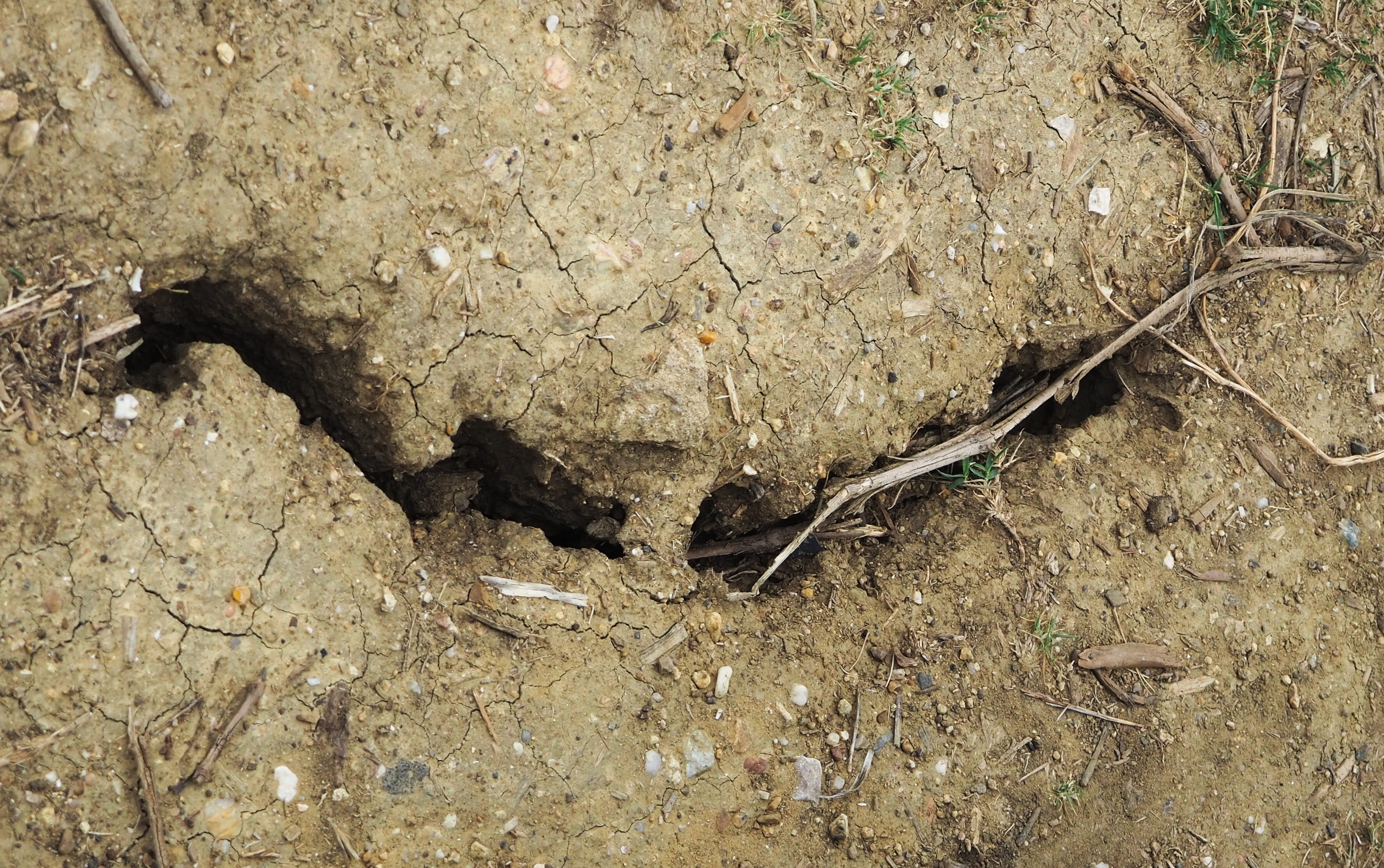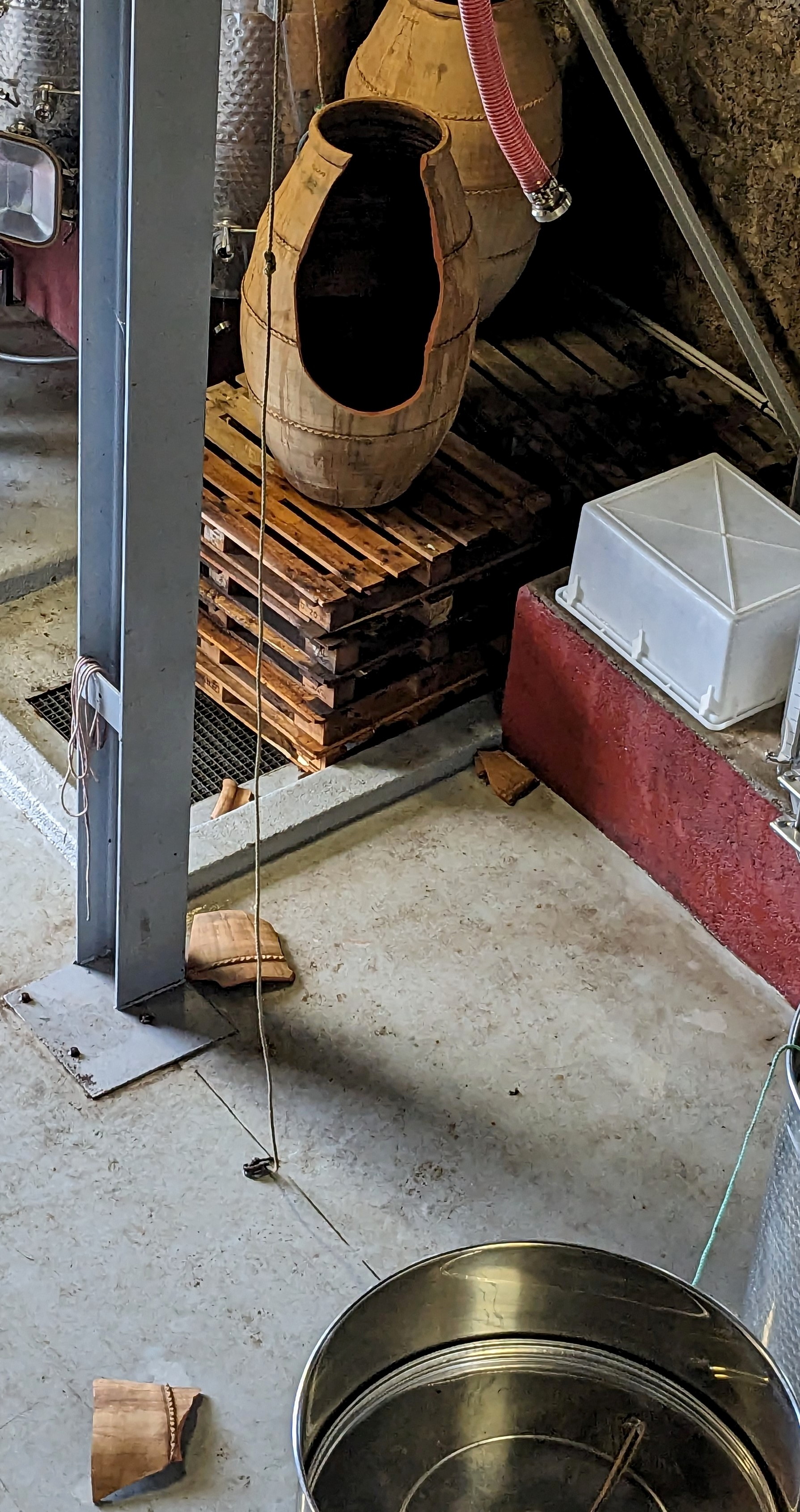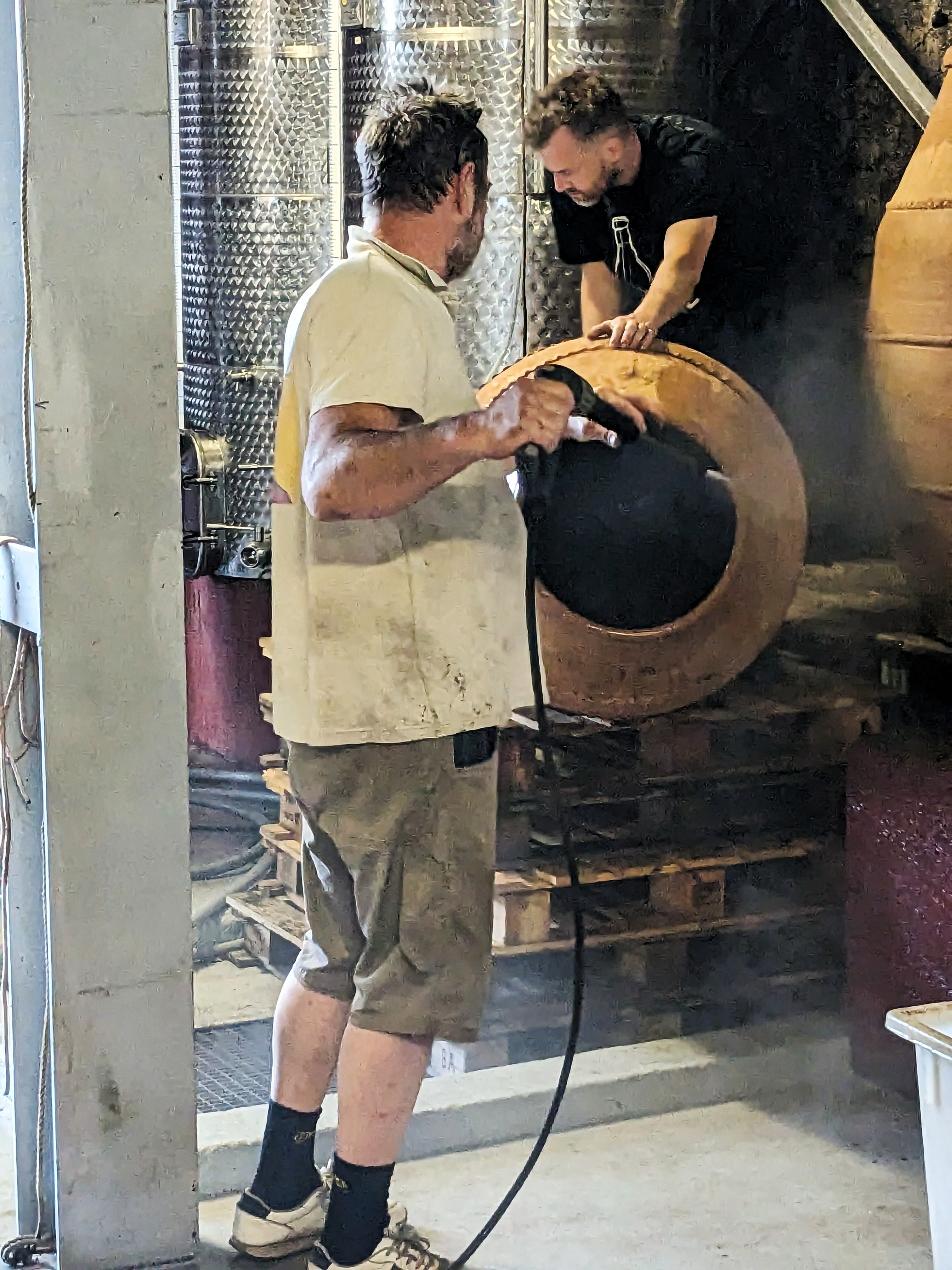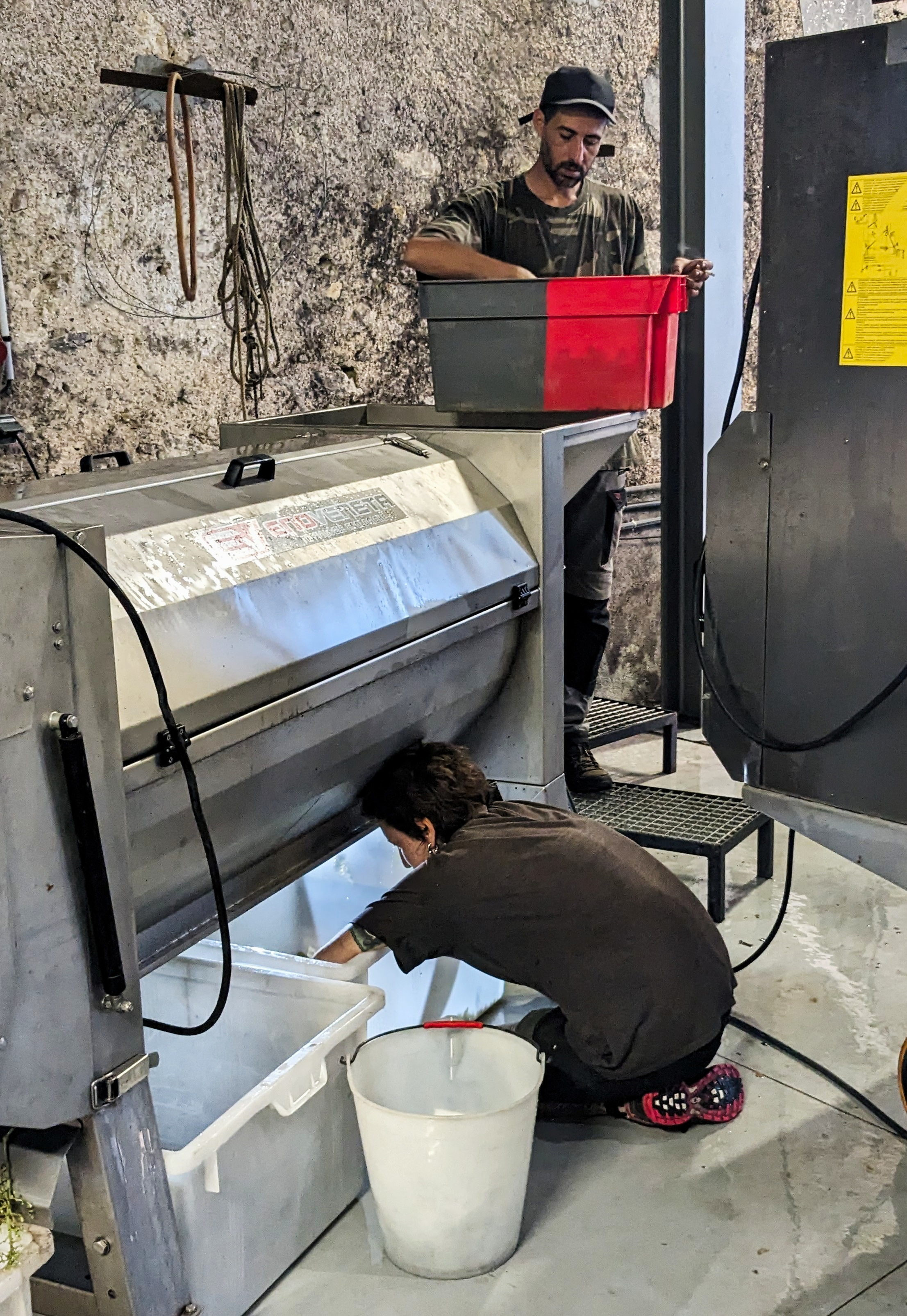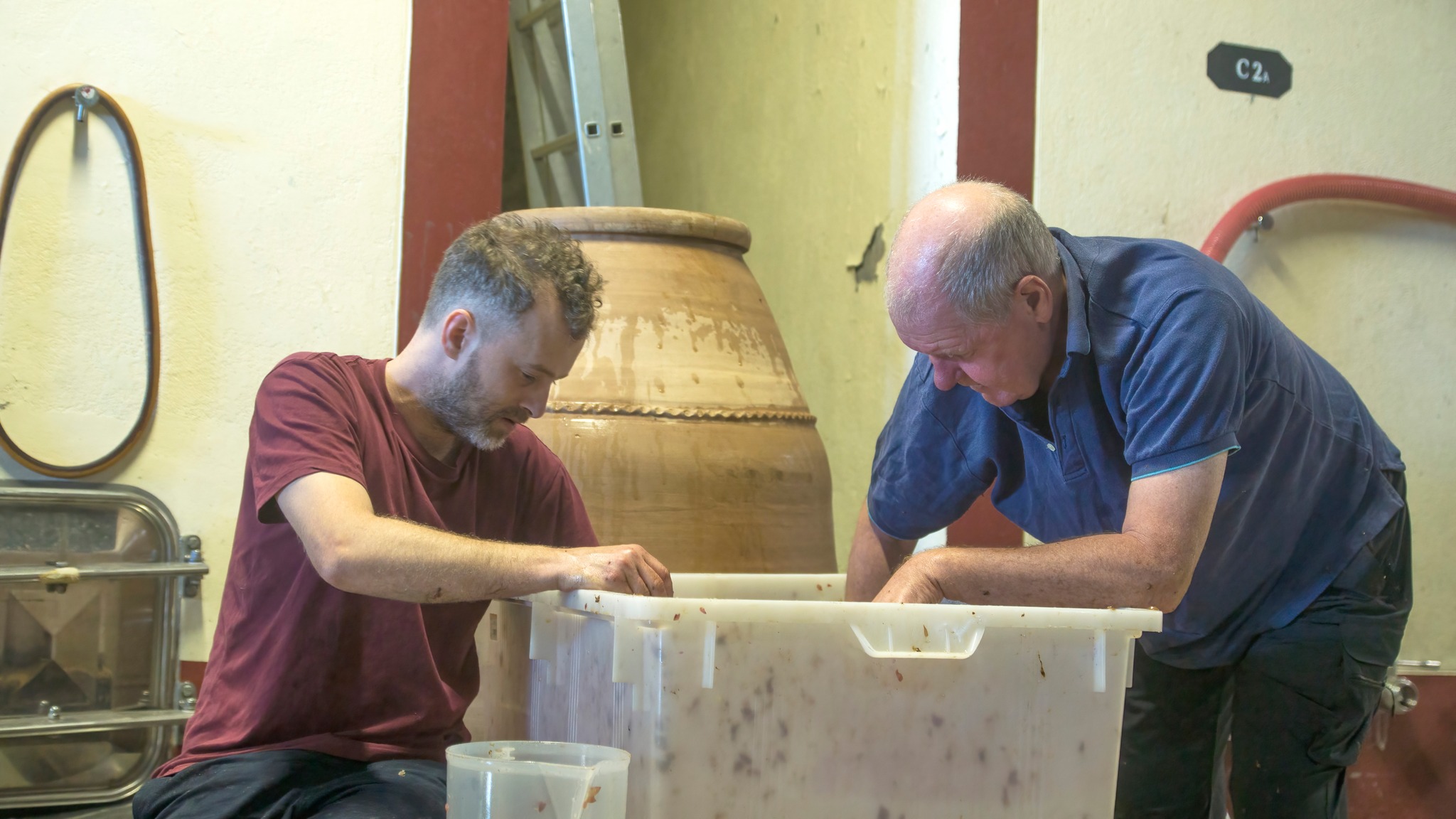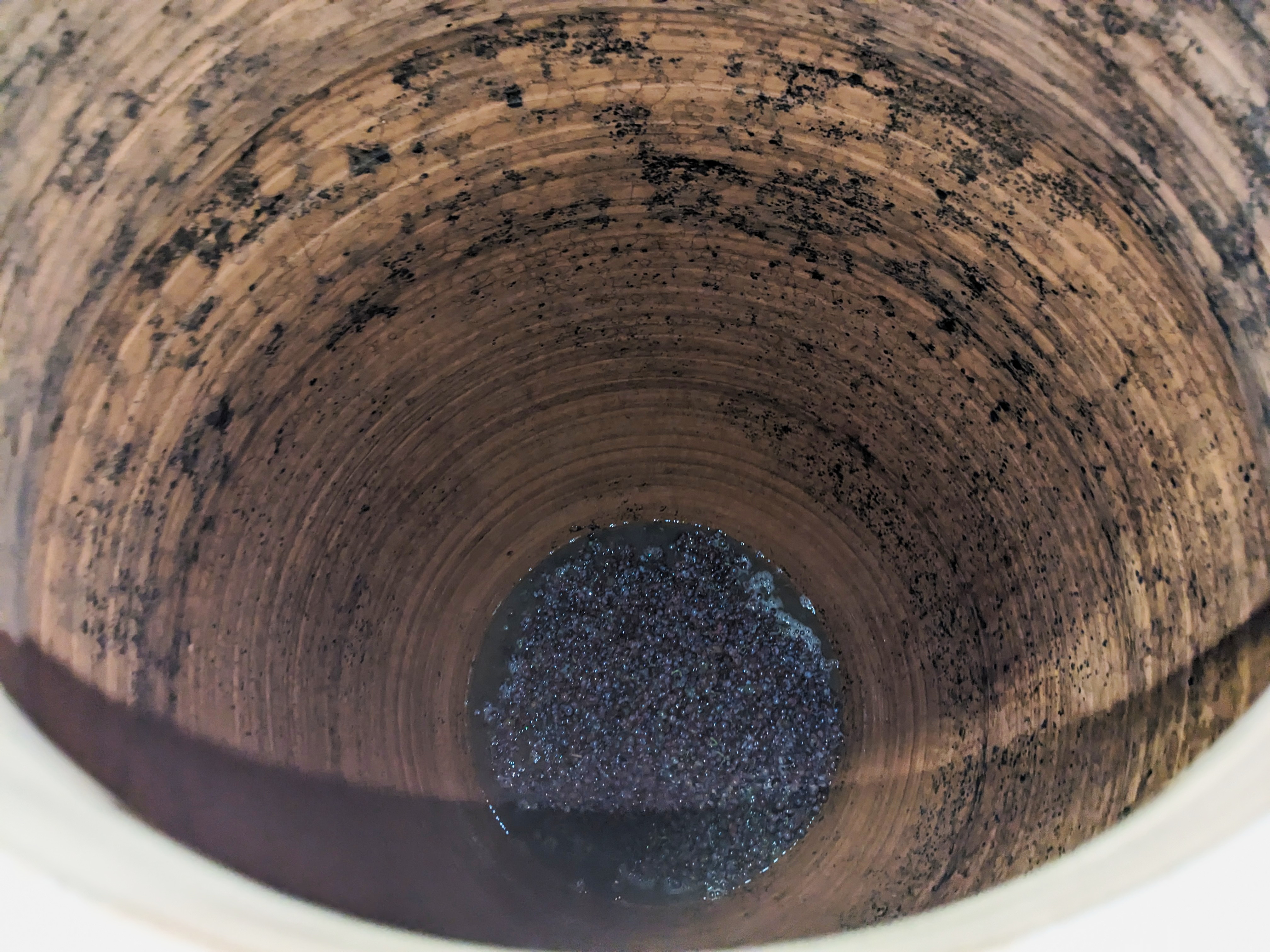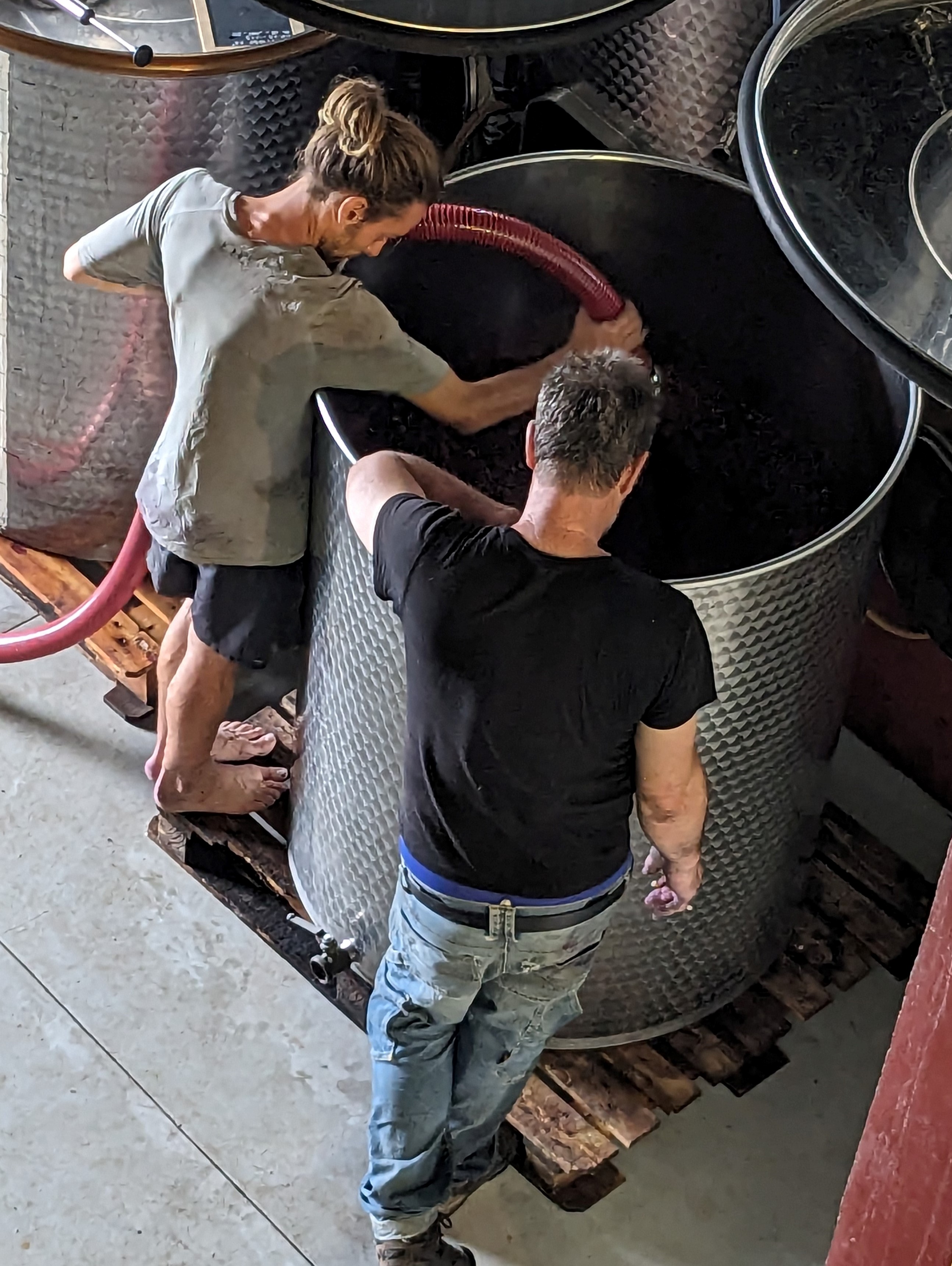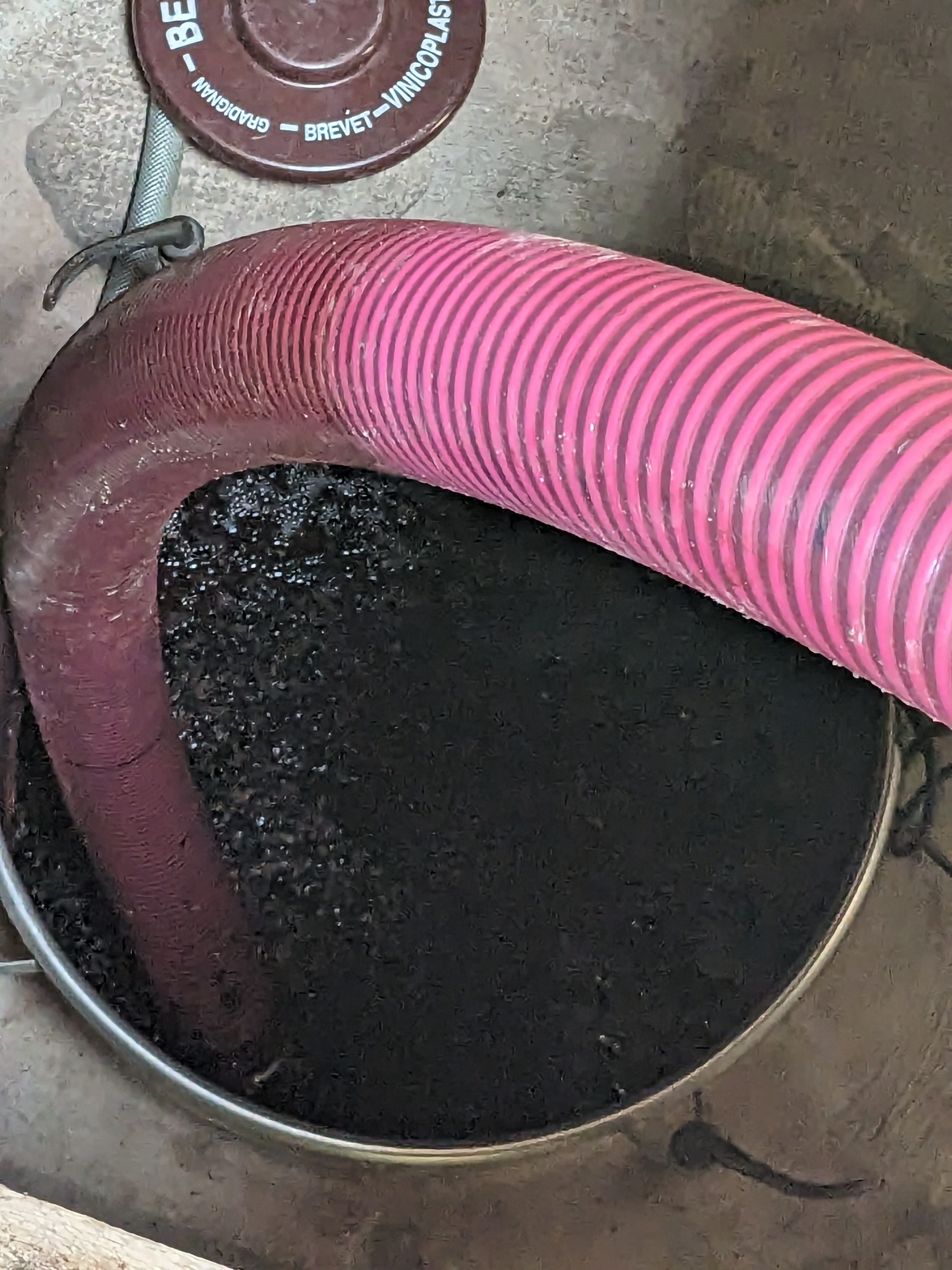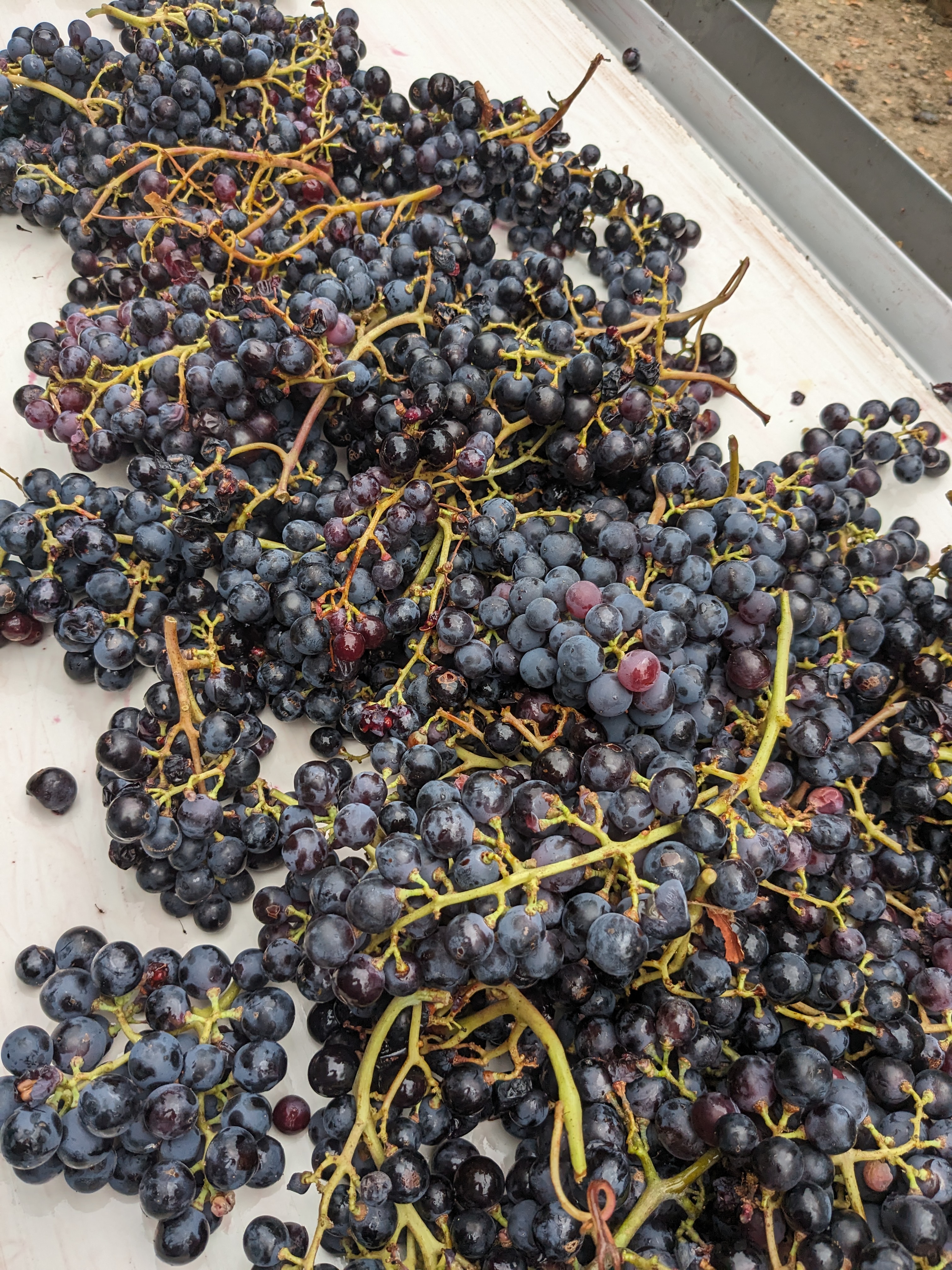
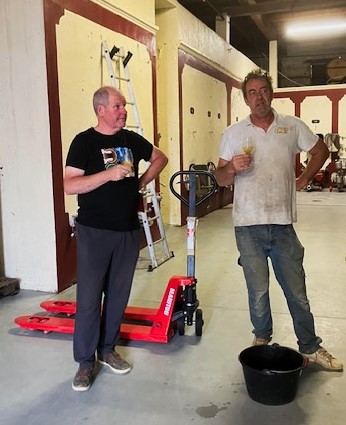
On Thursday, September 31st, a shift in pace occurred, moving from the large production grapes at the sorting table to a significantly more time-consuming task. Amphorae have made a resurgence in the last decade for fermenting grapes. Jeff acquired a couple in 2017 and has since expanded his collection. Regrettably, one of the amphorae burst open last week, likely due to an unnoticed crack, as it was filled with water. The water serves to ensure thorough cleaning of the amphora. One of the new amphorae was still holding remnants of wine from the previous year, with the porous clay retaining some of the juice. Filling the amphora with water, replaced daily, aids in clearing any residue.
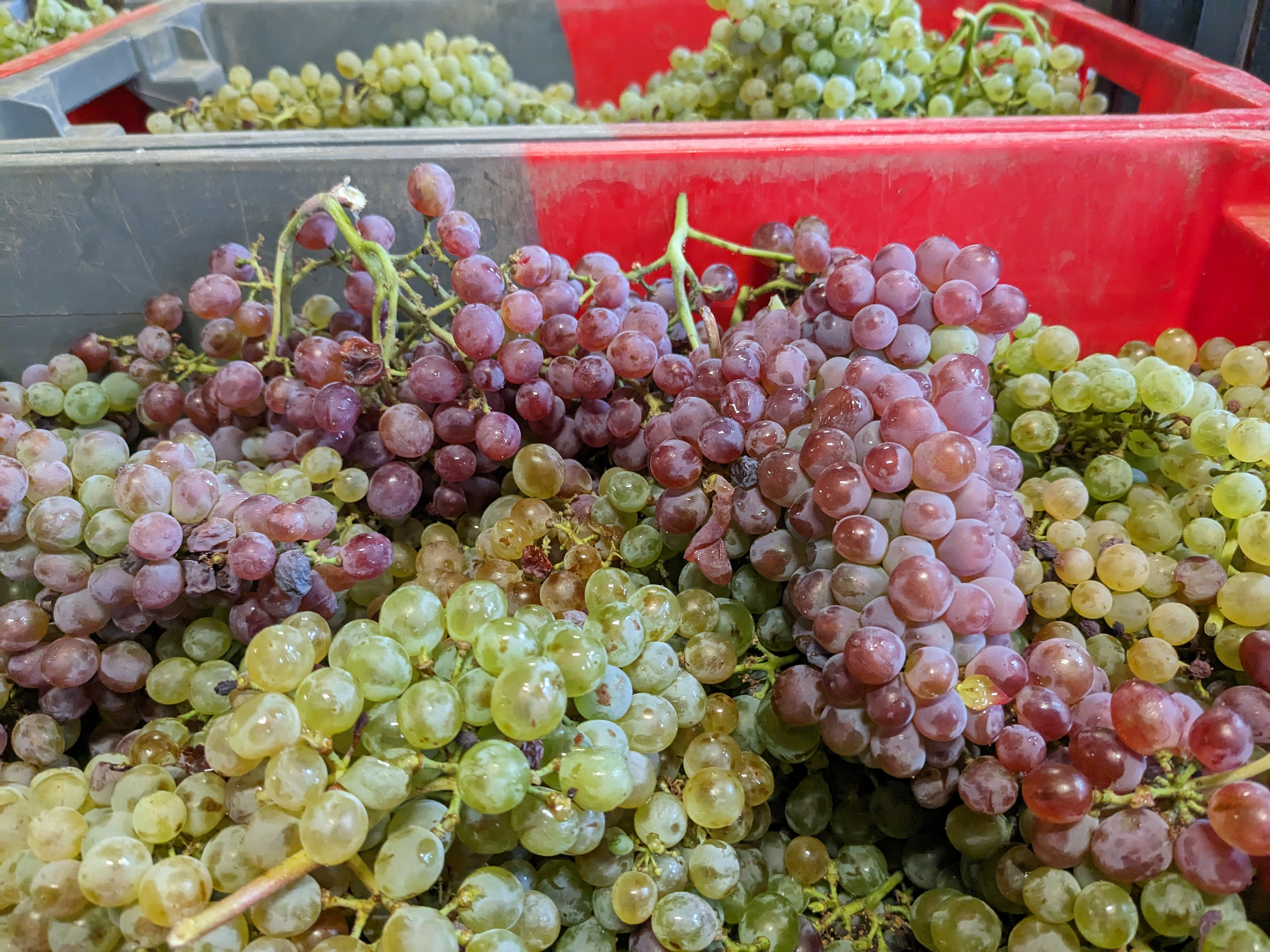
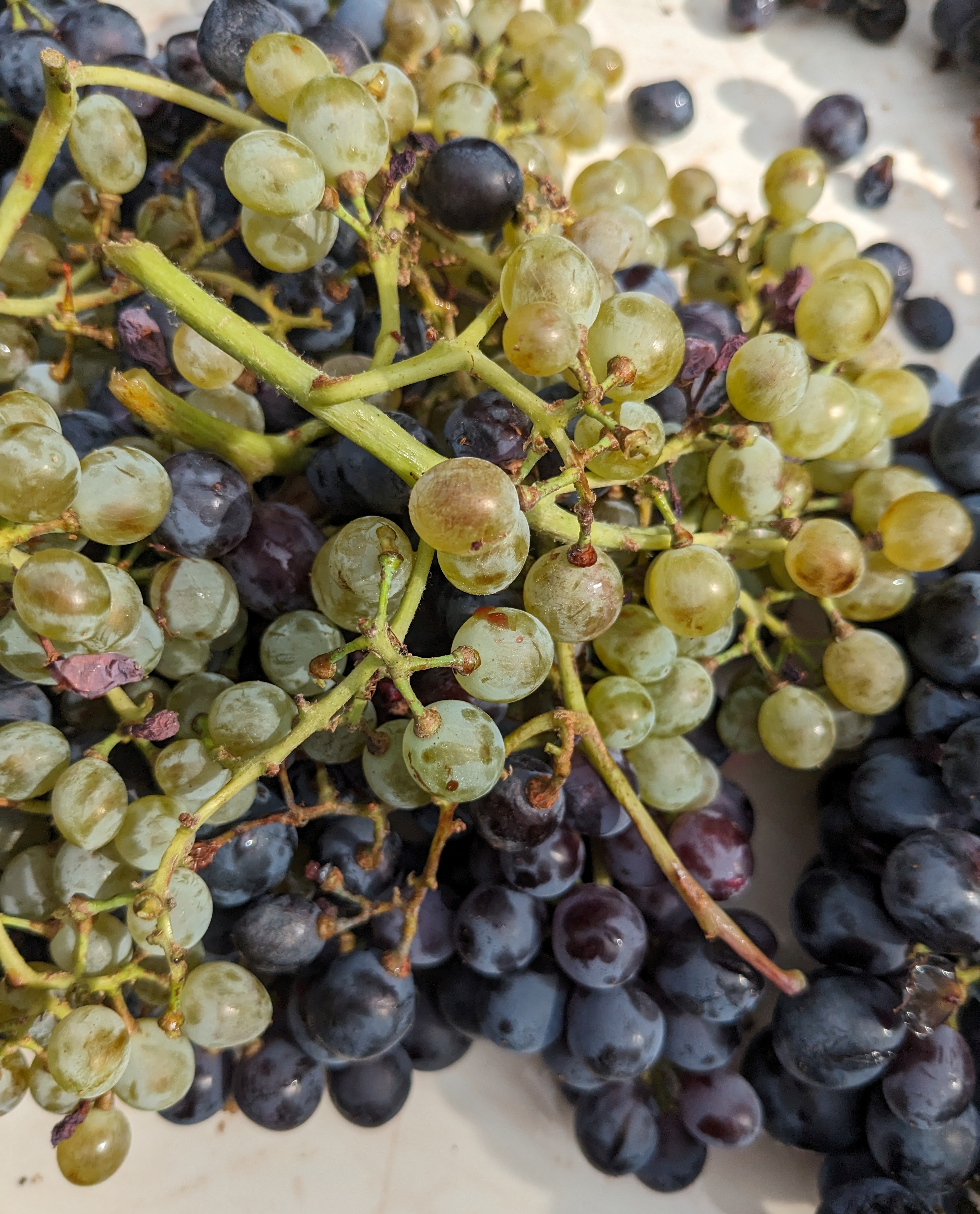
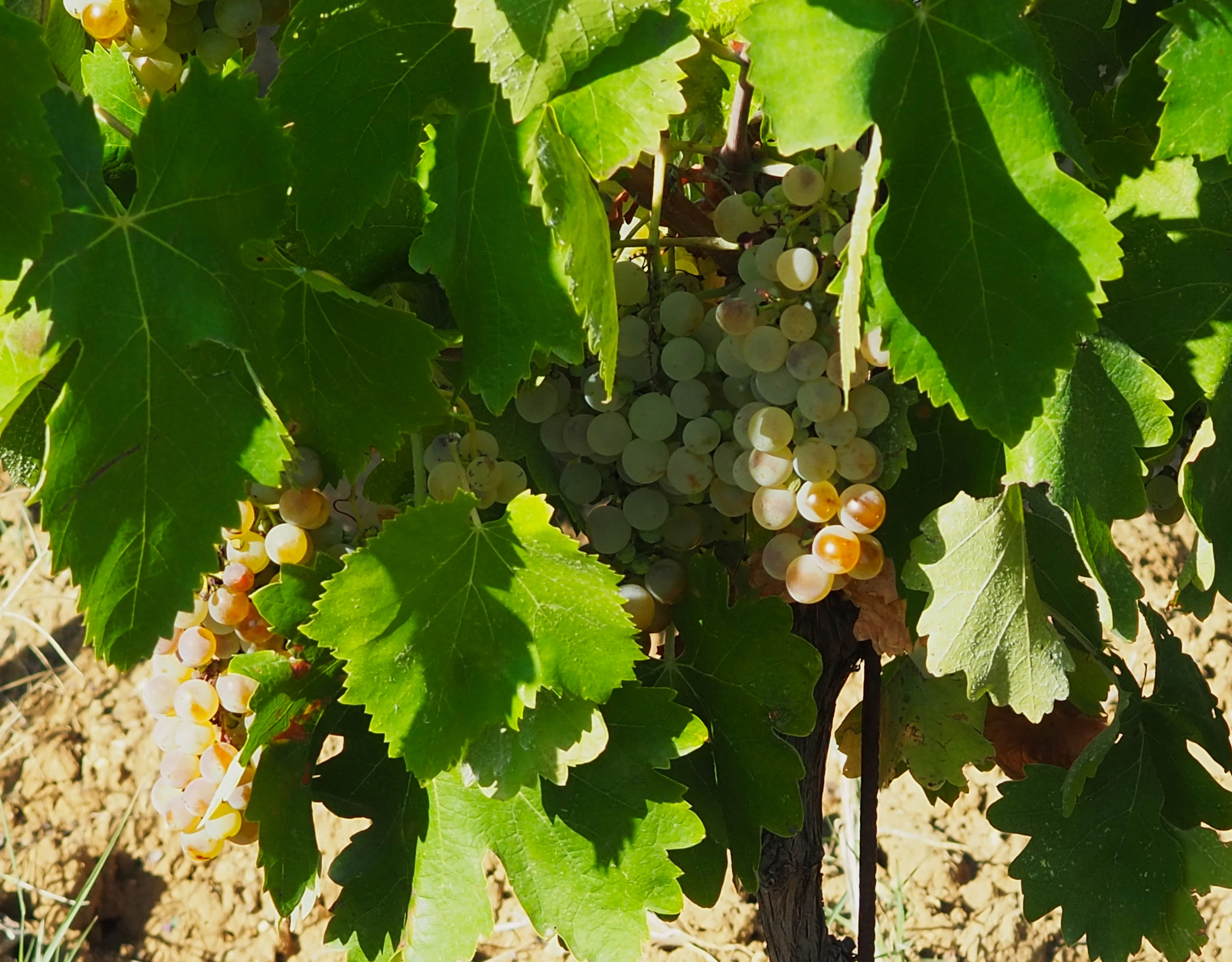
Jeff insists that the grapes entering the amphora be as pure as the clay itself. This meticulous process involves sorting or triage, and indeed, a trio of triages. Today’s selection included Grenache Gris, my favourite grape due to its distinctive colour, and Macabeu.
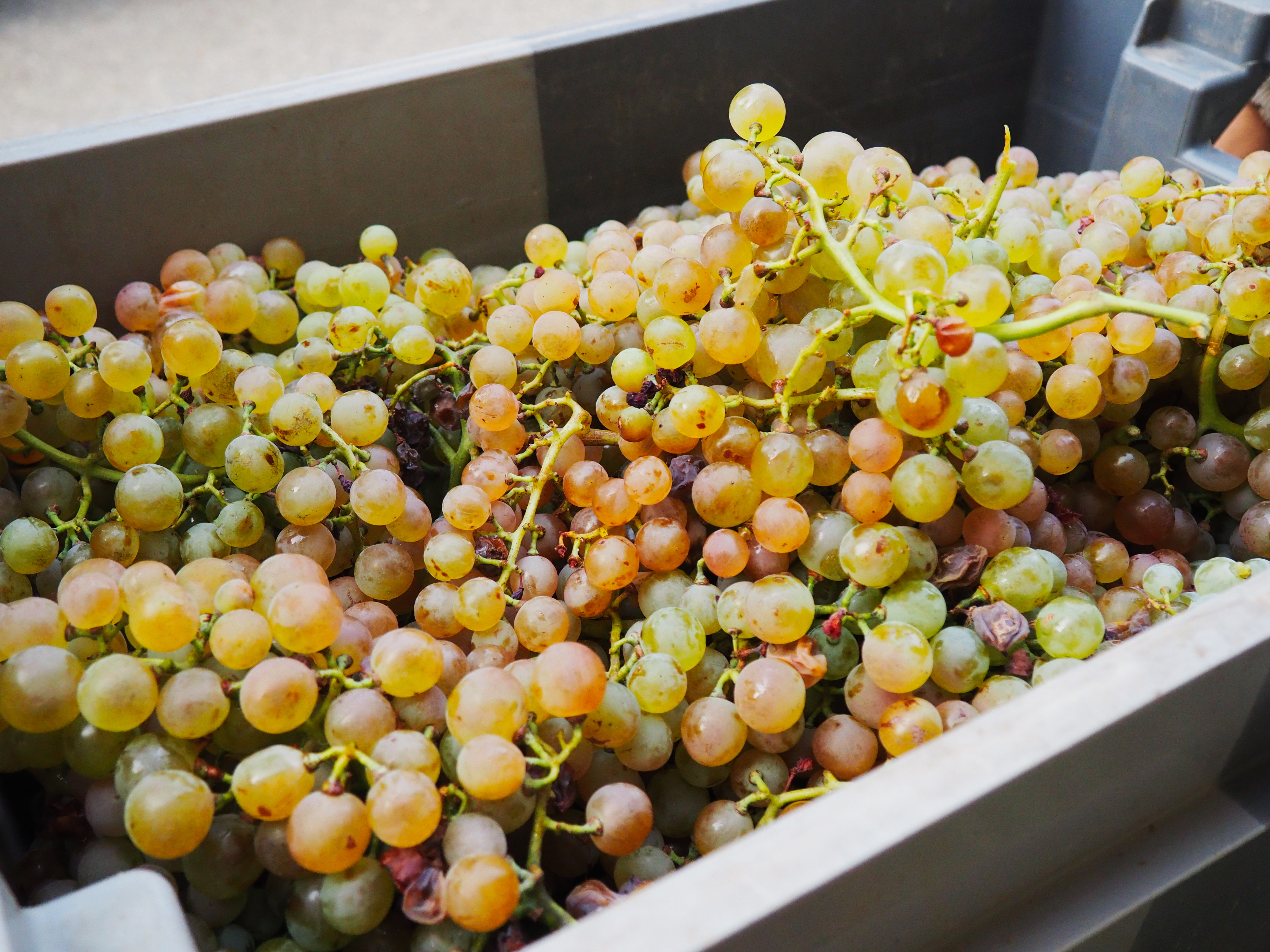
Grenache Gris et MacabeuMacabeu
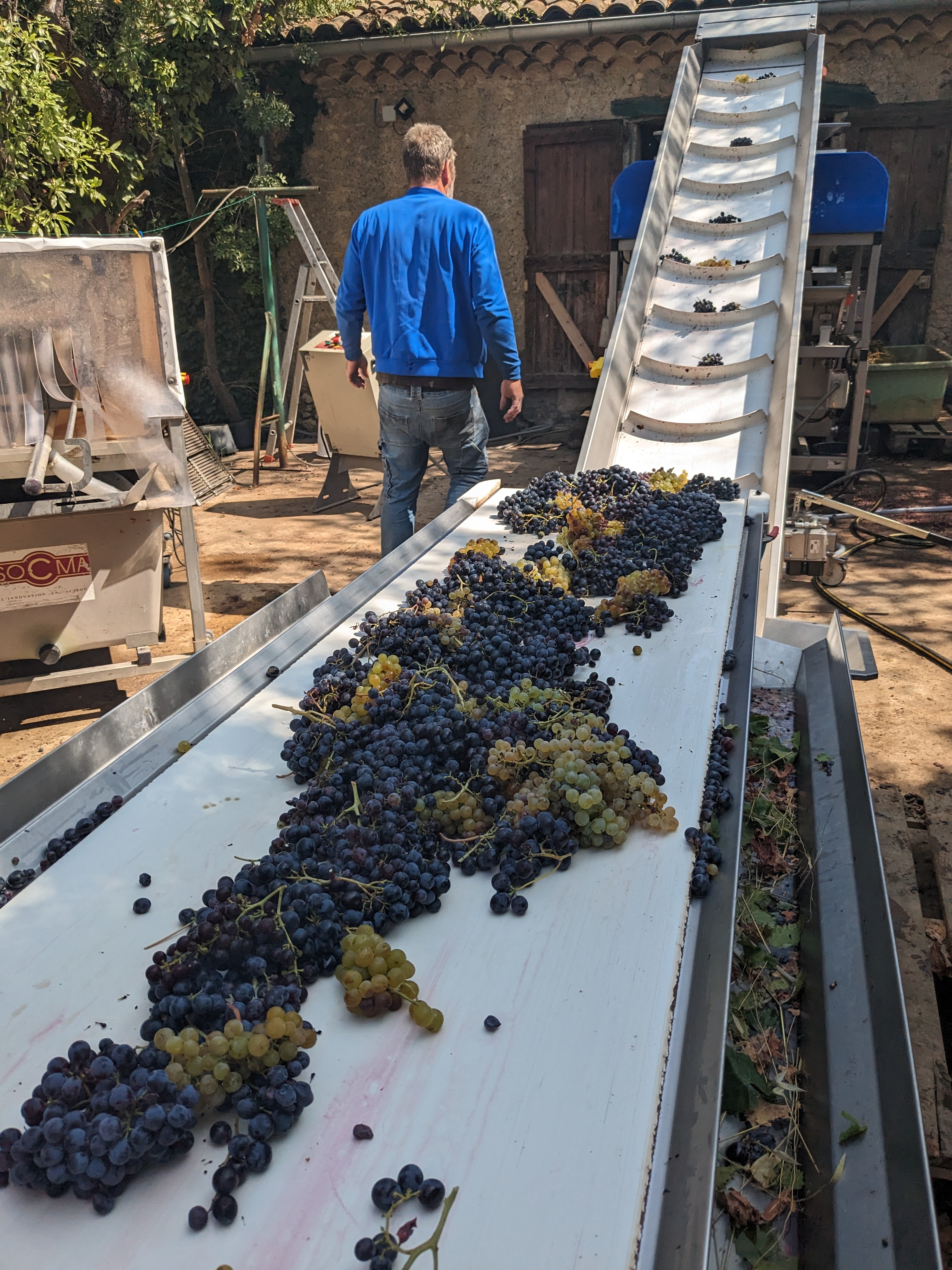
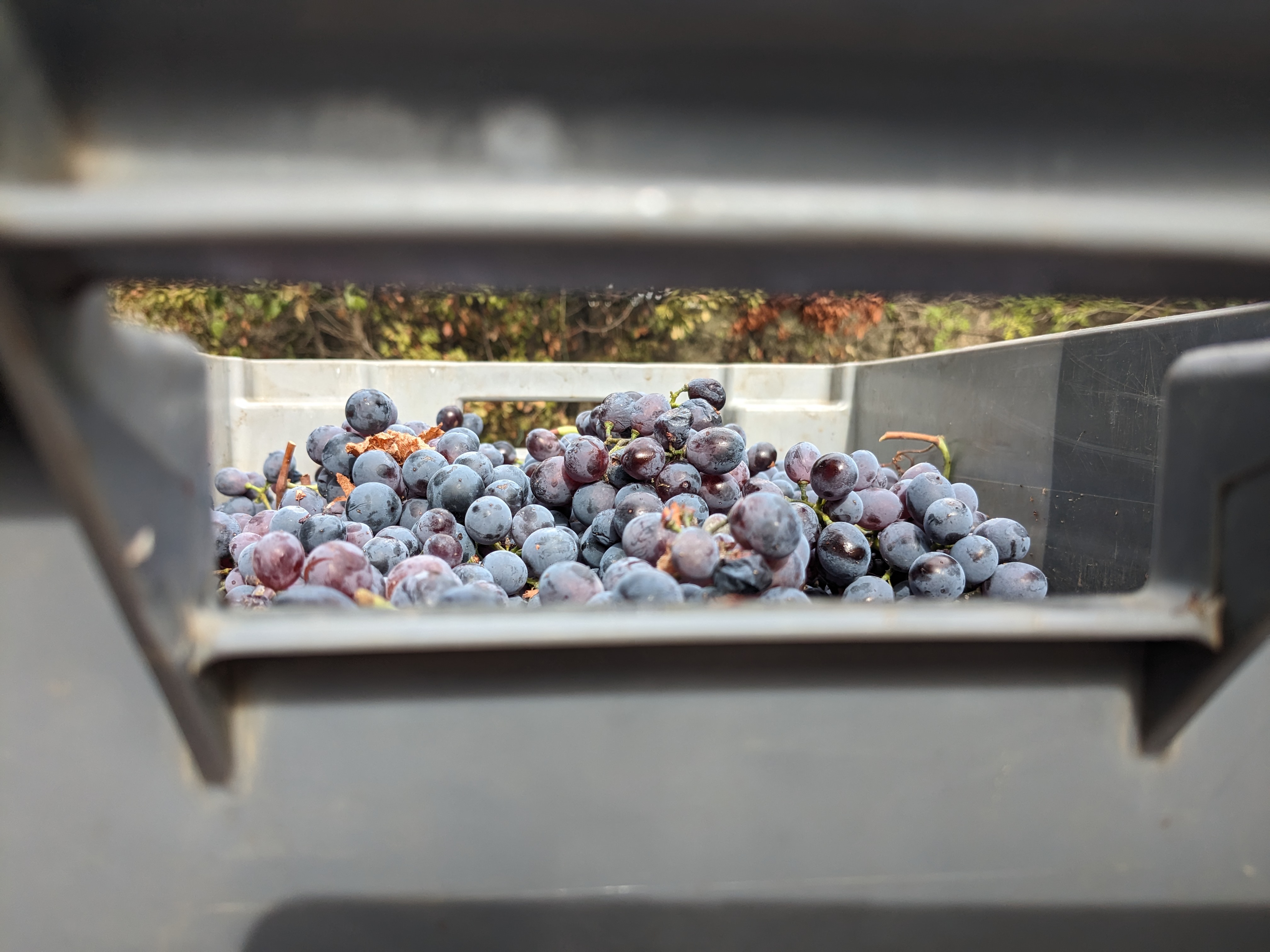
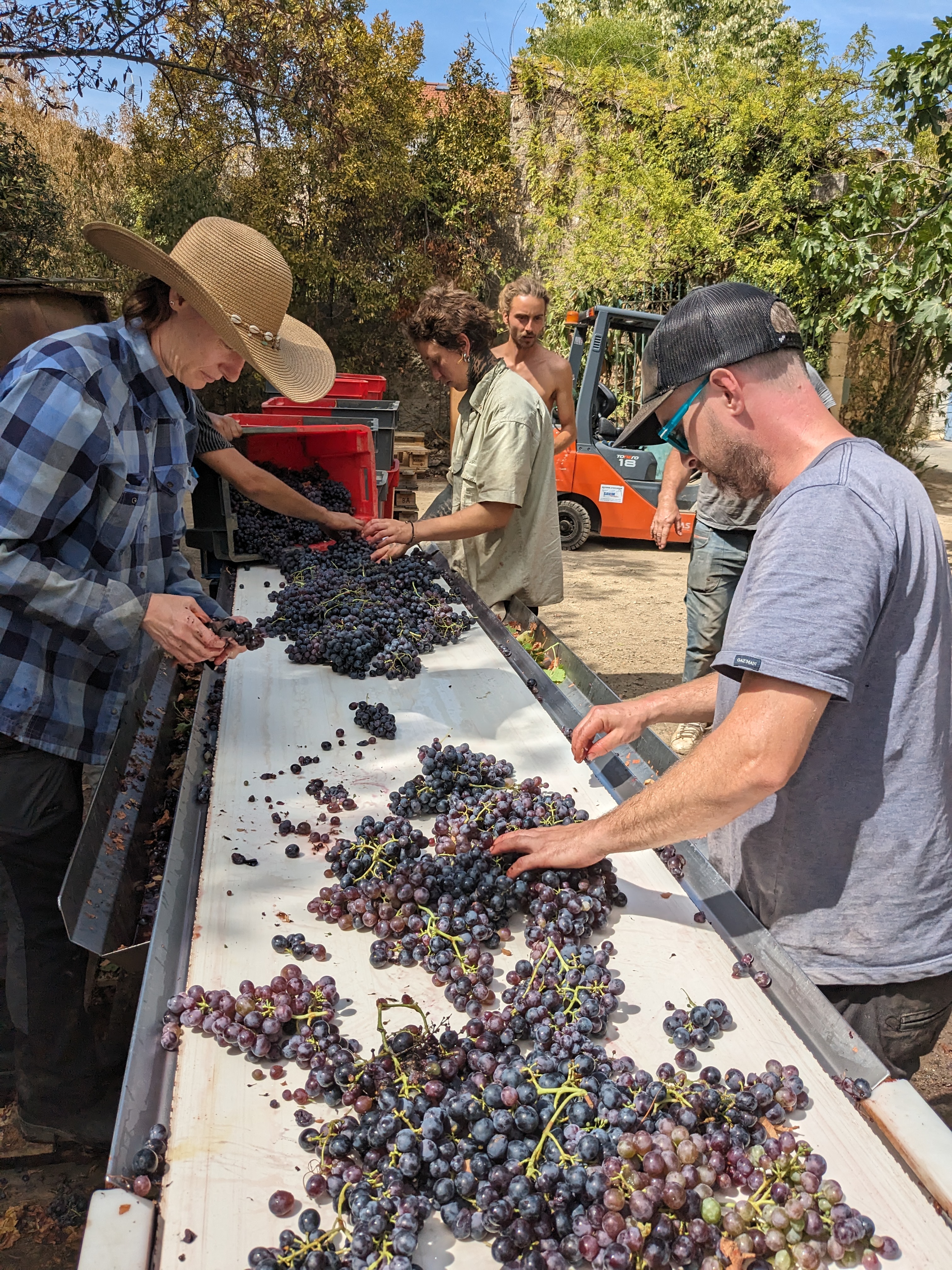
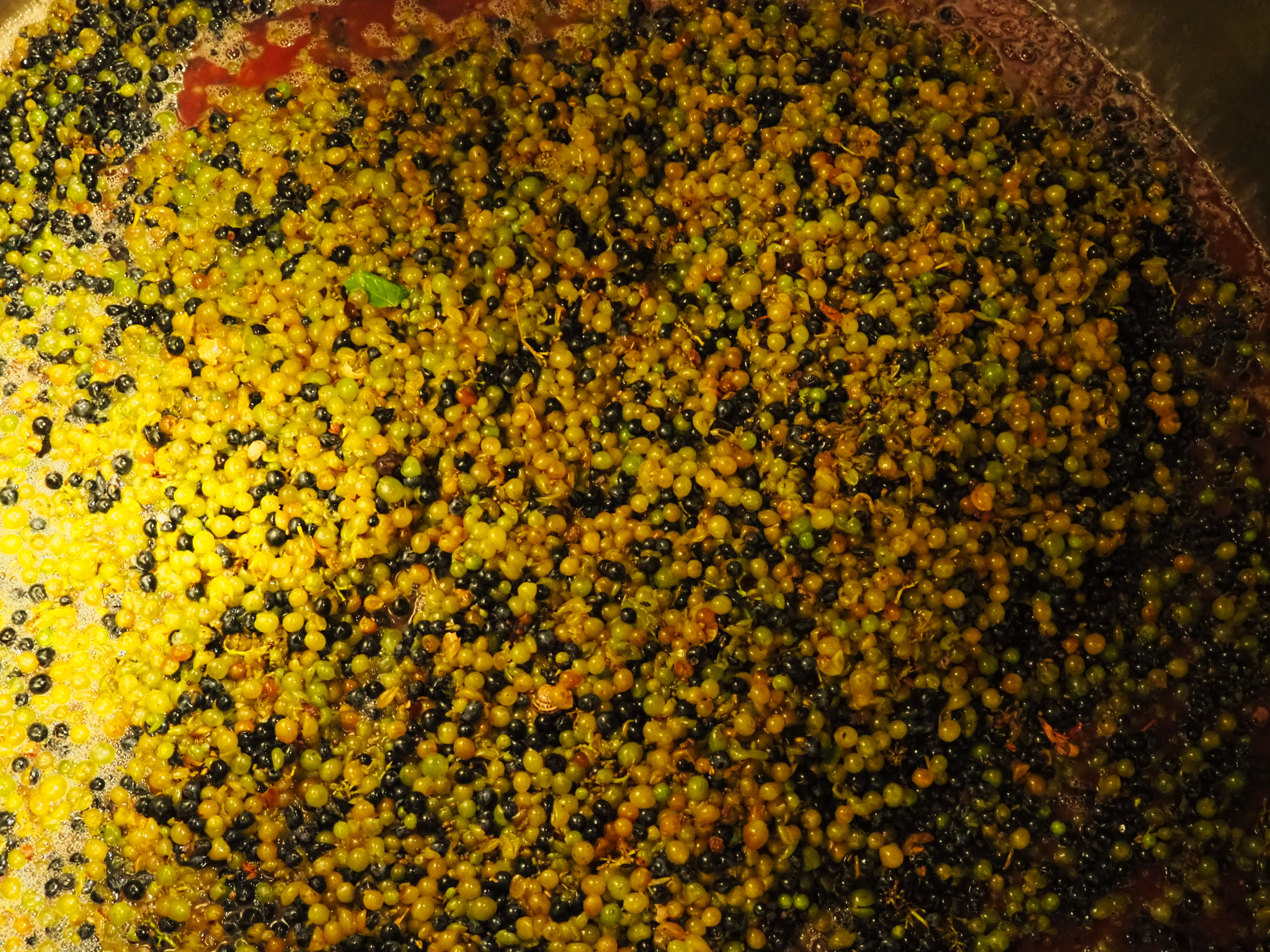
First, the grapes passed through the destemmer after being sorted from their cases. Working beneath the destemmer (érafleur), two of us meticulously removed any bits of stem or leaf that had slipped through. The large container (bac) was then subjected to another round of sorting, with the goal of retaining only pure grapes to place into the amphora. It’s a slow, methodical process. If you wonder why Jeff’s amphora wines might command a higher price, this labour-intensive process is a significant factor.
1st tri, Mouss, 2nd tri Ines3rd tri To amphoraFirst layer, Grenache GrisSecond layer, Macabeu
Meanwhile, the first Carignan of 2023 arrived in the cellars from the Peilhan vineyard, and the team worked tirelessly on two levels of the cellar, the Carignan upstairs and the amphora on the ground floor.
Flora and Carignan
On Friday, another amphora needed filling, this time with Muscat D’Alexandrie, following the same exacting process. However, today saw fifteen dedicated pickers, and they worked relentlessly. After completing the Muscat from Peilhan, they transitioned to Segrairals and the parcel of Mourvedre.
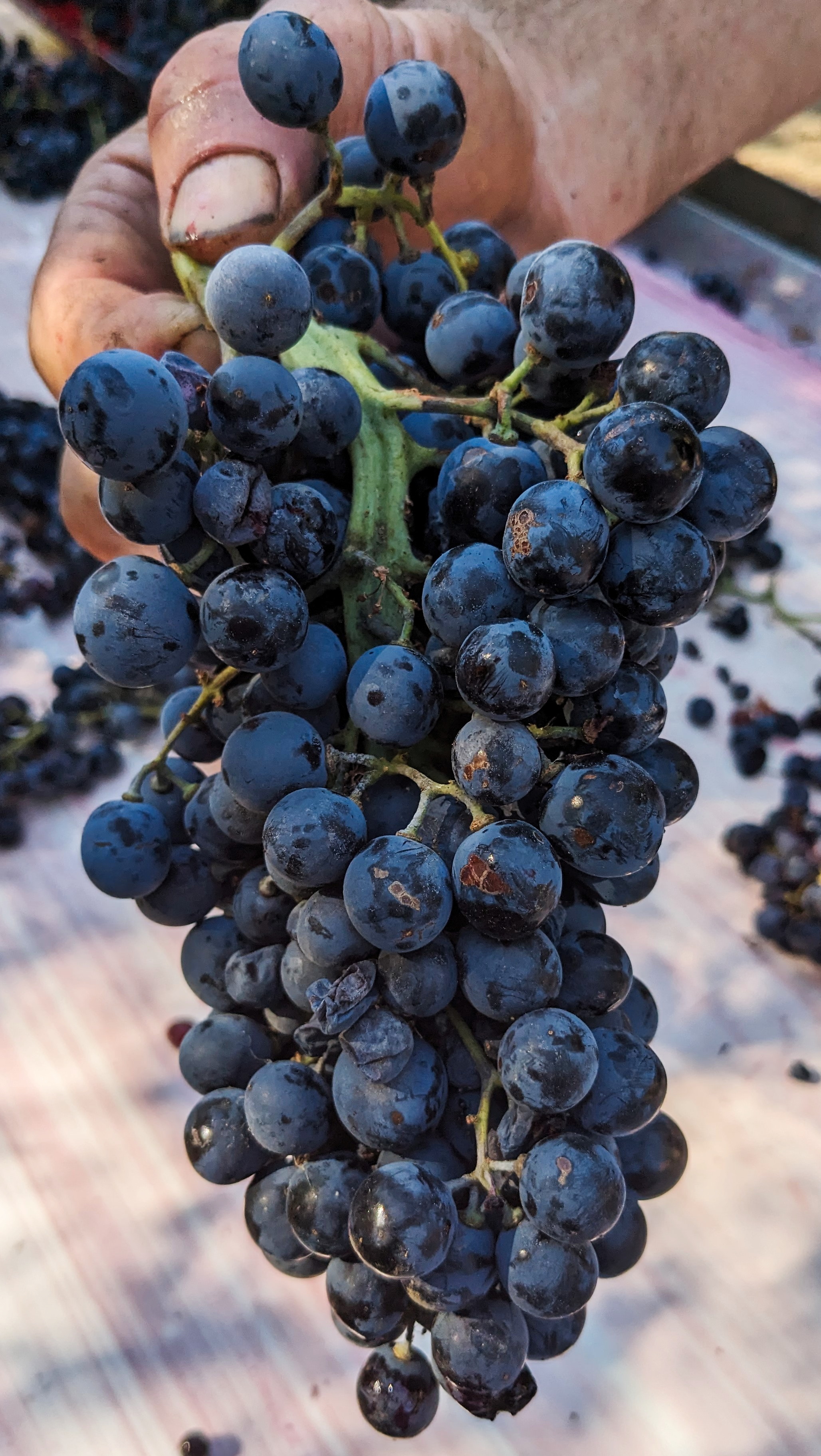
Muscat to amphoraMourvedre
This grape variety is complicated to grow. It has produced some of Jeff’s finest wines in recent years, yet it is notoriously finicky in the vineyard. Mourvedre does not tolerate moisture well and quickly deteriorates when wet. Additionally, the Mourvedre vines at the bottom of Segrairals face a dual threat, as the trees and shrubs in the area have provided shelter to the new wave of grape worms more than anywhere else in Jeff’s vineyards.
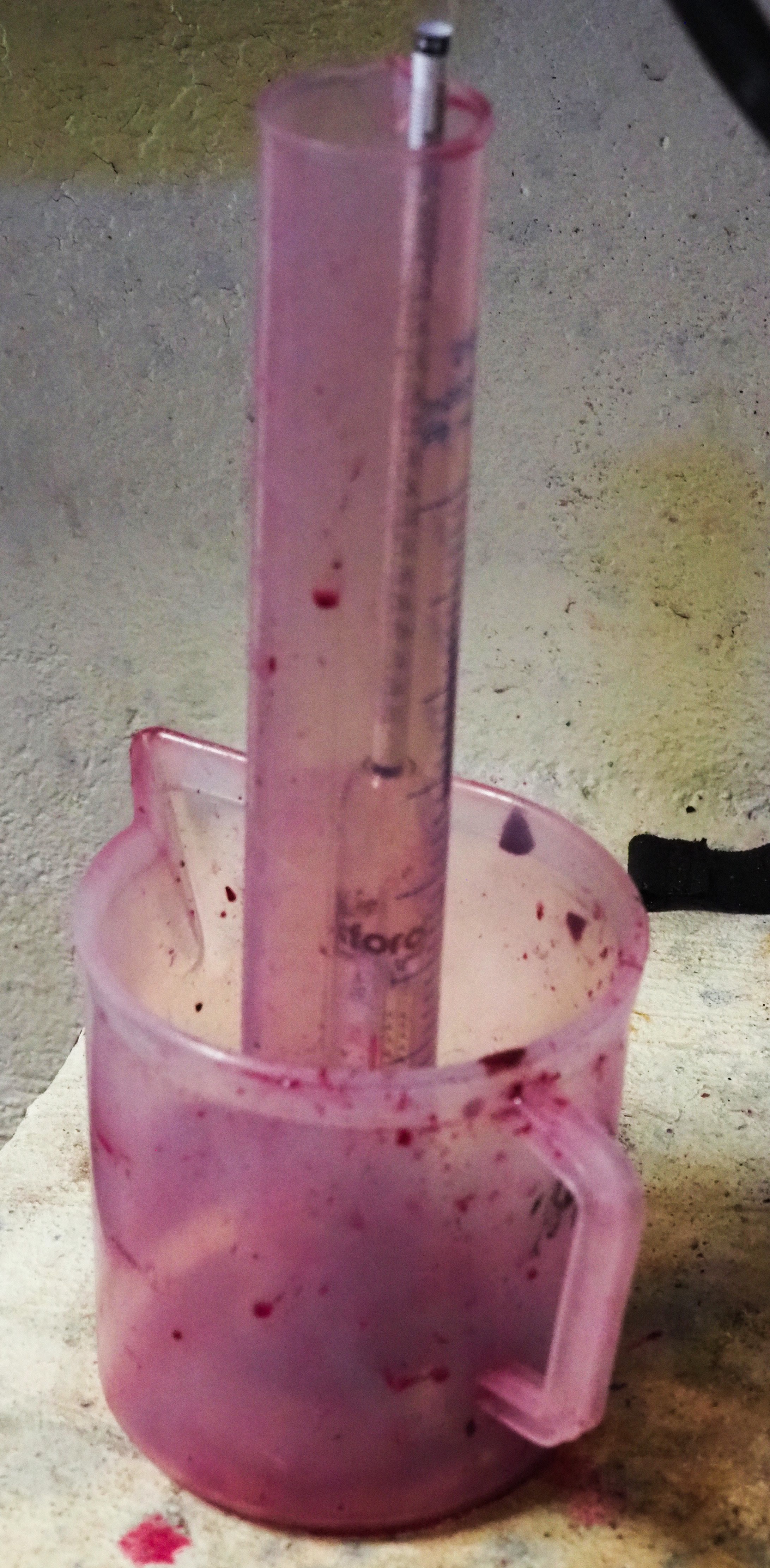
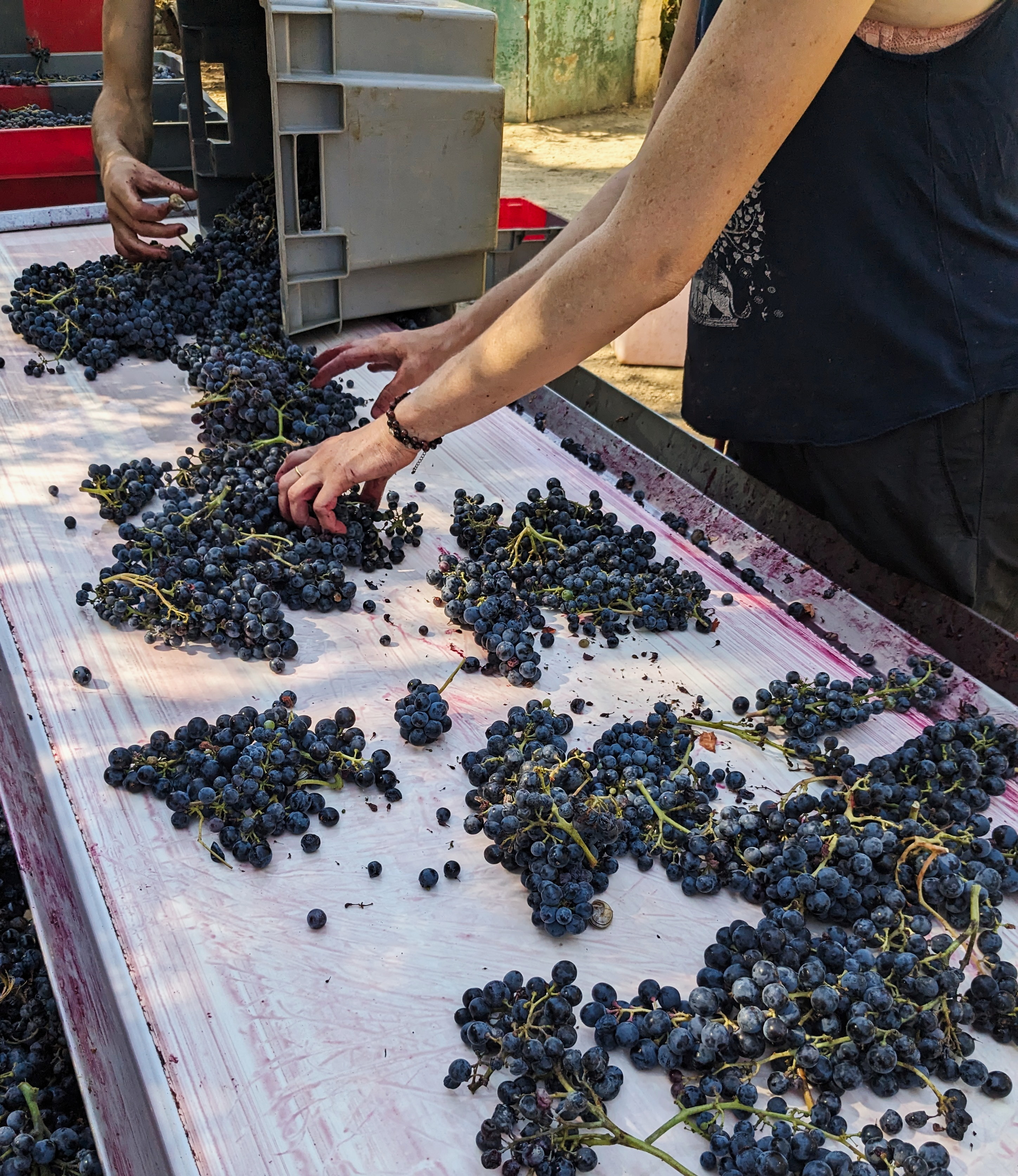
As a result, despite the overall health of most of the Mourvedre, it required more extensive sorting than any other grape during the vendanges. I will be posting an article detailing my approach to sorting bunches. Happily, the Mourvedre showed high nitrogen levels in the analysis, suggesting it will ferment well and can serve as a starter for slower tanks. By 3:30 pm, the Mourvedre was processed, and with the abundance of pickers, it was decided to tackle the final grape parcel to complete the harvest.
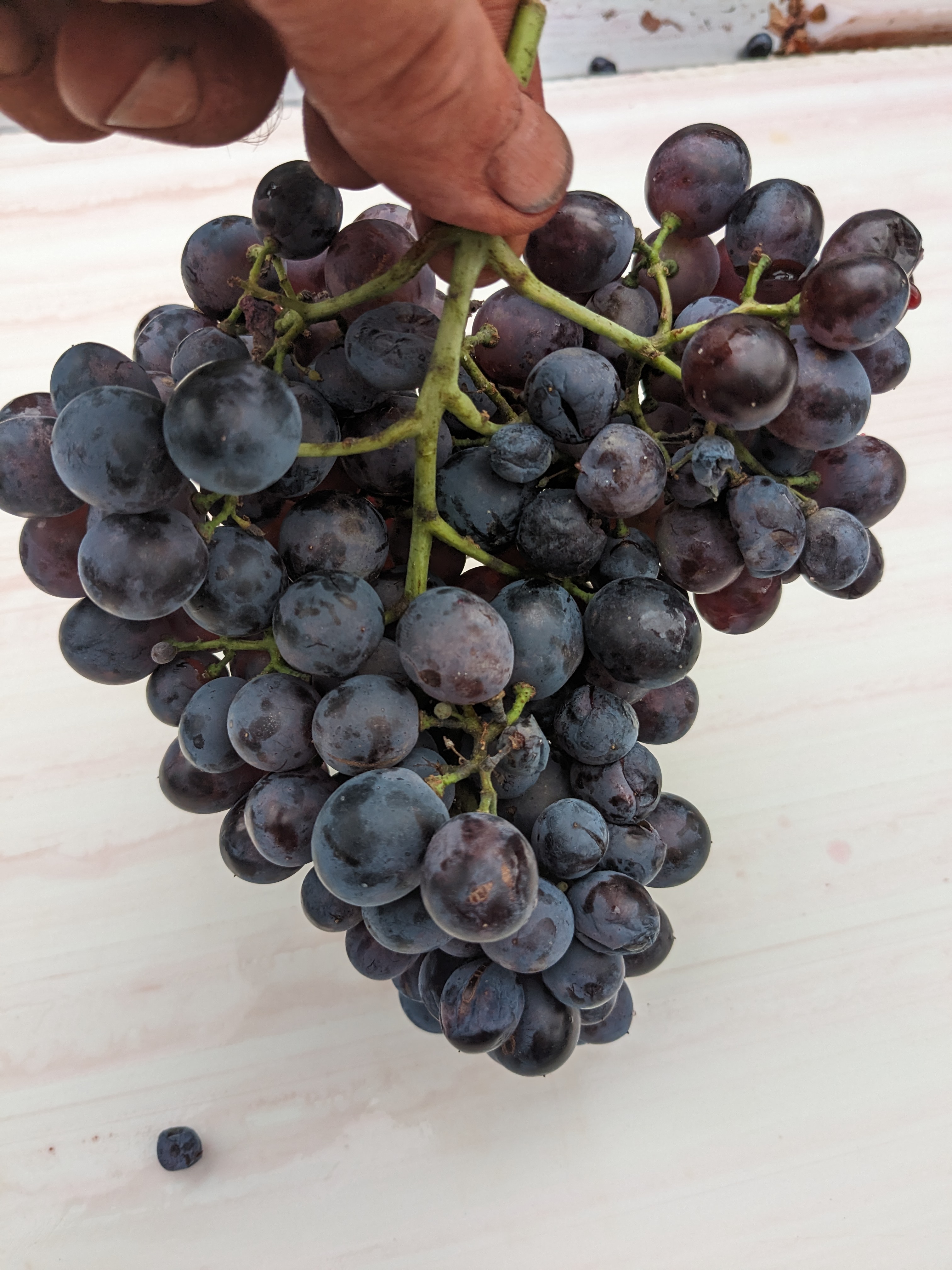
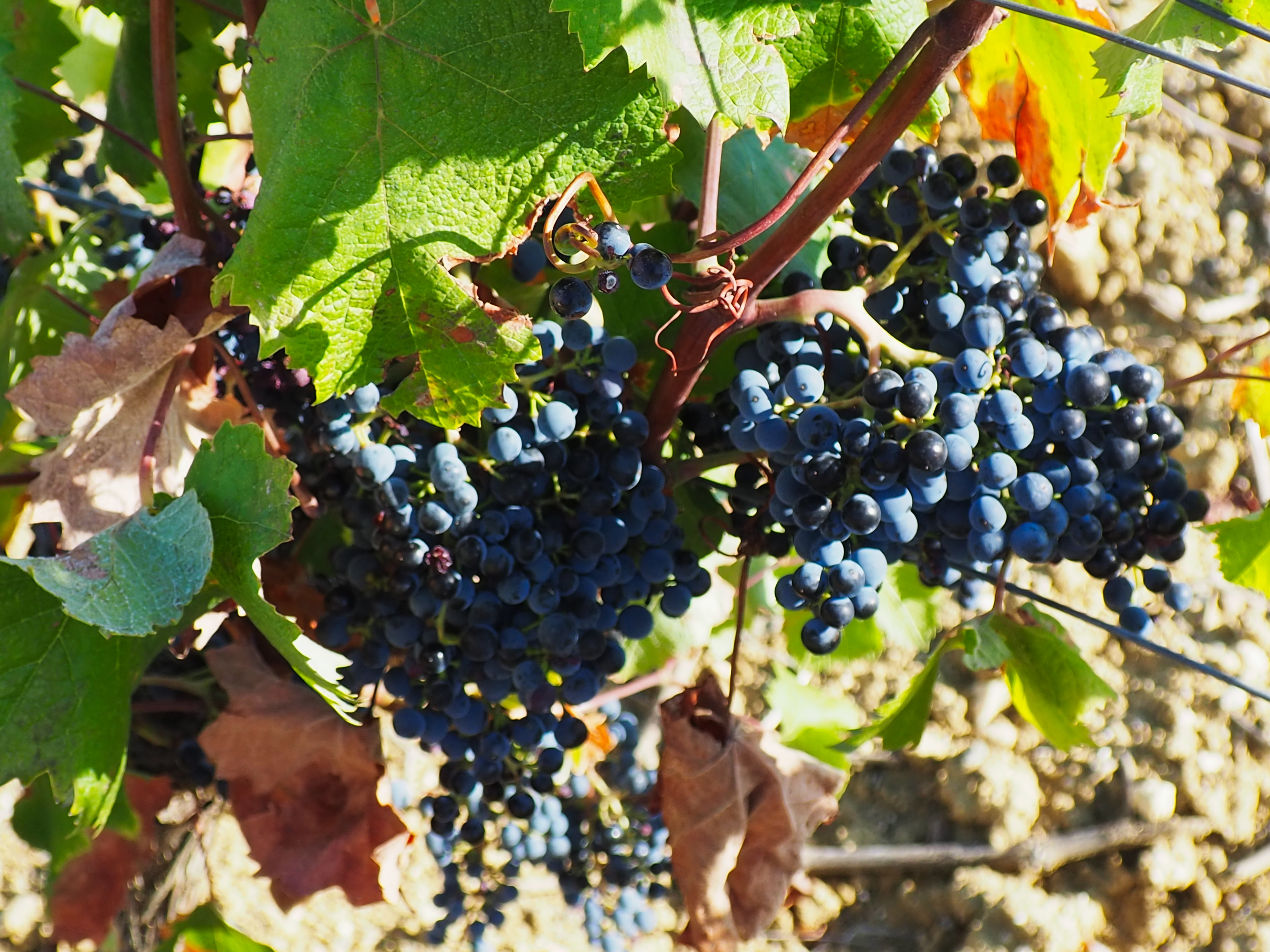
Strange Mourvedre bunch, half the stem hadn’t developedCarignan from Chemin de Pailhes
This last parcel consisted of Carignan from Rec D’Oulette, better known as Chemin De Pailhès. These grapes are destined for Flambadou wine, a regular standout in the Coutelou range. While the bunches and grapes weren’t particularly large, aside from a minor issue with oidium or powdery mildew, the sorting proceeded without problems, and another tank was mostly filled. We completed this task around 6:30 pm, commencing the standard procedure of thorough equipment cleaning. Though not glamorous, this step is essential to prevent spoiled wine. Cleaning is performed both at lunchtime and in the evening, typically when different grape selections begin.
The grapes are safely in, in decent quantities despite the drought. I will soon post an update on their condition, as they should yield excellent wines. Now, it’s up to Jeff to work his magic with what’s in his cellar.
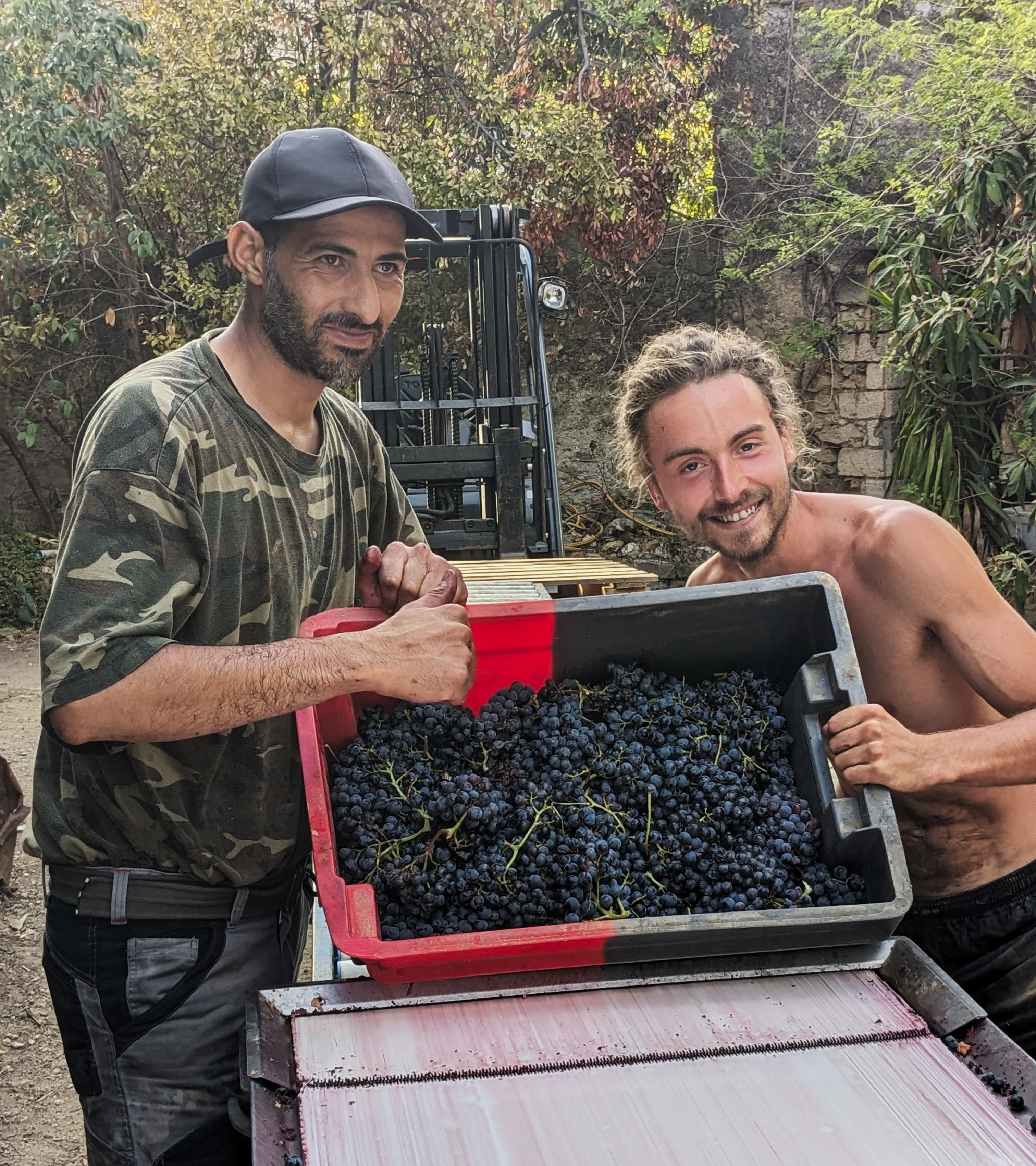
Mouss and Vincent with the last case of 2023 grapes
One of the reasons for starting to bring in Cinsault on Saturday had been the weather forecast for Sunday and the predicted rain arrived that morning though only 10mm or so. Cinsault has very thin skins and rain can often cause the grapes to become prone to rot as skins burst with swelling juice. I have spent many days sorting such Cinsault over the last ten years. I was, therefore, a bit concerned on Monday morning when we started up again as the remaining Cinsault was due to arrive at the table. In fact, my worries proved groundless, perhaps the dry year meant the ground soaked up the rain more effectively.
Boris and Vincent sorting Cinsault
I don’t recall such good quality Cinsault, it might be one of the highlights of the vintage, full of juice and good flavour. It is sometimes used for its own cuvée, 5SO and also for blending as part of Le Vin Des Amis. The only downside was the analysis showing low acidity but that is common with the variety.
SyrahGrenache, La Garrigue
The Cinsault comes from the Segrairals vineyard and the pickers moved across that vineyard for the next parcel, more Syrah, such an important part of the Coutelou production. The Syrah was quite small, plenty of flesh in the grapes but not a lot of juice despite the rain. This concentrated material will need blending to add acidity but will definitely add flavour. As the afternoon wore on Grenache arrived from La Garrigue at the other end of the village and proved to be another highlight of the season. Very good quality grapes, good acidity too so this will no doubt be a very useful tank for Jeff to use for blending.
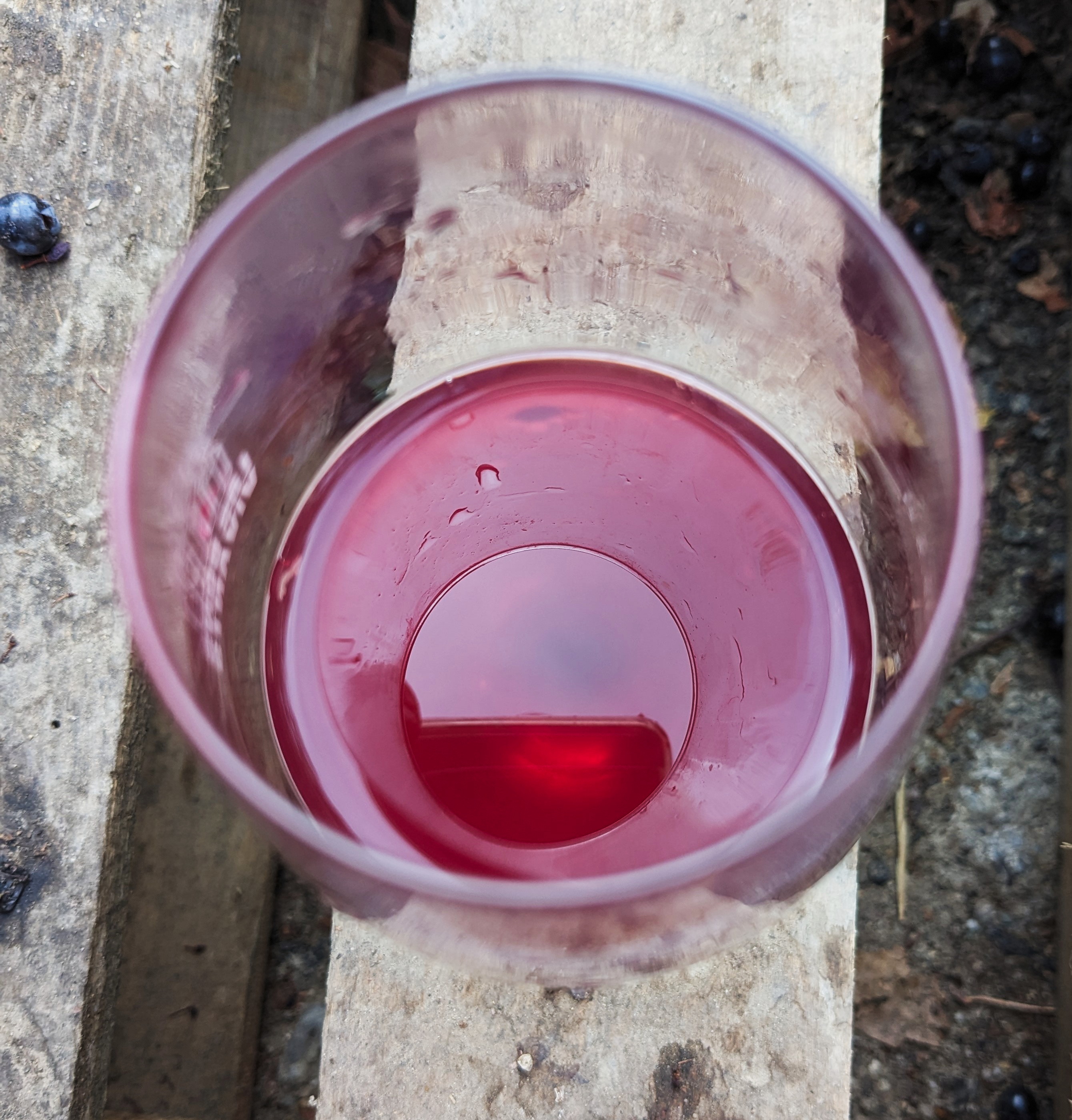
Full tankJuice from today’s tank
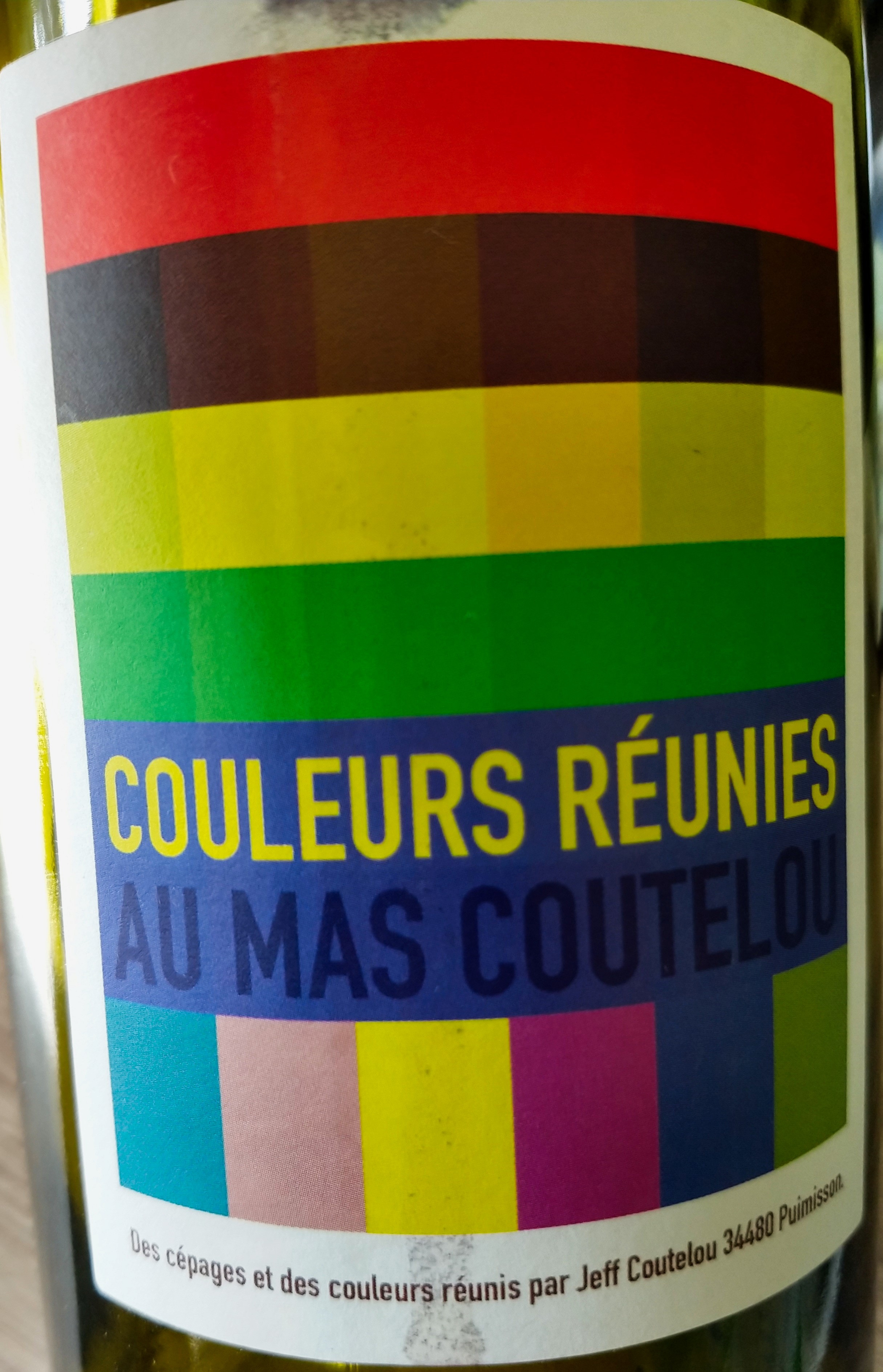
Tuesday the 30th was one of my favourite days of the vendanges, Couleurs Réunies day. This cuvée has been around for the last few years and is made up of many varieties of all colours including from my favourite vineyard, Rome. White grapes such as Servant, Olivette, Aramon Blanc , Terret Blanc, different types of Muscat, Grenache Blanc and Clairette Musquée.
Aramon BlancTerret Blanc, Servant, Olivette
Gris grapes such as Riveyrenc, Grenache, Aramon and Clairette Rose. Red varieties such as Cinsault, Oeillade,Delizia Di Vaprio and Mourvedre. An ampelographer’s dream day, I had great fun looking through the cases, trying to identify them and, very often, being corrected by Jeff!
Riveyrenc GrisCinsault et autres, RomeJeff, Rome grapes
A good two days, one hundred hectolitre tanks filling up with grapes of good quality. We were steaming ahead, could we finish picking by the weekend?
Friday and Saturday were full and busy days, the mechanical problems eased though we were still using the old sorting table. At the end of Thursday the pickers had moved across La Garrigue vineyard to pick the south facing Grenache. Most days the picking team is around 10-12 in size but there were 17 that day so Jeff wanted to use them to the maximum and gather as much as possible. Two hectares were picked that day, around 15-20% of the total vineyards, a lot of fruit. The Grenache was in fine form, good alcohol and acidity levels, probably to be used for blending.
Lovely looking Syrah from Segrairals
Friday and, following on from the last post, more Syrah. This time it was Syrah from Segrairals at the eastern side of the village which had benefited from rain on June 29th. Consequently, the grapes were fuller and, happily, disease free. Good quantities, good quality. There’s not much to add, it was a long day, still hot, not so stifling as previous days and we worked hard and steadily. It was good to be able to keep an eye on how full the tank was getting so that it didn’t overflow, another tank was needed.
Fill it up please
Saturday was more interesting for those, like me, who are interested in different grape varieties. Segrairals was again the focus, another nine hours and more of picking and processing. It’s a large vineyard and has seen a major replanting in recent years. Out went the extensive Cabernet Sauvignon vines and in came varieties such as Mauzac, Clairette, Oeillade, Aramon and many others.
Araon Gris amongst CinsaultAramon NoirMauzac
The largest area of the vineyard is Cinsault and it has to be picked at a Goldilocks moment, not too late, not too soon, not too ripe but just right. It can be healthy and very juicy one day and then mushy the next day. Its thin skins make it prone to rot and easy for the cryptoblabes / honeydew moths to access as the bunches and grapes are large with space for the moths to get into to lay eggs. Jeff had noticed that this new variety of grape worm which I wrote about earlier this year was starting to show. They become active when the grapes are ripe with good sugars, exactly the situation in the Cinsault.
Cinsault windowThis bunch must have weighed over a kilo
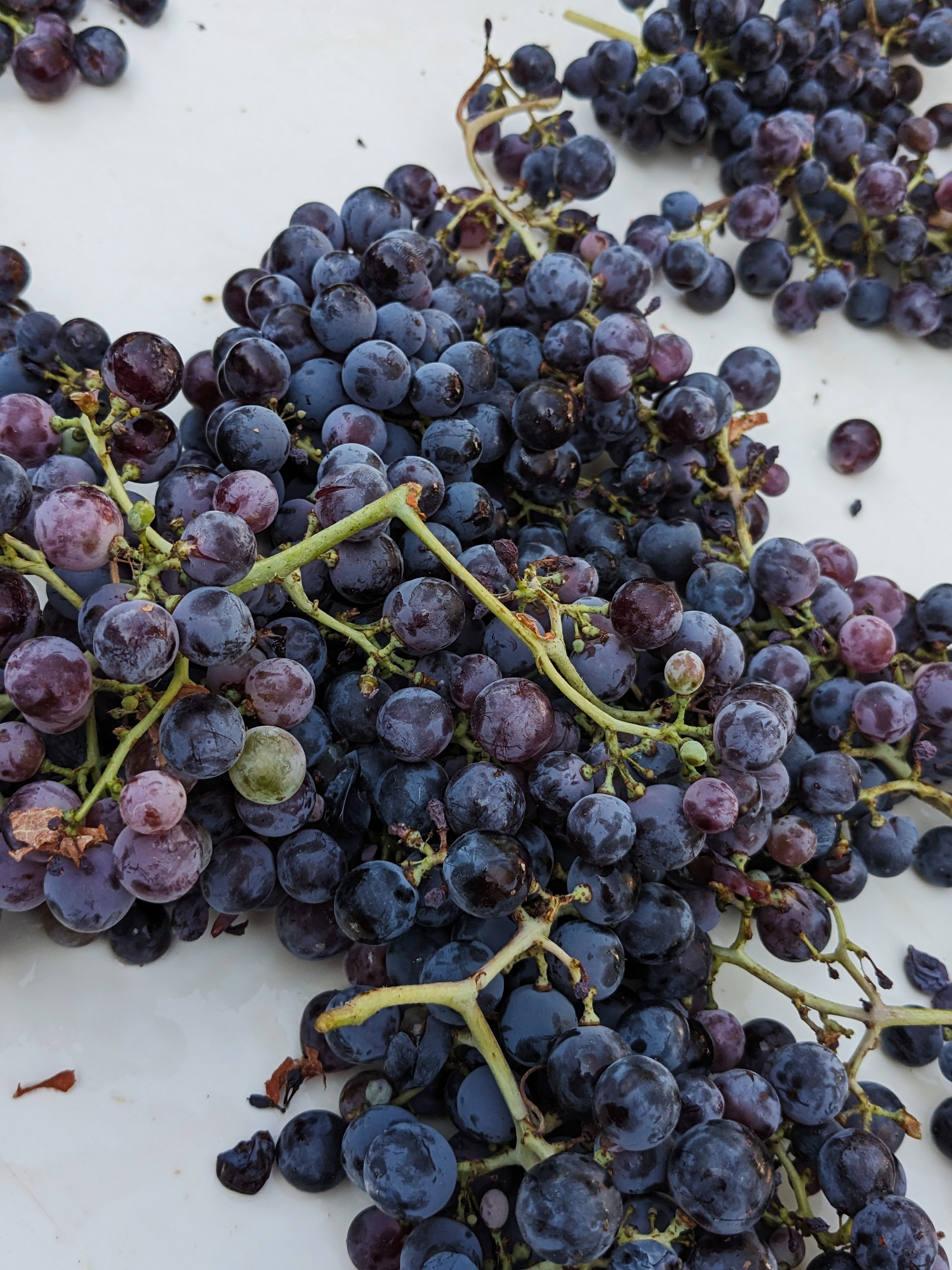
Fortunately, Jeff got the decision just right. Whilst there were some affected bunches, we were able to deal with them at the sorting table. The Cinsault was as good quality as I can recall and the size of the bunches and grapes meant that the cases came thick and fast to us from the vineyard. In addition there arrived Mauzac and Aramon Gris, both had to be scrutinised for small amounts of oidium – the first disease of the harvest but, happily, affecting just a tiny percentage of the grapes. Perhaps the most striking grapes though were the Aramon Noir, the stems a nice contrast to the very black grapes in very good health. Aramon, of course, was once widely planted in the region and used for producing huge quantities of low alcohol, cheap wine. The vast majority has been grubbed up but there has been a recent renaissance with producers such as Jeff aiming for low yields of fruity grapes. The blending of these grapes will make Ploutelou, the third vintage of this cuvée, the Coutelou homage to the Jura’s Ploussard, which itself has thin, dark skins producing a lightish, fruity wine. Ploutelou has been a big success and this year’s ought to be very good.
It was a good day, hard work, the team working well together. A new addition was Andrew form Australia. He works for James Madden in the Adelaide Hills at Scintilla Wines. James, of course, came to do harvest with Jeff in 2016 and, so, the link continues. He is an experienced worker and, after mostly getting over his jet lag, he was busy at the sorting table and then doing a remontage as the cellar work builds with increasing amounts of grapes to care for. We were certainly weary by 6pm on Saturday but happy that Jeff has plenty of promising wines ahead.
Hard at work under a blue skyAndrew cleaning the table down after a hard day’s work
Wednesday and Thursday saw the harvest and team get in to full swing after the practice run of Monday. Well, that was the plan and it mostly happened like that but technology let us down. Not the end of the world but on days when temperatures reached 42c it was not helpful to have to adapt to unforeseen adversity. Nonetheless, we battled through and filled some large tanks with lots of grapes. Well, Syrah (and a little Clairette). The good news was the return of Boris who has been part of the vendanges for the last five years.
Claurette, Ste SuzanneClairette in press
The Clairette was from the parcel at the bottom of Sainte Suzanne which was planted 5 years ago together with Macabeu. I showed a photograph of the Clairette last time and it was clear that these vines were under stress. So, it was picked Wednesday morning, straight into the press and tank. It’s quite low alcohol and acidity so will be used for blending.
Cellar work starts before the first grapes are picked, cleaning tanks thoroughly. And the Morastel needed punching down (pigeage) even after a day.
Then it was on to the Syrah of Sainte Suzanne, usually part of Le Vin Des Amis. Despite being most famous for Rhone wines such as Côte-Rôtie or Barossa Valley Shiraz the experience here in the Languedoc is that Syrah does not like too much sun and heat. Obviously in southern France it is used to both but it’s about balance. The Ste Suzanne grapes were small, lacking moisture of course. Nonetheless they were fine, disease free and at the sorting table we only had to remove snails and leaves.
Syrah, Ste SuzanneFull tankSnails and leaves
But, oh that sorting table. A new one had been bought but it wasn’t working properly and we had to do more triage by hand, slowing things down. The engineer arrived, nothing he could do after an hour and the table was shut down altogether. On to sorting from cases for the last hour of Wednesday. 42c weather and the heat from the grapes made for uncomfortable conditions, but I still wouldn’t have swapped for the pickers in the vineyards.
The new sorting table which came and went, twice. And the cube in the background.
On Thursday more Syrah. This time from Segrairals and La Garrigue, the latter grapes being the Syrah used to make La Vigne Haute in the best vintages. Sadly, this is not one of those years for Syrah. A replacement sorting table had now arrived, an older version but still useful. The grapes from La Garrigue may not have been LVH standard but they were higher quality, juicier and healthy.
Syrah La GarrigueSyrah La GarrigueBoris, right
All went well through the day until near the end (again) another mechanical failure, this time the érafleur, part of the cube which destems and sends the grapes to tank. Fortunately this was fixed by the next day. Meanwhile, the new sorting table was returned. Only to fail again on the trial run. So, back came the replacement again. Fair to say that this was not helping Jeff’s stress levels.
The Syrah has good acidity and alcohol levels but lacks some nitrogen so it has had a struggle to start fermenting. Fortunately some of the grapes from Saturday’s pick (more next time) are quite rich in nitrogen and some of those will kick start the Syrah, hopefully.
Challenging is how I’d describe these two days. The stifling heat, the need to protect vines, the technical problems. But we made it through.
As the last post described we started vendanges on Monday August 21st, very early in comparison with other years. The day was about getting the fruit from vines stressed by the drought of the last year, mainly to the western side of Puimisson. In some ways this first day was also a trial run for this year’s team. Gilles, Flora and Ines are long term members whilst newcomers so far are Mustapha and Vincent.
Muscat, the first cases of 2023Gilles bringing them to the cellar
Mustapha is Moroccan born and has been part of the picking team in recent years but wanted to learn more about the whole winemaking process. He is a ball of energy, he’ll certainly keep us busy. Vincent is a Québecois now living in France and we shall be joined soon by Andrew from Australia, a friend of James Madden who did harvest with us in 2016 before establishing his own Scintilla Wines in the Adelaide Hills.
The first picking was the Muscat d’Alexandrie of Peilhan vineyard, which has had minimal rain in the last ten months. This was pressed and put into a tank on its own. Next came Morastel from the 2015 plantation on the terrace of Peilhan. This suffered from disease last year and so has struggled with the drought even though other vines on the terrace have been ok.
Muscat and MorastelMuscat and Castets
Castets, with its small berries, was also suffering so it too was picked. The nearby Flower Power vineyard, a field blend of more than 20 varieties, has small gobelet vines and even though it looked better this year than ever before it too needed picking. To add to these grapes, picked early and. therefore, not fully ripe, Jeff added some Grenache from La Garrigue and some Carignan Blanc from Peilhan. This wasn’t fully ripe itself but more than the others, and so, will offer balance in the blend with the other red grapes picked today. Early analysis showed a healthy 13 degrees of alcohol with good acidity to support the nascent wine.
Mustapha at the sorting stageDestemmedInes and F;ora resortingInes, Vincent and the 3 tanks ofgrapesWe missed a leaf!
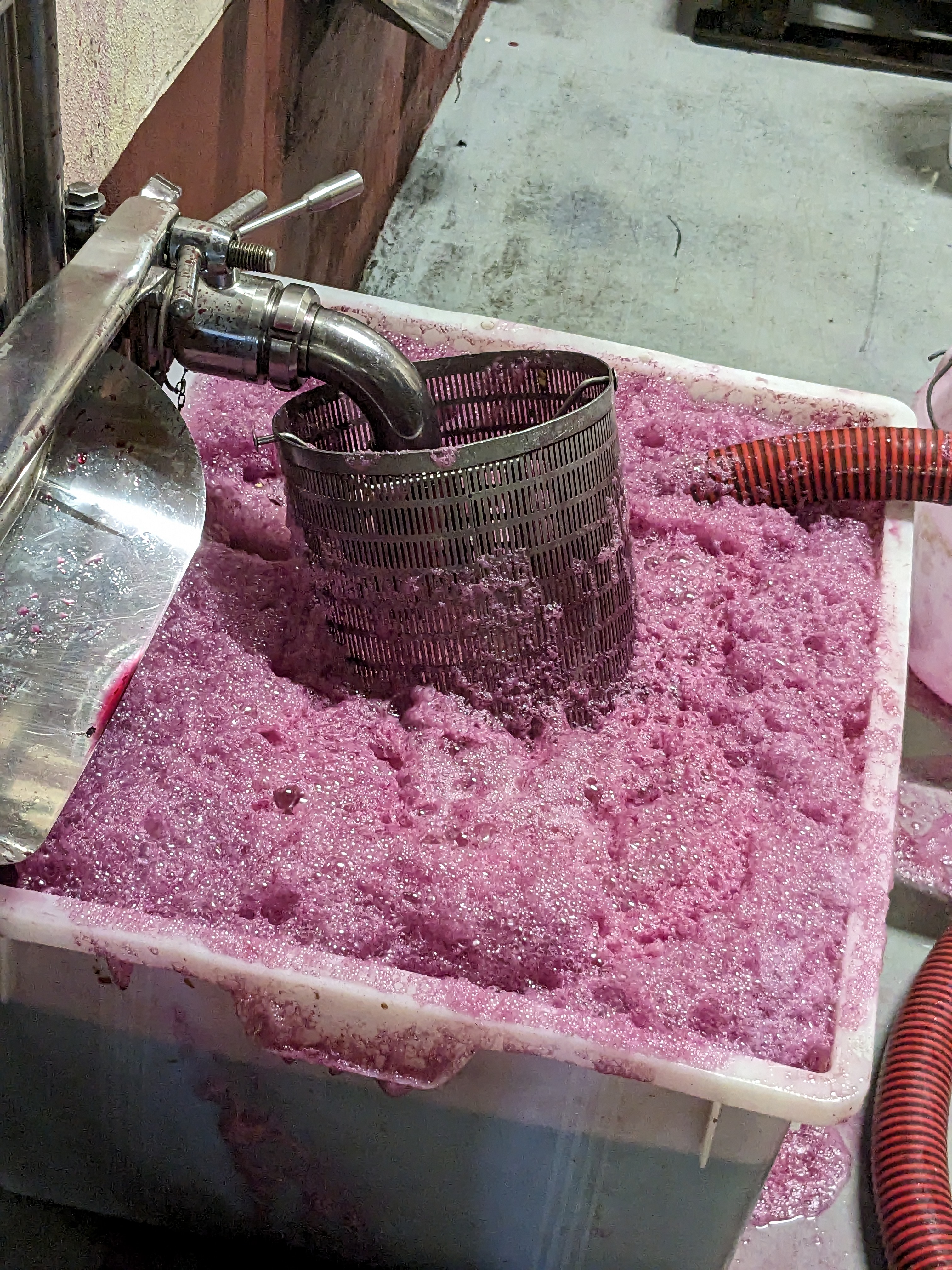
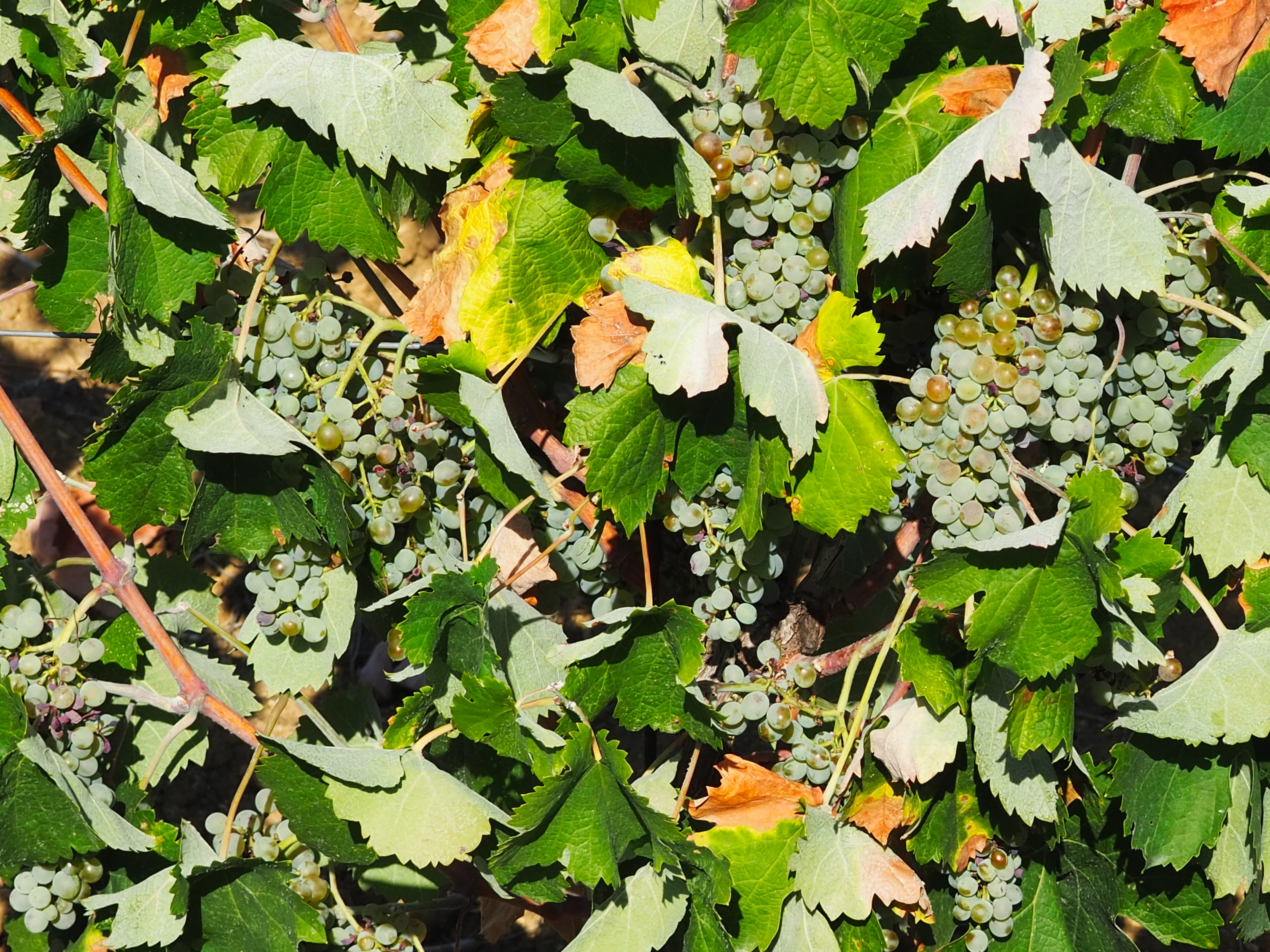
The grapes are very healthy, the drought has at least prevented any mildew or oidium. Sorting the red grapes was straightforward, mainly removing leaves and snails. The snails have clearly been seeking any moisture in the parched landscape and they clung to the grapes in desperation. After destemming the grapes were sorted a second time to remove any stalks or leaves which has made their way through. They were then put into small stainless steel tanks, three were filled and Jeff was reasonably content with the quantity, fairly typical yields despite the small grapes.
So, we’re underway. Tuesday is a day off then we’re back to it for the rest of the week. Monday registered temperatures up to 39c, it is due to be even hotter on Wednesday. Picking takes place only in the early morning in such heat, but even in the cellar we were in need of large quantities of water. Spare a thought for us!
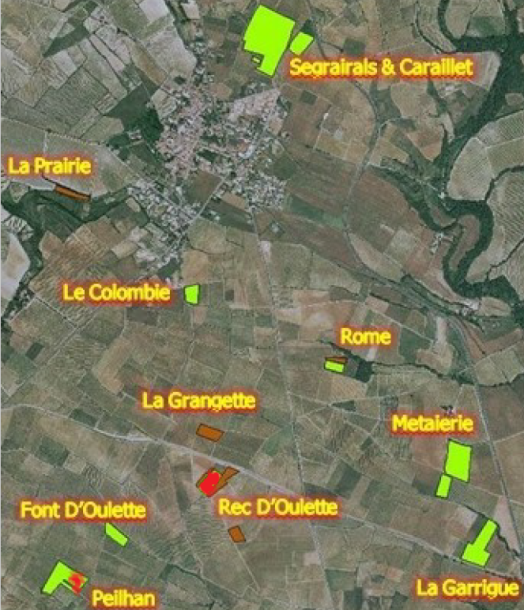
I haven’t updated this satellite map I made in 2016, but it shows you the positions of Peilhan, Font D’Oulette and La Garrigue mentioned in the post and how they are separated from Segrairals at the other end of Puimisson which has 16mm of rain on June 29th whereas those vineyards got nothing
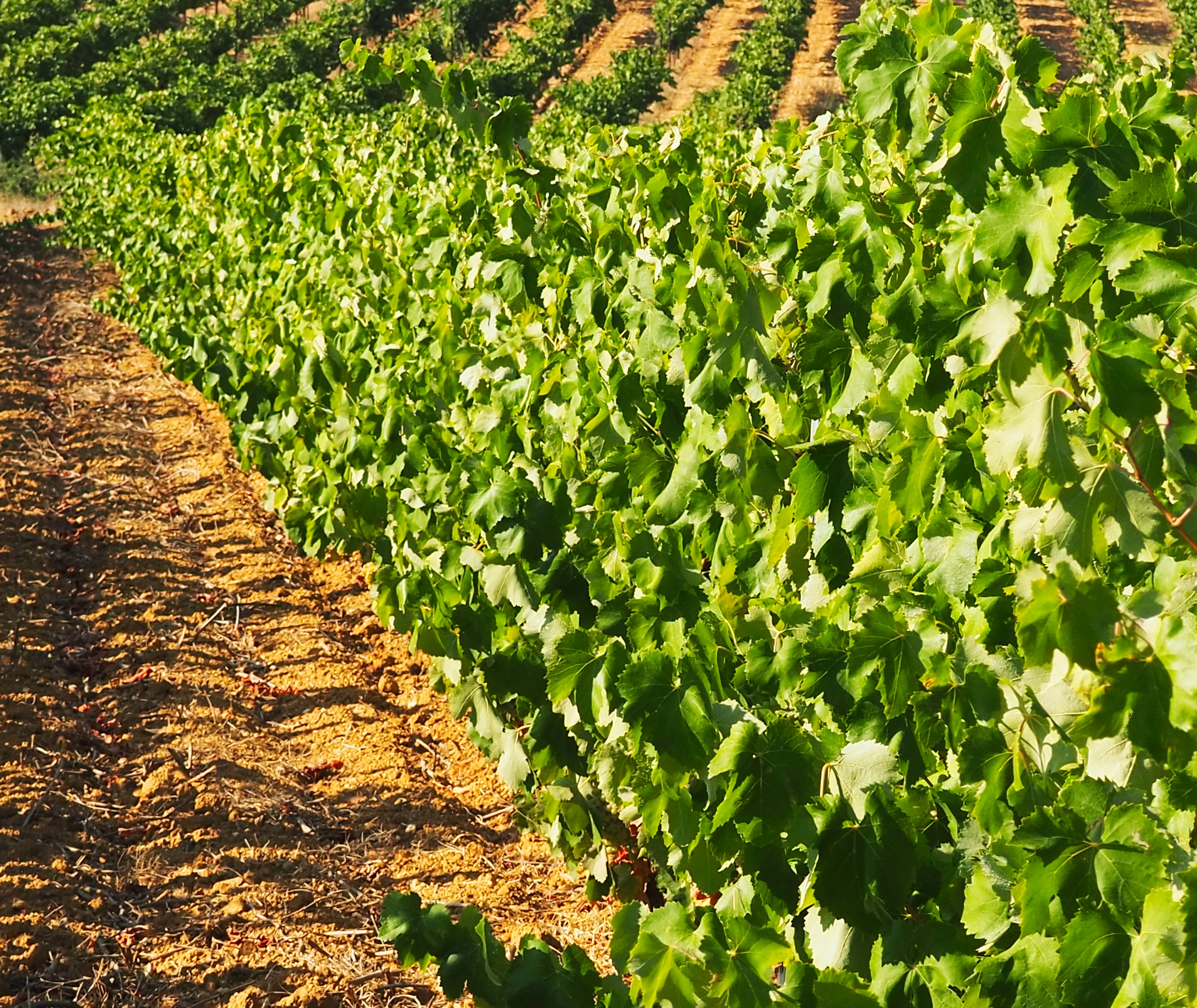
I did a quick tour of the vines this morning, we start harvest tomorrow (Monday 21st). There is a minor emergency with some vines so that we need to pick them before the main harvest starts on Wednesday. The drought which I wrote about in this post has put vines under stress. I also mentioned in the last post that on June 29th when we were all out tasting through Jeff’s 2022 wines there was a storm. In fact, 16mm of rain fell at one end of Puimisson, Segrairals vineyard for example. However, it was so localised that at the other end of the village there was no rain.
The vines in those vineyards are particularly stressed, particularly certain grape varieties, Castets, Morastel and Muscat in Peilhan, the whole of Flower Power (Font D’Oulette) with its 20+ varieties, and the young Clairette in Sainte Suzanne. Even though the grapes aren’t particularly ripe Jeff feels we need to collect them tomorrow so that the vines don’t become any more stressed as that could affect their health next year and even longer.
Vines under water stress first look to grow enough foliage and then to produce and ripen the fruit. This is their means of reproduction and the vine will seek to put every ounce of strength, every drop of water and sap into those aims. Even at risk to their own health. Jeff has to look after those vines and protect them from themselves in effect.
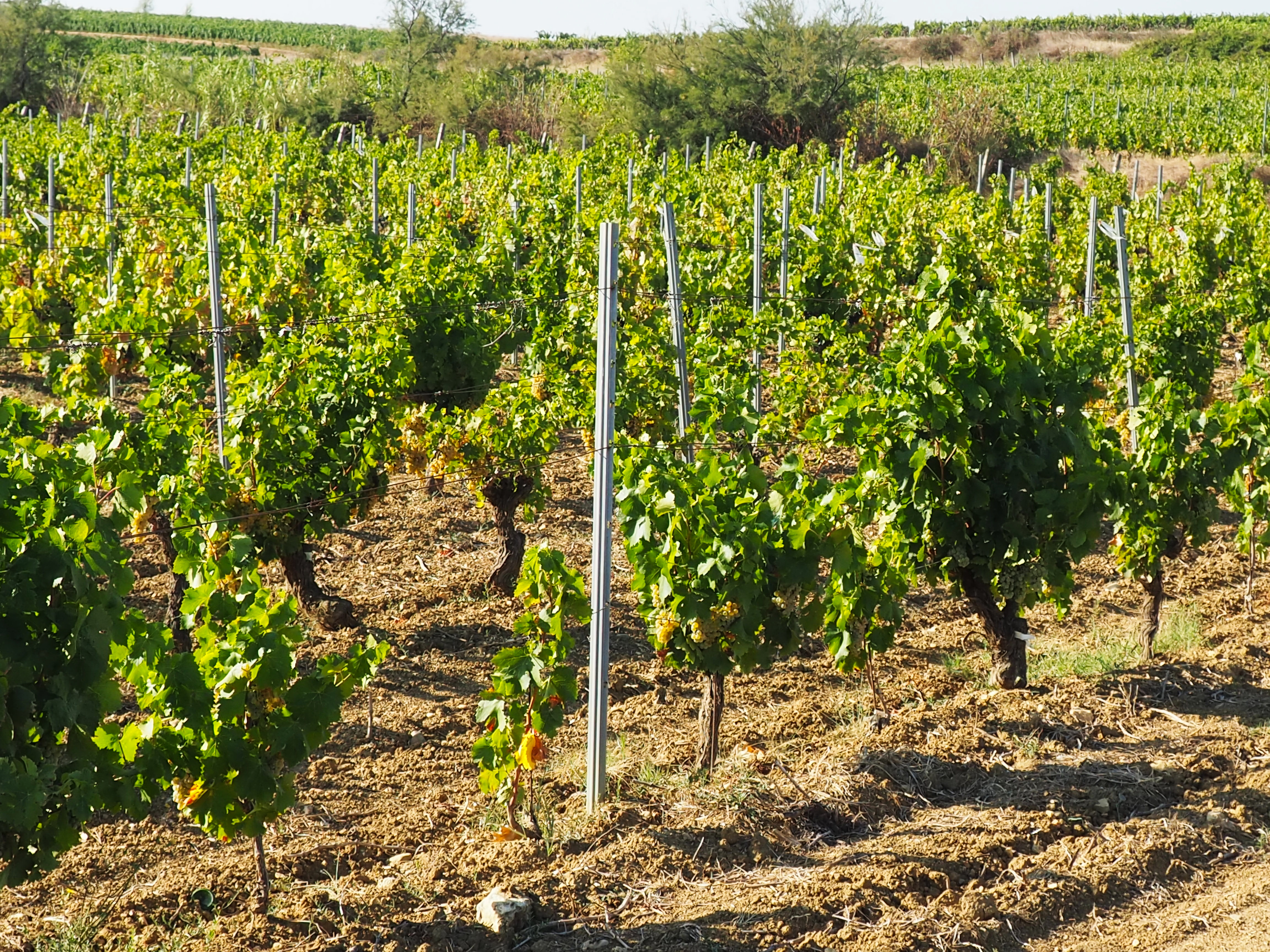
Those vines were the ones I visited this morning. I noticed two things, the size of the vines and the size of their grapes. The vines by now are usually taller than me (1m83 or just about 6ft), these were nowhere near as high, 1.5m maybe, 5ft at most. The grapes are generally smaller, not as juicy as usual. I’m sure Jeff will come up with something to make the most of what these vines have struggled hard to provide, they deserve recognition for their battle.
Peilhan vines not reaching the top of the fence posts
I mentioned to Jeff another observation. The Syrah of Ste. Suzanne has struggled, the Grenache is fine. The Macabeu there is healthy, the Clairette is in difficulty. Could it be that Spanish varieties have coped better than local, French varieties? He didn’t dismiss my thoughts so it may be worth another look. Remember Jeff planted Xarel-lo recently too, a Catalan grape used to heat. Is there a portent of the future here?
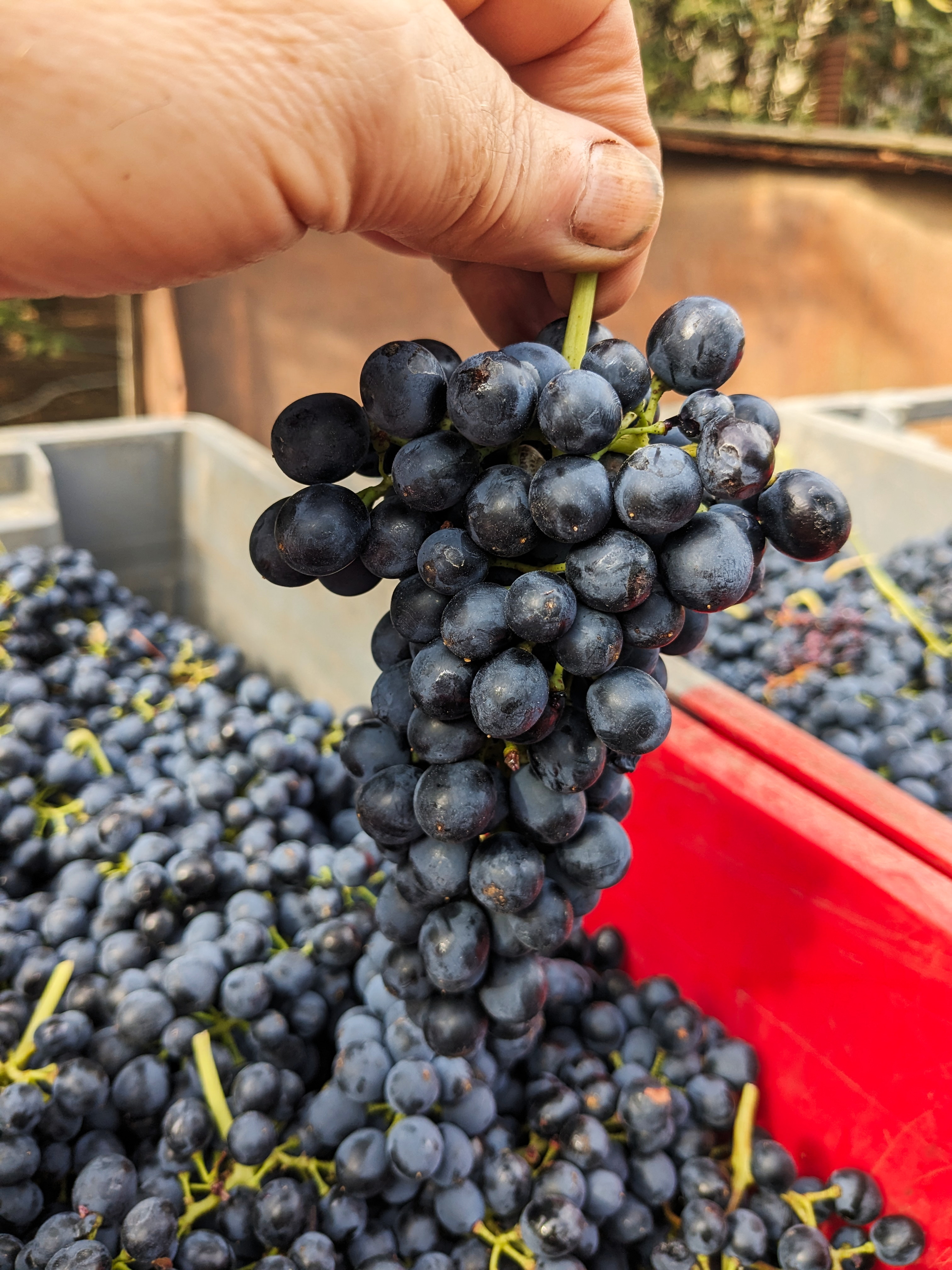
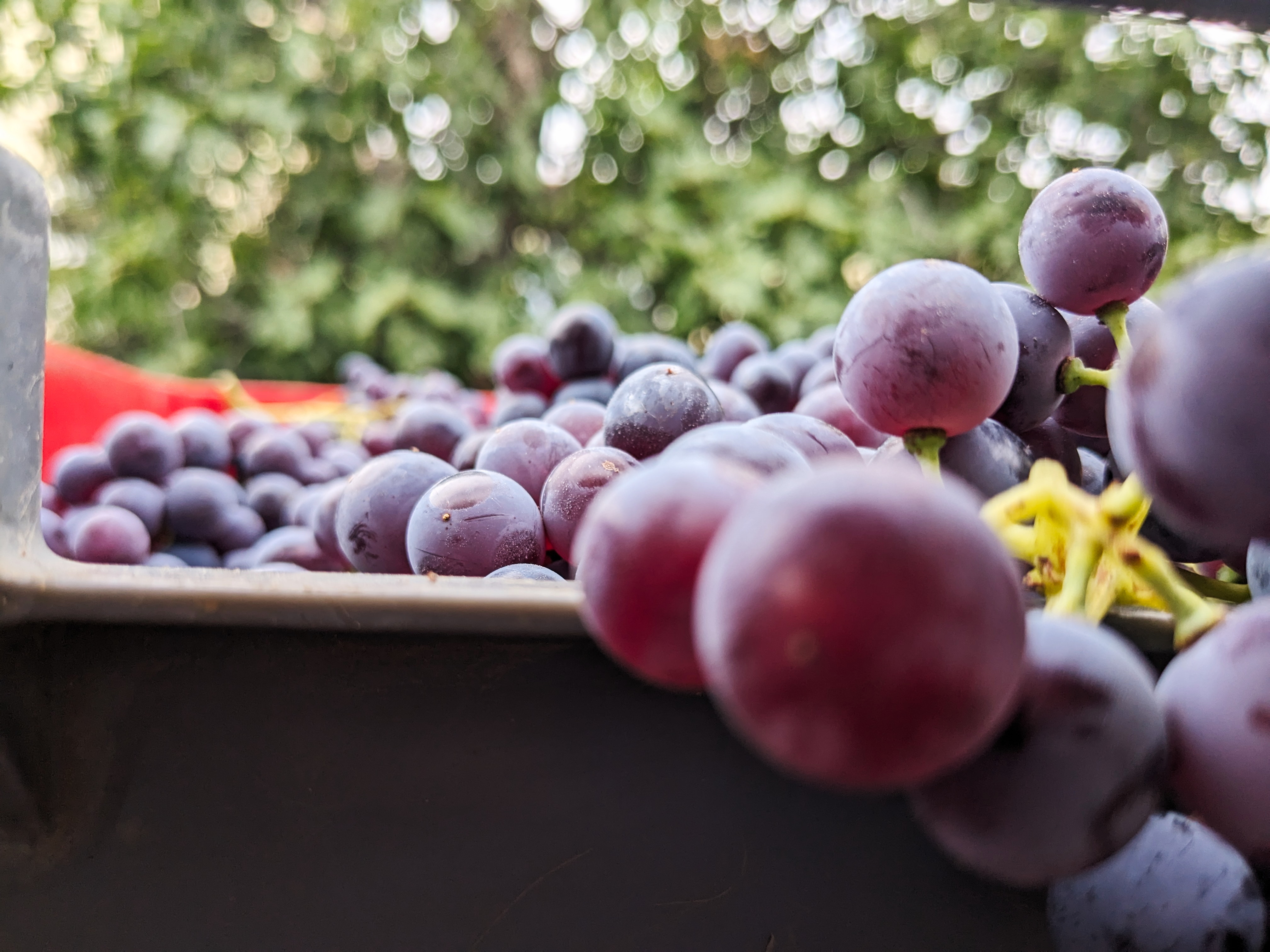
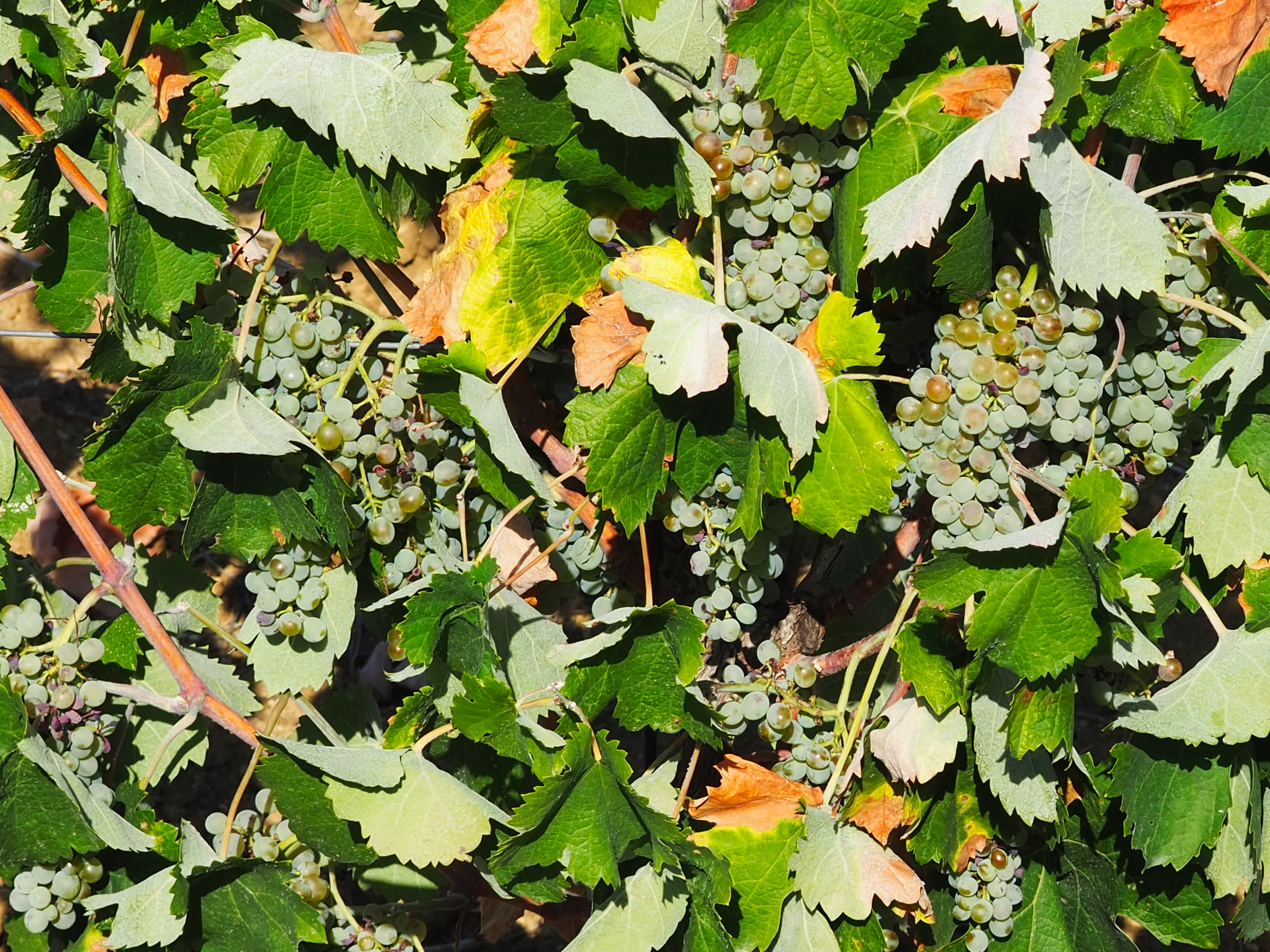
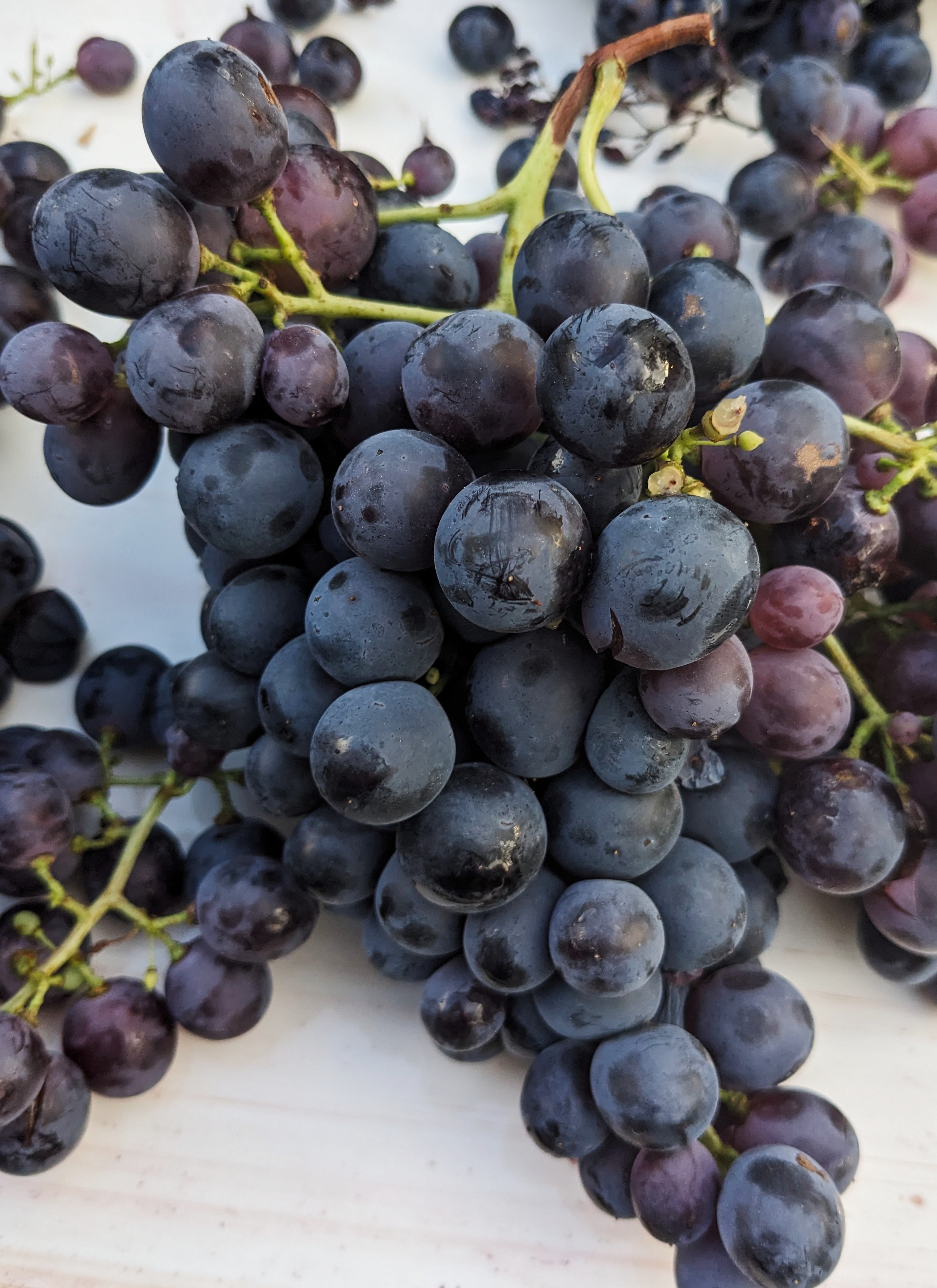
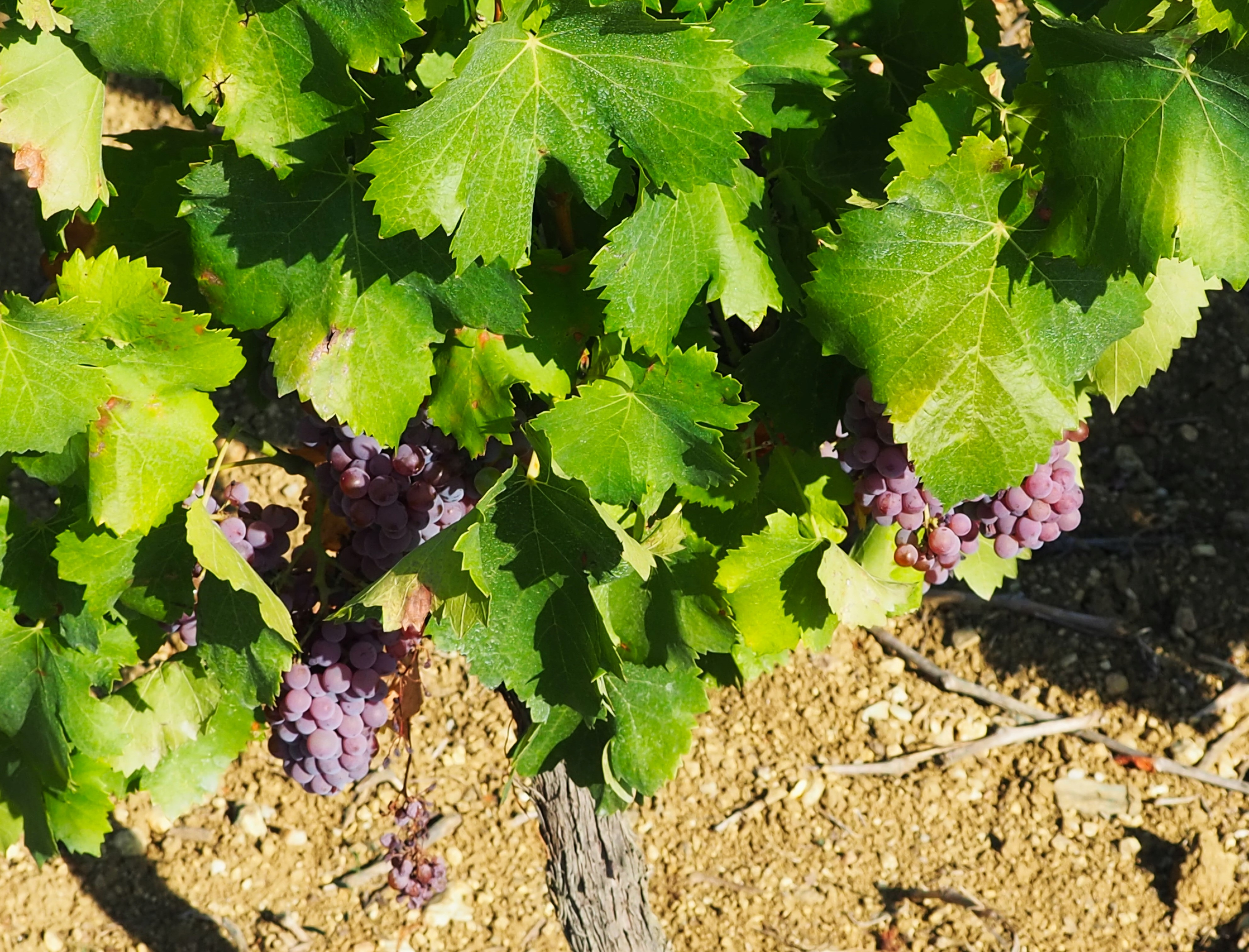
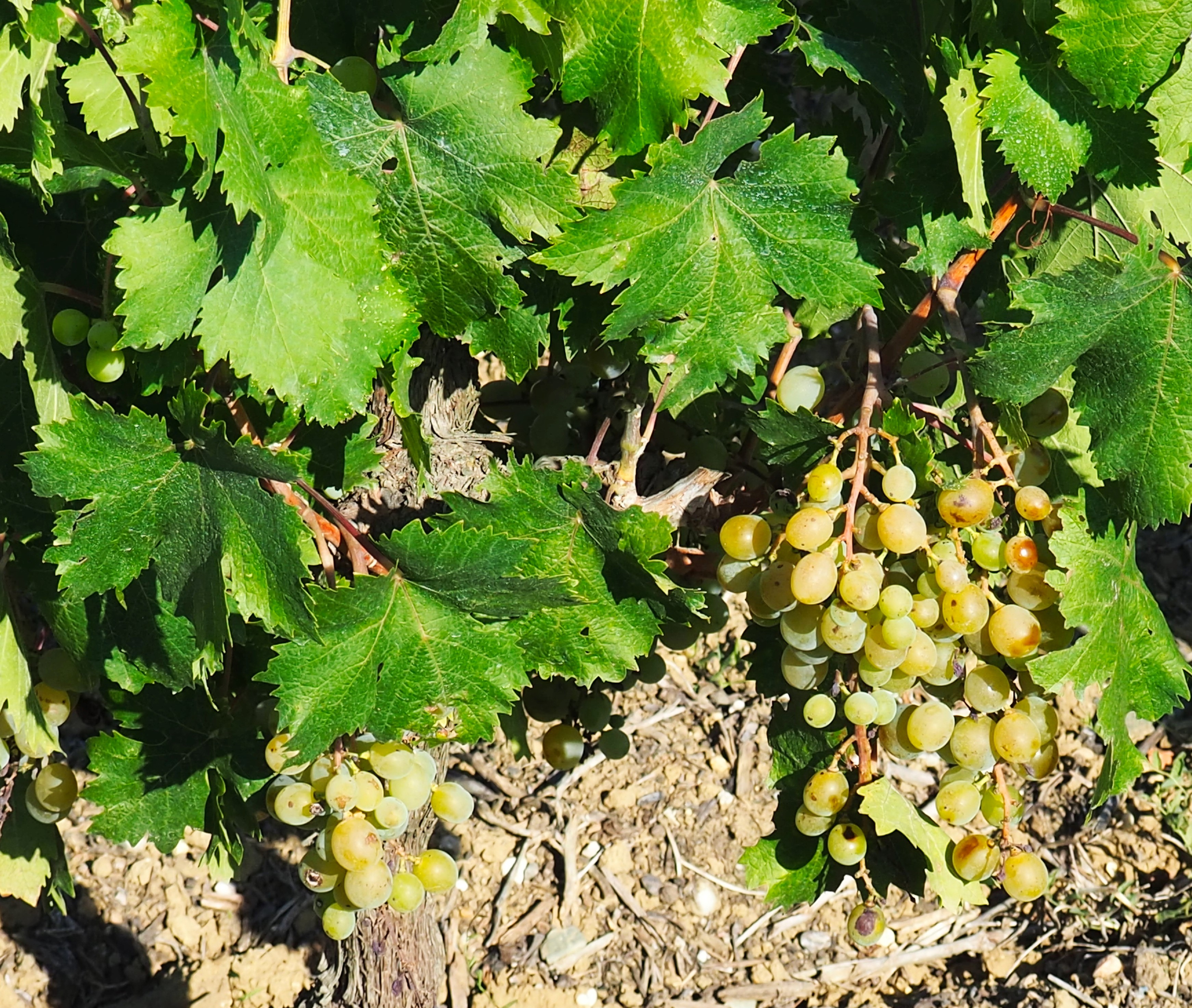
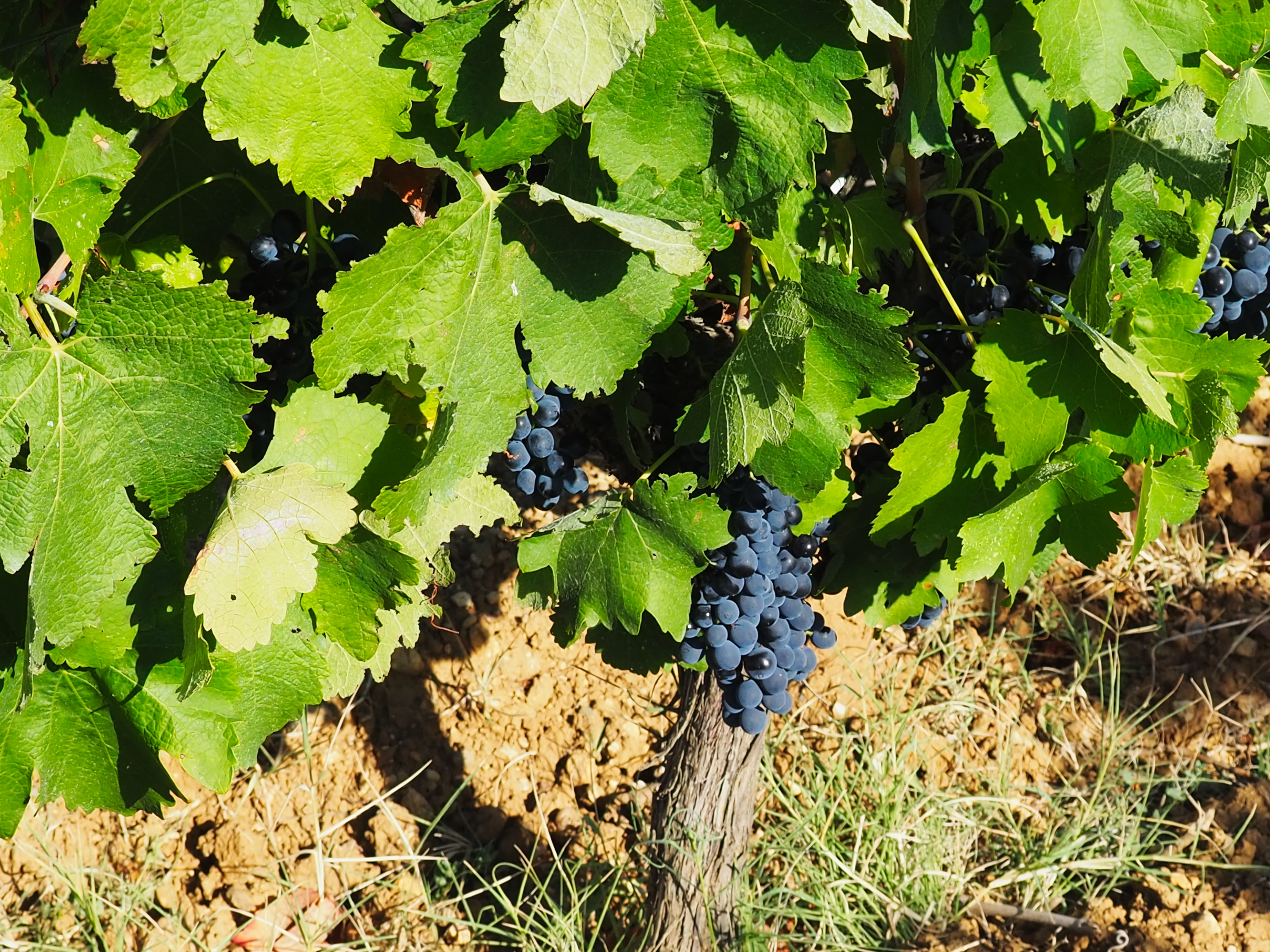
It’s not all doom and gloom though. Jeff was keen to say this morning that he is confident of the rest of the grapes such as the lovely Grenache Gris in the photo as the top of this post. There are plentiful bunches and some are big and bountiful, especially where that rain on the 29th brought relief. He is more confident this year than last, he said, that the harvest will be good. Let the games begin.
As my spell in June was coming to an end it was fortunate that Jeff had arranged with one of his longest standing importers to taste though the 2022 vintage wines on the 29th. Emil Broomé and Ulf Ringius have been running Vin & Natur in Malmö, Sweden since 2009 and Jeff has been one of their winemakers for most, if not all, of that time. They were visiting several of their producers in June and were heading home the next day. We started the tasting in the garden, moved into the cellar and finished at the excellent Picamandil wine bar / restaurant in nearby Puissalicon. After months of drought it was unlucky that we ended with a thunderstorm which curtailed the evening. However, a fun evening as you can imagine.
EmilOlaf
So, let’s start with the white wines. All vintages are 2022 unless shown otherwise. Clairette, macerated for 2 days on skins, was one of the hits of the previous vintage was showing well again, the characteristic bitterness of the grape offering plenty of refreshment. Three different versions of Macabeu were made. Macabeu 2 (though we drank it first) was from young vines at the southerly end of Sainte Suzanne vineyard. There was a cassis note to the wine, surprising in a white wine, zesty, leafy and lengthy, nice.
The young Macabeu and Clairette vines of Ste Suzanne
Macabeu 1 made from the Peilhan vines was given ten days maceration in a concrete egg. It was much more complex than Macabeu 2 with tannins showing to support the white fruits, very dry and lovely. Macabeu 3, the same Peilhan grapes but raised in amphora for six months in total. The difference in vessel was clear with greater concentration and depth. The flavours gathered in the centre of the tongue, white fruits and very long lasting. Not much was made, I am not sure whether it will even be released for sale. It was excellent.
La Vie En Grose is a new wine, made from Carignan Blanc, Grenache Gris and Terret Blanc grapes, macerated for a short time in tank. Dry. clean and direct with clean fruit. The Grenache Gris adds a tint of red making this a very light, onion skin type rosé wine. Amazingly, there was even a red fruit note in the flavours on show. I had a bottle a month later and this is a real gem of a wine.
Amphore Métissé continues the not red wine, métissé means a wine that is a blend of red and white grapes I recall spending a half day carefully sorting the grapes for this, removing every little stalk. Macabeu, Grenache Gris and many other varieties went into the amphora.
This year’s version of the wine is much lighter in colour than previous vintages, very dry, soft tannins with light red fruit flavours, raspberry and cherry. This needs time to settle and soften a little but it’s really good.
To the reds. Ploutelou is a bistro type wine, made for easy drinking and food. Red fruits again, light and far too gluggable. Fast becoming a favourite like the Grenache Mise De Printemps cuvée simply because it is so enjoyable. La Buvette À Paulette is another wine made for early drinking, a little fuller than Ploutelou, made for food. 50% whole bunch Carignan Noir and 50% Grenache from La Garrigue. Good acidity supports the plummy fruit, very nice.
Classe, one of the Coutelou star wines, has been blended from Syrah, Grenache and Mourvedre this year. Tropical fruit aromas practically jumped out of the glass, red fruits and blackberry flavours followed on. This will maintain the wine’s popularity for sure. Couleurs Réunies has become another regular cuvée in recent years. Jeff told us that there had been an issue with gas in the tank but this had settled after a month or so. It doesn’t have the smoothness of previous bottlings so Jeff is considering giving it a new name and label. Fresh with red fruits, still good.
Making my notes
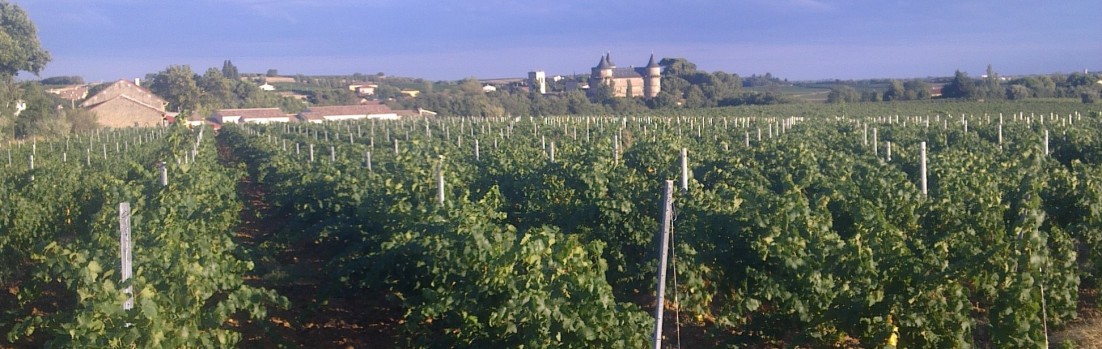
La Vigne Haute, my favourite. Made as ever with the Syrah from La Garrigue vineyard (just visible in the top photograph next to the white van in the distance), this vintage is very aromatic, cassis leaf, Olaf detected watermelon aromas. The wine was beautifully balanced, good acidity but not too much, light tannins but not too evident, bright fruits but built to age too – it’s a Goldilocks wine, just right. Mourvedre is lighter and spicier than previous vintages, I enjoyed this more, it’s not often one of my preferred wines. Unlike Flambadou, another Coutelou headline act, pure Carignan from Rec D’Oulette. The wine is closed on the nose for the moment but in the glass ripe, concentrated fruits with good acidity, with just a hint of greenness on the finish.
Amphore Syrah 21, made from Ste. Suzanne grapes. This was very pure Syrah, darker than La Vigne Haute. It carried lovely power and concentration, full yet still smooth with dark fruits. Jeff has also made a lovely wine which will be available in magnum only, a blend of La Vigne Haute and the Amphore Syrah. It is the latter which is more apparent for now though Jeff suspects LVH will start to show more with time. This definitely needs some ageing to bring everything to its best but it will be worth the wait, I shall be at the front of the queue.
A very enjoyable evening with good people and excellent wines. There are other 22 wines already on the market such as the Gris De Coeur made from gris grapes such as grenache, carignan and riveyrenc. However, it was good to unveil this promising vintage with wines which are being gently aged in bottle in Jeff’s cellars for now. Make sure to watch for their release, in Sweden or around the world.
I shall soon be heading south again ready for vendanges, the tenth year of my involvement. It’s a period of very hard work, aches and great fun. For Jeff though it is a period of very hard work, aches and great stress. This is his bottom line, will he make money this year or not? I remember reading one winemaker saying that he would only get thirty or so opportunities to make wine in his life and therefore he felt a duty to make the best wine he possibly could each year. Jeff thinks similarly, he wants to produce wine of the best possible quality, but he also needs to make enough wine to pay for salaries, equipment and all the other costs he faces. So, how is 2023 shaping?
Mourvedre looking healthy
In my last post I explained that I did two full vineyard tours in June. In the first, alone, I saw vines in excellent condition. The vines had few signs of disease, well below average. The dry, hot conditions were good for preventing mildew for example. There were lots of bunches of grapes in all vineyards, I felt very optimistic for the vintage. However, on my second tour, with Jeff, he revealed some of the problems caused by those same dry, hot conditions.
One reason why Jeff, Ines and Jérome were tying up the vines, as I described in the last post, is to stop the vines pushing growth of more greenery and foliage so that they can concentrate on developing and ripening fruit. However, the drought also means that some of the vines were already making that decision for themselves. These Clairette vines in Segrairals were producing limited vegetation at the end of June.
The vines were already beginning to take measures to prioritise fruit. Across all the vineyards the vines had many bunches but Jeff pointed out that most of those bunches were half full. Jeff explained that the vines are aborting some of the berries in order that some mature and ripen fully. Better some than none, or all of them being unripe.
Jeff pointing out an incomplete Cinsault bunch
ServantClarette
This all means that harvest will be difficult. Fewer grapes means a smaller harvest, less wine and income for Jeff. 20mm of rain from October to June was bound to cause problems, that is tantamount to desert conditions. Some storms in July might have brought some relief but 2023 is looking a far from ideal vintage.
After an eight-month absence, I was back in the vineyards, and the first task, and pleasure, was to assess any changes that had taken place. Based here from 2014 to 2017, I had witnessed all of Jeff Coutelou’s vineyard and cellar developments. Though he keeps me updated, there is nothing quite like experiencing everything in person. On June 20th, I embarked on a tour of the vines myself, followed by a more enlightening one with Jeff a week later. As always, his expertise extends beyond vines and encompasses all aspects of horticulture. I will delve further into that in my next update. Stay tuned!
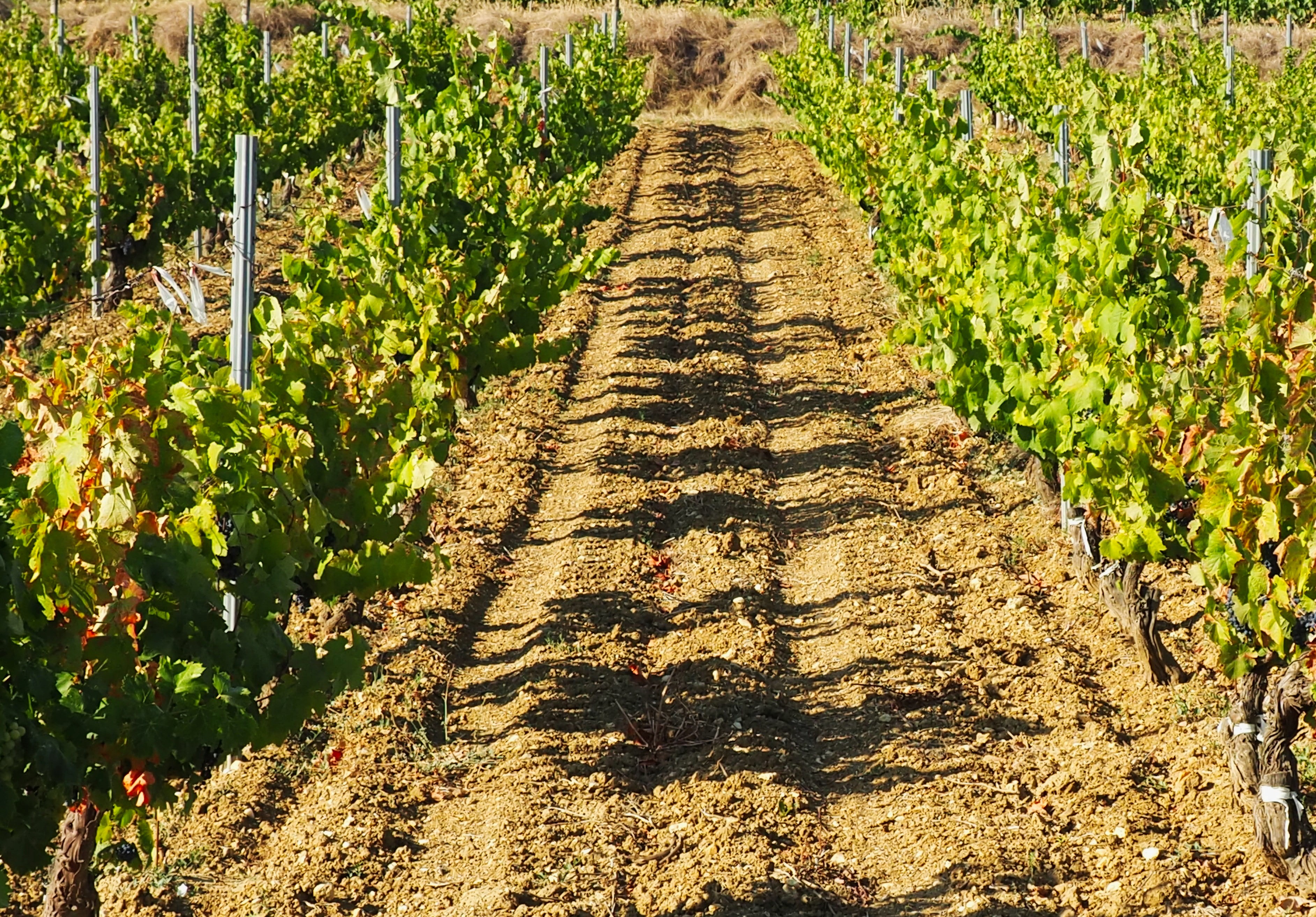
Syrah of La Garrigue in the foreground with Ste Suzanne Syrah and Grenache in the distance and Maccabeu and Clairette below the hut on the left
My first tour took place on a grey, cooler day, but unfortunately, there was no rain. The region has been experiencing paltry amounts of rainfall since last October. Even when other areas in the region received some rain, the plains, where Jeff’s vineyards are located, remained dry. Despite the lack of rain, the vines surprisingly looked in good condition, largely due to the dry period having a beneficial impact on disease prevention. During my visit, I noticed that Jeff and Gilles had been diligently raking the ground, incorporating the plant growth into the soil to use it as compost. This practice is crucial for maintaining the vineyard’s health and fertility.
During my visit, I observed that most vines displayed full foliage. Ines and Jérôme were busy in La Garrigue, meticulously tying up the vines onto the wire trellises, a practice known as “pallisage.” A week later, Jeff explained to me the purpose behind his technique of knotting the tops of the vines together.
Vines have a remarkable ability to produce leaf buds in abundance. Being climbing plants, they continuously grow and extend their branches. However, by tying them together, Jeff aims to restrict the further expansion of foliage and overall size. This strategy encourages the vines to channel their energy more into fruit production. By diverting their resources away from excessive foliage growth, the vines are encouraged to focus on developing healthier and more robust fruits, ultimately leading to improved grape quality and yield. It’s an essential method in vineyard management to strike the right balance between vegetative growth and fruit production.
Relentless vine growthTresse formed by knotting the vines
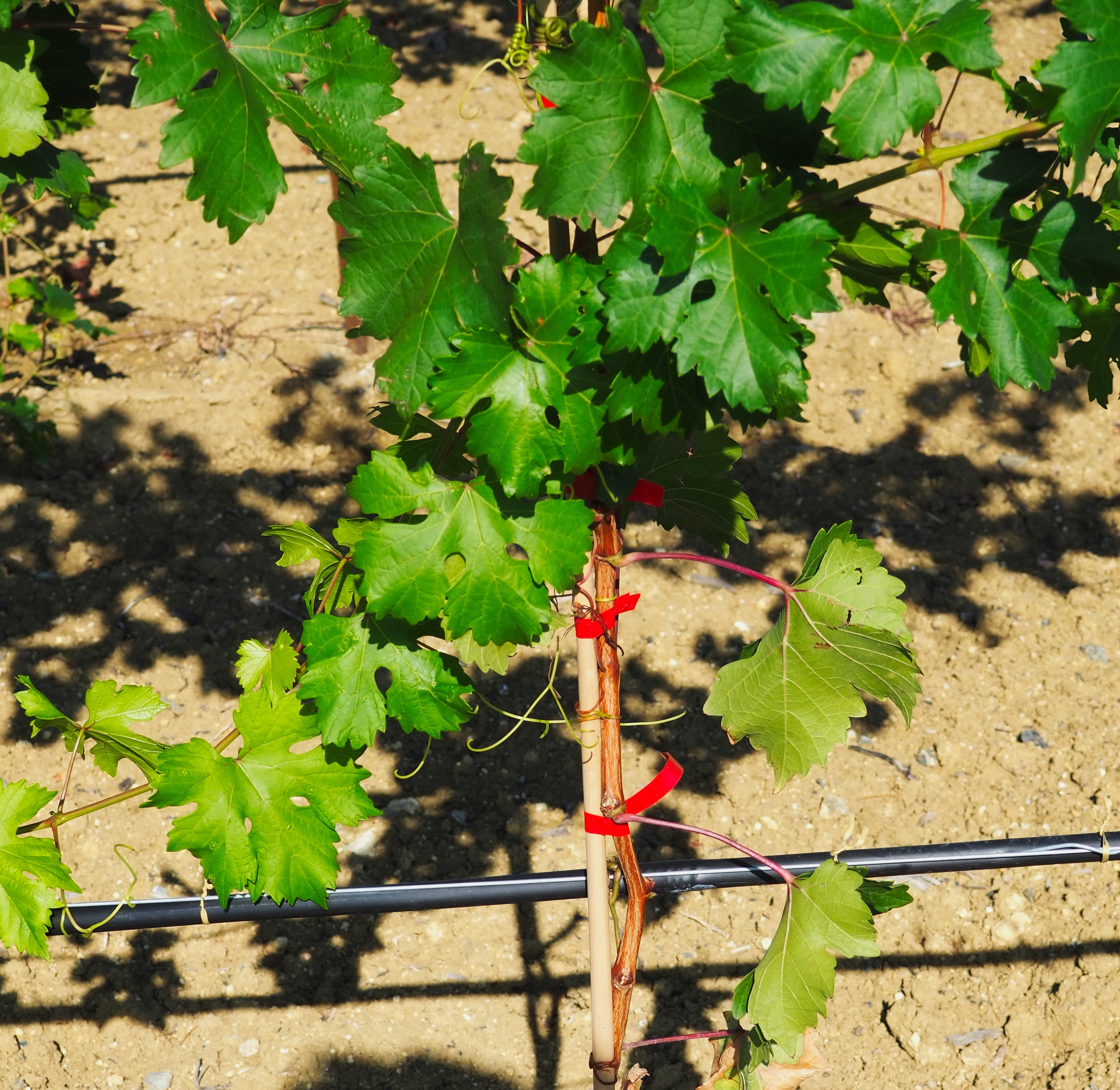
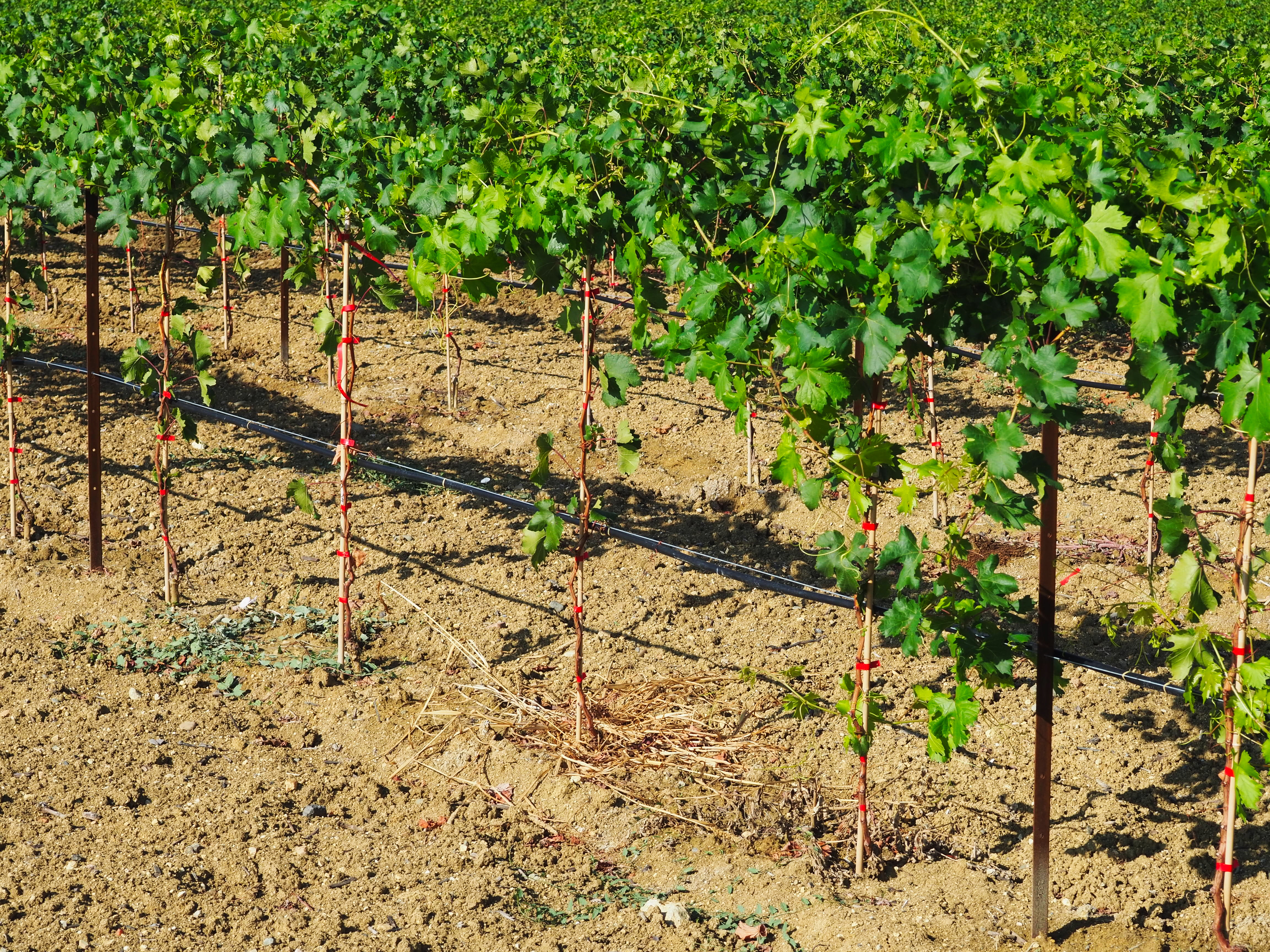
The recently planted vineyards were thriving, benefiting from irrigation. Since these young vines are not yet producing fruit for wine, they require proper nurturing to establish strong root systems and healthy growth. Jeff ensures they receive adequate water through irrigation to support their early development.
Some people wonder why, despite being in a time of drought, Jeff opposes the idea of irrigating his older vines. The reason behind this decision primarily lies in his principles as a natural winemaker. He firmly believes in minimal intervention and allowing the vines to express themselves as much as possible.
While it is true that viticulteurs do engage in various vineyard practices, including planting, pruning, trellising, and spraying, Jeff’s approach leans towards allowing the vines to thrive in their natural environment. He is cautious about introducing elements from outside the region through irrigation sourced from the Rhone river, which would alter the purity of the wine’s terroir expression.
Instead, the water used for the young vines comes from Jeff’s own well and other local sources. By using water that is specific to the area, he ensures that the vines maintain a pure connection with their terroir, reflecting the unique characteristics of the land in the wine they eventually produce. This dedication to preserving the essence of terroir in his natural wines distinguishes Jeff’s winemaking philosophy and practices from those of conventional viticulteurs.
La Vigne Haute Syrah and new extensionYear old Xarel-lo
Nonetheless, the overall condition of the vines was impressive notably Flower Power (Font D’Oulette), looked more vibrant and healthy than ever before. Over the past eight years or so, the vines in this vineyard have become well-established and significantly more productive. The efforts and care put into nurturing them have certainly paid off.
The Xarel-lo parcel which was planted just last year, is also thriving remarkably well. These young vines are showing robust growth and are on track to start producing grapes next year. These grapes will likely be utilized for blending purposes in early years, adding to the complexity and character of the wines.
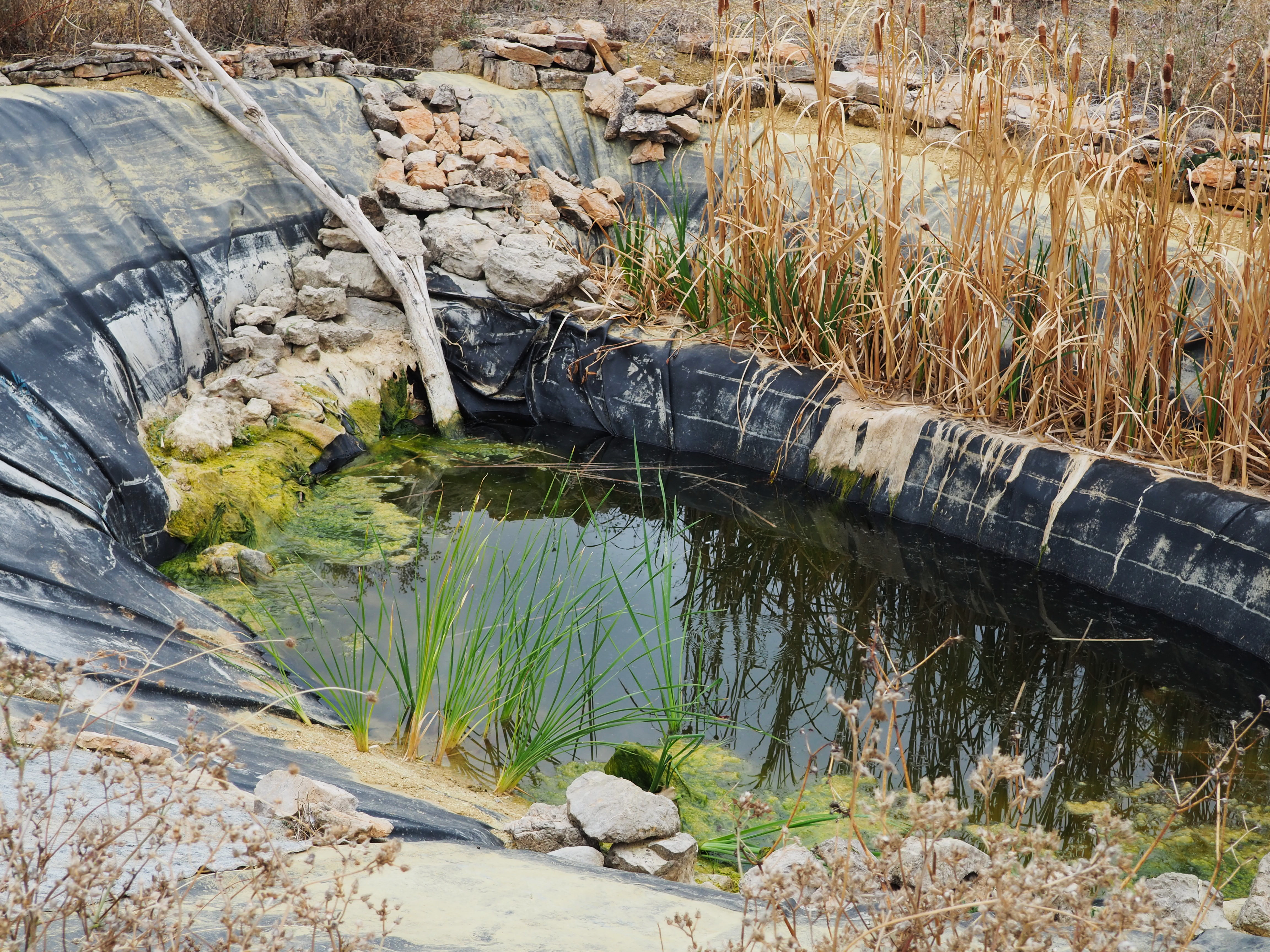
Adjacent to the Xarel-lo plantation is a small reservoir that Jeff created last year. Despite the prevailing drought, the reservoir has managed to retain a good amount of water, thanks to its steep sides. This reservoir has become a habitat for a diverse range of animals, as evidenced by the tracks left behind. During my visit, I even had the pleasure of observing a kestrel soaring in the vicinity of the reservoir, attentively eyeing its prey among the small creatures drawn to the water source.
The ecosystem and balance that Jeff fosters within his vineyard are a testament to his commitment to sustainable and thoughtful viticulture practices. By creating these natural reservoirs and allowing wildlife to thrive, he not only preserves the biodiversity of the area but also contributes to the overall health and resilience of his vineyard ecosystem.
Kestrel over the marneRed wheat in front of the Peilhan terraceBat shelters
The field of red wheat was now ripe and ready for harvest. Jeff had decided to leave this land free of vines to give it time towards its conversion to organic production. The harvested wheat will be sent to a local miller, and the flour will be used by a nearby village baker. This sustainable approach not only supports local businesses but also promotes ecological practices.
Furthermore, in one corner of the wheat field, Jeff has created a new area specifically designated for bats. By providing these nocturnal creatures with a safe shelter, he invites them to take up residence on his property. Bats are incredibly beneficial as natural pest controllers. They play a vital role in maintaining ecological balance by preying on insects and pests, including the moths responsible for ver de la grappe without the need for chemical intervention. Jeff’s commitment to biodiversity and ecological balance is evident in every aspect of his vineyard management.
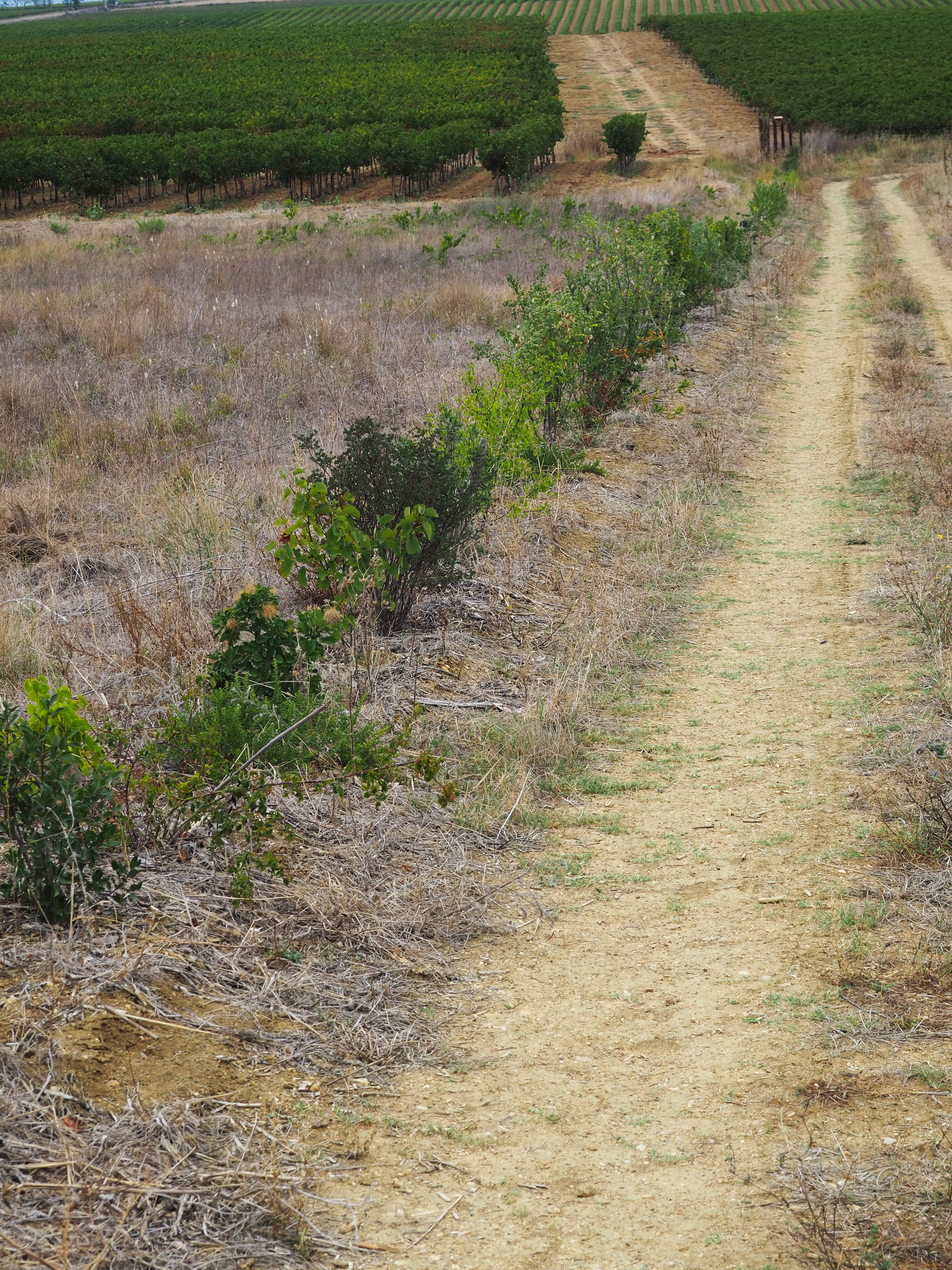
Despite facing vandalism in the past, Jeff remains unwavering in his belief of the importance of planting trees and shrubs around his vineyards. In addition to olive trees, he has introduced various fruit and nut trees as well. During our tour on the 27th, I noticed a collection of large water containers in the back of Jeff’s Jeep. These containers play a crucial role in irrigating the young trees, ensuring their survival in the challenging conditions of heat and drought.
To give these young trees the best chance to thrive, copious amounts of well water were added to the soil. To minimize water loss through evaporation, the soil was then covered with additional layers of soil and compost. This careful approach to irrigation reflects Jeff’s commitment to preserving water resources and using them efficiently.
Fruit and nut trees on the border of Peilhan
Beyond their aesthetic value, the trees and shrubs serve multiple purposes within the vineyard ecosystem. They contribute to biodiversity by providing habitats and food sources for various fauna and flora. Some of the vegetation also acts as a protective shield, offering shelter to the vineyards and preventing run-off from neighboring vineyards.
Jeff’s dedication to planting trees is deeply moving, especially knowing that these trees will mature long after he has retired and passed on. Yet, he is devoted to the idea of creating a positive impact on the land’s ecology in both the short and long term. By investing in the health of the ecosystem, Jeff demonstrates a profound sense of stewardship and a desire to leave a sustainable and thriving legacy for future generations to appreciate and benefit from.
Back in Puimisson and all the better for being there. After travelling around vineyards and cellars in the Grand Est it was a relief to be in one place and reacquaint myself with the Coutelou domaine. The familiar and the new, people, wines and vineyards.
Exciting news came quickly as Flora, Jeff’s niece, is now working full time as his assistant. Exciting because the domaine is being tended by the Coutelou family, now and into the future. Flora has been working with Jeff for a couple of years, learning the role of the winemaker in the cellar and vineyard. Jeff is very happy with Flora’s role, I am delighted.
Flora at work
Gilles is still around, working mainly in the vines, driving the tractor and other specialist jobs. New to the scene is a lovely young couple in Ines and Jérôme, experienced in the cellar and vineyard and hoping to establish their own vineyard at some point.
Jerome and Ines at work
My arrival was well timed, with a bit of manoeuvring by Jeff. He had told me bottling (la mise) was taking place in the week, wines such as Classe, Buvette À Paulette, Flambadou* and La Vigne Haute. Summer means the wines have been in tank for a good time and ready for bottle and as autumn approaches those tanks will be needed again. Jeff left La Vigne Haute to last so that I could be there, knowing it is my absolute favourite wine. It’s a familiar process after all these years, described in detail here. I was able to taste the four wines bottled and the signs are very good for the 22 wines, Classe was a joy but La Vigne Haute did steal the show, I believe that Jeff did utter the words “best ever” though he’d probably deny it! The remaining wine is taken out of tank and will be blended with other wine, magnums had already been made with the hand operated machine.
A few days later I was back as Jeff was tidying up some of the barrels. Some needed to be topped up (ouillage) with wine kept for that purpose in smaller containers. A barrel of fortified alcohol, was put into a steel tank to use in making some of the spirits and fortified wines which are now part of Vins et Spiritueux Coutelou, the proper name for the domaine these days.
The fortified alcohol
As usual I am taken aback by the complexity of what wine is in what container. I know Jeff keeps spreadsheets with the details but in a flash he can tell you what is in each tank, barrel or other container. There are dozens of such containers, and Jeff is always thinking of how he can use some of the wines to show them at their best individually or to meet commercial needs.
There are always new wines, more in a future post as we tasted through the 22 range. There is also consistent change in the vineyards, more in the next post.
La Vigne Haute 2022
*In a recent tasting of Languedoc wines by a panel of experts Flambadou 2007 and 2017 both emerged with flying colours and praise, for the quality and for their longevity.