In a horse race (or any other race for that matter) as the start falls behind you need to get into a prime position. Not too fast or you’ll use up all your energy before the finish. Not too slow so that if things go wrong you’re caught out and in no place to achieve what you want.
That’s how it has felt as the first week drew on at Jeff Coutelou’s this year. The Syrah grape is a fundamental part of the domaine. It is grown in four different vineyards and is used to make pure Syrah wines, such as legendary La Vigne Haute, or for blending into wines such as Classe and Le Vin Des Amis. It also matures relatively early and has formed the bulk of this week’s picks.
Syrah from Segrairals left and La Garrigue right
The grapes from Peilhan were suffering as I described in an earlier post but since then we have sorted several tonnes of lovely, fresh but ripe grapes in good condition. The sorting table has been mainly a question of sifting out snails, sticking to grapes for any water they can get, earwigs and dried leaves. The vibrating table means that the snails shells rattle and it easy to pick them out whilst it lets the smaller leaves, peduncles and any grit drop through the grilles. We remove larger detritus and any bunches affected by grape moths or oidium. The Syrah from La Garrigue was in very nice condition, Jeff even teased about making La Vigne Haute, I’ll try not to get too excited just yet.
Me working on the sorting table (video by Bart Johnston)
Jeff decided on Thursday to pick some Cinsault which was a little underripe and only around 9% alcohol potential. Why? It will be used to balance some of the riper and higher alcohol yields such as some of the Syrah, adding freshness and energy as well as lowering that alcohol level. It’s decisions like these which mean that Jeff has put us in that pole position going into the second week. The base is there and now we can add the grapes to make very good wines.
Tank ready for grapes, Cinsault right
White grapes were not ignored, I described the Muscat in the last post and since then the Clairette and Macabeu from Sainte Suzanne has been harvested too. This is a young plantation still, only four or five years old and the heat has got to it a bit. Macabeu had a downy underside on its leaves to help dissipate heat but even that has found 2024 a wee bit much. Nonetheless, early picking and direct pressing means that we have nice, fresh white wine in the tanks, just not enough of it really, the effects of the summer.
Picking in Ste Suzanne and some Clairette grapes
Clairette into press with Bart and Jeff and right, Bart using the basket press for some less perfect Macabeu
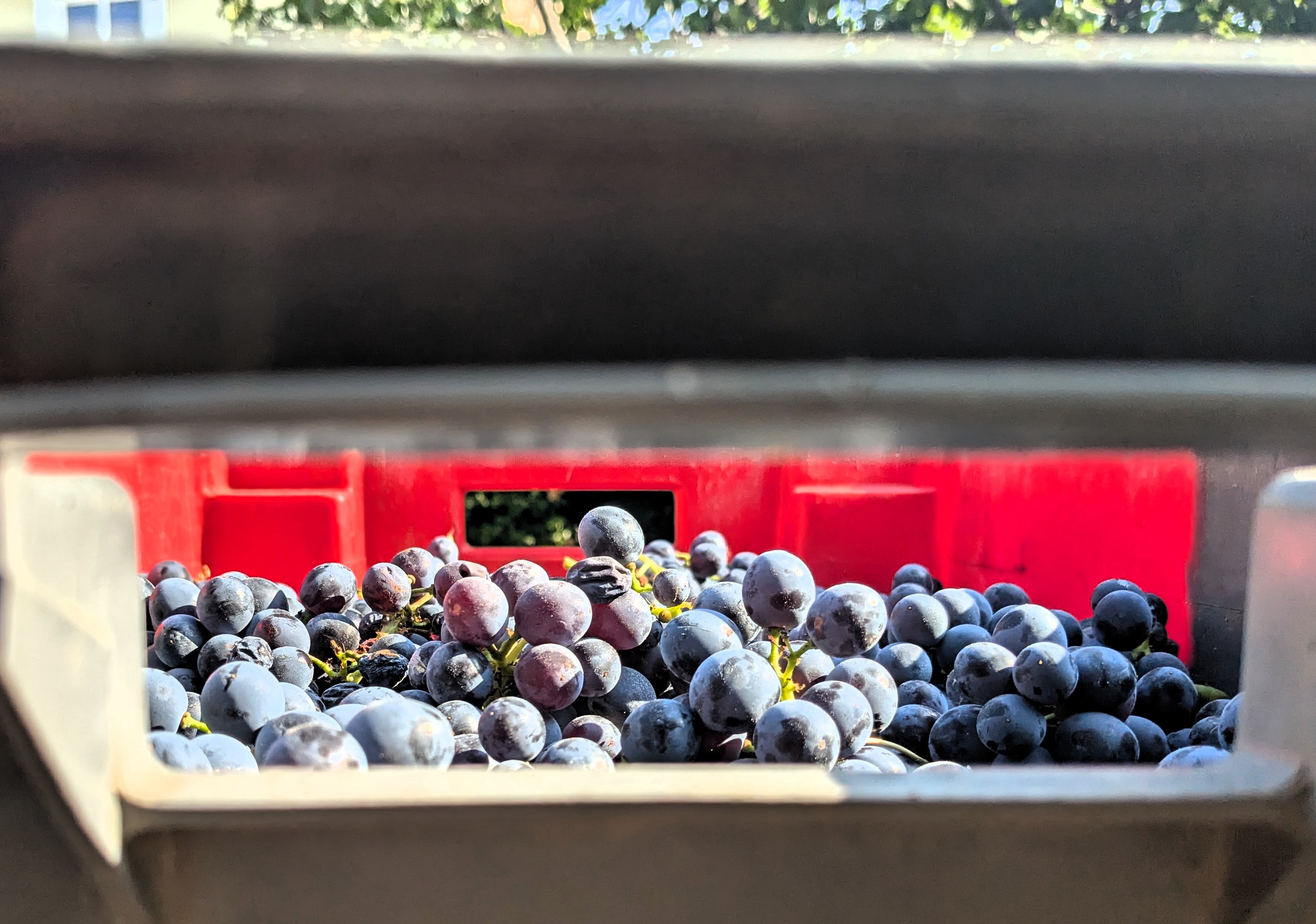
On touring the vineyard of Segrairals Jeff felt it was necessary to bring in the rest of the Cinsault, just a couple of days after the previous pick. In those two days there had been great changes, amazingly. The grapes were fuller and riper but they were threatening to go over the top just as quickly. Cinsault has very thin skins and full grapes which provide a rich target for grape worms, wasps and other insects and if they get to work then spoiled grapes in a bunch can turn the rest to vinegar. So, Saturday afternoon brought a lot of Cinsault, its size and generosity means that the big bunches soon fill the cases and we were working flat out sorting to get rid of any potential problems. Again, having that in tank to use for the cuvée 5SO or for blending to add lightness and fruitiness, means that Jeff has greater options in the coming days.
Macabeu, a 500g bunch right, oidium hit at the top and some mildewed grapes left. Fortunately there’s more of the first.
Saturday, in particular, was full on and the temperature hasn’t dropped below 30c any day this week. Sunday, and a day of rest, is a welcome break and chance for Jeff to look at the analyses and make his choices for what comes next. Back to the race analogy, the pace has been rapid but steady and we are placed well to go on and finish the race with energy and success. Problems and decisions remain, there is a threat of rain this week and the machinery has felt the pace of work and given a few headaches and lessons in French swear words with occasional breakdowns.
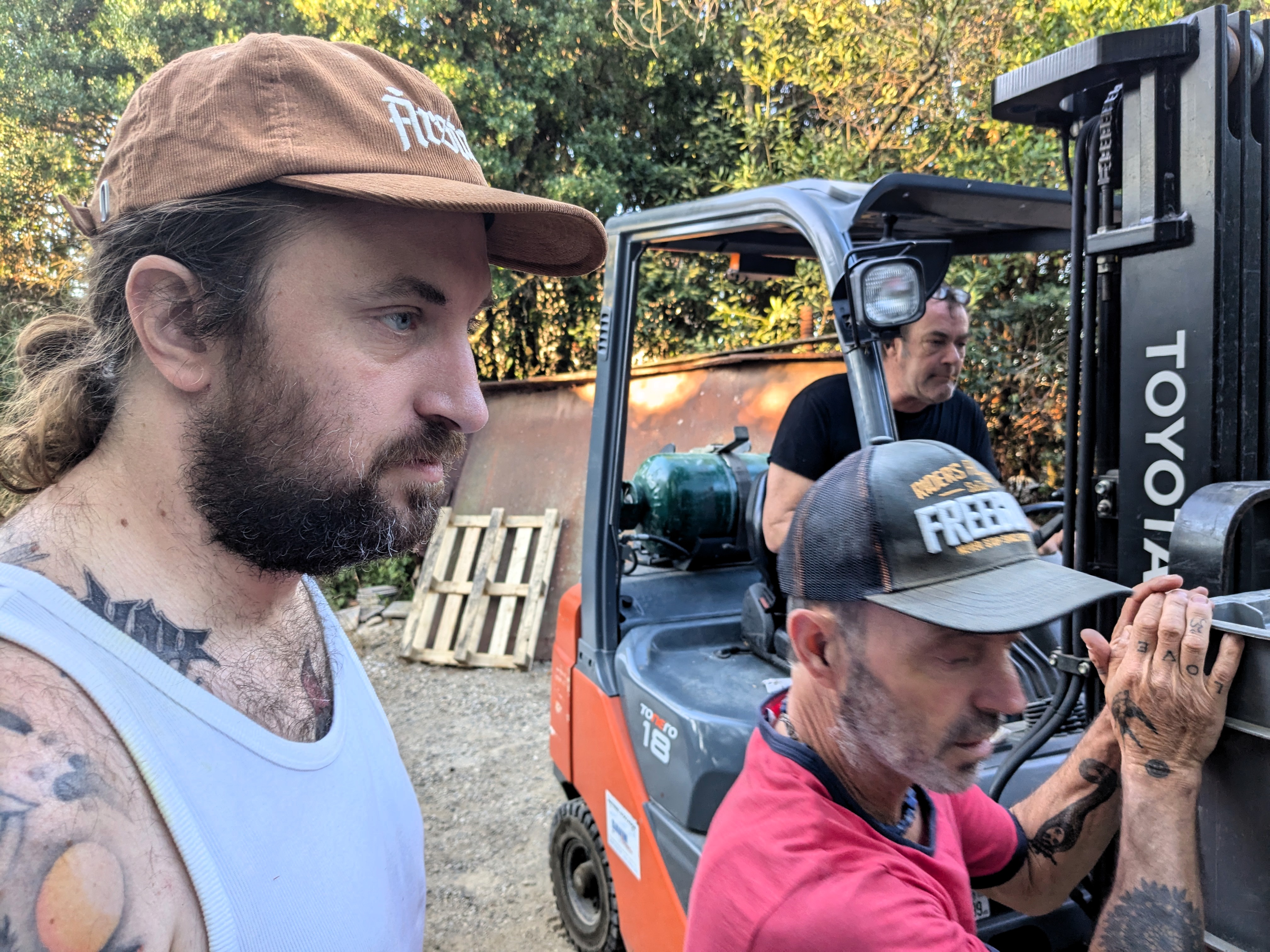
left to right – Linus, Dario, Flora, Gilles behind Jeff
Eleven years of coming to vendanges (minus covid year), my tenth experience. Is there anything new to say? Well, yes, of course. Each vintage is different, the weather, the new plantings and the people. Jeff Coutelou is the central figure and around him there come and go people from all over the world, each bringing new eyes, new stories and they become an extension of the Coutelou family. There are quite a few who have gone on to make their own wines, some who move into different aspects of the wine world and others who simply put it down to experience.
Gilles and Bart unloading the first cases
When I tell people that I do wine harvest each year the most common response is that it must be lovely, how romantic the idea is. They obviously don’t recognise the brutally hard work which harvest brings, the aches, pains and cuts which follow and the heat! It has been a hot start to the ’24 harvest, every day well into the 30s centigrade. I drank many litres of water yesterday (August 28th) and still felt parched. Clothing covered in dirt, grape juice, sweat and blood are a commonality between many of us. As I have reached 65 years of age I am starting to feel such days take their toll so have taken today to recover from yesterday’s sweltering conditions and hard work, but I shall be doing six of the first seven days of vendanges.
After so many harvests it has got to the point where Jeff and I reminisce about past experiences, how we had to work differently, problems that arose in the past and which recur – shall we do the same thing this time? Something which did come back was the sorting table which broke down twice last year and had to be replaced. It is high tech, vibrating to winnow the loose debris from the bunches together with insects and snails and it makes sorting bunches a lot more straightforward. Hopefully it will continue to work for the whole season in 2024.
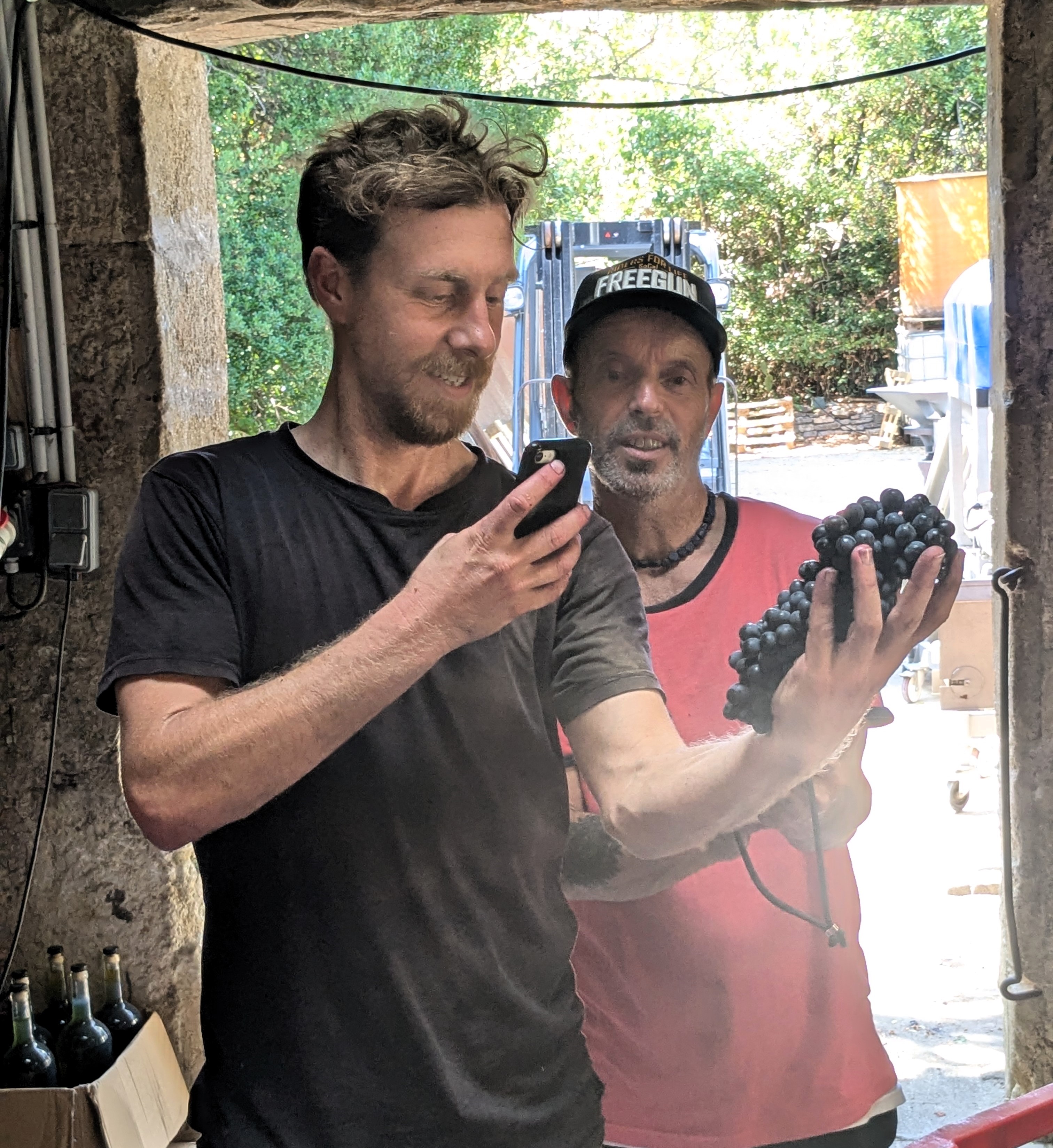
Linus and TysBart and Thijs admire the Segrairals Syrah
Old sorting table, new use
Tuesday was, as many first days have been, a day for Syrah. The grapes from Sainte Suzanne vineyard were somewhat lacking in juice because of this year’s drought. Healthy bunches but small grapes and Jeff felt they would be best vinified in whole bunches to bring out the fruitiness of the grapes. Normally we have sorted such grapes by hand straight from case at the top of the fermentation tank. However, Jeff decided to hang on to the original sorting table and so this was used inside the cellar to make it a more comfortable and efficient operation. Joining me at the table were Tys, a Dutchman who lives in the Auvergne and is considering winemaking for his future. He was there for just one day. Alongside him was Bart Johnston, an Australian, the fourth in my time with Jeff. From Sydney originally Bart now lives and works in Tasmania, running a wine operation as well as making his own wines under the L’Appel label. He was all set to come and do harvest with Jeff in 2020 but, for obvious reasons, that had to be postponed. His experience will be a big help to Jeff this year.
In the afternoon the pickers moved to the large Segrairals vineyard and its Syrah. As I mentioned last time this vineyard has suffered less from the heat and drought than the other side of the village so the grapes were bigger and juicier than those in the morning and by balancing them out Jeff hopes for a good base of Syrah wine, probably for blending into classic cuvées such Le Vin des Amis. The team of Moroccan pickers returned and were joined by Flora, Jeff’s niece. Dario, an Italian who has been working in Puimisson since March after coming for harvest last year forms another experienced hand. Linus, from Sweden is here for the harvest, he works in the wine business there and is looking for more experience of real winemaking. Gilles, as ever, ferries the grapes to and fro and keeps Jeff up to date with how the picking is going.
Muscat going into tank
Learning how to operate the press
Day 2 brought a change of personnel. Another familiar face returned for a day. By coincidence the person who replaced Bart in 2020 was Louis from Narbonne and he ended up working for Jeff for a year or so. As it happened I had seen him at Jeff’s in April and it was good to catch up. He and Linus did half a day each of sorting and picking. The morning brought white grapes. Muscat À Petits Grains from Peilhan was collected and pressed directly into tank.
Muscat grapes after being pressed
Back to red grapes and Grenache from Sainte Suzanne which, as I wrote last time, had fared much better than the Syrah. Good, healthy and full bunches meant a lot of work and, hopefully, a fuller tank than the Syrah from there which Jeff had estimated to be about half the usual yield. It was a sapping, hot afternoon and I must admit, a tiring one but it was good to have had a successful day.
GrenacheGrenache
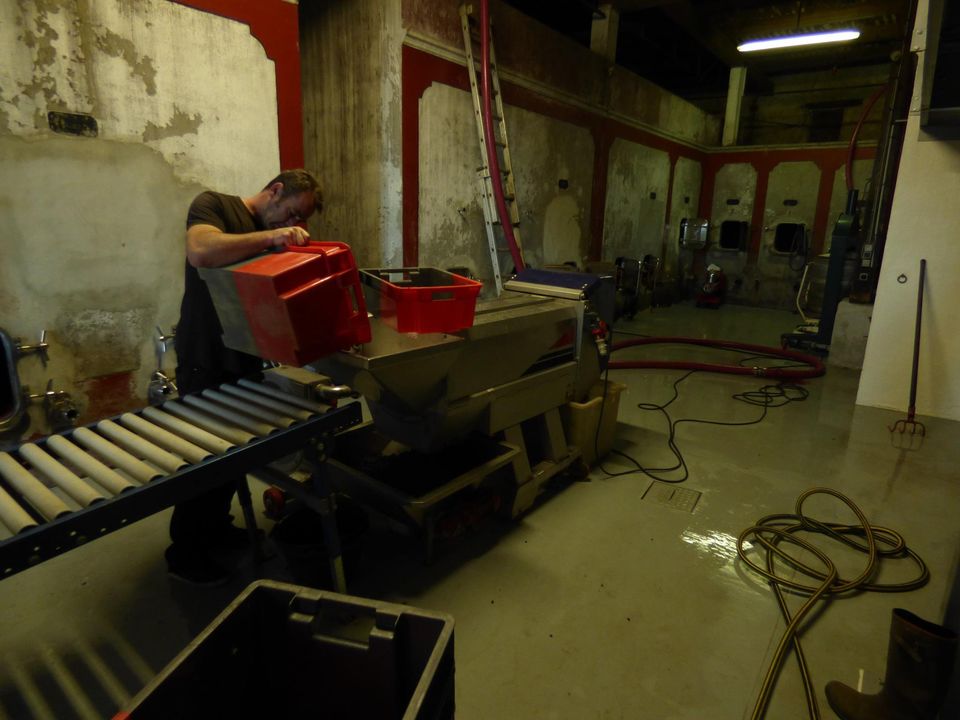
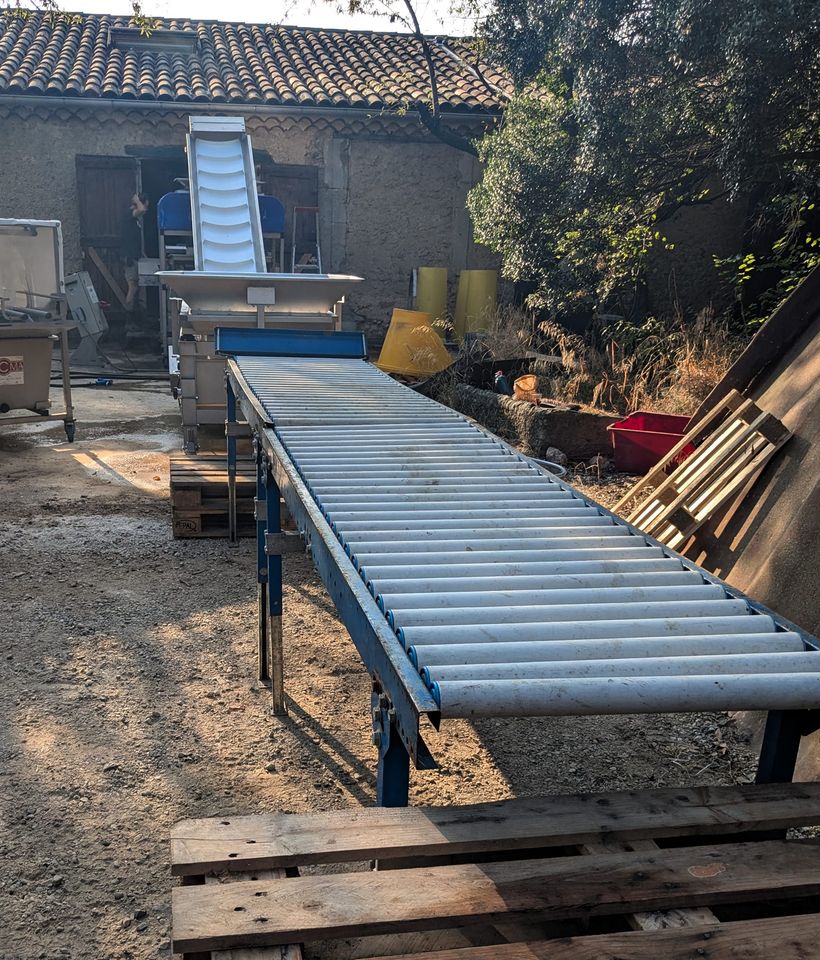
Compare these two pictures to see how much sorting the grapes has become more mechanised and efficient.
Jeff sorting by hand from case straight into the destemmer in 2016. On the right is the equipment for 2024, watch the video below.
It’s that time of year. the harvest is just around the corner. We’ll be starting next Monday at Jeff Coutelou’s domaine. I’ll be here for some but not all of the vendanges as I have a lot of travelling coming up and a much busier time here on the blog lies ahead. I shall be updating about the harvest whilst I’m here and with reports passed on to me when I return to the UK.
It’s been an ‘interesting’ year here weather-wise in the Languedoc. When I was here in April it was grey, damp and colder than average. Since then though the region has a long period of hot weather, it was still 38c when I arrived a week ago and that was cooler than the previous fortnight. I toured the vines and talked with Jeff who was rather downbeat about the vintage.
Tell tale mildew signs, the brown spots on the leaves
Mildew, the powdery version, has been prevalent from Spring onwards, the humidity and warmth setting it off. There is downy mildew, oidium, too. The vines look parched, the grapes struggling to swell because of the dry summer. A couple of storms last week offered a brief respite, sadly no more rain is forecast. It reaches a point where you just have to harvest as the vines are struggling and their long term health needs to be protected.
Couloure in Flower Power vineyard
There was also a lot of evidence of the difficult Spring with coulure. This is caused by strong winds damaging the flowers and buds at that time, which was exactly what conditions were like when I was there in April. The result is bunches with a lot of gaps.
Jeff was clear that not all vineyards were equally effected. Peilhan, to the West, has suffered most whilst Segrairals, to the Eastern side of Puimisson, has done much better. There will be good grapes and good wines from 2024.
Grenache, La GarrigueGrenache, La Garrigue
There were also a couple of other observations I thought to pass on. One vineyard area which was in good condition in Peilhan was the new plantation of Spanish grapes such as Parellada, Malvesia de Sitges and Macabeu. I assumed that they must have been irrigated as they are in their first year, they were a lush green in colour and looked strong, holding their branches out wide. Jeff corrected me though, they were watered on planting and then once in their early weeks but not since then. In vineyards such as La Garrigue and Sainte Suzanne it was also noteworthy that Grenache, (Spanish origins) was also doing well compared to most. Similarly, the Xarel-lo, now 2 years old, was looking strong with good, full bunches. Perhaps the deliberate policy of Jeff in moving towards grape varieties more adapted to hot and dry conditions is already proving a wise one?
Nice Xarel-loThe new planting in Peilhan
Visiting the cellars on the 20th Jeff had emptied all the main concrete tanks and they were being cleaned thoroughly. The harvesting machinery is also being prepared, checked and cleaned. Lots of hard work to get things ready. there will be plenty of triage for me to do next week but fingers crossed for a successful harvest despite the worst nature can throw at it.
Cleaning inside the reception tank
One last oddity. In the midst of the good looking Grenache vines of La Garrigue, one vine has mutated to offer Grenache Gris instead.
This isn’t a post I had expected to write but sometimes you find a wine which makes you want to tell everyone how good it was. It happened back in February at Noble Rot in London when I had a bottle of the excellent Domaine Aux Moines’ Savennières 2021 and I made a beeline to the domaine in April. Then, last week we went for a week to Cambrils on the Costa Daurada near Tarragona. A week intended to be simply restful but with gourmet interludes. Well, at the excellent Miramar* restaurant I ordered a bottle of local Grenache Blanc and was blown away by it.
The bottle in question was from the Terra Alta region, Edetària’s, Finca La Terrenal 2020. It is made from old vine Garnatxa Blanca from a single, steep vineyard on clay soils. The winery is the work of Joan Àngel Lliberia who studied and worked in wine in France before returning to the area and eventually establishing his winery. It is organic wine production, harvesting by hand with careful sorting at the cellar. The wines are fermented in small tanks before ageing as appropriate for the various levels of wine they produce. The Finca wines are their top level wines aimed at expressing grape and place. Certainly, this bottle certainly achieved those goals.
The Terra Alta wine region is just west of Tarragona in the foothills of the Pyrenees. Overshadowed by other local regions, such as Priorat and Montsant, it is beginning to gain recognition. Checking back on the Spanish tasting I attended in London in February, Vinateros, there were no Terra Alta producers present so it is still relatively unknown. One interesting fact, a third of all the Grenache Blanc in the world comes from Terra Alta.
Over the next few days I deliberately chose other organic Garnatxa Blanc wines from Terra Alta to see how they compared.
LaFou Celler’s Els Ameleres 2022 is made of a blend of young and older vines, aged in various types of container to add complexity. It was a nice bottle, fresh acidity and citrussy notes, a little flabby perhaps on the finish but perfectly decent. The producer’s website claims the wine shows aromas of the local almonds which give the wine its name, I didn’t pick that up.
Better was a wine made especially for the El Posit restaurant chain by Estones Vins, a project based in Priorat but with vineyards in Montsant and Terra Alta. Salvi Moliner is the winemaker and he makes his own Garnatxa Blanca as well as this one for the restaurants. Grown in the typical sandy ‘panal’ soils, Aproppòsit Garnatxa Blanca 2022 had good acidity and freshness to accompany seafood, its raison d’être of course, but with more yellow fruit notes and complexity than the LaFou. Nice bottle.
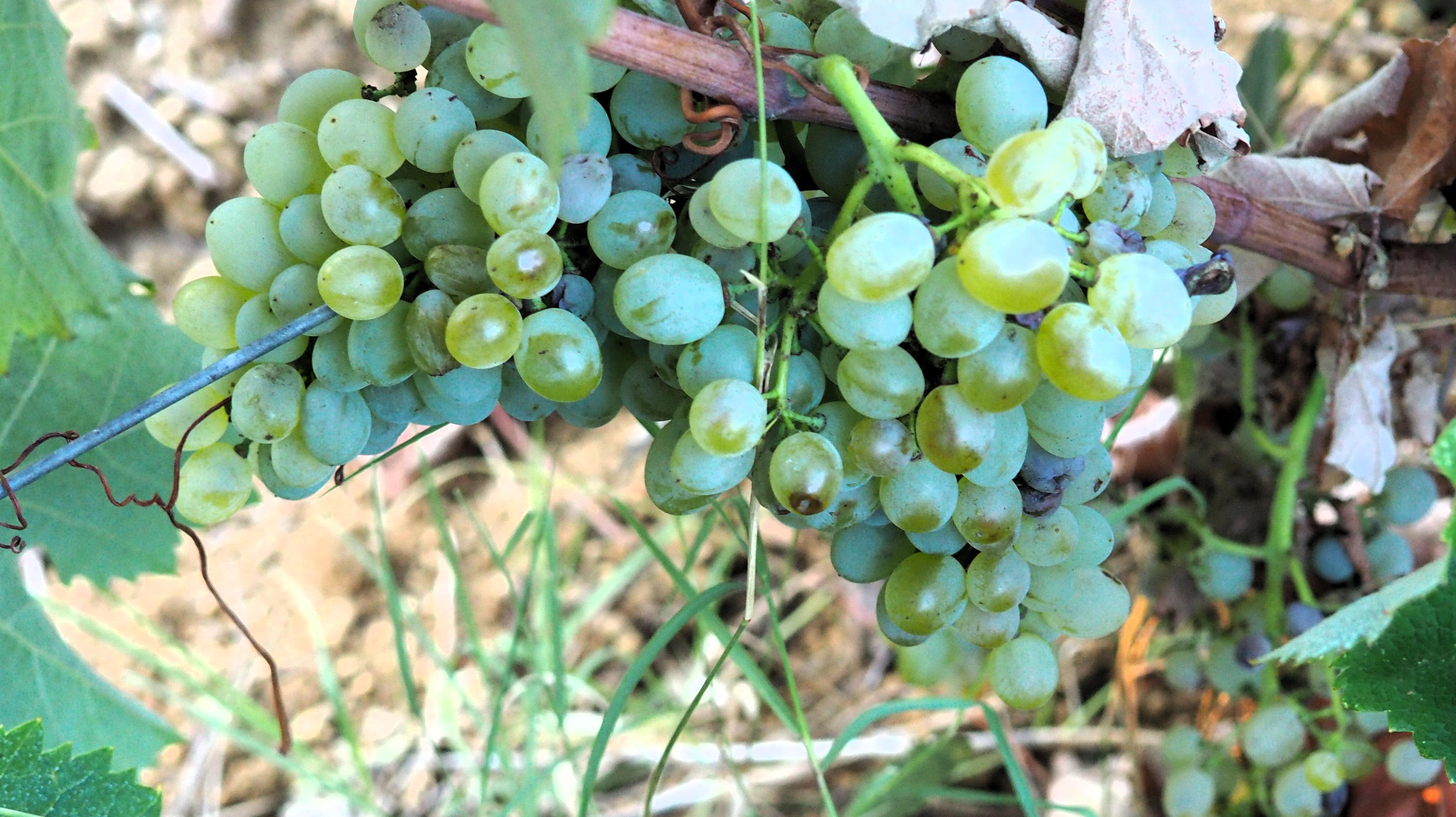
Grenache Blanc grapes from Jeff Coutelou
Grenache Blanc with some Grenache Gris
Nothing special then, perfectly decent bottles of wine but can we expect more from Grenache Blanc? After all production of this grape has fallen by two thirds in France since 1980 so it can’t be that great? Why was La Terrenal so special?
For me, and wine taste is personal, a top white wine brings a range of characteristics. This wine had aromas of white flowers and fruit, a sense of cleanliness but also a citrus note with stony texture. At first it tasted light, citrus again, but then it built in the mouth to add peachy notes, nutty too, suggesting some oak barrel ageing. There was no heaviness, no flabby notes to leave the palate overwhelmed or tired. Instead the freshness cut through again and the wine, from first glass to last, walked a fine line between the acidity and the fruit. It developed and changed but maintained its interest all down the bottle. A balanced wine, capable of being drunk on its own or with food.
So top marks from me, it was a bottle to remember along with that excellent Savennières. And one final point. Miramar was one of several excellent restaurants we visited in the area*, whisper it quietly but a standard higher than you’d generally find in France. The wine retails for around 40€ and the restaurant listed it at 49€, I wish other restaurants had similar pricing! I know it wasn’t cheap, yet it was a bargain. Now to hunt some down!
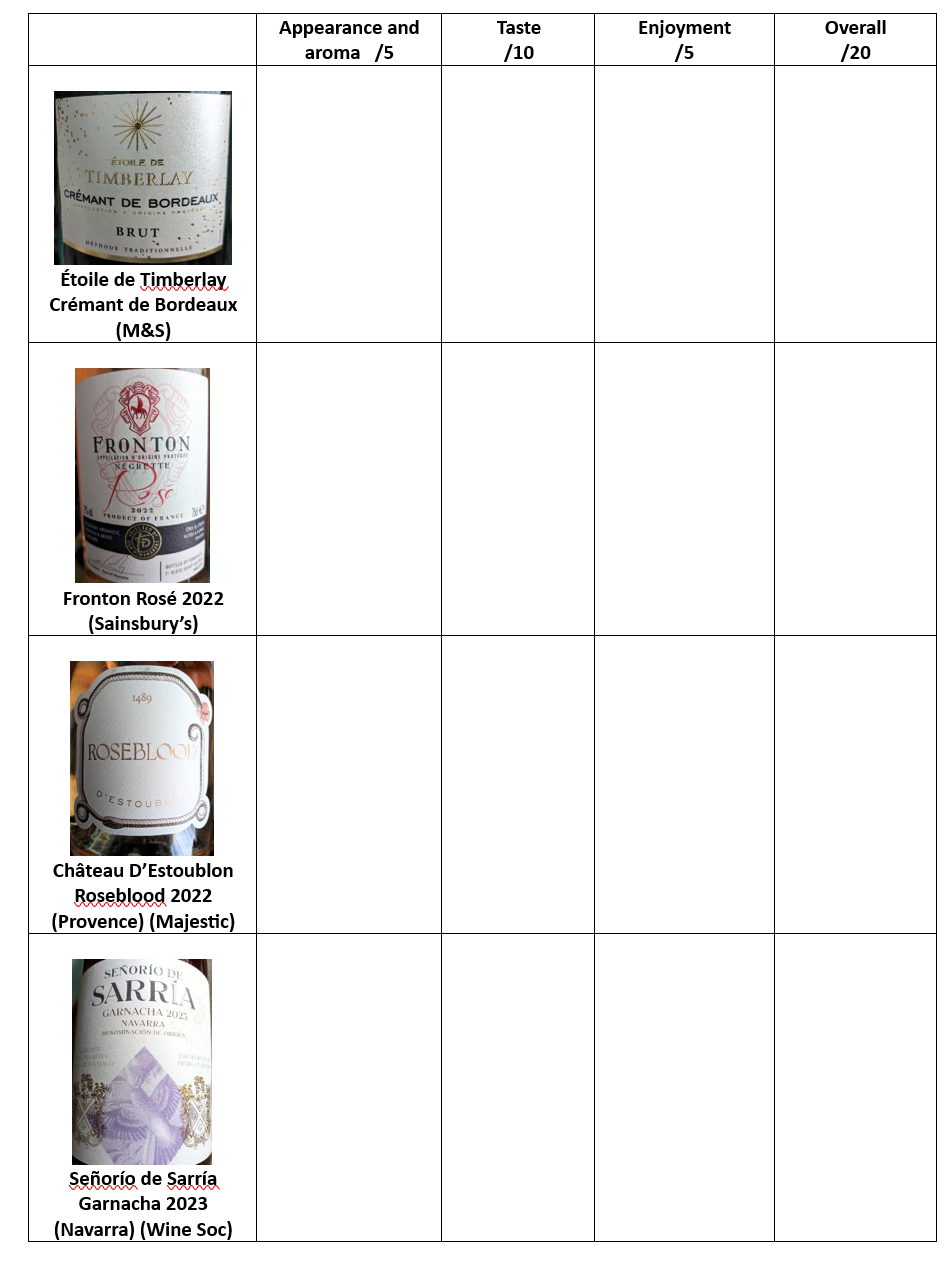
It was an honour to be asked back on Friday June 7th to Snod’s Edge Village Hall to lead a third wine tasting event there. When we started to plan back in March we had in mind that an event in early June would happen in warm, summer conditions, I recall saying that we might need plenty of ice and ice buckets. Well, the Spring and early Summer of 2024 have proved to be wet, cool and grey. Nonetheless, with a little imagination and plenty of enthusiasm the summer theme led to an enjoyable event with some interesting wines and discoveries. Bear in mind that this is a fund raising event and I stick to a budget for the wines, an average of £10 or less per bottle. The wines should also be readily available.
Whilst looking into the story of the eight wines I wanted to explore three themes; what to look for in a summer wine, trends in wine and buying wisely. The committee had suggested a tasting of rosé wines and though I broadened that out to include white, orange, red and sparkling wines I did select three rosés. Rather than the usual format of starting with lighter wines, eg white, and moving through to more structured red wines I decided to leave the rosé wines until the end with a sparkling wine to restart the tasting after a half time break. I think this worked well, especially given the final rosé wine, of which more soon.
I have copied up my notes, so if the writing looks a little ungrammatical please excuse me on this occasion. Feedback on the wines at the event are shown in italics.
Wine 1 – English White 2023 – Wine Society £9.95
Made by Three Choirs vineyard on the borders of Gloucestershire, Herefordshire and Worcestershire, the second largest in England (after Denbies) and one of the oldest, started in the 1970s.
A wine for aperitif though it is dry and would go with cheeses, seafood and goat’s cheese for example.It is aromatic; white flowers, hedgerows and gooseberries ; it is dry, not stone dry but good acidity ; it is light; 11% alc and should be drunk within 2 years.
Grapes not given but likely to include Bacchus, Madeleine, Reichensteiner, Siegerrebe (both crosses of Madeleine, latter with Gewurz) and Orion a hybrid grape (a crossing of vitis vinifera and other types of vitis eg rupestris and riparia). Hybrid grapes are becoming more important due to their ability to resist disease and cope with climate change, even Champagne has begun to experiment with hybrid grapes.
The Wine Society, £40 to join but £20 off first order, co-operative principles so prices low eg no tax rise after last Budget, events, information for wines, range, returns, free delivery no matter how small the order.
Unfortunately, I served this a little too chilled so the aromatics lost some of their exuberance and the flavours were subdued. The wine was given a positive reception but was one of the least popular, unjustly in my opinion as I have enjoyed this wine before and it’s very good.Lesson learned, don’t overchill!
Wine 2 – Tbilvino Qvevri 2021 – M&S £10
Aperitif but also spicy and with some tannins so would match spicy food, Chinese, Thai or even Indian
Georgia, Kakheti (east of Tbilisi) where they have made wine in qvevri for over a thousand years, ie clay pots buried in the ground where the grapes are put to ferment. Can be for shorter or longer periods and that would affect the tannin, colour and flavour. This leaches the colouring pigments from the skins giving it an amber or orange hue, hence the term orange wine. One of the fastest growing trends in wine, sales have doubled in each of the last five years and now available in most supermarkets.
Tbilvino is now a big concern (7.5 million bottles) owned by 2 brothers and modernised in 2006 after the communist days.
Made from Rkatsiteli grapes, the most planted in Georgia, its name means red stem. Late budding and maturing and relatively resistant to mildew. Relatively neutral when conventionally made but qvevri elicits flavours of honey, dried orange peel, spices, apricot and other stone fruits. But also tannins which we can find unusual if not used to orange wine. 12% alc
M&S don’t do discounts like other supermarkets. Sometimes get discount on a case of 6, like Majestic. Most supermarkets and Majestic offer 25% at various times, especially round Bank Holidays so take advantage but make sure you know the price hasn’t been artificially raised beforehand.
Value of the wine in bottles – £5 bottle = 29p, £7.50 = £1.06, £10 = £2.10, £20 = £6.33
Tax hike next February, 50p per bottle over 11.5% abv. so stock up!
Orange wines continue to divide opinion for consumers not used to the style. This bottle is a gentle(ish) introduction to one of my favourite styles of wine but only one person selected it as their favourite on the night though many said they liked it or at least enjoyed trying something different for them.
Wine 3 – Morandé Pais 2019 (Chile) (Majestic) – £8.99
Light red for those who prefer reds, a light chilling will concentrate the fruit flavour. Can match to prawns, salmon, meats and cheese as well as grilling. Raspberry, blackcurrant fruit aromatics and flavours. Still a tannic note and 14% alc. The name One To One because one vine produces one bottle, the average is 1.5 bottles per vine though some commercial wines are based on up to 5 bottles per vine.
Pais was brought to the Americas by Cortes and the conquistadors in the 16thC, known as Criolla grapes. Traditionally made for everyday drinking wine, jug wine and not meant to be complex.
Morandé founded in 1996 but bought older vines including the Pais, 60 year old vines. Carbonic maceration and open wood tanks to soften the wine and bring out the fruit. Based in Maulé Valley, towards cooler south of Chile which will help freshness. Trend for fresher regions – higher altitude wines, eg Alps and Jura in France.
2019 is quite old for such a light wine, look for younger vintages if possible, Majestic are now selling the 2021.
Despite its age the wine tasted well on the night, fresh with a good fruit profile and some tannins. It was a popular wine at the tastingand it’s good to see unusual grapes being given a chance by major UK retailers.
Another light red, pale colour, almost rosé like colour. Floral, herbal aromas and red fruits. Red fruit flavours, some sweetness from the fruit but with refreshing acidity to match food though this would serve as an aperitif. Seared tuna, grilled veg or even aperitif. Red fruit, spice a little tannin but light and very drinkable at 13% alc.
Santa Tresa based in South East Sicily, quite low altitude of 24m. Frappato was developed in this region centuries ago and the estate has its own clones. Scientists have found that it is linked to the Sangiovese grape from Chianti. Rina Russa means red sands, the soils in the vineyard. Organic production, irrigated but with their own reservoir and using fertilizers based on their own beans and plants.
Supermarkets sometimes put out new wines and grapes such as the Found at M&S or Loved & Found at Waitrose. Try them.
This proved to be the most successful wine of the first half of the night, appreciated by those preferring red wines and others too. It was showing well with the chilling highlighting the red fruits.
Wine 5 – Étoile de Timberlay Crémant de Bordeaux (M&S) – £10
Sparkling wines for aperitif but also food, fresh for summer dishes such as salads, fish, chicken.
Champagne the obvious choice, Prosecco too. Crémants are traditional French sparkling wines made in the Champagne method, Burgundy, Loire, Jura and others. Bordeaux is a huge area with 7,000 wineries so there are a lot of grapes and wines and the market turned against traditional wines so some producers are looking at other productions. Whites are making a comeback and Crémant too.
This is made from 33% Semillon but also 62% Merlot and a tiny bit of Cabernet Franc, the latter two being red grapes. Wine is taken off the skins straightaway to keep it white, though look out for Rosé Crémant too.
Apple and elderflower aromas? Anise? Lemony freshness? But also yeasty, hazelnut notes. 12% alc.
Yeasty notes come from secondary fermentation in bottle. Add sugar and lees to the wine and leave it in bottle to create bubbles and flavour. The yeast dies as it develops alcohol and the dead yeast cells (called lees) give flavour of bread, brioche to the wine. Prosecco and Asti use other methods so less likely to have this dimension., it’s a matter of choice.
PetNats a new trend where the wine isn’t fined or extra sugar added, it is simply bottled fresh wine so ferments in bottle. Sales have boomed, up 500% in the last two years.
Sparkling wines often on top shelf in supermarkets, be careful, if they are close to lights, light strike can damage wines with UV interacting with phenols in the wine to create sulphurous notes.
This was very successful on the night, refreshing, palette cleansing and plenty of flavour. It may not have been Champagne but at the price it was a good choice and lots of the attendees were saying they’d be seeking it out.
Rosés
THE biggest trend in wine in the last ten years, sales have risen from around 5-6% of all wine sold to 12%
Rosés started in Ancient Greece where they added water to wine and the Phoenician city of Marseilles was the starting point for modern rosé, Provence remains the heart of rosé. There are various styles and myths. Colour does not relate to quality, they can be drunk all year round like white wines, they are not all sweet and bubblegum, they can age and can be quality wines.
Methods of making
saignée (bleeding) – run juice off red wine early in its fermentation before the skins have given off colour just like we saw with orange wine. (By benefit, the juice on the skins becomes more concentrated)
direct press – press red grapes and run the juice straight off
Clarete – a Spanish technique of blending a mix of red and white grapes in tank to produce the desired colour
Assemblage – blend finished red and white wines (only allowed in Champagne)
Also known as Vin Gris, Rosado or Rosato.
Wine 6 – Fronton Rosé 2022 (Sainsbury’s) – £8
Made in SW France near Toulouse and with a local grape Négrette. This has good colour but not high acidity so good for light reds and rosé. Reviews all suggest this has sweet aromas of Turkish Delight, even Parma violets. However, the flavours are dry, red fruits such as raspberry, cranberry and cherry, sour notes and acidity for freshness, even minty.
The aromatics make it suitable for aperitif (12%alc) but the freshness suggests good match for light grilled foods, vegetables, halloumi perhaps.
Made by the cave cooperative, a source of good value for many supermarkets – some are better than others so try to do some research.
This made a good start to the rosé wines, a classic light but flavoursome wine which would be perfect on a warm summer’s evening in the garden and at a keen price from a region needing support.It has been a successful wine for Sainsbury’s over many vintages and garnered many plaudits in the press.
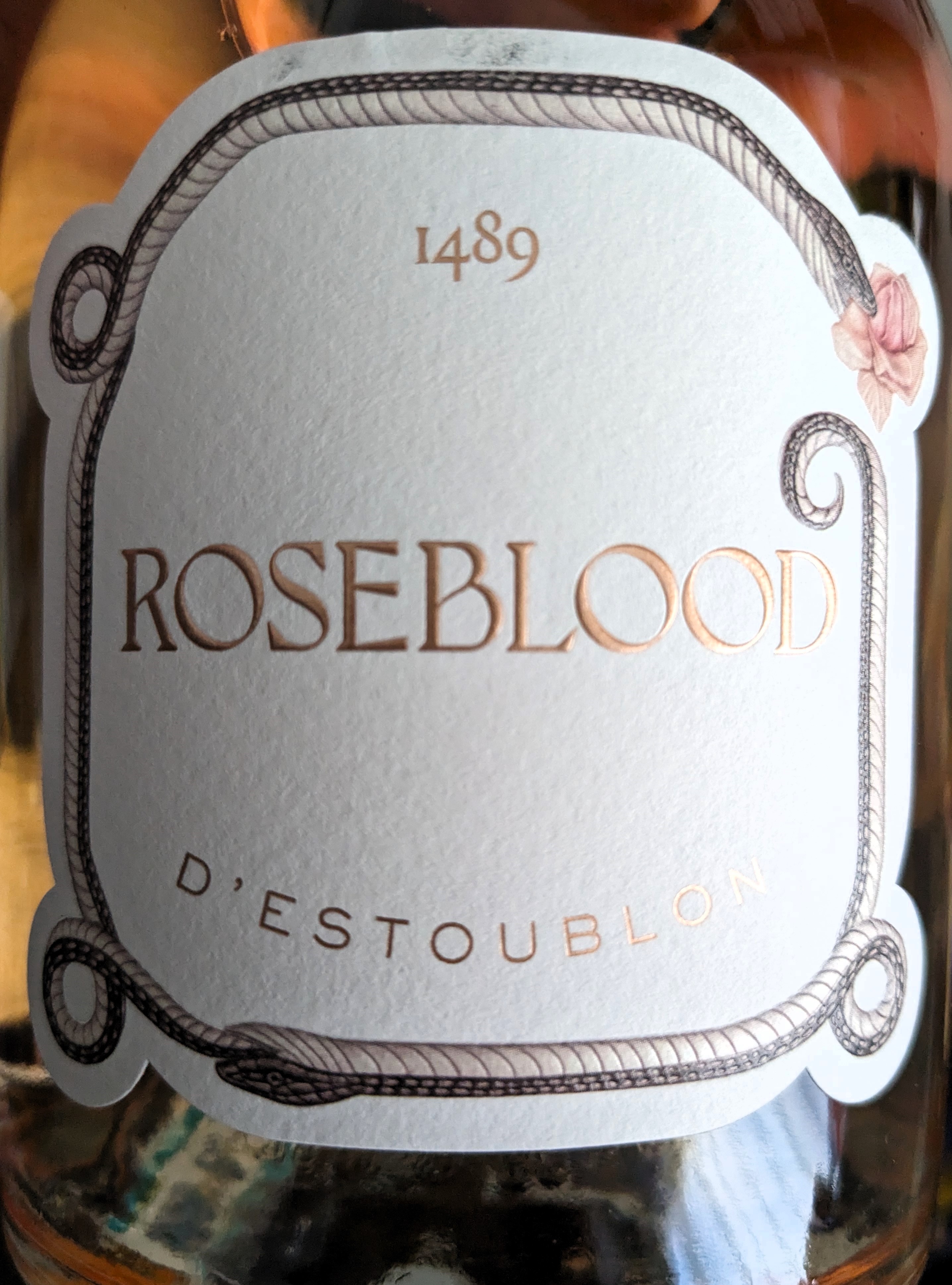
This was an exciting discovery as Majestic had it reduced even from the usual mix 6 discount. Therefore an expensive wine became viable on our budget.
Why exciting? As I said Provence is the heartland of rosé wine and there are some big estates – Esclans with Whispering Angel, Miraval of Brad and Angelina fame, Mirabeau and Estoublon, south of Avignon. A huge estate with olives, vines and a beautiful chateau. The estate is owned by some of France’s elite, including former President Sarkozy and Carla Bruni. They employed the winemaker from Cloudy Bay (Victor Joyeaux) to create it but the owners of Chateau Lafite also own some of the estate so plenty of investment and expertise.
This is the new flagship wine of the latter estate launched in 2020.
Made from Grenache, Cinsault and Tibouren. The latter was a Greek grape imported to Marseilles during its Phoenician time, matching the story of rosé wine I mentioned earlier.
Getting high marks from the likes of Decanter. Colour – pale, the Provencal style of onion skin. Aromas – red berry, fresh fruit leaves. Flavours – delicate apricots, blackcurrant and fresh minerality, 12.5% alc. Made for Mediterranean dishes and aperitif
Celebrity wines – Caveat emptor – they all say they have been involved but at most that usually means they liked the wine made for them. There are exceptions but this is a marketing exercise and you’ll pay more than for the same wine under another name.
Fascinating. This was well made, good freshness and yet fairly neutral in aroma and flavour. There were some in the audience who liked it a lot but just as many preferred the Fronton and certainly the price of the Fronton! Would I pay £21.99? Do you need to ask?It is a much more serious wine, it would certainly age and be a good food wine. Is there a market for such a wine? Is that why it was so discounted?
This is a Rosado from Navarre in NE Spain, next door to Rioja. The area includes the driest area of Europe (Bardenas Reales) and the vineyard is based in the hills and influenced by the maritime winds too. Female winemaker Milagros Rodriguez wants a full coloured wine based on the Garnacha grape (25 year old vines with some aged 60). A 16thC wine domaine which was basically pulled down and restarted in 1953.
In articles on 2024 rosé wines this was selected by Decanter, Independent, GQ, Telegraph and Times as one of the best on the market despite its price.
Aperitif, but with enough body for a variety of foods, cheeses and even spicy food. Strawberry, cherry fruit aromas and flavours and the elongated saignée method gives it tannin to match food. It is bone dry, just 0.5g/l of residual sugar, though this means sugar turned to alcohol at 14% but the wine is very balanced.
Price isn’t everything, read reviews by those whose judgement you trust.
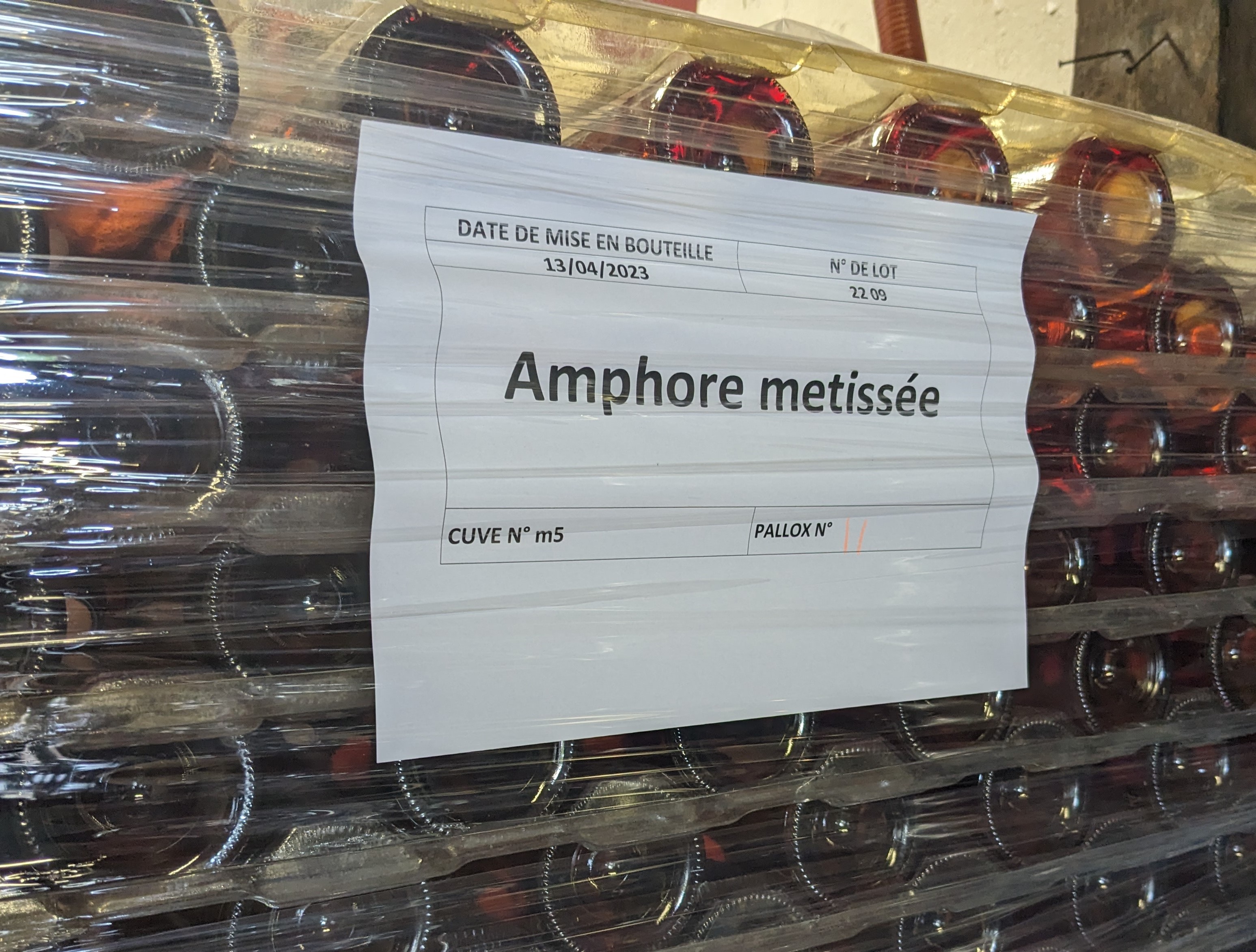
New trends – field blends and the clarete method described before, also known as assemblage or métisse, producing might red or rosé coloured wines.
This was the wine of the night. I thought so and most of the audience shared that view. Yet, it was the cheapest wine of the night. The deep pink / light red colour is attractive, the aromas and flavours are upfront and appealing. Plenty of freshness, tannin to support food but easy drinking too. Terrific winemaking and what a wine. The only negative is the plastic cork, surely we can move on from them these days. Give me this over the Whispering Angels or Rosebloods every time. It was very pleasing to see so many appreciate this wine, well done the domaine, winemaker and Wine Society.
The Rosado was certainly the most popular, followed by the Frappato and Crémant with the other two rosés just behind. Overall, this was a successful evening with a group of people keen to try new styles and explore the stories behind the wines. All we need next time is some warm weather!
Louis taking a photo, Jeff and visitorlooking atthe Xarel-lo vines
Strands sometimes come together. At Bons Vivants I met a Danish woman talking to Jeff Coutelou who is writing a thesis on natural wine, climate change and the environment. She had been told by many vignerons to talk to Jeff as he is so knowledgeable about vines, plants and the environment in general. She arranged to visit Puimisson on the 23rd, a week after the tour I featured in my last post. We were also welcoming Louis, from Narbonne, who has worked with Jeff many times at vendanges and, indeed, for extended periods. It turned out that he too is writing a thesis on natural wine as part of his studies for the University of Paris. So, a combination of my last few posts and coincidences galore led to another tour of the vineyards. At this time of year it is interesting to see how quickly the vines change, so were things so different in just a week?
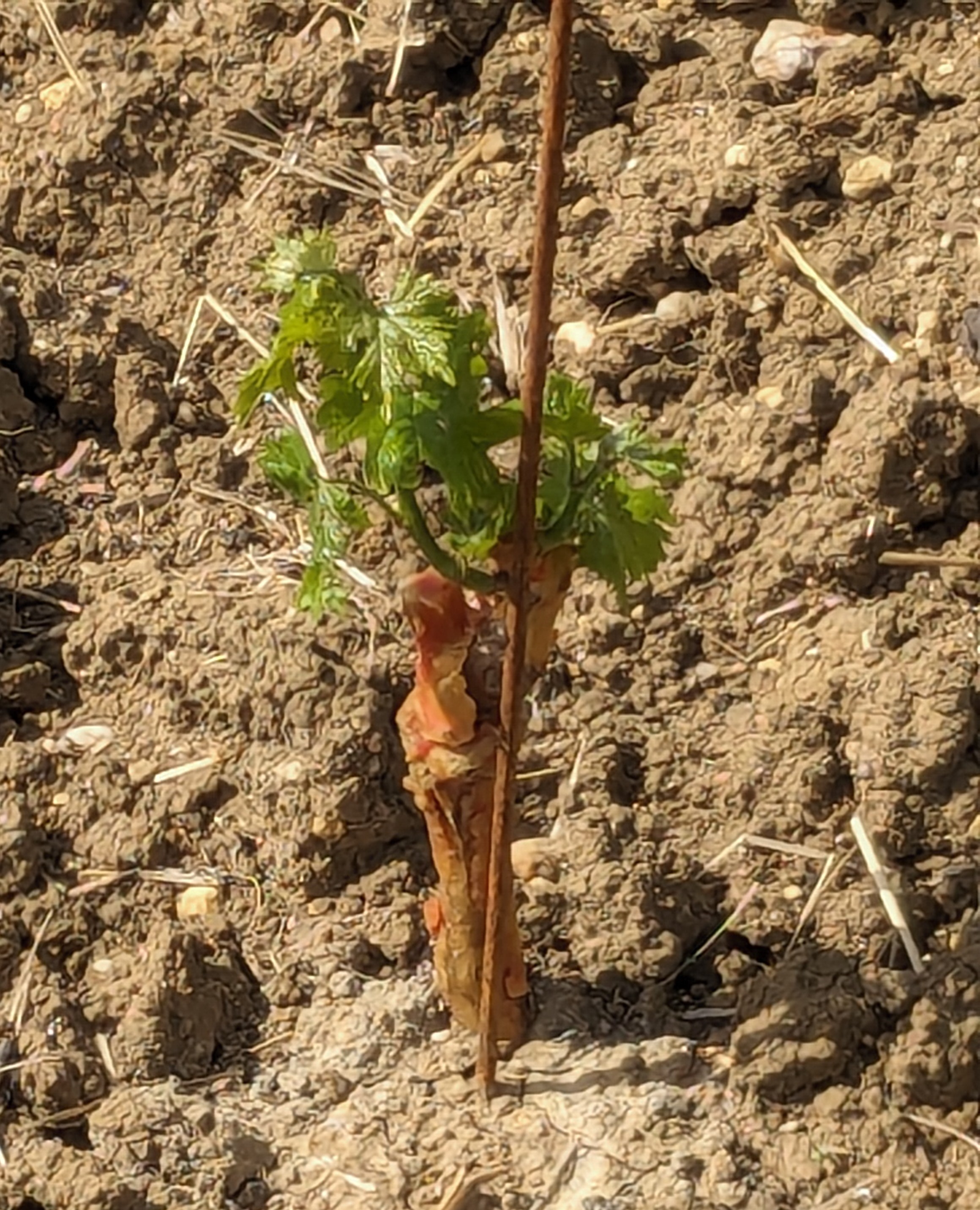
La Garrigue planting 17th
La Garrigue planting 23rd, some growth
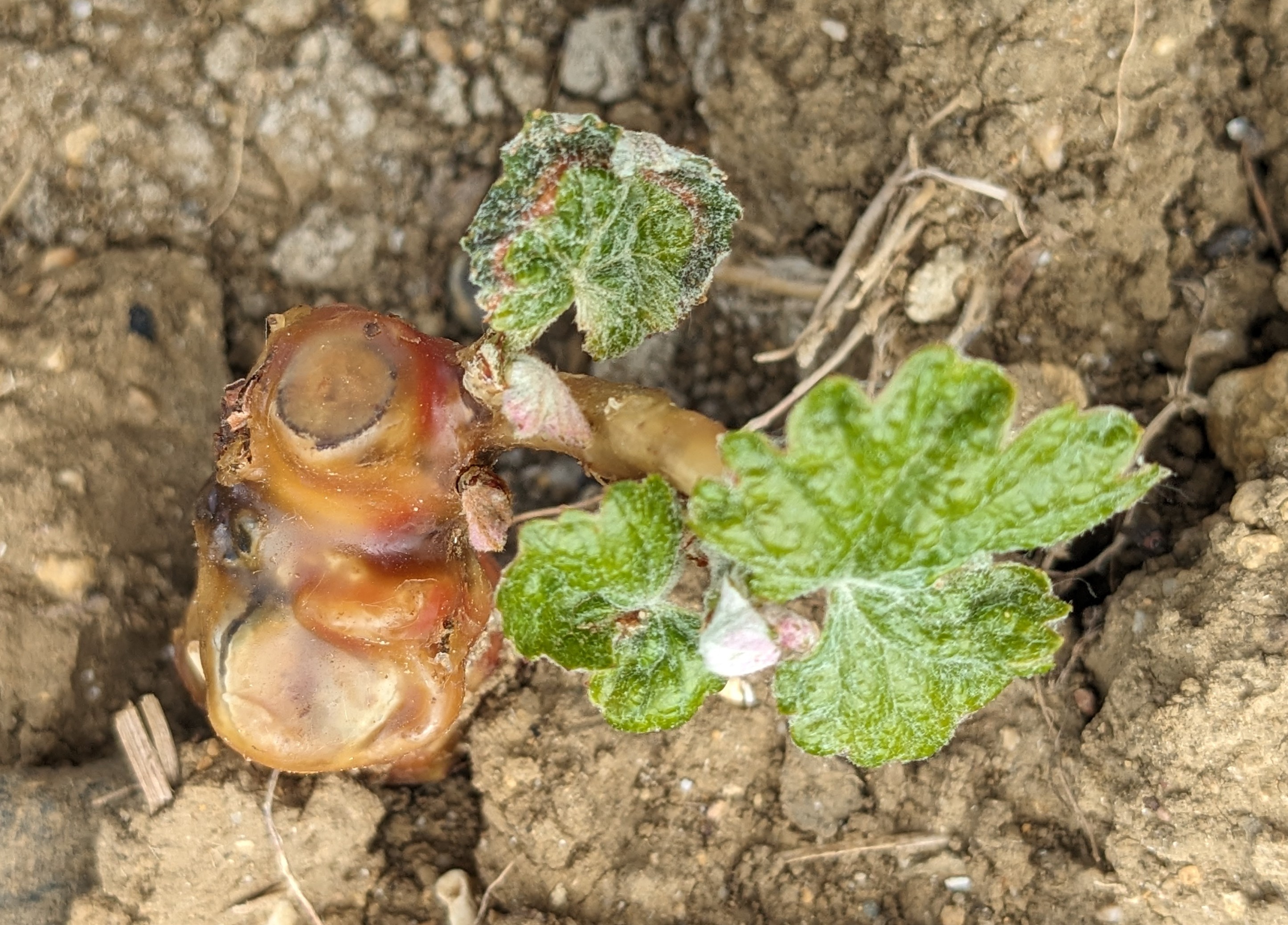
As I said in the last post Jeff had held a gathering of fellow winemakers on the 18th and it was a cold day with a small fall of hail as we sat in the garden. One of the consequences had been that some of the newly budded vines were grilled by frost. Vines develop a contre-bourgeon after frost or hail damage, a kind of second attempt so they will grow through the season (unless more frost damage occurs) but grown vines will not bear so much fruit. Obviously, new vines won’t develop grapes but it was interesting to see how rapidly they responded to the damage.
Grilled bud
Contre-bourgeon with the grilled bud behind
In Rome vineyard the development of the buds and flowers was plain to see on the Cinsault vines.
Cinsault vine 17th
Cinsault vine 23rd
On the tour some interesting points emerged. For example, Jeff explained how some of the grape varieties such as Macabeu are better adapted for coping with heat than others. The back of their leaves has a rougher, waxy surface protecting themselves better than the thinner leaves of other varieties.
Clairette leaves with rough surface, 2023
Macabeu leaf showing on the right
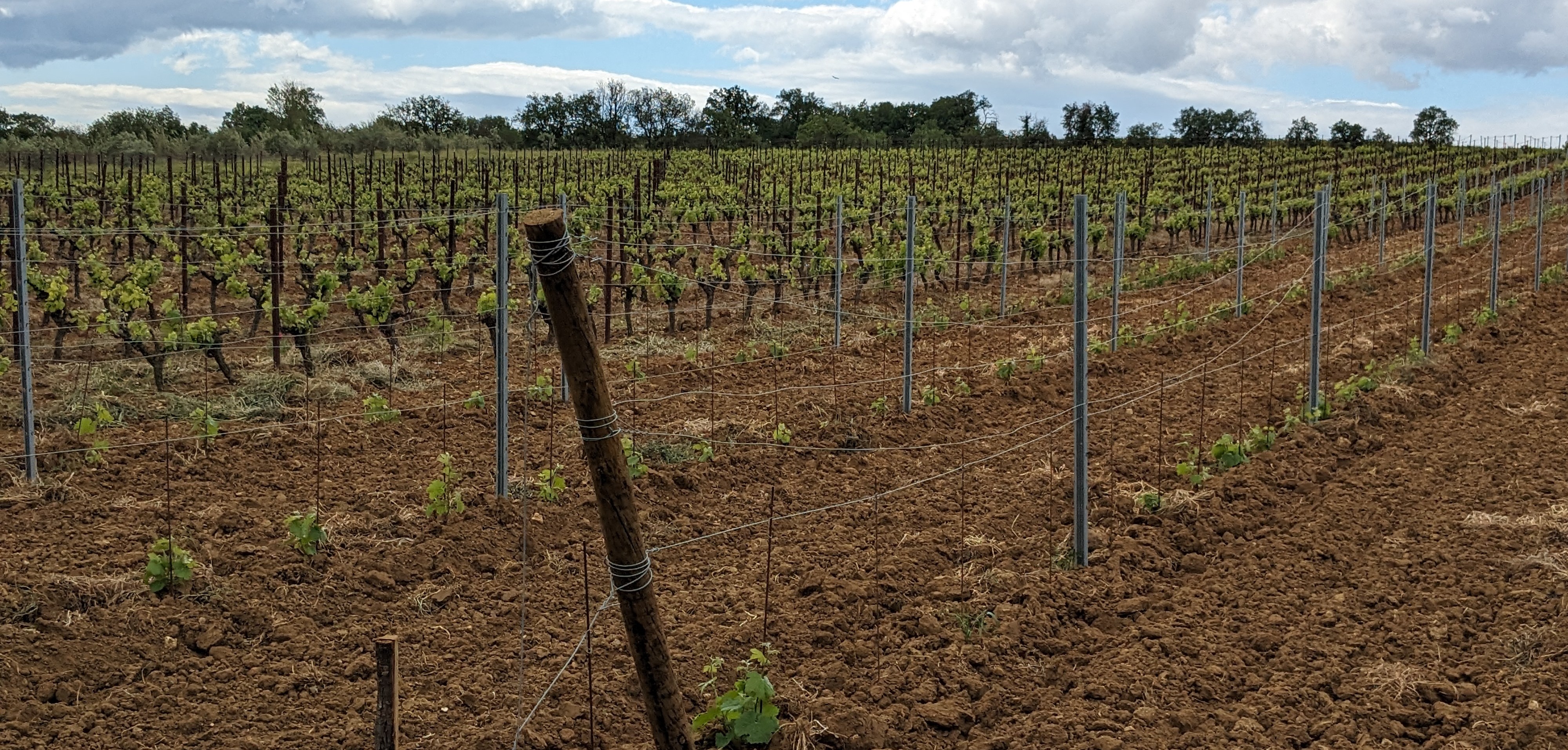
A visit to the Flower Power vineyard also revealed an interesting contrast. This was planted ten years ago and it is fair to say that it has proved to be a disappointment after early promise. In 2016 I spent a whole day in this vineyard picking snails off the young vines, but, like the proverbial painting of the Forth Bridge, it was a job without an end. The snails returned that year and devoured much of the plants and they have never really recovered from that. The 2015 Flower Power wine was excellent, recognised by La Revue du Vin de France even, and widely available. However, since then the vines have produced such small quantities of grapes that they have had to be assembled with grapes from other vineyards. The vines themselves remain short though they have grown in the last couple of years.
Over the unpaved road is a vineyard planted by a conventionally farming producer two years ago. The vines there are much taller than the ten year old Flower Power vines. They are also very spindly and lack substance, fed by irrigation and fertilisers. They will make grapes for wine this year and probably be grubbed up within ten years, qualifying for subsidies! Now, you could argue that they will be have been more successful than the Flower Power vines but at what cost. For example the soils are bare and every time it rains the topsoils are washed away. This post from 2014 illustrates the point clearly.
Flower Power
Conventional vines
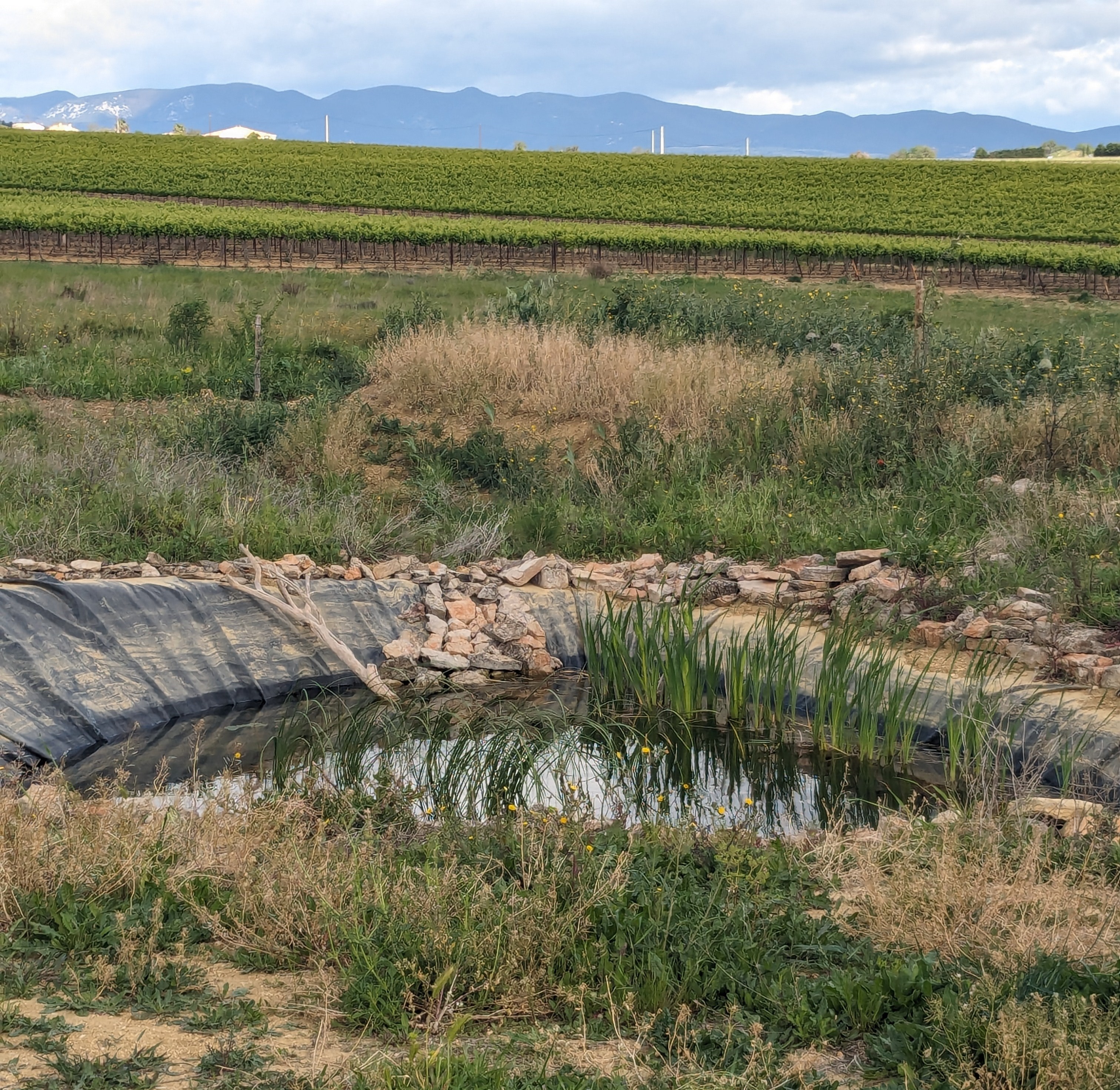
Meanwhile, the water level in the marne created by Jeff to help animals was getting low. There were tadpoles and animal tracks showing it was doing its job but rain was needed here just like the rest of the vineyards. Happily, shortly after we left the Languedoc to return to the UK, heavy rains arrived for a few days and Jeff tells me that the vines are thriving though the water table is still very low beneath the surface.
After the journey down western France it was time to return to the beloved Languedoc. It had been a few years since we were there in Springtime but, with the added pull of Bons Vivants, it was time to return. This is so often the nicest season in the area, flowers blooming before the summer heat makes them wilt, birds everywhere and the sunshine to warm you up without being too hot. In the vineyards too the end of April sees the budding and flowering of the vines, a renewal of hope for the vintage ahead. Well, that was the plan.
Rome with budding Cinsault
Unfortunately, we arrived for a fortnight of cool weather with a chilling Tramontane blowing for ten days. Indeed Jeff told me that the Spring so far had been cool, other than a few days, and as a result, the vines were a bit behind. Budding was taking place but it was still too early for flowering, delayed by the cool weather. On the Thursday when some of Jeff’s friends came to share lunch and wines we actually sat through a shower of very small hail, fortunately not enough to cause any damage for Jeff. Elsewhere in France and Italy vignerons were less fortunate. Hail and frost hit widespread areas from Alsace and the Moselle to Sicily via Burgundy (especially Chablis) and Beaujolais. Many winemakers will have lost much of their 2024 crop before it has even flowered. Yes, the vines will carry out a secondary budding but that is never the same as the first in quality or quantity.
As climate change unravels our ecosystems it is becoming an almost annual story. Vines bud and flower sooner (despite the Languedoc’s story this year) and are therefore more vulnerable to Spring frosts. The famous Saints de Glace (the saints days which traditionally mark the end of frost risk) took place on the 11th to 13th of May this year so April budding and flowering is exposed to that risk. Sadly, that risk became all too real again.
For Jeff, however, the main problem on my first visit to the vines on April 17th was the lack of rain. Again. Another feature of climate chaos, drought has been affecting the Roussillon and a band of the Languedoc between the coast and hills. When talking to friends, like Olivier Andrieu in Faugères, they were happy with this Spring, rain had fallen and all was set fair. A dozen kilometres south though and the rain had not fallen on Puimisson, 25mm up to that date at Jeff’s.
Malvasie de Sitges (left) and Parellada (centre) in Peilhan
New Syrah vines alongside established ones in La Garrigue
Jeff and I toured the vines and all was looking well at first sight. Vines were small still, not as tall as I recalled at this time of year but growing steadily. Jeff told me though that the vines were using their reserves of water already. New plantations such as the Parellada in Peilhan and Syrah of La Garrigue were requiring plenty of watering to survive their first few months. The reservoir in Peilhan, designed for animals to drink, was very low in water. It was however, attracting animals, birds and was full of tadpoles and froglets, a true oasis in a very dry landscape.
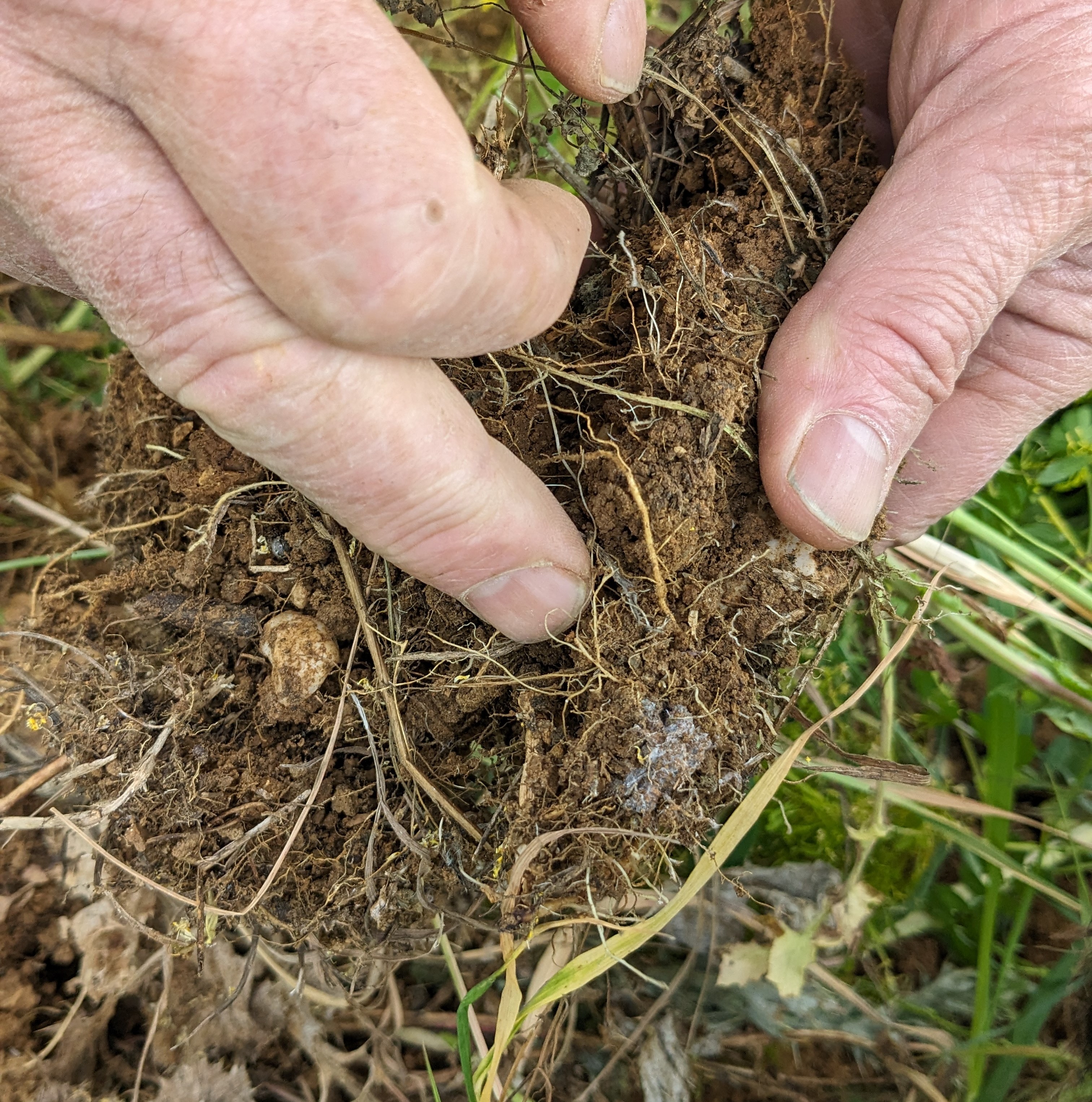
As a result of all this Jeff had not ploughed this Spring, just a light raking. He did not want to turn over the soils and expose any dampness buried in the soils. It is ten years since he ploughed Rome vineyard and the vines there looked well. The soils there are also full of mycorrhizae. These fungal threads carry all sorts of benefits to and from the vines and other plants building a whole network of energy, information and life. It is an area of study which is only really starting to be understood, we are scratching the surface literally and metaphorically. Such study will inform Jeff and others about their practices in the vineyards, there are already many who have abandoned ploughing altogether such as the aforementioned Andrieu family at Clos Fantine.
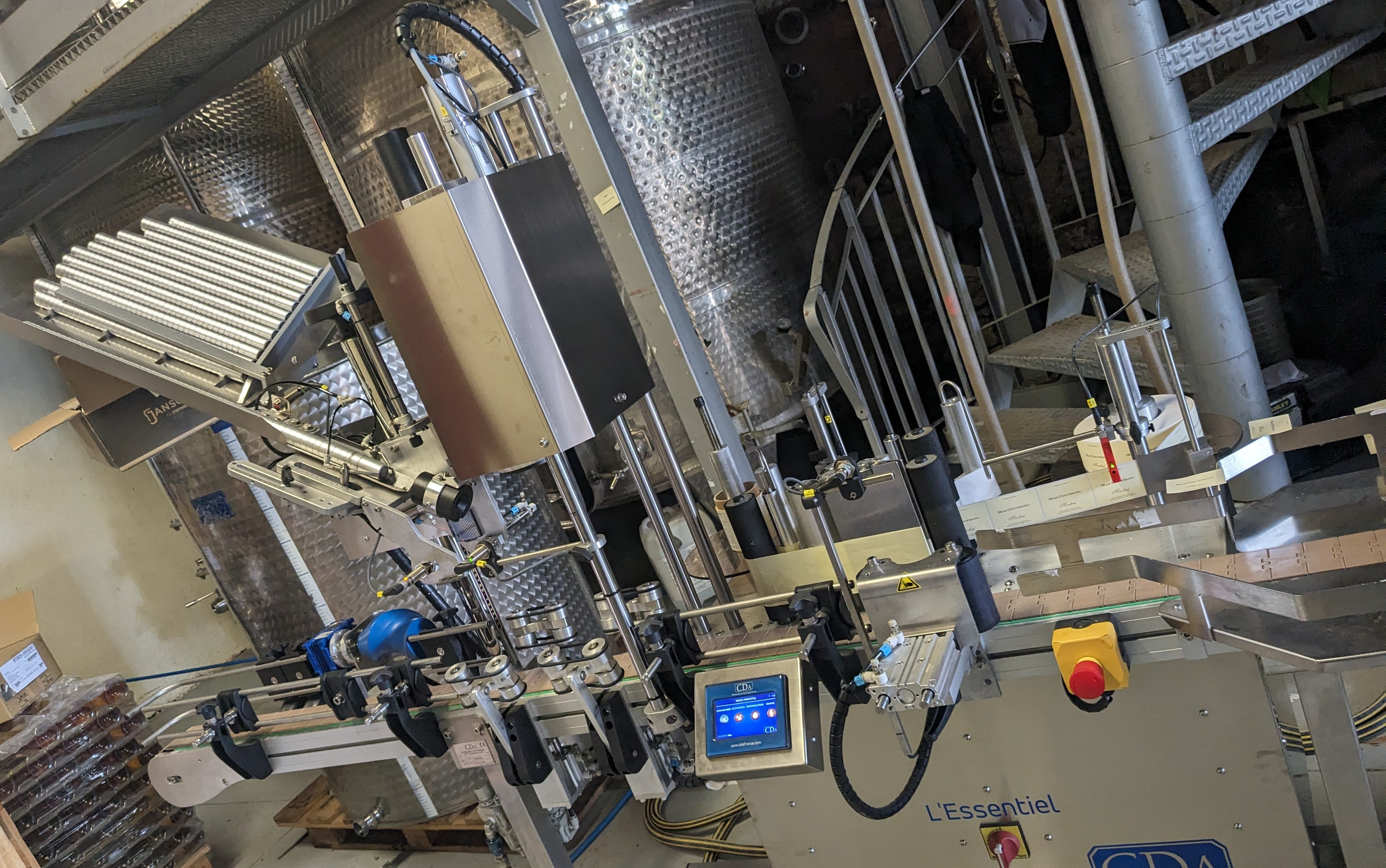
Back in the cellars Jeff, niece Flora and others have been busy bottling some of the 2022 and 23 wines and on the 17th Flora was labelling some of them for orders to the USA with a new machine to make the job easier. Another change was the van. The little Renault Kangoo had been working for 30 years and as this video shows it had certainly given its all! Now Gilles and others can travel in relative comfort.
So, that was the scene on the 17th of April. Have things changed? I’ll update next time.
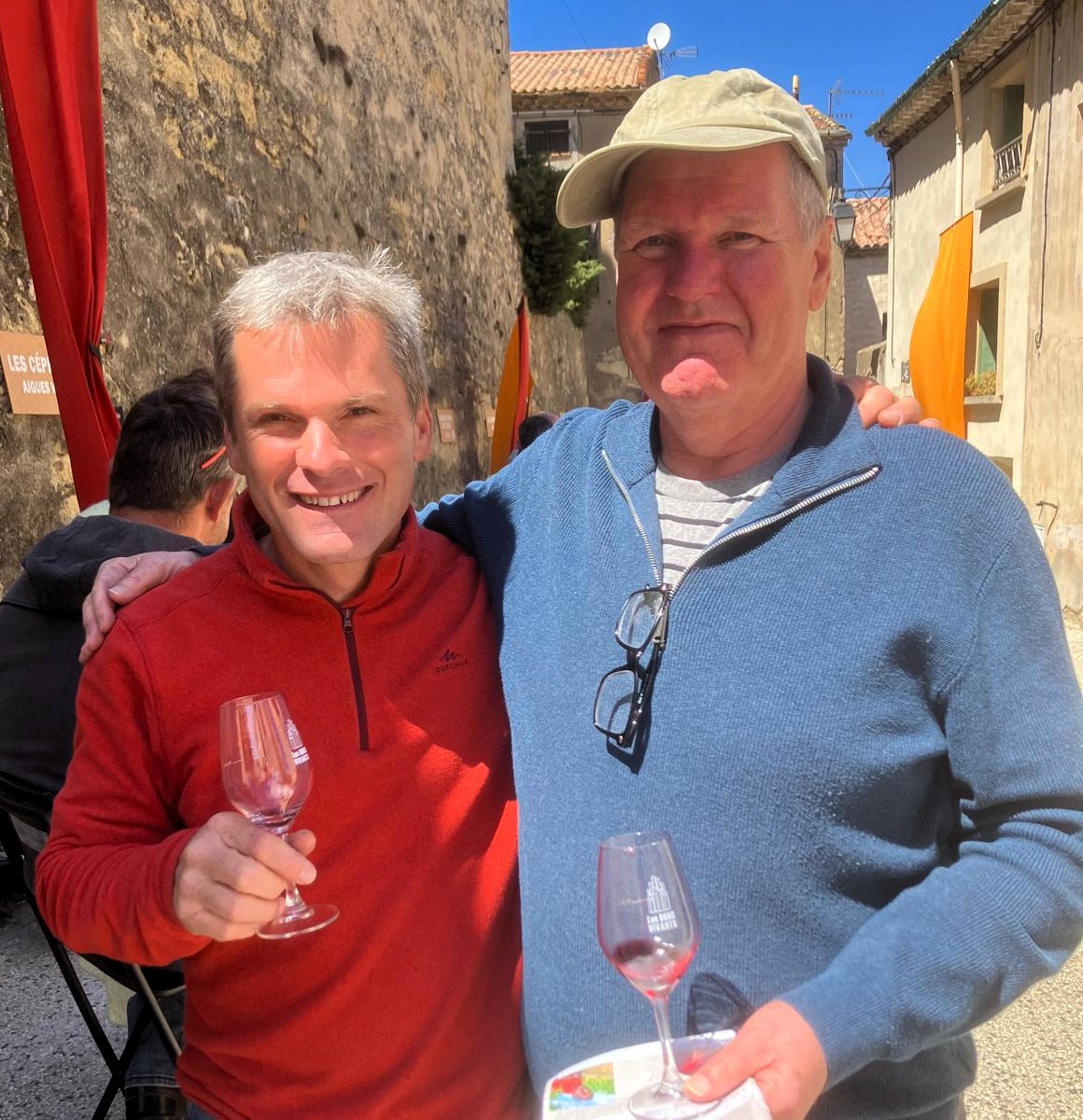
After going Ouest we headed back to the Hérault for an event called Bons Vivants. One of the driving forces behind the event is Fred Lamboeuf of Picamandil in the village where I have enjoyed many a meal and bought many a bottle. Jeff Coutelou is based in the next village and he, together with many natural wine producers, were present on April 20th, spread around the village and its château. The event was very well attended and lived up to all expectations with excellent wines, lively animations and good food provision.
It was a good opportunity to catch up with friends, old and new. Jeff held a get together of vignerons earlier in the week, some new to me, and I was able to enjoy more of their wines at Bons Vivants. There are too many wines to describe in detail so here are my favourite wines.
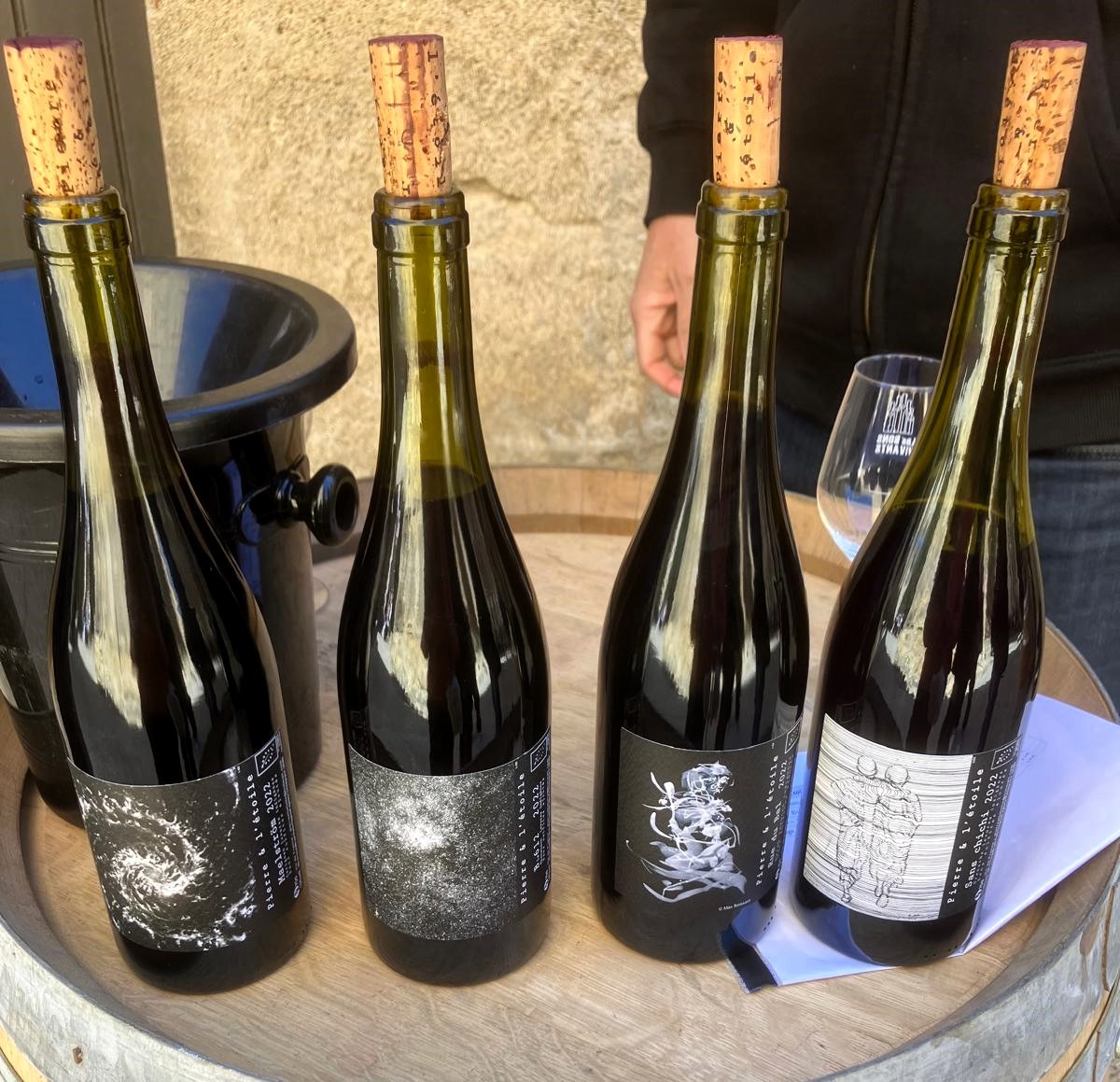
Pierre et L’Étoile is the domaine of Pierre Regnault based in Assignan. After early vintages Pierre realised that sulfur and sulfites were causing him personal discomfort and illness. At the same time he decided to reduce the power and alcohol content of his wines as well as remove chemical treatments in the vineyards. The wines also changed to monocépage and it was his Carignan, Maelstrom 2022, which I liked most, full of fruit but also length and freshness, so much so that I bought some.
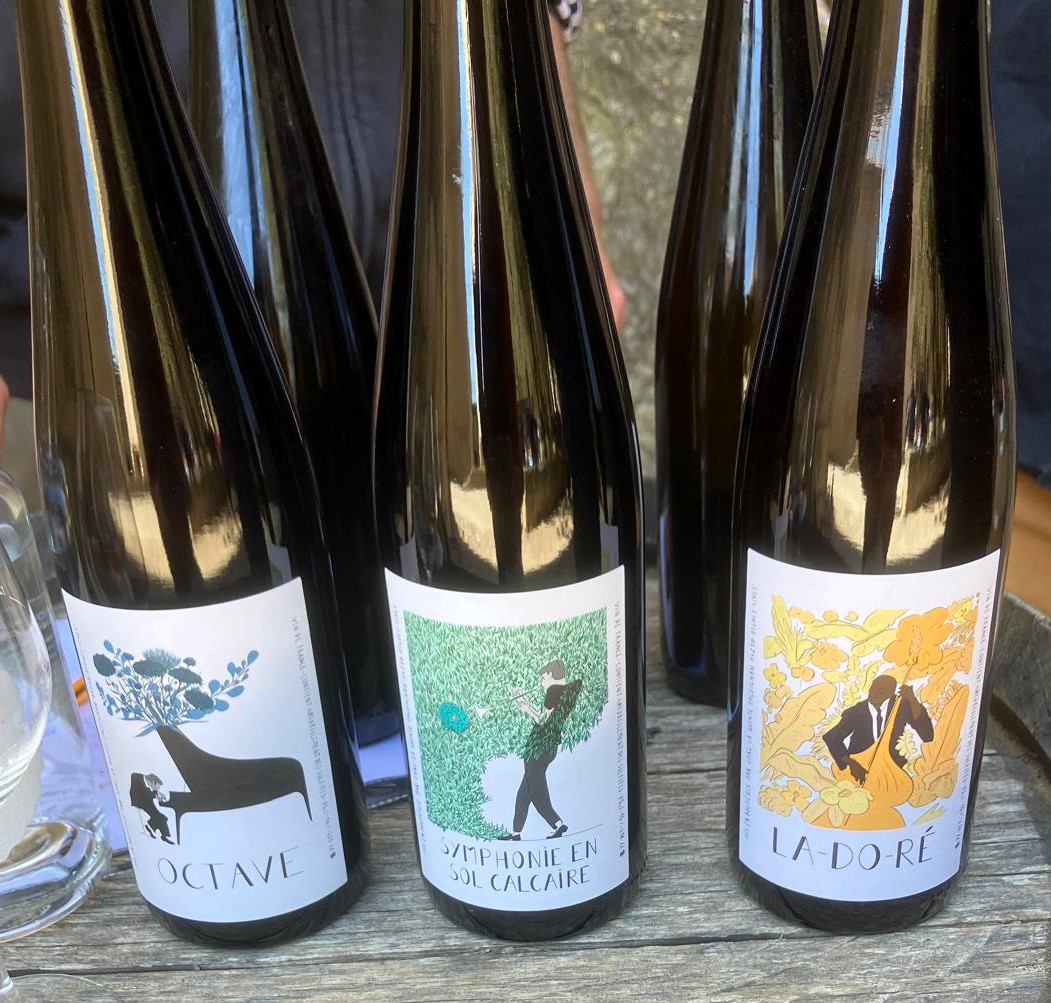
La Quinte is the project of Matthieu Schutzger and Pierrick Lieber, two young Alsatian winemakers who have established themselves in Aigues-Vives, not far from Pierre’s domaine. Named after the space between music notes these two also have a distillery and use plants for medicinal use on their vines. Bottled in Alsace flutes as a nod to their heritage I enjoyed their Syrah, Octave (musical influences abound) but most of all their white wine La Dorée22. Made from Grenache Blanc grapes not picked until December 15th (Alsace influence?) and given 3 days on skins the wine was fruity with a hint of late harvest sweetness but essentially dry and a note of oxidation added more complexity. Very promising.
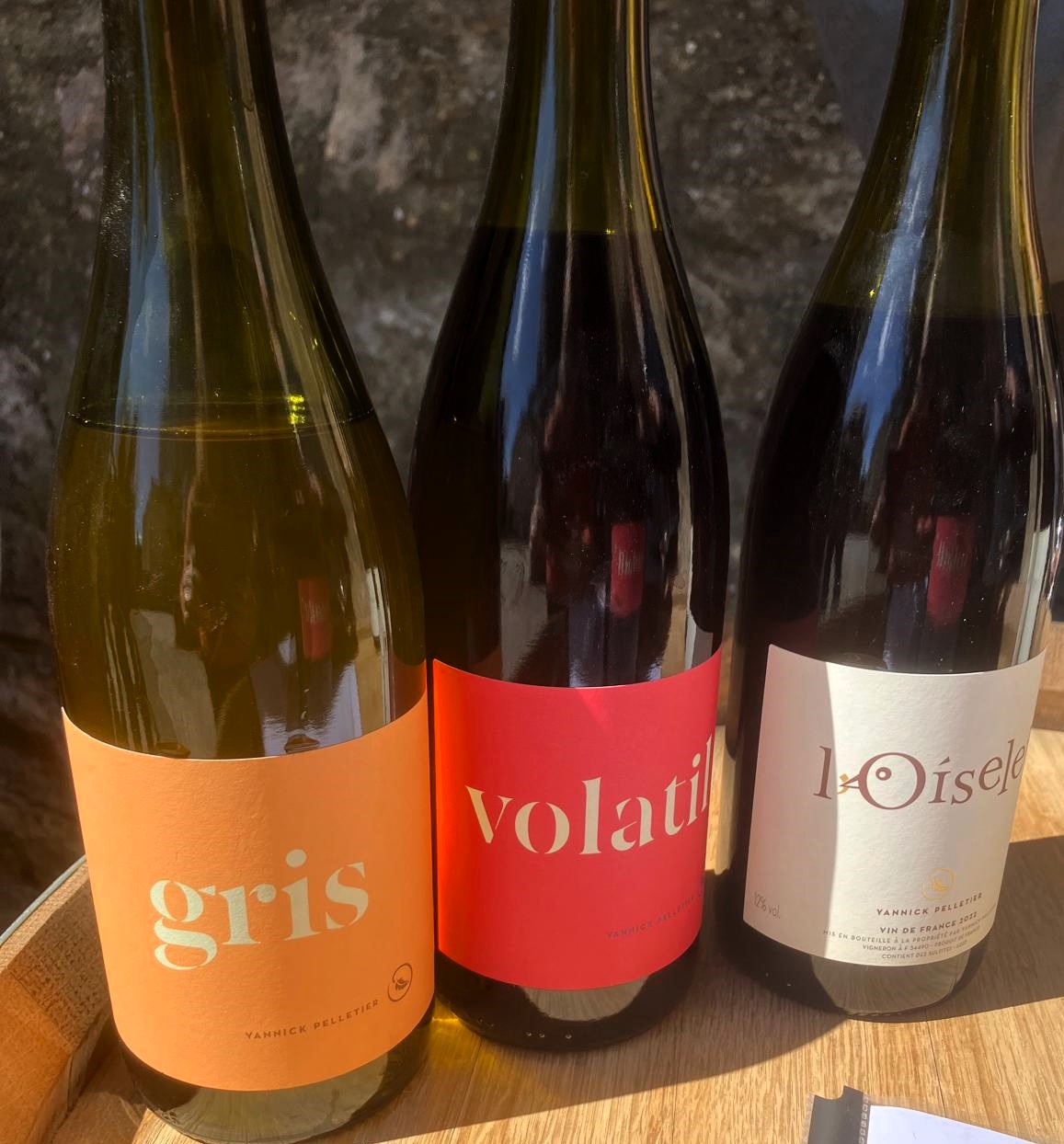
I have known Yannick Pelletier for many years now and he is one of the nicest people in wine, quietly spoken, polite and always welcoming. I have also enjoyed many of his wines over the years, he doesn’t rush them and they show pure fruit and Yannick’s skill in the cellar. I was unaware of his Beaujolais roots but I can recognise that influence in the wines. His rosé, José 21, is direct pressed Grenache and Mourvèdre, and full of bright red fruit flavours, still fresh despite the age. The interestingly named Volatil 22 is his Cinsault, such a friendly grape with summery, fresh fruit (there were no hints of volatility either!).
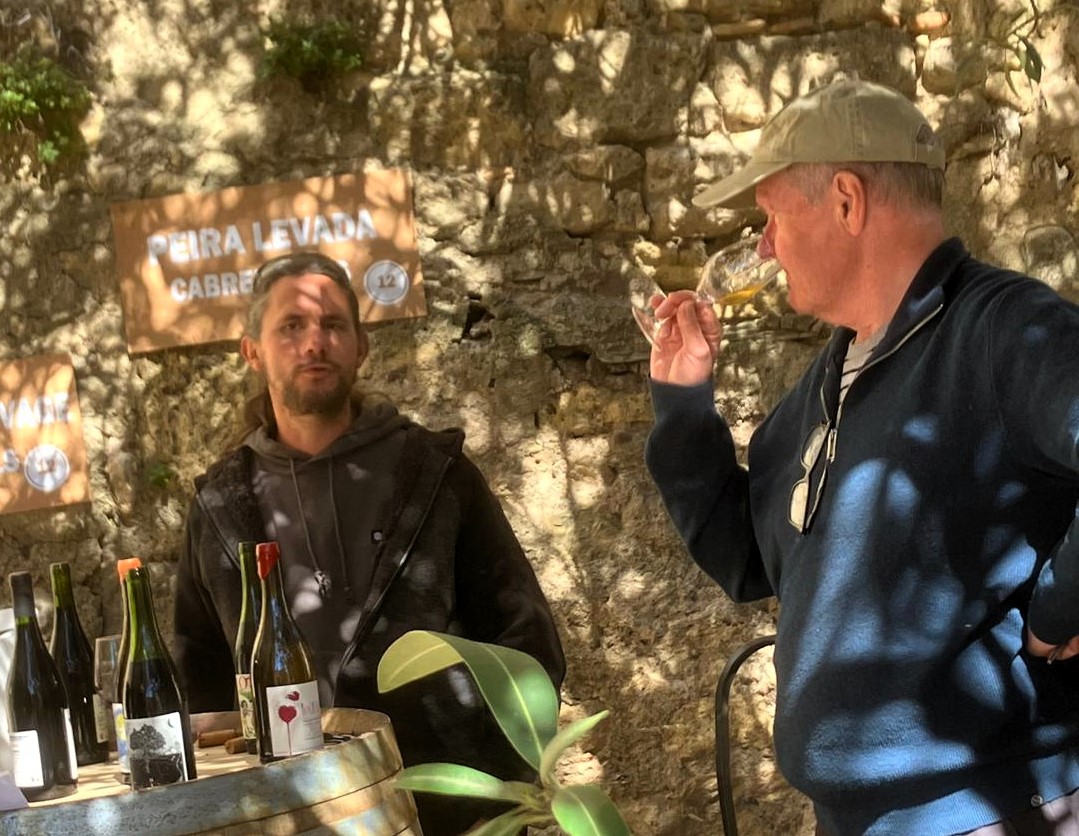
I have also been fortunate to know Sybil Baldassare and Alex Durand for a long time now. They are a Faugères based couple and each has their own domaine. Sybil’s La Graine Sauvage has garnered much justified praise and is the only all white wine domaine in the appellation. A trained oenologist, Sybil eschews any additions to the grape juice and her wines are pure and clean. On this occasion it was a new wine, À Léon, which I found exciting. Named in honour of their new son it is a blend of Vermentino, Roussanne and Marsanne grapes given a few days maceration to produce a skin contact wine with texture but plenty of clean, white fruit. Lovely and my joint highest rated wine of the day. Alex’s Peira Levada domaine concentrates on red wines, for now, and bring plenty of Faugères character with red fruits and structure from the schist and marble soils. The labels are always fascinating but the wines speak for themselves. Favourite on the day was Velvet Underschiste (brilliant name and label) made with Grenache and Syrah grapes fermented with additional dry skins. There’s power, big fruit and a lovely freshness. I Found A Reason to buy some.*
It was good to catch up with Olivier Andrieu of Clos Fantine, one of my favourite winemaking families whose Faugères vineyards are stunningly beautiful and unploughed for the last ten years. I was very taken by a new cuvée, Fantasque, made with hand pressed Grenache and Syrah to which a little Muscat is added afterwards adding grapey notes and lifting the wine’s aromatics and flavours. However, the standout wine was certainly Tradition 2016. We’d had Tradition 20 which is always so classically Faugères and Languedoc but the extra ageing of the 2016 showed how pure, natural wine can benefit from time in bottle. Deep, red and black fruits from Syrah, Carignan and Grenache but with complexity, length and still feeling youthful. Joint top rated wine of the day.
Another old friend was present, Simon Bertshinger of Mas Sibert, whom I had not seen for way too long. Simon and his wife, Sara, were the subject of one of my first producer profiles back in 2015 and I have bought their wines since then. Another Faugères producer, based in Fos, Simon and Sara have unusual grape varieties for the area such as Petit Verdot and Merlot as well as more typical Syrah etc. Two wines from 2019 were my favourites, Armélot (Merlot and Petit Verdot) full of restrained fruit and complexity and Soléno with more red fruit notes from Syrah as well as Merlot and Petit Verdot too. The wines need time to mature to reach their peak but are worth the wait. I was saddened to hear from Simon that they are likely to be giving up their domaine, worried about the effects of climate change and how it affects the wines they want to make. Whatever the future brings, I wish them well and buy their wines while you can!
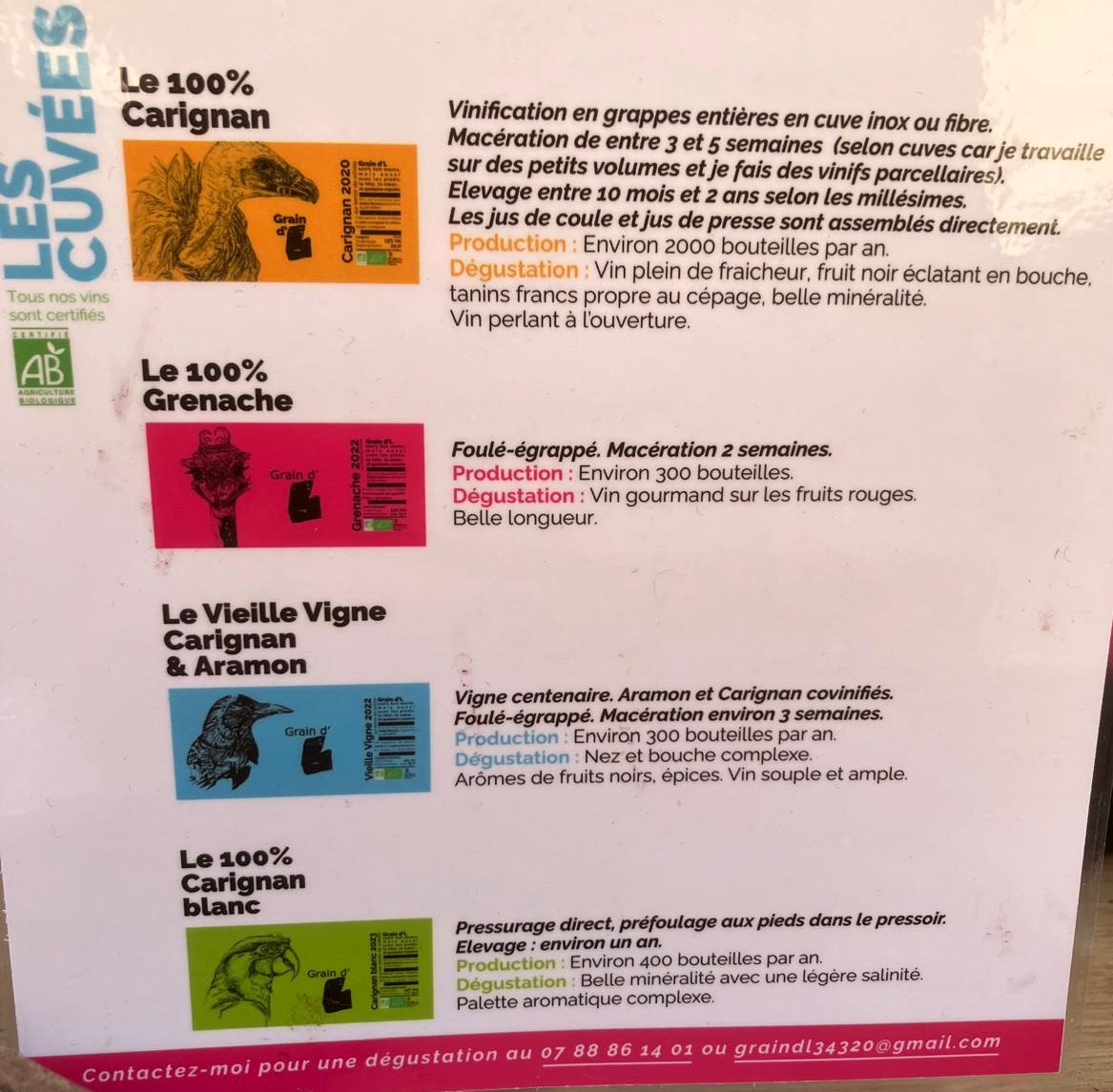
The final two wines I want to highlight both came from producers who I had not met until Jeff’s gathering two days previously. One of the best things about the natural wine world is how producers help out and encourage each other. Jeff’s former career as a teacher, nurturing young talent is well known with a number of winemakers citing his support and influence. One of those is certainly Gaëlle Steunou based in the village of Vailhan, between Pézenas and Bédarieux. Her domaine is Grain D’L based on old vine Carignan, Noir and Blanc, Grenache and Aramon. I liked all her wines but the one I bought was the Carignan Noir 2020, the final one of the trio garnering my highest ranking of the day. Given 3 to 5 weeks on skins, the individual small tanks are given 10 to 24 months to mature before being assembled. Full, bright dark fruits and very long on the palate it is an excellent Carignan, such a cornerstone grape of the area. This is Gaëlle’s biggest production but there are only 2000 bottles. She and her wife are gradually forging a domaine to follow, its punny name reflecting female skills and the wines reflecting a skilful winemaker.
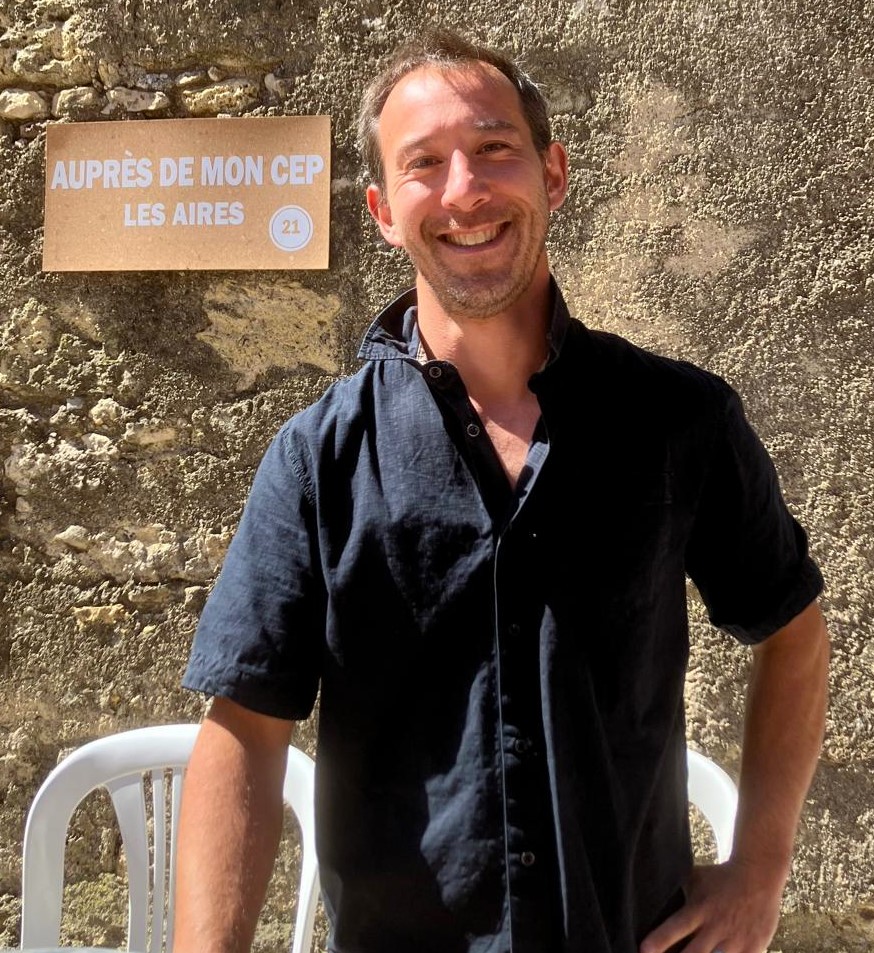
Ian Lu became a winemaker after moving to the Lamalou area, west of Bédarieux with his wife. His passion is plants and, influenced by neighbours Wim Wagemans (Le Bouc A 3 Pattes) and Axel Prufer (Les Temps des Cerises) , he decided to try winemaking. I had enjoyed Ian’s wine at Jeff’s and was pleased to try more here. Glou Glou 22 was a very good example of fruity Grenache, pleasurable and serious. Marguerite et Coccinelle 22 was my favourite though with red fruit notes, light with 12%alc and real freshness. Delicious, another purchase and a lovely label too. I certainly will be following Ian’s career at Auprès De Mon Cep and urge you to do so too.
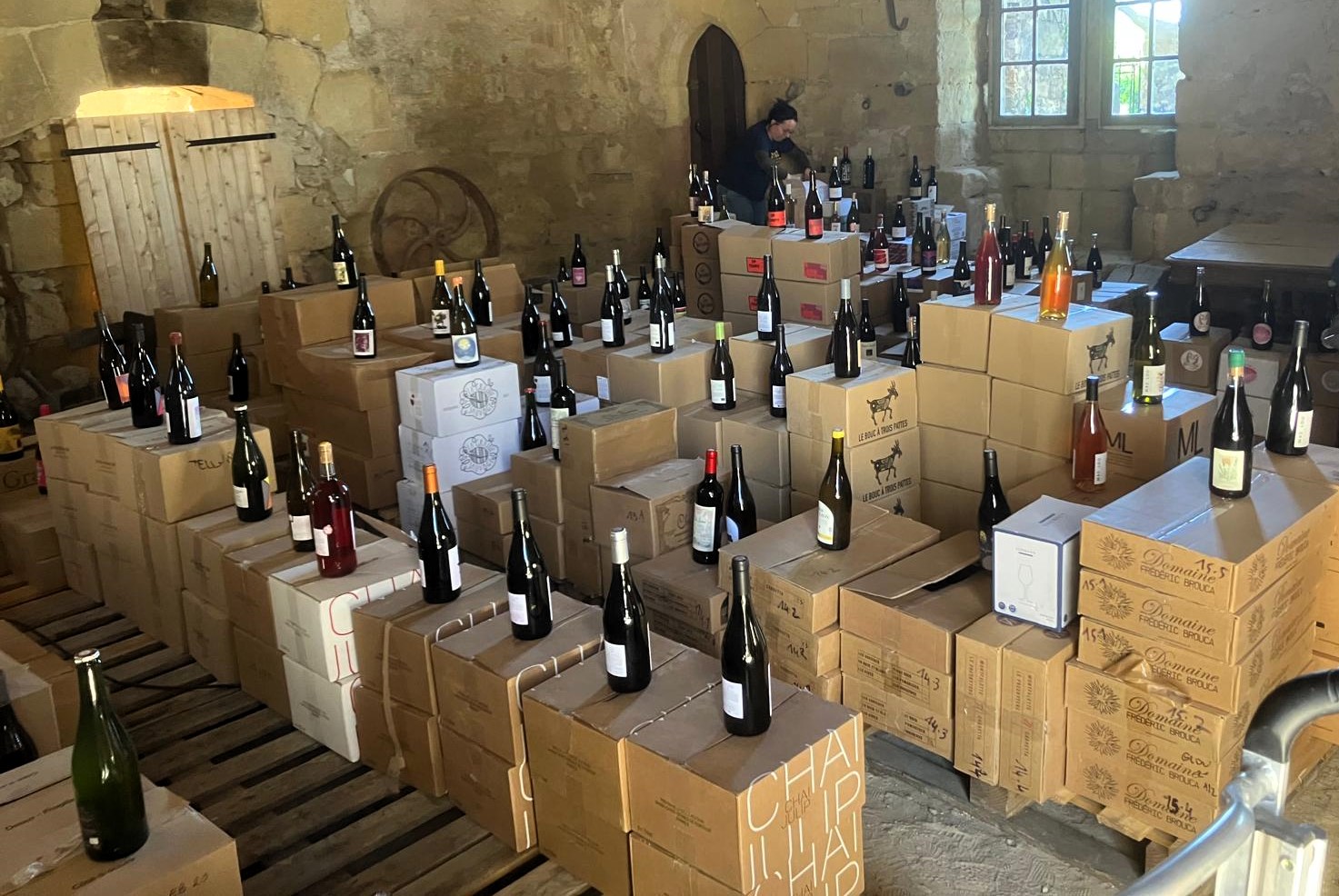
Congratulations to Fred and everyone associated with organising Bons Vivants, one of the better tastings I have attended and highlighting the talents of local winemakers from the area around Puissalicon and the Hérault. It was good to see many attendees who would not usually be natural wine consumers, I am sure many will have been convinced with so many top wines on show. Sales were brisk at Fred’s pop up shop (see below). There were plenty of other producers I’d have liked to visit but time is sadly limited. To next year and more good living.
*(sorry about that Velvet Underground song reference)
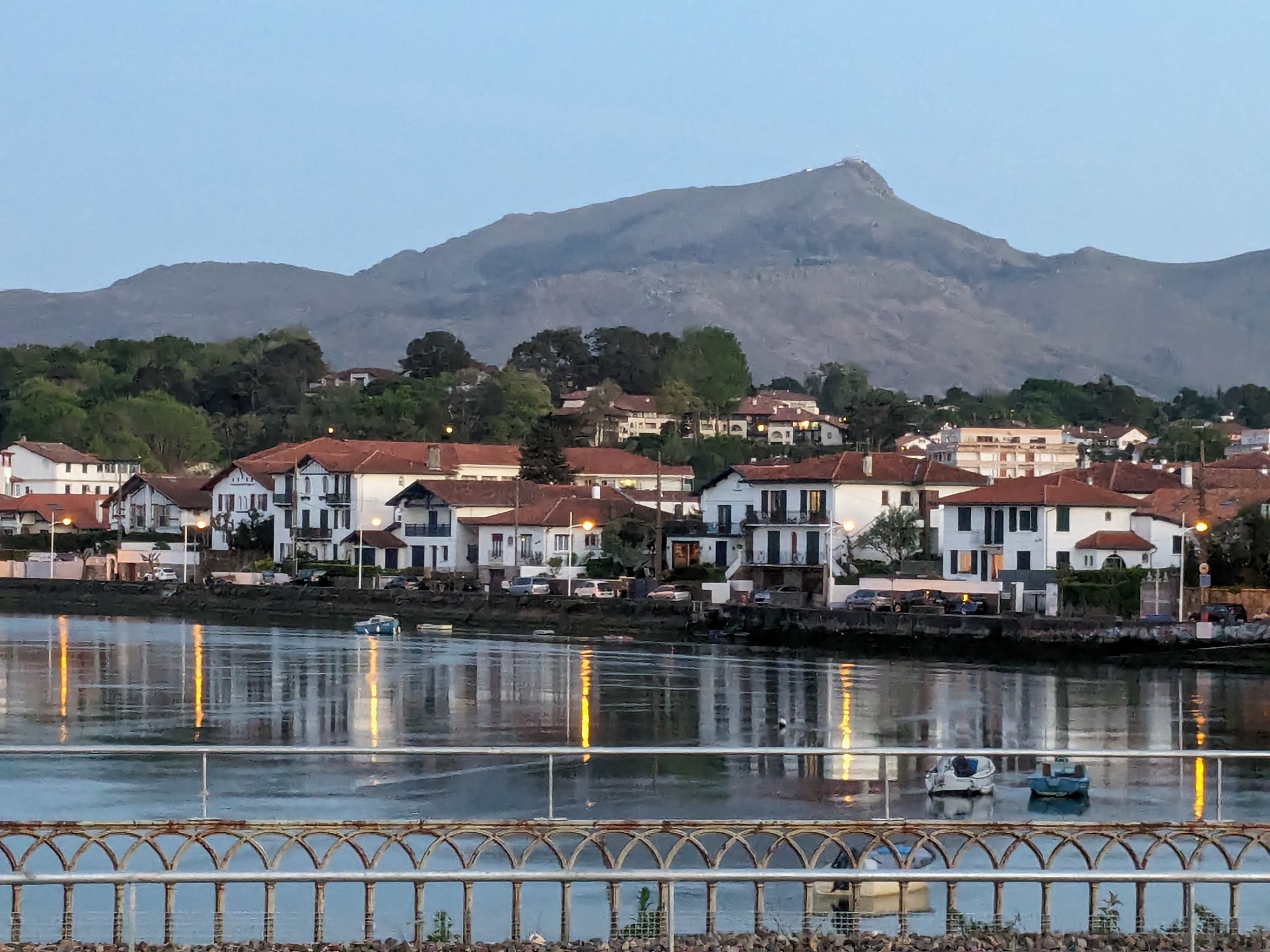
From Bordeaux down through Les Landes to St. Jean De Luz right next to the Spanish border. It is such a beautiful town that when we visited briefly a few years ago whilst staying in Biarritz we vowed to return. Having spent 4 days there I’d still happily return soon. From there we moved on the Béarn in the foothills of the Pyrenees to stay with a great friend, Vincent, who worked with Jeff as a teacher and is a frequent visitor and worker in Puimisson. I’d happily say that Jurançon’s dry wines are amongst my favourite white wines of all, alongside German Riesling and Burgundy, the fresh citrus streak of acidity supported by rich white fruits and a remote hint of honeyed sweetness.
photo from CellarTracker.com
This was more of a holiday than wine trip but whilst in the area it’s always good to try new wines from the region. I was helped a lot in St. Jean De Luz by the very good wine shop, Cave Notre Selection who pointed me towards good producers of the local Txakoli from just across the border such as Zudugarai, Izagirre and Gorrondona. traditionally Txakoli was made with unripe grapes and its spritzy acidity is refreshing in the heat of the Basque coastal area. However, modern producers such as these are attempting to add complexity with different grapes to the traditional Hondarrabi (Petit Courbu) and by making wines on lees, in barrels etc. I tried several examples and whilst I liked the modern styles I do have a fondness for the traditional uncompromising, low alcohol, spritzy versions too. There is a lot of information about Txakoli here.
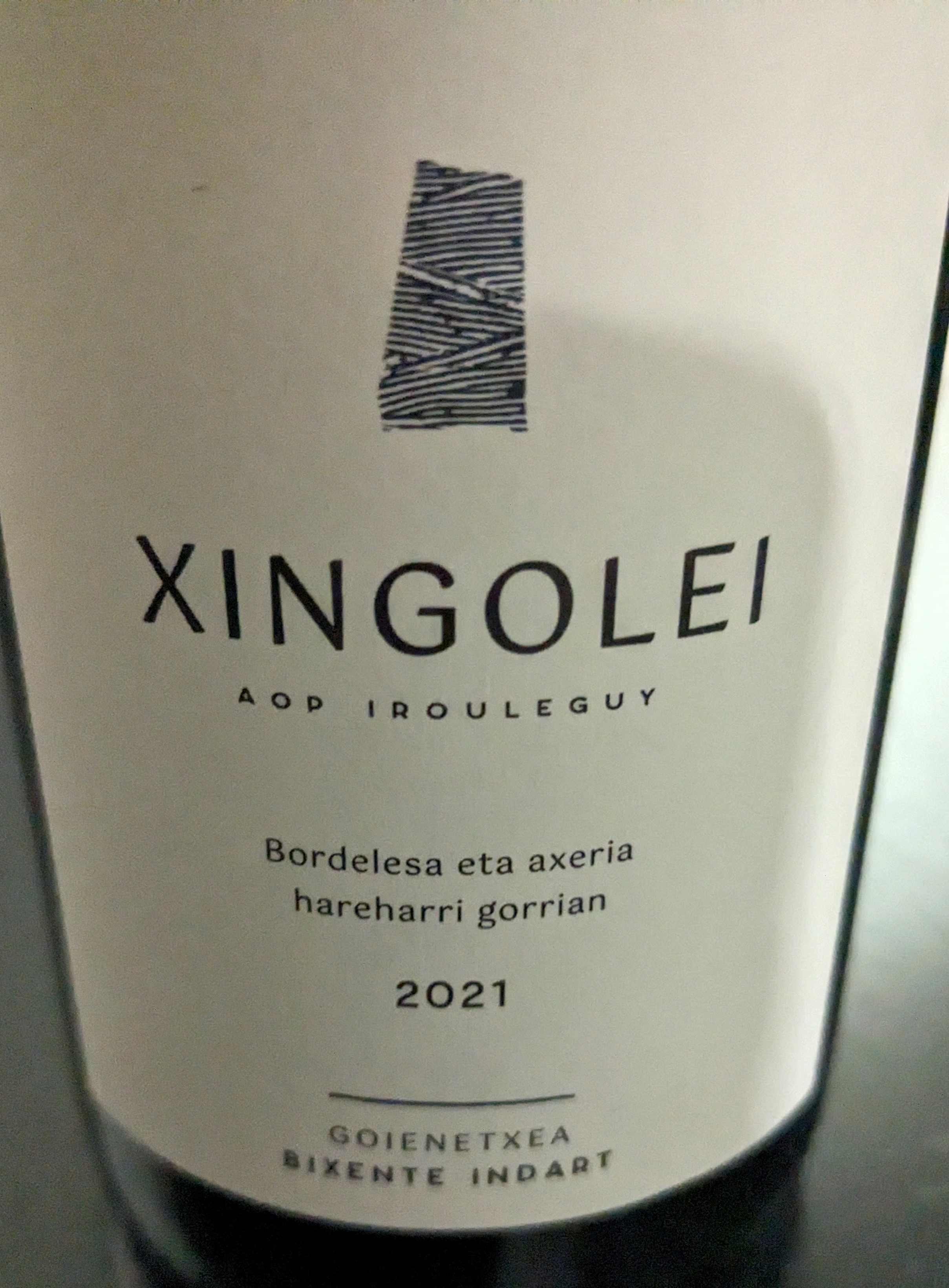
Irouléguy is a wine region of the South West which has started to make some waves in recent times. It is inland from St. Jean in the foothills of the Pyrenees, north of Pamplona. The most famous producer is certainly Ilarria whose wines I have tasted before and very much enjoyed, particularly the white with its Petit Manseng and Petit Courbu similar to nearby Jurançon. However, the Ilarria wines carry a premium, a good 10 euros more than most other wines of the region. Notre Sélection pointed me to a new producer working organically with minimal sulfites, Goienetxea. The domaine was selling its grapes to other producers but made its own first wines in 2021 and it was one of those which I bought, Xingolei. Made from the difficult Tannat, famous in nearby Madiran and, more so, Uruguay these days, and, yes, here we go again, Cabernet Franc. Tannat is notoriously tannic and tough and the helpful young woman in the shop advised me to carafe the wine or put it away for a few years. And then still carafe! I did try a little from an open bottle and it was big, bold and powerful but there was plummy fruit showing through but it would definitely need help to show fully at this stage. One to watch.
It was a little disappointing that many of the bars and cafés offered me wines from all over France rather than their local region, especially given the evident pride in the Basque language and culture. Areas such as Madiran and Pacherenc du Vic Bilh were unseen, a real shame. Another trip is needed. One very good wine bar on the Ciboure side of the river was Maitenia, good Txakoli from Izagirre and well priced wines of interest from elsewhere, more of which in a future post.
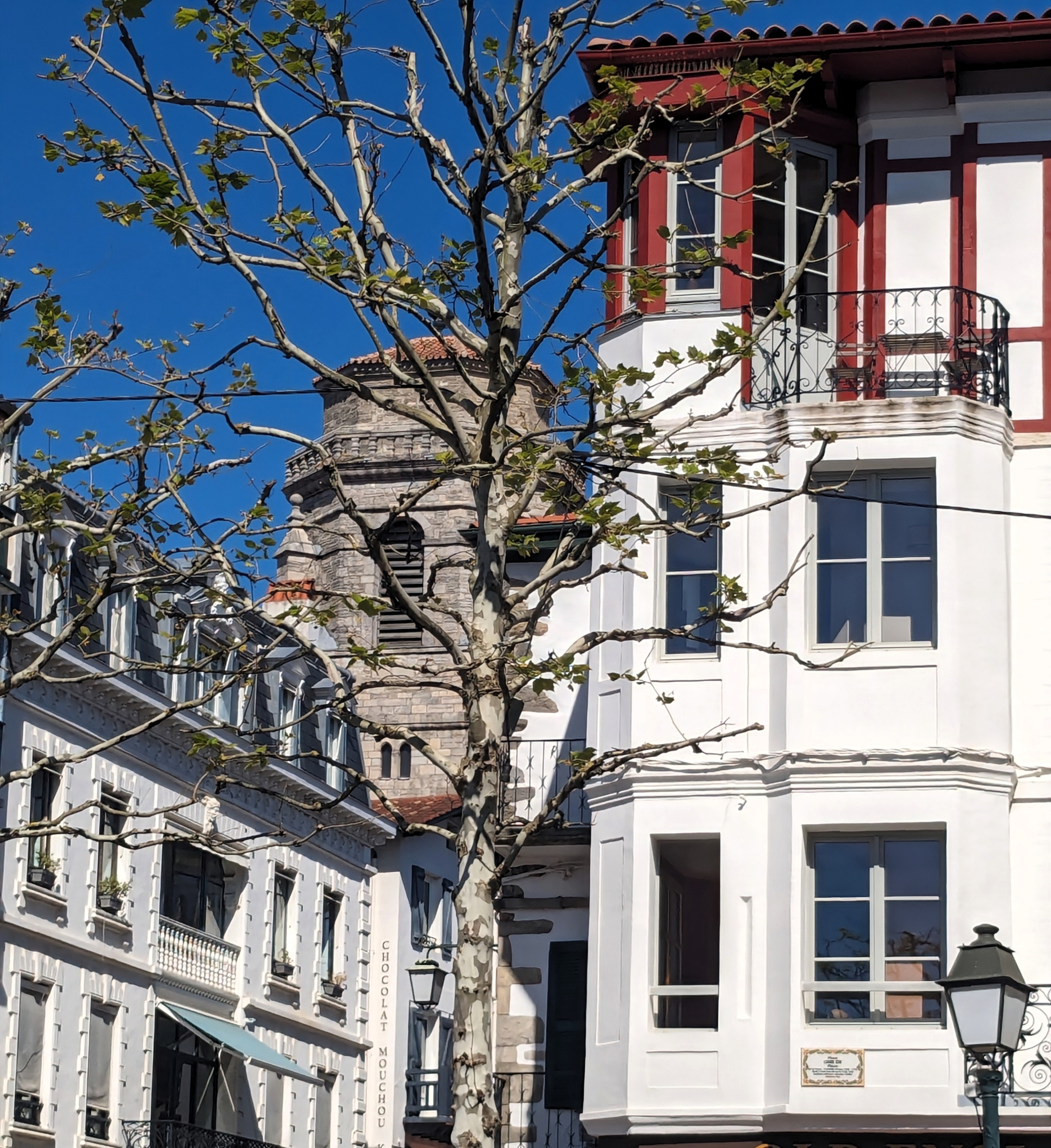
I wrote about Jurançon in a previous post. As I said I love the white wines from this area and producers like Montesquiou, Larredya, Cauhapé and Lafitte are frequent purchases. I also enjoyed the wines from de Souch at the recent Dynamic Wines tasting. The Béarn is a beautiful region with its views of the snow capped Pyrenees, green hills, small villages and, fascinatingly, huge churches such as that in Monein, one of the wine centres. Many of the vines are trained on large wooden frames which piqued my interest. Presumably this helps to raise the grapes towards the sun in quite steep valleys.
Natural wines are making an impact in the region, for example. Montesquiou has switched to less and less use of sulfites and often eschews them altogether. Vincent recommended the wines of Domaine Lajibe, I shall look out for them. Vincent is also enthusiastic about a new producer, Vincent Glaizes of Les âmes heureuses à Monein, his first bottles will be coming out soon.
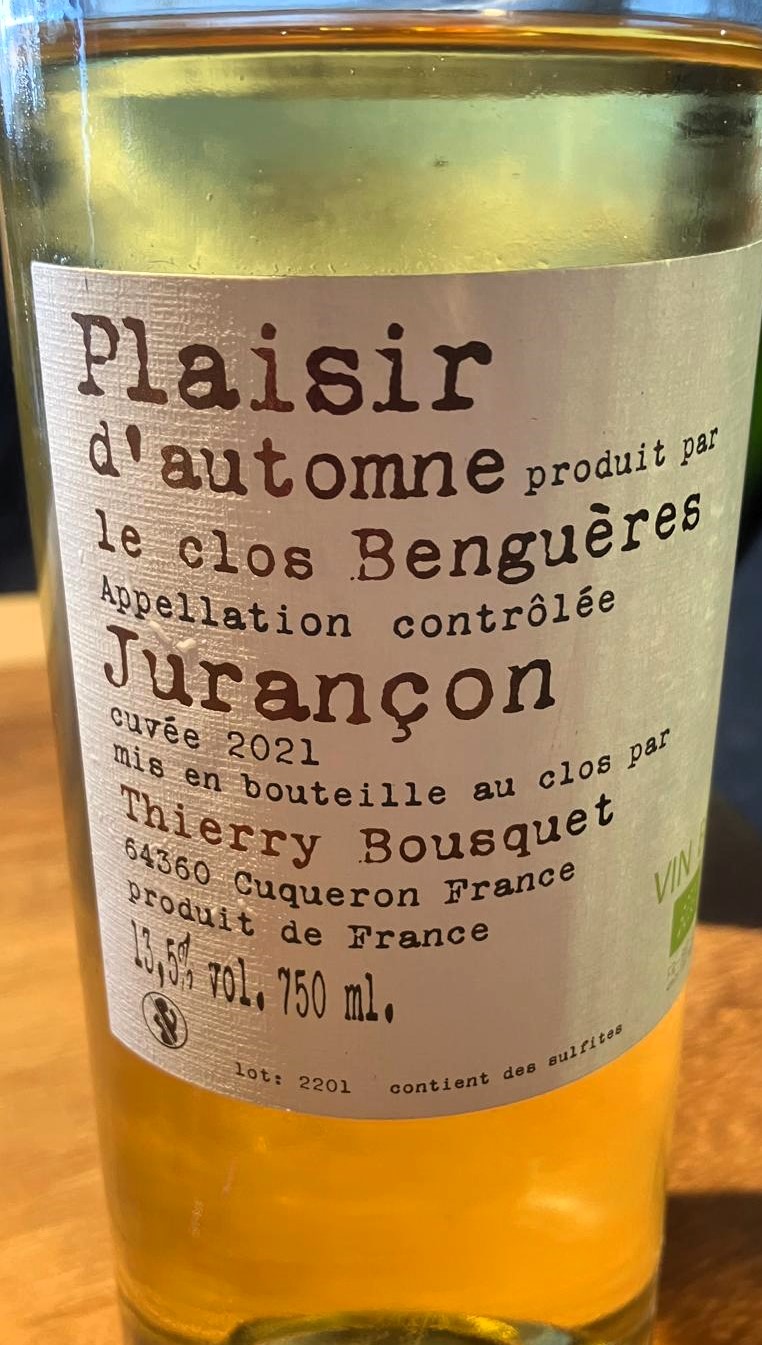
Two wines I can recommend were enjoyed in the excellent Ekaitza restaurant. Firstly a straightforward, enjoyable sweet / moelleux Jurançon called Plaisir d’Automne 21 from Le Clos Benguères but particularly the 2009 Cuvée Marie from Charles Hours. This domaine has rather slipped from its peak but this older bottle, in magnum, was beautiful and at its peak with mouthfilling yellow fruit flavours, fresh acidity underneath and great length. Magnums are becoming increasingly in demand in top restaurants and this showcased the reason why, ageing more gently than traditional 75cl. bottles.
I love the wines of this region for their diversity, unusual grapes and curiosity. I would love to return and do a wine exploration in depth, à la prochaine!
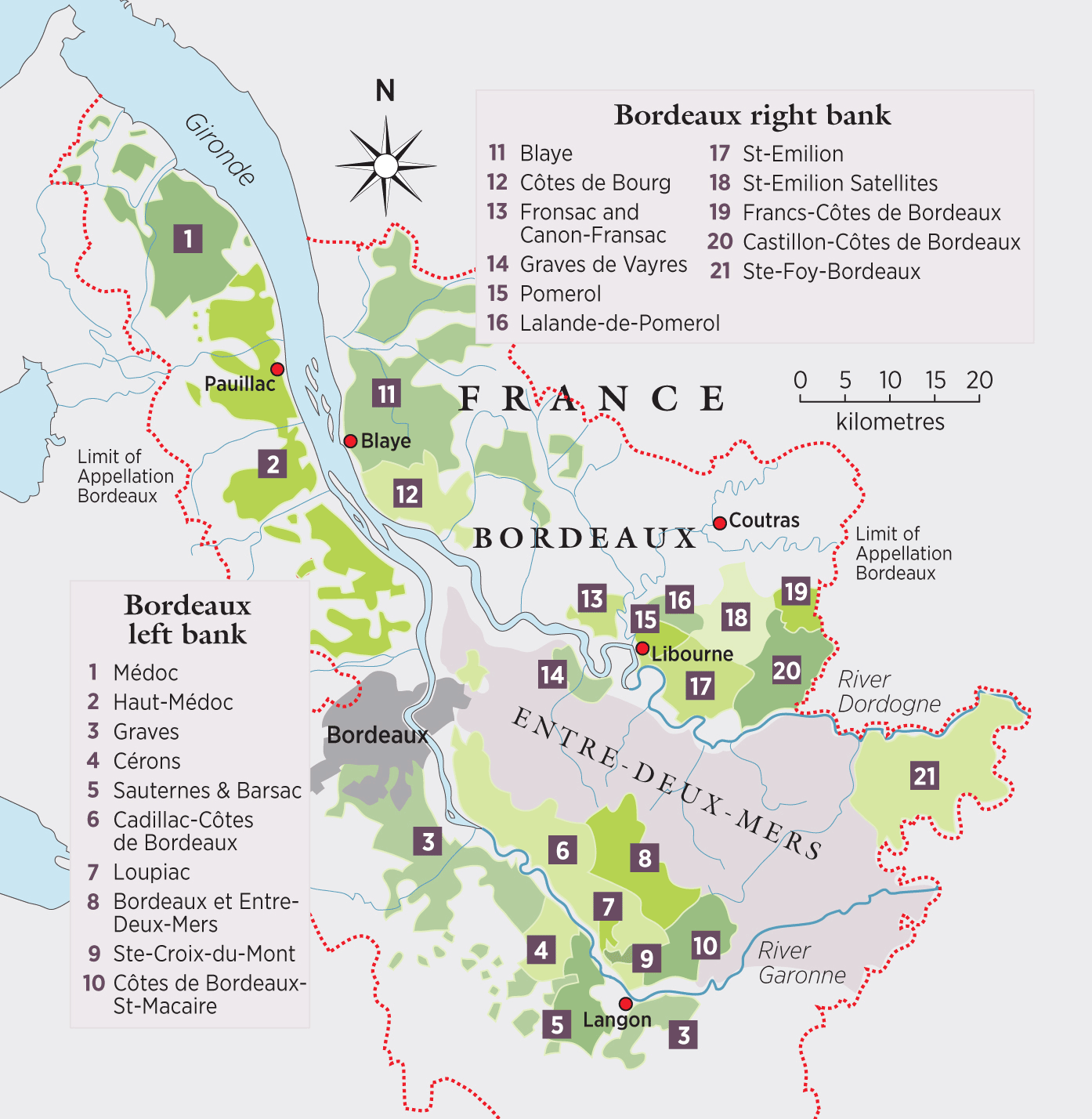
It had been thirty years since I last visited what is probably the most famous wine centre in the world. During that time Bordeaux has been rather eclipsed by Burgundy in terms of most sought after wines but it remains the home of celebrated chateaux whose bottles carry huge price tags. It is also fair to say that in the last 15 years or so Bordeaux has fallen out of fashion with those of us who enjoy natural wines and alternative grape varieties to Cabernet and Merlot in particular. Nonetheless I still enjoy Bordeaux wines and a few days in the city and Médoc provided an opportunity to explore a much changed city and wine heartland with its dramatic and legendary chateaux.
In recent times I have enjoyed Bordeaux wines from the likes of Chateau Le Puy and Ormiale at the Dynamic Wines event and Le Puy’s Emilien 2020 was my wine of the year for 2023. So, it is fair to say that the region’s wines have been steadily working themselves back in to my affections. I had no appointments with winegrowers, the trip to Bordeaux was more about enjoying the city itself. However, in the course of the five days I did enjoy some local wines in restaurants and wine bars.
from Decanter magazine
One wine which was certainly an unexpected pleasure was of all things a rosé Crémant de Bordeaux called Célène Cuvée Royale, a blend of Cabernet Franc (the grape which is following me everywhere this year) and Merlot though some sites say there is some Muscadelle too. Made in the Entre-Deux-Mers this was a very refreshing glass with plenty of red fruit aromas and flavours, ideal after a long walk on a warm day. Crémant de Bordeaux does seem to be having its moment, with some good bottles around. This was enjoyed at the École du Vin right opposite the Tourist Information and Grand Théâtre in the centre of Bordeaux, a lovely building with stained glass windows and various wines and tasting plates on offer. I also enjoyed a glass of red from Cadillac, south east of the city, called Originel from Chateau Ste. Cathérine. I was told the wine was made naturally though I can’t find any evidence online of this but it was very pleasing with ripe Merlot and Cabernet Franc (!) fruit, fresh and lengthy in the mouth. What these wines showed was that there is a lot of unsung, good quality wine at reasonable prices from the area.
I chatted with a couple of wine professionals during my stay and the topic of organics came up. Both said that there are many producers now working to organic and biodynamic principles but not being certified. The main reason for this, they suggested, was the wet weather in this region so close to the Atlantic Ocean. In a wet Spring many wanted the option to be able to spray whatever they deemed necessary to combat mildew and other problems. I understand that, obviously not ideal from my point of view, but they have to safeguard their income. I was also told that there are some chateaux owned by older generations who have transferred the running of their property to younger vignerons who tend to have more sympathy for organic practices. Indeed I even found some natural wines!
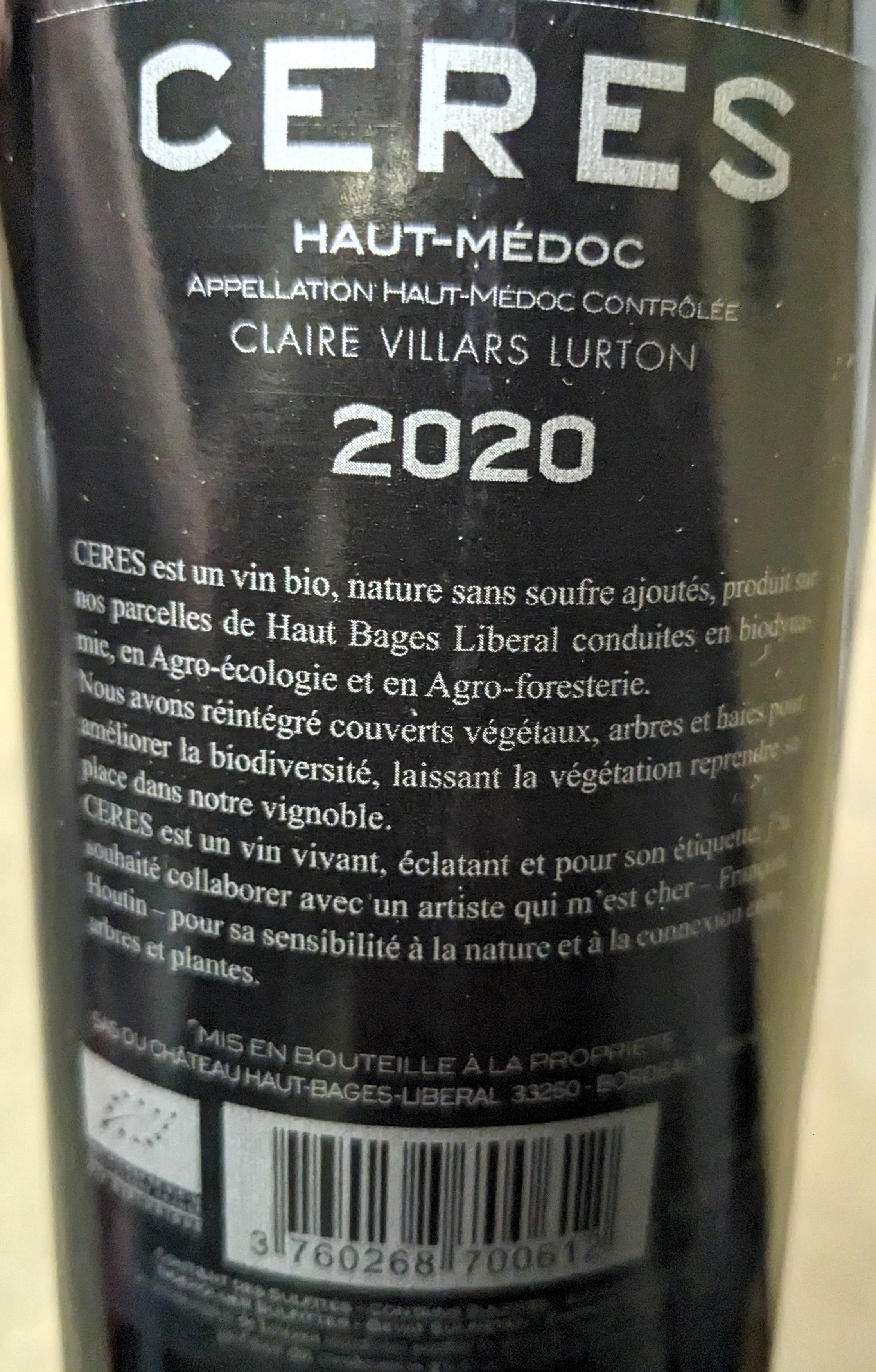
One example is this bottle which I found in a wine shop in Margaux (a village without much else in it). Made at Ch. Haut-Bages Libéral, a Fifth Growth classed Grand Cru, Ceres is organic and made without sulfites by the Lurtons who also own biodynamic estates such as Ch. Ferrière. I have yet to open the bottle and will report back but it was good to see major producers embracing modern, responsible ways of winemaking.
Vines with their feet in water next to Ch. La Lagune
La Cité Du Vin opened in 2016 and provided plenty of information and fun for a full half day. It is very modern in its use of interactive displays, film and digital activities. There were video interviews with winemakers around the world set on displays about their terroir, rooms showing items on the history of wine, the winemaker’s year and how wine is made. A sensory section showed how wine aromas can be identified and matched, how senses affect mood and wine tasting.
La Cité du Vin, shaped like a decanter
It was all designed for a more general audience but there were plenty of nuggets of information to keep me happy too. I would also commend their wine shop, which had wines from all corners of the world, you don’t see many Japanese, Mexican or Indian wines in most shops but they were available here and the prices of wines I recognised were all fair. The brasserie provided a good lunch, the restaurant is supposed to be very good. Well worth a visit.
Terroir and interviews
Grape varieties
Virtual grape treading
A trip to Bordeaux would also not be complete without a visit to the vineyards. I have visited St. Émilion a number of times and it is a lovely village but this time I wanted to tour the Médoc, the left bank. I had done so once many years ago but it’s always fun to see the famous chateaux with names which are so familiar from when I was first learning about wine. I drove around but the tourist information office can easily organise tours in groups of various sizes and there were plenty of private companies in evidence too. I would advise to reserve a tour if that is the way you are going, the tourist information visits were well booked up and this was in April. I would also reserve any visits to a chateau that you may wish to enjoy. I found it frustrating that many places advertised as open (even on the door) were not at all. There have been improvements in oenotourism in the Médoc but there is some way to go still.
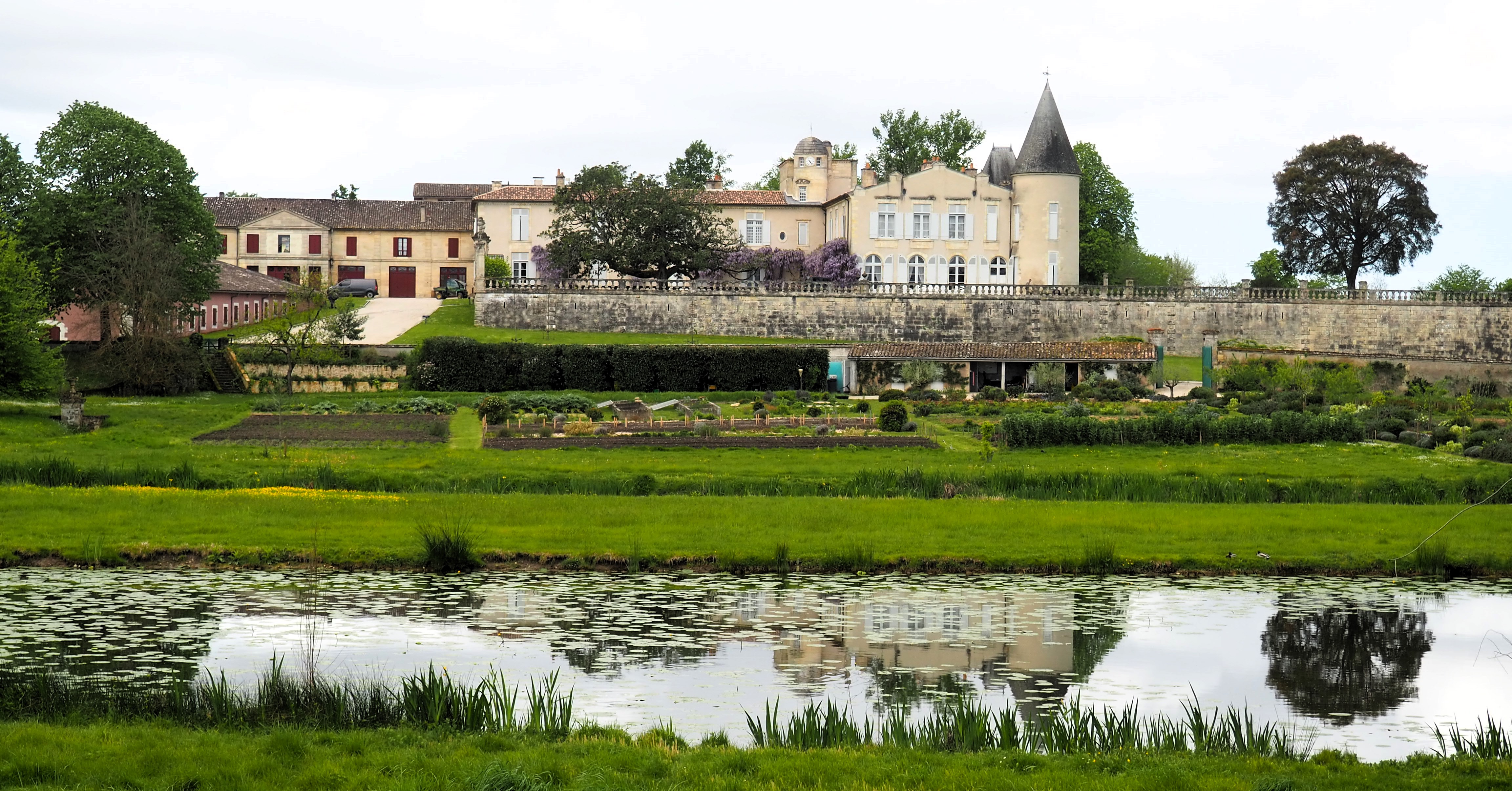
Chateau Lafitte
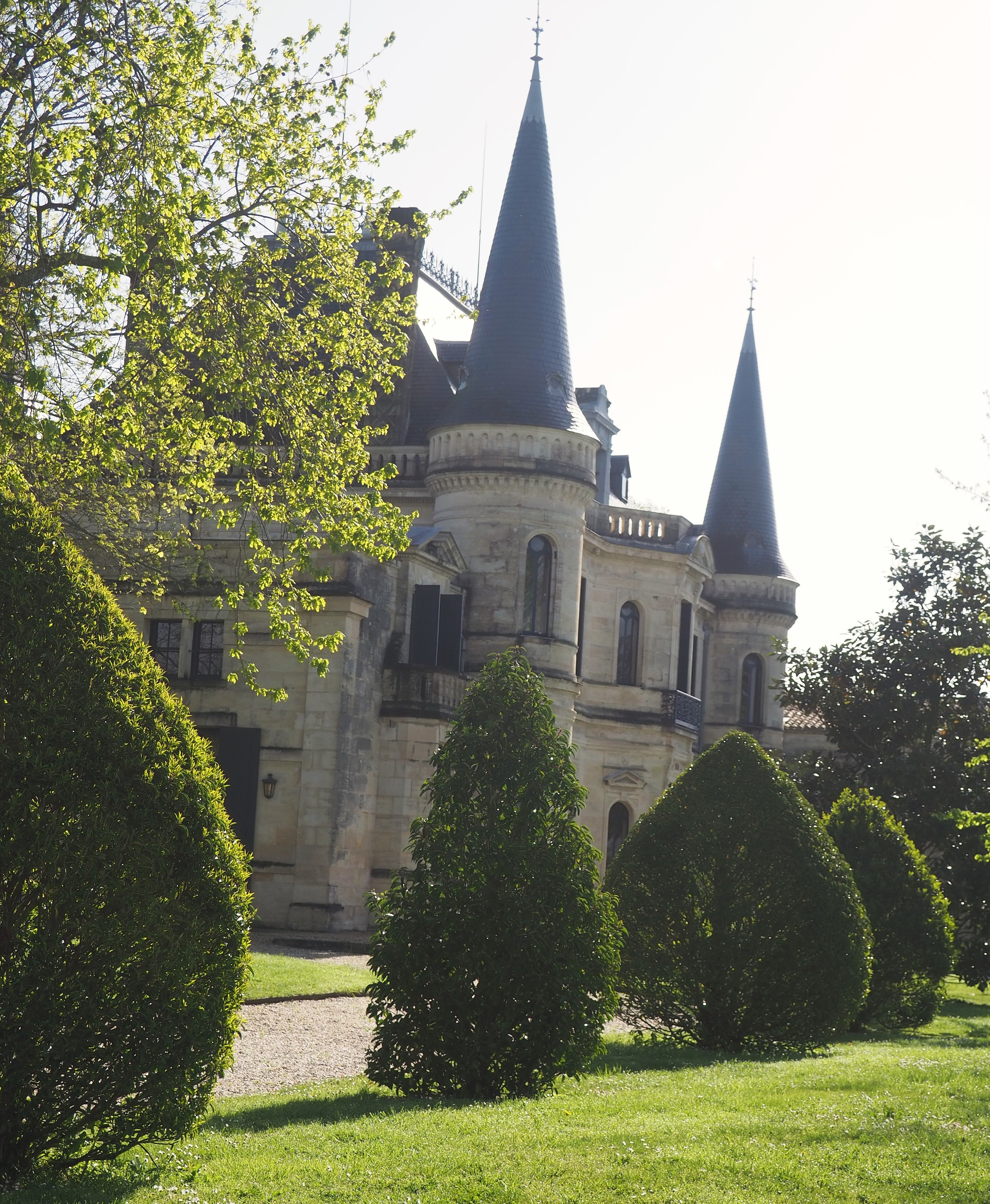
Ch. Ritz Zuger, huge investments recently
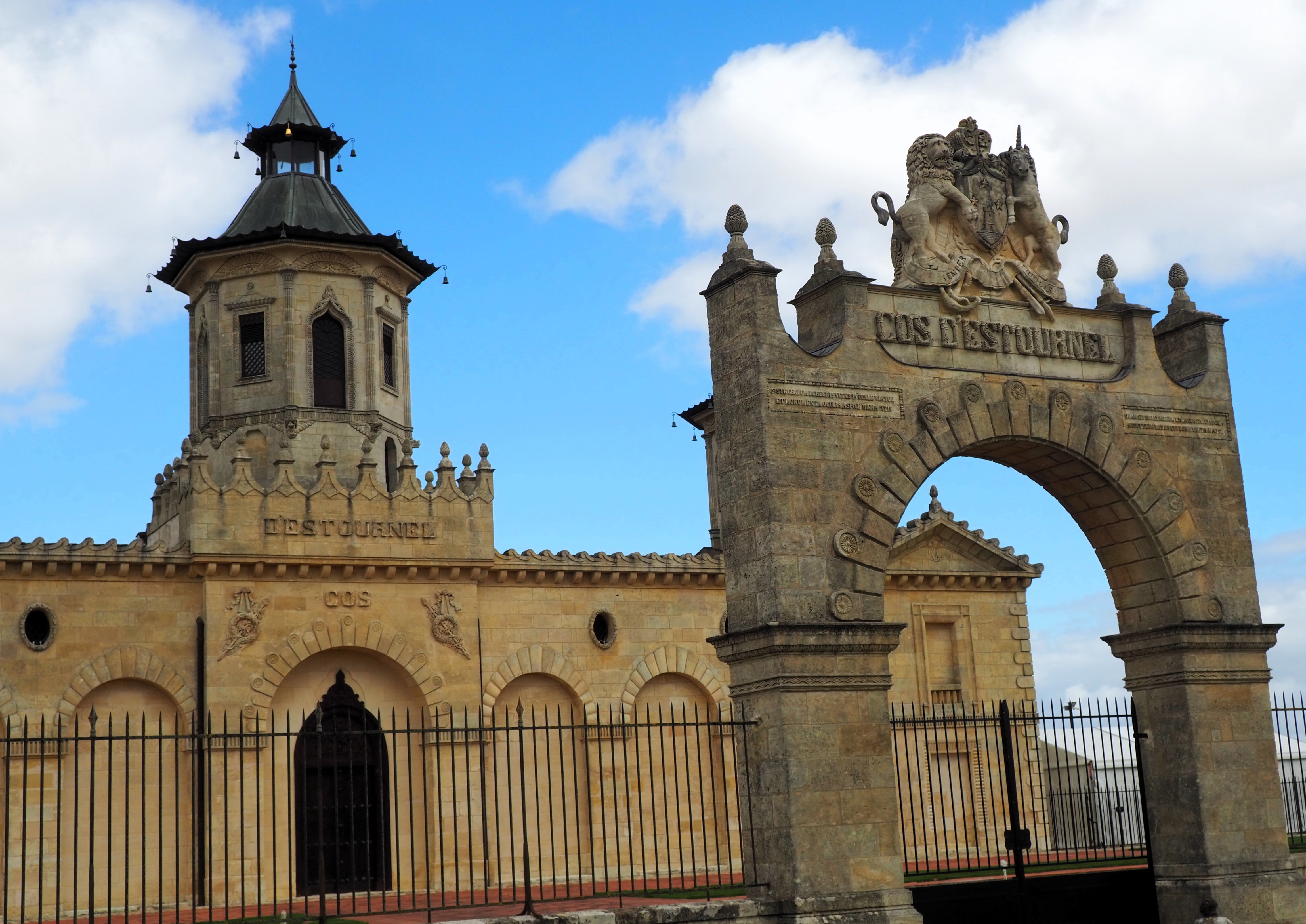
Cos D’Estournel
Ch. Rauzan Gassies
It was noticeable that the main châteaux had large teams of workers out in the vineyards, in common with my visit to Burgundy last year. The high prices means bigger teams can be afforded which they hope will bring better wines. As with the Loire the common practice was double Guyot vine pruning and to leave a grass covering. With such wet soils it was difficult to really examine the famous soils and the gravelly soil from the proximity to river and sea.
Double Guyot
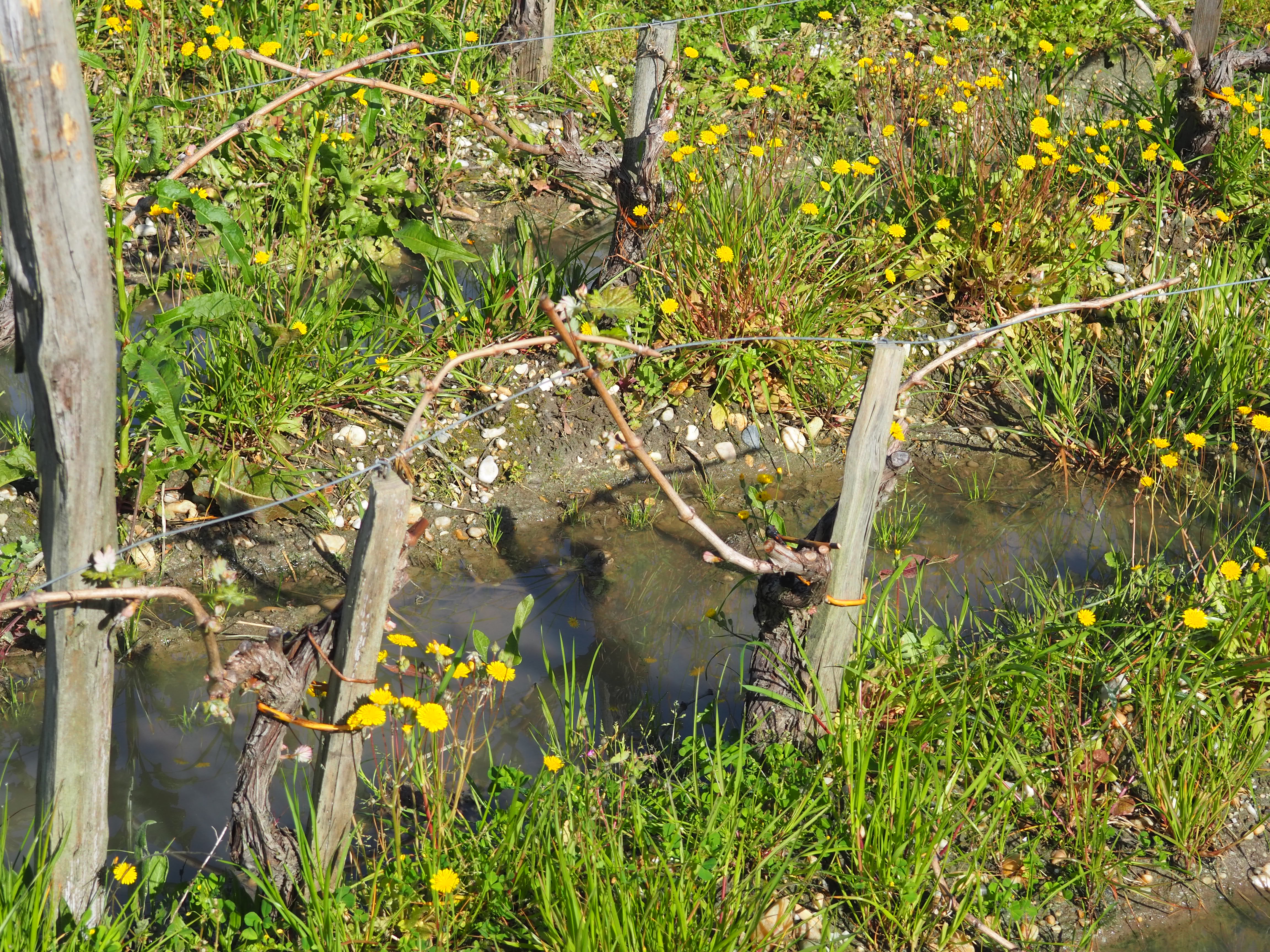
Not all vineyards were grass covered, tractor imprints show the damp conditions (right)
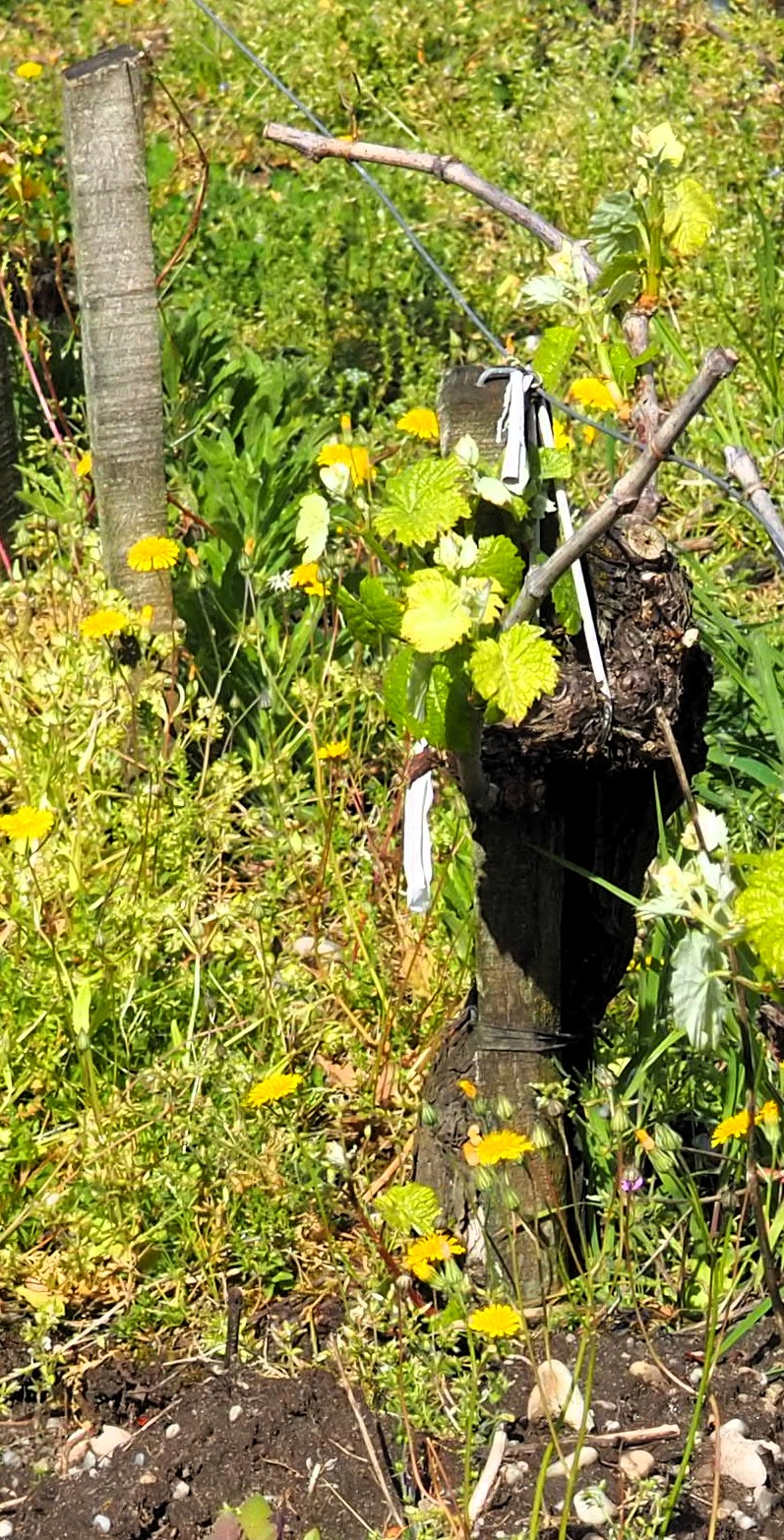
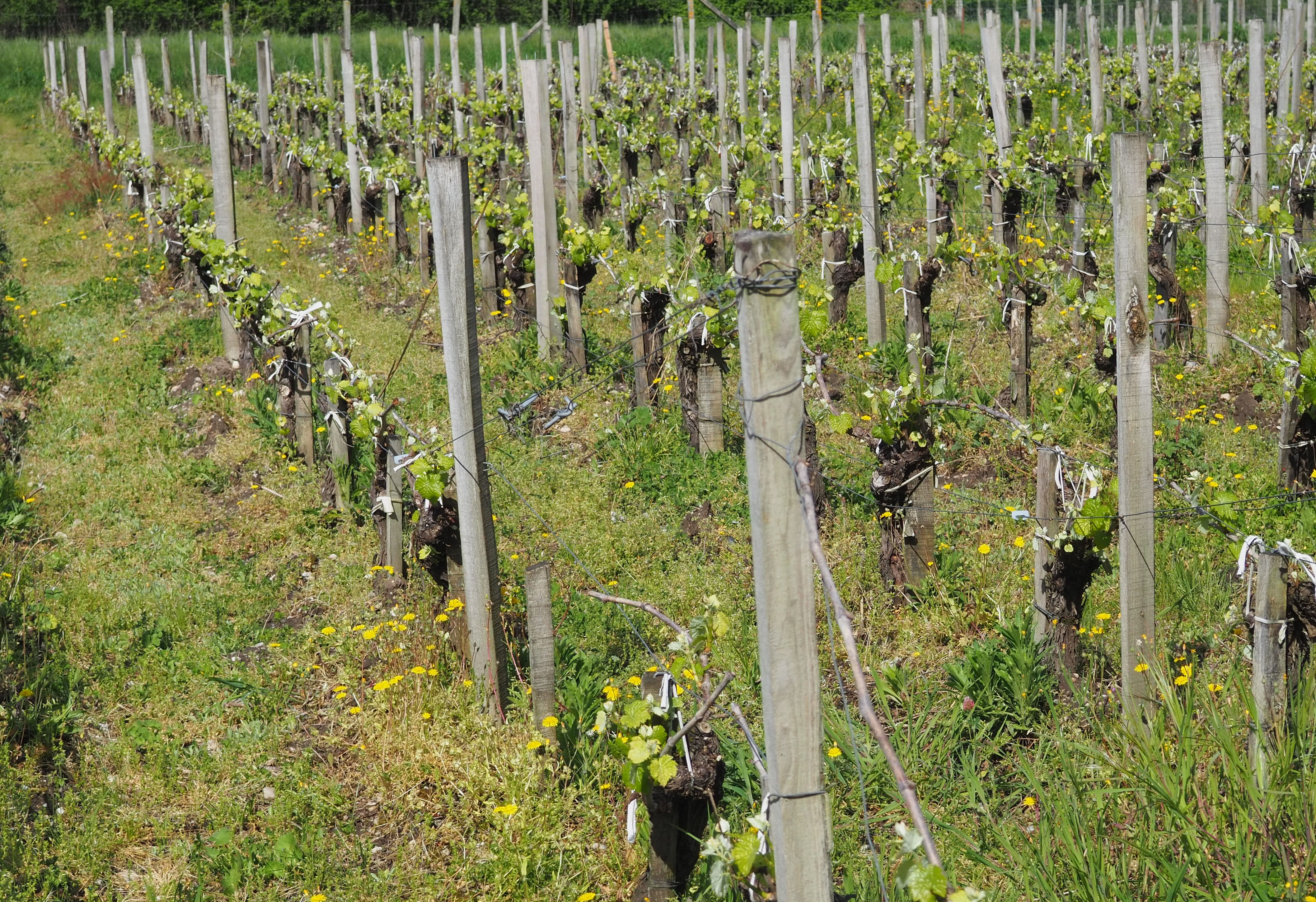
Why do I go on about grass covering etc? Well, have a look at the next photo taken back in the Languedoc where I type this. This is a typical scene of vineyards with most cover taken away by herbicides etc. Here the philosophy is to maximise the yield not the quality, the co-op pays by tonnage. That’s why people like Jeff Coutelou are fighting to maintain flora and fauna in a sea of barren soils. And why it is good to see on the Médoc, where not all are rich, that they put their vineyard soils first. This photo was taken on a windy day with a lot of the topsoil just blowing about, the grass prevents such erosion as well as maintaining better drainage.
The other local wine of note that I tasted (I did try some others but nothing too remarkable) was a white wine and that fits a pattern of Bordeaux Blancs that I have enjoyed in recent times. Chateau Peybonhomme-les-Tours 21 is equal parts Sauvignon Blanc and Sémillon and there is a lovely freshness from the Sauvignon alongside a richness from the Sémillon, it really is a marriage from heaven. Excellent bottle.
I scratched the surface of the region with my visit in wine terms and I don’t even pretend that this article casts much light on the wines themselves. However, it was interesting to see how white, rosé and Crémant wines are reaching new heights and that, though rooted in history, winemaking is starting to change, led by successful châteaux like Pontet Canet. The city itself has been modernised beautifully, lovely for walking around, served by an excellent tram system and with so much to see. I would definitely recommend a visit whether you’re a Bordeaux wine fan or not.
















































 amarchinthevines